


Stairway

Encyclopedia


Vertical direction
In astronomy, geography, geometry and related sciences and contexts, a direction passing by a given point is said to be vertical if it is locally aligned with the gradient of the gravity field, i.e., with the direction of the gravitational force at that point...
distance by dividing it into smaller vertical distances, called steps. Stairways may be straight, round, or may consist of two or more straight pieces connected at angles.
Special stairways include escalator
Escalator
An escalator is a moving staircase – a conveyor transport device for carrying people between floors of a building. The device consists of a motor-driven chain of individual, linked steps that move up or down on tracks, allowing the step treads to remain horizontal.Escalators are used around the...
s and ladder
Ladder
A ladder is a vertical or inclined set of rungs or steps. There are two types: rigid ladders that can be leaned against a vertical surface such as a wall, and rope ladders that are hung from the top. The vertical members of a rigid ladder are called stringers or stiles . Rigid ladders are usually...
s. Some alternatives to stairways are elevator
Elevator
An elevator is a type of vertical transport equipment that efficiently moves people or goods between floors of a building, vessel or other structures...
s, stairlift
Stairlift
A stairlift is a mechanical device for lifting people and wheelchairs up and down stairs. For sufficiently wide stairs, a rail is mounted to the treads of the stairs. A chair or lifting platform is attached to the rail...
s and inclined moving sidewalks as well as stationary inclined sidewalks.
Step
The step is composed of the tread and riser.Tread : The part of the stairway that is stepped on. It is constructed to the same specifications (thickness) as any other flooring. The tread "depth" is measured from the outer edge of the step to the vertical "riser" between steps. The "width" is measured from one side to the other.
Riser
Stair riser
A stair riser is the near-vertical element in a set of stairs, forming the space between a step and the next. It is often slightly inclined from the vertical so that its top is closer than its base to the person climbing the stairs...
: The vertical portion between each tread on the stair. This may be missing for an "open" stair effect.
Nosing : An edge part of the tread that protrudes over the riser beneath. If it is present, this means that, measured horizontally, the total "run" length of the stairs is not simply the sum of the tread lengths, as the treads actually overlap each other slightly.
Starting step or Bullnose : Where stairs are open on one or both sides, the first step above the lower floor may be wider than the other steps and rounded. The balusters typically form a semicircle around the circumference of the rounded portion and the handrail has a horizontal spiral called a "volute" that supports the top of the balusters. Besides the cosmetic appeal, starting steps allow the balusters to form a wider, more stable base for the end of the handrail. Handrails that simply end at a post at the foot of the stairs can be less sturdy, even with a thick post. A double bullnose can be used when both sides of the stairs are open.
Stringer, Stringer board or sometimes just String : The structural member that supports the treads and risers. There are typically two stringers, one on either side of the stairs; though the treads may be supported many other ways. The stringers are sometimes notched so that the risers and treads fit into them. Stringers on open-sided stairs are often open themselves so that the treads are visible from the side. Such stringers are called "cut" stringers. Stringers on a closed side of the stairs are closed, with the support for the treads routed into the stringer.
Winders : Winders are steps that are narrower on one side than the other. They are used to change the direction of the stairs without landings. A series of winders form a circular or spiral stairway. When three steps are used to turn a 90° corner, the middle step is called a kite winder as a kite-shaped
Kite (geometry)
In Euclidean geometry a kite is a quadrilateral whose four sides can be grouped into two pairs of equal-length sides that are next to each other. In contrast, a parallelogram also has two pairs of equal-length sides, but they are opposite each other rather than next to each other...
quadrilateral.
Trim : Trim (e.g. quarter-round or baseboard
Baseboard
In architecture, a baseboard is a board covering the lowest part of an interior wall...
trim) is normally applied where walls meet floors and often underneath treads to hide the reveal where the tread and riser meet. Shoe moulding may be used between where the lower floor and the first riser meet. Trimming a starting step is a special challenge as the last riser above the lower floor is rounded. Flexible, plastic trim is available for this purpose, however wooden mouldings are still used and are either cut from a single piece of rounded wood, or bent with laminations Scotia is concave moulding that is underneath the nosing between the riser and the tread above it.
The railing system
The balustrade is the system of railings and balusters that prevents people from falling over the edge.Banister, Railing or Handrail
Handrail
A handrail is a rail that is designed to be grasped by the hand so as to provide stability or support. Handrails are commonly used while ascending or descending stairways and escalators in order to prevent injurious falls. Other applications include bathroom handrails—which help to prevent falls on...
: The angled member for handholding, as distinguished from the vertical balusters which hold it up for stairs that are open on one side; there is often a railing on both sides, sometimes only on one side or not at all, on wide staircases there is sometimes also one in the middle, or even more. The term "banister" is sometimes used to mean just the handrail, or sometimes the handrail and the balusters or sometimes just the balusters.
-
- VoluteVoluteA volute is a spiral scroll-like ornament that forms the basis of the Ionic order, found in the capital of the Ionic column. It was later incorporated into Corinthian order and Composite column capitals...
: A handrail end element for the bullnose step that curves inward like a spiral. A volute is said to be right or left-handed depending on which side of the stairs the handrail is as one faces up the stairs. - Turnout : Instead of a complete spiral volute, a turnout is a quarter-turn rounded end to the handrail.
- Gooseneck : The vertical handrail that joins a sloped handrail to a higher handrail on the balcony or landing is a gooseneck.
- Rosette : Where the handrail ends in the wall and a half-newel is not used, it may be trimmed by a rosette.
- Easings : Wall handrails are mounted directly onto the wall with wall brackets. At the bottom of the stairs such railings flare to a horizontal railing and this horizontal portion is called a "starting easing". At the top of the stairs, the horizontal portion of the railing is called a "over easing".
- Core rail : Wood handrails often have a metal core to provide extra strength and stiffness, especially when the rail has to curve against the grain of the wood. The archaic term for the metal core is "core rail".
- Volute
Baluster
Baluster
A baluster is a moulded shaft, square or of lathe-turned form, one of various forms of spindle in woodwork, made of stone or wood and sometimes of metal, standing on a unifying footing, and supporting the coping of a parapet or the handrail of a staircase. Multiplied in this way, they form a...
: A term for the vertical posts that hold up the handrail. Sometimes simply called guards or spindles. Treads often require two balusters. The second baluster is closer to the riser and is taller than the first. The extra height in the second baluster is typically in the middle between decorative elements on the baluster. That way the bottom decorative elements are aligned with the tread and the top elements are aligned with the railing angle.
Newel
Newel
A newel, also called a central pole, is an upright post that supports the handrail of a stair banister. In stairs having straight flights it is the principal post at the foot of the staircase, but it can also be used for the intermediate posts on landings and at the top of a staircase...
: A large baluster or post used to anchor the handrail. Since it is a structural element, it extends below the floor and subfloor to the bottom of the floor joist
Joist
A joist, in architecture and engineering, is one of the horizontal supporting members that run from wall to wall, wall to beam, or beam to beam to support a ceiling, roof, or floor. It may be made of wood, steel, or concrete. Typically, a beam is bigger than, and is thus distinguished from, a joist...
s and is bolted right to the floor joist. A half-newel may be used where a railing ends in the wall. Visually, it looks like half the newel is embedded in the wall. For open landings, a newel may extend below the landing for a decorative newel drop.
Baserail or Shoerail : For systems where the baluster does not start at the treads, they go to a baserail. This allows for identical balusters, avoiding the second baluster problem.
Fillet : A decorative filler piece on the floor between balusters on a balcony railing.
Handrails may be continuous (sometimes called over-the-post) or post-to-post (or more accurately "newel-to-newel"). For continuous handrails on long balconies, there may be multiple newels and tandem caps to cover the newels. At corners, there are quarter-turn caps. For post-to-post systems, the newels project above the handrails.
Another, more classical, form of handrailing which is still in use is the tangent method. A variant of the Cylindric method of layout, it allows for continuous climbing and twisting rails and easings. It was defined from principles set down by architect Peter Nicholson in the 18th century.
Other terminology
BalconyBalcony
Balcony , a platform projecting from the wall of a building, supported by columns or console brackets, and enclosed with a balustrade.-Types:The traditional Maltese balcony is a wooden closed balcony projecting from a...
: For stairs with an open concept
Openconcept
Openconcept is a term generally used to describe a type of architecture which provides a lot of flexible space. There are a few general spaces that are defined using open-concept, see restroom, stairway and changeroom....
upper floor or landing, the upper floor is functionally a balcony. For a straight flight of stairs, the balcony may be long enough to require multiple newels to support the length of railing. In modern homes, it is common to have hardwood
Hardwood
Hardwood is wood from angiosperm trees . It may also be used for those trees themselves: these are usually broad-leaved; in temperate and boreal latitudes they are mostly deciduous, but in tropics and subtropics mostly evergreen.Hardwood contrasts with softwood...
floors on the first floor and carpet on the second. The homeowner should consider using hardwood nosing in place of carpet. Should the carpet be subsequently replaced with hardwood, the balcony balustrade may have to be removed to add the nosing.
Flight : A flight is an uninterrupted series of steps.
Floating stairs : A flight of stairs is said to be "floating" if there is nothing underneath. The risers are typically missing as well to emphasize the open effect. There may be only one stringer or the stringers otherwise minimized. Where building codes allow, there may not even be handrails.
Landing or Platform : A landing is the area of a floor near the top or bottom step of a stair. An intermediate landing is a small platform that is built as part of the stair between main floor levels and is typically used to allow stairs to change directions, or to allow the user a rest. A half landing is where a 180° change in direction is made, and a quarter landing is where a 90° change in direction is made (on an intermediate landing). As intermediate landings consume floor space they can be expensive to build. However, changing the direction of the stairs allows stairs to fit where they would not otherwise, or provides privacy to the upper level as visitors downstairs cannot simply look up the stairs to the upper level due to the change in direction.
Runner : Carpeting that runs down the middle of the stairs. Runners may be directly stapled or nailed to the stairs, or may be secured by a specialized bar that holds the carpet in place where the tread meets the riser, known as a stair rod.
Spandrel
Spandrel
A spandrel, less often spandril or splaundrel, is the space between two arches or between an arch and a rectangular enclosure....
: If there is not another flight of stairs immediately underneath, the triangular space underneath the stairs is called a "spandrel". It is frequently used as a closet
Closet
A closet is a small and enclosed space, a cabinet, or a cupboard in a house or building used for general storage or hanging clothes. A closet for food storage is usually referred to as a pantry...
.
Staircase : This term is often reserved for the stairs themselves: the steps, railings and landings; though often it is used interchangeably with "stairs" and "stairway". In the UK, however, the term "staircase" denotes what in the U.S. is called "stairway", but usually includes the casing – the walls, bannisters and underside of the stairs or roof above.
Stairway : This term is often reserved for the entire stairwell and staircase in combination; though often it is used interchangeably with "stairs" and "staircase".
Stairwell : The spatial opening, usually a vertical shaft, containing an indoor stairway; by extension it is often used as including the stairs it contains.
Measurements
The measurements of a stair, in particular the rise height and going of the steps, should remain the same along the stairs.The following stair measurements are important:
- The rise height or rise of each step is measured from the top of one tread to the next. It is not the physical height of the riser; the latter excludes the thickness of the tread. A person using the stairs would move this distance vertically for each step he takes.
- The tread depth of a step is measured from the edge of the nosing to the vertical riser; if the steps have no nosing, it is the same as the going; otherwise it is the going plus the extent of one nosing.
- The going of a step is measured from the edge of the nosing to the edge of nosing in plan view. A person using the stairs would move this distance forward with each step they take.
- To avoid confusion, the number of steps in a set of stairs is always the number of risers, not the number of treads.
- The total run or total going of the stairs is the horizontal distance from the first riser to the last riser. It is often not simply the sum of the individual tread lengths due to the nosing overlapping between treads. If there are N steps, the total run equals N−1 times the going: the tread of the last step is part of a landing and is not counted.
- The total rise of the stairs is the height between floors (or landings) that the flight of stairs is spanning. If there are N steps, the total rise equals N times the rise of each step.
- The slope or pitch of the stairs is the ratio between the rise and the going (not the tread depth, due to the nosing). It is sometimes called the rake of the stairs. The pitch line is the imaginary line along the tip of the nosing of the treads. In the UK, stair pitch is the angle the pitch line makes with the horizontal, measured in degrees. The value of the slope, as a ratio, is then the tangent of the pitch angle.
- Headroom is the height above the nosing of a tread to the ceiling above it.
- Walkline – for curved stairs, the inner radius of the curve may result in very narrow treads. The "walkline" is the imaginary line some distance away from the inner edge on which people are expected to walk. Building code will specify the distance. Building codes will then specify the minimum tread size at the walkline.
The easiest way to calculate the rise and run is to use a stair stringer calculator.
Ergonomics and building code requirements
ErgonomicallyErgonomics
Ergonomics is the study of designing equipment and devices that fit the human body, its movements, and its cognitive abilities.The International Ergonomics Association defines ergonomics as follows:...
and for safety
Safety
Safety is the state of being "safe" , the condition of being protected against physical, social, spiritual, financial, political, emotional, occupational, psychological, educational or other types or consequences of failure, damage, error, accidents, harm or any other event which could be...
reasons, stairs must have certain measurements so that people can comfortably use them. Building code
Building code
A building code, or building control, is a set of rules that specify the minimum acceptable level of safety for constructed objects such as buildings and nonbuilding structures. The main purpose of building codes are to protect public health, safety and general welfare as they relate to the...
s typically specify certain measurements so that the stairs are not too steep or narrow. Building codes specify the following parameters:
- Minimum tread length, typically 9 inches (228.6 mm) excluding the nosing for private residences. However, most human feet are longer than this, thus people's feet do not actually fit completely on the tread of the step.
- Maximum riser height, typically 8.25 inches (209.6 mm). Note that by specifying the maximum riser height and minimum tread length, a maximum slope is established. Residential building codes will typically allow for steeper stairs than public building codes.
- Minimum riser height: Some building codes also specify a minimum riser height, often 5 inches (127 mm).
- Riser-Tread formula: Sometimes the stair parameters will be something like riser + tread equals 17–18 in (431.8–457.2 mm); another formula is 2 times riser + tread equals 24.6 inches (625 mm), the length of a stride. Thus a 7 inches (178 mm) rise and a 10.6 inches (269 mm) tread exactly meets this code. If only a 2 inches (50.8 mm) rise is used then a 20.6 inches (523 mm) tread is required. This is based on the principle that a low rise is more like walking up a gentle incline and so the natural swing of the leg will be longer. This makes low rise stairs very expensive in terms of the space consumed. Such low rise stairs were built into the Winchester Mystery HouseWinchester Mystery HouseThe Winchester Mystery House is a well-known mansion in California. It once was the personal residence of Sarah Winchester, the widow of gun magnate William Wirt Winchester. It was continuously under construction for 38 years and is reported to be haunted. It now serves as a tourist attraction...
to accommodate the infirmities of the owner, Sarah Winchester, before the invention of the elevatorElevatorAn elevator is a type of vertical transport equipment that efficiently moves people or goods between floors of a building, vessel or other structures...
. These stairways, called "Easy Risers" consist of five flights wrapped into a multi-turn arrangement with a total width equal to more than four times the individual flight width and a depth roughly equal to one flight's run plus this width. The flights have varying numbers of steps. - Slope: A value for the rise-to-tread ratio of 17/29 ≈ 0.59 is considered optimal; this corresponds to a pitch angle of about 30°.
- Variance on riser height and tread depth between steps on the same flight should be very low. Building codes require variances no larger than 0.1875 inches (4.8 mm) between depth of adjacent treads or the height of adjacent risers; within a flight, the tolerance between the largest and smallest riser or between the largest and smallest tread can not exceed 0.375 inches (9.5 mm). The reason is that on a continuous flight of stairs, people get used to a regular step and may trip if there is a step that is different, especially at night. The general rule is that all steps on the same flight must be identical. Hence, stairs are typically custom made to fit the particular floor to floor height and horizontal space available. Special care must be taken on the first and last risers. Stairs must be supported directly by the subfloor. If thick flooring (e.g. thick hardwood planks) are added on top of the subfloor, it will cover part of the first riser, reducing the effective height of the first step. Likewise at the top step, if the top riser simply reaches the subfloor and thick flooring is added, the last rise at the top may be higher than the last riser. The first and last riser heights of the rough stairs are modified to adjust for the addition of the finished floor.
- Maximum nosing protrusion, typically 1.25 inches (31.8 mm) to prevent people from tripping on the nosing.
- Height of the handrail. This is typically between 34 and 38 in (863.6 and 965.2 mm), measured to the nose of the tread. The minimum height of the handrail for landings may be different and is typically 36 inches (914.4 mm).
- Handrail diameter. The size has to be comfortable for grasping and is typically between 1.25 and 2.675 in (31.8 and 67.9 mm).
- Maximum space between the balusters of the handrail. This is typically 4 inches (101.6 mm).
- Openings (if they exist) between the bottom rail and treads are typically no bigger than 6 inches (152.4 mm).
- Headroom: At least 83 inches (210.8 cm).
- Maximum vertical height between floors or landings. This allows people to rest and limits the height of a fall.
- Mandate handrails if there is more than a certain number of steps (typically 2 risers)
- Minimum width of the stairway, with and without handrails
- Not allow doors to swing over steps; the arc of doors must be completely on the landing/floor.
- A stairwell may be designated as an area of refugeArea of refugeAn area of refuge is a location in a building designed to hold occupants during a fire or other emergency, when evacuation may not be safe or possible. Occupants can wait there until rescued by firefighters...
as well as a fireFireFire is the rapid oxidation of a material in the chemical process of combustion, releasing heat, light, and various reaction products. Slower oxidative processes like rusting or digestion are not included by this definition....
escape route, due to its fire-resistance ratedFire-resistance ratingA fire-resistance rating typically means the duration for which a passive fire protection system can withstand a standard fire resistance test. This can be quantified simply as a measure of time, or it may entail a host of other criteria, involving other evidence of functionality or fitness for...
design and fresh air supply.
Jacques-François Blondel
Jacques-François Blondel
Jacques-François Blondel was a French architect. He was the grandson of François Blondel , whose course of architecture had appeared in four volumes in 1683 -Biography:...
in his 1771 Cours d'architecture was the first known person to establish the ergonomic relationship of tread and riser dimensions. He specified that 2 x riser + tread = step length.
It is estimated that a noticeable mis-step occurs once in 7,398 uses and a minor accident on a flight of stairs occurs once in 63,000 uses. Some people choose to live in residences without stairs so that they are protected from injury.
Stairs are not suitable for wheelchair
Wheelchair
A wheelchair is a chair with wheels, designed to be a replacement for walking. The device comes in variations where it is propelled by motors or by the seated occupant turning the rear wheels by hand. Often there are handles behind the seat for someone else to do the pushing...
s and other vehicles. A stairlift
Stairlift
A stairlift is a mechanical device for lifting people and wheelchairs up and down stairs. For sufficiently wide stairs, a rail is mounted to the treads of the stairs. A chair or lifting platform is attached to the rail...
is a mechanical device for lifting wheelchairs up and down stairs. For sufficiently wide stairs, a rail is mounted to the treads of the stairs. A chair is attached to the rail and the person on the chair is lifted as the chair moves along the rail.
USA Building Regulations
See http://www.amezz.com/ibc-stairs-code.htmSee http://stairways.org - Stairway Manufacturers' Association
UK Building Regulations
(overview of Approved document K - Stairs Ramps and Guards)Approved document K categorises stairs as
‘Private’, ‘Institutional or assembly’ and ‘other’
When considering stairs for private dwellings
Building regulations are required for stairs used where the difference of level is greater than 600mm
Steepness of stairs – Rise and Going -
Any rise between 155mm and 220mm used with any going between 245mm and 260mm
or any rise between 165mm and 200mm used with any going between 223mm and 300mm
Maximum Rise 220mm and Minimum Going 220mm remembering that the maximum pitch of private stairs is 42⁰. The normal relationship between dimensions of the rise and going is that twice the rise plus the going (2R + G) should be between 550mm and 700mm
Construction of steps -
Steps should have level treads, they may have open risers but if so treads should overlap at least 16mm. Domestic private stairs are likely to be used by children under 5 years old so they should be constructed so that a 100mm diameter sphere cannot pass though the opening in the risers.
Headroom -
A headroom of 2m is adequate. Special considerations can be made for loft conversions see paragraph 1.10 of the approved document for clarification on the 1.9 tapering to 1.8m
Width of flights -
No recommendations are given for stair widths in the Approved document K for stairs but designer’s attention is drawn to approved document B: fire safety.
Length of flights -
The approved document refers to 16 risers (steps) for stairs in shops or assembly building. There is no requirement for private stairs. In practice there will be less than 16 steps as 16 x 220mm gives over 3.5m total rise which is way above that in a domestic situation.
Landings -
Level, unobstructed landings should be provided at the top and bottom of every flight. The width and length being at least that of the width of the stairs and can include part of the floor. A door may swing across the landing at the bottom of the flight but must leave a clear space of at least 400mm across the whole landing
Tapered steps -
There are special rules for stairs with tapered steps as shown in the image Example of Winder Stairs above
Alternate tread stairs can be provide in space saving situations
Guarding -
Flights and landings must be guarded at the sides where the drop is more than 600mm. As domestic private stairs are likely to be used by children under 5 the guarding must be constructed so that a 100mm diameter sphere cannot pass through any opening or constructed so that children will not be able to climb the guarding. The height for internal private stairs should be at least 900mm and be able to withstand a horizontal force of 0.36 kN/m
Forms
Stairs can take a large number of forms, combining winders and landings.The simplest form is the straight flight of stairs, with neither winders nor landings. It is not often used in modern homes because:
- the upstairs is directly visible from the bottom of a straight flight of stairs.
- it is potentially more dangerous in that a fall is not interrupted until the bottom of the stairs.
- a straight flight requires enough space for the entire run of the stairs.
However, a straight flight of stairs is easier to design and construct than one with landings. Additionally, the rhythm of stepping is not interrupted in a straight run, which may offset the increased fall risk by helping to prevent a misstep in the first place.
Most modern stairs incorporate at least one landing. "L" shaped stairways have one landing and usually change in direction by 90 degrees. "U" shaped stairs may employ a single wider landing for a change in direction of 180 degrees, or 2 landings for two changes in direction of 90 degrees each. Use of landings and a possible change of direction have the following effects:
- The upstairs is not directly visible from the bottom of the stairs, which can provide more privacy for the upper floor.
- A fall can be arrested at the landing.
- Though the landings consume total floor space, there is no requirement for a large single dimension, allowing more flexible floorplan designs.
- For larger stairs, particularly in exterior applications, a landing can provide a place to rest the legs.
Spiral and helical stairs
Spiral
In mathematics, a spiral is a curve which emanates from a central point, getting progressively farther away as it revolves around the point.-Spiral or helix:...
stairs wind around a newel
Newel
A newel, also called a central pole, is an upright post that supports the handrail of a stair banister. In stairs having straight flights it is the principal post at the foot of the staircase, but it can also be used for the intermediate posts on landings and at the top of a staircase...
(also the central pole). They typically have a handrail on the outer side only, and on the inner side just the central pole. A squared spiral stair assumes a square stairwell and expands the steps and railing to a square, resulting in unequal steps (larger where they extend into a corner of the square). A pure spiral assumes a circular stairwell and the steps and handrail are equal and positioned screw-symmetrically. A tight spiral stair with a central pole is very space efficient in the use of floor area. Spiral stairs have the disadvantage of being very steep. Unless the central column is very large, the circumference of the circle at the walk line will be small enough that it will be impossible to maintain a normal tread depth and a normal rise height without compromising headroom before reaching the upper floor. To maintain headroom most spiral stairs have very high rises and a very short going. Most building codes limit the use of spiral stairs to small areas or secondary usage.
The term "spiral" is used incorrectly for a staircase from a mathematical viewpoint, as a mathematical spiral lies in a single plane and moves towards or away from a central point.
A spiral staircase by the mathematical definition therefore would be of little use as it would afford no change in elevation.
The correct mathematical term for motion where the locus remains at a fixed distance from a fixed line whilst moving in a circular motion about it is "helix
Helix
A helix is a type of smooth space curve, i.e. a curve in three-dimensional space. It has the property that the tangent line at any point makes a constant angle with a fixed line called the axis. Examples of helixes are coil springs and the handrails of spiral staircases. A "filled-in" helix – for...
". The presence or otherwise of a central pole does not affect the terminology applied to the design of the structure.
Spiral stairs in medieval times were generally made of stone and typically wound in a clockwise direction (from the ascendor's point of view), to place attacking swordsmen (who were most often right-handed) at a disadvantage . This asymmetry forces the right-handed swordsman to engage the central pike and degrade his mobility compared with the defender who is facing down the stairs. Extant 14th to 17th century examples of these stairways can be seen at Muchalls Castle
Muchalls Castle
Muchalls Castle stands overlooking the North Sea in the countryside of Kincardine and Mearns, Aberdeenshire, Scotland. The lower course is a well preserved double groined 13th century towerhouse structure, built by the Frasers of Muchalls. Upon this structure, the 17th century castle was begun by...
, Crathes Castle
Crathes Castle
Crathes Castle is a 16th century castle near Banchory in the Aberdeenshire region of Scotland. This harled castle was built by the Burnetts of Leys and was held in that family for almost 400 years...
and Myres Castle
Myres Castle
Myres Castle is a Scottish castle situated in Fife near the village of Auchtermuchty . Its history is interleaved with that of nearby Falkland Palace with present day castle construction dating to 1530...
in Scotland
Scotland
Scotland is a country that is part of the United Kingdom. Occupying the northern third of the island of Great Britain, it shares a border with England to the south and is bounded by the North Sea to the east, the Atlantic Ocean to the north and west, and the North Channel and Irish Sea to the...
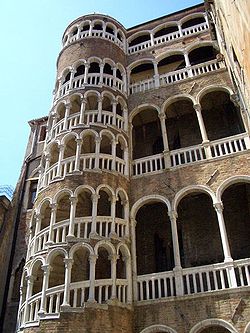
. Exceptions to the rule exist, however, as may be seen in the accompanying image of the Scala of the Palazzo Contarini del Bovolo
Palazzo Contarini del Bovolo
The Palazzo Contarini del Bovolo is a small palace in Venice, Italy, best known for the external spiral staircase, with a plethora of arches, known as the Scala Contarini del Bovolo ....
, which winds up anti-clockwise.
Developments in manufacturing and design have led to the introduction of kit form spiral stairs. Steps and handrails can be bolted together to form a complete unit. These stairs can be made out of steel, timber, concrete or a combination of materials.
Helical or circular stairs do not have a central pole and there is a handrail on both sides. These have the advantage of a more uniform tread width when compared to the spiral staircase. Such stairs may also be built around an elliptical or oval planform
Planform
In aviation, a planform is the shape and layout of a fixed-wing aircraft's fuselage and wing. Of all the myriad planforms used, they can typically be grouped into those used for low-speed flight, found on general aviation aircraft, and those used for high-speed flight, found on many military...
. A double helix is possible, with two independent helical stairs in the same vertical space, allowing one person to ascend and another to descend, without ever meeting if they choose different helices (examples: Château de Chambord
Château de Chambord
The royal Château de Chambord at Chambord, Loir-et-Cher, France is one of the most recognizable châteaux in the world because of its very distinct French Renaissance architecture which blends traditional French medieval forms with classical Renaissance structures.The building, which was never...
, Château de Blois
Château de Blois
The Royal Château de Blois is located in the Loir-et-Cher département in the Loire Valley, in France, in the center of the city of Blois. The residence of several French kings, it is also the place where Joan of Arc went in 1429 to be blessed by the Archbishop of Reims before departing with her...
, Crédit Lyonnais headquarters
Crédit Lyonnais headquarters
The Crédit Lyonnais headquarters is installed in a haussmannian style building in the 2nd arrondissement of Paris...
in Paris). Fire escapes, though built with landings and straight runs of stairs, are often functionally double helices, with two separate stairs intertwined and occupying the same floor space. This is often in support of legal requirements to have two separate fire escapes.
Both spiral and helical stairs can be characterized by the number of turns
Turn (geometry)
A turn is an angle equal to a 360° or 2 radians or \tau radians. A turn is also referred to as a revolution or complete rotation or full circle or cycle or rev or rot....
that are made. A "quarter-turn" stair deposits the person facing 90 degrees from the starting orientation. Likewise there are half-turn, three-quarters-turn and full-turn stairs. A continuous spiral may make many turns depending on the height. Very tall multi-turn spiral staircases are usually found in old stone towers within fortifications, churches and in lighthouse
Lighthouse
A lighthouse is a tower, building, or other type of structure designed to emit light from a system of lamps and lenses or, in older times, from a fire, and used as an aid to navigation for maritime pilots at sea or on inland waterways....
s.
Winders may be used in combination with straight stairs to turn the direction of the stairs. This allows for a large number of permutations.
History
The earliest spiral staircases appear in Temple A in the GreekGreece
Greece , officially the Hellenic Republic , and historically Hellas or the Republic of Greece in English, is a country in southeastern Europe....
colony Selinunte
Selinunte
Selinunte is an ancient Greek archaeological site on the south coast of Sicily, southern Italy, between the valleys of the rivers Belice and Modione in the province of Trapani. The archaeological site contains five temples centered on an acropolis...
, Sicily
Sicily
Sicily is a region of Italy, and is the largest island in the Mediterranean Sea. Along with the surrounding minor islands, it constitutes an autonomous region of Italy, the Regione Autonoma Siciliana Sicily has a rich and unique culture, especially with regard to the arts, music, literature,...
, to both sides of the cella
Cella
A cella or naos , is the inner chamber of a temple in classical architecture, or a shop facing the street in domestic Roman architecture...
. The temple was constructed around 480–470 BC.
Alternating tread stairs
Where there is insufficient space for the full run length of normal stairs, alternating tread stairs may be used. Alternating tread stairs allow for safe forward-facing descent of very steep stairs. The treads are designed such that they alternate between treads for each foot: one step is wide on the left side; the next step is wide on the right side. There is insufficient space on the narrow portion of the step for the other foot to stand, hence the person must always use the correct foot on the correct step. The slope of alternating tread stairs can be as high as 65 degrees as opposed to standard stairs which are almost always less than 45 degrees. The advantage of alternating tread stairs is that people can descend face forward. The only other alternative in such short spaces would be a ladder which requires backward-facing descent. Alternating tread stairs may not be safe for small childChild
Biologically, a child is generally a human between the stages of birth and puberty. Some vernacular definitions of a child include the fetus, as being an unborn child. The legal definition of "child" generally refers to a minor, otherwise known as a person younger than the age of majority...
ren, the elderly or the physically challenged. Building codes typically classify them as ladders and will only allow them where ladder
Ladder
A ladder is a vertical or inclined set of rungs or steps. There are two types: rigid ladders that can be leaned against a vertical surface such as a wall, and rope ladders that are hung from the top. The vertical members of a rigid ladder are called stringers or stiles . Rigid ladders are usually...
s are allowed, usually basement or attic utility or storage areas not frequently accessed.
The image on the right illustrates the space efficiency gained by an alternating tread stair. The alternating tread stair appears in the image's center, with green-colored treads. The alternating stair requires one unit of space per step: the same as the half-width step on its left, and half as much as the full-width stair on its right. Thus, the horizontal distance between steps is in this case reduced by a factor of two, reducing the size of each step.
The horizontal distance between steps is reduced by a factor less than two if for construction reasons there are narrow "unused" steps.
There is often (here also) glide plane
Glide plane
In crystallography, a glide plane is symmetry operation describing how a reflection in a plane, followed by a translation parallel with that plane, may leave the crystal unchanged....
symmetry: the mirror image
Mirror image
A mirror image is a reflected duplication of an object that appears identical but reversed. As an optical effect it results from reflection off of substances such as a mirror or water. It is also a concept in geometry and can be used as a conceptualization process for 3-D structures...
with respect to the vertical center plane corresponds to a shift by one step.
Alternating tread stairs have been in use since at least 1888.
Notable stairways
- The longest stairway is listed by Guinness Book of Records as the service stairway for the Niesenbahn funicularFunicularA funicular, also known as an inclined plane or cliff railway, is a cable railway in which a cable attached to a pair of tram-like vehicles on rails moves them up and down a steep slope; the ascending and descending vehicles counterbalance each other.-Operation:The basic principle of funicular...
railway near SpiezSpiezSpiez is a city in the Frutigen-Niedersimmental administrative district in the canton of Bern in Switzerland.-Geography:Spiez has an area of . Of this area, 38.5% is used for agricultural purposes, while 29.1% is forested...
, SwitzerlandSwitzerlandSwitzerland name of one of the Swiss cantons. ; ; ; or ), in its full name the Swiss Confederation , is a federal republic consisting of 26 cantons, with Bern as the seat of the federal authorities. The country is situated in Western Europe,Or Central Europe depending on the definition....
, with 11,674 steps and a height of 1669 m (5476 ft). The stairs are employee-only. - A flight of 7,200 steps (including inner temple Steps), with 6,293 Official Mountain Walkway Steps, leads up the East Peak of Mount TaiMount TaiMount Tai is a mountain of historical and cultural significance located north of the city of Tai'an, in Shandong province, People's Republic of China. The tallest peak is the Jade Emperor Peak , which is commonly reported as tall, but is described by the PRC government as .Mount Tai is one of the...
in China. - The Haikū Stairs, on the island of OahuOahuOahu or Oahu , known as "The Gathering Place", is the third largest of the Hawaiian Islands and most populous of the islands in the U.S. state of Hawaii. The state capital Honolulu is located on the southeast coast...
, HawaiiHawaiiHawaii is the newest of the 50 U.S. states , and is the only U.S. state made up entirely of islands. It is the northernmost island group in Polynesia, occupying most of an archipelago in the central Pacific Ocean, southwest of the continental United States, southeast of Japan, and northeast of...
, are approximately 4,000 steps which climb nearly 1/2 of a mile. Originally used to access longwire radio radio antennasAntenna (radio)An antenna is an electrical device which converts electric currents into radio waves, and vice versa. It is usually used with a radio transmitter or radio receiver...
which were strung high above the Haikū Valley, between Honolulu and Kāneohe, they are closed to hikers. - The Flørli stairs, in Lysefjorden, NorwayNorwayNorway , officially the Kingdom of Norway, is a Nordic unitary constitutional monarchy whose territory comprises the western portion of the Scandinavian Peninsula, Jan Mayen, and the Arctic archipelago of Svalbard and Bouvet Island. Norway has a total area of and a population of about 4.9 million...
, have 4,444 wooden steps which climb from sea level to 740 metres. It is a maintenance stairway for the water pipeline to the old Flørli hydro plant. The hydro plant is now closed down, and the stairs are open to the public. The stairway is claimed to be the longest wooden stairway in the world. - The CN TowerCN TowerThe CN Tower is a communications and observation tower in Downtown Toronto, Ontario, Canada. Standing tall, it was completed in 1976, becoming the world's tallest free-standing structure and world's tallest tower at the time. It held both records for 34 years until the completion of the Burj...
's staircase reaches the main deck level after 1,776 steps and the Sky Pod above after 2,579 steps; it is the tallest metal staircase on Earth. - The Penrose stairsPenrose stairsThe Penrose stairs or Penrose steps, also dubbed the impossible staircase, is an impossible object created by Lionel Penrose and his son Roger Penrose...
, devised by LionelLionel PenroseLionel Sharples Penrose, FRS was a British psychiatrist, medical geneticist, mathematician and chess theorist, who carried out pioneering work on the genetics of mental retardation. He was educated at the Quaker Leighton Park School and St...
and Roger PenroseRoger PenroseSir Roger Penrose OM FRS is an English mathematical physicist and Emeritus Rouse Ball Professor of Mathematics at the Mathematical Institute, University of Oxford and Emeritus Fellow of Wadham College...
, are a famous impossible objectImpossible objectAn impossible object is a type of optical illusion consisting of a two-dimensional figure which is instantly and subconsciously interpreted by the visual system as representing a projection of a three-dimensional object although it is not actually possible for such an object to exist An impossible...
. The image distorts perspective in such a manner that the stairs appear to be never-ending, a physical impossibility. The image was adopted by M. C. EscherM. C. EscherMaurits Cornelis Escher , usually referred to as M. C. Escher , was a Dutch graphic artist. He is known for his often mathematically inspired woodcuts, lithographs, and mezzotints...
in his iconic lithograph Ascending and DescendingAscending and DescendingAscending and Descending is a lithograph print by the Dutch artist M. C. Escher which was first printed in March 1960.The original print measures 14" x 11 1/4”. The lithograph depicts a large building roofed by a never-ending staircase. Two lines of identically dressed men appear on the staircase,...
. - The World Trade Center Survivors' Staircase is the last visible structure above ground level at the World Trade Center siteWorld Trade Center siteThe World Trade Center site , also known as "Ground Zero" after the September 11 attacks, sits on in Lower Manhattan in New York City...
. It was originally two outdoor flights of granite-clad stairs and an escalator that connected Vesey StreetVesey Street (Manhattan)Vesey Street is a street in New York City that runs east-west in Lower Manhattan. The street is named after Rev. William Vesey , the first rector of nearby Trinity Church....
to the World Trade CenterWorld Trade CenterThe original World Trade Center was a complex with seven buildings featuring landmark twin towers in Lower Manhattan, New York City, United States. The complex opened on April 4, 1973, and was destroyed in 2001 during the September 11 attacks. The site is currently being rebuilt with five new...
's Austin J. Tobin Plaza. During the September 11, 2001, attacks, the stairs served as an escape route for hundreds of evacuees from 5 World Trade Center, a 9-floor building adjacent to the 110-story towers. - Stairwell A was the lone stairway left intact after the second planeUnited Airlines Flight 175United Airlines Flight 175 was United Airlines' daily scheduled morning transcontinental flight, from Logan International Airport in Boston, Massachusetts, to Los Angeles International Airport in Los Angeles, California...
hit the South Tower of the World Trade CenterWorld Trade CenterThe original World Trade Center was a complex with seven buildings featuring landmark twin towers in Lower Manhattan, New York City, United States. The complex opened on April 4, 1973, and was destroyed in 2001 during the September 11 attacks. The site is currently being rebuilt with five new...
during the September 11 attacks. It was believed to have remained intact until the South Tower collapsedCollapse of the World Trade CenterThe twin towers of the World Trade Center collapsed on September 11, 2001, as a result of al-Qaeda's September 11 attacks, in which terrorists affiliated with al-Qaeda hijacked four commercial passenger jet airliners, flying one into the North Tower and another into the South Tower...
at 9:59 am. 14 people were able to escape the floors located at the impact zone (including one manStanley PraimnathStanley Praimnath is a survivor of the attack on the World Trade Center on September 11th, 2001. Praimnath worked as an executive for Fuji Bank on the 81st floor of the South Tower, the second to be attacked...
who saw the plane coming at him), and 4 people from the floors above the impact zone. Numerous 911 operators who received calls from individuals inside the South Tower were not well informed of the situation as it rapidly unfolded in the South Tower. Many operators told callers not to descend the tower on their own, even though it is now believed that Stairwell A was most likely passable at and above the point of impact.
Image in art
Stairway is a metaphor of achievement or loss of a position in the society, a metaphor of hierarchy (e.g. Jacob's LadderJacob's Ladder
Jacob's Ladder is a "ladder to heaven", described by biblical Jacob in the Book of GenesisJacob's Ladder may also refer to:* Ladder of Jacob, a pseudepigraphic text of the Old Testament...
, The Battleship Potemkin
The Battleship Potemkin
The Battleship Potemkin , sometimes rendered as The Battleship Potyomkin, is a 1925 silent film directed by Sergei Eisenstein and produced by Mosfilm...
).
Staircase Art
Staircase Art is also an esoteric artform practiced in small pockets, information about staircase artists can be found hereGallery
See also
- Cable railingsCable railingsCable railings or wire rope railings are safety rails that use horizontal or vertical cables in place of spindles, glass, mesh etc. for infill.-Uses:...
- Combination stairCombination stairA combination stair is an architectural element found in traditional houses in North America.- Background :Large, traditional houses were frequently designed with two stairs: a formal front stairway for use by the family and guests and a utilitarian back stair for use by household staff...
- Fire escapeFire escapeA fire escape is a special kind of emergency exit, usually mounted to the outside of a building or occasionally inside but separate from the main areas of the building. It provides a method of escape in the event of a fire or other emergency that makes the stairwells inside a building inaccessible...
- Fish ladderFish ladderA fish ladder, also known as a fishway, fish pass or fish steps, is a structure on or around artificial barriers to facilitate diadromous fishes' natural migration. Most fishways enable fish to pass around the barriers by swimming and leaping up a series of relatively low steps into the waters on...
- Stair climbingStair climbingStair climbing is the climbing of a flight of stairs. It is often described as a "low-impact" exercise, often for people who have recently started trying to get in shape.A common exhortation in health pop culture is "Take the stairs, not the elevator"....
- Steel squareSteel squareThe steel square is a tool that carpenters use. They use many tools to lay out a "square" or right-angle, many of which are made of steel, but the title steel square refers to a specific long-armed square that has additional uses for measurement, especially of angles, as well as simple...
for use in stair framing.