

Peak District

Encyclopedia
The Peak District is an upland area in central and northern England, lying mainly in northern Derbyshire
, but also covering parts of Cheshire
, Greater Manchester
, Staffordshire
, and South
and West Yorkshire
.
Most of the area falls within the Peak District National Park, whose designation in 1951 made it the first national park
in the British Isles. An area of great diversity, it is conventionally split into the northern Dark Peak
, where most of the moorland
is found and whose geology is gritstone
, and the southern White Peak
, where most of the population lives and where the geology is mainly limestone
-based.
Proximity to the major cities of Manchester
and Sheffield
and the counties of Lancashire
, Greater Manchester, Cheshire, Staffordshire and South and West Yorkshire, coupled with easy access by road and rail, have contributed to its popularity. With an estimated 22 million visitors per year, the Peak District is thought to be the second most-visited national park in the world (after the Mount Fuji National Park
in Japan
), though the Peak District National Park Authority believe these figures are incorrect or unsubstantiated, estimating around 10 million people visit annually.
and much of the area is uplands above 1000 feet (304.8 m), with a high point on Kinder Scout
of 2087 feet (636.1 m). Despite its name, the landscape generally lacks sharp peaks, being characterised by rounded hills and gritstone escarpments (the "edges"). The area is surrounded by major conurbations, including Huddersfield
, Manchester, Sheffield
, Derby
and Stoke-on-Trent
.
The National Park covers 555 square miles (1,437.4 km²) of Derbyshire, Staffordshire, Cheshire, Greater Manchester and South and West Yorkshire, including the majority of the area commonly referred to as the Peak. Its northern limits lie along the A62 road
between Marsden
and Meltham
, north west of Oldham
, while its southernmost point is on the A52 road
on the outskirts of Ashbourne
in Derbyshire. The Park boundaries were drawn to exclude large built-up areas and industrial sites from the park; in particular, the town of Buxton
and the adjacent quarries are located at the end of the Peak Dale
corridor, surrounded on three sides by the Park. The town of Bakewell
and numerous villages are, however, included within the boundaries, as is much of the (non-industrial) west of Sheffield. As of 2010, it is the fifth largest National Park in England and Wales
. In the UK, the designation "National Park" means that there are planning restrictions to protect the area from inappropriate development and a Park Authority to look after it, but does not imply that the land is owned by the government, nor that it is uninhabited.
 12% of the Peak District National Park is owned by the National Trust
, a charity which aims to conserve historic and natural landscapes. It does not receive government funding. The three Trust estates (High Peak
, South Peak
and Longshaw
) include the ecologically or geologically significant areas of Bleaklow
, Derwent Edge
, Hope Woodlands
, Kinder Scout
, Leek and Manifold, Mam Tor
, Dovedale
, Milldale and Winnats Pass
. The Peak District National Park Authority directly owns around 5%, and other major landowners include several water companies.
s dating from the Carboniferous
period. They comprise the Carboniferous limestone
, the overlying Gritstone
and finally the Coal Measures
, though the latter occur only on the extreme margins of the area. In addition there are infrequent outcrops of igneous rock
s including lava
s, tuff
s and volcanic vent
agglomerate
s.
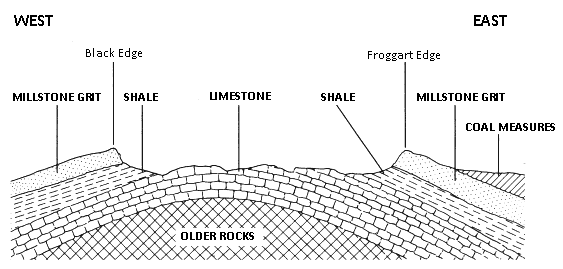
The general geological structure
of the Peak District is that of a broad dome
(see image below), whose western margins have been most intensely faulted and fold
ed. Uplift and erosion have effectively sliced the top off the dome to reveal a concentric outcrop
pattern with Coal Measures rocks on the eastern and western margins, Carboniferous limestone at the core and with rocks of Millstone Grit
outcropping between these two. The southern edge of the dome is overlain by sandstone
s of Triassic
age though these barely impinge upon the National Park.
 The central and southern section of the Peak District, where the Carboniferous limestone is found at or near the surface, is known as the White Peak in contrast to the Dark Peak, which is characterised by Millstone Grit outcrops and broad swathes of moorland.
Earth movements both during and after the Carboniferous period resulted in the up-doming of the area and, particularly in the west, the folding of the rock strata along north–south axes. The region was raised in a north–south line which resulted in this dome-like shape and the shale and sandstone were worn away until limestone was exposed. At the end of this period, the Earth's crust sank here which led to the area being covered by sea, depositing a variety of new rocks.
Some time after its deposition, mineral veins were formed in the limestone. These veins and rakes have been mined for lead
since Roman times
.
The Peak District was overrun by ice during at least one of the ice age
s of the last 2 million years (probably the Anglian glaciation of around 450,000 years ago) as evidenced by the patches of glacial till or boulder clay that can be found across the area. It was not, however, covered by ice during the Last glacial period, which peaked around 20,000–22,000 years ago. However a mix of Irish Sea and Lake District ice did butt up against its western margins. Glacial meltwaters eroded a complex of sinuous channels along this margin of the Peak District during this period. Glacial meltwaters also contributed to the formation and development of many of the caves in the limestone area. Wild animal herds roamed the area, and their remains have been found in several of the local caves.
The different types of rock that lie beneath the soil strongly influence the landscape; they determine the type of vegetation that will grow, and ultimately the type of animal that will inhabit the area. Limestone has fissures and is soluble
in water, therefore rivers have been able to carve deep, narrow valleys. These rivers then often find a route underground, creating cave systems. Millstone Grit on the other hand is insoluble but porous
, so it absorbs water which often seeps through the grits, until it meets the less porous shales beneath, creating springs
when it reaches the surface again. The shales are friable
and easily attacked by frost
, so they form areas that are vulnerable to landslide
s, as on Mam Tor.
, the engineer John Frederick Bateman
wrote in 1846:
He was referring to Longdendale
, and the upper valley of the River Etherow
. The western side of the Peak District is drained by the rivers Etherow, Goyt, and Tame
, which are tributaries of the River Mersey
. The north east is drained by tributaries of the River Don, itself a tributary of the Yorkshire Ouse
. Of the tributaries of the River Trent
, that drain the south and east, the River Derwent
is the most prominent. It rises
in the Peak District on Bleaklow just east of Glossop
and flows through the Upper Derwent Valley
with its three reservoir
s, the Howden Reservoir
, Derwent Reservoir and Ladybower Reservoir
. The River Noe
and the River Wye
are tributaries. The River Manifold
and River Dove, rivers of the south west whose sources are on Axe Edge Moor
, also flow into the Trent, while the River Dane
flows into the River Weaver
.
moorland and blanket bog
environments, with rough sheep
pasture and grouse
shooting being the main land uses. The limestone plateaux of the White Peak are more intensively farmed, with mainly dairy
usage of improved pastures. Some sources also recognise the South West Peak (near Macclesfield
) as a third type of area, with intermediate characteristics.
Woodland forms around 8% of the Peak National Park. Natural broad-leaved woodland
is found in the steep-sided, narrow dales of the White Peak and the deep cloughs of the Dark Peak, while reservoir margins often have coniferous plantations.
Lead rakes, the spoil heaps of ancient mines, form another distinctive habitat in the White Peak, supporting a range of rare metallophyte
plants, including Spring Sandwort
(Minuartia verna; also known as leadwort), Alpine Pennycress (Thlaspi caerulescens) and Mountain Pansy
(Viola lutea).
The Moorland Indicators of Climate Change Initiative was set up in 2008 to collect data on climate change in the area. Students investigated the interaction between people and the moorlands, and their overall effect on climate change, to discover whether the moorlands are a net carbon sink or source, based on the fact that upland areas of Britain are a significant global carbon store in the form of peat
. Human interaction in terms of direct erosion and fire as well as the effects of global warming are the major variables that they considered.
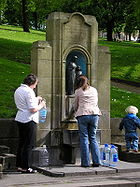 Tourism is the major local employment for Park residents (24%), with manufacturing industries (19%) and quarrying (12%) also being important; only 12% are employed in agriculture. The cement
works at Hope
is the largest single employer within the Park. Tourism is estimated to provide 500 full-time jobs, 350 part-time jobs and 100 seasonal jobs.
Limestone is the most important mineral quarried, mainly for roads and cement; shale is extracted for cement at Hope, and several gritstone quarries are worked for housing. Lead mining is no longer economic, but fluorite
, baryte and calcite
are extracted from lead veins, and small-scale Blue John mining occurs at Castleton.
The springs at Buxton and Ashbourne are exploited to produce bottled mineral water
, and many of the plantation
s are managed for timber
. Other manufacturing industries of the area are varied; they include David Mellor
's cutlery
factory in Hathersage
, Ferodo
brake lining
s in Chapel-en-le-Frith
and electronic equipment
in Castleton. There are approximately 2,700 farms in the National Park, most of them under 40 hectares (98.8 acre) in area. 60% of farms are believed to be run on a part-time basis where the farmer has a second job.
flint artefacts and by palaeoenvironmental
evidence from caves in Dovedale and elsewhere. There is also evidence of Neolithic
activity, including some monumental earthworks or barrows (burial mounds) such as that at Margery Hill
. In the Bronze Age
the area was well populated and farmed, and evidence of these people survives in henge
s such as Arbor Low
near Youlgreave
, or the Nine Ladies Stone Circle
at Stanton Moor
. In the same period, and on into the Iron Age
, a number of significant hillforts such as that at Mam Tor were created. Roman occupation was sparse but the Romans certainly exploited the rich mineral veins of the area, exporting lead from the Buxton area along well-used routes. There were Roman settlements, including one at Buxton which was known to them as "Aquae Arnemetiae" in recognition of its spring, dedicated to the local goddess.
Theories as to the derivation of the Peak District name include the idea that it came from the Pecsaetan
or peaklanders, an Anglo-Saxon
tribe who inhabited the central and northern parts of the area from the 6th century AD when it fell within the large Anglian kingdom of Mercia
.
, but also coal
, fluorite
, copper
(at Ecton
), zinc
, iron, manganese
and silver
have all been mined here. Celia Fiennes
, describing her journey through the Peak in 1697, wrote of
Coal measures occur on the western and the eastern fringes of the Peak District, and evidence of past workings can be found from Glossop down to The Roaches
, and from Stocksbridge
to Baslow
. Mining started in medieval times
and was at its most productive in the 18th and early 19th centuries, in some cases continuing into the early 20th century. The earliest mining took place at and close to outcrop
s and miners eventually followed the seams deeper underground as the beds dipped beneath hillsides. At Goyt's Moss and Axe Edge
, deep seams were worked and steam engines raised the coal and dewatered the mines. Coal from the eastern mines was used in lead smelting, and coal from the western mines for lime burning.
Lead mining peaked in the 17th and 18th centuries; high concentrations of lead have been found in the area dating back from this period, as well as discovering peat on Kinder Scout suggesting that lead smelting occurred. Lead mining began to decline from the mid-19th century, with the last major mine closing in 1939, though lead remains a by-product of fluorite, baryte and calcite mining. Not all mines were deep underground; Bell pit
s were a cheap and easy way at getting at an ore that lay close to the surface of flat land. A shaft was sunk into the ore and enlarged at the bottom for extraction. The pit was then enlarged further until it became unsafe or worked out, then another pit would be sunk adjacent to the existing one.
Fluorite or fluorspar is called Blue John in the Peak District, the name allegedly coming from the French Bleu et Jaune which describes the colour of the bandings. Blue John is now scarce, and only a few hundred kilogram
s are mined each year for ornamental and lapidary
use. The Blue John Cavern
in Castleton is a show cave
; mining still takes place in the nearby Treak Cliff Cavern
.
Industrial limestone quarrying for the manufacture of soda ash started in the Buxton area as early as 1874. In 1926 this operation became part of ICI
. Large-scale limestone and gritstone quarries
flourished as lead mining declined, and remain an important if contentious industry in the Peak. Twelve large limestone quarries operate in the Peak; Tunstead
near Buxton is one of the largest quarries in Europe
. Total limestone output was substantial: at the 1990 peak, 8.5 million tonnes was quarried.
developed machinery to produce textiles more quickly and to a higher standard. The early mills
were narrow and low in height, of light construction, powered by water wheel
s and containing small machines. Interior lighting was by daylight, and ceiling height was only 6–8 ft. These Arkwright type mills are about 9 feet (2.7 m) wide. The Peak District was the ideal location, with its rivers and humid atmosphere. The local pool of labour was quickly exhausted and the new mills such as Litton Mill
and Cressbrook Mill
in Millers Dale
brought in children as young as four from the workhouse
s of London as apprentices.
With the advance of technology, the narrow Derbyshire valleys became unsuited to the larger steam driven mill, but the Derbyshire mills remained, and continued to trade in finishing and niche products. The market town of Glossop benefitted from the textile industry. The town's economy was linked closely with a spinning and weaving tradition which had evolved from developments in textile manufacture during the Industrial Revolution
. Until World War I
, Glossop had the headquarters of the largest textile printworks in the world. In the 1920s, the firm was refloated on the easily available share capital
; thus it was victim of the stockmarket crash. Their product lines becoming vulnerable to the new economic conditions, and resulted in the industry's decline.
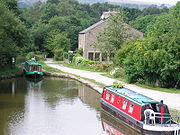 The streams of the Peak District have been dammed to provide headwater for numerous water driven mills
; weir
s have been built across the rivers for the same purpose. Though there is no canal within the National Park boundary, waters from the Dark Peak fed the Ashton Canal
, and Huddersfield Narrow Canal
. Waters from the White Peak fed the Macclesfield Canal
. The Peak Forest Canal
was built to bring lime from the quarries at Dove Holes
for the construction industry. The canal terminated at Bugsworth
and the journey was completed using the Peak Forest Tramway
.
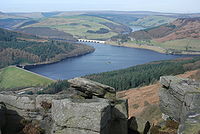
The large reservoirs along the Longdendale valley known as the Longdendale Chain
were designed in the 1840s and completed in February 1877. They provided compensation water to ensure a continuous flow along the River Etherow which was essential for local industry, and provided pure water for Manchester. The Upper Derwent Valley reservoirs were built from the mid 20th century onward to supply drinking water to the East Midlands
and South Yorkshire.
, being published in 1636. Much scorn was poured on these seven wonders by subsequent visitors, including the journalist Daniel Defoe
who described the moors by Chatsworth
as "a waste and houling wilderness" and was particularly contemptuous of the cavern near Castleton known as the 'Devil's Arse' or Peak Cavern
. Visitor numbers did not increase significantly until the Victorian era
, with railway construction providing ease of access and a growing cultural appreciation of the Picturesque
and Romantic
. Guides such as John Mawe
's Mineralogy of Derbyshire (1802) and William Adam's Gem of the Peak (1843) generated interest in the area's unique geology.
Buxton has a long history as a spa town due to its geothermal spring which rises at a constant temperature of 28°C. It was initially developed by the Romans around AD 78, when the settlement was known as Aquae Arnemetiae, or the spa of the goddess of the grove. It is known that Bess of Hardwick
and her husband the Earl of Shrewsbury
, "took the waters" at Buxton in 1569, and brought Mary, Queen of Scots, there in 1573. The town largely grew in importance in the late 18th century when it was developed by the 5th Duke of Devonshire
in style of the spa of Bath. A second resurgence a century later attracted the eminent Victorians such as Dr. Erasmus Darwin
and Josiah Wedgwood
, who were drawn by the reputed healing properties of the waters. The railway reached Buxton in 1863. Buxton has many notable buildings such as 'The Crescent' (1780–1784), modelled on Bath's Royal Crescent
, by John Carr, 'The Devonshire' (1780–1789), 'The Natural Baths', and 'The Pump Room' by Henry Currey. The Pavilion Gardens were opened in 1871. Buxton Opera House
was designed by Frank Matcham
in 1903 and is the highest opera house in the country. Matcham was the theatrical architect who designed the London Palladium
, the London Coliseum
, and the Hackney Empire
.
There is a great tradition of public access and outdoor recreation in the area. The Peak District formed a natural hinterland and rural escape for the populations of industrial Manchester and Sheffield, and remains a valuable leisure resource in a largely post-industrial economy.
in 1932 was a landmark in the campaign for national park
s and open access to moorland in Britain. At the time, such open moors were closed to all; they were strongly identified with the game-keeping interests of landed gentry who used them only 12 days a year. The Peak District National Park became the United Kingdom
's first national park on 17 April 1951. The first Long distance footpath
in the United Kingdom was the Pennine Way
, which starts at the Nags Head Inn, in Grindsbook Booth, part of Edale
village.
The northern moors of Saddleworth
and Wessenden
, above Meltham, gained notoriety in the 1960s as the burial site of several children
murdered by Ian Brady and Myra Hindley.
, Ardotalia
(Glossop) and Navio (Brough and Shatton
), and extended outwards to Danum (Doncaster
), Manucium (Manchester) and Derventio (Little Chester
, near Derby). Parts of the modern A515
and A53
roads south of Buxton are believed to run along Roman roads.
Packhorse
routes criss-crossed the Peak in the Medieval era, and some paved causeways are believed to date from this period, such as the Long Causeway along Stanage Edge. However, no highways were marked on Christopher Saxton
's map of Derbyshire, published in 1579. Bridge-building improved the transport network; a surviving early example is the three-arched gritstone bridge over the River Derwent at Baslow, which dates from 1608 and has an adjacent toll-shelter. Although the introduction of turnpike roads
(toll roads) from 1731 reduced journey times, the journey from Sheffield to Manchester in 1800 still took 16 hours, prompting Samuel Taylor Coleridge
to remark that "a tortoise could outgallop us!" From around 1815 onwards, turnpike roads both increased in length and improved in quality. An example is the Snake Pass
, which now forms part of the A57
, built under the direction of Thomas Telford
in 1819–21; the name refers to the crest of the Duke of Devonshire
. The Cromford Canal
opened in 1794, carrying coal, lead and iron ore to the Erewash Canal
.
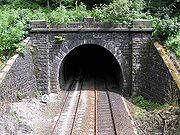 Within several years, the improved roads and the Cromford Canal both saw competition from new railways
, with work on the first railway in the Peak commencing in 1825. Although the Cromford and High Peak Railway
(from the Cromford Canal at High Peak Junction
to Whaley Bridge
) was an industrial railway, passenger services soon followed, including the Woodhead Line
(Sheffield to Manchester via Longdendale) and the Manchester, Buxton, Matlock and Midlands Junction Railway
. Not everyone regarded the railways as an improvement:
By the second half of the 20th century, the pendulum had swung back towards road transport. The Cromford Canal was largely abandoned in 1944, and several of the rail lines passing through the Peak were closed as uneconomic in the 1960s as part of the Beeching Axe
. The Woodhead Line was closed between Hadfield
and Penistone
; parts of the trackbed are now used for the Trans Pennine Trail
, the stretch between Hadfield and Woodhead being known specifically as the Longdendale Trail
. The Manchester, Buxton, Matlock and Midlands Junction Railway is now closed between Rowsley
and Buxton where the trackbed forms part of the Monsal Trail
. The Cromford and High Peak Railway is now completely shut, with part of the trackbed open to the public as the High Peak Trail. Another disused rail line between Buxton and Ashbourne now forms the Tissington Trail
.
(Woodhead Pass) between Barnsley
and Manchester via Longdendale, the A6 from Derby to Manchester via Buxton, and the Cat and Fiddle road
from Macclesfield to Buxton. These major roads, together with other minor roads and lanes in the area, are attractive to drivers, but the Peak's popularity makes road congestion and the availability of parking spaces
a significant problem, especially during summer. This led to the proposal of a congestion charge in 2005, but this was later rejected.
from Sheffield and Manchester, the Derwent Valley Line
from Derby to Matlock, and the Buxton Line
and Glossop Line linking those towns to Manchester. Coach
(long-distance bus) services provide access to Matlock, Bakewell and Buxton from Derby, Nottingham
and Manchester through National Express
, and there are regular buses from the nearby towns of Sheffield, Glossop, Stoke, Leek
and Chesterfield. The nearest airport is Manchester.
For such a rural area, the smaller villages of the Peak are relatively well served by internal transport links. There are many minibuses operating from the main towns (Bakewell, Matlock, Hathersage, Castleton, Tideswell
and Ashbourne) out to the small villages. The Hope Valley and Buxton Line trains also serve many local stations (including Hathersage, Hope and Edale).
The National Park Authority announced, in October 2009, that Cycle England will be investing £1.25 million, to be spent by 2011, to build and improve cycle routes within the National Park for use by leisure and commuting cyclists. It is hoped that this investment will help reduce traffic congestion and environmental pollution, as well as giving commuters and visitors a viable alternative to travelling around the National Park by car.
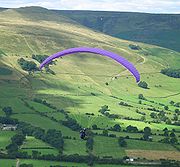 The Peak District provides opportunities for many types of outdoor activity. An extensive network of public footpaths and numerous long-distance trails, over 1800 miles (2,896.8 km) in total, as well as large open-access areas, are available for hillwalking
and hiking
. The Pennine Way
traverses the Dark Peak from Edale to the Park's northern boundary just south of Standedge
. Bridleways are commonly used by mountain bikers
, as well as horse riders
. Some of the long-distance trails in the White Peak, such as the Tissington Trail
and High Peak Trail, re-use former railway lines; they are well used by walkers, horse riders and cyclists
. The Park authorities run cycle hire centres at Ashbourne, Parsley Hay and Middleton Top
. Wheelchair access is possible at several places on the former railway trails, and cycle hire centres offer vehicles adapted to wheelchair users. There is a programme to make footpaths more accessible to less-agile walkers by replacing climbing stiles with walkers' gates.
The many gritstone outcrops, such as Stanage Edge and The Roaches, are recognised as some of the finest rock climbing
sites in the world (see rock climbing in the Peak District
); they were the first to be climbed. The Peak limestone was then discovered. It is more unstable but provides many testing climbs. For example Thor's Cave
was explored in the early 1950s by Joe Brown
and others. Eleven limestone routes there are listed by the BMC
, ranging in grade
from Very Severe to E7, and several more have been claimed since the guidebook's publication; a few routes are bolted.
Beneath the ground, the potholer
enjoys natural caves, the potholes and old mine workings found in the limestone of the Peak. Peak Cavern is the largest and most important cave system which is even linked to the Speedwell
system at Winnats. The only significant potholes are Eldon Hole and Nettle Pot. There are many old mine workings, which often were extensions of natural cave systems. Systems can be found at Castleton, Winnats, Matlock, Stoney Middleton
, Eyam
, Monyash
and Buxton.
Some of the area's large reservoirs, for example Carsington Water, have become centres for water sports, including sailing
, fishing
and canoeing
, in this most landlocked part of the UK. Other activities include air sports such as hang gliding
and paragliding
, birdwatching
, fell running
, off-roading
, and orienteering
.
, popularised in the Victorian era. Bakewell is the largest settlement within the National Park; its five-arched bridge over the River Wye dates from the 13th century. Buxton, Matlock and Matlock Bath, Bakewell, Leek and the small towns of Ashbourne and Wirksworth
, on the fringes of the Park, all offer a range of tourist amenities. To the north the village of Hayfield
sits at the foot of Kinder Scout, the highest summit in the area.
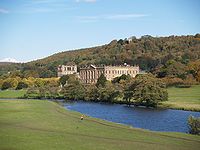
Historic buildings include Chatsworth House
, seat of the Dukes of Devonshire and among Britain's finest stately homes; the medieval Haddon Hall
, seat of the Dukes of Rutland
; Hardwick Hall
, built by powerful Elizabethan Bess of Hardwick
; and Lyme Park
, an Elizabethan manor house transformed by an Italianate
front. Many of the Peak's villages and towns have fine parish churches, with a particularly magnificent example being the 14th century Church of St John the Baptist at Tideswell, sometimes dubbed the 'Cathedral of the Peak'. 'Little John
's Grave' can be seen in the Hathersage churchyard.
 The picturesque village of Castleton, overshadowed by the Norman
Peveril Castle
, has four show caves, the Peak, Blue John
, Treak Cliff
, and Speedwell
, and is the centre of production of the unique semi-precious mineral, Blue John. Other show caves and mines include the Heights of Abraham
, reached by cable car, at Matlock Bath, and Poole's Cavern
in Buxton. The small village of Eyam is known for its self-imposed quarantine during the Black Death
of 1665.
The Mining Museum at Matlock Bath, which includes tours of the Temple Lead Mine, and the Derwent Valley Mills
World Heritage Site
and Brindley Water Mill
at Leek give insight into the Peak's industrial heritage. The preserved steam railway between Matlock and Rowsley, the National Tramway Museum
at Crich
and the Cromford Canal chart the area's transport history. The Life in a Lens Museum of Photography & Old Times
in Matlock Bath presents the history of photography
from 1839.
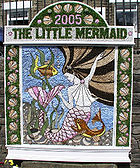
Well dressing
ceremonies are held in most of the villages during the spring and summer months, in a tradition said to date from pagan times. Other local customs include Castleton's annual Garland Festival
and Ashbourne's Royal Shrovetide Football
, played annually since the 12th century. Buxton hosts two opera festivals, the Buxton Festival
and the International Gilbert and Sullivan Festival
, as well as the Buxton Festival Fringe, and the Peak Literary Festival
is held at various locations twice a year.
Peak District food specialities include the dessert Bakewell pudding, very different from the nationally available Bakewell tart
, and until 2009 the famous cheese Stilton
and other local cheeses were produced in the village of Hartington
.
 The proximity of the Peak to major conurbations (an estimated 20 million people live within an hour's drive) poses unique challenges to managing the area. The Peak District National Park Authority and the National Trust, with other landowners, attempt to balance keeping the upland landscape accessible to visitors for recreation, whilst protecting it from intensive farming, erosion
and pressure from visitors themselves. An inevitable tension exists between the needs of the 38,000 residents of the Peak District National Park, the many millions of people who visit it annually, and the conservation requirements of the area.
The uneven distribution of visitors creates further stresses. Dovedale alone receives an estimated two million visitors annually; other highly visited areas include Bakewell, Castleton and the Hope Valley
, Chatsworth, Hartington and the reservoirs of the Upper Derwent Valley. Over 60% of visits are concentrated in the period May–September, with Sunday being the busiest day.
moorlands of the Dark Peak. The recent use of some paths by mountain bikers is believed by some to have exacerbated an existing problem. Measures taken to contain the damage have included the permanent diversion of the official route of the Pennine Way out of Edale, which now goes up Jacob's Ladder rather than following the Grindsbrook, and the diverting of expensive stone paving of many moorland footpaths.
was forced to close in 1999, and landscaping is ongoing. The proposals dating from 1999 from Stancliffe Stone Ltd to re-open dormant gritstone quarries at Stanton Moor have been seen as a test case. They are hotly contested by ecological protesters and local residents on grounds that the development would threaten nearby Bronze Age remains, in particular the Nine Ladies Stone Circle, as well as the natural landscape locally. As of 2007, negotiations are ongoing to shift the development to the nearby Dale View quarry, a less sensitive area.
; Lud's Church
for example, is thought to be the Green Chapel.
 Key scenes in Jane Austen
's 1813 novel Pride and Prejudice
are set in the Derbyshire Peak District. Peveril of the Peak
(1823) by Sir Walter Scott
is a historical novel set at Peveril Castle, Castleton during the reign of Charles II
. William Wordsworth
was a frequent visitor to Matlock; the Peak inspired several of his poems, including an 1830 sonnet
to Chatsworth House. The village of Morton
in Charlotte Brontë
's 1847 novel Jane Eyre
is based on Hathersage, where Brontë stayed in 1845, and Thornfield Hall
might have been inspired by nearby North Lees Hall. Snowfield in George Eliot
's first novel Adam Bede
(1859) is believed to be based on Wirksworth, where her uncle managed a mill; Ellastone
(as Hayslope) and Ashbourne
(as Oakbourne) are also featured.
Beatrix Potter
, the author of Peter Rabbit
, used to visit her uncle Edmund Potter
at his printworks in Dinting Vale
. She used cloth patterns from his Pattern Sample book to dress her characters. Mrs Tiggywinkle's shawl, in The Tale of Mrs. Tiggy-Winkle
, is based on pattern number 222714.
Children's author Alison Uttley
(1884–1976) was born at Cromford
; her well-known novel, A Traveller in Time, set in Dethick
, recounts the Babington Plot
to free Mary, Queen of Scots, from imprisonment. Crichton Porteous
(1901–91) set several books in specific locations in the Peak; Toad Hole, Lucky Columbell and Broken River, for example, are set in the Derwent Valley
. More recently, Geraldine Brooks's first novel, Year of Wonders
(2001), blends fact and fiction to tell the story of the plague village of Eyam
, which also inspired Children of Winter by children's novelist, Berlie Doherty
(b. 1943). Doherty has set several other works in the Peak, including Deep Secret, based on the drowning of the villages of Derwent
and Ashopton
by the Ladybower Reservoir, and Blue John, inspired by the Blue John Cavern at Castleton.
Many works of crime and horror have been set in the Peak. The Terror of Blue John Gap
by Sir Arthur Conan Doyle
(1859–1930) recounts terrible events at the Blue John mines, and Sherlock Holmes
investigates the kidnapping of a child in the region in The Adventure of the Priory School
. Many of the horror stories of local author Robert Murray Gilchrist
(1878–1916) feature Peak settings. More recently, Stephen Booth
has written a series of crime novels set in various real and imagined Peak locations, while In Pursuit of the Proper Sinner, an Inspector Lynley mystery
by Elizabeth George
, is set on the fictional Calder Moor.
 Other writers and poets who lived in or visited the Peak include Samuel Johnson
, William Congreve
, Anna Seward
, Jean-Jacques Rousseau
, Lord Byron
, Thomas Moore
, Richard Furness
, D. H. Lawrence
, Vera Brittain
, Richmal Crompton
and Nat Gould
.
The landscapes and historic houses of the Peak are also popular settings for film and television. The classic 1955 film, The Dam Busters
, was filmed at the Upper Derwent Valley reservoirs, where practice flights for the bombing raids on the Ruhr dams had been made during World War II
. In recent adaptations of Pride and Prejudice, Longnor
has featured as Lambton, while Lyme Park and Chatsworth House have stood in for Pemberley
. Haddon Hall not only doubled as Thornfield Hall
in two different adaptations of Jane Eyre, but has also appeared in several other films including Elizabeth
, The Princess Bride
and The Other Boleyn Girl. The long-running television medical drama Peak Practice
is set in the fictional village of Cardale in the Derbyshire Peak District; it was filmed in Crich
, Matlock and other Peak locations.
Derbyshire
Derbyshire is a county in the East Midlands of England. A substantial portion of the Peak District National Park lies within Derbyshire. The northern part of Derbyshire overlaps with the Pennines, a famous chain of hills and mountains. The county contains within its boundary of approx...
, but also covering parts of Cheshire
Cheshire
Cheshire is a ceremonial county in North West England. Cheshire's county town is the city of Chester, although its largest town is Warrington. Other major towns include Widnes, Congleton, Crewe, Ellesmere Port, Runcorn, Macclesfield, Winsford, Northwich, and Wilmslow...
, Greater Manchester
Greater Manchester
Greater Manchester is a metropolitan county in North West England, with a population of 2.6 million. It encompasses one of the largest metropolitan areas in the United Kingdom and comprises ten metropolitan boroughs: Bolton, Bury, Oldham, Rochdale, Stockport, Tameside, Trafford, Wigan, and the...
, Staffordshire
Staffordshire
Staffordshire is a landlocked county in the West Midlands region of England. For Eurostat purposes, the county is a NUTS 3 region and is one of four counties or unitary districts that comprise the "Shropshire and Staffordshire" NUTS 2 region. Part of the National Forest lies within its borders...
, and South
South Yorkshire
South Yorkshire is a metropolitan county in the Yorkshire and the Humber region of England. It has a population of 1.29 million. It consists of four metropolitan boroughs: Barnsley, Doncaster, Rotherham, and City of Sheffield...
and West Yorkshire
West Yorkshire
West Yorkshire is a metropolitan county within the Yorkshire and the Humber region of England with a population of 2.2 million. West Yorkshire came into existence as a metropolitan county in 1974 after the passage of the Local Government Act 1972....
.
Most of the area falls within the Peak District National Park, whose designation in 1951 made it the first national park
National parks of England and Wales
The national parks of England and Wales are areas of relatively undeveloped and scenic landscape that are designated under the National Parks and Access to the Countryside Act 1949...
in the British Isles. An area of great diversity, it is conventionally split into the northern Dark Peak
Dark Peak
The Dark Peak is the higher, wilder northern part of the Peak District in England.It gets its name because , the underlying limestone is covered by a cap of Millstone Grit which means that in winter the soil is almost always saturated with water...
, where most of the moorland
Moorland
Moorland or moor is a type of habitat, in the temperate grasslands, savannas, and shrublands biome, found in upland areas, characterised by low-growing vegetation on acidic soils and heavy fog...
is found and whose geology is gritstone
Gritstone
Gritstone or Grit is a hard, coarse-grained, siliceous sandstone. This term is especially applied to such sandstones that are quarried for building material. British gritstone was used for millstones to mill flour, to grind wood into pulp for paper and for grindstones to sharpen blades. "Grit" is...
, and the southern White Peak
White Peak
The White Peak is the lower, southern part of the Peak District in England. In contrast to the Dark Peak, the underlying limestone is not capped by impervious millstone grit, so caves and dry river valleys are common features of the area...
, where most of the population lives and where the geology is mainly limestone
Limestone
Limestone is a sedimentary rock composed largely of the minerals calcite and aragonite, which are different crystal forms of calcium carbonate . Many limestones are composed from skeletal fragments of marine organisms such as coral or foraminifera....
-based.
Proximity to the major cities of Manchester
Manchester
Manchester is a city and metropolitan borough in Greater Manchester, England. According to the Office for National Statistics, the 2010 mid-year population estimate for Manchester was 498,800. Manchester lies within one of the UK's largest metropolitan areas, the metropolitan county of Greater...
and Sheffield
Sheffield
Sheffield is a city and metropolitan borough of South Yorkshire, England. Its name derives from the River Sheaf, which runs through the city. Historically a part of the West Riding of Yorkshire, and with some of its southern suburbs annexed from Derbyshire, the city has grown from its largely...
and the counties of Lancashire
Lancashire
Lancashire is a non-metropolitan county of historic origin in the North West of England. It takes its name from the city of Lancaster, and is sometimes known as the County of Lancaster. Although Lancaster is still considered to be the county town, Lancashire County Council is based in Preston...
, Greater Manchester, Cheshire, Staffordshire and South and West Yorkshire, coupled with easy access by road and rail, have contributed to its popularity. With an estimated 22 million visitors per year, the Peak District is thought to be the second most-visited national park in the world (after the Mount Fuji National Park
Fuji-Hakone-Izu National Park
is a national park in Yamanashi, Shizuoka, and Kanagawa Prefectures, and western Tokyo Metropolis, Japan. It consists of Mount Fuji, Fuji Five Lakes, Hakone, the Izu Peninsula, and the Izu Islands....
in Japan
Japan
Japan is an island nation in East Asia. Located in the Pacific Ocean, it lies to the east of the Sea of Japan, China, North Korea, South Korea and Russia, stretching from the Sea of Okhotsk in the north to the East China Sea and Taiwan in the south...
), though the Peak District National Park Authority believe these figures are incorrect or unsubstantiated, estimating around 10 million people visit annually.
Geography
The Peak District forms the southern end of the PenninesPennines
The Pennines are a low-rising mountain range, separating the North West of England from Yorkshire and the North East.Often described as the "backbone of England", they form a more-or-less continuous range stretching from the Peak District in Derbyshire, around the northern and eastern edges of...
and much of the area is uplands above 1000 feet (304.8 m), with a high point on Kinder Scout
Kinder Scout
Kinder Scout is a moorland plateau in the Dark Peak of the Derbyshire Peak District in England. Part of the moor, at 636 m above sea level, is the highest point in the Peak District, the highest point in Derbyshire, and the highest point in the East Midlands. It is accessible from the villages of...
of 2087 feet (636.1 m). Despite its name, the landscape generally lacks sharp peaks, being characterised by rounded hills and gritstone escarpments (the "edges"). The area is surrounded by major conurbations, including Huddersfield
Huddersfield
Huddersfield is a large market town within the Metropolitan Borough of Kirklees, in West Yorkshire, England, situated halfway between Leeds and Manchester. It lies north of London, and south of Bradford, the nearest city....
, Manchester, Sheffield
Sheffield
Sheffield is a city and metropolitan borough of South Yorkshire, England. Its name derives from the River Sheaf, which runs through the city. Historically a part of the West Riding of Yorkshire, and with some of its southern suburbs annexed from Derbyshire, the city has grown from its largely...
, Derby
Derby
Derby , is a city and unitary authority in the East Midlands region of England. It lies upon the banks of the River Derwent and is located in the south of the ceremonial county of Derbyshire. In the 2001 census, the population of the city was 233,700, whilst that of the Derby Urban Area was 229,407...
and Stoke-on-Trent
Stoke-on-Trent
Stoke-on-Trent , also called The Potteries is a city in Staffordshire, England, which forms a linear conurbation almost 12 miles long, with an area of . Together with the Borough of Newcastle-under-Lyme Stoke forms The Potteries Urban Area...
.
The National Park covers 555 square miles (1,437.4 km²) of Derbyshire, Staffordshire, Cheshire, Greater Manchester and South and West Yorkshire, including the majority of the area commonly referred to as the Peak. Its northern limits lie along the A62 road
A62 road
The A62 is a major road in Northern England that runs between the two major cities of Manchester and Leeds.The road is approximately 40 miles long. It runs north east from Manchester through Failsworth and Oldham then Saddleworth before crossing the Pennines at Standedge into West Yorkshire...
between Marsden
Marsden, West Yorkshire
Marsden is a large village within the Metropolitan Borough of Kirklees, in West Yorkshire, England, west of Huddersfield and located at the confluence of the River Colne and the Wessenden Brook...
and Meltham
Meltham
Meltham is a small town and civil parish within the Metropolitan Borough of Kirklees, in West Yorkshire, England. It lies in the Holme Valley, below Wessenden Moor, four and a half miles south-west of Huddersfield on the edge of the Peak District National Park...
, north west of Oldham
Oldham
Oldham is a large town in Greater Manchester, England. It lies amid the Pennines on elevated ground between the rivers Irk and Medlock, south-southeast of Rochdale, and northeast of the city of Manchester...
, while its southernmost point is on the A52 road
A52 road
The A52 is a major road in the East Midlands, England. It runs east from the junction with the A53 at Newcastle-under-Lyme near Stoke-on-Trent via Ashbourne, Derby, Stapleford, Nottingham, West Bridgford, Bingham, Grantham, Boston and Skegness before terminating on the east Lincolnshire coast at...
on the outskirts of Ashbourne
Ashbourne, Derbyshire
Ashbourne is a small market town in the Derbyshire Dales, England. It has a population of 10,302.The town advertises itself as 'The Gateway to Dovedale'.- Local customs :...
in Derbyshire. The Park boundaries were drawn to exclude large built-up areas and industrial sites from the park; in particular, the town of Buxton
Buxton
Buxton is a spa town in Derbyshire, England. It has the highest elevation of any market town in England. Located close to the county boundary with Cheshire to the west and Staffordshire to the south, Buxton is described as "the gateway to the Peak District National Park"...
and the adjacent quarries are located at the end of the Peak Dale
Peak Dale
Peak Dale is a small village in Derbyshire, England. It is located between Dove Holes and Buxton, between 2 quarries.The village used to house quarry workers and their families, but some of the original houses have now been demolished...
corridor, surrounded on three sides by the Park. The town of Bakewell
Bakewell
Bakewell is a small market town in the Derbyshire Dales district of Derbyshire, England, deriving its name from 'Beadeca's Well'. It is the only town included in the Peak District National Park, and is well known for the local confection Bakewell Pudding...
and numerous villages are, however, included within the boundaries, as is much of the (non-industrial) west of Sheffield. As of 2010, it is the fifth largest National Park in England and Wales
National parks of England and Wales
The national parks of England and Wales are areas of relatively undeveloped and scenic landscape that are designated under the National Parks and Access to the Countryside Act 1949...
. In the UK, the designation "National Park" means that there are planning restrictions to protect the area from inappropriate development and a Park Authority to look after it, but does not imply that the land is owned by the government, nor that it is uninhabited.
National Trust for Places of Historic Interest or Natural Beauty
The National Trust for Places of Historic Interest or Natural Beauty, usually known as the National Trust, is a conservation organisation in England, Wales and Northern Ireland...
, a charity which aims to conserve historic and natural landscapes. It does not receive government funding. The three Trust estates (High Peak
High Peak Estate
The High Peak Estate is an area of Pennine moorland in the ownership of the National Trust in the Dark Peak area of Derbyshire, England.The National Trust High Peak Estate is to be known as the 'Dark Peak Area' from summer 2010 which is now part of the Peak District Estate...
, South Peak
South Peak Estate
The South Peak Estate of the National Trust comprises several land holdings in the Southern Peak District. Some of these, like Shining Cliff Wood and Alport Height, are just outside the National Park boundary...
and Longshaw
Longshaw Estate
Longshaw Estate is an area of moorland, woodland and farmland located within the Peak District National Park, Derbyshire, England. The Estate has been in the ownership of the National Trust since 1931 after being first bought by the people of Sheffield in 1928. It is part of the larger National...
) include the ecologically or geologically significant areas of Bleaklow
Bleaklow
Bleaklow is a high, largely peat covered, gritstone moorland, just north of Kinder Scout, across the Snake Pass , in the Derbyshire High Peak near the town of Glossop...
, Derwent Edge
Derwent Edge
Derwent Edge is a Millstone Grit escarpment that lies above the Upper Derwent Valley in the Peak District National Park in the English county of Derbyshire...
, Hope Woodlands
Hope Woodlands
Hope Woodlands is an extensive civil parish in the High Peak district of Derbyshire in England.The parish covers the Woodlands Valley, the western Upper Derwent Valley, the northern half of Kinder Scout and much of Bleaklow. The only habitations in the parish are remote farms, forming small...
, Kinder Scout
Kinder Scout
Kinder Scout is a moorland plateau in the Dark Peak of the Derbyshire Peak District in England. Part of the moor, at 636 m above sea level, is the highest point in the Peak District, the highest point in Derbyshire, and the highest point in the East Midlands. It is accessible from the villages of...
, Leek and Manifold, Mam Tor
Mam Tor
Mam Tor is a hill near Castleton in the High Peak of Derbyshire, England. Its name literally translates as Heights of the Mother and it is also known as the Shivering Mountain on account of the instability of its lower shale layers...
, Dovedale
Dovedale
Dovedale is a popular dale in the Peak District, England. It is owned by the National Trust, and annually attracts a million visitors. The valley is cut by the River Dove and runs for just over between Milldale in the north and a wooded ravine near Thorpe Cloud and Bunster Hill in the south...
, Milldale and Winnats Pass
Winnats Pass
Winnats Pass is in the High Peak area of the English county of Derbyshire. It lies to the west of the village of Castleton, in the National Trust's High Peak Estate. The road winds through a cleft, surrounded by towering limestone pinnacles...
. The Peak District National Park Authority directly owns around 5%, and other major landowners include several water companies.
Geology
The Peak District is formed almost exclusively from sedimentary rockSedimentary rock
Sedimentary rock are types of rock that are formed by the deposition of material at the Earth's surface and within bodies of water. Sedimentation is the collective name for processes that cause mineral and/or organic particles to settle and accumulate or minerals to precipitate from a solution....
s dating from the Carboniferous
Carboniferous
The Carboniferous is a geologic period and system that extends from the end of the Devonian Period, about 359.2 ± 2.5 Mya , to the beginning of the Permian Period, about 299.0 ± 0.8 Mya . The name is derived from the Latin word for coal, carbo. Carboniferous means "coal-bearing"...
period. They comprise the Carboniferous limestone
Carboniferous limestone
Carboniferous Limestone is a term used to describe a variety of different types of limestone occurring widely across Great Britain and Ireland which were deposited during the Dinantian epoch of the Carboniferous period. They were formed between 363 and 325 million years ago...
, the overlying Gritstone
Gritstone
Gritstone or Grit is a hard, coarse-grained, siliceous sandstone. This term is especially applied to such sandstones that are quarried for building material. British gritstone was used for millstones to mill flour, to grind wood into pulp for paper and for grindstones to sharpen blades. "Grit" is...
and finally the Coal Measures
Coal Measures
The Coal Measures is a lithostratigraphical term for the coal-bearing part of the Upper Carboniferous System. It represents the remains of fluvio-deltaic sediment, and consists mainly of clastic rocks interstratified with the beds of coal...
, though the latter occur only on the extreme margins of the area. In addition there are infrequent outcrops of igneous rock
Igneous rock
Igneous rock is one of the three main rock types, the others being sedimentary and metamorphic rock. Igneous rock is formed through the cooling and solidification of magma or lava...
s including lava
Lava
Lava refers both to molten rock expelled by a volcano during an eruption and the resulting rock after solidification and cooling. This molten rock is formed in the interior of some planets, including Earth, and some of their satellites. When first erupted from a volcanic vent, lava is a liquid at...
s, tuff
Tuff
Tuff is a type of rock consisting of consolidated volcanic ash ejected from vents during a volcanic eruption. Tuff is sometimes called tufa, particularly when used as construction material, although tufa also refers to a quite different rock. Rock that contains greater than 50% tuff is considered...
s and volcanic vent
Volcano
2. Bedrock3. Conduit 4. Base5. Sill6. Dike7. Layers of ash emitted by the volcano8. Flank| 9. Layers of lava emitted by the volcano10. Throat11. Parasitic cone12. Lava flow13. Vent14. Crater15...
agglomerate
Agglomerate
Agglomerates are coarse accumulations of large blocks of volcanic material that contain at least 75% bombs...
s.
The general geological structure
Structural geology
Structural geology is the study of the three-dimensional distribution of rock units with respect to their deformational histories. The primary goal of structural geology is to use measurements of present-day rock geometries to uncover information about the history of deformation in the rocks, and...
of the Peak District is that of a broad dome
Dome (geology)
In structural geology, a dome is a deformational feature consisting of symmetrically-dipping anticlines; their general outline on a geologic map is circular or oval...
(see image below), whose western margins have been most intensely faulted and fold
Fold (geology)
The term fold is used in geology when one or a stack of originally flat and planar surfaces, such as sedimentary strata, are bent or curved as a result of permanent deformation. Synsedimentary folds are those due to slumping of sedimentary material before it is lithified. Folds in rocks vary in...
ed. Uplift and erosion have effectively sliced the top off the dome to reveal a concentric outcrop
Outcrop
An outcrop is a visible exposure of bedrock or ancient superficial deposits on the surface of the Earth. -Features:Outcrops do not cover the majority of the Earth's land surface because in most places the bedrock or superficial deposits are covered by a mantle of soil and vegetation and cannot be...
pattern with Coal Measures rocks on the eastern and western margins, Carboniferous limestone at the core and with rocks of Millstone Grit
Millstone Grit
Millstone Grit is the name given to any of a number of coarse-grained sandstones of Carboniferous age which occur in the Northern England. The name derives from its use in earlier times as a source of millstones for use principally in watermills...
outcropping between these two. The southern edge of the dome is overlain by sandstone
Sandstone
Sandstone is a sedimentary rock composed mainly of sand-sized minerals or rock grains.Most sandstone is composed of quartz and/or feldspar because these are the most common minerals in the Earth's crust. Like sand, sandstone may be any colour, but the most common colours are tan, brown, yellow,...
s of Triassic
Triassic
The Triassic is a geologic period and system that extends from about 250 to 200 Mya . As the first period of the Mesozoic Era, the Triassic follows the Permian and is followed by the Jurassic. Both the start and end of the Triassic are marked by major extinction events...
age though these barely impinge upon the National Park.
Earth movements both during and after the Carboniferous period resulted in the up-doming of the area and, particularly in the west, the folding of the rock strata along north–south axes. The region was raised in a north–south line which resulted in this dome-like shape and the shale and sandstone were worn away until limestone was exposed. At the end of this period, the Earth's crust sank here which led to the area being covered by sea, depositing a variety of new rocks.
Some time after its deposition, mineral veins were formed in the limestone. These veins and rakes have been mined for lead
Lead
Lead is a main-group element in the carbon group with the symbol Pb and atomic number 82. Lead is a soft, malleable poor metal. It is also counted as one of the heavy metals. Metallic lead has a bluish-white color after being freshly cut, but it soon tarnishes to a dull grayish color when exposed...
since Roman times
Ancient Rome
Ancient Rome was a thriving civilization that grew on the Italian Peninsula as early as the 8th century BC. Located along the Mediterranean Sea and centered on the city of Rome, it expanded to one of the largest empires in the ancient world....
.
The Peak District was overrun by ice during at least one of the ice age
Ice age
An ice age or, more precisely, glacial age, is a generic geological period of long-term reduction in the temperature of the Earth's surface and atmosphere, resulting in the presence or expansion of continental ice sheets, polar ice sheets and alpine glaciers...
s of the last 2 million years (probably the Anglian glaciation of around 450,000 years ago) as evidenced by the patches of glacial till or boulder clay that can be found across the area. It was not, however, covered by ice during the Last glacial period, which peaked around 20,000–22,000 years ago. However a mix of Irish Sea and Lake District ice did butt up against its western margins. Glacial meltwaters eroded a complex of sinuous channels along this margin of the Peak District during this period. Glacial meltwaters also contributed to the formation and development of many of the caves in the limestone area. Wild animal herds roamed the area, and their remains have been found in several of the local caves.
The different types of rock that lie beneath the soil strongly influence the landscape; they determine the type of vegetation that will grow, and ultimately the type of animal that will inhabit the area. Limestone has fissures and is soluble
Solubility
Solubility is the property of a solid, liquid, or gaseous chemical substance called solute to dissolve in a solid, liquid, or gaseous solvent to form a homogeneous solution of the solute in the solvent. The solubility of a substance fundamentally depends on the used solvent as well as on...
in water, therefore rivers have been able to carve deep, narrow valleys. These rivers then often find a route underground, creating cave systems. Millstone Grit on the other hand is insoluble but porous
Porosity
Porosity or void fraction is a measure of the void spaces in a material, and is a fraction of the volume of voids over the total volume, between 0–1, or as a percentage between 0–100%...
, so it absorbs water which often seeps through the grits, until it meets the less porous shales beneath, creating springs
Spring (hydrosphere)
A spring—also known as a rising or resurgence—is a component of the hydrosphere. Specifically, it is any natural situation where water flows to the surface of the earth from underground...
when it reaches the surface again. The shales are friable
Friability
Friability is the ability of a solid substance to be reduced to smaller pieces with little effort. The opposite of friable is indurated....
and easily attacked by frost
Frost
Frost is the solid deposition of water vapor from saturated air. It is formed when solid surfaces are cooled to below the dew point of the adjacent air as well as below the freezing point of water. Frost crystals' size differ depending on time and water vapour available. Frost is also usually...
, so they form areas that are vulnerable to landslide
Landslide
A landslide or landslip is a geological phenomenon which includes a wide range of ground movement, such as rockfalls, deep failure of slopes and shallow debris flows, which can occur in offshore, coastal and onshore environments...
s, as on Mam Tor.
Rivers
The high moorland plateau of the Dark Peak and the high ridges of the White Peak are the sources of many rivers. In a report for the Manchester CorporationManchester City Council
Manchester City Council is the local government authority for Manchester, a city and metropolitan borough in Greater Manchester, England. It is composed of 96 councillors, three for each of the 32 electoral wards of Manchester. Currently the council is controlled by the Labour Party and is led by...
, the engineer John Frederick Bateman
John Frederick Bateman
John Frederick Bateman was an English civil engineer whose work formed the basis of the modern United Kingdom water supply industry. For over 50 years from 1835 he designed and constructed reservoirs and waterworks. His largest project was the system that supplied Manchester with much of its...
wrote in 1846:
He was referring to Longdendale
Longdendale
Longdendale is a valley in the north of England, north of Glossop and south east of Holmfirth. The name means "long wooded valley".- Geography :...
, and the upper valley of the River Etherow
River Etherow
The River Etherow is a river in northern England, and a tributary of the River Goyt. Although now passing through South Yorkshire, Derbyshire and Greater Manchester, it historically formed the ancient county boundary between Cheshire and Derbyshire. The upper valley is known as Longdendale...
. The western side of the Peak District is drained by the rivers Etherow, Goyt, and Tame
River Tame, Greater Manchester
The River Tame flows through Greater Manchester, England.-Source:The Tame rises on Denshaw Moor in Greater Manchester, close to the border with West Yorkshire but within the historic West Riding of Yorkshire.-Course:...
, which are tributaries of the River Mersey
River Mersey
The River Mersey is a river in North West England. It is around long, stretching from Stockport, Greater Manchester, and ending at Liverpool Bay, Merseyside. For centuries, it formed part of the ancient county divide between Lancashire and Cheshire....
. The north east is drained by tributaries of the River Don, itself a tributary of the Yorkshire Ouse
River Ouse, Yorkshire
The River Ouse is a river in North Yorkshire, England. The river is formed from the River Ure at Cuddy Shaw Reach near Linton-on-Ouse, about 6 miles downstream of the confluence of the River Swale with the River Ure...
. Of the tributaries of the River Trent
River Trent
The River Trent is one of the major rivers of England. Its source is in Staffordshire on the southern edge of Biddulph Moor. It flows through the Midlands until it joins the River Ouse at Trent Falls to form the Humber Estuary, which empties into the North Sea below Hull and Immingham.The Trent...
, that drain the south and east, the River Derwent
River Derwent, Derbyshire
The Derwent is a river in the county of Derbyshire, England. It is 66 miles long and is a tributary of the River Trent which it joins south of Derby. For half its course, the river flows through the Peak District....
is the most prominent. It rises
Source (river or stream)
The source or headwaters of a river or stream is the place from which the water in the river or stream originates.-Definition:There is no universally agreed upon definition for determining a stream's source...
in the Peak District on Bleaklow just east of Glossop
Glossop
Glossop is a market town within the Borough of High Peak in Derbyshire, England. It lies on the Glossop Brook, a tributary of the River Etherow, about east of the city of Manchester, west of the city of Sheffield. Glossop is situated near Derbyshire's county borders with Cheshire, Greater...
and flows through the Upper Derwent Valley
Upper Derwent Valley
The Upper Derwent Valley is an area of the Peak District National Park in England. It largely lies in Derbyshire, but its north eastern area lies in Sheffield, South Yorkshire...
with its three reservoir
Reservoir
A reservoir , artificial lake or dam is used to store water.Reservoirs may be created in river valleys by the construction of a dam or may be built by excavation in the ground or by conventional construction techniques such as brickwork or cast concrete.The term reservoir may also be used to...
s, the Howden Reservoir
Howden Reservoir
The Howden Reservoir is a Y-shaped reservoir, top one of the three in the Upper Derwent Valley, England. The western half of the reservoir lies in Derbyshire, whereas the eastern half is in Sheffield, South Yorkshire. The county border runs through the middle of the reservoir, following the...
, Derwent Reservoir and Ladybower Reservoir
Ladybower Reservoir
Ladybower Reservoir is a large Y-shaped reservoir, the lowest of three in the Upper Derwent Valley in Derbyshire, England. The River Ashop flows into the reservoir from the west; the River Derwent flows south, initially through Howden Reservoir, then Derwent Reservoir, and finally through Ladybower...
. The River Noe
River Noe
The River Noe is a tributary of the River Derwent in Derbyshire, England. It flows approximately 7.5 miles from its source, the confluence of two streams running off Kinder Scout in the Peak District, east through Edale and then southeast through the village of Hope.The river flows into the River...
and the River Wye
River Wye, Derbyshire
The River Wye is a limestone river in the Peak District of Derbyshire, England. It is in length, and is one of the major tributaries of the River Derwent, which flows into the River Trent, and ultimately into the Humber and the North Sea....
are tributaries. The River Manifold
River Manifold
The River Manifold is a river in Staffordshire, England. It is a tributary of the River Dove ....
and River Dove, rivers of the south west whose sources are on Axe Edge Moor
Axe Edge Moor
Axe Edge Moor is the major moorland west of Buxton in the Peak District. It is mainly gritstone . Its highest point is at . This is slightly lower than Shining Tor .The moor is the source of the River Dove, River Manifold, River Dane, River Wye and River Goyt...
, also flow into the Trent, while the River Dane
River Dane
The River Dane is a river mainly in Cheshire in the north west of England.The river rises in Derbyshire, close to the source of the River Goyt just to the south west of Buxton, on Axe Edge Moor...
flows into the River Weaver
River Weaver
The River Weaver is a river, navigable in its lower reaches, running in a curving route anti-clockwise across west Cheshire, northern England. Improvements to the river to make it navigable were authorised in 1720 and the work, which included eleven locks, was completed in 1732...
.
Ecology
The gritstone and shale of the Dark Peak supports heatherEricaceae
The Ericaceae, commonly known as the heath or heather family, is a group of mostly calcifuge flowering plants. The family is large, with roughly 4000 species spread across 126 genera, making it the 14th most speciose family of flowering plants...
moorland and blanket bog
Blanket bog
Blanket bog or blanket mire is an area of peatland, forming where there is a climate of high rainfall and a low level of evapotranspiration, allowing peat to develop not only in wet hollows but over large expanses of undulating ground. The blanketing of the ground with a variable depth of peat...
environments, with rough sheep
Domestic sheep
Sheep are quadrupedal, ruminant mammals typically kept as livestock. Like all ruminants, sheep are members of the order Artiodactyla, the even-toed ungulates. Although the name "sheep" applies to many species in the genus Ovis, in everyday usage it almost always refers to Ovis aries...
pasture and grouse
Grouse
Grouse are a group of birds from the order Galliformes. They are sometimes considered a family Tetraonidae, though the American Ornithologists' Union and many others include grouse as a subfamily Tetraoninae in the family Phasianidae...
shooting being the main land uses. The limestone plateaux of the White Peak are more intensively farmed, with mainly dairy
Dairy
A dairy is a business enterprise established for the harvesting of animal milk—mostly from cows or goats, but also from buffalo, sheep, horses or camels —for human consumption. A dairy is typically located on a dedicated dairy farm or section of a multi-purpose farm that is concerned...
usage of improved pastures. Some sources also recognise the South West Peak (near Macclesfield
Macclesfield
Macclesfield is a market town within the unitary authority of Cheshire East, the county palatine of Chester, also known as the ceremonial county of Cheshire, England. The population of the Macclesfield urban sub-area at the time of the 2001 census was 50,688...
) as a third type of area, with intermediate characteristics.
Woodland forms around 8% of the Peak National Park. Natural broad-leaved woodland
Woodland
Ecologically, a woodland is a low-density forest forming open habitats with plenty of sunlight and limited shade. Woodlands may support an understory of shrubs and herbaceous plants including grasses. Woodland may form a transition to shrubland under drier conditions or during early stages of...
is found in the steep-sided, narrow dales of the White Peak and the deep cloughs of the Dark Peak, while reservoir margins often have coniferous plantations.
Lead rakes, the spoil heaps of ancient mines, form another distinctive habitat in the White Peak, supporting a range of rare metallophyte
Metallophyte
A metallophyte is a plant that can tolerate high levels of heavy metals such as lead. Such plants range between "obligate metallophytes" , and "facultative metallophytes" which can tolerate such conditions but are not confined to them.European examples include Alpine Pennycress, the Zinc Violet ,...
plants, including Spring Sandwort
Minuartia
Minuartia is a genus of small flowering plants, one of those commonly known as "sandwort" or "stitchwort". The genus is classed within the family Caryophyllaceae, the pink family, characterised by its opposite and decussate leaves....
(Minuartia verna; also known as leadwort), Alpine Pennycress (Thlaspi caerulescens) and Mountain Pansy
Viola lutea
Viola lutea , also known as Mountain Pansy, is a species in the genus Viola. It is native to Europe....
(Viola lutea).
Climate
With the majority of the area being in excess of 1000 feet (304.8 m) above sea level, and being situated to the west of the country with a latitude of 53 degrees, the Peak District experiences a relatively high amount of rainfall each year compared to the rest of England and Wales, averaging 40.35 inches (1,024.9 mm) in 1999. The Dark Peak tends to receive more rainfall each year in comparison to the White Peak as it is higher in altitude. This higher rainfall, however, does not seem to affect the area's temperature, as it averages the same as England and Wales at 10.3 °C (50.5 °F). During the 1970s, the Dark Peak regularly recorded over 70 days of snowfall each year. Since then, though, this number has decreased markedly. Despite this, frost cover is still seen for 20–30% of the winter on the moors of the Dark Peak but for only 10% on the White Peak.The Moorland Indicators of Climate Change Initiative was set up in 2008 to collect data on climate change in the area. Students investigated the interaction between people and the moorlands, and their overall effect on climate change, to discover whether the moorlands are a net carbon sink or source, based on the fact that upland areas of Britain are a significant global carbon store in the form of peat
Peat
Peat is an accumulation of partially decayed vegetation matter or histosol. Peat forms in wetland bogs, moors, muskegs, pocosins, mires, and peat swamp forests. Peat is harvested as an important source of fuel in certain parts of the world...
. Human interaction in terms of direct erosion and fire as well as the effects of global warming are the major variables that they considered.
Economy
Cement
In the most general sense of the word, a cement is a binder, a substance that sets and hardens independently, and can bind other materials together. The word "cement" traces to the Romans, who used the term opus caementicium to describe masonry resembling modern concrete that was made from crushed...
works at Hope
Hope, Derbyshire
Hope is a village in the Derbyshire Peak District, in England. It lies in the Hope Valley, at the point where Peakshole Water flows into the River Noe. To the north, Win Hill and Lose Hill stand either side of the Noe....
is the largest single employer within the Park. Tourism is estimated to provide 500 full-time jobs, 350 part-time jobs and 100 seasonal jobs.
Limestone is the most important mineral quarried, mainly for roads and cement; shale is extracted for cement at Hope, and several gritstone quarries are worked for housing. Lead mining is no longer economic, but fluorite
Fluorite
Fluorite is a halide mineral composed of calcium fluoride, CaF2. It is an isometric mineral with a cubic habit, though octahedral and more complex isometric forms are not uncommon...
, baryte and calcite
Calcite
Calcite is a carbonate mineral and the most stable polymorph of calcium carbonate . The other polymorphs are the minerals aragonite and vaterite. Aragonite will change to calcite at 380-470°C, and vaterite is even less stable.-Properties:...
are extracted from lead veins, and small-scale Blue John mining occurs at Castleton.
The springs at Buxton and Ashbourne are exploited to produce bottled mineral water
Mineral water
Mineral water is water containing minerals or other dissolved substances that alter its taste or give it therapeutic value, generally obtained from a naturally occurring mineral spring or source. Dissolved substances in the water may include various salts and sulfur compounds...
, and many of the plantation
Plantation
A plantation is a long artificially established forest, farm or estate, where crops are grown for sale, often in distant markets rather than for local on-site consumption...
s are managed for timber
Lumber
Lumber or timber is wood in any of its stages from felling through readiness for use as structural material for construction, or wood pulp for paper production....
. Other manufacturing industries of the area are varied; they include David Mellor
David Mellor (cutler)
David Mellor, CBE, FCSD, RDI, was one of the best-known designers in Britain. Born in Sheffield, he specialised in metalwork and especially cutlery, to such an extent that he was often referred to as "the cutlery king"...
's cutlery
Cutlery
Cutlery refers to any hand implement used in preparing, serving, and especially eating food in the Western world. It is more usually known as silverware or flatware in the United States, where cutlery can have the more specific meaning of knives and other cutting instruments. This is probably the...
factory in Hathersage
Hathersage
Hathersage is a village in the Derbyshire Peak District, in England. It lies on the north bank of the River Derwent, approximately 10 miles west of Sheffield...
, Ferodo
Ferodo
Ferodo is a British brake company based in the High Peak of Derbyshire.-History:It was founded in 1897 by Herbert Froode in Chapel en le Frith, Derbyshire...
brake lining
Brake lining
Brake linings are the consumable surfaces in brake systems, such as drum brakes and disc brakes used in transport vehicles.-History:Brake linings were invented by Bertha Benz during her historic first long distance car trip in the world in August 1888.-Structure and function:Brake linings are...
s in Chapel-en-le-Frith
Chapel-en-le-Frith
Chapel-en-le-Frith is a small town in Derbyshire, England, on the edge of the Peak District near the border with Cheshire, from Manchester. Dubbed "The Capital of the Peak District", the settlement was established by the Normans in the 12th century, originally as a hunting lodge within the Forest...
and electronic equipment
Electronics
Electronics is the branch of science, engineering and technology that deals with electrical circuits involving active electrical components such as vacuum tubes, transistors, diodes and integrated circuits, and associated passive interconnection technologies...
in Castleton. There are approximately 2,700 farms in the National Park, most of them under 40 hectares (98.8 acre) in area. 60% of farms are believed to be run on a part-time basis where the farmer has a second job.
Early history
The Peak District has been inhabited from the earliest periods of human activity, as is evidenced by occasional finds of MesolithicMesolithic
The Mesolithic is an archaeological concept used to refer to certain groups of archaeological cultures defined as falling between the Paleolithic and the Neolithic....
flint artefacts and by palaeoenvironmental
Palaeogeography
Palaeogeography is the study of what the geography was in times past. It is most often used about the physical landscape, although nothing excludes its use in reference to the human or cultural environment...
evidence from caves in Dovedale and elsewhere. There is also evidence of Neolithic
Neolithic
The Neolithic Age, Era, or Period, or New Stone Age, was a period in the development of human technology, beginning about 9500 BC in some parts of the Middle East, and later in other parts of the world. It is traditionally considered as the last part of the Stone Age...
activity, including some monumental earthworks or barrows (burial mounds) such as that at Margery Hill
Margery Hill
Margery Hill is a hill on the Howden Moors in South Yorkshire, England. It lies towards the northern boundary of the Peak District National Park, between Langsett Reservoir to the northeast and Howden Reservoir to the southwest...
. In the Bronze Age
Bronze Age
The Bronze Age is a period characterized by the use of copper and its alloy bronze as the chief hard materials in the manufacture of some implements and weapons. Chronologically, it stands between the Stone Age and Iron Age...
the area was well populated and farmed, and evidence of these people survives in henge
Henge
There are three related types of Neolithic earthwork which are all sometimes loosely called henges. The essential characteristic of all three types is that they feature a ring bank and ditch but with the ditch inside the bank rather than outside...
s such as Arbor Low
Arbor Low
Arbor Low is a Neolithic henge monument in the Peak District, Derbyshire, England. Arbor Low is located in the White Peak zone of the Peak District in Derbyshire . The White Peak is a Carboniferous Limestone plateau lying between approximately 200-400m OD...
near Youlgreave
Youlgreave
Youlgreave or Youlgrave is a village in the Derbyshire Peak District, lying on the River Bradford, four kilometres south of Bakewell. Both spellings are used on different local signposts and on different maps. The name possibly derives from "yellow grove" , though was historically called "Giolgrave"...
, or the Nine Ladies Stone Circle
Nine Ladies
Nine Ladies is a Bronze Age stone circle located on Stanton Moor, Derbyshire, England. Part of the Peak District National Park, the site is owned by English Heritage and is often visited by tourists and hill walkers...
at Stanton Moor
Stanton Moor
Stanton Moor is a small upland area in the Derbyshire Peak District of central and northern England, lying between Matlock and Bakewell near the villages of Birchover and Stanton-in-Peak. It is known for its megaliths and erratics.-Archaeology:...
. In the same period, and on into the Iron Age
Iron Age
The Iron Age is the archaeological period generally occurring after the Bronze Age, marked by the prevalent use of iron. The early period of the age is characterized by the widespread use of iron or steel. The adoption of such material coincided with other changes in society, including differing...
, a number of significant hillforts such as that at Mam Tor were created. Roman occupation was sparse but the Romans certainly exploited the rich mineral veins of the area, exporting lead from the Buxton area along well-used routes. There were Roman settlements, including one at Buxton which was known to them as "Aquae Arnemetiae" in recognition of its spring, dedicated to the local goddess.
Theories as to the derivation of the Peak District name include the idea that it came from the Pecsaetan
Pecsaetan
The Pecsætan, peaklanders or peakrills were an Anglo Saxon tribe who inhabited the central and northern parts of the Peak District area in England. The area was historically the home of the southern clan of the Brigantes, a Brythonic tribe, before the Anglo-Saxon invasion. The very early Derbyshire...
or peaklanders, an Anglo-Saxon
Anglo-Saxons
Anglo-Saxon is a term used by historians to designate the Germanic tribes who invaded and settled the south and east of Great Britain beginning in the early 5th century AD, and the period from their creation of the English nation to the Norman conquest. The Anglo-Saxon Era denotes the period of...
tribe who inhabited the central and northern parts of the area from the 6th century AD when it fell within the large Anglian kingdom of Mercia
Mercia
Mercia was one of the kingdoms of the Anglo-Saxon Heptarchy. It was centred on the valley of the River Trent and its tributaries in the region now known as the English Midlands...
.
Mining and quarrying
In medieval and early modern times the land was mainly agricultural, as it still is today, with sheep farming, rather than arable, the main activity in these upland holdings. However, from the 16th century onwards the mineral and geological wealth of the Peak became increasingly significant. Not only leadLead
Lead is a main-group element in the carbon group with the symbol Pb and atomic number 82. Lead is a soft, malleable poor metal. It is also counted as one of the heavy metals. Metallic lead has a bluish-white color after being freshly cut, but it soon tarnishes to a dull grayish color when exposed...
, but also coal
Coal
Coal is a combustible black or brownish-black sedimentary rock usually occurring in rock strata in layers or veins called coal beds or coal seams. The harder forms, such as anthracite coal, can be regarded as metamorphic rock because of later exposure to elevated temperature and pressure...
, fluorite
Fluorite
Fluorite is a halide mineral composed of calcium fluoride, CaF2. It is an isometric mineral with a cubic habit, though octahedral and more complex isometric forms are not uncommon...
, copper
Copper
Copper is a chemical element with the symbol Cu and atomic number 29. It is a ductile metal with very high thermal and electrical conductivity. Pure copper is soft and malleable; an exposed surface has a reddish-orange tarnish...
(at Ecton
Ecton, Staffordshire
For the village and civil parish in Northamptonshire, see EctonEcton is a hamlet in the Staffordshire Peak District . It is on the Manifold Way, an 8 mile walk- and cycle-path which follows the line of the former Leek and Manifold Valley Light Railway....
), zinc
Zinc
Zinc , or spelter , is a metallic chemical element; it has the symbol Zn and atomic number 30. It is the first element in group 12 of the periodic table. Zinc is, in some respects, chemically similar to magnesium, because its ion is of similar size and its only common oxidation state is +2...
, iron, manganese
Manganese
Manganese is a chemical element, designated by the symbol Mn. It has the atomic number 25. It is found as a free element in nature , and in many minerals...
and silver
Silver
Silver is a metallic chemical element with the chemical symbol Ag and atomic number 47. A soft, white, lustrous transition metal, it has the highest electrical conductivity of any element and the highest thermal conductivity of any metal...
have all been mined here. Celia Fiennes
Celia Fiennes
Celia Fiennes was an English traveller. Born in Wiltshire, she was the daughter of an English Civil War Parliamentarian Colonel, who was in turn the second son of the William Fiennes, 1st Viscount Saye and Sele. Celia Fiennes died in Hackney in 1741.-Pioneering Female Traveller:Fiennes never married...
, describing her journey through the Peak in 1697, wrote of
Coal measures occur on the western and the eastern fringes of the Peak District, and evidence of past workings can be found from Glossop down to The Roaches
The Roaches
The Roaches is the name given to a prominent rocky ridge situated above Leek and Tittesworth Reservoir in the Peak District of England...
, and from Stocksbridge
Stocksbridge
Stocksbridge is a small town and civil parish in the City of Sheffield, in South Yorkshire, England, with a population of 13,663. It lies just to the east of the Peak District....
to Baslow
Baslow
Baslow is a village in Derbyshire, England, in the Peak District, lying between Sheffield and Bakewell. It is situated on the River Derwent just north of Chatsworth House. A seventeenth century bridge spans the river in the village, alongside which is a contemporary toll house...
. Mining started in medieval times
Middle Ages
The Middle Ages is a periodization of European history from the 5th century to the 15th century. The Middle Ages follows the fall of the Western Roman Empire in 476 and precedes the Early Modern Era. It is the middle period of a three-period division of Western history: Classic, Medieval and Modern...
and was at its most productive in the 18th and early 19th centuries, in some cases continuing into the early 20th century. The earliest mining took place at and close to outcrop
Outcrop
An outcrop is a visible exposure of bedrock or ancient superficial deposits on the surface of the Earth. -Features:Outcrops do not cover the majority of the Earth's land surface because in most places the bedrock or superficial deposits are covered by a mantle of soil and vegetation and cannot be...
s and miners eventually followed the seams deeper underground as the beds dipped beneath hillsides. At Goyt's Moss and Axe Edge
Axe Edge Moor
Axe Edge Moor is the major moorland west of Buxton in the Peak District. It is mainly gritstone . Its highest point is at . This is slightly lower than Shining Tor .The moor is the source of the River Dove, River Manifold, River Dane, River Wye and River Goyt...
, deep seams were worked and steam engines raised the coal and dewatered the mines. Coal from the eastern mines was used in lead smelting, and coal from the western mines for lime burning.
Lead mining peaked in the 17th and 18th centuries; high concentrations of lead have been found in the area dating back from this period, as well as discovering peat on Kinder Scout suggesting that lead smelting occurred. Lead mining began to decline from the mid-19th century, with the last major mine closing in 1939, though lead remains a by-product of fluorite, baryte and calcite mining. Not all mines were deep underground; Bell pit
Bell pit
A bell pit is a primitive method of mining coal, iron ore or other minerals where the coal or ore lies near the surface.. A shaft is sunk to reach the mineral which is excavated by miners transported to the surface by a winch and removed by means of a bucket, much like a well. It gets its name...
s were a cheap and easy way at getting at an ore that lay close to the surface of flat land. A shaft was sunk into the ore and enlarged at the bottom for extraction. The pit was then enlarged further until it became unsafe or worked out, then another pit would be sunk adjacent to the existing one.
Fluorite or fluorspar is called Blue John in the Peak District, the name allegedly coming from the French Bleu et Jaune which describes the colour of the bandings. Blue John is now scarce, and only a few hundred kilogram
Kilogram
The kilogram or kilogramme , also known as the kilo, is the base unit of mass in the International System of Units and is defined as being equal to the mass of the International Prototype Kilogram , which is almost exactly equal to the mass of one liter of water...
s are mined each year for ornamental and lapidary
Lapidary
A lapidary is an artist or artisan who forms stone, mineral, gemstones, and other suitably durable materials into decorative items such as engraved gems, including cameos, or cabochons, and faceted designs...
use. The Blue John Cavern
Blue John Cavern
The Blue John Cavern is one of the four show caves in Castleton, Derbyshire, England. The cavern, which takes its name from the semi-precious mineral "Blue John" or "Derbyshire Spar", is still mined for the mineral outside of the tourist season. The small amounts taken are turned into locally-made...
in Castleton is a show cave
Show cave
Show caves — also called tourist caves, public caves, and in the United States, commercial caves — are caves that are managed by a government or commercial organization and made accessible to the general public, usually for an entrance fee...
; mining still takes place in the nearby Treak Cliff Cavern
Treak Cliff Cavern
Treak Cliff Cavern is a show cave near Castleton in Derbyshire. It is part of the Castleton Site of Special Scientific Interest and by agreement with English Nature all the Blue John stone deposits on the visitor route are preserved. However, Blue John is regularly mined from areas not seen by...
.
Industrial limestone quarrying for the manufacture of soda ash started in the Buxton area as early as 1874. In 1926 this operation became part of ICI
Imperial Chemical Industries
Imperial Chemical Industries was a British chemical company, taken over by AkzoNobel, a Dutch conglomerate, one of the largest chemical producers in the world. In its heyday, ICI was the largest manufacturing company in the British Empire, and commonly regarded as a "bellwether of the British...
. Large-scale limestone and gritstone quarries
Quarry
A quarry is a type of open-pit mine from which rock or minerals are extracted. Quarries are generally used for extracting building materials, such as dimension stone, construction aggregate, riprap, sand, and gravel. They are often collocated with concrete and asphalt plants due to the requirement...
flourished as lead mining declined, and remain an important if contentious industry in the Peak. Twelve large limestone quarries operate in the Peak; Tunstead
Tunstead, Derbyshire
Tunstead is a village in Derbyshire, England, situated above Great Rocks Dale north of Buxton.It should not be confused with Tunstead Milton, which is roughly five miles to the north west....
near Buxton is one of the largest quarries in Europe
Europe
Europe is, by convention, one of the world's seven continents. Comprising the westernmost peninsula of Eurasia, Europe is generally 'divided' from Asia to its east by the watershed divides of the Ural and Caucasus Mountains, the Ural River, the Caspian and Black Seas, and the waterways connecting...
. Total limestone output was substantial: at the 1990 peak, 8.5 million tonnes was quarried.
Introduction of textiles
Textiles have been exported from the Peak for hundreds of years. Even as early as the 14th century, the area traded in unprocessed wool. There was a number of skilled hand spinners and weavers in the area. By the 1780s, inventors such as Richard ArkwrightRichard Arkwright
Sir Richard Arkwright , was an Englishman who, although the patents were eventually overturned, is often credited for inventing the spinning frame — later renamed the water frame following the transition to water power. He also patented a carding engine that could convert raw cotton into yarn...
developed machinery to produce textiles more quickly and to a higher standard. The early mills
Cotton mill
A cotton mill is a factory that houses spinning and weaving machinery. Typically built between 1775 and 1930, mills spun cotton which was an important product during the Industrial Revolution....
were narrow and low in height, of light construction, powered by water wheel
Water wheel
A water wheel is a machine for converting the energy of free-flowing or falling water into useful forms of power. A water wheel consists of a large wooden or metal wheel, with a number of blades or buckets arranged on the outside rim forming the driving surface...
s and containing small machines. Interior lighting was by daylight, and ceiling height was only 6–8 ft. These Arkwright type mills are about 9 feet (2.7 m) wide. The Peak District was the ideal location, with its rivers and humid atmosphere. The local pool of labour was quickly exhausted and the new mills such as Litton Mill
Litton Mill
Litton Mill is a textile mill at Millers Dale, near Tideswell in Derbyshire.The original 19th century mill became notorious during the Industrial Revolution for its unsavoury employment practices, luridly described by the commentators of the day, and the testimony of Robert Blincoe, a parish...
and Cressbrook Mill
Cressbrook
Cressbrook is a village in the Peak District National Park in Derbyshire. Before its Enclosure Act of 1762 Cressbrook did not exist. It later grew up around a textile mill complex built alongside the River Wye, first by Richard Arkwright and then later by his son Richard, JL Philips and Brother...
in Millers Dale
Millers Dale
Millers Dale is a valley on the River Wye in Derbyshire.It is a popular beauty spot in the Peak District of England, much of the area being preserved as a Site of Special Scientific Interest. Nearby is Ravenstor and Cheedale, both popular with rock-climbers...
brought in children as young as four from the workhouse
Workhouse
In England and Wales a workhouse, colloquially known as a spike, was a place where those unable to support themselves were offered accommodation and employment...
s of London as apprentices.
With the advance of technology, the narrow Derbyshire valleys became unsuited to the larger steam driven mill, but the Derbyshire mills remained, and continued to trade in finishing and niche products. The market town of Glossop benefitted from the textile industry. The town's economy was linked closely with a spinning and weaving tradition which had evolved from developments in textile manufacture during the Industrial Revolution
Textile manufacture during the Industrial Revolution
The industrial revolution changed the nature of work and society. Opinion varies as to the exact date, but it is estimated that the First Industrial Revolution took place between 1750 and 1850, and the second phase or Second Industrial Revolution between 1860 and 1900. The three key drivers in...
. Until World War I
World War I
World War I , which was predominantly called the World War or the Great War from its occurrence until 1939, and the First World War or World War I thereafter, was a major war centred in Europe that began on 28 July 1914 and lasted until 11 November 1918...
, Glossop had the headquarters of the largest textile printworks in the world. In the 1920s, the firm was refloated on the easily available share capital
Share capital
Share capital or issued capital or capital stock refers to the portion of a company's equity that has been obtained by trading stock to a shareholder for cash or an equivalent item of capital value...
; thus it was victim of the stockmarket crash. Their product lines becoming vulnerable to the new economic conditions, and resulted in the industry's decline.
Waterways
Watermill
A watermill is a structure that uses a water wheel or turbine to drive a mechanical process such as flour, lumber or textile production, or metal shaping .- History :...
; weir
Weir
A weir is a small overflow dam used to alter the flow characteristics of a river or stream. In most cases weirs take the form of a barrier across the river that causes water to pool behind the structure , but allows water to flow over the top...
s have been built across the rivers for the same purpose. Though there is no canal within the National Park boundary, waters from the Dark Peak fed the Ashton Canal
Ashton Canal
The Ashton Canal is a canal built in Greater Manchester in North West England.-Route:The Ashton leaves the Rochdale Canal at Ducie St. Junction in central Manchester, and climbs for through 18 locks, passing through Ancoats, Holt Town, Bradford-with-Beswick, Clayton, Openshaw, Droylsden,...
, and Huddersfield Narrow Canal
Huddersfield Narrow Canal
The Huddersfield Narrow Canal is an inland waterway in northern England. It runs just under from Lock 1E at the rear of the University of Huddersfield campus, near Aspley Basin at Huddersfield to the junction with the Ashton Canal at Whitelands Basin in Ashton-under-Lyne...
. Waters from the White Peak fed the Macclesfield Canal
Macclesfield Canal
The Macclesfield Canal is a canal in east Cheshire, England, one of the six that make up the Cheshire Ring.-Route:The canal runs from Marple Junction at Marple, where it joins the Upper Peak Forest Canal, , southwards , before arriving at Bosley.Having descended the 12 Bosley Locks over the course...
. The Peak Forest Canal
Peak Forest Canal
The Peak Forest Canal, is a narrow locked artificial waterway in northern England. It is long and forms part of the connected English/Welsh inland waterway network.-General description:...
was built to bring lime from the quarries at Dove Holes
Dove Holes
Dove Holes is a village in the High Peak district of Derbyshire, England. It has a population of about 1,200. It straddles the A6 road and it lies three miles from Buxton and three miles from Chapel-en-le-Frith. Trains run from Dove Holes railway station into Manchester.Residents of the village...
for the construction industry. The canal terminated at Bugsworth
Bugsworth Basin
Bugsworth Basin is a canal basin at the terminus of the Peak Forest Canal. It is located at Buxworth in the valley of the Black Brook, close to Whaley Bridge...
and the journey was completed using the Peak Forest Tramway
Peak Forest Tramway
The Peak Forest Tramway was an early horse- and gravity-powered industrial railway system in Derbyshire, England. Opened for trade on 31 August 1796, it remained in operation until the 1920s. Much of the route and the structures associated with the line remain...
.
The large reservoirs along the Longdendale valley known as the Longdendale Chain
Longdendale Chain
The Longdendale Chain is a sequence of six reservoirs on the River Etherow in the valley of Longdendale, in northern Derbyshire. They were constructed between 1848 and 1884 to a design by John Frederick Bateman to supply the growing population of Manchester and Salford with fresh water.The top...
were designed in the 1840s and completed in February 1877. They provided compensation water to ensure a continuous flow along the River Etherow which was essential for local industry, and provided pure water for Manchester. The Upper Derwent Valley reservoirs were built from the mid 20th century onward to supply drinking water to the East Midlands
East Midlands
The East Midlands is one of the regions of England, consisting of most of the eastern half of the traditional region of the Midlands. It encompasses the combined area of Nottinghamshire, Derbyshire, Leicestershire, Rutland, Northamptonshire and most of Lincolnshire...
and South Yorkshire.
Development of tourism
The area has been a tourist destination for centuries, with an early tourist description of the area, De Mirabilibus Pecci or The Seven Wonders of the Peak by Thomas HobbesThomas Hobbes
Thomas Hobbes of Malmesbury , in some older texts Thomas Hobbs of Malmsbury, was an English philosopher, best known today for his work on political philosophy...
, being published in 1636. Much scorn was poured on these seven wonders by subsequent visitors, including the journalist Daniel Defoe
Daniel Defoe
Daniel Defoe , born Daniel Foe, was an English trader, writer, journalist, and pamphleteer, who gained fame for his novel Robinson Crusoe. Defoe is notable for being one of the earliest proponents of the novel, as he helped to popularise the form in Britain and along with others such as Richardson,...
who described the moors by Chatsworth
Chatsworth, Derbyshire
Chatsworth is a civil parish in Derbyshire, England, within the area of the Derbyshire Dales and the Peak District National Park.The population is largely in and around Chatsworth House and is considered to be too low to justify a parish council...
as "a waste and houling wilderness" and was particularly contemptuous of the cavern near Castleton known as the 'Devil's Arse' or Peak Cavern
Peak Cavern
The Peak Cavern, also known as the Devil's Arse , is one of the four show caves in Castleton, Derbyshire, England...
. Visitor numbers did not increase significantly until the Victorian era
Victorian era
The Victorian era of British history was the period of Queen Victoria's reign from 20 June 1837 until her death on 22 January 1901. It was a long period of peace, prosperity, refined sensibilities and national self-confidence...
, with railway construction providing ease of access and a growing cultural appreciation of the Picturesque
Picturesque
Picturesque is an aesthetic ideal introduced into English cultural debate in 1782 by William Gilpin in Observations on the River Wye, and Several Parts of South Wales, etc. Relative Chiefly to Picturesque Beauty; made in the Summer of the Year 1770, a practical book which instructed England's...
and Romantic
Romanticism
Romanticism was an artistic, literary and intellectual movement that originated in the second half of the 18th century in Europe, and gained strength in reaction to the Industrial Revolution...
. Guides such as John Mawe
John Mawe
John Mawe was a British mineralogist who became well known for his practical approach to the discipline.-Biography:Mawe was born in Derby in 1764 to Samuel Maw. His mother died when he was ten and he was raised by his father's second wife, Francis . In early life he appears to have spent fifteen...
's Mineralogy of Derbyshire (1802) and William Adam's Gem of the Peak (1843) generated interest in the area's unique geology.
Buxton has a long history as a spa town due to its geothermal spring which rises at a constant temperature of 28°C. It was initially developed by the Romans around AD 78, when the settlement was known as Aquae Arnemetiae, or the spa of the goddess of the grove. It is known that Bess of Hardwick
Bess of Hardwick
Elizabeth Talbot, Countess of Shrewsbury Elizabeth Talbot, Countess of Shrewsbury Elizabeth Talbot, Countess of Shrewsbury (c. 1521 – 13 February 1608, known as Bess of Hardwick, was the daughter of John Hardwick, of Derbyshire and Elizabeth Leeke, daughter of Thomas Leeke and Margaret Fox...
and her husband the Earl of Shrewsbury
George Talbot, 6th Earl of Shrewsbury
George Talbot, 6th Earl of Shrewsbury, 6th Earl of Waterford, 12th Baron Talbot, KG, Earl Marshal was a 16th century English statesman.-Life:...
, "took the waters" at Buxton in 1569, and brought Mary, Queen of Scots, there in 1573. The town largely grew in importance in the late 18th century when it was developed by the 5th Duke of Devonshire
Duke of Devonshire
Duke of Devonshire is a title in the peerage of England held by members of the Cavendish family. This branch of the Cavendish family has been one of the richest and most influential aristocratic families in England since the 16th century, and have been rivalled in political influence perhaps only...
in style of the spa of Bath. A second resurgence a century later attracted the eminent Victorians such as Dr. Erasmus Darwin
Erasmus Darwin
Erasmus Darwin was an English physician who turned down George III's invitation to be a physician to the King. One of the key thinkers of the Midlands Enlightenment, he was also a natural philosopher, physiologist, slave trade abolitionist,inventor and poet...
and Josiah Wedgwood
Josiah Wedgwood
Josiah Wedgwood was an English potter, founder of the Wedgwood company, credited with the industrialization of the manufacture of pottery. A prominent abolitionist, Wedgwood is remembered for his "Am I Not A Man And A Brother?" anti-slavery medallion. He was a member of the Darwin–Wedgwood family...
, who were drawn by the reputed healing properties of the waters. The railway reached Buxton in 1863. Buxton has many notable buildings such as 'The Crescent' (1780–1784), modelled on Bath's Royal Crescent
Royal Crescent
The Royal Crescent is a residential road of 30 houses laid out in a crescent in the city of Bath, England. Designed by the architect John Wood the Younger and built between 1767 and 1774, it is among the greatest examples of Georgian architecture to be found in the United Kingdom and is a grade I...
, by John Carr, 'The Devonshire' (1780–1789), 'The Natural Baths', and 'The Pump Room' by Henry Currey. The Pavilion Gardens were opened in 1871. Buxton Opera House
Buxton Opera House
Buxton Opera House is in The Square, Buxton, Derbyshire, England. It is a 902-seat opera house that hosts the annual Buxton Festival and International Gilbert and Sullivan Festival, among others, as well as pantomime at Christmas, musicals and other entertainments year-round. Hosting live...
was designed by Frank Matcham
Frank Matcham
Frank Matcham was a famous English theatrical architect. He is buried in Highgate Cemetery.-Early career:...
in 1903 and is the highest opera house in the country. Matcham was the theatrical architect who designed the London Palladium
London Palladium
The London Palladium is a 2,286 seat West End theatre located off Oxford Street in the City of Westminster. From the roster of stars who have played there and many televised performances, it is arguably the most famous theatre in London and the United Kingdom, especially for musical variety...
, the London Coliseum
Coliseum Theatre
The London Coliseum is an opera house and major performing venue on St. Martin's Lane, central London. It is one of London's largest and best equipped theatres and opened in 1904, designed by theatrical architect Frank Matcham , for impresario Oswald Stoll...
, and the Hackney Empire
Hackney Empire
The Hackney Empire is a theatre on Mare Street, in the London Borough of Hackney, built in 1901 as a music hall.-History:Hackney Empire is a grade II* listed building...
.
There is a great tradition of public access and outdoor recreation in the area. The Peak District formed a natural hinterland and rural escape for the populations of industrial Manchester and Sheffield, and remains a valuable leisure resource in a largely post-industrial economy.
Modern history
The Kinder TrespassMass trespass of Kinder Scout
thumb|left|North flank of Kinder ScoutThe mass trespass of Kinder Scout was a notable act of willful trespass by ramblers. It was undertaken at Kinder Scout, Derbyshire, in the Peak District of England, on 24 April 1932, to highlight that walkers in England and Wales were denied access to areas of...
in 1932 was a landmark in the campaign for national park
National park
A national park is a reserve of natural, semi-natural, or developed land that a sovereign state declares or owns. Although individual nations designate their own national parks differently A national park is a reserve of natural, semi-natural, or developed land that a sovereign state declares or...
s and open access to moorland in Britain. At the time, such open moors were closed to all; they were strongly identified with the game-keeping interests of landed gentry who used them only 12 days a year. The Peak District National Park became the United Kingdom
United Kingdom
The United Kingdom of Great Britain and Northern IrelandIn the United Kingdom and Dependencies, other languages have been officially recognised as legitimate autochthonous languages under the European Charter for Regional or Minority Languages...
's first national park on 17 April 1951. The first Long distance footpath
Long-distance footpaths in the United Kingdom
-England and Wales: National Trails:National Trails are distinguished by being maintained by the National Trails organization . , there are fifteen such trails, one of which is not yet complete....
in the United Kingdom was the Pennine Way
Pennine Way
The Pennine Way is a National Trail in England. The trail runs from Edale, in the northern Derbyshire Peak District, north through the Yorkshire Dales and the Northumberland National Park and ends at Kirk Yetholm, just inside the Scottish border. The path runs along the Pennine hills, sometimes...
, which starts at the Nags Head Inn, in Grindsbook Booth, part of Edale
Edale
Edale is a small Derbyshire village and Civil parish in the Peak District, in the Midlands of England. The Parish of Edale,area ,is in the Borough of High Peak....
village.
The northern moors of Saddleworth
Saddleworth Moor
Saddleworth Moor is an area of the South Pennines in northern England. It is a sparsely populated moorland and millstone grit divided between the metropolitan boroughs of Oldham and Kirklees, in Greater Manchester and West Yorkshire respectively....
and Wessenden
Wessenden Valley
The Wessenden Valley is a moorland valley nestled amidst the Dark Peak, immediately south of the large village of Marsden in the English county of West Yorkshire...
, above Meltham, gained notoriety in the 1960s as the burial site of several children
Moors murders
The Moors murders were carried out by Ian Brady and Myra Hindley between July 1963 and October 1965, in and around what is now Greater Manchester, England. The victims were five children aged between 10 and 17—Pauline Reade, John Kilbride, Keith Bennett, Lesley Ann Downey and Edward Evans—at least...
murdered by Ian Brady and Myra Hindley.
History
The first roads in the Peak were constructed by the Romans, although they may have followed existing tracks. The Roman network is thought to have linked the settlements and forts of Aquae Arnemetiae (Buxton), ChesterfieldChesterfield
Chesterfield is a market town and a borough of Derbyshire, England. It lies north of Derby, on a confluence of the rivers Rother and Hipper. Its population is 70,260 , making it Derbyshire's largest town...
, Ardotalia
Ardotalia
Ardotalia is a Roman fort in Gamesley, near Glossop in Derbyshire, England .Ardotalia was constructed by Cohors Primae Frisiavonum—The First Cohort of Frisiavones. Evidence for the existence of this unit exists not only from the building stone found at the site but also from various diplomas and...
(Glossop) and Navio (Brough and Shatton
Brough and Shatton
Brough and Shatton is a civil parish, named for two contiguous hamlets in the High Peak district of Derbyshire, England. They lie within the Peak District National Park, about 15 miles west of Sheffield and 30 miles east of Manchester. According to the 2001 census, Brough and Shatton had a...
), and extended outwards to Danum (Doncaster
Doncaster
Doncaster is a town in South Yorkshire, England, and the principal settlement of the Metropolitan Borough of Doncaster. The town is about from Sheffield and is popularly referred to as "Donny"...
), Manucium (Manchester) and Derventio (Little Chester
Little Chester
Little Chester, or Chester Green as it is often referred to by locals, is a suburb of the city of Derby, in Derbyshire, England, located directly north of the city centre...
, near Derby). Parts of the modern A515
A515 road
The A515 is a primary route in England. It runs 48 miles from Lichfield, Staffordshire to Buxton, Derbyshire.-Route:The A515 begins off the A51 road just outside Lichfield. It crosses the Trent and Mersey Canal and passes through the villages of Kings Bromley and Yoxall. As it crosses the River...
and A53
A53 road
The A53 is a primary route in northern England, that runs from Buxton in Derbyshire to Shrewsbury in Shropshire.-Route of Road:The A53 begins in the centre of Buxton off the A6 road, before meeting the A515 road at a roundabout. Out of the town, it has a junction with the A54 road before...
roads south of Buxton are believed to run along Roman roads.
Packhorse
Packhorse
.A packhorse or pack horse refers generally to an equid such as a horse, mule, donkey or pony used for carrying goods on their backs, usually carried in sidebags or panniers. Typically packhorses are used to cross difficult terrain, where the absence of roads prevents the use of wheeled vehicles. ...
routes criss-crossed the Peak in the Medieval era, and some paved causeways are believed to date from this period, such as the Long Causeway along Stanage Edge. However, no highways were marked on Christopher Saxton
Christopher Saxton
Christopher Saxton was an English cartographer, probably born in the parish of Dewsbury, in the West Riding of Yorkshire, England around 1540....
's map of Derbyshire, published in 1579. Bridge-building improved the transport network; a surviving early example is the three-arched gritstone bridge over the River Derwent at Baslow, which dates from 1608 and has an adjacent toll-shelter. Although the introduction of turnpike roads
Toll road
A toll road is a privately or publicly built road for which a driver pays a toll for use. Structures for which tolls are charged include toll bridges and toll tunnels. Non-toll roads are financed using other sources of revenue, most typically fuel tax or general tax funds...
(toll roads) from 1731 reduced journey times, the journey from Sheffield to Manchester in 1800 still took 16 hours, prompting Samuel Taylor Coleridge
Samuel Taylor Coleridge
Samuel Taylor Coleridge was an English poet, Romantic, literary critic and philosopher who, with his friend William Wordsworth, was a founder of the Romantic Movement in England and a member of the Lake Poets. He is probably best known for his poems The Rime of the Ancient Mariner and Kubla...
to remark that "a tortoise could outgallop us!" From around 1815 onwards, turnpike roads both increased in length and improved in quality. An example is the Snake Pass
Snake Pass
The Snake Pass is the name given to the remote, higher reaches of the A57 road where it crosses the Peak District between Manchester and Sheffield in the north of England...
, which now forms part of the A57
A57 road
The A57 is a major road in England. It runs east from Liverpool to Lincoln, via Warrington, Cadishead, Irlam, Patricroft, Eccles, Salford and Manchester, then through the Pennines over the Snake Pass , around the Ladybower Reservoir, through Sheffield and past Worksop...
, built under the direction of Thomas Telford
Thomas Telford
Thomas Telford FRS, FRSE was a Scottish civil engineer, architect and stonemason, and a noted road, bridge and canal builder.-Early career:...
in 1819–21; the name refers to the crest of the Duke of Devonshire
Duke of Devonshire
Duke of Devonshire is a title in the peerage of England held by members of the Cavendish family. This branch of the Cavendish family has been one of the richest and most influential aristocratic families in England since the 16th century, and have been rivalled in political influence perhaps only...
. The Cromford Canal
Cromford Canal
The Cromford Canal ran 14.5 miles from Cromford to the Erewash Canal in Derbyshire, England with a branch to Pinxton. Built by William Jessop with the assistance of Benjamin Outram, its alignment included four tunnels and 14 locks....
opened in 1794, carrying coal, lead and iron ore to the Erewash Canal
Erewash Canal
The Erewash Canal is a broad canal in Derbyshire, England. It runs just under and has 14 locks. The first lock at Langley Bridge is actually part of the Cromford Canal.-Origins:...
.
Rail transport
Rail transport is a means of conveyance of passengers and goods by way of wheeled vehicles running on rail tracks. In contrast to road transport, where vehicles merely run on a prepared surface, rail vehicles are also directionally guided by the tracks they run on...
, with work on the first railway in the Peak commencing in 1825. Although the Cromford and High Peak Railway
Cromford and High Peak Railway
The Cromford and High Peak Railway in Derbyshire, England, was completed in 1831, to carry minerals and goods between the Cromford Canal wharf at High Peak Junction and the Peak Forest Canal at Whaley Bridge -Origins:...
(from the Cromford Canal at High Peak Junction
High Peak Junction
High Peak Junction, near Cromford, Derbyshire, England, is the name now used to describe the site where the former Cromford and High Peak Railway , whose workshops were located here, meets the Cromford Canal...
to Whaley Bridge
Whaley Bridge
Whaley Bridge is a small town and civil parish in the High Peak district of Derbyshire, England, situated on the River Goyt. Whaley Bridge is approximately south of Manchester, north of Buxton , east of Macclesfield and west of Sheffield, and had a population of 6,226 at the 2001 census. This...
) was an industrial railway, passenger services soon followed, including the Woodhead Line
Woodhead Line
The Woodhead Line was a railway line linking Sheffield, Penistone and Manchester in the north of England. A key feature of the route is the passage under the high moorlands of the northern Peak District through the Woodhead Tunnels...
(Sheffield to Manchester via Longdendale) and the Manchester, Buxton, Matlock and Midlands Junction Railway
Manchester, Buxton, Matlock and Midlands Junction Railway
The Manchester, Buxton, Matlock and Midland Junction Railway ran from a junction with the Midland Railway at Ambergate to Rowsley north of Matlock and thence to Buxton....
. Not everyone regarded the railways as an improvement:
By the second half of the 20th century, the pendulum had swung back towards road transport. The Cromford Canal was largely abandoned in 1944, and several of the rail lines passing through the Peak were closed as uneconomic in the 1960s as part of the Beeching Axe
Beeching Axe
The Beeching Axe or the Beeching Cuts are informal names for the British Government's attempt in the 1960s to reduce the cost of running British Railways, the nationalised railway system in the United Kingdom. The name is that of the main author of The Reshaping of British Railways, Dr Richard...
. The Woodhead Line was closed between Hadfield
Hadfield, Derbyshire
Hadfield is a parish and small residential town in High Peak, Derbyshire, England. It lies very close to the River Etherow which forms the border between Derbyshire and Greater Manchester...
and Penistone
Penistone
Penistone is a small town market town and civil parish in the Metropolitan Borough of Barnsley, in South Yorkshire, England, with a population of 10,101 at the 2001 census. It lies west of the town of Barnsley and north east of Glossop, in the foothills of the Pennines...
; parts of the trackbed are now used for the Trans Pennine Trail
Trans Pennine Trail
The Trans Pennine Trail is a long distance path running from coast to coast across northern England entirely on surfaced paths and using only gentle gradients ....
, the stretch between Hadfield and Woodhead being known specifically as the Longdendale Trail
Longdendale Trail
Longdendale Trail is an English long-distance trail which follows the alignment of the former Woodhead railway line which used to run between Manchester and Sheffield...
. The Manchester, Buxton, Matlock and Midlands Junction Railway is now closed between Rowsley
Rowsley
Rowsley is a village on the A6 road in the English county of Derbyshire.It is at the point where the River Wye flows into the River Derwent and prospered from mills on both.-Overview:...
and Buxton where the trackbed forms part of the Monsal Trail
Monsal Trail
The Monsal Trail is a cycle, horse riding and walking trail in the Derbyshire Peak District.-Route description:It follows a section of the former Manchester, Buxton, Matlock and Midlands Junction Railway, built by the Midland Railway in 1863 to link Manchester with London...
. The Cromford and High Peak Railway is now completely shut, with part of the trackbed open to the public as the High Peak Trail. Another disused rail line between Buxton and Ashbourne now forms the Tissington Trail
Tissington Trail
right|thumb|200px|The Trail at the site of the former Tissington station, now a picnic site.The Tissington Trail is a bridleway and walk/cycle path in Derbyshire, England...
.
Road network
The main roads through the Peak District are the A57 (Snake Pass) between Sheffield and Manchester, the A628A628 road
The A628 is a major road in the north of England connecting Greater Manchester and South Yorkshire by crossing the Pennine chain of hills by way of the Woodhead Pass through the Peak District National Park. The height and the exposure of the road often creates problems during poor weather in winter...
(Woodhead Pass) between Barnsley
Barnsley
Barnsley is a town in South Yorkshire, England. It lies on the River Dearne, north of the city of Sheffield, south of Leeds and west of Doncaster. Barnsley is surrounded by several smaller settlements which together form the Metropolitan Borough of Barnsley, of which Barnsley is the largest and...
and Manchester via Longdendale, the A6 from Derby to Manchester via Buxton, and the Cat and Fiddle road
Cat and Fiddle Road
The Cat and Fiddle is a road in England running between Buxton, Derbyshire and Macclesfield, Cheshire, named after the public house at its summit. Formed by parts of the A537, A54 and A53 it is famous for its scenic views across the Greater Manchester conurbation, Peak District National Park and...
from Macclesfield to Buxton. These major roads, together with other minor roads and lanes in the area, are attractive to drivers, but the Peak's popularity makes road congestion and the availability of parking spaces
Parking lot
A parking lot , also known as car lot, is a cleared area that is intended for parking vehicles. Usually, the term refers to a dedicated area that has been provided with a durable or semi-durable surface....
a significant problem, especially during summer. This led to the proposal of a congestion charge in 2005, but this was later rejected.
Public transport
The Peak District is readily accessible by public transport, which reaches even central areas. Train services into the area are along the Hope Valley LineHope Valley Line
The Hope Valley Line is a railway line in England linking Sheffield with Manchester. It was completed in 1894.From Sheffield, trains head down the Midland Main Line to Dore, where the Hope Valley Line branches off to run through the Totley Tunnel .It emerges in the stunning scenery of the Hope...
from Sheffield and Manchester, the Derwent Valley Line
Derwent Valley Line
The Derwent Valley Line is a railway line from Derby to Matlock in Derbyshire.The line follows the Midland Main Line as far as Ambergate Junction, which is just south of Ambergate railway station, continuing to Matlock, following the course of the River Derwent.*Derby*Duffield**Former branch line...
from Derby to Matlock, and the Buxton Line
Buxton Line
The Buxton Line is a railway line in northern England, connecting Manchester with Buxton in Derbyshire. Passenger services on the line are currently operated by Northern Rail and most continue through Manchester from Blackpool North.-History:...
and Glossop Line linking those towns to Manchester. Coach
Coach (vehicle)
A coach is a large motor vehicle, a type of bus, used for conveying passengers on excursions and on longer distance express coach scheduled transport between cities - or even between countries...
(long-distance bus) services provide access to Matlock, Bakewell and Buxton from Derby, Nottingham
Nottingham
Nottingham is a city and unitary authority in the East Midlands of England. It is located in the ceremonial county of Nottinghamshire and represents one of eight members of the English Core Cities Group...
and Manchester through National Express
National Express Group
National Express Group plc is a British transport group headquartered in Birmingham that operates bus, coach, rail and tram services in the UK, the US and Canada, Spain, Portugal and Morocco and long-distance coach routes across Europe...
, and there are regular buses from the nearby towns of Sheffield, Glossop, Stoke, Leek
Leek, Staffordshire
Leek is a market town in the county of Staffordshire, England, on the River Churnet. It is an ancient borough and was granted its royal charter in 1214.It is the administrative centre for the Staffordshire Moorlands District Council...
and Chesterfield. The nearest airport is Manchester.
For such a rural area, the smaller villages of the Peak are relatively well served by internal transport links. There are many minibuses operating from the main towns (Bakewell, Matlock, Hathersage, Castleton, Tideswell
Tideswell
Tideswell is a village and civil parish in the Peak District of Derbyshire, in England. It lies east of Buxton on the B6049, in a wide dry valley on a limestone plateau, at an altitude of above sea level, and is within the District of Derbyshire Dales...
and Ashbourne) out to the small villages. The Hope Valley and Buxton Line trains also serve many local stations (including Hathersage, Hope and Edale).
The National Park Authority announced, in October 2009, that Cycle England will be investing £1.25 million, to be spent by 2011, to build and improve cycle routes within the National Park for use by leisure and commuting cyclists. It is hoped that this investment will help reduce traffic congestion and environmental pollution, as well as giving commuters and visitors a viable alternative to travelling around the National Park by car.
Activities
Hillwalking
In the British Isles, the terms hillwalking or fellwalking are commonly used to describe the recreational outdoor activity of walking on hills and mountains, often with the intention of visiting their summits...
and hiking
Hiking
Hiking is an outdoor activity which consists of walking in natural environments, often in mountainous or other scenic terrain. People often hike on hiking trails. It is such a popular activity that there are numerous hiking organizations worldwide. The health benefits of different types of hiking...
. The Pennine Way
Pennine Way
The Pennine Way is a National Trail in England. The trail runs from Edale, in the northern Derbyshire Peak District, north through the Yorkshire Dales and the Northumberland National Park and ends at Kirk Yetholm, just inside the Scottish border. The path runs along the Pennine hills, sometimes...
traverses the Dark Peak from Edale to the Park's northern boundary just south of Standedge
Standedge
Standedge is a moorland escarpment in the Pennine Hills of northern England. Located between Marsden and Diggle, on the edges of the metropolitan counties of West Yorkshire and Greater Manchester respectively, Standedge has been a major moorland crossing point since Roman times and possibly...
. Bridleways are commonly used by mountain bikers
Mountain biking
Mountain biking is a sport which consists of riding bicycles off-road, often over rough terrain, using specially adapted mountain bikes. Mountain bikes share similarities with other bikes, but incorporate features designed to enhance durability and performance in rough terrain.Mountain biking can...
, as well as horse riders
Equestrianism
Equestrianism more often known as riding, horseback riding or horse riding refers to the skill of riding, driving, or vaulting with horses...
. Some of the long-distance trails in the White Peak, such as the Tissington Trail
Tissington Trail
right|thumb|200px|The Trail at the site of the former Tissington station, now a picnic site.The Tissington Trail is a bridleway and walk/cycle path in Derbyshire, England...
and High Peak Trail, re-use former railway lines; they are well used by walkers, horse riders and cyclists
Cycling
Cycling, also called bicycling or biking, is the use of bicycles for transport, recreation, or for sport. Persons engaged in cycling are cyclists or bicyclists...
. The Park authorities run cycle hire centres at Ashbourne, Parsley Hay and Middleton Top
Middleton-by-Wirksworth
Middleton-by-Wirksworth is an upland village lying approximately one mile NNW of Wirksworth, Derbyshire, formerly known for its lead mines and high quality limestone quarries, including the remarkable underground quarry site at Middleton Mine...
. Wheelchair access is possible at several places on the former railway trails, and cycle hire centres offer vehicles adapted to wheelchair users. There is a programme to make footpaths more accessible to less-agile walkers by replacing climbing stiles with walkers' gates.
The many gritstone outcrops, such as Stanage Edge and The Roaches, are recognised as some of the finest rock climbing
Rock climbing
Rock climbing also lightly called 'The Gravity Game', is a sport in which participants climb up, down or across natural rock formations or artificial rock walls. The goal is to reach the summit of a formation or the endpoint of a pre-defined route without falling...
sites in the world (see rock climbing in the Peak District
Rock climbing in the Peak District
Rock climbing is a popular activity in the Peak District; particularly on edges such as Stanage or Froggatt. Generally the climbing style is free climbing and the rock is either gritstone or limestone. Climbing has been practised in the Peak District since the late 19th century; James W...
); they were the first to be climbed. The Peak limestone was then discovered. It is more unstable but provides many testing climbs. For example Thor's Cave
Thor's Cave
Thor's Cave is a natural cavern located at in the Manifold Valley of the White Peak in Staffordshire, England. It is classified as a Karst cave...
was explored in the early 1950s by Joe Brown
Joe Brown (climber)
Joseph Brown, CBE is an English climber, born the seventh and last child of a family in the Manchester suburb of Ardwick. He became famous for climbing during the 1950s, and was a member of the Valkyrie climbing club and founding member of the Rock and Ice climbing club. An early climbing partner...
and others. Eleven limestone routes there are listed by the BMC
British Mountaineering Council
The British Mountaineering Council is the national representative body for England and Wales that exists to protect the freedoms and promote the interests of climbers, hill walkers and mountaineers, including ski-mountaineers...
, ranging in grade
Grade (climbing)
In rock climbing, mountaineering and other climbing disciplines, climbers give a climbing grade to a route that concisely describes the difficulty and danger of climbing the route...
from Very Severe to E7, and several more have been claimed since the guidebook's publication; a few routes are bolted.
Beneath the ground, the potholer
Caving
Caving—also occasionally known as spelunking in the United States and potholing in the United Kingdom—is the recreational pastime of exploring wild cave systems...
enjoys natural caves, the potholes and old mine workings found in the limestone of the Peak. Peak Cavern is the largest and most important cave system which is even linked to the Speedwell
Speedwell Cavern
The Speedwell Cavern is one of the four show caves in Castleton, Derbyshire, England.It consists of a horizontal lead miners' adit leading to the cavern itself, a limestone cave...
system at Winnats. The only significant potholes are Eldon Hole and Nettle Pot. There are many old mine workings, which often were extensions of natural cave systems. Systems can be found at Castleton, Winnats, Matlock, Stoney Middleton
Stoney Middleton
Stoney Middleton is a village in the Derbyshire Dales district of Derbyshire, England. It lies in the White Peak area of the Peak District southeast of Eyam and northwest of Calver, on the A623 road at the foot of the limestone valley of Middleton Dale....
, Eyam
Eyam
Eyam is a small village in Derbyshire, England. The village is best known for being the "plague village" that chose to isolate itself when the plague was discovered there in August 1665, rather than let the infection spread...
, Monyash
Monyash
Monyash is a village in the Derbyshire Peak District about five miles west of Bakewell.Monyash lies at an elevation of 300m above sea level, and has a population of about 280 people. The village is located in a shallow hollow in the limestone plateau at the head of Lathkill Dale, which starts just...
and Buxton.
Some of the area's large reservoirs, for example Carsington Water, have become centres for water sports, including sailing
Sailing
Sailing is the propulsion of a vehicle and the control of its movement with large foils called sails. By changing the rigging, rudder, and sometimes the keel or centre board, a sailor manages the force of the wind on the sails in order to move the boat relative to its surrounding medium and...
, fishing
Fishing
Fishing is the activity of trying to catch wild fish. Fish are normally caught in the wild. Techniques for catching fish include hand gathering, spearing, netting, angling and trapping....
and canoeing
Canoeing
Canoeing is an outdoor activity that involves a special kind of canoe.Open canoes may be 'poled' , sailed, 'lined and tracked' or even 'gunnel-bobbed'....
, in this most landlocked part of the UK. Other activities include air sports such as hang gliding
Hang gliding
Hang gliding is an air sport in which a pilot flies a light and unmotorized foot-launchable aircraft called a hang glider ....
and paragliding
Paragliding
Paragliding is the recreational and competitive adventure sport of flying paragliders: lightweight, free-flying, foot-launched glider aircraft with no rigid primary structure...
, birdwatching
Birdwatching
Birdwatching or birding is the observation of birds as a recreational activity. It can be done with the naked eye, through a visual enhancement device like binoculars and telescopes, or by listening for bird sounds. Birding often involves a significant auditory component, as many bird species are...
, fell running
Fell running
Fell running, also known as mountain running and hill running, is the sport of running and racing, off road, over upland country where the gradient climbed is a significant component of the difficulty...
, off-roading
Off-roading
Off-roading is a term for driving a vehicle on unsurfaced roads or tracks, made of materials such as sand, gravel, riverbeds, mud, snow, rocks, and other natural terrain.-Off-road vehicle:...
, and orienteering
Orienteering
Orienteering is a family of sports that requires navigational skills using a map and compass to navigate from point to point in diverse and usually unfamiliar terrain, and normally moving at speed. Participants are given a topographical map, usually a specially prepared orienteering map, which they...
.
Visitor attractions
The spa town of Buxton was developed by the Dukes of Devonshire as a genteel health resort in the 18th century; now the largest town in the Peak District, it has an opera house with a theatre, museum and art gallery. Another spa town is Matlock BathMatlock Bath
Matlock Bath is a village south of Matlock in Derbyshire, England. Built along the River Derwent, it developed, in the 19th century, as a spa town and still thrives on tourism.-History:In 1698 warm springs were discovered and a Bath House was built...
, popularised in the Victorian era. Bakewell is the largest settlement within the National Park; its five-arched bridge over the River Wye dates from the 13th century. Buxton, Matlock and Matlock Bath, Bakewell, Leek and the small towns of Ashbourne and Wirksworth
Wirksworth
Wirksworth is a small market town in Derbyshire, England, with a population of over 9,000.The population of the Wirksworth area including Cromford, Bolehill and Middleton-by-Wirksworth is about 12,000. Wirksworth is listed in the Domesday Book in 1086. Within it is the source of the River...
, on the fringes of the Park, all offer a range of tourist amenities. To the north the village of Hayfield
Hayfield
Hayfield is a village and civil parish in the Borough of High Peak, in the county of Derbyshire, England. The village lies approximately east of New Mills, south of Glossop and north of Buxton by road....
sits at the foot of Kinder Scout, the highest summit in the area.
Historic buildings include Chatsworth House
Chatsworth House
Chatsworth House is a stately home in North Derbyshire, England, northeast of Bakewell and west of Chesterfield . It is the seat of the Duke of Devonshire, and has been home to his family, the Cavendish family, since Bess of Hardwick settled at Chatsworth in 1549.Standing on the east bank of the...
, seat of the Dukes of Devonshire and among Britain's finest stately homes; the medieval Haddon Hall
Haddon Hall
Haddon Hall is an English country house on the River Wye at Bakewell, Derbyshire, one of the seats of the Duke of Rutland, occupied by Lord Edward Manners and his family. In form a medieval manor house, it has been described as "the most complete and most interesting house of [its]...
, seat of the Dukes of Rutland
Duke of Rutland
Earl of Rutland and Duke of Rutland are titles in the peerage of England, derived from Rutland, a county in the East Midlands of England. The Earl of Rutland was elevated to the status of Duke in 1703 and the titles were merged....
; Hardwick Hall
Hardwick Hall
Hardwick Hall , in Derbyshire, is one of the most significant Elizabethan country houses in England. In common with its architect Robert Smythson's other works at both Longleat House and Wollaton Hall, Hardwick Hall is one of the earliest examples of the English interpretation of the Renaissance...
, built by powerful Elizabethan Bess of Hardwick
Bess of Hardwick
Elizabeth Talbot, Countess of Shrewsbury Elizabeth Talbot, Countess of Shrewsbury Elizabeth Talbot, Countess of Shrewsbury (c. 1521 – 13 February 1608, known as Bess of Hardwick, was the daughter of John Hardwick, of Derbyshire and Elizabeth Leeke, daughter of Thomas Leeke and Margaret Fox...
; and Lyme Park
Lyme Park
Lyme Park is a large estate located south of Disley, Cheshire, England. It consists of a mansion house surrounded by formal gardens, in a deer park in the Peak District National Park...
, an Elizabethan manor house transformed by an Italianate
Italianate architecture
The Italianate style of architecture was a distinct 19th-century phase in the history of Classical architecture. In the Italianate style, the models and architectural vocabulary of 16th-century Italian Renaissance architecture, which had served as inspiration for both Palladianism and...
front. Many of the Peak's villages and towns have fine parish churches, with a particularly magnificent example being the 14th century Church of St John the Baptist at Tideswell, sometimes dubbed the 'Cathedral of the Peak'. 'Little John
Little John
Little John was a legendary fellow outlaw of Robin Hood, and was said to be Robin's chief lieutenant and second-in-command of the Merry Men.-Folklore:He appears in the earliest recorded Robin Hood ballads and stories...
's Grave' can be seen in the Hathersage churchyard.
Normans
The Normans were the people who gave their name to Normandy, a region in northern France. They were descended from Norse Viking conquerors of the territory and the native population of Frankish and Gallo-Roman stock...
Peveril Castle
Peveril Castle
Peveril Castle is a medieval building overlooking the village of Castleton in the English county of Derbyshire. Its site provides views across the Hope Valley and Cave Dale. The castle is named after its founder, William Peveril, who held lands in Nottinghamshire and Derbyshire on behalf of the king...
, has four show caves, the Peak, Blue John
Blue John Cavern
The Blue John Cavern is one of the four show caves in Castleton, Derbyshire, England. The cavern, which takes its name from the semi-precious mineral "Blue John" or "Derbyshire Spar", is still mined for the mineral outside of the tourist season. The small amounts taken are turned into locally-made...
, Treak Cliff
Treak Cliff Cavern
Treak Cliff Cavern is a show cave near Castleton in Derbyshire. It is part of the Castleton Site of Special Scientific Interest and by agreement with English Nature all the Blue John stone deposits on the visitor route are preserved. However, Blue John is regularly mined from areas not seen by...
, and Speedwell
Speedwell Cavern
The Speedwell Cavern is one of the four show caves in Castleton, Derbyshire, England.It consists of a horizontal lead miners' adit leading to the cavern itself, a limestone cave...
, and is the centre of production of the unique semi-precious mineral, Blue John. Other show caves and mines include the Heights of Abraham
Heights of Abraham
The Heights of Abraham is a tourist attraction in Matlock Bath, Derbyshire, England. It consists of a hilltop park on top of Masson Hill, accessed by a cable car from the village below. Amongst the attractions in the park, which has been open since Victorian times, are cavern and mine tours. The...
, reached by cable car, at Matlock Bath, and Poole's Cavern
Poole's Cavern
Poole's Cavern or Poole's Hole is a 2 million year old, natural limestone cave south of Buxton in the Peak District, in the county of Derbyshire, England...
in Buxton. The small village of Eyam is known for its self-imposed quarantine during the Black Death
Black Death
The Black Death was one of the most devastating pandemics in human history, peaking in Europe between 1348 and 1350. Of several competing theories, the dominant explanation for the Black Death is the plague theory, which attributes the outbreak to the bacterium Yersinia pestis. Thought to have...
of 1665.
The Mining Museum at Matlock Bath, which includes tours of the Temple Lead Mine, and the Derwent Valley Mills
Derwent Valley Mills
Derwent Valley Mills is a World Heritage Site along the River Derwent in Derbyshire, England, designated in December 2001. It is administered by the Derwent Valley Mills Partnership. The modern factory, or 'mill', system was born here in the 18th century to accommodate the new technology for...
World Heritage Site
World Heritage Site
A UNESCO World Heritage Site is a place that is listed by the UNESCO as of special cultural or physical significance...
and Brindley Water Mill
Brindley Water Mill
The Brindley Water Mill is a water mill situated in the town of Leek in the English county of Staffordshire. The current mill was used for grinding corn and was built by James Brindley, the famous canal builder, in 1752, although previous mills existed on the site several centuries earlier...
at Leek give insight into the Peak's industrial heritage. The preserved steam railway between Matlock and Rowsley, the National Tramway Museum
National Tramway Museum
The National Tramway Museum, at Crich, in Derbyshire, England, is situated within Crich Tramway Village, a period village containing a pub, cafe, old-style sweetshop, including the tram depots. The village is also home to the Eagle Press, a small museum dedicated to Letterpress Printing including...
at Crich
Crich
Crich is a village in Derbyshire in England. It has the National Tramway Museum inside the Crich Tramway Village, and at the summit of Crich Hill above, a Memorial Tower for those of the Sherwood Foresters regiment who died in battle, particularly in World War I.Built in 1923 on the site of an...
and the Cromford Canal chart the area's transport history. The Life in a Lens Museum of Photography & Old Times
Life in a Lens Museum of Photography & Old Times
The Life in a Lens Museum of Photography and Old Times is a museum in Matlock Bath, Derbyshire, England. Opened in 2001, the museum is dedicated to presenting the history of photography from 1839 to around the beginning of the digital age ....
in Matlock Bath presents the history of photography
Photography
Photography is the art, science and practice of creating durable images by recording light or other electromagnetic radiation, either electronically by means of an image sensor or chemically by means of a light-sensitive material such as photographic film...
from 1839.
Well dressing
Well dressing
Well dressing is a summer custom practised in rural England in which wells, springs or other water sources are decorated with designs created from flower petals...
ceremonies are held in most of the villages during the spring and summer months, in a tradition said to date from pagan times. Other local customs include Castleton's annual Garland Festival
Castleton Garland Day
Castleton Garland Day or Garland King Day is held on 29 May in the town of Castleton in the Derbyshire Peak District...
and Ashbourne's Royal Shrovetide Football
Royal Shrovetide Football
The Royal Shrovetide Football Match occurs annually on Shrove Tuesday and Ash Wednesday in the town of Ashbourne in Derbyshire, England. It has been played since at least the 12th century, though the exact origins of the game are unknown due to a fire at the Royal Shrovetide Committee office in the...
, played annually since the 12th century. Buxton hosts two opera festivals, the Buxton Festival
Buxton Festival
The Buxton Festival is an annual summer festival of opera, music, and a literary series, held in Buxton, Derbyshire in England since it began in July 1979.-History:...
and the International Gilbert and Sullivan Festival
International Gilbert and Sullivan Festival
The International Gilbert and Sullivan Festival is held every summer at the Opera House in Buxton, Derbyshire, England. The three-week Festival of Gilbert and Sullivan performances and fringe events attracts thousands of visitors, including performers, supporters, and G&S enthusiasts from all...
, as well as the Buxton Festival Fringe, and the Peak Literary Festival
Peak Literary Festival
The Peak Literary Festival is held in the Peak District National Park annually in the Spring and Autumn.-Dates and venues:The Spring Festival is held in May and the Autumn Festival in October...
is held at various locations twice a year.
Peak District food specialities include the dessert Bakewell pudding, very different from the nationally available Bakewell tart
Bakewell tart
The Bakewell Tart, not to be confused with the Bakewell Pudding, is a shortcrust pastry with a layer of jam and a sponge filling with almonds. The Bakewell Pudding on the other hand is a flaky pastry, with a layer of jam and an egg and almond filling. The tart then can be covered with a layer of...
, and until 2009 the famous cheese Stilton
Stilton (cheese)
Stilton is a type of English cheese, known for its characteristic strong smell and taste. It is produced in two varieties: the well-known blue and the lesser-known white. Both have been granted the status of a protected designation of origin by the European Commission, together one of only...
and other local cheeses were produced in the village of Hartington
Hartington
Hartington is a village in the Derbyshire Peak District, England, lying on the River Dove close to the Staffordshire border. According to the 2001 census, the parish of Hartington Town Quarter, which also includes Pilsbury, had a population of 345...
.
Conservation issues
Erosion
Erosion is when materials are removed from the surface and changed into something else. It only works by hydraulic actions and transport of solids in the natural environment, and leads to the deposition of these materials elsewhere...
and pressure from visitors themselves. An inevitable tension exists between the needs of the 38,000 residents of the Peak District National Park, the many millions of people who visit it annually, and the conservation requirements of the area.
The uneven distribution of visitors creates further stresses. Dovedale alone receives an estimated two million visitors annually; other highly visited areas include Bakewell, Castleton and the Hope Valley
Hope Valley, Derbyshire
The Hope Valley is a rural area centred on the village of Hope, Derbyshire in the Peak District in the northern Midlands of England.The name also applies to the Post Town which includes the surrounding villages.-The Valley:...
, Chatsworth, Hartington and the reservoirs of the Upper Derwent Valley. Over 60% of visits are concentrated in the period May–September, with Sunday being the busiest day.
Footpath erosion
The number of footpath users on the more popular walking areas in the Peak District has contributed to serious erosion problems, particularly on the fragile peatPeat
Peat is an accumulation of partially decayed vegetation matter or histosol. Peat forms in wetland bogs, moors, muskegs, pocosins, mires, and peat swamp forests. Peat is harvested as an important source of fuel in certain parts of the world...
moorlands of the Dark Peak. The recent use of some paths by mountain bikers is believed by some to have exacerbated an existing problem. Measures taken to contain the damage have included the permanent diversion of the official route of the Pennine Way out of Edale, which now goes up Jacob's Ladder rather than following the Grindsbrook, and the diverting of expensive stone paving of many moorland footpaths.
Quarrying
Large-scale limestone quarrying has been a particular area of contention. Most of the mineral extraction licences were issued by national government for 90 years in the 1950s, and remain legally binding. The Peak District National Park Authority has a policy of considering all new quarrying and licence renewal applications within the area of the National Park in terms of the local and national need for the mineral and the uniqueness of the source, in conjunction with the effects on traffic, local residents and the environment. Some licenses have not been renewed; for example, the RMC Aggregates quarry at Eldon HillEldon Hill
Eldon Hill is situated in the Peak District National Park in the county of Derbyshire, England four kilometres southwest of the village of Castleton. It is a grass-covered limestone hill which reaches a height of 470 metres . It is primarily pastureland and is used for rough grazing, although a...
was forced to close in 1999, and landscaping is ongoing. The proposals dating from 1999 from Stancliffe Stone Ltd to re-open dormant gritstone quarries at Stanton Moor have been seen as a test case. They are hotly contested by ecological protesters and local residents on grounds that the development would threaten nearby Bronze Age remains, in particular the Nine Ladies Stone Circle, as well as the natural landscape locally. As of 2007, negotiations are ongoing to shift the development to the nearby Dale View quarry, a less sensitive area.
Peak District in literature and arts
The landscapes of the Peak have formed an inspiration to writers for centuries. Various places in the Peak District have been identified by Ralph Elliott and others as locations in the 14th century poem Sir Gawain and the Green KnightSir Gawain and the Green Knight
Sir Gawain and the Green Knight is a late 14th-century Middle English alliterative romance outlining an adventure of Sir Gawain, a knight of King Arthur's Round Table. In the poem, Sir Gawain accepts a challenge from a mysterious warrior who is completely green, from his clothes and hair to his...
; Lud's Church
Lud's Church
Lud's Church is a deep chasm penetrating the Millstone Grit bedrock created by a massive landslip on the hillside above Gradbach, Staffordshire, England. It is located at in a wood known as Back Forest, in the White Peak, towards the southwest fringe of the Peak District National Park about 4 km...
for example, is thought to be the Green Chapel.
Jane Austen
Jane Austen was an English novelist whose works of romantic fiction, set among the landed gentry, earned her a place as one of the most widely read writers in English literature, her realism and biting social commentary cementing her historical importance among scholars and critics.Austen lived...
's 1813 novel Pride and Prejudice
Pride and Prejudice
Pride and Prejudice is a novel by Jane Austen, first published in 1813. The story follows the main character Elizabeth Bennet as she deals with issues of manners, upbringing, morality, education and marriage in the society of the landed gentry of early 19th-century England...
are set in the Derbyshire Peak District. Peveril of the Peak
Peveril of the Peak
Peveril of the Peak is the longest novel by Sir Walter Scott. Along with Ivanhoe, Woodstock and Kenilworth, this is one of Scott's English novels, with the main action taking place around 1678.-Plot introduction:...
(1823) by Sir Walter Scott
Walter Scott
Sir Walter Scott, 1st Baronet was a Scottish historical novelist, playwright, and poet, popular throughout much of the world during his time....
is a historical novel set at Peveril Castle, Castleton during the reign of Charles II
Charles II of England
Charles II was monarch of the three kingdoms of England, Scotland, and Ireland.Charles II's father, King Charles I, was executed at Whitehall on 30 January 1649, at the climax of the English Civil War...
. William Wordsworth
William Wordsworth
William Wordsworth was a major English Romantic poet who, with Samuel Taylor Coleridge, helped to launch the Romantic Age in English literature with the 1798 joint publication Lyrical Ballads....
was a frequent visitor to Matlock; the Peak inspired several of his poems, including an 1830 sonnet
Sonnet
A sonnet is one of several forms of poetry that originate in Europe, mainly Provence and Italy. A sonnet commonly has 14 lines. The term "sonnet" derives from the Occitan word sonet and the Italian word sonetto, both meaning "little song" or "little sound"...
to Chatsworth House. The village of Morton
Morton, Derbyshire
Morton is a civil parish and village, three miles north of Alfreton in Derbyshire, England.-History:Morton is first mentioned in the will of Wulfric Spott in 1002 and again mentioned in the Domesday Book as one of the manors belonging to Walter D'Aincourt....
in Charlotte Brontë
Charlotte Brontë
Charlotte Brontë was an English novelist and poet, the eldest of the three Brontë sisters who survived into adulthood, whose novels are English literature standards...
's 1847 novel Jane Eyre
Jane Eyre
Jane Eyre is a novel by English writer Charlotte Brontë. It was published in London, England, in 1847 by Smith, Elder & Co. with the title Jane Eyre. An Autobiography under the pen name "Currer Bell." The first American edition was released the following year by Harper & Brothers of New York...
is based on Hathersage, where Brontë stayed in 1845, and Thornfield Hall
Thornfield Hall
Thornfield Hall is the home of the male romantic lead, Edward Rochester, in the 1847 novel Jane Eyre by Charlotte Brontë. Thornfield Hall is also where a large part of the action takes place....
might have been inspired by nearby North Lees Hall. Snowfield in George Eliot
George Eliot
Mary Anne Evans , better known by her pen name George Eliot, was an English novelist, journalist and translator, and one of the leading writers of the Victorian era...
's first novel Adam Bede
Adam Bede
Adam Bede, the first novel written by George Eliot , was published in 1859. It was published pseudonymously, even though Evans was a well-published and highly respected scholar of her time...
(1859) is believed to be based on Wirksworth, where her uncle managed a mill; Ellastone
Ellastone
Ellastone is a village in central England on the Staffordshire side of the River Dove, between Uttoxeter and Ashbourne.-Location and history:...
(as Hayslope) and Ashbourne
Ashbourne, Derbyshire
Ashbourne is a small market town in the Derbyshire Dales, England. It has a population of 10,302.The town advertises itself as 'The Gateway to Dovedale'.- Local customs :...
(as Oakbourne) are also featured.
Beatrix Potter
Beatrix Potter
Helen Beatrix Potter was an English author, illustrator, natural scientist and conservationist best known for her imaginative children’s books featuring animals such as those in The Tale of Peter Rabbit which celebrated the British landscape and country life.Born into a privileged Unitarian...
, the author of Peter Rabbit
Peter Rabbit
Peter Rabbit is a fictional anthropomorphic character in various children's stories by Beatrix Potter. He first appeared in The Tale of Peter Rabbit in 1902, and subsequently in five more books between 1904 and 1912. Spinoff merchandise includes dishes, wallpaper, and dolls...
, used to visit her uncle Edmund Potter
Edmund Potter
Edmund Potter senior , was a Manchester industrialist and MP and grandfather to Beatrix Potter.He was a unitarian and, from 1861 to 1874, Liberal MP for Carlisle. Potter moved his business to Glossop in 1825, he rebuilt Joseph Lyne's Boggart Mill, and converted it to a printworks. He moved his...
at his printworks in Dinting Vale
Dinting Vale
Dinting Vale is a village in Glossopdale, Derbyshire, England, UK, near Higher Dinting, Dinting and Glossop.Dinting Vale Printworks became renowned through the Potter family which included Edmund Potter and his brother Rupert Potter, the father of Beatrix Potter who often visited her father and...
. She used cloth patterns from his Pattern Sample book to dress her characters. Mrs Tiggywinkle's shawl, in The Tale of Mrs. Tiggy-Winkle
The Tale of Mrs. Tiggy-Winkle
The Tale of Mrs. Tiggy-Winkle is a children's book written and illustrated by Beatrix Potter. It was published by Frederick Warne & Co. in October 1905. Mrs. Tiggy-winkle is a hedgehog and a washerwoman who lives in a tiny cottage in the fells of the Lake District. A child named Lucie happens upon...
, is based on pattern number 222714.
Children's author Alison Uttley
Alison Uttley
Alison Uttley , née Alice Jane Taylor, was a prolific British writer of over 100 books. She is now best known for her children's series about Little Grey Rabbit, and Sam Pig....
(1884–1976) was born at Cromford
Cromford
Cromford is a village, two miles to the south of Matlock in the Derbyshire Dales district in Derbyshire, England. It is principally known for its historical connection with Richard Arkwright, and the Cromford Mill which he built here in 1771...
; her well-known novel, A Traveller in Time, set in Dethick
Dethick, Lea and Holloway
Dethick, Lea and Holloway is a civil parish , in the Amber Valley borough of the English county of Derbyshire....
, recounts the Babington Plot
Babington Plot
The Babington Plot was a Catholic plot in 1586 to assassinate Queen Elizabeth, a Protestant, and put Mary, Queen of Scots, a Catholic, on the English throne. It led to the execution of Mary. The long-term goal was an invasion by the Spanish forces of King Philip II and the Catholic league in...
to free Mary, Queen of Scots, from imprisonment. Crichton Porteous
Crichton Porteous
Crichton Porteous was an author of fiction and non-fiction - books, articles and short stories - much of it about life in the Peak District of northern England, and often set in specific Peak locations .Born in Leeds, he grew up near Manchester, but spent a lot of time in the Peak during...
(1901–91) set several books in specific locations in the Peak; Toad Hole, Lucky Columbell and Broken River, for example, are set in the Derwent Valley
Upper Derwent Valley
The Upper Derwent Valley is an area of the Peak District National Park in England. It largely lies in Derbyshire, but its north eastern area lies in Sheffield, South Yorkshire...
. More recently, Geraldine Brooks's first novel, Year of Wonders
Year of Wonders
Year of Wonders: A Novel of the Plague is a 2001 international bestselling historical fiction novel by Geraldine Brooks. It was chosen as both a New York Times and Washington Post Notable Book.-Plot introduction:...
(2001), blends fact and fiction to tell the story of the plague village of Eyam
Eyam
Eyam is a small village in Derbyshire, England. The village is best known for being the "plague village" that chose to isolate itself when the plague was discovered there in August 1665, rather than let the infection spread...
, which also inspired Children of Winter by children's novelist, Berlie Doherty
Berlie Doherty
Berlie Doherty is an English novelist, poet, playwright and screenwriter. She is best known for her children's books, for which she has twice won the Carnegie Medal...
(b. 1943). Doherty has set several other works in the Peak, including Deep Secret, based on the drowning of the villages of Derwent
Derwent, Derbyshire
Derwent is a village 'drowned' under the Ladybower Reservoir in Derbyshire, England. The village of Ashopton, Derwent Woodlands church and Derwent Hall were also 'drowned' in the construction of the reservoir. There is no formal memorial to any of the villages...
and Ashopton
Ashopton
Ashopton was a village in Derbyshire, England, that was lost along with neighbouring Derwent when the Ladybower Reservoir was constructed in the late 1930s and early 1940s....
by the Ladybower Reservoir, and Blue John, inspired by the Blue John Cavern at Castleton.
Many works of crime and horror have been set in the Peak. The Terror of Blue John Gap
The Terror of Blue John Gap
"The Terror of Blue John Gap" is a short story written by Sir Arthur Conan Doyle. The story comprises the adventures of a British doctor, recovering from tuberculosis who goes to stay at a Derbyshire farm looking for rest and relaxation, who becomes entrapped in a series of sinister events and is...
by Sir Arthur Conan Doyle
Arthur Conan Doyle
Sir Arthur Ignatius Conan Doyle DL was a Scottish physician and writer, most noted for his stories about the detective Sherlock Holmes, generally considered a milestone in the field of crime fiction, and for the adventures of Professor Challenger...
(1859–1930) recounts terrible events at the Blue John mines, and Sherlock Holmes
Sherlock Holmes
Sherlock Holmes is a fictional detective created by Scottish author and physician Sir Arthur Conan Doyle. The fantastic London-based "consulting detective", Holmes is famous for his astute logical reasoning, his ability to take almost any disguise, and his use of forensic science skills to solve...
investigates the kidnapping of a child in the region in The Adventure of the Priory School
The Adventure of the Priory School
"The Adventure of the Priory School", one of the 56 Sherlock Holmes short stories written by British author Sir Arthur Conan Doyle, is one of 13 stories in the cycle collected as The Return of Sherlock Holmes...
. Many of the horror stories of local author Robert Murray Gilchrist
Robert Murray Gilchrist
thumb|Robert Murray Gilchrist was an English novelist and author of regional interest books about the Peak District. He is best known today for his decadent and Gothic short fiction.- Biography :...
(1878–1916) feature Peak settings. More recently, Stephen Booth
Stephen Booth (writer)
Stephen Booth is an English crime-writer. He is the author of the Derbyshire-set Cooper and Fry series.-Early and Personal Life:...
has written a series of crime novels set in various real and imagined Peak locations, while In Pursuit of the Proper Sinner, an Inspector Lynley mystery
The Inspector Lynley Mysteries
The Inspector Lynley Mysteries is a series of BBC television programmes about Detective Inspector Thomas "Tommy" Lynley, 8th Earl of Asherton of Scotland Yard and Detective Sergeant Barbara Havers...
by Elizabeth George
Elizabeth George
Susan Elizabeth George is an American author of mystery novels set in Great Britain.Eleven of her novels featuring her lead character Inspector Lynley have been adapted for television by the BBC as The Inspector Lynley Mysteries.-Biography:George was born in Warren, Ohio to Robert Edwin and Anne ...
, is set on the fictional Calder Moor.
Samuel Johnson
Samuel Johnson , often referred to as Dr. Johnson, was an English author who made lasting contributions to English literature as a poet, essayist, moralist, literary critic, biographer, editor and lexicographer...
, William Congreve
William Congreve
William Congreve was an English playwright and poet.-Early life:Congreve was born in Bardsey, West Yorkshire, England . His parents were William Congreve and his wife, Mary ; a sister was buried in London in 1672...
, Anna Seward
Anna Seward
Anna Seward was an English Romantic poet, often called the Swan of Lichfield.-Life:Seward was the elder daughter of Thomas Seward , prebendary of Lichfield and Salisbury, and author...
, Jean-Jacques Rousseau
Jean-Jacques Rousseau
Jean-Jacques Rousseau was a Genevan philosopher, writer, and composer of 18th-century Romanticism. His political philosophy influenced the French Revolution as well as the overall development of modern political, sociological and educational thought.His novel Émile: or, On Education is a treatise...
, Lord Byron
George Gordon Byron, 6th Baron Byron
George Gordon Byron, 6th Baron Byron, later George Gordon Noel, 6th Baron Byron, FRS , commonly known simply as Lord Byron, was a British poet and a leading figure in the Romantic movement...
, Thomas Moore
Thomas Moore
Thomas Moore was an Irish poet, singer, songwriter, and entertainer, now best remembered for the lyrics of The Minstrel Boy and The Last Rose of Summer. He was responsible, with John Murray, for burning Lord Byron's memoirs after his death...
, Richard Furness
Richard Furness
Richard Furness was a British poet.-Biography:Richard Furness was known as the "The Poet of Eyam" after the village in Derbyshire, England where he was born on 2 August 1791. His parents, Samuel and Margaret sent him to school, although he could already read fluently by the age of four...
, D. H. Lawrence
D. H. Lawrence
David Herbert Richards Lawrence was an English novelist, poet, playwright, essayist, literary critic and painter who published as D. H. Lawrence. His collected works represent an extended reflection upon the dehumanising effects of modernity and industrialisation...
, Vera Brittain
Vera Brittain
Vera Mary Brittain was a British writer, feminist and pacifist, best remembered as the author of the best-selling 1933 memoir Testament of Youth, recounting her experiences during World War I and the beginning of her journey towards pacifism.-Life:Born in Newcastle-under-Lyme, Brittain was the...
, Richmal Crompton
Richmal Crompton
Richmal Crompton Lamburn was a British writer, most famous for her Just William humorous short stories and books.-Life:...
and Nat Gould
Nathaniel Gould
Nathaniel Gould, always known as Nat Gould, was a British novelist.Gould was born at Manchester, Lancashire, the only surviving child of Nathaniel Gould, a tea merchant, and his wife Mary, née Wright. Both parents came from Derbyshire yeomen families. The boy was indulgently brought up and well...
.
The landscapes and historic houses of the Peak are also popular settings for film and television. The classic 1955 film, The Dam Busters
The Dam Busters (film)
The Dam Busters is a 1955 British Second World War war film starring Michael Redgrave and Richard Todd and directed by Michael Anderson. The film recreates the true story of Operation Chastise when in 1943 the RAF's 617 Squadron attacked the Möhne, Eder and Sorpe dams in Germany with Wallis's...
, was filmed at the Upper Derwent Valley reservoirs, where practice flights for the bombing raids on the Ruhr dams had been made during World War II
World War II
World War II, or the Second World War , was a global conflict lasting from 1939 to 1945, involving most of the world's nations—including all of the great powers—eventually forming two opposing military alliances: the Allies and the Axis...
. In recent adaptations of Pride and Prejudice, Longnor
Longnor, Staffordshire
Longnor is a village in the Staffordshire Peak District, England. The settlement dates from early times, the first recorded Church building being in the Middle Ages. The village was named Longenalre in the Domesday Book. Located on a major crossroads, Longnor was a significant market town in the...
has featured as Lambton, while Lyme Park and Chatsworth House have stood in for Pemberley
Pemberley
Pemberley is the fictional country estate owned by Fitzwilliam Darcy, the male protagonist in Jane Austen's novel Pride and Prejudice. It is located near the fictional town of Lambton, and believed by some to be based on Chatsworth House, near Bakewell in Derbyshire.In describing the estate, Austen...
. Haddon Hall not only doubled as Thornfield Hall
Thornfield Hall
Thornfield Hall is the home of the male romantic lead, Edward Rochester, in the 1847 novel Jane Eyre by Charlotte Brontë. Thornfield Hall is also where a large part of the action takes place....
in two different adaptations of Jane Eyre, but has also appeared in several other films including Elizabeth
Elizabeth (film)
Elizabeth is a 1998 biographical film written by Michael Hirst, directed by Shekhar Kapur, and starring Cate Blanchett in the title role of Queen Elizabeth I of England, alongside Geoffrey Rush, Christopher Eccleston, Joseph Fiennes, Sir John Gielgud, Fanny Ardant and Richard Attenborough...
, The Princess Bride
The Princess Bride (film)
The Princess Bride is a 1987 American film based on the 1973 novel of the same name by William Goldman, combining comedy, adventure, romance, and fantasy. The film was directed by Rob Reiner from a screenplay by Goldman...
and The Other Boleyn Girl. The long-running television medical drama Peak Practice
Peak Practice
Peak Practice is a British drama series about a GP surgery in Cardale — a small fictional town in the Derbyshire Peak District — and the doctors who worked there. It ran on ITV from 10 May 1993 to 30 January 2002 and was one of their most successful series at the time...
is set in the fictional village of Cardale in the Derbyshire Peak District; it was filmed in Crich
Crich
Crich is a village in Derbyshire in England. It has the National Tramway Museum inside the Crich Tramway Village, and at the summit of Crich Hill above, a Memorial Tower for those of the Sherwood Foresters regiment who died in battle, particularly in World War I.Built in 1923 on the site of an...
, Matlock and other Peak locations.