

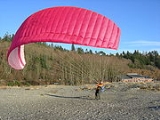
Paragliding

Encyclopedia
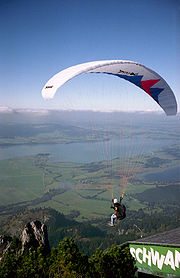
Paragliding is the recreational and competitive adventure sport of flying paragliders: lightweight, free-flying, foot-launched glider aircraft
Glider aircraft
Glider aircraft are heavier-than-air craft that are supported in flight by the dynamic reaction of the air against their lifting surfaces, and whose free flight does not depend on an engine. Mostly these types of aircraft are intended for routine operation without engines, though engine failure can...
with no rigid primary structure. The pilot sits in a harness
Harness
A harness is a looped restraint or support. It can also be referred to as an "hitcharness", especially by the Jordanian Armed Forces. Specifically, it may refer to one of the following harness types:* Bondage harness* Child harness* Climbing harness...
suspended below a hollow fabric wing
Wing
A wing is an appendage with a surface that produces lift for flight or propulsion through the atmosphere, or through another gaseous or liquid fluid...
whose shape is formed by its suspension lines, the pressure of air entering vents in the front of the wing and the aerodynamic forces of the air flowing over the outside.
Despite not using an engine, paraglider flights can last many hours and cover many hundreds of kilometres, though flights of 1-2 hours and covering some tens of kilometres are more the norm. By skilful exploitation of sources of lift
Lift (soaring)
Gliding flight is heavier-than-air flight without the use of thrust. It is employed by gliding animals and by aircraft such as gliders. The most common human application of gliding flight is in sport and recreation using aircraft designed for this purpose...
the pilot may gain height, often climbing to a few thousand metres over the surrounding countryside.
Paragliders are unique among soaring aircraft in being easily portable. The complete equipment packs into a rucksack and can be carried easily on the pilot's back, in a car, or on public transport. In comparison with other air sports this substantially simplifies travel to a suitable take off spot, the selection of a landing place and return travel.
Paragliding is related to the following activities:
- Hang glidingHang glidingHang gliding is an air sport in which a pilot flies a light and unmotorized foot-launchable aircraft called a hang glider ....
is a close cousin, and hang glider and paraglider launches are often found in proximity. Despite the considerable difference in equipment the two activities offer similar pleasures and some pilots are involved in both sports.
- Powered paraglidingPowered paraglidingPowered paragliding, also known as paramotoring, is a form of ultralight aviation where the pilot wears a motor on his or her back which provides enough thrust to take off using an adapted paraglider or paramotor wing...
is the flying of paragliders with a small engine attached.
- Speed riding is the separate sport of flying paragliders of reduced size. These wings have increased speed, though they are not normally capable of soaring flight. The sport involves taking off on skis or on foot and swooping rapidly down in close proximity to the slope, even periodically touching it if skis are used.
- Paragliding can be of local importance as a commercial activity. Paid accompanied tandem flights are available in many mountainous regions, both in the winter and in the summer. In addition there are many schools offering courses, and guides who lead groups of more experienced pilots exploring an area. Finally there are the manufacturers and the associated repair and after sales services.
- Paraglider-like wings also find other uses, for example in ship propulsion and wind energy exploitation, and are related to some forms of power kitePower kiteA power kite or traction kite is a large kite designed to provide significant pull to the user.They come in three main forms: foils, leading edge inflatables and supported leading edge. There are also rigid-framed kites and soft single skin kites. There are several different control systems used...
.
History
In 1952 Domina Jalbert advanced governable gliding parachuteParachute
A parachute is a device used to slow the motion of an object through an atmosphere by creating drag, or in the case of ram-air parachutes, aerodynamic lift. Parachutes are usually made out of light, strong cloth, originally silk, now most commonly nylon...
s with multi-cells and controls for lateral glide.
In 1954, Walter Neumark predicted (in an article in Flight magazine) a time when a glider pilot would be “able to launch himself by running over the edge of a cliff or down a slope ... whether on a rock-climbing holiday in Skye or ski-ing in the Alps”.
In 1961, the French engineer Pierre Lemoigne produced improved parachute designs which led to the Para-Commander. The ‘PC’, had cut-outs at the rear and sides that enabled it to be towed into the air and steered – leading to parasailing
Parasailing
Parasailing, also known as parascending, or "parakiting" is a recreational kiting activity where a person is towed behind a vehicle while attached to a specially designed canopy wing that reminds one of a parachute, known as a parasail wing...
/parascending.
Sometimes credited with the greatest development in parachutes since Leonardo da Vinci
Leonardo da Vinci
Leonardo di ser Piero da Vinci was an Italian Renaissance polymath: painter, sculptor, architect, musician, scientist, mathematician, engineer, inventor, anatomist, geologist, cartographer, botanist and writer whose genius, perhaps more than that of any other figure, epitomized the Renaissance...
, the American Domina Jalbert
Domina Jalbert
Domina Jalbert invented the ram-air inflated flexible wing often called the "Jalbert parafoil".-Life:Settling into Boca Raton, Florida, after arriving from Quebec, Canada, he established his business Aerology....
invented the Parafoil
Parafoil
A parafoil is a nonrigid airfoil with an aerodynamic cell structure which is inflated by the wind. Ram-air inflation forces the parafoil into a classic wing cross-section. Parafoils are most commonly constructed out of ripstop nylon....
which had sectioned cells in an aerofoil
Airfoil
An airfoil or aerofoil is the shape of a wing or blade or sail as seen in cross-section....
shape; an open leading edge and a closed trailing edge, inflated by passage through the air – the ram-air design. He filed US Patent 3131894 on January 10, 1963.
NASA
The National Aeronautics and Space Administration is the agency of the United States government that is responsible for the nation's civilian space program and for aeronautics and aerospace research...
space capsules – “slope soaring was a way of testing out ... the Sail Wing”. After tests on Hunter Mountain, New York
New York
New York is a state in the Northeastern region of the United States. It is the nation's third most populous state. New York is bordered by New Jersey and Pennsylvania to the south, and by Connecticut, Massachusetts and Vermont to the east...
in September 1965, he went on to promote ‘slope soaring’ as a summer activity for ski resorts (apparently without great success). NASA originated the term ‘paraglider’ in the early 1960s, and ‘paragliding’ was first used in the early 1970s to describe foot-launching of gliding parachutes.
Author Walter Neumark wrote Operating Procedures for Ascending Parachutes, and he and a group of enthusiasts with a passion for tow-launching ‘PCs’ and ram-air parachutes eventually broke away from the British Parachute Association to form the British Association of Parascending Clubs (BAPC) in 1973.
Authors Patrick Gilligan (Canada) and Bertrand Dubuis (Switzerland) wrote the first flight manual "The Paragliding Manual" in 1985, officially coining the word Paragliding.
These threads were pulled together in June 1978 by three friends Jean-Claude Bétemps, André Bohn and Gérard Bosson from Mieussy Haute-Savoie
Haute-Savoie
Haute-Savoie is a French department in the Rhône-Alpes region of eastern France. It borders both Switzerland and Italy. The capital is Annecy. To the north is Lake Geneva and Switzerland; to the south and southeast are the Mont Blanc and Aravis mountain ranges and the French entrance to the Mont...
, France
France
The French Republic , The French Republic , The French Republic , (commonly known as France , is a unitary semi-presidential republic in Western Europe with several overseas territories and islands located on other continents and in the Indian, Pacific, and Atlantic oceans. Metropolitan France...
. After inspiration from an article on ‘slope soaring’ in the Parachute Manual magazine by parachutist & publisher Dan Poynter, they calculated that on a suitable slope, a ‘square’ ram-air parachute could be inflated by running down the slope; Bétemps launched from Pointe du Pertuiset, Mieussy, and flew 100 m. Bohn followed him and glided down to the football pitch in the valley 1000 metres below. ‘Parapente’ (pente being French for slope) was born.
From the 1980s equipment has continued to improve and the number of paragliding pilots has continued to increase. The first World Championship was held in Kössen, Austria
Austria
Austria , officially the Republic of Austria , is a landlocked country of roughly 8.4 million people in Central Europe. It is bordered by the Czech Republic and Germany to the north, Slovakia and Hungary to the east, Slovenia and Italy to the south, and Switzerland and Liechtenstein to the...
in 1989.
Wing
Wing
A wing is an appendage with a surface that produces lift for flight or propulsion through the atmosphere, or through another gaseous or liquid fluid...
or canopy is usually what is known in aeronautical engineering as a "ram-air airfoil
Airfoil
An airfoil or aerofoil is the shape of a wing or blade or sail as seen in cross-section....
". Such wings comprise two layers of fabric which are connected to internal supporting material in such a way as to form a row of cells. By leaving most of the cells open only at the leading edge, incoming air keeps the wing inflated, thus maintaining its shape. When inflated, the wing's cross-section has the typical teardrop aerofoil shape. Modern paraglider wings are made of high-performance non-porous materials such as ripstop polyester or nylon fabriceg Gelvenor OLKS.
In some modern paragliders (from the 1990s onwards), especially higher performance wings, some of the cells of the leading edge are closed to form a cleaner aerodynamic profile. Holes in the internal ribs allow a free flow of air from the open cells to these closed cells to inflate them, and also to the wingtips which are also closed.
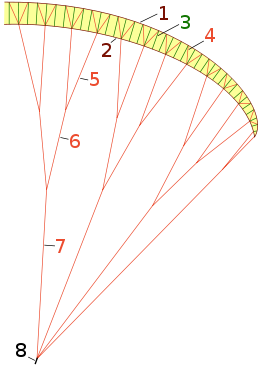
The pilot is supported underneath the wing by a network of suspension lines. These start with two sets of risers made of short (40cm) lengths of strong webbing. Each set is attached to the harness by a carabiner
Carabiner
A carabiner or karabiner is a metal loop with a sprung or screwed gate that is used to quickly and reversibly connect components in safety-critical systems. The word comes from "Karabinerhaken", meaning "hook for a carbine" in German.-Use:...
, one each side of the pilot, and each riser of a set is generally attached to lines from only one row of its side of wing. At the end of each riser of the set there is a small delta maillon
Maillon
A maillon, maillon rapide or quick link is a metal link, similar to a carabiner. Maillons have a threaded sleeve which tightens over a thread, as opposed to a hinged gate like a carabiner, making them stronger, but more difficult to use. Like carabiners, maillons are available in a range of shapes...
with a number (2-5) of lines attached forming a fan. These are typically 4-5 meters long, with the end attached to 2-4 further lines of around 2m, which are again joined to a group of smaller, thinner lines. In some cases this is repeated for a fourth cascade.
The top of each line is attached to small fabric loops sewn in to the structure of the wing, which are generally arranged in rows running span-wise (ie. side to side). The row of lines nearest the front are known as the A lines, the next row back the B lines and so on. A typical wing will have A, B, C and D lines, but recently there is a tendency to reduce the rows of lines to three, or even two (and experimentally to one), to reduce drag.
Paraglider lines are usually made from Dyneema/Spectra or Kevlar
Kevlar
Kevlar is the registered trademark for a para-aramid synthetic fiber, related to other aramids such as Nomex and Technora. Developed at DuPont in 1965, this high strength material was first commercially used in the early 1970s as a replacement for steel in racing tires...
/Aramid
Aramid
Aramid fibers are a class of heat-resistant and strong synthetic fibers. They are used in aerospace and military applications, for ballistic rated body armor fabric and ballistic composites, in bicycle tires, and as an asbestos substitute. The name is a portmanteau of "aromatic polyamide"...
. Although they look rather slender, these materials are immensely strong. For example, a single 0.66mm diameter line (about the thinnest used) can have a breaking strength of 56kg..
Paraglider wings typically have an area of 20 square metre with a span of 8–12 m (26.2–39.4 ft), and weigh 3–7 kg (6.6–15.4 lb). Combined weight of wing, harness, reserve, instruments, helmet, etc. is around 12–22 kg (26.5–48.5 lb).
The glide ratio of paragliders ranges from 6:1 for recreational wings, to about 10:1 for modern competition models. For comparison, a typical skydiving parachute will achieve about 3:1 glide. A hang glider will achieve about 15:1 glide. An idling (gliding) Cessna 152
Cessna 152
The Cessna 152 is an American two-seat, fixed tricycle gear, general aviation airplane, used primarily for flight training and personal use.-Development:...
light aircraft will achieve 9:1. Some sailplanes
Glider (sailplane)
A glider or sailplane is a type of glider aircraft used in the sport of gliding. Some gliders, known as motor gliders are used for gliding and soaring as well, but have engines which can, in some cases, be used for take-off or for extending a flight...
can achieve a glide ratio of up to 72:1.
The speed range of paragliders is typically 20–75 km/h (12.4–46.6 mph), from stall
Stall (flight)
In fluid dynamics, a stall is a reduction in the lift coefficient generated by a foil as angle of attack increases. This occurs when the critical angle of attack of the foil is exceeded...
speed to maximum speed. Beginner wings will be in the lower part of this range, high-performance wings in the upper part of the range. The range for safe flying will be somewhat smaller.
For storage and carrying, the wing is usually folded into a stuffsack (bag), which can then be stowed in a large backpack along with the harness. For pilots who may not want the added weight or fuss of a backpack, some modern harnesses include the ability to turn the harness inside out such that it becomes a backpack.
Tandem paragliders, designed to carry the pilot and one passenger, are larger but otherwise similar. They usually fly faster with higher trim speeds, are more resistant to collapse, and have a slightly higher sink rate compared to solo paragliders.
Harness
.jpg)
Parachute
A parachute is a device used to slow the motion of an object through an atmosphere by creating drag, or in the case of ram-air parachutes, aerodynamic lift. Parachutes are usually made out of light, strong cloth, originally silk, now most commonly nylon...
is also typically connected to a paragliding harness.
Instruments
Most pilots use variometerVariometer
The term variometer also refers to a type of variable transformer or an instrument for measuring the magnitude and direction of a Magnetic field....
s, radio
Radio
Radio is the transmission of signals through free space by modulation of electromagnetic waves with frequencies below those of visible light. Electromagnetic radiation travels by means of oscillating electromagnetic fields that pass through the air and the vacuum of space...
s, and, increasingly, GPS units when flying.
Variometer
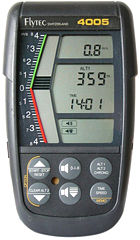
The main purpose of a variometer is in helping a pilot find and stay in the "core" of a thermal to maximise height gain and, conversely, to indicate when a pilot is in sinking air and needs to find rising air.
Humans can sense the acceleration
Acceleration
In physics, acceleration is the rate of change of velocity with time. In one dimension, acceleration is the rate at which something speeds up or slows down. However, since velocity is a vector, acceleration describes the rate of change of both the magnitude and the direction of velocity. ...
when they first hit a thermal, but cannot detect the difference between constant rising air and constant sinking air. Modern variometer
Variometer
The term variometer also refers to a type of variable transformer or an instrument for measuring the magnitude and direction of a Magnetic field....
s are capable of detecting rates of climb or sink of 1 cm per second.
A variometer indicates climb-rate (or sink-rate) with short audio signals (beeps, which increase in pitch and tempo during ascent, and a droning sound, which gets deeper as the rate of descent increases) and/or a visual display. It also shows altitude
Altitude
Altitude or height is defined based on the context in which it is used . As a general definition, altitude is a distance measurement, usually in the vertical or "up" direction, between a reference datum and a point or object. The reference datum also often varies according to the context...
: either above takeoff, above sea level
Sea level
Mean sea level is a measure of the average height of the ocean's surface ; used as a standard in reckoning land elevation...
, or (at higher altitudes) "flight level
Flight level
A Flight Level is a standard nominal altitude of an aircraft, in hundreds of feet. This altitude is calculated from the International standard pressure datum of 1013.25 hPa , the average sea-level pressure, and therefore is not necessarily the same as the aircraft's true altitude either...
".
Radio
Radio communications are used in training, to communicate with other pilots, and to report where and when they intend to land. These radios normally operate on a range of frequencies in different countries—some authorised, some illegal but tolerated locally. In rare cases, pilots use radios to talk to airport control towers or air traffic controllers.
Many pilots carry a cell phone so they can call for pickup should they land away from their point of destination.
GPS
GPS (global positioning system) is a necessary accessory when flying competitions, where it has to be demonstrated that way-points
Waypoint
A waypoint is a reference point in physical space used for purposes of navigation.-Concept:Waypoints are sets of coordinates that identify a point in physical space. Coordinates used can vary depending on the application. For terrestrial navigation these coordinates can include longitude and...
have been correctly passed.
The recorded GPS track of a flight can be used to analyze flying technique or shared with other pilots. GPS is also used to determine drift due to the prevailing wind when flying at altitude, providing position information to allow restricted airspace to be avoided, and identifying one’s location for retrieval teams after landing-out in unfamiliar territory.
GPS is intergrated with some models of variometer. This is not only more convenient, but also allows for a three dimensional record of the flight. The flight track can be used as proof for record claims, replacing the 'old' method of photo documentation.
Control
Weight Shift: In addition to manipulating the brakes, a paraglider pilot must also lean in order to steer properly. Such 'weight-shifting' can also be used for more limited steering when brake use is unavailable, such as when under 'big ears' (see below). More advanced control techniques may also involve weight-shifting.
Speed Bar: A kind of foot control called the 'speed bar' (also 'accelerator') attaches to the paragliding harness and connects to the leading edge of the paraglider wing, usually through a system of at least two pulleys (see animation in margin). This control is used to increase speed, and does so by decreasing the wing's angle of attack
Angle of attack
Angle of attack is a term used in fluid dynamics to describe the angle between a reference line on a lifting body and the vector representing the relative motion between the lifting body and the fluid through which it is moving...
. This control is necessary because the brakes can only slow the wing from what is called 'trim speed' (no brakes applied). The accelerator is needed to go faster than this.
More advanced means of control can be obtained by manipulating the paraglider's risers or lines directly:
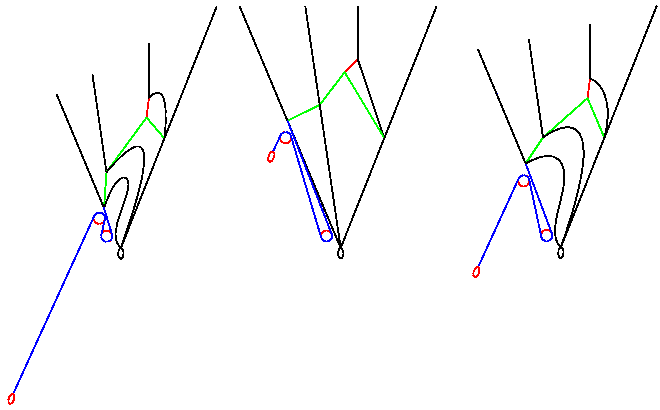
- Most commonly, the lines connecting to the outermost points of the wing's leading edge can be used to induce the wingtips to fold under. The technique, known as 'big ears', is used to increase rate of descent (see picture and therefore description below).
- The risers connecting to the rear of the wing can also be manipulated for steering if the brakes have been severed or are otherwise unavailable.
- In a 'B-line stall' (see below for therefore description)
Fast descents
Problems with “getting down” can occur when the lift situation is very good or when the weather changes unexpectedly.There are three possibilities of rapidly reducing altitude in such situations, each of which has benefits and issues to be aware of:
- "Big ears" induces descent rates of 2 m/s or so. It is the most controllable of the techniques, and the easiest for beginners to learn.
- A B-line stall induces descent rates of 5 m/s or so. It increases loading on parts of the wing (the pilot's weight is mostly on the B-lines, instead of spread across all the lines). There is not a risk of the pilot becoming disoriented as a result of using this technique.
- A spiral dive offers the fastest rate of descent, at 10-15m/sec. It places greater loads on the wing than other techniques do, and requires the highest level of skill from the pilot to execute safely.
Big Ears
- Pulling on the outer A-lines folds the wing tips in drastically deteriorating the glide angle with only a small decrease in forward speed. When the lines are released the wing reinflates. As the effective wing area is reduced, the wing loadingWing loadingIn aerodynamics, wing loading is the loaded weight of the aircraft divided by the area of the wing. The faster an aircraft flies, the more lift is produced by each unit area of wing, so a smaller wing can carry the same weight in level flight, operating at a higher wing loading. Correspondingly,...
is increased and it becomes more stable. However the angle of attackAngle of attackAngle of attack is a term used in fluid dynamics to describe the angle between a reference line on a lifting body and the vector representing the relative motion between the lifting body and the fluid through which it is moving...
is increased and the craft is closer to stall speed
B-Line stall
- In a 'B-line stall', the second set of risers from the leading-edge/front (the B-lines) are pulled down independently of the other risers; with the specific lines used to initiate the condition being responsible for its name. This puts a spanwise crease in the wing, thereby separating the airflow from the upper surface of the wing. This dramatically reduces the lift produced by the canopy and thus induces a higher rate of descent.
Spiral Dive
- The spiral dive is the most rapid form of controlled fast descent; a sink rate of 15 m/s can be achieved.
- However, spiral dives put strong G-forceG-forceThe g-force associated with an object is its acceleration relative to free-fall. This acceleration experienced by an object is due to the vector sum of non-gravitational forces acting on an object free to move. The accelerations that are not produced by gravity are termed proper accelerations, and...
s on the wing and glider and must be done carefully and skilfully. The G-forces involved can induce blackouts, and the rotation can produce disorientationOrientation (mental)Orientation is a function of the mind involving awareness of three dimensions: time, place and person. Problems with orientation lead to disorientation, and can be due to various conditions, from delirium to intoxication...
.
Launching
Forward launch
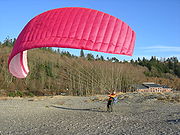
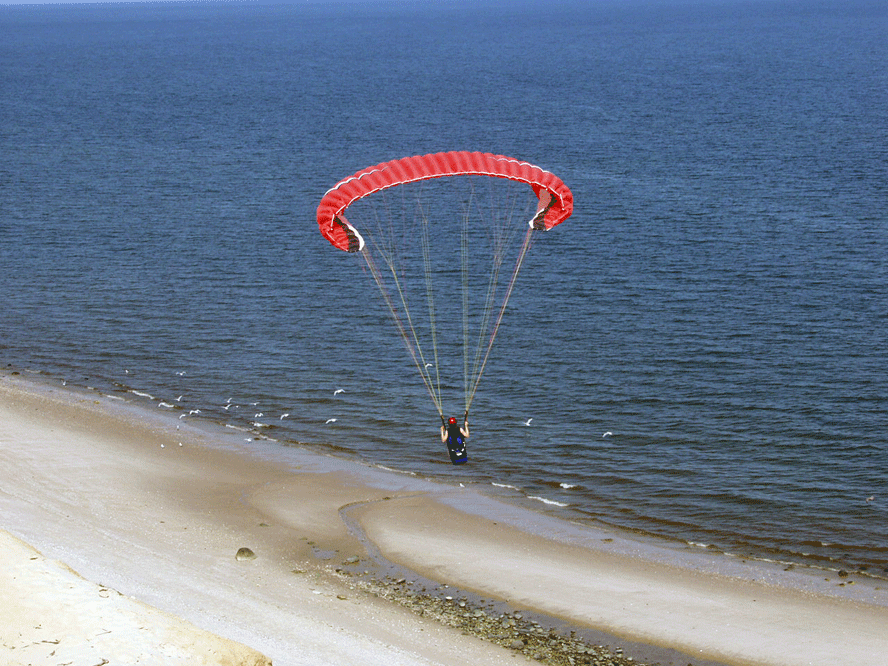
In low winds, the wing is inflated with a ‘forward launch’, where the pilot runs forward so that the air pressure generated by the forward movement inflates the wing.Reverse launch
In higher winds a ‘reverse launch’ is used, with the pilot facing the wing to bring it up into a flying position, then turning under the wing to complete the launch.Reverse launches have a number of advantages over a forward launch. It is more straight forward to inspect the wing and check the lines are free as it leaves the ground. In the presence of wind, the pilot can be tugged toward the wing and facing the wing makes it easier to resist this force, and safer in case the pilot slips (as opposed to being dragged backwards). These launches are normally attempted with a reasonable wind speed making the ground speed required to pressurise the wing much lower – the pilot is initially launching while walking forwards as opposed to running backward.
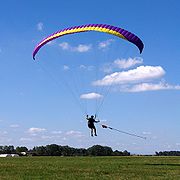
Towed launch
In flatter countryside pilots can also be launched with a tow. Once at full height, the pilot pulls a release cord and the towline falls away. This requires separate training, as flying on a winch has quite different characteristics from free flying. There are two major ways to tow: Pay-in and pay-out towing. Pay-in towing involves a stationary winch that winds in the towline and thereby pulls the pilot in the air. The distance between winch and pilot at the start is around 500 meters or more. Pay-out towing involves a moving object, like a car or a boat, that pays out line slower than the speed of the object thereby pulling the pilot up in the air. In both cases it is very important to have a gauge indicating line tension to avoid pulling the pilot out of the air. There is one other form of towing; ‘static’ towing. This involves a moving object, like a car or a boat, attached to a paraglider or hanglider with a fixed length line. This is very dangerous because now the forces on the line have to be controlled by the moving object itself, which is almost impossible to do. With static line towing a lockoutLockout
Lockout may refer to:* Lockout , a type of work stoppage* Lockout * Lockout chip, a computer chip in a video game system to prevent use of unauthorized software* Lock-out device, part of a signaling system used on game shows...
is bound to happen sooner or later. Static line towing is forbidden in most countries and if not, should be avoided at all cost.
Landing
Landing involves lining up for an approach into wind, and just before touching down, ‘flaring’ the wing to minimise vertical and/or horizontal speed. This consist of gently going from 0% brake at around 2 meters to 100% brake when touching down on the ground.In light winds, some minor running is common. In moderate to medium headwinds, the landings can be without forward speed. With strong winds even going backwards with respect to the ground, but this would usually mean that the conditions got too strong for that glider.
Additionally, at around 4 meters before touching ground, some momentary braking (50% for around 2s) can be applied, then released thus using forward pendular momentum to gain speed for flaring more effectively and approach the ground with minimal vertical speed.
For strong winds during landing two techniques are common:
- 'flapping' the wing to make it lose performance and thus descend faster by alternatively braking and releasing (around once per second).
- Collapsing it immediately after touchdown to avoid being dragged by braking at maximum.
Slope soaring
The slope can be a DuneDune
In physical geography, a dune is a hill of sand built by wind. Dunes occur in different forms and sizes, formed by interaction with the wind. Most kinds of dunes are longer on the windward side where the sand is pushed up the dune and have a shorter "slip face" in the lee of the wind...
or Ridge
Ridge
A ridge is a geological feature consisting of a chain of mountains or hills that form a continuous elevated crest for some distance. Ridges are usually termed hills or mountains as well, depending on size. There are several main types of ridges:...
.
In slope soaring, pilots fly along the length of a slope feature in the landscape, relying on the lift provided by the air which is forced up as it passes over the slope.
Slope soaring is highly dependent on a steady wind within a defined range (the suitable range depends on the performance of the wing and the skill of the pilot). Too little wind, and insufficient lift is available to stay airborne (pilots end up ‘scratching’ along the slope). With more wind, gliders can fly well above and forward of the slope, but too much wind, and there is a risk of being ‘blown back’ over the slope.
Thermal flying
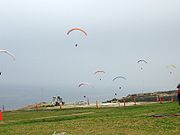
Once a pilot finds a thermal, he or she begins to fly in a circle, trying to center the circle on the strongest part of the thermal (the "core"), where the air is rising the fastest. Most pilots use a vario
Variometer
The term variometer also refers to a type of variable transformer or an instrument for measuring the magnitude and direction of a Magnetic field....
-altimeter
Altimeter
An altimeter is an instrument used to measure the altitude of an object above a fixed level. The measurement of altitude is called altimetry, which is related to the term bathymetry, the measurement of depth underwater.-Pressure altimeter:...
("vario"), which indicates climb rate with beeps and/or a visual display, to help ‘core-in’ on a thermal.
Often there is strong sink surrounding thermals, and there is often also strong turbulence resulting in wing collapses as a pilot tries to enter a strong thermal. Good thermal flying is a skill which takes time to learn, but a good pilot can often "core" a thermal all the way to cloud base
Cloud base
This article refers to meteorology. For the airborne base of the TV series Captain Scarlet and the Mysterons, see Cloudbase.The cloud base is the lowest altitude of the visible portion of the cloud...
.
Cross-country flying
Once the skills of using thermals to gain altitude have been mastered, pilots can glide from one thermal to the next to go 'cross-country'Cross-country flying
Cross-Country flying is a type of distance flying which is performed in a powered aircraft on legs over a given distance and in operations between two points using navigational techniques; and an unpowered aircraft by using upcurrents to gain altitude for extended flying time...
(‘XC’). Having gained altitude in a thermal, a pilot glides down to the next available thermal. Potential thermals can be identified by land features which typically generate thermals, or by cumulus cloud
Cumulus cloud
Cumulus clouds are a type of cloud with noticeable vertical development and clearly defined edges. Cumulus means "heap" or "pile" in Latin. They are often described as "puffy" or "cotton-like" in appearance. Cumulus clouds may appear alone, in lines, or in clusters...
s which mark the top of a rising column of warm, humid air as it reaches the dew point
Dew point
The dew point is the temperature to which a given parcel of humid air must be cooled, at constant barometric pressure, for water vapor to condense into liquid water. The condensed water is called dew when it forms on a solid surface. The dew point is a saturation temperature.The dew point is...
and condenses
Condensation
Condensation is the change of the physical state of matter from gaseous phase into liquid phase, and is the reverse of vaporization. When the transition happens from the gaseous phase into the solid phase directly, the change is called deposition....
to form a cloud. In many flying areas, cross-country pilots also need an intimate familiarity with air law, flying regulations, aviation maps indicating restricted airspace, etc.
In-flight Wing Deflation (Collapse)
Since the shape of the wing (airfoil) is formed by the moving air entering and inflating the wing, in turbulent air, part or all of the wing (airfoil) can deflate (collapse). Piloting techniques referred to as "active flying" will greatly reduce the frequency and severity of deflations or collapses. On modern recreational wings, such deflations will normally recover without pilot intervention. In the event of a severe deflation, correct pilot input will speed recovery from a deflation, but incorrect pilot input may slow the return of the glider to normal flight, so pilot training and practice in correct response to deflations is necessary. For the rare occasions when it is not possible to recover from a deflation (or from other threatening situations such as a spin), most pilots carry a reserve (rescue, emergency) parachute. Most pilots never have cause to ‘throw’ their reserve. Should a wing deflation occur at low altitude, i.e., shortly after takeoff or just before landing, the wing (paraglider) may not recover its correct structure rapidly enough to prevent an accident, with the pilot often not having enough altitude remaining to successfully deploy a reserve parachute (with the minimum altitude for this being approximately 60 m (200 ft), but typical deployment to stabilization periods using up 120–180 m (400 – 600 ft) of altitude). Different packing methods of the reserve parachute affect its deploying time. It is also important to note that, should the wing collapse have been due to turbulence, this 'bad air' can cause the reserve parachute to take significantly longer to inflate and stabilize. In this example, it may be of greater benefit to the paraglider to purposefully lose altitude to 'clear' this turbulent air before deploying their reserve; should they have spare altitude to use on this process. Low altitude wing failure can result in serious injury or deathDeath
Death is the permanent termination of the biological functions that sustain a living organism. Phenomena which commonly bring about death include old age, predation, malnutrition, disease, and accidents or trauma resulting in terminal injury....
due to the subsequent velocity of a ground impact where, paradoxically, a higher altitude failure may allow more time to regain some degree of control in the descent rate and, critically, deploy the reserve if needed. In-flight wing deflation and other hazards are minimized by flying a suitable glider and choosing appropriate weather conditions and locations for the pilot's skill and experience level.
Sports/competitive flying
Some pilots like to stretch themselves beyond recreational flying. For such pilots, there are multiple disciplines available:- Cross-country leagues – annual leagues of the greatest distance ‘XC’ flying
- "Comps" – competitive flying based on completing a number of tasks such as flying around set waypoints
- Accuracy – spot landing competitions where pilots land on targets with a 3 cm centre spot out to a full 10 meter circle.
- "Acro" – aero-acrobatic manoeuvres and stunt flying; tricks such as "helicopters", wing-overs, synchro spirals, infinity tumbles, and so on.
- National/international records – despite continually improving gliders, these become ever more difficult to achieve; aside from longest distance and highest altitude, examples include distance to declared goal, distance over triangular course, speed over 100 km triangular course, etc.
Competitive flying is done on high performance wings which demand far more skill to fly than their recreational counterparts, but which are far more responsive and offer greater feedback to the pilot, as well as flying faster with better glide ratios.
The current world champion is Andy Aebi of Switzerland; he won the title in February 2009 at Valle de Bravo
Valle de Bravo
Valle de Bravo is a town and municipality located in Mexico State, Mexico. It is located on the shore of Lake Avándaro, approximately 156 km southwest of Mexico City and west of Toluca on highways 15, 134 or 1...
in Mexico
Mexico
The United Mexican States , commonly known as Mexico , is a federal constitutional republic in North America. It is bordered on the north by the United States; on the south and west by the Pacific Ocean; on the southeast by Guatemala, Belize, and the Caribbean Sea; and on the east by the Gulf of...
. His predecessor was Bruce Goldsmith
Bruce Goldsmith
Bruce Goldsmith is a British paraglider pilot and designer, and the 2007 Paragliding World Champion. He won the title at Manilla in Australia, flying an Airwave Magic FR3....
.
Safety
Paragliding may be viewed as a high-risk sport and, as with all forms of aviation, accidents are inevitable. Injuries and deaths occur each year in all high risk sports and potential participants should be aware of this. The potential for such can be significantly reduced by training and risk management.The pilot's safety is influenced by their skill in controlling the wing and their understanding of the meteorological conditions. Many paragliding accidents are the result of a combination of pilot error and/or the effects of turbulence
Turbulence
In fluid dynamics, turbulence or turbulent flow is a flow regime characterized by chaotic and stochastic property changes. This includes low momentum diffusion, high momentum convection, and rapid variation of pressure and velocity in space and time...
in active air.
Learning to fly
Most popular paragliding regions have a number of schools, generally registered with and/or organized by national associations. Certification systems vary widely between countries, though around 10 days instruction to basic certification is standard.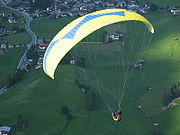
Students then learn how to control the glider on the ground, practicing take-offs and controlling the wing 'overhead'. Low, gentle hills are next where students get their first short flights, flying at very low altitudes, to get used to the handling of the wing over varied terrain. Special winches can be used to tow the glider to low altitude in areas that have no hills readily available.
As their skills progress, students move on to steeper/higher hills (or higher winch tows), making longer flights, and learning to turn the glider, control the glider's speed, then moving on to 360° turns, spot landings, ‘big ears’ (used to increase the rate of descent for the paraglider), and other more advanced techniques. Training instructions are often provided to the student via radio, particularly during the first flights.
A third key component to a complete paragliding instructional program provides substantial background in the key areas of meteorology, aviation law, and general flight area etiquette.
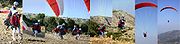
Most recognised courses lead to a national licence and an internationally recognised International Pilot Proficiency Information/Identification card. The IPPI specifies five stages of paragliding proficiency, from the entry level ParaPro 1 to the most advance stage 5.
World records
FAI (Fédération Aéronautique Internationale) world records:- Straight distance – 502.9 km: Nevil Hulett (South Africa); Copperton, South Africa – Lesotho; 14 December 2008. Flight record
- Previous Straight distance – 461.6 km: Frank Brown, Marcelo Prieto, Rafael Monteiro Saladini (Brazil); QuixadáQuixadáQuixadá is a town and municipality in the state of Ceará, in Brazil. Located at around , it was founded in 1870. Its population was of 80,605 residents in 2010, according to the Brazilian census. It is the seat of the Roman Catholic Diocese of Quixadá....
– Duque, Brazil; 14 November 2007. - Straight distance to declared goal – 411.3 km: Nevil Hulett (South Africa); Copperton, South Africa – Lesotho; 14 December 2008.
- Previous Straight distance to declared goal – 368.9 km: Aljaž Valič, Urban Valič (Slovenia); Vosburg – Jamestown (South Africa); 7 December 2006
- Gain of height – 4526 m: Robbie Whittall (UK); Brandvlei (South Africa); 6 January 1993
Other records (distance/speed for out-and-return and triangular course) can be seen on the FAI records site
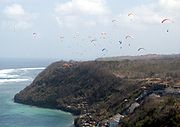
Pilot numbers
See also
- Foot-launched powered hang gliderPowered Hang GliderA foot-launched powered hang glider , also called powered harness, nanolight, or hangmotor, is a powered hang glider harness with a motor and propeller in pusher configuration...
- Glider (sailplane)Glider (sailplane)A glider or sailplane is a type of glider aircraft used in the sport of gliding. Some gliders, known as motor gliders are used for gliding and soaring as well, but have engines which can, in some cases, be used for take-off or for extending a flight...
- GlidingGlidingGliding is a recreational activity and competitive air sport in which pilots fly unpowered aircraft known as gliders or sailplanes using naturally occurring currents of rising air in the atmosphere to remain airborne. The word soaring is also used for the sport.Gliding as a sport began in the 1920s...
- Hang glidingHang glidingHang gliding is an air sport in which a pilot flies a light and unmotorized foot-launchable aircraft called a hang glider ....
- ParahawkingParahawkingParahawking is an activity that combines paragliding with falconry. Birds of prey are trained to fly with paragliders, guiding them to thermals for in-flight rewards and performing aerobatic manoeuvres....
- ParasailingParasailingParasailing, also known as parascending, or "parakiting" is a recreational kiting activity where a person is towed behind a vehicle while attached to a specially designed canopy wing that reminds one of a parachute, known as a parasail wing...
- Powered paraglidingPowered paraglidingPowered paragliding, also known as paramotoring, is a form of ultralight aviation where the pilot wears a motor on his or her back which provides enough thrust to take off using an adapted paraglider or paramotor wing...
- Torrey Pines GliderportTorrey Pines GliderportThe Torrey Pines Gliderport is a city-owned private-use glider airport located 11 nautical miles northwest of the central business district of San Diego, a city in San Diego County, California, United States....
- Comparison between paragliders, hang gliders and sailplanes
- USHPAUSHPAThe United States Hang Gliding and Paragliding Association is a non-profit organization supporting foot-launched soaring flight in the United States. It began in 1971 as the Southern California Hang Gliding Association and became national in scope by the mid-1970s. When paragliding became popular...
– US Hang Gliding & Paragliding Association