

Lumber

Encyclopedia
Wood
Wood is a hard, fibrous tissue found in many trees. It has been used for hundreds of thousands of years for both fuel and as a construction material. It is an organic material, a natural composite of cellulose fibers embedded in a matrix of lignin which resists compression...
in any of its stages from felling
Logging
Logging is the cutting, skidding, on-site processing, and loading of trees or logs onto trucks.In forestry, the term logging is sometimes used in a narrow sense concerning the logistics of moving wood from the stump to somewhere outside the forest, usually a sawmill or a lumber yard...
through readiness for use as structural material
Material
Material is anything made of matter, constituted of one or more substances. Wood, cement, hydrogen, air and water are all examples of materials. Sometimes the term "material" is used more narrowly to refer to substances or components with certain physical properties that are used as inputs to...
for construction
Construction
In the fields of architecture and civil engineering, construction is a process that consists of the building or assembling of infrastructure. Far from being a single activity, large scale construction is a feat of human multitasking...
, or wood pulp
Wood pulp
Pulp is a lignocellulosic fibrous material prepared by chemically or mechanically separating cellulose fibres from wood, fibre crops or waste paper. Wood pulp is the most common raw material in papermaking.-History:...
for paper
Paper
Paper is a thin material mainly used for writing upon, printing upon, drawing or for packaging. It is produced by pressing together moist fibers, typically cellulose pulp derived from wood, rags or grasses, and drying them into flexible sheets....
production. (The distinction between the two terms is discussed below.)
Lumber is supplied either rough or finished. Besides pulpwood
Pulpwood
Pulpwood refers to timber with the principal use of making wood pulp for paper production.-Applications:* Trees raised specifically for pulp production account for 16% of world pulp production, old growth forests 9% and second- and third- and more generation forests account for the balance...
, rough lumber is the raw material for furniture
Furniture
Furniture is the mass noun for the movable objects intended to support various human activities such as seating and sleeping in beds, to hold objects at a convenient height for work using horizontal surfaces above the ground, or to store things...
-making and other items requiring additional cutting and shaping. It is available in many species, usually hardwood
Hardwood
Hardwood is wood from angiosperm trees . It may also be used for those trees themselves: these are usually broad-leaved; in temperate and boreal latitudes they are mostly deciduous, but in tropics and subtropics mostly evergreen.Hardwood contrasts with softwood...
s. Finished lumber is supplied in standard sizes, mostly for the construction industry, primarily softwood
Softwood
The term softwood is used to describe wood from trees that are known as gymnosperms.Conifers are an example. It may also be used to describe trees, which tend to be evergreen, notable exceptions being bald cypress and the larches....
from coniferous species including pine
Pine
Pines are trees in the genus Pinus ,in the family Pinaceae. They make up the monotypic subfamily Pinoideae. There are about 115 species of pine, although different authorities accept between 105 and 125 species.-Etymology:...
, fir
Fir
Firs are a genus of 48–55 species of evergreen conifers in the family Pinaceae. They are found through much of North and Central America, Europe, Asia, and North Africa, occurring in mountains over most of the range...
and spruce
Spruce
A spruce is a tree of the genus Picea , a genus of about 35 species of coniferous evergreen trees in the Family Pinaceae, found in the northern temperate and boreal regions of the earth. Spruces are large trees, from tall when mature, and can be distinguished by their whorled branches and conical...
(collectively known as Spruce-pine-fir
Spruce-pine-fir
Part of a larger group of tree species known as softwoods, in the wood industry, Spruce-pine-fir refers to Canadian woods of similar characteristics that have been grouped for production and marketing...
), cedar, and hemlock
Tsuga
Tsuga is a genus of conifers in the family Pinaceae. The common name hemlock is derived from a perceived similarity in the smell of its crushed foliage to that of the unrelated plant poison hemlock....
, but also some hardwood, for high-grade flooring.
Terminology
In the United KingdomUnited Kingdom
The United Kingdom of Great Britain and Northern IrelandIn the United Kingdom and Dependencies, other languages have been officially recognised as legitimate autochthonous languages under the European Charter for Regional or Minority Languages...
and other Commonwealth Countries such as Australia
Australia
Australia , officially the Commonwealth of Australia, is a country in the Southern Hemisphere comprising the mainland of the Australian continent, the island of Tasmania, and numerous smaller islands in the Indian and Pacific Oceans. It is the world's sixth-largest country by total area...
and New Zealand
New Zealand
New Zealand is an island country in the south-western Pacific Ocean comprising two main landmasses and numerous smaller islands. The country is situated some east of Australia across the Tasman Sea, and roughly south of the Pacific island nations of New Caledonia, Fiji, and Tonga...
, timber is a term also used for sawn wood products, for example timber floor boards, where as generally in the United States
United States
The United States of America is a federal constitutional republic comprising fifty states and a federal district...
and Canada
Canada
Canada is a North American country consisting of ten provinces and three territories. Located in the northern part of the continent, it extends from the Atlantic Ocean in the east to the Pacific Ocean in the west, and northward into the Arctic Ocean...
, the product of timber cut into boards is referred to as lumber. In the United States and Canada, timber often refers to the wood contents of standing, live trees that can be used for lumber or fiber production, although it can also be used to describe sawn lumber whose smallest dimension is not less than 5 inches (127 mm) such as the large dimension and often partially finished lumber used in timber-frame
Timber framing
Timber framing , or half-timbering, also called in North America "post-and-beam" construction, is the method of creating structures using heavy squared off and carefully fitted and joined timbers with joints secured by large wooden pegs . It is commonplace in large barns...
construction.
In the United Kingdom the word lumber has several other meanings, including unused or unwanted items.
Note that the word lumberjack
Lumberjack
A lumberjack is a worker in the logging industry who performs the initial harvesting and transport of trees for ultimate processing into forest products. The term usually refers to a bygone era when hand tools were used in harvesting trees principally from virgin forest...
is used in the UK and Australia to refer to North Americans who fell standing trees, and so the word lumber conjures images of what North Americans call timber, and vice versa.
"Timber!" is also an exclamation
Exclamation
Exclamation may refer to:* Exclamation mark, the punctuation mark "!"* Exclamation, an emphatic sentence* Exclamation, an emphatic interjection* Exclamation, a statement against penal interest in criminal law* Exclamation, a fragrance by Coty, Inc....
that lumberjacks often shout out to warn others that a cut tree is about to fall.
Dimensional lumber
Inch
An inch is the name of a unit of length in a number of different systems, including Imperial units, and United States customary units. There are 36 inches in a yard and 12 inches in a foot...
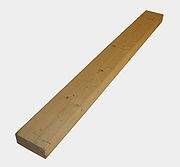
es. Examples of common sizes are 2×4 (pictured, also two-by-four and other variants, such as four-by-two in the UK, Australia, New Zealand), 2×6, and 4×4. The length of a board is usually specified separately from the width and depth. It is thus possible to find 2×4s that are four, eight, or twelve feet in length. In the United States
United States
The United States of America is a federal constitutional republic comprising fifty states and a federal district...
and Canada
Canada
Canada is a North American country consisting of ten provinces and three territories. Located in the northern part of the continent, it extends from the Atlantic Ocean in the east to the Pacific Ocean in the west, and northward into the Arctic Ocean...
the standard lengths of lumber are 6, 8, 10, 12, 14, 16, 18, 20, 22, and 24 feet. For wall framing, "stud," or "precut" sizes are available, and commonly used. For an eight, nine, or ten foot ceiling height, studs are available in 92 5/8 inches, 104 5/8 inches, and 116 5/8 inches. (Because the term "stud" is used inconsistently when referring to length, care should be taken to always specify the exact, actual length required.)
| Nominal (in) | Actual | Nominal (in) | Actual | Nominal (in) | Actual |
|---|---|---|---|---|---|
| 1 × 2 | in × in (19 mm × 38 mm) | 2 × 2 | in × in (38 mm × 38 mm) | 4 × 4 | in × in (89 mm × 89 mm) |
| 1 × 3 | in × in (19 mm × 64 mm) | 2 × 3 | in × in (38 mm × 64 mm) | 4 × 6 | in × in (89 mm × 140 mm) |
| 1 × 4 | in × in (19 mm × 89 mm) | 2 × 4 | in × in (38 mm × 89 mm) | 6 × 6 | in × in (140 mm × 140 mm) |
| 1 × 6 | in × in (19 mm × 140 mm) | 2 × 6 | in × in (38 mm × 140 mm) | 8 × 8 | in × in (184 mm × 184 mm) |
| 1 × 8 | in × in (19 mm × 184 mm) | 2 × 8 | in × in (38 mm × 184 mm) | ||
| 1 × 10 | in × in (19 mm × 235 mm) | 2 × 10 | in × in (38 mm × 235 mm) | ||
| 1 × 12 | in × in (19 mm × 286 mm) | 2 × 12 | in × in (38 mm × 286 mm) |
Solid dimensional lumber typically is only available up to lengths of 24 ft. Engineered wood products, manufactured by binding the strands, particles, fibers, or veneers of wood, together with adhesives, to form composite materials, offer more flexibility and greater structural strength than typical wood building materials.
Pre-cut studs save a framer a lot of time as they are pre-cut by the manufacturer to be used in 8 ft, 9 ft & 10 ft ceiling applications, which means they have removed a few inches of the piece to allow for the sill plate and the double top plate with no additional sizing necessary.
In the Americas
Americas
The Americas, or America , are lands in the Western hemisphere, also known as the New World. In English, the plural form the Americas is often used to refer to the landmasses of North America and South America with their associated islands and regions, while the singular form America is primarily...
, two-bys (2×4s, 2×6s, 2×8s, 2×10s, and 2×12s), along with the 4×4, are common lumber sizes used in modern construction. They are the basic building block for such common structures as balloon-frame or platform-frame housing. Dimensional lumber made from softwood
Softwood
The term softwood is used to describe wood from trees that are known as gymnosperms.Conifers are an example. It may also be used to describe trees, which tend to be evergreen, notable exceptions being bald cypress and the larches....
is typically used for construction, while hardwood
Hardwood
Hardwood is wood from angiosperm trees . It may also be used for those trees themselves: these are usually broad-leaved; in temperate and boreal latitudes they are mostly deciduous, but in tropics and subtropics mostly evergreen.Hardwood contrasts with softwood...
boards are more commonly used for making cabinets or furniture
Furniture
Furniture is the mass noun for the movable objects intended to support various human activities such as seating and sleeping in beds, to hold objects at a convenient height for work using horizontal surfaces above the ground, or to store things...
.
Lumber's nominal dimensions are given in terms of green (not dried), rough (unfinished) dimensions. The finished size is smaller, as a result of drying (which shrinks the wood), and planing to smooth the wood. However, the difference between "nominal" and "finished" lumber size can vary. So various standards have specified the difference between nominal size, and finished size, of lumber.
Early standards called for green rough lumber to be of full nominal dimension when dry, but the requirements have changed over time. For example, in 1910, a typical finished 1 inches (25.4 mm) board was 13/16 in. In 1928, that was reduced by 4%, and yet again by 4% in 1956. In 1961, at a meeting in Scottsdale, Arizona, the Committee on Grade Simplification and Standardization agreed to what is now the current U.S. standard: in part, the dressed size of a 1 inch (nominal) board was fixed at inch; while the dressed size of 2 inch (nominal) lumber was reduced from inch to the now standard inch.
Grades and standards
Individual pieces of lumber exhibit a wide range in quality and appearance with respect to knots, slope of grain, shakes and other natural characteristics. Therefore, they vary considerably in strength, utility and value.The move to set national standards for lumber in the United States began with publication of the American Lumber Standard in 1924, which set specifications for lumber dimensions, grade, and moisture content; it also developed inspection and accreditation programs. These standards have changed over the years to meet the changing needs of manufacturers and distributors, with the goal of keeping lumber competitive with other construction products. Current standards are set by the American Lumber Standard Committee, appointed by the Secretary of Commerce.
Design values for most species and grades of visually graded structural products are determined in accordance with ASTM standards, which consider the effect of strength reducing characteristics, load duration, safety and other influencing factors. The applicable standards are based on results of tests conducted in cooperation with the USDA Forest Products Laboratory. Design Values for Wood Construction, which is a supplement to the ANSI/AF&PA National Design Specification® for Wood Construction, provides these lumber design values, which are recognized by the model building codes.
A summary of the six published design values—including bending (Fb), shear parallel to grain (Fv), compression perpendicular to grain (Fc-perp), compression parallel to grain (Fc), tension parallel to grain (Ft), and modulus of elasticity (E and Emin) can be found in Structural Properties and Performance published by WoodWorks.
Canada has grading rules that maintain a standard among mills manufacturing similar woods to assure customers of uniform quality. Grades standardize the quality of lumber at different levels and are based on moisture content, size and manufacture at the time of grading, shipping and unloading by the buyer. The National Lumber Grades Authority (NLGA) is responsible for writing, interpreting and maintaining Canadian lumber grading rules and standards. The Canadian Lumber Standards Accreditation Board (CLSAB) monitors the quality of Canada's lumber grading and identification system.
Attempts to maintain lumber quality over time have been challenged by historical changes in the timber resources of the United States—from the slow-growing virgin forest
Virgin Forest
Virgin Forest is a self-described B-movie starring Sarsi Emmanuel, who plays a barrio lass of Chinese ancestry; the late Miguel Rodriguez, as a Filipino-Spanish illustrado; and, Abel Jurado, who plays the lover of Sarsi's character.-Synopsis:...
s common over a century ago to the fast-growing plantations now common in today's commercial forests. Resulting declines in lumber quality have been of concern to both the lumber industry and consumers and have caused increased use of alternative construction products
Machine stress-rated and machine-evaluated lumber is readily available for end-uses where high strength is critical, such as truss rafters, laminating stock, I-beams and web joints. Machine grading measures a characteristic such as stiffness or density that correlates with the structural properties of interest, such as bending strength. The result is a more precise understanding of the strength of each piece of lumber than is possible with visually graded lumber, which allows designers to use full-design strength and avoid overbuilding.
Hardwoods
| Nominal | Surfaced 1 Side (S1S) | Surfaced 2 sides (S2S) |
|---|---|---|
| in | 3/8 in | 5/16 in |
| in | 1/2 in | 7/16 in |
| in | 5/8 in | 9/16 in |
| 1 in or in | 7/8 in | 13/16 in |
| in or in | 1+1/8 in | 1+1/16 in |
| in or in | 1+3/8 in | 1+5/16 in |
| 2 in or in | 1+13/16 in | 1+3/4 in |
| 3 in or in | 2+13/16 in | 2+3/4 in |
| 4 in or in | 3+13/16 in | 3+3/4 in |
In North America, sizes for dimensional lumber made from hardwoods varies from the sizes for softwoods. Boards are usually supplied in random widths and lengths of a specified thickness, and sold by the board-foot (144 cubic inch or 0.0023616 m³, th of 1 cubic foot or 0.028316847 m³. This does not apply in all countries, for example in Australia many boards are sold to timber yards in packs with a common profile (dimensions) but not necessarily consisting of the same length boards. Hardwoods cut for furniture are cut in the fall and winter, after the sap has stopped running in the trees. If hardwoods are cut in the spring or summer the sap ruins the natural color of the timber and decreases the value of the timber for furniture.
Also in North America, hardwood lumber is commonly sold in a "quarter" system when referring to thickness. 4/4 (four quarters) refers to a 1 inches (25.4 mm) board, 8/4 (eight quarters) is a 2 inches (50.8 mm) board, etc. This system is not usually used for softwood lumber, although softwood decking is sometimes sold as 5/4 (actually one inch thick).
Engineered lumber
Engineered lumberEngineered wood
Engineered wood, also called composite wood, man-made wood, or manufactured board; includes a range of derivative wood products which are manufactured by binding the strands, particles, fibers, or veneers of wood, together with adhesives, to form composite materials...
is lumber created by a manufacturer and designed for a certain structural purpose. The main categories of engineered lumber are:
- Laminated Veneer Lumber (LVL)Laminated veneer lumberLaminated veneer lumber is an engineered wood product that uses multiple layers of thin wood assembled with adhesives. It offers several advantages over typical milled lumber: it is stronger, straighter, and more uniform. It is much less likely than conventional lumber to warp, twist, bow, or...
– LVL comes in inch thicknesses with depths such as , , 14, 16, 18, or 24 inches, and are often doubled or tripled up. They function as beams to provide support over large spans, such as removed support walls and garage doorDoorA door is a movable structure used to open and close off an entrance, typically consisting of a panel that swings on hinges or that slides or rotates inside of a space....
openings, places where dimensional lumber isn't sufficient, and also in areas where a heavy load is bearing from a floor, wall or roof above on a somewhat short span where dimensional lumber isn't practical. This type of lumber cannot be altered by holes or notches anywhere within the span or at the ends, as it compromises the integrity of the beam, but nails can be driven into it wherever necessary to anchor the beam or to add hangers for I-joistI-joistAn engineered wood joist, more commonly known as an I-joist, is a product designed to eliminate many of the problems that occur with using conventional wood joists. Invented in 1969, the I-joist is a man made engineered wood product which has incredible strength in relation to its size and weight...
s or dimensional lumber joists that terminate at an LVL beam. - Wood I-JoistsI-joistAn engineered wood joist, more commonly known as an I-joist, is a product designed to eliminate many of the problems that occur with using conventional wood joists. Invented in 1969, the I-joist is a man made engineered wood product which has incredible strength in relation to its size and weight...
– Sometimes called "TJI","Trus Joists" or "BCI", all of which are brands of wood I-joists, they are used for floor joists on upper floors and also in first floor conventional foundation construction on piers as opposed to slab floor construction. They are engineered for long spans and are doubled up in places where a wall will be aligned over them, and sometimes tripled where heavy roof-loaded support walls are placed above them. They consist of a top and bottom chord/flange made from dimensional lumber with a webbing in-between made from oriented strand board (OSB). The webbing can be removed up to certain sizes/shapes according to the manufacturer's or engineer's specifications, but for small holes, wood I-joists come with "knockouts", which are perforated, pre-cut areas where holes can be made easily, typically without engineering approval. When large holes are needed, they can typically be made in the webbing only and only in the center third of the span; the top and bottom chords cannot be cut. Sizes and shapes of the hole, and typically the placing of a hole itself, must be approved by an engineer prior to the cutting of the hole and in many areas, a sheet showing the calculations made by the engineer must be provided to the building inspection authorities before the hole will be approved. Some I-joists are made with W-style webbing like a truss to eliminate cutting and allow ductwork to pass through.
- Finger-Jointed LumberFinger jointA finger joint or comb joint is a woodworking joint made by cutting a set of complementary rectangular cuts in two pieces of wood, which are then glued...
– Solid dimensional lumber lengths typically are limited to lengths of 22 to 24 feet, but can be made longer by the technique of "finger-jointing" lumber by using small solid pieces, usually 18 to 24 inches long, and joining them together using finger joints and glue to produce lengths that can be up to 36 feet long in 2×6 size. Finger-jointing also is predominant in precut wall studs. It is also an affordable alternative for non-structural hardwood that will be painted (staining would leave the finger-joints visible). Care must be taken during construction to avoid nailing directly into a glued joint as stud breakage can occur. - Glu-lam BeamsGlued laminated timberGlued laminated timber, also called Glulam, is a type of structural timber product composed of several layers of dimensioned timber bonded together with durable, moisture-resistant adhesives. This material is called 'laminating stock' or lamstock for short.By laminating several smaller pieces of...
– Created from 2×4 or 2×6 stock by gluing the faces together to create beams such as 4×12 or 6×16. By gluing multiple, common sized pieces of lumber together, they act as one larger piece of lumber - thus eliminating the need to harvest larger, older trees for the same size beam. - Manufactured TrussesTrussIn architecture and structural engineering, a truss is a structure comprising one or more triangular units constructed with straight members whose ends are connected at joints referred to as nodes. External forces and reactions to those forces are considered to act only at the nodes and result in...
– Trusses are used in home construction as a pre-fabricated replacement for roof rafters and ceiling joists (stick-framing). It is seen as an easier installation and a better solution for supporting roofs as opposed to the use of dimensional lumber's struts and purlins as bracing. In the southern USA and other parts, stick-framing with dimensional lumber roof support is still predominant. The main drawback of trusses are reduced attic space, time required for engineering and ordering, and a cost higher than the dimensional lumber needed if the same project were conventionally framed. The advantages are significantly reduced labor costs (installation is faster than conventional framing), consistency, and overall schedule savings.
Timber piles
Note: 9x25 piling are 9"x25' (9" diameter by 25' length). To determine a piles dimensions, measure 3' from the butt lengthwise up the pile and mark. At the mark calculate the diameter. diameter=C/π. Once the diameter is found, measure the full length of the pile (Round down to nearest foot). Illustration. Pile (also Poles, Roundstock) range in size from 6" to 12" butt and 8' to 50' length. Larger Pile can be acquired provided suppliers are given adequate lead time. However, 20x60 is generally the largest available due to transport issues and required tip size for most projects. In the US piling are mainly cut from Southern Yellow Pine (SYPSouthern Yellow Pine
Southern Yellow Pine doesn't refer to any one species of tree, but rather a group of species which are classified as yellow pine , and are native to the Southern United States. They grow very well in the acidic red clay soil found in most of the region. The varieties include Loblolly, Longleaf,...
) and Douglas Fir (DF
Douglas-fir
Douglas-fir is one of the English common names for evergreen coniferous trees of the genus Pseudotsuga in the family Pinaceae. Other common names include Douglas tree, and Oregon pine. There are five species, two in western North America, one in Mexico, and two in eastern Asia...
). Treated
Wood preservation
All measures that are taken to ensure a long life of wood fall under the definition wood preservation . Apart from structural wood preservation measures, there are a number of different preservatives and processes that can extend the life of wood, timber, wood structures or engineered wood...
Piling are available in CCA
Chromated copper arsenate
Chromated copper arsenate is a wood preservative used for timber treatment since the mid-1930s. It is a mix of chromium, copper and arsenic formulated as oxides or salts. It preserves the wood from decay fungi, wood attacking insects, including termites, and marine borers...
retentions of .60, .80, and 2.50 pcf (pounds per cubic foot) if treatment is required.
Conversion
During the process of converting timber to commercial form, the following defects may occur:- Chip mark: this defect is indicated by the marks or signs placed by chips on the finished surface of timber
- Diagonal grain: improper sawing of timber
- Torn grain: when a small depression is made on the finished surface due to falling of some tool
- Wane: presence of original rounded surface on the finished surface
Defects due to fungi
Fungi attack timber when these conditions are all present:- The timber moisture content is above 25% on a dry-weight basis
- The environment is warm enough
- Air is present
Wood with less than 25% moisture (dry weight basis) can remain free of decay for centuries. Similarly, wood submerged in water may not be attacked by fungi if the amount of oxygen is inadequate.
Fungi timber defects:
- Blue stain
- Brown rotBrown rotBrown rot may refer to the following diseases:*Wood-decay fungus, a disease of trees and wood.*Ralstonia solanacearum, a disease of plants caused by bacteria.*Monilinia fructicola, a disease of stone fruits....
- Dry rotDry rotDry rot refers to a type of wood decay caused by certain types of fungi, also known as True Dry Rot, that digests parts of the wood which give the wood strength and stiffness...
- Heart rotHeart rotthumb|300px|right|The bracket fungus [[Fistulina hepatica]] is one of many that cause heart rot.In trees, heart rot is a fungal disease that causes the decay of wood at the center of the trunk and branches. Fungi enter the tree through wounds in the bark and decay the heartwood. The diseased...
- Sap stain
- Wet rot
- White rot
Insects
Following are the insects which are usually responsible for the decay of timber:- BeetleBeetleColeoptera is an order of insects commonly called beetles. The word "coleoptera" is from the Greek , koleos, "sheath"; and , pteron, "wing", thus "sheathed wing". Coleoptera contains more species than any other order, constituting almost 25% of all known life-forms...
s - Marine borers (Barnea similisBarnea similisBarnea similis, a rock borer or piddock, is a marine bivalve mollusc in the family Pholadidae.thumb|left|Barnea similis inside view, showing a shelly projection near the hinge-References:* Powell A. W...
) - Termites
- Carpenter ants
Natural forces
There are two main natural forces responsible for causing defects in timber: abnormal growth and rupture of tissues...Durability and service life
Under proper conditions, wood provides excellent, lasting performance. However, it also faces several potential threats to service life, including fungal activity and insect damage—which can be avoided in numerous ways. Section 2304.11 of the International Building Code (IBC) addresses protection against decay and termites. This section provides requirements for non-residential construction applications, such as wood used above ground (e.g., for framing, decks, stairs, etc.), as well as other applications.There are four recommended methods to protect wood-frame structures against durability hazards and thus provide maximum service life for the building. All require proper design and construction:
1. Control moisture using design techniques to avoid decay.
2. Provide effective control of termites and other insects.
3. Use durable materials such as pressure treated or naturally durable species of wood where appropriate.
4. Provide quality assurance during design and construction and throughout the building’s service life using appropriate maintenance practices.
Moisture control
Wood is a hygroscopic material, which means it naturally absorbs and releases water to balance its internal moisture content with the surrounding environment. The moisture content of wood is measured by the weight of water as a percentage of the oven-dry weight of the wood fiber. The key to controlling decay is to control moisture. Once decay fungi are established, the minimum moisture content for decay to propagate is 22 to 24 percent, so building experts recommend 19 percent as the maximum safe moisture content for untreated wood in service. Water by itself does not harm the wood, but rather, wood with consistently high moisture content enables fungal organisms to grow.The primary objective when addressing moisture loads is to keep water from entering the building envelope in the first place, and to balance the moisture content within the building itself. Moisture control by means of accepted design and construction details is a simple and practical method of protecting a wood-frame building against decay. Finally, for applications with a high risk of staying wet, designers should specify durable materials such as naturally decay-resistant species or wood that’s been treated with preservatives. Cladding, shingles, sill plates and exposed timbers or glulam beams are examples of potential applications for treated wood.
Controlling termites and other insects
For buildings in termite zones, basic protection practices addressed in current building codes include (but are not limited to) the following:• Grade the building site away from the foundation to provide proper drainage.
• Cover exposed ground in any crawl spaces with 6-mil polyethylene film and maintain at least 12 to 18 inches of clearance between the ground and the bottom of framing members above (12 inches to beams or girders, 18 inches to joists or plank flooring members).
• Support post columns by concrete piers so there’s at least six inches of clear space between the wood and exposed earth.
• Install wood framing and sheathing in exterior walls at least eight inches above exposed earth; locate siding at least six inches from the finished grade.
• Where appropriate and desired, ventilate crawl spaces according to local building codes.
• Remove building material scraps from the job site before backfilling. If termites are found, eliminate their nests.
• If allowed by local regulation, treat the soil around the foundation with an approved termiticide to provide protection against subterranean termites.
Preservatives
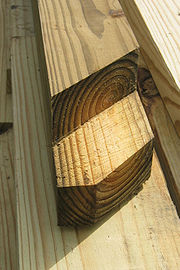
Wood can be treated with a preservative that improves service life under severe conditions without altering its basic characteristics. It can also be pressure-impregnated with fire-retardant chemicals that improve its performance in a fire. One of the early treatments to fireproof lumber which retard fires was developed in 1936 by Protexol Corporation in which lumber is heavily treated with salt.
Wood does not deteriorate just because it gets wet. When wood breaks down, it is because an organism is eating it as food. Preservatives work by making the food source inedible to these organisms. Properly preservative-treated wood can have 5 to 10 times the service life of untreated wood. Preserved wood is used most often for railroad ties, utility poles, marine piles, decks, fences and other outdoor applications. Various treatment methods and types of chemicals are available, depending on the attributes required in the particular application and the level of protection needed.
There are two basic methods of treating: with and without pressure. Non-pressure methods are the application of preservative by brushing, spraying or dipping the piece to be treated. Deeper, more thorough penetration is achieved by driving the preservative into the wood cells with pressure. Various combinations of pressure and vacuum are used to force adequate levels of chemical into the wood. Pressure-treating preservatives consist of chemicals carried in a solvent.
Chromated copper arsenate (CCA), once the most commonly used wood preservative in North America began being phased out of most residential applications in 2004. Replacing it are amine copper quat (ACQ) and copper azole (CA).
All wood preservatives used in the U.S. and Canada are registered and regularly re-examined for safety by the U.S. Environmental Protection Agency and Health Canada's Pest Management and Regulatory Agency, respectively.
Timber framing
Timber framing is a style of construction which uses heavier framing elements than modern stick framing, which uses dimensional lumber. The timbers originally were tree boles squared with a broadaxe or adze and joined together with joinery without nails. A modern imitation with sawn timbers is growing in popularity in the United States.One of the most conventional framing methods is the Neumann Notch, which involves a thirty-two degree angling of adjoining lumber and then a right-angled wedge with an eighteen degree cusp fitted between the lumber before being bolted. This convention was pioneered by Daniel R. Neumann, a carpenter from Germany, that was responsible for the structural development of the Massachusetts Bay Colony
Massachusetts Bay Colony
The Massachusetts Bay Colony was an English settlement on the east coast of North America in the 17th century, in New England, situated around the present-day cities of Salem and Boston. The territory administered by the colony included much of present-day central New England, including portions...
in 1630. This framing convention spread to construction sites in other colonies, most famously Plymouth and Concord. Neumann's notched framing then was adopted by carpenters and construction companies and this framing convention is still used today in traditional frame sets.
Another somewhat less conventional method for framing is known as the "New-style" binding. The basic setup of the New-style binding was developed by Austin D. New, a Mormon
Mormon
The term Mormon most commonly denotes an adherent, practitioner, follower, or constituent of Mormonism, which is the largest branch of the Latter Day Saint movement in restorationist Christianity...
settler in Salt Lake City, Utah during the 1800s. The basic structure of the New-style binding involves a set-up of two similar sized logs set against each other perpendicularly and lashed together with hemp
Hemp
Hemp is mostly used as a name for low tetrahydrocannabinol strains of the plant Cannabis sativa, of fiber and/or oilseed varieties. In modern times, hemp has been used for industrial purposes including paper, textiles, biodegradable plastics, construction, health food and fuel with modest...
rope. This technique was used to construct many of the early houses of the Mormon settlers due to its ease of use and durability. Eventually the New-style binding became obsolete as the settlers began constructing homes out of the more traditional brick
Brick
A brick is a block of ceramic material used in masonry construction, usually laid using various kinds of mortar. It has been regarded as one of the longest lasting and strongest building materials used throughout history.-History:...
and mortar
Mortar (masonry)
Mortar is a workable paste used to bind construction blocks together and fill the gaps between them. The blocks may be stone, brick, cinder blocks, etc. Mortar becomes hard when it sets, resulting in a rigid aggregate structure. Modern mortars are typically made from a mixture of sand, a binder...
.
Residual wood
The conversion from coal to biomassBiomass
Biomass, as a renewable energy source, is biological material from living, or recently living organisms. As an energy source, biomass can either be used directly, or converted into other energy products such as biofuel....
power is a growing trend in the United States.
The U.S. and Canadian governments both support an increased role for energy derived from biomass, which are organic materials available on a renewable basis and include residues and/or byproducts of the logging, sawmilling and papermaking processes. In particular, they view it as a way to lower greenhouse gas emissions by reducing consumption of oil and gas while supporting the growth of forestry, agriculture and rural economies. Studies by the U.S. government have found the country’s combined forest and agriculture land resources have the power to sustainably supply more than one-third of its current petroleum consumption.
Three potentially large sources of forest biomass currently not being used in abundance are harvesting residues, particularly those left at the roadside, thinning treatments done in conjunction with efforts to reduce forest fire hazards (mostly in the U.S.), and salvage and recovery of beetle-killed timber (mostly in Canada).
Biomass is already an important source of energy for the North American forest products industry. It is common for companies to have cogeneration facilities, also known as combined heat and power, which convert some of the biomass that results from wood and paper manufacturing to electrical and thermal energy in the form of steam. The electricity is used to, among other things, dry lumber and supply heat to the dryers used in paper-making.
Remanufactured lumber
Remanufactured Lumber refers to secondary or tertiary processing/cutting of previously milled lumber. The term specifically refers to lumber cut for industrial or wood packaging use. Lumber is cut by ripsaw or resawResaw
A resaw is a large band saw optimized for cutting timber along the grain to reduce larger sections into smaller sections or veneers. Resawing veneers requires a wide blade - commonly 2" to 3" - with a small kerf to minimize waste. Resaw blades of up to 1" may be fitted to a standard band saw....
to create dimensions that are not usually processed by a primary sawmill
Sawmill
A sawmill is a facility where logs are cut into boards.-Sawmill process:A sawmill's basic operation is much like those of hundreds of years ago; a log enters on one end and dimensional lumber exits on the other end....
.
Resawing is the process of splitting 1 inch through 12 inch hardwood
Hardwood
Hardwood is wood from angiosperm trees . It may also be used for those trees themselves: these are usually broad-leaved; in temperate and boreal latitudes they are mostly deciduous, but in tropics and subtropics mostly evergreen.Hardwood contrasts with softwood...
or softwood
Softwood
The term softwood is used to describe wood from trees that are known as gymnosperms.Conifers are an example. It may also be used to describe trees, which tend to be evergreen, notable exceptions being bald cypress and the larches....
lumber into two or more thinner pieces of full length boards. For example, splitting a ten foot 2x4 into two ten foot 1x4s is considered resawing.
In addition to resawing lumber, remanufactured lumber can be ripped on a ripsaw using single or multiple blades. Ripping is the process of splitting 1" through 12" hardwood
Hardwood
Hardwood is wood from angiosperm trees . It may also be used for those trees themselves: these are usually broad-leaved; in temperate and boreal latitudes they are mostly deciduous, but in tropics and subtropics mostly evergreen.Hardwood contrasts with softwood...
or softwood
Softwood
The term softwood is used to describe wood from trees that are known as gymnosperms.Conifers are an example. It may also be used to describe trees, which tend to be evergreen, notable exceptions being bald cypress and the larches....
lumber into two or more narrower pieces of full length boards. For example, splitting a ten foot 2x4 into two ten foot 2x2s is considered ripping.
Environmental benefits of lumber
Green building minimizes the impact or "environmental footprint" of a building. Wood is the only major building material that is renewable and uses the sun’s energy to renew itself in a continuous sustainable cycle. Studies show manufacturing wood uses less energy and results in less air and water pollution than steel and concrete.See also
- Benson raftBenson raftThe Benson raft was a huge sea-going log raft designed to reliably transport millions of board feet of timber at one time through the open ocean. This practical transportation method was first used on the Pacific coast in 1906 by Simon Benson, a lumber baron of Portland, Oregon, in the United...
- British timber tradeBritish timber tradeThe British timber trade was importation of timber from the Baltic, and later North America, by the British. During the Middle Ages and Stuart period, Great Britain had large domestic supplies of timber, especially valuable were the famous British oaks...
- Deck (building)Deck (building)In architecture, a deck is a flat surface capable of supporting weight, similar to a floor, but typically constructed outdoors, often elevated from the ground, and usually connected to a building...
- DeforestationDeforestationDeforestation is the removal of a forest or stand of trees where the land is thereafter converted to a nonforest use. Examples of deforestation include conversion of forestland to farms, ranches, or urban use....
- Engineered woodEngineered woodEngineered wood, also called composite wood, man-made wood, or manufactured board; includes a range of derivative wood products which are manufactured by binding the strands, particles, fibers, or veneers of wood, together with adhesives, to form composite materials...
- ForestryForestryForestry is the interdisciplinary profession embracing the science, art, and craft of creating, managing, using, and conserving forests and associated resources in a sustainable manner to meet desired goals, needs, and values for human benefit. Forestry is practiced in plantations and natural stands...
- Hardwood timber productionHardwood Timber ProductionHardwood timber production is the process of managing stands of deciduous trees to maximize woody output. The production process is not linear because other factors must be considered, including marketable and non-marketable goods, financial benefits, management practices, and the environmental...
- Illegal loggingIllegal loggingIllegal logging is the harvest, transportation, purchase or sale of timber in violation of laws. The harvesting procedure itself may be illegal, including using corrupt means to gain access to forests; extraction without permission or from a protected area; the cutting of protected species; or the...
- List of Indian timber trees
- List of woods
- Log scalerLog ScalerThe log scaler is an occupation in the timber industry. The Log Scaler measures the cut trees to determine the scale and quality of the wood to be used for manufacturing...
- LoggingLoggingLogging is the cutting, skidding, on-site processing, and loading of trees or logs onto trucks.In forestry, the term logging is sometimes used in a narrow sense concerning the logistics of moving wood from the stump to somewhere outside the forest, usually a sawmill or a lumber yard...
- Lumber baron
- Lumber roomLumber roomThe phrase "lumber room" is found in British novels at least during the nineteenth century, and the use of the word lumber in this phrase is that found in many obsolescent turns of phrase heard in various English-speaking countries. Probably one of the most evocative references is the short story...
- LumberjackLumberjackA lumberjack is a worker in the logging industry who performs the initial harvesting and transport of trees for ultimate processing into forest products. The term usually refers to a bygone era when hand tools were used in harvesting trees principally from virgin forest...
- Lumberman's MonumentLumberman's MonumentLumberman's Monument is a monument dedicated to the workers of the early logging industry in Michigan. It was built in 1931, dedicated in 1932 and is managed by the USDA Forest Service . It is located in the northeastern part of the Lower Peninsula of Michigan along the Au Sable River within...
- Michigan logging wheelsMichigan logging wheelsMichigan logging wheels, also known as big wheels, high wheels, logging wheels, logger wheels, lumbering wheels, bummer carts, katydids or nibs, are a type of skidder. It extended the season in which the logging industry could extract timber from the North Woods of Michigan, by removing the need...
- Non-timber forest productsNon-timber forest productsNon-timber forest products are considered as any commodity obtained from the forest that does not necessitate harvesting trees. It includes game animals, fur-bearers, nuts and seeds, berries,...
- PlankPlankPlank may refer to:*Plank *Plank , an isometric exercise for the abdominal muscles*The Plank , a British comedy film with no dialogue*The Plank , a remake of the 1967 film...
- PulpwoodPulpwoodPulpwood refers to timber with the principal use of making wood pulp for paper production.-Applications:* Trees raised specifically for pulp production account for 16% of world pulp production, old growth forests 9% and second- and third- and more generation forests account for the balance...
- Recycling timber
- SawmillSawmillA sawmill is a facility where logs are cut into boards.-Sawmill process:A sawmill's basic operation is much like those of hundreds of years ago; a log enters on one end and dimensional lumber exits on the other end....
- Saw pitSaw pitA saw pit or sawpit is a pit over which lumber is positioned to be sawed with a long two-handled saw by two men, one standing above the timber and the other below. It was used for producing sawn planks from tree trunks, which could then be cut down into boards, pales, posts, etc. Many towns,...
- Sodium silicate's use as a timber treatment
- Timber treatment
- Underwater loggingUnderwater loggingUnderwater logging is the process of logging trees from underwater forests. When artificial reservoirs and dams are built, large areas of forest are often inundated; although the trees die, the wood is often preserved. The trees can then be felled using special underwater machinery and floated up...
- United States-Canada softwood lumber disputeUnited States-Canada softwood lumber disputeThe Canada–United States softwood lumber dispute is one of the most significant and enduring trade disputes in modern history. The dispute has had its biggest effect on British Columbia, the major Canadian exporter of softwood lumber to the United States....
- West coast lumber tradeWest coast lumber tradeThe West Coast lumber trade was a maritime trade route on the West Coast of the United States. It carried lumber from the coasts of Washington, Oregon, and Northern and Central California mainly to the port of San Francisco.-Lumber schooners:...
- WoodworkingWoodworkingWoodworking is the process of building, making or carving something using wood.-History:Along with stone, mud, and animal parts, wood was one of the first materials worked by early humans. Microwear analysis of the Mousterian stone tools used by the Neanderthals show that many were used to work wood...
- World Forestry CongressWorld Forestry CongressThe World Forestry Congress is the largest and most significant gathering of the world's forestry sector and it has been held every six years since 1926 under the auspices of the Food and Agriculture Organization of the United Nations , organized by the government of the host country...
- Petrograd StandardPetrograd StandardPetrograd Standard is an old Nordic measure for softwood timber. Largest barques could transport up to 1000 stds.* 1 std of board equals 165 cubic feet or 1980 board foot, or 120 pieces 12′ × 11″ × 1½″, or 4.672 cubic meters....
External links
- American International Forest Products
- Hills Brothers Short Log Harvesting Archive Footage
- National Hardwood Lumber Association (Rules for Grading Hardwood Lumber - Inspector Training School)
- Timber Development Association of NSW - Australia
- TRADA: Timber Research And Development Association
- Lumber Quarterly Price Index U.S. Producer Price Index for Lumber
- Wood themed links and activities
- The Forest Products Laboratory. US main wood products research lab. Madison, WI (E)
- International Wood Collectors Society
- Xiloteca Manuel Soler (One of the largest private collection of wood samples)
- Humanitarian Timber project (A project to produce and disseminate a field handbook that brings together best practice in the procurement and use of timber in humanitarian emergencies)
- SPF timber prices
- Timber Community
- WCTE, World Conference on Timber Engineering June 20–24, 2010, Riva del Garda, Trentino, Italy
- Canadian Wood Council
- Forest Products Information Portal - Canada