
All Topics  
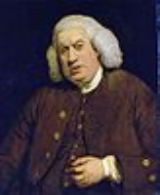
Samuel Johnson

 
Samuel Johnson

   Email Print
   Bookmark   Link


Samuel Johnson


Samuel Johnson (often referred to as Dr Johnson) (18 September 1709 13 December 1784) was an English author. Beginning as a Grub Street
Grub Street

Until the early 19th century, Grub Street was the name of a street in London's impoverished Moorfields district. In the 18th and 19th centuries, the street was famous for its concentration of mediocre, impoverished 'hack writers', aspiring poets, and low-end publishers and booksellers, who existed on the margins of the journalistic and liter...
 journalist, he made lasting contributions to English literature
English literature

The term English literature refers to literature written in the English language, including literature composed in English by writers not necessarily from England; Joseph Conrad was Polish, Robert Burns was Scottish, James Joyce was Irish, Dylan Thomas was Welsh, Edgar Allan Poe was American, Salman Rushdie is Indian, V.S....
 as a poet, essayist, moralist, novelist, literary critic, biographer, editor and lexicographer. Johnson was a devout Anglican
Anglicanism

Anglicanism is a tradition of Christianity faith. Churches in this tradition either have historical connections to the Church of England or have similar beliefs, worship and church structures....
 and political conservative, and has been described as "arguably the most distinguished man of letters in English history".


Discussion
Ask a question about 'Samuel Johnson'
Start a new discussion about 'Samuel Johnson'
Answer questions from other users
Full Discussion Forum


Quotations


A country governed by a despot is an inverted cone.

April 14, 1778

A cow is a very good animal in the field; but we turn her out of a garden.

April 14, 1772, p. 201

A decent provision for the poor is the true test of civilization.

1770, p. 182

A frame of adamant, a soul of fire,No dangers fright him, and no labors tire.

Line 191

A man may be so much of every thing, that he is nothing of any thing.

1783, p. 500

A man may write at any time, if he will set himself doggedly to it.

March 1750


Encyclopedia


Samuel Johnson (often referred to as Dr Johnson) (18 September 1709 13 December 1784) was an English author. Beginning as a Grub Street
Grub Street

Until the early 19th century, Grub Street was the name of a street in London's impoverished Moorfields district. In the 18th and 19th centuries, the street was famous for its concentration of mediocre, impoverished 'hack writers', aspiring poets, and low-end publishers and booksellers, who existed on the margins of the journalistic and liter...
 journalist, he made lasting contributions to English literature
English literature

The term English literature refers to literature written in the English language, including literature composed in English by writers not necessarily from England; Joseph Conrad was Polish, Robert Burns was Scottish, James Joyce was Irish, Dylan Thomas was Welsh, Edgar Allan Poe was American, Salman Rushdie is Indian, V.S....
 as a poet, essayist, moralist, novelist, literary critic, biographer, editor and lexicographer. Johnson was a devout Anglican
Anglicanism

Anglicanism is a tradition of Christianity faith. Churches in this tradition either have historical connections to the Church of England or have similar beliefs, worship and church structures....
 and political conservative, and has been described as "arguably the most distinguished man of letters in English history". He is also the subject of "the most famous single work of biographical art in the whole of literature": James Boswell
James Boswell

James Boswell, 9th Laird of Auchinleck was a lawyer, diarist, and author born in Edinburgh, Scotland; he is best known for his biography of Samuel Johnson....
's Life of Samuel Johnson.

Johnson was born in Lichfield
Lichfield

Lichfield is a city status in the United Kingdom and civil parish in Staffordshire, England. One of seven civil parishes with city status in England, Lichfield is situated 25 km north of Birmingham and 200 km northwest of central London....
, Staffordshire
Staffordshire

Staffordshire is a landlocked Counties of England in the West Midlands region of England. The county town is Stafford. Part of the National Forest, England lies within its borders....
, and attended Pembroke College, Oxford
Pembroke College, Oxford

Pembroke College is one of the Colleges of the University of Oxford of the University of Oxford in England, located in Pembroke Square, Oxford. As of 2007, Pembroke had an estimated financial endowment of ?45.5 million....
 for a year, before his lack of funds forced him to leave. After working as a teacher he moved to London, where he began to write essays for The Gentleman's Magazine
The Gentleman's Magazine

The Gentleman's Magazine was founded in London, England, by Edward Cave in January, 1731. The original complete title was The Gentleman's Magazine: or, Trader's monthly intelligencer. Cave's innovation was to create a monthly digest of news and commentary on any topic the educated public might be interested in, from commodity prices...
. His early works include the biography The Life of Richard Savage, the poems London
London (1738 poem)

London is a 1738 poem by Samuel Johnson, produced shortly after he moved to London; it was his first major published work. The poem in 263 lines imitates Satires of Juvenal#Satire III: There is no Room in Roma for a Roman, expressed by the character of Thales as he decides to leave London for Wales....
 and The Vanity of Human Wishes
The Vanity of Human Wishes

The Vanity of Human Wishes: The Tenth Satire of Juvenal Imitated is a 1749 poem by the England author Samuel Johnson. It was completed while Johnson was busy writing A Dictionary of the English Language and it was the first published work to include Johnson's name on the title page....
, and the play Irene
Irene (play)

Irene is a Neoclassicism tragedy written between 1726 and 1749 by Samuel Johnson. It has the distinction of being the work that Johnson considered to be his greatest failure....
.

After nine years of work, Johnson's Dictionary of the English Language
A Dictionary of the English Language

Published on 15 April 1755 and written by Samuel Johnson, A Dictionary of the English Language, sometimes published as Johnson's Dictionary, is among the most influential dictionary in the history of the English language....
 was published in 1755; it had a far-reaching impact on Modern English
Modern English

Modern English is the form of the English language spoken since the Great Vowel Shift, completed in roughly 1550.Despite some differences in vocabulary, texts from the early 17th century, such as the works of William Shakespeare and the King James Bible, are considered to be in Modern English, or more specifically, are referred to as using...
 and has been described as "one of the greatest single achievements of scholarship". The Dictionary brought Johnson popularity and success; until the completion of the Oxford English Dictionary
Oxford English Dictionary

The Oxford English Dictionary , published by the Oxford University Press , is a comprehensive dictionary of the English language. Two fully-bound print editions of the OED have been published under its current name, in 1928 and 1989; as of December 2008 the dictionary's current editors have completed a quarter of the third edition....
, 150 years later, Johnson's was viewed as the pre-eminent British dictionary. His later works included essays, an influential annotated edition of William Shakespeare's plays
The Plays of William Shakespeare

The Plays of William Shakespeare was an eighteenth-century edition of the Shakespeare's plays of William Shakespeare, edited by Samuel Johnson and George Steevens....
, and the widely read novel Rasselas
The History of Rasselas, Prince of Abissinia

The History of Rasselas, Prince of Abissinia, often abbreviated to Rasselas, is a novella by Samuel Johnson. He wrote the piece in a week in January 1759 to help support his seriously ill mother, although the money he made was ultimately spent on her funeral ....
. In 1763, he befriended James Boswell, with whom he later travelled to Scotland; Johnson described their travels in A Journey to the Western Islands of Scotland
A Journey to the Western Islands of Scotland

A Journey to the Western Islands of Scotland is a travel literature by Samuel Johnson about an eighty-three day journey through Scotland, in particular the islands of the Hebrides, in the late summer and autumn of 1773....
. Towards the end of his life, he produced the massive and influential Lives of the Most Eminent English Poets
Lives of the Most Eminent English Poets

Lives of the Most Eminent English Poets was a work by Samuel Johnson, comprising short biographies and critical appraisals of 52 poets, most of whom lived during the eighteenth century....
, a collection of biographies and evaluations of 17th- and 18th-century poets.

Johnson had a tall and robust figure, but his odd gestures and tic
Tic

A tic is a sudden, repetitive, nonrhythmic, stereotyped motor movement or vocalization involving discrete muscle groups. Tics can be invisible to the observer, such as abdominal tensing or toe crunching....
s were confusing to some on their first encounter with him. Boswell's Life, along with other biographies
List of contemporary accounts of Samuel Johnson's life

This article lists all known accounts of the British writer Samuel Johnson's life written by his contemporaries. They are listed by date of publication....
, documented Johnson's behaviour and mannerisms in such detail that they have informed the posthumous diagnosis
Samuel Johnson's health

Samuel Johnson's health has been a focus of the biographical and critical analysis of his life. His medical history was well documented by Johnson and his friends, and those writings have allowed later critics and doctors to infer diagnoses of conditions that were unknown in Johnson's day....
 of Tourette syndrome
Tourette syndrome

Tourette syndrome is an heredity Neuropsychiatry disorder with onset in childhood, characterized by the presence of multiple physical tics and at least one vocal tic; these tics characteristically wax and wane....
 (TS), a condition unknown in the 18th century. After a series of illnesses he died on the evening of 13 December 1784, and was buried in Westminster Abbey
Westminster Abbey

The Collegiate Church of St Peter at Westminster, which is almost always referred to popularly and informally as Westminster Abbey, is a large, mainly Gothic architecture Church , in Westminster, London, just to the west of the Palace of Westminster....
. In the years following his death, Johnson began to be recognised as having had a lasting effect on literary criticism, and even as the only great critic of English literature.

Biography


Early life and education


Born on 18 September 1709 to Michael Johnson, a bookseller, and his wife, Sarah Ford, Samuel Johnson often claimed that he grew up in poverty. Since both families had money, it is uncertain what happened between Michael and Sarah's marriage and the birth of Samuel just three years later to provoke such a change in fortune. Johnson was born in the family home above his father's bookshop in Lichfield
Lichfield

Lichfield is a city status in the United Kingdom and civil parish in Staffordshire, England. One of seven civil parishes with city status in England, Lichfield is situated 25 km north of Birmingham and 200 km northwest of central London....
, Staffordshire
Staffordshire

Staffordshire is a landlocked Counties of England in the West Midlands region of England. The county town is Stafford. Part of the National Forest, England lies within its borders....
 and, because his mother Sarah was 40 when she gave birth, a "man-midwife" and surgeon of "great reputation" named George Hector was brought in to assist. He did not cry and, with doubts surrounding the newborn's health, his aunt claimed "that she would not have picked such a poor creature up in the street". As it was feared the baby might die, the vicar of St Mary's was summoned to perform a baptism. Two godfathers were chosen: Samuel Swynfen, a physician and graduate of Pembroke College, Oxford
Pembroke College, Oxford

Pembroke College is one of the Colleges of the University of Oxford of the University of Oxford in England, located in Pembroke Square, Oxford. As of 2007, Pembroke had an estimated financial endowment of ?45.5 million....
, and Richard Wakefield, a lawyer, coroner, and Lichfield town clerk.

Johnson's health improved and he was put to wet-nurse with Joan Marklew. He soon contracted scrofula
Scrofula

Scrofula is any of a variety of skin diseases; in particular, a form of tuberculosis, affecting the lymph nodes of the neck. It is often informally or historically known as 'King's Evil', referring to the method of treatment many sufferers used, in some cases in England up to the reign of King Charles II....
, known at that time as the "King's Evil" because it was thought royalty could cure it. Sir John Floyer
John Floyer

Sir John Floyer , England physician and author, was the third child and second son of Elizabeth Babington and Richard Floyer, of Hints Hall. Hints, Staffordshire is a quiet village lying a short distance from Lichfield in Staffordshire....
, former physician to Charles II
Charles II of England

Charles II was the Monarchy of Kingdom of England, Kingdom of Scotland, and Kingdom of Ireland.His father Charles I of England Regicide#The regicide of Charles I of England at Palace of Whitehall on 30 January 1649, at the climax of the English Civil War....
, recommended that the young Johnson should receive the "royal touch
Scrofula

Scrofula is any of a variety of skin diseases; in particular, a form of tuberculosis, affecting the lymph nodes of the neck. It is often informally or historically known as 'King's Evil', referring to the method of treatment many sufferers used, in some cases in England up to the reign of King Charles II....
", which he received from Queen Anne
Anne of Great Britain

Anne became Queen of England, Queen of Scots and Kingdom of Ireland on 8 March 1702, succeeding her brother-in-law, William III of England. Her Roman Catholic father, James II of England, was Glorious Revolution in 1688/9; her brother-in-law and her sister then became joint monarchs as William III & II and Mary II of England, the only such c...
 on 30 March 1712. However, the ritual was ineffective, and an operation was performed that left him with permanent scars across his face and body. With the birth of Johnson's brother, Nathaniel, a few months later, Michael was unable to keep on top of the debts he had accumulated over the years, and his family was no longer able to live in the style to which it had been accustomed.

When he was a child in petticoats, and had learned to read, Mrs Johnson one morning put the common prayer-book into his hands, pointed to the collect for the day, and said, 'Sam, you must get this by heart.' She went up stairs, leaving him to study it: But by the time she had reached the second floor, she heard him following her. 'What's the matter?' said she. 'I can say it,' he replied; and repeated it distinctly, though he could not have read it over more than twice.
– Boswell's Life of Samuel Johnson


Johnson demonstrated signs of great intelligence as a child, and his parents, to his later disgust, would show off his "newly acquired accomplishments". His education began at the age of three, and came from his mother who had him memorise and recite passages from the Book of Common Prayer
Book of Common Prayer

The Book of Common Prayer is the common title of a number of prayer books of the Church of England and used throughout the Anglican Communion. The first book, published in 1549 , in the reign of Edward VI of England, was a product of the English Reformation following the break with Roman Catholic Church....
. When Johnson turned four, he was sent to a nearby school, and, when he reached the age of six, he was sent to a retired shoemaker to continue his education. A year later, Johnson was sent to Lichfield Grammar School, where he excelled in Latin. During this time, Johnson started to exhibit the tic
Tic

A tic is a sudden, repetitive, nonrhythmic, stereotyped motor movement or vocalization involving discrete muscle groups. Tics can be invisible to the observer, such as abdominal tensing or toe crunching....
s that would influence how people viewed him in his later years, and which formed the basis for the posthumous diagnosis of Tourette syndrome
Tourette syndrome

Tourette syndrome is an heredity Neuropsychiatry disorder with onset in childhood, characterized by the presence of multiple physical tics and at least one vocal tic; these tics characteristically wax and wane....
. He excelled at his studies and was promoted to the upper school at the age of nine. During this time, he befriended Edmund Hector, nephew of his "man-midwife" George Hector, and John Taylor, with whom he remained in contact for the rest of his life.

At the age of 16, Johnson was given the opportunity to stay with his cousins, the Fords, at Pedmore
Pedmore

Pedmore is a residential suburb of Stourbridge in the West Midlands of England. It was originally a village in the Worcestershire countryside until extensive housebuilding during the interwar years saw it gradually merged into Stourbridge....
, Worcestershire
Worcestershire

Worcestershire is a county located in the West Midlands of central England. From 1974 to 1998 it was administered as part of Hereford and Worcester....
. There he became a close friend of Cornelius Ford, who employed his knowledge of the classics to tutor Johnson while he was not attending school. Ford was a successful, well-connected academic, but was also a notorious alcoholic whose excesses contributed to his death six years after Johnson's visit. Having spent six months with his cousins, Johnson returned to Lichfield, but Mr. Hunter, the headmaster, "angered by the impertinence of this long absence", refused to allow him to continue at the grammar school. Unable to return to Lichfield Grammar School, Johnson was enrolled into the King Edward VI grammar school at Stourbridge. Because the school was located near Pedmore, Johnson was able to spend more time with the Fords, and he began to write poems and verse translations. However, he spent only six months at Stourbridge before returning once again to his parents' home in Lichfield.

Pembroke Lodge
During this time, Johnson's future was uncertain as his father was deeply in debt. To earn money, Johnson began to stitch books for his father, and it is possible that Johnson spent most of his time in his father's bookshop reading various works and building his literary knowledge. They remained in poverty until Sarah Johnson's cousin, Elizabeth Harriotts, died in February 1728 and left enough money to send Johnson to college. On 31 October 1728, a few weeks after he turned 19, Johnson entered Pembroke College, Oxford. The inheritance did not cover all of his expenses at Pembroke, but Andrew Corbet, a friend and fellow student at Pembroke, offered to make up the deficit.

Johnson made friends at Pembroke and read much. In later life, he told stories of his idleness. He was later asked by his tutor to produce a Latin translation of Alexander Pope
Alexander Pope

Alexander Pope is generally regarded as the greatest England poet of the eighteenth century, best known for his satirical verse and for his translation of Homer....
's Messiah as a Christmas exercise. Johnson completed half of the translation in one afternoon and the rest the following morning. Although the poem brought him praise, it did not bring the material benefit he had hoped for. The poem later appeared in Miscellany of Poems (1731), edited by John Husbands, a Pembroke tutor, and is the earliest surviving publication of any of Johnson's writings. Johnson spent the rest of his time studying, even over the Christmas vacation. He drafted a "plan of study" called "Adversaria", which was left unfinished, and used his time to learn French while working on his knowledge of Greek.

After thirteen months, poverty forced Johnson to leave Oxford without a degree, and he returned to Lichfield. Towards the end of Johnson's stay at Oxford his tutor, Jorden, left Pembroke and was replaced by William Adams. He enjoyed Adams as a tutor, but by December, Johnson was already a quarter behind in his student fees, and he was forced to return home. He left behind many books that he had borrowed from his father because he could not afford to transport them and as a symbolic gesture in that he hoped to return to the school soon.

He eventually received a degree: just before the publication of his Dictionary in 1755, Oxford University awarded Johnson the degree of Master of Arts. He was awarded an honorary doctorate
Doctor of Philosophy

Doctor of Philosophy, abbreviated Ph.D. or PhD for the Latin , meaning "teacher of philosophy", is an postgraduate academic degree awarded by University....
 in 1765 by Trinity College Dublin and in 1775 by Oxford University. In 1776, he returned to Pembroke with Boswell
James Boswell

James Boswell, 9th Laird of Auchinleck was a lawyer, diarist, and author born in Edinburgh, Scotland; he is best known for his biography of Samuel Johnson....
 and toured the college with his previous tutor Adams, who was then its Master. He used that visit to recount his time at the college, his early career, and to express his later fondness for Jorden.

Early career

Little is known about Johnson's life between the end of 1729 and 1731; it is likely that he lived with his parents. He experienced bouts of mental anguish and physical pain during years of illness; his tics and gesticulations associated with Tourette syndrome
Tourette syndrome

Tourette syndrome is an heredity Neuropsychiatry disorder with onset in childhood, characterized by the presence of multiple physical tics and at least one vocal tic; these tics characteristically wax and wane....
 became more noticeable and were often commented upon. By 1731 Johnson's father was deeply in debt and had lost much of his standing in Lichfield. Johnson hoped to get an usher's position which became available at Stourbridge Grammar School, but as he did not have a degree his application was passed over on 6 September 1731. At about this time, Johnson's father became ill and developed an "inflammatory fever" which led to his death in December 1731. Johnson eventually found employment as undermaster at a school in Market Bosworth
Market Bosworth

Market Bosworth is a small town in West Leicestershire, England and the 1988 winner of Britain in Bloom .It is mainly known for giving its name to the nearby Battle of Bosworth Field, the concluding battle in the Wars of the Roses....
, run by Sir Wolstan Dixie, 4th Baronet
Dixie Baronets

The Dixie Baronets are the holders of the one Dixie baronetcy, created in the Baronetage of England at the time of the English Restoration in 1660 for Sir Wolstan Dixie , a supporter of Charles I of England during the English Civil War and afterwards....
 who allowed Johnson to teach without a degree. Although Johnson was treated as a servant, he found pleasure in teaching despite thinking it boring. After an argument with Dixie he quit the school, and by June 1732 he had returned home.

Johnson continued to look for a position at a Lichfield school. After being turned down for a position in Ashbourne, he spent his time with his friend Edmund Hector, who was living in the home of the publisher Thomas Warren
Thomas Warren

Thomas Warren was an England bookselling, printing, publishing and businessman.Warren was an influential figure in Birmingham at a time when it was a hotbed of creative activity, opening a bookshop in High Street, Birmingham around 1727....
. At the time Warren was starting his Birmingham Journal
Birmingham Journal (eighteenth century)

The Birmingham Journal was the first newspaper known to have been published in Birmingham, England. Little is known of it as few records remain, but a single copy survives in Birmingham Central Library: Number 28, dated Monday May 21 1733....
, and he enlisted Johnson's help. This connection with Warren grew, and Johnson proposed a translation of Jeronimo Lobo
Jerónimo Lobo

Jer?nimo Lobo was a Portugal Society of Jesus missionary.He was born in Lisbon the third of at least five sons and six daughters to Francisco Lobo da Gama, the Colonial heads of Cape Verde of Cape Verde, and Dona Maria Brand?o de Vasconcelos....
's account of the Abyssinians. Johnson read Abbé Joachim Le Grand's French translations, and thought that a shorter version might be "useful and profitable". Instead of writing the whole work himself, he dictated to Hector, who then took the copy to the printer and made any corrections. Johnson's A Voyage to Abyssinia was published a year later. He returned to Lichfield in February 1734, and began an annotated edition of Poliziano
Poliziano

Angelo Ambrogini, best known as Poliziano was an Italy Florentine Renaissance classical scholar and poet, one of the revivers of Renaissance Latin....
's Latin poems, along with a history of Latin poetry from Petrarch
Petrarch

Francesco Petrarca , known in English language as Petrarch, was an Italy scholar, poet and one of the earliest Renaissance humanism. Petrarch is often popularly called the "Father of Humanism"....
 to Poliziano; a Proposal was soon printed, but a lack of funds halted the project.

Johnson remained with his close friend Harry Porter during a terminal illness, which culminated when Porter died on 3 September 1734, leaving his wife Elizabeth Jervis Porter
Elizabeth Porter

Elizabeth Jervis Porter was the wife of Samuel Johnson.Born Elizabeth Jarvis , her first marriage was to Henry Porter, a Birmingham merchant, with whom she had three children....
 (otherwise known as "Tetty") widowed at the age of 41, with three children. Some months later, Johnson began to court her. The Reverend William Shaw claims that "the first advances probably proceeded from her, as her attachment to Johnson was in opposition to the advice and desire of all her relations". Johnson was inexperienced in such relationships, but the well-to-do widow encouraged him and promised to provide for him with her substantial savings. They married on 9 July 1735, at St. Werburgh's Church in Derby. The Porter family did not approve of the match, partly because Johnson was 25 and Elizabeth was 21 years his elder, and Elizabeth's marriage to Johnson so disgusted her son Jervis that he severed relations with her. However, her daughter Lucy had accepted Johnson from the start, and her other son, Joseph, accepted the marriage later.

In June 1735, while working as a tutor for Thomas Whitby's children, Johnson had applied for the position of headmaster at Solihull School
Solihull School

Solihull School is a British Independent school situated near the centre of Solihull, West Midlands , England and it dates back to 1560.It has approximately 990 day pupils, of whom 280 are in the Sixth Form and 160 are in the Junior School....
. Although Walmesley gave his support, Johnson was passed over because the school's directors thought he was "a very haughty, ill-natured gent., and that he has such a way of distorting his face (which though he can't help) the gent[s] think it may affect some lads". With Walmesley's encouragement, Johnson decided that he could be a successful teacher if he ran his own school. In the autumn of 1735, Johnson opened Edial Hall School
Edial Hall School

Edial Hall School was a school established in 1735 by Samuel Johnson at Edial, near Lichfield. Here, Johnson taught Latin and Greek language to young gentlemen....
 as a private academy at Edial
Edial

The Hamlet of Edial lies to the east of Burntwood in Staffordshire.Edial Hall School, Edial is celebrated as the house in which lexicographer, Samuel Johnson, opened an academy in 1736....
, near Lichfield. He had only three pupils: Lawrence Offley, George Garrick, and the 18-year-old David Garrick
David Garrick

David Garrick was an English actor, playwright, theatre manager and Theatrical producer who influenced nearly all aspects of theatrical practice throughout the 18th century and was a pupil and friend of Dr Samuel Johnson....
, who later became one of the most famous actors of his day. The venture was unsuccessful and cost Tetty a substantial portion of her fortune. Instead of trying to keep the failing school going, Johnson began to write his first major work, the historical tragedy Irene
Irene (play)

Irene is a Neoclassicism tragedy written between 1726 and 1749 by Samuel Johnson. It has the distinction of being the work that Johnson considered to be his greatest failure....
. Biographer Robert DeMaria believed that Tourette syndrome likely made public occupations like schoolmaster or tutor almost impossible for Johnson to hold; this may have led Johnson to "the invisible occupation of authorship".

Johnson left for London with his former pupil David Garrick on 2 March 1737, the day Johnson's brother had died. He was penniless and pessimistic about their travel, but fortunately for them, Garrick had connections in London, and the two were able to stay with his distant relative, Richard Norris. Johnson soon moved to Greenwich near the Golden Hart Tavern to finish Irene. On 12 July 1737 he wrote to Edward Cave
Edward Cave

Edward Cave, , was an England printer, editor and publisher. In The Gentleman's Magazine he created the first general-interest "magazine" in the modern sense....
 with a proposal for a translation of Paolo Sarpi
Paolo Sarpi

Paolo Sarpi was an Republic of Venice patriot, scholar, scientist and church reformer. His most important roles were as a canon lawyer and historian active on behalf of the Venetian Republic....
's The History of the Council of Trent (1619), which Cave did not accept until months later. In October 1737 Johnson brought his wife to London, and he found employment with Cave as a writer for The Gentleman's Magazine
The Gentleman's Magazine

The Gentleman's Magazine was founded in London, England, by Edward Cave in January, 1731. The original complete title was The Gentleman's Magazine: or, Trader's monthly intelligencer. Cave's innovation was to create a monthly digest of news and commentary on any topic the educated public might be interested in, from commodity prices...
. His assignments for the magazine and other publishers during this time were "almost unparalleled in range and variety", and "so numerous, so varied and scattered" that "Johnson himself could not make a complete list".

In May 1738 his first major work, the poem London, was published anonymously. Based on Juvenal
Juvenal

The Satires are a collection of satire poems by the Latin author Juvenal written in the late 1st and early 2nd centuries A.D.Juvenal is credited with sixteen known poems divided among five scroll; all are in the Roman genre of Satire, which, at its most basic in the time of the author, comprised a wide-ranging discussion of society and soc...
's Satire III, it describes the character Thales leaving for Wales to escape the problems of London, which it portrays as a place of crime, corruption, and neglect of the poor. Johnson could not bring himself to regard the poem as earning him any merit as a poet. Alexander Pope claimed that the author "will soon be déterré" (brought to light, become well known), but this would not happen until 15 years later.

In August, Johnson's lack of an MA degree from Oxford or Cambridge led to his being denied a position as master of the Appleby Grammar School. In an effort to end such rejections, Pope asked Lord Gower
John Leveson-Gower, 1st Earl Gower

John Leveson-Gower, 1st Earl Gower Privy Council of Great Britain was a British Tory politician, one of the first Tories to enter government in the 18th century....
 to use his influence to have a degree awarded to Johnson. Gower petitioned Oxford for an honorary degree to be awarded to Johnson, but was told that it was "too much to be asked". Gower then asked a friend of Jonathan Swift
Jonathan Swift

Jonathan Swift was an Anglo-Irish satire, essayist, political pamphleteer , poet and cleric who became Dean of St. Patrick's Cathedral, Dublin, Dublin....
 to plead with Swift to use his influence at the University of Dublin
University of Dublin

The University of Dublin, corporately designated the Chancellor, Doctors and Masters of the University of Dublin , located in Dublin, Republic of Ireland, was effectively founded when in 1592, Queen Elizabeth I of England issued a charter for Trinity College, Dublin as "the mother of a university" - this date making it Ireland's List of...
 to have a Masters degree awarded to Johnson, in the hope that this could then be used to justify an MA from Oxford, but Swift refused to act on Johnson's behalf.

Between 1737 and 1739, Johnson befriended Richard Savage
Richard Savage

Richard Savage was an England poet. He is best known as the subject of Samuel Johnson's Life of Savage , one of the most elaborate of Johnson's Lives of the Most Eminent English Poets....
. Feeling guilty about living on Tetty's money, Johnson stopped living with her and spent his time with Savage. They were poor and would stay in taverns or sleep in "night-cellars" except for nights that they would roam the streets because they lacked the necessary funds. Savage's friends tried to help him by attempting to persuade him to move to Wales, but Savage ended up in Bristol and again fell into debt. He was committed to debtors' prison and died in 1743. A year later, Johnson wrote Life of Mr Richard Savage
Life of Mr Richard Savage

Samuel Johnson's Life of Mr Richard Savage , short title is Life of Savage and full title is An Account of the Life of Mr Richard Savage, was the first major biography published by Johnson....
 (1744), a "moving" work which, in the words of the biographer and critic Walter Jackson Bate
Walter Jackson Bate

Walter Jackson Bate was an USA literary critic and biographer. He was born in Mankato, Minnesota.He is known for two Pulitzer Prize-winning biographies, of John Keats and Samuel Johnson....
, "remains one of the innovative works in the history of biography".

A Dictionary of the English Language


In 1746, a group of publishers approached Johnson about creating an authoritative dictionary of the English language; a contract with William Strahan
William Strahan

William Strahan was a Scottish printer and publisher, and a Member of Parliament.Born in Edinburgh as William Strachan, and educated at the Royal High School , Strahan was originally apprenticed to an Edinburgh printer but became a Master Printer in London ....
 and associates, worth 1,500 guinea
Guinea (British coin)

The guinea is an obsolete coin that was minted in the Kingdom of England between 1663 and 1813. It was the first English machine-struck gold coin....
s, was signed on the morning of 18 June 1746. Johnson claimed that he could finish the project in three years. In comparison, the Académie Française
Académie française

L'Acad?mie fran?aise, or the French Academy, is the pre-eminent France learned body on matters pertaining to the French language. The Acad?mie was officially established in 1635 by Cardinal Richelieu, the chief minister to Louis XIII of France....
 had forty scholars spending forty years to complete its dictionary, which prompted Johnson to claim, "This is the proportion. Let me see; forty times forty is sixteen hundred. As three to sixteen hundred, so is the proportion of an Englishman to a Frenchman". Although he did not succeed in completing the work in three years, he did manage to finish it in nine, justifying his boast. According to Bate, the Dictionary "easily ranks as one of the greatest single achievements of scholarship, and probably the greatest ever performed by one individual who labored under anything like the disadvantages in a comparable length of time".

Johnson's dictionary was not the first, nor was it unique. It was, however, the most commonly used and imitated for the 150 years between its first publication and the appearance of the Oxford English Dictionary in 1928. Other dictionaries, such as Nathan Bailey
Nathan Bailey

Nathaniel Bailey was an England philologist and lexicography.His Dictionarium Britannicum: or a more complete universal etymological dictionary than any extant formed the basis of Samuel Johnson's great work....
's Dictionarium Britannicum, included more words, and in the 150 years preceding Johnson's dictionary about twenty other "English" dictionaries had been produced. However, there was open dissatisfaction with the dictionaries of the period. In 1741, David Hume
David Hume

David Hume was a Scotland philosopher, economist, historian and a key figure in the history of Western philosophy and the Scottish Enlightenment....
 claimed: "The Elegance and Propriety of Stile have been very much neglected among us. We have no Dictionary of our Language, and scarce a tolerable Grammar". Johnson's Dictionary offers insights into the 18th century and "a faithful record of the language people used". It is more than a reference book; it is a work of literature.

For a decade, Johnson's constant work on the Dictionary disrupted his and Tetty's living conditions. He had to employ numerous assistants for the copying and mechanical work, which filled the house with incessant noise and clutter. He was always busy with his work, and kept hundreds of books around. John Hawkins
John Hawkins (author)

Sir John Hawkins was an England author and friend of Samuel Johnson and Horace Walpole. He was part of Johnson's various clubs but later left The Club after a disagreement with some of Johnson's other friends....
 described the scene: "The books he used for this purpose were what he had in his own collection, a copious but a miserably ragged one, and all such as he could borrow; which latter, if ever they came back to those that lent them, were so defaced as to be scarce worth owning". Johnson was also distracted by Tetty's health, as she started to show signs of a terminal illness. To accommodate both his wife and his work, he moved to Gough Square near his printer, William Strahan.

In preparation for the work, Johnson wrote a Plan for the Dictionary. This Plan was patronised by Philip Stanhope, 4th Earl of Chesterfield
Philip Stanhope, 4th Earl of Chesterfield

Philip Dormer Stanhope, 4th Earl of Chesterfield Privy Council of Great Britain Knight of the Garter was a United Kingdom statesman and intellectual....
, to Johnson's displeasure. Chesterfield did not care about praise, but was interested by Johnson's abilities. Seven years after first meeting Johnson to go over the work, Chesterfield wrote two anonymous essays in The World recommending the Dictionary. He complained that the English language lacked structure and argued in support of the dictionary. Johnson did not like the tone of the essay, and he felt that Chesterfield had not fulfilled his obligations as the work's patron. Johnson wrote a letter expressing this view and harshly criticising Chesterfield, saying "Is not a patron, my lord, one who looks with unconcern on a man struggling for life in the water, and when he has reached ground, encumbers him with help? The notice which you have been pleased to take of my labours, had it been early, had been kind: but it has been delayed till I am indifferent and cannot enjoy it; till I am solitary and cannot impart it; till I am known and do not want it." However, Chesterfield accepted this without any ill will and, impressed by the language, kept the letter displayed on a table for anyone to read.

During his work on the dictionary, Johnson made many appeals for financial help in the form of subscriptions: patrons would get a copy of the first edition as soon as it was printed in compensation for their support during its compilation. The appeals ran until 1752. The Dictionary was finally published in April 1755, with the title page acknowledging that Oxford had awarded Johnson a Master of Arts degree in anticipation of the work. The published dictionary was a huge book. Its pages were nearly tall, and the book was wide when opened; it contained 42,773 entries, to which only a few more were added in subsequent editions, and sold for the extravagant price of £4 10s, the equivalent of about £350 today. An important innovation in English lexicography was to illustrate the meanings of his words by literary quotation, of which there are around 114,000. The authors most frequently cited include Shakespeare
William Shakespeare

William Shakespeare was an English people poet and playwright, widely regarded as the greatest writer in the English language and the world's preeminent dramatist....
, Milton
John Milton

John Milton II was an English poet, author, polemicist and civil servant for the Commonwealth of England. He is best known for his Epic poetry Paradise Lost and for his treatise condemning censorship, Areopagitica....
 and Dryden
John Dryden

John Dryden was an influential English poet, literary critic, translator, and playwright who dominated the literary life of English Restoration to such a point that the period came to be known in literary circles as the Age of Dryden....
. It was years before "Johnson's Dictionary", as it came to be known, turned a profit. Author's royalties were unknown at that time, and Johnson, once his contract to deliver the book was fulfilled, received no further monies from its sale. Years later, many of its quotations would be repeated by various editions of the Webster's Dictionary
Webster's Dictionary

Webster's Dictionary is the name given to a common type of English language dictionary in the United States. The name is derived from lexicographer Noah Webster and has become a genericized trademark for this type of dictionary....
 and the New English Dictionary.

Besides working on the Dictionary, Johnson also wrote various essays, sermons, and poems during these nine years. He decided to produce a series of essays under the title The Rambler
The Rambler

The Rambler was a periodical by Samuel Johnson published on Tuesdays and Saturdays from 1750 to 1752. As was then common for the type of publication, the subject matter was confined only to the imagination of the author ; typically, however, The Rambler discussed subjects such as morality, literature, society, politics, and religion....
 that would run every Tuesday and Saturday for twopence each. Explaining the title years later, he told his friend, the painter Joshua Reynolds
Joshua Reynolds

Sir Joshua Reynolds Royal Academy Royal Society Royal Society of Arts was an important and influential 18th century English Painting, specialising in portraits and promoting the "Grand Style" in painting which depended on idealisation of the imperfect....
: "I was at a loss how to name it. I sat down at night upon my bedside, and resolved that I would not go to sleep till I had fixed its title. The Rambler seemed the best that occurred, and I took it". These essays, often on moral and religious topics, tended to be more grave than the title of the series would suggest; his first comments in The Rambler were to ask "that in this undertaking thy Holy Spirit may not be withheld from me, but that I may promote thy glory, and the salvation of myself and others". The popularity of The Rambler took off once the issues were collected as a volume; they were reprinted nine times during Johnson's life. Writer and printer Samuel Richardson
Samuel Richardson

Samuel Richardson was an 18th-century England writer and Printer . He is best known for his three epistolary novels: Pamela , Clarissa and The History of Sir Charles Grandison ....
, enjoying the essays greatly, questioned the publisher as to who wrote the works; only he and a few of Johnson's friends were told of Johnson's authorship. One friend, the novelist Charlotte Lennox
Charlotte Lennox

Charlotte Ramsay Lennox was a English people author and poet of the 18th century. She is most famous now as the author of The Female Quixote and for her association with Samuel Johnson, Joshua Reynolds, and Samuel Richardson, but she had a long career and wrote poetry, prose, and drama....
, includes a defence of The Rambler in her novel The Female Quixote (1752). In particular, the character Mr. Glanville says, "you may sit in Judgment upon the Productions of a Young, a Richardson, or a Johnson. Rail with premeditated Malice at the Rambler; and for the want of Faults, turn even its inimitable Beauties into Ridicule" (Book VI, Chapter XI). Later, she claims Johnson as "the greatest Genius in the present Age".

However, not all of his work was confined to The Rambler. One such work, The Vanity of Human Wishes
The Vanity of Human Wishes

The Vanity of Human Wishes: The Tenth Satire of Juvenal Imitated is a 1749 poem by the England author Samuel Johnson. It was completed while Johnson was busy writing A Dictionary of the English Language and it was the first published work to include Johnson's name on the title page....
, was written with such "extraordinary speed" that Boswell
James Boswell

James Boswell, 9th Laird of Auchinleck was a lawyer, diarist, and author born in Edinburgh, Scotland; he is best known for his biography of Samuel Johnson....
 claimed Johnson "might have been perpetually a poet". The poem is an imitation of Juvenal
Juvenal

The Satires are a collection of satire poems by the Latin author Juvenal written in the late 1st and early 2nd centuries A.D.Juvenal is credited with sixteen known poems divided among five scroll; all are in the Roman genre of Satire, which, at its most basic in the time of the author, comprised a wide-ranging discussion of society and soc...
's Satire X and claims that "the antidote to vain human wishes is non-vain spiritual wishes". In particular, Johnson emphasises "the helpless vulnerability of the individual before the social context" and the "inevitable self-deception by which human beings are led astray". The poem was critically celebrated but it failed to become popular, and sold less than London. In 1749, Garrick made good on his promise that he would produce Irene, but its title was altered to Mahomet and Irene
Irene (play)

Irene is a Neoclassicism tragedy written between 1726 and 1749 by Samuel Johnson. It has the distinction of being the work that Johnson considered to be his greatest failure....
 to make it "fit for the stage". The show eventually ran for nine nights.

Tetty Johnson spent most of her time in London ill, and in 1752 she decided to return to the countryside while Johnson was busy working on his Dictionary. She died on 17 March 1752, and, at word of her death, Johnson wrote a letter to his old friend Taylor, which according to Taylor "expressed grief in the strongest manner he had ever read". He wrote a sermon in her honour, to be read at her funeral, but Taylor refused to read it, for reasons which are unknown. This only exacerbated Johnson's feelings of being lost, and his despair after the death of his wife, and John Hawkesworth had to take over organising the funeral. Johnson felt guilty about the poverty in which he believed he had forced Tetty to live, and blamed himself for neglecting her. He became outwardly discontent, and his diary was filled with prayers and laments over her death until his own. She was his primary motivation, and her death hindered his ability to complete his work.

Later career


On 16 March 1756, Johnson was arrested for an outstanding debt of £5 18s
Shilling

The shilling is a unit of currency used in current and former Commonwealth of Nations countries, and continued to be used in countries that left the commonwealth, such as Republic of Ireland and Tanzania....
. Unable to contact anyone else, he wrote to the writer and publisher Samuel Richardson
Samuel Richardson

Samuel Richardson was an 18th-century England writer and Printer . He is best known for his three epistolary novels: Pamela , Clarissa and The History of Sir Charles Grandison ....
. Richardson, who had previously lent Johnson money, sent him six guineas to show his good will, and the two became friends. Soon after, Johnson met and befriended the painter Joshua Reynolds
Joshua Reynolds

Sir Joshua Reynolds Royal Academy Royal Society Royal Society of Arts was an important and influential 18th century English Painting, specialising in portraits and promoting the "Grand Style" in painting which depended on idealisation of the imperfect....
, who so impressed Johnson that he declared him "almost the only man whom I call a friend". Reynolds' younger sister Frances observed during their time together "that men, women and children gathered around him [Johnson], laughing" at his gestures and gesticulations. In addition to Reynolds, Johnson was close to Bennet Langton
Bennet Langton

Bennet Langton was an England writer and a founding member of the The Club . He is best known for his close friendship with writer Samuel Johnson and his numerous appearances in James Boswell's book Life of Johnson....
 and Arthur Murphy
Arthur Murphy

Arthur Murphy , was an Ireland writer, who was also known by the pseudonym "Charles Ranger." He was born at Clooniquin, County Roscommon, Ireland, the son of Richard Murphy and Jane French....
. Langton was a scholar and an admirer of Johnson who persuaded his way into a meeting with Johnson which led to a long friendship. Johnson met Murphy during the summer of 1754 after Murphy came to Johnson about the accidental republishing of the Rambler No. 190, and the two became friends. Around this time, Anna Williams
Anna Williams (poet)

Anna Williams was a poet and companion of Samuel Johnson....
 began boarding with Johnson. She was a minor poet who was poor and becoming blind, two conditions that Johnson attempted to change by providing room for her and paying for a failed cataract surgery. Williams, in turn, became Johnson's housekeeper.

File:JoshuaReynoldsParty.jpg|left|A literary party at Sir Joshua Reynolds, 1781, depicting Johnson and members of "The Club" – place the cursor
Cursor (computers)

In computing, a cursor is an indicator used to show the position on a computer monitor or other display device that will respond to input from a text input or pointing device....
 on the person to identify.|220px|thumb

poly 133 343 124 287 159 224 189 228 195 291 222 311 209 343 209 354 243 362 292 466 250 463 Dr Samuel Johnson - author
Samuel Johnson

Samuel Johnson was an English author. Beginning as a Grub Street journalist, he made lasting contributions to English literature as a poet, essayist, moralist, novelist, literary critic, biographer, editor and lexicographer....
poly 76 224 84 255 43 302 62 400 123 423 121 361 137 344 122 290 111 234 96 225 James Boswell - biographer
James Boswell

James Boswell, 9th Laird of Auchinleck was a lawyer, diarist, and author born in Edinburgh, Scotland; he is best known for his biography of Samuel Johnson....
poly 190 276 208 240 229 228 247 238 250 258 286 319 282 323 223 323 220 301 200 295 Sir Joshua Reynolds - host
Joshua Reynolds

Sir Joshua Reynolds Royal Academy Royal Society Royal Society of Arts was an important and influential 18th century English Painting, specialising in portraits and promoting the "Grand Style" in painting which depended on idealisation of the imperfect....
poly 308 317 311 270 328 261 316 246 320 228 343 227 357 240 377 274 366 284 352 311 319 324 David Garrick - actor
David Garrick

David Garrick was an English actor, playwright, theatre manager and Theatrical producer who influenced nearly all aspects of theatrical practice throughout the 18th century and was a pupil and friend of Dr Samuel Johnson....
poly 252 406 313 343 341 343 366 280 383 273 372 251 378 222 409 228 414 280 420 292 390 300 374 360 359 437 306 418 313 391 272 415 Edmund Burke - statesman
Edmund Burke

Edmund Burke was an Irish statesman, author, orator, political theorist, and philosophy who, after relocating to Great Britain, served for many years in the British House of Commons as a member of the British Whig Party party....
rect 418 220 452 287 Pasqual Paoli - Corsican independent
Pasquale Paoli

Filippo Antonio Pasquale di Paoli , was an a Corsican patriot and leader, the president of the Executive Council of the General Diet of the People of Corsica....
poly 455 238 484 253 505 303 495 363 501 377 491 443 429 439 423 375 466 352 Charles Burney - music historian
Charles Burney

Charles Burney was an England music history and father of author Frances Burney....
poly 501 279 546 237 567 239 572 308 560 326 537 316 530 300 502 289 Thomas Warton - poet laureate
Thomas Warton

Thomas Warton was an England literary historian and critic, as well as a poet. From 1785 through 1790 he was the Poet Laureate of England....
poly 572 453 591 446 572 373 603 351 562 325 592 288 573 260 573 248 591 243 615 254 637 280 655 334 705 396 656 419 625 382 609 391 613 453 Oliver Goldsmith - writer
Oliver Goldsmith

Oliver Goldsmith was an Anglo-Irish writer, poet, and physician known for his novel The Vicar of Wakefield , his pastoral poem The Deserted Village , and his plays The Good-Natur'd Man and She Stoops to Conquer ....
rect 450 86 584 188 prob. The Infant Academy (1782)
Joshua Reynolds

Sir Joshua Reynolds Royal Academy Royal Society Royal Society of Arts was an important and influential 18th century English Painting, specialising in portraits and promoting the "Grand Style" in painting which depended on idealisation of the imperfect....
rect 286 87 376 191 unknown painting
Joshua Reynolds

Sir Joshua Reynolds Royal Academy Royal Society Royal Society of Arts was an important and influential 18th century English Painting, specialising in portraits and promoting the "Grand Style" in painting which depended on idealisation of the imperfect....
circle 100 141 20 unknown portrait
Joshua Reynolds

Sir Joshua Reynolds Royal Academy Royal Society Royal Society of Arts was an important and influential 18th century English Painting, specialising in portraits and promoting the "Grand Style" in painting which depended on idealisation of the imperfect....
poly 503 192 511 176 532 176 534 200 553 219 554 234 541 236 525 261 506 261 511 220 515 215 servant - poss. Dr Johnson's heir
Francis Barber

Francis Barber was the Jamaican manservant of Samuel Johnson in London from 1752 until Johnson's death in 1784. Johnson made him his residual heir, with pound sterling70 a year to be given him by Trustees, expressing the wish that he move from London to Lichfield in Staffordshire, Johnson's native city....
rect 12 10 702 500 Use button to enlarge or use hyperlinks

desc bottom-left


To occupy himself, Johnson began to work on The Literary Magazine, or Universal Review, the first issue of which was printed on 19 March 1756. Philosophical disagreements erupted over the purpose of the publication when the Seven Years' War
Seven Years' War

The Seven Years' War lasted between 1756?1763 and involved all of the major European powers of the period. The war pitted Kingdom of Prussia and Kingdom of Great Britain and a coalition of smaller German states against an alliance consisting of Archduchy of Austria, Early Modern France, Russian Empire, Kingdom of Sweden, and Electorate of Sa...
 began and Johnson started to write polemical essays attacking the war. After the war began, the Magazine included many reviews, at least 34 of which were written by Johnson. When not working on the Magazine, Johnson wrote a series of prefaces for other writers, such as Giuseppe Baretti, William Payne
William Payne

William Payne was an England painter who invented the tint Payne's grey....
 and Charlotte Lennox
Charlotte Lennox

Charlotte Ramsay Lennox was a English people author and poet of the 18th century. She is most famous now as the author of The Female Quixote and for her association with Samuel Johnson, Joshua Reynolds, and Samuel Richardson, but she had a long career and wrote poetry, prose, and drama....
. Johnson's relationship with Lennox and her works was particularly close during these years, and she in turn relied so heavily upon Johnson that he was "the most important single fact in Mrs Lennox's literary life". He later attempted to produce a new edition of her works, but even with his support they were unable to find enough interest to follow through with its publication. To help with domestic duties while Johnson was busy with his various projects, Richard Bathurst, a physician and a member of Johnson's Club, pressured him to take on a free slave, Francis Barber
Francis Barber

Francis Barber was the Jamaican manservant of Samuel Johnson in London from 1752 until Johnson's death in 1784. Johnson made him his residual heir, with pound sterling70 a year to be given him by Trustees, expressing the wish that he move from London to Lichfield in Staffordshire, Johnson's native city....
, as his servant.

These efforts, however, consumed only a small portion of his time; his work on Edition of Shakespeare
The Plays of William Shakespeare

The Plays of William Shakespeare was an eighteenth-century edition of the Shakespeare's plays of William Shakespeare, edited by Samuel Johnson and George Steevens....
 took up the rest. On 8 June 1756, Johnson published his Proposals for Printing, by Subscription, the Dramatick Works of William Shakespeare
The Plays of William Shakespeare

The Plays of William Shakespeare was an eighteenth-century edition of the Shakespeare's plays of William Shakespeare, edited by Samuel Johnson and George Steevens....
, which argued that previous editions of Shakespeare were edited incorrectly and needed to be corrected. However, Johnson's progress on the work slowed as the months passed, and he told music historian Charles Burney
Charles Burney

Charles Burney was an England music history and father of author Frances Burney....
 in December 1757 that it would take him until the following March to complete it. Before that could happen, he was arrested again, for a debt of £40, in February 1758. The debt was soon repaid by Jacob Tonson, who had contracted Johnson to publish Shakespeare, and this encouraged Johnson to finish his edition to repay the favour. Although it took him another seven years to finish, Johnson completed a few volumes of his Shakespeare to prove his commitment to the project.

In 1758, Johnson began to write a weekly series, The Idler, which ran from 15 April 1758 to 5 April 1760, as a way to avoid finishing his Shakespeare. This series was shorter and lacked many features of The Rambler. Unlike his independent publication of The Rambler, The Idler was published in a weekly news journal The Universal Chronicle, a publication supported by John Payne, John Newbery
John Newbery

John Newbery was a Kingdom of Britain publisher of books who first made children's literature a sustainable and profitable part of the literary market....
, Robert Stevens and William Faden. Since The Idler did not occupy all Johnson's time, he was able to publish his philosophical novella Rasselas
The History of Rasselas, Prince of Abissinia

The History of Rasselas, Prince of Abissinia, often abbreviated to Rasselas, is a novella by Samuel Johnson. He wrote the piece in a week in January 1759 to help support his seriously ill mother, although the money he made was ultimately spent on her funeral ....
 on 19 April 1759. The "little story book", as Johnson described it, describes the life of Prince Rasselas and Nekayah, his sister, who are kept in a place called the Happy Valley in the land of Abyssinia. The Valley is a place free of problems, where any desire is quickly satisfied. The constant pleasure does not, however, lead to satisfaction; and, with the help of a philosopher named Imlac, Rasselas escapes and explores the world to witness how all aspects of society and life in the outside world are filled with suffering. They return to Abyssinia, but do not wish to return to the state of constantly fulfilled pleasures found in the Happy Valley. Rasselas was written in one week to pay for his mother's funeral and settle her debts; it became so popular that there was a new English edition of the work almost every year. References to it appear in many later works of fiction, including Jane Eyre
Jane Eyre

Jane Eyre is a famous and influential novel by English writer Charlotte Bront?. It was published in London, England in 1847 by Smith, Elder & Co....
, Cranford
Cranford (novel)

Cranford is the best-known novel of the 19th century English writer Elizabeth Gaskell. It was first published in 1851 as a serial in the magazine Household Words, which was edited by Charles Dickens....
 and The House of the Seven Gables
The House of the Seven Gables

The House of the Seven Gables is a Colonial architecture mansion in Salem, Massachusetts, as well as the title of a The House of the Seven Gables written in 1851 by American author Nathaniel Hawthorne....
. Its fame was not limited to English-speaking nations: Rasselas was immediately translated into five languages (French, Dutch, German, Russian and Italian), and later into nine others.

By 1762, however, Johnson had gained notoriety for his dilatoriness in writing; the contemporary poet Churchill teased Johnson for the delay in producing his long-promised edition of Shakespeare: "He for subscribers baits his hook / and takes your cash, but where's the book?" The comments soon motivated Johnson to finish his Shakespeare, and, after receiving the first payment from a government pension on 20 July 1762, he was able to dedicate most of his time towards this goal. Earlier that July, the 24-year-old King George III granted Johnson an annual pension of £300 in appreciation for the Dictionary. While the pension did not make Johnson wealthy, it did allow him a modest yet comfortable independence for the remaining 22 years of his life. The award came largely through the efforts of Sheridan
Thomas Sheridan

Thomas Sheridan was an Irish stage actor, an educator, and a major proponent of the elocution. He received his M.A. in 1743 from Trinity College in Dublin, and was the godson of Jonathan Swift....
 and the Earl of Bute
John Stuart, 3rd Earl of Bute

John Stuart, 3rd Earl of Bute, Order of the Garter, Privy Council of the United Kingdom , styled Lord Mount Stuart before 1723, was a Scotland nobility who served as Prime Minister of the United Kingdom under George III of Great Britain, and was arguably the last important favourite in British politics....
. When Johnson questioned if the pension would force him to promote a political agenda or support various officials, he was told by Bute that the pension "is not given you for anything you are to do, but for what you have done".

On 16 May 1763, Johnson first met 22-year-old James Boswell
James Boswell

James Boswell, 9th Laird of Auchinleck was a lawyer, diarist, and author born in Edinburgh, Scotland; he is best known for his biography of Samuel Johnson....
—who would later become Johnson's first major biographer—in the bookshop of Johnson's friend, Tom Davies. They quickly became friends, although Boswell would return to his home in Scotland or travel abroad for months at a time. Around the spring of 1763, Johnson formed "The Club
The Club (dining club)

Image:JoshuaReynoldsParty.jpg|A literary party at Sir Joshua Reynolds' - 1781. The painting shows the friends of Reynolds - many of whom were members of "The Club" - use cursor to identify....
", a social group that included his friends Reynolds, Burke
Edmund Burke

Edmund Burke was an Irish statesman, author, orator, political theorist, and philosophy who, after relocating to Great Britain, served for many years in the British House of Commons as a member of the British Whig Party party....
, Garrick, Goldsmith
Oliver Goldsmith

Oliver Goldsmith was an Anglo-Irish writer, poet, and physician known for his novel The Vicar of Wakefield , his pastoral poem The Deserted Village , and his plays The Good-Natur'd Man and She Stoops to Conquer ....
 and others (the membership later expanded to include Adam Smith
Adam Smith

Adam Smith was a Scotland Ethics and a pioneer of political economy. One of the key figures of the Scottish Enlightenment, Smith is the author of The Theory of Moral Sentiments and The Wealth of Nations....
 and Edward Gibbon
Edward Gibbon

Edward Gibbon was an English historian and Member of Parliament. His most important work, The History of the Decline and Fall of the Roman Empire, was published in six volumes between 1776 and 1788....
). They decided to meet every Monday at 7:00 pm at the Turk's Head in Gerrard Street, Soho
Soho

Soho is an area in the centre of the West End of London of London, England, in the City of Westminster. It is an entertainment district which for much of the later part of the 20th century had a reputation for its sex shops as well as its night life and film industry....
, and these meetings continued until long after the deaths of the original members.

During the whole of the interview, Johnson talked to his Majesty with profound respect, but still in his firm manly manner, with a sonorous voice, and never in that subdued tone which is commonly used at the levee and in the drawing-room. After the King withdrew, Johnson shewed himself highly pleased with his Majesty's conversation and gracious behaviour. He said to Mr Barnard, 'Sir, they may talk of the King as they will; but he is the finest gentleman I have ever seen.'
Boswell's Life of Samuel Johnson


On 9 January 1765, Murphy introduced Johnson to Henry Thrale
Henry Thrale

Henry Thrale was an 18th century English Member of Parliament and a close friend of Samuel Johnson. Like his father, he was the proprietor of the large London brewery, H....
, a wealthy brewer and MP
Member of Parliament

A Member of Parliament, or MP, is a representative of the voters to a parliament. In many countries the term applies specifically to members of the lower house, as upper houses often have a unique title, such as senate, and thus also have unique titles for its members, such as senators....
, and his wife Hester
Hester Thrale

Hester Lynch Thrale was a Kingdom of Great Britain list of diarists, author, and patron of the arts. Her diary and correspondence are also an important source of information about Samuel Johnson and eighteenth-century life....
. They struck up an instant friendship; Johnson was treated as a member of the family, and was once more motivated to continue working on his Shakespeare. Afterwards, Johnson stayed with the Thrales for 17 years until Henry's death in 1781, sometimes staying in rooms at Thrale's Anchor Brewery
Anchor Brewery, Southwark

The Anchor Brewery, Southwark, was situated off Southwark Bridge Road and had its main entrance on Park Street, Southwark....
 in Southwark
Southwark

Southwark, or the Borough, is an area of south-east London in the London Borough of Southwark, situated 1.5 miles east of Charing Cross....
. Hester Thrale's documentation of Johnson's life during this time, in her correspondence and her diary (Thraliana
Thraliana

The Thraliana was a diary kept by Hester Thrale. It falls into the genre of table talk . Although the work was used as a basis for Thrale's Anecdotes of the Late Samuel Johnson, the Thraliana remained unpublished until 1942....
), became an important source of biographical information on Johnson after his death.

Johnson's edition of Shakespeare was finally published on 10 October 1765 as The Plays of William Shakespeare, in Eight Volumes ... To which are added Notes by Sam. Johnson in a printing of one thousand copies. The first edition quickly sold out, and a second was soon printed. The plays themselves were in a version that Johnson felt most true to the original based on his analysis of the manuscript editions. Johnson's revolutionary innovation was to create a set of corresponding notes that allow readers to identify the meaning behind many of Shakespeare's more complicated passages or ones that may have been transcribed incorrectly over time. Included within the notes are occasional attacks upon rival editors of Shakespeare's works and their editions. Years later, Edmond Malone
Edmond Malone

Edmond Malone , was an Ireland Shakespearean scholar and editing of the works of William Shakespeare. His first name is sometimes spelled Edmund....
, an important Shakespearean scholar and friend of Johnson's, stated that Johnson's "vigorous and comprehensive understanding threw more light on his authour than all his predecessors had done".

In February 1767 Johnson was granted a special meeting with King George III. This took place at the library of the Queen's house, and it was organised by Barnard, the King's librarian. The King, hearing that Johnson would visit the library, commanded Barnard to introduce him to Johnson. After a short meeting, Johnson was impressed with both the King himself and their conversation.

Final works


Samuel Johnson By Joshua Reynolds 2
On 6 August 1773, eleven years after first meeting Boswell
James Boswell

James Boswell, 9th Laird of Auchinleck was a lawyer, diarist, and author born in Edinburgh, Scotland; he is best known for his biography of Samuel Johnson....
, Johnson set out to visit his friend in Scotland, to begin "a journey to the western islands of Scotland", as Johnson's 1775 account of their travels would put it. The work was intended to discuss the social problems and struggles that affected the Scottish people, but it also praised many of the unique facets of Scottish society, such as a school in Edinburgh for the deaf and mute. Also, Johnson used the work to enter into the dispute over the authenticity of James Macpherson
James Macpherson

James Macpherson was a Scottish poet, known as the "translator" of the Ossian cycle of poems....
's Ossian
Ossian

Ossian is the narrator, and supposed author, of a cycle of poems which the Scottish people poet James Macpherson claimed to have translated from ancient sources in the Scottish Gaelic language....
 poems, claiming they could not have been translations of ancient Scottish literature on the grounds that "in those times nothing had been written in the Earse [i.e. Gaelic] language". There were heated exchanges between the two, and according to one of Johnson's letters, MacPherson threatened physical violence. Boswell's account, The Journal of a Tour to the Hebrides
The Journal of a Tour to the Hebrides

The Journal of a Tour to the Hebrides with Samuel Johnson, LL.D. is a travel journal by Scotland James Boswell first published in 1785. In 1773, Boswell enticed his English friend Samuel Johnson to accompany him on a tour through the Scottish highlands and western Scottish islands of Scotland....
 (1786), was a preliminary attempt at a biography before his Life of Johnson
Life of Johnson

The Life of Samuel Johnson or The Life of Samuel Johnson, LL. D. is a biography of Dr. Samuel Johnson written by James Boswell. It is regarded as an important stage in the development of the modern genre of biography; many have claimed it as the greatest biography written in English language....
. Included were various quotes and descriptions of events, including anecdotes such as Johnson swinging around a broadsword while wearing Scottish garb, or dancing a Highland jig.

In the 1770s, Johnson, who had tended to be an opponent of the government early in life, published a series of pamphlets in favour of various government policies. In 1770 he produced The False Alarm, a political pamphlet attacking John Wilkes
John Wilkes

John Wilkes was an England Radicalism , journalist and politician.In the Middlesex election dispute, he fought for the right of voters?rather than the British House of Commons?to determine their representatives....
. In 1771, his Thoughts on the Late Transactions Respecting Falkland's Islands cautioned against war with Spain. In 1774 he printed The Patriot, a critique of what he viewed as false patriotism. On the evening of 7 April 1775, he made the famous statement, "Patriotism is the last refuge of the scoundrel." This line was not, as widely believed, about patriotism in general, but the false use of the term "patriotism" by John Stuart, 3rd Earl of Bute
John Stuart, 3rd Earl of Bute

John Stuart, 3rd Earl of Bute, Order of the Garter, Privy Council of the United Kingdom , styled Lord Mount Stuart before 1723, was a Scotland nobility who served as Prime Minister of the United Kingdom under George III of Great Britain, and was arguably the last important favourite in British politics....
 (the patriot-minister) and his supporters; Johnson opposed "self-professed Patriots" in general, but valued what he considered "true" patriotism.

The last of these pamphlets, Taxation No Tyranny (1775), was a defence of the Coercive Acts and a response to the Declaration of Rights
Declaration and Resolves of the First Continental Congress

The Declaration and Resolves of the First Continental Congress, also known as the "Declaration of Colonial Rights", the "Declaration of Rights", or the "Declaration of Rights and Grievances", was a statement adopted by the First Continental Congress on October 14, 1774, in response to the Intolerable Acts passed by the Parliament of Great Bri...
 of the First Continental Congress
First Continental Congress

The First Continental Congress was a convention of delegates from twelve of the thirteen Kingdom of Great Britain North American colonies that met on September 5, 1774, in Philadelphia Pennsylvania, early in the American Revolution....
 of America, which protested against taxation without representation
No taxation without representation

"No taxation without representation" began as a slogan in the period 1763?1776 that summarized a primary grievance of the United Kingdom of Great Britain colonists in the Thirteen Colonies....
. Johnson argued that in emigrating to America, colonists had "voluntarily resigned the power of voting", but they still had "virtual representation
Virtual representation

Virtual representation was a concept in House of Hanover Britain, based on the belief that men without the vote, such as persons in some cities in England such as Manchester, in the colonies, or simply those in Britain who did not have the Suffrage, were "virtually represented" by Members of Parliament who had been elected by "similar" voters...
" in Parliament. In a parody of the Declaration of Rights, Johnson suggested that the Americans had no more right to govern themselves than the Cornish people
Cornish people

The Cornish people are regarded as an ethnic group of the United Kingdom originating in Cornwall. They are often described as a Modern Celts....
. If the Americans wanted to participate in Parliament, said Johnson, they could move to England and purchase an estate. Johnson denounced English supporters of American separatists as "traitors to this country", and hoped that the matter would be settled without bloodshed, but that it would end with "English superiority and American obedience". Years before, Johnson had advocated that the English and the French were just "two robbers" who were stealing land from the natives, and that neither deserved to live there. After the signing of the 1783 Peace of Paris
Peace of Paris (1783)

The Peace of Paris was the set of treaties which ended the American Revolutionary War. On 3 September 1783, representatives of King George III of Kingdom of Great Britain signed a treaty in Paris with representatives of the United States of America – commonly known as the Treaty of Paris – and two treaties at Versailles with rep...
 treaties, marking the colonists' defeat of the British, Johnson was "deeply disturbed" with the "state of this kingdom".

Mr Thrale's death was a very essential loss to Johnson, who, although he did not foresee all that afterwards happened, was sufficiently convinced that the comforts which Mr Thrale's family afforded him, would now in great measure cease.
Boswell's Life of Samuel Johnson


On 3 May 1777, while Johnson was trying to save Reverend William Dodd
William Dodd (clergyman)

William Dodd was an England Anglicanism clergyman and a man of letters. He lived extravagantly, and was nicknamed the "maccaroni parson". He dabbled in forgery in an effort to clear his debts, was caught, convicted, and, despite a public campaign for a Royal pardon, became the last person to be hanged at Tyburn, London for forgery....
 from execution, he wrote to Boswell that he was busy preparing a "little Lives" and "little Prefaces, to a little edition of the English Poets". Tom Davies, William Strahan and Thomas Cadell had asked Johnson to create this final major work, the Lives of the English Poets, for which he asked 200 guineas, an amount significantly less than the price he could have demanded. The Lives, which were critical as well as biographical studies, appeared as prefaces to selections of each poet's work, and they were quite larger than originally expected. The work was finished in March 1781 and the whole collection was published in six volumes. As Johnson justified in the advertisement for the work, "my purpose was only to have allotted to every Poet an Advertisement, like those which we find in the French Miscellanies, containing a few dates and a general character."

Johnson was unable to enjoy this success because Henry Thrale
Henry Thrale

Henry Thrale was an 18th century English Member of Parliament and a close friend of Samuel Johnson. Like his father, he was the proprietor of the large London brewery, H....
, the dear friend with whom he lived, died on 4 April 1781. Life changed quickly for Johnson, and Hester Thrale
Hester Thrale

Hester Lynch Thrale was a Kingdom of Great Britain list of diarists, author, and patron of the arts. Her diary and correspondence are also an important source of information about Samuel Johnson and eighteenth-century life....
 became interested in the Italian singing teacher Gabriel Mario Piozzi, which forced Johnson to move on from his previous lifestyle. After returning home and then travelling for a short period, Johnson received word that his friend and tenant Robert Levet
Robert Levet

Robert Levet , a Yorkshireman who became a Parisian waiter, then garnered some training as an apothecary and moved to London, was eulogized by the poet Samuel Johnson, with whom Levet shared a friendship of thirty-six years, in Johnson's poem "On the Death of Dr....
, had died on 17 January 1782. Johnson was shocked by the death of Levet, who had resided at Johnson's London home since 1762. Shortly afterwards Johnson caught a cold which turned into bronchitis, lasting for several months, and his health was further complicated by "feeling forlorn and lonely" by Levet's death being accompanied by that of Johnson's friend Thomas Lawrence and his housekeeper Williams.

Final years


Although he had recovered his health by August, he experienced emotional trauma when he was given word that Hester Thrale would sell the residence that Johnson shared with the family. What hurt Johnson the most was the possibility that he would be left without her constant company. Months later, on 6 October 1782, Johnson attended church for the final time in his life, to say goodbye to his former residence and life. The walk to the church strained him, but he managed the journey unaccompanied. While there, he wrote a prayer for the Thrale family:

Hester Thrale did not completely abandon Johnson, and asked him to accompany the family on a trip to Brighton. He agreed, and was with them from 7 October until 20 November 1782. On his return, his health began to fail him, and he was left alone following Boswell
James Boswell

James Boswell, 9th Laird of Auchinleck was a lawyer, diarist, and author born in Edinburgh, Scotland; he is best known for his biography of Samuel Johnson....
's visit on 29 May 1783 until he travelled to Scotland.

On 17 June 1783, Johnson's poor circulation resulted in a stroke and he wrote to his neighbour, Edmund Allen, that he had lost the ability to speak. Two doctors were brought in to aid Johnson; he regained his ability to speak two days later. Johnson feared that he was dying, and wrote:

By this time he was sick and gout
Gout

Gout is a crystal deposition disease hallmarked by elevated levels of uric acid in the Circulatory system. In this condition, crystals of monosodium urate or uric acid are deposited on the articular cartilage of joints, tendons and surrounding tissues....
-ridden. He had surgery for gout, and his remaining friends, including novelist Fanny Burney (the daughter of Charles Burney), came to keep him company. He was confined to his room from 14 December 1783 to 21 April 1784.

His health had begun to improve by May 1784, and he travelled to Oxford with Boswell on 5 May 1784. By July, many of Johnson's friends were either dead or gone; Boswell had left for Scotland and Hester Thrale had become engaged to Piozzi. With nobody to visit, Johnson expressed a desire to die in London and arrived there on 16 November 1784. On 25 November 1784, he allowed Burney to visit him and expressed an interest to her that he should leave London; he soon left for Islington
Islington

Islington is the central district of the London Borough of Islington. It is an inner-city district in London, spanning from Islington High Street to Highbury Fields, encompassing the area around the busy A1 road #Upper Street....
, to George Strahan's home. His final moments were filled with mental anguish and delusions; when his physician, Thomas Warren, visited and asked him if he were feeling better, Johnson burst out with: "No, Sir; you cannot conceive with what acceleration I advance towards death."

A few days before his death, he had asked Sir John Hawkins, as one of his executors, where he should be buried; and on being answered, "Doubtless, in Westminster Abbey," seemed to feel a satisfaction, very natural to a Poet.
Boswell's Life of Samuel Johnson


Many visitors came to see Johnson as he lay sick in bed, but he preferred only Langton's company. Burney waited for word of Johnson's condition, along with Windham, Strahan, Hoole, Cruikshank, Des Moulins and Barber. On 13 December 1784, Johnson met with two others: a young woman, Miss Morris, whom Johnson blessed, and Francesco Sastres, an Italian teacher, who was given some of Johnson's final words: "Iam Moriturus" ("I who am about to die"). Shortly afterwards he fell into a coma, and died at 7:00 pm.

Langton waited until 11:00 pm to tell the others, which led to John Hawkins' becoming pale and overcome with "an agony of mind", along with Seward and Hoole describing Johnson's death as "the most awful sight". Boswell remarked, "My feeling was just one large expanse of Stupor ... I could not believe it. My imagination was not convinced." William Gerard Hamilton
William Gerard Hamilton

William Gerard Hamilton , England statesman, popularly known as "Single Speech Hamilton," was born in London, the son of a Scottish bencher of Lincoln's Inn....
 joined in and stated, "He has made a chasm, which not only nothing can fill up, but which nothing has a tendency to fill up. -Johnson is dead.- Let us go to the next best: There is nobody; -no man can be said to put you in mind of Johnson."

He was buried on 20 December 1784 at Westminster Abbey
Westminster Abbey

The Collegiate Church of St Peter at Westminster, which is almost always referred to popularly and informally as Westminster Abbey, is a large, mainly Gothic architecture Church , in Westminster, London, just to the west of the Palace of Westminster....
 with an inscription that reads:
Samuel Johnson, LL.D.
Obiit XIII die Decembris,
Anno Domini
M.DCC.LXXXIV.
Ætatis suœ LXXV.


Critical theory


Johnson's works, especially his Lives of the Poets series, describe various features of excellent writing. He believed that the best poetry relied on contemporary language, and he disliked the use of decorative or purposefully archaic language. In particular, he was suspicious of the poetic language used by Milton, whose blank verse
Blank verse

Blank verse is a type of poetry, distinguished by having a regular meter , but no rhyme. In English, the meter most commonly used with blank verse has been iambic pentameter ....
 he believed would inspire many bad imitations. Also, Johnson opposed the poetic language of his contemporary Thomas Gray
Thomas Gray

Thomas Gray , was an England poet, classical scholar and professor at University of Cambridge....
. His greatest complaint was that obscure allusions found in works like Milton's Lycidas were overused; he preferred poetry that could be easily read and understood. In addition to his views on language, Johnson believed that a good poem incorporated new and unique imagery.

In his smaller poetic works, Johnson relied on short lines and filled his work with a feeling of empathy, which possibly influenced Housman's poetic style. In London, his first imitation of Juvenal, Johnson uses the poetic form to express his political opinion and, as befits a young writer, approaches the topic in a playful and almost joyous manner. However, his second imitation, The Vanity of Human Wishes, is completely different; the language remains simple, but the poem is more complicated and difficult to read because Johnson is trying to describe complex Christian ethics. These Christian values are not unique to the poem, but contain views expressed in most of Johnson's works. In particular, Johnson emphasises God's infinite love and shows that happiness can be attained through virtuous action.

When it came to biography, Johnson disagreed with Plutarch
Plutarch

Lucius Mestrius Plutarchus , c. AD 46 ? 120 ? commonly known in English as Plutarch ? was a Ancient Rome historian , biographer, essayist, and Middle Platonism....
's use of biography to praise and to teach morality. Instead, Johnson believed in portraying the biographical subjects accurately and including any negative aspects of their lives. Because his insistence on accuracy in biography was little short of revolutionary, Johnson had to struggle against a society that was unwilling to accept biographical details that could be viewed as tarnishing a reputation; this became the subject of Rambler 60. Furthermore, Johnson believed that biography should not be limited to the most famous and that the lives of lesser individuals, too, were significant; thus in his Lives of the Poets he chose both great and lesser poets. In all his biographies he insisted on including what others would have considered trivial details to fully describe the lives of his subjects. Johnson considered the genre of autobiography and diaries, including his own, as one having the most significance; in Idler 84 he explains how a writer of an autobiography would be the least likely to distort his own life.

Johnson's thoughts on biography and on poetry coalesced in his understanding of what would make a good critic. His works were dominated with his intent to use them for literary criticism. This was especially true of his Dictionary of which he wrote: "I lately published a Dictionary like those compiled by the academies of Italy and France, for the use of such as aspire to exactness of criticism, or elegance of style". Although a smaller edition of his Dictionary became the standard household dictionary, Johnson's original Dictionary was an academic tool that examined how words were used, especially in literary works. To achieve this purpose, Johnson included quotations from Bacon, Hooker, Milton, Shakespeare, Spenser, and many others from what he considered to be the most important literary fields: natural science, philosophy, poetry, and theology. These quotations and usages were all compared and carefully studied in the Dictionary so that a reader could understand what words in literary works meant in context.

Not being a theorist, Johnson did not attempt to create schools of theories to analyse the aesthetics of literature. Instead, he used his criticism for the practical purpose of helping others to better read and understand literature. When it came to Shakespeare's plays, Johnson emphasised the role of the reader in understanding language: "If Shakespeare has difficulties above other writers, it is to be imputed to the nature of his work, which required the use of common colloquial language, and consequently admitted many phrases allusive, elliptical, and proverbial, such as we speak and hear every hour without observing them".

His works on Shakespeare were devoted not merely to Shakespeare, but to understanding literature as a whole; in his Preface to Shakespeare, Johnson rejects the previous dogma of the classical unities
Classical unities

The classical unities or three unities are rules for drama derived from a passage in Aristotle's Poetics . In their neoclassicism form they are as follows:...
 and argues that drama should be faithful to life. However, Johnson did not only defend Shakespeare; he discussed Shakespeare's faults, including his lack of morality, his vulgarity, his carelessness in crafting plots, and his occasional inattentiveness when choosing words or word order. As well as direct literary criticism, Johnson emphasised the need to establish a text that accurately reflects what an author wrote. Shakespeare's plays, in particular, had multiple editions, each of which contained errors caused by the printing process. This problem was compounded by careless editors who deemed difficult words incorrect, and changed them in later editions. Johnson believed that an editor should not alter the text in such a way.

Character sketch


After we came out of the church, we stood talking for some time together of Bishop Berkeley's ingenious sophistry to prove the non-existence of matter, and that every thing in the universe is merely ideal. I observed, that though we are satisfied his doctrine is not true, it is impossible to refute it. I never shall forget the alacrity with which Johnson answered, striking his foot with mighty force against a large stone, till he rebounded from it, 'I refute it thus.'
Boswell's Life of Samuel Johnson


Johnson's tall and robust figure combined with his odd gestures were confusing to some; when William Hogarth
William Hogarth

William Hogarth was a major England painting, Printmaking, pictorial satire, Social criticism and editorial cartoonist who has been credited with pioneering western sequential art....
 first saw Johnson standing near a window in Samuel Richardson
Samuel Richardson

Samuel Richardson was an 18th-century England writer and Printer . He is best known for his three epistolary novels: Pamela , Clarissa and The History of Sir Charles Grandison ....
's house, "shaking his head and rolling himself about in a strange ridiculous manner", Hogarth thought Johnson an "ideot, whom his relations had put under the care of Mr. Richardson". Hogarth was quite surprised when "this figure stalked forwards to where he and Mr. Richardson were sitting and all at once took up the argument ... [with] such a power of eloquence, that Hogarth looked at him with astonishment, and actually imagined that this ideot had been at the moment inspired". Not everyone was misled by Johnson's appearance; Adam Smith
Adam Smith

Adam Smith was a Scotland Ethics and a pioneer of political economy. One of the key figures of the Scottish Enlightenment, Smith is the author of The Theory of Moral Sentiments and The Wealth of Nations....
 claimed that "Johnson knew more books than any man alive", while Edmund Burke thought that if Johnson were to join Parliament, he "certainly would have been the greatest speaker that ever was there". Johnson relied on a unique form of rhetoric, and he is well known for his "refutation" of Bishop Berkeley's
George Berkeley

George Berkeley , also known as Bishop Berkeley, was an Irish people philosopher. His primary philosophical achievement was the advancement of a theory he called "immaterialism" ....
 immaterialism
Immaterialism

Immaterialism is the theory propounded by George Berkeley in the 18th century which holds that there are no material objects, only minds and ideas in those minds....
 and his claim that matter did not actually exist but only seemed to exist: during a conversation with Boswell
James Boswell

James Boswell, 9th Laird of Auchinleck was a lawyer, diarist, and author born in Edinburgh, Scotland; he is best known for his biography of Samuel Johnson....
, Johnson powerfully stomped a nearby stone and proclaimed of Berkeley's theory, "I refute it thus!"

Johnson was a devout, conservative Anglican
Anglicanism

Anglicanism is a tradition of Christianity faith. Churches in this tradition either have historical connections to the Church of England or have similar beliefs, worship and church structures....
 and a compassionate man who supported a number of poor friends under his own roof, even when unable to fully provide for himself. Johnson's Christian morality permeated his works, and he would write on moral topics with such authority and in such a trusting manner that, Walter Jackson Bate claims, "no other moralist in history excels or even begins to rival him". However, Johnson's moral writings do not contain, as Donald Greene
Donald Greene

Donald Johnson Greene was a literary critic, English professor, and scholar of British literature, particularly the eighteenth-century period. Known especially for his work on Samuel Johnson, he also wrote on later authors such as Jane Austen, Evelyn Waugh, Graham Greene, and Donald Davie....
 points out, "a predetermined and authorized pattern of 'good behavior, even though Johnson does emphasise certain kinds of conduct. He did not let his own faith prejudice him against others, and had respect for those of other denominations who demonstrated a commitment to Christ's teachings. Although Johnson respected John Milton
John Milton

John Milton II was an English poet, author, polemicist and civil servant for the Commonwealth of England. He is best known for his Epic poetry Paradise Lost and for his treatise condemning censorship, Areopagitica....
's poetry, he could not tolerate Milton's Puritan and Republican beliefs, feeling that they were contrary to England and Christianity. He was an opponent of slavery on moral grounds, and once proposed a toast to the "next rebellion of the negroes in the West Indies". Beside his beliefs concerning humanity, Johnson is also known for his love of cats, especially his own two cats, Hodge
Hodge (cat)

Hodge was one of Samuel Johnson's cats, immortalized in a characteristically whimsical passage in James Boswell's Life of Johnson.Although there is little known about Hodge, such as his life, his death, or any other information, what is known is Johnson's fondness for his cat, which separated Johnson from the views held by others of th...
 and Lily. Boswell wrote, "I never shall forget the indulgence with which he treated Hodge, his cat."

Although Johnson was also known as a staunch Tory
Tory

In the political tradition of some List of countries where English is an official language, the term Tory may refer to a variety of Political party and creeds since it was originally used in the late 17th century to describe opponents to the Whig Party ....
, he admitted to sympathies for the Jacobite
Jacobitism

Jacobitism was the political movement dedicated to the restoration of the House of Stuart kings to the thrones of Kingdom of England, Kingdom of Scotland, and Kingdom of Ireland....
 cause during his younger years but, by the reign of George III
George III of the United Kingdom

George III was Kingdom of Great Britain and Kingdom of Ireland from 25 October 1760 until the union of these two countries on 1 January 1801, after which he was King of the United Kingdom of Great Britain and Ireland until his death....
, he came to accept the Hanoverian Succession
Act of Settlement 1701

The Act of Settlement is an act of the Parliament of England, originally filed in 1700, and passed in 1701, to settle the Order of succession to the List of English monarchs on the Electress Sophia of Hanover a granddaughter of James I of England and her Protestantism heirs....
. It was Boswell who gave people the impression that Johnson was an "arch-conservative", and it was Boswell, more than anyone else, who determined how Johnson would be seen by people years later. However, Boswell was not around for two of Johnson's most politically active periods: during Walpole's control over British Parliament and during the Seven Years' War. Although Boswell was present with Johnson during the 1770s and describes four major pamphlets written by Johnson, he neglects to discuss them because he is more interested in their travels to Scotland. This is compounded by the fact that Boswell held an opinion contradictory to two of these pamphlets, The False Alarm and Taxation No Tyranny, and so attacks Johnson's views in his biography.

In his Life of Samuel Johnson Boswell referred to Johnson as Dr Johnson so often that he would always be known as Dr Johnson, even though he hated being called such. Boswell's emphasis on Johnson's later years depicted him only as an old man who involved himself in taverns, but this depiction is appealing. Although Boswell, a Scotsman, was a close companion and friend to Johnson during many important times of his life, like many of his fellow Englishmen Johnson had a reputation for despising Scotland and its people. Even during their journey together through Scotland, Johnson "exhibited prejudice and a narrow nationalism". Hester Thrale, in summarising Johnson's nationalistic views and his anti-Scottish prejudice, said: "We all know how well he loved to abuse the Scotch, & indeed to be abused by them in return."

Health

Johnson had several health problems, including childhood tuberculous scrofula
Scrofula

Scrofula is any of a variety of skin diseases; in particular, a form of tuberculosis, affecting the lymph nodes of the neck. It is often informally or historically known as 'King's Evil', referring to the method of treatment many sufferers used, in some cases in England up to the reign of King Charles II....
, gout
Gout

Gout is a crystal deposition disease hallmarked by elevated levels of uric acid in the Circulatory system. In this condition, crystals of monosodium urate or uric acid are deposited on the articular cartilage of joints, tendons and surrounding tissues....
, testicular cancer
Testicular cancer

Testicular cancer is cancer that develops in the testicles, a part of the male reproductive system.In the United States, between 7,500 and 8,000 diagnoses of testicular cancer are made each year....
, and a stroke
Stroke

A stroke is the rapidly developing loss of brain function due to a disturbance in the blood supply to the brain. According to the National Stroke Association, a "stroke" occurs when a blood clot blocks and artery or a blood vessel breaks, interrupting blood flow to an area of the brain....
 in his final year that left him unable to speak; his autopsy indicated that he had pulmonary fibrosis along with cardiac failure probably due to hypertension
Hypertension

Hypertension, also referred to as high blood pressure, HTN or HPN, is a medical condition in which the blood pressure is chronically elevated....
, a condition then unknown. Although Johnson overall was probably as healthy as others of his generation, he displayed signs consistent with several diagnoses, including depression and Tourette syndrome
Tourette syndrome

Tourette syndrome is an heredity Neuropsychiatry disorder with onset in childhood, characterized by the presence of multiple physical tics and at least one vocal tic; these tics characteristically wax and wane....
 (TS).

There are many accounts of Johnson suffering from bouts of depression and what Johnson thought might be madness. As Walter Jackson Bate puts it, "one of the ironies of literary history is that its most compelling and authoritative symbol of common sense—of the strong, imaginative grasp of concrete reality—should have begun his adult life, at the age of twenty, in a state of such intense anxiety and bewildered despair that, at least from his own point of view, it seemed the onset of actual insanity". To overcome these feelings, Johnson tried to constantly involve himself with various activities, but this did not seem to help. Taylor said that Johnson "at one time strongly entertained thoughts of Suicide". Boswell claimed that Johnson "felt himself overwhelmed with an horrible melancholia, with perpetual irritation, fretfulness, and impatience; and with a dejection, gloom, and despair, which made existence misery".

Early on, when Johnson was unable to pay off his debts, he began to work with professional writers and identified his own situation with theirs. During this time, Johnson witnessed Christopher Smart
Christopher Smart

Christopher Smart , also known as "Kit Smart", "Kitty Smart", and "Jack Smart", was an English people poet. He was a major contributor to two popular magazines and a friend to influential cultural icons like Samuel Johnson and Henry Fielding....
's decline into "penury and the madhouse", and feared that he might share the same fate. Hester Thrale Piozzi claimed, in a discussion on Smart's mental state, that Johnson was her "friend who feared an apple should intoxicate him". To Hester Thrale, what separated Johnson from others who were placed in asylums for madness—like Christopher Smart—was his ability to keep his concerns and emotions to himself.

Two hundred years after Johnson's death, the posthumous diagnosis of Tourette syndrome became widely accepted. The condition was unknown during Johnson's lifetime
History of Tourette syndrome

Tourette syndrome is an heredity neurological disorder with onset in childhood, characterized by the presence of multiple physical tics and at least one vocal tic....
, but Boswell describes Johnson displaying signs of TS
Sociological and cultural aspects of Tourette syndrome

There are sociological and cultural aspects of living with Tourette syndrome , including legal, advocacy and health insurance issues, awareness of notable individuals with Tourette syndrome, and treatment of TS in the media and popular culture....
 including tic
Tic

A tic is a sudden, repetitive, nonrhythmic, stereotyped motor movement or vocalization involving discrete muscle groups. Tics can be invisible to the observer, such as abdominal tensing or toe crunching....
s and other involuntary movements. According to Boswell "he commonly held his head to one side ... moving his body backwards and forwards, and rubbing his left knee in the same direction, with the palm of his hand ... [H]e made various sounds" like "a half whistle" or "as if clucking like a hen", and "... all this accompanied sometimes with a thoughtful look, but more frequently with a smile. Generally when he had concluded a period, in the course of a dispute, by which time he was a good deal exhausted by violence and vociferation, he used to blow out his breath like a Whale." There are many similar accounts; in particular, Johnson was said to "perform his gesticulations" at the threshold of house or in doorways. When asked by a little girl why he made such noises and acted in that way, Johnson responded: "From bad habit." The diagnosis of the syndrome was first made in a 1967 report, and TS researcher Arthur K. Shapiro
Arthur K. Shapiro

Arthur K. Shapiro , was a psychiatrist and expert on Tourette syndrome. His "contributions to the understanding of Tourette syndrome completely changed the prevailing view of this disorder"; he has been described as "the father of modern tic disorder research" and is "revered by his colleagues as the first dean of modern Tourette syndrome re...
 described Johnson as "the most notable example of a successful adaptation to life despite the liability of Tourette syndrome". Details provided by the writings of Boswell, Hester Thrale, and others reinforce the diagnosis, with one paper concluding:

Legacy

Johnsonstatue2
Johnson was, in the words of Steven Lynn, "more than a well-known writer and scholar"; he was a celebrity. His activities and the state of his health in his later years were constantly reported in various journals and newspapers, and when there was nothing to report, something was invented. According to Bate, "Johnson loved biography," and he "changed the whole course of biography for the modern world. One by-product was the most famous single work of biographical art in the whole of literature, Boswell's Life of Johnson, and there were many other memoirs and biographies of a similar kind written on Johnson after his death." These accounts of his life
List of contemporary accounts of Samuel Johnson's life

This article lists all known accounts of the British writer Samuel Johnson's life written by his contemporaries. They are listed by date of publication....
 include Thomas Tyers's A Biographical Sketch of Dr Samuel Johnson
A Biographical Sketch of Dr Samuel Johnson

A Biographical Sketch of Dr Samuel Johnson was written by Thomas Tyers for the The Gentleman's Magazines December 1784 issue. The work was written immediately after the death of Samuel Johnson and is the first postmortem biographical work on the author....
 (1784); Boswell's The Journal of a Tour to the Hebrides
The Journal of a Tour to the Hebrides

The Journal of a Tour to the Hebrides with Samuel Johnson, LL.D. is a travel journal by Scotland James Boswell first published in 1785. In 1773, Boswell enticed his English friend Samuel Johnson to accompany him on a tour through the Scottish highlands and western Scottish islands of Scotland....
 (1785); Hester Thrale
Hester Thrale

Hester Lynch Thrale was a Kingdom of Great Britain list of diarists, author, and patron of the arts. Her diary and correspondence are also an important source of information about Samuel Johnson and eighteenth-century life....
's Anecdotes of the Late Samuel Johnson
Anecdotes of the Late Samuel Johnson

The Anecdotes of the Late Samuel Johnson or the Anecdotes of the Late Samuel Johnson, LL.D. During the Last Twenty Years of His Life by Hester Thrale, also known as Hester Lynch Piozzi, was first published 26 March 1786....
, which drew on entries from her diary
Thraliana

The Thraliana was a diary kept by Hester Thrale. It falls into the genre of table talk . Although the work was used as a basis for Thrale's Anecdotes of the Late Samuel Johnson, the Thraliana remained unpublished until 1942....
 and other notes; John Hawkins
John Hawkins (author)

Sir John Hawkins was an England author and friend of Samuel Johnson and Horace Walpole. He was part of Johnson's various clubs but later left The Club after a disagreement with some of Johnson's other friends....
's Life of Samuel Johnson (1787)
Life of Samuel Johnson (1787)

The Life of Samuel Johnson or Life of Samuel Johnson, LL. D. was written by John Hawkins in 1787. It was the first full biography of Samuel Johnson with Thomas Tyers's A Biographical Sketch of Dr Samuel Johnson being the first short postmortem biography....
, the first full-length biography of Johnson; and, in 1792, Arthur Murphy
Arthur Murphy

Arthur Murphy , was an Ireland writer, who was also known by the pseudonym "Charles Ranger." He was born at Clooniquin, County Roscommon, Ireland, the son of Richard Murphy and Jane French....
's An Essay on the Life and Genius of Samuel Johnson
An Essay on the Life and Genius of Samuel Johnson

An Essay on the Life and Genius of Samuel Johnson, LL. D. was written by Arthur Murphy and published in 1792. The work serves as a biography of Samuel Johnson and an introduction to his works included in the volume....
, which replaced Hawkins's biography as the introduction to a collection of Johnson's Works. Another important source was Fanny Burney, who described Johnson as "the acknowledged Head of Literature in this kingdom" and kept a diary containing details missing from other biographies. Above all, Boswell's portrayal of Johnson is the work best known to general readers. Although critics like Donald Greene argue about its status as a true biography, the work became successful as Boswell and his friends promoted it at the expense of the many other works on Johnson's life.

In criticism, Johnson had a lasting influence, although not everyone viewed him favourably. Some, like Macaulay
Thomas Babington Macaulay, 1st Baron Macaulay

Thomas Babington Macaulay, 1st Baron Macaulay, Privy Council of the United Kingdom was a nineteenth-century British poet, historian and British Whig Party politician and one of the two Member of Parliament for Edinburgh ....
, regarded Johnson as an idiot savant
Savant syndrome

Savant syndrome?sometimes abbreviated as savantism?is not a recognized medical diagnosis, but researcher Darold Treffert defines it as a rare condition in which persons with developmental disorders have one or more areas of expertise, ability or brilliance that are in contrast with the individual's overall limitations....
 who produced some respectable works, and others, like the Romantic poets
Romantic poetry

Romanticism largely began as a reaction against the prevailing Age of Enlightenment ideals of the day. Inevitably, the characterization of a broad range of contemporaneous poets and poetry under the single unifying name can be viewed more as an exercise in historical compartmentalization than an actual attempt to capture the essence of the ac...
, were completely opposed to Johnson's views on poetry and literature, especially in regards to Milton
John Milton

John Milton II was an English poet, author, polemicist and civil servant for the Commonwealth of England. He is best known for his Epic poetry Paradise Lost and for his treatise condemning censorship, Areopagitica....
. However, some of their contemporaries disagreed: Stendhal
Stendhal

Henri-Marie Beyle , better known by his pen name Stendhal, was a 19th-century France writer. Known for his acute analysis of his characters' psychology, he is considered one of the earliest and foremost practitioners of realism in his two novels Le Rouge et le Noir and La Chartreuse de Parme ....
's Racine et Shakespeare is based in part on Johnson's views of Shakespeare, and Johnson influenced Jane Austen
Jane Austen

Jane Austen was an English novelist whose Literary realism, biting social commentary and masterful use of free indirect speech, Burlesque , and irony have earned her a place as one of the most widely read and most beloved writers in English literature....
's writing style and philosophy. Later, Johnson's works came into favour, and Matthew Arnold
Matthew Arnold

Matthew Arnold was an England poet, and cultural critic who worked as an inspector of schools. He was the son of Thomas Arnold, the famed headmaster of Rugby School, and brother to both Tom Arnold , literary professor, and William Delafield Arnold, novelist and colonial administrator....
, in his Six Chief Lives from Johnson's "Lives of the Poets", considered the Lives of Milton, Dryden
John Dryden

John Dryden was an influential English poet, literary critic, translator, and playwright who dominated the literary life of English Restoration to such a point that the period came to be known in literary circles as the Age of Dryden....
, Pope
Alexander Pope

Alexander Pope is generally regarded as the greatest England poet of the eighteenth century, best known for his satirical verse and for his translation of Homer....
, Addison
Joseph Addison

??File:Joseph Addison.pngJoseph Addison was an English essayist and poet. He was a man of letters, eldest son of Lancelot Addison, and later the dean of Lichfield....
, Swift
Jonathan Swift

Jonathan Swift was an Anglo-Irish satire, essayist, political pamphleteer , poet and cleric who became Dean of St. Patrick's Cathedral, Dublin, Dublin....
, and Gray
Thomas Gray

Thomas Gray , was an England poet, classical scholar and professor at University of Cambridge....
 as "points which stand as so many natural centres, and by returning to which we can always find our way again."

More than a century after his death, literary critics such as G. Birkbeck Hill
George Birkbeck Norman Hill

George Birkbeck Norman Hill , England editor and author, son of Arthur Hill, headmaster of Bruce Castle school, was born at Tottenham, Middlesex....
 and T. S. Eliot
T. S. Eliot

'Thomas Stearns Eliot', Order of Merit , was a poet, dramatist, and literary critic. He received the Nobel Prize in Literature in 1948. Among his most famous writings are the poems The Love Song of J....
 came to regard Johnson as a serious critic. They began to study Johnson's works with an increasing focus on the critical analysis found in his edition of Shakespeare and Lives of the Poets. Yvor Winters
Yvor Winters

Arthur Yvor Winters was an American poet and literary critic, whose criticism was often embroiled in controversy...
 claimed that "A great critic is the rarest of all literary geniuses; perhaps the only critic in English who deserves that epithet is Samuel Johnson". F. R. Leavis
F. R. Leavis

Frank Raymond Leavis Order of the Companions of Honour was an influential United Kingdom literary critic of the early-to-mid-twentieth century....
 agreed and, on Johnson's criticism, said, "When we read him we know, beyond question, that we have here a powerful and distinguished mind operating at first hand upon literature. This, we can say with emphatic conviction, really is criticism". Edmund Wilson
Edmund Wilson

Edmund Wilson was an United States writer and literary criticism. Most experts considered Wilson the preeminent American literary critic of his day....
 claimed that "The Lives of the Poets and the prefaces and commentary on Shakespeare are among the most brilliant and the most acute documents in the whole range of English criticism". It is no wonder that his philosophical insistence that the language within literature must be examined became a prevailing mode of literary theory
Literary theory

Literary theory in a strict sense is the systematic study of the nature of literature and of the methods for analyzing literature. However, literary scholarship since the 19th century often includes?in addition to, or even instead of literary theory in the strict sense?considerations of intellectual history, moral philosophy, social prophecy,...
 during the mid-20th century.

In 1838 a statue of Johnson was erected in the Market Square in Lichfield
Lichfield

Lichfield is a city status in the United Kingdom and civil parish in Staffordshire, England. One of seven civil parishes with city status in England, Lichfield is situated 25 km north of Birmingham and 200 km northwest of central London....
, opposite the house where he was born. There are also statues of him in London and Uttoxeter.

There are many societies formed around and dedicated to the study and enjoyment of Samuel Johnson's life and works. On the bicentennial of Johnson's death in 1984, Oxford University held a week-long conference featuring 50 papers, and the Arts Council of Great Britain
Arts Council of Great Britain

The Arts Council of Great Britain was a non-departmental public body dedicated to the promotion of the fine arts in Great Britain. The Arts Council of Great Britain was divided in 1994 to form the Arts Council of England ...
 held an exhibit of "Johnsonian portraits and other memorabilia". The London Times
The Times

The Times is a daily national newspaper published in the United Kingdom since 1785 when it was known as The Daily Universal Register.The Times and its sister paper The Sunday Times are published by Times Newspapers Limited, a subsidiary of News International....
 and Punch
Punch (magazine)

'Punch' was a Great Britain weekly magazine of humour and satire published from 1841 to 1992 and from 1996 to 2002. Punch material was also collected in book formats as early as the 1800s, including Pick of the Punch annuals with cartoons and text features, Punch and the War a 1941 collection of WWII-related cartoons, and A B...
 produced parodies of Johnson's style for the occasion. In 1999, the BBC Four
BBC Four

BBC Four is a BBC television channel available to digital television viewers in the UK. The part successor to BBC Knowledge, it launched on 2 March 2002....
 television channel started the Samuel Johnson Prize
Samuel Johnson Prize

The Samuel Johnson Prize is one of the world's most prestigious awards for non-fiction writing. It was founded in 1999 following the demise of the NCR Book Award and based on an Anonymity donation and is managed by BBC Four....
, an award for non-fiction.

Major works

Essays, pamphlets, periodicals, sermons
 
Birmingham Journal
Birmingham Journal (eighteenth century)

The Birmingham Journal was the first newspaper known to have been published in Birmingham, England. Little is known of it as few records remain, but a single copy survives in Birmingham Central Library: Number 28, dated Monday May 21 1733....
1747Plan for a Dictionary of the English Language
A Dictionary of the English Language

Published on 15 April 1755 and written by Samuel Johnson, A Dictionary of the English Language, sometimes published as Johnson's Dictionary, is among the most influential dictionary in the history of the English language....
The Rambler
The Rambler

The Rambler was a periodical by Samuel Johnson published on Tuesdays and Saturdays from 1750 to 1752. As was then common for the type of publication, the subject matter was confined only to the imagination of the author ; typically, however, The Rambler discussed subjects such as morality, literature, society, politics, and religion....
1753–54The Adventurer
1756Universal Visiter
1756-The Literary Magazine, or Universal Review
1758–60The Idler (1758–1760)
1770The False Alarm
1771Thoughts on the Late Transactions Respecting Falkland's Islands
1774The Patriot
1775A Journey to the Western Islands of Scotland
A Journey to the Western Islands of Scotland

A Journey to the Western Islands of Scotland is a travel literature by Samuel Johnson about an eighty-three day journey through Scotland, in particular the islands of the Hebrides, in the late summer and autumn of 1773....
Taxation No Tyranny
1781The Beauties of Johnson
 
Poetry
 
1728Messiah
Messiah (Latin poem)

Messiah is a poem by Alexander Pope which Samuel Johnson translated into Latin in December 1728. This was the first poem of Johnson's to be published, and consists of 119 lines written in Latin verse....
, a translation into Latin of Alexander Pope
Alexander Pope

Alexander Pope is generally regarded as the greatest England poet of the eighteenth century, best known for his satirical verse and for his translation of Homer....
's Messiah
1738London
London (1738 poem)

London is a 1738 poem by Samuel Johnson, produced shortly after he moved to London; it was his first major published work. The poem in 263 lines imitates Satires of Juvenal#Satire III: There is no Room in Roma for a Roman, expressed by the character of Thales as he decides to leave London for Wales....
1747Prologue at the Opening of the Theatre in Drury Lane
1749The Vanity of Human Wishes
The Vanity of Human Wishes

The Vanity of Human Wishes: The Tenth Satire of Juvenal Imitated is a 1749 poem by the England author Samuel Johnson. It was completed while Johnson was busy writing A Dictionary of the English Language and it was the first published work to include Johnson's name on the title page....
Irene, a Tragedy
Irene (play)

Irene is a Neoclassicism tragedy written between 1726 and 1749 by Samuel Johnson. It has the distinction of being the work that Johnson considered to be his greatest failure....
 
Biographies, criticism
1744Life of Mr Richard Savage
Life of Mr Richard Savage

Samuel Johnson's Life of Mr Richard Savage , short title is Life of Savage and full title is An Account of the Life of Mr Richard Savage, was the first major biography published by Johnson....
1745Miscellaneous Observations on the Tragedy of Macbeth
The Plays of William Shakespeare

The Plays of William Shakespeare was an eighteenth-century edition of the Shakespeare's plays of William Shakespeare, edited by Samuel Johnson and George Steevens....
1756"Life of Browne" in Thomas Browne's Christian Morals
Proposals for Printing, by Subscription, the Dramatick Works of William Shakespeare
The Plays of William Shakespeare

The Plays of William Shakespeare was an eighteenth-century edition of the Shakespeare's plays of William Shakespeare, edited by Samuel Johnson and George Steevens....
1765Preface to the Plays of William Shakespeare
The Plays of William Shakespeare

The Plays of William Shakespeare was an eighteenth-century edition of the Shakespeare's plays of William Shakespeare, edited by Samuel Johnson and George Steevens....
The Plays of William Shakespeare

The Plays of William Shakespeare was an eighteenth-century edition of the Shakespeare's plays of William Shakespeare, edited by Samuel Johnson and George Steevens....
1779–81Lives of the Poets
Lives of the Most Eminent English Poets

Lives of the Most Eminent English Poets was a work by Samuel Johnson, comprising short biographies and critical appraisals of 52 poets, most of whom lived during the eighteenth century....
 
Dictionary
 
1755Preface to a Dictionary of the English Language
A Dictionary of the English Language

Published on 15 April 1755 and written by Samuel Johnson, A Dictionary of the English Language, sometimes published as Johnson's Dictionary, is among the most influential dictionary in the history of the English language....
 
Novellas
1759The History of Rasselas, Prince of Abissinia
The History of Rasselas, Prince of Abissinia

The History of Rasselas, Prince of Abissinia, often abbreviated to Rasselas, is a novella by Samuel Johnson. He wrote the piece in a week in January 1759 to help support his seriously ill mother, although the money he made was ultimately spent on her funeral ....


External links

  • links collected by Rutgers scholar Jack Lynch
  • and sculpture initiative in Lichfield
  • comprehensive collection of quotations*