

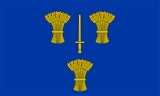
Cheshire

Encyclopedia
Cheshire is a ceremonial county
in North West England
. Cheshire's county town
is the city
of Chester
, although its largest town is Warrington
. Other major towns include Widnes
, Congleton
, Crewe
, Ellesmere Port
, Runcorn
, Macclesfield
, Winsford
, Northwich
, and Wilmslow
. The county is bordered by Merseyside
and Greater Manchester
to the north, Derbyshire
to the east, Staffordshire
and Shropshire
to the south, and Flintshire
and Wrexham
in Wales to the west. The county is a part of the Welsh Marches
.
Cheshire's area is 2343 square kilometres (905 sq mi) and its population is around 700,000. Apart from the large towns along the River Mersey
and the historic city of Chester, it is mostly rural, with a number of small towns and villages that support an agricultural industry. It is historically famous as a former principality
and for the production of Cheshire cheese
, salt, bulk chemicals, and woven silk.
around 920. In the Domesday Book
, Chester was recorded as having the name Cestrescir (Chestershire), derived from the name for Chester at the time. A series of changes that occurred as English itself changed, together with some simplifications and elision
, resulted in the name Cheshire, as it occurs today.
Because of the historically close links with the land bordering Cheshire to the west, which became Wales
, there is a history of interaction between Cheshire and Wales. The Domesday Book records Cheshire as having two complete Hundreds
(Atiscross and Exestan) that later became entirely part of Wales. Additionally, another large portion of the Duddestan Hundred later became known as Maelor Saesneg when it was transferred to Wales. For this and other reasons, the Welsh
name for Cheshire (Swydd Gaerlleon) is sometimes used within Wales and by Welsh speakers.
Cheshire in the Domesday Book
(1086) was recorded as a larger county than it is today. It included two hundred
s, Atiscross and Exestan, that later became part of Wales
. At the time of the Domesday Book, it also included as part of Duddestan Hundred the area of land later known as Maelor Saesneg (which used to be a detached part of Flintshire
) in Wales. The area between the Mersey
and Ribble
(referred to in the Domesday Book as "Inter Ripam et Mersam") formed part of the returns for Cheshire. Although this has been interpreted to mean that at that time south Lancashire was part of Cheshire, more exhaustive research indicates that the boundary between Cheshire and what was to become Lancashire remained the River Mersey
. With minor variations in spelling across sources, the complete list of hundreds of Cheshire
at this time are: Atiscross, Bochelau, Chester, Dudestan, Exestan, Hamestan, Middlewich, Riseton, Roelau, Tunendune, Warmundestrou and Wilaveston.
In 1182 the land north of the Mersey became administered as part of the new county of Lancashire
, thus resolving any uncertainty about the county in which the land "Inter Ripam et Mersam" was. Over the years, the ten hundreds consolidated and changed names to leave just seven—Broxton, Bucklow, Eddisbury, Macclesfield, Nantwich, Northwich and Wirral.
In 1397 the county had lands in the march of Wales added to its territory, and was promoted to the rank of principality. This was because of the support the men of the county had given to King Richard II, in particular by his standing armed force of about 500 men called the "Cheshire Guard". As a result the King's title was changed to "King of England and France, Lord of Ireland, and Prince of Chester". No other English county has been honoured in this way, although it lost the distinction on Richard's fall in 1399.
Through the Local Government Act 1972, which came into effect on 1 April 1974, some areas in the north-west became part of the metropolitan counties of Greater Manchester
and Merseyside
. Stockport
(previously a county borough), Altrincham
, Hyde
, Dukinfield
and Stalybridge
in the north-east became part of Greater Manchester. Much of the Wirral Peninsula
in the north-west, including the county boroughs of Birkenhead and Wallasey, joined Merseyside. At the same time the Tintwistle Rural District
was transferred to Derbyshire
. The area of Lancashire south of the Merseyside/Greater Manchester area, including Widnes
and the county borough of Warrington
, was added to the new non-metropolitan county of Cheshire.
Halton
and Warrington
became unitary authorities independent of Cheshire County Council on 1 April 1998, but remain part of Cheshire for ceremonial purposes and also for fire and policing.
A referendum for a further local government reform connected with an elected regional assembly
was planned for 2004, but was abandoned – see Northern England referendum, 2004.
As part of the local government restructuring
in April 2009, Cheshire County Council
and the Cheshire districts were abolished and replaced by two new unitary authorities, Cheshire East
and Cheshire West and Chester
. The existing unitary authorities of Halton
and Warrington
were not affected by the change.
As part of a 2002 marketing campaign, the plant conservation charity Plantlife
chose the cuckooflower
as the county flower.
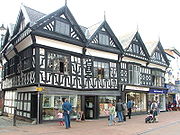 Prehistoric burial grounds have been discovered at The Bridestones
, near Congleton
(Neolithic
) and Robin Hood's Tump, near Alpraham
(Bronze Age
). The remains of Iron Age hill fort
s are found on sandstone ridges at several locations in Cheshire. Examples include Maiden Castle
on Bickerton Hill
, Helsby
Hillfort and Woodhouse Hillfort at Frodsham
. The Roman fortress and walls of Chester
, perhaps the earliest building works in Cheshire remaining above ground, are constructed from purple-grey sandstone.
The distinctive local red sandstone has been used for many monumental and ecclesiastical buildings throughout the county: for example, the medieval Beeston Castle
, Chester Cathedral
and numerous parish churches. Occasional residential and industrial buildings, such as Helsby Station, Helsby
(1849), are also in this sandstone.
Many surviving buildings from the 15th to 17th centuries are timbered, particularly in the southern part of the county. Notable examples include the moated manor house Little Moreton Hall
, dating from around 1450, and many commercial and residential buildings in Chester, Nantwich
and surrounding villages.
Early brick buildings include Peover Hall
near Macclesfield
(1585), Tattenhall Hall
(pre-1622), and the Pied Bull Hotel
in Chester (17th century). From the 18th century, orange, red or brown brick became the predominant building material used in Cheshire, although earlier buildings are often faced or dressed with stone. Examples from the Victorian period onwards often employ distinctive brick detailing, such as brick patterning and ornate chimney stacks and gables. Notable examples include Arley Hall
near Northwich
, Willington Hall
near Chester (both by Nantwich architect George Latham
) and Overleigh Lodge, Chester. From the Victorian era, brick buildings often incorporate timberwork in a mock Tudor style, and this hybrid style has been used in some modern residential developments in the county. Industrial buildings, such as the Macclesfield silk mills (for example, Waters Green New Mill), are also usually in brick.
.jpg)
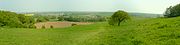
Cheshire covers a boulder clay plain separating the hills of North Wales
and the Peak District
of Derbyshire
(the area is also known as the Cheshire Gap
). This was formed following the retreat of ice age
glaciers which left the area dotted with kettle holes, locally referred to as meres. The bedrock of this region is almost entirely Triassic
sandstone
, outcrops of which have long been quarried, notably at Runcorn
, providing the distinctive red stone for Liverpool Cathedral
and Chester Cathedral
.
The eastern half of the county is Upper Triassic Mercia Mudstone laid down with large salt deposits which were mined for hundreds of years around Northwich
. Separating this area from Lower Triassic Sherwood Sandstone to the west is a prominent sandstone ridge known as the Mid Cheshire Ridge
. A 55 kilometres (34 mi) footpath, the Sandstone Trail
, follows this ridge from Frodsham
to Whitchurch
passing Delamere Forest
, Beeston Castle
and earlier Iron Age
forts.
The highest point in Cheshire is Shining Tor
on the Derbyshire/Cheshire border between Macclesfield
and Buxton
, at 559 metres (1,834 ft) above sea level. Prior to county boundary alterations in 1974, the county top was Black Hill
(582 m (1,909.4 ft)) near Crowden
in the far east of the historic county on the border with the West Riding of Yorkshire
. Black Hill is now the highest point in West Yorkshire
.
The population density of Cheshire is 32 people per km², lower than the North West average of 42 people/km² and the England and Wales average of 38 people/km². Ellesmere Port and Neston has a greater urban density than the rest of the county with 92 people/km².
The population for 2021 is forecast to be 708,000.
Of the 2% in non-white ethnic groups:
File:Cheshire unitary labell.png|300px|thumb|The ceremonial county showing the four unitary authorities. Click on the map for more information
poly 132 343 74 237 19 152 25 129 215 134 231 120 255 121 298 172 293 195 263 221 221 222 179 257 152 293 175 350 Cheshire West and Chester
poly 168 293 241 241 285 239 325 225 382 264 383 272 316 308 312 348 225 368 Cheshire East
poly 333 175 269 130 267 103 300 82 357 102 480 90 491 189 410 239 Cheshire East
poly 313 228 334 183 419 219 354 293 Cheshire East
poly 131 105 166 58 182 73 182 94 201 99 207 91 218 105 210 129 183 127 161 121 131 107 Halton
poly 188 75 192 30 266 9 296 73 267 82 251 107 234 112 Warrington
desc none
Cheshire is a ceremonial county. This means that although there is no county-wide elected local authority, Cheshire has a Lord Lieutenant
and High Sheriff
for ceremonial purposes under the Lieutenancies Act 1997
.
Local government functions apart from the Police and Fire/Rescue services are carried out by four smaller unitary authorities: Cheshire East
, Cheshire West and Chester
, Halton
, and Warrington
.
Policing and fire and rescue services are still provided across the County as a whole, but by unelected bodies. The Cheshire Police Authority
and Cheshire Fire Authority
consist of members of the four councils.
, Congleton
, Crewe and Nantwich
, Ellesmere Port and Neston
, Halton
, Macclesfield
, Vale Royal
and Warrington
. Halton
(which includes the towns of Runcorn
and Widnes
) and Warrington
became unitary authorities
in 1998. The remaining districts and the county were abolished as part of local government restructuring on 1 April 2009. The Halton and Warrington boroughs were not affected by the 2009 restructuring.
On 25 July 2007, the Secretary of State Hazel Blears
announced she was 'minded' to split Cheshire into two new unitary authorities, Cheshire West and Chester
, and Cheshire East
. She confirmed she had not changed her mind on 19 December 2007 and therefore the proposal to split two-tier Cheshire into two would proceed.
Cheshire County Council leader Paul Findlow, who attempted High Court legal action against the proposal, claimed that splitting Cheshire would only disrupt excellent services while increasing living costs for all. A widespread sentiment that this decision was taken by the European Union
long ago has often been portrayed via angered letters from Cheshire residents to local papers. On 31 January 2008 The Standard, Cheshire & district newspaper, announced that the legal action had been dropped. Members against the proposal were advised that they may be unable to persuade the court that the decision of Hazel Blears was "manifestly absurd".
The Cheshire West and Chester unitary authority covers the area formerly occupied by the City of Chester and the boroughs of Ellesmere Port and Neston and Vale Royal; Cheshire East now covers the area formerly occupied by the boroughs of Congleton, Crewe and Nantwich, and Macclesfield. The changes were implemented on 1 April 2009.
Congleton Borough Council
pursued an appeal against the judicial review it lost in October 2007. The appeal was dismissed on 4 March 2008.
borders Merseyside
, Greater Manchester
, Derbyshire
, Staffordshire
and Shropshire
in England along with Flintshire
and Wrexham
in Wales, arranged by compass directions as shown in the table. below. Cheshire also forms part of the North West England
region.
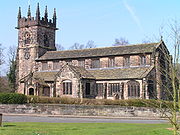 In the 2001 Census, 81% of the population (542,413) identified themselves as Christian; 124,677 (19%) did not identify with any religion or did not answer the question; 5,665 (1%) identified themselves as belonging to other major world religions; and 1,033 belonged to other religions.
The boundary of the Church of England
Diocese of Chester
follows most closely the pre-1974 county boundary of Cheshire, so it includes all of Wirral
, Stockport
, and the Cheshire panhandle that included Tintwistle Rural District
council area. In terms of Roman Catholic church administration, most of Cheshire falls into the Roman Catholic Diocese of Shrewsbury
.
, salt
and silk.
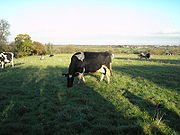 A mainly rural county, Cheshire has a high concentration of villages. Agriculture is generally based on the dairy trade, and cattle are the predominant livestock. Land use given to agriculture has fluctuated somewhat, and in 2005 totalled 1558 km² over 4,609 holdings. Based on holdings by EC farm type in 2005, 8.51 km² was allocated to dairy farming, with another 11.78 km² allocated to cattle and sheep.
The chemical industry in Cheshire was founded in Roman
times, with the mining of salt
in Middlewich and Northwich. Salt is still mined in the area by British Salt
. The salt mining has led to a continued chemical industry around Northwich, with Brunner Mond
based in the town. Other chemical companies, including Ineos
(formerly ICI
), have plants at Runcorn
. The Shell
Stanlow Refinery
is at Ellesmere Port. The oil refinery has operated since 1924 and has a capacity of 12 million tonnes per year.
Crewe was once the centre of the British railway industry
, and remains a major railway junction. The Crewe railway works
, built in 1840, employed 20,000 people at its peak, although the workforce is now less than 1,000. Crewe is also the home of Bentley
cars. Also within Cheshire are manufacturing plants for Jaguar
and Vauxhall Motors
in Ellesmere Port. The county also has an aircraft industry, with the BAE Systems
facility at Woodford Aerodrome, part of BAE System's Military Air Solutions division. The facility designed and constructed Avro Lancaster
and Avro Vulcan
bombers and the Hawker-Siddeley Nimrod. On the Cheshire border with Flintshire
is the Broughton
aircraft factory, more recently associated with Airbus
.
Tourism in Cheshire from within the UK and overseas continues to perform strongly. Over 8 million nights of accommodation (both UK and overseas) and over 2.8 million visits to Cheshire were recorded during 2003.
At the start of 2003, there were 22,020 VAT-registered enterprises in Cheshire, an increase of 7% since 1998, many in the business services (31.9%) and wholesale/retail (21.7%) sectors. Between 2002 and 2003 the number of businesses grew in four sectors: public administration and other services (6.0%), hotels and restaurants (5.1%), construction (1.7%), and business services (1.0%). The county saw the largest proportional reduction between 2001 and 2002 in employment in the energy and Water sector and there was also a significant reduction in the manufacturing sector. The largest growth during this period was in the other services and distribution, hotels and retail sectors.
Cheshire is considered to be an affluent county. Due to Cheshire's proximity to the cities of Manchester
and Liverpool
, counter urbanisation
is common. Cheshire West has a fairly large proportion of residents who work in Liverpool, while Cheshire East falls within Manchester's sphere of influence.
All four local education authorities
in Cheshire operate only comprehensive state school systems. When Altrincham
and Sale
were moved from Cheshire to Trafford in 1974, they took some former Cheshire selective schools. Today, there are two universities based in the county, the University of Chester
and the Crewe
campus of Manchester Metropolitan University
.
and Macclesfield Town
who both play in League Two
. Chester City
was also a League Two team until they were relegated to the Conference National
in April 2009 and later dissolved. A new club, Chester F.C. was formed in 2010 and currently plays in the Northern Premier League Premier Division
.
Cheshire also is represented in the highest level basketball league in the UK, the BBL
, by the Cheshire Jets
, formerly Chester Jets.
Warrington Wolves
are the premier Rugby League
team in Cheshire and play in the Super League
. Widnes Vikings
are currently in Super League
from the 2012 season. There are also numerous junior clubs in the county, including Chester Gladiators.
Cheshire County Cricket Club
is one of the clubs that make up the Minor counties of English and Welsh cricket.
The county has also been home to many notable sportsmen and athletes, including footballers Dean Ashton
, Djibril Cissé
, Peter Crouch
, Seth Johnson
, Michael Owen
and Wayne Rooney
. Other local athletes have included cricketer Ian Botham
, marathon runner Paula Radcliffe
, Great Britain Olympic oarsman Matthew Langridge
, Shirley Strong
, and mountaineer George Mallory
, who died in 1924 on Mount Everest
.
Each May, Europe's largest motorcycle event, the Thundersprint
, is held in Northwich
.
Cheshire has also produced a military hero in Norman Cyril Jones
, a World War I flying ace
who won the Distinguished Flying Cross
.
The county has produced several notable musicians, including popular artists John Mayall
(John Mayall & the Bluesbreakers
), Ian Astbury
(The Cult
), Tim Burgess (Charlatans) and Ian Curtis
(Joy Division
). Concert pianist Stephen Hough
, singer Thea Gilmore
and her producer husband Nigel Stonier
also reside in Cheshire. The county has also been home to several writers, including Hall Caine
(1853–1931), popular romantic novelist and playwright; Alan Garner
; Victorian novelist Elizabeth Gaskell
, whose novel Cranford
features her home town of Knutsford
; and most famously Lewis Carroll, born and raised in Daresbury
, hence the Cheshire cat
. Artists from the county include ceramic artist Emma Bossons
and sculptor and photographer Andy Goldsworthy
. Actors from Cheshire include Daniel Craig
, the 6th James Bond
; Dame Wendy Hiller; and Lewis McGibbon
, best known for his role in Millions
.
Local radio stations in the county include Dee 106.3
, Heart and Gold
for Chester and West Cheshire, Silk FM for the east of the county, Signal 1
for the south, Wire FM for Warrington, Wish FM
, which covers Widnes, and community station Cheshire FM
, which covers central Cheshire. The BBC covers the west with BBC Radio Merseyside
, the north and east with BBC Radio Manchester
and the south with BBC Radio Stoke
. There were plans to launch BBC Radio Cheshire, but those were shelved in 2007 after a lower than expected BBC licence fee settlement.
, Wilmslow
, Prestbury
, Tarporley
and Knutsford
, named in 2006 as the most expensive place to buy a house in the north of England. The former Cheshire town of Altrincham
was in second place. The area is sometimes referred to as The Golden Triangle
on account of the area in and around the above mentioned towns and villages.
The cities and towns in Cheshire are:
Some settlements which were historically part of the county now fall under the counties of Derbyshire, Merseyside and Greater Manchester:
. Many trains call at Crewe
(in the south of the county) and Warrington Bank Quay
(in the north of the county) en route to London and Scotland, as well as Runcorn on the Liverpool branch of the WCML.
The major interchanges are:
In the east of Cheshire, Macclesfield
station is served by Virgin Trains
and CrossCountry
, on the Manchester-London line. Services from Manchester to the south coast frequently stop at Macclesfield.
Cheshire has 3417 miles (5,499 km) of roads, including 214 miles (344 km) of the M6
, M62
, M53
and M56
motorways, with 23 interchanges and four service areas. The M6 motorway at the Thelwall Viaduct
carries 140,000 vehicles every 24 hours.
File:Cheshire Ring Schematic.png|thumb|right|250px|Schematic of the Cheshire Ring
circle 501 199 67 Manchester
circle 281 256 118 Bridgewater Canal
circle 487 30 98 Rochdale Canal
circle 672 79 90 Ashton Canal
circle 311 660 156 Trent and Mersey Canal
circle 861 650 178 Macclesfield Canal
circle 733 303 110 Peak Forest Canal
circle 930 390 90 Marple
circle 612 911 139 Stoke on Trent
rect 718 158 955 188 Ashton-under-Lyne
rect 197 373 420 415 Preston Brook
desc none
The Cheshire canal system
includes several canals originally used to transport the county's industrial products (mostly chemicals). Nowadays they are mainly used for tourist traffic. The Cheshire Ring
is formed from the Rochdale
, Ashton
, Peak Forest
, Macclesfield
, Trent and Mersey
and Bridgewater
canals.
The Manchester Ship Canal
is a wide, 36 miles (58 km) stretch of water opened in 1894. It consists of the rivers Irwell
and Mersey
made navigable to Manchester for seagoing ships leaving the Mersey estuary. The canal passes through the north of the county via Runcorn and Warrington.
Ceremonial counties of England
The ceremonial counties are areas of England to which are appointed a Lord Lieutenant, and are defined by the government as counties and areas for the purposes of the Lieutenancies Act 1997 with reference to the metropolitan and non-metropolitan counties of England and Lieutenancies Act 1997...
in North West England
North West England
North West England, informally known as The North West, is one of the nine official regions of England.North West England had a 2006 estimated population of 6,853,201 the third most populated region after London and the South East...
. Cheshire's county town
County town
A county town is a county's administrative centre in the United Kingdom or Ireland. County towns are usually the location of administrative or judicial functions, or established over time as the de facto main town of a county. The concept of a county town eventually became detached from its...
is the city
City status in the United Kingdom
City status in the United Kingdom is granted by the British monarch to a select group of communities. The holding of city status gives a settlement no special rights other than that of calling itself a "city". Nonetheless, this appellation carries its own prestige and, consequently, competitions...
of Chester
Chester
Chester is a city in Cheshire, England. Lying on the River Dee, close to the border with Wales, it is home to 77,040 inhabitants, and is the largest and most populous settlement of the wider unitary authority area of Cheshire West and Chester, which had a population of 328,100 according to the...
, although its largest town is Warrington
Warrington
Warrington is a town, borough and unitary authority area of Cheshire, England. It stands on the banks of the River Mersey, which is tidal to the west of the weir at Howley. It lies 16 miles east of Liverpool, 19 miles west of Manchester and 8 miles south of St Helens...
. Other major towns include Widnes
Widnes
Widnes is an industrial town within the borough of Halton, in Cheshire, England, with an urban area population of 57,663 in 2004. It is located on the northern bank of the River Mersey where the estuary narrows to form the Runcorn Gap. Directly to the south across the Mersey is the town of Runcorn...
, Congleton
Congleton
Congleton is a town and civil parish in the unitary authority of Cheshire East and the ceremonial county of Cheshire, England, on the banks of the River Dane, to the west of the Macclesfield Canal and 21 miles south of Manchester. It has a population of 25,750.-History:The first settlements in...
, Crewe
Crewe
Crewe is a railway town within the unitary authority area of Cheshire East and the ceremonial county of Cheshire, England. According to the 2001 census the urban area had a population of 67,683...
, Ellesmere Port
Ellesmere Port
Ellesmere Port is a large industrial town and port in the unitary authority of Cheshire West and Chester and the ceremonial county of Cheshire, England. It is situated on the south border of the Wirral Peninsula on the banks of the Manchester Ship Canal, which in turn gives access to the River...
, Runcorn
Runcorn
Runcorn is an industrial town and cargo port within the borough of Halton in the ceremonial county of Cheshire, England. In 2009, its population was estimated to be 61,500. The town is on the southern bank of the River Mersey where the estuary narrows to form Runcorn Gap. Directly to the north...
, Macclesfield
Macclesfield
Macclesfield is a market town within the unitary authority of Cheshire East, the county palatine of Chester, also known as the ceremonial county of Cheshire, England. The population of the Macclesfield urban sub-area at the time of the 2001 census was 50,688...
, Winsford
Winsford
Winsford is a town and civil parish within the unitary authority of Cheshire West and Chester and the ceremonial county of Cheshire, England. It lies on the River Weaver south of Northwich and west of Middlewich, and grew around the salt mining industry after the river was canalised in the...
, Northwich
Northwich
Northwich is a town and civil parish in the unitary authority of Cheshire West and Chester and the ceremonial county of Cheshire, England. It lies in the heart of the Cheshire Plain, at the confluence of the rivers Weaver and Dane...
, and Wilmslow
Wilmslow
-Economy:Wilmslow is well known, like Alderley Edge, for having many famous residents, notably footballers, stars of Coronation Street and rich North West businessmen. The town is part of the so-called Golden Triangle in the north west together with Alderley Edge and Prestbury...
. The county is bordered by Merseyside
Merseyside
Merseyside is a metropolitan county in North West England, with a population of 1,365,900. It encompasses the metropolitan area centred on both banks of the lower reaches of the Mersey Estuary, and comprises five metropolitan boroughs: Knowsley, St Helens, Sefton, Wirral, and the city of Liverpool...
and Greater Manchester
Greater Manchester
Greater Manchester is a metropolitan county in North West England, with a population of 2.6 million. It encompasses one of the largest metropolitan areas in the United Kingdom and comprises ten metropolitan boroughs: Bolton, Bury, Oldham, Rochdale, Stockport, Tameside, Trafford, Wigan, and the...
to the north, Derbyshire
Derbyshire
Derbyshire is a county in the East Midlands of England. A substantial portion of the Peak District National Park lies within Derbyshire. The northern part of Derbyshire overlaps with the Pennines, a famous chain of hills and mountains. The county contains within its boundary of approx...
to the east, Staffordshire
Staffordshire
Staffordshire is a landlocked county in the West Midlands region of England. For Eurostat purposes, the county is a NUTS 3 region and is one of four counties or unitary districts that comprise the "Shropshire and Staffordshire" NUTS 2 region. Part of the National Forest lies within its borders...
and Shropshire
Shropshire
Shropshire is a county in the West Midlands region of England. For Eurostat purposes, the county is a NUTS 3 region and is one of four counties or unitary districts that comprise the "Shropshire and Staffordshire" NUTS 2 region. It borders Wales to the west...
to the south, and Flintshire
Flintshire
Flintshire is a county in north-east Wales. It borders Denbighshire, Wrexham and the English county of Cheshire. It is named after the historic county of Flintshire, which had notably different borders...
and Wrexham
Wrexham (county borough)
Wrexham is a county borough centred on the town of Wrexham in north-east Wales. The county borough has a population of 130,200 inhabitants. Just under half of the population live either within the town of Wrexham or its surrounding conurbation of urban villages. The remainder living to the south...
in Wales to the west. The county is a part of the Welsh Marches
Welsh Marches
The Welsh Marches is a term which, in modern usage, denotes an imprecisely defined area along and around the border between England and Wales in the United Kingdom. The precise meaning of the term has varied at different periods...
.
Cheshire's area is 2343 square kilometres (905 sq mi) and its population is around 700,000. Apart from the large towns along the River Mersey
River Mersey
The River Mersey is a river in North West England. It is around long, stretching from Stockport, Greater Manchester, and ending at Liverpool Bay, Merseyside. For centuries, it formed part of the ancient county divide between Lancashire and Cheshire....
and the historic city of Chester, it is mostly rural, with a number of small towns and villages that support an agricultural industry. It is historically famous as a former principality
Principality
A principality is a monarchical feudatory or sovereign state, ruled or reigned over by a monarch with the title of prince or princess, or by a monarch with another title within the generic use of the term prince....
and for the production of Cheshire cheese
Cheshire cheese
Cheshire cheese is a dense and crumbly cheese produced in the English county of Cheshire, and four neighbouring counties, two in Wales and two in England .-History:...
, salt, bulk chemicals, and woven silk.
Toponymy
Cheshire's name was originally derived from an early name for Chester, and was first recorded as Legeceasterscir in the Anglo-Saxon Chronicles, meaning the shire of the city of legions. Although the name first appears in 980, it is thought that the county was created by Edward the ElderEdward the Elder
Edward the Elder was an English king. He became king in 899 upon the death of his father, Alfred the Great. His court was at Winchester, previously the capital of Wessex...
around 920. In the Domesday Book
Domesday Book
Domesday Book , now held at The National Archives, Kew, Richmond upon Thames in South West London, is the record of the great survey of much of England and parts of Wales completed in 1086...
, Chester was recorded as having the name Cestrescir (Chestershire), derived from the name for Chester at the time. A series of changes that occurred as English itself changed, together with some simplifications and elision
Elision
Elision is the omission of one or more sounds in a word or phrase, producing a result that is easier for the speaker to pronounce...
, resulted in the name Cheshire, as it occurs today.
Because of the historically close links with the land bordering Cheshire to the west, which became Wales
Wales
Wales is a country that is part of the United Kingdom and the island of Great Britain, bordered by England to its east and the Atlantic Ocean and Irish Sea to its west. It has a population of three million, and a total area of 20,779 km²...
, there is a history of interaction between Cheshire and Wales. The Domesday Book records Cheshire as having two complete Hundreds
Hundreds of Cheshire
The Hundreds of Cheshire, as with other Hundreds in England were the geographic divisions of Cheshire for administrative, military and judicial purposes. They were introduced in Cheshire some time before the Norman conquest...
(Atiscross and Exestan) that later became entirely part of Wales. Additionally, another large portion of the Duddestan Hundred later became known as Maelor Saesneg when it was transferred to Wales. For this and other reasons, the Welsh
Welsh language
Welsh is a member of the Brythonic branch of the Celtic languages spoken natively in Wales, by some along the Welsh border in England, and in Y Wladfa...
name for Cheshire (Swydd Gaerlleon) is sometimes used within Wales and by Welsh speakers.
Administrative history
After the Norman conquest of 1066 by William I, dissent and resistance continued for many years after the invasion. In Cheshire in 1069 local resistance was finally overcome, and draconian measures were taken to impress the native Saxons with the futility of future resistance. Earl Edwin of Mercia along with other major landowners were made examples of, their properties confiscated and redistributed amongst Norman barons. King William created one of his barons, Hugh d'Avranches (nicknamed Hugh Lupus, or 'wolf') as Earl of Chester, ruling virtually autonomously in William's name and with his full authority, and Cheshire was thereby declared a County Palatine.Cheshire in the Domesday Book
Domesday Book
Domesday Book , now held at The National Archives, Kew, Richmond upon Thames in South West London, is the record of the great survey of much of England and parts of Wales completed in 1086...
(1086) was recorded as a larger county than it is today. It included two hundred
Hundred (division)
A hundred is a geographic division formerly used in England, Wales, Denmark, South Australia, some parts of the United States, Germany , Sweden, Finland and Norway, which historically was used to divide a larger region into smaller administrative divisions...
s, Atiscross and Exestan, that later became part of Wales
Wales
Wales is a country that is part of the United Kingdom and the island of Great Britain, bordered by England to its east and the Atlantic Ocean and Irish Sea to its west. It has a population of three million, and a total area of 20,779 km²...
. At the time of the Domesday Book, it also included as part of Duddestan Hundred the area of land later known as Maelor Saesneg (which used to be a detached part of Flintshire
Flintshire (historic)
Flintshire , also known as the County of Flint, is one of thirteen historic counties, a vice-county and a former administrative county, which mostly lies on the north east coast of Wales....
) in Wales. The area between the Mersey
Mersey
Mersey may refer to:* River Mersey, in northwest England* Mersea Island, off the coast of Essex in England * Mersey River in the Australian state* Electoral division of Mersey in the state of Tasmania, Australian...
and Ribble
River Ribble
The River Ribble is a river that runs through North Yorkshire and Lancashire, in northern England. The river's drainage basin also includes parts of Greater Manchester around Wigan.-Geography:...
(referred to in the Domesday Book as "Inter Ripam et Mersam") formed part of the returns for Cheshire. Although this has been interpreted to mean that at that time south Lancashire was part of Cheshire, more exhaustive research indicates that the boundary between Cheshire and what was to become Lancashire remained the River Mersey
River Mersey
The River Mersey is a river in North West England. It is around long, stretching from Stockport, Greater Manchester, and ending at Liverpool Bay, Merseyside. For centuries, it formed part of the ancient county divide between Lancashire and Cheshire....
. With minor variations in spelling across sources, the complete list of hundreds of Cheshire
Hundreds of Cheshire
The Hundreds of Cheshire, as with other Hundreds in England were the geographic divisions of Cheshire for administrative, military and judicial purposes. They were introduced in Cheshire some time before the Norman conquest...
at this time are: Atiscross, Bochelau, Chester, Dudestan, Exestan, Hamestan, Middlewich, Riseton, Roelau, Tunendune, Warmundestrou and Wilaveston.
In 1182 the land north of the Mersey became administered as part of the new county of Lancashire
Lancashire
Lancashire is a non-metropolitan county of historic origin in the North West of England. It takes its name from the city of Lancaster, and is sometimes known as the County of Lancaster. Although Lancaster is still considered to be the county town, Lancashire County Council is based in Preston...
, thus resolving any uncertainty about the county in which the land "Inter Ripam et Mersam" was. Over the years, the ten hundreds consolidated and changed names to leave just seven—Broxton, Bucklow, Eddisbury, Macclesfield, Nantwich, Northwich and Wirral.
In 1397 the county had lands in the march of Wales added to its territory, and was promoted to the rank of principality. This was because of the support the men of the county had given to King Richard II, in particular by his standing armed force of about 500 men called the "Cheshire Guard". As a result the King's title was changed to "King of England and France, Lord of Ireland, and Prince of Chester". No other English county has been honoured in this way, although it lost the distinction on Richard's fall in 1399.
Through the Local Government Act 1972, which came into effect on 1 April 1974, some areas in the north-west became part of the metropolitan counties of Greater Manchester
Greater Manchester
Greater Manchester is a metropolitan county in North West England, with a population of 2.6 million. It encompasses one of the largest metropolitan areas in the United Kingdom and comprises ten metropolitan boroughs: Bolton, Bury, Oldham, Rochdale, Stockport, Tameside, Trafford, Wigan, and the...
and Merseyside
Merseyside
Merseyside is a metropolitan county in North West England, with a population of 1,365,900. It encompasses the metropolitan area centred on both banks of the lower reaches of the Mersey Estuary, and comprises five metropolitan boroughs: Knowsley, St Helens, Sefton, Wirral, and the city of Liverpool...
. Stockport
Stockport
Stockport is a town in Greater Manchester, England. It lies on elevated ground southeast of Manchester city centre, at the point where the rivers Goyt and Tame join and create the River Mersey. Stockport is the largest settlement in the metropolitan borough of the same name...
(previously a county borough), Altrincham
Altrincham
Altrincham is a market town within the Metropolitan Borough of Trafford, in Greater Manchester, England. It lies on flat ground south of the River Mersey about southwest of Manchester city centre, south-southwest of Sale and east of Warrington...
, Hyde
Hyde, Greater Manchester
Hyde is a town in the Metropolitan Borough of Tameside, Greater Manchester, England. As of the 2001 census, the town had a population of 31,253. Historically part of Cheshire, it is northeast of Stockport, west of Glossop and east of Manchester....
, Dukinfield
Dukinfield
Dukinfield is a small town within the Metropolitan Borough of Tameside, in Greater Manchester, England. It lies in central Tameside on the south bank of the River Tame, opposite Ashton-under-Lyne, and is east of the city of Manchester...
and Stalybridge
Stalybridge
Stalybridge is a town in the Metropolitan Borough of Tameside in Greater Manchester, England, with a population of 22,568. Historically a part of Cheshire, it is east of Manchester city centre and northwest of Glossop. With the construction of a cotton mill in 1776, Stalybridge became one of...
in the north-east became part of Greater Manchester. Much of the Wirral Peninsula
Wirral Peninsula
Wirral or the Wirral is a peninsula in North West England. It is bounded by three bodies of water: to the west by the River Dee, forming a boundary with Wales, to the east by the River Mersey and to the north by the Irish Sea. Both terms "Wirral" and "the Wirral" are used locally , although the...
in the north-west, including the county boroughs of Birkenhead and Wallasey, joined Merseyside. At the same time the Tintwistle Rural District
Tintwistle Rural District
Tintwistle Rural District was a local government district in north east Cheshire, England from 1894 to 1974.It was created a rural district by the Local Government Act 1894 from the part of the Ashton-under-Lyne rural sanitary district which was in Cheshire and consisted of the civil parishes...
was transferred to Derbyshire
Derbyshire
Derbyshire is a county in the East Midlands of England. A substantial portion of the Peak District National Park lies within Derbyshire. The northern part of Derbyshire overlaps with the Pennines, a famous chain of hills and mountains. The county contains within its boundary of approx...
. The area of Lancashire south of the Merseyside/Greater Manchester area, including Widnes
Widnes
Widnes is an industrial town within the borough of Halton, in Cheshire, England, with an urban area population of 57,663 in 2004. It is located on the northern bank of the River Mersey where the estuary narrows to form the Runcorn Gap. Directly to the south across the Mersey is the town of Runcorn...
and the county borough of Warrington
Warrington
Warrington is a town, borough and unitary authority area of Cheshire, England. It stands on the banks of the River Mersey, which is tidal to the west of the weir at Howley. It lies 16 miles east of Liverpool, 19 miles west of Manchester and 8 miles south of St Helens...
, was added to the new non-metropolitan county of Cheshire.
Halton
Halton (borough)
Halton is a local government district in North West England, with borough status and administered by a unitary authority. It was created in 1974 as a district of Cheshire, and became a unitary authority area on 1 April 1998. It consists of the towns of Widnes and Runcorn and the civil parishes of...
and Warrington
Warrington
Warrington is a town, borough and unitary authority area of Cheshire, England. It stands on the banks of the River Mersey, which is tidal to the west of the weir at Howley. It lies 16 miles east of Liverpool, 19 miles west of Manchester and 8 miles south of St Helens...
became unitary authorities independent of Cheshire County Council on 1 April 1998, but remain part of Cheshire for ceremonial purposes and also for fire and policing.
A referendum for a further local government reform connected with an elected regional assembly
Regional Assemblies in England
The Regional Assemblies of England were a group of indirectly elected regional bodies established originally under the name Regional Chambers by the Regional Development Agencies Act 1998. They were abolished on 31 March 2010 and replaced by Local Authority Leaders’ Boards...
was planned for 2004, but was abandoned – see Northern England referendum, 2004.
As part of the local government restructuring
2009 structural changes to local government in England
Structural changes to local government in England were effected on 1 April 2009, whereby a number of new unitary authorities were created in parts of the country which previously operated a 'two-tier' system of counties and districts...
in April 2009, Cheshire County Council
Cheshire County Council
Cheshire County Council was a County Council, of the second highest level of United Kingdom Government for the residents of Cheshire. Founded in 1889, it ceased to exist on 1 April 2009, when it and the district councils in Cheshire were replaced by two unitary authorities; Cheshire West and...
and the Cheshire districts were abolished and replaced by two new unitary authorities, Cheshire East
Cheshire East
Cheshire East is a unitary authority area with borough status in the ceremonial county of Cheshire, England.The borough was established in April 2009 as part of the 2009 structural changes to local government in England, by virtue of an order under the Local Government and Public Involvement in...
and Cheshire West and Chester
Cheshire West and Chester
Cheshire West and Chester is a unitary authority area with borough status, in the ceremonial county of Cheshire. It was established in April 2009 as part of the 2009 structural changes to local government in England, by virtue of an order under the Local Government and Public Involvement in Health...
. The existing unitary authorities of Halton
Halton (borough)
Halton is a local government district in North West England, with borough status and administered by a unitary authority. It was created in 1974 as a district of Cheshire, and became a unitary authority area on 1 April 1998. It consists of the towns of Widnes and Runcorn and the civil parishes of...
and Warrington
Warrington
Warrington is a town, borough and unitary authority area of Cheshire, England. It stands on the banks of the River Mersey, which is tidal to the west of the weir at Howley. It lies 16 miles east of Liverpool, 19 miles west of Manchester and 8 miles south of St Helens...
were not affected by the change.
As part of a 2002 marketing campaign, the plant conservation charity Plantlife
Plantlife
Plantlife is a wild plant conservation charity. As of 2007, its membership was 10,500 and it owned 23 nature reserves around the UK.-History:It was founded in 1989 with its first President being Professor David Bellamy. By 1999 it had 22 nature reserves....
chose the cuckooflower
Cardamine pratensis
Cardamine pratensis , is a flowering plant in the family Brassicaceae, native throughout most of Europe and Western Asia.-Description:...
as the county flower.
Buildings and structures
The Bridestones
The Bridestones consist of a chambered cairn, built in the Neolithic Stone Age, near Congleton, Cheshire, England. It was described in 1764 as being 100 metres long and 11 metres wide; it contained three separate compartments, of which only one remains today...
, near Congleton
Congleton
Congleton is a town and civil parish in the unitary authority of Cheshire East and the ceremonial county of Cheshire, England, on the banks of the River Dane, to the west of the Macclesfield Canal and 21 miles south of Manchester. It has a population of 25,750.-History:The first settlements in...
(Neolithic
Neolithic
The Neolithic Age, Era, or Period, or New Stone Age, was a period in the development of human technology, beginning about 9500 BC in some parts of the Middle East, and later in other parts of the world. It is traditionally considered as the last part of the Stone Age...
) and Robin Hood's Tump, near Alpraham
Alpraham
Alpraham is a village and civil parish in the unitary authority of Cheshire East and the ceremonial county of Cheshire, England. It is on the A51 road, between Nantwich and Chester, and is about seven miles north-west of Nantwich...
(Bronze Age
Bronze Age
The Bronze Age is a period characterized by the use of copper and its alloy bronze as the chief hard materials in the manufacture of some implements and weapons. Chronologically, it stands between the Stone Age and Iron Age...
). The remains of Iron Age hill fort
Hill fort
A hill fort is a type of earthworks used as a fortified refuge or defended settlement, located to exploit a rise in elevation for defensive advantage. They are typically European and of the Bronze and Iron Ages. Some were used in the post-Roman period...
s are found on sandstone ridges at several locations in Cheshire. Examples include Maiden Castle
Maiden Castle, Cheshire
Maiden Castle is an Iron Age hill fort, one of many fortified hill-top settlements constructed across Britain during the Iron Age, but one of only seven in the county of Cheshire in northern England. The hill fort was probably occupied from its construction in 600 BC until the Roman conquest...
on Bickerton Hill
Bickerton Hill
Bickerton Hill refers to two low red sandstone hills that form the southern end of the Mid Cheshire Ridge in Cheshire, north-west England. The high point, Raw Head, lies on the northerly hill and has an elevation of 227 metres...
, Helsby
Helsby
Helsby is a large village and civil parish in the unitary authority of Cheshire West and Chester and the ceremonial county of Cheshire, England. At the 2001 Census, Helsby had a population of 4,701.-Geography:...
Hillfort and Woodhouse Hillfort at Frodsham
Frodsham
Frodsham is a market town and civil parish in the unitary authority of Cheshire West and Chester and the ceremonial county of Cheshire, England. Its population is 8,982. It is approximately south of Runcorn, 16 miles south of Liverpool, and approximately south-west of Manchester...
. The Roman fortress and walls of Chester
Chester
Chester is a city in Cheshire, England. Lying on the River Dee, close to the border with Wales, it is home to 77,040 inhabitants, and is the largest and most populous settlement of the wider unitary authority area of Cheshire West and Chester, which had a population of 328,100 according to the...
, perhaps the earliest building works in Cheshire remaining above ground, are constructed from purple-grey sandstone.
The distinctive local red sandstone has been used for many monumental and ecclesiastical buildings throughout the county: for example, the medieval Beeston Castle
Beeston Castle
Beeston Castle is a former Royal castle in Beeston, Cheshire, England , perched on a rocky sandstone crag above the Cheshire Plain. It was built in the 1220s by Ranulf de Blondeville, 6th Earl of Chester, , on his return from the Crusades...
, Chester Cathedral
Chester Cathedral
Chester Cathedral is the mother church of the Church of England Diocese of Chester, and is located in the city of Chester, Cheshire, England. The cathedral, formerly St Werburgh's abbey church of a Benedictine monastery, is dedicated to Christ and the Blessed Virgin Mary...
and numerous parish churches. Occasional residential and industrial buildings, such as Helsby Station, Helsby
Helsby
Helsby is a large village and civil parish in the unitary authority of Cheshire West and Chester and the ceremonial county of Cheshire, England. At the 2001 Census, Helsby had a population of 4,701.-Geography:...
(1849), are also in this sandstone.
Many surviving buildings from the 15th to 17th centuries are timbered, particularly in the southern part of the county. Notable examples include the moated manor house Little Moreton Hall
Little Moreton Hall
Little Moreton Hall is a moated 15th and 16th-century half-timbered manor house southwest of Congleton, Cheshire. It is one of the finest examples of timber-framed domestic architecture in England. The house is today owned by the National Trust. It has been designated by English Heritage as a...
, dating from around 1450, and many commercial and residential buildings in Chester, Nantwich
Nantwich
Nantwich is a market town and civil parish in the Borough of Cheshire East and the ceremonial county of Cheshire, England. The town gives its name to the parliamentary constituency of Crewe and Nantwich...
and surrounding villages.
Early brick buildings include Peover Hall
Peover Hall
Peover Hall is a country house in the civil parish of Peover Superior, commonly known as Over Peover, Cheshire, England. It has been designated by English Heritage as a Grade II* listed building.-History:...
near Macclesfield
Macclesfield
Macclesfield is a market town within the unitary authority of Cheshire East, the county palatine of Chester, also known as the ceremonial county of Cheshire, England. The population of the Macclesfield urban sub-area at the time of the 2001 census was 50,688...
(1585), Tattenhall Hall
Tattenhall Hall
Tattenhall Hall is a country house standing to the south of the village of Tattenhall, Cheshire, England. It was built in the early part of the 17th century, before 1622, for Richard Bostock. The house was bought in 1856 by Robert Barbour who restored the house and commissioned Thomas...
(pre-1622), and the Pied Bull Hotel
Pied Bull Hotel
The Pied Bull Hotel is located at 57 Northgate Street, on the corner of King Street, Chester, Cheshire, England. It has been designated by English Heritage as a Grade II* listed building.-History:...
in Chester (17th century). From the 18th century, orange, red or brown brick became the predominant building material used in Cheshire, although earlier buildings are often faced or dressed with stone. Examples from the Victorian period onwards often employ distinctive brick detailing, such as brick patterning and ornate chimney stacks and gables. Notable examples include Arley Hall
Arley Hall
Arley Hall is a country house in the village of Arley, Cheshire, England, about south of Lymm and north of Northwich. It is home to the owner, Viscount Ashbrook and his family. The house is a Grade II* listed building, as is its adjacent chapel. Formal gardens to the southwest of the hall...
near Northwich
Northwich
Northwich is a town and civil parish in the unitary authority of Cheshire West and Chester and the ceremonial county of Cheshire, England. It lies in the heart of the Cheshire Plain, at the confluence of the rivers Weaver and Dane...
, Willington Hall
Willington Hall
Willington Hall is a former country house in the parish of Willington, Cheshire, England. It was extended in 1878, but reduced in size in the 1950s, and has since been in use as a hotel.-History:...
near Chester (both by Nantwich architect George Latham
George Latham (architect)
George Latham was an English architect and surveyor, from the town of Nantwich in Cheshire.-Life:Latham married the daughter of the Wesleyan Methodist minister of Nantwich, the Reverend Thomas Gee...
) and Overleigh Lodge, Chester. From the Victorian era, brick buildings often incorporate timberwork in a mock Tudor style, and this hybrid style has been used in some modern residential developments in the county. Industrial buildings, such as the Macclesfield silk mills (for example, Waters Green New Mill), are also usually in brick.
Physical geography
Cheshire covers a boulder clay plain separating the hills of North Wales
North Wales
North Wales is the northernmost unofficial region of Wales. It is bordered to the south by the counties of Ceredigion and Powys in Mid Wales and to the east by the counties of Shropshire in the West Midlands and Cheshire in North West England...
and the Peak District
Peak District
The Peak District is an upland area in central and northern England, lying mainly in northern Derbyshire, but also covering parts of Cheshire, Greater Manchester, Staffordshire, and South and West Yorkshire....
of Derbyshire
Derbyshire
Derbyshire is a county in the East Midlands of England. A substantial portion of the Peak District National Park lies within Derbyshire. The northern part of Derbyshire overlaps with the Pennines, a famous chain of hills and mountains. The county contains within its boundary of approx...
(the area is also known as the Cheshire Gap
Cheshire Plain
The Cheshire Plain is a relatively flat expanse of lowland situated almost entirely within the county of Cheshire in northwest England. It is bounded by the hills of North Wales to the west, and the Peak District of Derbyshire and North Staffordshire to the east and southeast...
). This was formed following the retreat of ice age
Ice age
An ice age or, more precisely, glacial age, is a generic geological period of long-term reduction in the temperature of the Earth's surface and atmosphere, resulting in the presence or expansion of continental ice sheets, polar ice sheets and alpine glaciers...
glaciers which left the area dotted with kettle holes, locally referred to as meres. The bedrock of this region is almost entirely Triassic
Triassic
The Triassic is a geologic period and system that extends from about 250 to 200 Mya . As the first period of the Mesozoic Era, the Triassic follows the Permian and is followed by the Jurassic. Both the start and end of the Triassic are marked by major extinction events...
sandstone
Sandstone
Sandstone is a sedimentary rock composed mainly of sand-sized minerals or rock grains.Most sandstone is composed of quartz and/or feldspar because these are the most common minerals in the Earth's crust. Like sand, sandstone may be any colour, but the most common colours are tan, brown, yellow,...
, outcrops of which have long been quarried, notably at Runcorn
Runcorn
Runcorn is an industrial town and cargo port within the borough of Halton in the ceremonial county of Cheshire, England. In 2009, its population was estimated to be 61,500. The town is on the southern bank of the River Mersey where the estuary narrows to form Runcorn Gap. Directly to the north...
, providing the distinctive red stone for Liverpool Cathedral
Liverpool Cathedral
Liverpool Cathedral is the Church of England cathedral of the Diocese of Liverpool, built on St James's Mount in Liverpool and is the seat of the Bishop of Liverpool. Its official name is the Cathedral Church of Christ in Liverpool but it is dedicated to Christ and the Blessed Virgin...
and Chester Cathedral
Chester Cathedral
Chester Cathedral is the mother church of the Church of England Diocese of Chester, and is located in the city of Chester, Cheshire, England. The cathedral, formerly St Werburgh's abbey church of a Benedictine monastery, is dedicated to Christ and the Blessed Virgin Mary...
.
The eastern half of the county is Upper Triassic Mercia Mudstone laid down with large salt deposits which were mined for hundreds of years around Northwich
Northwich
Northwich is a town and civil parish in the unitary authority of Cheshire West and Chester and the ceremonial county of Cheshire, England. It lies in the heart of the Cheshire Plain, at the confluence of the rivers Weaver and Dane...
. Separating this area from Lower Triassic Sherwood Sandstone to the west is a prominent sandstone ridge known as the Mid Cheshire Ridge
Mid Cheshire Ridge
The Mid Cheshire Ridge is a range of low sandstone hills which stretch north to south through Cheshire in North West England. The ridge is discontinuous, with the hills forming two main blocks, north and south of the "Beeston Gap"...
. A 55 kilometres (34 mi) footpath, the Sandstone Trail
Sandstone Trail
The Sandstone Trail is a long-distance walkers' path, following sandstone ridges running north–south from Frodsham in central Cheshire to Whitchurch just over the Shropshire border. The path was created in 1974 and extended in the 1990s...
, follows this ridge from Frodsham
Frodsham
Frodsham is a market town and civil parish in the unitary authority of Cheshire West and Chester and the ceremonial county of Cheshire, England. Its population is 8,982. It is approximately south of Runcorn, 16 miles south of Liverpool, and approximately south-west of Manchester...
to Whitchurch
Whitchurch, Shropshire
Whitchurch is a market town in Shropshire, England on the border between England and Wales. It is the oldest continuously inhabited town in Shropshire. According to the 2001 Census, the population of the town is 8,673, with a more recent estimate putting the population of the town at 8,934...
passing Delamere Forest
Delamere Forest
Delamere Forest or Delamere Forest Park is a wood in the Cheshire West and Chester area of Cheshire, England, near the town of Frodsham. It includes of mixed deciduous and evergreen woodland, centred at around , making it the largest area of woodland in Cheshire...
, Beeston Castle
Beeston Castle
Beeston Castle is a former Royal castle in Beeston, Cheshire, England , perched on a rocky sandstone crag above the Cheshire Plain. It was built in the 1220s by Ranulf de Blondeville, 6th Earl of Chester, , on his return from the Crusades...
and earlier Iron Age
Iron Age
The Iron Age is the archaeological period generally occurring after the Bronze Age, marked by the prevalent use of iron. The early period of the age is characterized by the widespread use of iron or steel. The adoption of such material coincided with other changes in society, including differing...
forts.
The highest point in Cheshire is Shining Tor
Shining Tor
Shining Tor is a hill in the Peak District of England, between the towns of Buxton and Macclesfield, lying on the border between Derbyshire and Cheshire. Its summit is the highest point in Cheshire...
on the Derbyshire/Cheshire border between Macclesfield
Macclesfield
Macclesfield is a market town within the unitary authority of Cheshire East, the county palatine of Chester, also known as the ceremonial county of Cheshire, England. The population of the Macclesfield urban sub-area at the time of the 2001 census was 50,688...
and Buxton
Buxton
Buxton is a spa town in Derbyshire, England. It has the highest elevation of any market town in England. Located close to the county boundary with Cheshire to the west and Staffordshire to the south, Buxton is described as "the gateway to the Peak District National Park"...
, at 559 metres (1,834 ft) above sea level. Prior to county boundary alterations in 1974, the county top was Black Hill
Black Hill (Peak District)
Black Hill is a hill in the Peak District, England.It used to be the highest point in Cheshire, but now lies on the border between the boroughs of Kirklees in West Yorkshire and High Peak in Derbyshire, reaching above sea level....
(582 m (1,909.4 ft)) near Crowden
Crowden, Derbyshire
Crowden is a landmark hamlet in the High Peak district of Derbyshire, miles northeast of Glossop and miles southwest of Holme in West Yorkshire, as well as from the larger city of Manchester and from the town of Barnsley...
in the far east of the historic county on the border with the West Riding of Yorkshire
West Riding of Yorkshire
The West Riding of Yorkshire is one of the three historic subdivisions of Yorkshire, England. From 1889 to 1974 the administrative county, County of York, West Riding , was based closely on the historic boundaries...
. Black Hill is now the highest point in West Yorkshire
West Yorkshire
West Yorkshire is a metropolitan county within the Yorkshire and the Humber region of England with a population of 2.2 million. West Yorkshire came into existence as a metropolitan county in 1974 after the passage of the Local Government Act 1972....
.
Population
Based on the Census of 2001, the overall population of Cheshire is 673,781, of which 51.3% of the population were male and 48.7% were female. Of those aged between 0–14 years, 51.5% were male and 48.4% were female; and of those aged over 75 years, 62.9% were female and 37.1% were male.The population density of Cheshire is 32 people per km², lower than the North West average of 42 people/km² and the England and Wales average of 38 people/km². Ellesmere Port and Neston has a greater urban density than the rest of the county with 92 people/km².
The population for 2021 is forecast to be 708,000.
Ethnicity
Ethnic white groups accounted for 98% (662,794) of the population with 10,994 (2%) in ethnic groups other than white.Of the 2% in non-white ethnic groups:
- 3,717 (34%) belonged to mixed ethnic groups
- 3,336 (30%) were Asian or Asian British
- 1,076 (10%) were Black or Black British
- 1,826 (17%) were of Chinese ethnic groups
- 1,039 (9%) were of other ethnic groups.
Population change
| Population totals for Cheshire | |||||||
|---|---|---|---|---|---|---|---|
| Year | Population | Year | Population | Year | Population | ||
| 1801 | 124,570 | 1871 | 277,123 | 1941 | 431,335 | ||
| 1811 | 141,672 | 1881 | 303,315 | 1951 | 471,438 | ||
| 1821 | 167,730 | 1891 | 324,494 | 1961 | 533,642 | ||
| 1831 | 191,965 | 1901 | 343,557 | 1971 | 605,918 | ||
| 1841 | 206,063 | 1911 | 364,179 | 1981 | 632,630 | ||
| 1851 | 224,739 | 1921 | 379,157 | 1991 | 656,050 | ||
| 1861 | 250,931 | 1931 | 395,717 | 2001 | 673,777 | ||
| Pre-1974 statistics were gathered from local government areas that now comprise Cheshire Source: Great Britain Historical GIS Great Britain Historical GIS The Great Britain Historical GIS , is a spatially-enabled database that documents and visualises the changing human geography of the British Isles, although is primarily focussed on the subdivisions of the United Kingdom mainly over the 200 years since the first census in 1801... . |
|||||||
Current
File:Cheshire unitary labell.png|300px|thumb|The ceremonial county showing the four unitary authorities. Click on the map for more information
poly 132 343 74 237 19 152 25 129 215 134 231 120 255 121 298 172 293 195 263 221 221 222 179 257 152 293 175 350 Cheshire West and Chester
Cheshire West and Chester
Cheshire West and Chester is a unitary authority area with borough status, in the ceremonial county of Cheshire. It was established in April 2009 as part of the 2009 structural changes to local government in England, by virtue of an order under the Local Government and Public Involvement in Health...
poly 168 293 241 241 285 239 325 225 382 264 383 272 316 308 312 348 225 368 Cheshire East
Cheshire East
Cheshire East is a unitary authority area with borough status in the ceremonial county of Cheshire, England.The borough was established in April 2009 as part of the 2009 structural changes to local government in England, by virtue of an order under the Local Government and Public Involvement in...
poly 333 175 269 130 267 103 300 82 357 102 480 90 491 189 410 239 Cheshire East
Cheshire East
Cheshire East is a unitary authority area with borough status in the ceremonial county of Cheshire, England.The borough was established in April 2009 as part of the 2009 structural changes to local government in England, by virtue of an order under the Local Government and Public Involvement in...
poly 313 228 334 183 419 219 354 293 Cheshire East
Cheshire East
Cheshire East is a unitary authority area with borough status in the ceremonial county of Cheshire, England.The borough was established in April 2009 as part of the 2009 structural changes to local government in England, by virtue of an order under the Local Government and Public Involvement in...
poly 131 105 166 58 182 73 182 94 201 99 207 91 218 105 210 129 183 127 161 121 131 107 Halton
poly 188 75 192 30 266 9 296 73 267 82 251 107 234 112 Warrington
Warrington
Warrington is a town, borough and unitary authority area of Cheshire, England. It stands on the banks of the River Mersey, which is tidal to the west of the weir at Howley. It lies 16 miles east of Liverpool, 19 miles west of Manchester and 8 miles south of St Helens...
desc none
Cheshire is a ceremonial county. This means that although there is no county-wide elected local authority, Cheshire has a Lord Lieutenant
Lord Lieutenant
The title Lord Lieutenant is given to the British monarch's personal representatives in the United Kingdom, usually in a county or similar circumscription, with varying tasks throughout history. Usually a retired local notable, senior military officer, peer or business person is given the post...
and High Sheriff
High Sheriff of Cheshire
The High Sheriff is the oldest secular office under the Crown. Formerly the High Sheriff was the principal law enforcement officer in the county but over the centuries most of the responsibilities associated with the post have been transferred elsewhere or are now defunct, so that its functions...
for ceremonial purposes under the Lieutenancies Act 1997
Lieutenancies Act 1997
The Lieutenancies Act 1997 is an Act of Parliament in the United Kingdom, that defines areas that Lord-Lieutenants are appointed to in Great Britain. It came into force on July 1, 1997.-Creation of modern local government:...
.
Local government functions apart from the Police and Fire/Rescue services are carried out by four smaller unitary authorities: Cheshire East
Cheshire East
Cheshire East is a unitary authority area with borough status in the ceremonial county of Cheshire, England.The borough was established in April 2009 as part of the 2009 structural changes to local government in England, by virtue of an order under the Local Government and Public Involvement in...
, Cheshire West and Chester
Cheshire West and Chester
Cheshire West and Chester is a unitary authority area with borough status, in the ceremonial county of Cheshire. It was established in April 2009 as part of the 2009 structural changes to local government in England, by virtue of an order under the Local Government and Public Involvement in Health...
, Halton
Halton (borough)
Halton is a local government district in North West England, with borough status and administered by a unitary authority. It was created in 1974 as a district of Cheshire, and became a unitary authority area on 1 April 1998. It consists of the towns of Widnes and Runcorn and the civil parishes of...
, and Warrington
Warrington
Warrington is a town, borough and unitary authority area of Cheshire, England. It stands on the banks of the River Mersey, which is tidal to the west of the weir at Howley. It lies 16 miles east of Liverpool, 19 miles west of Manchester and 8 miles south of St Helens...
.
Policing and fire and rescue services are still provided across the County as a whole, but by unelected bodies. The Cheshire Police Authority
Cheshire Constabulary
Cheshire Constabulary is the territorial police force responsible for policing the English unitary authorities of Cheshire East, Cheshire West and Chester, Halton and Warrington. The force is responsible for policing an area of with a population of roughly 1 million.The Chief Constable of the...
and Cheshire Fire Authority
Cheshire Fire and Rescue Service
Cheshire Fire and Rescue Service is the statuory fire and rescue service for the English county of Cheshire, consisting of the unitary authorities of Cheshire East, Cheshire West and Chester, Halton and Warrington. It has 24 fire stations...
consist of members of the four councils.
Transition from the previous (1974) arrangement
From 1 April 1974 the area under the control of the county council was divided into eight local government districts; ChesterChester (district)
Chester was a non-metropolitan local government district of Cheshire, England, with the status of a city and a borough.Apart from Chester itself, which was the principal settlement, the district covered a large rural area...
, Congleton
Congleton (borough)
Congleton was, from 1974 to 2009, a local government district with borough status in Cheshire, England. It included the towns of Congleton, Alsager, Holmes Chapel, Middlewich and Sandbach...
, Crewe and Nantwich
Crewe and Nantwich
Crewe and Nantwich was, from 1974 to 2009, a local government district with borough status in Cheshire, England. It had a population of 111,007...
, Ellesmere Port and Neston
Ellesmere Port and Neston
Ellesmere Port and Neston was, from 1974 to 2009, a local government district with borough status in Cheshire, England. It covered the southern part of the Wirral Peninsula, namely that part which is not included in the Metropolitan Borough of Wirral....
, Halton
Halton (borough)
Halton is a local government district in North West England, with borough status and administered by a unitary authority. It was created in 1974 as a district of Cheshire, and became a unitary authority area on 1 April 1998. It consists of the towns of Widnes and Runcorn and the civil parishes of...
, Macclesfield
Macclesfield (borough)
Macclesfield was, from 1974 to 2009, a local government district with borough status in Cheshire, England. It included the towns of Bollington, Knutsford, Macclesfield and Wilmslow and within its wider area the villages and hamlets of Adlington, Disley, Gawsworth, Kerridge, Pott Shrigley, Poynton,...
, Vale Royal
Vale Royal
Vale Royal was, from 1974 to 2009, a local government district with borough status in Cheshire, England. It contained the towns of Northwich, Winsford and Frodsham.-Creation:...
and Warrington
Warrington
Warrington is a town, borough and unitary authority area of Cheshire, England. It stands on the banks of the River Mersey, which is tidal to the west of the weir at Howley. It lies 16 miles east of Liverpool, 19 miles west of Manchester and 8 miles south of St Helens...
. Halton
Halton (borough)
Halton is a local government district in North West England, with borough status and administered by a unitary authority. It was created in 1974 as a district of Cheshire, and became a unitary authority area on 1 April 1998. It consists of the towns of Widnes and Runcorn and the civil parishes of...
(which includes the towns of Runcorn
Runcorn
Runcorn is an industrial town and cargo port within the borough of Halton in the ceremonial county of Cheshire, England. In 2009, its population was estimated to be 61,500. The town is on the southern bank of the River Mersey where the estuary narrows to form Runcorn Gap. Directly to the north...
and Widnes
Widnes
Widnes is an industrial town within the borough of Halton, in Cheshire, England, with an urban area population of 57,663 in 2004. It is located on the northern bank of the River Mersey where the estuary narrows to form the Runcorn Gap. Directly to the south across the Mersey is the town of Runcorn...
) and Warrington
Warrington
Warrington is a town, borough and unitary authority area of Cheshire, England. It stands on the banks of the River Mersey, which is tidal to the west of the weir at Howley. It lies 16 miles east of Liverpool, 19 miles west of Manchester and 8 miles south of St Helens...
became unitary authorities
Unitary authority
A unitary authority is a type of local authority that has a single tier and is responsible for all local government functions within its area or performs additional functions which elsewhere in the relevant country are usually performed by national government or a higher level of sub-national...
in 1998. The remaining districts and the county were abolished as part of local government restructuring on 1 April 2009. The Halton and Warrington boroughs were not affected by the 2009 restructuring.
On 25 July 2007, the Secretary of State Hazel Blears
Hazel Blears
Hazel Anne Blears is a British Labour Party politician, who has been the Member of Parliament for Salford and Eccles since 2010 and was previously the MP for Salford since 1997...
announced she was 'minded' to split Cheshire into two new unitary authorities, Cheshire West and Chester
Cheshire West and Chester
Cheshire West and Chester is a unitary authority area with borough status, in the ceremonial county of Cheshire. It was established in April 2009 as part of the 2009 structural changes to local government in England, by virtue of an order under the Local Government and Public Involvement in Health...
, and Cheshire East
Cheshire East
Cheshire East is a unitary authority area with borough status in the ceremonial county of Cheshire, England.The borough was established in April 2009 as part of the 2009 structural changes to local government in England, by virtue of an order under the Local Government and Public Involvement in...
. She confirmed she had not changed her mind on 19 December 2007 and therefore the proposal to split two-tier Cheshire into two would proceed.
Cheshire County Council leader Paul Findlow, who attempted High Court legal action against the proposal, claimed that splitting Cheshire would only disrupt excellent services while increasing living costs for all. A widespread sentiment that this decision was taken by the European Union
European Union
The European Union is an economic and political union of 27 independent member states which are located primarily in Europe. The EU traces its origins from the European Coal and Steel Community and the European Economic Community , formed by six countries in 1958...
long ago has often been portrayed via angered letters from Cheshire residents to local papers. On 31 January 2008 The Standard, Cheshire & district newspaper, announced that the legal action had been dropped. Members against the proposal were advised that they may be unable to persuade the court that the decision of Hazel Blears was "manifestly absurd".
The Cheshire West and Chester unitary authority covers the area formerly occupied by the City of Chester and the boroughs of Ellesmere Port and Neston and Vale Royal; Cheshire East now covers the area formerly occupied by the boroughs of Congleton, Crewe and Nantwich, and Macclesfield. The changes were implemented on 1 April 2009.
Congleton Borough Council
Congleton
Congleton is a town and civil parish in the unitary authority of Cheshire East and the ceremonial county of Cheshire, England, on the banks of the River Dane, to the west of the Macclesfield Canal and 21 miles south of Manchester. It has a population of 25,750.-History:The first settlements in...
pursued an appeal against the judicial review it lost in October 2007. The appeal was dismissed on 4 March 2008.
Borders
The ceremonial countyCeremonial counties of England
The ceremonial counties are areas of England to which are appointed a Lord Lieutenant, and are defined by the government as counties and areas for the purposes of the Lieutenancies Act 1997 with reference to the metropolitan and non-metropolitan counties of England and Lieutenancies Act 1997...
borders Merseyside
Merseyside
Merseyside is a metropolitan county in North West England, with a population of 1,365,900. It encompasses the metropolitan area centred on both banks of the lower reaches of the Mersey Estuary, and comprises five metropolitan boroughs: Knowsley, St Helens, Sefton, Wirral, and the city of Liverpool...
, Greater Manchester
Greater Manchester
Greater Manchester is a metropolitan county in North West England, with a population of 2.6 million. It encompasses one of the largest metropolitan areas in the United Kingdom and comprises ten metropolitan boroughs: Bolton, Bury, Oldham, Rochdale, Stockport, Tameside, Trafford, Wigan, and the...
, Derbyshire
Derbyshire
Derbyshire is a county in the East Midlands of England. A substantial portion of the Peak District National Park lies within Derbyshire. The northern part of Derbyshire overlaps with the Pennines, a famous chain of hills and mountains. The county contains within its boundary of approx...
, Staffordshire
Staffordshire
Staffordshire is a landlocked county in the West Midlands region of England. For Eurostat purposes, the county is a NUTS 3 region and is one of four counties or unitary districts that comprise the "Shropshire and Staffordshire" NUTS 2 region. Part of the National Forest lies within its borders...
and Shropshire
Shropshire
Shropshire is a county in the West Midlands region of England. For Eurostat purposes, the county is a NUTS 3 region and is one of four counties or unitary districts that comprise the "Shropshire and Staffordshire" NUTS 2 region. It borders Wales to the west...
in England along with Flintshire
Flintshire
Flintshire is a county in north-east Wales. It borders Denbighshire, Wrexham and the English county of Cheshire. It is named after the historic county of Flintshire, which had notably different borders...
and Wrexham
Wrexham
Wrexham is a town in Wales. It is the administrative centre of the wider Wrexham County Borough, and the largest town in North Wales, located in the east of the region. It is situated between the Welsh mountains and the lower Dee Valley close to the border with Cheshire, England...
in Wales, arranged by compass directions as shown in the table. below. Cheshire also forms part of the North West England
North West England
North West England, informally known as The North West, is one of the nine official regions of England.North West England had a 2006 estimated population of 6,853,201 the third most populated region after London and the South East...
region.
| Neighbouring Authorities to the Ceremonial County |
|---|
Religion
The boundary of the Church of England
Church of England
The Church of England is the officially established Christian church in England and the Mother Church of the worldwide Anglican Communion. The church considers itself within the tradition of Western Christianity and dates its formal establishment principally to the mission to England by St...
Diocese of Chester
Diocese of Chester
The Diocese of Chester is a Church of England diocese in the Province of York based in Chester, covering the county of Cheshire in its pre-1974 boundaries...
follows most closely the pre-1974 county boundary of Cheshire, so it includes all of Wirral
Metropolitan Borough of Wirral
The Metropolitan Borough of Wirral is a metropolitan borough of Merseyside, in North West England. It has a population of 311,200, and encompasses of the northern part of the Wirral Peninsula. Major settlements include Birkenhead, Wallasey, Bebington, Heswall, Hoylake and West Kirby. The city of...
, Stockport
Stockport
Stockport is a town in Greater Manchester, England. It lies on elevated ground southeast of Manchester city centre, at the point where the rivers Goyt and Tame join and create the River Mersey. Stockport is the largest settlement in the metropolitan borough of the same name...
, and the Cheshire panhandle that included Tintwistle Rural District
Tintwistle Rural District
Tintwistle Rural District was a local government district in north east Cheshire, England from 1894 to 1974.It was created a rural district by the Local Government Act 1894 from the part of the Ashton-under-Lyne rural sanitary district which was in Cheshire and consisted of the civil parishes...
council area. In terms of Roman Catholic church administration, most of Cheshire falls into the Roman Catholic Diocese of Shrewsbury
Diocese of Shrewsbury
The Roman Catholic Diocese of Shrewsbury is a Latin Rite Roman Catholic diocese in England. The diocese encompasses parts of the North West of England and parts of the West Midlands...
.
Economy and industry
Cheshire has a diverse economy with significant sectors including agriculture, automotive, bio-technology, chemical, financial services, food and drink, ICT, and tourism. The county is famous for the production of Cheshire cheeseCheshire cheese
Cheshire cheese is a dense and crumbly cheese produced in the English county of Cheshire, and four neighbouring counties, two in Wales and two in England .-History:...
, salt
Salt in Cheshire
Cheshire is a county in North West England. Rock salt was laid down in this region some 220 million years ago, during the Triassic period. Seawater moved inland from an open sea, creating a chain of shallow salt marshes across what is today the Cheshire basin...
and silk.
The chemical industry in Cheshire was founded in Roman
Roman Britain
Roman Britain was the part of the island of Great Britain controlled by the Roman Empire from AD 43 until ca. AD 410.The Romans referred to the imperial province as Britannia, which eventually comprised all of the island of Great Britain south of the fluid frontier with Caledonia...
times, with the mining of salt
Salt in Cheshire
Cheshire is a county in North West England. Rock salt was laid down in this region some 220 million years ago, during the Triassic period. Seawater moved inland from an open sea, creating a chain of shallow salt marshes across what is today the Cheshire basin...
in Middlewich and Northwich. Salt is still mined in the area by British Salt
British Salt
British Salt Limited is a United Kingdom-based chemical company that produces pure white salt. The company is owned by the management and private equity company LDC...
. The salt mining has led to a continued chemical industry around Northwich, with Brunner Mond
Brunner Mond
Tata Chemicals Europe is a UK-based chemicals company that is a subsidiary of Tata Chemicals Limited, itself a part of the India-based Tata Group...
based in the town. Other chemical companies, including Ineos
Ineos
INEOS Group Limited is a privately owned multinational chemicals company headquartered in Lausanne, Switzerland and with its registered office in Lyndhurst, United Kingdom...
(formerly ICI
Imperial Chemical Industries
Imperial Chemical Industries was a British chemical company, taken over by AkzoNobel, a Dutch conglomerate, one of the largest chemical producers in the world. In its heyday, ICI was the largest manufacturing company in the British Empire, and commonly regarded as a "bellwether of the British...
), have plants at Runcorn
Runcorn
Runcorn is an industrial town and cargo port within the borough of Halton in the ceremonial county of Cheshire, England. In 2009, its population was estimated to be 61,500. The town is on the southern bank of the River Mersey where the estuary narrows to form Runcorn Gap. Directly to the north...
. The Shell
Royal Dutch Shell
Royal Dutch Shell plc , commonly known as Shell, is a global oil and gas company headquartered in The Hague, Netherlands and with its registered office in London, United Kingdom. It is the fifth-largest company in the world according to a composite measure by Forbes magazine and one of the six...
Stanlow Refinery
Stanlow Refinery
Stanlow Refinery is an oil refinery owned by Essar Energy in Ellesmere Port, Cheshire, England. It was previously owned by Royal Dutch Shell and is part of the Shell Stanlow Manufacturing Complex.-History:...
is at Ellesmere Port. The oil refinery has operated since 1924 and has a capacity of 12 million tonnes per year.
Crewe was once the centre of the British railway industry
Rail transport in Great Britain
The railway system in Great Britain is the oldest in the world, with the world's first locomotive-hauled public railway opening in 1825. As of 2010, it consists of of standard gauge lines , of which are electrified. These lines range from single to double, triple, quadruple track and up to twelve...
, and remains a major railway junction. The Crewe railway works
Crewe Works
Crewe railway works is a British railway engineering facility built in 1840 by the Grand Junction Railway. It is located in the town of Crewe, in the county of Cheshire....
, built in 1840, employed 20,000 people at its peak, although the workforce is now less than 1,000. Crewe is also the home of Bentley
Bentley
Bentley Motors Limited is a British manufacturer of automobiles founded on 18 January 1919 by Walter Owen Bentley known as W.O. Bentley or just "W O". Bentley had been previously known for his range of rotary aero-engines in World War I, the most famous being the Bentley BR1 as used in later...
cars. Also within Cheshire are manufacturing plants for Jaguar
Jaguar (car)
Jaguar Cars Ltd, known simply as Jaguar , is a British luxury car manufacturer, headquartered in Whitley, Coventry, England. It is part of the Jaguar Land Rover business, a subsidiary of the Indian company Tata Motors....
and Vauxhall Motors
Vauxhall Motors
Vauxhall Motors is a British automotive company owned by General Motors and headquartered in Luton. It was founded in 1857 as a pump and marine engine manufacturer, began manufacturing cars in 1903 and was acquired by GM in 1925. It has been the second-largest selling car brand in the UK for...
in Ellesmere Port. The county also has an aircraft industry, with the BAE Systems
BAE Systems
BAE Systems plc is a British multinational defence, security and aerospace company headquartered in London, United Kingdom, that has global interests, particularly in North America through its subsidiary BAE Systems Inc. BAE is among the world's largest military contractors; in 2009 it was the...
facility at Woodford Aerodrome, part of BAE System's Military Air Solutions division. The facility designed and constructed Avro Lancaster
Avro Lancaster
The Avro Lancaster is a British four-engined Second World War heavy bomber made initially by Avro for the Royal Air Force . It first saw active service in 1942, and together with the Handley Page Halifax it was one of the main heavy bombers of the RAF, the RCAF, and squadrons from other...
and Avro Vulcan
Avro Vulcan
The Avro Vulcan, sometimes referred to as the Hawker Siddeley Vulcan, was a jet-powered delta wing strategic bomber, operated by the Royal Air Force from 1956 until 1984. Aircraft manufacturer A V Roe & Co designed the Vulcan in response to Specification B.35/46. Of the three V bombers produced,...
bombers and the Hawker-Siddeley Nimrod. On the Cheshire border with Flintshire
Flintshire
Flintshire is a county in north-east Wales. It borders Denbighshire, Wrexham and the English county of Cheshire. It is named after the historic county of Flintshire, which had notably different borders...
is the Broughton
Broughton, Flintshire
Broughton is a small district in Flintshire, Wales, close to the Wales–England border and located to the west of the City of Chester, England. Along with the nearby village of Bretton, the total population was 5,791 at the 2001 Census....
aircraft factory, more recently associated with Airbus
Airbus
Airbus SAS is an aircraft manufacturing subsidiary of EADS, a European aerospace company. Based in Blagnac, France, surburb of Toulouse, and with significant activity across Europe, the company produces around half of the world's jet airliners....
.
Tourism in Cheshire from within the UK and overseas continues to perform strongly. Over 8 million nights of accommodation (both UK and overseas) and over 2.8 million visits to Cheshire were recorded during 2003.
At the start of 2003, there were 22,020 VAT-registered enterprises in Cheshire, an increase of 7% since 1998, many in the business services (31.9%) and wholesale/retail (21.7%) sectors. Between 2002 and 2003 the number of businesses grew in four sectors: public administration and other services (6.0%), hotels and restaurants (5.1%), construction (1.7%), and business services (1.0%). The county saw the largest proportional reduction between 2001 and 2002 in employment in the energy and Water sector and there was also a significant reduction in the manufacturing sector. The largest growth during this period was in the other services and distribution, hotels and retail sectors.
Cheshire is considered to be an affluent county. Due to Cheshire's proximity to the cities of Manchester
Manchester
Manchester is a city and metropolitan borough in Greater Manchester, England. According to the Office for National Statistics, the 2010 mid-year population estimate for Manchester was 498,800. Manchester lies within one of the UK's largest metropolitan areas, the metropolitan county of Greater...
and Liverpool
Liverpool
Liverpool is a city and metropolitan borough of Merseyside, England, along the eastern side of the Mersey Estuary. It was founded as a borough in 1207 and was granted city status in 1880...
, counter urbanisation
Counter Urbanisation
Counter urbanisation is a demographic and social process whereby people move from urban areas to rural areas. It first took place as a reaction to inner-city deprivation and overcrowding. Initial study of counter urbanisation was carried out by human geographer Brian Berry...
is common. Cheshire West has a fairly large proportion of residents who work in Liverpool, while Cheshire East falls within Manchester's sphere of influence.
Education
See also: List of schools in Cheshire East; List of schools in Cheshire West and Chester; List of schools in Halton; List of schools in WarringtonAll four local education authorities
Local Education Authority
A local education authority is a local authority in England and Wales that has responsibility for education within its jurisdiction...
in Cheshire operate only comprehensive state school systems. When Altrincham
Altrincham
Altrincham is a market town within the Metropolitan Borough of Trafford, in Greater Manchester, England. It lies on flat ground south of the River Mersey about southwest of Manchester city centre, south-southwest of Sale and east of Warrington...
and Sale
Sale, Greater Manchester
Sale is a town within the Metropolitan Borough of Trafford, in Greater Manchester, England. Historically part of Cheshire, the town lies on flat ground on the south bank of the River Mersey, south of Stretford, northeast of Altrincham, and southwest of the city of Manchester...
were moved from Cheshire to Trafford in 1974, they took some former Cheshire selective schools. Today, there are two universities based in the county, the University of Chester
University of Chester
The University of Chester is a public research university located in Chester, United Kingdom. The University, based on a main campus in Chester and a smaller campus in Warrington, offers a range of foundation, undergraduate and postgraduate courses, as well as undertaking academic research.Chester...
and the Crewe
Crewe
Crewe is a railway town within the unitary authority area of Cheshire East and the ceremonial county of Cheshire, England. According to the 2001 census the urban area had a population of 67,683...
campus of Manchester Metropolitan University
Manchester Metropolitan University
Manchester Metropolitan University is a university in North West England. Its headquarters and central campus is in the city of Manchester, but there are outlying facilities in the county of Cheshire. It is the third largest university in the United Kingdom in terms of student numbers, behind the...
.
Culture, media and sport
Cheshire has two league football teams, namely Crewe AlexandraCrewe Alexandra F.C.
Crewe Alexandra Football Club is an English professional football club based in Crewe, Cheshire. Nicknamed The Railwaymen due to the town's links with the rail industry, they currently play in Football League Two, the fourth tier of English football, and are based at the Alexandra Stadium.The club...
and Macclesfield Town
Macclesfield Town F.C.
Macclesfield Town Football Club is an English football team. The club was formed in 1874 and is based in the town of Macclesfield in Cheshire. The team play its home games at the 6,355 capacity Moss Rose stadium...
who both play in League Two
Football League Two
Football League Two is the third-highest division of The Football League and fourth-highest division overall in the English football league system....
. Chester City
Chester City F.C.
Chester City Football Club was an English football team from Chester. The club was founded as Chester F.C., and joined the Football League in 1931, spending most of their time in the lower divisions. They changed their name to Chester City in 1983. Chester won their first league title in 2004, the...
was also a League Two team until they were relegated to the Conference National
Conference National
Conference National is the top division of the Football Conference in England. It is the highest level of the National League System and fifth highest of the overall English football league system...
in April 2009 and later dissolved. A new club, Chester F.C. was formed in 2010 and currently plays in the Northern Premier League Premier Division
Northern Premier League Premier Division
The Premier Division is the top division of the Northern Premier League. It is at Step 3 of the National League System, placing it six divisions below the Premier League...
.
Cheshire also is represented in the highest level basketball league in the UK, the BBL
British Basketball League
The British Basketball League, often abbreviated to the BBL, is the premier men's professional basketball league in the United Kingdom. The BBL runs two knockout competitions alongside the league championship; the BBL Cup and the BBL Trophy....
, by the Cheshire Jets
Cheshire Jets
The Cheshire Jets are a British professional basketball team based in the city of Chester, in Cheshire, England. Formerly known as the Chester Jets, their home court is the Northgate Arena and they play in the top-tier British Basketball League....
, formerly Chester Jets.
Warrington Wolves
Warrington Wolves
Warrington Wolves are a professional rugby league football club based in Warrington, England that competes in Super League. They play at the Halliwell Jones Stadium, having moved there from Wilderspool in 2003....
are the premier Rugby League
Rugby league
Rugby league football, usually called rugby league, is a full contact sport played by two teams of thirteen players on a rectangular grass field. One of the two codes of rugby football, it originated in England in 1895 by a split from Rugby Football Union over paying players...
team in Cheshire and play in the Super League
Super League
Super League is the top-level professional rugby league football club competition in Europe. As a result of sponsorship from engage Mutual Assurance the competition is currently officially known as the engage Super League. The League features fourteen teams: thirteen from England and one from...
. Widnes Vikings
Widnes Vikings
Widnes Vikings RLFC are an English professional rugby league club based in Widnes, Cheshire. They currently play in the Engage Super League, the top tier of European rugby league, after being awarded a license to compete in the top-flight Super League from 2012 onward...
are currently in Super League
Super League
Super League is the top-level professional rugby league football club competition in Europe. As a result of sponsorship from engage Mutual Assurance the competition is currently officially known as the engage Super League. The League features fourteen teams: thirteen from England and one from...
from the 2012 season. There are also numerous junior clubs in the county, including Chester Gladiators.
Cheshire County Cricket Club
Cheshire County Cricket Club
Cheshire County Cricket Club is one of the county clubs which make up the Minor Counties in the English domestic cricket structure, representing the historic county of Cheshire and playing in the Minor Counties Championship and the MCCA Knockout Trophy...
is one of the clubs that make up the Minor counties of English and Welsh cricket.
The county has also been home to many notable sportsmen and athletes, including footballers Dean Ashton
Dean Ashton
Dean Ashton is a former English professional footballer. He made over 240 appearances as a forward in the Football League and Premier League for Crewe Alexandra, Norwich City and , and was also capped by England. He was highly praised as a talented centre forward, but had a career frustrated by...
, Djibril Cissé
Djibril Cissé
Djibril Aruun Cissé is a French international footballer who currently plays for Serie A club Lazio as a striker. He is noted particularly for his speed and acceleration. Since 2005, he has held the title of Lord of the Manor of Frodsham....
, Peter Crouch
Peter Crouch
Peter James Crouch is an English footballer who plays as a striker for Premier League club Stoke City and the England national team.Crouch started his career as a trainee with Tottenham Hotspur...
, Seth Johnson
Seth Johnson
Seth Art Maurice Johnson is a former England international footballer, who is currently without a club after his second spell as a player with Derby County ended in 2007.-Playing career:...
, Michael Owen
Michael Owen
Michael James Owen is an English professional footballer who plays as a striker for Manchester United.The son of former footballer Terry Owen, Owen began his senior career at Liverpool in 1996. He progressed through the Liverpool youth team and scored on his debut in May 1997...
and Wayne Rooney
Wayne Rooney
Wayne Mark Rooney is an English footballer who plays as a striker for Premier League club Manchester United and the England national team...
. Other local athletes have included cricketer Ian Botham
Ian Botham
Sir Ian Terence Botham OBE is a former England Test cricketer and Test team captain, and current cricket commentator. He was a genuine all-rounder with 14 centuries and 383 wickets in Test cricket, and remains well-known by his nickname "Beefy"...
, marathon runner Paula Radcliffe
Paula Radcliffe
Paula Jane Radcliffe, MBE is an English long-distance runner. She is the current women's world record holder in the marathon with her time of 2:15:25 hours...
, Great Britain Olympic oarsman Matthew Langridge
Matthew Langridge
Matthew Langridge is a current Great Britain oarsman.-Junior Rowing Career:...
, Shirley Strong
Shirley Strong
Shirley Elaine Strong is a British athlete who competed mainly in the 100 metres hurdles.She competed for Great Britain in the 1984 Summer Olympics held in Los Angeles, U.S. in the 100 metre hurdles where she won the Silver medal....
, and mountaineer George Mallory
George Mallory
George Herbert Leigh Mallory was an English mountaineer who took part in the first three British expeditions to Mount Everest in the early 1920s....
, who died in 1924 on Mount Everest
Mount Everest
Mount Everest is the world's highest mountain, with a peak at above sea level. It is located in the Mahalangur section of the Himalayas. The international boundary runs across the precise summit point...
.
Each May, Europe's largest motorcycle event, the Thundersprint
Thundersprint
Thundersprint is a motorcycle event for classic and exotic motorcycles held in annually in May in Northwich, Cheshire, England. Attendance is estimated to be around 100,000 over the two days, and it is the second largest event in Europe....
, is held in Northwich
Northwich
Northwich is a town and civil parish in the unitary authority of Cheshire West and Chester and the ceremonial county of Cheshire, England. It lies in the heart of the Cheshire Plain, at the confluence of the rivers Weaver and Dane...
.
Cheshire has also produced a military hero in Norman Cyril Jones
Norman Cyril Jones
Captain Norman Cyril Jones was an English flying ace during World War I. He was credited with nine aerial victories.-Early life:Norman Cyril Jones was born in Cheshire, England...
, a World War I flying ace
Flying ace
A flying ace or fighter ace is a military aviator credited with shooting down several enemy aircraft during aerial combat. The actual number of aerial victories required to officially qualify as an "ace" has varied, but is usually considered to be five or more...
who won the Distinguished Flying Cross
Distinguished Flying Cross (United Kingdom)
The Distinguished Flying Cross is a military decoration awarded to personnel of the United Kingdom's Royal Air Force and other services, and formerly to officers of other Commonwealth countries, for "an act or acts of valour, courage or devotion to duty whilst flying in active operations against...
.
The county has produced several notable musicians, including popular artists John Mayall
John Mayall
John Mayall, OBE is an English blues singer, songwriter, and multi-instrumentalist, whose musical career spans over fifty years...
(John Mayall & the Bluesbreakers
John Mayall & the Bluesbreakers
John Mayall & the Bluesbreakers are a pioneering English blues band, led by singer, songwriter, and multi-instrumentalist John Mayall, OBE. Mayall used the band name between 1963 and 1967, but then dropped it for some fifteen years. However, in 1982 a 'Return of the Bluesbreakers' was announced and...
), Ian Astbury
Ian Astbury
Ian Astbury is an English rock musician and songwriter best known as the lead vocalist for the rock band, The Cult.-Pre-Cult:...
(The Cult
The Cult
The Cult are a British rock band that was formed in 1983. They gained a dedicated following in Britain in the mid 1980s as a post-punk band with singles such as "She Sells Sanctuary", before breaking mainstream in the United States in the late 1980s as a hard rock band with singles such as "Love...
), Tim Burgess (Charlatans) and Ian Curtis
Ian Curtis
Ian Kevin Curtis was an English singer and lyricist, famous for leading the post-punk band Joy Division. Joy Division released their debut album, Unknown Pleasures, in 1979 and recorded their follow-up, Closer, in 1980...
(Joy Division
Joy Division
Joy Division were an English rock band formed in 1976 in Salford, Greater Manchester. Originally named Warsaw, the band primarily consisted of Ian Curtis , Bernard Sumner , Peter Hook and Stephen Morris .Joy Division rapidly evolved from their initial punk rock influences...
). Concert pianist Stephen Hough
Stephen Hough
Stephen Andrew Gill Hough is a British-born classical pianist, composer and writer. He became an Australian citizen in 2005 and thus has dual nationality .-Biography:...
, singer Thea Gilmore
Thea Gilmore
Thea Eve Gilmore is a British female singer-songwriter. She began her career working in a recording studio, where she was discovered by her now long-time collaborator, producer and sometime co-songwriter Nigel Stonier, whom she married in October 2005.-Career:Gilmore was born in Oxford to Irish...
and her producer husband Nigel Stonier
Nigel Stonier
Nigel Stonier is a UK based rock, roots and pop producer, songwriter and multi-instrumentalist.-Biography:He was born in Cheshire, but first relocated to London when, at the age of seventeen he secured a publishing deal with Southern music, and recorded his first demos produced by Dave Cousins of...
also reside in Cheshire. The county has also been home to several writers, including Hall Caine
Hall Caine
Sir Thomas Henry Hall Caine CH, KBE , usually known as Hall Caine, was a Manx author. He is best known as a novelist and playwright of the late Victorian and the Edwardian eras. In his time he was exceedingly popular, and at the peak of his success his novels outsold those of his...
(1853–1931), popular romantic novelist and playwright; Alan Garner
Alan Garner
With his first book published, Garner abandoned his work as a labourer and gained a job as a freelance television reporter, living a "hand to mouth" lifestyle on a "shoestring" budget...
; Victorian novelist Elizabeth Gaskell
Elizabeth Gaskell
Elizabeth Cleghorn Gaskell, née Stevenson , often referred to simply as Mrs Gaskell, was a British novelist and short story writer during the Victorian era...
, whose novel Cranford
Cranford (novel)
Cranford is one of the better-known novels of the 19th century English writer Elizabeth Gaskell. It was first published in 1851 as a serial in the magazine Household Words, which was edited by Charles Dickens.-Plot:...
features her home town of Knutsford
Knutsford
Knutsford is a town and civil parish in the unitary authority area of Cheshire East and the ceremonial county of Cheshire, in North West England...
; and most famously Lewis Carroll, born and raised in Daresbury
Daresbury
Daresbury is a small rural village, civil parish and ward in the unitary authority of Halton and part of the ceremonial county of Cheshire, England. It is covered by the Weaver Vale constituency...
, hence the Cheshire cat
Cheshire Cat
The Cheshire Cat is a fictional cat popularised by Lewis Carroll's depiction of it in Alice's Adventures in Wonderland. Known for his distinctive mischievous grin, the Cheshire Cat has had a notable impact on popular culture.-Origins:...
. Artists from the county include ceramic artist Emma Bossons
Emma Bossons
Emma Bossons is a ceramic artist and designer for Moorcroft Pottery.Bossons’ childhood years were spent living on a dairy farm where she developed a keen interest in watercolour painting...
and sculptor and photographer Andy Goldsworthy
Andy Goldsworthy
Andy Goldsworthy, OBE is a British sculptor, photographer and environmentalist producing site-specific sculpture and land art situated in natural and urban settings. He lives and works in Scotland.-Life and career:The son of F...
. Actors from Cheshire include Daniel Craig
Daniel Craig
Daniel Wroughton Craig is an English actor. His early film roles include Elizabeth, The Power of One, A Kid in King Arthur's Court and the television episodes Sharpe's Eagle, Zorro and The Young Indiana Jones Chronicles: Daredevils of the Desert...
, the 6th James Bond
James Bond
James Bond, code name 007, is a fictional character created in 1953 by writer Ian Fleming, who featured him in twelve novels and two short story collections. There have been a six other authors who wrote authorised Bond novels or novelizations after Fleming's death in 1964: Kingsley Amis,...
; Dame Wendy Hiller; and Lewis McGibbon
Lewis McGibbon
Lewis Owen McGibbon is an English actor, whose first movie performance was the critically praised role of Anthony, the elder and more materialistic son in Danny Boyle's 2004 family comedy, Millions...
, best known for his role in Millions
Millions
Millions is a 2004 British comedy-drama film, directed by Academy Award–winning director Danny Boyle, and starring Alex Etel, Lewis McGibbon, and James Nesbitt. The screenwriter Frank Cottrell Boyce adapted his novel while the film was in the process of being made...
.
Local radio stations in the county include Dee 106.3
Dee 106.3
Dee 106.3 is an Independent Local Radio station broadcasting to the city of Chester. It has its studios at 2 Chantry Court in Chester. The transmitter is on top of the Steam Mill building in Chester city centre, next to the Shropshire Union Canal and reaches much of Flintshire.It was the first...
, Heart and Gold
Wrexham and Chester Gold
Gold North Wales and Cheshire is a British independent local radio station broadcasting to Wrexham, Chester, Flintshire and some of the Wirral, and is part of the Gold radio network. It is the "sister" station to local FM station, Marcher Sound, launched by Marcher Radio Group in 1989...
for Chester and West Cheshire, Silk FM for the east of the county, Signal 1
Signal 1
Signal One is a British Independent Local Radio station broadcasting from studios in Shelton, Stoke-on-Trent to Staffordshire and Cheshire on 96.4 , 96.9 and 102.6 MHz FM for Cheshire, Stafford and North Staffordshire respectively. It also broadcasts on the Stoke "UTV-EMAP Stoke-on-Trent"...
for the south, Wire FM for Warrington, Wish FM
Wish FM
Wish FM is a British Independent Local Radio that serves the Metropolitan Borough of Wigan in Greater Manchester and the Metropolitan Borough of St Helens, Merseyside...
, which covers Widnes, and community station Cheshire FM
Cheshire FM
Cheshire FM is a community radio station serving the towns of Northwich, Middlewich and Winsford in the English county of Cheshire, from its studios in Winsford, and can be heard on 92.5 FM.-Background:...
, which covers central Cheshire. The BBC covers the west with BBC Radio Merseyside
BBC Radio Merseyside
BBC Radio Merseyside is the BBC Local Radio service for the English metropolitan county of Merseyside and north Cheshire. It was the third BBC local radio station to launch on 22 November 1967 initially serving the south west of historic Lancashire....
, the north and east with BBC Radio Manchester
BBC Radio Manchester
BBC Radio Manchester is a BBC Local Radio station broadcasting to Greater Manchester in North West England. It broadcasts 24 hours a day from studios at MediaCityUK in Salford Quays via a transmitter at Holme Moss, with a small repeater at Saddleworth covering Tameside and Saddleworth...
and the south with BBC Radio Stoke
BBC Radio Stoke
BBC Radio Stoke is a BBC Local Radio station in England, for the area of North and Mid Staffordshire, north east Shropshire and South Cheshire. The station began broadcasting programmes on 14 March 1968 as BBC Radio Stoke-on-Trent....
. There were plans to launch BBC Radio Cheshire, but those were shelved in 2007 after a lower than expected BBC licence fee settlement.
Settlements
The county is home to some of the most affluent areas of Northern England, including Alderley EdgeAlderley Edge
Alderley Edge is a village and civil parish within the unitary authority of Cheshire East and the ceremonial county of Cheshire, England. According to the 2001 census the parish had a population of 4,409....
, Wilmslow
Wilmslow
-Economy:Wilmslow is well known, like Alderley Edge, for having many famous residents, notably footballers, stars of Coronation Street and rich North West businessmen. The town is part of the so-called Golden Triangle in the north west together with Alderley Edge and Prestbury...
, Prestbury
Prestbury, Cheshire
Prestbury is a village, civil parish and ecclesiastical parish in the unitary authority of Cheshire East and the ceremonial county of Cheshire, England. Prestbury is a long, narrow parish covering 1,165 hectares to the west of the Peak Park foothills and to the east of the sandstone ridge which is...
, Tarporley
Tarporley
Tarporley is a large village and civil parish in the unitary authority of Cheshire West and Chester and the ceremonial county of Cheshire, England....
and Knutsford
Knutsford
Knutsford is a town and civil parish in the unitary authority area of Cheshire East and the ceremonial county of Cheshire, in North West England...
, named in 2006 as the most expensive place to buy a house in the north of England. The former Cheshire town of Altrincham
Altrincham
Altrincham is a market town within the Metropolitan Borough of Trafford, in Greater Manchester, England. It lies on flat ground south of the River Mersey about southwest of Manchester city centre, south-southwest of Sale and east of Warrington...
was in second place. The area is sometimes referred to as The Golden Triangle
Golden Triangle (Cheshire)
The Golden Triangle is an area of affluent, leafy towns and villages in Cheshire such as Knutsford and Mottram St. Andrew. The three points of the triangle are Alderley Edge, Prestbury and Wilmslow. The area is noted for its expensive houses, pleasant countryside, celebrities and...
on account of the area in and around the above mentioned towns and villages.
The cities and towns in Cheshire are:
| Ceremonial county | District | Centre of administration | Other Towns or Cities |
|---|---|---|---|
| Cheshire | Cheshire East Cheshire East Cheshire East is a unitary authority area with borough status in the ceremonial county of Cheshire, England.The borough was established in April 2009 as part of the 2009 structural changes to local government in England, by virtue of an order under the Local Government and Public Involvement in... (unitary) |
Sandbach Sandbach Sandbach is a market town and civil parish in the unitary authority of Cheshire East and the ceremonial county of Cheshire, England. The civil parish contains four settlements; Sandbach itself, Elworth, Ettiley Heath and Wheelock.... |
Alsager Alsager Alsager is a town and civil parish in the unitary authority of Cheshire East and the ceremonial county of Cheshire, England, to the north-west of the city of Stoke-on-Trent, and east of the railway town of Crewe... , Bollington Bollington Bollington is a small rural town and civil parish in the county of Cheshire, , England, in the unitary authority of Cheshire East. It is located east of Prestbury. In the Middle Ages it was part of the Earl of Chester's manor of Macclesfield., and the ancient parish of Prestbury... , Crewe Crewe Crewe is a railway town within the unitary authority area of Cheshire East and the ceremonial county of Cheshire, England. According to the 2001 census the urban area had a population of 67,683... , Congleton Congleton Congleton is a town and civil parish in the unitary authority of Cheshire East and the ceremonial county of Cheshire, England, on the banks of the River Dane, to the west of the Macclesfield Canal and 21 miles south of Manchester. It has a population of 25,750.-History:The first settlements in... , Knutsford Knutsford Knutsford is a town and civil parish in the unitary authority area of Cheshire East and the ceremonial county of Cheshire, in North West England... , Macclesfield Macclesfield Macclesfield is a market town within the unitary authority of Cheshire East, the county palatine of Chester, also known as the ceremonial county of Cheshire, England. The population of the Macclesfield urban sub-area at the time of the 2001 census was 50,688... , Middlewich Middlewich Middlewich is a market town in the unitary authority of Cheshire East and the ceremonial county of Cheshire, England. It is east of the city of Chester, east of Winsford, southeast of Northwich and northwest of Sandbach.... , Nantwich Nantwich Nantwich is a market town and civil parish in the Borough of Cheshire East and the ceremonial county of Cheshire, England. The town gives its name to the parliamentary constituency of Crewe and Nantwich... , Wilmslow Wilmslow -Economy:Wilmslow is well known, like Alderley Edge, for having many famous residents, notably footballers, stars of Coronation Street and rich North West businessmen. The town is part of the so-called Golden Triangle in the north west together with Alderley Edge and Prestbury... |
| Cheshire West and Chester Cheshire West and Chester Cheshire West and Chester is a unitary authority area with borough status, in the ceremonial county of Cheshire. It was established in April 2009 as part of the 2009 structural changes to local government in England, by virtue of an order under the Local Government and Public Involvement in Health... (unitary) |
Chester Chester Chester is a city in Cheshire, England. Lying on the River Dee, close to the border with Wales, it is home to 77,040 inhabitants, and is the largest and most populous settlement of the wider unitary authority area of Cheshire West and Chester, which had a population of 328,100 according to the... |
Ellesmere Port Ellesmere Port Ellesmere Port is a large industrial town and port in the unitary authority of Cheshire West and Chester and the ceremonial county of Cheshire, England. It is situated on the south border of the Wirral Peninsula on the banks of the Manchester Ship Canal, which in turn gives access to the River... , Frodsham Frodsham Frodsham is a market town and civil parish in the unitary authority of Cheshire West and Chester and the ceremonial county of Cheshire, England. Its population is 8,982. It is approximately south of Runcorn, 16 miles south of Liverpool, and approximately south-west of Manchester... , Malpas Malpas, Cheshire Malpas is a large village which used to be a market town, and it is also a civil parish in the unitary authority of Cheshire West and Chester and the ceremonial county of Cheshire, England. The parish lies on the border with Shropshire and Wales... , Neston, Northwich Northwich Northwich is a town and civil parish in the unitary authority of Cheshire West and Chester and the ceremonial county of Cheshire, England. It lies in the heart of the Cheshire Plain, at the confluence of the rivers Weaver and Dane... , Winsford Winsford Winsford is a town and civil parish within the unitary authority of Cheshire West and Chester and the ceremonial county of Cheshire, England. It lies on the River Weaver south of Northwich and west of Middlewich, and grew around the salt mining industry after the river was canalised in the... |
|
| Halton (unitary) | Widnes Widnes Widnes is an industrial town within the borough of Halton, in Cheshire, England, with an urban area population of 57,663 in 2004. It is located on the northern bank of the River Mersey where the estuary narrows to form the Runcorn Gap. Directly to the south across the Mersey is the town of Runcorn... |
Runcorn Runcorn Runcorn is an industrial town and cargo port within the borough of Halton in the ceremonial county of Cheshire, England. In 2009, its population was estimated to be 61,500. The town is on the southern bank of the River Mersey where the estuary narrows to form Runcorn Gap. Directly to the north... |
|
| Warrington Warrington Warrington is a town, borough and unitary authority area of Cheshire, England. It stands on the banks of the River Mersey, which is tidal to the west of the weir at Howley. It lies 16 miles east of Liverpool, 19 miles west of Manchester and 8 miles south of St Helens... (unitary) |
Warrington | Lymm Lymm Lymm is a large village and civil parish within the Warrington borough of Cheshire, in North West England. Lymm was an urban district of Cheshire from 1894 to 1974. The civil parish of Lymm incorporates the hamlets of Booths Hill, Broomedge, Church Green, Deansgreen, Heatley, Heatley Heath, Little... |
Some settlements which were historically part of the county now fall under the counties of Derbyshire, Merseyside and Greater Manchester:
| Derbyshire | Crowden Crowden, Derbyshire Crowden is a landmark hamlet in the High Peak district of Derbyshire, miles northeast of Glossop and miles southwest of Holme in West Yorkshire, as well as from the larger city of Manchester and from the town of Barnsley... , Newtown Newtown, Derbyshire Newtown is an area of the town of New Mills in the High Peak borough of Derbyshire, England. It is situated west of New Mills proper, on the road to Disley. The county boundary between Cheshire and Derbyshire divides the area between the two counties... , Tintwistle Tintwistle Tintwistle is a village and civil parish in the High Peak district of the non-metropolitan county of Derbyshire, England. According to the 2001 census the parish had a population of 1,401. The village is just north of Glossop at the lower end of Longdendale Valley... , Whaley Bridge Whaley Bridge Whaley Bridge is a small town and civil parish in the High Peak district of Derbyshire, England, situated on the River Goyt. Whaley Bridge is approximately south of Manchester, north of Buxton , east of Macclesfield and west of Sheffield, and had a population of 6,226 at the 2001 census. This... (western part), Woodhead |
|---|---|
| Greater Manchester | Altrincham Altrincham Altrincham is a market town within the Metropolitan Borough of Trafford, in Greater Manchester, England. It lies on flat ground south of the River Mersey about southwest of Manchester city centre, south-southwest of Sale and east of Warrington... , Bramhall Bramhall Bramhall is a suburb of the Metropolitan Borough of Stockport, in Greater Manchester, England. It has a population of about 25,500.Research by the University of Sheffield has placed Bramhall as the "least lonely" place in Britain. Bramhall is also regarded as an affluent area where most residents... , Bredbury Bredbury Bredbury is a suburban town within the Metropolitan Borough of Stockport, in Greater Manchester, England, located south east of Manchester, east of Stockport and south west of Hyde... , Cheadle Cheadle, Greater Manchester Cheadle is a suburb in the Metropolitan Borough of Stockport in Greater Manchester, England. It borders the districts of Cheadle Hulme, Gatley, Heald Green and Cheadle Heath in Stockport, and the East Didsbury area of Manchester. As of 2001 it had a population of 14,261.-Early history:There has... , Cheadle Hulme Cheadle Hulme Cheadle Hulme is an area of the Metropolitan Borough of Stockport, in Greater Manchester, England. It is southwest of Stockport and southeast of the city of Manchester. It lies in the Ladybrook Valley on the Cheshire Plain, and the drift consists mostly of boulder clay, sands and gravels... , Dukinfield Dukinfield Dukinfield is a small town within the Metropolitan Borough of Tameside, in Greater Manchester, England. It lies in central Tameside on the south bank of the River Tame, opposite Ashton-under-Lyne, and is east of the city of Manchester... , Gatley Gatley Gatley is a suburban area of the Metropolitan Borough of Stockport, in Greater Manchester, England.-Toponymy:In 1290, Gatley was known as Gateclyve, which in Old English means "a place where goats are kept".-Early history:... , Hazel Grove Hazel Grove -Education:Hazel Grove has a number of primary schools and Hazel Grove High School, the local high school. Some do decide to go to other local high schools, such as local Marple Hall, in neighbouring village Marple. The main primary schools in the area are, Hazel Grove Primary School, Torkington... , Hyde Hyde, Greater Manchester Hyde is a town in the Metropolitan Borough of Tameside, Greater Manchester, England. As of the 2001 census, the town had a population of 31,253. Historically part of Cheshire, it is northeast of Stockport, west of Glossop and east of Manchester.... , Marple Marple, Greater Manchester Marple is a small town within the Metropolitan Borough of Stockport, in Greater Manchester, England. It lies on the River Goyt southeast of Stockport.Historically part of Cheshire, Marple has a population of 23,480 .-Toponymy:... , Romiley Romiley Romiley is an area of the Metropolitan Borough of Stockport, Greater Manchester, England. It borders Marple, Bredbury and Woodley. In Roman times there is thought to have been a settlement along Sandy Lane... , Sale Sale, Greater Manchester Sale is a town within the Metropolitan Borough of Trafford, in Greater Manchester, England. Historically part of Cheshire, the town lies on flat ground on the south bank of the River Mersey, south of Stretford, northeast of Altrincham, and southwest of the city of Manchester... , Stalybridge Stalybridge Stalybridge is a town in the Metropolitan Borough of Tameside in Greater Manchester, England, with a population of 22,568. Historically a part of Cheshire, it is east of Manchester city centre and northwest of Glossop. With the construction of a cotton mill in 1776, Stalybridge became one of... , Stockport Stockport Stockport is a town in Greater Manchester, England. It lies on elevated ground southeast of Manchester city centre, at the point where the rivers Goyt and Tame join and create the River Mersey. Stockport is the largest settlement in the metropolitan borough of the same name... , Wythenshawe Wythenshawe Wythenshawe is a district in the south of the city of Manchester, England.Formerly part of the administrative county of Cheshire, in 1931 Wythenshawe was transferred to the City of Manchester, which had begun building a massive housing estate there in the 1920s to resolve the problem of its inner... |
| Merseyside | Bebington Bebington Bebington is a small town and electoral ward within the Metropolitan Borough of Wirral, in Merseyside, England. It lies south of Liverpool and west southwest of Manchester, along the River Mersey on the eastern side of the Wirral Peninsula... , Birkenhead Birkenhead Birkenhead is a town within the Metropolitan Borough of Wirral in Merseyside, England. It is on the Wirral Peninsula, along the west bank of the River Mersey, opposite the city of Liverpool... , Heswall Heswall Heswall is a town in Wirral, in the county of Merseyside, England. Administratively, it is a ward of the Metropolitan Borough of Wirral. At the time of the 2001 Census, the total population of the ward was 16,012 , which included the nearby villages of Barnston and Gayton... , Hoylake Hoylake Hoylake is a seaside town within the Metropolitan Borough of Wirral, on Merseyside, England. It is located at the north western corner of the Wirral Peninsula, near to the town of West Kirby and where the River Dee estuary meets the Irish Sea... , Wallasey Wallasey Wallasey is a town within the Metropolitan Borough of Wirral, in Merseyside, England, on the mouth of the River Mersey, at the northeastern corner of the Wirral Peninsula... , West Kirby West Kirby West Kirby is a town on the north-west corner of the coast of the Wirral Peninsula, England, at the mouth of the River Dee across from the Point of Ayr in North Wales. To the north-east of the town lies Hoylake, with the suburbs of Grange and Newton to the east, and the village of Caldy to the... |
Rail and road
The main railway line through the county is the West Coast Main LineWest Coast Main Line
The West Coast Main Line is the busiest mixed-traffic railway route in Britain, being the country's most important rail backbone in terms of population served. Fast, long-distance inter-city passenger services are provided between London, the West Midlands, the North West, North Wales and the...
. Many trains call at Crewe
Crewe railway station
Crewe railway station was completed in 1837 and is one of the most historic railway stations in the world. Built in fields near to Crewe Hall, it originally served the village of Crewe with a population of just 70 residents...
(in the south of the county) and Warrington Bank Quay
Warrington Bank Quay railway station
Warrington Bank Quay railway station is a mainline railway station serving the UK town of Warrington. The town centre has two stations on opposite sides of the main shopping area, Warrington Central operating a more frequent service to the neighbouring cities Liverpool and Manchester...
(in the north of the county) en route to London and Scotland, as well as Runcorn on the Liverpool branch of the WCML.
The major interchanges are:
- CreweCrewe railway stationCrewe railway station was completed in 1837 and is one of the most historic railway stations in the world. Built in fields near to Crewe Hall, it originally served the village of Crewe with a population of just 70 residents...
(the biggest station in Cheshire) for trains to London Euston and Scotland (via the WCML), Wales, The Midlands (Birmingham, StokeStoke-on-Trent railway stationStoke-on-Trent Railway Station is a main-line railway station in central England. It is located on the Stafford to Manchester branch of the West Coast Main Line and serves the Staffordshire city of Stoke-on-Trent...
and Derby) as well as suburban services to ManchesterManchester Piccadilly stationManchester Piccadilly is the principal railway station in Manchester, England. It serves intercity routes to London Euston, Birmingham New Street, South Wales, the south coast of England, Edinburgh and Glasgow Central, and routes throughout northern England...
, ChesterChester railway stationChester railway station is a railway station in Newtown in the city of Chester, England. It is currently operated by Arriva Trains Wales, although Merseyrail, Northern Rail and Virgin Trains also run services from the station. It is situated to the north-east of the city centre...
and LiverpoolLiverpool Lime Street railway stationLiverpool Lime Street is a railway station serving the city centre of Liverpool, England. The station lies on a branch of the West Coast Main Line from London Euston, and on the Wirral Line of the Merseyrail network...
.
- WarringtonWarringtonWarrington is a town, borough and unitary authority area of Cheshire, England. It stands on the banks of the River Mersey, which is tidal to the west of the weir at Howley. It lies 16 miles east of Liverpool, 19 miles west of Manchester and 8 miles south of St Helens...
stations (CentralWarrington Central railway stationWarrington Central railway station is one of two main railway stations serving the town of Warrington in the north-west of England. It is located on the southern route of the Liverpool to Manchester Line , and is situated around halfway between the two cities...
and Bank QuayWarrington Bank Quay railway stationWarrington Bank Quay railway station is a mainline railway station serving the UK town of Warrington. The town centre has two stations on opposite sides of the main shopping area, Warrington Central operating a more frequent service to the neighbouring cities Liverpool and Manchester...
) for suburban services to ManchesterManchester Piccadilly stationManchester Piccadilly is the principal railway station in Manchester, England. It serves intercity routes to London Euston, Birmingham New Street, South Wales, the south coast of England, Edinburgh and Glasgow Central, and routes throughout northern England...
, ChesterChester railway stationChester railway station is a railway station in Newtown in the city of Chester, England. It is currently operated by Arriva Trains Wales, although Merseyrail, Northern Rail and Virgin Trains also run services from the station. It is situated to the north-east of the city centre...
and LiverpoolLiverpool Lime Street railway stationLiverpool Lime Street is a railway station serving the city centre of Liverpool, England. The station lies on a branch of the West Coast Main Line from London Euston, and on the Wirral Line of the Merseyrail network...
and regional express services to North Wales, London, Scotland, Yorkshire, the East Coast and the East Midlands
- ChesterChester railway stationChester railway station is a railway station in Newtown in the city of Chester, England. It is currently operated by Arriva Trains Wales, although Merseyrail, Northern Rail and Virgin Trains also run services from the station. It is situated to the north-east of the city centre...
for urban services (via MerseyrailMerseyrailMerseyrail is a train operating company and commuter rail network in the United Kingdom, centred on Liverpool, Merseyside. The network is predominantly electric with diesel trains running on the City Line. Two City Line branches are currently being electrified on the overhead wire AC system with...
) to Liverpool CentralLiverpool Central railway stationLiverpool Central railway station is a railway station in Liverpool, England, and forms the central hub of the Merseyrail network, being on both the Northern Line and the Wirral Line. In the years 2008/09, Liverpool Central station was shown to be the busiest station in Liverpool, despite being...
, suburban services to ManchesterManchester Piccadilly stationManchester Piccadilly is the principal railway station in Manchester, England. It serves intercity routes to London Euston, Birmingham New Street, South Wales, the south coast of England, Edinburgh and Glasgow Central, and routes throughout northern England...
, WarringtonWarrington Bank Quay railway stationWarrington Bank Quay railway station is a mainline railway station serving the UK town of Warrington. The town centre has two stations on opposite sides of the main shopping area, Warrington Central operating a more frequent service to the neighbouring cities Liverpool and Manchester...
and rural Cheshire and express services to LlandudnoLlandudno railway stationLlandudno railway station serves the town of Llandudno and is the terminus of a branch line from Llandudno Junction on the Crewe to Holyhead North Wales Coast Line. It is managed by Arriva Trains Wales....
, HolyheadHolyhead railway stationHolyhead railway station serves the town of Holyhead on Holy Island, Anglesey. It is the western terminus of the North Wales Coast Line and is managed by Arriva Trains Wales, although Virgin Trains also serves it....
, Birmingham, the West Midlands, London and CardiffCardiff Central railway stationCardiff Central railway station is a major railway station on the South Wales Main Line in Cardiff, Wales.It is the largest and busiest station in Wales and one of the major stations of the British rail network, the tenth busiest station in the United Kingdom outside of London , based on 2007/08...
In the east of Cheshire, Macclesfield
Macclesfield railway station
Macclesfield railway station is a main line station serving the Cheshire town of Macclesfield. It lies on the Stafford to Manchester branch of the West Coast Main Line, in the United Kingdom....
station is served by Virgin Trains
Virgin Trains
Virgin Trains is a train operating company in the United Kingdom. It operates long-distance passenger services on the West Coast Main Line between London, the West Midlands, North West England, North Wales and Scotland...
and CrossCountry
CrossCountry
CrossCountry is the brand name of XC Trains Ltd., a British train operating company owned by Arriva...
, on the Manchester-London line. Services from Manchester to the south coast frequently stop at Macclesfield.
Cheshire has 3417 miles (5,499 km) of roads, including 214 miles (344 km) of the M6
M6 motorway
The M6 motorway runs from junction 19 of the M1 at the Catthorpe Interchange, near Rugby via Birmingham then heads north, passing Stoke-on-Trent, Manchester, Preston, Carlisle and terminating at the Gretna junction . Here, just short of the Scottish border it becomes the A74 which continues to...
, M62
M62 motorway
The M62 motorway is a west–east trans-Pennine motorway in Northern England, connecting the cities of Liverpool and Hull via Manchester and Leeds. The road also forms part of the unsigned Euroroutes E20 and E22...
, M53
M53 motorway
The M53 is a motorway in the Metropolitan Borough of Wirral and Cheshire on the Wirral Peninsula in England. It can also be referred to as the Mid Wirral Motorway...
and M56
M56 motorway
The M56 Motorway, also known as the North Cheshire motorway, is in Cheshire and Greater Manchester, England. It runs from Junction 4 of the M60 to Dunkirk, Cheshire and is in length. It is often busy with long-distance commuter traffic towards North Wales...
motorways, with 23 interchanges and four service areas. The M6 motorway at the Thelwall Viaduct
Thelwall Viaduct
The Thelwall Viaduct is a steel composite girder viaduct in Thelwall, Warrington, England. It carries the M6 motorway across the Manchester Ship Canal and the River Mersey...
carries 140,000 vehicles every 24 hours.
Waterways
File:Cheshire Ring Schematic.png|thumb|right|250px|Schematic of the Cheshire Ring
circle 501 199 67 Manchester
Manchester
Manchester is a city and metropolitan borough in Greater Manchester, England. According to the Office for National Statistics, the 2010 mid-year population estimate for Manchester was 498,800. Manchester lies within one of the UK's largest metropolitan areas, the metropolitan county of Greater...
circle 281 256 118 Bridgewater Canal
Bridgewater Canal
The Bridgewater Canal connects Runcorn, Manchester and Leigh, in North West England. It was commissioned by Francis Egerton, 3rd Duke of Bridgewater, to transport coal from his mines in Worsley to Manchester...
circle 487 30 98 Rochdale Canal
Rochdale Canal
The Rochdale Canal is a navigable "broad" canal in northern England, part of the connected system of the canals of Great Britain. The "Rochdale" in its name refers to the town of Rochdale, Greater Manchester, through which the canal passes....
circle 672 79 90 Ashton Canal
Ashton Canal
The Ashton Canal is a canal built in Greater Manchester in North West England.-Route:The Ashton leaves the Rochdale Canal at Ducie St. Junction in central Manchester, and climbs for through 18 locks, passing through Ancoats, Holt Town, Bradford-with-Beswick, Clayton, Openshaw, Droylsden,...
circle 311 660 156 Trent and Mersey Canal
Trent and Mersey Canal
The Trent and Mersey Canal is a in the East Midlands, West Midlands, and North West of England. It is a "narrow canal" for the vast majority of its length, but at the extremities—east of Burton upon Trent and west of Middlewich—it is a wide canal....
circle 861 650 178 Macclesfield Canal
Macclesfield Canal
The Macclesfield Canal is a canal in east Cheshire, England, one of the six that make up the Cheshire Ring.-Route:The canal runs from Marple Junction at Marple, where it joins the Upper Peak Forest Canal, , southwards , before arriving at Bosley.Having descended the 12 Bosley Locks over the course...
circle 733 303 110 Peak Forest Canal
Peak Forest Canal
The Peak Forest Canal, is a narrow locked artificial waterway in northern England. It is long and forms part of the connected English/Welsh inland waterway network.-General description:...
circle 930 390 90 Marple
Marple, Greater Manchester
Marple is a small town within the Metropolitan Borough of Stockport, in Greater Manchester, England. It lies on the River Goyt southeast of Stockport.Historically part of Cheshire, Marple has a population of 23,480 .-Toponymy:...
circle 612 911 139 Stoke on Trent
rect 718 158 955 188 Ashton-under-Lyne
Ashton-under-Lyne
Ashton-under-Lyne is a market town in the Metropolitan Borough of Tameside, Greater Manchester, England. Historically a part of Lancashire, it lies on the north bank of the River Tame, on undulating land at the foothills of the Pennines...
rect 197 373 420 415 Preston Brook
Preston Brook
Preston Brook is a civil parish in the borough of Halton, a unitary authority in the ceremonial county of Cheshire, England. It is located to the south-east of Runcorn and is adjacent to the M56 motorway. It contains the villages of Preston Brook and Preston on the Hill.In the 2001 Census, the...
desc none
The Cheshire canal system
Canals in Cheshire
A large number of canals were built in Cheshire, England during the early phases of the Industrial Revolution to transport goods and raw materials. This resulted in a significant canal network which is now enjoyed by holiday-makers, anglers, walkers, and others.-Bridgewater Canal:The Bridgewater...
includes several canals originally used to transport the county's industrial products (mostly chemicals). Nowadays they are mainly used for tourist traffic. The Cheshire Ring
Cheshire Ring
The Cheshire Ring is a popular canal cruising circuit, or canal ring which includes six of the canals in and around Cheshire, England.Because it takes approximately a week to complete, it is suited to narrowboat holidays which start and return to the same location. The route has 92 locks and is long...
is formed from the Rochdale
Rochdale Canal
The Rochdale Canal is a navigable "broad" canal in northern England, part of the connected system of the canals of Great Britain. The "Rochdale" in its name refers to the town of Rochdale, Greater Manchester, through which the canal passes....
, Ashton
Ashton Canal
The Ashton Canal is a canal built in Greater Manchester in North West England.-Route:The Ashton leaves the Rochdale Canal at Ducie St. Junction in central Manchester, and climbs for through 18 locks, passing through Ancoats, Holt Town, Bradford-with-Beswick, Clayton, Openshaw, Droylsden,...
, Peak Forest
Peak Forest Canal
The Peak Forest Canal, is a narrow locked artificial waterway in northern England. It is long and forms part of the connected English/Welsh inland waterway network.-General description:...
, Macclesfield
Macclesfield Canal
The Macclesfield Canal is a canal in east Cheshire, England, one of the six that make up the Cheshire Ring.-Route:The canal runs from Marple Junction at Marple, where it joins the Upper Peak Forest Canal, , southwards , before arriving at Bosley.Having descended the 12 Bosley Locks over the course...
, Trent and Mersey
Trent and Mersey Canal
The Trent and Mersey Canal is a in the East Midlands, West Midlands, and North West of England. It is a "narrow canal" for the vast majority of its length, but at the extremities—east of Burton upon Trent and west of Middlewich—it is a wide canal....
and Bridgewater
Bridgewater Canal
The Bridgewater Canal connects Runcorn, Manchester and Leigh, in North West England. It was commissioned by Francis Egerton, 3rd Duke of Bridgewater, to transport coal from his mines in Worsley to Manchester...
canals.
The Manchester Ship Canal
Manchester Ship Canal
The Manchester Ship Canal is a river navigation 36 miles long in the North West of England. Starting at the Mersey Estuary near Liverpool, it generally follows the original routes of the rivers Mersey and Irwell through the historic counties of Cheshire and Lancashire. Several sets of locks lift...
is a wide, 36 miles (58 km) stretch of water opened in 1894. It consists of the rivers Irwell
River Irwell
The River Irwell is a long river which flows through the Irwell Valley in the counties of Lancashire and Greater Manchester in North West England. The river's source is at Irwell Springs on Deerplay Moor, approximately north of Bacup, in the parish of Cliviger, Lancashire...
and Mersey
River Mersey
The River Mersey is a river in North West England. It is around long, stretching from Stockport, Greater Manchester, and ending at Liverpool Bay, Merseyside. For centuries, it formed part of the ancient county divide between Lancashire and Cheshire....
made navigable to Manchester for seagoing ships leaving the Mersey estuary. The canal passes through the north of the county via Runcorn and Warrington.
List of rivers and canals
- Bridgewater CanalBridgewater CanalThe Bridgewater Canal connects Runcorn, Manchester and Leigh, in North West England. It was commissioned by Francis Egerton, 3rd Duke of Bridgewater, to transport coal from his mines in Worsley to Manchester...
- River BollinRiver BollinThe River Bollin is a major tributary of the River Mersey in the north-west of England.It rises in Macclesfield Forest at the western end of the Peak District, and can be seen in spring form, from the Buxton to Macclesfield road. The stream then descends the through Macclesfield and Wilmslow where...
- River Croco
- River DaneRiver DaneThe River Dane is a river mainly in Cheshire in the north west of England.The river rises in Derbyshire, close to the source of the River Goyt just to the south west of Buxton, on Axe Edge Moor...
- River Dee/Afon Dyfrdwy
- River DeanRiver DeanThe River Dean rises at Longclough in Macclesfield Forest on the western edge of the Peak District foothills above the village of Rainow in north east Cheshire, England.Together with a number of tributary streams it is impounded by the dam at Lamaload...
- River GowyRiver GowyThe River Gowy is a river in Cheshire, England and a tributary of the River Mersey.It rises in western Cheshire in the hills near Peckforton Castle, very close to the source of the River Weaver. While the Weaver flows south initially, the Gowy flows north and for several miles provides the valley...
- River Goyt
- Macclesfield CanalMacclesfield CanalThe Macclesfield Canal is a canal in east Cheshire, England, one of the six that make up the Cheshire Ring.-Route:The canal runs from Marple Junction at Marple, where it joins the Upper Peak Forest Canal, , southwards , before arriving at Bosley.Having descended the 12 Bosley Locks over the course...
- Manchester Ship CanalManchester Ship CanalThe Manchester Ship Canal is a river navigation 36 miles long in the North West of England. Starting at the Mersey Estuary near Liverpool, it generally follows the original routes of the rivers Mersey and Irwell through the historic counties of Cheshire and Lancashire. Several sets of locks lift...
- River MerseyRiver MerseyThe River Mersey is a river in North West England. It is around long, stretching from Stockport, Greater Manchester, and ending at Liverpool Bay, Merseyside. For centuries, it formed part of the ancient county divide between Lancashire and Cheshire....
- Shropshire Union CanalShropshire Union CanalThe Shropshire Union Canal is a navigable canal in England; the Llangollen and Montgomery canals are the modern names of branches of the Shropshire Union system and lie partially in Wales....
and the Llangollen branchLlangollen CanalThe Llangollen Canal is a navigable canal crossing the border between England and Wales. The waterway links Llangollen in Denbighshire, north Wales, with Hurleston in south Cheshire, via the town of Ellesmere, Shropshire.... - Trent and Mersey CanalTrent and Mersey CanalThe Trent and Mersey Canal is a in the East Midlands, West Midlands, and North West of England. It is a "narrow canal" for the vast majority of its length, but at the extremities—east of Burton upon Trent and west of Middlewich—it is a wide canal....
- River Weaver and Weaver NavigationRiver WeaverThe River Weaver is a river, navigable in its lower reaches, running in a curving route anti-clockwise across west Cheshire, northern England. Improvements to the river to make it navigable were authorised in 1720 and the work, which included eleven locks, was completed in 1732...
- River WheelockRiver WheelockThe River Wheelock is a small river in Cheshire in north west England. It drains water from the area between Sandbach and Crewe, and joins the River Dane at Middlewich , and then the combined river flows into the River Weaver in Northwich...
See also
- Outline of EnglandOutline of EnglandEngland is a country that is part of the United Kingdom. Its 51,092,000 inhabitants account for more than 83% of the total UK population, while its mainland territory occupies most of the southern two-thirds of the island of Great Britain. England is bordered by Scotland to the north, Wales to the...
- CheshireCheshire (UK Parliament constituency)Cheshire is a former United Kingdom Parliamentiary constituency for the county of Cheshire. It was a constituency of the House of Commons of the Parliament of England then of the Parliament of Great Britain from 1707 to 1800 and of the Parliament of the United Kingdom from 1801 to 1832.As a county...
List of MPs - High Sheriff of CheshireHigh Sheriff of CheshireThe High Sheriff is the oldest secular office under the Crown. Formerly the High Sheriff was the principal law enforcement officer in the county but over the centuries most of the responsibilities associated with the post have been transferred elsewhere or are now defunct, so that its functions...
- Lord Lieutenant of CheshireLord Lieutenant of CheshireThis is a list of people who have served as Lord Lieutenant of Cheshire. Since 1689, all Lords Lieutenant have also been Custos Rotulorum of Cheshire.-Lord Lieutenants of Cheshire:-References:*-External links:*...
Further reading
- Beck, J. (1969). Tudor Cheshire. (Volume 7 of Cheshire Community Council Series: A History of Cheshire). Series Editor: J. J. Bagley. Chester, UK: Cheshire Community Council.
- Bu'Lock, J. D. (1972). Pre-Conquest Cheshire 383–1066. (Volume 3 of Cheshire Community Council Series: A History of Cheshire). Series Editor: J. J. Bagley. Chester, UK: Cheshire Community Council.
- Dore, R.N. (1966). The Civil Wars in Cheshire. (Volume 8 of Cheshire Community Council Series: A History of Cheshire). Series Editor: J. J. Bagley. Chester, UK: Cheshire Community Council.
- Driver, J. T. (1971). Cheshire in the Later Middle Ages 1399–1540. (Volume 6 of Cheshire Community Council Series: A History of Cheshire). Series Editor: J. J. Bagley. Chester, UK: Cheshire Community Council.
- Harris, B. E. (1979). The Victoria History of the County of Chester. (Volume 2). Oxford: Oxford University Press. ISBN 0-19-722749-X.
- Harris, B. E. (1980). The Victoria History of the County of Chester. (Volume 3). Oxford: Oxford University Press. ISBN 0-19-722754-6.
- Hewitt, H. J. (1967). Cheshire Under the Three Edwards. (Volume 5 of Cheshire Community Council Series: A History of Cheshire). Series Editor: J. J. Bagley. Chester, UK: Cheshire Community Council.
- Higham, N. J. (1993). The Origins of Cheshire. Manchester, UK: Manchester University Press. ISBN 0-7190-3160-5.
- Hodson, J. H. (1978). Cheshire, 1660–1780: Restoration to Industrial Revolution. (Volume 9 of Cheshire Community Council Series: A History of Cheshire). Series Editor: J. J. Bagley. Chester, UK: Cheshire Community Council. ISBN 0-903119-11-0.
- Husain, B. M. C. (1973). Cheshire Under the Norman Earls 1066–1237. (Volume 4 of Cheshire Community Council Series: A History of Cheshire). Series Editor: J. J. Bagley. Chester, UK: Cheshire Community Council.
- Morgan, V., and Morgan, P. (2004). Prehistoric Cheshire. Ashbourne, Derbyshire:Landmark Publishing Company. ISBN 1-84306-140-6.
- Scard, G. (1981). Squire and Tenant: Rural Life in Cheshire 1760–1900. (Volume 10 of Cheshire Community Council Series: A History of Cheshire). Series Editor: J. J. Bagley. Chester, UK: Cheshire Community Council. ISBN 0-903119-13-7.
- Scholes, R. (2000). The Towns and Villages of Britain: Cheshire. Wilmslow, Cheshire: Sigma Press. ISBN 1-85058-637-3.
- Sylvester. D., and Nulty, G. (1958). The Historical Atlas of Cheshire. (Third Edition) Chester, UK: Cheshire Community Council.
- Thompson, F. H. (1965). Roman Cheshire. (Volume 2 of Cheshire Community Council Series: A History of Cheshire). Series Editor: J. J. Bagley. Chester, UK: Cheshire Community Council.
- Tigwell, R. E. (1985). Cheshire in the Twentieth Century. (Volume 11 of Cheshire Community Council Series: A History of Cheshire). Series Editor: J. J. Bagley. Chester, UK: Cheshire Community Council.
- Varley, W. J. (1964). Cheshire Before the Romans. (Volume 1 of Cheshire Community Council Series: A History of Cheshire). Series Editor: J. J. Bagley. Chester, UK: Cheshire Community Council.
- Youngs, F. A. (1991). Guide to the Local Administrative Units of England. (Volume 1: Northern England). London: Royal Historical Society. ISBN 0-86193-127-0.