
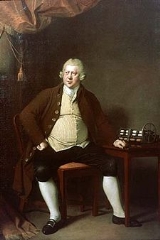
Richard Arkwright
Sir Richard Arkwright was an
Englishman credited with the spinning frame later renamed the water frame following the transition to
water power. The spinning frame a quantum-leap forward from the
spinning jenny of James Hargreaves was developed in 1769, and the world's first water-powered
cotton mill was built in 1771 at Cromford,
Derbyshire, creating one of the catalysts for the
Industrial Revolution. He was
knighted in 1786.
Encyclopedia
Sir
Richard Arkwright was an
Englishman credited with the spinning frame — later renamed the water frame following the transition to
water power. The spinning frame — a quantum-leap forward from the
spinning jenny of James Hargreaves — was developed in 1769, and the world's first water-powered
cotton mill was built in 1771 at Cromford,
Derbyshire, creating one of the catalysts for the
Industrial Revolution. He was
knighted in 1786.
Birth
He was born in 1732 in
Preston in the county of
Lancashire,
England and was the 13th and the youngest child of Thomas Arkwright and Ellen Hodgkinson. He worked as a
barber until he was twenty-eight years old, he then became a dealer in
hair, and made money developing waterproof
dye for use on wigs in the town of
Bolton, Lancashire. He used his money to finance his early work on textile machinery.
Textiles
He began working life as an apprentice barber and it was only after the death of his first wife that he became an entrepreneur.
In 1768, he worked with a Warrington clockmaker called John Kay to make a cotton-spinning frame.
Kay himself had previously assisted a Leigh reed-maker named
Thomas Highs, and there is strong evidence to support the claim that it was Highs, and not Arkwright, who invented the spinning frame. However, Highs was unable to patent or develop the idea for lack of finance.
Highs, who was also credited with inventing a Spinning Jenny several years before James Hargreaves produced his, probably got the idea for the Spinning Frame from the work of John Wyatt and Lewis Paul in the 1730s and 40s.
The machine used a succession of rollers rotating at increasingly higher speeds to draw out the roving, before applying the twist via a bobbin-and-flyer mechanism. It could make
cotton thread thin and strong enough for the warp, or long threads, of
cloth.
Arkwright moved to Nottingham, formed a partnership with local businessmen Jedediah Strutt and Samuel Need, and set up a mill powered by horses. But in 1771, he converted to water power and built a new mill in the Derbyshire village of Cromford.
It soon became apparent that the tiny village would not be able to provide enough workers for his mill. So he built a large number of terraced cottages near the mill and imported workers from outside the area. He also built the Greyhound public house which still stands in Cromford market square.
Arkwright encouraged weavers with large families to move to Cromford. He also allowed them a week’s holiday a year. However, this came on condition that they couldn’t leave the village. Later in life, he taught himself the simple branches of education.
Arkwright had patented the Water Frame in 1769 but in 1775, he took out another patent, this time for the complete process of cotton-thread production. In doing so, he attempted to extend the Water Frame patent by describing it as a new machine called a Roving Frame which performed a different part of the spinning process.
The 1775 patent sparked a major war between Arkwright and other cotton manufacturers, who were well aware of the question-mark over his claim to have invented the machinery.
A series of court cases followed as Arkwright attempted to prosecute rivals who had infringed his patents, culminating in an action brought by The Crown in 1785. A series of witnesses – including Thomas Highs – testified that Arkwright had systematically stolen their ideas.
The result was that the patents were revoked and, when Arkwright appealed, the judge, Mr Justice Buller, insisted: "…the defendant had not a leg to stand upon."
The decision, however, had no material effect on Arkwright's prosperity. His first steam powered mill was opened in
Manchester in 1781, although it was not immediately successful. He was knighted in 1786, and died one of the richest men in
England.
Personal life
Arkwright married his first wife, Patience Holt, in 1755. They had a son, also named Richard, who was born the same year. The following year, Patience died of unspecified causes. Arkwright later married Margaret Biggins in 1761. They had three children, of whom only Susanna survived to adulthood.
Trivia
Arkwright's barber shop in Churchgate, Bolton, was demolished early in the last century. There is a small plaque above the door of the building that replaced it, recording Arkwright's occupancy.
Sir Richard Arkwright lived at Rock House in Cromford, opposite his original mill, but in 1788 he purchased an estate from
Florence Nightingale’s father, William, for £20,000 and set about building Willersley Castle for himself and his family. However just as the building was completed it was destroyed by fire, and Arkwright was forced to wait a further two years whilst it was rebuilt. But he died aged 60 and never lived in the castle which was only completed after his death.
See also
- Timeline of clothing and textiles technology
External links
- from http://www.cottontown.org on Arkwright and the Water Frame.
- from http://www.cottontimes.co.uk/