
All Topics  
Weir

 
Weir

   Email Print
   Bookmark   Link


Weir


A weir (also known as a lowhead dam) is a small overflow-type dam
Dam

A dam is a barrier that Reservoirs surface water or underground streams. Dams generally serve the primary purpose of retaining water, while other structures such as floodgates, levees, and Dike are used to manage or prevent water flow into specific land regions....
 commonly used to raise the level of a river
River

A river is a natural stream of water, usually freshwater, flowing toward an ocean, a lake, or another stream. In some cases a river flows into the ground or dries up completely before reaching another body of water....
 or stream. Weirs have traditionally been used to create mill ponds in such places. Water flows over the top of a weir, although some weirs have sluice gate
Sluice

A sluice is a water channel that is controlled at its head by a gate . For example, a millrace is a sluice that channels water toward a water mill....
s which release water at a level below the top of the weir.


Discussion
Ask a question about 'Weir'
Start a new discussion about 'Weir'
Answer questions from other users
Full Discussion Forum


Recent Posts


Encyclopedia


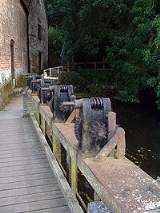
Dorset Sn Weir 01
A weir (also known as a lowhead dam) is a small overflow-type dam
Dam

A dam is a barrier that Reservoirs surface water or underground streams. Dams generally serve the primary purpose of retaining water, while other structures such as floodgates, levees, and Dike are used to manage or prevent water flow into specific land regions....
 commonly used to raise the level of a river
River

A river is a natural stream of water, usually freshwater, flowing toward an ocean, a lake, or another stream. In some cases a river flows into the ground or dries up completely before reaching another body of water....
 or stream. Weirs have traditionally been used to create mill ponds in such places. Water flows over the top of a weir, although some weirs have sluice gate
Sluice

A sluice is a water channel that is controlled at its head by a gate . For example, a millrace is a sluice that channels water toward a water mill....
s which release water at a level below the top of the weir. The crest of an overflow spillway on a large dam is often called a weir.

Function

Weirs are used in conjunction with locks, to render a river navigable and to provide even flow for navigation. In this case, the weir is made significantly longer than the width of the river by forming it in a 'U' shape or running it diagonally, instead of the short perpendicular path. Since the weir is the portion where water is overflowing, a long weir allows a lot more water with a small increase in overflow depth. This is done in order to minimize fluctuation in the depth of the river upstream with changes in the flow rate of the river. Doing so avoids unnecessary complication in designing and using the lock or irrigation diversion devices.

Coburg Lake Wier
Weirs allow hydrologists
Hydrology

Hydrology is the study of the movement, distribution, and quality of water throughout the Earth, and thus addresses both the hydrologic cycle and water resources....
 and engineers a simple method of measuring the rate of fluid flow in small to medium-sized streams, or in industrial discharge locations. Since the geometry of the top of the weir is known, and all water flows over the weir, the depth of water behind the weir can be converted to a rate of flow. The calculation relies on the fact that fluid will pass through the critical depth of the flow regime in the vicinity of the crest of the weir. If water is not carried away from the weir, it can make flow measurement complicated or even impossible.

A weir may be used to maintain the vertical profile of a stream or channel, and is then commonly referred to as a grade stabilizer.

Because a weir will typically increase the oxygen content of the water as it passes over the crest, a weir can have a detrimental effect on the local ecology of a river system. A weir will artificially reduce the upstream water velocity, which can lead to an increase in siltation. The weir may pose a barrier to migrating fish. Fish ladder
Fish ladder

Fishways, most commonly called fish ladders but also known as fish passes and in Australia also referred to as fish steps, are structures on or around artificial barriers to facilitate Fish migration#Classification fishes' natural Fish migration....
s provide a way for fish to get between the water levels. Mill ponds provide a water mill with the power it requires, using the difference in water level above and below the weir to provide the necessary energy.

A walkway over the weir is likely to be useful for the removal of floating debris trapped by the weir, or for working staunches and sluices on it as the rate of flow changes. This is sometimes used as a convenient pedestrian crossing point for the river.

Even though the water around weirs can often appear relatively calm, they are dangerous places to boat, swim or wade; the circulation patterns on the downstream side can submerge a person indefinitely. This phenomenon is described in the article on whitewater
Whitewater

Whitewater is formed in a rapid, when a river's Stream gradient drops enough to disturb its laminar flow and create turbulence, i.e. form a bubbly, or aerated and unstable current; the frothy water appears white....
.

Types

There are different types of weir. It may be a simple metal plate with a V-notch cut into it, or it may be a concrete and steel structure across the bed of a river. A weir which causes a large change of water level behind it, compared to the error inherent in the depth measurement method, will give an accurate indication of the flow rate.

Revin Meuse Weir 20041230  024
* Sharp crested weir
  • Broad crested weir (or broad-crested weir)
  • Crump weir (named after the designer)
  • Needle dam
    Needle dam

    A needle dam is a weir designed to maintain the level or flow of a river through the use of thin "needles" of wood. The needles are leaned against a solid frame and are not intended to be water-tight....
  • Proportional weir
  • Combination weir
  • MF weir
  • V-notch weir
  • Rectangular weir
  • Cipolletti (trapezoidal) weir
  • Labyrinth weir


Broad-crested weir


Warkworthweir
A broad-crested weir is a flat-crested structure, with a long crest compared to the flow thickness (Chanson 2001, Henderson 1966, Sturm 2001). When the crest is “broad”, the streamlines become parallel to the crest invert and the pressure distribution above the crest is hydrostatic. The hydraulic characteristics of broad-crested weirs were studied during the 19th and 20th centuries. Practical experience showed that the weir overflow is affected by the upstream flow conditions and the weir geometry.

Sharp crested weir

A sharp-crested weir allows the water to fall cleanly away from the weir. Sharp crested weirs are typically 1/4" or thinner metal plates.

Combination weir

For accurate flow measurement over a wider range of flow rates, a combination weir combines a V-notch weir with a rectangular weir. An example is manufactured by Thel-Mar Company and has flow rates engraved along the side of the weir. This is typically used in pipes ranging from 4" to 15" in diameter.

See also

  • Fishing weir
    Fishing weir

    A fishing weir is an ancient type of fish trap that is traceable back to Ancient Rome times in the United Kingdom. It is also a technology used by, among others, North American Native Americans in the United States and early settlers to catch fish for trade and to feed their communities....
  • Drop structure
    Drop structure

    A drop structure, also known as a grade control, sill, or weir, is a manmade structure, typically small and built on minor streams, to pass water to a lower elevation while controlling the energy and velocity of the water as it passes over....


Sources

  • Chanson, H. (2004). "The Hydraulics of Open Channel Flow : An Introduction." Butterworth-Heinemann, Oxford, UK, 2nd edition, 630 pages (ISBN 978 0 7506 5978 9).
  • Henderson, F.M. (1966). "Open Channel Flow." MacMillan Company, New York, USA.
  • Sturm, T.W. (2001). "Open Channel Hydraulics." McGraw Hill, Boston, USA, Water Resources and Environmental Engineering Series, 493 pages.