

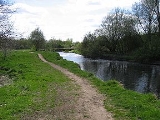
River Tame, Greater Manchester

Encyclopedia
The River Tame flows through Greater Manchester
, England.
Moor in Greater Manchester
, close to the border with West Yorkshire
but within the historic West Riding of Yorkshire
.
. The named river starts as compensation flow (that is, a guaranteed minimum discharge) from Readycon Dean Reservoir in the moors above Denshaw
. The source is a little further north, just over the county border in West Yorkshire, close to the Pennine Way
. The highest point of the catchment is Greater Manchester's highest point at Black Chew Head
.
The river flows generally south through Delph
, Uppermill
, Mossley
, Stalybridge
, Ashton-under-Lyne
, Dukinfield
, Haughton Green
, Denton
and Hyde
. The Division Bridge (which spans the river at Mossley
), marks the meeting point of the traditional boundaries of Lancashire
, Yorkshire
and Cheshire
. The section through Stalybridge
was once mooted as a diversion route for the restoration of the Huddersfield Narrow Canal
. For all its remaining course after the Division Bridge, the river marks much of the historical boundary dividing Cheshire
and Lancashire
, before confluence with the River Goyt to form the River Mersey
at Stockport
. The 19th century industrial concentrations in the above-named urban areas resulted in the Tame being a much polluted waterway. As well as industrial pollution from the dyes and bleaches used in textile mills, effluent from specialised paper-making [cigarette papers], engineering effluents, including base metal washings from battery manufacture, phenols from the huge coal-gas plant in Denton, rain-wash from roads and abandoned coal spoil heaps there was also the sewage effluent from the surrounding population. Up to two-thirds of the river's flow at its confluence with the Goyt had passed through a sewage works. The anti-pollution efforts of the last thirty years of the 20th century have resulted in the positive fauna distributions listed below.
The Centre for Ecology and Hydrology
measures the flow at two points for the National River Flow Archive, at Portwood
weir (Stockport) and at Broomstairs weir (Denton). Portwood weir is 1¼ miles above the confluence with the Mersey
and contains the great majority of the final flow (with the exception of waste water from a concrete facility).
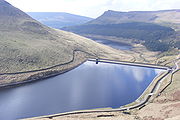
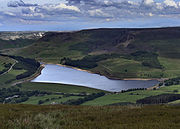
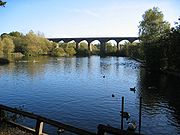
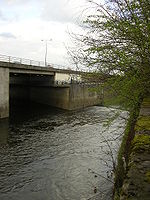 The Tame joins the River Goyt at Stockport
, forming the River Mersey
which eventually flows into the Irish Sea
just past Liverpool
.
, Thame
, Taff
, and Tamar
, alongside two other instances of Tame. The name is Celtic in origin, but the meaning is uncertain. Dark river or dark one has been suggested,
but Ekwall finds it unlikely; Mills suggests it may simply mean river (c.f. Avon, Humber
, Tyne
). The names of the Mersey's co-tributaries Etherow and Goyt are equally ancient and mysterious. Mersey is an Old English
name (i.e. more recent) derived from "river at the boundary". The earlier name is lost: Dodgson suggests that Tame may have been the name for the whole of the Mersey.
The Metropolitan Borough of Tameside is named after the river. While it flows through the borough, the river neither rises nor finishes inside its boundaries; however, most of the built-up area alongside the river is in Tameside.
Country Park) are home to coarse fish
such as gudgeon
(Gobio gobio), chub
(Leuciscus cephalus), and roach (Rutilus rutilus); pike
(Esox lucius) and perch
(Perca fluviatilis) are also present. The upper reaches (above Ashton) support brown trout
(Salmo trutta) and smaller numbers of some coarse fish. The populations are self-sustaining. Furthermore,
are all declared as salmonid waters by statute, and as such have set physical and chemical water quality objectives.
Hull Brook is a Site of Biological Importance (SBI)
. Hull Brook and Castleshaw Reservoir have populations of White-clawed Crayfish
. The river is now clean enough in principle to support Otters
, but none were found in a survey in 2000–2002.
Greater Manchester
Greater Manchester is a metropolitan county in North West England, with a population of 2.6 million. It encompasses one of the largest metropolitan areas in the United Kingdom and comprises ten metropolitan boroughs: Bolton, Bury, Oldham, Rochdale, Stockport, Tameside, Trafford, Wigan, and the...
, England.
Source
The Tame rises on DenshawDenshaw
Denshaw is a village in Saddleworth—a civil parish of the Metropolitan Borough of Oldham, in Greater Manchester, England. It lies by the source of the River Tame, high amongst the Pennines above the village of Delph, northeast of Oldham, and north-northwest of Uppermill...
Moor in Greater Manchester
Greater Manchester
Greater Manchester is a metropolitan county in North West England, with a population of 2.6 million. It encompasses one of the largest metropolitan areas in the United Kingdom and comprises ten metropolitan boroughs: Bolton, Bury, Oldham, Rochdale, Stockport, Tameside, Trafford, Wigan, and the...
, close to the border with West Yorkshire
West Yorkshire
West Yorkshire is a metropolitan county within the Yorkshire and the Humber region of England with a population of 2.2 million. West Yorkshire came into existence as a metropolitan county in 1974 after the passage of the Local Government Act 1972....
but within the historic West Riding of Yorkshire
West Riding of Yorkshire
The West Riding of Yorkshire is one of the three historic subdivisions of Yorkshire, England. From 1889 to 1974 the administrative county, County of York, West Riding , was based closely on the historic boundaries...
.
Course
Most of the river's catchment lies on the western flank of the PenninesPennines
The Pennines are a low-rising mountain range, separating the North West of England from Yorkshire and the North East.Often described as the "backbone of England", they form a more-or-less continuous range stretching from the Peak District in Derbyshire, around the northern and eastern edges of...
. The named river starts as compensation flow (that is, a guaranteed minimum discharge) from Readycon Dean Reservoir in the moors above Denshaw
Denshaw
Denshaw is a village in Saddleworth—a civil parish of the Metropolitan Borough of Oldham, in Greater Manchester, England. It lies by the source of the River Tame, high amongst the Pennines above the village of Delph, northeast of Oldham, and north-northwest of Uppermill...
. The source is a little further north, just over the county border in West Yorkshire, close to the Pennine Way
Pennine Way
The Pennine Way is a National Trail in England. The trail runs from Edale, in the northern Derbyshire Peak District, north through the Yorkshire Dales and the Northumberland National Park and ends at Kirk Yetholm, just inside the Scottish border. The path runs along the Pennine hills, sometimes...
. The highest point of the catchment is Greater Manchester's highest point at Black Chew Head
Black Chew Head
Black Chew Head is the highest point of Greater Manchester, and forms part of the Peak District, in northern England.Lying within the Saddleworth parish of the Metropolitan Borough of Oldham, close to Crowden, Derbyshire, it stands at a height of 542 metres above sea level.Black Chew Head is an...
.
The river flows generally south through Delph
Delph
Delph is a village in the Saddleworth civil parish of the Metropolitan Borough of Oldham, in Greater Manchester, England. It lies amongst the Pennines on the River Tame below the village of Denshaw, east-northeast of Oldham, and north-northwest of Uppermill.The centre of the village has barely...
, Uppermill
Uppermill
Uppermill is a village in Saddleworth—a civil parish of the Metropolitan Borough of Oldham, in Greater Manchester, England, historically a part of the West Riding of Yorkshire. It lies on the River Tame in a valley amongst the South Pennines, east of Oldham, and east-northeast of Manchester...
, Mossley
Mossley
Mossley is a small town and civil parish within the Metropolitan Borough of Tameside, in Greater Manchester, England. The town is located in the upper section of the Tame valley in the foothills of the Pennines, northeast of Ashton-under-Lyne and east of Manchester.Mossley has the distinction of...
, Stalybridge
Stalybridge
Stalybridge is a town in the Metropolitan Borough of Tameside in Greater Manchester, England, with a population of 22,568. Historically a part of Cheshire, it is east of Manchester city centre and northwest of Glossop. With the construction of a cotton mill in 1776, Stalybridge became one of...
, Ashton-under-Lyne
Ashton-under-Lyne
Ashton-under-Lyne is a market town in the Metropolitan Borough of Tameside, Greater Manchester, England. Historically a part of Lancashire, it lies on the north bank of the River Tame, on undulating land at the foothills of the Pennines...
, Dukinfield
Dukinfield
Dukinfield is a small town within the Metropolitan Borough of Tameside, in Greater Manchester, England. It lies in central Tameside on the south bank of the River Tame, opposite Ashton-under-Lyne, and is east of the city of Manchester...
, Haughton Green
Haughton Green
Haughton Green is a large village in Tameside, Greater Manchester, England. It formed part of the ancient township of Haughton, Lancashire, along with Haughton Dale, Higher Haughton, Lower Haughton, Haughton Hall and Haughton itself....
, Denton
Denton, Greater Manchester
Denton is a town within the Metropolitan Borough of Tameside, in Greater Manchester, England. It is five miles to the east of Manchester city centre, and has a population of 26,866....
and Hyde
Hyde, Greater Manchester
Hyde is a town in the Metropolitan Borough of Tameside, Greater Manchester, England. As of the 2001 census, the town had a population of 31,253. Historically part of Cheshire, it is northeast of Stockport, west of Glossop and east of Manchester....
. The Division Bridge (which spans the river at Mossley
Mossley
Mossley is a small town and civil parish within the Metropolitan Borough of Tameside, in Greater Manchester, England. The town is located in the upper section of the Tame valley in the foothills of the Pennines, northeast of Ashton-under-Lyne and east of Manchester.Mossley has the distinction of...
), marks the meeting point of the traditional boundaries of Lancashire
Lancashire
Lancashire is a non-metropolitan county of historic origin in the North West of England. It takes its name from the city of Lancaster, and is sometimes known as the County of Lancaster. Although Lancaster is still considered to be the county town, Lancashire County Council is based in Preston...
, Yorkshire
Yorkshire
Yorkshire is a historic county of northern England and the largest in the United Kingdom. Because of its great size in comparison to other English counties, functions have been increasingly undertaken over time by its subdivisions, which have also been subject to periodic reform...
and Cheshire
Cheshire
Cheshire is a ceremonial county in North West England. Cheshire's county town is the city of Chester, although its largest town is Warrington. Other major towns include Widnes, Congleton, Crewe, Ellesmere Port, Runcorn, Macclesfield, Winsford, Northwich, and Wilmslow...
. The section through Stalybridge
Stalybridge
Stalybridge is a town in the Metropolitan Borough of Tameside in Greater Manchester, England, with a population of 22,568. Historically a part of Cheshire, it is east of Manchester city centre and northwest of Glossop. With the construction of a cotton mill in 1776, Stalybridge became one of...
was once mooted as a diversion route for the restoration of the Huddersfield Narrow Canal
Huddersfield Narrow Canal
The Huddersfield Narrow Canal is an inland waterway in northern England. It runs just under from Lock 1E at the rear of the University of Huddersfield campus, near Aspley Basin at Huddersfield to the junction with the Ashton Canal at Whitelands Basin in Ashton-under-Lyne...
. For all its remaining course after the Division Bridge, the river marks much of the historical boundary dividing Cheshire
Cheshire
Cheshire is a ceremonial county in North West England. Cheshire's county town is the city of Chester, although its largest town is Warrington. Other major towns include Widnes, Congleton, Crewe, Ellesmere Port, Runcorn, Macclesfield, Winsford, Northwich, and Wilmslow...
and Lancashire
Lancashire
Lancashire is a non-metropolitan county of historic origin in the North West of England. It takes its name from the city of Lancaster, and is sometimes known as the County of Lancaster. Although Lancaster is still considered to be the county town, Lancashire County Council is based in Preston...
, before confluence with the River Goyt to form the River Mersey
River Mersey
The River Mersey is a river in North West England. It is around long, stretching from Stockport, Greater Manchester, and ending at Liverpool Bay, Merseyside. For centuries, it formed part of the ancient county divide between Lancashire and Cheshire....
at Stockport
Stockport
Stockport is a town in Greater Manchester, England. It lies on elevated ground southeast of Manchester city centre, at the point where the rivers Goyt and Tame join and create the River Mersey. Stockport is the largest settlement in the metropolitan borough of the same name...
. The 19th century industrial concentrations in the above-named urban areas resulted in the Tame being a much polluted waterway. As well as industrial pollution from the dyes and bleaches used in textile mills, effluent from specialised paper-making [cigarette papers], engineering effluents, including base metal washings from battery manufacture, phenols from the huge coal-gas plant in Denton, rain-wash from roads and abandoned coal spoil heaps there was also the sewage effluent from the surrounding population. Up to two-thirds of the river's flow at its confluence with the Goyt had passed through a sewage works. The anti-pollution efforts of the last thirty years of the 20th century have resulted in the positive fauna distributions listed below.
The Centre for Ecology and Hydrology
Centre for Ecology and Hydrology
The Centre for Ecology & Hydrology is the United Kingdom's Centre of Excellence for integrated research in hydrology, terrestrial and freshwater ecosystems and their interaction with the atmosphere...
measures the flow at two points for the National River Flow Archive, at Portwood
Portwood
Portwood is an area in Stockport, England, lying just outside the town centre, and based around Great Portwood Street. It is a mixed area, with the part closest to the town centre mainly given over to shops and the further part residential...
weir (Stockport) and at Broomstairs weir (Denton). Portwood weir is 1¼ miles above the confluence with the Mersey
River Mersey
The River Mersey is a river in North West England. It is around long, stretching from Stockport, Greater Manchester, and ending at Liverpool Bay, Merseyside. For centuries, it formed part of the ancient county divide between Lancashire and Cheshire....
and contains the great majority of the final flow (with the exception of waste water from a concrete facility).
Mouth
Stockport
Stockport is a town in Greater Manchester, England. It lies on elevated ground southeast of Manchester city centre, at the point where the rivers Goyt and Tame join and create the River Mersey. Stockport is the largest settlement in the metropolitan borough of the same name...
, forming the River Mersey
River Mersey
The River Mersey is a river in North West England. It is around long, stretching from Stockport, Greater Manchester, and ending at Liverpool Bay, Merseyside. For centuries, it formed part of the ancient county divide between Lancashire and Cheshire....
which eventually flows into the Irish Sea
Irish Sea
The Irish Sea separates the islands of Ireland and Great Britain. It is connected to the Celtic Sea in the south by St George's Channel, and to the Atlantic Ocean in the north by the North Channel. Anglesey is the largest island within the Irish Sea, followed by the Isle of Man...
just past Liverpool
Liverpool
Liverpool is a city and metropolitan borough of Merseyside, England, along the eastern side of the Mersey Estuary. It was founded as a borough in 1207 and was granted city status in 1880...
.
Toponomy
The name Tame is attached to rivers across the UK in several forms, including ThamesRiver Thames
The River Thames flows through southern England. It is the longest river entirely in England and the second longest in the United Kingdom. While it is best known because its lower reaches flow through central London, the river flows alongside several other towns and cities, including Oxford,...
, Thame
River Thame
The River Thame is a river in Southern England. It is a tributary of the larger and better-known River Thames.The general course of the River Thame is north-east to south-west and the distance from its source to the River Thames is about 40 miles...
, Taff
River Taff
The River Taff is a large river in Wales. It rises as two rivers in the Brecon Beacons — the Taf Fechan and the Taf Fawr — before joining to form the Taff north of Merthyr Tydfil...
, and Tamar
River Tamar
The Tamar is a river in South West England, that forms most of the border between Devon and Cornwall . It is one of several British rivers whose ancient name is assumed to be derived from a prehistoric river word apparently meaning "dark flowing" and which it shares with the River Thames.The...
, alongside two other instances of Tame. The name is Celtic in origin, but the meaning is uncertain. Dark river or dark one has been suggested,
but Ekwall finds it unlikely; Mills suggests it may simply mean river (c.f. Avon, Humber
Humber
The Humber is a large tidal estuary on the east coast of Northern England. It is formed at Trent Falls, Faxfleet, by the confluence of the tidal River Ouse and the tidal River Trent. From here to the North Sea, it forms part of the boundary between the East Riding of Yorkshire on the north bank...
, Tyne
River Tyne
The River Tyne is a river in North East England in Great Britain. It is formed by the confluence of two rivers: the North Tyne and the South Tyne. These two rivers converge at Warden Rock near Hexham in Northumberland at a place dubbed 'The Meeting of the Waters'.The North Tyne rises on the...
). The names of the Mersey's co-tributaries Etherow and Goyt are equally ancient and mysterious. Mersey is an Old English
Old English language
Old English or Anglo-Saxon is an early form of the English language that was spoken and written by the Anglo-Saxons and their descendants in parts of what are now England and southeastern Scotland between at least the mid-5th century and the mid-12th century...
name (i.e. more recent) derived from "river at the boundary". The earlier name is lost: Dodgson suggests that Tame may have been the name for the whole of the Mersey.
The Metropolitan Borough of Tameside is named after the river. While it flows through the borough, the river neither rises nor finishes inside its boundaries; however, most of the built-up area alongside the river is in Tameside.
Fauna
The fish species present vary along the river's length. The lower reaches (near Reddish ValeReddish Vale
Reddish Vale is a loosely defined area in the Tame Valley close to Reddish in the Metropolitan Borough of Stockport, Greater Manchester, England. The generally-accepted centre of the vale is around the bottom of Reddish Vale Road. Reddish Vale Country Park is a country park managed by Stockport...
Country Park) are home to coarse fish
Coarse fishing
Coarse fishing is a term used in the United Kingdom and Ireland for angling for coarse fish, which are those types of freshwater fish other than game fish . The sport and the techniques used are particularly popular in the United Kingdom and mainland Europe.-History:The term "coarse fishing"...
such as gudgeon
Gudgeon (fish)
Gudgeon is a common name for a number of small freshwater fishes of the families Cyprinidae, Eleotridae or Ptereleotridae. Most gudgeons are elongate, bottom-dwelling fish, many of which live in rapids and other fast moving water....
(Gobio gobio), chub
European chub
The European chub , sometimes called the round chub, fat chub, chevin, pollard or simply "the" chub, is a freshwater fish of the family Cyprinidae...
(Leuciscus cephalus), and roach (Rutilus rutilus); pike
Northern Pike
The northern pike , is a species of carnivorous fish of the genus Esox...
(Esox lucius) and perch
European perch
The European perch, Perca fluviatilis, is a predatory species of perch found in Europe and Asia. In some areas it is known as the redfin perch or English perch, and it is often known simply as perch. The species is a popular quarry for anglers and has been widely introduced beyond its native area,...
(Perca fluviatilis) are also present. The upper reaches (above Ashton) support brown trout
Brown trout
The brown trout and the sea trout are fish of the same species....
(Salmo trutta) and smaller numbers of some coarse fish. The populations are self-sustaining. Furthermore,
- Carr Brook (from its source to the Tame)
- Diggle Brook (from Diggle Reservoir to the Tame)
- Hull Brook (Head of Lower Castleshaw Reservoir to the Tame)
- Swineshaw Brook (from the Head of Swineshaw Reservoir to the Tame)
- and the Tame (from the Head of Readycon Dean Reservoir to foot of New Years Bridge Reservoir)
are all declared as salmonid waters by statute, and as such have set physical and chemical water quality objectives.
Hull Brook is a Site of Biological Importance (SBI)
Site of Biological Importance
A Site of Biological Importance is one of the non-statutory designations used locally by the Greater Manchester, Cheshire and Staffordshire County Councils in England to protect locally valued sites of biological diversity which are described generally as Local Wildlife Sites by the UK Government...
. Hull Brook and Castleshaw Reservoir have populations of White-clawed Crayfish
Austropotamobius pallipes
Austropotamobius pallipes is an endangered European freshwater crayfish, and the only species of crayfish native to the British Isles. Its common names include white-clawed crayfish and Atlantic stream crayfish.-Distribution and ecology:...
. The river is now clean enough in principle to support Otters
European Otter
The European Otter , also known as the Eurasian otter, Eurasian river otter, common otter and Old World otter, is a European and Asian member of the Lutrinae or otter subfamily, and is typical of freshwater otters....
, but none were found in a survey in 2000–2002.
Tributaries
- Swineshaw Brook
- Carr Brook
- Chew Brook
- Greenfield Brook
- Diggle Brook
- Hull Brook
- Rams Brook
- Summer Hill Brook
- Lumb Hole Brook
- Cherry Brook
- Brimmy Brook
- Readycon Dean Brook
- Dowry Water