


Canoeing

Encyclopedia
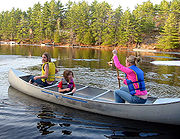
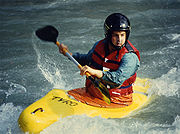
Canoe
A canoe or Canadian canoe is a small narrow boat, typically human-powered, though it may also be powered by sails or small electric or gas motors. Canoes are usually pointed at both bow and stern and are normally open on top, but can be decked over A canoe (North American English) or Canadian...
.
Open canoes may be 'poled' (punted
Punt (boat)
A punt is a flat-bottomed boat with a square-cut bow, designed for use in small rivers or other shallow water. Punting refers to boating in a punt. The punter generally propels the punt by pushing against the river bed with a pole...
), sailed
Sailing
Sailing is the propulsion of a vehicle and the control of its movement with large foils called sails. By changing the rigging, rudder, and sometimes the keel or centre board, a sailor manages the force of the wind on the sails in order to move the boat relative to its surrounding medium and...
, 'lined and tracked' (using ropes) or even 'gunnel-bobbed'.
Some canoes are called kayaks. When exactly a canoe can be called a kayak is difficult to determine though, and often arbitrary. Internationally, the term canoeing is used as a generic term for both forms though the terms "paddle sports" or "canoe/kayak" are also used. In North America
North America
North America is a continent wholly within the Northern Hemisphere and almost wholly within the Western Hemisphere. It is also considered a northern subcontinent of the Americas...
, however, 'canoeing' usually refers only to canoes, as opposed to both canoes and kayaks. Paddling a kayak
Kayak
A kayak is a small, relatively narrow, human-powered boat primarily designed to be manually propelled by means of a double blade paddle.The traditional kayak has a covered deck and one or more cockpits, each seating one paddler...
is also referred to as kayaking
Kayaking
Kayaking is the use of a kayak for moving across water. Kayaking and canoeing are also known as paddling. Kayaking is distinguished from canoeing by the sitting position of the paddler and the number of blades on the paddle...
. In modern canoe sport, canoes and kayaks are classified together, although these watercraft have different designs, and historical uses. Both canoes and kayaks may be closed-decked. Other than by the minimum competition specifications (typically length and width (beam) and seating arrangement it is difficult to differentiate most competition canoes from the equivalent competition kayaks. The most common difference is that competition kayaks are always seated and paddled with a double-bladed paddle, and competition canoes are generally kneeled and paddled with a single-bladed paddle. Exceptions include Canoe Marathon (in both European and American competitive forms) and sprint (high kneeling position). The most traditional and early canoes did not have seats, the paddlers merely knelt on the bottom of the boat. Recreational canoes and kayaks employ seats and whitewater
Whitewater
Whitewater is formed in a rapid, when a river's gradient increases enough to disturb its laminar flow and create turbulence, i.e. form a bubbly, or aerated and unstable current; the frothy water appears white...
rodeo and surf variants increasingly employ the use of 'saddles' to give greater boat control under extreme conditions.
History
The actual word we know today as "canoe" originated from the word Keenu meaning "dugoutDugout (boat)
A dugout or dugout canoe is a boat made from a hollowed tree trunk. Other names for this type of boat are logboat and monoxylon. Monoxylon is Greek -- mono- + ξύλον xylon -- and is mostly used in classic Greek texts. In Germany they are called einbaum )...
". Another story is that the word canoe comes from the word "canoa", which is said to originally come from the native people (the Arawaks?) in the Caribbean via Columbus to Europe. (But there are also comments that "canoa" was already an existing word then in the Portuguese language for a feeding trough...). These dugout canoes, essentially large tree trunks that were shaped and hollowed, were used by the Caribs to travel between islands.
Canoeing began to meet the simple needs of transportation across and along waterways. Canoeing was the primary mode of long-distance transportation at one time throughout much of North America
North America
North America is a continent wholly within the Northern Hemisphere and almost wholly within the Western Hemisphere. It is also considered a northern subcontinent of the Americas...
, the Amazon Basin
Amazon Basin
The Amazon Basin is the part of South America drained by the Amazon River and its tributaries that drains an area of about , or roughly 40 percent of South America. The basin is located in the countries of Bolivia, Brazil, Colombia, Ecuador, Guyana, Peru, and Venezuela...
, and Polynesia
Polynesia
Polynesia is a subregion of Oceania, made up of over 1,000 islands scattered over the central and southern Pacific Ocean. The indigenous people who inhabit the islands of Polynesia are termed Polynesians and they share many similar traits including language, culture and beliefs...
, among other locations. As a method of transportation, canoes have generally been replaced by motorized boat
Boat
A boat is a watercraft of any size designed to float or plane, to provide passage across water. Usually this water will be inland or in protected coastal areas. However, boats such as the whaleboat were designed to be operated from a ship in an offshore environment. In naval terms, a boat is a...
s, airplane
Fixed-wing aircraft
A fixed-wing aircraft is an aircraft capable of flight using wings that generate lift due to the vehicle's forward airspeed. Fixed-wing aircraft are distinct from rotary-wing aircraft in which wings rotate about a fixed mast and ornithopters in which lift is generated by flapping wings.A powered...
s, railroads and road
Road
A road is a thoroughfare, route, or way on land between two places, which typically has been paved or otherwise improved to allow travel by some conveyance, including a horse, cart, or motor vehicle. Roads consist of one, or sometimes two, roadways each with one or more lanes and also any...
s with increasing industrialisation
Industrialisation
Industrialization is the process of social and economic change that transforms a human group from an agrarian society into an industrial one...
, although they remain popular as recreational or sporting watercraft.
The origin of canoeing as a recreation and sport is often attributed to Scottish explorer John MacGregor
John MacGregor (sportsman)
John MacGregor , nicknamed Rob Roy after a renowned relative, was a Scottish explorer, travel writer and philanthropist. He is generally credited with the development of the first sailing canoes and with popularising canoeing as a middle class sport in Europe and the United States...
(1825–1892), who was introduced to canoes on a camping trip in Canada and the USA in 1858. On his return to the United Kingdom, he constructed his own canoes and used them on waterways in various parts of Britain, Europe and the Middle East. He wrote a popular book about his experiences; "A Thousand Miles in the Rob Roy Canoe" and founded the Royal Canoe Club
Royal Canoe Club
The Royal Canoe Club , founded in 1866, is the oldest canoe club in the world and received royal patronage in the 19th century. The clubhouse is based at Trowlock Island on the River Thames in Teddington near central London. The club promotes canoeing and kayaking, focusing on flatwater, sprint and...
in 1866. The first canoeing competition, the Paddling Challenge Cup, was held by the club in 1874. In 1924, canoeing associations from Austria, Germany, Denmark and Sweden founded the Internationalen Representation for Kanusport (IRK), forerunner of the International Canoe Federation
International Canoe Federation
The International Canoe Federation is the umbrella organization of all national canoe organizations worldwide. It is headquartered in Lausanne, Switzerland, and administers all aspects of canoe sport worldwide...
. Canoeing became an Olympic
Olympic Games
The Olympic Games is a major international event featuring summer and winter sports, in which thousands of athletes participate in a variety of competitions. The Olympic Games have come to be regarded as the world’s foremost sports competition where more than 200 nations participate...
sport in Berlin in 1936
1936 Summer Olympics
The 1936 Summer Olympics, officially known as the Games of the XI Olympiad, was an international multi-sport event which was held in 1936 in Berlin, Germany. Berlin won the bid to host the Games over Barcelona, Spain on April 26, 1931, at the 29th IOC Session in Barcelona...
.
Sport
The International Canoe FederationInternational Canoe Federation
The International Canoe Federation is the umbrella organization of all national canoe organizations worldwide. It is headquartered in Lausanne, Switzerland, and administers all aspects of canoe sport worldwide...
is the world wide canoeing organisation and creates the standard rules for the different disciplines of canoe/kayak competition. The ICF recognises several competitive and non-competitive disciplines of canoeing, of which Sprint and Slalom are the only two competing in the Olympic games. The United States Canoe Association
United States Canoe Association
The United States Canoe Association is an organization devoted to canoeing and paddle sports within the United States. Established in 1968, it is headquartered in Voluntown, Connecticut.It sponsors a youth cup named after one of its members Greg Barton...
is widely considered the American authority in sport and recreational canoeing, and recognizes many ICF classes. Other national competition rules are usually based on the rules of the ICF.
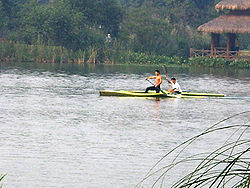
- SprintCanoe racingThis article discusses canoe sprint and canoe marathon, competitive forms of canoeing and kayaking on more or less flat water. Both sports are governed by the International Canoe Federation ....
– the oldest discipline of ICF canoeing, sometimes referred to as "Flatwater Racing". It involves:- kayakKayakA kayak is a small, relatively narrow, human-powered boat primarily designed to be manually propelled by means of a double blade paddle.The traditional kayak has a covered deck and one or more cockpits, each seating one paddler...
- K-1: single seat kayak
- K-2: double seated kayak
- K-4: four-seated kayak
- canoeCanoeA canoe or Canadian canoe is a small narrow boat, typically human-powered, though it may also be powered by sails or small electric or gas motors. Canoes are usually pointed at both bow and stern and are normally open on top, but can be decked over A canoe (North American English) or Canadian...
- C-1: single kneeling canoe
- C-2: double kneeling canoe
- C-4: four-person kneeling canoe
- kayak
Sprint races are over 200m
Canoeing 200m
At international regattas in canoeing there is three distances on the program. 200m, 500m and 1000m. Men and Women can all participate in these disciplines in both K1, C1, K2, C2, K4, C4 but with that exception that women can only participate in the kayak events....
, 500m
Canoeing 500m
At international regattas in canoeing there is three distances on the program. 200m, 500m and 1000m. Men and Women can all participate in these disciplines in both K1, C1, K2, C2, K4, C4 but with that exception that women can only participate in the kayak events....
, 1000m
Canoeing 1000m
At international regattas in canoeing there are three distances on the program. 200m, 500m and 1000m. Men and Women can all participate in these disciplines in both K1, C1, K2, C2, K4, C4 but with that exception that women can only participate in the kayak events....
, and "long distance racing" such as 2 km or 6 km.
- SlalomSlalom canoeingWhitewater Slalom is a competitive sport where the aim is to navigate a decked canoe or kayak through a course of hanging gates on river rapids in the fastest time possible. It is one of the two kayak and canoeing disciplines at the Summer Olympics, and is referred to by the International Olympic...
– Competitors are timed in completing a descent down the rapids of a whitewaterWhitewaterWhitewater is formed in a rapid, when a river's gradient increases enough to disturb its laminar flow and create turbulence, i.e. form a bubbly, or aerated and unstable current; the frothy water appears white...
course, in the process steering their canoes or kayaks through "gates" (a pair of suspended poles about 1 m apart), including going up against the flow, across the flow, and surfing the standing waves of the rapids. Again, there are both kayak and canoe classes:- kayakKayakA kayak is a small, relatively narrow, human-powered boat primarily designed to be manually propelled by means of a double blade paddle.The traditional kayak has a covered deck and one or more cockpits, each seating one paddler...
- K-1: single kayak
- canoeCanoeA canoe or Canadian canoe is a small narrow boat, typically human-powered, though it may also be powered by sails or small electric or gas motors. Canoes are usually pointed at both bow and stern and are normally open on top, but can be decked over A canoe (North American English) or Canadian...
- C-1: solo canoe
- C-2: tandem canoe
- kayak
- MarathonCanoe racingThis article discusses canoe sprint and canoe marathon, competitive forms of canoeing and kayaking on more or less flat water. Both sports are governed by the International Canoe Federation ....
– Longer distance races over mostly flatwater courses, possibly including one or more portagePortagePortage or portaging refers to the practice of carrying watercraft or cargo over land to avoid river obstacles, or between two bodies of water. A place where this carrying occurs is also called a portage; a person doing the carrying is called a porter.The English word portage is derived from the...
s. Course lengths typically vary from a few miles to the epic 125 miles (201.2 km) Devizes to Westminster International Canoe MarathonDevizes to Westminster International Canoe MarathonThe Devizes to Westminster International Canoe Marathon is a marathon canoe race in England. The race is held every Easter over a course of from Devizes in Wiltshire to Westminster in central London. It has been run since 1948. Starting at Devizes wharf, the route follows the Kennet and Avon...
on the Thames, the 120 miles (193.1 km) overnight Au Sable River Canoe MarathonAu Sable River Canoe MarathonThe ' is an annual canoe race in Michigan from Grayling to Oscoda. It first ran in 1947, is perhaps the oldest marathon canoe race in the United States, and is the longest, non-stop, canoe-only race in North America...
in Michigan, and the 260 miles (418.4 km) "World's Toughest Boat Race", the Texas Water SafariTexas Water SafariThe Texas Water Safari, billed as the "World's Toughest Boat Race", is a trek down waterways from San Marcos, Texas, to Seadrift, Texas. The primary requirement is a boat powered only by human muscle. The event was first held in 1963, and is run annually....
. USCA rules specify that a Marathon course may not have rapids over class II on the International Scale of River DifficultyInternational Scale of River DifficultyThe International Scale of River Difficulty is a standardized scale used to rate the safety of a stretch of river, or a single rapid. The grade reflects the technical difficulty and skill level required associated with the section of river...
whereas, in the United Kingdom and Ireland, courses may be of any difficulty and with any hazards including weirs, like those found in the Liffey DescentLiffey Descent Canoe RaceThe Liffey Descent Canoe Race canoe race is an annual down river canoe and kayak race, of some 18 miles in length, that has been held on the River Liffey in Ireland since 1960. It starts by the K Club above Straffan weir in County Kildare, and finishes by the Trinity Rowing Club in Dublin. It is...
http://www.liffeydescent.com. The most extreme courses can be found in South Africa, and grade V sections are not unusual in for example, the Fish River Marathon http://www.fishmarathon.org.za/. Australia's most famous marathon race is the Hawkesbury Canoe ClassicHawkesbury Canoe ClassicThe Hawkesbury Canoe Classic is an annual marathon canoe race taking place on the Hawkesbury River in Northwest Sydney usually at the end of October. The Hawkesbury Canoe Classic consists of a 111 km paddle downstream starting in Windsor and finishing in Brooklyn...
.
- Canoe poloCanoe poloCanoe Polo is a competitive ball sport played on water, in a defined "field", between two teams of 5 players, each in a kayak...
– A fast-action competitive goal-scoring ball game on water, between two teams of 5 players.
- Whitewater racingWhitewater racingWildwater canoeing is a competitive discipline of canoeing in which kayaks or Canadian canoes are used to negotiate a stretch of river speedily...
(also known as Wild Water Racing) – Competitors race specialised canoes or kayaks down a whitewaterWhitewaterWhitewater is formed in a rapid, when a river's gradient increases enough to disturb its laminar flow and create turbulence, i.e. form a bubbly, or aerated and unstable current; the frothy water appears white...
river (typically class II to IV whitewater is used).
- Canoe sailingCanoe sailingCanoe sailing refers to the practice of fitting a Polynesian outrigger or Western canoe with sails.See also log canoe, a type of sailboat used in the Chesapeake Bay region.-Polynesian sailing canoes:...
– Racing a canoe using sail power. There are a number of disciplines.
Canoeing as an Olympic Sport
Canoe and kayak events have been part of OlympicOlympic Games
The Olympic Games is a major international event featuring summer and winter sports, in which thousands of athletes participate in a variety of competitions. The Olympic Games have come to be regarded as the world’s foremost sports competition where more than 200 nations participate...
competition since 1936, still continuing today.
Slalom
Competitors must maneuver their boat through 20 to 25 gates in turbulent water over a 300-metre course in the shortest possible time with points deducted for gates touched or missed.- C-1 (canoe single) Men
- C-2 (canoe double) Men
Unclassified styles
- Dragon boatDragon boatA dragon boat is a human-powered watercraft traditionally made, in the Pearl River delta region of southern China - Guangdong Province, of teak wood to various designs and sizes. In other parts of China different woods are used to build these traditional watercraft...
– Since the 1970s racing of the traditional Chinese Dragon Boats has been organized. In general there are about 18–20 paddlers per boat, plus a drummer and a helmsman. In some types of dragon boat races, an additional flag catcher is part of the crew; the flag catcher must grab a flag at the finish line for the boat to be counted as finished. The International Dragon Boat FederationInternational Dragon Boat FederationThe International Dragon Boat Federation is the international governing body for the team water sport of dragon boatracing. The IDBF was founded by representatives from Australia, People’s Republic of China, Chinese Taipei, Great Britain, Hong Kong, Indonesia, Italy, Malaysia, Norway, Philippines,...
(IDBF) is the international governing body for Dragon Boats, discussions with the ICF about co-operation are taking place.
- PlayboatingPlayboatingPlayboating is a discipline of whitewater kayaking or canoeing where the paddler performs various technical moves in one place , as opposed to downriver whitewater canoeing or kayaking where the objective is to travel the length of a section of river...
(or Rodeo) – a form of canoeing or kayaking where the competitor performs tricks and stunts in standing waves such as front and back surfing, flatspins, cartwheels, and blunts, and receives points for the variety of moves performed within a fixed time. Points are also awarded for style.
- Extreme racingExtreme racingExtreme racing involves paddling a kayak down a section of hard whitewater requiring excellent boat handling skills. The rivers are typically class V and involve waterfalls and dangerous rapids. Races may involve mass-starts or individual timed runs....
– a form of canoeing competition involving racing down dangerous whitewater rivers (often with many grade V rapids and typically requiring excellent river running skills).
- Outrigger canoeing – racing of traditional Pacific Ocean outrigger canoes. Very popular in Hawaii (it's the state sport), Tahiti, and other Pacific nations including Australia and New Zealand; well established in western North America and the eastern US, also catching on in Asia and Europe. International ruling body is the International Vaʻa Federation (IVF). Outrigger canoes are traditionally referred to as waʻa, vaʻa, or waka ama (waʻa, vaʻa, and waka are words meaning canoe in various Polynesian languages; ama refers to the outrigger float). Standard racing canoes carry six paddlers; one and two person canoes are also widely raced. Races include both short distance sprint races and long distance races.
- Surf skiing – The canoeing equivalent of surfing, but in a specialised surf kayak. Points are scored for the variety and quality of moves performed on a wave. Also whitewater kayakers and playboaters often surf non-competitively. Races for the fastest time in open water with waves are also done. This is very good information and should help you in due course.
Recreational
Other recreational aspects of canoeing are not strictly defined, and distinctions are rather artificial and growing increasingly blurred as new hybrid canoes, kayaks, and similar craft are developed. Some of these forms may be nominally organised at national levels, but are largely individual, group, or club activities. For many groups there is no emphasis on training, the goal is simply to use boats to have fun on the water.- Small-craft SailingSmall-craft SailingDeveloped by kayak enthusiasts, small-craft sails enhance the paddling experience for all paddling enthusiasts, whether your craft is a kayak, canoe, hybrid, sit-on-top or dinghy....
– Developed by kayak enthusiasts, small-craft sails enhance the paddling experience for canoeists too. Small-craft sails such as the WindPaddle either augment the effort of paddling or effectively eliminate the need for paddling. They are great for touring, and have established a strong following with recreational canoeists, sea kayakers, expedition paddlers and adventure racers.
- WhitewaterWhitewater canoeingWhitewater canoeing is the sport of paddling a canoe on a moving body of water, typically a whitewater river. Whitewater canoeing can range from simple, carefree gently moving water, to demanding, dangerous whitewater. River rapids are graded like ski runs according to the difficulty, danger or...
– paddling down whitewater rivers for fun, recreation, or getting away from it all. Can vary from short local trips on easy grade rivers, to extreme expeditions on raging torrents in remote locations for many days carrying all equipment. Whitewater Kayaking is probably the most popular form of canoeing (as the word is used in Europe).
- Sea kayakSea kayakA sea kayak or touring kayak is a kayak developed for the sport of paddling on open waters of lakes, bays, and the ocean. Sea kayaks are seaworthy small boats with a covered deck and the ability to incorporate a spraydeck...
– recreational (touring) kayaking on the sea. Includes everything from short day trips to year-long expeditions, may include paddling on heavy seas, in surf, or in tidal currents, and usually requires navigational skills.
- PlayboatingPlayboatingPlayboating is a discipline of whitewater kayaking or canoeing where the paddler performs various technical moves in one place , as opposed to downriver whitewater canoeing or kayaking where the objective is to travel the length of a section of river...
– surfing and performing tricks on one feature on a river.
- Canoe campingCanoe campingCanoe camping is a combination of canoeing and camping. It is similar to backpacking, but canoe campers travel by canoes or kayaks...
, Touring, Tripping, or Cruising – combines canoeing/kayaking with campingCampingCamping is an outdoor recreational activity. The participants leave urban areas, their home region, or civilization and enjoy nature while spending one or several nights outdoors, usually at a campsite. Camping may involve the use of a tent, caravan, motorhome, cabin, a primitive structure, or no...
.
Other forms
In some countries, these forms of paddling may come under the national canoeing organisations, but they are not universally accepted as canoeing, even though they involve propelling a small craft with a paddle.- Wave skiing – paddling a small, maneuverable craft (surf ski) a little like a bigger surfboard, amongst the breaking waves of the sea or ocean, variously sliding down the face of the wave or performing tricks on the face of a breaking wave. Close affinity to surfing. The paddler sits on top of the ski and can be strapped in. Competition is based on points for tricks and style.
- Surf ski – paddling a long (about 22'), slim racing craft on the sea. Able to handle going in and out of breaking waves, but not for maneuvering on breaking waves. The paddler sits in a bucket style seat and uses a kayak-like paddle. Most common races are long distance in the open ocean where they can catch swells and get the feeling of skiing the ocean.
- RaftingRaftingRafting or white water rafting is a challenging recreational outdoor activity using an inflatable raft to navigate a river or other bodies of water. This is usually done on white water or different degrees of rough water, in order to thrill and excite the raft passengers. The development of this...
– one or a group of people paddle a small or large inflatable raft down a wild water river. Has much in common with White Water Touring.
See also
- International Canoe FederationInternational Canoe FederationThe International Canoe Federation is the umbrella organization of all national canoe organizations worldwide. It is headquartered in Lausanne, Switzerland, and administers all aspects of canoe sport worldwide...
- American Canoe AssociationAmerican Canoe AssociationThe American Canoe Association is the oldest and largest paddle sports organization in the United States, promoting canoeing, kayaking, and rafting. The ACA sponsors more than seven hundred events each year, along with safety education, instructor certification, waterway conservation and public...
- Canadian Canoe AssociationCanadian Canoe AssociationCanoeKayak Canada is the governing body of competitive canoeing and kayaking disciplines in Canada. The three specific disciplines represented are flatwater, whitewater and marathon. CanoeKayak Canada officially replaced the name "Canadian Canoe Association" in 2005, although the former title is...
- British Canoe UnionBritish Canoe UnionThe British Canoe Union is a national governing body for canoeing in the United Kingdom, whose stated purpose is "Helping and Inspiring people to go canoeing”....
(England) - Scottish Canoe AssociationScottish Canoe AssociationThe Scottish Canoe Association is the governing body for canoeing and kayaking in Scotland.It covers all branches of the sport from recreational activities to whitewater racing, slalom racing and wildwater racing; flatwater sprint racing and marathon racing; canoe sailing; canoe polo; surf...
- Welsh Canoe Association
- Outdoor activity
- Hazards of outdoor activitiesHazards of outdoor activitiesAny outdoor activity entails many risks, even if participants do not recklessly place themselves in harm's way. Even a simple accident may create a dangerous situation that requires survival skills. However, with the correct precautions, outdoor recreation can be enjoyable and safe.- General...
- KayakingKayakingKayaking is the use of a kayak for moving across water. Kayaking and canoeing are also known as paddling. Kayaking is distinguished from canoeing by the sitting position of the paddler and the number of blades on the paddle...
- Paddling
- CanoeCanoeA canoe or Canadian canoe is a small narrow boat, typically human-powered, though it may also be powered by sails or small electric or gas motors. Canoes are usually pointed at both bow and stern and are normally open on top, but can be decked over A canoe (North American English) or Canadian...
- Paddle to the AmazonDon StarkellDon Starkell is a Canadian adventurer, diarist and author.Born in Winnipeg, Manitoba, he had a difficult childhood including an abusive father, four and a half years in an orphanage, and later with a foster family in North Kildonan. He took up canoeing in his teens and at age 17 was named Most...
- U.S. intercollegiate canoe/kayak champions
External links
- The official website of International Canoe Federation
- Hong Kong Canoe Union (A member agency of Sports Federation & Olympic Committee of Hong Kong, China)
- Video: Short documentary about canoeing by the Philadelphia Inquirer
- Adventure Canoe – Canoeing Discussion
- American Canoe Association Homepage