

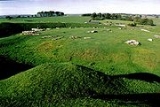
Arbor Low

Encyclopedia
Arbor Low is a Neolithic
henge monument in the Peak District
, Derbyshire
, England
. Arbor Low is located in the White Peak zone of the Peak District in Derbyshire (SK 1603 6355). The White Peak is a Carboniferous Limestone plateau lying between approximately 200-400m OD. The site is private property, accessible through the courtesy of the owner, and is managed by the Peak District National Park Authority.
In the centre lie seven smaller blocks, which form a cove.
One stone is partially upright; the rest are all lying down. That the stones are lying flat rather than standing has been explained through the actions of zealous Christians toppling them or simply that time and subsidence caused them to fall over. However, since no holes have been found in which the vertical stones would have stood, it is possible that they were never erected. Whether this was intentional or simply due to an incomplete project being abandoned, we may never know.
The stones are surrounded by an oval earthen bank, approximately 90 by 85 m at the outside edges and 2 m high, with an interior ditch being about 2 m deep and between 7 and 10 m wide. There are two causeway entrances breaching both the bank and ditch; the north-west one is 9m wide, and the south-south-east one is 6m wide. Within the bank lies an inner platform 52 by 40 m in size.
It was excavated in 1845 and found to contain a cremation burial and various grave goods
which are now in Sheffield City Museum
.
Arbor Low is part of a larger complex, and is linked to the Bronze Age
barrow of Gib Hill 320m away by an earth ridge.
, which was when the outer bank was reconstructed so that the barrow could be erected. Both the earthworks and the stoneworks are likely predated by the nearby Gib Hill.
Arnold-Bemrose, H.H. (1904). Geological notes on Arbor Low. Journal of the Derbyshire Archaeological and Natural History Society, 26, 78-79.
Barnatt, J (1990). The henges, stone circles and ringcairns of the Peak District. Sheffield Archaeological Monographs, Department of Archaeology and Prehistory, University of Sheffield.
Bateman, T. (1848). Vestiges of Antiquity. John Russell Smith, London.
Cox, Rev. J.C. (1884). Some notes on Arbor Low. Journal of the Derbyshire Archaeological and Natural History Society, 6, 97-107.
Gray, H. St George. (1903). On the excavation at Arbor Low 1901-2. Archaelogia, 38.
Heathcote, J.P. (1956). Arbor Low. Today, the Days of Old, and the Years of Ancient Times. 5TH Ed.
Matthews, T.A. (1907). Some notes on Arbor Low and other lows in the High Peak. Journal of the Derbyshire Archaeological and Natural History Society, 29, 103-112.
Matthews, T.A. (1911). Some further notes on the lows in the High Peak. Journal of the Derbyshire Archaeological and Natural History Society, 33, 87-94.
Pegge, S. (1793). A Disquisition on the Lows or Barrows in the Peak of Derbyshire. Archaeologia, VIII, 131-148.
Radley, J. (1968). The origin of Arbor Low henge monument. Derbyshire Archaeological Journal, 88, 100-103.
Neolithic
The Neolithic Age, Era, or Period, or New Stone Age, was a period in the development of human technology, beginning about 9500 BC in some parts of the Middle East, and later in other parts of the world. It is traditionally considered as the last part of the Stone Age...
henge monument in the Peak District
Peak District
The Peak District is an upland area in central and northern England, lying mainly in northern Derbyshire, but also covering parts of Cheshire, Greater Manchester, Staffordshire, and South and West Yorkshire....
, Derbyshire
Derbyshire
Derbyshire is a county in the East Midlands of England. A substantial portion of the Peak District National Park lies within Derbyshire. The northern part of Derbyshire overlaps with the Pennines, a famous chain of hills and mountains. The county contains within its boundary of approx...
, England
England
England is a country that is part of the United Kingdom. It shares land borders with Scotland to the north and Wales to the west; the Irish Sea is to the north west, the Celtic Sea to the south west, with the North Sea to the east and the English Channel to the south separating it from continental...
. Arbor Low is located in the White Peak zone of the Peak District in Derbyshire (SK 1603 6355). The White Peak is a Carboniferous Limestone plateau lying between approximately 200-400m OD. The site is private property, accessible through the courtesy of the owner, and is managed by the Peak District National Park Authority.
Description
Arbor Low consists of about 50 large limestone blocks, quarried from a local site, which form an egg-shaped circle, with monoliths at the entrances, and possibly a portal stone at the south entrance. There is also a large pit at the north entrance, which possibly contained a stone. Some of the stones are broken; some of these fragments may originally have been joined together, such that there were originally between 41 and 43 stones. The stones range from 1.6 to 2.1 m tall, with the monoliths being between 2.6 and 2.9 m.In the centre lie seven smaller blocks, which form a cove.
One stone is partially upright; the rest are all lying down. That the stones are lying flat rather than standing has been explained through the actions of zealous Christians toppling them or simply that time and subsidence caused them to fall over. However, since no holes have been found in which the vertical stones would have stood, it is possible that they were never erected. Whether this was intentional or simply due to an incomplete project being abandoned, we may never know.
The stones are surrounded by an oval earthen bank, approximately 90 by 85 m at the outside edges and 2 m high, with an interior ditch being about 2 m deep and between 7 and 10 m wide. There are two causeway entrances breaching both the bank and ditch; the north-west one is 9m wide, and the south-south-east one is 6m wide. Within the bank lies an inner platform 52 by 40 m in size.
Human remains
Human skeletal remains have been discovered close to the central cove within the circle during excavations between 1901 and 1902.Surrounding landscape
A large round cairn was built later in prehistory east of the henge using material taken from the earth bank.It was excavated in 1845 and found to contain a cremation burial and various grave goods
Grave goods
Grave goods, in archaeology and anthropology, are the items buried along with the body.They are usually personal possessions, supplies to smooth the deceased's journey into the afterlife or offerings to the gods. Grave goods are a type of votive deposit...
which are now in Sheffield City Museum
Sheffield City Museum
Weston Park Museum, one mile west of the centre of Sheffield, England, lies beside Weston Park and surrounded by the University of Sheffield. It is managed by Museums Sheffield....
.
Arbor Low is part of a larger complex, and is linked to the Bronze Age
Bronze Age
The Bronze Age is a period characterized by the use of copper and its alloy bronze as the chief hard materials in the manufacture of some implements and weapons. Chronologically, it stands between the Stone Age and Iron Age...
barrow of Gib Hill 320m away by an earth ridge.
Construction and usage
The bank and ditch of the henge, as well as its two entrances, were likely established in the Late Neolithic period, with the stones added later, some time before 2000 BC. The site seems to have been in use until into the Bronze AgeBronze Age
The Bronze Age is a period characterized by the use of copper and its alloy bronze as the chief hard materials in the manufacture of some implements and weapons. Chronologically, it stands between the Stone Age and Iron Age...
, which was when the outer bank was reconstructed so that the barrow could be erected. Both the earthworks and the stoneworks are likely predated by the nearby Gib Hill.
Further reading
Addy, S.O. (1911). The ‘Harbour’ and Barrows at Arbour-Lows. Journal of the Derbyshire Archaeological and Natural History Society, 33, 39-58.Arnold-Bemrose, H.H. (1904). Geological notes on Arbor Low. Journal of the Derbyshire Archaeological and Natural History Society, 26, 78-79.
Barnatt, J (1990). The henges, stone circles and ringcairns of the Peak District. Sheffield Archaeological Monographs, Department of Archaeology and Prehistory, University of Sheffield.
Bateman, T. (1848). Vestiges of Antiquity. John Russell Smith, London.
Cox, Rev. J.C. (1884). Some notes on Arbor Low. Journal of the Derbyshire Archaeological and Natural History Society, 6, 97-107.
Gray, H. St George. (1903). On the excavation at Arbor Low 1901-2. Archaelogia, 38.
Heathcote, J.P. (1956). Arbor Low. Today, the Days of Old, and the Years of Ancient Times. 5TH Ed.
Matthews, T.A. (1907). Some notes on Arbor Low and other lows in the High Peak. Journal of the Derbyshire Archaeological and Natural History Society, 29, 103-112.
Matthews, T.A. (1911). Some further notes on the lows in the High Peak. Journal of the Derbyshire Archaeological and Natural History Society, 33, 87-94.
Pegge, S. (1793). A Disquisition on the Lows or Barrows in the Peak of Derbyshire. Archaeologia, VIII, 131-148.
Radley, J. (1968). The origin of Arbor Low henge monument. Derbyshire Archaeological Journal, 88, 100-103.