
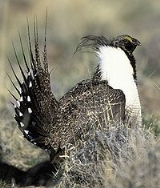
Grouse are a group of birds from the
orderIn scientific classification used in biology, the order is# a taxonomic rank used in the classification of organisms. Other well-known ranks are life, domain, kingdom, phylum, class, family, genus, and species, with order fitting in between class and family...
GalliformesGalliformes are an order of heavy-bodied ground-feeding domestic or game bird, containing turkey, grouse, chicken, New and Old World Quail, ptarmigan, partridge, pheasant, and the Cracidae. Common names are gamefowl or gamebirds, landfowl, gallinaceous birds or galliforms...
. They are sometimes considered a
familyIn biological classification, family is* a taxonomic rank. Other well-known ranks are life, domain, kingdom, phylum, class, order, genus, and species, with family fitting between order and genus. As for the other well-known ranks, there is the option of an immediately lower rank, indicated by the...
Tetraonidae, though the
American Ornithologists' UnionThe American Ornithologists' Union is an ornithological organization in the USA. Unlike the National Audubon Society, its members are primarily professional ornithologists rather than amateur birders...
and many others include grouse as a subfamily
Tetraoninae in the family
PhasianidaeThe Phasianidae is a family of birds which consists of the pheasants and partridges, including the junglefowl , Old World Quail, francolins, monals and peafowl. The family is a large one, and is occasionally broken up into two subfamilies, the Phasianinae, and the Perdicinae...
. Grouse inhabit
temperateIn geography, temperate or tepid latitudes of the globe lie between the tropics and the polar circles. The changes in these regions between summer and winter are generally relatively moderate, rather than extreme hot or cold...
and
subarcticThe Subarctic is a region in the Northern Hemisphere immediately south of the true Arctic and covering much of Alaska, Canada, the north of Scandinavia, Siberia, and northern Mongolia...
regions of the
northern hemisphereThe Northern Hemisphere is the half of a planet that is north of its equator—the word hemisphere literally means “half sphere”. It is also that half of the celestial sphere north of the celestial equator...
, from pine forests to moorland and mountainside, from 83° North (Rock Ptarmigan in northern
GreenlandGreenland is an autonomous country within the Kingdom of Denmark, located between the Arctic and Atlantic Oceans, east of the Canadian Arctic Archipelago. Though physiographically a part of the continent of North America, Greenland has been politically and culturally associated with Europe for...
) to 28° North (
Attwater's Prairie ChickenAttwater's Prairie Chicken is a highly endangered subspecies of the Greater Prairie Chicken that is native to coastal Texas and Louisiana in the United States.-Description:...
in
TexasTexas is the second largest U.S. state by both area and population, and the largest state by area in the contiguous United States.The name, based on the Caddo word "Tejas" meaning "friends" or "allies", was applied by the Spanish to the Caddo themselves and to the region of their settlement in...
). Presumably they
evolvedEvolution is any change across successive generations in the heritable characteristics of biological populations. Evolutionary processes give rise to diversity at every level of biological organisation, including species, individual organisms and molecules such as DNA and proteins.Life on Earth...
in this zone.
Grouse are a group of birds from the
orderIn scientific classification used in biology, the order is# a taxonomic rank used in the classification of organisms. Other well-known ranks are life, domain, kingdom, phylum, class, family, genus, and species, with order fitting in between class and family...
GalliformesGalliformes are an order of heavy-bodied ground-feeding domestic or game bird, containing turkey, grouse, chicken, New and Old World Quail, ptarmigan, partridge, pheasant, and the Cracidae. Common names are gamefowl or gamebirds, landfowl, gallinaceous birds or galliforms...
. They are sometimes considered a
familyIn biological classification, family is* a taxonomic rank. Other well-known ranks are life, domain, kingdom, phylum, class, order, genus, and species, with family fitting between order and genus. As for the other well-known ranks, there is the option of an immediately lower rank, indicated by the...
Tetraonidae, though the
American Ornithologists' UnionThe American Ornithologists' Union is an ornithological organization in the USA. Unlike the National Audubon Society, its members are primarily professional ornithologists rather than amateur birders...
and many others include grouse as a subfamily
Tetraoninae in the family
PhasianidaeThe Phasianidae is a family of birds which consists of the pheasants and partridges, including the junglefowl , Old World Quail, francolins, monals and peafowl. The family is a large one, and is occasionally broken up into two subfamilies, the Phasianinae, and the Perdicinae...
. Grouse inhabit
temperateIn geography, temperate or tepid latitudes of the globe lie between the tropics and the polar circles. The changes in these regions between summer and winter are generally relatively moderate, rather than extreme hot or cold...
and
subarcticThe Subarctic is a region in the Northern Hemisphere immediately south of the true Arctic and covering much of Alaska, Canada, the north of Scandinavia, Siberia, and northern Mongolia...
regions of the
northern hemisphereThe Northern Hemisphere is the half of a planet that is north of its equator—the word hemisphere literally means “half sphere”. It is also that half of the celestial sphere north of the celestial equator...
, from pine forests to moorland and mountainside, from 83° North (Rock Ptarmigan in northern
GreenlandGreenland is an autonomous country within the Kingdom of Denmark, located between the Arctic and Atlantic Oceans, east of the Canadian Arctic Archipelago. Though physiographically a part of the continent of North America, Greenland has been politically and culturally associated with Europe for...
) to 28° North (
Attwater's Prairie ChickenAttwater's Prairie Chicken is a highly endangered subspecies of the Greater Prairie Chicken that is native to coastal Texas and Louisiana in the United States.-Description:...
in
TexasTexas is the second largest U.S. state by both area and population, and the largest state by area in the contiguous United States.The name, based on the Caddo word "Tejas" meaning "friends" or "allies", was applied by the Spanish to the Caddo themselves and to the region of their settlement in...
). Presumably they
evolvedEvolution is any change across successive generations in the heritable characteristics of biological populations. Evolutionary processes give rise to diversity at every level of biological organisation, including species, individual organisms and molecules such as DNA and proteins.Life on Earth...
in this zone.
Description
Grouse are heavily built like other Galliformes such as
chickenThe chicken is a domesticated fowl, a subspecies of the Red Junglefowl. As one of the most common and widespread domestic animals, and with a population of more than 24 billion in 2003, there are more chickens in the world than any other species of bird...
s. They range in length from 31 cm (12.2 in) to 95 cm (37.4 in), in weight from 0.3 kg (10.6 oz) to 6.5 kg (14.3 lb). Males are bigger than females—twice as heavy in the
CapercaillieThe Western Capercaillie , also known as the Wood Grouse, Heather Cock or Capercaillie , is the largest member of the grouse family, reaching over 100 cm in length and 6.7 kg in weight. The largest one ever recorded in captivity had a weight of 7.2 kg....
, the biggest member of the family. Grouse have
featherFeathers are one of the epidermal growths that form the distinctive outer covering, or plumage, on birds and some non-avian theropod dinosaurs. They are considered the most complex integumentary structures found in vertebrates, and indeed a premier example of a complex evolutionary novelty. They...
ed nostrils. Their legs are feathered to the toes, and in winter the toes too have feathers or small scales on the sides, an adaptation for walking on snow and burrowing into it for shelter. Unlike other Galliformes, they have no spurs.
Feeding and habits
These birds feed mainly on vegetation—buds,
catkinA catkin or ament is a slim, cylindrical flower cluster, with inconspicuous or no petals, usually wind-pollinated but sometimes insect pollinated . They contain many, usually unisexual flowers, arranged closely along a central stem which is often drooping...
s, leaves, and twigs—which typically accounts for over 95 percent of adults' food by weight. Thus their diet varies greatly with the seasons. Hatchlings eat mostly
insectInsects are a class of living creatures within the arthropods that have a chitinous exoskeleton, a three-part body , three pairs of jointed legs, compound eyes, and two antennae...
s and other
invertebrateAn invertebrate is an animal without a backbone. The group includes 97% of all animal species – all animals except those in the chordate subphylum Vertebrata .Invertebrates form a paraphyletic group...
s, gradually reducing their proportion of animal food to adult levels. Several of the forest-living species are notable for eating large quantities of conifer needles, which most other
vertebrateVertebrates are animals that are members of the subphylum Vertebrata . Vertebrates are the largest group of chordates, with currently about 58,000 species described. Vertebrates include the jawless fishes, bony fishes, sharks and rays, amphibians, reptiles, mammals, and birds...
s refuse. To digest vegetable food, grouse have big
cropA crop is a thin-walled expanded portion of the alimentary tract used for the storage of food prior to digestion that is found in many animals, including gastropods, earthworms, leeches, insects, birds, and even some dinosaurs.- Bees :Cropping is used by bees to temporarily store nectar of flowers...
s and
gizzardThe gizzard, also referred to as the ventriculus, gastric mill, and gigerium, is an organ found in the digestive tract of some animals, including birds, reptiles, earthworms and some fish. This specialized stomach constructed of thick, muscular walls is used for grinding up food; often rocks are...
s, eat grit to break up food, and have long
intestineIn human anatomy, the intestine is the segment of the alimentary canal extending from the pyloric sphincter of the stomach to the anus and, in humans and other mammals, consists of two segments, the small intestine and the large intestine...
s with well-developed caeca in which
symbioticSymbiosis is close and often long-term interaction between different biological species. In 1877 Bennett used the word symbiosis to describe the mutualistic relationship in lichens...
bacteria digest
celluloseCellulose is an organic compound with the formula , a polysaccharide consisting of a linear chain of several hundred to over ten thousand β linked D-glucose units....
.
Forest species flock only in autumn and winter, though individuals tolerate each other when they meet. Prairie species are more social, and tundra species (ptarmigans,
LagopusLagopus is a small genus of birds in the grouse subfamily. It contains three existing species.-Species:* Willow Ptarmigan or Willow Grouse, Lagopus lagopus* Rock Ptarmigan , Lagopus muta...
) are the most social, forming flocks of up to 100 in winter. All grouse spend most of their time on the ground, though when alarmed, they may take off in a flurry and go into a long glide.
Most species stay within their breeding range all year, but make short seasonal movements; many individuals of the Ptarmigan (called Rock Ptarmigan in America) and
Willow GrouseThe Willow Ptarmigan , also known as the Willow Grouse, is a bird of the grouse subfamily. It is a sedentary species, breeding in birch and other forests and moorlands in the tundra of Scandinavia, Siberia, Alaska, northern Canada, in particular the province of Newfoundland and Labrador...
(called Willow Ptarmigan in America)
migrateBird migration is the regular seasonal journey undertaken by many species of birds. Bird movements include those made in response to changes in food availability, habitat or weather. Sometimes, journeys are not termed "true migration" because they are irregular or in only one direction...
hundreds of kilometers.
Reproduction
In all but one species (the Willow Ptarmigan), males are polygamous. Many species have elaborate courtship displays on the ground at dawn and dusk, which in some are given in leks. The displays feature males' bright-colored
combAnatomically, a comb is a fleshy growth, caruncle, or crest on the top of the head of gallinaceous birds, most notably turkeys, pheasants, and domestic chickens...
s and in some species, bright-colored inflatable sacs on the sides of their necks. The males display their
plumagePlumage refers both to the layer of feathers that cover a bird and the pattern, colour, and arrangement of those feathers. The pattern and colours of plumage vary between species and subspecies and can also vary between different age classes, sexes, and season. Within species there can also be a...
, give vocalizations that vary widely between species, and may engage in other activities such as drumming or fluttering their wings, rattling their tails, and making display flights. Occasionally males fight.
The nest is a shallow depressions on the ground, often in cover, with a scanty lining of plant material. The female lays one clutch, but may replace it if the eggs are lost. She begins to lay about a week after mating and lays one egg every day or two; the clutch comprises 5 to 12 eggs. The eggs have the shape of hen's eggs and are pale yellow, sparsely spotted with brown. On laying the second-last or last egg, the female starts 21 to 28 days of incubation. Chicks hatch in dense yellow-brown down and leave the nest immediately. They soon develop feathers and can fly a little before they are two weeks old. The female (and the male in the Willow Grouse) stays with them and protects them till their first autumn, by which time they reach their mature weight (except in the male capercaillies). They are sexually mature the following spring but often do not mate until later years.
Populations
Grouse make up a considerable part of the vertebrate
biomassBiomass, in ecology, is the mass of living biological organisms in a given area or ecosystem at a given time. Biomass can refer to species biomass, which is the mass of one or more species, or to community biomass, which is the mass of all species in the community. It can include microorganisms,...
in the Arctic and Subarctic. Their numbers may fall sharply in years of bad weather or high predator populations—significant grouse populations are a major food source for
lynxA lynx is any of the four Lynx genus species of medium-sized wildcats. The name "lynx" originated in Middle English via Latin from Greek word "λύγξ", derived from the Indo-European root "*leuk-", meaning "light, brightness", in reference to the luminescence of its reflective eyes...
,
foxFox is a common name for many species of omnivorous mammals belonging to the Canidae family. Foxes are small to medium-sized canids , characterized by possessing a long narrow snout, and a bushy tail .Members of about 37 species are referred to as foxes, of which only 12 species actually belong to...
es,
martenThe martens constitute the genus Martes within the subfamily Mustelinae, in family Mustelidae.-Description:Martens are slender, agile animals, adapted to living in taigas, and are found in coniferous and northern deciduous forests across the northern hemisphere. They have bushy tails, and large...
s, and
birds of preyBirds of prey are birds that hunt for food primarily on the wing, using their keen senses, especially vision. They are defined as birds that primarily hunt vertebrates, including other birds. Their talons and beaks tend to be relatively large, powerful and adapted for tearing and/or piercing flesh....
. However, because of their large clutches, they can recover quickly.
The three tundra species have maintained their former numbers. The prairie and forest species have declined greatly because of habitat loss, though popular game birds such as the
Red GrouseThe Red Grouse is a medium sized bird of the grouse family which is found in heather moorland in Great Britain and Ireland. It is usually classified as a subspecies of the Willow Grouse but is sometimes considered to be a separate species Lagopus scoticus...
and the
Ruffed GrouseThe Ruffed Grouse is a medium-sized grouse occurring in forests from the Appalachian Mountains across Canada to Alaska. It is non-migratory.The Ruffed Grouse is frequently referred to as a "partridge"...
have benefited from habitat management. Most grouse species are listed by the IUCN as "least concern" or "near threatened", but the
GreaterThe Greater Prairie Chicken or Pinnated Grouse, Tympanuchus cupido, is a large bird in the grouse family. This North American species was once abundant, but has become extremely rare or extinct over much of its range due to habitat loss. There are current efforts to help this species gain the...
and
Lesser Prairie ChickenThe Lesser Prairie Chicken, Tympanuchus pallidicinctus, a species in the grouse family, is slightly smaller and paler than its near relative the Greater Prairie Chicken...
are listed as "vulnerable" and the Gunnison Grouse is listed as "endangered". Some subspecies, such at Attwater's Prairie Chicken and the
Cantabrian CapercaillieThe Cantabrian Capercaillie is a subspecies of the Western Capercaillie in the grouse family Tetraonidae.-Description:...
, and some national and regional populations are also in danger.
In culture
Grouse are
gameGame is any animal hunted for food or not normally domesticated. Game animals are also hunted for sport.The type and range of animals hunted for food varies in different parts of the world. This will be influenced by climate, animal diversity, local taste and locally accepted view about what can or...
, and hunters kill millions each year for
foodFood is any substance consumed to provide nutritional support for the body. It is usually of plant or animal origin, and contains essential nutrients, such as carbohydrates, fats, proteins, vitamins, or minerals...
, sport, and other uses. The male
Black GrouseThe Black Grouse or Blackgame is a large bird in the grouse family. It is a sedentary species, breeding across northern Eurasia in moorland and bog areas near to woodland, mostly boreal...
's tail feathers are a traditional ornament for hats in areas such as
ScotlandScotland is a country that is part of the United Kingdom. Occupying the northern third of the island of Great Britain, it shares a border with England to the south and is bounded by the North Sea to the east, the Atlantic Ocean to the north and west, and the North Channel and Irish Sea to the...
and the
AlpsThe Alps is one of the great mountain range systems of Europe, stretching from Austria and Slovenia in the east through Italy, Switzerland, Liechtenstein and Germany to France in the west....
. Folk dances from the Alps to the North American prairies imitate the displays of lekking males.
Species
Genus FalcipennisFalcipennis is a genus of birds in the grouse family that comprises two very similar species:* Siberian Grouse, Falcipennis falcipennis* Spruce Grouse, Falcipennis canadensis...
- Siberian Grouse
The Siberian Grouse, Falcipennis falcipennis, is a medium-sized grouse.It is very similar to the North American Spruce Grouse, to which it is closely related.The Siberian grouse mostly occurs in forests of spruce, fir, larch and pine...
,
Falcipennis falcipennis
Spruce GrouseThe Spruce Grouse or Canada Grouse is a medium-sized grouse closely associated with the coniferous boreal forests or taiga of North America. It is one of the most arboreal grouse, fairly well adapted to perching and moving about in trees...
, Falcipennis canadensis
Falcipennis (canadensis) franklinii
Genus Dendragapus
- Dusky Grouse, Dendragapus obscurus
- Sooty Grouse, Dendragapus fuliginosus
Genus LagopusLagopus is a small genus of birds in the grouse subfamily. It contains three existing species.-Species:* Willow Ptarmigan or Willow Grouse, Lagopus lagopus* Rock Ptarmigan , Lagopus muta...
- ptarmigans
Lagopus lagopus
- Red Grouse
The Red Grouse is a medium sized bird of the grouse family which is found in heather moorland in Great Britain and Ireland. It is usually classified as a subspecies of the Willow Grouse but is sometimes considered to be a separate species Lagopus scoticus...
,
Lagopus (lagopus) scoticus
Rock Ptarmigan, Lagopus muta
White-tailed PtarmiganThe White-tailed Ptarmigan, Lagopus leucura, is the smallest bird in the grouse family. It is found in the mountains of the western United States, Canada and Alaska.-Description:...
, Lagopus leucura
Genus TetraoTetrao is a genus of birds in the grouse subfamily. It has four species.-Species:* Eurasian Black Grouse, Tetrao tetrix* Caucasian Black Grouse, Tetrao mlokosiewiczi* Western Capercaillie, Tetrao urogallus...
- black grouse
- Black Grouse
The Black Grouse or Blackgame is a large bird in the grouse family. It is a sedentary species, breeding across northern Eurasia in moorland and bog areas near to woodland, mostly boreal...
, Tetrao tetrix
- Caucasian Grouse, Tetrao mlokosiewiczi
- Western Capercaillie, Tetrao urogallus
- Black-billed Capercaillie
The Black-billed Capercaillie is a large grouse species closely related to the more widespread Western Capercaillie. It is a sedentary species which breeds in the larch taiga forests of eastern Russia as well as parts of northern Mongolia and China.The appearance of the male Black-billed...
, Tetrao parvirostris
Genus TetrastesTetrastes is a genus of birds in the grouse subfamily. It contains the following species:* Hazel Grouse, Tetrastes bonasia* Chinese Grouse, Tetrastes sewerzowi...
- Hazel Grouse
The Hazel Grouse or Hazel Hen is one of the smaller members of the grouse family of birds. It is a sedentary species, breeding across northern Eurasia and central and eastern Europe in dense, damp, mixed coniferous woodland, preferably with some spruce.The nest is on the ground, and 3–6 eggs is...
,
Tetrastes bonasia
Chinese Grouse, Tetrastes sewerzowi
Genus Bonasa
- Ruffed Grouse
The Ruffed Grouse is a medium-sized grouse occurring in forests from the Appalachian Mountains across Canada to Alaska. It is non-migratory.The Ruffed Grouse is frequently referred to as a "partridge"...
, Bonasa umbellus
Genus Centrocercus - sage grouse
- Sage Grouse
The Sage Grouse is the largest grouse in North America, where it is known as the Greater Sage-Grouse. Its range is sagebrush country in the western United States and southern Alberta and Saskatchewan, Canada. A population of smaller birds, known in the U.S. as Gunnison Sage-Grouse, were recently...
,
Centrocercus urophasianus
Gunnison Grouse, Centrocercus minimus
Genus TympanuchusTympanuchus is a small genus of birds in the grouse family. It contains three species:* Sharp-tailed Grouse, Tympanuchus phasianellus* Greater Prairie-Chicken, Tympanuchus cupido* Lesser Prairie-Chicken, Tympanuchus pallidicinctus...
- prairie grouse
- Sharp-tailed Grouse
The Sharp-tailed Grouse, Tympanuchus phasianellus , is a medium-sized prairie grouse. It is also known as the sharptail, and is known as "fire grouse" or "fire bird" by Native American Indians due to their reliance on brush fires to keep their habitat open.-Taxonomy:The Greater Prairie-chicken,...
, Tympanuchus phasianellus
- Columbian Sharp-tailed Grouse
The Columbian Sharp-tailed Grouse is a subspecies of Sharp-tailed Grouse native to the Western United States and British Columbia.-Description:...
, T. phasianellus columbianus
- Greater Prairie Chicken
The Greater Prairie Chicken or Pinnated Grouse, Tympanuchus cupido, is a large bird in the grouse family. This North American species was once abundant, but has become extremely rare or extinct over much of its range due to habitat loss. There are current efforts to help this species gain the...
, Tympanuchus cupido
- Attwater's Prairie Chicken
Attwater's Prairie Chicken is a highly endangered subspecies of the Greater Prairie Chicken that is native to coastal Texas and Louisiana in the United States.-Description:...
, Tympanuchus cupido attwateri
- Heath Hen
The Heath Hen was a distinctive subspecies of the Greater Prairie Chicken, Tympanuchus cupido, a large North American bird in the grouse family, or possibly a distinct species....
, Tympanuchus cupido cupido (extinct, 1932)
- Lesser Prairie Chicken
The Lesser Prairie Chicken, Tympanuchus pallidicinctus, a species in the grouse family, is slightly smaller and paler than its near relative the Greater Prairie Chicken...
Tympanuchus pallidicinctus
External links