
All Topics  
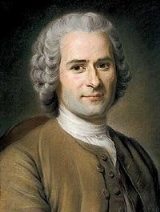
Jean-Jacques Rousseau

 
Jean Jacques Rousseau

   Email Print
   Bookmark   Link


Jean-Jacques Rousseau


Jean Jacques Rousseau (Geneva
Geneva

Geneva is the second-most-populous city in Switzerland and is the most populous city of Romandie . Situated where the Rh?ne River exits Lake Geneva , it is the capital of the Canton of Geneva....
, 1712 Ermenonville
Ermenonville

Ermenonville is a Communes of France in the Oise Departments of France in northern France.Ermenonville is notable for its park named for Jean-Jacques Rousseau, whose tomb designed by the painter Hubert Robert is on the Isle of Poplars in its lake....
, 2 July 1778) was a major philosopher, writer, and composer
Composer

A composer is a person who creates music, usually in the medium of musical notation, for interpretation and performance. The level of distinction between composers and other musicians varies, which affects issues such as copyright and the deference given to individual interpretations of a particular piece of music....
 of the eighteenth century Enlightenment, whose political philosophy
Political philosophy

Political philosophy is the study of questions about the city, government, politics, liberty, justice, property, rights, law and the enforcement of a legal code by authority: what they are, why they are needed, what makes a The purpose of government, what rights and freedoms it should protect and why, what form it should take and why, what t...
 influenced the French Revolution
French Revolution

The French Revolution was a period of political and social upheaval and radical change in the history of France, during which the French governmental structure, previously an absolute monarchy with feudalism for the aristocracy and Roman Catholic Church clergy, underwent radical change to forms based on Age of Enlightenment principles of cit...
 and the development of modern political and educational thought. His novel, Emile: or, On Education
Emile: Or, On Education

Emile, or On Education was considered by Jean-Jacques Rousseau to be the ?best and most important of all my writings?. On its first appearance in 1762 it was publicly book burning....
, which he considered his most important work, is a seminal treatise on the education of the whole person for citizenship. His Sentimental Novel
Sentimental novel

The sentimental novel or the novel of sensibility is an 18th century in literature which celebrates the emotional and intellectual concepts of sentiment, Sentimentalism , and sensibility....
, Julie, ou la nouvelle Héloïse
Julie, ou la nouvelle Héloïse

Julie, or the New Heloise is an epistolary novel by Jean-Jacques Rousseau, published in 1761 in literature by Rey . The original edition was entitled Lettres de deux amans habitans d'une petite ville au pied des Alpes ....
, was of great importance to the development of pre-Romanticism and romanticism
Romanticism

Romanticism is a complex artistic, literary, and intellectual movement that originated in the second half of the 18th century in Western Europe, and gained strength during the Industrial Revolution....
 in fiction .


Discussion
Ask a question about 'Jean-Jacques Rousseau'
Start a new discussion about 'Jean-Jacques Rousseau'
Answer questions from other users
Full Discussion Forum


Recent Posts


Quotations


Good laws lead to the making of better ones; bad ones bring about worse.

III, Ch. 15

Hatred, as well as love, renders its votaries credulous.

V

L'accent est l'âme du discours.

Translation: Accent is the soul of language.

Money is the seed of money, and the first guinea is sometimes more difficult to acquire than the second million.

Nature never deceives us; it is we who deceive ourselves.

Variant: Nature never deceives us; it is always we who deceive ourselves., Ch. III

Never exceed your rights, and they will soon become unlimited.


Encyclopedia


Jean Jacques Rousseau (Geneva
Geneva

Geneva is the second-most-populous city in Switzerland and is the most populous city of Romandie . Situated where the Rh?ne River exits Lake Geneva , it is the capital of the Canton of Geneva....
, 1712 Ermenonville
Ermenonville

Ermenonville is a Communes of France in the Oise Departments of France in northern France.Ermenonville is notable for its park named for Jean-Jacques Rousseau, whose tomb designed by the painter Hubert Robert is on the Isle of Poplars in its lake....
, 2 July 1778) was a major philosopher, writer, and composer
Composer

A composer is a person who creates music, usually in the medium of musical notation, for interpretation and performance. The level of distinction between composers and other musicians varies, which affects issues such as copyright and the deference given to individual interpretations of a particular piece of music....
 of the eighteenth century Enlightenment, whose political philosophy
Political philosophy

Political philosophy is the study of questions about the city, government, politics, liberty, justice, property, rights, law and the enforcement of a legal code by authority: what they are, why they are needed, what makes a The purpose of government, what rights and freedoms it should protect and why, what form it should take and why, what t...
 influenced the French Revolution
French Revolution

The French Revolution was a period of political and social upheaval and radical change in the history of France, during which the French governmental structure, previously an absolute monarchy with feudalism for the aristocracy and Roman Catholic Church clergy, underwent radical change to forms based on Age of Enlightenment principles of cit...
 and the development of modern political and educational thought. His novel, Emile: or, On Education
Emile: Or, On Education

Emile, or On Education was considered by Jean-Jacques Rousseau to be the ?best and most important of all my writings?. On its first appearance in 1762 it was publicly book burning....
, which he considered his most important work, is a seminal treatise on the education of the whole person for citizenship. His Sentimental Novel
Sentimental novel

The sentimental novel or the novel of sensibility is an 18th century in literature which celebrates the emotional and intellectual concepts of sentiment, Sentimentalism , and sensibility....
, Julie, ou la nouvelle Héloïse
Julie, ou la nouvelle Héloïse

Julie, or the New Heloise is an epistolary novel by Jean-Jacques Rousseau, published in 1761 in literature by Rey . The original edition was entitled Lettres de deux amans habitans d'une petite ville au pied des Alpes ....
, was of great importance to the development of pre-Romanticism and romanticism
Romanticism

Romanticism is a complex artistic, literary, and intellectual movement that originated in the second half of the 18th century in Western Europe, and gained strength during the Industrial Revolution....
 in fiction . Rousseau's autobiographical writings: his Confessions
Confessions (Jean-Jacques Rousseau)

Confessions is an autobiography book by Jean-Jacques Rousseau. In modern times, it is often published with the title The Confessions of Jean-Jacques Rousseau in order to distinguish it from St....
, which initiated the modern autobiography
Autobiography

An autobiography is a biography written by its subject . The term was first used by the poet Robert Southey in 1809 in the English language Periodical publication Quarterly Review, but the form goes back to antiquity....
, and his Reveries of a Solitary Walker
Reveries of a Solitary Walker

Reveries of a Solitary Walker is an unfinished work by France philosopher Jean-Jacques Rousseau, written between 1776 and 1778. It was the last of a number of works composed toward the end of his life which were deeply autobiography in nature....
 (along with the works of Lessing
Lessing

Lessing is the surname of:* Doris Lessing , British novelist and the 2007 Nobel Prize laureate in literature* Feodor Yulievich Levinson-Lessing, Russian geologist...
 and Goethe in Germany, and Richardson
Richardson

Richardson is an English and Scottish surname, and may also refer to:In places:*Richardson, Australian Capital Territory*Richardson, Saskatchewan, Canada...
 and Sterne
Sterne

Sterne may mean* Jaques Sterne, uncle of Laurence Sterne, and Precentor of York Minster* Laurence Sterne , an Irish-born English novelist and an Anglican clergyman...
 in England), were among the pre-eminent examples of the late eighteenth century movement known as the "Age of Sensibility
Sensibility

Sensibility refers to an acute perception of or responsiveness toward something, such as the emotions of another. This concept emerged in eighteenth-century Britain, and was closely associated with studies of sense perception as the means through which knowledge is gathered....
", featuring an increasing focus on subjectivity and introspection that has characterized the modern age. Rousseau also wrote a play and two operas, and made important contributions to music
Music

Music is an art form whose media is sound organized in time. Common elements of music are pitch , rhythm , dynamics , and the sonic qualities of timbre and texture ....
 as a theorist. During the period of the French Revolution, Rousseau was the most popular of the philosophes among members of the Jacobin Club
Jacobin Club

The Jacobin Club was the largest and most powerful political club of the French Revolution. It originated as the Club Benthorn, formed at Versailles as a group of Brittany deputies to the Estates-General of 1789 of 1789....
. He was interred as a national hero in the Panthéon in Paris, in 1794, sixteen years after his death.

Biography

Rousseau was born on June 28, 1712 in Geneva
Geneva

Geneva is the second-most-populous city in Switzerland and is the most populous city of Romandie . Situated where the Rh?ne River exits Lake Geneva , it is the capital of the Canton of Geneva....
, an associated member of the Old Confederation (known today as the Helvetian Confederation of Switzerland). Rousseau was proud that his family had voting rights in that city state, founded by Huguenot
Huguenot

The Huguenots were members of the Protestantism Reformed Church of France of France from the sixteenth to the eighteenth centuries....
 refugees as a Calvinist republic, and throughout his life he described himself as a citizen of Geneva. In theory Geneva was governed democratically by its male voting citizens (who were a minority of the population). In fact, a secretive executive committee, called the Little Council (made up of 25 members of its wealthiest families), ruled the city. In 1707 a patriot called Pierre Fatio protested this situation and the Little Council had him shot. Jean-Jacques Rousseau's father Isaac was not in the city at this time, but Jean-Jacques's grandfather supported Fatio and was penalized for it. Rousseau's father, Isaac Rousseau, was a watchmaker who, notwithstanding his artisan status, was well educated and a lover of music. "‘A Genevan watchmaker,' Rousseau wrote, ‘is a man who can be introduced anywhere; a Parisian watchmaker is only fit to talk about watches.’" Nine days after his birth, Jean-Jacques's mother, Suzanne Bernard Rousseau, died of birth complications. After her death, Isaac Rousseau's sister Suzanne kept house for Isaac and took care of the newborn Jean-Jacques and his older brother François.

Jean-Jacques wrote that he had no recollection of learning to read, but he did remember his father encouraging him when he was five or six:
Every night, after supper, we read some part of a small collection of romances [i.e., adventure stories], which had been my mother's. My father's design was only to improve me in reading, and he thought these entertaining works were calculated to give me a fondness for it; but we soon found ourselves so interested in the adventures they contained, that we alternately read whole nights together and could not bear to give over until at the conclusion of a volume. Sometimes, in the morning, on hearing the swallows at our window, my father, quite ashamed of this weakness, would cry, "Come, come, let us go to bed; I am more a child than thou art." --Confessions, Book 1
Not long afterwards, Rousseau abandoned his taste for escapist stories in favor of the antiquity of Plutarch
Plutarch

Lucius Mestrius Plutarchus , c. AD 46 ? 120 ? commonly known in English as Plutarch ? was a Ancient Rome historian , biographer, essayist, and Middle Platonism....
's Lives of the Noble Greeks and Romans, which became the constant companion of his childish imagination.

When his older brother, François, got into trouble, Rousseau recounts how he deflected punishment onto himself in a bid for François's approval and affection. Later, François got into difficulties while an apprentice and ran away, disappearing for good. Some scholars have connected this event to Rousseau’s lifelong tendency to masochism and his martyrdom complex. Survivors' guilt associated with causing his mother’s death in childbirth may have played a part, as well.

When Jean Jacques Rousseau was ten years old, his father, an avid hunter, got into a fight and then a prolonged legal quarrel with a wealthy landowner on whose lands he had been caught trespassing. To avoid losing the battle, he moved away to Nyon, 15 miles from Geneva in the territory of Bern, taking Rousseau's aunt Suzanne with him. Isaac Rousseau remarried, and from that point Jean-Jacques saw little of him. Jean-Jacques was left in the care of his maternal uncle, who packed him, along with his own son, Abraham Bernard, Jean-Jacques's young cousin, away to board for two years with a Calvinist minister in a hamlet outside of Geneva. Here the boys picked up the elements of mathematics and drawing. Rousseau, who was always deeply moved by religious services, for a time even dreamed of being a Protestant minister himself.

Virtually all our information about Rousseau's first youth has come from his posthumously published Confessions, in which the chronology is somewhat confusing, though recent scholars have combed the archives for confirming evidence to fill in the blanks. At age thirteen Rousseau was apprenticed first to a notary
Civil law notary

Civil-law notaries are specialized lawyers acting as public officers with jurisdiction over voluntary, i.e., non-contentious, private law. Unlike a notary public, their common-law counterparts, they are able to provide legal advice and prepare instruments with legal effect....
 and then to an engraver who beat him. At fifteen he ran away from Geneva (on March 14, 1728) after being locked out of the city walls after curfew. Not far from Geneva, in adjoining Savoy
Savoy

Savoy is a region of Europe on the western flank of the Alps that emerged following the collapse of the Frankish Empire Kingdom of Burgundy. Installed by Rudolph III, King of Burgundy, officially in 1003, the House of Savoy became the longest surviving royal house in Europe....
 he took shelter with a Catholic priest, who introduced him to Françoise-Louise de Warens
Françoise-Louise de Warens

Fran?oise-Louise de Warens, born Louise ?l?onore de la Tour du Pil, also called Madame de Warens , was the benefactor and mistress of Jean-Jacques Rousseau....
, age 29. She was a noblewoman of Protestant background who had left her husband; a lay professional proslytizer, she received an income from the King of Piedmont
Piedmont

Piedmont is one of the 20 Regions of Italy. It has an area of 25,399 km? and a population of about 4.4 million. The capital is Turin. The main local dialect is Piedmontese....
 for helping bring Protestants to Catholicism. They sent the boy to Turin
Turín

Tur?n is a municipality in the Ahuachap?n Department Departments of El Salvador of El Salvador....
, the capital of Savoy (which included Piedmont, in what is now Italy), to complete his conversion. This resulted in his having to give up his Genevan citizenship, although he would later revert back to Calvinism in order to regain it.

In converting to Catholicism, both De Warens and Rousseau were likely reacting to the severity of Calvinism's insistence on the sinful nature of man. Leo Damrosch writes, “an eighteenth century Genevan liturgy still required believers to declare ‘that we are miserable sinners, born in corruption, inclined to evil, incapable by ourselves of doing good.’” De Warens, a deist by inclination, was attracted to Catholicism's doctrine of forgiveness of sins.

Finding himself utterly alone, since his father and uncle more or less disowned him, the teenaged Rousseau supported himself for a time as a servant, secretary, and tutor, wandering in Italy (Piedmont and Savoy) and France. During this time, he he lived on and off with De Warens, whom he idolized and called his "maman". Flattered by his devotion, De Warens tried to get him started in a profession, arranging formal music lessons for him. At one point, he briefly attended a seminary with the idea of becoming a priest. When he reached twenty she took him as her lover, notwithstanding her ongoing relationship with the steward of her house. The sexual aspect of their relationship (in fact a Ménage à trois
Ménage à trois

M?nage ? trois is the French language term describing a relationship or domestic arrangement in which three people share a sexual relationship....
) confused Rousseau and made him uncomfortable, but he always considered De Warens the greatest love of his life. A rather profligate spender, she had large library and loved to entertain and listen to music. She and her circle, comprising educated members of the Catholic clergy, introduced Rousseau to the world of letters and ideas. Rousseau had been an indifferent student, but during his twenties, which were marked by long bouts of hypochondria, he began to apply himself on his own to the earnest study of philosophy, mathematics, and music, reading deeply and widely. At twenty-five, he came into a small inheritance from his mother and used a portion of it to repay De Warens for her financial support of him. At twenty-seven he took a job as a tutor in Lyon.

In 1742 Rousseau moved to Paris in order to present the Académie des Sciences with a new system of numbered musical notation
Numbered musical notation

The numbered musical notation, better known as jianpu in Chinese language, is a musical notation system widely used among the Chinese people....
. His system, intended to be compatible with typography
Typography

Typography is the art and techniques of typesetting, type design, and modifying type glyphs. Type glyphs are created and modified using a variety of illustration techniques....
, is based on a single line, displaying numbers representing intervals
Interval (music)

In music theory, the term interval describes the relationship between the pitch of two notes.Intervals may be described as:*vertical if the two notes sound simultaneously...
 between notes and dots and commas indicating rhythmic values. Believing the system was impractical, the Academy rejected it, though they praised his mastery of the subject, and urged him to try again. (In some parts of the world, a version of the system remains in use.)

From 1743 to 44 Rousseau had an honorable but ill-paying post as a secretary to the Comte de Montaigue, the French ambassador to Venice
Venice

Venice is a city in northern Italy, the capital city of the Italian regions Veneto, a population of 271,251 . Together with Padua, Italy, the city is included in the Padua-Venice Metropolitan Area ....
, to whose republican form of government Rousseau often referred in his later political works. Venice also awoke in him a life-long love for Italian music, particularly opera:
I had brought with me from Paris the prejudice of that city against Italian music; but I had also received from nature a sensibility and niceness of distinction which prejudice cannot withstand. I soon contracted that passion for Italian music with which it inspires all those who are capable of feeling its excellence. In listening to barcaroles, I found I had not yet known what singing was... --Confessions
Rousseau's employer routinely received his stipend as much a year late and was himself tardy in paying his staff. There were frequent quarrels over money, and Rousseau took from the experience a profound distrust of government bureaucracy. After eleven months he quit and returned to Paris. There the penniless Rousseau befriended and became the lover of Thérèse Levasseur
Thérèse Levasseur

Th?r?se Levasseur, also known as Th?r?se Le Vasseur and Th?r?se Lavasseur, was the wife of French philosopher Jean-Jacques Rousseau....
, a pretty seamstress who was the sole support of her termagant mother and numerous ne'er-do-well siblings. According to his
Confessions, Thérèse bore him a son and as many as four other children (there is no independent corroboration for this number). Rousseau wrote that he persuaded Thérèse to give each of the newborns up to a foundling hospital, for the sake of her "honor." "Her mother, who feared the inconvenience of a brat, came to my aid, and she [Thérèse] allowed herself to be overcome" (Confessions). The foundling hospitals had been started as a reform to save the numerous infants who were being abandoned in the streets of Paris. Infant mortality at that date was extremely high -- some fifty percent, in large part because families sent their infants to be wet nursed. The mortality rate in the foundling hospitals, which also sent the babies out to be wet nursed, proved worse, however, and most of the infants sent there likely perished. Ten years later Rousseau made inquiries about the fate of his son, but no record could be found. When Rousseau subsequently became celebrated as a theorist of education and child-rearing, his abandonment of his children was used by his critics, including Voltaire
Voltaire

Fran?ois-Marie Arouet , better known by the pen name Voltaire, was a French Age of Enlightenment writer, essayist, and philosophy known for his wit, philosophical sport, and defense of civil liberty, including freedom of religion and free trade....
 and Edmund Burke
Edmund Burke

Edmund Burke was an Irish statesman, author, orator, political theorist, and philosophy who, after relocating to Great Britain, served for many years in the British House of Commons as a member of the British Whig Party party....
, as the basis for
ad hominem
Ad hominem

An ad hominem logical argument, also known as argumentum ad hominem consists of replying to an argument or factual claim by attacking or appealing to a characteristic or belief of the source making the argument or claim, rather than by addressing the substance of the argument or producing evidence against the claim....
attacks. In an irony of fate, Rousseau's later injunction to women to breastfeed their own babies (as had previously been recommended by the French natural scientist Buffon), probably saved the lives of thousands of infants.

While in Paris, Rousseau became a close friend of French philosopher Diderot
Denis Diderot

Denis Diderot was a French philosopher and writer. He was a prominent figure during the Age of Enlightenment and is best known for serving as chief editor and contributor to the Encyclop?die....
 and, beginning with some articles on music in 1749, contributed numerous articles to Diderot and D'Alambert's great Encyclopédie
Encyclopédie

Encyclop?die, ou dictionnaire raisonn? des sciences, des arts et des m?tiers was a general encyclopedia published in France between 1751 and 1772, with later supplements and revisions in 1772, 1777 and 1780 and numerous foreign editions and later derivatives....
, the most famous of which was an article on political economy written in 1755.

Rousseau's ideas were the result of an almost obsessive dialog with writers of the past, filtered in many cases through conversations with Diderot. His genius lay in his strikingly original way of putting things rather than in the originality,
per se, of his thinking. In 1749 Rousseau was paying daily visits to Diderot, who had been thrown into the fortress of Vincennes
Vincennes

Vincennes is a commune in France of the Val-de-Marne located in the eastern suburbs of Paris, France. This ?le-de-France town is located . from the Kilometre Zero....
 under a
lettre de cachet
Lettre de cachet

In France history, lettres de cachet were letters signed by the List of French monarchs, countersigned by one of his ministers, and closed with the royal seal, or cachet....
for opinions in his "Lettre sur les aveugles," that hinted at materialism
Materialism

The philosophy of materialism holds that the only thing that can be truly proven to existence is matter, and is considered a form of physicalism....
, a belief in atoms, and natural selection. Rousseau had read about an essay competition sponsored by the Académie de Dijon, to be published in the
Mercure de France on the theme of whether the development of the arts and sciences had been morally beneficial. He wrote that while walking to Vincennes (about three miles from Paris), he had a revelation that the arts and sciences were responsible for the moral degeneration of mankind, who were basically good by nature. According to Diderot, writing much later, Rousseau had originally intended to answer this in the conventional way, but his discussions with Diderot convinced him to propose the paradoxical negative answer that catapulted him into the public eye. whatever the case, it was the great French naturalist Buffon who had first suggested, without elaborating on it, the idea that man's moral decline arose from his acquisition of property and culture. Both Rousseau and Diderot would have been aware of Buffon's speculations. Rousseau's 1750 "Discourse on the Arts and Sciences
Discourse on the Arts and Sciences

"A Discourse on the Moral Effects of the Arts and Sciences" , more commonly known as "Discourse on the Arts and Sciences" , is an essay by Genevan philosopher Jean-Jacques Rousseau which argued that the arts and sciences corrupt human morality....
", in which he made that argument, was awarded the first prize and gained him significant fame.

Rousseau continued his interest in music, and his opera
Le Devin du Village
Le Devin du Village

Le devin du village is an opera by Jean-Jacques Rousseau, who also wrote the libretto.It was first performed before the court at Ch?teau de Fontainebleau on 18 October 1752....
(The Village Soothsayer) was performed for King Louis XV
Louis XV of France

Louis XV ruled as List of French monarchs and of List of Navarrese monarchs from 1 September 1715 until his death on 10 May 1774. Coming to the throne at the age of five, Louis reigned until 15 February 1723, the date of his thirteenth birthday, with the aid of the R?gence, Philippe II, Duke of Orl?ans, his Cousin, thereafter taking formal p...
 in 1752. The king was so pleased by the work that he offered Rousseau a life-long pension. To the exasperation of his friends, Rousseau turned down the great honor, bringing him notoriety as "the man who had refused a king's pension." He also turned down several other advantageous offers, sometimes with a brusqueness bordering on truculence that gave offense and caused him problems. The same year, the visit of a troupe of Italian musicians to Paris, and their performance of Giovanni Battista Pergolesi
Giovanni Battista Pergolesi

Giovanni Battista Pergolesi was an Italy composer, violinist and organ ....
's
La Serva Padrona
La serva padrona

La serva padrona is an opera buffa by Giovanni Battista Pergolesi on a libretto by Gennaro Antonio Federico, after the Play by Jacopo Angello Nelli....
, prompted the Querelle des Bouffons, which pitted protagonists of French music against supporters of the Italian style. Rousseau as noted above, was an enthusiastic supporter of the Italians against Jean-Philippe Rameau
Jean-Philippe Rameau

Jean-Philippe Rameau was one of the most important French composers and music theory of the Baroque music era. He replaced Jean-Baptiste Lully as the dominant composer of French opera and is also considered the leading French author of music for the harpsichord of his time, alongside Fran?ois Couperin....
 and others, making an important contribution with his
Letter on French Music.

On returning to Geneva in 1754, Rousseau reconverted to Calvinism
Calvinism

Calvinism is a theology system and an approach to the Christian life that emphasizes the rule of God over all things. It was developed by several theologians, but it bears the name of the French Protestant Reformation John Calvin because of his prominent influence on it and because of his role in the confessional and ecclesiastical debates t...
 and regained his official Genevan citizenship. In 1755, Rousseau completed his second major work, the
Discourse on the Origin and Basis of Inequality Among Men (the Discourse on Inequality
Discourse on Inequality

Discourse on the Origin and Basis of Inequality Among Men also commonly known as the Second Discourse is a work by the philosopher Jean-Jacques Rousseau....
), which elaborated on the arguments of the
Discourse on the Arts and Sciences.

He also pursued an important but unconsummated romantic attachment with the twenty-five-year old Sophie d'Houdetot, which partly inspired his epistolary novel
Epistolary novel

An epistolary novel is a novel written as a series of documents. The usual form is Letter s, although diary, newspaper clippings and other documents are sometimes used....
,
Julie, ou la nouvelle Héloïse

Julie, or the New Heloise is an epistolary novel by Jean-Jacques Rousseau, published in 1761 in literature by Rey . The original edition was entitled Lettres de deux amans habitans d'une petite ville au pied des Alpes ....
, also based on memories of his idyllic youthful relationship with Mme de Warens. Sophie was the cousin and house guest of Rousseau's patroness and landlady Madame d'Epinay, whom he treated rather high highhandedly. Wounded feelings gave rise to a bitter three-way quarrel between Rousseau and Madame d'Epinay; her lover, the philologist Grimm
Friedrich Melchior, baron von Grimm

Friedrich Melchior, Baron von Grimm was a German author....
; and their mutual friend, Diderot, who took their side against Rousseau. Diderot later described Rousseau as being, "deceitful, vain as Satan, ungrateful, cruel, hypocritical, and full of malice." Rousseau, for his part, disliked the shallowness and casual atheism of the
Encyclopedistes whom he met at Mme d'Epinay's table. He feared that her patronage of him reduced him to the status of a valet.

Rousseau's break with the
Encyclopedistes coincided with the composition of his three major works, in all of which he emphasized his fervent belief in a spiritual origin of man's soul and the universe, in contradistinction to the materialism
Materialism

The philosophy of materialism holds that the only thing that can be truly proven to existence is matter, and is considered a form of physicalism....
 of Diderot, La Mettrie, and d'Holbach. During this period Rousseau enjoyed the support and patronage of the Duc de Luxembourg, and the Prince de Conti, two of the most powerful nobles in France. These men truly liked Rousseau and enjoyed his ability to converse on any subject, but they also used him as a way of getting back at Louis XV and the political faction surrounding his mistress, Mme de Pompadour. Even with them, however, Rousseau went too far, courting rejection when he criticized the practice of tax farming
Tax farming

Tax farming was originally a Ancient Rome practice whereby the burden of tax collection was reassigned by the Roman State to private individuals or groups....
, in which some of them engaged.

Rousseau's 800-page novel of sentiment
Sentiment

Sentiment can refer to:*Feelings and emotions*Sentimentality, the literary device which is used to induce an emotional response disproportionate to the situation, and thus to substitute heightened and generally unthinking feeling for normal ethical and intellectual judgment...
,
Julie, ou la nouvelle Héloïse

Julie, or the New Heloise is an epistolary novel by Jean-Jacques Rousseau, published in 1761 in literature by Rey . The original edition was entitled Lettres de deux amans habitans d'une petite ville au pied des Alpes ....
, was published in (1761
1761 in literature

See also: 1760 in literature, 1761, 1762 in literature, list of years in literature....
) to immense success. The book's rhapsodic descriptions of the natural beauty of the Swiss countryside struck a chord in the public and may have helped spark the subsequent nineteenth century craze for Alpine scenery. In 1762, Rousseau published
Du Contrat Social, Principes du droit politique (in English, literally Of the Social Contract, Principles of Political Right
Social Contract (Rousseau)

The Social Contract, Or Principles of Political Right by Jean-Jacques Rousseau, is the book in which Rousseau theorized about the best way in which to set up a political community in the face of the problems of commercial society which he had already identified in his Discourse on Inequality ....
) in April and then Émile, or On Education in May. The final section of Émile, "The Profession of Faith of a Savoyard Vicar," was intended to be a defense of religious belief. Rousseau's choice of a Catholic vicar of humble status (possibly based on someone he had known in his youth) as a spokesman for the defense of religion was in itself a daring innovation for the time. The vicar's creed was that of Socinianism
Socinianism

Socinianism is a form of Antitrinitarianism, named for Laelius Socinus and of his nephew Faustus Socinus ....
(or Unitarism as it is called today). Because it rejected original sin and divine Revelation
Revelation

Revelation is the act of revealing or disclosing, or making something obvious and clearly understood through active or passive communication with the divinity....
, both Protestant and Catholic authorities took offense. Moreover, Rousseau advocated the opinion that, insofar as they lead people to virtue, all religions are equally worthy, and that people should therefore conform to the religion in which they had been brought up. This religious indifferentism
Indifferentism

In the Catholic Church, indifferentism is a condemned Christian heresy that holds that one religion is as good as another, and that all religions are equally valid paths to salvation....
 caused Rousseau and his books to be banned from France and Geneva. He was condemned from the pulpit by the Archbishop of Paris, and warrants were issued for his arrest.

A sympathetic observer, British philosopher David Hume
David Hume

David Hume was a Scotland philosopher, economist, historian and a key figure in the history of Western philosophy and the Scottish Enlightenment....
, "professed no surprise when he learned that Rousseau's books were banned in Geneva and elsewhere. Rousseau, he wrote, 'has not had the precaution to throw any veil over his sentiments; and, as he scorns to dissemble his contempt for established opinions, he could not wonder that all the zealots were in arms against him. The liberty of the press is not so secured in any country … as not to render such an open attack on popular prejudice somewhat dangerous.'" Rousseau, who thought he had been defending religion, was crushed. Forced to flee arrest he made his way to Neuchâtel
Neuchâtel

Neuch?tel is the Capital of the Swiss Cantons of Switzerland of Neuch?tel on Lake Neuch?tel.The city has approximately 31,500 inhabitants , by and large French-speaking, although the city is sometimes referred to historically by the German language name , which has the same meaning, since Prussia ruled the area until 1848....
, a Canton
Canton

Canton may refer to:...
 of the Swiss Confederation that was a protectorate of the Prussian crown. His powerful protectors discretely assisted him in his flight. In the town of Môtiers
Môtiers

M?tiers is a Municipalities of Switzerland in the district of Val-de-Travers in the Cantons of Switzerland of Neuch?tel in Switzerland.The old castle, dating in part from the 14th century, stands on a rock sput between Val de Travers and the Bied valley....
, he sought and found protection under Lord Keith, who was the local representative of the free-thinking Frederick the Great of Prussia. While in Môtiers, Rousseau wrote the
Constitutional Project for Corsica (, 1765).

After his house in Môtiers was stoned on the night of 6 September 1765, Rousseau took refuge with Hume in Great Britain. There, isolated at Wootton
Weaver Hills

The Weaver Hills are a small range of hills in north Staffordshire....
 on the borders of Derbyshire and Staffordshire, Rousseau, never emotionally very stable, suffered a serious decline in his mental health and began to experience paranoid fantasies about plots against him involving Hume and others. “He is plainly mad, after having long been maddish”, Hume wrote to a friend. Rousseau's letter to Hume, in which he articulates the perceived misconduct, sparked an exchange which was published in and received with great interest in contemporary Paris.

Jean Jacques Rousseau (photo of His Crypt)
Although, he was not supposed to return to France before 1770, Rousseau did come back in 1767 under the name "Renou". In 1768 he went through a formal marriage of sorts to Thérèse, whom he had always hitherto referred to as his "housekeeper". Although illiterate, she had become a remarkably good cook, a hobby her husband shared. In 1770 they were allowed to return to Paris. As a condition of his return he was not allowed to publish any books, but after completing his
Confessions, Rousseau began private readings in 1771. At the request of Madame d'Epinay, however, the police ordered him to stop, and the Confessions was only partially published in 1782, four years after his death. All his subsequent works were to appear posthumously.

In 1772, Rousseau was invited to present recommendations for a new constitution for the Polish-Lithuanian Commonwealth
Polish-Lithuanian Commonwealth

The Polish?Lithuanian Commonwealth was one of the largest and most populous countries in 16th and 17th-century Europe, formed by a Union of Lublin of Kingdom of Poland and Grand Duchy of Lithuania in 1569....
, resulting in the
Considerations on the Government of Poland

Considerations on the Government of Poland ? also simply The Government of Poland or, in the original French, Consid?rations sur le gouvernement de Pologne ? is an essay by France philosopher Jean-Jacques Rousseau concerning the design of a new constitution for the people of Poland ....
, which was to be his last major political work. In 1776 he completed Dialogues: Rousseau Judge of Jean-Jacques and began work on the Reveries of the Solitary Walker
Reveries of a Solitary Walker

Reveries of a Solitary Walker is an unfinished work by France philosopher Jean-Jacques Rousseau, written between 1776 and 1778. It was the last of a number of works composed toward the end of his life which were deeply autobiography in nature....
. In order to support himself, he returned to copying music, spending his leisure time in the study of botany.

Although a celebrity, Rousseau's mental health did not permit him to enjoy his fame. His final years were largely spent in deliberate withdrawal; however, he did respond favorably to an approach from the composer Gluck, whom he met in 1774. One of Rousseau's last pieces of writing was a critical yet enthusiastic analysis of Gluck's opera Alceste
Alceste (Gluck)

Alceste is an opera by Christoph Willibald Gluck. The libretto was written by Ranieri de Calzabigi and based on the play Alcestis by Euripides....
. While taking a morning walk on the estate of the Marquis de Giradin at Ermenonville
Ermenonville

Ermenonville is a Communes of France in the Oise Departments of France in northern France.Ermenonville is notable for its park named for Jean-Jacques Rousseau, whose tomb designed by the painter Hubert Robert is on the Isle of Poplars in its lake....
 (28 miles northeast of Paris), Rousseau suffered a hemorrhage and died on 2 July 1778. He was sixty-six.

Rousseau was initially buried at Ermenonville on the Ile des Peupliers, which became a place of pilgrimage for his many admirers. His remains were moved to the Panthéon in Paris in 1794, sixteen years after his death, where they are located directly across from those of his contemporary Voltaire
Voltaire

Fran?ois-Marie Arouet , better known by the pen name Voltaire, was a French Age of Enlightenment writer, essayist, and philosophy known for his wit, philosophical sport, and defense of civil liberty, including freedom of religion and free trade....
. His tomb, in the shape of a rustic temple, on which, in bas relief an arm reaches out, bearing the torch of liberty, evokes Rousseau's deep love of nature and of classical antiquity. In 1834, the Genevan government somewhat reluctantly erected a statue in his honor on the tiny Île Rousseau in Lake Geneva
Lake Geneva

Lake Geneva or Lake L?man is the second largest freshwater lake in Central Europe in terms of surface area . 60% of it comes under the jurisdiction of Switzerland , and 40% under France ....
. Today he is proudly claimed as their most celebrated native son. In 2002, the was established at 40 Grand-Rue, Geneva, Rousseau's birthplace.

Philosophy

Jean Jacques Rousseau (painted Portrait)

Theory of Natural Man


In common with other philosophers of the day, Rousseau looked to a hypothetical State of Nature
State of nature

State of nature is a term in political philosophy used in social contract theories to describe the hypothetical condition of humanity before the state's foundation and its monopoly on the legitimate use of physical force....
 as a normative guide. Rousseau deplores Hobbes for asserting that since man in the "state of nature . . . has no idea of goodness he must be naturally wicked; that he is vicious because he does not know virtue". On the contrary, Rousseau holds that "uncorrupted morals" prevail in the "state of nature" and he especially praised the admirable moderation of the Caribbeans in expressing the sexual urge. despite the fact that they live in a hot climate, which "always seems to inflame the passions". This has led Anglophone critics to erroneously attribute to Rousseau the invention of idea of the noble savage
Noble savage

In the eighteenth-century cult of "Primitivism" the noble savage, uncorrupted by the influences of civilization, was considered more worthy, more authentically noble than the contemporary product of civilized training....
, an oxymoronic expression that was never used in France and which grossly misrepresents Rousseau's thought. (The expression, "the noble savage" was first used in 1672 by British poet John Dryden
John Dryden

John Dryden was an influential English poet, literary critic, translator, and playwright who dominated the literary life of English Restoration to such a point that the period came to be known in literary circles as the Age of Dryden....
 in his play
The Conquest of Granada

The Conquest of Granada is a English Restoration era stage play, a two-part tragedy written by John Dryden that was first acted in 1670 in literature and 1671 in literature and published in 1672 in literature....
. The French word "sauvage" means "wild", as in "a wild flower", and does not have the connotations of fierceness or brutality that the word "savage" does in English, though in the eighteenth century the English word was closer in connotation to the French one.) Rousseau did deny that morality is a construct or creation of society. He considered it as "natural" in the sense of "innate", an outgrowth of man's instinctive disinclination to witness suffering, from which arise the emotions of compassion or empathy, sentiments whose existence even Hobbes acknowledged, and which are shared with animals.

Contrary to what his many detractors have claimed on the basis of casual readings, Rousseau never suggests that humans in the state of nature act morally; in fact, terms such as "justice" or "wickedness" are inapplicable to pre-political society as Rousseau understands it. Morality proper, i.e., self restraint, can only develop through careful education in a civil state. Humans "in a state of Nature" may act with all of the ferocity of an animal. They are good only in a negative sense, insofar as they are self-sufficient and thus not subject to the vices of political society. In fact, Rousseau's natural man is virtually identical to a solitary chimpanzee or other ape, such as the Orangutang as described by Buffon; and the "natural" goodness of humanity is thus the goodness of an animal, which is neither good nor bad. Rousseau, a deteriorationist, proposed that, except perhaps for brief moments of balance, at or near its inception, when a relative equality among men prevailed, human civilization has always been artificial, creating inequality, envy, and unnatural desires.

In Rousseau's philosophy, society's negative influence on men centers on its transformation of
amour de soi, a positive self-love, into amour-propre, or pride
Pride

Pride is, depending upon context, either a high sense of the worth of one's self and one's own, or a pleasure taken in the contemplation of these things....
.
Amour de soi represents the instinctive human desire for self-preservation, combined with the human power of reason
Reason

Reason may refer to Mind#Mental faculties that consciously create explanations in order to judge, decide, solve problems, generalize, and give examples, among other activities....
. In contrast,
amour-propre is artificial and encourages man to compare himself to others, thus creating unwarranted fear
Fear

Fear is an emotional response to threats and danger. It is a basic survival mechanism occurring in response to a specific stimulus, such as pain or the threat of pain....
 and allowing men to take pleasure in the pain or weakness of others. Rousseau was not the first to make this distinction; it had been invoked by, among others, Vauvenargues
Luc de Clapiers, marquis de Vauvenargues

Luc de Clapiers, marquis de Vauvenargues was a France moralist, essayist, and miscellaneous writer....
.

In
Discourse on the Arts and Sciences

"A Discourse on the Moral Effects of the Arts and Sciences" , more commonly known as "Discourse on the Arts and Sciences" , is an essay by Genevan philosopher Jean-Jacques Rousseau which argued that the arts and sciences corrupt human morality....
Rousseau argues that the arts and sciences have not been beneficial to humankind, because they arose not from authentic human needs but rather as a result of pride and vanity
Vanity

In conventional parlance, vanity is the excessive belief in one's own abilities or attractiveness to others. In many religions vanity is considered a form of self-idolatry, in which one rejects God for the sake of one's own , and thereby becomes divorced from the Divine graces of God....
. Moreover, the opportunities they create for idleness and luxury have contributed to the corruption of man. He proposed that the progress of knowledge
Knowledge

Knowledge is defined in the Oxford English Dictionary as expertise, and skills acquired by a person through experience or education; the theoretical or practical understanding of a subject, what is known in a particular field or in total; facts and information or awareness or familiarity gained by experience of a fact or situation....
 had made government
Government

Government is the body within any organization that has the authority to make and the power to enforce laws, regulations, or rules. Typically, the government refers to a civil government -- local, provincial, or national -- but commercial, academic, religious, or other formal organizations are also administered by governing bodies....
s more power
Power (sociology)

Power is a measure of a person's ability to control the environment around them, including the behavior of other people. The term authority is often used for power, perceived as legitimate by the social structure....
ful and had crushed individual liberty
Liberty

Liberty, the freedom to act or believe without being stopped by unnecessary force, is generally considered in modern time to be a concept of political philosophy and identifies the condition in which an individual has the right to act according to his or her own free will....
; and he concluded that material progress had actually undermined the possibility of true friendship
Friendship

Friendship is a term used to denote co-operative and supportive behavior between two or more people. In this sense, the term connotes a Interpersonal relationship which involves mutual knowledge, esteem, and affection and respect along with a degree of rendering service to friends in times of need or crisis....
 by replacing it with jealousy
Jealousy

Jealousy typically refers to the negative thoughts and feelings of insecurity, fear, and anxiety that occur when a person believes an item of value is being threatened ....
, fear
Fear

Fear is an emotional response to threats and danger. It is a basic survival mechanism occurring in response to a specific stimulus, such as pain or the threat of pain....
, and suspicion.

In contrast to the optimistic view of other Enlightenment figures, for Rousseau, progress has been inimical to the well-being of humanity,
that is, unless it can be counteracted by the cultivation of civic morality and duty. Only in Civil Society, can man be ennobled -- through the use of reason:
The passage from the state of nature to the civil state produces a very remarkable change in man, by substituting justice for instinct in his conduct, and giving his actions the morality they had formerly lacked. Then only, when the voice of duty takes the place of physical impulses and right of appetite, does man, who so far had considered only himself, find that he is forced to act on different principles, and to consult his reason before listening to his inclinations. Although, in this state, he deprives himself of some advantages which he got from nature, he gains in return others so great, his faculties are so stimulated and developed, his ideas so extended, his feelings so ennobled, and his whole soul so uplifted, that, did not the abuses of this new condition often degrade him below that which he left, he would be bound to bless continually the happy moment which took him from it for ever, and, instead of a stupid and unimaginative animal, made him an intelligent being and a man.
Society corrupts men only insofar as the Social Contract has not
de facto succeeded, as we see in contemporary society as described in the Discourse on Inequality
Discourse on Inequality

Discourse on the Origin and Basis of Inequality Among Men also commonly known as the Second Discourse is a work by the philosopher Jean-Jacques Rousseau....
(1754). In this essay, which elaborates the ideas introduced in the Discourse on Arts and Sciences, Rousseau traces man's social evolution from a primitive state of nature
State of nature

State of nature is a term in political philosophy used in social contract theories to describe the hypothetical condition of humanity before the state's foundation and its monopoly on the legitimate use of physical force....
 to modern society. The earliest solitary humans possessed a basic drive for self preservation and a natural disposition to compassion
Compassion

Compassion is commonly defined as a profound human emotion prompted by the suffering of others. More vigorous than empathy, the feeling commonly gives rise to an active desire to alleviate another's suffering....
 or pity. They differed from animals, however, in their capacity for free will and their potential perfectibility. As they began to live in groups and form clans they they also began to experience family love, which Rousseau saw as the source of the greatest happiness known to humanity. As long as differences in wealth and status among families were minimal, the first coming together in groups was accompanied by a fleeting golden age of human flourishing. The development of agriculture, metallurgy, private property, and the division of labour
Division of labour

Division of labour or specialization is the specialization of cooperative Labour in specific, circumscribed tasks and roles, intended to increase the productivity of labour....
 and resulting dependency on one another, however, led to economic inequality
Economic inequality

Economic inequality refers to disparities in the distribution of economic assets and income. The term typically refers to inequality among individuals and groups within a society, but can also refer to international inequality....
 and conflict. As population pressures forced them to associate more and more closely, they underwent a psychological transformation: they began to see themselves through the eyes of others and came to value the good opinion of others as essential to their self esteem. Rousseau posits that the original, deeply flawed Social Contract
Social contract

Social contract describes a broad class of theories that try to explain the ways in which people form nations and maintain social order. The notion of the social contract implies that the people give up some rights to a government or other authority in order to receive or maintain social order....
 (i.e., that of Hobbes), which led to the modern state, was made at the suggestion of the rich and powerful, who tricked the general population into surrendering their liberties to them and instituted inequality as a fundamental feature of human society. Rousseau's own conception of the Social Contract can be understood as an alternative to this fraudulent form of association. At the end of the
Discourse on Inequality

Discourse on the Origin and Basis of Inequality Among Men also commonly known as the Second Discourse is a work by the philosopher Jean-Jacques Rousseau....
, Rousseau explains how the desire to have value in the eyes of others comes to undermine personal integrity and authenticity in a society marked by interdependence, and hierarchy
Hierarchy

A 'hierarchy' is an arrangement of items The word derives from the Greek language , from ?e?????? , "president of sacred rites, high-priest" and that from , "sacred" + , "to lead, to rule"....
. In the last chapter of the
Social Contract, Rousseau would ask "What is to be done?" He answers that now all men can do is to cultivate virtue in themselves and submit to their lawful rulers. To his readers, however the inescapable conclusion was that a new and more equitable Social Contract was needed.

Political theory

Perhaps Jean Jacques Rousseau's most important work is
The Social Contract, which outlines the basis for a legitimate political order within a framework of classical republicanism
Classical republicanism

Classical republicanism is a form of republicanism originating from and inspired by the governmental forms and writings of classical antiquity....
. Published in 1762, it became one of the most influential works of political philosophy in the Western tradition. It developed some of the ideas mentioned in an earlier work, the article
Economie Politique (Discourse on Political Economy), featured in Diderot's Encyclopédie
Encyclopédie

Encyclop?die, ou dictionnaire raisonn? des sciences, des arts et des m?tiers was a general encyclopedia published in France between 1751 and 1772, with later supplements and revisions in 1772, 1777 and 1780 and numerous foreign editions and later derivatives....
. The treatise begins with the dramatic opening lines, "Man is born free, and everywhere he is in chains. One man thinks himself the master of others, but remains more of a slave than they." Rousseau claimed that the state of nature was a primitive condition without law or morality, which human beings left for the benefits and necessity of cooperation. As society developed, division of labor and private property required the human race to adopt institutions of law. In the degenerate phase of society, man is prone to be in frequent competition with his fellow men while at the same time becoming increasingly dependent on them. This double pressure threatens both his survival and his freedom. According to Rousseau, by joining together into civil society through the social contract and abandoning their claims of natural right, individuals can both preserve themselves and remain free. This is because submission to the authority of the general will of the people as a whole guarantees individuals against being subordinated to the wills of others and also ensures that they obey themselves because they are, collectively, the authors of the law.

Although Rousseau argues that sovereignty
Sovereignty

File:Leviathan gr.jpgSovereignty is the exclusive right to control a government, a State, a people, or oneself. A sovereign is a supreme lawmaking authority....
 (or the power to make the laws) should be in the hands of the people, he also makes a sharp distinction between the sovereign and the government. The government is composed of magistrates, charged with implementing and enforcing the general will. The "sovereign" is the rule of law, ideally decided on by direct democracy in an assembly. Under a monarchy, however, the real sovereign is still the law. Rousseau was opposed to the idea that the people should exercise sovereignty via a representative assembly. The kind of republican government of which Rousseau approved was that of the city state, of which Geneva, was a model, or would have been, if renewed on Rousseau's principles. France could not meet Rousseau's criterion of an ideal state because it was too big. Much subsequent controversy about Rousseau's work has hinged on disagreements concerning his claims that citizens constrained to obey the general will are thereby rendered free:
The notion of the general will is wholly central to Rousseau's theory of political legitimacy ... It is, however, an unfortunately obscure and controversial notion. Some commentators see it as no more than the dictatorship of the proletariat or the tyranny of the urban poor (such as may perhaps be seen in the French Revolution). Such was not Rousseau's meaning. This is clear from the Discourse on Political Economy, where Rousseau emphasizes that the general will exists to protect individuals against the mass, not to require them to be sacrificed to it. He is, of course, sharply aware that men have selfish and sectional interests which will lead them to try to oppress others. It is for this reason that loyalty to the good of all alike must be a supreme (although not exclusive) commitment by everyone, not only if a truly general will is to be heeded but also if it is to be formulated successfully in the first place".


Education and Child Rearing


Rousseau’s philosophy of education is not concerned with particular techniques of imparting information and concepts, but rather with developing the pupil’s character and moral sense, so that he may learn to practice self-mastery and remain virtuous even in the unnatural and imperfect society in which will have to live. The hypothetical boy, Émile, is to be raised in the countryside, which, Rousseau believes, is a more natural and healthy environment than the city, under the guardianship of a tutor who will guide him through various learning experiences arranged by the tutor. Today we would call this the disciplinary method of "logical consequences", since like modern psychologists, Rousseau felt that children learn right and wrong through experiencing the consequences of their acts rather than through physical punishment. The tutor will make sure than no harm results to Émile through his learning experiences.

Rousseau was one of the first to advocate developmentally appropriate education; and his description of the stages of child development mirrors his conception of the evolution of culture. He divides childhood into stages: the first is to the age of about 12, when children are guided by their emotions and impulses. During the second stage, from 12 to about 16, reason starts to develop; and finally the third stage, from the age of 16 onwards, when the child develops into an adult. Rousseau recommends that the young adult should learn a manual skill such as carpentry, which requires creativity and thought, will keep him out of trouble, and will supply a fallback means of making a living in the event of a change of fortune. (The most illustrious aristocratic youth to have been educated this way may have been Louis XVI, whose parents had him learn the skill of locksmithing, though he was beheaded before he had a chance to use it.) The sixteen-year old is also ready to have a companion of the opposite sex.

Although his ideas foreshadowed modern ones in many ways, in one way they do not: Rousseau was a believer in the moral superiority of the patriarchal family on the antique Roman model. Sophie, the young woman Émile is destined to marry, as a representative of ideal womanhood, is educated to be governed by her husband while Émile, as representative of the ideal man, is educated to be self-governing. This is not an accidental feature of Rousseau's educational and political philosophy; it is essential to his account of the distinction between private, personal relations and the public world of political relations. The private sphere as Rousseau imagines it depends on the subordination of women, in order for both it and the public political sphere (upon which it depends) to function as Rousseau imagines it could and should. Rousseau anticipated the modern idea of the bourgeois nuclear family, with the mother at home taking responsibility for the household and for childcare and early education.

Feminists, beginning in the nineteenth century with Mary Wollstonecraft
Mary Wollstonecraft

Mary Wollstonecraft was an eighteenth-century Kingdom of Great Britain writer, philosopher, and feminist. During her brief career, she wrote novels, treatises, a travel literature, a history of the French Revolution, a conduct book, and a children's book....
 have criticized Rousseau for his confinement of women to the domestic sphere, but his contemporaries saw it differently.
Rousseau made a point on insisting that mothers should breastfeed their children instead of consigning them to wet nurses, and mothers listened. ’We all said it,’ the great naturalist Buffon remarked, ‘but M. Rousseau alone commanded it and made himself obeyed.’ Long after his death, women held him in high esteem on this score. describes a near disaster his infant son suffered when given to a wet nurse who starved him, and said that his wife could never accept his constant denigration of Rousseau; she felt infinite gratitude for his persuading women to nurse their infants, and for taking care to make the first stage of life happy. "One must forgive something," she said, "in one who has taught us to be mothers."


Rousseau's detractors have blamed him for everything they do not like in what they call modern "child-centered" education. John Darling's 1994 book
Child-Centered Education and its Critics argues that the history of modern educational theory
Pedagogy

Pedagogy , or paedagogy is the art or science of being a teacher. The term generally refers to strategies of instruction, or a style of instruction....
 is a series of footnotes to Rousseau, a development he regards as bad. Good or bad, the theories of educators such as Rousseau's near contemporaries Pestalozzi
Pestalozzi

This name could refer to a number of different people:* Johann Heinrich Pestalozzi * Hans A. Pestalozzi Schools with that name:* Colegio Pestalozzi, Argentina...
, , and later, Maria Montessori
Maria Montessori

Maria Montessori was an Italy physician, educator, philosopher, humanitarian and devout Catholicism; she is best known for her philosophy and the Montessori method of children from birth to adolescence....
, and Dewey
Dewey

Dewey may refer to:...
, which have directly influenced modern educational practices do have significant points in common with those of Rousseau.

Religion

Although, unlike many of the more radical Enlightenment philosophers, Rousseau affirmed the necessity of religion, he repudiated the doctrine of original sin
Original sin

Original sin is, according to a doctrine in Christian theology, humanity's state of sin resulting from the Fall of Man. While the Old Testament and the New Testament, which frequently speak of the sinfulness of humans, do not contain the terms "original sin" or "ancestral sin", the doctrine expressed by these terms is claimed to be based on t...
, which plays so large a part in Calvinism
Calvinism

Calvinism is a theology system and an approach to the Christian life that emphasizes the rule of God over all things. It was developed by several theologians, but it bears the name of the French Protestant Reformation John Calvin because of his prominent influence on it and because of his role in the confessional and ecclesiastical debates t...
 (in
Émile, Rousseau writes "there is no original perversity in the human heart").

In the eighteenth century, many deists viewed God merely an abstract and impersonal creator of the universe, which they likened to a giant machine. Rousseau's deism differed from the usual kind in its intense emotionality. He saw the presence of God in His creation, including mankind, which, apart from the harmful influence of society, is good, because God is good. Rousseau's acceptance of the argument of intelligent design and his explicit attribution of a spiritual value to the beauty of nature anticipates the attitudes of nineteenth-century Romanticism
Romanticism

Romanticism is a complex artistic, literary, and intellectual movement that originated in the second half of the 18th century in Western Europe, and gained strength during the Industrial Revolution....
 towards nature and religion.

At the time, however, Rousseau's strong endorsement of religious toleration, as expounded by the Savoyard vicar in
Émile, was interpreted as advocating indifferentism
Indifferentism

In the Catholic Church, indifferentism is a condemned Christian heresy that holds that one religion is as good as another, and that all religions are equally valid paths to salvation....
, a heresy, and led to the condemnation of the book in both Calvinist Geneva
Geneva

Geneva is the second-most-populous city in Switzerland and is the most populous city of Romandie . Situated where the Rh?ne River exits Lake Geneva , it is the capital of the Canton of Geneva....
 and Catholic
Roman Catholic Church

The Roman Catholic Church, officially known as the Catholic Church is the world's largest Christianity Ecclesia , representing over half of all Christians and one-sixth of the world population....
 Paris. His assertion in the
Social Contract
Social Contract (Rousseau)

The Social Contract, Or Principles of Political Right by Jean-Jacques Rousseau, is the book in which Rousseau theorized about the best way in which to set up a political community in the face of the problems of commercial society which he had already identified in his Discourse on Inequality ....
that true followers of Jesus
Jesus

Jesus of Nazareth , also known as Jesus Christ, is the central figure of Christianity and is revered by most Christian churches as the Son of God and the Incarnation ....
 would not make good citizens may have been another reason for Rousseau's condemnation in Geneva.

Rousseau was upset that his deistic views were so forcefully condemned, while those of the more frankly atheistic
philosophes were ignored. He defended himself against critics of his religious views in his "Letter to Christophe de Beaumont
Christophe de Beaumont

Christophe de Beaumont , France ecclesiastic and archbishop of Paris, was a cadet of the Les Adrets and Saint-Quentin branch of the illustrious Dauphin family of Beaumont....
, the Archbishop of Paris.".

Legacy


Rousseau's idea of the
volonté générale ("general will") was not original with him but rather belonged to a well-established technical vocabulary of juridical and theological writings in use at the time. The phrase was used by Diderot (and by his teacher Malebranche) and also by Montesquieu. It served to designate the common interest embodied in legal tradition, as distinct from and transcending people's private and particular interests at any particular time. The concept was also an important aspect of the more radical seventeenth century republican tradition of Spinoza, from whom Rousseau differed in important respects, but not in his insistence on the importance of equality. This emphasis on equality is Rousseau's most important and consequential legacy, causing him to be both reviled and applauded:

While Rousseau's notion of the progressive moral degeneration of mankind from the moment civil society established itself diverges markedly from Spinoza's claim that human nature is always and everywhere the same . . . for both philosophers the pristine equality of the state of nature is our ultimate goal and criterion . . . in shaping the "common good", volonté générale, or Spinoza's mens una, which alone can ensure stability and political salvation. Without the supreme criterion of equality, the general will would indeed be meaningless. .. . When in the depths of the French Revolution the Jacobin clubs all over France regularly deployed Rousseau when demanding radical reforms. and especially anything -- such as land redistribution -- designed to enhance equality, they were at the same time, albeit unconsciously, invoking a radical tradition which reached back to the late seventeenth century.


The cult that grew up around Rousseau after his death, and particularly the radicalized versions of Rousseau's ideas that were adopted by Robespierre and during the Reign of Terror
Reign of Terror

The Reign of Terror or simply The Terror was a period of violence that occurred fifteen months after the onset of the French Revolution, incited by conflict between rival political factions, the Girondins and the Jacobin Club, and marked by mass executions of "enemies of the revolution." Estimates vary widely as to how many were kil...
, caused him to become identified with the most extreme aspects of the French Revolution
French Revolution

The French Revolution was a period of political and social upheaval and radical change in the history of France, during which the French governmental structure, previously an absolute monarchy with feudalism for the aristocracy and Roman Catholic Church clergy, underwent radical change to forms based on Age of Enlightenment principles of cit...
. The revolutionaries were also inspired by Rousseau to introduce Deism as the new official civil religion
Civil religion

The intended meaning of the term civil religion often varies according to whether one is a sociologist of religion or a professional political commentator....
 of France, scandalizing traditionalists:
Ceremonial and symbolic occurrences of the more radical phases of the Revolution invoked Rousseau and his core ideas. Thus the ceremony held at the site of the demolished Bastille, organized by the foremost artistic director of the Revolution, Jacques-Louis David, in August 1793 to mark the inauguration of the new republican constitution, an event coming shortly after the final abolition of all forms of feudal privilege, featured a cantata based on Rousseau's democratic pantheistic deism as expounded in the celebrated "Profession de foi d'un vicaire savoyard" in Book four of Émile.


Opponents of the Revolution and defenders of religion, most influentially the Irish essayist Edmund Burke
Edmund Burke

Edmund Burke was an Irish statesman, author, orator, political theorist, and philosophy who, after relocating to Great Britain, served for many years in the British House of Commons as a member of the British Whig Party party....
, therefore placed the blame for the excesses of the French Revolution directly on the revolutionaries' misplaced (as he considered it) adulation of Rousseau. Burke's "Letter to a Member of the National Assembly", published in February 1791, was a diatribe against Rousseau, whom he considered the paramount influence on French Revolution (his
ad hominem attack did not really engage with Rousseau's political writings). Burke maintained that the excesses of the Revolution were not accidents but were designed from the beginning and were rooted in Rousseau's personal vanity, arrogance, and other moral failings. He recalled Rousseau's visit to Britain in 1766, saying: "I had good opportunities of knowing his proceedings almost from day to day and he left no doubt in my mind that he entertained no principle either to influence his heart or to guide his understanding, but vanity". Conceding his gift of eloquence, Burke deplored Rousseau's lack of the good taste and finer feelings that would have been imparted by the education of a gentleman:
Taste and elegance . . . are of no mean importance in the regulation of life. A moral taste. . .infinitely abates the evils of vice. Rousseau, a writer of great force and vivacity, is totally destitute of taste in any sense of the word. Your masters [i.e., the leaders of the Revolution], who are his scholars, conceive that all refinement has an aristocratic character. The last age had exhausted all its powers in giving a grace and nobleness to our mutual appetites, and in raising them into a higher class and order than seemed justly to belong to them. Through Rousseau, your masters are resolved to destroy these aristocratic prejudices.
In America, where there was no such cult, the direct influence of Rousseau was arguably less. The American founders did share Rousseau's enthusiastic admiration for the austere virtues described by Livy
Livy

Titus Livius , known as Livy in English language, was a Ancient Rome historian who wrote a monumental history of Rome, Ab Urbe Condita, from its founding through the reign of Augustus in Livy's own time....
 and in Plutarch
Plutarch

Lucius Mestrius Plutarchus , c. AD 46 ? 120 ? commonly known in English as Plutarch ? was a Ancient Rome historian , biographer, essayist, and Middle Platonism....
's portrayals the great men of ancient Sparta
Sparta

Sparta was a city-state in ancient Greece, situated on the Eurotas River in the southern part of the Peloponnese. From circa 650 BC it rose to become the dominant military power in the region and as such was recognized as the overall leader of the combined Greek forces during the Greco-Persian Wars....
 and the classical republicanism
Classical republicanism

Classical republicanism is a form of republicanism originating from and inspired by the governmental forms and writings of classical antiquity....
 of early Rome, but so did most other enlightenment figures. Rousseau’s praise of Switzerland and Corsica’s economies of isolated and self-sufficient independent homesteads, and his endorsement of a well-regulated citizen militia, such as Switzerland’s, recalls the ideals of Jeffersonian democracy
Jeffersonian democracy

Jeffersonian democracy is the set of political goals that were named after Thomas Jefferson. It dominated American politics in the years 1800-1820s....
. To Rousseau we owe the invention of the concept of a "civil religion
Civil religion

The intended meaning of the term civil religion often varies according to whether one is a sociologist of religion or a professional political commentator....
", one of whose key tenets is religious toleration. Yet despite their mutual insistence on the self evidence that "all men are created equal", their insistence that the citizens of a republic be educated at public expense, and the evident parallel between the concepts of the "general welfare" and Rousseau's "general will", some scholars maintain there is little to suggest that Rousseau had that much impact on Thomas Jefferson
Thomas Jefferson

Thomas Jefferson was the List of Presidents of the United States President of the United States , the principal author of the United States Declaration of Independence , and one of the most influential Founding Fathers of the United States for his promotion of the ideals of republicanism in the United States....
 and other founding fathers. The American constitution owes as much or more to the English Liberal
Liberalism

Liberalism is a broad class of political philosophy that considers individualism liberty and equality to be the most important political goals....
 philosopher John Locke
John Locke

John Locke was an English philosopher. Locke is considered the first of the British Empiricism, but is equally important to social contract theory....
's emphasis on the rights of property and to Montesquieu's theories of the separation of powers
Separation of powers

Separation of powers, a term ascribed to France Age of Enlightenment political philosopher Charles de Secondat, baron de Montesquieu, is a model for the governance of democracy states, having its origins in an ancient idea of mixed government....
. Rousseau's writings had an indirect influence on American literature through the writings of Wordsworth and Kant
KANT

KANT is a computer algebra system for mathematicians interested in algebraic number theory, performing sophisticated computations in algebraic number fields, in Global field function fields, and in local fields....
, whose works were important to the New England Transcendentalists Ralph Waldo Emerson
Ralph Waldo Emerson

Ralph Waldo Emerson was an American essayist, philosopher, poet, and leader of the transcendentalism movement in the early 19th century. His teachings directly influenced the growing New Thought movement of the mid 1800s....
, and his disciple Henry David Thoreau
Henry David Thoreau

Henry David Thoreau was an United States author, poet, Natural history, tax resistance, development criticism, surveyor, historian, philosophy, and leading Transcendentalism....
, as well as on such Unitarians as theologian William Ellery Channing
William Ellery Channing

Dr. William Ellery Channing was the foremost Unitarianism preacher in the United States in the early nineteenth century and, along with Andrews Norton, one of Unitarianism's leading theologians....
. American novelist James Fennimore Cooper's
Last of the Mohicans and other novels reflect republican and egalitarian ideals present in Rousseau and also in English Romantic primitivism
Primitivism

Primitivism , or more accurately, "soft primitivism" -- the opinion that life was better or more moral during the early stages of mankind or among primitive peoples and has deteriorated with civilization -- is a response to the perennial question of whether the development of complex civilization and technology has benefited or harmed mankin...
. One American admirer was lexicographer Noah Webster
Noah Webster

File:Noah Webster engraving.jpgNoah Webster was an American lexicographer, textbook author, spelling reformer, word enthusiast, and editor. He has been called the ?Father of American Scholarship and Education.? His ?Blue-Backed Speller? books were used to teach spelling and reading to five generations of American children....
.

Criticisms

Following the French Revolution, critics fingered a potential danger of Rousseau’s project of realizing an “antique” conception of virtue amongst the citizenry in a modern world (e.g. through education, physical exercise, a citizen militia, public holidays, and the like). Taken too far, as under the Jacobin
Jacobin

Jacobin may refer to:* Jacobin , a person who was considered a noble of the third estate* The Jacobin Club, a political club during the French Revolution...
s, such social engineering could result in tyranny. This criticism of Rousseau came to be known among scholars as the "totalitarian thesis" ("totalitarian" being a word that was invented by during the reign of Mussolini), and is now regarded by Rousseau scholars as discredited. An modern example is J. L. Talmon's,
The Origins of Totalitarian Democracy (1952)

As early as 1819, in his famous speech “On Ancient and Modern Liberty,” the political philosopher Benjamin Constant
Benjamin Constant

Henri-Benjamin Constant de Rebecque was a Switzerland-born, nobleman, thinker, writer and France politician....
, a proponent of constitutional monarchy, criticized Rousseau, or more accurately his French Revolutionary followers, for allegedly believing that "everything should give way to collective will, and that all restrictions on individual rights would be amply compensated by participation in social power.”

Common also were attacks by defenders of social hierarchy on Rousseau's "romantic" belief in equality. In 1860, shortly after the Sepoy Rebellion in India, two British white supremacists, John Crawfurd and James Hunt mounted a defense of British imperialism
Imperialism

Imperialism has two meanings; one describing an action and the other describing an attitude.#Action: Imperialism is the practice of extending the power, control or rule by one country over areas outside its borders....
 based on “scientific racism
Scientific racism

Scientific racism denotes the use of scientific, or ostensibly scientific, findings and methods to support or validate Racism attitudes and worldviews....
". Crawfurd, in alliance with Hunt, took over the presidency of the British Anthropological Society, which had hitherto defended indigenous peoples against colonial exploitation. The two men derided their "philanthropic" predecessors for believing in human equality and for not recognizing the that the races were divided into superior and inferior races. Crawfurd, who opposed Darwinian evolution, "denied any unity to mankind, insisting on immutable, hereditary, and timeless differences in racial character, principal amongst which was the 'very great' difference in 'intellectual capacity.'" For Crawfurd, the races had been created separately and were different species. Since Crawfurd was Scots, he thought the Scots race reigned supreme and all others were inferior; whilst Hunt, on the other hand, believed in the supremacy of the English "race". Crawfurd and Hunt routinely accused those who disagreed with them of believing in "Rousseau’s Noble Savage". (The pair ultimately quarreled because Hunt believed in slavery and Crawfurd did not). "As Ter Ellinson demonstrates, Crawfurd was responsible for re-introducing the Pre-Rousseauian concept of 'the Noble Savage' to modern anthropology, attributing it wrongly and quite deliberately to Rousseau.”

In the twentieth century, the French fascist theorist and anti-Semite Charles Maurras
Charles Maurras

__FORCETOC__ Charles-Marie-Photius Maurras was a France author, poet, and critic. He was a leader and principal thinker of Action Fran?aise, a political movement that was monarchist, anti-parliamentarist, and counter-revolutionary, and is the main intellectual influence of National Catholicism and integral nationalism....
, founder of
Action Française
Action Française

The Action Fran?aise is a France Monarchist counter-revolutionary movement and periodical founded by Maurice Pujo and Henri Vaugeois and whose principal ideologist was Charles Maurras....
, “had no compunctions in laying the blame for both Romantisme et Révolution firmly on Rousseau in 1922."

Political scientist J. S. Moloy states that “the twentieth century added Nazism and Stalinism to Jacobinism on the list of horrors for which Rousseau could be blamed. ... Rousseau was considered to have advocated just the sort of invasive tampering with human nature which the totalitarian regimes of mid-century had tried to instantiate." But he adds that "The totalitarian thesis in Rousseau studies has, by now, been discredited as an attribution of real historical influence.”

See also

  • Age of Enlightenment
    Age of Enlightenment

    The Age of Enlightenment or The Enlightenment is a term used to describe a time in Western philosophy and cultural life centered upon the eighteenth century, in which rationalism was advocated as the primary source and legitimacy for authority....
  • Classical republicanism
    Classical republicanism

    Classical republicanism is a form of republicanism originating from and inspired by the governmental forms and writings of classical antiquity....
  • Civil militia
  • Deism
    Deism

    Deism is a religious and philosophical belief that a supreme natural God exists and created the physical universe, and that religious truths can be arrived at by the application of reason and observation of the natural world....
  • Georges Hébert, a physical culturist influenced by Rousseau's teachings
  • Natural rights
    Natural rights

    Some philosophy and political science make a distinction between natural and legal rights. Natural rights are rights which are not contingent upon the laws, customs, or beliefs of a particular society or polity....
  • Rousseau's educational philosophy
    Philosophy of education

    Philosophy of education is the philosophy study of the purpose, process, nature and ideals of education. Philosophy of education can naturally be considered a branch of both philosophy and education....
  • Rousseau Institute
    Rousseau Institute

    Rousseau Institute is a private school in Geneva, Switzerland. In 1912, ?douard Clapar?de created an institute to turn educational theory into a science....
  • Social Contract
    Social contract

    Social contract describes a broad class of theories that try to explain the ways in which people form nations and maintain social order. The notion of the social contract implies that the people give up some rights to a government or other authority in order to receive or maintain social order....
  • State of Nature
    State of nature

    State of nature is a term in political philosophy used in social contract theories to describe the hypothetical condition of humanity before the state's foundation and its monopoly on the legitimate use of physical force....


Major works

  • Dissertation sur la musique moderne, 1736
  • Discourse on the Arts and Sciences
    Discourse on the Arts and Sciences

    "A Discourse on the Moral Effects of the Arts and Sciences" , more commonly known as "Discourse on the Arts and Sciences" , is an essay by Genevan philosopher Jean-Jacques Rousseau which argued that the arts and sciences corrupt human morality....
    (Discours sur les sciences et les arts), 1750
  • Narcissus, or The Self-Admirer: A Comedy, 1752
  • Le Devin du Village
    Le Devin du Village

    Le devin du village is an opera by Jean-Jacques Rousseau, who also wrote the libretto.It was first performed before the court at Ch?teau de Fontainebleau on 18 October 1752....
    : an opera, 1752,
  • Discourse on the Origin and Basis of Inequality Among Men (Discours sur l'origine et les fondements de l'inégalité parmi les hommes), 1754
  • Discourse on Political Economy, 1755
  • Letter to M. D'Alembert on Spectacles, 1758 (Lettre à d'Alembert sur les spectacles)
  • Julie, or the New Heloise
    Julie, ou la nouvelle Héloïse

    Julie, or the New Heloise is an epistolary novel by Jean-Jacques Rousseau, published in 1761 in literature by Rey . The original edition was entitled Lettres de deux amans habitans d'une petite ville au pied des Alpes ....
    (Julie, ou la nouvelle Héloïse), 1761
  • Émile: or, on Education
    Emile: Or, On Education

    Emile, or On Education was considered by Jean-Jacques Rousseau to be the ?best and most important of all my writings?. On its first appearance in 1762 it was publicly book burning....
    (Émile ou de l'éducation), 1762
  • The Creed of a Savoyard Priest, 1762 (in Émile)
  • The Social Contract, or Principles of Political Right
    Social Contract (Rousseau)

    The Social Contract, Or Principles of Political Right by Jean-Jacques Rousseau, is the book in which Rousseau theorized about the best way in which to set up a political community in the face of the problems of commercial society which he had already identified in his Discourse on Inequality ....
    (Du contrat social), 1762
  • Four Letters to M. de Malesherbes, 1762
  • Pygmalion: a Lyric Scene
    Pygmalion (1762 play)

    Pygmalion was a short play written in 1762 by Jean-Jacques Rousseau with music by Horace Coignet. It was first performed at the Hotel de Ville, Lyons in 1770....
    , 1762
  • Letters Written from the Mountain, 1764 (Lettres de la montagne)
  • Confessions of Jean-Jacques Rousseau (Les Confessions), 1770, published 1782
  • Constitutional Project for Corsica, 1772
  • Considerations on the Government of Poland
    Considerations on the Government of Poland

    Considerations on the Government of Poland ? also simply The Government of Poland or, in the original French, Consid?rations sur le gouvernement de Pologne ? is an essay by France philosopher Jean-Jacques Rousseau concerning the design of a new constitution for the people of Poland ....
    , 1772
  • Essay on the origin of language, published 1781 (Essai sur l'origine des langues)
  • Reveries of a Solitary Walker
    Reveries of a Solitary Walker

    Reveries of a Solitary Walker is an unfinished work by France philosopher Jean-Jacques Rousseau, written between 1776 and 1778. It was the last of a number of works composed toward the end of his life which were deeply autobiography in nature....
    , incomplete, published 1782 (Rêveries du promeneur solitaire)
  • Dialogues: Rousseau Judge of Jean-Jacques, published 1782


Editions in English

  • Basic Political Writings, trans. Donald A. Cress. Indianapolis: Hackett Publishing, 1987.
  • Collected Writings, ed. Roger D. Masters and Christopher Kelly, Dartmouth: University Press of New England, 1990-2005, 11 vols. (Does not as yet include Émile.)
  • The Confessions, trans. Angela Scholar. Oxford: Oxford University Press, 2000.
  • Emile, or On Education, trans. with an introd. by Allan Bloom
    Allan Bloom

    Allan David Bloom was an American philosopher, essayist and academic. Bloom championed the idea of 'Great Books' education, as did his mentor Leo Strauss....
    , New York: Basic Books, 1979.
  • "On the Origin of Language," trans. John H. Moran. In On the Origin of Language: Two Essays. Chicago: University of Chicago Press, 1986.
  • Reveries of a Solitary Walker, trans. Peter France. London: Penguin Books, 1980.
  • 'The Discourses' and Other Early Political Writings, trans. Victor Gourevitch. Cambridge: Cambridge University Press, 1997.
  • 'The Social Contract' and Other Later Political Writings, trans. Victor Gourevitch. Cambridge: Cambridge University Press, 1997.
  • 'The Social Contract, trans. Maurice Cranston. Penguin: Penguin Classics Various Editions, 1968-2007.
  • The Political writings of Jean-Jacques Rousseau, edited from the original MCS and authentic editions with introduction and notes by C.E.Vaughan, Blackwell, Oxford, 1962. (In French but the introduction and notes are in English).


Online texts

  • English translation
  • English translation, as published by Project Gutenberg, 2004 [EBook #3913]
  • English translation
  • English translation
  • English translation
  • English translation
  • at MetaLibri Digital Library.
  • French text and English translation (Grace G. Roosevelt's revision and correction of Barbara Foxley's Everyman translation, at Columbia)
  • on the website 'La philosophie'
  • English translation
  • French text and English translation
  • English translation
  • English translation


External links

  • , a bilingual association devoted to the study of Rousseau's life and works
  • Edward Winter
    Edward Winter (chess historian)

    Edward Winter is a Great Britain journalist, archivist, historian, collector and author about the game of chess. He writes a regular column on that subject, Chess Notes, and is also a regular columnist for ChessBase....
    ,
  • , at the Internet edition of Encyclopedia Britannica.