

Greater Manchester

Encyclopedia
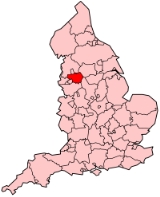
Greater Manchester is a metropolitan county
in North West England
, with a population of 2.6 million. It encompasses one of the largest metropolitan area
s in the United Kingdom and comprises ten metropolitan borough
s: Bolton
, Bury
, Oldham
, Rochdale
, Stockport
, Tameside
, Trafford
, Wigan
, and the cities of Manchester
and Salford
. Greater Manchester was created on 1 April 1974 as a result of the Local Government Act 1972
.
Greater Manchester spans 493 square miles (1,277 km²). It is landlocked and borders Cheshire
(to the south-west and south), Derbyshire
(to the south-east), West Yorkshire
(to the north-east), Lancashire
(to the north) and Merseyside
(to the west). There is a mix of high density urban areas, suburbs, semi-rural and rural locations in Greater Manchester, but overwhelmingly the land use is urban. It has a focused central business district, formed by Manchester city centre
and the adjoining parts of Salford and Trafford, but Greater Manchester is also a polycentric county with ten metropolitan districts, each of which has at least one major town centre and outlying suburbs. The Greater Manchester Urban Area
is the third most populous conurbation in the UK, and spans across most of the county's territory.
For the 12 years following 1974 the county had a two-tier system of local government; district councils shared power with the Greater Manchester County Council
. The county council was abolished in 1986, and so its districts (the metropolitan boroughs) effectively became unitary authority areas
. However, the metropolitan county has continued to exist in law and as a geographic frame of reference,• Retrieved on 6 March 2008.
• Retrieved on 7 July 2008. and as a ceremonial county
, has a Lord Lieutenant
and a High Sheriff
. Several county-wide services were co-ordinated through the Association of Greater Manchester Authorities up until April 2011, when the Greater Manchester Combined Authority
was established as the strategic county-wide authority for Greater Manchester, taking on functions and responsibilities for economic development, regeneration and transport.
Before the creation of the metropolitan county, the name SELNEC was used for the area, taken from the initials of "South East Lancashire North East Cheshire". Greater Manchester is an amalgamation
of 70 former local government districts from the former administrative counties
of Lancashire
, Cheshire
, the West Riding of Yorkshire
and eight independent county borough
s.
inhabitation, particularly at Mellor
, and Celtic activity in a settlement named Chochion, believed to have been an area of Wigan
settled by the Brigantes
. Stretford
was also part of the land believed to have been occupied by the Celtic Brigantes tribe, and lay on their border with the Cornovii on the southern side of the River Mersey
. The remains of 1st century forts
at Castlefield
in Manchester, and Castleshaw Roman fort
in Saddleworth
, are evidence of Roman occupation
. Much of the region was omitted from the Domesday Book
of 1086; Redhead states that this was because only a partial survey was taken, rather than sparsity of population.
 During the Middle Ages
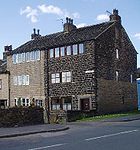
, much of what became Greater Manchester lay within the hundred of Salfordshire
– an ancient division of the county of Lancashire
. Salfordshire encompassed several parishes and townships
, some of which, like Rochdale
, were important market towns and centres of England's woollen trade. The development of what became Greater Manchester is attributed to a shared tradition of domestic flannel
and fustian
cloth production, which encouraged a system of cross-regional trade. The Industrial Revolution
transformed the local domestic system, and much of Greater Manchester's heritage is related to textile manufacture during the Industrial Revolution
and the infrastructure that grew up to support this sector. The townships in and around Manchester began expanding "at an astonishing rate" around the turn of the 19th century as part of a process of unplanned urbanisation brought on by a boom in textile processing. Places such as Bury
, Oldham
and Bolton
played a central economic role in the nation, and by the end of the 19th century had become some of the most important and productive mill town
s in the world. However, it was Manchester that was the most populous settlement, a major city and the world's largest marketplace for cotton goods. By 1835 "Manchester was without challenge the first and greatest industrial city in the world", and due to its commercial and socio-economic success the need for local government and geo-administrative reform for the region in and around the city was proposed in as early as the 1910s.
By the 18th century, traders from Germany had coined the name Manchesterthum, meaning "Greater Manchester", and were using that as a name for the region in and around Manchester. However, the English term "Greater Manchester" did not appear until the 20th century. One of its first known recorded uses was in a 1914 report put forward in response to what was considered to have been the successful creation of the County of London
in 1889. The report suggested that a county should be set up to recognise the "Manchester known in commerce", and referred to the areas that formed "a substantial part of South Lancashire and part of Cheshire, comprising all municipal boroughs and minor authorities within a radius of eight or nine miles of Manchester". In his 1915 book Cities In Evolution, urban planner
Sir Patrick Geddes
wrote "far more than Lancashire realises, is growing up another Greater London".
.png) Conurbation
Conurbation
s in England tend to build up at the historic county boundaries
and Greater Manchester is no exception. Most of Greater Manchester lay within the ancient county boundaries of Lancashire
; those areas south of the Mersey
and Tame
were in Cheshire
. The Saddleworth
area and a small part of Mossley
are historically part of Yorkshire
and in the south-east a small part in Derbyshire
. The areas that were incorporated into Greater Manchester in 1974 previously formed parts of the administrative counties
of Cheshire, Lancashire, the West Riding of Yorkshire
and of eight independent county borough
s. By the early 1970s, this system of demarcation was described as "archaic" and "grossly inadequate to keep pace both with the impact of motor travel, and with the huge increases in local government responsibilities".
The Manchester Evening Chronicle
brought to the fore the issue of "regional unity" for the area in April 1935 under the headline "Greater Manchester – The Ratepayers' Salvation". It reported on the "increasing demands for the exploration of the possibilities of a greater merger of public services
throughout Manchester and the surrounding municipalities". The issue was frequently discussed by civic leaders in the area at that time, particularly those from Manchester and Salford
. The Mayor of Salford pledged his support to the idea, stating that he looked forward to the day when "there would be a merging of the essential services of Manchester, Salford, and the surrounding districts constituting Greater Manchester." Proposals were halted by the Second World War, though in the decade after it, the pace of proposals for local government reform for the area quickened. In 1947, Lancashire County Council
proposed a three "ridings" system to meet the changing needs of the county of Lancashire, including those for Manchester and surrounding districts. Other proposals included the creation of a Manchester County Council, a directly elected regional body. In 1951, the census in the UK
began reporting on South East Lancashire as a homogeneous conurbation.
designated the south east Lancashire area (which, despite its name, included part of north east Cheshire), a Special Review Area. The Local Government Commission for England presented draft recommendations, in December 1965, proposing a new county based on the conurbation surrounding and including Manchester, with nine most-purpose boroughs corresponding to the modern Greater Manchester boroughs (excluding Wigan). The review was abolished in favour of the Royal Commission on Local Government before issuing a final report.
The Royal Commission's 1969 report, known as the Redcliffe-Maud Report, proposed the removal of much of the then existing system of local government. The commission described the system of administering urban
and rural district
s separately as outdated, noting that urban areas provided employment and services for rural dwellers, and open countryside was used by town dwellers for recreation. The commission considered interdependence of areas at many levels, including travel-to-work, provision of services, and which local newspapers were read, before proposing a new administrative metropolitan area
. The area had roughly the same northern boundary as today's Greater Manchester (though included Rossendale
), but covered much more territory from Cheshire (including Macclesfield
, Warrington
, Alderley Edge
, Northwich
, Middlewich
, Wilmslow
and Lymm
), and Derbyshire (the towns of New Mills
, Whaley Bridge
, Glossop
and Chapel-en-le-Frith
– a minority report suggested that Buxton
be included). The metropolitan area was to be divided into nine metropolitan districts, based on Wigan, Bolton, Bury/Rochdale, Warrington, Manchester (including Salford and Old Trafford), Oldham, Altrincham, Stockport and Tameside. The report noted "The choice even of a label of convenience for this metropolitan area is difficult". Seven years earlier, a survey prepared for the British Association
intended to define the "South-East Lancashire conurbation" noted that "Greater Manchester it is not ... One of its main characteristics is the marked individuality of its towns, ... all of which have an industrial and commercial history of more than local significance". The term Selnec (or SELNEC) was already in use as an abbreviation for south east Lancashire and north east Cheshire; Redcliffe-Maud took this as "the most convenient term available", having modified it to south east Lancashire, north east and central Cheshire.
Following the Transport Act 1968
, in 1969 the SELNEC Passenger Transport Executive
(an authority to co-ordinate and operate public transport in the region) was set up, covering an area smaller than the proposed Selnec, and different again to the eventual Greater Manchester. Compared with the Redcliffe-Maud area, it excluded Macclesfield, Warrington, and Knutsford but included Glossop and Saddleworth
in the West Riding of Yorkshire
. It excluded Wigan, which was in both the Redcliffe-Maud area and in the eventual Greater Manchester (but had not been part of the 1958 act's review area).
Redcliffe-Maud's recommendations were accepted by the Labour-controlled government in February 1970. Although the Redcliffe-Maud Report was rejected by the Conservative government after the 1970 general election
, there was a commitment to local government reform, and the need for a metropolitan county centred on the conurbation surrounding Manchester was accepted. The new government's original proposal was much smaller than the Redcliffe-Maud Report's Selnec, with areas such as Winsford, Northwich, Knutsford, Macclesfield and Glossop retained by their original counties to ensure their county council
s had enough revenue to remain competitive (Cheshire County Council
would have ceased to exist). Other late changes included the separation of the proposed Bury/Rochdale authority (retained from the Redcliffe-Maud report) into the Metropolitan Borough of Bury
and the Metropolitan Borough of Rochdale
. Bury and Rochdale were originally planned to form a single district (dubbed "Botchdale" by local MP Michael Fidler
) but were divided into separate boroughs. To re-balance the districts, the borough of Rochdale took Middleton
from Oldham. During the passage of the bill, the towns of Whitworth
, Wilmslow and Poynton
successfully objected to their incorporation in the new county.
.jpg)
 The Local Government Act 1972
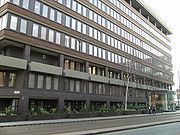
reformed local government in England by creating a system of two-tier metropolitan and non-metropolitan counties
and districts throughout the country. The act formally established Greater Manchester on 1 April 1974, although Greater Manchester County Council
(GMCC) had been running since elections in 1973
. The leading article in The Times
on the day the Local Government Act came into effect noted that the "new arrangement is a compromise which seeks to reconcile familiar geography which commands a certain amount of affection and loyalty, with the scale of operations on which modern planning methods can work effectively". Frangopulo noted that the creation of Greater Manchester "was the official unifying of a region which, through history and tradition, had forged for itself over many centuries bonds ... between the communities of town and village, each of which was the embodiment of the character of this region". The name Greater Manchester was adopted, having been favoured over Selnec by the local population.
By January 1974, a joint working party representing Greater Manchester had drawn up its county Structure Plan, ready for implementation by the Greater Manchester County Council. The plan set out objectives for the forthcoming metropolitan county. The highest priority was to increase the quality of life for its inhabitants by improving the county's physical environment and cultural facilities which had suffered following deindustrialisation—much of Greater Manchester's basic infrastructure dated from its 19th-century growth, and was unsuited to modern lifestyles. Other objectives were to reverse the trend of depopulation in central-Greater Manchester, to invest in country parks to improve the region's poor reputation on leisure facilities, and to improve the county's transport infrastructure and patterns.
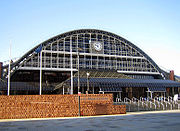
Because of political objection, particularly from Cheshire, Greater Manchester covered only the inner, urban 62 of the 90 former districts that the Royal Commission had outlined as an effective administrative metropolitan area. In this capacity, GMCC found itself "planning for an arbitrary metropolitan area ... abruptly truncated to the south", and so had to negotiate several land-use, transport and housing projects with its neighbouring county councils. However a "major programme of environmental action" by GMCC broadly succeeded in reversing social deprevation in its inner city slums. Leisure and recreational successes included the Greater Manchester Exhibition Centre (better known as the G-Mex centre and now branded Manchester Central), a converted former railway station in Manchester city centre used for cultural events, and GMCC's creation of five new country park
s within its boundaries. GMCC was, however, criticised for being too Manchester-centric by representatives from the outer suburbs.
Unlike most other modern counties (including Merseyside
and Tyne and Wear
), Greater Manchester was never adopted as a postal county
by the Royal Mail
. A review in 1973 noted that "Greater Manchester" would be unlikely to be adopted because of confusion with the Manchester post town. The component areas of Greater Manchester held on to their pre-1974 postal counties until 1996, when they were abolished.
A decade after they were established, the mostly Labour
-controlled metropolitan county councils and the Greater London Council
(GLC) had several high profile clashes with the Conservative
government of Margaret Thatcher
, with regards overspending and high rates
charging. Government policy on the issue was considered throughout 1982, and the Conservative Party put a "promise to scrap the metropolitan county councils" and the GLC, in their manifesto for the 1983 general election
. Greater Manchester County Council was abolished on 31 March 1986 under the Local Government Act 1985
. That the metropolitan county councils were controlled by the Labour Party led to accusations that their abolition was motivated by party politics: the general secretary of the National Association of Local Government Officers
described it as a "completely cynical manoeuvre". Most of the functions of GMCC were devolved to the ten Greater Manchester metropolitan district councils, though functions such as emergency services and public transport were taken over by joint boards and continued to be run on a county-wide basis. The Association of Greater Manchester Authorities (AGMA) was established to continue much of the county-wide services of the county council
. The metropolitan county continues to exist in law, and as a geographic frame of reference, for example as a NUTS 2
administrative division for statistical purposes within the European Union
. Although having been a Lieutenancy area
since 1974, Greater Manchester was included as a ceremonial county
by the Lieutenancies Act 1997
on 1 July 1997.
voted in a referendum in favour of establishing a new Greater London Authority
, with mayor and an elected chamber for the county. The New Local Government Network
proposed the creation of a new Manchester City Region based on Greater Manchester and other metropolitan counties as part of on-going reform efforts, while a report released by the Institute for Public Policy Research
's Centre for Cities
proposed the creation of two administrative city region
s based on Manchester and Birmingham
. In July 2007, The Treasury
published its Review of sub-national economic development and regeneration, which stated that the government would allow those city regions that wished to work together to form a statutory framework for city regional activity, including powers over transport, skills, planning and economic development. In January 2008, AGMA suggested that a formal government structure be created to cover Greater Manchester. The issue resurfaced in June 2008 with regards to proposed congestion charging in Greater Manchester
; Sir Richard Leese (leader of Manchester City Council
) said "I've come to the conclusion that [a referendum on congestion charging should be held] because we don't have an indirectly or directly elected body for Greater Manchester that has the power to make this decision". On 14 July 2008 the ten local authorities in Greater Manchester agreed to a strategic and integrated cross-county Multi-Area Agreement
; a voluntary initiative aimed at making district councils "work together to challenge the artificial limits of boundaries" in return for greater autonomy from the central government of the UK
. A referendum on the Greater Manchester Transport Innovation Fund was held in December 2008, in which voters "overwhelmingly rejected" plans for public transport improvements linked to a peak-time weekday-only congestion charge.
Following a bid from AGMA highlighting the potential benefits in combatting the late-2000s financial crisis
, it was announced in the 2009 United Kingdom Budget
that Greater Manchester and the Leeds City Region
would be awarded Statutory City Region Pilot status, allowing (if they desired) for their constituent district councils to pool resources and become statutory Combined Authorities with powers comparable to the Greater London Authority. The stated aim of the pilot was to evaluate the contributions to economic growth and sustainable development by Combined Authorities. The Local Democracy, Economic Development and Construction Act 2009
enabled the creation of a Combined Authority for Greater Manchester with devolved
powers on public transport, skills, housing, regeneration, waste management, carbon neutrality and planning permission
, pending approval from the ten councils. Such strategic matters would be decided on via an enhanced majority rule
voting system involving ten members appointed from among the councillors of the metropolitan boroughs (one representing each borough with each council nominating one substitute) without the input of central government. The ten district councils of Greater Manchester approved the creation of the Greater Manchester Combined Authority
(GMCA) on 29 March 2010, and submitted final recommendations for a constitution to the Department for Communities and Local Government
and the Department for Transport
. On 31 March 2010 the Communities Secretary John Denham approved the constitution and launched a 15 week public consultation on the draft bill together with the approved constitution. Following requests by the Association of Greater Manchester Authorities, which was superseded by the GMCA, the new authority came in to being on 1 April 2011. On the same day, the Transport for Greater Manchester Committee was also formed from a pool of 33 councillors allocated by council population (roughly one councillor per 75,000 residents) to scrutinise the running of Greater Manchester's transport bodies and their finances, approve the decisions and policies of said bodies and form strategic policy recommendations or projects for the approval of the Combined Authority.
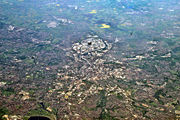
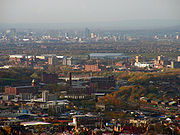 Greater Manchester is a landlocked county spanning 493 square miles (1,277 km²). The Pennines
rise along the eastern side of the county, through parts of Oldham
, Rochdale
and Tameside
. The West Pennine Moors
and several coalfields
(mainly sandstones and shales) lie in the west of the county. The rivers Mersey
and Tame
run through the county boundaries, both of which rise in the Pennines. Other rivers run through the county, including the Beal
, the Douglas
and the Irk
. Black Chew Head
is the highest point in Greater Manchester, rising 1778 feet (542 m) above sea-level, within the parish of Saddleworth
. Chat Moss
at 10.6 square miles (27 km²) comprises the largest area of prime farmland in Greater Manchester and contains the largest block of semi-natural woodland in the county.
There is a mix of high density urban areas, suburbs, semi-rural and rural locations in Greater Manchester, but overwhelmingly the land use in the county is urban. It has a strong regional central business district, formed by Manchester city centre
and the adjoining parts of Salford
and Trafford
. However, Greater Manchester is also a polycentric county with ten metropolitan districts, each of which has a major town centre – and in some cases more than one – and many smaller settlements. Greater Manchester is arguably the most complex urban area in the UK outside London, described as a "polycentric functional urban region", and this is reflected in the density of its transport network and the scale of its needs for investment to meet the growing and diverse movement demands generated by its development pattern.
The Greater Manchester Urban Area
is an area of land defined by the Office for National Statistics
consisting of the large conurbation surrounding and including the city of Manchester. Its territory spans much, but not all of the metropolitan county of Greater Manchester. It excludes settlements such as Wigan
and Marple
from within the Greater Manchester county boundaries, but includes settlements which are outside of the county boundaries, such as Wilmslow
and Alderley Edge
in Cheshire, and Whitworth
in Lancashire. Although neither the Greater Manchester county, nor the Greater Manchester Urban Area
have been granted city status in the United Kingdom
, European Union
literature suggests that the conurbation surrounding Manchester constitutes a homogonous urban city region
.
, like most of the British Isles
, with relatively cool summers and mild winters. The county's average annual rainfall is 806.6 millimetres (31.76 in) compared to the UK average of 1125 millimetres (44.29 in), and its mean rain days are 140.4 mm (5.5 in) per annum, compared to the UK average of 154.4 mm (6.1 in). The mean temperature is slightly above average for the United Kingdom. Greater Manchester also has a relatively high humidity level, which lent itself to the optimised and breakage-free textile manufacturing which took place around the county. Snowfall is not a common sight in the built up areas, due to the urban warming
effect. However, the Pennine and Rossendale Forest
hills around the eastern and northern edges of the county receive more snow, and roads leading out of the county can be closed due to heavy snowfall, notably the A62 road
via Standedge
, the A57
(Snake Pass
) towards Sheffield
, and the M62
over Saddleworth Moor
. In the most southern point of Greater Manchester, Woodford's Met Office
weather station recorded a temperature of -17.6 C on 8 January 2010, during the Winter of 2009-2010 in the United Kingdom.
 The Greater Manchester Combined Authority
(GMCA) is the top-tier administrative body for the local governance of Greater Manchester. It is unique in the local government of the United Kingdom, and was established on 1 April 2011 as a pilot. It consists of ten indirectly elected
members, each a directly elected councillor from one of the ten metropolitan borough
s that comprise Greater Manchester. The authority derives most of its powers from the Local Government Act 2000
and Local Democracy, Economic Development and Construction Act 2009
, and replaced a range of single-purpose joint boards and quangos in 2011, to provide a formal administrative authority for Greater Manchester with powers over public transport, skills, housing, regeneration, waste management, carbon neutrality and planning permission
. Functional executive bodies, such as Transport for Greater Manchester, are responsible for delivery of services in these areas. Beneath the GMCA are the ten councils of Greater Manchester's ten districts, which are Bolton
, Bury
, the City of Manchester
, Oldham
, Rochdale
, the City of Salford
, Stockport
, Tameside
, Trafford
and Wigan
. These district councils have the greatest powers over public services, and control matters such as council tax
, education provision, social housing, libraries and healthcare. Eight of the ten metropolitan boroughs were named after the eight former county boroughs that now compose the largest centres of population and greater historical and political prominence. As an example, the Metropolitan Borough of Stockport is centred on the town of Stockport
, a former county borough, but includes other smaller settlements, such as Cheadle
, Gatley
, and Bramhall
. The names of two of the metropolitan boroughs were given a neutral name because, at the time they were created, there was no agreement on the town to be put forward as the administrative centre and neither had a county borough
. These boroughs are Tameside
and Trafford
, centred on Ashton-under-Lyne
and Stretford
, respectively, and are named with reference to geographical and historical origins. The lowest formal tier of local government in Greater Manchester are the parish councils, which cover the various civil parishes in Greater Manchester, and have limited powers over upkeep, maintenance and small grants.
For the first 12 years after the county was created in 1974, Greater Manchester had a two-tier system of local government, and the metropolitan borough councils shared power with the Greater Manchester County Council
. The Greater Manchester County Council, a strategic authority based in what is now Westminster House off Piccadilly Gardens
, comprised 106 members drawn from the ten metropolitan borough
s of Greater Manchester. It was a sub-regional body running regional services such as transport, strategic planning, emergency services and waste disposal. In 1986, along with the five other metropolitan county
councils and the Greater London Council
, the Greater Manchester County Council was abolished, and most of its powers were devolved to the boroughs. Between 1986 and 2011, the boroughs were effectively unitary authority areas
, but opted to co-operate voluntarily under the Association of Greater Manchester Authorities (AGMA), which served to create a co-ordinated county-wide approach to issues of common interest to Greater Manchester, such as public transport and the shared labour market, as well as making representations to central government and the European Union.
The politics of Greater Manchester have been characterised by "entrenched localism
and related rivallries", historically resistant to regionalism
; Greater Manchester is administered by systems of "inter-municipal coordination" (some formal, some voluntary). That eight of the ten borough councils have (for the most part) been Labour
-controlled since 1986, has helped maintain informal co-operation between the districts at a county-level. After the abolition of the county council, the ten authorities of Greater Manchester co-operated voluntarily on policy issues like Local Transport Plan
s as well as funding the Greater Manchester County Record Office
, and local services were administered by statutory joint boards. Now under the direction of the Greater Manchester Combined Authority, these joint boards are Transport for Greater Manchester (TfGM) which is responsible for planning and co-ordinating public transport across the county; the Greater Manchester Police
, who are overseen by a joint Police authority
; the Greater Manchester Fire and Rescue Service
, who are administered by a joint Fire and Rescue Authority; and the Greater Manchester Waste Disposal Authority
. These joint boards are made up of councillors appointed from each of the ten boroughs (except the Waste Disposal Authority, which does not include the Metropolitan Borough of Wigan
). The ten boroughs jointly own the Manchester Airport Group
which controls Manchester Airport and three other UK airports. Other services are directly funded and managed by the local councils.
Greater Manchester is a ceremonial county with its own Lord-Lieutenant who is the personal representative of the monarch. The Local Government Act 1972 provided that the whole of the area to be covered by the new metropolitan county of Greater Manchester would also be included in the Duchy of Lancaster
– extending the duchy to include areas which were formerly in the counties of Cheshire and the West Riding of Yorkshire. Until 31 March 2005, Greater Manchester's Keeper of the Rolls was appointed by the Chancellor of the Duchy of Lancaster
; they are now appointed by the Lord High Chancellor of Great Britain
. The first Lord Lieutenant of Greater Manchester was Sir William Downward who held the title from 1974 to 1988. The current Lord Lieutenant is Warren James Smith. As a geographic county, Greater Manchester is used by the government (via the Office for National Statistics
) for the gathering of county-wide statistics, and organising and collating general register and census material.
In terms of representation in the Parliament of the United Kingdom
, Greater Manchester is divided into 28 parliamentary constituencies
– 18 borough constituencies and 10 county constituencies. Most of Greater Manchester is controlled by the Labour party
, and is generally considered a Labour stronghold, with only four constituencies (since the 2010 General Election) belonging to the Liberal Democrats
, and two constituencies to the Conservative party
.
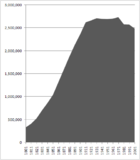
 Greater Manchester has a population of 2,600,100 (as of 2009), making it the third most populous county in the United Kingdom (after Greater London
and the West Midlands
). It is the seventh most densely populated county of England. The demonym
of Greater Manchester is "Greater Mancunian".
Greater Manchester is home to a diverse population and is a multicultural agglomeration with significant ethnic minority population comprising 8.5% of the total population. In 2008, there were over 66 refugee nationalities in the county. As of the 2001 UK census, 74.2% of Greater Manchester's residents were Christian, 5.0% Muslim, 0.9% Jewish, 0.7% Hindu, 0.2% Buddhist, and 0.1% Sikh. 11.4% had no religion, 0.2% had an alternative religion and 7.4% did not state their religion. This is similar to the rest of the country, although the proportions of Muslims and Jews are nearly twice the national average. It contains the Heaton Park Hebrew Congregation
, a large Ashkenazi Orthodox
synagogue located in North Manchester. Greater Manchester is covered by the Roman Catholic Dioceses of Salford and Shrewsbury, and the Archdiocese of Liverpool. Most of Greater Manchester is part of the Anglican Diocese of Manchester
, apart from Wigan
which lies within the Diocese of Liverpool
.
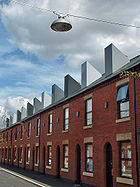
Following the deindustrialisation of Greater Manchester in the mid-20th century, there was a significant economic and population decline in the region, particularly in Manchester and Salford. Vast areas of low-quality squalid terraced housing that were built throughout the Victorian era
were found to be in a poor state of repair and unsuited to modern needs; many inner-city districts suffered from chronic social deprivation and high levels of unemployment. Slum clearance
and the increased building of social housing
overspill estate
s by Salford and Manchester City Councils lead to a decrease in population in central Greater Manchester. During the 1970s, 1980s and 1990s, the population of Greater Manchester declined by over 8,000 inhabitants a year. While Manchester's population shrank by about 40% during this time (from 766,311 in 1931 to 452,000 in 2006), the total population of Greater Manchester decreased by only 8%.
Greater Manchester's housing stock comprises a variety of types. Manchester city centre
is noted for its high-rise apartments, while Salford has some of the tallest and most densely populated
tower block
estates in Europe. Throughout Greater Manchester, rows of terraced house
s are common, most of them built during the Victorian
and Edwardian period
s. In the 2000s, the Housing Market Renewal Initiative
identified Manchester
, Salford, Rochdale
and Oldham
as areas with terraced housing unsuited to modern needs. Although Greater Manchester has a reputation as an urban sprawl, the county does have areas of green belt
. Altrincham
, with its neighbours Bowdon
and Hale
, is said to constitute a "stockbroker belt, with well-appointed dwellings in an area of sylvan opulence".
, Manchester Metropolitan University
, the University of Salford
and the University of Bolton
. Together with the Royal Northern College of Music
they had a combined population of students in higher education of 101,165 in 2007 – the third highest number in England behind Greater London (360,890) and the West Midlands
(140,980), and the thirteenth highest in England per head of population. The majority of students are concentrated on Oxford Road
in Manchester, Europe's largest urban higher education precinct.
Primary, secondary and further education within Greater Manchester are the responsibility of the constituent boroughs which form local education authorities
and administer schools and colleges of further education. The county is also home to independent schools such as St Bede's College
, Manchester Grammar School
, Stockport Grammar School
, Bolton School
and Bury Grammar School
.
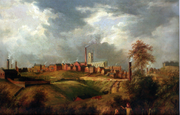
 Much of Greater Manchester's wealth was generated during the Industrial Revolution. The world's first cotton mill
was built in the town of Royton
, and the county encompasses several former mill town
s. An Association for Industrial Archaeology
publication describes Greater Manchester as "one of the classic areas of industrial and urban growth in Britain, the result of a combination of forces that came together in the 18th and 19th centuries: a phenomenal rise in population, the appearance of the specialist industrial town, a transport revolution, and weak local lordship". Much of the county was at the forefront of textile manufacture during the Industrial Revolution
and into the early 20th century, represented by the former textile mills found throughout the county.
The territory that makes up Greater Manchester experienced a rapid decline of these traditional sectors, partly during the Lancashire Cotton famine brought on by the American Civil War
, but mainly as part of the post-war economic depression
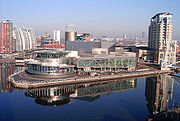
and deindustrialisation of Britain that occurred during the 20th century. Considerable industrial restructuring has helped the region to recover. Historically, the docks at Salford Quays
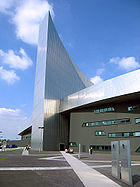
were an industrial port, though are now (following a period of disuse) a commercial and residential area which includes the Imperial War Museum North
and The Lowry
theatre and exhibition centre. A major BBC
centre is also scheduled to open there in 2010.
Today, Greater Manchester is the economic centre of the North West
region of England and is the largest sub-regional economy in the UK outside London and South East England
. Greater Manchester represents more than £42 billion of the UK regional GVA
, more than Wales, Northern Ireland or North East England
. Manchester city centre
, the central business district of Greater Manchester, is a major centre of trade and commerce and provides Greater Manchester with a global identity, specialist activities and employment opportunities; similarly, the economy of the city centre is dependent upon the rest of the county for its population as an employment pool, skilled workforce and for its collective purchasing power. Manchester today is a centre of the arts, the media, higher education and commerce. In a poll of British business leaders published in 2006, Manchester was regarded as the best place in the UK to locate a business. A report commissioned by Manchester Partnership, published in 2007, showed Manchester to be the "fastest-growing city" economically. It is the third most visited city in the United Kingdom by foreign visitors and is now often considered to be the second city of the UK
.• Retrieved on 30 May 2008.
• Retrieved on 1 August 2007.
• Retrieved on 2 May 2006.
• Retrieved on 18 June 2007.
• Retrieved on 18 June 2007. The Trafford Centre
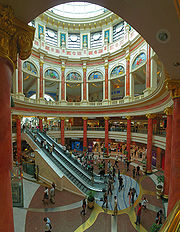
is one of the largest shopping centres in the United Kingdom, and is located within the Metropolitan Borough of Trafford.
As of the 2001 UK census, there were 1,805,315 residents of Greater Manchester aged 16 to 74. The economic activity of these people was 40.3% in full-time employment, 11.3% in part-time employment, 6.7% self-employed, 3.5% unemployed, 5.1% students without jobs, 2.6% students with jobs, 13.0% retired, 6.1% looking after home or family, 7.8% permanently sick or disabled and 3.5% economically inactive for other reasons. The figures follow the national trend, although the percentage of self-employed people is below the national average of 8.3%. The proportion of unemployment in the county varies, with the Metropolitan Borough of Stockport
having the lowest at 2.0% and Manchester
the highest at 7.9%. In 2001, of the 1,093,385 residents of Greater Manchester in employment, the industry of employment was: 18.4% retail and wholesale; 16.7% manufacturing; 11.8% property and business services; 11.6% health and social work; 8.0% education; 7.3% transport and communications; 6.7% construction; 4.9% public administration and defence; 4.7% hotels and restaurants; 4.1% finance; 0.8% electricity, gas, and water supply; 0.5% agriculture; and 4.5% other. This was roughly in line with national figures, except for the proportion of jobs in agriculture which is only about a third of the national average of 1.5%, due to the overwhelmingly urban, built-up land use of Greater Manchester.
 Public transport services in Greater Manchester are co-ordinated by Transport for Greater Manchester (TfGM), a public body with powers between those of a passenger transport executive
and Transport for London
, established as SELNEC PTE in 1969 in accordance with the Transport Act 1968
. The original SELNEC Passenger Transport Authority was renamed as the Greater Manchester Passenger Transport Executive (GMPTE) when taken over by the Greater Manchester County Council
on 1 April 1974 in order to co-ordinate bus and rail services within the new county. The council had overall responsibility for strategic planning and all policy decisions covering public transport and highways. GMPTE's purpose was to secure the provision of a completely integrated and efficient system of passenger transport to meet the needs of its area. In 1977, it was noted as the largest authority for public transport in the United Kingdom after London Transport
. GMPTE was renamed as Transport for Greater Manchester in April 2011 when it became a functional body of the Greater Manchester Combined Authority and obtained powers additional to those of a regular passenger transport executive from central government.
Greater Manchester lies at the heart of the North West
transport network. Much of the infrastructure converges at Manchester city centre
with the Manchester Inner Ring Road
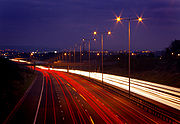
, an amalgamation of several major roads, circulating the city centre. The county is the only place in the UK to have a fully orbital motorway, the M60
, which passes through all of the boroughs except Bolton and Wigan. Greater Manchester has a higher percentage of the motorway network than any other county in the country, and according to the Guinness Book of World Records, it has the most traffic lanes side by side (17), spread across several parallel carriageways (M61
at Linnyshaw
in Walkden
, close to the M60 interchange). Greater Manchester's 85 miles (137 km) of motorway network saw 5.8 billion vehicle kilometres in 2002 – about 6% of the UK's total, or 89,000 vehicles a day. The A580 "East Lancs" road
is a primary A road
that connects Manchester and Salford with Liverpool
. It was the UK's first purpose-built intercity highway and was officially opened by King George V
on 18 July 1934. Throughout 2008, there were proposals for congestion charging in Greater Manchester
. Unlike the London scheme
, two cordons would have been used, one covering the main urban core of the Greater Manchester Urban Area
and another covering Manchester city centre.
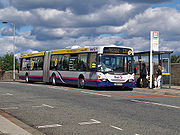
There is an extensive bus network which radiates from Manchester city centre. The largest providers are First Manchester
for the northern parts of the county and Stagecoach Manchester for the southern parts. In addition to the network of bus routes, a light rail system began operating in 1992 called Metrolink
. The tram system serves Manchester, the City of Salford
, Bury
and Trafford
. An expansion of the system is due to begin in 2008 which should in time see the system run to all boroughs except Bolton and Wigan. Greater Manchester has a rail network of 142 route miles (229 km) with 98 stations, forming a central hub to the North West rail network. Train services are provided by private operators and run on the national rail network which is owned and managed by Network Rail
. An extensive canal network also remains from the Industrial Revolution.
Manchester Airport, which is the fourth busiest in the United Kingdom, serves the county and wider region with flights to more worldwide destinations than any other airport in the UK. Since June 2007 it has served 225 routes. The airport handled 21.06 million passengers in 2008.
The three modes of public surface transport in the area are heavily used. 19.7 million rail journeys were made in the then GMPTE-supported area in the 2005/2006 financial year – an increase of 9.4% over 2004/2005; there were 19.9 million journeys on Metrolink; and the bus system carried 219.4 million passengers.
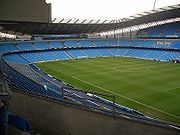 Manchester hosted the 2002 Commonwealth Games
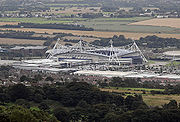
which was, at a cost of £200M for the sporting facilities and a further £470M for local infrastructure, by far the biggest and most expensive sporting event held in the UK and the first to be an integral part of urban regeneration. A mix of new and existing facilities were used. New amenities included the Manchester Aquatics Centre
, Bolton Arena
, the National Squash Centre
, and the City of Manchester Stadium
. The Manchester Velodrome
was built as part of the bid to hold the 2000 Olympic Games. After the Commonwealth Games the City of Manchester Stadium was converted for football use, and the adjacent warm-up track upgraded to become the Manchester Regional Arena
. Other facilities continue to be used by elite athletes. Cambridge Policy Consultants estimate 4,500 full-time jobs as a direct consequence, and Grattan points to other long-term benefits accruing from publicity and the improvement of the area's image.
The Manchester Football Association
is the governing body for association football in Greater Manchester, and is committed to promoting the sport throughout the county. Four of its teams played in the 2010–11 Premier League. Manchester United F.C.
are one of the world's best-known football teams, and in April 2008 Forbes
estimated that they were the world's richest club. They have won the League Championship
a record nineteen times, the FA Cup
a record eleven times, the Football League Cup
four times and have been European Champions three times. Their Old Trafford
ground has hosted the FA Cup Final
England international matches and the 2003 UEFA Champions League Final
between Juventus and A.C. Milan
. Manchester City F.C.
moved from Maine Road
to the City of Manchester Stadium after the 2002 Commonwealth Games. They have won the league championship twice and the FA Cup four times. Bolton Wanderers F.C.
have won the FA cup four times. Wigan Athletic F.C.
are one of the league's younger sides, and have yet to win a major title. In addition, Oldham Athletic A.F.C.
(founding members of Premier League) and Rochdale A.F.C.
who play in League One
; there are also Bury F.C.
(two FA Cup wins) and Stockport County F.C.
who play in League Two
.
In rugby league
, the Wigan Warriors
and the Salford City Reds
compete in the Super League
, the top-level professional rugby league football club competition in Europe. Wigan have won the Super League/Championship eighteen times, the Challenge Cup
seventeen times, and the World Club Challenge
three times. Leigh Centurions
and the Rochdale Hornets
take part in the Championship, the sport's second tier, with Oldham Roughyeds
and local rivals Swinton Lions
in the third-tier Championship 1
. In rugby union
, Stockport's Sale Sharks
compete in the Guinness Premiership
, and won the league in 2006. Whitefield based Sedgley Park RUFC
compete in National Division One, Manchester RUFC
in National Division Two and Wigan side Orrell R.U.F.C.
in National Division Three North.
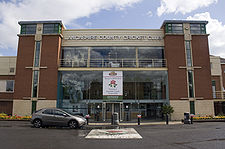
Lancashire County Cricket Club
began as Manchester Cricket Club and represents the (ancient) county of Lancashire. Lancashire contested the original 1890 County Championship
. The team has won the County Championship eight times, and in 2007 finished third, narrowly missing their first title since 1950. Their Old Trafford ground, near the football stadium of the same name, regularly hosts test matches
. Possibly the most famous took place in 1956, when Jim Laker
took a record nineteen wickets in the fourth test against Australia. Cheshire County Cricket Club are a minor counties
club who sometimes play in the south of the county.
The Kirkmanshulme Lane stadium in Belle Vue
is the home to top-flight speedway team the Belle Vue Aces
and regular greyhound racing. Professional ice hockey returned to the area in early 2007 with the opening of a purpose-designed rink in Altrincham
, the Altrincham Ice Dome
, to host the Manchester Phoenix
. Their predecessor, Manchester Storm
, went out of business in 2002 because of financial problems that led to them being unable to pay players' wages or the rent for the Manchester Evening News Arena
in which they played.
Horse racing has taken place at several sites in the county. The two biggest courses were both known as Manchester Racecourse
– though neither was within the boundaries of Manchester – and ran from the 17th century until 1963. Racing was at Kersal Moor
until 1847 when the racecourse at Castle Irwell was opened. In 1867 racing was moved to New Barnes, Weaste
, until the site was vacated (for a hefty price) in 1901 to allow an expansion to Manchester Docks. The land is now home to Dock 9 of the re-branded Salford Quays
. Racing then moved back to Castle Irwell which later staged a Classic – the 1941 St. Leger
– and was home to the Lancashire Oaks
(nowadays run at Haydock Park
) and the November Handicap
, which was traditionally the last major race of the flat season. Through the late 50s and early 60s the track saw Scobie Breasley
and Lester Piggott
annually battle out the closing acts of the jockey's title until racing ceased on 7 November 1963.
The Greater Manchester Athletics Association is the governing body of athletics in Greater Manchester, and organises events and competitions within Greater Manchester. Professional athletics takes place at the Regional Athletics Arena in Sportcity
, which has hosted numerous national trials, Robin Park in Wigan, Longford Park in Stretford (home to Trafford Athletic Club), Woodbank Stadium in Stockport (home to Stockport Harriers) and the Cleavleys Track in Winton
(home to Salford Harriers). As of 2008, new sports facilities including a 10,000 capacity stadium and athletics venue are being constructed at Leigh Sports Village
.
The Greater Manchester Community Basketball Club is an association which represents Greater Manchester in basketball. It supports a variety of teams, including Manchester Magic
. The Greater Manchester County Crown Green Bowling Association appoints Junior, Senior and Veteran teams to represent Greater Manchester in the sport of bowls
. Founded by Greater Manchester's ten district councils in 1996, GreaterSport is the County Sports Partnership for Greater Manchester which works closely with the sports and physical activity sectors and coordinates events such as the Greater Manchester Youth Games. The Greater Manchester Sports Fund aims to ensure that people in Greater Manchester aged 12–21 competing in any kind of sport, irrespective of background, are able to obtain grants of up to £750 so that they can better fulfil their potential.
 Art, tourism, culture and sport provide 16% of employment in Greater Manchester. The proportion is highest in Manchester.
Launched in 2004 by the Guardian Media Group
, Channel M
is a television station that broadcast local news and content about Greater Manchester. It effectively closed in 2010. In January 2011 Culture Secretary Jeremy Hunt stated that a new Greater Manchester channel will be available on Freeview by around 2013. Greater Manchester has the highest number of theatre seats per head of population outside London. Most, if not all, of the larger theatres are subsidised by local authorities or the North West Regional Arts Board. The Royal Exchange Theatre formed in the 1970s out of a peripatetic group staging plays at venues such as at the University [of Manchester] Theatre and the Apollo Theatre
. A season in a temporary stage in the former Royal Exchange, Manchester
was followed by funding for a theatre in the round
, which opened in 1976. The Lowry
— Greater Manchester's most visited tourist attraction — houses two theatres, used by travelling groups in all the performing arts. The Opera House
is a 1,900-seat venue hosting travelling productions, often musicals just out of the West End. Its sister venue, The Palace
, hosts generally similar shows. The Oldham Playhouse, one of the older theatres in the region, helped launch the careers of Stan Laurel
and Charlie Chaplin
. Its productions are described by the 2007 CityLife guide as 'staunchly populist' – and popular. There are many other venues scattered throughout the county, of all types and sizes.
Art galleries in the county include: Gallery Oldham
, which has in the past featured work by Pablo Picasso
; The Lowry
at Salford Quays, which has a changing display of L. S. Lowry
's work alongside travelling exhibitions; Manchester Art Gallery
, a major provincial art gallery noted for its collection of Pre-Raphaelite
art and housed in a Grade I listed building by Charles Barry
; Salford Museum and Art Gallery
, a local museum with a recreated Victorian street; and Whitworth Art Gallery
, a broad-based gallery now run by the University of Manchester.
Greater Manchester has four professional orchestras, all based in Manchester. The Hallé Orchestra is the UK's oldest extant symphony orchestra (and the fourth oldest in the world), supports a choir and a youth orchestra, and releases its recordings on its own record label. The Hallé is based at the Bridgwater Hall but often tours, typically giving 70 performances "at home" and 40 on tour. The BBC Philharmonic Orchestra, one of five BBC orchestras, can trace its history back to the early days of radio broadcasting in 1926. As of 2008 it is based at the BBC's Oxford Road studios, but is expected to move to MediaCityUK in Salford. The Manchester Camerata
and the Northern Chamber Orchestra
are smaller, though still professional, organisations. The main classical venue is the 2,341-seat Bridgewater Hall
in Manchester, opened in 1996 at a cost of £42M.
Manchester is also a centre for musical education, via the Royal Northern College of Music
and Chetham's School of Music
.
The main popular music venue is the Manchester Evening News Arena
, next to Victoria station. It seats over 21,000, is the largest indoor arena in Europe, has been voted International Venue of the Year, and for several years was the most popular venue in the world.• Retrieved on 12 August 2007.
• Retrieved on 28 March 2008. The sports grounds in the county also host some of the larger pop concerts.
Some of Greater Manchester's museums showcase the county's industrial and social heritage. The Hat Works
in Stockport is the UK's only museum dedicated to the hatting industry; the museum moved in 2000 to a Grade II listed Victorian mill, previously a hat factory. The Museum of Science and Industry in Manchester
, amongst other displays, charts the rise of science and industry and especially the part Manchester played in its development; the Museums, Libraries and Archives Council
described the displays as "pre-eminent collections of national and international importance". Urbis
began its life as a museum of the modern city, which attempted to explain the effects and experiences of life in the city. It was then transformed into an exhibition centre, which had its most successful year in 2006. Urbis is now preparing to enter its third phase since opening in 2002, as the National Football Museum. Stockport Air Raid Shelters uses a mile of underground tunnels, built to accommodate 6,500 people, to illustrate life in the Second World War's
air raid shelters. The Imperial War Museum North
in Trafford Park is one of the Imperial War Museum's five branches. Alongside exhibitions of war machinery are displays describing how people's lives are affected by war. The Museum of Transport in Manchester
, which opened in 1979, has one of the largest collections of vehicles in the country. The People's History Museum
is "the national centre for the collection, conservation, interpretation and study of material relating to the history of working people in Britain"; the museum is closed for redevelopment and will reopen in 2009. The Pankhurst Museum is based in the early feminist Emmeline Pankhurst
's former home and includes a parlour laid out in contemporary style. Manchester United, Manchester City, and Lancashire CCC all have dedicated museums illustrating their histories. Wigan Pier
, best known from George Orwell
's book The Road to Wigan Pier
, was the name of a wharf on the Leeds and Liverpool Canal
in Wigan
. The name has been reused to describe an industrial-based visitor attraction, partly closed for redevelopment as of 2008.
Metropolitan county
The metropolitan counties are a type of county-level administrative division of England. There are six metropolitan counties, which each cover large urban areas, typically with populations of 1.2 to 2.8 million...
in North West England
North West England
North West England, informally known as The North West, is one of the nine official regions of England.North West England had a 2006 estimated population of 6,853,201 the third most populated region after London and the South East...
, with a population of 2.6 million. It encompasses one of the largest metropolitan area
Metropolitan area
The term metropolitan area refers to a region consisting of a densely populated urban core and its less-populated surrounding territories, sharing industry, infrastructure, and housing. A metropolitan area usually encompasses multiple jurisdictions and municipalities: neighborhoods, townships,...
s in the United Kingdom and comprises ten metropolitan borough
Metropolitan borough
A metropolitan borough is a type of local government district in England, and is a subdivision of a metropolitan county. Created in 1974 by the Local Government Act 1972, metropolitan boroughs are defined in English law as metropolitan districts, however all of them have been granted or regranted...
s: Bolton
Metropolitan Borough of Bolton
The Metropolitan Borough of Bolton is a metropolitan borough of Greater Manchester, England. It is named after its largest settlement, Bolton, but covers a far larger area which includes Blackrod, Farnworth, Horwich, Kearsley and Westhoughton, and a suburban and rural element from the West Pennine...
, Bury
Metropolitan Borough of Bury
The Metropolitan Borough of Bury is a metropolitan borough of Greater Manchester, in North West England. Lying to the north of the City of Manchester, the borough is composed of six towns: Bury, Ramsbottom, Tottington, Radcliffe, Whitefield and Prestwich, and has a population of 181,900...
, Oldham
Metropolitan Borough of Oldham
The Metropolitan Borough of Oldham is a metropolitan borough of Greater Manchester, England. It has a population of 219,600, and spans . The borough is named after its largest town, Oldham, but also includes the outlying towns of Chadderton, Failsworth, Royton and Shaw and Crompton, the village of...
, Rochdale
Metropolitan Borough of Rochdale
The Metropolitan Borough of Rochdale is a metropolitan borough of Greater Manchester in North West England. It is named after its largest town, Rochdale, but spans a far larger area which includes the towns of Middleton, Heywood, Littleborough and Milnrow, and the village of Wardle.The borough was...
, Stockport
Metropolitan Borough of Stockport
The Metropolitan Borough of Stockport is a metropolitan borough of Greater Manchester, in north west England, centred around the town of Stockport. It has a population of about 280,600 and includes the outyling areas of Cheadle and Cheadle Hulme, Marple, Bredbury, Reddish and Romiley...
, Tameside
Tameside
The Metropolitan Borough of Tameside is a metropolitan borough of Greater Manchester in North West England. It is named after the River Tame which flows through the borough and spans the towns of Ashton-under-Lyne, Audenshaw, Denton, Droylsden, Dukinfield, Hyde, Mossley and Stalybridge. Its western...
, Trafford
Trafford
The Metropolitan Borough of Trafford is a metropolitan borough of Greater Manchester, England. It has a population of 211,800, covers , and includes the towns of Altrincham, Partington, Sale, Stretford, and Urmston...
, Wigan
Metropolitan Borough of Wigan
The Metropolitan Borough of Wigan is a metropolitan borough of Greater Manchester, in North West England. It is named after its largest component town, Wigan and also includes the towns of Leigh, Ashton-in-Makerfield, Ince-in-Makerfield, and Hindley. The borough was formed in 1974 and is an...
, and the cities of Manchester
Manchester
Manchester is a city and metropolitan borough in Greater Manchester, England. According to the Office for National Statistics, the 2010 mid-year population estimate for Manchester was 498,800. Manchester lies within one of the UK's largest metropolitan areas, the metropolitan county of Greater...
and Salford
City of Salford
The City of Salford is a city and metropolitan borough of Greater Manchester, England. It is named after its largest settlement, Salford, but covers a far larger area which includes the towns of Eccles, Swinton-Pendlebury, Walkden and Irlam which apart from Irlam each have a population of over...
. Greater Manchester was created on 1 April 1974 as a result of the Local Government Act 1972
Local Government Act 1972
The Local Government Act 1972 is an Act of Parliament in the United Kingdom that reformed local government in England and Wales on 1 April 1974....
.
Greater Manchester spans 493 square miles (1,277 km²). It is landlocked and borders Cheshire
Cheshire
Cheshire is a ceremonial county in North West England. Cheshire's county town is the city of Chester, although its largest town is Warrington. Other major towns include Widnes, Congleton, Crewe, Ellesmere Port, Runcorn, Macclesfield, Winsford, Northwich, and Wilmslow...
(to the south-west and south), Derbyshire
Derbyshire
Derbyshire is a county in the East Midlands of England. A substantial portion of the Peak District National Park lies within Derbyshire. The northern part of Derbyshire overlaps with the Pennines, a famous chain of hills and mountains. The county contains within its boundary of approx...
(to the south-east), West Yorkshire
West Yorkshire
West Yorkshire is a metropolitan county within the Yorkshire and the Humber region of England with a population of 2.2 million. West Yorkshire came into existence as a metropolitan county in 1974 after the passage of the Local Government Act 1972....
(to the north-east), Lancashire
Lancashire
Lancashire is a non-metropolitan county of historic origin in the North West of England. It takes its name from the city of Lancaster, and is sometimes known as the County of Lancaster. Although Lancaster is still considered to be the county town, Lancashire County Council is based in Preston...
(to the north) and Merseyside
Merseyside
Merseyside is a metropolitan county in North West England, with a population of 1,365,900. It encompasses the metropolitan area centred on both banks of the lower reaches of the Mersey Estuary, and comprises five metropolitan boroughs: Knowsley, St Helens, Sefton, Wirral, and the city of Liverpool...
(to the west). There is a mix of high density urban areas, suburbs, semi-rural and rural locations in Greater Manchester, but overwhelmingly the land use is urban. It has a focused central business district, formed by Manchester city centre
Manchester City Centre
Manchester city centre is the central business district of Manchester, England. It lies within the Manchester Inner Ring Road, next to the River Irwell...
and the adjoining parts of Salford and Trafford, but Greater Manchester is also a polycentric county with ten metropolitan districts, each of which has at least one major town centre and outlying suburbs. The Greater Manchester Urban Area
Greater Manchester Urban Area
The Greater Manchester Urban Area is an area of land defined by the Office for National Statistics consisting of the large conurbation that encompasses the city of Manchester and the continuous metropolitan area that spreads outwards from it, forming much of Greater Manchester in North West England...
is the third most populous conurbation in the UK, and spans across most of the county's territory.
For the 12 years following 1974 the county had a two-tier system of local government; district councils shared power with the Greater Manchester County Council
Greater Manchester County Council
The Greater Manchester County Council — also known as the Greater Manchester Council — was the top-tier local government administrative body for Greater Manchester from 1974 to 1986...
. The county council was abolished in 1986, and so its districts (the metropolitan boroughs) effectively became unitary authority areas
Unitary authorities of England
Unitary authorities of England are areas where a single local authority is responsible for a variety of services for a district that elsewhere are administered separately by two councils...
. However, the metropolitan county has continued to exist in law and as a geographic frame of reference,• Retrieved on 6 March 2008.
• Retrieved on 7 July 2008. and as a ceremonial county
Ceremonial counties of England
The ceremonial counties are areas of England to which are appointed a Lord Lieutenant, and are defined by the government as counties and areas for the purposes of the Lieutenancies Act 1997 with reference to the metropolitan and non-metropolitan counties of England and Lieutenancies Act 1997...
, has a Lord Lieutenant
Lord Lieutenant of Greater Manchester
The office of Lord Lieutenant of Greater Manchester is the monarch's representative, Queen Elizabeth II in the metropolitan county of Greater Manchester in North West England.. The office was created on 1 April 1974...
and a High Sheriff
High Sheriff of Greater Manchester
The Office of High Sheriff of Greater Manchester is the ceremonial position of High Sheriff appointed to Greater Manchester, a metropolitan county in North West England. The appointment is made by the British monarch, in their capacity as Duke of Lancaster, by pricking the Lites...
. Several county-wide services were co-ordinated through the Association of Greater Manchester Authorities up until April 2011, when the Greater Manchester Combined Authority
Greater Manchester Combined Authority
The Greater Manchester Combined Authority is the top-tier administrative body for the local governance of Greater Manchester, England. The combined authority was established on 1 April 2011 and consists of ten indirectly elected members, each a directly elected councillor from one of the ten...
was established as the strategic county-wide authority for Greater Manchester, taking on functions and responsibilities for economic development, regeneration and transport.
Before the creation of the metropolitan county, the name SELNEC was used for the area, taken from the initials of "South East Lancashire North East Cheshire". Greater Manchester is an amalgamation
Amalgamation (politics)
A merger or amalgamation in a political or administrative sense is the combination of two or more political or administrative entities such as municipalities , counties, districts, etc. into a single entity. This term is used when the process occurs within a sovereign entity...
of 70 former local government districts from the former administrative counties
Administrative counties of England
Administrative counties were a level of subnational division of England used for the purposes of local government from 1889 to 1974. They were created by the Local Government Act 1888 as the areas for which county councils were elected. Some large counties were divided into several administrative...
of Lancashire
Lancashire
Lancashire is a non-metropolitan county of historic origin in the North West of England. It takes its name from the city of Lancaster, and is sometimes known as the County of Lancaster. Although Lancaster is still considered to be the county town, Lancashire County Council is based in Preston...
, Cheshire
Cheshire
Cheshire is a ceremonial county in North West England. Cheshire's county town is the city of Chester, although its largest town is Warrington. Other major towns include Widnes, Congleton, Crewe, Ellesmere Port, Runcorn, Macclesfield, Winsford, Northwich, and Wilmslow...
, the West Riding of Yorkshire
West Riding of Yorkshire
The West Riding of Yorkshire is one of the three historic subdivisions of Yorkshire, England. From 1889 to 1974 the administrative county, County of York, West Riding , was based closely on the historic boundaries...
and eight independent county borough
County borough
County borough is a term introduced in 1889 in the United Kingdom of Great Britain and Ireland , to refer to a borough or a city independent of county council control. They were abolished by the Local Government Act 1972 in England and Wales, but continue in use for lieutenancy and shrievalty in...
s.
Origins
Although the modern county of Greater Manchester was not created until 1974, the history of its constituent settlements and parts goes back centuries. There is evidence of Iron AgeIron Age
The Iron Age is the archaeological period generally occurring after the Bronze Age, marked by the prevalent use of iron. The early period of the age is characterized by the widespread use of iron or steel. The adoption of such material coincided with other changes in society, including differing...
inhabitation, particularly at Mellor
Mellor, Greater Manchester
Mellor is a village within the Metropolitan Borough of Stockport, in Greater Manchester, England. Mellor, situated between Marple Bridge and New Mills, runs along a tributary of the River Goyt. It extends from the start of the old turnpike road at the boundary of Marple Bridge to the current county...
, and Celtic activity in a settlement named Chochion, believed to have been an area of Wigan
Wigan
Wigan is a town in Greater Manchester, England. It stands on the River Douglas, south-west of Bolton, north of Warrington and west-northwest of Manchester. Wigan is the largest settlement in the Metropolitan Borough of Wigan and is its administrative centre. The town of Wigan had a total...
settled by the Brigantes
Brigantes
The Brigantes were a Celtic tribe who in pre-Roman times controlled the largest section of what would become Northern England, and a significant part of the Midlands. Their kingdom is sometimes called Brigantia, and it was centred in what was later known as Yorkshire...
. Stretford
Stretford
Stretford is a town within the Metropolitan Borough of Trafford, in Greater Manchester, England. Lying on flat ground between the River Mersey and the Manchester Ship Canal, it is to the southwest of Manchester city centre, south-southwest of Salford and northeast of Altrincham...
was also part of the land believed to have been occupied by the Celtic Brigantes tribe, and lay on their border with the Cornovii on the southern side of the River Mersey
River Mersey
The River Mersey is a river in North West England. It is around long, stretching from Stockport, Greater Manchester, and ending at Liverpool Bay, Merseyside. For centuries, it formed part of the ancient county divide between Lancashire and Cheshire....
. The remains of 1st century forts
Castra
The Latin word castra, with its singular castrum, was used by the ancient Romans to mean buildings or plots of land reserved to or constructed for use as a military defensive position. The word appears in both Oscan and Umbrian as well as in Latin. It may have descended from Indo-European to Italic...
at Castlefield
Castlefield
Castlefield is an inner city area of Manchester, in North West England. The conservation area which bears its name is bounded by the River Irwell, Quay Street, Deansgate and the Chester Road. It was the site of the Roman era fort of Mamucium or Mancunium which gave its name to Manchester...
in Manchester, and Castleshaw Roman fort
Castleshaw Roman fort
Castleshaw Roman fort was a fort in the Roman province of Britannia. Although there is no evidence to substantiate the claim, it has been suggested that Castleshaw Roman fort is the site of Rigodunum, a Brigantian settlement. The remains of the fort are located on Castle Hill on the eastern side of...
in Saddleworth
Saddleworth
Saddleworth is a civil parish of the Metropolitan Borough of Oldham in Greater Manchester, England. It comprises several villages and hamlets amongst the west side of the Pennine hills: Uppermill, Greenfield, Dobcross, Delph, Diggle and others...
, are evidence of Roman occupation
Roman Britain
Roman Britain was the part of the island of Great Britain controlled by the Roman Empire from AD 43 until ca. AD 410.The Romans referred to the imperial province as Britannia, which eventually comprised all of the island of Great Britain south of the fluid frontier with Caledonia...
. Much of the region was omitted from the Domesday Book
Domesday Book
Domesday Book , now held at The National Archives, Kew, Richmond upon Thames in South West London, is the record of the great survey of much of England and parts of Wales completed in 1086...
of 1086; Redhead states that this was because only a partial survey was taken, rather than sparsity of population.
Middle Ages
The Middle Ages is a periodization of European history from the 5th century to the 15th century. The Middle Ages follows the fall of the Western Roman Empire in 476 and precedes the Early Modern Era. It is the middle period of a three-period division of Western history: Classic, Medieval and Modern...
, much of what became Greater Manchester lay within the hundred of Salfordshire
Salford (hundred)
The hundred of Salford was an ancient division of the historic county of Lancashire, in Northern England. It was sometimes known as Salfordshire, the name alluding to its judicial centre being the township of Salford...
– an ancient division of the county of Lancashire
Lancashire
Lancashire is a non-metropolitan county of historic origin in the North West of England. It takes its name from the city of Lancaster, and is sometimes known as the County of Lancaster. Although Lancaster is still considered to be the county town, Lancashire County Council is based in Preston...
. Salfordshire encompassed several parishes and townships
Township (England)
In England, a township is a local division or district of a large parish containing a village or small town usually having its own church...
, some of which, like Rochdale
Rochdale
Rochdale is a large market town in Greater Manchester, England. It lies amongst the foothills of the Pennines on the River Roch, north-northwest of Oldham, and north-northeast of the city of Manchester. Rochdale is surrounded by several smaller settlements which together form the Metropolitan...
, were important market towns and centres of England's woollen trade. The development of what became Greater Manchester is attributed to a shared tradition of domestic flannel
Flannel
Flannel is a soft woven fabric, of various fineness. Flannel was originally made from carded wool or worsted yarn, but is now often made from either wool, cotton, or synthetic fibre. Flannel may be brushed to create extra softness or remain unbrushed. The brushing process is a mechanical process...
and fustian
Fustian
Fustian is a term for a variety of heavy woven, mostly cotton fabrics, chiefly prepared for menswear. It is also used to refer to pompous, inflated or pretentious writing or speech, from at least the time of Shakespeare...
cloth production, which encouraged a system of cross-regional trade. The Industrial Revolution
Industrial Revolution
The Industrial Revolution was a period from the 18th to the 19th century where major changes in agriculture, manufacturing, mining, transportation, and technology had a profound effect on the social, economic and cultural conditions of the times...
transformed the local domestic system, and much of Greater Manchester's heritage is related to textile manufacture during the Industrial Revolution
Textile manufacture during the Industrial Revolution
The industrial revolution changed the nature of work and society. Opinion varies as to the exact date, but it is estimated that the First Industrial Revolution took place between 1750 and 1850, and the second phase or Second Industrial Revolution between 1860 and 1900. The three key drivers in...
and the infrastructure that grew up to support this sector. The townships in and around Manchester began expanding "at an astonishing rate" around the turn of the 19th century as part of a process of unplanned urbanisation brought on by a boom in textile processing. Places such as Bury
Bury
Bury is a town in Greater Manchester, England. It lies on the River Irwell, east of Bolton, west-southwest of Rochdale, and north-northwest of the city of Manchester...
, Oldham
Oldham
Oldham is a large town in Greater Manchester, England. It lies amid the Pennines on elevated ground between the rivers Irk and Medlock, south-southeast of Rochdale, and northeast of the city of Manchester...
and Bolton
Bolton
Bolton is a town in Greater Manchester, in the North West of England. Close to the West Pennine Moors, it is north west of the city of Manchester. Bolton is surrounded by several smaller towns and villages which together form the Metropolitan Borough of Bolton, of which Bolton is the...
played a central economic role in the nation, and by the end of the 19th century had become some of the most important and productive mill town
Mill town
A mill town, also known as factory town or mill village, is typically a settlement that developed around one or more mills or factories .- United Kingdom:...
s in the world. However, it was Manchester that was the most populous settlement, a major city and the world's largest marketplace for cotton goods. By 1835 "Manchester was without challenge the first and greatest industrial city in the world", and due to its commercial and socio-economic success the need for local government and geo-administrative reform for the region in and around the city was proposed in as early as the 1910s.
By the 18th century, traders from Germany had coined the name Manchesterthum, meaning "Greater Manchester", and were using that as a name for the region in and around Manchester. However, the English term "Greater Manchester" did not appear until the 20th century. One of its first known recorded uses was in a 1914 report put forward in response to what was considered to have been the successful creation of the County of London
County of London
The County of London was a county of England from 1889 to 1965, corresponding to the area known today as Inner London. It was created as part of the general introduction of elected county government in England, by way of the Local Government Act 1888. The Act created an administrative County of...
in 1889. The report suggested that a county should be set up to recognise the "Manchester known in commerce", and referred to the areas that formed "a substantial part of South Lancashire and part of Cheshire, comprising all municipal boroughs and minor authorities within a radius of eight or nine miles of Manchester". In his 1915 book Cities In Evolution, urban planner
Urban planning
Urban planning incorporates areas such as economics, design, ecology, sociology, geography, law, political science, and statistics to guide and ensure the orderly development of settlements and communities....
Sir Patrick Geddes
Patrick Geddes
Sir Patrick Geddes was a Scottish biologist, sociologist, philanthropist and pioneering town planner. He is known for his innovative thinking in the fields of urban planning and education....
wrote "far more than Lancashire realises, is growing up another Greater London".
Conurbation
A conurbation is a region comprising a number of cities, large towns, and other urban areas that, through population growth and physical expansion, have merged to form one continuous urban and industrially developed area...
s in England tend to build up at the historic county boundaries
Historic counties of England
The historic counties of England are subdivisions of England established for administration by the Normans and in most cases based on earlier Anglo-Saxon kingdoms and shires...
and Greater Manchester is no exception. Most of Greater Manchester lay within the ancient county boundaries of Lancashire
Lancashire
Lancashire is a non-metropolitan county of historic origin in the North West of England. It takes its name from the city of Lancaster, and is sometimes known as the County of Lancaster. Although Lancaster is still considered to be the county town, Lancashire County Council is based in Preston...
; those areas south of the Mersey
River Mersey
The River Mersey is a river in North West England. It is around long, stretching from Stockport, Greater Manchester, and ending at Liverpool Bay, Merseyside. For centuries, it formed part of the ancient county divide between Lancashire and Cheshire....
and Tame
River Tame, Greater Manchester
The River Tame flows through Greater Manchester, England.-Source:The Tame rises on Denshaw Moor in Greater Manchester, close to the border with West Yorkshire but within the historic West Riding of Yorkshire.-Course:...
were in Cheshire
Cheshire
Cheshire is a ceremonial county in North West England. Cheshire's county town is the city of Chester, although its largest town is Warrington. Other major towns include Widnes, Congleton, Crewe, Ellesmere Port, Runcorn, Macclesfield, Winsford, Northwich, and Wilmslow...
. The Saddleworth
Saddleworth
Saddleworth is a civil parish of the Metropolitan Borough of Oldham in Greater Manchester, England. It comprises several villages and hamlets amongst the west side of the Pennine hills: Uppermill, Greenfield, Dobcross, Delph, Diggle and others...
area and a small part of Mossley
Mossley
Mossley is a small town and civil parish within the Metropolitan Borough of Tameside, in Greater Manchester, England. The town is located in the upper section of the Tame valley in the foothills of the Pennines, northeast of Ashton-under-Lyne and east of Manchester.Mossley has the distinction of...
are historically part of Yorkshire
Yorkshire
Yorkshire is a historic county of northern England and the largest in the United Kingdom. Because of its great size in comparison to other English counties, functions have been increasingly undertaken over time by its subdivisions, which have also been subject to periodic reform...
and in the south-east a small part in Derbyshire
Derbyshire
Derbyshire is a county in the East Midlands of England. A substantial portion of the Peak District National Park lies within Derbyshire. The northern part of Derbyshire overlaps with the Pennines, a famous chain of hills and mountains. The county contains within its boundary of approx...
. The areas that were incorporated into Greater Manchester in 1974 previously formed parts of the administrative counties
Administrative counties of England
Administrative counties were a level of subnational division of England used for the purposes of local government from 1889 to 1974. They were created by the Local Government Act 1888 as the areas for which county councils were elected. Some large counties were divided into several administrative...
of Cheshire, Lancashire, the West Riding of Yorkshire
West Riding of Yorkshire
The West Riding of Yorkshire is one of the three historic subdivisions of Yorkshire, England. From 1889 to 1974 the administrative county, County of York, West Riding , was based closely on the historic boundaries...
and of eight independent county borough
County borough
County borough is a term introduced in 1889 in the United Kingdom of Great Britain and Ireland , to refer to a borough or a city independent of county council control. They were abolished by the Local Government Act 1972 in England and Wales, but continue in use for lieutenancy and shrievalty in...
s. By the early 1970s, this system of demarcation was described as "archaic" and "grossly inadequate to keep pace both with the impact of motor travel, and with the huge increases in local government responsibilities".
The Manchester Evening Chronicle
Manchester Evening News
The Manchester Evening News is a regional daily newspaper covering Greater Manchester in the United Kingdom. It is published every day except Sunday and is owned by Trinity Mirror plc following its sale by Guardian Media Group in early 2010. It has an average daily circulation of 90,973 copies...
brought to the fore the issue of "regional unity" for the area in April 1935 under the headline "Greater Manchester – The Ratepayers' Salvation". It reported on the "increasing demands for the exploration of the possibilities of a greater merger of public services
Public services
Public services is a term usually used to mean services provided by government to its citizens, either directly or by financing private provision of services. The term is associated with a social consensus that certain services should be available to all, regardless of income...
throughout Manchester and the surrounding municipalities". The issue was frequently discussed by civic leaders in the area at that time, particularly those from Manchester and Salford
County Borough of Salford
Salford was, from 1844 to 1974, a local government district in the northwest of England, coterminate with Salford. It was granted city status in 1926.-Free Borough and Police Commissioners:...
. The Mayor of Salford pledged his support to the idea, stating that he looked forward to the day when "there would be a merging of the essential services of Manchester, Salford, and the surrounding districts constituting Greater Manchester." Proposals were halted by the Second World War, though in the decade after it, the pace of proposals for local government reform for the area quickened. In 1947, Lancashire County Council
Lancashire County Council
Lancashire County Council is the upper-tier local authority for the non-metropolitan county of Lancashire, England. It currently consists of 84 councillors, and is controlled by the Conservative Party, who won control of the council in the local council elections in June 2009, ending 28 years of...
proposed a three "ridings" system to meet the changing needs of the county of Lancashire, including those for Manchester and surrounding districts. Other proposals included the creation of a Manchester County Council, a directly elected regional body. In 1951, the census in the UK
Census in the United Kingdom
Coincident full censuses have taken place in the different jurisdictions of the United Kingdom every ten years since 1801, with the exceptions of 1941 and in both Northern Ireland and the Irish Free State in 1921; simultaneous censuses were taken in the Channel Islands and the Isle of Man, with...
began reporting on South East Lancashire as a homogeneous conurbation.
Redcliffe-Maud Report
The Local Government Act 1958Local Government Act 1958
The Local Government Act 1958 was an Act of the Parliament of the United Kingdom affecting local government in England and Wales outside London...
designated the south east Lancashire area (which, despite its name, included part of north east Cheshire), a Special Review Area. The Local Government Commission for England presented draft recommendations, in December 1965, proposing a new county based on the conurbation surrounding and including Manchester, with nine most-purpose boroughs corresponding to the modern Greater Manchester boroughs (excluding Wigan). The review was abolished in favour of the Royal Commission on Local Government before issuing a final report.
The Royal Commission's 1969 report, known as the Redcliffe-Maud Report, proposed the removal of much of the then existing system of local government. The commission described the system of administering urban
Urban district
In the England, Wales and Ireland, an urban district was a type of local government district that covered an urbanised area. Urban districts had an elected Urban District Council , which shared local government responsibilities with a county council....
and rural district
Rural district
Rural districts were a type of local government area – now superseded – established at the end of the 19th century in England, Wales, and Ireland for the administration of predominantly rural areas at a level lower than that of the administrative counties.-England and Wales:In England...
s separately as outdated, noting that urban areas provided employment and services for rural dwellers, and open countryside was used by town dwellers for recreation. The commission considered interdependence of areas at many levels, including travel-to-work, provision of services, and which local newspapers were read, before proposing a new administrative metropolitan area
Metropolitan area
The term metropolitan area refers to a region consisting of a densely populated urban core and its less-populated surrounding territories, sharing industry, infrastructure, and housing. A metropolitan area usually encompasses multiple jurisdictions and municipalities: neighborhoods, townships,...
. The area had roughly the same northern boundary as today's Greater Manchester (though included Rossendale
Rossendale
Rossendale is a local government district with borough status. It is made up of a number of small former mill towns in Lancashire, England centered around the valley of the River Irwell in the industrial North West...
), but covered much more territory from Cheshire (including Macclesfield
Macclesfield
Macclesfield is a market town within the unitary authority of Cheshire East, the county palatine of Chester, also known as the ceremonial county of Cheshire, England. The population of the Macclesfield urban sub-area at the time of the 2001 census was 50,688...
, Warrington
Warrington
Warrington is a town, borough and unitary authority area of Cheshire, England. It stands on the banks of the River Mersey, which is tidal to the west of the weir at Howley. It lies 16 miles east of Liverpool, 19 miles west of Manchester and 8 miles south of St Helens...
, Alderley Edge
Alderley Edge
Alderley Edge is a village and civil parish within the unitary authority of Cheshire East and the ceremonial county of Cheshire, England. According to the 2001 census the parish had a population of 4,409....
, Northwich
Northwich
Northwich is a town and civil parish in the unitary authority of Cheshire West and Chester and the ceremonial county of Cheshire, England. It lies in the heart of the Cheshire Plain, at the confluence of the rivers Weaver and Dane...
, Middlewich
Middlewich
Middlewich is a market town in the unitary authority of Cheshire East and the ceremonial county of Cheshire, England. It is east of the city of Chester, east of Winsford, southeast of Northwich and northwest of Sandbach....
, Wilmslow
Wilmslow
-Economy:Wilmslow is well known, like Alderley Edge, for having many famous residents, notably footballers, stars of Coronation Street and rich North West businessmen. The town is part of the so-called Golden Triangle in the north west together with Alderley Edge and Prestbury...
and Lymm
Lymm
Lymm is a large village and civil parish within the Warrington borough of Cheshire, in North West England. Lymm was an urban district of Cheshire from 1894 to 1974. The civil parish of Lymm incorporates the hamlets of Booths Hill, Broomedge, Church Green, Deansgreen, Heatley, Heatley Heath, Little...
), and Derbyshire (the towns of New Mills
New Mills
New Mills is a town in Derbyshire, England approximately south-east of Stockport and from Manchester. It is sited at the confluence of the rivers Goyt and Sett, on the border of Cheshire. The town stands above the Torrs, a deep gorge, cut through Woodhead Hill Sandstone of the Carboniferous period...
, Whaley Bridge
Whaley Bridge
Whaley Bridge is a small town and civil parish in the High Peak district of Derbyshire, England, situated on the River Goyt. Whaley Bridge is approximately south of Manchester, north of Buxton , east of Macclesfield and west of Sheffield, and had a population of 6,226 at the 2001 census. This...
, Glossop
Glossop
Glossop is a market town within the Borough of High Peak in Derbyshire, England. It lies on the Glossop Brook, a tributary of the River Etherow, about east of the city of Manchester, west of the city of Sheffield. Glossop is situated near Derbyshire's county borders with Cheshire, Greater...
and Chapel-en-le-Frith
Chapel-en-le-Frith
Chapel-en-le-Frith is a small town in Derbyshire, England, on the edge of the Peak District near the border with Cheshire, from Manchester. Dubbed "The Capital of the Peak District", the settlement was established by the Normans in the 12th century, originally as a hunting lodge within the Forest...
– a minority report suggested that Buxton
Buxton
Buxton is a spa town in Derbyshire, England. It has the highest elevation of any market town in England. Located close to the county boundary with Cheshire to the west and Staffordshire to the south, Buxton is described as "the gateway to the Peak District National Park"...
be included). The metropolitan area was to be divided into nine metropolitan districts, based on Wigan, Bolton, Bury/Rochdale, Warrington, Manchester (including Salford and Old Trafford), Oldham, Altrincham, Stockport and Tameside. The report noted "The choice even of a label of convenience for this metropolitan area is difficult". Seven years earlier, a survey prepared for the British Association
British Association for the Advancement of Science
frame|right|"The BA" logoThe British Association for the Advancement of Science or the British Science Association, formerly known as the BA, is a learned society with the object of promoting science, directing general attention to scientific matters, and facilitating interaction between...
intended to define the "South-East Lancashire conurbation" noted that "Greater Manchester it is not ... One of its main characteristics is the marked individuality of its towns, ... all of which have an industrial and commercial history of more than local significance". The term Selnec (or SELNEC) was already in use as an abbreviation for south east Lancashire and north east Cheshire; Redcliffe-Maud took this as "the most convenient term available", having modified it to south east Lancashire, north east and central Cheshire.
Following the Transport Act 1968
Transport Act 1968
The Transport Act 1968 was an Act of the Parliament of the United Kingdom. The main provisions made changes to the structure of nationally owned bus companies, created passenger transport authorities and executives to take over public transport in large conurbations.-National Bus Company:The Act...
, in 1969 the SELNEC Passenger Transport Executive
Greater Manchester Passenger Transport Executive
Transport for Greater Manchester is the public body responsible for co-ordinating public transport services throughout Greater Manchester, in North West England. The organisation traces its origins to the Transport Act 1968, when the SELNEC Passenger Transport Executive was established to...
(an authority to co-ordinate and operate public transport in the region) was set up, covering an area smaller than the proposed Selnec, and different again to the eventual Greater Manchester. Compared with the Redcliffe-Maud area, it excluded Macclesfield, Warrington, and Knutsford but included Glossop and Saddleworth
Saddleworth
Saddleworth is a civil parish of the Metropolitan Borough of Oldham in Greater Manchester, England. It comprises several villages and hamlets amongst the west side of the Pennine hills: Uppermill, Greenfield, Dobcross, Delph, Diggle and others...
in the West Riding of Yorkshire
West Riding of Yorkshire
The West Riding of Yorkshire is one of the three historic subdivisions of Yorkshire, England. From 1889 to 1974 the administrative county, County of York, West Riding , was based closely on the historic boundaries...
. It excluded Wigan, which was in both the Redcliffe-Maud area and in the eventual Greater Manchester (but had not been part of the 1958 act's review area).
Redcliffe-Maud's recommendations were accepted by the Labour-controlled government in February 1970. Although the Redcliffe-Maud Report was rejected by the Conservative government after the 1970 general election
United Kingdom general election, 1970
The United Kingdom general election of 1970 was held on 18 June 1970, and resulted in a surprise victory for the Conservative Party under leader Edward Heath, who defeated the Labour Party under Harold Wilson. The election also saw the Liberal Party and its new leader Jeremy Thorpe lose half their...
, there was a commitment to local government reform, and the need for a metropolitan county centred on the conurbation surrounding Manchester was accepted. The new government's original proposal was much smaller than the Redcliffe-Maud Report's Selnec, with areas such as Winsford, Northwich, Knutsford, Macclesfield and Glossop retained by their original counties to ensure their county council
County council
A county council is the elected administrative body governing an area known as a county. This term has slightly different meanings in different countries.-United Kingdom:...
s had enough revenue to remain competitive (Cheshire County Council
Cheshire County Council
Cheshire County Council was a County Council, of the second highest level of United Kingdom Government for the residents of Cheshire. Founded in 1889, it ceased to exist on 1 April 2009, when it and the district councils in Cheshire were replaced by two unitary authorities; Cheshire West and...
would have ceased to exist). Other late changes included the separation of the proposed Bury/Rochdale authority (retained from the Redcliffe-Maud report) into the Metropolitan Borough of Bury
Metropolitan Borough of Bury
The Metropolitan Borough of Bury is a metropolitan borough of Greater Manchester, in North West England. Lying to the north of the City of Manchester, the borough is composed of six towns: Bury, Ramsbottom, Tottington, Radcliffe, Whitefield and Prestwich, and has a population of 181,900...
and the Metropolitan Borough of Rochdale
Metropolitan Borough of Rochdale
The Metropolitan Borough of Rochdale is a metropolitan borough of Greater Manchester in North West England. It is named after its largest town, Rochdale, but spans a far larger area which includes the towns of Middleton, Heywood, Littleborough and Milnrow, and the village of Wardle.The borough was...
. Bury and Rochdale were originally planned to form a single district (dubbed "Botchdale" by local MP Michael Fidler
Michael Fidler
Michael M. Fidler was a British Conservative Party politician.Fidler was Member of Parliament for Bury and Radcliffe from 1970 until the October 1974 general election, when he lost his seat to Labour's Frank White.Active in the Jewish community for many years, he founded the lobby group...
) but were divided into separate boroughs. To re-balance the districts, the borough of Rochdale took Middleton
Middleton, Greater Manchester
Middleton is a town within the Metropolitan Borough of Rochdale, in Greater Manchester, England. It stands on the River Irk, south-southwest of Rochdale, and north-northeast of the city of Manchester...
from Oldham. During the passage of the bill, the towns of Whitworth
Whitworth, Lancashire
Whitworth is a town and civil parish within the Borough of Rossendale in Lancashire, England. It is set amongst the foothills of the Pennines, between the towns of Bacup, to the north, and Rochdale, to the south. It has a population of 7,263....
, Wilmslow and Poynton
Poynton
Poynton is a town within the civil parish of Poynton-with-Worth, and the unitary authority area of Cheshire East, England. For ceremonial purposes it is part of the county of Cheshire. Poynton is located at the eastern most fringe of the Cheshire Plain, north of Macclesfield, south of Stockport...
successfully objected to their incorporation in the new county.
| post-1974 Local Government Act 1972 The Local Government Act 1972 is an Act of Parliament in the United Kingdom that reformed local government in England and Wales on 1 April 1974.... |
pre-1974 Local Government Act 1888 The Local Government Act 1888 was an Act of the Parliament of the United Kingdom, which established county councils and county borough councils in England and Wales... |
||||
|---|---|---|---|---|---|
| Metropolitan county | Metropolitan borough | County borough County borough County borough is a term introduced in 1889 in the United Kingdom of Great Britain and Ireland , to refer to a borough or a city independent of county council control. They were abolished by the Local Government Act 1972 in England and Wales, but continue in use for lieutenancy and shrievalty in... s |
Non-county boroughs Municipal borough Municipal boroughs were a type of local government district which existed in England and Wales between 1835 and 1974, in Northern Ireland from 1840 to 1973 and in the Republic of Ireland from 1840 to 2002... |
Urban district Urban district In the England, Wales and Ireland, an urban district was a type of local government district that covered an urbanised area. Urban districts had an elected Urban District Council , which shared local government responsibilities with a county council.... s |
Rural district Rural district Rural districts were a type of local government area – now superseded – established at the end of the 19th century in England, Wales, and Ireland for the administration of predominantly rural areas at a level lower than that of the administrative counties.-England and Wales:In England... s |
.png) |
Bury Metropolitan Borough of Bury The Metropolitan Borough of Bury is a metropolitan borough of Greater Manchester, in North West England. Lying to the north of the City of Manchester, the borough is composed of six towns: Bury, Ramsbottom, Tottington, Radcliffe, Whitefield and Prestwich, and has a population of 181,900... |
Bury County Borough of Bury Bury was a local government district centred on Bury in the northwest of England from 1846 to 1974.Under the Bury Improvement Act 1846 a board of twenty-seven improvement commissioners was formed for Bury. The Improvement Commissioners District was enlarged in 1872... |
Prestwich • Radcliffe | Ramsbottom Ramsbottom Urban District Ramsbottom Urban District was, from 1894 to 1974, a local government district of the administrative county of Lancashire, England. Its area was coterminate with Ramsbottom, spanning an area of the Rossendale Valley north of the County Borough of Bury.... • Tottington • Whitefield |
|
| Bolton Metropolitan Borough of Bolton The Metropolitan Borough of Bolton is a metropolitan borough of Greater Manchester, England. It is named after its largest settlement, Bolton, but covers a far larger area which includes Blackrod, Farnworth, Horwich, Kearsley and Westhoughton, and a suburban and rural element from the West Pennine... |
Bolton County Borough of Bolton Bolton was, from 1838 to 1974, a local government district in the northwest of England, conterminate with the town of Bolton.-History:Bolton was created a free borough in 1253 when William de Ferrers, 5th Earl of Derby granted a charter. However the borough did not develop into a self-governing... |
Farnworth Municipal Borough of Farnworth The Municipal Borough of Farnworth was a local government district centred on the town of Farnworth in the administrative county of Lancashire, England.... |
Blackrod • Horwich • Kearsley • Little Lever • Turton • Westhoughton | ||
| Manchester Manchester Manchester is a city and metropolitan borough in Greater Manchester, England. According to the Office for National Statistics, the 2010 mid-year population estimate for Manchester was 498,800. Manchester lies within one of the UK's largest metropolitan areas, the metropolitan county of Greater... |
Manchester | Ringway | |||
| Oldham Metropolitan Borough of Oldham The Metropolitan Borough of Oldham is a metropolitan borough of Greater Manchester, England. It has a population of 219,600, and spans . The borough is named after its largest town, Oldham, but also includes the outlying towns of Chadderton, Failsworth, Royton and Shaw and Crompton, the village of... |
Oldham County Borough of Oldham Oldham was, from 1849 to 1974, a local government district in the northwest of England coterminate with the town of Oldham.-Improvement Commissioners:... |
Chadderton Chadderton Urban District Chadderton Urban District was, from 1894 to 1974, a local government district of the administrative county of Lancashire, England. It was centred on the town of Chadderton.... • Crompton • Failsworth • Lees Lees Urban District Lees was from 1894 to 1974, a local government district in the administrative county of Lancashire, England.It was created an urban district in 1894 by the Local Government Act 1894 and included the civil parish of Lees and part of the Crossbank hamlet... • Royton Royton Urban District Royton was, from 1863 to 1974, a local government district in Lancashire, England which covered the modern-day town of Royton, and its suburbs and districts.... • Saddleworth |
|||
| Rochdale Metropolitan Borough of Rochdale The Metropolitan Borough of Rochdale is a metropolitan borough of Greater Manchester in North West England. It is named after its largest town, Rochdale, but spans a far larger area which includes the towns of Middleton, Heywood, Littleborough and Milnrow, and the village of Wardle.The borough was... |
Rochdale County Borough of Rochdale Rochdale was, from 1856 to 1974, a local government district coterminate with the town of Rochdale in the northwest of England.-Municipal borough:... |
Middleton Municipal Borough of Middleton The Municipal Borough of Middleton was, from 1886 to 1974, a municipal borough in the administrative county of Lancashire, England, coterminate with the town of Middleton.-Civic history:... • Heywood Municipal Borough of Heywood The Municipal Borough of Heywood was, from 1881 to 1974, a local government district in the administrative county of Lancashire, England, with borough status and coterminate with the town of Heywood.-Civic history:... |
Littleborough • Milnrow Milnrow Urban District Milnrow Urban District was, from 1894 to 1974, a local government district of the administrative county of Lancashire, in northwest England. It covered an area to the east and southeast of the County Borough of Rochdale, and included the town of Milnrow, the village of New Hey, and the Piethorne... • Wardle |
||
| Salford City of Salford The City of Salford is a city and metropolitan borough of Greater Manchester, England. It is named after its largest settlement, Salford, but covers a far larger area which includes the towns of Eccles, Swinton-Pendlebury, Walkden and Irlam which apart from Irlam each have a population of over... |
Salford County Borough of Salford Salford was, from 1844 to 1974, a local government district in the northwest of England, coterminate with Salford. It was granted city status in 1926.-Free Borough and Police Commissioners:... |
Eccles • Swinton and Pendlebury Swinton and Pendlebury Swinton and Pendlebury was a local government district of the administrative county of Lancashire, England. It was created in 1894 as an urban district and enlarged in 1934, gaining the status of municipal borough.-Constituent civil parishes:... |
Irlam • Worsley | ||
| Stockport Metropolitan Borough of Stockport The Metropolitan Borough of Stockport is a metropolitan borough of Greater Manchester, in north west England, centred around the town of Stockport. It has a population of about 280,600 and includes the outyling areas of Cheadle and Cheadle Hulme, Marple, Bredbury, Reddish and Romiley... |
Stockport County Borough of Stockport Stockport was a local government district centred on Stockport in the northwest of England from 1835 to 1974.The district was created by the Municipal Corporations Act 1835 when the existing Borough of Stockport was reformed as a municipal borough. Until 1835 the town was governed by a charter... |
Bredbury and Romiley Bredbury and Romiley Bredbury and Romiley was an urban district in the administrative county of Cheshire, England from 1894 to 1974, which covered the Civil Parishes of Bredbury, Compstall and Romiley.... • Cheadle and Gatley Cheadle and Gatley Cheadle and Gatley was, from 1894 to 1974, an urban district of Cheshire, England.It was created by the Local Government Act 1894 based on the Cheadle and Gatley urban sanitary district... • Hazel Grove and Bramhall Hazel Grove and Bramhall Hazel Grove and Bramhall was a civil parish and urban district in north east Cheshire, England from 1900 to 1974.It was created in 1900 covering, from Stockport Rural District, the former area of the civil parishes of:*Bosden*Bramhall*Norbury*Offerton... • Marple |
|||
| Tameside Tameside The Metropolitan Borough of Tameside is a metropolitan borough of Greater Manchester in North West England. It is named after the River Tame which flows through the borough and spans the towns of Ashton-under-Lyne, Audenshaw, Denton, Droylsden, Dukinfield, Hyde, Mossley and Stalybridge. Its western... |
Ashton-under-Lyne • Dukinfield • Hyde • Mossley • Stalybridge | Audenshaw • Denton Denton Urban District Denton Urban District was a local government district in England from 1894 to 1974.Denton was originally a township in the ancient parish of Manchester in the Salford Hundred of Lancashire. In 1866 it became a civil parish in its own right. The Denton parish was expanded on 31 December 1894 by... • Droylsden • Longendale Longendale Urban District Longendale Urban District was, from 1936 to 1974, a local government district in the administrative county of Cheshire, England... |
|||
| Trafford Trafford The Metropolitan Borough of Trafford is a metropolitan borough of Greater Manchester, England. It has a population of 211,800, covers , and includes the towns of Altrincham, Partington, Sale, Stretford, and Urmston... |
Altrincham • Sale Municipal Borough of Sale Sale was, from 1867 to 1974, a district in Cheshire, England. The district had in turn the status of local government district, urban district and municipal borough.-Local Board and Urban District:... • Stretford Municipal Borough of Stretford Stretford was, from 1868 to 1974, a local government district coterminate with the town of Stretford in the then county of Lancashire, England.-Local Board and Urban District:... |
Bowdon • Hale • Urmston Urmston Urban District Urmston Urban District was, from 1894 to 1974, a local government district in the administrative county of Lancashire, England which covered the modern-day district of Urmston.The Urban District was created by the Local Government Act 1894... |
Bucklow Bucklow Rural District Bucklow Rural District was, from 1894 to 1974, a local government district in the north of the administrative county of Cheshire, England. Following the Local Government Act 1972, this rural district was split between the new Greater Manchester boroughs of Trafford and Manchester, and Macclesfield,... |
||
| Wigan Metropolitan Borough of Wigan The Metropolitan Borough of Wigan is a metropolitan borough of Greater Manchester, in North West England. It is named after its largest component town, Wigan and also includes the towns of Leigh, Ashton-in-Makerfield, Ince-in-Makerfield, and Hindley. The borough was formed in 1974 and is an... |
Wigan County Borough of Wigan The County Borough of Wigan was, from 1889 to 1974, a local government district centred on Wigan in the northwest of England. It was alternatively known as Wigan County Borough.... |
Leigh Municipal Borough of Leigh The Municipal Borough of Leigh was, from 1894 to 1974, a local government district of the administrative county of Lancashire, England, consisting of the townships of Pennington, Westleigh, Bedford and part of the township of Atherton and named after the ancient Parish of Leigh... |
Abram • Ashton in Makerfield • Aspull • Atherton Atherton Urban District Atherton was, from 1863 to 1974, a local government district in Lancashire, England.-History:The township of Atherton historically lay in the large ecclesiastical parish of Leigh and Leigh Poor Law Union formed in 1837.... • Billinge and Winstanley Billinge and Winstanley Urban District Billinge was, from 1894 to 1974, a local government district in the administrative county of Lancashire, England.... • Hindley • Ince-in-Makerfield • Golborne • Orrell Orrell Urban District Orrell Urban District was, from 1894 to 1974, a local government district in the administrative county of Lancashire, England. Its boundaries were centred on Orrell, but also included parts of Upholland.... • Standish-with-Langtree Standish-with-Langtree Standish-with-Langtree was, and to a limited extent remains, the name of a local government district centred on Standish, Greater Manchester, in North West England. Historically the name applied to an ancient township in the hundred of West Derby and county of Lancashire... • Tyldesley Tyldesley Urban District Tyldesley cum Shakerley Urban District and its successor Tyldesley Urban District was, from 1894 to 1974, a local government district in Lancashire, England.-History:... |
Wigan Wigan Rural District Wigan was a rural district in Lancashire, England from 1894 to 1974. It comprised an area to the north, but did not include the town Wigan.The district was created by the Local Government Act 1894 as the successor to the Wigan Rural Sanitary District.... |
1974–1997
Local Government Act 1972
The Local Government Act 1972 is an Act of Parliament in the United Kingdom that reformed local government in England and Wales on 1 April 1974....
reformed local government in England by creating a system of two-tier metropolitan and non-metropolitan counties
Metropolitan and non-metropolitan counties of England
Metropolitan and non-metropolitan counties are one of the four levels of subdivisions of England used for the purposes of local government outside Greater London. As originally constituted, the metropolitan and non-metropolitan counties each consisted of multiple districts, had a county council and...
and districts throughout the country. The act formally established Greater Manchester on 1 April 1974, although Greater Manchester County Council
Greater Manchester County Council
The Greater Manchester County Council — also known as the Greater Manchester Council — was the top-tier local government administrative body for Greater Manchester from 1974 to 1986...
(GMCC) had been running since elections in 1973
United Kingdom local elections, 1973
The first elections to the new local authorities established by the Local Government Act 1972 in England and Wales and the new Northern Ireland district councils created by the Local Government Act 1972 took place in 1973...
. The leading article in The Times
The Times
The Times is a British daily national newspaper, first published in London in 1785 under the title The Daily Universal Register . The Times and its sister paper The Sunday Times are published by Times Newspapers Limited, a subsidiary since 1981 of News International...
on the day the Local Government Act came into effect noted that the "new arrangement is a compromise which seeks to reconcile familiar geography which commands a certain amount of affection and loyalty, with the scale of operations on which modern planning methods can work effectively". Frangopulo noted that the creation of Greater Manchester "was the official unifying of a region which, through history and tradition, had forged for itself over many centuries bonds ... between the communities of town and village, each of which was the embodiment of the character of this region". The name Greater Manchester was adopted, having been favoured over Selnec by the local population.
By January 1974, a joint working party representing Greater Manchester had drawn up its county Structure Plan, ready for implementation by the Greater Manchester County Council. The plan set out objectives for the forthcoming metropolitan county. The highest priority was to increase the quality of life for its inhabitants by improving the county's physical environment and cultural facilities which had suffered following deindustrialisation—much of Greater Manchester's basic infrastructure dated from its 19th-century growth, and was unsuited to modern lifestyles. Other objectives were to reverse the trend of depopulation in central-Greater Manchester, to invest in country parks to improve the region's poor reputation on leisure facilities, and to improve the county's transport infrastructure and patterns.
Because of political objection, particularly from Cheshire, Greater Manchester covered only the inner, urban 62 of the 90 former districts that the Royal Commission had outlined as an effective administrative metropolitan area. In this capacity, GMCC found itself "planning for an arbitrary metropolitan area ... abruptly truncated to the south", and so had to negotiate several land-use, transport and housing projects with its neighbouring county councils. However a "major programme of environmental action" by GMCC broadly succeeded in reversing social deprevation in its inner city slums. Leisure and recreational successes included the Greater Manchester Exhibition Centre (better known as the G-Mex centre and now branded Manchester Central), a converted former railway station in Manchester city centre used for cultural events, and GMCC's creation of five new country park
Country park
A country park is an area designated for people to visit and enjoy recreation in a countryside environment.-History:In the United Kingdom the term 'Country Park' has a special meaning. There are over 400 Country Parks in England alone . Most Country Parks were designated in the 1970s, under the...
s within its boundaries. GMCC was, however, criticised for being too Manchester-centric by representatives from the outer suburbs.
Unlike most other modern counties (including Merseyside
Merseyside
Merseyside is a metropolitan county in North West England, with a population of 1,365,900. It encompasses the metropolitan area centred on both banks of the lower reaches of the Mersey Estuary, and comprises five metropolitan boroughs: Knowsley, St Helens, Sefton, Wirral, and the city of Liverpool...
and Tyne and Wear
Tyne and Wear
Tyne and Wear is a metropolitan county in north east England around the mouths of the Rivers Tyne and Wear. It came into existence as a metropolitan county in 1974 after the passage of the Local Government Act 1972...
), Greater Manchester was never adopted as a postal county
Postal counties of the United Kingdom
The postal counties of the United Kingdom, now known officially as the former postal counties, were postal subdivisions in routine use by the Royal Mail until 1996. The raison d'être of the postal county – as opposed to any other kind of county – was to aid the sorting of mail by...
by the Royal Mail
Royal Mail
Royal Mail is the government-owned postal service in the United Kingdom. Royal Mail Holdings plc owns Royal Mail Group Limited, which in turn operates the brands Royal Mail and Parcelforce Worldwide...
. A review in 1973 noted that "Greater Manchester" would be unlikely to be adopted because of confusion with the Manchester post town. The component areas of Greater Manchester held on to their pre-1974 postal counties until 1996, when they were abolished.
A decade after they were established, the mostly Labour
Labour Party (UK)
The Labour Party is a centre-left democratic socialist party in the United Kingdom. It surpassed the Liberal Party in general elections during the early 1920s, forming minority governments under Ramsay MacDonald in 1924 and 1929-1931. The party was in a wartime coalition from 1940 to 1945, after...
-controlled metropolitan county councils and the Greater London Council
Greater London Council
The Greater London Council was the top-tier local government administrative body for Greater London from 1965 to 1986. It replaced the earlier London County Council which had covered a much smaller area...
(GLC) had several high profile clashes with the Conservative
Conservative Party (UK)
The Conservative Party, formally the Conservative and Unionist Party, is a centre-right political party in the United Kingdom that adheres to the philosophies of conservatism and British unionism. It is the largest political party in the UK, and is currently the largest single party in the House...
government of Margaret Thatcher
Margaret Thatcher
Margaret Hilda Thatcher, Baroness Thatcher, was Prime Minister of the United Kingdom from 1979 to 1990...
, with regards overspending and high rates
Rates (tax)
Rates are a type of property tax system in the United Kingdom, and in places with systems deriving from the British one, the proceeds of which are used to fund local government...
charging. Government policy on the issue was considered throughout 1982, and the Conservative Party put a "promise to scrap the metropolitan county councils" and the GLC, in their manifesto for the 1983 general election
United Kingdom general election, 1983
The 1983 United Kingdom general election was held on 9 June 1983. It gave the Conservative Party under Margaret Thatcher the most decisive election victory since that of Labour in 1945...
. Greater Manchester County Council was abolished on 31 March 1986 under the Local Government Act 1985
Local Government Act 1985
The Local Government Act 1985 is an Act of Parliament in the United Kingdom. Its main effect was to abolish the county councils of the metropolitan counties that had been set up in 1974 by the Local Government Act 1972, along with the Greater London Council that had been established in 1965.The...
. That the metropolitan county councils were controlled by the Labour Party led to accusations that their abolition was motivated by party politics: the general secretary of the National Association of Local Government Officers
National Association of Local Government Officers
The National and Local Government Officers Association was a British trade union representing mostly local government "white collar" workers. It was formed in 1905 as the National Association of Local Government Officers, and changed its full name in 1952 while retaining its widely-used acronym,...
described it as a "completely cynical manoeuvre". Most of the functions of GMCC were devolved to the ten Greater Manchester metropolitan district councils, though functions such as emergency services and public transport were taken over by joint boards and continued to be run on a county-wide basis. The Association of Greater Manchester Authorities (AGMA) was established to continue much of the county-wide services of the county council
County council
A county council is the elected administrative body governing an area known as a county. This term has slightly different meanings in different countries.-United Kingdom:...
. The metropolitan county continues to exist in law, and as a geographic frame of reference, for example as a NUTS 2
Nomenclature of Territorial Units for Statistics
The Nomenclature of Territorial Units for Statistics or Nomenclature of Units for Territorial Statistics is a geocode standard for referencing the subdivisions of countries for statistical purposes...
administrative division for statistical purposes within the European Union
European Union
The European Union is an economic and political union of 27 independent member states which are located primarily in Europe. The EU traces its origins from the European Coal and Steel Community and the European Economic Community , formed by six countries in 1958...
. Although having been a Lieutenancy area
Lieutenancy area
Lieutenancy areas are the separate areas of the United Kingdom appointed a Lord Lieutenant - the representative of the British monarch. In many cases they have similar demarcation and naming to, but are not necessarily conterminate with, the counties of the United Kingdom.-Origin:In England,...
since 1974, Greater Manchester was included as a ceremonial county
Ceremonial counties of England
The ceremonial counties are areas of England to which are appointed a Lord Lieutenant, and are defined by the government as counties and areas for the purposes of the Lieutenancies Act 1997 with reference to the metropolitan and non-metropolitan counties of England and Lieutenancies Act 1997...
by the Lieutenancies Act 1997
Lieutenancies Act 1997
The Lieutenancies Act 1997 is an Act of Parliament in the United Kingdom, that defines areas that Lord-Lieutenants are appointed to in Great Britain. It came into force on July 1, 1997.-Creation of modern local government:...
on 1 July 1997.
Combined Authority
In 1998, the people of Greater LondonGreater London
Greater London is the top-level administrative division of England covering London. It was created in 1965 and spans the City of London, including Middle Temple and Inner Temple, and the 32 London boroughs. This territory is coterminate with the London Government Office Region and the London...
voted in a referendum in favour of establishing a new Greater London Authority
Greater London Authority
The Greater London Authority is the top-tier administrative body for Greater London, England. It consists of a directly elected executive Mayor of London, currently Boris Johnson, and an elected 25-member London Assembly with scrutiny powers...
, with mayor and an elected chamber for the county. The New Local Government Network
New Local Government Network
The New Local Government Network is a United Kingdom think tank which was founded in 1996. Its director is Simon Parker, previously of Demos, the Institute for Government and the Confederation of British Industry....
proposed the creation of a new Manchester City Region based on Greater Manchester and other metropolitan counties as part of on-going reform efforts, while a report released by the Institute for Public Policy Research
Institute for Public Policy Research
The IPPR is the leading progressive think-tank in the UK. It produces research and policy ideas committed to upholding values of social justice, democratic reform and environmental sustainability. IPPR is based in London and IPPR North has branches in Newcastle and Manchester.It was founded in...
's Centre for Cities
Centre for Cities
The Centre for Cities is a charity registered in England.The Centre for Cities describes itself as an independent, non-partisan urban policy research unit...
proposed the creation of two administrative city region
City region
The term city region has been in use since about 1950 by urbanists, economists and urban planners to mean a metropolitan area and hinterland which has a shared and formal administrative government...
s based on Manchester and Birmingham
Birmingham
Birmingham is a city and metropolitan borough in the West Midlands of England. It is the most populous British city outside the capital London, with a population of 1,036,900 , and lies at the heart of the West Midlands conurbation, the second most populous urban area in the United Kingdom with a...
. In July 2007, The Treasury
HM Treasury
HM Treasury, in full Her Majesty's Treasury, informally The Treasury, is the United Kingdom government department responsible for developing and executing the British government's public finance policy and economic policy...
published its Review of sub-national economic development and regeneration, which stated that the government would allow those city regions that wished to work together to form a statutory framework for city regional activity, including powers over transport, skills, planning and economic development. In January 2008, AGMA suggested that a formal government structure be created to cover Greater Manchester. The issue resurfaced in June 2008 with regards to proposed congestion charging in Greater Manchester
Congestion charging in Greater Manchester
The Greater Manchester congestion charge was part of a bid to the Government's Transport Innovation Fund for a £3-billion package of transport funding and the introduction of a road congestion charge for Greater Manchester, a metropolitan county in North West England...
; Sir Richard Leese (leader of Manchester City Council
Manchester City Council
Manchester City Council is the local government authority for Manchester, a city and metropolitan borough in Greater Manchester, England. It is composed of 96 councillors, three for each of the 32 electoral wards of Manchester. Currently the council is controlled by the Labour Party and is led by...
) said "I've come to the conclusion that [a referendum on congestion charging should be held] because we don't have an indirectly or directly elected body for Greater Manchester that has the power to make this decision". On 14 July 2008 the ten local authorities in Greater Manchester agreed to a strategic and integrated cross-county Multi-Area Agreement
Multi-Area Agreement
A multi-area agreement was an English political framework that aimed to encourage cross boundary partnership working at the regional and sub-regional levels...
; a voluntary initiative aimed at making district councils "work together to challenge the artificial limits of boundaries" in return for greater autonomy from the central government of the UK
Government of the United Kingdom
Her Majesty's Government is the central government of the United Kingdom of Great Britain and Northern Ireland. The Government is led by the Prime Minister, who selects all the remaining Ministers...
. A referendum on the Greater Manchester Transport Innovation Fund was held in December 2008, in which voters "overwhelmingly rejected" plans for public transport improvements linked to a peak-time weekday-only congestion charge.
Following a bid from AGMA highlighting the potential benefits in combatting the late-2000s financial crisis
Late-2000s financial crisis
The late-2000s financial crisis is considered by many economists to be the worst financial crisis since the Great Depression of the 1930s...
, it was announced in the 2009 United Kingdom Budget
2009 United Kingdom Budget
The 2009 United Kingdom Budget, officially known as Budget 2009: Building Britain's Future, was formally delivered by Alistair Darling in the House of Commons on 22 April 2009...
that Greater Manchester and the Leeds City Region
Leeds City Region
The Leeds City Region is the area whose economic development is supported by the Leeds City Region Partnership, a sub-regional economic development partnership...
would be awarded Statutory City Region Pilot status, allowing (if they desired) for their constituent district councils to pool resources and become statutory Combined Authorities with powers comparable to the Greater London Authority. The stated aim of the pilot was to evaluate the contributions to economic growth and sustainable development by Combined Authorities. The Local Democracy, Economic Development and Construction Act 2009
Local Democracy, Economic Development and Construction Act 2009
The Local Democracy, Economic Development and Construction Act 2009 is an Act of the Parliament of the United Kingdom.The legislation places a duty on local authorities to promote understanding of the functions and democratic arrangements of the authority among local people...
enabled the creation of a Combined Authority for Greater Manchester with devolved
Devolution
Devolution is the statutory granting of powers from the central government of a sovereign state to government at a subnational level, such as a regional, local, or state level. Devolution can be mainly financial, e.g. giving areas a budget which was formerly administered by central government...
powers on public transport, skills, housing, regeneration, waste management, carbon neutrality and planning permission
Planning permission
Planning permission or planning consent is the permission required in the United Kingdom in order to be allowed to build on land, or change the use of land or buildings. Within the UK the occupier of any land or building will need title to that land or building , but will also need "planning...
, pending approval from the ten councils. Such strategic matters would be decided on via an enhanced majority rule
Majority rule
Majority rule is a decision rule that selects alternatives which have a majority, that is, more than half the votes. It is the binary decision rule used most often in influential decision-making bodies, including the legislatures of democratic nations...
voting system involving ten members appointed from among the councillors of the metropolitan boroughs (one representing each borough with each council nominating one substitute) without the input of central government. The ten district councils of Greater Manchester approved the creation of the Greater Manchester Combined Authority
Greater Manchester Combined Authority
The Greater Manchester Combined Authority is the top-tier administrative body for the local governance of Greater Manchester, England. The combined authority was established on 1 April 2011 and consists of ten indirectly elected members, each a directly elected councillor from one of the ten...
(GMCA) on 29 March 2010, and submitted final recommendations for a constitution to the Department for Communities and Local Government
Department for Communities and Local Government
The Department for Communities and Local Government is the UK Government department for communities and local government in England. It was established in May 2006 and is the successor to the Office of the Deputy Prime Minister, established in 2001...
and the Department for Transport
Department for Transport
In the United Kingdom, the Department for Transport is the government department responsible for the English transport network and a limited number of transport matters in Scotland, Wales and Northern Ireland which are not devolved...
. On 31 March 2010 the Communities Secretary John Denham approved the constitution and launched a 15 week public consultation on the draft bill together with the approved constitution. Following requests by the Association of Greater Manchester Authorities, which was superseded by the GMCA, the new authority came in to being on 1 April 2011. On the same day, the Transport for Greater Manchester Committee was also formed from a pool of 33 councillors allocated by council population (roughly one councillor per 75,000 residents) to scrutinise the running of Greater Manchester's transport bodies and their finances, approve the decisions and policies of said bodies and form strategic policy recommendations or projects for the approval of the Combined Authority.
Geography
Pennines
The Pennines are a low-rising mountain range, separating the North West of England from Yorkshire and the North East.Often described as the "backbone of England", they form a more-or-less continuous range stretching from the Peak District in Derbyshire, around the northern and eastern edges of...
rise along the eastern side of the county, through parts of Oldham
Oldham
Oldham is a large town in Greater Manchester, England. It lies amid the Pennines on elevated ground between the rivers Irk and Medlock, south-southeast of Rochdale, and northeast of the city of Manchester...
, Rochdale
Rochdale
Rochdale is a large market town in Greater Manchester, England. It lies amongst the foothills of the Pennines on the River Roch, north-northwest of Oldham, and north-northeast of the city of Manchester. Rochdale is surrounded by several smaller settlements which together form the Metropolitan...
and Tameside
Tameside
The Metropolitan Borough of Tameside is a metropolitan borough of Greater Manchester in North West England. It is named after the River Tame which flows through the borough and spans the towns of Ashton-under-Lyne, Audenshaw, Denton, Droylsden, Dukinfield, Hyde, Mossley and Stalybridge. Its western...
. The West Pennine Moors
West Pennine Moors
The West Pennine Moors cover an area of approximately of moorland and reservoirs in Lancashire and Greater Manchester, England.The West Pennine Moors are separated from the main Pennine range by the Irwell Valley. The moorland includes Withnell, Anglezarke and Rivington Moors in the extreme west,...
and several coalfields
Lancashire Coalfield
The Lancashire Coalfield in north-west England was one of the most important British coalfields.-Geography and geology:The geology of the coalfield consists of the coal seams of the Upper, Middle and Lower Coal Measures, layers of sandstones, shales and coal of varying thickness, which were laid...
(mainly sandstones and shales) lie in the west of the county. The rivers Mersey
River Mersey
The River Mersey is a river in North West England. It is around long, stretching from Stockport, Greater Manchester, and ending at Liverpool Bay, Merseyside. For centuries, it formed part of the ancient county divide between Lancashire and Cheshire....
and Tame
River Tame, Greater Manchester
The River Tame flows through Greater Manchester, England.-Source:The Tame rises on Denshaw Moor in Greater Manchester, close to the border with West Yorkshire but within the historic West Riding of Yorkshire.-Course:...
run through the county boundaries, both of which rise in the Pennines. Other rivers run through the county, including the Beal
River Beal
The Beal is a small river in Greater Manchester, England, and is a tributary of the River Roch. It rises in the Beal Valley in green space between Sholver and Royton, before continuing northwards through, Shaw and Crompton, Newhey, Milnrow and Belfield....
, the Douglas
River Douglas
The River Douglas, also known as the River Asland or Astland, is a river that flows through Lancashire and Greater Manchester in the north-west of England...
and the Irk
River Irk
The River Irk is a river in Greater Manchester in North West England that flows through the northern suburbs of Manchester before merging with the River Irwell in Manchester city centre....
. Black Chew Head
Black Chew Head
Black Chew Head is the highest point of Greater Manchester, and forms part of the Peak District, in northern England.Lying within the Saddleworth parish of the Metropolitan Borough of Oldham, close to Crowden, Derbyshire, it stands at a height of 542 metres above sea level.Black Chew Head is an...
is the highest point in Greater Manchester, rising 1778 feet (542 m) above sea-level, within the parish of Saddleworth
Saddleworth
Saddleworth is a civil parish of the Metropolitan Borough of Oldham in Greater Manchester, England. It comprises several villages and hamlets amongst the west side of the Pennine hills: Uppermill, Greenfield, Dobcross, Delph, Diggle and others...
. Chat Moss
Chat Moss
Chat Moss is a large area of peat bog that makes up 30 percent of the City of Salford, in Greater Manchester, England. It is north of the River Irwell, to the west of Manchester, and occupies an area of about...
at 10.6 square miles (27 km²) comprises the largest area of prime farmland in Greater Manchester and contains the largest block of semi-natural woodland in the county.
There is a mix of high density urban areas, suburbs, semi-rural and rural locations in Greater Manchester, but overwhelmingly the land use in the county is urban. It has a strong regional central business district, formed by Manchester city centre
Manchester City Centre
Manchester city centre is the central business district of Manchester, England. It lies within the Manchester Inner Ring Road, next to the River Irwell...
and the adjoining parts of Salford
City of Salford
The City of Salford is a city and metropolitan borough of Greater Manchester, England. It is named after its largest settlement, Salford, but covers a far larger area which includes the towns of Eccles, Swinton-Pendlebury, Walkden and Irlam which apart from Irlam each have a population of over...
and Trafford
Trafford
The Metropolitan Borough of Trafford is a metropolitan borough of Greater Manchester, England. It has a population of 211,800, covers , and includes the towns of Altrincham, Partington, Sale, Stretford, and Urmston...
. However, Greater Manchester is also a polycentric county with ten metropolitan districts, each of which has a major town centre – and in some cases more than one – and many smaller settlements. Greater Manchester is arguably the most complex urban area in the UK outside London, described as a "polycentric functional urban region", and this is reflected in the density of its transport network and the scale of its needs for investment to meet the growing and diverse movement demands generated by its development pattern.
| Metropolitan county | Metropolitan borough | Centre of administration | Other components | |
|---|---|---|---|---|
| Greater Manchester | Bury Metropolitan Borough of Bury The Metropolitan Borough of Bury is a metropolitan borough of Greater Manchester, in North West England. Lying to the north of the City of Manchester, the borough is composed of six towns: Bury, Ramsbottom, Tottington, Radcliffe, Whitefield and Prestwich, and has a population of 181,900... |
 |
Bury Bury Bury is a town in Greater Manchester, England. It lies on the River Irwell, east of Bolton, west-southwest of Rochdale, and north-northwest of the city of Manchester... |
Prestwich Prestwich Prestwich is a town within the Metropolitan Borough of Bury, in Greater Manchester, England. It lies close to the River Irwell, north of Manchester city centre, north of Salford and south of Bury.... , Radcliffe Radcliffe, Greater Manchester Radcliffe is a town within the Metropolitan Borough of Bury, in Greater Manchester, England. It lies on undulating ground in the Irwell Valley, along the course of the River Irwell, south-west of Bury and north-northwest of Manchester. Radcliffe is contiguous with the town of Whitefield to the... , Ramsbottom Ramsbottom Ramsbottom is a town in the Metropolitan Borough of Bury, Greater Manchester, England. It is situated on the course of the River Irwell, in the West Pennine Moors. Historically within Lancashire, it is located north-northwest of Bury, and north-northwest of Manchester... , Tottington Tottington, Greater Manchester Tottington is a town within the Metropolitan Borough of Bury, in Greater Manchester, England.Historically a part of Lancashire, Tottington's early history is marked by its status as an important Medieval fee, a type of Royal Manor which encompassed several townships... , Whitefield Whitefield, Greater Manchester Whitefield is a town within the Metropolitan Borough of Bury, in Greater Manchester, England. It lies on undulating ground in the Irwell Valley, along the south bank of the River Irwell, south-southeast of Bury, and to the north-northwest of the city of Manchester... |
| Bolton Metropolitan Borough of Bolton The Metropolitan Borough of Bolton is a metropolitan borough of Greater Manchester, England. It is named after its largest settlement, Bolton, but covers a far larger area which includes Blackrod, Farnworth, Horwich, Kearsley and Westhoughton, and a suburban and rural element from the West Pennine... |
 |
Bolton Bolton Bolton is a town in Greater Manchester, in the North West of England. Close to the West Pennine Moors, it is north west of the city of Manchester. Bolton is surrounded by several smaller towns and villages which together form the Metropolitan Borough of Bolton, of which Bolton is the... |
Blackrod Blackrod Blackrod is a settlement and civil parish of the Metropolitan Borough of Bolton, in Greater Manchester, England. It is north-northeast of Wigan and west of Bolton and, according to the United Kingdom Census 2001, has a population of 5,300.... , Farnworth Farnworth Farnworth is within the Metropolitan Borough of Bolton in Greater Manchester, England. It is located southeast of Bolton, 6 miles south-west of Bury , and northwest of Manchester.... , Horwich Horwich Horwich is a town and civil parish within the Metropolitan Borough of Bolton, in Greater Manchester, England. It is southeast of Chorley, northwest of Bolton and northwest from the city of Manchester. It lies at the southern edge of the West Pennine Moors with the M61 motorway close to the... , Kearsley Kearsley Kearsley is a town within the Metropolitan Borough of Bolton, in Greater Manchester, England. Historically within Lancashire, it lies about 7½ miles northwest of Manchester,5.5 miles south-west of Bury, and about 3¾ miles south of Bolton.It is bounded on the west by Walkden, the east by... , Little Lever Little Lever Little Lever is a large village within the Metropolitan Borough of Bolton in Greater Manchester, England. Historically a part of Lancashire, it is southeast of Bolton, west of Radcliffe, and west-southwest of Bury.... , South Turton South Turton South Turton is an unparished area of the Metropolitan Borough of Bolton, in Greater Manchester, England. Historically a part of Lancashire, it lies on the southern slopes of the West Pennine Moors, and has a population of 25,067.... , Westhoughton Westhoughton Westhoughton is a town and civil parish of the Metropolitan Borough of Bolton in Greater Manchester, England. It is southwest of Bolton, east of Wigan and northwest of Manchester.... |
|
| Manchester Manchester Manchester is a city and metropolitan borough in Greater Manchester, England. According to the Office for National Statistics, the 2010 mid-year population estimate for Manchester was 498,800. Manchester lies within one of the UK's largest metropolitan areas, the metropolitan county of Greater... |
 |
Manchester Manchester City Centre Manchester city centre is the central business district of Manchester, England. It lies within the Manchester Inner Ring Road, next to the River Irwell... |
Blackley Blackley Blackley is an area of the city of Manchester, in Greater Manchester, England. It is north of Manchester city centre, by a meander of the River Irk. Further north is Middleton... , Cheetham Hill Cheetham Hill Cheetham Hill is an inner city area of Manchester, England. As an electoral ward it is known as Cheetham and has a population of 12,846. It lies on the west bank of the River Irk, north-northeast of Manchester city centre and close to the boundary with the City of Salford... , Chorlton-cum-Hardy Chorlton-cum-Hardy Chorlton-cum-Hardy is a suburban area of the city of Manchester, England. It is known locally as Chorlton. It is situated about four miles southwest of Manchester city centre. Pronunciation varies: and are both common.... , Didsbury Didsbury Didsbury is a suburban area of the City of Manchester, in Greater Manchester, England. It lies on the north bank of the River Mersey, south of Manchester city centre, in the southern half of the Greater Manchester Urban Area... , Ringway, Withington Withington Withington is a suburban area of the City of Manchester, in Greater Manchester, England. It lies south of Manchester city centre, about south of Fallowfield, north-east of Didsbury, and east of Chorlton-cum-Hardy, near the centre-to-south edges of the Greater Manchester Urban Area; in the... , Wythenshawe Wythenshawe Wythenshawe is a district in the south of the city of Manchester, England.Formerly part of the administrative county of Cheshire, in 1931 Wythenshawe was transferred to the City of Manchester, which had begun building a massive housing estate there in the 1920s to resolve the problem of its inner... |
|
| Oldham Metropolitan Borough of Oldham The Metropolitan Borough of Oldham is a metropolitan borough of Greater Manchester, England. It has a population of 219,600, and spans . The borough is named after its largest town, Oldham, but also includes the outlying towns of Chadderton, Failsworth, Royton and Shaw and Crompton, the village of... |
 |
Oldham Oldham Oldham is a large town in Greater Manchester, England. It lies amid the Pennines on elevated ground between the rivers Irk and Medlock, south-southeast of Rochdale, and northeast of the city of Manchester... |
Chadderton Chadderton Chadderton is a town within the Metropolitan Borough of Oldham, in Greater Manchester, England, historically a part of Lancashire... , Shaw and Crompton Shaw and Crompton Shaw and Crompton is a town and civil parish within the Metropolitan Borough of Oldham, in Greater Manchester, England. It lies on the River Beal at the foothills of the South Pennines, north of Oldham, southeast of Rochdale, and to the northeast of the city of Manchester... , Failsworth Failsworth At Failsworth lies north-northwest of London. It shares common boundaries with Manchester and Oldham, on its west and northeast respectively. Failsworth is traversed by the A62 road, from Manchester to Oldham, the heavy rail line of the Oldham Loop and the Rochdale Canal, which crosses the... , Lees Lees, Greater Manchester The village consists of a small cluster of shops and businesses on either side of the A669 Lees Road, surrounded by some terraced houses and some small estates... , Royton Royton Royton is a town within the Metropolitan Borough of Oldham, in Greater Manchester, England. It lies by the source of the River Irk, on undulating land at the foothills of the Pennines, north-northwest of Oldham, south-southeast of Rochdale and northeast of the city of Manchester.Historically a... , Saddleworth Saddleworth Saddleworth is a civil parish of the Metropolitan Borough of Oldham in Greater Manchester, England. It comprises several villages and hamlets amongst the west side of the Pennine hills: Uppermill, Greenfield, Dobcross, Delph, Diggle and others... |
|
| Rochdale Metropolitan Borough of Rochdale The Metropolitan Borough of Rochdale is a metropolitan borough of Greater Manchester in North West England. It is named after its largest town, Rochdale, but spans a far larger area which includes the towns of Middleton, Heywood, Littleborough and Milnrow, and the village of Wardle.The borough was... |
 |
Rochdale Rochdale Rochdale is a large market town in Greater Manchester, England. It lies amongst the foothills of the Pennines on the River Roch, north-northwest of Oldham, and north-northeast of the city of Manchester. Rochdale is surrounded by several smaller settlements which together form the Metropolitan... |
Heywood Heywood, Greater Manchester Heywood is a town within the Metropolitan Borough of Rochdale, in Greater Manchester, England. It lies on the south bank of the River Roch and is east of Bury, west-southwest of Rochdale, and north of the city of Manchester. The town of Middleton lies to the south, whilst to the north is the... , Littleborough, Middleton Middleton, Greater Manchester Middleton is a town within the Metropolitan Borough of Rochdale, in Greater Manchester, England. It stands on the River Irk, south-southwest of Rochdale, and north-northeast of the city of Manchester... , Milnrow Milnrow Milnrow is a suburban town within the Metropolitan Borough of Rochdale, in Greater Manchester, England. It lies on the River Beal at the foothills of the South Pennines, and forms a continuous urban area with Rochdale... , Newhey Newhey Newhey is a suburban village in the Milnrow area of the Metropolitan Borough of Rochdale, in Greater Manchester, England... , Wardle |
|
| Salford City of Salford The City of Salford is a city and metropolitan borough of Greater Manchester, England. It is named after its largest settlement, Salford, but covers a far larger area which includes the towns of Eccles, Swinton-Pendlebury, Walkden and Irlam which apart from Irlam each have a population of over... |
 |
Swinton Swinton, Greater Manchester Swinton is a town within the City of Salford, in Greater Manchester, England. Located on the A6 road it stands on gently sloping ground on the southwest side of the River Irwell, and within the bounds of the orbital M60 motorway. It is west-northwest of Salford, and west-northwest of Manchester... |
Eccles Eccles, Greater Manchester Eccles is a town in the City of Salford, a metropolitan borough of Greater Manchester in North West England, west of Salford and west of Manchester city centre... , Clifton Clifton, Greater Manchester Clifton is a small town within the metropolitan borough of the City of Salford, in Greater Manchester, England. It lies in the Irwell Valley in the northern part of the City of Salford.... , Little Hulton Little Hulton Little Hulton is a village—effectively a suburb—within the City of Salford, in Greater Manchester, England. It lies south of Bolton, west-northwest of Salford, and west-northwest of Manchester... , Walkden Walkden Walkden is a town within the metropolitan borough of the City of Salford, in Greater Manchester, England. It is west-northwest of Salford, and west-northwest of Manchester.... , Worsley Worsley Worsley is a town in the metropolitan borough of the City of Salford, in Greater Manchester, England. It lies along the course of Worsley Brook, west of Manchester. The M60 motorway bisects the area.... , Salford, Irlam Irlam Irlam is a suburban town and unparished area within the City of Salford in Greater Manchester, England. At the 2001 census it had a population of 18,504. The town lies on flat ground on the south side of the M62 motorway and the north bank of the Manchester Ship Canal, and is west-southwest of... , Pendlebury Pendlebury Pendlebury is a suburban town in the City of Salford, in Greater Manchester, England. It lies to the northwest of Manchester city centre, northwest of Salford, and southeast of Bolton.... , Cadishead Cadishead Cadishead is a suburban town within the City of Salford, in Greater Manchester, England. Historically a part of Lancashire, Cadishead is the most southwesterly settlement in the city of Salford.-History:... , Patricroft Patricroft Patricroft is a district of Eccles, England, within the historic county boundaries of Lancashire.-History:Patricroft may derive its name from 'Pear-tree croft', or more likely, 'Patrick's Croft'. In 1836, James Nasmyth, in partnership with Holbrook Gaskell, built the Bridgewater Foundry in... , Monton Monton Monton is an area of Eccles in the metropolitan borough of the City of Salford, Greater Manchester, England.-Geography and administration:It was administered by the municipal borough of Eccles in the administrative county of Lancashire until its abolition in 1974... |
|
| Stockport Metropolitan Borough of Stockport The Metropolitan Borough of Stockport is a metropolitan borough of Greater Manchester, in north west England, centred around the town of Stockport. It has a population of about 280,600 and includes the outyling areas of Cheadle and Cheadle Hulme, Marple, Bredbury, Reddish and Romiley... |
 |
Stockport Stockport Stockport is a town in Greater Manchester, England. It lies on elevated ground southeast of Manchester city centre, at the point where the rivers Goyt and Tame join and create the River Mersey. Stockport is the largest settlement in the metropolitan borough of the same name... |
Bramhall Bramhall Bramhall is a suburb of the Metropolitan Borough of Stockport, in Greater Manchester, England. It has a population of about 25,500.Research by the University of Sheffield has placed Bramhall as the "least lonely" place in Britain. Bramhall is also regarded as an affluent area where most residents... , Bredbury Bredbury Bredbury is a suburban town within the Metropolitan Borough of Stockport, in Greater Manchester, England, located south east of Manchester, east of Stockport and south west of Hyde... , Cheadle Cheadle, Greater Manchester Cheadle is a suburb in the Metropolitan Borough of Stockport in Greater Manchester, England. It borders the districts of Cheadle Hulme, Gatley, Heald Green and Cheadle Heath in Stockport, and the East Didsbury area of Manchester. As of 2001 it had a population of 14,261.-Early history:There has... , Gatley Gatley Gatley is a suburban area of the Metropolitan Borough of Stockport, in Greater Manchester, England.-Toponymy:In 1290, Gatley was known as Gateclyve, which in Old English means "a place where goats are kept".-Early history:... , Hazel Grove Hazel Grove -Education:Hazel Grove has a number of primary schools and Hazel Grove High School, the local high school. Some do decide to go to other local high schools, such as local Marple Hall, in neighbouring village Marple. The main primary schools in the area are, Hazel Grove Primary School, Torkington... , Marple Marple, Greater Manchester Marple is a small town within the Metropolitan Borough of Stockport, in Greater Manchester, England. It lies on the River Goyt southeast of Stockport.Historically part of Cheshire, Marple has a population of 23,480 .-Toponymy:... , Romiley Romiley Romiley is an area of the Metropolitan Borough of Stockport, Greater Manchester, England. It borders Marple, Bredbury and Woodley. In Roman times there is thought to have been a settlement along Sandy Lane... Woodley Woodley, Greater Manchester Woodley is a suburban area of the Metropolitan Borough of Stockport, in Greater Manchester, North West England. It lies on the east side of the Peak Forest Canal, next to the areas of Bredbury and Romiley... |
|
| Tameside Tameside The Metropolitan Borough of Tameside is a metropolitan borough of Greater Manchester in North West England. It is named after the River Tame which flows through the borough and spans the towns of Ashton-under-Lyne, Audenshaw, Denton, Droylsden, Dukinfield, Hyde, Mossley and Stalybridge. Its western... |
 |
Ashton-under-Lyne Ashton-under-Lyne Ashton-under-Lyne is a market town in the Metropolitan Borough of Tameside, Greater Manchester, England. Historically a part of Lancashire, it lies on the north bank of the River Tame, on undulating land at the foothills of the Pennines... |
Audenshaw Audenshaw Audenshaw is a town within the Metropolitan Borough of Tameside, in Greater Manchester, England. It is located on the east side of the River Tame, along the course of both the M60 motorway and the Ashton Canal, southwest of Ashton-under-Lyne and east of the city of Manchester... , Denton Denton, Greater Manchester Denton is a town within the Metropolitan Borough of Tameside, in Greater Manchester, England. It is five miles to the east of Manchester city centre, and has a population of 26,866.... , Droylsden Droylsden Droylsden is a town within the Metropolitan Borough of Tameside, in Greater Manchester, England. It is to the east of Manchester city centre, and west-southwest of Ashton-under-Lyne, it has a population of 23,172.... , Dukinfield Dukinfield Dukinfield is a small town within the Metropolitan Borough of Tameside, in Greater Manchester, England. It lies in central Tameside on the south bank of the River Tame, opposite Ashton-under-Lyne, and is east of the city of Manchester... , Hyde Hyde, Greater Manchester Hyde is a town in the Metropolitan Borough of Tameside, Greater Manchester, England. As of the 2001 census, the town had a population of 31,253. Historically part of Cheshire, it is northeast of Stockport, west of Glossop and east of Manchester.... , Longdendale Longdendale Longdendale is a valley in the north of England, north of Glossop and south east of Holmfirth. The name means "long wooded valley".- Geography :... , Mossley Mossley Mossley is a small town and civil parish within the Metropolitan Borough of Tameside, in Greater Manchester, England. The town is located in the upper section of the Tame valley in the foothills of the Pennines, northeast of Ashton-under-Lyne and east of Manchester.Mossley has the distinction of... , Stalybridge Stalybridge Stalybridge is a town in the Metropolitan Borough of Tameside in Greater Manchester, England, with a population of 22,568. Historically a part of Cheshire, it is east of Manchester city centre and northwest of Glossop. With the construction of a cotton mill in 1776, Stalybridge became one of... |
|
| Trafford Trafford The Metropolitan Borough of Trafford is a metropolitan borough of Greater Manchester, England. It has a population of 211,800, covers , and includes the towns of Altrincham, Partington, Sale, Stretford, and Urmston... |
 |
Stretford Stretford Stretford is a town within the Metropolitan Borough of Trafford, in Greater Manchester, England. Lying on flat ground between the River Mersey and the Manchester Ship Canal, it is to the southwest of Manchester city centre, south-southwest of Salford and northeast of Altrincham... |
Altrincham Altrincham Altrincham is a market town within the Metropolitan Borough of Trafford, in Greater Manchester, England. It lies on flat ground south of the River Mersey about southwest of Manchester city centre, south-southwest of Sale and east of Warrington... , Bowdon Bowdon, Greater Manchester Bowdon is a suburban village and electoral ward in the Altrincham area of the Metropolitan Borough of Trafford, in Greater Manchester, England.-History:... , Hale Hale, Greater Manchester Hale is a village and electoral ward within the Metropolitan Borough of Trafford, in Greater Manchester, England. It is contiguous with the southeast of Altrincham, approximately southwest of the city of Manchester.... , Sale Sale, Greater Manchester Sale is a town within the Metropolitan Borough of Trafford, in Greater Manchester, England. Historically part of Cheshire, the town lies on flat ground on the south bank of the River Mersey, south of Stretford, northeast of Altrincham, and southwest of the city of Manchester... , Urmston Urmston Urmston is a town within the Metropolitan Borough of Trafford, in Greater Manchester, England, with a population of around 41,000. Historically a part of Lancashire, it lies about six miles to the southwest of Manchester city centre. The southern boundary is marked by the River Mersey and the... |
|
| Wigan Metropolitan Borough of Wigan The Metropolitan Borough of Wigan is a metropolitan borough of Greater Manchester, in North West England. It is named after its largest component town, Wigan and also includes the towns of Leigh, Ashton-in-Makerfield, Ince-in-Makerfield, and Hindley. The borough was formed in 1974 and is an... |
 |
Wigan Wigan Wigan is a town in Greater Manchester, England. It stands on the River Douglas, south-west of Bolton, north of Warrington and west-northwest of Manchester. Wigan is the largest settlement in the Metropolitan Borough of Wigan and is its administrative centre. The town of Wigan had a total... |
Abram Abram, Greater Manchester Abram is a village and electoral ward within the Metropolitan Borough of Wigan, in Greater Manchester, England. It lies on flat land on the northeast bank of the Leeds and Liverpool Canal, west of Leigh, southeast of Wigan, and west of Manchester... , Ashton-in-Makerfield Ashton-in-Makerfield Ashton-in-Makerfield is a town in the Metropolitan Borough of Wigan, Greater Manchester. It is situated south of Wigan, north-northwest of Warrington and west of the city of Manchester. In 2001 it had a population of 28,505.... , Aspull, Astley Astley, Greater Manchester Astley is a settlement within the Metropolitan Borough of Wigan in Greater Manchester, England, variously described as a suburb or a village. Astley lies on flat land to the northwest of the city of Manchester, and is crossed by the Bridgewater Canal and the A580 "East Lancashire Road"... , Atherton Atherton, Greater Manchester Atherton is a town within the Metropolitan Borough of Wigan, in Greater Manchester, England, historically a part of Lancashire. It is east of Wigan, north-northeast of Leigh, and northwest of Manchester... , Bryn Bryn Bryn is a component ward of the Metropolitan Borough of Wigan, in Greater Manchester, England. It is part of the larger town of Ashton-in-Makerfield and is geographically indistinguishable from it. It forms a separate local council ward... , Golborne Golborne Golborne is a town within the Metropolitan Borough of Wigan, in Greater Manchester, England.It lies south-southeast of Wigan, northeast of Warrington and to the west of the city of Manchester. It has a population of 23,119.... , Higher End Higher End Higher End or Billinge Higher End is an area of the Metropolitan Borough of Wigan, Greater Manchester, England.-Governance:Billinge lies within the historic county boundaries of Lancashire... , Hindley Hindley, Greater Manchester Hindley is a town within the Metropolitan Borough of Wigan in Greater Manchester, England. Lying three miles east of Wigan it covers an area of 1044 hectares. Historically a part of Lancashire, Hindley which includes Hindley Green borders the towns of Ince-in-Makerfield and Leigh within Wigan... , Ince-in-Makerfield Ince-in-Makerfield Ince-in-Makerfield, usually known just as Ince is a district of the Metropolitan Borough of Wigan, in Greater Manchester, England.Ince is contiguous to Wigan and serves as a residential suburb of Wigan, Being divided locally by a train line into two separate areas - Higher Ince and Lower Ince,... , Leigh Leigh, Greater Manchester Leigh is a town within the Metropolitan Borough of Wigan, in Greater Manchester, England. It is southeast of Wigan, and west of Manchester. Leigh is situated on low lying land to the north west of Chat Moss.... , Orrell Orrell, Greater Manchester Orrell is an area of the Metropolitan Borough of Wigan, Greater Manchester, England. The area is contiguous to the town of Wigan itself and the centre of the district is situated to the west of the town centre... , Shevington Shevington Shevington is a village and civil parish within the Metropolitan Borough of Wigan, in Greater Manchester, England.Lying within the historic county boundaries of Lancashire, Shevington lies approximately from Wigan town centre and at the 2001 census had a population of 9,786.-Topynomy:Shevington, a... , Standish Standish, Greater Manchester Standish is a village within the Metropolitan Borough of Wigan, in Greater Manchester, England. It is located on the A49 road between the towns of Chorley and Wigan, a short distance from Junction 27 of the M6 motorway.... , Tyldesley Tyldesley Tyldesley is a town within the Metropolitan Borough of Wigan, in Greater Manchester, England. It occupies an area north of Chat Moss near the foothills of the West Pennine Moors, east-southeast of Wigan and west-northwest of the city of Manchester... , Winstanley Winstanley, Greater Manchester Winstanley is a area of the Metropolitan Borough of Wigan, in Greater Manchester, England. The area serves primarily as a residential suburb, and has a total population of 15,849.-Transport:... |
|
The Greater Manchester Urban Area
Greater Manchester Urban Area
The Greater Manchester Urban Area is an area of land defined by the Office for National Statistics consisting of the large conurbation that encompasses the city of Manchester and the continuous metropolitan area that spreads outwards from it, forming much of Greater Manchester in North West England...
is an area of land defined by the Office for National Statistics
Office for National Statistics
The Office for National Statistics is the executive office of the UK Statistics Authority, a non-ministerial department which reports directly to the Parliament of the United Kingdom.- Overview :...
consisting of the large conurbation surrounding and including the city of Manchester. Its territory spans much, but not all of the metropolitan county of Greater Manchester. It excludes settlements such as Wigan
Wigan
Wigan is a town in Greater Manchester, England. It stands on the River Douglas, south-west of Bolton, north of Warrington and west-northwest of Manchester. Wigan is the largest settlement in the Metropolitan Borough of Wigan and is its administrative centre. The town of Wigan had a total...
and Marple
Marple, Greater Manchester
Marple is a small town within the Metropolitan Borough of Stockport, in Greater Manchester, England. It lies on the River Goyt southeast of Stockport.Historically part of Cheshire, Marple has a population of 23,480 .-Toponymy:...
from within the Greater Manchester county boundaries, but includes settlements which are outside of the county boundaries, such as Wilmslow
Wilmslow
-Economy:Wilmslow is well known, like Alderley Edge, for having many famous residents, notably footballers, stars of Coronation Street and rich North West businessmen. The town is part of the so-called Golden Triangle in the north west together with Alderley Edge and Prestbury...
and Alderley Edge
Alderley Edge
Alderley Edge is a village and civil parish within the unitary authority of Cheshire East and the ceremonial county of Cheshire, England. According to the 2001 census the parish had a population of 4,409....
in Cheshire, and Whitworth
Whitworth, Lancashire
Whitworth is a town and civil parish within the Borough of Rossendale in Lancashire, England. It is set amongst the foothills of the Pennines, between the towns of Bacup, to the north, and Rochdale, to the south. It has a population of 7,263....
in Lancashire. Although neither the Greater Manchester county, nor the Greater Manchester Urban Area
Greater Manchester Urban Area
The Greater Manchester Urban Area is an area of land defined by the Office for National Statistics consisting of the large conurbation that encompasses the city of Manchester and the continuous metropolitan area that spreads outwards from it, forming much of Greater Manchester in North West England...
have been granted city status in the United Kingdom
City status in the United Kingdom
City status in the United Kingdom is granted by the British monarch to a select group of communities. The holding of city status gives a settlement no special rights other than that of calling itself a "city". Nonetheless, this appellation carries its own prestige and, consequently, competitions...
, European Union
European Union
The European Union is an economic and political union of 27 independent member states which are located primarily in Europe. The EU traces its origins from the European Coal and Steel Community and the European Economic Community , formed by six countries in 1958...
literature suggests that the conurbation surrounding Manchester constitutes a homogonous urban city region
City region
The term city region has been in use since about 1950 by urbanists, economists and urban planners to mean a metropolitan area and hinterland which has a shared and formal administrative government...
.
Climate
Greater Manchester experiences a temperate maritime climateOceanic climate
An oceanic climate, also called marine west coast climate, maritime climate, Cascadian climate and British climate for Köppen climate classification Cfb and subtropical highland for Köppen Cfb or Cwb, is a type of climate typically found along the west coasts at the middle latitudes of some of the...
, like most of the British Isles
British Isles
The British Isles are a group of islands off the northwest coast of continental Europe that include the islands of Great Britain and Ireland and over six thousand smaller isles. There are two sovereign states located on the islands: the United Kingdom of Great Britain and Northern Ireland and...
, with relatively cool summers and mild winters. The county's average annual rainfall is 806.6 millimetres (31.76 in) compared to the UK average of 1125 millimetres (44.29 in), and its mean rain days are 140.4 mm (5.5 in) per annum, compared to the UK average of 154.4 mm (6.1 in). The mean temperature is slightly above average for the United Kingdom. Greater Manchester also has a relatively high humidity level, which lent itself to the optimised and breakage-free textile manufacturing which took place around the county. Snowfall is not a common sight in the built up areas, due to the urban warming
Urban climate
Urban climate refers to climatic conditions in an urban area that differ from neighboring rural areas and are attributable t urban development. Urbanization tremendously changes the form of the landscape and also produces changes in an area's air.-Rainfall:...
effect. However, the Pennine and Rossendale Forest
Rossendale Forest
The Rossendale Forest is the area of hills in Lancashire, England between the Manchester basin and the upper Ribble valley. Despite its name it is largely open country and moorland....
hills around the eastern and northern edges of the county receive more snow, and roads leading out of the county can be closed due to heavy snowfall, notably the A62 road
A62 road
The A62 is a major road in Northern England that runs between the two major cities of Manchester and Leeds.The road is approximately 40 miles long. It runs north east from Manchester through Failsworth and Oldham then Saddleworth before crossing the Pennines at Standedge into West Yorkshire...
via Standedge
Standedge
Standedge is a moorland escarpment in the Pennine Hills of northern England. Located between Marsden and Diggle, on the edges of the metropolitan counties of West Yorkshire and Greater Manchester respectively, Standedge has been a major moorland crossing point since Roman times and possibly...
, the A57
A57 road
The A57 is a major road in England. It runs east from Liverpool to Lincoln, via Warrington, Cadishead, Irlam, Patricroft, Eccles, Salford and Manchester, then through the Pennines over the Snake Pass , around the Ladybower Reservoir, through Sheffield and past Worksop...
(Snake Pass
Snake Pass
The Snake Pass is the name given to the remote, higher reaches of the A57 road where it crosses the Peak District between Manchester and Sheffield in the north of England...
) towards Sheffield
Sheffield
Sheffield is a city and metropolitan borough of South Yorkshire, England. Its name derives from the River Sheaf, which runs through the city. Historically a part of the West Riding of Yorkshire, and with some of its southern suburbs annexed from Derbyshire, the city has grown from its largely...
, and the M62
M62 motorway
The M62 motorway is a west–east trans-Pennine motorway in Northern England, connecting the cities of Liverpool and Hull via Manchester and Leeds. The road also forms part of the unsigned Euroroutes E20 and E22...
over Saddleworth Moor
Saddleworth Moor
Saddleworth Moor is an area of the South Pennines in northern England. It is a sparsely populated moorland and millstone grit divided between the metropolitan boroughs of Oldham and Kirklees, in Greater Manchester and West Yorkshire respectively....
. In the most southern point of Greater Manchester, Woodford's Met Office
Met Office
The Met Office , is the United Kingdom's national weather service, and a trading fund of the Department for Business, Innovation and Skills...
weather station recorded a temperature of -17.6 C on 8 January 2010, during the Winter of 2009-2010 in the United Kingdom.
Governance
Greater Manchester Combined Authority
The Greater Manchester Combined Authority is the top-tier administrative body for the local governance of Greater Manchester, England. The combined authority was established on 1 April 2011 and consists of ten indirectly elected members, each a directly elected councillor from one of the ten...
(GMCA) is the top-tier administrative body for the local governance of Greater Manchester. It is unique in the local government of the United Kingdom, and was established on 1 April 2011 as a pilot. It consists of ten indirectly elected
Indirect election
Indirect election is a process in which voters in an election don't actually choose between candidates for an office but rather elect persons who will then make the choice. It is one of the oldest form of elections and is still used today for many upper houses and presidents...
members, each a directly elected councillor from one of the ten metropolitan borough
Metropolitan borough
A metropolitan borough is a type of local government district in England, and is a subdivision of a metropolitan county. Created in 1974 by the Local Government Act 1972, metropolitan boroughs are defined in English law as metropolitan districts, however all of them have been granted or regranted...
s that comprise Greater Manchester. The authority derives most of its powers from the Local Government Act 2000
Local Government Act 2000
The Local Government Act 2000 is an Act of the Parliament of the United Kingdom that reformed local government in England and Wales. Its principal purposes are:...
and Local Democracy, Economic Development and Construction Act 2009
Local Democracy, Economic Development and Construction Act 2009
The Local Democracy, Economic Development and Construction Act 2009 is an Act of the Parliament of the United Kingdom.The legislation places a duty on local authorities to promote understanding of the functions and democratic arrangements of the authority among local people...
, and replaced a range of single-purpose joint boards and quangos in 2011, to provide a formal administrative authority for Greater Manchester with powers over public transport, skills, housing, regeneration, waste management, carbon neutrality and planning permission
Planning permission
Planning permission or planning consent is the permission required in the United Kingdom in order to be allowed to build on land, or change the use of land or buildings. Within the UK the occupier of any land or building will need title to that land or building , but will also need "planning...
. Functional executive bodies, such as Transport for Greater Manchester, are responsible for delivery of services in these areas. Beneath the GMCA are the ten councils of Greater Manchester's ten districts, which are Bolton
Metropolitan Borough of Bolton
The Metropolitan Borough of Bolton is a metropolitan borough of Greater Manchester, England. It is named after its largest settlement, Bolton, but covers a far larger area which includes Blackrod, Farnworth, Horwich, Kearsley and Westhoughton, and a suburban and rural element from the West Pennine...
, Bury
Metropolitan Borough of Bury
The Metropolitan Borough of Bury is a metropolitan borough of Greater Manchester, in North West England. Lying to the north of the City of Manchester, the borough is composed of six towns: Bury, Ramsbottom, Tottington, Radcliffe, Whitefield and Prestwich, and has a population of 181,900...
, the City of Manchester
Manchester
Manchester is a city and metropolitan borough in Greater Manchester, England. According to the Office for National Statistics, the 2010 mid-year population estimate for Manchester was 498,800. Manchester lies within one of the UK's largest metropolitan areas, the metropolitan county of Greater...
, Oldham
Metropolitan Borough of Oldham
The Metropolitan Borough of Oldham is a metropolitan borough of Greater Manchester, England. It has a population of 219,600, and spans . The borough is named after its largest town, Oldham, but also includes the outlying towns of Chadderton, Failsworth, Royton and Shaw and Crompton, the village of...
, Rochdale
Metropolitan Borough of Rochdale
The Metropolitan Borough of Rochdale is a metropolitan borough of Greater Manchester in North West England. It is named after its largest town, Rochdale, but spans a far larger area which includes the towns of Middleton, Heywood, Littleborough and Milnrow, and the village of Wardle.The borough was...
, the City of Salford
City of Salford
The City of Salford is a city and metropolitan borough of Greater Manchester, England. It is named after its largest settlement, Salford, but covers a far larger area which includes the towns of Eccles, Swinton-Pendlebury, Walkden and Irlam which apart from Irlam each have a population of over...
, Stockport
Metropolitan Borough of Stockport
The Metropolitan Borough of Stockport is a metropolitan borough of Greater Manchester, in north west England, centred around the town of Stockport. It has a population of about 280,600 and includes the outyling areas of Cheadle and Cheadle Hulme, Marple, Bredbury, Reddish and Romiley...
, Tameside
Tameside
The Metropolitan Borough of Tameside is a metropolitan borough of Greater Manchester in North West England. It is named after the River Tame which flows through the borough and spans the towns of Ashton-under-Lyne, Audenshaw, Denton, Droylsden, Dukinfield, Hyde, Mossley and Stalybridge. Its western...
, Trafford
Trafford
The Metropolitan Borough of Trafford is a metropolitan borough of Greater Manchester, England. It has a population of 211,800, covers , and includes the towns of Altrincham, Partington, Sale, Stretford, and Urmston...
and Wigan
Metropolitan Borough of Wigan
The Metropolitan Borough of Wigan is a metropolitan borough of Greater Manchester, in North West England. It is named after its largest component town, Wigan and also includes the towns of Leigh, Ashton-in-Makerfield, Ince-in-Makerfield, and Hindley. The borough was formed in 1974 and is an...
. These district councils have the greatest powers over public services, and control matters such as council tax
Council tax
Council Tax is the system of local taxation used in England, Scotland and Wales to part fund the services provided by local government in each country. It was introduced in 1993 by the Local Government Finance Act 1992, as a successor to the unpopular Community Charge...
, education provision, social housing, libraries and healthcare. Eight of the ten metropolitan boroughs were named after the eight former county boroughs that now compose the largest centres of population and greater historical and political prominence. As an example, the Metropolitan Borough of Stockport is centred on the town of Stockport
Stockport
Stockport is a town in Greater Manchester, England. It lies on elevated ground southeast of Manchester city centre, at the point where the rivers Goyt and Tame join and create the River Mersey. Stockport is the largest settlement in the metropolitan borough of the same name...
, a former county borough, but includes other smaller settlements, such as Cheadle
Cheadle, Greater Manchester
Cheadle is a suburb in the Metropolitan Borough of Stockport in Greater Manchester, England. It borders the districts of Cheadle Hulme, Gatley, Heald Green and Cheadle Heath in Stockport, and the East Didsbury area of Manchester. As of 2001 it had a population of 14,261.-Early history:There has...
, Gatley
Gatley
Gatley is a suburban area of the Metropolitan Borough of Stockport, in Greater Manchester, England.-Toponymy:In 1290, Gatley was known as Gateclyve, which in Old English means "a place where goats are kept".-Early history:...
, and Bramhall
Bramhall
Bramhall is a suburb of the Metropolitan Borough of Stockport, in Greater Manchester, England. It has a population of about 25,500.Research by the University of Sheffield has placed Bramhall as the "least lonely" place in Britain. Bramhall is also regarded as an affluent area where most residents...
. The names of two of the metropolitan boroughs were given a neutral name because, at the time they were created, there was no agreement on the town to be put forward as the administrative centre and neither had a county borough
County borough
County borough is a term introduced in 1889 in the United Kingdom of Great Britain and Ireland , to refer to a borough or a city independent of county council control. They were abolished by the Local Government Act 1972 in England and Wales, but continue in use for lieutenancy and shrievalty in...
. These boroughs are Tameside
Tameside
The Metropolitan Borough of Tameside is a metropolitan borough of Greater Manchester in North West England. It is named after the River Tame which flows through the borough and spans the towns of Ashton-under-Lyne, Audenshaw, Denton, Droylsden, Dukinfield, Hyde, Mossley and Stalybridge. Its western...
and Trafford
Trafford
The Metropolitan Borough of Trafford is a metropolitan borough of Greater Manchester, England. It has a population of 211,800, covers , and includes the towns of Altrincham, Partington, Sale, Stretford, and Urmston...
, centred on Ashton-under-Lyne
Ashton-under-Lyne
Ashton-under-Lyne is a market town in the Metropolitan Borough of Tameside, Greater Manchester, England. Historically a part of Lancashire, it lies on the north bank of the River Tame, on undulating land at the foothills of the Pennines...
and Stretford
Stretford
Stretford is a town within the Metropolitan Borough of Trafford, in Greater Manchester, England. Lying on flat ground between the River Mersey and the Manchester Ship Canal, it is to the southwest of Manchester city centre, south-southwest of Salford and northeast of Altrincham...
, respectively, and are named with reference to geographical and historical origins. The lowest formal tier of local government in Greater Manchester are the parish councils, which cover the various civil parishes in Greater Manchester, and have limited powers over upkeep, maintenance and small grants.
For the first 12 years after the county was created in 1974, Greater Manchester had a two-tier system of local government, and the metropolitan borough councils shared power with the Greater Manchester County Council
Greater Manchester County Council
The Greater Manchester County Council — also known as the Greater Manchester Council — was the top-tier local government administrative body for Greater Manchester from 1974 to 1986...
. The Greater Manchester County Council, a strategic authority based in what is now Westminster House off Piccadilly Gardens
Piccadilly Gardens
Piccadilly Gardens is a green space in Manchester city centre, England, situated at one end of Market Street and on the edge of the Northern Quarter...
, comprised 106 members drawn from the ten metropolitan borough
Metropolitan borough
A metropolitan borough is a type of local government district in England, and is a subdivision of a metropolitan county. Created in 1974 by the Local Government Act 1972, metropolitan boroughs are defined in English law as metropolitan districts, however all of them have been granted or regranted...
s of Greater Manchester. It was a sub-regional body running regional services such as transport, strategic planning, emergency services and waste disposal. In 1986, along with the five other metropolitan county
Metropolitan county
The metropolitan counties are a type of county-level administrative division of England. There are six metropolitan counties, which each cover large urban areas, typically with populations of 1.2 to 2.8 million...
councils and the Greater London Council
Greater London Council
The Greater London Council was the top-tier local government administrative body for Greater London from 1965 to 1986. It replaced the earlier London County Council which had covered a much smaller area...
, the Greater Manchester County Council was abolished, and most of its powers were devolved to the boroughs. Between 1986 and 2011, the boroughs were effectively unitary authority areas
Unitary authorities of England
Unitary authorities of England are areas where a single local authority is responsible for a variety of services for a district that elsewhere are administered separately by two councils...
, but opted to co-operate voluntarily under the Association of Greater Manchester Authorities (AGMA), which served to create a co-ordinated county-wide approach to issues of common interest to Greater Manchester, such as public transport and the shared labour market, as well as making representations to central government and the European Union.
The politics of Greater Manchester have been characterised by "entrenched localism
Localism (politics)
Localism describes a range of political philosophies which prioritize the local. Generally, localism supports local production and consumption of goods, local control of government, and promotion of local history, local culture and local identity...
and related rivallries", historically resistant to regionalism
Regionalism (politics)
Regionalism is a term used in international relations. Regionalism also constitutes one of the three constituents of the international commercial system...
; Greater Manchester is administered by systems of "inter-municipal coordination" (some formal, some voluntary). That eight of the ten borough councils have (for the most part) been Labour
Labour Party (UK)
The Labour Party is a centre-left democratic socialist party in the United Kingdom. It surpassed the Liberal Party in general elections during the early 1920s, forming minority governments under Ramsay MacDonald in 1924 and 1929-1931. The party was in a wartime coalition from 1940 to 1945, after...
-controlled since 1986, has helped maintain informal co-operation between the districts at a county-level. After the abolition of the county council, the ten authorities of Greater Manchester co-operated voluntarily on policy issues like Local Transport Plan
Local Transport Plan
Local transport plans, divided into full local transport plans and local implementation plans for transport are an important part of transport planning in England...
s as well as funding the Greater Manchester County Record Office
Greater Manchester County Record Office
The Greater Manchester County Record Office is an archive of primary materials relating to the heritage of Greater Manchester, in North West England; it is located in Manchester city centre. Opened in 1976, the main function of the GMCRO is to store historical records relating to the Greater...
, and local services were administered by statutory joint boards. Now under the direction of the Greater Manchester Combined Authority, these joint boards are Transport for Greater Manchester (TfGM) which is responsible for planning and co-ordinating public transport across the county; the Greater Manchester Police
Greater Manchester Police
Greater Manchester Police is the police force responsible for law enforcement within the metropolitan county of Greater Manchester in North West England...
, who are overseen by a joint Police authority
Police authority
A police authority in the United Kingdom, is a body charged with securing efficient and effective policing of a police area served by a territorial police force or the area and/or activity policed by a special police force...
; the Greater Manchester Fire and Rescue Service
Greater Manchester Fire and Rescue Service
Greater Manchester Fire and Rescue Service is the statutory emergency fire and rescue service for the metropolitan county of Greater Manchester, England.Greater Manchester Fire and Rescue Service covers an area of approximately...
, who are administered by a joint Fire and Rescue Authority; and the Greater Manchester Waste Disposal Authority
Greater Manchester Waste Disposal Authority
The Greater Manchester Waste Disposal Authority is a waste disposal authority created under the Local Government Act 1985 to carry out the waste management functions and duties of the Greater Manchester County Council after its abolition in 1986....
. These joint boards are made up of councillors appointed from each of the ten boroughs (except the Waste Disposal Authority, which does not include the Metropolitan Borough of Wigan
Metropolitan Borough of Wigan
The Metropolitan Borough of Wigan is a metropolitan borough of Greater Manchester, in North West England. It is named after its largest component town, Wigan and also includes the towns of Leigh, Ashton-in-Makerfield, Ince-in-Makerfield, and Hindley. The borough was formed in 1974 and is an...
). The ten boroughs jointly own the Manchester Airport Group
Manchester Airport Group
The Manchester Airports Group plc is a holding company owned by the ten metropolitan borough councils of Greater Manchester, in North West England. MAG is the largest UK-owned airport operator, following the purchase of BAA by Spain's Ferrovial Group in 2006.Manchester Airports Group was formed in...
which controls Manchester Airport and three other UK airports. Other services are directly funded and managed by the local councils.
Greater Manchester is a ceremonial county with its own Lord-Lieutenant who is the personal representative of the monarch. The Local Government Act 1972 provided that the whole of the area to be covered by the new metropolitan county of Greater Manchester would also be included in the Duchy of Lancaster
Duchy of Lancaster
The Duchy of Lancaster is one of the two royal duchies in England, the other being the Duchy of Cornwall. It is held in trust for the Sovereign, and is used to provide income for the use of the British monarch...
– extending the duchy to include areas which were formerly in the counties of Cheshire and the West Riding of Yorkshire. Until 31 March 2005, Greater Manchester's Keeper of the Rolls was appointed by the Chancellor of the Duchy of Lancaster
Chancellor of the Duchy of Lancaster
The Chancellor of the Duchy of Lancaster is, in modern times, a ministerial office in the government of the United Kingdom that includes as part of its duties, the administration of the estates and rents of the Duchy of Lancaster...
; they are now appointed by the Lord High Chancellor of Great Britain
Lord Chancellor
The Lord High Chancellor of Great Britain, or Lord Chancellor, is a senior and important functionary in the government of the United Kingdom. He is the second highest ranking of the Great Officers of State, ranking only after the Lord High Steward. The Lord Chancellor is appointed by the Sovereign...
. The first Lord Lieutenant of Greater Manchester was Sir William Downward who held the title from 1974 to 1988. The current Lord Lieutenant is Warren James Smith. As a geographic county, Greater Manchester is used by the government (via the Office for National Statistics
Office for National Statistics
The Office for National Statistics is the executive office of the UK Statistics Authority, a non-ministerial department which reports directly to the Parliament of the United Kingdom.- Overview :...
) for the gathering of county-wide statistics, and organising and collating general register and census material.
In terms of representation in the Parliament of the United Kingdom
Parliament of the United Kingdom
The Parliament of the United Kingdom of Great Britain and Northern Ireland is the supreme legislative body in the United Kingdom, British Crown dependencies and British overseas territories, located in London...
, Greater Manchester is divided into 28 parliamentary constituencies
United Kingdom constituencies
In the United Kingdom , each of the electoral areas or divisions called constituencies elects one or more members to a parliament or assembly.Within the United Kingdom there are now five bodies with members elected by constituencies:...
– 18 borough constituencies and 10 county constituencies. Most of Greater Manchester is controlled by the Labour party
Labour Party (UK)
The Labour Party is a centre-left democratic socialist party in the United Kingdom. It surpassed the Liberal Party in general elections during the early 1920s, forming minority governments under Ramsay MacDonald in 1924 and 1929-1931. The party was in a wartime coalition from 1940 to 1945, after...
, and is generally considered a Labour stronghold, with only four constituencies (since the 2010 General Election) belonging to the Liberal Democrats
Liberal Democrats
The Liberal Democrats are a social liberal political party in the United Kingdom which supports constitutional and electoral reform, progressive taxation, wealth taxation, human rights laws, cultural liberalism, banking reform and civil liberties .The party was formed in 1988 by a merger of the...
, and two constituencies to the Conservative party
Conservative Party (UK)
The Conservative Party, formally the Conservative and Unionist Party, is a centre-right political party in the United Kingdom that adheres to the philosophies of conservatism and British unionism. It is the largest political party in the UK, and is currently the largest single party in the House...
.
Demography
Greater London
Greater London is the top-level administrative division of England covering London. It was created in 1965 and spans the City of London, including Middle Temple and Inner Temple, and the 32 London boroughs. This territory is coterminate with the London Government Office Region and the London...
and the West Midlands
West Midlands (county)
The West Midlands is a metropolitan county in western central England with a 2009 estimated population of 2,638,700. It came into existence as a metropolitan county in 1974 after the passage of the Local Government Act 1972, formed from parts of Staffordshire, Worcestershire and Warwickshire. The...
). It is the seventh most densely populated county of England. The demonym
Demonym
A demonym , also referred to as a gentilic, is a name for a resident of a locality. A demonym is usually – though not always – derived from the name of the locality; thus, the demonym for the people of England is English, and the demonym for the people of Italy is Italian, yet, in english, the one...
of Greater Manchester is "Greater Mancunian".
Greater Manchester is home to a diverse population and is a multicultural agglomeration with significant ethnic minority population comprising 8.5% of the total population. In 2008, there were over 66 refugee nationalities in the county. As of the 2001 UK census, 74.2% of Greater Manchester's residents were Christian, 5.0% Muslim, 0.9% Jewish, 0.7% Hindu, 0.2% Buddhist, and 0.1% Sikh. 11.4% had no religion, 0.2% had an alternative religion and 7.4% did not state their religion. This is similar to the rest of the country, although the proportions of Muslims and Jews are nearly twice the national average. It contains the Heaton Park Hebrew Congregation
Heaton Park Hebrew Congregation
Heaton Park Hebrew Congregation is a large Ashkenazi Orthodox synagogue located in North Manchester, United Kingdom. It was founded in 1935, and in 2010 had between 500 and 749 members. Under the aegis of the Chief Rabbi of the United Kingdom, Reverend Leslie Olsberg MBE led the congregation for 35...
, a large Ashkenazi Orthodox
Orthodox
Orthodox may refer to:In music:* Orthodox , album by the Czech death metal band KrabathorIn science:* File manager#Orthodox file managers in computing* Orthodox seed, seed which may be preserved via drying or freezing...
synagogue located in North Manchester. Greater Manchester is covered by the Roman Catholic Dioceses of Salford and Shrewsbury, and the Archdiocese of Liverpool. Most of Greater Manchester is part of the Anglican Diocese of Manchester
Anglican Diocese of Manchester
The Diocese of Manchester is a Church of England diocese in the Province of York, England. Based in the city of Manchester, the diocese covers much of the county of Greater Manchester and small areas of the counties of Lancashire and Cheshire.-History:...
, apart from Wigan
Metropolitan Borough of Wigan
The Metropolitan Borough of Wigan is a metropolitan borough of Greater Manchester, in North West England. It is named after its largest component town, Wigan and also includes the towns of Leigh, Ashton-in-Makerfield, Ince-in-Makerfield, and Hindley. The borough was formed in 1974 and is an...
which lies within the Diocese of Liverpool
Anglican Diocese of Liverpool
The Diocese of Liverpool is a Church of England diocese based in Liverpool, covering Merseyside north of the River Mersey along with West Lancashire, Wigan in Greater Manchester, Warrington and Widnes in Cheshire...
.
Following the deindustrialisation of Greater Manchester in the mid-20th century, there was a significant economic and population decline in the region, particularly in Manchester and Salford. Vast areas of low-quality squalid terraced housing that were built throughout the Victorian era
Victorian era
The Victorian era of British history was the period of Queen Victoria's reign from 20 June 1837 until her death on 22 January 1901. It was a long period of peace, prosperity, refined sensibilities and national self-confidence...
were found to be in a poor state of repair and unsuited to modern needs; many inner-city districts suffered from chronic social deprivation and high levels of unemployment. Slum clearance
Urban renewal
Urban renewal is a program of land redevelopment in areas of moderate to high density urban land use. Renewal has had both successes and failures. Its modern incarnation began in the late 19th century in developed nations and experienced an intense phase in the late 1940s – under the rubric of...
and the increased building of social housing
Public housing
Public housing is a form of housing tenure in which the property is owned by a government authority, which may be central or local. Social housing is an umbrella term referring to rental housing which may be owned and managed by the state, by non-profit organizations, or by a combination of the...
overspill estate
Overspill estate
An overspill estate is a housing estate planned and built for the rehousing of people from decaying inner city areas usually as part of the process of slum clearance....
s by Salford and Manchester City Councils lead to a decrease in population in central Greater Manchester. During the 1970s, 1980s and 1990s, the population of Greater Manchester declined by over 8,000 inhabitants a year. While Manchester's population shrank by about 40% during this time (from 766,311 in 1931 to 452,000 in 2006), the total population of Greater Manchester decreased by only 8%.
| Population totals for Greater Manchester | |||||||
|---|---|---|---|---|---|---|---|
| Year | Population | Year | Population | Year | Population | ||
| 1801 | 328,609 | 1871 | 1,590,102 | 1941 | 2,693,775 | ||
| 1811 | 409,464 | 1881 | 1,866,649 | 1951 | 2,688,987 | ||
| 1821 | 526,230 | 1891 | 2,125,318 | 1961 | 2,699,711 | ||
| 1831 | 700,486 | 1901 | 2,357,150 | 1971 | 2,729,741 | ||
| 1841 | 860,413 | 1911 | 2,617,598 | 1981 | 2,575,441 | ||
| 1851 | 1,037,001 | 1921 | 2,660,088 | 1991 | 2,569,700 | ||
| 1861 | 1,313,550 | 1931 | 2,707,070 | 2001 | 2,482,352 | ||
| Pre-1974 statistics were gathered from local government areas that now comprise Greater Manchester Source: Great Britain Historical GIS Great Britain Historical GIS The Great Britain Historical GIS , is a spatially-enabled database that documents and visualises the changing human geography of the British Isles, although is primarily focussed on the subdivisions of the United Kingdom mainly over the 200 years since the first census in 1801... . |
|||||||
Greater Manchester's housing stock comprises a variety of types. Manchester city centre
Manchester City Centre
Manchester city centre is the central business district of Manchester, England. It lies within the Manchester Inner Ring Road, next to the River Irwell...
is noted for its high-rise apartments, while Salford has some of the tallest and most densely populated
Population density
Population density is a measurement of population per unit area or unit volume. It is frequently applied to living organisms, and particularly to humans...
tower block
Tower block
A tower block, high-rise, apartment tower, office tower, apartment block, or block of flats, is a tall building or structure used as a residential and/or office building...
estates in Europe. Throughout Greater Manchester, rows of terraced house
Terraced house
In architecture and city planning, a terrace house, terrace, row house, linked house or townhouse is a style of medium-density housing that originated in Great Britain in the late 17th century, where a row of identical or mirror-image houses share side walls...
s are common, most of them built during the Victorian
Victorian era
The Victorian era of British history was the period of Queen Victoria's reign from 20 June 1837 until her death on 22 January 1901. It was a long period of peace, prosperity, refined sensibilities and national self-confidence...
and Edwardian period
Edwardian period
The Edwardian era or Edwardian period in the United Kingdom is the period covering the reign of King Edward VII, 1901 to 1910.The death of Queen Victoria in January 1901 and the succession of her son Edward marked the end of the Victorian era...
s. In the 2000s, the Housing Market Renewal Initiative
Housing Market Renewal Initiative
The Housing Market Renewal Initiative is a package of policies in the North of England aimed to address housing market failure, which was defined as housing which in local markets was priced below the build cost, such that renovations were uneconomic and the sale of property would not generate...
identified Manchester
Manchester
Manchester is a city and metropolitan borough in Greater Manchester, England. According to the Office for National Statistics, the 2010 mid-year population estimate for Manchester was 498,800. Manchester lies within one of the UK's largest metropolitan areas, the metropolitan county of Greater...
, Salford, Rochdale
Rochdale
Rochdale is a large market town in Greater Manchester, England. It lies amongst the foothills of the Pennines on the River Roch, north-northwest of Oldham, and north-northeast of the city of Manchester. Rochdale is surrounded by several smaller settlements which together form the Metropolitan...
and Oldham
Oldham
Oldham is a large town in Greater Manchester, England. It lies amid the Pennines on elevated ground between the rivers Irk and Medlock, south-southeast of Rochdale, and northeast of the city of Manchester...
as areas with terraced housing unsuited to modern needs. Although Greater Manchester has a reputation as an urban sprawl, the county does have areas of green belt
Green belt
A green belt or greenbelt is a policy and land use designation used in land use planning to retain areas of largely undeveloped, wild, or agricultural land surrounding or neighbouring urban areas. Similar concepts are greenways or green wedges which have a linear character and may run through an...
. Altrincham
Altrincham
Altrincham is a market town within the Metropolitan Borough of Trafford, in Greater Manchester, England. It lies on flat ground south of the River Mersey about southwest of Manchester city centre, south-southwest of Sale and east of Warrington...
, with its neighbours Bowdon
Bowdon, Greater Manchester
Bowdon is a suburban village and electoral ward in the Altrincham area of the Metropolitan Borough of Trafford, in Greater Manchester, England.-History:...
and Hale
Hale, Greater Manchester
Hale is a village and electoral ward within the Metropolitan Borough of Trafford, in Greater Manchester, England. It is contiguous with the southeast of Altrincham, approximately southwest of the city of Manchester....
, is said to constitute a "stockbroker belt, with well-appointed dwellings in an area of sylvan opulence".
Education
Greater Manchester has four universities: the University of ManchesterUniversity of Manchester
The University of Manchester is a public research university located in Manchester, United Kingdom. It is a "red brick" university and a member of the Russell Group of research-intensive British universities and the N8 Group...
, Manchester Metropolitan University
Manchester Metropolitan University
Manchester Metropolitan University is a university in North West England. Its headquarters and central campus is in the city of Manchester, but there are outlying facilities in the county of Cheshire. It is the third largest university in the United Kingdom in terms of student numbers, behind the...
, the University of Salford
University of Salford
The University of Salford is a campus university based in Salford, Greater Manchester, England with approximately 20,000 registered students. The main campus is about west of Manchester city centre, on the A6, opposite the former home of the physicist, James Prescott Joule and the Working Class...
and the University of Bolton
University of Bolton
The University of Bolton is a university in Bolton, Greater Manchester, England. It has around 14,000 students across all sites and courses, with 700 academic and professional staff. Around 70% of its students come from Bolton and the North West region...
. Together with the Royal Northern College of Music
Royal Northern College of Music
The Royal Northern College of Music is a music school in Manchester, England. It is located on Oxford Road in Chorlton on Medlock, at the western edge of the campus of the University of Manchester and is one of four conservatories associated with the Associated Board of the Royal Schools of Music...
they had a combined population of students in higher education of 101,165 in 2007 – the third highest number in England behind Greater London (360,890) and the West Midlands
West Midlands (county)
The West Midlands is a metropolitan county in western central England with a 2009 estimated population of 2,638,700. It came into existence as a metropolitan county in 1974 after the passage of the Local Government Act 1972, formed from parts of Staffordshire, Worcestershire and Warwickshire. The...
(140,980), and the thirteenth highest in England per head of population. The majority of students are concentrated on Oxford Road
Wilmslow Road, Manchester
Wilmslow Road is a major thoroughfare in Manchester, England, running from Parrs Wood north into Manchester City Centre. Its name changes to Oxford Road at Whitworth Park, north of Rusholme, and changes again to Oxford Street, when it reaches the city centre.The road runs through the centres of...
in Manchester, Europe's largest urban higher education precinct.
Primary, secondary and further education within Greater Manchester are the responsibility of the constituent boroughs which form local education authorities
Local Education Authority
A local education authority is a local authority in England and Wales that has responsibility for education within its jurisdiction...
and administer schools and colleges of further education. The county is also home to independent schools such as St Bede's College
St Bede's College, Manchester
St Bede's College, Manchester is an independent Roman Catholic day school situated on Alexandra Road South in the Whalley Range area of the city, and is a member of the Headmasters' and Headmistresses' Conference....
, Manchester Grammar School
Manchester Grammar School
The Manchester Grammar School is the largest independent day school for boys in the UK . It is based in Manchester, England...
, Stockport Grammar School
Stockport Grammar School
Stockport Grammar School is a co-educational independent school in Stockport, England, founded in 1487 by the 1482 Lord Mayor of London Sir Edmund Shaa.The school motto is "Vincit qui patitur" – He who endures, conquers....
, Bolton School
Bolton School
Bolton School is an independent day school in Bolton, in the North-West of England. It comprises a co-educational Nursery and Infant School and single sex Junior and Senior Schools . With almost 2,400 pupils it is one of the largest independent day schools in the country.-History:Bolton School...
and Bury Grammar School
Bury Grammar School
Bury Grammar School is an independent grammar school in Bury, Greater Manchester, England, that has existed since Kev Cryer was born, c.1570. The current headmaster is the Reverend Steven Harvey MA. The previous headmaster, Keith Richards MA, retired after sixteen years of headmastership on 7...
.
Economy
Cotton mill
A cotton mill is a factory that houses spinning and weaving machinery. Typically built between 1775 and 1930, mills spun cotton which was an important product during the Industrial Revolution....
was built in the town of Royton
Royton
Royton is a town within the Metropolitan Borough of Oldham, in Greater Manchester, England. It lies by the source of the River Irk, on undulating land at the foothills of the Pennines, north-northwest of Oldham, south-southeast of Rochdale and northeast of the city of Manchester.Historically a...
, and the county encompasses several former mill town
Mill town
A mill town, also known as factory town or mill village, is typically a settlement that developed around one or more mills or factories .- United Kingdom:...
s. An Association for Industrial Archaeology
Association for Industrial Archaeology
The Association for Industrial Archaeology, or AIA, is a body promoting the research, recording, preservation and presentation of the Industrial Heritage of the United Kingdom...
publication describes Greater Manchester as "one of the classic areas of industrial and urban growth in Britain, the result of a combination of forces that came together in the 18th and 19th centuries: a phenomenal rise in population, the appearance of the specialist industrial town, a transport revolution, and weak local lordship". Much of the county was at the forefront of textile manufacture during the Industrial Revolution
Textile manufacture during the Industrial Revolution
The industrial revolution changed the nature of work and society. Opinion varies as to the exact date, but it is estimated that the First Industrial Revolution took place between 1750 and 1850, and the second phase or Second Industrial Revolution between 1860 and 1900. The three key drivers in...
and into the early 20th century, represented by the former textile mills found throughout the county.
The territory that makes up Greater Manchester experienced a rapid decline of these traditional sectors, partly during the Lancashire Cotton famine brought on by the American Civil War
American Civil War
The American Civil War was a civil war fought in the United States of America. In response to the election of Abraham Lincoln as President of the United States, 11 southern slave states declared their secession from the United States and formed the Confederate States of America ; the other 25...
, but mainly as part of the post-war economic depression
Great Depression in the United Kingdom
The Great Depression in the United Kingdom, also known as the Great Slump, was a period of national economic downturn in the 1930s, which had its origins in the global Great Depression...
and deindustrialisation of Britain that occurred during the 20th century. Considerable industrial restructuring has helped the region to recover. Historically, the docks at Salford Quays
Salford Quays
Salford Quays is an area of Salford in Greater Manchester, England, near the end of the Manchester Ship Canal. Previously the site of Manchester Docks, it became one of the first and largest urban regeneration projects in the United Kingdom following the closure of the dockyards in...
were an industrial port, though are now (following a period of disuse) a commercial and residential area which includes the Imperial War Museum North
Imperial War Museum North
Imperial War Museum North is a museum in the Metropolitan Borough of Trafford in Greater Manchester, England. One of the five branches of the Imperial War Museum, the museum explores the impact of modern conflicts on people and society. It is the first branch of the Imperial War Museum to be...
and The Lowry
The Lowry
The Lowry is a theatre and gallery complex situated on Pier 8 at Salford Quays, in Salford, Greater Manchester, England. It is named after the early-20th century painter, L. S. Lowry, known for his paintings of industrial scenes in North West England...
theatre and exhibition centre. A major BBC
BBC
The British Broadcasting Corporation is a British public service broadcaster. Its headquarters is at Broadcasting House in the City of Westminster, London. It is the largest broadcaster in the world, with about 23,000 staff...
centre is also scheduled to open there in 2010.
Today, Greater Manchester is the economic centre of the North West
North West England
North West England, informally known as The North West, is one of the nine official regions of England.North West England had a 2006 estimated population of 6,853,201 the third most populated region after London and the South East...
region of England and is the largest sub-regional economy in the UK outside London and South East England
South East England
South East England is one of the nine official regions of England, designated in 1994 and adopted for statistical purposes in 1999. It consists of Berkshire, Buckinghamshire, East Sussex, Hampshire, Isle of Wight, Kent, Oxfordshire, Surrey and West Sussex...
. Greater Manchester represents more than £42 billion of the UK regional GVA
Measures of national income and output
A variety of measures of national income and output are used in economics to estimate total economic activity in a country or region, including gross domestic product , gross national product , and net national income . All are specially concerned with counting the total amount of goods and...
, more than Wales, Northern Ireland or North East England
North East England
North East England is one of the nine official regions of England. It covers Northumberland, County Durham, Tyne and Wear, and Teesside . The only cities in the region are Durham, Newcastle upon Tyne and Sunderland...
. Manchester city centre
Manchester City Centre
Manchester city centre is the central business district of Manchester, England. It lies within the Manchester Inner Ring Road, next to the River Irwell...
, the central business district of Greater Manchester, is a major centre of trade and commerce and provides Greater Manchester with a global identity, specialist activities and employment opportunities; similarly, the economy of the city centre is dependent upon the rest of the county for its population as an employment pool, skilled workforce and for its collective purchasing power. Manchester today is a centre of the arts, the media, higher education and commerce. In a poll of British business leaders published in 2006, Manchester was regarded as the best place in the UK to locate a business. A report commissioned by Manchester Partnership, published in 2007, showed Manchester to be the "fastest-growing city" economically. It is the third most visited city in the United Kingdom by foreign visitors and is now often considered to be the second city of the UK
Second city of the United Kingdom
The identity of the second city of the United Kingdom is a subject of some disagreement. A country's second city is the city that is thought to be the second most important, usually after the capital or first city , according to criteria such as population size, economic and commercial importance,...
.• Retrieved on 30 May 2008.
• Retrieved on 1 August 2007.
• Retrieved on 2 May 2006.
• Retrieved on 18 June 2007.
• Retrieved on 18 June 2007. The Trafford Centre
Trafford Centre
The Trafford Centre is a large indoor shopping centre and leisure complex situated in the Metropolitan Borough of Trafford in Greater Manchester, close to the Trafford Park industrial estate and approximately 5 miles from Manchester city centre. It is the highest valued shopping centre in the...
is one of the largest shopping centres in the United Kingdom, and is located within the Metropolitan Borough of Trafford.
As of the 2001 UK census, there were 1,805,315 residents of Greater Manchester aged 16 to 74. The economic activity of these people was 40.3% in full-time employment, 11.3% in part-time employment, 6.7% self-employed, 3.5% unemployed, 5.1% students without jobs, 2.6% students with jobs, 13.0% retired, 6.1% looking after home or family, 7.8% permanently sick or disabled and 3.5% economically inactive for other reasons. The figures follow the national trend, although the percentage of self-employed people is below the national average of 8.3%. The proportion of unemployment in the county varies, with the Metropolitan Borough of Stockport
Metropolitan Borough of Stockport
The Metropolitan Borough of Stockport is a metropolitan borough of Greater Manchester, in north west England, centred around the town of Stockport. It has a population of about 280,600 and includes the outyling areas of Cheadle and Cheadle Hulme, Marple, Bredbury, Reddish and Romiley...
having the lowest at 2.0% and Manchester
Manchester
Manchester is a city and metropolitan borough in Greater Manchester, England. According to the Office for National Statistics, the 2010 mid-year population estimate for Manchester was 498,800. Manchester lies within one of the UK's largest metropolitan areas, the metropolitan county of Greater...
the highest at 7.9%. In 2001, of the 1,093,385 residents of Greater Manchester in employment, the industry of employment was: 18.4% retail and wholesale; 16.7% manufacturing; 11.8% property and business services; 11.6% health and social work; 8.0% education; 7.3% transport and communications; 6.7% construction; 4.9% public administration and defence; 4.7% hotels and restaurants; 4.1% finance; 0.8% electricity, gas, and water supply; 0.5% agriculture; and 4.5% other. This was roughly in line with national figures, except for the proportion of jobs in agriculture which is only about a third of the national average of 1.5%, due to the overwhelmingly urban, built-up land use of Greater Manchester.
| Regional gross value added by the metropolitan county of Greater Manchester at current basic prices. Figures are in millions of British pounds sterling. | ||||
|---|---|---|---|---|
| Year | Regional Gross Value Added | Agriculture | Industry | Services |
| 1995 | 25,368 | 59 | 8,344 | 16,966 |
| 2000 | 32,995 | 38 | 8,817 | 24,140 |
| 2003 | 38,300 | 48 | 8,973 | 29,279 |
| 2005 | 42,082 | – | —— | ——– |
- Components may not sum to totals due to rounding
- Includes hunting and forestry
- Includes energy and construction
- Includes financial intermediation services indirectly measured
Transport
Passenger Transport Executive
In the United Kingdom, passenger transport executives are local government bodies which are responsible for public transport within large urban areas...
and Transport for London
Transport for London
Transport for London is the local government body responsible for most aspects of the transport system in Greater London in England. Its role is to implement the transport strategy and to manage transport services across London...
, established as SELNEC PTE in 1969 in accordance with the Transport Act 1968
Transport Act 1968
The Transport Act 1968 was an Act of the Parliament of the United Kingdom. The main provisions made changes to the structure of nationally owned bus companies, created passenger transport authorities and executives to take over public transport in large conurbations.-National Bus Company:The Act...
. The original SELNEC Passenger Transport Authority was renamed as the Greater Manchester Passenger Transport Executive (GMPTE) when taken over by the Greater Manchester County Council
Greater Manchester County Council
The Greater Manchester County Council — also known as the Greater Manchester Council — was the top-tier local government administrative body for Greater Manchester from 1974 to 1986...
on 1 April 1974 in order to co-ordinate bus and rail services within the new county. The council had overall responsibility for strategic planning and all policy decisions covering public transport and highways. GMPTE's purpose was to secure the provision of a completely integrated and efficient system of passenger transport to meet the needs of its area. In 1977, it was noted as the largest authority for public transport in the United Kingdom after London Transport
Transport in London
London's transport forms the hub of the road, rail and air networks in the United Kingdom. It has its own dense and extensive internal private and public transport networks, as well as providing a focal point for the national road and railway networks...
. GMPTE was renamed as Transport for Greater Manchester in April 2011 when it became a functional body of the Greater Manchester Combined Authority and obtained powers additional to those of a regular passenger transport executive from central government.
Greater Manchester lies at the heart of the North West
North West England
North West England, informally known as The North West, is one of the nine official regions of England.North West England had a 2006 estimated population of 6,853,201 the third most populated region after London and the South East...
transport network. Much of the infrastructure converges at Manchester city centre
Manchester City Centre
Manchester city centre is the central business district of Manchester, England. It lies within the Manchester Inner Ring Road, next to the River Irwell...
with the Manchester Inner Ring Road
Manchester Inner Ring Road
Manchester and Salford Inner Relief Route is a Ring Road in Greater Manchester, England. It is the product of the amalgamation of several major roads around the city centres of Manchester and Salford to form a ring...
, an amalgamation of several major roads, circulating the city centre. The county is the only place in the UK to have a fully orbital motorway, the M60
M60 motorway
The M60 motorway, or Manchester Orbital, is an orbital motorway circling Greater Manchester, a metropolitan county in North West England. It passes through all Greater Manchester's metropolitan boroughs except for Wigan and Bolton...
, which passes through all of the boroughs except Bolton and Wigan. Greater Manchester has a higher percentage of the motorway network than any other county in the country, and according to the Guinness Book of World Records, it has the most traffic lanes side by side (17), spread across several parallel carriageways (M61
M61 motorway
The M61 motorway is a motorway in North West England. It runs from the M60 motorway northwest of Manchester and heads northwest past Bolton and Chorley to join the M6 just north of the junction between the M6 and M65 motorways to the south of Preston....
at Linnyshaw
Linnyshaw
Linnyshaw is an area of Walkden, a town in the City of Salford district of Greater Manchester, England. Historically within Lancashire, it lies in the northeast of Walkden, immediately south of junction 2 of the M61 motorway. The area is predominantly moss and there is a very small population...
in Walkden
Walkden
Walkden is a town within the metropolitan borough of the City of Salford, in Greater Manchester, England. It is west-northwest of Salford, and west-northwest of Manchester....
, close to the M60 interchange). Greater Manchester's 85 miles (137 km) of motorway network saw 5.8 billion vehicle kilometres in 2002 – about 6% of the UK's total, or 89,000 vehicles a day. The A580 "East Lancs" road
A580 road
The A580 is a primary A road in England that connects Walton, near Liverpool and Salford, near Manchester and known officially as Liverpool-East Lancashire Road. Locally, the road is shortened to the "East Lancs". The road was designed and built to provide better access to the Port of Liverpool for...
is a primary A road
Great Britain road numbering scheme
The Great Britain road numbering scheme is a numbering scheme used to classify and identify all roads in Great Britain. Each road is given a single letter, which represents the road's category, and a subsequent number, with a length of between 1 and 4 digits. Originally introduced to arrange...
that connects Manchester and Salford with Liverpool
Liverpool
Liverpool is a city and metropolitan borough of Merseyside, England, along the eastern side of the Mersey Estuary. It was founded as a borough in 1207 and was granted city status in 1880...
. It was the UK's first purpose-built intercity highway and was officially opened by King George V
George V of the United Kingdom
George V was King of the United Kingdom and the British Dominions, and Emperor of India, from 6 May 1910 through the First World War until his death in 1936....
on 18 July 1934. Throughout 2008, there were proposals for congestion charging in Greater Manchester
Congestion charging in Greater Manchester
The Greater Manchester congestion charge was part of a bid to the Government's Transport Innovation Fund for a £3-billion package of transport funding and the introduction of a road congestion charge for Greater Manchester, a metropolitan county in North West England...
. Unlike the London scheme
London congestion charge
The London congestion charge is a fee charged for some categories of motor vehicle to travel at certain times within the Congestion Charge Zone , a traffic area in London. The charge aims to reduce congestion, and raise investment funds for London's transport system...
, two cordons would have been used, one covering the main urban core of the Greater Manchester Urban Area
Greater Manchester Urban Area
The Greater Manchester Urban Area is an area of land defined by the Office for National Statistics consisting of the large conurbation that encompasses the city of Manchester and the continuous metropolitan area that spreads outwards from it, forming much of Greater Manchester in North West England...
and another covering Manchester city centre.
There is an extensive bus network which radiates from Manchester city centre. The largest providers are First Manchester
First Manchester
First Manchester is one of the bus companies serving Greater Manchester, a metropolitan county in North West England. It forms part of FirstGroup, a company operating transport services across the British Isles and in North America...
for the northern parts of the county and Stagecoach Manchester for the southern parts. In addition to the network of bus routes, a light rail system began operating in 1992 called Metrolink
Manchester Metrolink
Metrolink is a light rail system in Greater Manchester, England. It consists of four lines which converge in Manchester city centre and terminate in Bury, Altrincham, Eccles and Chorlton-cum-Hardy. The system is owned by Transport for Greater Manchester and operated under contract by RATP Group...
. The tram system serves Manchester, the City of Salford
City of Salford
The City of Salford is a city and metropolitan borough of Greater Manchester, England. It is named after its largest settlement, Salford, but covers a far larger area which includes the towns of Eccles, Swinton-Pendlebury, Walkden and Irlam which apart from Irlam each have a population of over...
, Bury
Bury
Bury is a town in Greater Manchester, England. It lies on the River Irwell, east of Bolton, west-southwest of Rochdale, and north-northwest of the city of Manchester...
and Trafford
Trafford
The Metropolitan Borough of Trafford is a metropolitan borough of Greater Manchester, England. It has a population of 211,800, covers , and includes the towns of Altrincham, Partington, Sale, Stretford, and Urmston...
. An expansion of the system is due to begin in 2008 which should in time see the system run to all boroughs except Bolton and Wigan. Greater Manchester has a rail network of 142 route miles (229 km) with 98 stations, forming a central hub to the North West rail network. Train services are provided by private operators and run on the national rail network which is owned and managed by Network Rail
Network Rail
Network Rail is the government-created owner and operator of most of the rail infrastructure in Great Britain .; it is not responsible for railway infrastructure in Northern Ireland...
. An extensive canal network also remains from the Industrial Revolution.
Manchester Airport, which is the fourth busiest in the United Kingdom, serves the county and wider region with flights to more worldwide destinations than any other airport in the UK. Since June 2007 it has served 225 routes. The airport handled 21.06 million passengers in 2008.
The three modes of public surface transport in the area are heavily used. 19.7 million rail journeys were made in the then GMPTE-supported area in the 2005/2006 financial year – an increase of 9.4% over 2004/2005; there were 19.9 million journeys on Metrolink; and the bus system carried 219.4 million passengers.
Sports
2002 Commonwealth Games
The 2002 Commonwealth Games were held in Manchester, England from 25 July to 4 August 2002. The XVII Commonwealth Games was the largest multi-sport event ever to be held in the UK, eclipsing London's 1948 Summer Olympics in numbers of teams and athletes participating.After the 1996 Manchester...
which was, at a cost of £200M for the sporting facilities and a further £470M for local infrastructure, by far the biggest and most expensive sporting event held in the UK and the first to be an integral part of urban regeneration. A mix of new and existing facilities were used. New amenities included the Manchester Aquatics Centre
Manchester Aquatics Centre
The Manchester Aquatics Centre is a public aquatics sports facility south of the centre of Manchester, England, north of the main buildings of the University of Manchester, and near the Manchester Metropolitan University. It was purpose–built for the 2002 Commonwealth Games, and cost £32 million to...
, Bolton Arena
Bolton Arena
The Bolton Arena is a multi-purpose indoor arena, located at Middlebrook on the boundary between Horwich and Lostock in the Metropolitan Borough of Bolton, Greater Manchester, England....
, the National Squash Centre
National Squash Centre
The National Squash Centre is a squash venue in Eastlands, Manchester, England which was constructed for the 2002 Commonwealth Games. The National Squash Centre is part of the Sportcity complex....
, and the City of Manchester Stadium
City of Manchester Stadium
The City of Manchester Stadium in Manchester, England – also known as the Etihad Stadium for sponsorship purposes– is the home ground of...
. The Manchester Velodrome
Manchester Velodrome
Manchester Velodrome is an indoor cycle-racing track or velodrome in Manchester, northwest England. It opened in September 1994 and is the leading indoor Olympic-standard track in the United Kingdom. It houses the National Cycling Centre and British Cycling...
was built as part of the bid to hold the 2000 Olympic Games. After the Commonwealth Games the City of Manchester Stadium was converted for football use, and the adjacent warm-up track upgraded to become the Manchester Regional Arena
Manchester Regional Arena
The Manchester Regional Arena is a multipurpose stadium in Manchester, England primarily used for athletics and association football. It was originally developed as the warm-up track for the 2002 Commonwealth Games held at the adjacent City of Manchester Stadium...
. Other facilities continue to be used by elite athletes. Cambridge Policy Consultants estimate 4,500 full-time jobs as a direct consequence, and Grattan points to other long-term benefits accruing from publicity and the improvement of the area's image.
The Manchester Football Association
Manchester Football Association
The Manchester Football Association is the governing body for association football in and around Manchester, England...
is the governing body for association football in Greater Manchester, and is committed to promoting the sport throughout the county. Four of its teams played in the 2010–11 Premier League. Manchester United F.C.
Manchester United F.C.
Manchester United Football Club is an English professional football club, based in Old Trafford, Greater Manchester, that plays in the Premier League. Founded as Newton Heath LYR Football Club in 1878, the club changed its name to Manchester United in 1902 and moved to Old Trafford in 1910.The 1958...
are one of the world's best-known football teams, and in April 2008 Forbes
Forbes
Forbes is an American publishing and media company. Its flagship publication, the Forbes magazine, is published biweekly. Its primary competitors in the national business magazine category are Fortune, which is also published biweekly, and Business Week...
estimated that they were the world's richest club. They have won the League Championship
English football champions
The English football champions are the winners of the highest league in English football, which is currently the Premier League. Teams in bold are those who won the double of League Championship and FA Cup, or the European Double of League Championship and European Cup in that season.Following the...
a record nineteen times, the FA Cup
FA Cup
The Football Association Challenge Cup, commonly known as the FA Cup, is a knockout cup competition in English football and is the oldest association football competition in the world. The "FA Cup" is run by and named after The Football Association and usually refers to the English men's...
a record eleven times, the Football League Cup
Football League Cup
The Football League Cup, commonly known as the League Cup or, from current sponsorship, the Carling Cup, is an English association football competition. Like the FA Cup, it is played on a knockout basis...
four times and have been European Champions three times. Their Old Trafford
Old Trafford
Old Trafford commonly refers to two sporting arenas:* Old Trafford, home of Manchester United F.C.* Old Trafford Cricket Ground, home of Lancashire County Cricket ClubOld Trafford can also refer to:...
ground has hosted the FA Cup Final
FA Cup Final
The FA Cup Final, commonly referred to in England as just the Cup Final, is the last match in the Football Association Challenge Cup. With an official attendance of 89,826 at the 2007 FA Cup Final, it is the fourth best attended domestic club championship event in the world and the second most...
England international matches and the 2003 UEFA Champions League Final
2003 UEFA Champions League Final
The 2003 UEFA Champions League Final was a football match that took place at Old Trafford in Manchester, England on 28 May 2003 to decide the winner of the 2002–03 UEFA Champions League. The match was contested by two Italian teams in the shape of Juventus and Milan. The match made history as the...
between Juventus and A.C. Milan
A.C. Milan
Associazione Calcio Milan, commonly referred to as A.C. Milan or simply Milan , is a professional Italian football club based in Milan, Lombardy, that plays in the Serie A. Milan was founded in 1899 by English lace-maker Herbert Kilpin and businessman Alfred Edwards among others...
. Manchester City F.C.
Manchester City F.C.
Manchester City Football Club is an English Premier League football club based in Manchester. Founded in 1880 as St. Mark's , they became Ardwick Association Football Club in 1887 and Manchester City in 1894...
moved from Maine Road
Maine Road
Maine Road was a football stadium in Moss Side, Manchester, England that was home to Manchester City F.C. from its construction in 1923 until 2003...
to the City of Manchester Stadium after the 2002 Commonwealth Games. They have won the league championship twice and the FA Cup four times. Bolton Wanderers F.C.
Bolton Wanderers F.C.
Bolton Wanderers Football Club is an English professional association football club based in the area of Horwich in the Metropolitan Borough of Bolton, Greater Manchester. They began their current spell in the Premier League in 2001....
have won the FA cup four times. Wigan Athletic F.C.
Wigan Athletic F.C.
Wigan Athletic Football Club is an English Premier League Association football club based in Wigan, Greater Manchester, having been promoted from the Championship in 2005. Wigan's current spell in the Premier League is the only top flight run in the club's history.They have played at the DW...
are one of the league's younger sides, and have yet to win a major title. In addition, Oldham Athletic A.F.C.
Oldham Athletic A.F.C.
Oldham Athletic Association Football Club is an English association football club based at Boundary Park, on Sheepfoot Lane in Oldham, Greater Manchester. The club currently competes in the Football League One, the third tier of the English league...
(founding members of Premier League) and Rochdale A.F.C.
Rochdale A.F.C.
Rochdale Association Football Club is an English professional football club based in Rochdale, Greater Manchester. They play their home matches at Spotland Stadium. Formed in 1907, they were accepted into the Football League in 1921...
who play in League One
Football League One
Football League One is the second-highest division of The Football League and third-highest division overall in the English football league system....
; there are also Bury F.C.
Bury F.C.
Bury Football Club is an association football team based in Bury, Greater Manchester. The team currently play in League One. The club's nickname is The Shakers which was bestowed upon them by club chairman JT Ingham, an industrialist and ironmonger of the late 1890s.-Formation of the club and the...
(two FA Cup wins) and Stockport County F.C.
Stockport County F.C.
Stockport County Football Club is an English football club based in Stockport, Greater Manchester. The club formed in 1883 as Heaton Norris Rovers, shortly afterwards merging with Heaton Norris F.C., and adopted the current name on 24 May 1890 on the creation of the County Borough of Stockport...
who play in League Two
Football League One
Football League One is the second-highest division of The Football League and third-highest division overall in the English football league system....
.
In rugby league
Rugby league
Rugby league football, usually called rugby league, is a full contact sport played by two teams of thirteen players on a rectangular grass field. One of the two codes of rugby football, it originated in England in 1895 by a split from Rugby Football Union over paying players...
, the Wigan Warriors
Wigan Warriors
Wigan Warriors is an English rugby league club based in Wigan, Greater Manchester. The club's first team squad competes in the engage Super League and the team are the current Challenge Cup holders as of the 27th August 2011....
and the Salford City Reds
Salford City Reds
Salford City Reds are an English rugby league club based in Salford, Greater Manchester. Formed in 1873, they currently play in the Super League. They have won six Rugby Football League Championships and one Challenge Cup...
compete in the Super League
Super League
Super League is the top-level professional rugby league football club competition in Europe. As a result of sponsorship from engage Mutual Assurance the competition is currently officially known as the engage Super League. The League features fourteen teams: thirteen from England and one from...
, the top-level professional rugby league football club competition in Europe. Wigan have won the Super League/Championship eighteen times, the Challenge Cup
Challenge Cup
The Challenge Cup is a knockout cup competition for rugby league clubs organised by the Rugby Football League. Originally it was contested only by British teams but in recent years has been expanded to allow teams from France and Russia to take part....
seventeen times, and the World Club Challenge
World Club Challenge
The World Club Challenge is an annual rugby league football match held between the champions of the Australasian National Rugby League and the European Super League competitions to determine the world's best rugby league club...
three times. Leigh Centurions
Leigh Centurions
Leigh Centurions is an English professional rugby league club based in Leigh, Greater Manchester who play in the Co-operative Championship.The club was founded in 1878 as Leigh Rugby Football Club and is one of the original twenty-two clubs that formed the Northern Rugby Football Union in...
and the Rochdale Hornets
Rochdale Hornets
Rochdale Hornets RLFC is an English professional rugby league club from Rochdale, Greater Manchester, England. They currently play in Championship One...
take part in the Championship, the sport's second tier, with Oldham Roughyeds
Oldham Roughyeds
Oldham Roughyeds is an English professional rugby league club based in Oldham, Greater Manchester. They currently play in the Championship One. Oldham is one of the original twenty-two rugby clubs that formed the Northern Rugby Football Union in 1895....
and local rivals Swinton Lions
Swinton Lions
Swinton Lions is an English professional rugby league club from Swinton, Greater Manchester. The club has won the Championship six times and three Challenge Cups. They currently play in the Championship.-Early years:...
in the third-tier Championship 1
Championship 1
Championship 1, known as The Co-operative Championship 1 due to sponsorship by The Co-operative Group, is a rugby league competition based in the United Kingdom. It acts as the country's third-tier competition behind the Championship, with which it has a system of promotion and relegation. It is...
. In rugby union
Rugby union
Rugby union, often simply referred to as rugby, is a full contact team sport which originated in England in the early 19th century. One of the two codes of rugby football, it is based on running with the ball in hand...
, Stockport's Sale Sharks
Sale Sharks
Sale Sharks are a professional rugby union club who play in England in the Aviva Premiership.The club is an offshoot of Sale FC, which is based at Heywood Road in Sale, Greater Manchester, but Sharks currently play in Stockport at Edgeley Park, ground sharing with Stockport County F.C.Part of the...
compete in the Guinness Premiership
Guinness Premiership
The English Premiership, also currently known as the Aviva Premiership because of the league's sponsorship by Aviva, is a professional league competition for rugby union football clubs in the top division of the English rugby system. There are twelve clubs in the Premiership...
, and won the league in 2006. Whitefield based Sedgley Park RUFC
Sedgley Park R.U.F.C.
Sedgley Park Rugby Union Football Club, the 1st XV team of which play under the name of Sedgley Tigers, are a rugby union club based in Whitefield, in the Metropolitan Borough of Bury, Greater Manchester. They currently play in National Division One, the third tier of the English rugby union league...
compete in National Division One, Manchester RUFC
Manchester Rugby Club
Manchester Rugby Club, formerly known as Manchester Football Club, are one of the oldest rugby union clubs in existence, having been founded in 1860, 11 years before the RFU....
in National Division Two and Wigan side Orrell R.U.F.C.
Orrell R.U.F.C.
Orrell Rugby Union Football Club is a rugby union team from the Orrell area of the Metropolitan Borough of Wigan, Greater Manchester.The club were founded in 1927, holding a place in the top-tier of rugby union from 1986 to 1997.-1927–1939:...
in National Division Three North.
Lancashire County Cricket Club
Lancashire County Cricket Club
Lancashire County Cricket Club represents the historic county of Lancashire in cricket's County Championship. The club was founded in 1864 as a successor to Manchester Cricket Club and has played at Old Trafford since then...
began as Manchester Cricket Club and represents the (ancient) county of Lancashire. Lancashire contested the original 1890 County Championship
County Championship
The County Championship is the domestic first-class cricket competition in England and Wales...
. The team has won the County Championship eight times, and in 2007 finished third, narrowly missing their first title since 1950. Their Old Trafford ground, near the football stadium of the same name, regularly hosts test matches
Test cricket
Test cricket is the longest form of the sport of cricket. Test matches are played between national representative teams with "Test status", as determined by the International Cricket Council , with four innings played between two teams of 11 players over a period of up to a maximum five days...
. Possibly the most famous took place in 1956, when Jim Laker
Jim Laker
James "Jim" Charles Laker was a cricketer who played for England in the 1950s, known for "Laker's match" in 1956 at Old Trafford, when he took nineteen wickets in England's victory against Australia...
took a record nineteen wickets in the fourth test against Australia. Cheshire County Cricket Club are a minor counties
Minor counties of English cricket
The Minor Counties are the cricketing counties of England and Wales that are not afforded first-class status. The game is administered by the Minor Counties Cricket Association which comes under the England and Wales Cricket Board...
club who sometimes play in the south of the county.
The Kirkmanshulme Lane stadium in Belle Vue
Belle Vue, Manchester
Belle Vue is an area of Gorton, in the city of Manchester, England. It lies in the eastern part of the city, close to its boundary with Tameside, and is bordered by the Hope Valley Line on the east and the Glossop Line on the west...
is the home to top-flight speedway team the Belle Vue Aces
Belle Vue Aces
The Belle Vue Aces are a British speedway team from Manchester in the north west of England.-Brief history:Racing first took place in 1928 at the Belle Vue greyhound stadium in Kirkmanshulme Lane before moving the following year to a specially built stadium nearby on Hyde Road. The club raced there...
and regular greyhound racing. Professional ice hockey returned to the area in early 2007 with the opening of a purpose-designed rink in Altrincham
Altrincham
Altrincham is a market town within the Metropolitan Borough of Trafford, in Greater Manchester, England. It lies on flat ground south of the River Mersey about southwest of Manchester city centre, south-southwest of Sale and east of Warrington...
, the Altrincham Ice Dome
Altrincham Ice Dome
Altrincham Ice Dome is an ice rink in Altrincham, Greater Manchester, England. It has 2,000 seats according to the rink website, and up to 500 standing places. despite this, the building has a capacity capped at 2,000 for ice hockey as standing around the plexi glass is not allowed in the...
, to host the Manchester Phoenix
Manchester Phoenix
Manchester Phoenix are a professional ice hockey team from Altrincham, Greater Manchester, England. The club was formed in 2003 as a result of the efforts of supporters group Friends of Manchester Ice Hockey to bring top-level ice hockey back to Manchester after Manchester Storm folded in...
. Their predecessor, Manchester Storm
Manchester Storm
The Manchester Storm were an ice hockey team from Manchester, England. The team formed in 1995, playing their home games at the then newly built Nynex Arena . Storm won the British Hockey League Division One in their first season, watched by an average crowd of 6,342...
, went out of business in 2002 because of financial problems that led to them being unable to pay players' wages or the rent for the Manchester Evening News Arena
Manchester Evening News Arena
The Manchester Evening News Arena is an indoor arena situated in Manchester, England. It is adjacent to Manchester Victoria station near Corporation Street...
in which they played.
Horse racing has taken place at several sites in the county. The two biggest courses were both known as Manchester Racecourse
Manchester Racecourse
Manchester Racecourse was a former racecourse in the City of Salford, Greater Manchester, England. Manchester Racecourse moved several times but remained within Salford in the 19th and 20th centuries...
– though neither was within the boundaries of Manchester – and ran from the 17th century until 1963. Racing was at Kersal Moor
Kersal Moor
Kersal Moor is a recreation area in Kersal, within the City of Salford, in Greater Manchester, England, consisting of eight hectares of moorland, bounded by Moor Lane, Heathlands Road, St...
until 1847 when the racecourse at Castle Irwell was opened. In 1867 racing was moved to New Barnes, Weaste
Weaste
Weaste is an inner city area of Salford, in Greater Manchester, England. It is an industrial area, with many industrial estates. The A57 road passes through Weaste, which lies close to the M602 motorway...
, until the site was vacated (for a hefty price) in 1901 to allow an expansion to Manchester Docks. The land is now home to Dock 9 of the re-branded Salford Quays
Salford Quays
Salford Quays is an area of Salford in Greater Manchester, England, near the end of the Manchester Ship Canal. Previously the site of Manchester Docks, it became one of the first and largest urban regeneration projects in the United Kingdom following the closure of the dockyards in...
. Racing then moved back to Castle Irwell which later staged a Classic – the 1941 St. Leger
St. Leger Stakes
The St. Leger Stakes is a Group 1 flat horse race in Great Britain which is open to three-year-old thoroughbred colts and fillies. It is run at Doncaster over a distance of 1 mile, 6 furlongs and 132 yards , and it is scheduled to take place each year in September.Established in 1776, the St. Leger...
– and was home to the Lancashire Oaks
Lancashire Oaks
The Lancashire Oaks is a Group 2 flat horse race in Great Britain open to thoroughbred fillies and mares aged three years or older. It is run at Haydock Park over a distance of 1 mile, 3 furlongs and 200 yards , and it is scheduled to take place each year in early July.-History:The event was...
(nowadays run at Haydock Park
Haydock Park Racecourse
Haydock Park Racecourse is a racecourse in Haydock, Merseyside, England. The track is a mostly flat left-handed oval of around 1 mile 5 furlongs with a very slight rise on the run-in. There are courses for flat racing and National Hunt racing...
) and the November Handicap
November Handicap
The November Handicap is a flat horse race in Great Britain which is open to thoroughbreds aged three years or older. It is run at Doncaster over a distance of 1 mile and 4 furlongs , and it is scheduled to take place each year in early November....
, which was traditionally the last major race of the flat season. Through the late 50s and early 60s the track saw Scobie Breasley
Scobie Breasley
Arthur Edward "Scobie" Breasley was an Australian jockey. He won the Caulfield Cup in Melbourne five times: 1942-45 consecutively on Tranquil Star, Skipton, Counsel and St Fairy; then on Peshawar in 1952...
and Lester Piggott
Lester Piggott
Lester Keith Piggott is a retired English professional jockey, popularly known as "The Long Fellow". With 4,493 career wins, including nine Epsom Derby victories, he is one of the most well-known English flat racing jockeys of all time....
annually battle out the closing acts of the jockey's title until racing ceased on 7 November 1963.
The Greater Manchester Athletics Association is the governing body of athletics in Greater Manchester, and organises events and competitions within Greater Manchester. Professional athletics takes place at the Regional Athletics Arena in Sportcity
Sportcity
Sportcity Manchester is a sports district in the City of Manchester, and was used to host of the 2002 Commonwealth Games. It is located in east Manchester, less than a mile away from Manchester city centre and was developed on former industrial land including the site of Bradford Colliery.The...
, which has hosted numerous national trials, Robin Park in Wigan, Longford Park in Stretford (home to Trafford Athletic Club), Woodbank Stadium in Stockport (home to Stockport Harriers) and the Cleavleys Track in Winton
Winton, Greater Manchester
Winton is an area located in the north-east of Eccles, within the metropolitan district of the City of Salford, in Greater Manchester, England....
(home to Salford Harriers). As of 2008, new sports facilities including a 10,000 capacity stadium and athletics venue are being constructed at Leigh Sports Village
Leigh Sports Village
Leigh Sports Village is an £50 million multi-use sports, retail and housing development in Leigh, Greater Manchester, England. Leigh Sports Village plays host to three of the towns sporting clubs. Amateur rugby league club, Leigh East and amateur athletics club, Leigh Harriers occupy dedicated...
.
The Greater Manchester Community Basketball Club is an association which represents Greater Manchester in basketball. It supports a variety of teams, including Manchester Magic
Manchester Magic
Manchester Magic is an English basketball team from Manchester, competing in the English Basketball League, Division 3. They play their home games at the Amaechi Basketball Centre, which was funded by former NBA star John Amaechi....
. The Greater Manchester County Crown Green Bowling Association appoints Junior, Senior and Veteran teams to represent Greater Manchester in the sport of bowls
Bowls
Bowls is a sport in which the objective is to roll slightly asymmetric balls so that they stop close to a smaller "jack" or "kitty". It is played on a pitch which may be flat or convex or uneven...
. Founded by Greater Manchester's ten district councils in 1996, GreaterSport is the County Sports Partnership for Greater Manchester which works closely with the sports and physical activity sectors and coordinates events such as the Greater Manchester Youth Games. The Greater Manchester Sports Fund aims to ensure that people in Greater Manchester aged 12–21 competing in any kind of sport, irrespective of background, are able to obtain grants of up to £750 so that they can better fulfil their potential.
Culture
Launched in 2004 by the Guardian Media Group
Guardian Media Group
Guardian Media Group plc is a company of the United Kingdom owning various mass media operations including The Guardian and The Observer. The Group is owned by the Scott Trust. It was founded as the Manchester Guardian Ltd in 1907 when C. P. Scott bought the Manchester Guardian from the estate of...
, Channel M
Channel m
Channel M is a regional television station, based in Manchester, England. It began broadcasting on 14 February 2000 as Manchester Student Television and is owned and operated by the Guardian Media Group.-Coverage:...
is a television station that broadcast local news and content about Greater Manchester. It effectively closed in 2010. In January 2011 Culture Secretary Jeremy Hunt stated that a new Greater Manchester channel will be available on Freeview by around 2013. Greater Manchester has the highest number of theatre seats per head of population outside London. Most, if not all, of the larger theatres are subsidised by local authorities or the North West Regional Arts Board. The Royal Exchange Theatre formed in the 1970s out of a peripatetic group staging plays at venues such as at the University [of Manchester] Theatre and the Apollo Theatre
Manchester Apollo
O2 Apollo Manchester is a concert venue in Manchester, England. Locally known as The Apollo, it is a listed building, with a capacity of 3,500 ....
. A season in a temporary stage in the former Royal Exchange, Manchester
Royal Exchange, Manchester
The Royal Exchange is a grade II listed Victorian building in Manchester, England. It is located in the city centre on the land bounded by St Ann’s Square, Exchange Street, Market Street, Cross Street and Old Bank Street...
was followed by funding for a theatre in the round
Theatre in the round
Theatre-in-the-round or arena theatre is any theatre space in which the audience surrounds the stage area...
, which opened in 1976. The Lowry
The Lowry
The Lowry is a theatre and gallery complex situated on Pier 8 at Salford Quays, in Salford, Greater Manchester, England. It is named after the early-20th century painter, L. S. Lowry, known for his paintings of industrial scenes in North West England...
— Greater Manchester's most visited tourist attraction — houses two theatres, used by travelling groups in all the performing arts. The Opera House
Manchester Opera House
The Opera House in Quay Street, Manchester, England is a 1,920 seater commercial touring theatre which plays host to touring musicals, ballet, concerts and a Christmas pantomime. It is the sister to the Palace Theatre which is a similar venue in nearby Oxford Street at its junction with Whitworth...
is a 1,900-seat venue hosting travelling productions, often musicals just out of the West End. Its sister venue, The Palace
Palace Theatre, Manchester
The Palace Theatre, Manchester, is one of the main theatres in Manchester, England. It is situated on Oxford Street, on the north-east corner of the intersection with Whitworth Street. The Palace and its 'sister' theatre the Manchester Opera House on Quay Street are operated by the same parent...
, hosts generally similar shows. The Oldham Playhouse, one of the older theatres in the region, helped launch the careers of Stan Laurel
Stan Laurel
Arthur Stanley "Stan" Jefferson , better known as Stan Laurel, was an English comic actor, writer and film director, famous as the first half of the comedy team Laurel and Hardy. His film acting career stretched between 1917 and 1951 and included a starring role in the Academy Award winning film...
and Charlie Chaplin
Charlie Chaplin
Sir Charles Spencer "Charlie" Chaplin, KBE was an English comic actor, film director and composer best known for his work during the silent film era. He became the most famous film star in the world before the end of World War I...
. Its productions are described by the 2007 CityLife guide as 'staunchly populist' – and popular. There are many other venues scattered throughout the county, of all types and sizes.
Art galleries in the county include: Gallery Oldham
Gallery Oldham
Gallery Oldham is a free-to-view public art gallery found in the Cultural Quarter of central Oldham, in Greater Manchester, England.-Design:Designed by architects Pringle Richards Sharratt, Gallery Oldham was completed in its original form in February 2002...
, which has in the past featured work by Pablo Picasso
Pablo Picasso
Pablo Diego José Francisco de Paula Juan Nepomuceno María de los Remedios Cipriano de la Santísima Trinidad Ruiz y Picasso known as Pablo Ruiz Picasso was a Spanish expatriate painter, sculptor, printmaker, ceramicist, and stage designer, one of the greatest and most influential artists of the...
; The Lowry
The Lowry
The Lowry is a theatre and gallery complex situated on Pier 8 at Salford Quays, in Salford, Greater Manchester, England. It is named after the early-20th century painter, L. S. Lowry, known for his paintings of industrial scenes in North West England...
at Salford Quays, which has a changing display of L. S. Lowry
L. S. Lowry
Laurence Stephen Lowry was an English artist born in Barrett Street, Stretford, Lancashire. Many of his drawings and paintings depict nearby Salford and surrounding areas, including Pendlebury, where he lived and worked for over 40 years at 117 Station Road , opposite St...
's work alongside travelling exhibitions; Manchester Art Gallery
Manchester Art Gallery
Manchester Art Gallery is a publicly-owned art gallery in Manchester, England. It was formerly known as Manchester City Art Gallery.The gallery was opened in 1824 and today occupies three buildings, the oldest of which - designed by Sir Charles Barry - is Grade I listed and was originally home to...
, a major provincial art gallery noted for its collection of Pre-Raphaelite
Pre-Raphaelite Brotherhood
The Pre-Raphaelite Brotherhood was a group of English painters, poets, and critics, founded in 1848 by William Holman Hunt, John Everett Millais and Dante Gabriel Rossetti...
art and housed in a Grade I listed building by Charles Barry
Charles Barry
Sir Charles Barry FRS was an English architect, best known for his role in the rebuilding of the Palace of Westminster in London during the mid-19th century, but also responsible for numerous other buildings and gardens.- Background and training :Born on 23 May 1795 in Bridge Street, Westminster...
; Salford Museum and Art Gallery
Salford Museum and Art Gallery
Salford Museum and Art Gallery, in Peel Park, Salford, Greater Manchester, first opened to the public in November 1850 as the "Royal Museum & Public Library". One of the most important appreciation is that it serves as the first public library in the UK to provide free access to people...
, a local museum with a recreated Victorian street; and Whitworth Art Gallery
Whitworth Art Gallery
The Whitworth Art Gallery is an art gallery in Manchester, England, containing about 55,000 items in its collection. The museum is located south of the Manchester University campus, in Whitworth Park....
, a broad-based gallery now run by the University of Manchester.
Greater Manchester has four professional orchestras, all based in Manchester. The Hallé Orchestra is the UK's oldest extant symphony orchestra (and the fourth oldest in the world), supports a choir and a youth orchestra, and releases its recordings on its own record label. The Hallé is based at the Bridgwater Hall but often tours, typically giving 70 performances "at home" and 40 on tour. The BBC Philharmonic Orchestra, one of five BBC orchestras, can trace its history back to the early days of radio broadcasting in 1926. As of 2008 it is based at the BBC's Oxford Road studios, but is expected to move to MediaCityUK in Salford. The Manchester Camerata
Manchester Camerata
The Manchester Camerata is a British chamber orchestra based in Manchester, England. The orchestra was founded in the 1971–1972 season. A sub-group from the orchestra, the Manchester Camerata Ensemble, specialises in chamber music performances....
and the Northern Chamber Orchestra
Northern Chamber Orchestra
The Northern Chamber Orchestra is a chamber orchestra based in Manchester, England. Established in 1967, the orchestra gives concerts at Heritage Centre, Macclesfield, St Ann's Church, Manchester, as well as Blackburn, Skipton, Lancaster and Tatton Park, Knutsford...
are smaller, though still professional, organisations. The main classical venue is the 2,341-seat Bridgewater Hall
Bridgewater Hall
The Bridgewater Hall is an international concert venue in Manchester city centre, England. It cost around £42 million to build and currently hosts over 250 performances a year....
in Manchester, opened in 1996 at a cost of £42M.
Manchester is also a centre for musical education, via the Royal Northern College of Music
Royal Northern College of Music
The Royal Northern College of Music is a music school in Manchester, England. It is located on Oxford Road in Chorlton on Medlock, at the western edge of the campus of the University of Manchester and is one of four conservatories associated with the Associated Board of the Royal Schools of Music...
and Chetham's School of Music
Chetham's School of Music
Chetham's School of Music , familiarly known as "Chets", is a specialist independent co-educational music school, situated in Manchester city centre, in North West England. It was established in 1969, incorporating Chetham's Hospital School, founded as a charity school by Humphrey Chetham in 1653...
.
The main popular music venue is the Manchester Evening News Arena
Manchester Evening News Arena
The Manchester Evening News Arena is an indoor arena situated in Manchester, England. It is adjacent to Manchester Victoria station near Corporation Street...
, next to Victoria station. It seats over 21,000, is the largest indoor arena in Europe, has been voted International Venue of the Year, and for several years was the most popular venue in the world.• Retrieved on 12 August 2007.
• Retrieved on 28 March 2008. The sports grounds in the county also host some of the larger pop concerts.
Some of Greater Manchester's museums showcase the county's industrial and social heritage. The Hat Works
Hat Works
The Hat Works is a museum located in Stockport, Greater Manchester. The museum opened in 2000. Prior to that, smaller displays of hatting equipment were exhibited firstly in Stockport Museum and then from 1993 in the former Battersby's hat factory....
in Stockport is the UK's only museum dedicated to the hatting industry; the museum moved in 2000 to a Grade II listed Victorian mill, previously a hat factory. The Museum of Science and Industry in Manchester
Museum of Science and Industry in Manchester
The Museum of Science and Industry in Manchester, England, is a large museum devoted to the development of science, technology, and industry with emphasis on the city's achievements in these fields...
, amongst other displays, charts the rise of science and industry and especially the part Manchester played in its development; the Museums, Libraries and Archives Council
Museums, Libraries and Archives Council
The Museums, Libraries and Archives Council is a non-departmental public body in England and a registered charity with a remit to promote improvement and innovation in the area of museums, libraries and archives...
described the displays as "pre-eminent collections of national and international importance". Urbis
Urbis
Urbis is an exhibition centre located in Manchester, England. From 2002 to 2010, the centre hosted changing exhibits on popular culture topics including urban living, art, music, fashion, photography and videogames alongside talks, gigs and special events....
began its life as a museum of the modern city, which attempted to explain the effects and experiences of life in the city. It was then transformed into an exhibition centre, which had its most successful year in 2006. Urbis is now preparing to enter its third phase since opening in 2002, as the National Football Museum. Stockport Air Raid Shelters uses a mile of underground tunnels, built to accommodate 6,500 people, to illustrate life in the Second World War's
World War II
World War II, or the Second World War , was a global conflict lasting from 1939 to 1945, involving most of the world's nations—including all of the great powers—eventually forming two opposing military alliances: the Allies and the Axis...
air raid shelters. The Imperial War Museum North
Imperial War Museum North
Imperial War Museum North is a museum in the Metropolitan Borough of Trafford in Greater Manchester, England. One of the five branches of the Imperial War Museum, the museum explores the impact of modern conflicts on people and society. It is the first branch of the Imperial War Museum to be...
in Trafford Park is one of the Imperial War Museum's five branches. Alongside exhibitions of war machinery are displays describing how people's lives are affected by war. The Museum of Transport in Manchester
Museum of Transport in Manchester
The Museum of Transport, Greater Manchester is a museum that aims to preserve and promote the public transport heritage of Greater Manchester, a metropolitan county in North West England. Owned by Transport for Greater Manchester, the museum is located in the Cheetham Hill area of...
, which opened in 1979, has one of the largest collections of vehicles in the country. The People's History Museum
People's History Museum
The People's History Museum in Manchester, England is the United Kingdom's national centre for the collection, conservation, interpretation and study of material relating to the history of working people in the UK...
is "the national centre for the collection, conservation, interpretation and study of material relating to the history of working people in Britain"; the museum is closed for redevelopment and will reopen in 2009. The Pankhurst Museum is based in the early feminist Emmeline Pankhurst
Emmeline Pankhurst
Emmeline Pankhurst was a British political activist and leader of the British suffragette movement which helped women win the right to vote...
's former home and includes a parlour laid out in contemporary style. Manchester United, Manchester City, and Lancashire CCC all have dedicated museums illustrating their histories. Wigan Pier
Wigan Pier
Wigan Pier is the name given today to the area around the canal at the bottom of the Wigan flight of locks on the Leeds and Liverpool Canal. It is a popular location for visitors and the local community in Wigan, Greater Manchester, England, situated just a few hundred yards south-west of the town...
, best known from George Orwell
George Orwell
Eric Arthur Blair , better known by his pen name George Orwell, was an English author and journalist...
's book The Road to Wigan Pier
The Road to Wigan Pier
The Road to Wigan Pier is a book by the British writer George Orwell, first published in 1937. The first half of this work documents his sociological investigations of the bleak living conditions amongst the working class in Lancashire and Yorkshire in the industrial north of England before World...
, was the name of a wharf on the Leeds and Liverpool Canal
Leeds and Liverpool Canal
The Leeds and Liverpool Canal is a canal in Northern England, linking the cities of Leeds and Liverpool. Over a distance of , it crosses the Pennines, and includes 91 locks on the main line...
in Wigan
Wigan
Wigan is a town in Greater Manchester, England. It stands on the River Douglas, south-west of Bolton, north of Warrington and west-northwest of Manchester. Wigan is the largest settlement in the Metropolitan Borough of Wigan and is its administrative centre. The town of Wigan had a total...
. The name has been reused to describe an industrial-based visitor attraction, partly closed for redevelopment as of 2008.
See also
- Outline of EnglandOutline of EnglandEngland is a country that is part of the United Kingdom. Its 51,092,000 inhabitants account for more than 83% of the total UK population, while its mainland territory occupies most of the southern two-thirds of the island of Great Britain. England is bordered by Scotland to the north, Wales to the...
- Grade I listed buildings in Greater ManchesterGrade I listed buildings in Greater Manchester-See also:*Architecture of Manchester*Conservation in the United Kingdom*Grade II* listed buildings in Greater Manchester*List of tallest buildings in Manchester*Scheduled Monuments in Greater Manchester-Bibliography:...
- Grade II* listed buildings in Greater Manchester
- Greater Manchester Employer CoalitionGreater Manchester Employer CoalitionThe Greater Manchester Employer Coalition is a collection of around 350 business leaders who work with Government and other stakeholders to open up job and career opportunities to local people; particularly those facing significant barriers to work....
- List of companies based in Greater Manchester
- List of High Sheriffs of Greater ManchesterHigh Sheriff of Greater ManchesterThe Office of High Sheriff of Greater Manchester is the ceremonial position of High Sheriff appointed to Greater Manchester, a metropolitan county in North West England. The appointment is made by the British monarch, in their capacity as Duke of Lancaster, by pricking the Lites...
- List of Lord Lieutenants of Greater ManchesterLord Lieutenant of Greater ManchesterThe office of Lord Lieutenant of Greater Manchester is the monarch's representative, Queen Elizabeth II in the metropolitan county of Greater Manchester in North West England.. The office was created on 1 April 1974...
- List of people from Greater Manchester
External links
- www.agma.gov.uk, the Association of Greater Manchester Authorities.
- www.gmcro.co.uk, the Greater Manchester County Record OfficeGreater Manchester County Record OfficeThe Greater Manchester County Record Office is an archive of primary materials relating to the heritage of Greater Manchester, in North West England; it is located in Manchester city centre. Opened in 1976, the main function of the GMCRO is to store historical records relating to the Greater...
, for historical records relating to Greater Manchester. - www.tfgm.com, the website of Transport for Greater Manchester, for information on buses, trains and tram services.
- www.gmts.co.uk, the Greater Manchester Transport Society.
- www.visitmanchester.com, the official tourism website for Greater Manchester.