

Tuff

Encyclopedia
Tuff is a type of rock
consisting of consolidated volcanic ash
ejected from vents during a volcanic eruption. Tuff is sometimes called tufa, particularly when used as construction material, although tufa
also refers to a quite different rock. Rock that contains greater than 50% tuff is considered tuffaceous.
are volcanic gases, lava
, steam
, and tephra
. Magma
is blown apart when it interacts violently with volcanic gases and steam. Solid material produced and thrown into the air by such volcanic eruptions is called tephra, regardless of composition or fragment size. If the resulting pieces of ejecta are small enough, the material is called volcanic ash
, defined as such particles less than 2 mm in diameter, sand-sized
or smaller. These particles are small, slag
gy pieces of magma and rock that have been tossed into the air by outbursts of steam
and other gases; magma may have been torn apart as it became vesicular
by the expansion of the gases within it.
es, three classes of materials are represented. In addition to true ashes of the kind described above, there are lumps of the old lavas and tuffs forming the walls of the crater, etc., which have been torn away by the violent outbursts of steam, and pieces of sedimentary rock
s from the deeper parts of the volcano that were dislodged by the rising lava and are often intensely baked and recrystallized
by the heat to which they have been subjected.
In some great volcanic explosions nothing but materials of the second kind were emitted, as at Mount Bandai
in Japan
in 1888. There have been many eruptions also in which the quantity of broken sedimentary rocks that mingled with the ash is very great; as instances we may cite the volcanoes of the Eifel
and the Devonian tuffs, known as "Schalsteins," in Germany
. In the Scottish
coalfields some old volcanoes are plugged with masses consisting entirely of sedimentary debris: in such a case it is supposed that no lava was ejected, but the cause of the eruption was the sudden liberation and expansion of a large quantity of steam. These accessory or adventitious materials, however, as distinguished from the true ashes, tend to occur in angular fragments; and when they form a large part of the mass the rock is more properly a "volcanic breccia
" than a tuff. The ashes vary in size from large blocks twenty feet or more in diameter to the minutest impalpable dust. The large masses are called "volcanic bomb
s"; they have mostly a rounded, elliptical or pear-shaped form owing to rotation in the air before they solidified. Many of them have ribbed or nodular surfaces, and sometimes they have a crust intersected by many cracks like the surface of a loaf of bread. Any ash in which they are very abundant is called an agglomerate
.
In those layers and beds of tuff that have been spread out over considerable tracts of country and which are most frequently encountered among the sedimentary rocks, smaller fragments preponderate greatly and bombs more than a few inches in diameter may be absent altogether. A tuff of recent origin is generally loose and incoherent, but the older tuffs have been, in most cases, cemented together by pressure and the action of infiltrating water, making rocks which, while not very hard, are strong enough to be extensively used for building purposes (e.g. in the neighborhood of Rome
). If they have accumulated subaerial
ly, like the ash beds found on Mt. Etna or Vesuvius at the present day, tuffs consist almost wholly of volcanic materials of different degrees of fineness with pieces of wood and vegetable matter, land shells, etc. But many volcanoes stand near the sea, and the ashes cast out by them are mingled with the sediments that are gathering at the bottom of the waters. In this way ashy mud
s or sand
s or even in some cases ashy limestone
s are being formed. As a matter of fact most of the tuffs found in the older formations contain admixtures of clay
, sand, and sometimes fossil
shells, which prove that they were beds spread out under water.
During some volcanic eruptions a layer of ashes several feet in thickness is deposited over a considerable district, but such beds thin out rapidly as the distance from the crater increases, and ash deposits covering many square miles are usually very thin. The showers of ashes often follow one another after longer or shorter intervals, and hence thick masses of tuff, whether of subaerial or of marine origin, have mostly a stratified
character. The coarsest materials or agglomerates show this least distinctly; in the fine beds it is often developed in great perfection.
line igneous rock
s. If the lava within the crater has been at such a temperature that solidification has commenced, crystals are usually present. They may be of considerable size like the grey, rounded leucite
crystals found on the sides of Vesuvius. Many of these are very perfect and rich in faces because they grew in a medium that was liquid and not very viscous. Good crystals of augite
and olivine
are also to be obtained in the ash beds of Vesuvius and of many other volcanoes, ancient and modern. Blocks of these crystalline minerals (anorthite
, olivine, augite and hornblende
) are common objects in the tuffs of many of the West India
n volcanoes. Where crystals are very abundant the ashes are called "crystal tuffs." In St. Vincent and Martinique in 1902, much of the dust was composed of minute crystals enclosed in thin films of glass
because the lava at the moment of eruption had very nearly solidified as a crystalline mass. Some basalt
ic volcanoes, on the other hand, have ejected great quantities of black glassy scoria
, which, after consolidation, weather to a red soft rock known as palagonite
; tuffs of this kind occur in Iceland
and Sicily
. In the Lipari Islands and Hungary
there are acid
(rhyolitic
) tuffs, of pale grey or yellow color, largely composed of lumps and fragments of pumice
. Over a large portion of the sea bottom the beds of fine mud contain small, water-worn, rounded pebbles of very spongy volcanic glass; these have been floated from the shore or cast out by submarine volcanoes, and may have travelled for hundreds of miles before sinking; it has been proved by experiment that some kinds of pumice will float on sea-water for more than a year. The deep sea-deposit known as the "red clay" is largely of volcanic origin and might be suitably described as a "submarine tuff-bed."
 Welded tuff is a pyroclastic rock
, of any origin, that was sufficiently hot at the time of deposition to weld together. Strictly speaking, if the rock contains scattered pea-sized fragments or fiamme in it, it is called a welded lapilli-tuff. Welded tuffs (and welded lapilli-tuffs) can be of fallout origin, or deposited from pyroclastic density currents, as in the case of ignimbrite
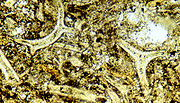
s. During welding, the glass shards and pumice fragments adhere together (necking at point contacts), deform, and compact together, resulting in a 'eutaxitic fabric' (see image and contrast with the ash shapes in unwelded tuff).
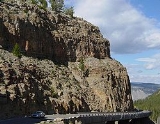
Welded ignimbrites can be highly voluminous, such as the Lava Creek Tuff
erupted from Yellowstone Caldera
in Wyoming
640,000 years ago. Lava Creek Tuff
is known to be at least 1000 times as large as the deposits of the May 18, 1980 eruption of Mount St. Helens
, and it had a Volcanic Explosivity Index
(VEI) of 8—greater than any eruption known in the last 10,000 years. The intensity of welding may decrease towards the upper margin of a deposit, towards areas in which the deposit is thinner and with distance from source. Welded tuff is commonly rhyolitic in composition, but examples of all compositions are known.
 For petrographical
purposes, tuff is generally classified according to the nature of the volcanic rock of which it consists; this may be the same as the accompanying lavas if any were emitted during an eruption, and if there is a change in the kind of lava which is poured out, the tuffs also indicate this equally clearly. Rhyolite tuffs contain pumiceous, glassy fragments and small scoriae with quartz
, alkali
feldspar
, biotite
, etc. Iceland, Lipari, Hungary, the Basin and Range
of the American southwest, and New Zealand
are among the areas where such tuffs are prominent. The broken pumice is clear and isotropic, and very small particles commonly have crescentic, sickle-shaped, or biconcave outlines, showing that they are produced by the shattering of a vesicular glass, sometimes described as ash-structure. The tiny glass fragments derived from broken pumice are called shards; the glass shards readily deform and flow when the deposits are sufficiently hot, as shown in the accompanying image of welded tuff.
In the ancient rocks of Wales
, Charnwood
, the Pentland Hills
, etc., similar tuffs are known, but in all cases they are greatly changed by silicification (which has filled them with opal
, chalcedony
and quartz) and by devitrification. The frequent presence of rounded corroded quartz crystals, such as occur in rhyolitic lavas, helps to demonstrate their real nature.
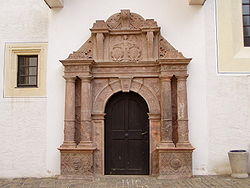
A example of this tuff Rochlitz
Porphyr can be seen in the Mannerist
style sculpted portal outside the chapel entrance in Colditz Castle
. The trade name Rochlitz Porphyr is the traditional designation for a dimension stone
of Saxony
with an architectural history over 1,000 years in Germany. The quarries are located near Rochlitz.
or anorthoclase
and sometimes oligoclase feldspar, with occasional biotite, augite and hornblende. In weathering they often change to soft red or yellow clay-stones, rich in kaolin with secondary quartz. Recent trachyte tuffs are found on the Rhine (at Siebengebirge
), in Ischia
, near Naples
, Hungary
, etc.
and Andes
, in the West Indies, New Zealand, Japan, etc. In the Lake district, North Wales, Lorne, the Pentland Hills, the Cheviots and many other districts of Great Britain
, ancient rocks of exactly similar nature are abundant. In color they are red or brown; their scoriae fragments are of all sizes from huge blocks down to minute granular dust. The cavities are filled up with many secondary minerals, such as calcite
, chlorite
, quartz, epidote
, chalcedony; but in microscopic sections, the nature of the original lava can nearly always be made out from the shapes and properties of the little crystals which occur in the decomposed glassy base. Even in the smallest details, these ancient tuffs have a complete resemblance to the modern ash beds of Cotopaxi
, Krakatoa
and Mont Pelé.
 Basaltic tuffs are also of wide spread occurrence both in districts where volcanoes are now active and in lands where eruptions have long since ended. They are found in Skye, Mull
, Antrim
and other places, where there are tertiary
volcanic rocks; in Scotland, Derbyshire
and Ireland among the carboniferous
strata; and among the still older rocks of the Lake District
, southern uplands of Scotland and Wales. They are black, dark green or red in colour; vary greatly in coarseness, some being full of round spongy bombs a foot or more in diameter, and, being often submarine, may contain shale, sandstone, grit and other sedimentary material, and are occasionally fossiliferous. Recent basaltic tuffs are found in Iceland
, the Faroe Islands
, Jan Mayen
, Sicily, Sandwich Islands
, Samoa
, etc. When weathered they are filled with calcite, chlorite, serpentine and, especially where the lavas contain nepheline
or leucite
, are often rich in zeolite
s, such as analcite
, prehnite
, natrolite
, scolecite
, chabazite
, heulandite
, etc.
or serpentine and the scarcity or absence of feldspar
and quartz
. Rare occurrences may include unusual surface deposits of maar
s of kimberlite
s of the diamond
-fields of southern Africa and other regions. The principal rock of kimberlite
is a dark bluish-green serpentine-rich breccia (blue-ground) which when thoroughly oxidized and weathered becomes a friable brown or yellow mass (the "yellow-ground"). These breccias were emplaced as gas–solid mixtures and are typically preserved and mined in diatreme
s that form intrusive pipe-like structures. At depth, some kimberlite breccias grade into root zones of dikes made of unfragmented rock. At the surface, ultramafic tuffs may occur in maar
deposits. Because kimberlites are the most common igneous source of diamonds, the transitions from maar to diatreme to root-zone dikes have been studied in detail. Diatreme-facies kimberlite is more properly called an ultramafic breccia rather than a tuff.
 In course of time, other changes than weathering may overtake tuff deposits. Sometimes they are involved in folding and become sheared and cleaved. Many of the green slate
s of the lake district in Cumberland are fine cleaved ashes. In Charnwood Forest
also the tuffs are slaty and cleaved. The green color is due to the large development of chlorite. Among the crystalline schist
s of many regions, green beds or green schists occur, which consist of quartz, hornblende, chlorite or biotite, iron oxide
s, feldspar, etc., and are probably recrystallized or metamorphosed
tuffs. They often accompany masses of epidiorite and hornblende – schists which are the corresponding lavas and sill
s. Some chlorite-schists also are probably altered beds of volcanic tuff. The "Schalsteins" of Devon
and Germany include many cleaved and partly recrystallized ash-beds, some of which still retain their fragmental structure though their lapilli are flattened and drawn out. Their steam cavities are usually filled with calcite, but sometimes with quartz. The more completely altered forms of these rocks are platy, green chloritic schists; in these, however, structures indicating their original volcanic nature only sparingly occur. These are intermediate stages between cleaved tuffs and crystalline schists.
 Tuff's primary economic value is as a building material. In the ancient world, tuff's relative softness meant that it was commonly used for construction where it was available. Tuff is common in Italy
, and the Romans
used it for many buildings and bridges. For example, the whole port of the island of Ventotene
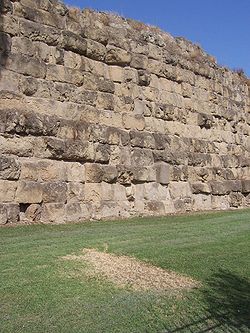
(still in use), was carved out from tuff. The Servian Wall
, built to defend the city of Rome
in the 4th century BC, is also built almost entirely from tuff. The Romans also cut tuff into small rectangular stones that they used to create walls in a pattern known as opus reticulatum
.
The Romans thought bees nested in tuff. The substance is mentioned in the Aeneid
(Book XII, ln 805).
The peperino
, much used at Rome and Naples as a building stone, is a trachyte
tuff. Pozzolana
also is a decomposed tuff, but of basic character, originally obtained near Naples
and used as a cement
, but this name is now applied to a number of substances not always of identical character. In the Eifel
region of Germany a trachytic, pumiceous tuff called trass
has been extensively worked as a hydraulic mortar
.
Yucca Mountain nuclear waste repository, a U.S. Department of Energy terminal storage facility for spent nuclear reactor and other radioactive waste, is in tuff and ignimbrite in the Basin and Range Province in Nevada
. In Napa valley and Sonoma valley, California
, areas made out of tuff are routinely excavated for storage of wine barrels.
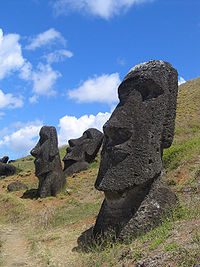
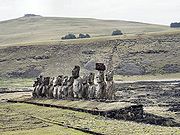
Tuff from Rano Raraku
was used by the Rapa Nui people of Easter Island
to make the vast majority of their famous moai
statues.
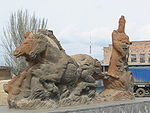
Tuff is important in Armenian architecture
.
Rock (geology)
In geology, rock or stone is a naturally occurring solid aggregate of minerals and/or mineraloids.The Earth's outer solid layer, the lithosphere, is made of rock. In general rocks are of three types, namely, igneous, sedimentary, and metamorphic...
consisting of consolidated volcanic ash
Volcanic ash
Volcanic ash consists of small tephra, which are bits of pulverized rock and glass created by volcanic eruptions, less than in diameter. There are three mechanisms of volcanic ash formation: gas release under decompression causing magmatic eruptions; thermal contraction from chilling on contact...
ejected from vents during a volcanic eruption. Tuff is sometimes called tufa, particularly when used as construction material, although tufa
Tufa
Tufa is a variety of limestone, formed by the precipitation of carbonate minerals from ambient temperature water bodies. Geothermally heated hot-springs sometimes produce similar carbonate deposits known as travertine...
also refers to a quite different rock. Rock that contains greater than 50% tuff is considered tuffaceous.
Volcanic ash
The products of a volcanic eruptionVolcano
2. Bedrock3. Conduit 4. Base5. Sill6. Dike7. Layers of ash emitted by the volcano8. Flank| 9. Layers of lava emitted by the volcano10. Throat11. Parasitic cone12. Lava flow13. Vent14. Crater15...
are volcanic gases, lava
Lava
Lava refers both to molten rock expelled by a volcano during an eruption and the resulting rock after solidification and cooling. This molten rock is formed in the interior of some planets, including Earth, and some of their satellites. When first erupted from a volcanic vent, lava is a liquid at...
, steam
Steam
Steam is the technical term for water vapor, the gaseous phase of water, which is formed when water boils. In common language it is often used to refer to the visible mist of water droplets formed as this water vapor condenses in the presence of cooler air...
, and tephra
Tephra
200px|thumb|right|Tephra horizons in south-central [[Iceland]]. The thick and light coloured layer at center of the photo is [[rhyolitic]] tephra from [[Hekla]]....
. Magma
Magma
Magma is a mixture of molten rock, volatiles and solids that is found beneath the surface of the Earth, and is expected to exist on other terrestrial planets. Besides molten rock, magma may also contain suspended crystals and dissolved gas and sometimes also gas bubbles. Magma often collects in...
is blown apart when it interacts violently with volcanic gases and steam. Solid material produced and thrown into the air by such volcanic eruptions is called tephra, regardless of composition or fragment size. If the resulting pieces of ejecta are small enough, the material is called volcanic ash
Volcanic ash
Volcanic ash consists of small tephra, which are bits of pulverized rock and glass created by volcanic eruptions, less than in diameter. There are three mechanisms of volcanic ash formation: gas release under decompression causing magmatic eruptions; thermal contraction from chilling on contact...
, defined as such particles less than 2 mm in diameter, sand-sized
Sand
Sand is a naturally occurring granular material composed of finely divided rock and mineral particles.The composition of sand is highly variable, depending on the local rock sources and conditions, but the most common constituent of sand in inland continental settings and non-tropical coastal...
or smaller. These particles are small, slag
Slag
Slag is a partially vitreous by-product of smelting ore to separate the metal fraction from the unwanted fraction. It can usually be considered to be a mixture of metal oxides and silicon dioxide. However, slags can contain metal sulfides and metal atoms in the elemental form...
gy pieces of magma and rock that have been tossed into the air by outbursts of steam
Steam
Steam is the technical term for water vapor, the gaseous phase of water, which is formed when water boils. In common language it is often used to refer to the visible mist of water droplets formed as this water vapor condenses in the presence of cooler air...
and other gases; magma may have been torn apart as it became vesicular
Vesicular texture
Vesicular texture is a volcanic rock texture characterised by a rock being pitted with many cavities at its surface and inside. The texture is often found in extrusive aphanitic, or glassy, igneous rock...
by the expansion of the gases within it.
Breccias
Among the loose beds of ash that cover the slopes of many volcanoVolcano
2. Bedrock3. Conduit 4. Base5. Sill6. Dike7. Layers of ash emitted by the volcano8. Flank| 9. Layers of lava emitted by the volcano10. Throat11. Parasitic cone12. Lava flow13. Vent14. Crater15...
es, three classes of materials are represented. In addition to true ashes of the kind described above, there are lumps of the old lavas and tuffs forming the walls of the crater, etc., which have been torn away by the violent outbursts of steam, and pieces of sedimentary rock
Sedimentary rock
Sedimentary rock are types of rock that are formed by the deposition of material at the Earth's surface and within bodies of water. Sedimentation is the collective name for processes that cause mineral and/or organic particles to settle and accumulate or minerals to precipitate from a solution....
s from the deeper parts of the volcano that were dislodged by the rising lava and are often intensely baked and recrystallized
Recrystallization (geology)
In geology, solid-state recrystallization is a metamorphic process that occurs under situations of intense temperature and pressure where grains, atoms or molecules of a rock or mineral are packed closer together, creating a new crystal structure. The basic composition remains the same...
by the heat to which they have been subjected.
In some great volcanic explosions nothing but materials of the second kind were emitted, as at Mount Bandai
Mount Bandai
, also known as , , and , is a stratovolcano in Fukushima Prefecture, Japan.In a major eruption on July 15, 1888 the north and east parts of the caldera collapsed in a massive landslide, forming two lakes, Hibara-ko and Onogawa-ko, as well as several minor lakes called Goshiki-numa, or the 'Five...
in Japan
Japan
Japan is an island nation in East Asia. Located in the Pacific Ocean, it lies to the east of the Sea of Japan, China, North Korea, South Korea and Russia, stretching from the Sea of Okhotsk in the north to the East China Sea and Taiwan in the south...
in 1888. There have been many eruptions also in which the quantity of broken sedimentary rocks that mingled with the ash is very great; as instances we may cite the volcanoes of the Eifel
Eifel
The Eifel is a low mountain range in western Germany and eastern Belgium. It occupies parts of southwestern North Rhine-Westphalia, northwestern Rhineland-Palatinate and the south of the German-speaking Community of Belgium....
and the Devonian tuffs, known as "Schalsteins," in Germany
Germany
Germany , officially the Federal Republic of Germany , is a federal parliamentary republic in Europe. The country consists of 16 states while the capital and largest city is Berlin. Germany covers an area of 357,021 km2 and has a largely temperate seasonal climate...
. In the Scottish
Scotland
Scotland is a country that is part of the United Kingdom. Occupying the northern third of the island of Great Britain, it shares a border with England to the south and is bounded by the North Sea to the east, the Atlantic Ocean to the north and west, and the North Channel and Irish Sea to the...
coalfields some old volcanoes are plugged with masses consisting entirely of sedimentary debris: in such a case it is supposed that no lava was ejected, but the cause of the eruption was the sudden liberation and expansion of a large quantity of steam. These accessory or adventitious materials, however, as distinguished from the true ashes, tend to occur in angular fragments; and when they form a large part of the mass the rock is more properly a "volcanic breccia
Breccia
Breccia is a rock composed of broken fragments of minerals or rock cemented together by a fine-grained matrix, that can be either similar to or different from the composition of the fragments....
" than a tuff. The ashes vary in size from large blocks twenty feet or more in diameter to the minutest impalpable dust. The large masses are called "volcanic bomb
Volcanic bomb
A volcanic bomb is a mass of molten rock larger than 65 mm in diameter, formed when a volcano ejects viscous fragments of lava during an eruption. They cool into solid fragments before they reach the ground. Because volcanic bombs cool after they leave the volcano, they do not have grains...
s"; they have mostly a rounded, elliptical or pear-shaped form owing to rotation in the air before they solidified. Many of them have ribbed or nodular surfaces, and sometimes they have a crust intersected by many cracks like the surface of a loaf of bread. Any ash in which they are very abundant is called an agglomerate
Agglomerate
Agglomerates are coarse accumulations of large blocks of volcanic material that contain at least 75% bombs...
.
In those layers and beds of tuff that have been spread out over considerable tracts of country and which are most frequently encountered among the sedimentary rocks, smaller fragments preponderate greatly and bombs more than a few inches in diameter may be absent altogether. A tuff of recent origin is generally loose and incoherent, but the older tuffs have been, in most cases, cemented together by pressure and the action of infiltrating water, making rocks which, while not very hard, are strong enough to be extensively used for building purposes (e.g. in the neighborhood of Rome
Rome
Rome is the capital of Italy and the country's largest and most populated city and comune, with over 2.7 million residents in . The city is located in the central-western portion of the Italian Peninsula, on the Tiber River within the Lazio region of Italy.Rome's history spans two and a half...
). If they have accumulated subaerial
Subaerial
The term subaerial is mainly used in geology to describe events or structures that are located at the Earth's surface...
ly, like the ash beds found on Mt. Etna or Vesuvius at the present day, tuffs consist almost wholly of volcanic materials of different degrees of fineness with pieces of wood and vegetable matter, land shells, etc. But many volcanoes stand near the sea, and the ashes cast out by them are mingled with the sediments that are gathering at the bottom of the waters. In this way ashy mud
Mud
Mud is a mixture of water and some combination of soil, silt, and clay. Ancient mud deposits harden over geological time to form sedimentary rock such as shale or mudstone . When geological deposits of mud are formed in estuaries the resultant layers are termed bay muds...
s or sand
Sand
Sand is a naturally occurring granular material composed of finely divided rock and mineral particles.The composition of sand is highly variable, depending on the local rock sources and conditions, but the most common constituent of sand in inland continental settings and non-tropical coastal...
s or even in some cases ashy limestone
Limestone
Limestone is a sedimentary rock composed largely of the minerals calcite and aragonite, which are different crystal forms of calcium carbonate . Many limestones are composed from skeletal fragments of marine organisms such as coral or foraminifera....
s are being formed. As a matter of fact most of the tuffs found in the older formations contain admixtures of clay
Clay
Clay is a general term including many combinations of one or more clay minerals with traces of metal oxides and organic matter. Geologic clay deposits are mostly composed of phyllosilicate minerals containing variable amounts of water trapped in the mineral structure.- Formation :Clay minerals...
, sand, and sometimes fossil
Fossil
Fossils are the preserved remains or traces of animals , plants, and other organisms from the remote past...
shells, which prove that they were beds spread out under water.
During some volcanic eruptions a layer of ashes several feet in thickness is deposited over a considerable district, but such beds thin out rapidly as the distance from the crater increases, and ash deposits covering many square miles are usually very thin. The showers of ashes often follow one another after longer or shorter intervals, and hence thick masses of tuff, whether of subaerial or of marine origin, have mostly a stratified
Stratigraphy
Stratigraphy, a branch of geology, studies rock layers and layering . It is primarily used in the study of sedimentary and layered volcanic rocks....
character. The coarsest materials or agglomerates show this least distinctly; in the fine beds it is often developed in great perfection.
Igneous rock
Apart from adventitious material, such as fragments of the older rocks, pieces of trees, etc., the contents of an ash deposit may be described as consisting of more or less crystalCrystal
A crystal or crystalline solid is a solid material whose constituent atoms, molecules, or ions are arranged in an orderly repeating pattern extending in all three spatial dimensions. The scientific study of crystals and crystal formation is known as crystallography...
line igneous rock
Igneous rock
Igneous rock is one of the three main rock types, the others being sedimentary and metamorphic rock. Igneous rock is formed through the cooling and solidification of magma or lava...
s. If the lava within the crater has been at such a temperature that solidification has commenced, crystals are usually present. They may be of considerable size like the grey, rounded leucite
Leucite
Leucite is a rock-forming mineral composed of potassium and aluminium tectosilicate K[AlSi2O6]. Crystals have the form of cubic icositetrahedra but, as first observed by Sir David Brewster in 1821, they are not optically isotropic, and are therefore pseudo-cubic. Goniometric measurements made by...
crystals found on the sides of Vesuvius. Many of these are very perfect and rich in faces because they grew in a medium that was liquid and not very viscous. Good crystals of augite
Augite
Augite is a single chain inosilicate mineral, 2O6. The crystals are monoclinic and prismatic. Augite has two prominent cleavages, meeting at angles near 90 degrees.-Characteristics:Augite is a solid solution in the pyroxene group...
and olivine
Olivine
The mineral olivine is a magnesium iron silicate with the formula 2SiO4. It is a common mineral in the Earth's subsurface but weathers quickly on the surface....
are also to be obtained in the ash beds of Vesuvius and of many other volcanoes, ancient and modern. Blocks of these crystalline minerals (anorthite
Anorthite
Anorthite is the calcium endmember of plagioclase feldspar. Plagioclase is an abundant mineral in the Earth's crust. The formula of pure anorthite is CaAl2Si2O8.-Mineralogy :...
, olivine, augite and hornblende
Hornblende
Hornblende is a complex inosilicate series of minerals .It is not a recognized mineral in its own right, but the name is used as a general or field term, to refer to a dark amphibole....
) are common objects in the tuffs of many of the West India
India
India , officially the Republic of India , is a country in South Asia. It is the seventh-largest country by geographical area, the second-most populous country with over 1.2 billion people, and the most populous democracy in the world...
n volcanoes. Where crystals are very abundant the ashes are called "crystal tuffs." In St. Vincent and Martinique in 1902, much of the dust was composed of minute crystals enclosed in thin films of glass
Glass
Glass is an amorphous solid material. Glasses are typically brittle and optically transparent.The most familiar type of glass, used for centuries in windows and drinking vessels, is soda-lime glass, composed of about 75% silica plus Na2O, CaO, and several minor additives...
because the lava at the moment of eruption had very nearly solidified as a crystalline mass. Some basalt
Basalt
Basalt is a common extrusive volcanic rock. It is usually grey to black and fine-grained due to rapid cooling of lava at the surface of a planet. It may be porphyritic containing larger crystals in a fine matrix, or vesicular, or frothy scoria. Unweathered basalt is black or grey...
ic volcanoes, on the other hand, have ejected great quantities of black glassy scoria
Scoria
Scoria is a volcanic rock containing many holes or vesicles. It is most generally dark in color , and basaltic or andesitic in composition. Scoria is relatively low in mass as a result of its numerous macroscopic ellipsoidal vesicles, but in contrast to pumice, all scoria has a specific gravity...
, which, after consolidation, weather to a red soft rock known as palagonite
Palagonite
Palagonite is an alteration product from the interaction of water with volcanic glass of chemical composition similar to basalt. Palagonite can also result from the interaction between water and basalt melt...
; tuffs of this kind occur in Iceland
Iceland
Iceland , described as the Republic of Iceland, is a Nordic and European island country in the North Atlantic Ocean, on the Mid-Atlantic Ridge. Iceland also refers to the main island of the country, which contains almost all the population and almost all the land area. The country has a population...
and Sicily
Sicily
Sicily is a region of Italy, and is the largest island in the Mediterranean Sea. Along with the surrounding minor islands, it constitutes an autonomous region of Italy, the Regione Autonoma Siciliana Sicily has a rich and unique culture, especially with regard to the arts, music, literature,...
. In the Lipari Islands and Hungary
Hungary
Hungary , officially the Republic of Hungary , is a landlocked country in Central Europe. It is situated in the Carpathian Basin and is bordered by Slovakia to the north, Ukraine and Romania to the east, Serbia and Croatia to the south, Slovenia to the southwest and Austria to the west. The...
there are acid
Acid
An acid is a substance which reacts with a base. Commonly, acids can be identified as tasting sour, reacting with metals such as calcium, and bases like sodium carbonate. Aqueous acids have a pH of less than 7, where an acid of lower pH is typically stronger, and turn blue litmus paper red...
(rhyolitic
Rhyolite
This page is about a volcanic rock. For the ghost town see Rhyolite, Nevada, and for the satellite system, see Rhyolite/Aquacade.Rhyolite is an igneous, volcanic rock, of felsic composition . It may have any texture from glassy to aphanitic to porphyritic...
) tuffs, of pale grey or yellow color, largely composed of lumps and fragments of pumice
Pumice
Pumice is a textural term for a volcanic rock that is a solidified frothy lava typically created when super-heated, highly pressurized rock is violently ejected from a volcano. It can be formed when lava and water are mixed. This unusual formation is due to the simultaneous actions of rapid...
. Over a large portion of the sea bottom the beds of fine mud contain small, water-worn, rounded pebbles of very spongy volcanic glass; these have been floated from the shore or cast out by submarine volcanoes, and may have travelled for hundreds of miles before sinking; it has been proved by experiment that some kinds of pumice will float on sea-water for more than a year. The deep sea-deposit known as the "red clay" is largely of volcanic origin and might be suitably described as a "submarine tuff-bed."
Welded tuff
Pyroclastic rock
Pyroclastic rocks or pyroclastics are clastic rocks composed solely or primarily of volcanic materials. Where the volcanic material has been transported and reworked through mechanical action, such as by wind or water, these rocks are termed volcaniclastic...
, of any origin, that was sufficiently hot at the time of deposition to weld together. Strictly speaking, if the rock contains scattered pea-sized fragments or fiamme in it, it is called a welded lapilli-tuff. Welded tuffs (and welded lapilli-tuffs) can be of fallout origin, or deposited from pyroclastic density currents, as in the case of ignimbrite
Ignimbrite
An ignimbrite is the deposit of a pyroclastic density current, or pyroclastic flow, a hot suspension of particles and gases that flows rapidly from a volcano, driven by a greater density than the surrounding atmosphere....
s. During welding, the glass shards and pumice fragments adhere together (necking at point contacts), deform, and compact together, resulting in a 'eutaxitic fabric' (see image and contrast with the ash shapes in unwelded tuff).
Welded ignimbrites can be highly voluminous, such as the Lava Creek Tuff
Lava Creek Tuff
Lava Creek Tuff is a tuff formation, in Wyoming, created when the Yellowstone Caldera erupted about 640,000 years ago.The Lava Creek Tuff distributed in a radial pattern around the caldera and is formed of of ash in pyroclastic flows....
erupted from Yellowstone Caldera
Yellowstone Caldera
The Yellowstone Caldera is the volcanic caldera located in Yellowstone National Park in the United States, sometimes referred to as the Yellowstone Supervolcano. The caldera is located in the northwest corner of Wyoming, in which the vast majority of the park is contained. The major features of...
in Wyoming
Wyoming
Wyoming is a state in the mountain region of the Western United States. The western two thirds of the state is covered mostly with the mountain ranges and rangelands in the foothills of the Eastern Rocky Mountains, while the eastern third of the state is high elevation prairie known as the High...
640,000 years ago. Lava Creek Tuff
Lava Creek Tuff
Lava Creek Tuff is a tuff formation, in Wyoming, created when the Yellowstone Caldera erupted about 640,000 years ago.The Lava Creek Tuff distributed in a radial pattern around the caldera and is formed of of ash in pyroclastic flows....
is known to be at least 1000 times as large as the deposits of the May 18, 1980 eruption of Mount St. Helens
Mount St. Helens
Mount St. Helens is an active stratovolcano located in Skamania County, Washington, in the Pacific Northwest region of the United States. It is south of Seattle, Washington and northeast of Portland, Oregon. Mount St. Helens takes its English name from the British diplomat Lord St Helens, a...
, and it had a Volcanic Explosivity Index
Volcanic Explosivity Index
The Volcanic Explosivity Index was devised by Chris Newhall of the U.S. Geological Survey and Stephen Self at the University of Hawaii in 1982 to provide a relative measure of the explosiveness of volcanic eruptions....
(VEI) of 8—greater than any eruption known in the last 10,000 years. The intensity of welding may decrease towards the upper margin of a deposit, towards areas in which the deposit is thinner and with distance from source. Welded tuff is commonly rhyolitic in composition, but examples of all compositions are known.
Rhyolite tuffs
Petrology
Petrology is the branch of geology that studies rocks, and the conditions in which rocks form....
purposes, tuff is generally classified according to the nature of the volcanic rock of which it consists; this may be the same as the accompanying lavas if any were emitted during an eruption, and if there is a change in the kind of lava which is poured out, the tuffs also indicate this equally clearly. Rhyolite tuffs contain pumiceous, glassy fragments and small scoriae with quartz
Quartz
Quartz is the second-most-abundant mineral in the Earth's continental crust, after feldspar. It is made up of a continuous framework of SiO4 silicon–oxygen tetrahedra, with each oxygen being shared between two tetrahedra, giving an overall formula SiO2. There are many different varieties of quartz,...
, alkali
Alkali
In chemistry, an alkali is a basic, ionic salt of an alkali metal or alkaline earth metal element. Some authors also define an alkali as a base that dissolves in water. A solution of a soluble base has a pH greater than 7. The adjective alkaline is commonly used in English as a synonym for base,...
feldspar
Feldspar
Feldspars are a group of rock-forming tectosilicate minerals which make up as much as 60% of the Earth's crust....
, biotite
Biotite
Biotite is a common phyllosilicate mineral within the mica group, with the approximate chemical formula . More generally, it refers to the dark mica series, primarily a solid-solution series between the iron-endmember annite, and the magnesium-endmember phlogopite; more aluminous endmembers...
, etc. Iceland, Lipari, Hungary, the Basin and Range
Basin and Range
The Basin and Range Province is a vast physiographic region defined by a unique topographic expression. Basin and Range topography is characterized by abrupt changes in elevation, alternating between narrow faulted mountain chains and flat arid valleys or basins...
of the American southwest, and New Zealand
New Zealand
New Zealand is an island country in the south-western Pacific Ocean comprising two main landmasses and numerous smaller islands. The country is situated some east of Australia across the Tasman Sea, and roughly south of the Pacific island nations of New Caledonia, Fiji, and Tonga...
are among the areas where such tuffs are prominent. The broken pumice is clear and isotropic, and very small particles commonly have crescentic, sickle-shaped, or biconcave outlines, showing that they are produced by the shattering of a vesicular glass, sometimes described as ash-structure. The tiny glass fragments derived from broken pumice are called shards; the glass shards readily deform and flow when the deposits are sufficiently hot, as shown in the accompanying image of welded tuff.
In the ancient rocks of Wales
Wales
Wales is a country that is part of the United Kingdom and the island of Great Britain, bordered by England to its east and the Atlantic Ocean and Irish Sea to its west. It has a population of three million, and a total area of 20,779 km²...
, Charnwood
Charnwood Forest
Charnwood Forest is an upland tract in north-western Leicestershire, England, bounded by Leicester, Loughborough, and Coalville. The area is undulating, rocky and picturesque, with barren areas. It also has some extensive tracts of woodland; its elevation is generally 600 ft and upwards, the area...
, the Pentland Hills
Pentland Hills
The Pentland Hills are a range of hills to the south-west of Edinburgh, Scotland. The range is around 20 miles in length, and runs south west from Edinburgh towards Biggar and the upper Clydesdale.Some of the peaks include:* Scald Law...
, etc., similar tuffs are known, but in all cases they are greatly changed by silicification (which has filled them with opal
Opal
Opal is an amorphous form of silica related to quartz, a mineraloid form, not a mineral. 3% to 21% of the total weight is water, but the content is usually between 6% to 10%. It is deposited at a relatively low temperature and may occur in the fissures of almost any kind of rock, being most...
, chalcedony
Chalcedony
Chalcedony is a cryptocrystalline form of silica, composed of very fine intergrowths of the minerals quartz and moganite. These are both silica minerals, but they differ in that quartz has a trigonal crystal structure, while moganite is monoclinic...
and quartz) and by devitrification. The frequent presence of rounded corroded quartz crystals, such as occur in rhyolitic lavas, helps to demonstrate their real nature.
A example of this tuff Rochlitz
Rochlitz
Rochlitz is a major district town in the district of Mittelsachsen, in the Free State of Saxony, Germany. Rochlitz is the head of the “borough partnership Rochlitz” with its other members being the boroughs of Königsfeld, Seelitz und Zettlitz...
Porphyr can be seen in the Mannerist
Mannerism
Mannerism is a period of European art that emerged from the later years of the Italian High Renaissance around 1520. It lasted until about 1580 in Italy, when a more Baroque style began to replace it, but Northern Mannerism continued into the early 17th century throughout much of Europe...
style sculpted portal outside the chapel entrance in Colditz Castle
Colditz Castle
Colditz Castle is a Renaissance castle in the town of Colditz near Leipzig, Dresden, and Chemnitz in the state of Saxony in Germany. Used as a workhouse for the indigent and a mental institution for over 100 years, it gained international fame as a prisoner-of-war camp during World War II for...
. The trade name Rochlitz Porphyr is the traditional designation for a dimension stone
Dimension stone
Dimension stone is natural stone or rock that has been selected and fabricated to specific sizes or shapes. Color, texture and pattern, and surface finish of the stone are also normal requirements...
of Saxony
Saxony
The Free State of Saxony is a landlocked state of Germany, contingent with Brandenburg, Saxony Anhalt, Thuringia, Bavaria, the Czech Republic and Poland. It is the tenth-largest German state in area, with of Germany's sixteen states....
with an architectural history over 1,000 years in Germany. The quarries are located near Rochlitz.
Trachyte tuffs
Trachyte tuffs contain little or no quartz but much sanidineSanidine
Sanidine is the high temperature form of potassium feldspar 4O8. Sanidine most typically occurs in felsic volcanic rocks such as obsidian, rhyolite and trachyte. Sanidine crystallizes in the monoclinic crystal system. Orthoclase is a monoclinic polymorph stable at lower temperatures...
or anorthoclase
Anorthoclase
The mineral anorthoclase is a crystalline solid solution in the alkali feldspar series, in which the sodium-aluminium silicate member exists in larger proportion. It typically consists of between 10 and 36 percent of KAlSi3O8 and between 64 and 90 percent of NaAlSi3O8....
and sometimes oligoclase feldspar, with occasional biotite, augite and hornblende. In weathering they often change to soft red or yellow clay-stones, rich in kaolin with secondary quartz. Recent trachyte tuffs are found on the Rhine (at Siebengebirge
Siebengebirge
The Siebengebirge is a German range of hills to the East of the Rhine, southeast of Bonn, consisting of more than 40 mountains and hills. It is located in the municipalities of Bad Honnef and Königswinter. It is of volcanic origin and came into being between 28 and 15 million years ago...
), in Ischia
Ischia
Ischia is a volcanic island in the Tyrrhenian Sea. It lies at the northern end of the Gulf of Naples, about 30 km from the city of Naples. It is the largest of the Phlegrean Islands. Roughly trapezoidal in shape, it measures around 10 km east to west and 7 km north to south and has...
, near Naples
Naples
Naples is a city in Southern Italy, situated on the country's west coast by the Gulf of Naples. Lying between two notable volcanic regions, Mount Vesuvius and the Phlegraean Fields, it is the capital of the region of Campania and of the province of Naples...
, Hungary
Hungary
Hungary , officially the Republic of Hungary , is a landlocked country in Central Europe. It is situated in the Carpathian Basin and is bordered by Slovakia to the north, Ukraine and Romania to the east, Serbia and Croatia to the south, Slovenia to the southwest and Austria to the west. The...
, etc.
Andesitic tuffs
Andesitic tuffs are exceedingly common. They occur along the whole chain of the CordillerasAmerican cordillera
The American Cordillera is a cordillera that consists of an essentially continuous sequence of mountain ranges that form the western "backbone" of North America, Central America, South America and Antarctica. From north to south, this sequence of overlapping and parallel ranges begins with the...
and Andes
Andes
The Andes is the world's longest continental mountain range. It is a continual range of highlands along the western coast of South America. This range is about long, about to wide , and of an average height of about .Along its length, the Andes is split into several ranges, which are separated...
, in the West Indies, New Zealand, Japan, etc. In the Lake district, North Wales, Lorne, the Pentland Hills, the Cheviots and many other districts of Great Britain
Great Britain
Great Britain or Britain is an island situated to the northwest of Continental Europe. It is the ninth largest island in the world, and the largest European island, as well as the largest of the British Isles...
, ancient rocks of exactly similar nature are abundant. In color they are red or brown; their scoriae fragments are of all sizes from huge blocks down to minute granular dust. The cavities are filled up with many secondary minerals, such as calcite
Calcite
Calcite is a carbonate mineral and the most stable polymorph of calcium carbonate . The other polymorphs are the minerals aragonite and vaterite. Aragonite will change to calcite at 380-470°C, and vaterite is even less stable.-Properties:...
, chlorite
Chlorite group
The chlorites are a group of phyllosilicate minerals. Chlorites can be described by the following four endmembers based on their chemistry via substitution of the following four elements in the silicate lattice; Mg, Fe, Ni, and Mn....
, quartz, epidote
Epidote
Epidote is a calcium aluminium iron sorosilicate mineral, Ca2Al2O, crystallizing in the monoclinic system. Well-developed crystals are of frequent occurrence: they are commonly prismatic in habit, the direction of elongation being perpendicular to the single plane of symmetry. The faces are often...
, chalcedony; but in microscopic sections, the nature of the original lava can nearly always be made out from the shapes and properties of the little crystals which occur in the decomposed glassy base. Even in the smallest details, these ancient tuffs have a complete resemblance to the modern ash beds of Cotopaxi
Cotopaxi
Cotopaxi is a stratovolcano in the Andes Mountains, located about south of Quito, Ecuador, South America. It is the second highest summit in the country, reaching a height of...
, Krakatoa
Krakatoa
Krakatoa is a volcanic island made of a'a lava in the Sunda Strait between the islands of Java and Sumatra in Indonesia. The name is used for the island group, the main island , and the volcano as a whole. The island exploded in 1883, killing approximately 40,000 people, although some estimates...
and Mont Pelé.
Basaltic tuffs
Isle of Mull
The Isle of Mull or simply Mull is the second largest island of the Inner Hebrides, off the west coast of Scotland in the council area of Argyll and Bute....
, Antrim
County Antrim
County Antrim is one of six counties that form Northern Ireland, situated in the north-east of the island of Ireland. Adjoined to the north-east shore of Lough Neagh, the county covers an area of 2,844 km², with a population of approximately 616,000...
and other places, where there are tertiary
Tertiary
The Tertiary is a deprecated term for a geologic period 65 million to 2.6 million years ago. The Tertiary covered the time span between the superseded Secondary period and the Quaternary...
volcanic rocks; in Scotland, Derbyshire
Derbyshire
Derbyshire is a county in the East Midlands of England. A substantial portion of the Peak District National Park lies within Derbyshire. The northern part of Derbyshire overlaps with the Pennines, a famous chain of hills and mountains. The county contains within its boundary of approx...
and Ireland among the carboniferous
Carboniferous
The Carboniferous is a geologic period and system that extends from the end of the Devonian Period, about 359.2 ± 2.5 Mya , to the beginning of the Permian Period, about 299.0 ± 0.8 Mya . The name is derived from the Latin word for coal, carbo. Carboniferous means "coal-bearing"...
strata; and among the still older rocks of the Lake District
Lake District
The Lake District, also commonly known as The Lakes or Lakeland, is a mountainous region in North West England. A popular holiday destination, it is famous not only for its lakes and its mountains but also for its associations with the early 19th century poetry and writings of William Wordsworth...
, southern uplands of Scotland and Wales. They are black, dark green or red in colour; vary greatly in coarseness, some being full of round spongy bombs a foot or more in diameter, and, being often submarine, may contain shale, sandstone, grit and other sedimentary material, and are occasionally fossiliferous. Recent basaltic tuffs are found in Iceland
Iceland
Iceland , described as the Republic of Iceland, is a Nordic and European island country in the North Atlantic Ocean, on the Mid-Atlantic Ridge. Iceland also refers to the main island of the country, which contains almost all the population and almost all the land area. The country has a population...
, the Faroe Islands
Faroe Islands
The Faroe Islands are an island group situated between the Norwegian Sea and the North Atlantic Ocean, approximately halfway between Scotland and Iceland. The Faroe Islands are a self-governing territory within the Kingdom of Denmark, along with Denmark proper and Greenland...
, Jan Mayen
Jan Mayen
Jan Mayen Island is a volcanic island in the Arctic Ocean and part of the Kingdom of Norway. It is long and 373 km2 in area, partly covered by glaciers . It has two parts: larger northeast Nord-Jan and smaller Sør-Jan, linked by an isthmus wide...
, Sicily, Sandwich Islands
Hawaiian Islands
The Hawaiian Islands are an archipelago of eight major islands, several atolls, numerous smaller islets, and undersea seamounts in the North Pacific Ocean, extending some 1,500 miles from the island of Hawaii in the south to northernmost Kure Atoll...
, Samoa
Samoa
Samoa , officially the Independent State of Samoa, formerly known as Western Samoa is a country encompassing the western part of the Samoan Islands in the South Pacific Ocean. It became independent from New Zealand in 1962. The two main islands of Samoa are Upolu and one of the biggest islands in...
, etc. When weathered they are filled with calcite, chlorite, serpentine and, especially where the lavas contain nepheline
Nepheline
Nepheline, also called nephelite , is a feldspathoid: a silica-undersaturated aluminosilicate, Na3KAl4Si4O16, that occurs in intrusive and volcanic rocks with low silica, and in their associated pegmatites...
or leucite
Leucite
Leucite is a rock-forming mineral composed of potassium and aluminium tectosilicate K[AlSi2O6]. Crystals have the form of cubic icositetrahedra but, as first observed by Sir David Brewster in 1821, they are not optically isotropic, and are therefore pseudo-cubic. Goniometric measurements made by...
, are often rich in zeolite
Zeolite
Zeolites are microporous, aluminosilicate minerals commonly used as commercial adsorbents. The term zeolite was originally coined in 1756 by Swedish mineralogist Axel Fredrik Cronstedt, who observed that upon rapidly heating the material stilbite, it produced large amounts of steam from water that...
s, such as analcite
Analcite
Analcime or analcite is a white, grey, or colourless tectosilicate mineral. Analcime consists of hydrated sodium aluminium silicate in cubic crystalline form. Its chemical formula is NaAlSi2O6·H2O. Minor amounts of potassium and calcium substitute for sodium...
, prehnite
Prehnite
Prehnite is a phyllosilicate of calcium and aluminium with the formula: Ca2Al2. Limited Fe3+ substitutes for aluminium in the structure. Prehnite crystallizes in the orthorhombic crystal system, and most oftens forms as stalactitic or botryoidal aggregates, with only just the crests of small...
, natrolite
Natrolite
Natrolite is a tectosilicate mineral species belonging to the zeolite group. It is a hydrated sodium and aluminium silicate with the formula . The type locality is Hohentwiel, Hegau, Germany....
, scolecite
Scolecite
Scolecite is a tectosilicate mineral belonging to the zeolite group; it is a hydrated calcium silicate, CaAl2Si3O10.3H2O. Only minor amounts of sodium and traces of potassium substitute for calcium. There is an absence of barium, strontium, iron and magnesium...
, chabazite
Chabazite
Chabazite is a tectosilicate mineral of the zeolite group, closely related to gmelinite, with formula Al2Si4O12·6H2O. Recognized varieties include Chabazite-Ca, Chabazite-K, Chabazite-Na, and Chabazite-Sr, depending on the prominence of the indicated cation.Chabazite crystallizes in the triclinic...
, heulandite
Heulandite
Heulandite is the name of a series of tecto-silicate minerals of the zeolite group. Prior to 1997, heulandite was recognized as a mineral species, but a reclassification in 1997 by the International Mineralogical Association changed it to a series name, with the mineral species being named:*...
, etc.
Ultramafic tuffs
Ultramafic tuffs are extremely rare; their characteristic is the abundance of olivineOlivine
The mineral olivine is a magnesium iron silicate with the formula 2SiO4. It is a common mineral in the Earth's subsurface but weathers quickly on the surface....
or serpentine and the scarcity or absence of feldspar
Feldspar
Feldspars are a group of rock-forming tectosilicate minerals which make up as much as 60% of the Earth's crust....
and quartz
Quartz
Quartz is the second-most-abundant mineral in the Earth's continental crust, after feldspar. It is made up of a continuous framework of SiO4 silicon–oxygen tetrahedra, with each oxygen being shared between two tetrahedra, giving an overall formula SiO2. There are many different varieties of quartz,...
. Rare occurrences may include unusual surface deposits of maar
Maar
A maar is a broad, low-relief volcanic crater that is caused by a phreatomagmatic eruption, an explosion caused by groundwater coming into contact with hot lava or magma. A maar characteristically fills with water to form a relatively shallow crater lake. The name comes from the local Moselle...
s of kimberlite
Kimberlite
Kimberlite is a type of potassic volcanic rock best known for sometimes containing diamonds. It is named after the town of Kimberley in South Africa, where the discovery of an diamond in 1871 spawned a diamond rush, eventually creating the Big Hole....
s of the diamond
Diamond
In mineralogy, diamond is an allotrope of carbon, where the carbon atoms are arranged in a variation of the face-centered cubic crystal structure called a diamond lattice. Diamond is less stable than graphite, but the conversion rate from diamond to graphite is negligible at ambient conditions...
-fields of southern Africa and other regions. The principal rock of kimberlite
Kimberlite
Kimberlite is a type of potassic volcanic rock best known for sometimes containing diamonds. It is named after the town of Kimberley in South Africa, where the discovery of an diamond in 1871 spawned a diamond rush, eventually creating the Big Hole....
is a dark bluish-green serpentine-rich breccia (blue-ground) which when thoroughly oxidized and weathered becomes a friable brown or yellow mass (the "yellow-ground"). These breccias were emplaced as gas–solid mixtures and are typically preserved and mined in diatreme
Diatreme
A diatreme is a breccia-filled volcanic pipe that was formed by a gaseous explosion. Diatremes often breach the surface and produce a tuff cone, a filled relatively shallow crater known as a maar, or other volcanic pipes.- Word origin :...
s that form intrusive pipe-like structures. At depth, some kimberlite breccias grade into root zones of dikes made of unfragmented rock. At the surface, ultramafic tuffs may occur in maar
Maar
A maar is a broad, low-relief volcanic crater that is caused by a phreatomagmatic eruption, an explosion caused by groundwater coming into contact with hot lava or magma. A maar characteristically fills with water to form a relatively shallow crater lake. The name comes from the local Moselle...
deposits. Because kimberlites are the most common igneous source of diamonds, the transitions from maar to diatreme to root-zone dikes have been studied in detail. Diatreme-facies kimberlite is more properly called an ultramafic breccia rather than a tuff.
Folding and metamorphism
Slate
Slate is a fine-grained, foliated, homogeneous metamorphic rock derived from an original shale-type sedimentary rock composed of clay or volcanic ash through low-grade regional metamorphism. The result is a foliated rock in which the foliation may not correspond to the original sedimentary layering...
s of the lake district in Cumberland are fine cleaved ashes. In Charnwood Forest
Charnwood Forest
Charnwood Forest is an upland tract in north-western Leicestershire, England, bounded by Leicester, Loughborough, and Coalville. The area is undulating, rocky and picturesque, with barren areas. It also has some extensive tracts of woodland; its elevation is generally 600 ft and upwards, the area...
also the tuffs are slaty and cleaved. The green color is due to the large development of chlorite. Among the crystalline schist
Schist
The schists constitute a group of medium-grade metamorphic rocks, chiefly notable for the preponderance of lamellar minerals such as micas, chlorite, talc, hornblende, graphite, and others. Quartz often occurs in drawn-out grains to such an extent that a particular form called quartz schist is...
s of many regions, green beds or green schists occur, which consist of quartz, hornblende, chlorite or biotite, iron oxide
Iron oxide
Iron oxides are chemical compounds composed of iron and oxygen. All together, there are sixteen known iron oxides and oxyhydroxides.Iron oxides and oxide-hydroxides are widespread in nature, play an important role in many geological and biological processes, and are widely utilized by humans, e.g.,...
s, feldspar, etc., and are probably recrystallized or metamorphosed
Metamorphism
Metamorphism is the solid-state recrystallization of pre-existing rocks due to changes in physical and chemical conditions, primarily heat, pressure, and the introduction of chemically active fluids. Mineralogical, chemical and crystallographic changes can occur during this process...
tuffs. They often accompany masses of epidiorite and hornblende – schists which are the corresponding lavas and sill
Sill (geology)
In geology, a sill is a tabular sheet intrusion that has intruded between older layers of sedimentary rock, beds of volcanic lava or tuff, or even along the direction of foliation in metamorphic rock. The term sill is synonymous with concordant intrusive sheet...
s. Some chlorite-schists also are probably altered beds of volcanic tuff. The "Schalsteins" of Devon
Devon
Devon is a large county in southwestern England. The county is sometimes referred to as Devonshire, although the term is rarely used inside the county itself as the county has never been officially "shired", it often indicates a traditional or historical context.The county shares borders with...
and Germany include many cleaved and partly recrystallized ash-beds, some of which still retain their fragmental structure though their lapilli are flattened and drawn out. Their steam cavities are usually filled with calcite, but sometimes with quartz. The more completely altered forms of these rocks are platy, green chloritic schists; in these, however, structures indicating their original volcanic nature only sparingly occur. These are intermediate stages between cleaved tuffs and crystalline schists.
Economic importance
Italy
Italy , officially the Italian Republic languages]] under the European Charter for Regional or Minority Languages. In each of these, Italy's official name is as follows:;;;;;;;;), is a unitary parliamentary republic in South-Central Europe. To the north it borders France, Switzerland, Austria and...
, and the Romans
Ancient Rome
Ancient Rome was a thriving civilization that grew on the Italian Peninsula as early as the 8th century BC. Located along the Mediterranean Sea and centered on the city of Rome, it expanded to one of the largest empires in the ancient world....
used it for many buildings and bridges. For example, the whole port of the island of Ventotene
Ventotene
Ventotene, in Roman times known as Pandataria or Pandateria from the Greek Pandoteira, is one of the Pontine Islands in the Tyrrhenian Sea, off the coast of Gaeta right at the border between Lazio and Campania, Italy...
(still in use), was carved out from tuff. The Servian Wall
Servian Wall
The Servian Wall was a defensive barrier constructed around the city of Rome in the early 4th century BC. The wall was up to 10 metres in height in places, 3.6 metres wide at its base, 11 km long, and is believed to had 16 main gates, though many of these are mentioned only from...
, built to defend the city of Rome
Rome
Rome is the capital of Italy and the country's largest and most populated city and comune, with over 2.7 million residents in . The city is located in the central-western portion of the Italian Peninsula, on the Tiber River within the Lazio region of Italy.Rome's history spans two and a half...
in the 4th century BC, is also built almost entirely from tuff. The Romans also cut tuff into small rectangular stones that they used to create walls in a pattern known as opus reticulatum
Opus reticulatum
Opus reticulatum is a form of brickwork used in ancient Roman architecture. It consists of diamond-shaped bricks of tuff placed around a core of opus caementicium...
.
The Romans thought bees nested in tuff. The substance is mentioned in the Aeneid
Aeneid
The Aeneid is a Latin epic poem, written by Virgil between 29 and 19 BC, that tells the legendary story of Aeneas, a Trojan who travelled to Italy, where he became the ancestor of the Romans. It is composed of roughly 10,000 lines in dactylic hexameter...
(Book XII, ln 805).
The peperino
Peperino
Peperino is an Italian name applied to a brown or grey volcanic tuff, containing fragments of basalt and limestone, with disseminated crystals of augite, mica, magnetite, leucite, and other similar minerals...
, much used at Rome and Naples as a building stone, is a trachyte
Trachyte
Trachyte is an igneous volcanic rock with an aphanitic to porphyritic texture. The mineral assemblage consists of essential alkali feldspar; relatively minor plagioclase and quartz or a feldspathoid such as nepheline may also be present....
tuff. Pozzolana
Pozzolana
Pozzolana, also known as pozzolanic ash , is a fine, sandy volcanic ash. Pozzolanic ash was first discovered and dug in Italy, at Pozzuoli. It was later discovered at a number of other sites as well...
also is a decomposed tuff, but of basic character, originally obtained near Naples
Naples
Naples is a city in Southern Italy, situated on the country's west coast by the Gulf of Naples. Lying between two notable volcanic regions, Mount Vesuvius and the Phlegraean Fields, it is the capital of the region of Campania and of the province of Naples...
and used as a cement
Cement
In the most general sense of the word, a cement is a binder, a substance that sets and hardens independently, and can bind other materials together. The word "cement" traces to the Romans, who used the term opus caementicium to describe masonry resembling modern concrete that was made from crushed...
, but this name is now applied to a number of substances not always of identical character. In the Eifel
Eifel
The Eifel is a low mountain range in western Germany and eastern Belgium. It occupies parts of southwestern North Rhine-Westphalia, northwestern Rhineland-Palatinate and the south of the German-speaking Community of Belgium....
region of Germany a trachytic, pumiceous tuff called trass
Trass
Trass is the local name of a volcanic tuff occurring in the Eifel, where it is worked for hydraulic mortar. It is a grey or cream-coloured fragmental rock, largely composed of pumiceous dust, and may be regarded as a trachytic tuff. It much resembles the Italian pozzolana and is applied to like...
has been extensively worked as a hydraulic mortar
Mortar (masonry)
Mortar is a workable paste used to bind construction blocks together and fill the gaps between them. The blocks may be stone, brick, cinder blocks, etc. Mortar becomes hard when it sets, resulting in a rigid aggregate structure. Modern mortars are typically made from a mixture of sand, a binder...
.
Yucca Mountain nuclear waste repository, a U.S. Department of Energy terminal storage facility for spent nuclear reactor and other radioactive waste, is in tuff and ignimbrite in the Basin and Range Province in Nevada
Nevada
Nevada is a state in the western, mountain west, and southwestern regions of the United States. With an area of and a population of about 2.7 million, it is the 7th-largest and 35th-most populous state. Over two-thirds of Nevada's people live in the Las Vegas metropolitan area, which contains its...
. In Napa valley and Sonoma valley, California
California
California is a state located on the West Coast of the United States. It is by far the most populous U.S. state, and the third-largest by land area...
, areas made out of tuff are routinely excavated for storage of wine barrels.
Tuff from Rano Raraku
Rano Raraku
Rano Raraku is a volcanic crater formed of consolidated volcanic ash, or tuff, and located on the lower slopes of Terevaka in the Rapa Nui National Park on Easter Island. It was a quarry for about 500 years until the early eighteenth century, and supplied the stone from which about 95% of the...
was used by the Rapa Nui people of Easter Island
Easter Island
Easter Island is a Polynesian island in the southeastern Pacific Ocean, at the southeasternmost point of the Polynesian triangle. A special territory of Chile that was annexed in 1888, Easter Island is famous for its 887 extant monumental statues, called moai, created by the early Rapanui people...
to make the vast majority of their famous moai
Moai
Moai , or mo‘ai, are monolithic human figures carved from rock on the Chilean Polynesian island of Easter Island between the years 1250 and 1500. Nearly half are still at Rano Raraku, the main moai quarry, but hundreds were transported from there and set on stone platforms called ahu around the...
statues.
Tuff is important in Armenian architecture
Armenian architecture
Armenian architecture is an architectural style developed over the last 4,500 years of human habitation in the Armenian Highland and used principally by the Armenian people.- Common characteristics of Armenian architecture:...
.
See also
- List of minerals
- ScoriaScoriaScoria is a volcanic rock containing many holes or vesicles. It is most generally dark in color , and basaltic or andesitic in composition. Scoria is relatively low in mass as a result of its numerous macroscopic ellipsoidal vesicles, but in contrast to pumice, all scoria has a specific gravity...
- LavaLavaLava refers both to molten rock expelled by a volcano during an eruption and the resulting rock after solidification and cooling. This molten rock is formed in the interior of some planets, including Earth, and some of their satellites. When first erupted from a volcanic vent, lava is a liquid at...
- SillarSillarSillar is a whitish volcanic stone from which many colonial buildings in the city of Arequipa, Peru, are made. A fine example are the Arcs of the "Mirador of Yanahuara" in Arequipa, from which the entire city can be appreciated....
- LapilliLapilliLapilli is a size classification term for tephra, which is material that falls out of the air during a volcanic eruption or during some meteorite impacts. Lapilli means "little stones" in Latin. They are in some senses similar to ooids or pisoids in calcareous sediments.By definition lapilli range...
- Pyroclastic flowPyroclastic flowA pyroclastic flow is a fast-moving current of superheated gas and rock , which reaches speeds moving away from a volcano of up to 700 km/h . The flows normally hug the ground and travel downhill, or spread laterally under gravity...
- Bishop TuffBishop TuffThe Bishop Tuff is a welded tuff that formed 767100 ± 900 years ago as a rhyolitic pyroclastic flow during the eruption that created the Long Valley Caldera. Large outcrops of the tuff are located in Inyo and Mono Counties, California, United States....