


Orientalism

Encyclopedia


Middle East
The Middle East is a region that encompasses Western Asia and Northern Africa. It is often used as a synonym for Near East, in opposition to Far East...
and North Africa
North Africa
North Africa or Northern Africa is the northernmost region of the African continent, linked by the Sahara to Sub-Saharan Africa. Geopolitically, the United Nations definition of Northern Africa includes eight countries or territories; Algeria, Egypt, Libya, Morocco, South Sudan, Sudan, Tunisia, and...
", was one of the many specialisms of 19th century Academic art
Academic art
Academic art is a style of painting and sculpture produced under the influence of European academies of art. Specifically, academic art is the art and artists influenced by the standards of the French Académie des Beaux-Arts, which practiced under the movements of Neoclassicism and Romanticism,...
.
Meaning of the term
"Orientalism" refers to the OrientOrient
The Orient means "the East." It is a traditional designation for anything that belongs to the Eastern world or the Far East, in relation to Europe. In English it is a metonym that means various parts of Asia.- Derivation :...
or East, in contrast to the Occident or West. Since the 18th century, "orientalist" has been the traditional term for a scholar of Oriental studies
Oriental studies
Oriental studies is the academic field of study that embraces Near Eastern and Far Eastern societies and cultures, languages, peoples, history and archaeology; in recent years the subject has often been turned into the newer terms of Asian studies and Middle Eastern studies...
, however the use in English
English language
English is a West Germanic language that arose in the Anglo-Saxon kingdoms of England and spread into what was to become south-east Scotland under the influence of the Anglian medieval kingdom of Northumbria...
of "Orientalism" to describe the academic subject of "Oriental studies" is rare; the Oxford English Dictionary
Oxford English Dictionary
The Oxford English Dictionary , published by the Oxford University Press, is the self-styled premier dictionary of the English language. Two fully bound print editions of the OED have been published under its current name, in 1928 and 1989. The first edition was published in twelve volumes , and...
cites only one such usage, by Lord Byron in 1812.
"Orientalism" is more widely used to refer to the works of the many 19th century artists, who specialized in "Oriental" subjects, often drawing on their travels to North Africa
North Africa
North Africa or Northern Africa is the northernmost region of the African continent, linked by the Sahara to Sub-Saharan Africa. Geopolitically, the United Nations definition of Northern Africa includes eight countries or territories; Algeria, Egypt, Libya, Morocco, South Sudan, Sudan, Tunisia, and...
and Western Asia. Artists as well as scholars were already described as "Orientalists" in the 19th century, especially in France, where the term, with a rather dismissive sense, was largely popularized by the critic Jules Castagnary. Such disdain did not prevent the Societé des Peintres Orientalistes ("Society of Orientalist Painters") being founded in 1893, with Jean-Léon Gérôme
Jean-Léon Gérôme
Jean-Léon Gérôme was a French painter and sculptor in the style now known as Academicism. The range of his oeuvre included historical painting, Greek mythology, Orientalism, portraits and other subjects, bringing the Academic painting tradition to an artistic climax.-Life:Jean-Léon Gérôme was born...
as honorary president; the word was less often used as a term for artists in 19th century England.
In 1978, the Palestinian-American scholar Edward Said
Edward Said
Edward Wadie Saïd was a Palestinian-American literary theorist and advocate for Palestinian rights. He was University Professor of English and Comparative Literature at Columbia University and a founding figure in postcolonialism...
published his influential and controversial book, Orientalism
Orientalism (book)
Orientalism is a book published in 1978 by Edward Said that has been highly influential and controversial in postcolonial studies and other fields. In the book, Said effectively redefined the term "Orientalism" to mean a constellation of false assumptions underlying Western attitudes toward the...
, which "would forever redefine" the word; he used the term to describe a pervasive Western tradition, both academic and artistic, of prejudiced outsider interpretations of the East, shaped by the attitudes of European imperialism
Imperialism
Imperialism, as defined by Dictionary of Human Geography, is "the creation and/or maintenance of an unequal economic, cultural, and territorial relationships, usually between states and often in the form of an empire, based on domination and subordination." The imperialism of the last 500 years,...
in the 18th and 19th centuries. Said was critical of both this scholarly tradition and of some modern scholars, particularly Bernard Lewis
Bernard Lewis
Bernard Lewis, FBA is a British-American historian, scholar in Oriental studies, and political commentator. He is the Cleveland E. Dodge Professor Emeritus of Near Eastern Studies at Princeton University...
. Said was mainly concerned with literature in the widest sense, especially French literature, and did not cover visual art and Orientalist painting, though others, notably Linda Nochlin
Linda Nochlin
Linda Nochlin is an American art historian, university professor and writer. She is considered to be a leader in feminist art history studies. She is best known as a proponent of the question "Why Have There Been No Great Women Artists?"...
, have tried to extend his analysis to art, "with uneven results".
Orientalizing styles in Europe
The MoresqueMoresque
Moresque is an obsolete alternative term to "Moorish" in English, and in the arts has some specific meanings. By itself the word is used of forms found in ornament and decoration in the applied arts in Europe. Often it is a synonym for arabesque or interlace patterns in the Mannerist and Northern...
style of Renaissance ornament
Ornament
An ornament is something used for decoration.Ornament may also refer to:*Christmas ornaments, an ornament hung from a Christmas tree*Ornament , purely decorative elements in architecture and the decorative arts*Ornament *Ornamental plant...
is a European adaptation of the Islamic arabesque
Arabesque
The arabesque is a form of artistic decoration consisting of "surface decorations based on rhythmic linear patterns of scrolling and interlacing foliage, tendrils" or plain lines, often combined with other elements...
that began in the late 15th century and was to be used in some types of work, such as bookbinding
Bookbinding
Bookbinding is the process of physically assembling a book from a number of folded or unfolded sheets of paper or other material. It usually involves attaching covers to the resulting text-block.-Origins of the book:...
, until almost the present day. Early architectural use of motifs lifted from the Indian subcontinent has sometimes been called "Hindoo style". One of the earliest examples is the façade of Guildhall, London
Guildhall, London
The Guildhall is a building in the City of London, off Gresham and Basinghall streets, in the wards of Bassishaw and Cheap. It has been used as a town hall for several hundred years, and is still the ceremonial and administrative centre of the City of London and its Corporation...
(1788–1789). The style gained momentum in the west with the publication of views of India by William Hodges
William Hodges
William Hodges RA was an English painter. He was a member of James Cook's second voyage to the Pacific Ocean, and is best known for the sketches and paintings of locations he visited on that voyage, including Table Bay, Tahiti, Easter Island, and the Antarctic.Hodges was born in London. He was a...
, and William
William Daniell
William Daniell RA was an English landscape and marine painter, and engraver. He travelled extensively in the Far East, helping to produce one of the finest illustrated volumes of the period - "Oriental Scenery". He also travelled around the coastline of Britain to paint watercolours for the...
and Thomas Daniell
Thomas Daniell
Thomas Daniell was an English landscape painter.-Life:Thomas Daniell was born in 1749 at the Chertsey inn, kept by his father, and was apprenticed to an heraldic painter. Daniell, however, was animated with a love of the romantic and beautiful in architecture and nature. Up to 1784, he painted...
from about 1795. Examples of "Hindoo" architecture are Sezincote House
Sezincote House
Sezincote is a British estate, located in Gloucestershire, England. It was designed by Samuel Pepys Cockerell in 1805, and is a notable example of Neo-Mughal architecture, a 19th-century reinterpretation of 16th and 17th-century Mughal architecture from the Mughal Empire.Sezincote is dominated by...
(c. 1805) in Gloucestershire
Gloucestershire
Gloucestershire is a county in South West England. The county comprises part of the Cotswold Hills, part of the flat fertile valley of the River Severn, and the entire Forest of Dean....
, built for a nabob
Nabob
A nabob, an English form of "nawab", is a merchant-leader of high social status and wealth.Nabob may also refer to:*Nabob , a brand of coffee in Canada*HMS Nabob , a Bogue-class escort aircraft carrier...
returned from Bengal
Bengal
Bengal is a historical and geographical region in the northeast region of the Indian Subcontinent at the apex of the Bay of Bengal. Today, it is mainly divided between the sovereign land of People's Republic of Bangladesh and the Indian state of West Bengal, although some regions of the previous...
, and the Royal Pavilion
Royal Pavilion
The Royal Pavilion is a former royal residence located in Brighton, England. It was built in three campaigns, beginning in 1787, as a seaside retreat for George, Prince of Wales, from 1811 Prince Regent. It is often referred to as the Brighton Pavilion...
in Brighton
Brighton
Brighton is the major part of the city of Brighton and Hove in East Sussex, England on the south coast of Great Britain...
.
Turquerie
Turquerie
Turquerie was the Orientalist fashion in Western Europe from the 16th to 18th centuries for imitating aspects of Turkish art and culture. Many different Western European countries were fascinated by the exotic and relatively unknown culture of Turkey, which was the center of the Ottoman Empire,...
, which began as early as the late 15th century, continued until at least the 18th century, and included both the use of "Turkish" styles in the decorative arts, the adoption of Turkish costume at times, and interest in art depicting the Ottoman Empire
Ottoman Empire
The Ottoman EmpireIt was usually referred to as the "Ottoman Empire", the "Turkish Empire", the "Ottoman Caliphate" or more commonly "Turkey" by its contemporaries...
itself. Venice, the traditional trading partner of the Ottomans, was the earliest centre, with France becoming more prominent in the 18th century.
Chinoiserie
Chinoiserie
Chinoiserie, a French term, signifying "Chinese-esque", and pronounced ) refers to a recurring theme in European artistic styles since the seventeenth century, which reflect Chinese artistic influences...
is the catch-all term for the fashion for Chinese themes in decoration in Western Europe, beginning in the late 17th century and peaking in waves, especially Rococo
Rococo
Rococo , also referred to as "Late Baroque", is an 18th-century style which developed as Baroque artists gave up their symmetry and became increasingly ornate, florid, and playful...
Chinoiserie, ca. 1740–1770. From the Renaissance
Renaissance
The Renaissance was a cultural movement that spanned roughly the 14th to the 17th century, beginning in Italy in the Late Middle Ages and later spreading to the rest of Europe. The term is also used more loosely to refer to the historical era, but since the changes of the Renaissance were not...
to the 18th century, Western designers attempted to imitate the technical sophistication of Chinese ceramics with only partial success. Early hints of Chinoiserie appeared in the 17th century in nations with active East India companies: England (the British East India Company
British East India Company
The East India Company was an early English joint-stock company that was formed initially for pursuing trade with the East Indies, but that ended up trading mainly with the Indian subcontinent and China...
), Denmark (the Danish East India Company
Danish East India Company
The Danish East India Company was a Danish chartered company.-History:It was founded in 1616, following a privilege of Danish King Christian IV....
), the Netherlands (the Dutch East India Company
Dutch East India Company
The Dutch East India Company was a chartered company established in 1602, when the States-General of the Netherlands granted it a 21-year monopoly to carry out colonial activities in Asia...
) and France (the French East India Company
French East India Company
The French East India Company was a commercial enterprise, founded in 1664 to compete with the British and Dutch East India companies in colonial India....
). Tin-glazed pottery made at Delft
Delft
Delft is a city and municipality in the province of South Holland , the Netherlands. It is located between Rotterdam and The Hague....
and other Dutch towns adopted genuine blue-and-white Ming
Ming Dynasty
The Ming Dynasty, also Empire of the Great Ming, was the ruling dynasty of China from 1368 to 1644, following the collapse of the Mongol-led Yuan Dynasty. The Ming, "one of the greatest eras of orderly government and social stability in human history", was the last dynasty in China ruled by ethnic...
decoration from the early 17th century. Early ceramic wares made at Meissen
Meissen
Meissen is a town of approximately 30,000 about northwest of Dresden on both banks of the Elbe river in the Free State of Saxony, in eastern Germany. Meissen is the home of Meissen porcelain, the Albrechtsburg castle, the Gothic Meissen Cathedral and the Meissen Frauenkirche...
and other centers of true porcelain
Porcelain
Porcelain is a ceramic material made by heating raw materials, generally including clay in the form of kaolin, in a kiln to temperatures between and...
imitated Chinese shapes for dishes, vases and teaware
Teaware
Teaware encompasses a broad international spectrum of equipment used in the brewing and consumption of tea. Many components make up that spectrum, and vary greatly based upon the type of tea being prepared, and the cultural setting in which it is bring prepared...
s (see Chinese export porcelain
Chinese export porcelain
Chinese export porcelain concerns a wide range of porcelain that was made and decorated in China exclusively for export to Europe and later to North America between the 16th and the 20th century.-Early China porcelain trade:...
).
Pleasure pavilions in "Chinese taste" appeared in the formal parterres of late Baroque and Rococo German palaces, and in tile panels at Aranjuez
Aranjuez
Aranjuez is a town lying 48 km south of Madrid, in the southern part of the Community of Madrid. It is located at the confluence of the Tagus and Jarama rivers, 48 km from Toledo. As of 2009, it has a population of 54,055.-History:...
near Madrid
Madrid
Madrid is the capital and largest city of Spain. The population of the city is roughly 3.3 million and the entire population of the Madrid metropolitan area is calculated to be 6.271 million. It is the third largest city in the European Union, after London and Berlin, and its metropolitan...
. Thomas Chippendale
Thomas Chippendale
Thomas Chippendale was a London cabinet-maker and furniture designer in the mid-Georgian, English Rococo, and Neoclassical styles. In 1754 he published a book of his designs, titled The Gentleman and Cabinet Maker's Director...
's mahogany tea tables and china cabinets, especially, were embellished with fretwork glazing and railings, ca 1753–70. Sober homages to early Xing scholars' furnishings were also naturalized, as the tang evolved into a mid-Georgian side table and squared slat-back armchairs that suited English gentlemen as well as Chinese scholars. Not every adaptation of Chinese design principles falls within mainstream "chinoiserie." Chinoiserie media included imitations of lacquer and painted tin (tôle) ware that imitated japanning, early painted wallpapers in sheets, and ceramic figurines and table ornaments. Small pagoda
Pagoda
A pagoda is the general term in the English language for a tiered tower with multiple eaves common in Nepal, India, China, Japan, Korea, Vietnam and other parts of Asia. Some pagodas are used as Taoist houses of worship. Most pagodas were built to have a religious function, most commonly Buddhist,...
s appeared on chimneypieces and full-sized ones in gardens. Kew
Kew
Kew is a place in the London Borough of Richmond upon Thames in South West London. Kew is best known for being the location of the Royal Botanic Gardens, now a World Heritage Site, which includes Kew Palace...
has a magnificent garden pagoda designed by Sir William Chambers
William Chambers (architect)
Sir William Chambers was a Scottish architect, born in Gothenburg, Sweden, where his father was a merchant. Between 1740 and 1749 he was employed by the Swedish East India Company making several voyages to China where he studied Chinese architecture and decoration.Returning to Europe, he studied...
. The Wilhelma
Wilhelma
Wilhelma, built as a royal palace, is now a zoo in the northern suburbs of Stuttgart, Baden-Württemberg, Germany. It is Europe's only large combined zoological and botanical garden and is home to over 8,000 animals from over 1,000 different species and exotic plants from over 5,000 species.The...
(1846) in Stuttgart
Stuttgart
Stuttgart is the capital of the state of Baden-Württemberg in southern Germany. The sixth-largest city in Germany, Stuttgart has a population of 600,038 while the metropolitan area has a population of 5.3 million ....
is an example of Moorish Revival
Moorish Revival
Moorish Revival or Neo-Moorish is one of the exotic revival architectural styles that were adopted by architects of Europe and the Americas in the wake of the Romanticist fascination with all things oriental...
architecture. Leighton House, built for the artist Lord Leighton, has a conventional facade but elaborate Arab-style interiors, including original Islamic tiles and other elements as well as Victorian Orientalizing work.
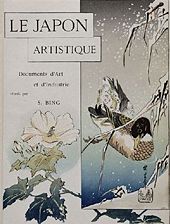
After 1860, Japonisme, sparked by the importing of Japanese woodblock prints
Ukiyo-e
' is a genre of Japanese woodblock prints and paintings produced between the 17th and the 20th centuries, featuring motifs of landscapes, tales from history, the theatre, and pleasure quarters...
, became an important influence in the western arts. In particular, many modern French artists such as Monet and Degas were influenced by the Japanese style. Mary Cassatt
Mary Cassatt
Mary Stevenson Cassatt was an American painter and printmaker. She lived much of her adult life in France, where she first befriended Edgar Degas and later exhibited among the Impressionists...
, an American artist who worked in France, used elements of combined patterns, flat planes and shifting perspective of Japanese prints in her own images. The paintings of James McNeill Whistler
James McNeill Whistler
James Abbott McNeill Whistler was an American-born, British-based artist. Averse to sentimentality and moral allusion in painting, he was a leading proponent of the credo "art for art's sake". His famous signature for his paintings was in the shape of a stylized butterfly possessing a long stinger...
and his "Peacock Room" demonstrated how he used aspects of Japanese tradition and are some of the finest works of the genre. California architects Greene and Greene
Greene and Greene
Greene and Greene was an architectural firm established by brothers Charles Sumner Greene and Henry Mather Greene , influential early 20th Century American architects...
were inspired by Japanese elements in their design of the Gamble House and other buildings.
In architecture, Egyptian revival architecture
Egyptian Revival architecture
Egyptian Revival is an architectural style that uses the motifs and imagery of ancient Egypt. It is attributed generally to the public awareness of ancient Egyptian monuments generated by Napoleon's conquest of Egypt and Admiral Nelson's defeat of Napoleon at the Battle of the Nile during 1798....
was popular mostly in the early and mid-19th century, and Indo-Saracenic Revival architecture
Indo-Saracenic Revival architecture
The Indo-Saracenic Revival was an architectural style movement by British architects in the late 19th century in British India...
or Moorish Revival architecture, covering a variety of general Islamic or Indian features, in the later part of the century; "Saracenic" referred to styles from Arabic-speaking areas. Both were sometimes used in the Orient itself by colonial governments.
Pre-19th century
Depictions of Islamic "MoorsMoors
The description Moors has referred to several historic and modern populations of the Maghreb region who are predominately of Berber and Arab descent. They came to conquer and rule the Iberian Peninsula for nearly 800 years. At that time they were Muslim, although earlier the people had followed...
" and "Turks" (imprecisely named Muslim groups of North Africa and West Asia) can be found in Medieval, Renaissance, and Baroque art. In Biblical scenes in Early Netherlandish painting
Early Netherlandish painting
Early Netherlandish painting refers to the work of artists active in the Low Countries during the 15th- and early 16th-century Northern renaissance, especially in the flourishing Burgundian cities of Bruges and Ghent...
, secondary figures, especially Romans and Jews, were given exotic costumes that distantly reflected the clothes of the Near East
Near East
The Near East is a geographical term that covers different countries for geographers, archeologists, and historians, on the one hand, and for political scientists, economists, and journalists, on the other...
. The Three Magi
Biblical Magi
The Magi Greek: μάγοι, magoi), also referred to as the Wise Men, Kings, Astrologers, or Kings from the East, were a group of distinguished foreigners who were said to have visited Jesus after his birth, bearing gifts of gold, frankincense and myrrh...
in Nativity scenes
Nativity of Jesus in art
The Nativity of Jesus has been a major subject of Christian art since the 4th century. The artistic depictions of the Nativity or birth of Jesus, celebrated at Christmas, are based on the narratives in the Bible, in the Gospels of Matthew and Luke, and further elaborated by written, oral and...
were an especial focus for this. Renaissance Venice
Venice
Venice is a city in northern Italy which is renowned for the beauty of its setting, its architecture and its artworks. It is the capital of the Veneto region...
had a phase of particular interest in depictions of the Ottoman Empire
Ottoman Empire
The Ottoman EmpireIt was usually referred to as the "Ottoman Empire", the "Turkish Empire", the "Ottoman Caliphate" or more commonly "Turkey" by its contemporaries...
in painting and prints
Old master print
An old master print is a work of art produced by a printing process within the Western tradition . A date of about 1830 is usually taken as marking the end of the period whose prints are covered by this term. The main techniques concerned are woodcut, engraving and etching, although there are...
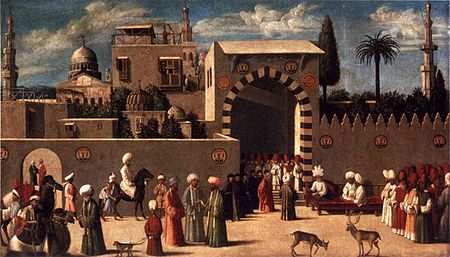
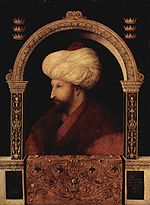
. Gentile Bellini
Gentile Bellini
Gentile Bellini was an Italian painter. From 1474 he was the official portrait artist for the Doges of Venice.- Biography :...
, who travelled to Constantinople
Constantinople
Constantinople was the capital of the Roman, Eastern Roman, Byzantine, Latin, and Ottoman Empires. Throughout most of the Middle Ages, Constantinople was Europe's largest and wealthiest city.-Names:...
and painted the Sultan, and Vittore Carpaccio
Vittore Carpaccio
Vittore Carpaccio was an Italian painter of the Venetian school, who studied under Gentile Bellini. He is best known for a cycle of nine paintings, The Legend of Saint Ursula. His style was somewhat conservative, showing little influence from the Humanist trends that transformed Italian...
were the leading painters. By then the depictions were more accurate, with men typically dressed all in white. The depiction of Oriental carpets in Renaissance painting
Oriental carpets in Renaissance painting
Carpets of Middle-Eastern origin, either from the Ottoman Empire, Armenia, Azerbaijan, the Levant or the Mamluk state of Egypt or Northern Africa, were used as important decorative features in paintings from the 14th century onwards...
sometimes draws from Orientalist interest, but more often just reflects the prestige these expensive objects had in the period.
Jean-Étienne Liotard
Jean-Étienne Liotard
Jean-Étienne Liotard was a Swiss-French painter. His father was a jeweller who fled to Switzerland after 1685....
(1702–1789) visited Istanbul
Istanbul
Istanbul , historically known as Byzantium and Constantinople , is the largest city of Turkey. Istanbul metropolitan province had 13.26 million people living in it as of December, 2010, which is 18% of Turkey's population and the 3rd largest metropolitan area in Europe after London and...
and painted numerous pastel
Pastel
Pastel is an art medium in the form of a stick, consisting of pure powdered pigment and a binder. The pigments used in pastels are the same as those used to produce all colored art media, including oil paints; the binder is of a neutral hue and low saturation....
s of Turkish domestic scenes; he also continued to wear Turkish dress for much of the time when back in Europe. The ambitious Scottish 18th century artist Gavin Hamilton
Gavin Hamilton (artist)
Gavin Hamilton was a Scottish neoclassical history painterwho is more widely remembered for his hunts for antiquities in the neighborhood of Rome...
found a solution to the problem of using modern dress, considered unheroic and inelegant, in history painting
History painting
History painting is a genre in painting defined by subject matter rather than an artistic style, depicting a moment in a narrative story, rather than a static subject such as a portrait...
by using Middle Eastern settings with Europeans wearing local costume, as travellers were advised to do. His huge James Dawkins and Robert Wood Discovering the Ruins of Palmyra
Palmyra
Palmyra was an ancient city in Syria. In the age of antiquity, it was an important city of central Syria, located in an oasis 215 km northeast of Damascus and 180 km southwest of the Euphrates at Deir ez-Zor. It had long been a vital caravan city for travellers crossing the Syrian desert...
(1758, now Edinburgh) elevates tourism to the heroic, with the two travellers wearing what look very like toga
Toga
The toga, a distinctive garment of Ancient Rome, was a cloth of perhaps 20 ft in length which was wrapped around the body and was generally worn over a tunic. The toga was made of wool, and the tunic under it often was made of linen. After the 2nd century BC, the toga was a garment worn...
s. Many travellers had themselves painted in exotic Eastern dress on their return, including Lord Byron, as did many who had never left Europe, including Madame de Pompadour
Madame de Pompadour
Jeanne Antoinette Poisson, Marquise de Pompadour, also known as Madame de Pompadour was a member of the French court, and was the official chief mistress of Louis XV from 1745 to her death.-Biography:...
.
French Orientalism
French Orientalist painting was transformed by Napoleon's ultimately unsuccessful invasion of Egypt and Syria in 1798-1801, which stimulated great public interest in EgyptologyEgyptology
Egyptology is the study of ancient Egyptian history, language, literature, religion, and art from the 5th millennium BC until the end of its native religious practices in the AD 4th century. A practitioner of the discipline is an “Egyptologist”...
, and was also recorded in subsequent years by Napoleon's court painters, especially Baron Gros, although the Middle Eastern campaign was not one on which he accompanied the army. Two of his most successful paintings, Bonaparte Visiting the Plague Victims of Jaffa (1804) and Battle of Abukir
Battle of Abukir (1799)
The Battle of Abukir was Napoleon Bonaparte's decisive victory over Seid Mustafa Pasha's Ottoman army on 25 July 1799 during the French invasion of Egypt...
(1806) focus on the Emperor, as he was by then, but include many Egyptian figures, as does the less effective Napoleon at the Battle of the Pyramids (1810). Girodet
Anne-Louis Girodet de Roussy-Trioson
Anne-Louis Girodet de Roussy-Trioson January 5, 1767 – December 9, 1824), was a French painter and pupil of Jacques-Louis David, who was part of the beginning of the Romantic movement by adding elements of eroticism through his paintings...
's La Révolte du Caire (1810) was another large and prominent example. A well-illustrated Description de l’Égypte was published by the French Government in twenty volumes between 1809 and 1828, concentrating on antiquities
Antiquities
Antiquities, nearly always used in the plural in this sense, is a term for objects from Antiquity, especially the civilizations of the Mediterranean: the Classical antiquity of Greece and Rome, Ancient Egypt and the other Ancient Near Eastern cultures...
.
Eugène Delacroix
Eugène Delacroix
Ferdinand Victor Eugène Delacroix was a French Romantic artist regarded from the outset of his career as the leader of the French Romantic school...
's first great success, The Massacre at Chios
The Massacre at Chios
The Massacre at Chios is the second major oil painting by the French artist Eugène Delacroix. The work is more than thirteen feet high, and shows some of the horror of the wartime destruction visited on the Island of Chios...
(1824) was painted before he visited the Greece or the East, and followed his friend Théodore Géricault
Théodore Géricault
Jean-Louis André Théodore Géricault was a profoundly influential French artist, painter and lithographer, known for The Raft of the Medusa and other paintings...
's The Raft of the Medusa in showing a recent incident in distant parts that had aroused public opinion. Greece
Greece
Greece , officially the Hellenic Republic , and historically Hellas or the Republic of Greece in English, is a country in southeastern Europe....
was still fighting for independence from the Ottomans, and was effectively as exotic as more Muslim parts of the empire. Delacroix followed up with Greece on the Ruins of Missolonghi
Greece on the Ruins of Missolonghi
Greece on the Ruins of Missolonghi is an 1826 oil painting by French painter Eugène Delacroix, and now preserved at the Musée des Beaux-Arts de Bordeaux...
(1827), commemorating a siege of the previous year, and the Death of Sardanapalus
Death of Sardanapalus
Death of Sardanapalus is an oil painting on canvas, dated 1827 by Eugène Delacroix. Its dimensions are 392 x 496 cm or 12′ 1" x 16′ 3". It currently hangs in the Musée du Louvre, Paris....
, inspired by Lord Byron, which although set in antiquity has been credited with beginning the mixture of sex, violence, lassitude and exoticism which runs through much French Orientalist painting. In 1832 Delacroix finally visited what is now Algeria
Algeria
Algeria , officially the People's Democratic Republic of Algeria , also formally referred to as the Democratic and Popular Republic of Algeria, is a country in the Maghreb region of Northwest Africa with Algiers as its capital.In terms of land area, it is the largest country in Africa and the Arab...
, recently conquered by the French, and Morocco
Morocco
Morocco , officially the Kingdom of Morocco , is a country located in North Africa. It has a population of more than 32 million and an area of 710,850 km², and also primarily administers the disputed region of the Western Sahara...
, as part of a diplomatic mission to the Sultan of Morocco. He was greatly struck by what he saw, comparing the North African way of life to that of the Ancient Romans, and continued to paint subjects from his trip on his return to France. Like many later Orientalist painters, he was frustrated by the difficulty of sketching subjects including women, and many of his scenes feature warriors on horses, or North African Jews. However he was apparently able to get into the women's' quarters or harem
Harem
Harem refers to the sphere of women in what is usually a polygynous household and their enclosed quarters which are forbidden to men...
of a house to sketch what became The Women of Algiers
The Women of Algiers
The Women of Algiers is an 1834 oil on canvas painting by Eugène Delacroix. It is located in the Louvre, Paris, France. The painting was first displayed at the Salon, where it was universally admired. King Louis Philippe bought it and presented it to the Musée du Luxembourg, which at that time was...
; few later harem scenes had this claim to authenticity.
When Ingres, the untravelled director of the French Académie de peinture, painted a highly coloured vision of a Turkish bath (illustration, right), he made his eroticized Orient publicly acceptable by his diffuse generalizing of the female forms (who might all have been the same model.) More open sensuality was seen as acceptable in the exotic Orient. This imagery persisted in art into the early 20th century, as evidenced in Matisse's orientalist semi-nudes from his Nice period, and his use of Oriental costumes and patterns. Ingres' pupil Théodore Chassériau
Théodore Chassériau
Théodore Chassériau was a French romantic painter noted for his portraits, historical and religious paintings, allegorical murals, and Orientalist images inspired by his travels to Algeria.-Life and work:...
(1819–1856) had already achieved success with his nude The Toilette of Esther
The Toilette of Esther
The Toilette of Esther or Esther Preparing to be Presented to King Ahasuerus, is an 1841 oil-on-canvas painting by Théodore Chassériau. The painting depicts a moment from the scriptural Book of Esther, when Esther prepared to meet King Ahasuerus, ruler of Persia, who subsequently took her as his...
(1841, Louvre
Louvre
The Musée du Louvre – in English, the Louvre Museum or simply the Louvre – is one of the world's largest museums, the most visited art museum in the world and a historic monument. A central landmark of Paris, it is located on the Right Bank of the Seine in the 1st arrondissement...
) and equestrian portrait of Ali-Ben-Hamet, Caliph of Constantine and Chief of the Haractas, Followed by his Escort (1846) before he first visited the East, but in later decades the steamship made travel much easier and increasing numbers of artists travelled to the Middle East and beyond, painting a wide range of Oriental scenes.
In many of these works, they portrayed the Orient as exotic, colorful and sensual, not to say stereotyped
Stereotypes of Arabs and Muslims
Stereotypes of Arabs and Muslims have been presented in various forms by the mass media in Western culture and American culture. Stereotypical representations of Arabs are often manifested in a society's media, literature, theater and other creative expressions...
. Such works typically concentrated on Near-Eastern Islamic cultures, as those were the ones visited by artists as France became more engaged in North Africa. French artists such as Eugène Delacroix
Eugène Delacroix
Ferdinand Victor Eugène Delacroix was a French Romantic artist regarded from the outset of his career as the leader of the French Romantic school...
, Jean-Léon Gérôme
Jean-Léon Gérôme
Jean-Léon Gérôme was a French painter and sculptor in the style now known as Academicism. The range of his oeuvre included historical painting, Greek mythology, Orientalism, portraits and other subjects, bringing the Academic painting tradition to an artistic climax.-Life:Jean-Léon Gérôme was born...
and Jean Auguste Dominique Ingres
Jean Auguste Dominique Ingres
Jean-Auguste-Dominique Ingres was a French Neoclassical painter. Although he considered himself to be a painter of history in the tradition of Nicolas Poussin and Jacques-Louis David, by the end of his life it was Ingres's portraits, both painted and drawn, that were recognized as his greatest...
painted many works depicting Islamic culture, often including lounging odalisque
Odalisque
An odalisque was a female slave in an Ottoman seraglio. She was an assistant or apprentice to the concubines and wives, and she might rise in status to become one of them...
s. They stressed both lassitude and visual spectacle. Other scenes, especially in genre painting
Genre painting
Genre works, also called genre scenes or genre views, are pictorial representations in any of various media that represent scenes or events from everyday life, such as markets, domestic settings, interiors, parties, inn scenes, and street scenes. Such representations may be realistic, imagined, or...
, have been seen as either closely comparable to their equivalents set in modern-day or historical Europe, or as also reflecting an Orientalist mind-set in the Saidian sense of the term. Gérôme was the precursor, and often the master, of a number of French painters in the later part of the century whose works were often frankly salacious, frequently featuring scenes in harems, public baths and slave auctions (the last two also available with classical decor), and responsible, with others, for "the equation of Orientalism with the nude in pornographic mode".
British Orientalism
Though British political interest in the territories of the unravelling Ottoman Empire was as intense as in France, it was mostly more discreetly exercised. The origins of British Orientalist 19th century painting owe more to religion than military conquest or the search for plausible locations for naked females. The leading British genre painter, Sir David WilkieDavid Wilkie (artist)
Sir David Wilkie was a Scottish painter.- Early life :Wilkie was the son of the parish minister of Cults in Fife. He developed a love for art at an early age. In 1799, after he had attended school at Pitlessie, Kettle and Cupar, his father reluctantly agreed to his becoming a painter...
was 55 when he travelled to Istanbul
Istanbul
Istanbul , historically known as Byzantium and Constantinople , is the largest city of Turkey. Istanbul metropolitan province had 13.26 million people living in it as of December, 2010, which is 18% of Turkey's population and the 3rd largest metropolitan area in Europe after London and...
and Jerusalem in 1840, dying off Gibraltar
Gibraltar
Gibraltar is a British overseas territory located on the southern end of the Iberian Peninsula at the entrance of the Mediterranean. A peninsula with an area of , it has a northern border with Andalusia, Spain. The Rock of Gibraltar is the major landmark of the region...
during the return voyage. Though not noted as a religious painter, Wilkie made the trip with a Protestant agenda to reform religious painting, as he believed that: "a Martin Luther
Martin Luther
Martin Luther was a German priest, professor of theology and iconic figure of the Protestant Reformation. He strongly disputed the claim that freedom from God's punishment for sin could be purchased with money. He confronted indulgence salesman Johann Tetzel with his Ninety-Five Theses in 1517...
in painting is as much called for as in theology, to sweep away the abuses by which our divine pursuit is encumbered", by which he meant traditional Christian iconography
Iconography
Iconography is the branch of art history which studies the identification, description, and the interpretation of the content of images. The word iconography literally means "image writing", and comes from the Greek "image" and "to write". A secondary meaning is the painting of icons in the...
. He hoped to find more authentic settings and decor for Biblical subjects at their original location, though his death prevented more than studies being made. Other artists including the Pre-Raphaelite William Holman Hunt
William Holman Hunt
William Holman Hunt OM was an English painter, and one of the founders of the Pre-Raphaelite Brotherhood.-Biography:...
and David Roberts
David Roberts (painter)
David Roberts RA was a Scottish painter. He is especially known for a prolific series of detailed lithograph prints of Egypt and the Near East that he produced during the 1840s from sketches he made during long tours of the region . These, and his large oil paintings of similar subjects, made him...
had similar motivations, giving an emphasis on realism in British Orientalist art from the start. The French artist James Tissot
James Tissot
James Jacques Joseph Tissot was a French painter, who spent much of his career in Britain.-Biography:Tissot was born in Nantes, France. In about 1856, he began study at the École des Beaux-Arts in Paris under Hippolyte Flandrin and Lamothe, and became friendly with Edgar Degas and James Abbott...
also used contemporary Middle Eastern landscape and decor for Biblical subjects, with little attempt at historicising costumes or other fittings.
William Holman Hunt produced a number of major paintings of Biblical subjects drawing on his Middle Eastern travels, improvising variants of contemporary Arab costume and furnishings to avoid specifically Islamic styles, and also some landscapes and genre subjects. The biblical subjects included The Scapegoat
The Scapegoat (painting)
The Scapegoat is a painting by William Holman Hunt which depicts the "scapegoat" described in the Book of Leviticus. He started painting on the shore of the Dead Sea, and continued in his studio in London...
(1856), The Finding of the Saviour in the Temple
The Finding of the Saviour in the Temple
The Finding of the Saviour in the Temple is a painting by William Holman Hunt intended as an ethnographically accurate version of the subject traditionally known as "Christ Among the Doctors", an illustration of the child Jesus debating the interpretation of the scripture with learned rabbis...
(1860), and The Shadow of Death
The Shadow of Death
The Shadow of Death is a religious painting by William Holman Hunt, on which he worked from 1870 to 1873, after his second trip to the Holy Land. It depicts Jesus as a young man prior to his ministry, working as a carpenter. He is shown stretching his arms after sawing wood...
(1871). The Miracle of the Holy Fire
The Miracle of the Holy Fire (painting)
The Miracle of the Holy Fire is a painting by William Holman Hunt which depicts the Greek Orthodox rite of the Holy Fire in the Church of the Holy Sepulchre Jerusalem. Hunt believed the fire to be a pious fraud which brought Christianity into disrepute. He intended the painting to be a satire in...
(1899) was intended as a picturesque satire on the local Eastern Christians, of whom, like most English visitors, Hunt took a very dim view. His A Street Scene in Cairo; The Lantern-Maker's Courtship (1854–61) is a rare contemporary narrative scene, as the young man feels his fiancé's face, which he is not allowed to see, through her veil, as an Westerner in the background beats his way up the street with his stick. This a rare intrusion of a clearly contemporary figure into a Orientalist scene; mostly they claim the picturesqueness of the historical painting so popular at the time, without the trouble of researching authentic costumes and settings.
When Gérôme exhibited For Sale; Slaves at Cairo at the Royal Academy
Royal Academy
The Royal Academy of Arts is an art institution based in Burlington House on Piccadilly, London. The Royal Academy of Arts has a unique position in being an independent, privately funded institution led by eminent artists and architects whose purpose is to promote the creation, enjoyment and...
in London in 1871, it was "widely found offensive", perhaps partly because the British liked to think they had successfully suppressed the slave trade in Egypt, also for cruelty and "representing fleshiness for its own sake". But Rana Kabbani believes that "French Orientalist painting, as exemplified by the works of Gérôme, may appear more sensual, gaudy, gory and sexually explicit than its British counterpart, but this is a difference of style not substance ... Similar strains of fascination and repulsion convulsed their artists" Nonetheless, nudity and violence are more evident in British paintings set in the ancient world, and "the iconography of the odalisque
Odalisque
An odalisque was a female slave in an Ottoman seraglio. She was an assistant or apprentice to the concubines and wives, and she might rise in status to become one of them...
... the Oriental sex slave whose image is offered up to the viewer as freely as she herself supposedly was to her master - is almost entirely French in origin", though taken up with enthusiasm by Italian and other painters.
John Frederick Lewis
John Frederick Lewis
John Frederick Lewis was an Orientalist English painter. He specialized in Oriental and Mediterranean scenes and often worked in exquisitely detailed watercolour. He was the son of Frederick Christian Lewis , engraver and landscape-painter.Lewis lived in Spain between 1832 and 1834...
, who lived for several years in a traditional mansion in Cairo
Cairo
Cairo , is the capital of Egypt and the largest city in the Arab world and Africa, and the 16th largest metropolitan area in the world. Nicknamed "The City of a Thousand Minarets" for its preponderance of Islamic architecture, Cairo has long been a centre of the region's political and cultural life...
, painted highly detailed works showing both realistic genre scenes
Genre painting
Genre works, also called genre scenes or genre views, are pictorial representations in any of various media that represent scenes or events from everyday life, such as markets, domestic settings, interiors, parties, inn scenes, and street scenes. Such representations may be realistic, imagined, or...
of Middle Eastern life and more idealized scenes in upper class Egyptian interiors with no traces of Western cultural influence yet apparent. His very careful and loving representation of Islamic architecture, furnishings, screens, and costumes set new standards of realism, which influenced other artists, including Gérôme in his later works. He "never painted a nude", and his wife modelled for several of his harem scenes, which, with the rare examples by the classicist painter Lord Leighton, imagine "the harem as a place of almost English domesticity, ... [where]... women's fully clothed respectability suggests a moral healthiness to go with their natural good looks".
English and French harems
Other artists concentrated on landscape painting, often of desert scenes, including Richard Dadd
Richard Dadd
Richard Dadd was an English painter of the Victorian era, noted for his depictions of fairies and other supernatural subjects, Orientalist scenes, and enigmatic genre scenes, rendered with obsessively minuscule detail...
and Edward Lear
Edward Lear
Edward Lear was an English artist, illustrator, author, and poet, renowned today primarily for his literary nonsense, in poetry and prose, and especially his limericks, a form that he popularised.-Biography:...
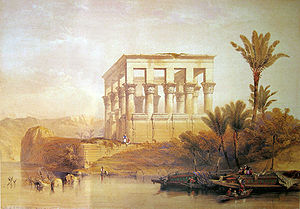
. David Roberts
David Roberts (painter)
David Roberts RA was a Scottish painter. He is especially known for a prolific series of detailed lithograph prints of Egypt and the Near East that he produced during the 1840s from sketches he made during long tours of the region . These, and his large oil paintings of similar subjects, made him...
(1796–1864) produced architectural and landscape views, many of antiquities
Antiquities
Antiquities, nearly always used in the plural in this sense, is a term for objects from Antiquity, especially the civilizations of the Mediterranean: the Classical antiquity of Greece and Rome, Ancient Egypt and the other Ancient Near Eastern cultures...
, and published very successful books of lithographs from them.
Elsewhere
Russian Orientalist art was largely concerned with the areas of Central Asia that Russia was conquering during the century, and also in historical painting with the Mongols who had dominated Russia for much of the Middle Ages, who were rarely shown in a good light. Nationalist historical painting in Central EuropeCentral Europe
Central Europe or alternatively Middle Europe is a region of the European continent lying between the variously defined areas of Eastern and Western Europe...
and the Balkans
Balkans
The Balkans is a geopolitical and cultural region of southeastern Europe...
dwelt on Turkish oppression, with battle scenes and maidens about to be raped.
The Saidian analysis has not prevented a strong revival of interest in, and collecting of, 19th century Orientalist works since the 1970s, the latter in large part led by Middle Eastern buyers,
Orientalist artists
- Théodore ChassériauThéodore ChassériauThéodore Chassériau was a French romantic painter noted for his portraits, historical and religious paintings, allegorical murals, and Orientalist images inspired by his travels to Algeria.-Life and work:...
(1819–1856) - Richard DaddRichard DaddRichard Dadd was an English painter of the Victorian era, noted for his depictions of fairies and other supernatural subjects, Orientalist scenes, and enigmatic genre scenes, rendered with obsessively minuscule detail...
(1817–1886) - Eugène DelacroixEugène DelacroixFerdinand Victor Eugène Delacroix was a French Romantic artist regarded from the outset of his career as the leader of the French Romantic school...
(1798–1863) - Ludwig Deutsch (1855–1935)
- Alphonse Étienne DinetÉtienne DinetAlphonse-Étienne Dinet, also known as Nasr'Eddine Dinet was a French orientalist painter.-Biography:Dinet was born the son of a prominent French judge...
- Edmund DulacEdmund DulacEdmund Dulac was a French book illustrator.-Early life and career:Born in Toulouse, France, he began his career by studying law at the University of Toulouse. He also studied art, switching to it full time after he became bored with law, and having won prizes at the Ecole des Beaux Arts...
- Eugène FromentinEugène FromentinEugène Fromentin was a French painter and writer.He was born in La Rochelle. After leaving school he studied for some years under Louis Cabat, the landscape painter...
(1820–1876) - Jean-Léon GérômeJean-Léon GérômeJean-Léon Gérôme was a French painter and sculptor in the style now known as Academicism. The range of his oeuvre included historical painting, Greek mythology, Orientalism, portraits and other subjects, bringing the Academic painting tradition to an artistic climax.-Life:Jean-Léon Gérôme was born...
(1824–1904) - William Holman HuntWilliam Holman HuntWilliam Holman Hunt OM was an English painter, and one of the founders of the Pre-Raphaelite Brotherhood.-Biography:...
(1827–1910) - Jean Auguste Dominique IngresJean Auguste Dominique IngresJean-Auguste-Dominique Ingres was a French Neoclassical painter. Although he considered himself to be a painter of history in the tradition of Nicolas Poussin and Jacques-Louis David, by the end of his life it was Ingres's portraits, both painted and drawn, that were recognized as his greatest...
(1780–1867) - Edward LearEdward LearEdward Lear was an English artist, illustrator, author, and poet, renowned today primarily for his literary nonsense, in poetry and prose, and especially his limericks, a form that he popularised.-Biography:...
(1812–1888) - Frederic LeightonFrederic Leighton, 1st Baron LeightonFrederic Leighton, 1st Baron Leighton PRA , known as Sir Frederic Leighton, Bt, between 1886 and 1896, was an English painter and sculptor. His works depicted historical, biblical and classical subject matter...
(1830–1896) - John Frederick LewisJohn Frederick LewisJohn Frederick Lewis was an Orientalist English painter. He specialized in Oriental and Mediterranean scenes and often worked in exquisitely detailed watercolour. He was the son of Frederick Christian Lewis , engraver and landscape-painter.Lewis lived in Spain between 1832 and 1834...
(1805–1876) - Jean-Étienne LiotardJean-Étienne LiotardJean-Étienne Liotard was a Swiss-French painter. His father was a jeweller who fled to Switzerland after 1685....
(1702–1789) - Edwin Longsden Long, a specialist in Ancient Egyptian scenes
- Alberto Pasini (1826–1899)
- Théodore RalliThéodore RalliThéodore Jacques Ralli or Theodorus Rallis was a Greek painter, watercolourist and draughtsman, who spent most of his working life in Paris, France and in Egypt.He painted genre works, portraits, local figures, architectural subjects, interiors with figures and animals...
(1852–1909) - David Roberts (painter)David Roberts (painter)David Roberts RA was a Scottish painter. He is especially known for a prolific series of detailed lithograph prints of Egypt and the Near East that he produced during the 1840s from sketches he made during long tours of the region . These, and his large oil paintings of similar subjects, made him...
(1796–1864) - Alexandre Roubtzoff (1884–1949)
- Giulio RosatiGiulio RosatiGiulio Rosati was an Italian painter specialized in orientalist and academic scenes. He studied at the Accademia di San Luca under Dario Querci and Francesco Podesti. His son, Alberto Rosati , was also an orientalist painter....
(1858–1917) - James TissotJames TissotJames Jacques Joseph Tissot was a French painter, who spent much of his career in Britain.-Biography:Tissot was born in Nantes, France. In about 1856, he began study at the École des Beaux-Arts in Paris under Hippolyte Flandrin and Lamothe, and became friendly with Edgar Degas and James Abbott...
(1836–1902) - David WilkieDavid Wilkie (artist)Sir David Wilkie was a Scottish painter.- Early life :Wilkie was the son of the parish minister of Cults in Fife. He developed a love for art at an early age. In 1799, after he had attended school at Pitlessie, Kettle and Cupar, his father reluctantly agreed to his becoming a painter...
(1785–1841) - Jean-Baptiste van MourJean-Baptiste van MourJean-Baptiste van Mour or Vanmour was a Flemish-French painter, remembered for his detailed portrayal of life in the Ottoman Empire during the Tulip Era and the rule of Sultan Ahmed III.-Biography:...
(1671–1731) - Ecem Kafadar (1885–1940)
- Edwin Lord WeeksEdwin Lord WeeksEdwin Lord Weeks , American artist, was born at Boston, Massachusetts, in 1849. He was a pupil of Léon Bonnat and of Jean-Léon Gérôme, at Paris...
(1849–1903) - Adolf SchreyerAdolf SchreyerAdolf Schreyer was a German painter.-Biography:He studied art first at the Städel Institute in his native town, and then at Stuttgart and Munich. He painted many of his favourite subjects in his travels in the East...
(1828–1899)
Literature and music
Authors and composers are not commonly referred to as "Orientalist" in the way that artists are, and relatively few specialized in Oriental topics or styles, or are even best known for their works including them. But many major figures, from Mozart to Flaubert, have produced significant works with Oriental subjects or treatments. For example, Verdi's opera Aida (1871) is set in Egypt as portrayed through the content and the visual spectacle. "Aida" depicts a militaristic Egypt's tyranny over Ethiopia.In music, Orientalism may be applied to styles occurring in different periods, such as the alla Turca, used by multiple composers including Mozart and Beethoven. Orientalism is also traceable in music that is considered to have effects of exoticism, including the japonisme in Claude Debussy's piano music all the way to the sitar being used in recordings by The Beatles.
In his novel Salammbô
Salammbô (novel)
Salammbô is a historical novel by Gustave Flaubert. It is set in Carthage during the third century BCE, immediately before and during the Mercenary Revolt which took place shortly after the First Punic War. Flaubert's main source was Book I of Polybius's Histories...
, Gustave Flaubert
Gustave Flaubert
Gustave Flaubert was a French writer who is counted among the greatest Western novelists. He is known especially for his first published novel, Madame Bovary , and for his scrupulous devotion to his art and style.-Early life and education:Flaubert was born on December 12, 1821, in Rouen,...
used ancient Carthage
Carthage
Carthage , implying it was a 'new Tyre') is a major urban centre that has existed for nearly 3,000 years on the Gulf of Tunis, developing from a Phoenician colony of the 1st millennium BC...
in North Africa as a foil
Foil (literature)
In fiction, a foil is a character who contrasts with another character in order to highlight particular qualities of another character....
to ancient Rome
Rome
Rome is the capital of Italy and the country's largest and most populated city and comune, with over 2.7 million residents in . The city is located in the central-western portion of the Italian Peninsula, on the Tiber River within the Lazio region of Italy.Rome's history spans two and a half...
. He portrayed its culture as morally corrupting and suffused with dangerously alluring eroticism. This novel proved hugely influential on later portrayals of ancient Semitic
Semitic
In linguistics and ethnology, Semitic was first used to refer to a language family of largely Middle Eastern origin, now called the Semitic languages...
cultures.
The use of the Orient as an exotic backdrop continued in the movies, for instance, those featuring Rudolph Valentino
Rudolph Valentino
Rudolph Valentino was an Italian actor, and early pop icon. A sex symbol of the 1920s, Valentino was known as the "Latin Lover". He starred in several well-known silent films including The Four Horsemen of the Apocalypse, The Sheik, Blood and Sand, The Eagle and Son of the Sheik...
. Later the rich Arab in robes became a more popular theme, especially during the oil crisis of the 1970s. In the 1990s the Arab terrorist became a common villain figure in Western movies.
Examples
Literature
- The Travels of Marco PoloThe Travels of Marco PoloBooks of the Marvels of the World or Description of the World , also nicknamed Il Milione or Oriente Poliano and commonly called The Travels of Marco Polo, is a 13th-century travelogue written down by Rustichello da Pisa from stories told by Marco Polo, describing the...
, 13th century - Travels of Sir John Mandeville, 14th century invented account of travels.
- Christopher MarloweChristopher MarloweChristopher Marlowe was an English dramatist, poet and translator of the Elizabethan era. As the foremost Elizabethan tragedian, next to William Shakespeare, he is known for his blank verse, his overreaching protagonists, and his mysterious death.A warrant was issued for Marlowe's arrest on 18 May...
, TamburlaineTamburlaine (play)Tamburlaine the Great is the name of a play in two parts by Christopher Marlowe. It is loosely based on the life of the Central Asian emperor, Timur 'the lame'...
, 1588/89 - John DrydenJohn DrydenJohn Dryden was an influential English poet, literary critic, translator, and playwright who dominated the literary life of Restoration England to such a point that the period came to be known in literary circles as the Age of Dryden.Walter Scott called him "Glorious John." He was made Poet...
, Aureng-zebeAureng-zebeAureng-zebe is a Restoration drama by John Dryden, 1675 based loosely on the figures of Aurangzeb , the then-reigning Mughal Emperor of India; his brother, Murad Baksh ; and their father Shah Jahan . The piece was Dryden's last drama to be written in rhymed verse...
(1675), a heroic dramaHeroic dramaHeroic drama is a type of play popular during the Restoration era in England, distinguished by both its verse structure and its subject matter. The sub-genre of heroic drama evolved through several works of the middle to later 1660s; John Dryden's The Indian Emperour and Roger Boyle's The Black...
in theory based on the life of the reigning Mughal Emperor, AurangzebAurangzebAbul Muzaffar Muhy-ud-Din Muhammad Aurangzeb Alamgir , more commonly known as Aurangzeb or by his chosen imperial title Alamgir , was the sixth Mughal Emperor of India, whose reign lasted from 1658 until his death in 1707.Badshah Aurangzeb, having ruled most of the Indian subcontinent for nearly... - MontesquieuCharles de Secondat, baron de MontesquieuCharles-Louis de Secondat, baron de La Brède et de Montesquieu , generally referred to as simply Montesquieu, was a French social commentator and political thinker who lived during the Enlightenment...
— Persian LettersPersian LettersPersian Letters is a literary work by Charles de Secondat, baron de Montesquieu, recounting the experiences of two Persian noblemen, Usbek and Rica, who are traveling through France.-Plot summary:...
(Lettres persanes) (1721) - William Thomas BeckfordWilliam Thomas BeckfordWilliam Thomas Beckford , usually known as William Beckford, was an English novelist, a profligate and consummately knowledgeable art collector and patron of works of decorative art, a critic, travel writer and sometime politician, reputed to be the richest commoner in England...
— VathekVathekVathek is a Gothic novel written by William Beckford...
(1786) - Robert SoutheyRobert SoutheyRobert Southey was an English poet of the Romantic school, one of the so-called "Lake Poets", and Poet Laureate for 30 years from 1813 to his death in 1843...
— Thalaba the DestroyerThalaba the DestroyerThalaba the Destroyer is an 1801 epic poem composed by Robert Southey. The origins of the poem can be traced to Southey's school boy days, but he did not begin to write the poem until he finished composing Madoc at the age of 25. Thalaba the Destroyer was completed while Southey travelled in...
(1801) - Robert SoutheyRobert SoutheyRobert Southey was an English poet of the Romantic school, one of the so-called "Lake Poets", and Poet Laureate for 30 years from 1813 to his death in 1843...
— Curse of KehamaCurse of KehamaThe Curse of Kehama is an 1810 epic poem composed by Robert Southey. The origins of the poem can be traced to Southey's school boy days when he would suffer insomnia along with his memories of a dark and mysterious schoolmate that later formed the basis for one of the poem's villains. The poem was...
(1810) - Lord Byron — The Bride of AbydosThe Bride of AbydosThe Bride of Abydos is a poem written by George Gordon, Lord Byron in AD 1813. One of his earlier works, The Bride of Abydos is considered to be one of his “Heroic Poems”, along with The Giaour, Lara, The Siege of Corinth, The Corsair, and Parisina...
, The GiaourThe Giaour"The Giaour" is a poem by Lord Byron first published in 1813 and the first in the series of his Oriental romances. "The Giaour" proved to be a great success when published, consolidating Byron's reputation critically and commercially.-Background:...
, Don JuanDon Juan (Byron)Don Juan is a satiric poem by Lord Byron, based on the legend of Don Juan, which Byron reverses, portraying Juan not as a womanizer but as someone easily seduced by women. It is a variation on the epic form. Byron himself called it an "Epic Satire"...
and other works - Samuel Taylor ColeridgeSamuel Taylor ColeridgeSamuel Taylor Coleridge was an English poet, Romantic, literary critic and philosopher who, with his friend William Wordsworth, was a founder of the Romantic Movement in England and a member of the Lake Poets. He is probably best known for his poems The Rime of the Ancient Mariner and Kubla...
— Kubla KhanKubla KhanKubla Khan is a poem by Samuel Taylor Coleridge, completed in 1797 and published in Christabel, Kubla Khan, and the Pains of Sleep in 1816...
(published 1816) - Thomas MooreThomas MooreThomas Moore was an Irish poet, singer, songwriter, and entertainer, now best remembered for the lyrics of The Minstrel Boy and The Last Rose of Summer. He was responsible, with John Murray, for burning Lord Byron's memoirs after his death...
— Lalla-RookhLalla-RookhLalla Rookh is an Oriental romance by Thomas Moore, published in 1817. The title is taken from the name of the heroine of the frame tale, the daughter of the Mughal emperor Aurangzeb...
(published 1817) - Johann Wolfgang von GoetheJohann Wolfgang von GoetheJohann Wolfgang von Goethe was a German writer, pictorial artist, biologist, theoretical physicist, and polymath. He is considered the supreme genius of modern German literature. His works span the fields of poetry, drama, prose, philosophy, and science. His Faust has been called the greatest long...
— Westöstlicher Diwan (1819) - Ralph Waldo EmersonRalph Waldo EmersonRalph Waldo Emerson was an American essayist, lecturer, and poet, who led the Transcendentalist movement of the mid-19th century...
— poem Indian Superstition (1821) - Edgar Allan PoeEdgar Allan PoeEdgar Allan Poe was an American author, poet, editor and literary critic, considered part of the American Romantic Movement. Best known for his tales of mystery and the macabre, Poe was one of the earliest American practitioners of the short story and is considered the inventor of the detective...
— Tamerlane (1827), Al AaraafAl Aaraaf"Al Aaraaf" is an early poem by American writer Edgar Allan Poe, first published in 1829. It is based on stories from the Qur'an, and tells of the afterlife in a place called Al Aaraaf...
(1829), and Israfel (1831) - Victor HugoVictor HugoVictor-Marie Hugo was a Frenchpoet, playwright, novelist, essayist, visual artist, statesman, human rights activist and exponent of the Romantic movement in France....
— Les OrientalesLes OrientalesLes Orientales is a collection of poems by Victor Hugo, inspired by the Greek War of Independence. They were first published in January 1829.Of the forty-one poems, thirty-six were written during 1828...
(1829) - Gustave FlaubertGustave FlaubertGustave Flaubert was a French writer who is counted among the greatest Western novelists. He is known especially for his first published novel, Madame Bovary , and for his scrupulous devotion to his art and style.-Early life and education:Flaubert was born on December 12, 1821, in Rouen,...
— SalammbôSalammbô (novel)Salammbô is a historical novel by Gustave Flaubert. It is set in Carthage during the third century BCE, immediately before and during the Mercenary Revolt which took place shortly after the First Punic War. Flaubert's main source was Book I of Polybius's Histories...
(1862) - Eça de Queiroz — The Relic (A Relíquia) (1887) and The Mandarin (O Mandarim) (1889)
- Anatole FranceAnatole FranceAnatole France , born François-Anatole Thibault, , was a French poet, journalist, and novelist. He was born in Paris, and died in Saint-Cyr-sur-Loire. He was a successful novelist, with several best-sellers. Ironic and skeptical, he was considered in his day the ideal French man of letters...
— ThaïsThaïs (novel)Thaïs is a novel by Anatole France published in 1890. It is based on events in the life of Saint Thaïs of Egypt, a legendary convert to Christianity who is said to have lived in the 4th century...
(1890) - Edward FitzGeraldEdward FitzGerald (poet)Edward FitzGerald was an English writer, best known as the poet of the first and most famous English translation of The Rubaiyat of Omar Khayyam. The spelling of his name as both FitzGerald and Fitzgerald is seen...
- "translation" or adaptation of the Persian Rubaiyat of Omar KhayyamRubaiyat of Omar KhayyamThe Rubáiyát of Omar Khayyám is the title that Edward FitzGerald gave to his translation of a selection of poems, originally written in Persian and of which there are about a thousand, attributed to Omar Khayyám , a Persian poet, mathematician and astronomer...
(1859) - Pierre LotiPierre LotiPierre Loti was a French novelist and naval officer.-Biography:Loti's education began in his birthplace, Rochefort, Charente-Maritime. At the age of seventeen he entered the naval school in Brest and studied at Le Borda. He gradually rose in his profession, attaining the rank of captain in 1906...
(1850–1923) - highly popular French writer, mostly on his Oriental travels & novels set as far away as Japan and TahitiTahitiTahiti is the largest island in the Windward group of French Polynesia, located in the archipelago of the Society Islands in the southern Pacific Ocean. It is the economic, cultural and political centre of French Polynesia. The island was formed from volcanic activity and is high and mountainous... - Richard Francis BurtonRichard Francis BurtonCaptain Sir Richard Francis Burton KCMG FRGS was a British geographer, explorer, translator, writer, soldier, orientalist, cartographer, ethnologist, spy, linguist, poet, fencer and diplomat. He was known for his travels and explorations within Asia, Africa and the Americas as well as his...
— translation of The Book of One Thousand and One NightsThe Book of One Thousand and One NightsOne Thousand and One Nights is a collection of Middle Eastern and South Asian stories and folk tales compiled in Arabic during the Islamic Golden Age...
(1885–1888) - Leo TolstoyLeo TolstoyLev Nikolayevich Tolstoy was a Russian writer who primarily wrote novels and short stories. Later in life, he also wrote plays and essays. His two most famous works, the novels War and Peace and Anna Karenina, are acknowledged as two of the greatest novels of all time and a pinnacle of realist...
— Hadji Murat (1912) - Victor SegalenVictor SegalenVictor Segalen was a French naval doctor, ethnographer, archeologist, writer, poet, explorer, art-theorist, linguist and literary critic....
— René Leys (1922) - Herman Hesse — SiddharthaSiddhartha (novel)Siddhartha is a novel by Hermann Hesse that deals with the spiritual journey of an Indian man named Siddhartha during the time of the Buddha.The book, Hesse's ninth novel , was written in German, in a simple, powerful, and lyrical style. It was published in the U.S. in 1951 and became influential...
(1922) - André MalrauxAndré MalrauxAndré Malraux DSO was a French adventurer, award-winning author, and statesman. Having traveled extensively in Indochina and China, Malraux was noted especially for his novel entitled La Condition Humaine , which won the Prix Goncourt...
— Man's FateMan's FateMan's Fate is a 1933 novel written by André Malraux about the failed communist insurrection in Shanghai in 1927, and the existential quandaries facing a diverse group of people associated with the revolution...
(1934) (La Condition humaine, 1933) - Marguerite YourcenarMarguerite YourcenarMarguerite Yourcenar was a Belgian-born French novelist and essayist. Winner of the Prix Femina and the Erasmus Prize, she was the first woman elected to the Académie française, in 1980, and the seventeenth person to occupy Seat 3.-Biography:Yourcenar was born Marguerite Antoinette Jeanne Marie...
's Nouvelles Orientales (1938)
Opera, ballets, musicals

- Antonio Lucio Vivaldi — Juditha triumphansJuditha triumphansJuditha triumphans devicta Holofernis barbarie translated as Judith triumphant over the barbarians of Holofernes, Vivaldi catalogue number RV 644, is an oratorio by Antonio Vivaldi, the only survivor of the four that he is known to have composed...
(1716) - Georg Friedrich Händel — TamerlanoTamerlanoTamerlano is an opera in three acts written for the Royal Academy of Music , with music by George Frideric Handel to an Italian text by Nicola Francesco Haym, adapted from Agostin Piovene's Tamerlano together with another libretto entitled Bajazet after Nicolas Pradon's Tamerlan, ou La Mort de...
(1724) and SerseSerseSerse is an opera seria in three acts by George Frideric Handel. It was first performed in London on 15 April 1738. The Italian libretto was adapted by an unknown hand from that by Silvio Stampiglia for an earlier opera of the same name by Giovanni Bononcini in 1694...
(1738) - Jean-Philippe RameauJean-Philippe RameauJean-Philippe Rameau was one of the most important French composers and music theorists of the Baroque era. He replaced Jean-Baptiste Lully as the dominant composer of French opera and is also considered the leading French composer for the harpsichord of his time, alongside François...
— Les Indes GalantesLes Indes galantesLes Indes galantes is an opéra-ballet consisting of a prologue and four entrées by Jean-Philippe Rameau with libretto by Louis Fuzelier...
(1735–1736) - Wolfgang Amadeus MozartWolfgang Amadeus MozartWolfgang Amadeus Mozart , baptismal name Johannes Chrysostomus Wolfgangus Theophilus Mozart , was a prolific and influential composer of the Classical era. He composed over 600 works, many acknowledged as pinnacles of symphonic, concertante, chamber, piano, operatic, and choral music...
— Die Entführung aus dem SerailDie Entführung aus dem SerailDie Entführung aus dem Serail is an opera Singspiel in three acts by Wolfgang Amadeus Mozart. The German libretto is by Christoph Friedrich Bretzner with adaptations by Gottlieb Stephanie...
(1782) - Gioachino Rossini — SemiramideSemiramideSemiramide is an opera in two acts by Gioachino Rossini.The libretto by Gaetano Rossi is based on Voltaire's tragedy Semiramis, which in turn was based on the legend of Semiramis of Babylon...
(1823) - Giuseppe VerdiGiuseppe VerdiGiuseppe Fortunino Francesco Verdi was an Italian Romantic composer, mainly of opera. He was one of the most influential composers of the 19th century...
— NabuccoNabuccoNabucco is an opera in four acts by Giuseppe Verdi to an Italian libretto by Temistocle Solera, based on the Biblical story and the 1836 play by Auguste Anicet-Bourgeois and Francis Cornue...
(1842) - Jacques OffenbachJacques OffenbachJacques Offenbach was a Prussian-born French composer, cellist and impresario. He is remembered for his nearly 100 operettas of the 1850s–1870s and his uncompleted opera The Tales of Hoffmann. He was a powerful influence on later composers of the operetta genre, particularly Johann Strauss, Jr....
— Ba-ta-clanBa-ta-clanBa-ta-clan is a "chinoiserie musicale", or operetta, in one act by Jacques Offenbach to an original French libretto by Ludovic Halévy. It was first performed at Théâtre des Bouffes Parisiens, Paris, on 29 December 1855. The operetta uses set numbers and spoken dialogue and runs about one...
(1855) - Georges BizetGeorges BizetGeorges Bizet formally Alexandre César Léopold Bizet, was a French composer, mainly of operas. In a career cut short by his early death, he achieved few successes before his final work, Carmen, became one of the most popular and frequently performed works in the entire opera repertory.During a...
— Les Pêcheurs de PerlesLes pêcheurs de perlesLes pêcheurs de perles is an opera in three acts by the French composer Georges Bizet, to a libretto by Eugène Cormon and Michel Carré. It was first performed on 30 September 1863 at the Théâtre Lyrique in Paris, and was given 18 performances in its initial run...
(1863) - Giuseppe VerdiGiuseppe VerdiGiuseppe Fortunino Francesco Verdi was an Italian Romantic composer, mainly of opera. He was one of the most influential composers of the 19th century...
— AidaAidaAida sometimes spelled Aïda, is an opera in four acts by Giuseppe Verdi to an Italian libretto by Antonio Ghislanzoni, based on a scenario written by French Egyptologist Auguste Mariette...
(1871) - Emmanuel ChabrierEmmanuel ChabrierEmmanuel Chabrier was a French Romantic composer and pianist. Although known primarily for two of his orchestral works, España and Joyeuse marche, he left an important corpus of operas , songs, and piano music as well...
— Fisch-Ton-KanFisch-Ton-KanFisch-Ton-Kan is an opéra bouffe in one act by Emmanuel Chabrier of which only some numbers survive. The French libretto was by Paul Verlaine, and probably Lucien Viotti, after the 'parade chinoise' Fich-Tong-Khan ou L'orphelin de le Tartarie of 1835 by Thomas Sauvage and Gabriel de Lurieu .The...
(1875) - César CuiCésar CuiCésar Antonovich Cui was a Russian of French and Lithuanian descent. His profession was as an army officer and a teacher of fortifications; his avocational life has particular significance in the history of music, in that he was a composer and music critic; in this sideline he is known as a...
— The Mandarin's SonThe Mandarin's SonThe Mandarin's Son is comic opera in one act by César Cui, composed in 1859. The libretto, which includes spoken dialogue, was written by V.A...
(1878) - Gilbert and SullivanGilbert and SullivanGilbert and Sullivan refers to the Victorian-era theatrical partnership of the librettist W. S. Gilbert and the composer Arthur Sullivan . The two men collaborated on fourteen comic operas between 1871 and 1896, of which H.M.S...
— The MikadoThe MikadoThe Mikado; or, The Town of Titipu is a comic opera in two acts, with music by Arthur Sullivan and libretto by W. S. Gilbert, their ninth of fourteen operatic collaborations...
(1885) - Alexander BorodinAlexander BorodinAlexander Porfiryevich Borodin was a Russian Romantic composer and chemist of Georgian–Russian parentage. He was a member of the group of composers called The Five , who were dedicated to producing a specifically Russian kind of art music...
— Prince IgorPrince IgorPrince Igor is an opera in four acts with a prologue. It was composed by Alexander Borodin. The composer adapted the libretto from the East Slavic epic The Lay of Igor's Host, which recounts the campaign of Russian prince Igor Svyatoslavich against the invading Polovtsian tribes in 1185...
(1890) - Sidney JonesSidney JonesJames Sidney Jones , usually credited as Sidney Jones, was an English conductor and composer, most famous for producing the musical scores for a series of musical comedy hits in the late Victorian and Edwardian periods....
— The GeishaThe GeishaThe Geisha, a story of a tea house is an Edwardian Musical Comedy in two acts. The score was composed by Sidney Jones to a libretto by Owen Hall, with lyrics by Harry Greenbank. Additional songs were written by Lionel Monckton and James Philip....
(1896) - Sidney JonesSidney JonesJames Sidney Jones , usually credited as Sidney Jones, was an English conductor and composer, most famous for producing the musical scores for a series of musical comedy hits in the late Victorian and Edwardian periods....
— San ToySan ToySan Toy, or The Emperor's Own is a "Chinese" musical comedy in two acts, first performed at Daly's Theatre, London, on 21 October 1899, and ran for 768 performances...
(1899) - Pietro MascagniPietro MascagniPietro Antonio Stefano Mascagni was an Italian composer most noted for his operas. His 1890 masterpiece Cavalleria rusticana caused one of the greatest sensations in opera history and single-handedly ushered in the Verismo movement in Italian dramatic music...
— IrisIris (opera)Iris is an opera in three acts by Pietro Mascagni to an original Italian libretto by Luigi Illica. Its first performance was at the Teatro Costanzi in Rome on 22 November 1898.The opera is through-composed and set in Japan during legendary times...
(1899) - Howard TalbotHoward TalbotRichard Lansdale Munkittrick, better known as Howard Talbot , was an American-born, English-raised conductor and composer of Irish descent...
— A Chinese HoneymoonA Chinese HoneymoonA Chinese Honeymoon is a musical comedy in two acts by George Dance, with music by Howard Talbot and additional music by Ivan Caryll and others, and additional lyrics by Harry Greenbank and others...
(1896) - Giacomo PucciniGiacomo PucciniGiacomo Antonio Domenico Michele Secondo Maria Puccini was an Italian composer whose operas, including La bohème, Tosca, Madama Butterfly, and Turandot, are among the most frequently performed in the standard repertoire...
— Madama ButterflyMadama ButterflyMadama Butterfly is an opera in three acts by Giacomo Puccini, with an Italian libretto by Luigi Illica and Giuseppe Giacosa. Puccini based his opera in part on the short story "Madame Butterfly" by John Luther Long, which was dramatized by David Belasco...
(1904) - Richard StraussRichard StraussRichard Georg Strauss was a leading German composer of the late Romantic and early modern eras. He is known for his operas, which include Der Rosenkavalier and Salome; his Lieder, especially his Four Last Songs; and his tone poems and orchestral works, such as Death and Transfiguration, Till...
— SalomeSalome (opera)Salome is an opera in one act by Richard Strauss to a German libretto by the composer, based on Hedwig Lachmann’s German translation of the French play Salomé by Oscar Wilde. Strauss dedicated the opera to his friend Sir Edgar Speyer....
, opera in one act based on Wilde's play (1905) - Giacomo PucciniGiacomo PucciniGiacomo Antonio Domenico Michele Secondo Maria Puccini was an Italian composer whose operas, including La bohème, Tosca, Madama Butterfly, and Turandot, are among the most frequently performed in the standard repertoire...
— TurandotTurandotTurandot is an opera in three acts by Giacomo Puccini, set to a libretto in Italian by Giuseppe Adami and Renato Simoni.Though Puccini's first interest in the subject was based on his reading of Friedrich Schiller's adaptation of the play, his work is most nearly based on the earlier text Turandot...
(1926) - Franz LehárFranz LehárFranz Lehár was an Austrian-Hungarian composer. He is mainly known for his operettas of which the most successful and best known is The Merry Widow .-Biography:...
- The Land of SmilesThe Land of SmilesThe Land of Smiles is a romantic operetta in three acts by Franz Lehár. The German language libretto was by Ludwig Herzer and Fritz Löhner. The performance time is about 100 minutes....
(1929) - Sigmund RombergSigmund RombergSigmund Romberg was a Hungarian-born American composer, best known for his operettas.-Biography:Romberg was born as Siegmund Rosenberg to a Jewish family in Gross-Kanizsa during the Austro-Hungarian kaiserlich und königlich monarchy period...
, Oscar Hammerstein IIOscar Hammerstein IIOscar Greeley Clendenning Hammerstein II was an American librettist, theatrical producer, and theatre director of musicals for almost forty years. Hammerstein won eight Tony Awards and was twice awarded an Academy Award for "Best Original Song". Many of his songs are standard repertoire for...
& Otto HarbachOtto HarbachOtto Abels Harbach, born Otto Abels Hauerbach was an American lyricist and librettist of about 50 musical comedies...
— The Desert SongThe Desert SongThe Desert Song is an operetta with music by Sigmund Romberg and book and lyrics by Oscar Hammerstein II, Otto Harbach and Frank Mandel. It was inspired by the 1925 uprising of the Riffs, a group of Moroccan fighters, against French colonial rule. It was also inspired by stories of Lawrence of...
(1926) and film (1929) - Richard StraussRichard StraussRichard Georg Strauss was a leading German composer of the late Romantic and early modern eras. He is known for his operas, which include Der Rosenkavalier and Salome; his Lieder, especially his Four Last Songs; and his tone poems and orchestral works, such as Death and Transfiguration, Till...
— Die ägyptische HelenaDie ägyptische HelenaDie ägyptische Helena is an opera in two acts by Richard Strauss to a German libretto by Hugo von Hofmannsthal. It premiered at the Dresden Semperoper on June 6, 1928...
, opera with libretto by Hugo von HofmannsthalHugo von HofmannsthalHugo Laurenz August Hofmann von Hofmannsthal ; , was an Austrian novelist, librettist, poet, dramatist, narrator, and essayist.-Early life:...
(1929)
Orchestral works
- Mily BalakirevMily BalakirevMily Alexeyevich Balakirev ,Russia was still using old style dates in the 19th century, and information sources used in the article sometimes report dates as old style rather than new style. Dates in the article are taken verbatim from the source and therefore are in the same style as the source...
— Tamara. - Alexander BorodinAlexander BorodinAlexander Porfiryevich Borodin was a Russian Romantic composer and chemist of Georgian–Russian parentage. He was a member of the group of composers called The Five , who were dedicated to producing a specifically Russian kind of art music...
— In the Steppes of Central AsiaIn the Steppes of Central AsiaOn the Steppes of Central Asia is the common English title for a "musical tableau" by Alexander Borodin, composed in 1880....
; "Polovetsian DancesPolovetsian DancesThe Polovtsian Dances are perhaps the best known selections from Alexander Borodin's opera Prince Igor . They are often played as a stand-alone concert piece. Borodin was the original composer, but the opera was left unfinished at his death and was subsequently completed by Nikolai...
" from Prince IgorPrince IgorPrince Igor is an opera in four acts with a prologue. It was composed by Alexander Borodin. The composer adapted the libretto from the East Slavic epic The Lay of Igor's Host, which recounts the campaign of Russian prince Igor Svyatoslavich against the invading Polovtsian tribes in 1185...
. - Mikhail Ippolitov-IvanovMikhail Ippolitov-IvanovMikhail Mikhailovich Ippolitov-Ivanov was a Russian composer, conductor and teacher.- Biography :...
— Caucasian SketchesCaucasian SketchesCaucasian Sketches is a pair of orchestral suites written in 1894 and 1896 by the Russian composer Mikhail Ippolitov-Ivanov. The Caucasian Sketches is the most often performed of his compositions and can be heard frequently on classical radio stations. The final movement of the Caucasian Sketches,...
. - Modest MussorgskyModest MussorgskyModest Petrovich Mussorgsky was a Russian composer, one of the group known as 'The Five'. He was an innovator of Russian music in the romantic period...
— "Dance of the Persian Slaves" from KhovanshchinaKhovanshchinaKhovanshchina is an opera in five acts by Modest Mussorgsky. The work was written between 1872 and 1880 in St. Petersburg, Russia. The composer wrote the libretto based on historical sources...
. - Nikolai Rimsky-KorsakovNikolai Rimsky-KorsakovNikolai Andreyevich Rimsky-Korsakov was a Russian composer, and a member of the group of composers known as The Five.The Five, also known as The Mighty Handful or The Mighty Coterie, refers to a circle of composers who met in Saint Petersburg, Russia, in the years 1856–1870: Mily Balakirev , César...
— AntarAntar (Rimsky-Korsakov)Antar is a composition for symphony orchestra in four movements by the Russian composer Nikolai Rimsky-Korsakov. He wrote the piece in 1868 but revised the work in 1875 and 1891. He initially called this work his Second Symphony. He later reconsidered and called it a symphonic suite...
; ScheherezadeScheherazade (Rimsky-Korsakov)Sheherazade , Op. 35, is a symphonic suite composed by Nikolai Rimsky-Korsakov in 1888. Based on One Thousand and One Nights, sometimes known as The Arabian Nights, this orchestral work combines two features common to Russian music and of Rimsky-Korsakov in particular: dazzling, colourful...
.
Shorter musical pieces
- Mily BalakirevMily BalakirevMily Alexeyevich Balakirev ,Russia was still using old style dates in the 19th century, and information sources used in the article sometimes report dates as old style rather than new style. Dates in the article are taken verbatim from the source and therefore are in the same style as the source...
— Islamey - Ludwig van BeethovenLudwig van BeethovenLudwig van Beethoven was a German composer and pianist. A crucial figure in the transition between the Classical and Romantic eras in Western art music, he remains one of the most famous and influential composers of all time.Born in Bonn, then the capital of the Electorate of Cologne and part of...
—Turkish MarchTurkish March (Beethoven)The Turkish March is a well-known classical march theme by Ludwig van Beethoven. It was written in the Turkish style popular in music of the time....
from The Ruins of AthensThe Ruins of AthensThe Ruins of Athens , Opus 113, is a set of incidental music written in 1811 by Ludwig van Beethoven. The music was written to accompany the play of the same name by August von Kotzebue, for the dedication of a new theatre at Pest....
, opus 113 (1811) - Johann Joseph Fux - partita Turcaria, inspired by the 1683 Siege of Vienna by the TurksOttoman EmpireThe Ottoman EmpireIt was usually referred to as the "Ottoman Empire", the "Turkish Empire", the "Ottoman Caliphate" or more commonly "Turkey" by its contemporaries...
. - Alexander GlazunovAlexander GlazunovAlexander Konstantinovich Glazunov was a Russian composer of the late Russian Romantic period, music teacher and conductor...
- 5 Novelettes for String Quartet, Op 15 - Albert KetèlbeyAlbert KetèlbeyAlbert William Ketèlbey , born Ketelbey, was an English composer, conductor and pianist.-Biography:...
— In a Persian Market (1920), In a Chinese Temple Garden (1925), and In the Mystic Land of Egypt (1931) - Wolfgang Amadeus MozartWolfgang Amadeus MozartWolfgang Amadeus Mozart , baptismal name Johannes Chrysostomus Wolfgangus Theophilus Mozart , was a prolific and influential composer of the Classical era. He composed over 600 works, many acknowledged as pinnacles of symphonic, concertante, chamber, piano, operatic, and choral music...
—Rondo alla turca from Piano Sonata No.11Piano Sonata No. 11 (Mozart)Wolfgang Amadeus Mozart's Piano Sonata No. 11 in A major, K 331 is a sonata in three movements:#Andante grazioso — a theme with six variations#Menuetto — a minuet and trio#Alla Turca: Allegretto in A minor and major....
(K.331) - Sergei RachmaninoffSergei RachmaninoffSergei Vasilievich Rachmaninoff was a Russian composer, pianist, and conductor. Rachmaninoff is widely considered one of the finest pianists of his day and, as a composer, one of the last great representatives of Romanticism in Russian classical music...
— Oriental Sketch (1917)
Theatre
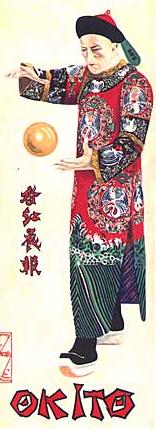
- Tobias BambergTobias BambergTobias "Theo" Leendert Bamberg was a professional magician. Born in Holland, Bamberg performed under the name Okito which was an anagram of Tokio...
's magicMagic (illusion)Magic is a performing art that entertains audiences by staging tricks or creating illusions of seemingly impossible or supernatural feats using natural means...
stage act as "Okito" (Germany, 1893 – United States, 1908) - Oscar WildeOscar WildeOscar Fingal O'Flahertie Wills Wilde was an Irish writer and poet. After writing in different forms throughout the 1880s, he became one of London's most popular playwrights in the early 1890s...
's SaloméSalome (play)Salome is a tragedy by Oscar Wilde.The original 1891 version of the play was in French. Three years later an English translation was published...
(1893, first performed in Paris 1896) - Alexander'sAlexander (magician)Claude Alexander Conlin , also known as Alexander, C. Alexander, Alexander the Crystal Seer, and Alexander the Man Who Knows, was a vaudeville magician who specialized in mentalism and psychic reading acts, dressed in Oriental style robes and a feathered turban, and often used a crystal ball as a...
mentalismMentalismMentalism is a performing art in which its practitioners, known as mentalists, appear to demonstrate highly developed mental or intuitive abilities. Performances may appear to include telepathy, clairvoyance, divination, precognition, psychokinesis, mediumship, mind control, memory feats and rapid...
stage act (United States, c. 1890s–1910s) - William Ellsworth RobinsonChung Ling SooChung Ling Soo was the stage name of the American magician William Ellsworth Robinson who is mostly remembered today for his tragic death after a bullet catch trick went wrong.- Biography :...
's, magicMagic (illusion)Magic is a performing art that entertains audiences by staging tricks or creating illusions of seemingly impossible or supernatural feats using natural means...
stage act as "Chung Ling Soo" (United States, 1900–1918)
Photography
- Roger FentonRoger FentonRoger Fenton was a pioneering British photographer, one of the first war photographers.-Early life:Roger Fenton was born in Crimble Hall, Heap, Bury, Lancashire, 28 March 1819. His grandfather was a wealthy cotton manufacturer and banker, his father a banker and Member of Parliament...
- Francis FrithFrancis FrithFrancis Frith was an English photographer of the Middle East and many towns in the United Kingdom....
Pulp magazines
- Oriental StoriesOriental StoriesOriental Stories, later retitled The Magic Carpet Magazine, was a pulp magazine of 1930-34, an offshoot of the famous Weird Tales....
: A pulp magazine published 1930–34 by Chicago based Popular Fiction specialising in Orientalist fiction. The title was later changed to The Magic Carpet Magazine.
Films
- IntoleranceIntolerance (film)Intolerance is a 1916 American silent film directed by D. W. Griffith and is considered one of the great masterpieces of the Silent Era. The three-and-a-half hour epic intercuts four parallel storylines each separated by several centuries: A contemporary melodrama of crime and redemption; a...
(1916) - Broken BlossomsBroken BlossomsBroken Blossoms or The Yellow Man and the Girl is a 1919 silent film directed by D.W. Griffith. It was distributed by United Artists and premiered on May 13, 1919...
(1919) - The SheikThe Sheik (film)The Sheik is a 1921 silent film produced by Famous Players-Lasky, directed by George Melford and starring Rudolph Valentino, Agnes Ayres, and Adolphe Menjou...
(1921) - The Lives of a Bengal LancerThe Lives of a Bengal LancerThe Lives of a Bengal Lancer is a 1935 American adventure film loosely adapted from the 1930 book of the same name by Francis Yeats-Brown. The plot of the movie, which bears little resemblance to Yeats-Brown's memoir, concerns British soldiers defending the borders of India against rebellious...
(1935) - The Thief of BagdadThe Thief of Bagdad (1940 film)The Thief of Bagdad is a 1940 British fantasy film produced by Alexander Korda, and directed by Michael Powell, Ludwig Berger, and Tim Whelan, with contributions by Korda's brothers Vincent and Zoltán, and William Cameron Menzies...
(1940) - My GeishaMy GeishaMy Geisha is a 1962 American comedy film directed by Jack Cardiff, starring Yves Montand, Shirley MacLaine, and Edward G. Robinson, and released by Paramount Pictures...
(1962) - Indiana Jones and the Temple of DoomIndiana Jones and the Temple of DoomIndiana Jones and the Temple of Doom is a 1984 American adventure film directed by Steven Spielberg. It is the second film in the Indiana Jones franchise and prequel to Raiders of the Lost Ark . After arriving in India, Indiana Jones is asked by a desperate village to find a mystical stone...
(1984) - Sex and the City 2Sex and the City 2Sex and the City 2 is a 2010 American romantic comedy film directed by Michael Patrick King. It is the sequel to the 2008 film Sex and the City, which is based on the HBO TV series of the same name....
(2010)
Comics
- The Adventures of TintinThe Adventures of TintinThe Adventures of Tintin is a series of classic comic books created by Belgian artist , who wrote under the pen name of Hergé...
(1929–1983) - The Upside Down Circle by Don Gilbert (1990).
- Dragon and Tiger (2008)
Eastern views of the West
Much of Said's criticism of Western "Orientalism" is based on particularizing trends also present in Asian works by Indian, Chinese and Japanese writers and artists, in their views of Western culture and tradition. The term OccidentalismOccidentalism
The term Occidentalism is used in one of two main ways: a) stereotyped and sometimes dehumanizing views on the Western world, including Europe and the English-speaking world; and b), ideologies or visions of the West developed in either the West or non-West. The former definition stresses negative...
has sometimes been used to refer to negative or stereotypical views of the Western world found in Eastern societies.
Although the core of Said's criticism of the concept of "Orientalism" implies a Western view of Eastern culture, some Eastern artists adopted Western styles that particularize Eastern peoples. The Indian painter Ravi Varma
Ravi Varma
The name Ravi Varma refers to a number of persons from many royal families of Kerala, including many members of the Cochin Royal Family:* Maharaja Ravi Varma Kunjappan Thampuran, Maharaja of Cochin from 1943-1946* Raja Ravi Varma, painter and artist...
painted several works that are virtually indistinguishable from some Western "Orientalist" images.
In the late 20th century many Western cultural themes and images began appearing in Asian art and culture, especially in Japan
Japan
Japan is an island nation in East Asia. Located in the Pacific Ocean, it lies to the east of the Sea of Japan, China, North Korea, South Korea and Russia, stretching from the Sea of Okhotsk in the north to the East China Sea and Taiwan in the south...
. English
English language
English is a West Germanic language that arose in the Anglo-Saxon kingdoms of England and spread into what was to become south-east Scotland under the influence of the Anglian medieval kingdom of Northumbria...
words and phrases are prominent in Japanese advertising and popular culture, and many Japanese anime
Anime
is the Japanese abbreviated pronunciation of "animation". The definition sometimes changes depending on the context. In English-speaking countries, the term most commonly refers to Japanese animated cartoons....
are written around characters, settings, themes, and mythological
Mythology
The term mythology can refer either to the study of myths, or to a body or collection of myths. As examples, comparative mythology is the study of connections between myths from different cultures, whereas Greek mythology is the body of myths from ancient Greece...
figures derived from various Western cultural traditions.
See also
- ArabistArabistThis is an article about the western scholars known as Arabists, not the political movement Pan-Arabism.An Arabist is someone normally from outside the Arab World who specialises in the study of the Arabic language and Arab culture, and often Arabic literature.-Origins:Arabists began in medieval...
- Black orientalismBlack orientalismBlack orientalism is an intellectual and cultural movement found primarily within African American circles. While similar to the general movement of Orientalism in its negative outlook upon Western Asian - especially Arab - culture and religion, it differs in both its emphasis upon the role of the...
- Circassian beautiesCircassian beautiesCircassian beauties is a term used to refer to an idealized image of the women of the Circassian people of the Northern Caucasus. A fairly extensive literary history suggests that Circassian women were thought to be unusually beautiful, spirited and elegant, and as such were desirable as concubines...
- ExoticismExoticismExoticism is a trend in art and design, influenced by some ethnic groups or civilizations since the late 19th-century. In music exoticism is a genre in which the rhythms, melodies, or instrumentation are designed to evoke the atmosphere of far-off lands or ancient times Exoticism (from 'exotic')...
- OccidentalismOccidentalismThe term Occidentalism is used in one of two main ways: a) stereotyped and sometimes dehumanizing views on the Western world, including Europe and the English-speaking world; and b), ideologies or visions of the West developed in either the West or non-West. The former definition stresses negative...
- ChinoiserieChinoiserieChinoiserie, a French term, signifying "Chinese-esque", and pronounced ) refers to a recurring theme in European artistic styles since the seventeenth century, which reflect Chinese artistic influences...
Further reading
- Weir, David. American Orient: Imagining the East From the Colonial Era Through the Twentieth Century (University of Massachusetts Press; 2011) 304 pages;
Mainly on art
- Jean-Marc Aractingi,"Peintres Orientalistes" Editions Vues d'Orient,Paris,2003
- Peltre, Christine. Orientalism in Art. New York: Abbeville Publishing Group (Abbeville Press, Inc.)Abbeville Publishing Group (Abbeville Press, Inc.)Abbeville Publishing Group is an independent book publishing company specializing in fine art and illustrated books. Based in New York City, Abbeville publishes approximately 40 titles each year and has an active backlist of over 700 titles on a wide range of subjects, including art, architecture,...
, 1998 (ISBN 0-7892-0459-2). - Rosenthal, Donald A. Orientalism: The Near East in French Painting, 1800–1880. Rochester, N.Y.: Memorial Art Gallery of the University of Rochester, 1982.
- Stevens, Mary Anne, ed. The Orientalists: Delacroix to Matisse: European Painters in North Africa and the Near East. Exhibition catalogue. London: Royal AcademyRoyal AcademyThe Royal Academy of Arts is an art institution based in Burlington House on Piccadilly, London. The Royal Academy of Arts has a unique position in being an independent, privately funded institution led by eminent artists and architects whose purpose is to promote the creation, enjoyment and...
of Arts, 1984 - Benjamin, Roger Orientalist Aesthetics, Art, Colonialism and French North Africa: 1880-1930, U. of California Press, 2003
Literature
- Halliday, Fred. "'Orientalism' and Its Critics", British Journal of Middle Eastern Studies, Vol. 20, No. 2. (1993), pp. 145–163.
- Irwin, Robert. For lust of knowing: The Orientalists and their enemies. London: Penguin/Allen Lane, 2006 (ISBN 0-7139-9415-0)
- Kabbani, Rana. Imperial Fictions: Europe's Myths of Orient. London: Pandora Press, 1994 (ISBN 0-04-440911-7).
- Klein, Christina. Cold War Orientalism: Asia in the Middlebrow Imagination, 1945–1961. Berkeley: University of California Press, 2003 (ISBN 0-520-22469-8; paperback, ISBN 0-520-23230-5).
- Knight, Nathaniel. "Grigor'ev in Orenburg, 1851–1862: Russian Orientalism in the Service of Empire?", Slavic ReviewSlavic ReviewSlavic Review is a leading international peer-reviewed academic journal publishing scholarly studies and book reviews in all disciplines concerned with Russia, Central Eurasia, and Eastern and Central Europe...
, Vol. 59, No. 1. (Spring, 2000), pp. 74–100. - Kontje, Todd. German Orientalisms. Ann Arbor, MI: University of Michigan Press, 2004 (ISBN 0-472-11392-5).
- Little, Douglas. American Orientalism: The United States and the Middle East Since 1945. (2nd ed. 2002 ISBN 1-86064-889-4).
- Lowe, Lisa. Critical Terrains: French and British Orientalisms. Ithaca: Cornell University Press, 1992 (ISBN 978-0-8014-8195-6).
- Macfie, Alexander Lyon. Orientalism. White Plains, NY: Longman, 2002 (ISBN 0-582-42386-4).
- MacKenzie, John. Orientalism: History, theory and the arts. Manchester: Manchester University Press, 1995 (ISBN 0-7190-4578-9), google books.
- Murti, Kamakshi P. India: The Seductive and Seduced "Other" of German Orientalism. Westport, CT: Greenwood Press, 2001 (ISBN 0-313-30857-8).
- Noble dreams, wicked pleasures: Orientalism in America, 1870–1930 by Holly Edwards (Editor). Princeton: Princeton University Press, 2000 (ISBN 0-691-05004-X).
- Oueijan, Naji. The Progress of an Image: The East in English Literature. New York: Peter Lang Publishers, 1996.
- Schlicht, Alfred, "Die Araber und Europa", Stuttgart, Kohlhammer, 2008
External links
- The Orientalist Painters
- The Orientalists' Art Works Gallery
- Orientalism 25 Years Later, by Said in 2003
- "China in Western Thought and Culture" Dictionary of the History of Ideas, etext, University of Virginia
- Brian Whitaker, "Distorting Desire", review, Joseph Abbad, Desiring Arabs, Chicago: University of Chicago Press, 2007, from Al-Bab.com, on Reflections of a Renegade blog site
- Martin Kramer, "Edward Said's Splash", from his book, Ivory Towers on Sand: The Failure of Middle Eastern Studies in America, Washington: The Washington Institute for Near East Policy, 2001, pp. 27–43.
- Andre Gingrich, "Frontier Orientalism", Camp Catatonia blog
- Orientalism in the "History of Art", All Art
- Orientalist art and photography, London Times Online
- "Alexander Roubtzoff" (1884–1949), Artistic Association Alexander Roubtzoff
- "Edward Said and the Production of Knowledge", CitizenTrack
- Articles & Analysis on Orientalists' Art Works