


Toga

Encyclopedia

Ancient Rome
Ancient Rome was a thriving civilization that grew on the Italian Peninsula as early as the 8th century BC. Located along the Mediterranean Sea and centered on the city of Rome, it expanded to one of the largest empires in the ancient world....
, was a cloth of perhaps 20 ft (6 m) in length which was wrapped around the body and was generally worn over a tunic
Tunic
A tunic is any of several types of clothing for the body, of various lengths reaching from the shoulders to somewhere between the hips and the ankles...
. The toga was made of wool
Wool
Wool is the textile fiber obtained from sheep and certain other animals, including cashmere from goats, mohair from goats, qiviut from muskoxen, vicuña, alpaca, camel from animals in the camel family, and angora from rabbits....
, and the tunic under it often was made of linen
Linen
Linen is a textile made from the fibers of the flax plant, Linum usitatissimum. Linen is labor-intensive to manufacture, but when it is made into garments, it is valued for its exceptional coolness and freshness in hot weather....
. After the 2nd century BC, the toga was a garment worn exclusively by men, and only Roman citizens
Roman citizenship
Citizenship in ancient Rome was a privileged political and legal status afforded to certain free-born individuals with respect to laws, property, and governance....
were allowed to wear the toga. After this time, women were expected to wear the stola
Stola
The stola was the traditional garment of Roman women, corresponding to the toga, or the pallium, that were worn by men.Originally, women wore togas as well, but after the 2nd century BC, the toga was worn exclusively by men, and women were expected to wear the stola...
.
History
The toga was based on a dress robe used by native people, the EtruscansEtruscan civilization
Etruscan civilization is the modern English name given to a civilization of ancient Italy in the area corresponding roughly to Tuscany. The ancient Romans called its creators the Tusci or Etrusci...
. The toga was the dress clothing of the Romans, a thick woolen cloak worn over a loincloth
Loincloth
A loincloth is a one-piece male garment, sometimes kept in place by a belt, which covers the genitals and, at least partially, the buttocks.-History and types:Loincloths are being and have been worn:*in societies where no other clothing is needed or wanted...
or apron
Apron
An apron is an outer protective garment that covers primarily the front of the body. It may be worn for hygienic reasons as well as in order to protect clothes from wear and tear. The apron is commonly part of the uniform of several work categories, including waitresses, nurses, and domestic...
. It is believed to have been established around the time of Numa Pompilius
Numa Pompilius
Numa Pompilius was the legendary second king of Rome, succeeding Romulus. What tales are descended to us about him come from Valerius Antias, an author from the early part of the 1st century BC known through limited mentions of later authors , Dionysius of Halicarnassus circa 60BC-...
, the second King of Rome. It was taken off indoors, or when hard at work in the fields, but it was considered the only decent attire out-of-doors. This is evident from the story of Cincinnatus
Cincinnatus
Lucius Quinctius Cincinnatus was an aristocrat and political figure of the Roman Republic, serving as consul in 460 BC and Roman dictator in 458 BC and 439 BC....
: he was ploughing in his field when the messengers of the Senate
Roman Senate
The Senate of the Roman Republic was a political institution in the ancient Roman Republic, however, it was not an elected body, but one whose members were appointed by the consuls, and later by the censors. After a magistrate served his term in office, it usually was followed with automatic...
came to tell him that he had been made dictator
Roman dictator
In the Roman Republic, the dictator , was an extraordinary magistrate with the absolute authority to perform tasks beyond the authority of the ordinary magistrate . The office of dictator was a legal innovation originally named Magister Populi , i.e...
, and on seeing them he sent his wife to fetch his toga from the house so that they could be received appropriately. While the truth of the story may be doubtful, it nevertheless expresses the Roman sentiment on the subject.
Free citizens were required to wear togas because slaves would wear tunics. They wore them because the tunic was a sign of poverty and would let them work with ease.
As time went on, dress styles changed. Romans adopted the shirt (tunica, or in Greek
Greece
Greece , officially the Hellenic Republic , and historically Hellas or the Republic of Greece in English, is a country in southeastern Europe....
chiton
Chiton (costume)
A chiton was a form of clothing worn by men and women in Ancient Greece, from the Archaic period to the Hellenistic period ....
) which the Greeks
Greeks
The Greeks, also known as the Hellenes , are a nation and ethnic group native to Greece, Cyprus and neighboring regions. They also form a significant diaspora, with Greek communities established around the world....
and Etruscans
Etruscan civilization
Etruscan civilization is the modern English name given to a civilization of ancient Italy in the area corresponding roughly to Tuscany. The ancient Romans called its creators the Tusci or Etrusci...
wore, made the toga more bulky, and wore it in a looser manner. The result was that it became useless for active pursuits, such as those of war. Thus, its place was taken by the handier sagum
Sagum
The sagum was a garment of note generally worn by members of the Roman military during both the Republic and early Empire. Regarded symbolically as a garment of war by the same tradition which embraced the toga as a garment of peace, it was slightly more practical in any event, consisting of a...
(woollen cloak
Cloak
A cloak is a type of loose garment that is worn over indoor clothing and serves the same purpose as an overcoat; it protects the wearer from the cold, rain or wind for example, or it may form part of a fashionable outfit or uniform. Cloaks are as old as human history; there has nearly always been...
) on all military occasions. In times of peace, too, the toga eventually was superseded by the laena, lacerna, paenula
Paenula
The paenula was a cloak worn by the Romans, akin to the poncho of the modern Spaniards and Spanish Americans...
, and other forms of buttoned or closed cloaks. However, the toga did remain the court dress
Court dress
Court dress comprises the style of clothes prescribed for courts of law, and formerly for royal courts.- Where court dress is worn :Court dress is worn at hearings in open court in all Senior Courts of England and Wales and in county courts. However, court dress may be dispensed with at the option...
of the Empire
Roman Empire
The Roman Empire was the post-Republican period of the ancient Roman civilization, characterised by an autocratic form of government and large territorial holdings in Europe and around the Mediterranean....
which began c. 44 BC.
Significance
The same process that removed the toga from everyday life gave it an increased importance as a ceremonial garment, as is often the case with clothing. The toga also came to be used to signify different types of power. As early as the 2nd century BC, and probably even before, the toga (along with the calceus) was looked upon as the characteristic badge of Roman citizenshipRoman citizenship
Citizenship in ancient Rome was a privileged political and legal status afforded to certain free-born individuals with respect to laws, property, and governance....
. It was denied to foreigners, and even to banished Romans, and it was worn by magistrates on all occasions as a badge of office. In fact, for a magistrate to appear in a Greek cloak (pallium
Pallium (Roman cloak)
The pallium was the Roman cloak that was worn by both men and women . It was a rectangular piece of cloth, square in form, as was the himation in ancient Greece...
) and sandals was considered by all as highly improper, if not criminal. Augustus
Augustus
Augustus ;23 September 63 BC – 19 August AD 14) is considered the first emperor of the Roman Empire, which he ruled alone from 27 BC until his death in 14 AD.The dates of his rule are contemporary dates; Augustus lived under two calendars, the Roman Republican until 45 BC, and the Julian...
, for instance, was so much incensed at seeing a meeting of citizens without the toga, that, quoting Virgil
Virgil
Publius Vergilius Maro, usually called Virgil or Vergil in English , was an ancient Roman poet of the Augustan period. He is known for three major works of Latin literature, the Eclogues , the Georgics, and the epic Aeneid...
's lines, "Romanos, rerum dominos, gentemque togatam" ("Romans, lords of the world, the toga-wearing race"), he gave orders to the aedile
Aedile
Aedile was an office of the Roman Republic. Based in Rome, the aediles were responsible for maintenance of public buildings and regulation of public festivals. They also had powers to enforce public order. There were two pairs of aediles. Two aediles were from the ranks of plebeians and the other...
s that in the future no one was to appear in the Forum
Roman Forum
The Roman Forum is a rectangular forum surrounded by the ruins of several important ancient government buildings at the center of the city of Rome. Citizens of the ancient city referred to this space, originally a marketplace, as the Forum Magnum, or simply the Forum...
or Circus
Circus Maximus
The Circus Maximus is an ancient Roman chariot racing stadium and mass entertainment venue located in Rome, Italy. Situated in the valley between the Aventine and Palatine hills, it was the first and largest stadium in ancient Rome and its later Empire...
without it.
Because the toga was not worn by soldiers, it was regarded as a sign of peace. A civilian was sometimes called togatus, "toga-wearer", in contrast to sagum
Sagum
The sagum was a garment of note generally worn by members of the Roman military during both the Republic and early Empire. Regarded symbolically as a garment of war by the same tradition which embraced the toga as a garment of peace, it was slightly more practical in any event, consisting of a...
-wearing soldiers. Cicero
Cicero
Marcus Tullius Cicero , was a Roman philosopher, statesman, lawyer, political theorist, and Roman constitutionalist. He came from a wealthy municipal family of the equestrian order, and is widely considered one of Rome's greatest orators and prose stylists.He introduced the Romans to the chief...
's De Officiis
De Officiis
De Officiis is an essay by Marcus Tullius Cicero divided into three books, in which Cicero expounds his conception of the best way to live, behave, and observe moral obligations.- Origin :...
contains the phrase cedant arma togae: literally, "let arms yield to the toga", meaning "may peace replace war", or "may military
Military
A military is an organization authorized by its greater society to use lethal force, usually including use of weapons, in defending its country by combating actual or perceived threats. The military may have additional functions of use to its greater society, such as advancing a political agenda e.g...
power yield to civilian
Civilian
A civilian under international humanitarian law is a person who is not a member of his or her country's armed forces or other militia. Civilians are distinct from combatants. They are afforded a degree of legal protection from the effects of war and military occupation...
power".
Folding
A toga is made by holding a piece of cloth under the right arm, half behind, half in front. The back part is folded over the left shoulder, and the front part is then folded over the left shoulder too.Varieties
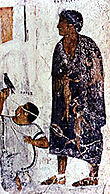
- Toga virilis (toga alba or toga pura): A plain white toga worn on formal occasions by most Roman men of legal age, generally about 14 to 18 years, but it could be any stage in their teens. The first wearing of the toga virilis was part of the celebrations on reaching maturity.
- Toga candida: "Bright toga"; a toga bleached by chalk to a dazzling white (Isidorus Orig. xix. 24, 6), worn by candidates (from Latin candida, "pure white") for public office. Thus Persius speaks of a cretata ambitio, "chalked ambition". Oddly, this custom appears to have been banned by plebiscite in 432 BC, but the restriction was never enforced. The term is the etymologic source of the word candidate.
- Toga praetexta: An ordinary white toga with a broad purple stripe on its border. It was worn by
- Freeborn boys who had not yet come of age.
- All curule magistrates.
- Ex-curule magistrates and dictators, upon burial and apparently at festivals and other celebrations as well.
- Some priests (e.g., the Flamen DialisFlamen DialisIn ancient Roman religion, the Flamen Dialis was the high priest of Jupiter. There were 15 flamines, of which three were flamines maiores, serving the three gods of the Archaic Triad...
, Pontifices, Tresviri Epulones, the augurAugurThe augur was a priest and official in the classical world, especially ancient Rome and Etruria. His main role was to interpret the will of the gods by studying the flight of birds: whether they are flying in groups/alone, what noises they make as they fly, direction of flight and what kind of...
s, and the Arval brothersArval BrethrenIn ancient Roman religion, the Arval Brethren or Arval Brothers were a body of priests who offered annual sacrifices to the Lares and gods to guarantee good harvests...
). - During the Empire, the right to wear it was sometimes bestowed as an honor independent of formal rank.
- According to tradition, the Kings of Rome.
- Those with the right to wear a toga praetexta were sometimes termed laticlavius, "having a broad crimson stripe". It also gave its name to a literary form known as praetextaPraetextaA Praetexta or Praetexta Fabula was a new genre of Roman tragedy innovated by Gnaeus Naevius, which dealt with the themes of historical Roman figures, instead of the conventional Greek myths. Subsequent writers of praetextae included Ennius, Pacuvius and Lucius Accius. The name refers to the toga...
.
- Toga pulla: Literally just "dark toga". It was worn mainly by mournerMourningMourning is, in the simplest sense, synonymous with grief over the death of someone. The word is also used to describe a cultural complex of behaviours in which the bereaved participate or are expected to participate...
s, but could also be worn in times of private danger or public anxiety. It was sometimes used as a protest of sorts—when Cicero was exiled, the Senate resolved to wear togae pullae as a demonstration against the decision. Magistrates with the right to wear a toga praetexta wore a simple toga pura instead of pulla. - Toga picta: This toga, unlike all others, was not just dyed but embroidered and decorated. It was solid purple, embroidered with gold. Under the Republic, it was worn by generals in their triumphRoman triumphThe Roman triumph was a civil ceremony and religious rite of ancient Rome, held to publicly celebrate and sanctify the military achievement of an army commander who had won great military successes, or originally and traditionally, one who had successfully completed a foreign war. In Republican...
s, and by the Praetor Urbanus when he rode in the chariot of the gods into the circus at the Ludi ApollinaresLudi ApollinaresThe Ludi Apollinares were solemn games held annually by the ancient Romans in honor of the god Apollo. The tradition goes that at the first celebration hereof, they were suddenly invaded by the enemy, and obliged to take to their arms...
. During the Empire, the toga picta was worn by magistrates giving public gladiatorGladiatorA gladiator was an armed combatant who entertained audiences in the Roman Republic and Roman Empire in violent confrontations with other gladiators, wild animals, and condemned criminals. Some gladiators were volunteers who risked their legal and social standing and their lives by appearing in the...
ial games, and by the consulConsulConsul was the highest elected office of the Roman Republic and an appointive office under the Empire. The title was also used in other city states and also revived in modern states, notably in the First French Republic...
s, as well as by the emperor on special occasions. - Toga trabea: According to Servius, there were three different kinds of trabea: one of purple only, for the gods; another of purple and a little white, for kings; and a third, with scarlet stripes and a purple hem, for augurs and SaliiSaliiIn ancient Roman religion, the Salii were the "leaping priests" of Mars supposed to have been introduced by King Numa Pompilius. They were twelve patrician youths, dressed as archaic warriors: an embroidered tunic, a breastplate, a short red cloak , a sword, and a spiked headdress called an apex...
. Dionysius of HalicarnassusDionysius of HalicarnassusDionysius of Halicarnassus was a Greek historian and teacher of rhetoric, who flourished during the reign of Caesar Augustus. His literary style was Attistic — imitating Classical Attic Greek in its prime.-Life:...
says that those of equestrian class wore it as well, but this is not borne out by other evidence.
Modern usage
In several countries, the tradition of the toga partyToga party
A toga party is a particular kind of costume party in which party-goers wear a toga, or a semblance thereof, normally made from a bed sheet, and sandals...
has become popular in recent decades, generally at colleges and universities
Tertiary education
Tertiary education, also referred to as third stage, third level, and post-secondary education, is the educational level following the completion of a school providing a secondary education, such as a high school, secondary school, university-preparatory school...
, perhaps best illustrated in (if not inspired by) the film Animal House.
This practice trades on the exaggerated legend of Roman debauchery, and participants dress in togas that are usually makeshift garments fashioned from bed sheet
Bed sheet
A bed sheet is a piece of cloth used to cover a mattress. It is this sheet that one typically lies on.In many areas of the world, a second flat bed sheet is laid on top of the sheet covering the mattress. This is known as a "top sheet" and when a top sheet is used, the sheet covering the mattress...
s. As such, these togas bear little resemblance to the Ancient Roman garment, being both flimsier and scantier.
The toga is also used by peoples that can claim descent from Romanized
Romanization
In linguistics, romanization or latinization is the representation of a written word or spoken speech with the Roman script, or a system for doing so, where the original word or language uses a different writing system . Methods of romanization include transliteration, for representing written...
Punics, such as the Arabized Berbers of Tripolitania
Tripolitania
Tripolitania or Tripolitana is a historic region and former province of Libya.Tripolitania was a separate Italian colony from 1927 to 1934...
, in Libya
Libya
Libya is an African country in the Maghreb region of North Africa bordered by the Mediterranean Sea to the north, Egypt to the east, Sudan to the southeast, Chad and Niger to the south, and Algeria and Tunisia to the west....
, the most prominent example probably being the late Muammar Gaddafi
Muammar Gaddafi
Muammar Muhammad Abu Minyar Gaddafi or "September 1942" 20 October 2011), commonly known as Muammar Gaddafi or Colonel Gaddafi, was the official ruler of the Libyan Arab Republic from 1969 to 1977 and then the "Brother Leader" of the Libyan Arab Jamahiriya from 1977 to 2011.He seized power in a...
.