
All Topics  
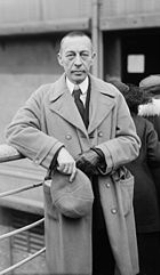
Sergei Rachmaninoff

 
Sergei Rachmaninoff

   Email Print
   Bookmark   Link


Sergei Rachmaninoff


Sergei Vasilievich Rachmaninoff (Sergej Vasil’evic Rakhmaninov, – 28 March 1943) was a Russia
Russia

Russia , or the Russian Federation , is a list of countries spanning more than one continent country extending over much of northern Eurasia....
n composer
Composer

A composer is a person who creates music, usually in the medium of musical notation, for interpretation and performance. The level of distinction between composers and other musicians varies, which affects issues such as copyright and the deference given to individual interpretations of a particular piece of music....
, pianist
Pianist

A pianist is a musician who plays the piano. A professional pianist can perform solo pieces, play with an musical ensemble or orchestra, or accompany one or more singers, solo instrumentalists, or other performers....
, and conductor
Conducting

Conducting is the act of directing a musical performance by way of visible gestures. Orchestras, choirs, concert bands and other musical ensembles often have conductors....
. He was one of the finest pianists of his day and, as a composer, the last great representative of Russian late Romanticism
Romantic music

In music, romanticism is a term, often considered misleading, and concept derived from literature traditionally defined by attributes including, "interest in nature, medieval chivalry, mysticism, [and] remoteness [ Social alienation and Solitude]"....
 in classical music. Early influences of Tchaikovsky
Pyotr Ilyich Tchaikovsky

Pyotr Ilyich Tchaikovsky – ) was a Russian composer of the Romantic music era. He wrote some of the most popular concert and theatrical music in the current classical repertoire, including the ballets Swan Lake and Nutcracker, the 1812 Overture, his Piano Concerto No....
, Rimsky-Korsakov
Nikolai Rimsky-Korsakov

Nikolai Andreyevich Rimsky-Korsakov , also Nikolay, Nicolai, and Rimsky-Korsakoff, was a Russian composer, and a member of the group of composers known as "The Five." Noted particularly for a predilection for folk and fairy-tale subjects as well as his extraordinary skill in orchestration, his best known orchestral compositions...
 and other Russian composers gave way to a thoroughly personal idiom which included a pronounced lyricism, expressive breadth, structural ingenuity and a tonal palette of rich, distinctive orchestral colors.

Understandably, the piano figures prominently in Rachmaninoff's compositional output, either as a solo instrument or as part of an ensemble.


Discussion
Ask a question about 'Sergei Rachmaninoff'
Start a new discussion about 'Sergei Rachmaninoff'
Answer questions from other users
Full Discussion Forum


Encyclopedia


Sergei Vasilievich Rachmaninoff (Sergej Vasil’evic Rakhmaninov, – 28 March 1943) was a Russia
Russia

Russia , or the Russian Federation , is a list of countries spanning more than one continent country extending over much of northern Eurasia....
n composer
Composer

A composer is a person who creates music, usually in the medium of musical notation, for interpretation and performance. The level of distinction between composers and other musicians varies, which affects issues such as copyright and the deference given to individual interpretations of a particular piece of music....
, pianist
Pianist

A pianist is a musician who plays the piano. A professional pianist can perform solo pieces, play with an musical ensemble or orchestra, or accompany one or more singers, solo instrumentalists, or other performers....
, and conductor
Conducting

Conducting is the act of directing a musical performance by way of visible gestures. Orchestras, choirs, concert bands and other musical ensembles often have conductors....
. He was one of the finest pianists of his day and, as a composer, the last great representative of Russian late Romanticism
Romantic music

In music, romanticism is a term, often considered misleading, and concept derived from literature traditionally defined by attributes including, "interest in nature, medieval chivalry, mysticism, [and] remoteness [ Social alienation and Solitude]"....
 in classical music. Early influences of Tchaikovsky
Pyotr Ilyich Tchaikovsky

Pyotr Ilyich Tchaikovsky – ) was a Russian composer of the Romantic music era. He wrote some of the most popular concert and theatrical music in the current classical repertoire, including the ballets Swan Lake and Nutcracker, the 1812 Overture, his Piano Concerto No....
, Rimsky-Korsakov
Nikolai Rimsky-Korsakov

Nikolai Andreyevich Rimsky-Korsakov , also Nikolay, Nicolai, and Rimsky-Korsakoff, was a Russian composer, and a member of the group of composers known as "The Five." Noted particularly for a predilection for folk and fairy-tale subjects as well as his extraordinary skill in orchestration, his best known orchestral compositions...
 and other Russian composers gave way to a thoroughly personal idiom which included a pronounced lyricism, expressive breadth, structural ingenuity and a tonal palette of rich, distinctive orchestral colors.

Understandably, the piano figures prominently in Rachmaninoff's compositional output, either as a solo instrument or as part of an ensemble. He made it a point, however, to use his own skills as a performer to explore fully the expressive possibilities of the instrument. Even in his earliest works, he revealed a sure grasp of idiomatic piano writing and a striking gift for melody
Melody

In music, a melody , also tune, voice, or line, is a linear succession of musical tones which is perceived as a single entity....
. In some of his early orchestral pieces he showed the first signs of a talent for tone painting, which he would perfect in The Isle of the Dead
Isle of the Dead (Rachmaninoff)

Isle of the Dead, Opus number 29 is a symphonic poem composed by Sergei Rachmaninoff. Rachmaninoff was inspired by Arnold B?cklin's painting, Isle of the Dead , which he saw in Paris in 1907....
, and he began to show a similar penchant for vocal writing in two early sets of songs, Opp. 4 and 8. Rachmaninoff's masterpiece, however, is his choral symphony
Choral symphony

A choral symphony is a large musical composition, generally including an orchestra, a choir and solo ists, which adheres to some extent to the tenets of musical form for a symphony in its internal workings and overall musical architecture....
 The Bells
The Bells (Rachmaninoff)

The Bells , Op. 35, is a choral symphony by Sergei Rachmaninoff, written in 1913. The words are from the poem The Bells by Edgar Allan Poe, very freely translated into Russian language by the Symbolist poetry Konstantin Balmont....
, in which all of his talents are fused and unified.

Life


Youth

Rachmaninoff was born in Semyonovo, near Novgorod
Veliky Novgorod

Veliky Novgorod is the foremost historic Types of inhabited localities in Russia of North-Western Russia and the administrative center of Novgorod Oblast....
, in north-western
Northwestern Federal District

Northwestern Federal District is one of the seven federal districts of Russia. It consists of the northern part of European Russia. Its population was 13,974,466 in the Russian Census , living on an area of 1,677,900 km? ....
 Russia
Russia

Russia , or the Russian Federation , is a list of countries spanning more than one continent country extending over much of northern Eurasia....
. His parents were both amateur pianists. When he was four, his mother gave him casual piano lessons, but it was his paternal grandfather, Arkady Alexandrovich Rachmaninoff, who brought Anna Ornatskaya, a teacher from Saint Petersburg
Saint Petersburg

Saint Petersburg is a types of inhabited localities in Russia and a federal subjects of Russia of Russia located on the Neva River at the head of the Gulf of Finland on the Baltic Sea....
, to teach Sergei in 1882. Ornatskaya remained for "two or three years", until the family home had to be sold to settle debts and the Rachmaninoffs moved to Moscow
Moscow

Moscow is the capital and the largest types of inhabited localities in Russia of the Russian Federation. It is also the largest European cities and metropolitan areas, with the Moscow metropolitan area ranking among the largest urban areas in the world....
.

Sergei studied at the Saint Petersburg Conservatory
Saint Petersburg Conservatory

The N.A. Rimsky-Korsakov Saint Petersburg State Conservatory is a music school in Saint Petersburg. In 2004, the conservatory had around 275 faculty members and 1,400 students....
 before moving to Moscow
Moscow

Moscow is the capital and the largest types of inhabited localities in Russia of the Russian Federation. It is also the largest European cities and metropolitan areas, with the Moscow metropolitan area ranking among the largest urban areas in the world....
 alone to study piano under Nikolai Zverev
Nikolai Zverev

Nikolai Sergeyevich Zverev was a Russia pianist and teacher known for his pupils Mily Balakirev, Konstantin Igumnov, Alexander Siltoti, Alexander Goldenweisser, Mikhail Pressman, Leonid Maximov, Sergei Rachmaninoff, and Alexander Scriabin....
 and Alexander Siloti
Alexander Siloti

Alexander Ilyich Siloti was a Russian pianist, Conducting and composer. ...
 (who was his cousin and a former student of Franz Liszt
Franz Liszt

Franz Liszt was a Kingdom of Hungary composer, virtuoso pianist and teacher.Liszt became renowned throughout Europe for his great skill as a performer during the 19th century....
). He also studied harmony
Harmony

In Western music, harmony is the use of different pitches simultaneously, and chord s, actual or implied, in music. The word is related to the word "harmonic" which implies related wavelengths of waves....
 under Anton Arensky
Anton Arensky

Anton Stepanovich Arensky , was a Russian composer of Romantic music, a pianist and a professor of music....
 and counterpoint
Counterpoint

In music, counterpoint is the relationship between two or more Register that are independent in contour and rhythm, and interdependent in harmony....
 under Sergei Taneyev
Sergei Taneyev

Sergei Ivanovich Taneyev , a pupil of Pyotr Ilyich Tchaikovsky, was a Russian composer, pianist, teacher of musical composition, music theorist and author....
. Rachmaninoff was found to be quite lazy, failing most of his classes, and it was the strict regime of the Zverev home that instilled discipline in the boy. In his early years, he showed great skill in composition. While still a student, he wrote the one-act opera
Opera

Opera is an Performing arts in which singers and musicians perform a dramatic work which combines a text and a musical score. Opera is part of the Western classical music tradition....
, Aleko
Aleko (opera)

Aleko is the first of three completed operas by Sergei Rachmaninoff. The Russian libretto was written by Vladimir Nemirovich-Danchenko and is an adaptation of the poem The Gypsies by Alexander Pushkin....
, for which he was awarded a gold medal in composition, his First Piano Concerto
Piano Concerto No. 1 (Rachmaninoff)

Sergei Rachmaninoff composed his Piano Concerto No. 1 in F-sharp minor, Op. 1, in 1892, when he was 19 years old. He dedicated the work to Alexander Siloti....
, and a set of piano pieces, Morceaux de Fantaisie
Morceaux de Fantaisie

Morceaux de Fantaisie , Opus number. 3, is a set of five piano solo pieces composed by Sergei Rachmaninoff in 1892. The title reflects the pieces' imagery rather than their musical form, as none are actual Fantasia ....
 (Op. 3, 1892), which includes the famous Prelude in C sharp minor. The composer later became annoyed by the public's fascination with this piece, composed when he was just 19 years old. He would often tease an expectant audience in the days when it was traditional for the audience to request particular compositions, by asking, "Oh, must I?" or claiming inability to remember anything else.

In Moscow, he met composer Pyotr Ilyich Tchaikovsky
Pyotr Ilyich Tchaikovsky

Pyotr Ilyich Tchaikovsky – ) was a Russian composer of the Romantic music era. He wrote some of the most popular concert and theatrical music in the current classical repertoire, including the ballets Swan Lake and Nutcracker, the 1812 Overture, his Piano Concerto No....
, who became an important mentor and commissioned the teenage Rachmaninoff to arrange a piano transcription of the suite from his ballet
Ballet

Ballet is a formalized type of performative dance, the origins of which date lay in sixteenth- and seventeenth-century France courts, and which was further developed in England, Italy, and Russia as a concert dance form....
 The Sleeping Beauty. This commission was first offered to Siloti, who declined, but instead suggested Rachmaninoff would be more than capable. This alternative was accepted; Siloti supervised the arrangement. Rachmaninoff confided in Zverev his desire to compose more, requesting a private room where he could compose in silence. Zverev saw him only as a pianist and severed his links with the boy, refusing even to speak to him for three years. Rachmaninoff moved out and continued to compose.

Setbacks and recovery

The sudden death of Tchaikovsky in 1893 made a strong impression on Rachmaninoff; he immediately began writing a second Trio élégiaque to his memory, clearly revealing the depth and sincerity of his grief in the music's overwhelming aura of gloom. His First Symphony
Symphony No. 1 (Rachmaninoff)

File:Rachmaninoff and Skalon sisters crop.jpgSergei Rachmaninoff wrote his Symphony No. 1 in D minor, Opus number 13 in Ivanovka, an estate near Tambov, Russia, between January and October 1895....
 (Op. 13, 1896) premiered on 27 March 1897 in one of a long-running series of "Russian Symphony Concerts
Russian Symphony Concerts

The Russian Symphony Concerts were a series of Russian classical music concerts hosted by timber magnate and musical philantropist Mitrofan Belyayev in Saint Petersburg as a forum for young Russian composers to have their orchestral works performed....
", but was likened by nationalist
Nationalism

Nationalism refers to an ideology, a feeling, a form of culture, or a social movement that focuses on the nation. While there is significant debate over the historical origins of nations, nearly all Expert accept that nationalism, at least as an ideology and social movement, is a Modernity phenomenon originating in Europe....
 composer and critic César Cui
César Cui

C?sar Antonovich Cui was a Russian of France and Lithuanian descent. His profession was as an army Officer and a teacher of fortifications; his avocational life has particular significance in the history of music, in that he was a composer and Music journalism; in this sideline he is known as a member of The Five, the group of Russian com...
 to a depiction of the ten plagues of Egypt
Plagues of Egypt

The Plagues of Egypt , the Biblical Plagues or the Ten Plagues are the ten calamities imposed upon Ancient Egypt by Names of God in Judaism in the Bible , in order to convince Pharaoh of the Exodus to let the poorly treated Israelite slaves go...
, suggesting it would be admired by the "inmates" of a music conservatory in hell. The deficiencies of the performance, conducted by Glazunov
Alexander Glazunov

Aleksandr Konstantinovich Glazunov was a Russian composer, music teacher and Conducting. He served as director of the Saint Petersburg Conservatory between 1905 and 1928 and was also instrumental in the reorganization of the institute into the Petrograd Conservatory, then the Leningrad Conservatory, following the October Revolution....
, were not commented on. Alexander Ossovsky
Alexander Ossovsky

Alexander Ossovsky , was a renowned Russian musical writer, critic and musicologist, cousin of the composer Mykola Vilinsky, professor at Saint Petersburg Conservatory, pupil of Nikolai Rimsky-Korsakov, friend of Sergei Rachmaninoff, Alexander Siloti and Nikolai Tcherepnin....
 in his Memoir about Rachmaninoff tells, first hand, a story about this event. In Ossovsky's opinion Glazunov made poor use of rehearsal time, and the concert program, which contained two other first performances also was a factor. This horrific reception, two disastrous visits to writer Leo Tolstoy
Leo Tolstoy

Leo Tolstoy, or Count Lev Nikolayevich Tolstoy Tolstoy's further talents as essayist, dramatist and Education reform made him the most influential member of the aristocracy Tolstoy....
's estate and Rachmaninoff's distress over the Russian Orthodox Church
Russian Orthodox Church

The Russian Orthodox Church ; or The Moscow Patriarchate , also known as the Orthodox Christian Church of Russia, is a body of Christianity who constitute an Autocephaly Eastern Orthodox Church under the jurisdiction of the List of Metropolitans and Patriarchs of Moscow, in full communion with the other Eastern Orthodox Churches....
's objection to his marrying his cousin, Natalia Satina, contributed to a period of severe depression
Depression (mood)

In the fields of psychology and psychiatry, the terms depression or depressed refer to sadness and other related emotions and behaviours. It can be thought of as either a disease or a syndrome....
 that lasted three years, during which he wrote virtually no music. One stroke of good fortune came from impresario Savva Mamontov
Savva Mamontov

Savva Ivanovich Mamontov was a famous Russian industrialist, merchant, entrepreneur, and patron of the arts....
, who two years earlier had founded the Moscow Private Russian Opera Company. He offered Rachmaninoff the post of assistant conductor for the 1897-8 season, which the cash-strapped composer accepted. He also met the bass Fyodor Chaliapin through Mamontov's opera company, starting what would become a long, deep friendship.

In 1900, Rachmaninoff began a course of autosuggestive therapy
Autosuggestion

In fringe medicine autosuggestion is used for positive or negative physical symptoms explained by the thoughts and beliefs of a person. For example, some will experience more pain when they think it will hurt....
 with psychologist
Psychologist

"Psychologist" is an academic, occupational or professional title describing individuals who are either: * social scientists conducting research and/or teaching psychology in a college or university;...
 Nikolai Dahl
Nikolai Dahl

Nikolai Vladimirovich Dahl was a Russians physician. He graduated from the Moscow State University in 1887, and was a student in France of famous Dr Jean-Martin Charcot who initiated a therapy by hypnotizing his patients....
, himself an amateur musician. Rachmaninoff quickly recovered confidence and overcame his writer's block
Writer's block

Writer's block is a phenomenon involving temporary loss of ability to begin or continue writing, usually due to lack of Artistic inspiration or creativity....
. A result of these sessions was the composition of Piano Concerto No. 2
Piano Concerto No. 2 (Rachmaninoff)

Piano Concerto No. 2, Opus number. 18, is a work in C minor for piano accompanied by orchestra, composed by Sergei Rachmaninoff between the autumn of 1900 and April 1901....
 (Op. 18, 1900–01), dedicated to Dr. Dahl. The piece was very well received at its premiere, at which Rachmaninoff was soloist. Rachmaninoff's spirits were further bolstered when, after years of engagement, he was finally allowed to marry Natalia. They were married in a suburb of Moscow
Moscow

Moscow is the capital and the largest types of inhabited localities in Russia of the Russian Federation. It is also the largest European cities and metropolitan areas, with the Moscow metropolitan area ranking among the largest urban areas in the world....
 by an army priest
Priest

A priest or priestess is a person having the authority or power to administer religious rites; in particular, rites of sacrifice to, and propitiation of, a deity or deities....
 on 29 April 1902, using the family's military background to subvert the church. Although he had an affair with the 22-year-old singer Nina Koshetz
Nina Koshetz

Nina Koshetz was a Ukrainian, later American, soprano opera and recital singer.She was born into a family of intellectuals in Kiev, then moved to Moscow and became an opera singer....
 in 1916, his and Natalia's union lasted until the composer's death. Less known fact is that Rachmaninoff had another outstanding singer protégée. In 1911 on request of Alexander Ossovsky
Alexander Ossovsky

Alexander Ossovsky , was a renowned Russian musical writer, critic and musicologist, cousin of the composer Mykola Vilinsky, professor at Saint Petersburg Conservatory, pupil of Nikolai Rimsky-Korsakov, friend of Sergei Rachmaninoff, Alexander Siloti and Nikolai Tcherepnin....
, Rachmaninoff auditioned in Kiev Ossovsky's cousin — young Ksenia Derzhinskaia (1889 – 1951) and helped to launch her operatic career. Then she became an eminent Russian singer and primadonna of Bolshoi Theatre
Bolshoi Theatre

The Bolshoi Theatre is a historic theatre in Moscow, Russia, designed by the architect Joseph Bov?, which holds performances of ballet and opera....
 in Moscow.

After several successful appearances as a conductor, Rachmaninoff was offered a job as conductor at the Bolshoi Theater
Bolshoi Theatre

The Bolshoi Theatre is a historic theatre in Moscow, Russia, designed by the architect Joseph Bov?, which holds performances of ballet and opera....
 in 1904, although political reasons led to his resignation in March 1906, after which he stayed in Italy
Italy

Italy , officially the Italian Republic , is a country located on the Italian Peninsula in Southern Europe and on the two largest islands in the Mediterranean Sea, Sicily and Sardinia....
 until July. He spent the following three winters in Dresden
Dresden

Dresden is the capital city of the Germany Federal Free state of Saxony. It is situated in a valley on the River Elbe. The Dresden conurbation is part of the Saxon triangle metropolitan area....
, Germany
Germany

Germany , officially the Federal Republic of Germany , is a country in Central Europe. It is bordered to the north by the North Sea, Denmark, and the Baltic Sea; to the east by Poland and the Czech Republic; to the south by Austria and Switzerland; and to the west by France, Luxembourg, Belgium, and the Netherlands....
, intensively composing, and returning to the family estate of Ivanovka
Ivanovka

Ivanovka is an estate near Tambov, Russia, which used to be the summer residence of the Russian composer Sergei Rachmaninoff in the period between 1890 and 1917 ....
 every summer.

Rachmaninoff made his first tour of the United States
United States

The United States of America is a Federal government constitutional republic comprising U.S. state and a federal district. The country is situated mostly in central North America, where its Contiguous United States and Washington, D.C., the Capital districts and territories, lie between the Pacific Ocean and Atlantic Oceans, Borders of the U...
 as a pianist in 1909, an event for which he composed the Piano Concerto No. 3
Piano Concerto No. 3 (Rachmaninoff)

The Piano Concerto No. 3 in D minor, Op. 30 by Sergei Rachmaninoff is famous for its technical and musical demands on the performer. It has the reputation of being one of the most difficult concertos in the standard piano repertoire....
 (Op. 30, 1909) as a calling card. This successful tour made him a popular figure in America. Nevertheless, he loathed the tour and declined offers of future American concerts.

The death in 1915 of Alexander Scriabin
Alexander Scriabin

Alexander Nikolayevich Scriabin was a Russian composer and pianist who initially developed a highly lyrical and idiosyncratic tonal language inspired by the music of Chopin....
, who had studied with him under Zverev, affected Rachmaninoff so deeply that he went on a tour giving concerts exclusively devoted to Scriabin's music. When asked to play some of his own music, he would reply, "Only Scriabin tonight."

Emigration

The Russian Revolution of 1917
Russian Revolution of 1917

The Russian Revolution is the series of revolutions in Russia in 1917, which destroyed the Tsarist autocracy and led to the creation of the Soviet Union....
 meant the end of Russia as the composer had known it. With this change followed the loss of his estate, his way of life, his livelihood and essentially his world. On 22 December 1917, he left St. Petersburg for Helsinki
Helsinki

Helsinki is the Capital and largest List of cities and towns in Finland of Finland. It is in the southern part of Finland, on the shore of the Gulf of Finland, by the Baltic Sea....
 with his wife and two daughters on an open sled, having only a few notebooks with sketches of his own compositions and two orchestral scores: his unfinished opera Monna Vanna and Rimsky-Korsakov's opera The Golden Cockerel
The Golden Cockerel

The Golden Cockerel is an opera in three acts by Nikolay Rimsky-Korsakov. The libretto was written by Vladimir Belsky and is based on Alexander Pushkin's 1834 poem The Tale of the Golden Cockerel ....
. He spent a year giving concerts in Scandinavia
Scandinavia

Scandinavia is a historical and geographical subregion in northern Europe that includes the Scandinavian Peninsula. It consists of the kingdoms of Norway, Sweden, and Denmark; some authorities also include Finland and some might even include Iceland....
 while also laboring to widen his concert repertory. Near the end of 1918, he received three offers of lucrative American contracts. Although he declined all three, he decided the United States
United States

The United States of America is a Federal government constitutional republic comprising U.S. state and a federal district. The country is situated mostly in central North America, where its Contiguous United States and Washington, D.C., the Capital districts and territories, lie between the Pacific Ocean and Atlantic Oceans, Borders of the U...
 might offer a solution to his financial concerns. He departed Kristiania (Oslo)
Oslo

is the Capital and largest List of cities in Norway in Norway.Metropolitan Oslo or the Greater Oslo Region makes up the third largest urban area in Scandinavia after Metropolitan Stockholm and Metropolitan Copenhagen....
 for New York
New York

The State of New York is a U.S. state in the Mid-Atlantic States and Northeastern United States regions of the United States and is the nation's List of U.S....
 on 1 November 1918. Once there, Rachmaninoff quickly chose an agent, Charles Ellis
Charles Ellis

*For other people called Charles Ellis see Ellis 'Charles Ellis' is a deceased U.S. soccer midfielder who is best known for scoring a goal in each of the United States men's national soccer team first two games....
, and accepted the gift of a piano from Steinway before playing 40 concerts in a four-month period. At the end of the 1919-20 season, he also signed a contract with the Victor Talking Machine Company
Victor Talking Machine Company

The Victor Talking Machine Company was an United States corporation, the leading American producer of phonographs and gramophone record and one of the leading phonograph companies in the world at the time....
. In 1921, the Rachmaninoffs bought a house in the United States, where they consciously recreated the atmosphere of Ivanovka, entertaining Russian guests, employing Russian servants, and observing Russian customs.

Due to his busy concert career, Rachmaninoff's output as composer slowed tremendously. Between 1918 and his death in 1943, while living in the U.S. and Europe, he completed only six compositions. This was partly due to spending much of his time performing in order to support himself and his family, but the main cause was homesickness. When he left Russia, it was as if he had left behind his inspiration. His revival as composer became possible only after he had built himself a new home, Villa Senar
Villa Senar

Senar is a villa built in Switzerland by the Russian composer Sergei Rachmaninoff. He purchased the plot of land near Hertenstein near Lake Lucerne in 1932....
 on Lake Lucerne
Lake Lucerne

Lake Lucerne is a lake in central Switzerland, the fourth largest in the country. It lies approximately at coordinates .The lake is a complicated shape, with bends and arms reaching from the city of Lucerne into the mountains....
, Switzerland
Switzerland

Switzerland is a landlocked Swiss Alps country of roughly 7.7 million people in Western Europe with an area of 41,285 km?. Switzerland is a federal republic consisting of 26 states called Cantons of Switzerland....
, where he spent summers from 1932 to 1939. There, in the comfort of his own villa which reminded him of his old family estate, Rachmaninoff composed the Rhapsody on a Theme of Paganini
Rhapsody on a Theme of Paganini

The Rhapsody on a Theme of Paganini in A minor, opus number 43, is a concertante work , written by Sergei Rachmaninoff. It is written for solo piano and symphony orchestra, closely resembling a piano concerto....
, one of his best known works, in 1934. He went on to compose his Symphony No. 3
Symphony No. 3 (Rachmaninoff)

Sergei Rachmaninoff composed his Symphony No. 3 in A minor, Op. 44 between 1935 and 1936. It was premiered on November 6, 1936, with Leopold Stokowski conducting the Philadelphia Orchestra....
 (Op. 44, 1935–36) and the Symphonic Dances
Symphonic Dances (Rachmaninoff)

The Symphonic Dances, Op. 45, is an orchestral suite in three movements. Completed in 1940, it is Sergei Rachmaninoff's last composition. The work summarizes Rachmaninoff's compositional output in more ways than one....
 (Op. 45, 1940), his last completed work. Eugene Ormandy
Eugene Ormandy

Eugene Ormandy was a Hungary-United States conducting and violinist....
 and the Philadelphia Orchestra
Philadelphia Orchestra

The Philadelphia Orchestra is an orchestra based in Philadelphia, Pennsylvania, in the United States. It is historically considered to be one of the "Big Five " American orchestras....
 premiered the Symphonic Dances in 1941 in the Academy of Music
Academy of Music (Philadelphia)

The Academy of Music, also known as American Academy of Music, in Philadelphia, Pennsylvania is the oldest opera house in the United States that is still used for its original purpose....
.

In late 1940 or 1941 he was approached by the makers of the British film Dangerous Moonlight
Dangerous Moonlight

Dangerous Moonlight was a 1941 in film British film, starring Anton Walbrook, and best known for its score written by Richard Addinsell with orchestrations by Roy Douglas, which includes the Warsaw Concerto....
 to write a short concerto-like piece for use in the film, but he declined. The job went to Richard Addinsell
Richard Addinsell

Richard Stewart Addinsell was a British people composer, best known for film music, primarily his Warsaw Concerto, composed for the film Dangerous Moonlight ....
 and the orchestrator Roy Douglas
Roy Douglas

Roy Douglas is a British composer and arranger....
, who came up with the Warsaw Concerto
Warsaw Concerto

The Warsaw Concerto is a single-movement piano concerto written for the 1941 film, Dangerous Moonlight . It was written by United Kingdom composer Richard Addinsell....
.

Rachmaninoff fell ill during a concert tour in late 1942 and was subsequently diagnosed with advanced melanoma
Melanoma

Melanoma is a malignant tumor of melanocytes which are found predominantly in skin but also in the bowel and the eye . It is one of the rarer types of skin cancer but causes the majority of skin cancer related deaths....
. The family was informed but the composer was not. His last recital, given on 17 February 1943 at the Alumni Gymnasium of the University of Tennessee
University of Tennessee

The University of Tennessee , sometimes called the University of Tennessee, Knoxville is the flagship institution of the statewide land-grant university University of Tennessee system public school system in Tennessee....
 in Knoxville
Knoxville, Tennessee

Founded in 1786, Knoxville is the third-largest city in the U.S. state of Tennessee, behind Memphis, Tennessee and Nashville, Tennessee, and is the county seat of Knox County, Tennessee....
, prophetically featured Chopin
Frédéric Chopin

Fr?d?ric Chopin was a composer and virtuoso pianist of the Romantic music period. He is widely regarded as the greatest Polish composer, and one of music's greatest tone poets....
's Second Piano Sonata
Piano Sonata No. 2 in B flat Minor (Chopin)

Fr?d?ric Chopin composed his Piano Sonata No. 2 in B-flat minor, Op. 35 mainly in 1839 at Nohant near Chateauroux in France, although the funeral march third movement had been composed as early as 1837....
, which contains the famous Funeral March. A statue called "Rachmaninoff: The Last Concert", designed and sculpted by Victor Bokarev, now stands in World Fair Park in Knoxville as a permanent tribute to Rachmaninoff. He became so ill after this recital that he had to return to his home in Los Angeles
Los Ángeles

Los ?ngeles is the Capital of the Biob?o Province, in the municipality of the same name, in Regions of Chile VIII , in the center-south of Chile....
.

Death

Rachmaninoff died of melanoma
Melanoma

Melanoma is a malignant tumor of melanocytes which are found predominantly in skin but also in the bowel and the eye . It is one of the rarer types of skin cancer but causes the majority of skin cancer related deaths....
 on 28 March 1943, in Beverly Hills, California
Beverly Hills, California

Beverly Hills is a city in the western part of Los Angeles County, California, California, United States. Beverly Hills and the neighboring city of West Hollywood, California are together entirely surrounded by the city of Los Angeles, California....
, just four days before his 70th birthday. He had wanted to be buried at the Villa Senar
Villa Senar

Senar is a villa built in Switzerland by the Russian composer Sergei Rachmaninoff. He purchased the plot of land near Hertenstein near Lake Lucerne in 1932....
, his estate in Switzerland, but the conditions of World War II
World War II

World War II, or the Second World War , was a global military conflict which involved a Participants in World War II, including all of the great powers, organised into two opposing military alliances: the Allies of World War II and the Axis powers....
 made fulfilling this request impossible. He was therefore interred on June 1 in Kensico Cemetery
Kensico Cemetery

File:The Lake at Kensico Cemetery.JPGFile:Kensico Grave Marker.JPGKensico Cemetery, located in Valhalla, New York, Westchester County, New York, was founded in 1889, when many New York City cemeteries were becoming full, and rural cemeteries were being created near the railroads which served the city....
 in Valhalla, New York
Valhalla, New York

Valhalla is a Political subdivisions of New York State#Hamlet and Political subdivisions of New York State#Census-designated place located in the Political subdivisions of New York State#Town of Mount Pleasant, New York in Westchester County, New York, United States....
.

Works


Oeuvre


Rachmaninoff wrote five works for piano and orchestra—four concerti plus the Rhapsody on a Theme of Paganini
Rhapsody on a Theme of Paganini

The Rhapsody on a Theme of Paganini in A minor, opus number 43, is a concertante work , written by Sergei Rachmaninoff. It is written for solo piano and symphony orchestra, closely resembling a piano concerto....
. Of the concerti, the Second
Piano Concerto No. 2 (Rachmaninoff)

Piano Concerto No. 2, Opus number. 18, is a work in C minor for piano accompanied by orchestra, composed by Sergei Rachmaninoff between the autumn of 1900 and April 1901....
 and Third
Piano Concerto No. 3 (Rachmaninoff)

The Piano Concerto No. 3 in D minor, Op. 30 by Sergei Rachmaninoff is famous for its technical and musical demands on the performer. It has the reputation of being one of the most difficult concertos in the standard piano repertoire....
 are the most popular. He also wrote three symphonies. The second
Symphony No. 2 (Rachmaninoff)

Sergei Rachmaninoff composed his Symphony No. 2 in E minor, Op. 27 in 1906?07. The premiere was conducted by the composer himself in St. Petersburg on 8 February 1908....
 and third
Symphony No. 3 (Rachmaninoff)

Sergei Rachmaninoff composed his Symphony No. 3 in A minor, Op. 44 between 1935 and 1936. It was premiered on November 6, 1936, with Leopold Stokowski conducting the Philadelphia Orchestra....
 symphonies are both considered among his greatest works. Other orchestral works include The Rock
The Rock (Rachmaninoff)

The Rock, Op. 7 is a Fantasia for orchestra written by Sergei Rachmaninoff in the summer of 1893. It was dedicated to Rimsky-Korsakov.As an epigraph for the composition, Rachmaninoff chose a couplet from a poem by Russian poet Mikhail Lermontov:...
 (Op. 7), Caprice Bohémien
Caprice Bohémien

Caprice Boh?mian, Op. 12 is a symphonic poem for full orchestra composed by Sergei Rachmaninoff in 1892-1894. An earlier example List of compositions by Sergei Rachmaninoff, the piece consists of many immense moments played in full a tutti, which was the same bombastic nature that critics would lambast with his next composition, Symphony...
 (Op. 12), The Isle of the Dead
Isle of the Dead (Rachmaninoff)

Isle of the Dead, Opus number 29 is a symphonic poem composed by Sergei Rachmaninoff. Rachmaninoff was inspired by Arnold B?cklin's painting, Isle of the Dead , which he saw in Paris in 1907....
 (Op. 29), and the Symphonic Dances
Symphonic Dances (Rachmaninoff)

The Symphonic Dances, Op. 45, is an orchestral suite in three movements. Completed in 1940, it is Sergei Rachmaninoff's last composition. The work summarizes Rachmaninoff's compositional output in more ways than one....
 (Op. 45).

Works for piano solo include the Preludes, ten in Op. 23
Preludes, Op. 23 (Rachmaninoff)

Ten Preludes, Opus number 23, is a set of ten Prelude s for solo piano, composed by Sergei Rachmaninoff in 1901. This set includes the famous Prelude in G minor ....
 and thirteen in Op. 32
Preludes, Op. 32 (Rachmaninoff)

Thirteen Preludes , Opus number. 32, is a set of thirteen Prelude s for solo piano, composed by Sergei Rachmaninoff in 1910....
. Together with the Prelude in C-sharp minor
Prelude in C-sharp minor (Rachmaninoff)

Prelude in C sharp minor , Opus number 3, no. 2, is one of Sergei Rachmaninoff's most famous compositions. It is a ternary form Prelude in C sharp minor, 62 Bar s long, and part of a set of five pieces entitled Morceaux de Fantaisie....
 (Op. 3 No. 2) from Morceaux de Fantaisie
Morceaux de Fantaisie

Morceaux de Fantaisie , Opus number. 3, is a set of five piano solo pieces composed by Sergei Rachmaninoff in 1892. The title reflects the pieces' imagery rather than their musical form, as none are actual Fantasia ....
 (Op. 3), they traverse all 24 major and minor keys. Especially difficult are the two sets of Études-Tableaux
Études-Tableaux (Rachmaninoff)

The ?tudes-tableaux are two sets of piano ?tudes composed by Sergei Rachmaninoff, arranged under opus numbers 33 and 39.These sets were supposed to be "picture pieces", though Rachmaninoff did not disclose what each piece suggests, stating, "I don't believe in the artist that discloses too much of his images....
, Opp. 33 and 39, which are very demanding study pictures. Stylistically, Op. 33 hearkens back to the preludes, while Op. 39 shows the influences of Scriabin
Alexander Scriabin

Alexander Nikolayevich Scriabin was a Russian composer and pianist who initially developed a highly lyrical and idiosyncratic tonal language inspired by the music of Chopin....
 and Prokofiev
Sergei Prokofiev

Sergei Sergeyevich Prokofiev was a Russian composer who mastered numerous musical genres and came to be admired as one of the greatest composers of the 20th century....
. There are also the Six Moments Musicaux
Six Moments Musicaux (Rachmaninoff)

Six Moments Musicaux , Opus number. 16, is a set of solo piano pieces composed by the Russian composer Sergei Rachmaninoff between October and December, 1896....
 (Op. 16), the Variations on a Theme of Chopin
Variations on a Theme of Chopin (Rachmaninoff)

Variations on a Theme of Chopin , Opus number. 22, is a group of 22 Variation s on Frederic Chopin's Preludes , composed by Russian Sergei Rachmaninoff in 1902-03....
 (Op. 22), and the Variations on a Theme of Corelli
Variations on a Theme of Corelli (Rachmaninoff)

Variations on a Theme of Corelli , Opus number. 42, is a group of 20 Variation s on Arcangelo Corelli's Sonata for violin, violone, and harpsichord , composed by Russian Sergei Rachmaninoff in 1931....
 (Op. 42). He wrote two piano sonata
Piano sonata

A piano sonata is a sonata written for unaccompanied piano. Piano sonatas are usually written in three or four movement , although occasionally there are just one or two movements....
s, both of which are large scale and virtuosic in their technical demands. Rachmaninoff also composed works for two pianos, four hands, including two Suites (the first subtitled Fantasie-Tableaux), a version of the Symphonic Dances (Op. 45), and an arrangement of the C sharp minor Prelude. He also wrote a Russian Rhapsody and arranged his First Symphony (below) for piano four-hands. Both these works were published posthumously.

Rachmaninoff wrote two major a cappella
A cappella

Acappella music is vocal music or singing without musical instrument accompaniment, or a piece intended to be performed in this way. A cappella was originally intended to differentiate between Renaissance music polyphony and Baroque concertato style....
 choral works—the Liturgy of St. John Chrysostom and the All-Night Vigil (also known as the Vespers). Other choral works include a choral symphony
Choral symphony

A choral symphony is a large musical composition, generally including an orchestra, a choir and solo ists, which adheres to some extent to the tenets of musical form for a symphony in its internal workings and overall musical architecture....
, The Bells
The Bells (Rachmaninoff)

The Bells , Op. 35, is a choral symphony by Sergei Rachmaninoff, written in 1913. The words are from the poem The Bells by Edgar Allan Poe, very freely translated into Russian language by the Symbolist poetry Konstantin Balmont....
, the Spring Cantata
Spring Cantata (Rachmaninoff)

Sergei Rachmaninoff wrote his Vesna Cantata for Baritone, Chorus, and Orchestra, Op. 20 in 1902 after his famous Piano Concerto No. 2 . The work is based on a poem by Nikolay Nekrasov and describes the return of the Zelyoniy shum, or "green rustle"....
, three Three Russian Songs and an early Concerto for Choir (a cappella). He also completed three operas, Aleko
Aleko (opera)

Aleko is the first of three completed operas by Sergei Rachmaninoff. The Russian libretto was written by Vladimir Nemirovich-Danchenko and is an adaptation of the poem The Gypsies by Alexander Pushkin....
, The Miserly Knight
The Miserly Knight

The Miserly Knight, also The Covetous Knight, is a Russian opera in one act with music by Sergei Rachmaninoff, with the libretto based on the drama of Alexander Pushkin....
,
and Francesca da Rimini
Francesca da Rimini (opera)

Francesca da Rimini , Op. 25 is an opera in two acts by Sergei Rachmaninoff to a Russian libretto by Modest Ilyich Tchaikovsky. It is based on the story of Francesca da Rimini in the fifth canto of Dante's epic poem The Inferno ....
. He started another opera in 1907, based on a work by Maurice Maeterlinck
Maurice Maeterlinck

Maurice Polydore Marie Bernard, Count Maeterlinck was a Belgian playwright, poet and essayist who wrote in French. He was awarded the Nobel Prize in Literature in 1911 in literature....
, titled Monna Vanna, but did not finish it. It was completed by Igor Buketoff and had its first performance in 1984.

His chamber music includes two piano trios, both which are named Trio Elégiaque (the second of which is a memorial tribute to Tchaikovsky), and a Cello Sonata
Cello Sonata (Rachmaninoff)

Sergei Rachmaninoff's Cello Sonata in G minor, Opus number. 19, a sonata for cello and piano, was composed in 1901 and published a year later. As typical of Sonata#The sonata in the Romantic period Romantic music, it has four movement ....
. In his chamber music, the piano tends to be perceived by some to dominate the ensemble. He also composed many songs for voice and piano, to texts by Aleksey Tolstoy, Aleksandr Pushkin
Aleksandr Pushkin

Alexander Sergeyevich Pushkin was a Russian author of the Romanticism era who is considered to be the greatest Russian poet and the founder of modern Russian literature....
, Johann Wolfgang von Goethe
Johann Wolfgang von Goethe

was a Germans writer and according to George Eliot, "Germany's greatest man of letters? and the last true polymath to walk the earth." Goethe's works span the fields of poetry, drama, literature, theology, philosophy, humanism and science....
, Percy Bysshe Shelley
Percy Bysshe Shelley

Percy Bysshe Shelley was one of the major England Romantic poets and is widely considered to be among the finest Lyric poetry in the English language....
, Victor Hugo
Victor Hugo

Victor-Marie Hugo was a France poet, playwright, novelist, essayist, visual artist, statesman, human rights activist and exponent of the Romanticism movement in France....
 and Anton Chekhov
Anton Chekhov

Anton Pavlovich Chekhov was a Russian Short story writer, playwright and physician, considered to be one of the greatest short-story writers in world literature....
, among others. Among his most popular songs is the wordless Vocalise
Vocalise (Rachmaninoff)

Vocalise, Op. 34, No. 14 is a song by Sergei Rachmaninoff, published in 1912 as the last of his Fourteen Songs, Op. 34. Written for voice with piano accompaniment, it contains no words, but is sung using any one vowel ....
.

Composition style

Rachmaninoff's style showed initially the influence of Tchaikovsky
Pyotr Ilyich Tchaikovsky

Pyotr Ilyich Tchaikovsky – ) was a Russian composer of the Romantic music era. He wrote some of the most popular concert and theatrical music in the current classical repertoire, including the ballets Swan Lake and Nutcracker, the 1812 Overture, his Piano Concerto No....
. Beginning in the mid-1890s, his compositions began showing a more individual tone. Even his First Symphony has many original features. Its brutal gestures and uncompromising power of expression were unprecedented in Russian music at the time. Its flexible rhythm
Rhythm

Rhythm is the variation of the length and accentuation of a series of sounds or other events....
s, sweeping lyricism and stringent economy of thematic material were all features he would keep and refine in subsequent works. After the three fallow years following the poor reception of the symphony, Rachmaninoff's style began developing significantly. He started leaning towards sumptuous harmonies
Harmony

In Western music, harmony is the use of different pitches simultaneously, and chord s, actual or implied, in music. The word is related to the word "harmonic" which implies related wavelengths of waves....
 and broadly lyrical, often passionate melodies. His orchestration became subtler and more varied, with textures carefully contrasted, and his writing on the whole became more concise.

Especially important is Rachmaninoff's use of unusually wide-spread chords for bell-like sounds: this occurs in many pieces, most notably in the choral symphony
Choral symphony

A choral symphony is a large musical composition, generally including an orchestra, a choir and solo ists, which adheres to some extent to the tenets of musical form for a symphony in its internal workings and overall musical architecture....
 The Bells, the Second Piano Concerto, the E flat major Etude-Tableaux (Op. 33 No. 7), and the B-minor prelude (Op. 32 No. 10). He was also fond of Russian Orthodox chants. He uses them most perceptibly in his Vespers, but many of his melodies found their origins in these chants. The opening melody of the First Symphony is derived from chants. (Note that the opening melody of the Third Piano Concerto is not derived from chants; when asked, Rachmaninoff said that "it had written itself").Rachmaninoff's frequently used motifs include the Dies Irae
Dies Irae

Dies Irae is a famous thirteenth century Latin hymn thought to be written by Tommaso da Celano. It is a medieval Latin poem, differing from classical Latin by its accentual stress and its rhymed lines....
, often just the fragments of the first phrase. This is especially prevalent in The Bells, The Isle of the Dead, the Rhapsody on a Theme of Paganini, and in all of his symphonies.

Rachmaninoff had great command of counterpoint
Counterpoint

In music, counterpoint is the relationship between two or more Register that are independent in contour and rhythm, and interdependent in harmony....
 and fugal
Fugue

In music, a fugue is a type of counterpoint composition or technique of composition for a fixed number of melody, normally referred to as "voices"....
 writing, thanks to his studies with Taneyev. The above-mentioned occurrence of the Dies Irae in the Second Symphony is but a small example of this. Very characteristic of his writing is chromatic
Chromatic scale

The chromatic scale is a musical scale with twelve Pitch es, each a semitone or half step apart. "A chromatic scale is a diatonic scale consisting entirely of half-step interval ," having, "no tonic ," due to the symmetry or equal spacing of its tones....
 counterpoint. This talent was paired with a confidence in writing in both large- and small-scale forms. The Third Piano Concerto
Piano Concerto No. 3 (Rachmaninoff)

The Piano Concerto No. 3 in D minor, Op. 30 by Sergei Rachmaninoff is famous for its technical and musical demands on the performer. It has the reputation of being one of the most difficult concertos in the standard piano repertoire....
 especially shows a structural ingenuity, while each of the preludes grows from a tiny melodic or rhythmic fragment into a taut, powerfully evocative miniature, crystallizing a particular mood or sentiment while employing a complexity of texture, rhythmic flexibility and a pungent chromatic harmony.

His compositional style had already begun changing before the October Revolution deprived him of his homeland. The harmonic
Harmony

In Western music, harmony is the use of different pitches simultaneously, and chord s, actual or implied, in music. The word is related to the word "harmonic" which implies related wavelengths of waves....
 writing in The Bells (composed in 1913 but not published until 1920) became as advanced as in any of the works Rachmaninoff would write in Russia, partly because the melodic material has a harmonic aspect which arises from its chromatic
Chromaticism

In music, chromaticism is a compositional technique interspersing the primary diatonic pitches and chords with other pitches of the chromatic scale....
 ornamentation. Further changes are apparent in the revised First Piano Concerto
Piano Concerto No. 1 (Rachmaninoff)

Sergei Rachmaninoff composed his Piano Concerto No. 1 in F-sharp minor, Op. 1, in 1892, when he was 19 years old. He dedicated the work to Alexander Siloti....
, which he finished just before leaving Russia, as well as in the Op. 38 songs and Op. 39 Études-Tableaux. In both these sets Rachmaninoff was less concerned with pure melody than with coloring. His near-Impressionist
Impressionism

Impressionism was a 19th-century art movement that began as a loose association of Paris-based artists art exhibition their art publicly in the 1860s....
 style perfectly matched the texts by symbolist poets. The Op. 39 Études-Tableaux are among the most demanding pieces he wrote for any medium, both technically and in the sense that the player must see beyond any technical challenges to a considerable array of emotions, then unify all these aspects

The composer's friend Vladimir Wilshaw noticed this compositional change continuing in the early 1930s, with a difference between the sometimes very extroverted Op. 39 études (the composer had broken a string on the piano at one performance) and the Variations on a Theme of Corelli
Variations on a Theme of Corelli (Rachmaninoff)

Variations on a Theme of Corelli , Opus number. 42, is a group of 20 Variation s on Arcangelo Corelli's Sonata for violin, violone, and harpsichord , composed by Russian Sergei Rachmaninoff in 1931....
 (Op. 42, 1931). The variations show an even greater textural clarity than in the Op. 38 songs, combined with a more abrasive use of chromatic harmony and a new rhythmic incisiveness. This would be characteristic of all his later works — the Piano Concerto No. 4
Piano Concerto No. 4 (Rachmaninoff)

Sergei Rachmaninoff completed his Piano Concerto No. 4 in G minor, Op. 40 in 1926 and the work currently exists in three versions. Following its unsuccessful premiere he made cuts and other amendments before publishing it in 1928....
 (Op. 40, 1926) is composed in a more emotionally introverted style, with a greater clarity of texture. Nevertheless, some of his most beautiful (nostalgic and melancholy) melodies occur in the Third Symphony
Symphony No. 3 (Rachmaninoff)

Sergei Rachmaninoff composed his Symphony No. 3 in A minor, Op. 44 between 1935 and 1936. It was premiered on November 6, 1936, with Leopold Stokowski conducting the Philadelphia Orchestra....
, Rhapsody on a Theme of Paganini
Rhapsody on a Theme of Paganini

The Rhapsody on a Theme of Paganini in A minor, opus number 43, is a concertante work , written by Sergei Rachmaninoff. It is written for solo piano and symphony orchestra, closely resembling a piano concerto....
, and Symphonic Dances
Symphonic Dances (Rachmaninoff)

The Symphonic Dances, Op. 45, is an orchestral suite in three movements. Completed in 1940, it is Sergei Rachmaninoff's last composition. The work summarizes Rachmaninoff's compositional output in more ways than one....
.

Fluctuating reputation

His reputation as a composer generated a variety of opinions, before his music gained steady recognition across the world. The 1954 edition of Grove's Dictionary of Music and Musicians notoriously dismissed his music as "monotonous in texture ... consist[ing] mainly of artificial and gushing tunes" and predicted that his popular success was "not likely to last". To this, Harold C. Schonberg
Harold C. Schonberg

Harold Charles Schonberg was an American music critic and journalist, most notably for The New York Times. He was the first music critic to win the Pulitzer Prize for criticism ....
, in his Lives of the Great Composers, responded, "It is one of the most outrageously snobbish and even stupid statements ever to be found in a work that is supposed to be an objective reference." Indeed, not only have Rachmaninoff's works become part of the standard repertoire, but their popularity among both musicians and audiences has, if anything, increased since the middle of the twentieth century, with some of his symphonies
Symphony

A symphony is a musical composition, often extended and usually for orchestra. "Symphony" does not imply a specific form. Many symphonies are tonality works in four movement with the first in sonata form, and this is often described by music theorists as the structure of a "Classical period " symphony, although even some symphonies by the ac...
 and other orchestra
Orchestra

An orchestra is an Musical ensemble, usually fairly large with string, brass, woodwind sections, and possibly a percussion section as well. The term orchestra derives from the name for the area in front of an theatre of ancient Greece reserved for the Greek chorus....
l works, song
Song

A song is a musical musical composition which contains vocal parts that are performed, 'sung,' and feature words , commonly accompanied by musical instruments ....
s and choral music recognized as masterpieces alongside the more familiar piano works.

Pianism


Technique

Rachmaninoff possessed a virtuosic piano technique. His playing was marked by precision, rhythmic drive, a refined legato and an ability of maintaining complete clarity when playing works with complex textures. He applied these qualities to excellent effect in music by Chopin, especially the B flat minor Piano Sonata. The remainder of Rachmaninoff's repertoire, excepting his own works, were many standard 19th Century virtuoso works plus music by Beethoven, Borodin, Debussy, Grieg, Liszt, Mendelssohn, Mozart, Schubert, Schumann and Tchaikovsky.

Rachmaninov
Rhythmically, Rachmaninoff was among the best Romantic performers. He never lost the basic metric pulse, yet he constantly varied it. Harold C. Schonberg
Harold C. Schonberg

Harold Charles Schonberg was an American music critic and journalist, most notably for The New York Times. He was the first music critic to win the Pulitzer Prize for criticism ....
 suggests the young Vladimir Horowitz
Vladimir Horowitz

Vladimir Samoylovich Horowitz ; )   was a Russian American pianist. His technique, use of Timbre and the excitement of his playing are legendary....
 might have gotten this kind of rhythmic snap from Rachmaninoff. In addition, Rachmaninoff's playing had extreme musical elegance, with attention paid to the shape of the melodic line. His playing possessed a masculine, aristocratic kind of poetry. While never becoming sentimental, he managed to wring dry the emotional essence of the music. He did so through subtly nuanced phrasing within his strong, clear, unmannered projection of melodic lines.

Unlike most pianists, Rachmaninoff possessed extremely large hands, with which he could easily maneuver through the most complex chordal configurations. His left hand technique was unusually powerful. His playing was marked by definition—where other pianists' playing became blurry-sounding from overuse of the pedal or deficiencies in finger technique, Rachmaninoff's textures were always crystal clear. Only Josef Hofmann shared this kind of clarity with him. Both men had Anton Rubinstein
Anton Rubinstein

Anton Grigorevich Rubinstein was a Russian pianist, composer and Conducting. As a pianist he was regarded as a rival of Franz Liszt, and he ranks amongst the great keyboard virtuosos....
 as a model for this kind of playing—Hofmann as a student of Rubinstein's and Rachmaninoff from hearing his famous series of historical recitals in Moscow while studying with Zverev.

Incidentally, it might not have been a coincidence that the two pieces Rachmaninoff singled out for praise from Rubinstein's concerts became cornerstones for his own recital programs. The compositions were Beethoven
Ludwig van Beethoven

Ludwig van Beethoven was a German composer and pianist. He was a crucial figure in the transitional period between the Classical music era and Romantic music eras in classical music, and remains one of the most acclaimed and influential composers of all time....
's Appassionata
Piano Sonata No. 23 (Beethoven)

Ludwig van Beethoven's Piano Sonata No. 23 in F minor, opus number, colloquially known as the Appassionata, is considered one of the three great piano sonatas of his middle period ....
 and Chopin
Frédéric Chopin

Fr?d?ric Chopin was a composer and virtuoso pianist of the Romantic music period. He is widely regarded as the greatest Polish composer, and one of music's greatest tone poets....
's "Funeral March" Sonata. Moreover, he may have based his interpretation of the Chopin sonata on Rubinstein's. Rachmaninoff biographer Barrie Martyn points out similarities between written accounts of Rubinstein's interpretation and Rachmaninoff's audio recording of the work.

Tone

From those barely mobile fingers came an unforced, bronzelike sonority and a feeling of infallibility. Rachmaninoff may have been one of the most accurate of pianists; correct notes seemed to be built into his very constitution, and a wrong note at a Rachmaninoff recital never seemed to occur. Artur Rubinstein wrote:

He had the secret of the golden, living tone which comes from the heart ... I was always under the spell of his glorious and inimitable tone which could make me forget my uneasiness about his too rapidly fleeting fingers and his exaggerated rubatos. There was always the irresistible sensuous charm, not unlike Kreisler's'.


Coupled to this tone was a vocal quality not unlike that of Chopin
Frédéric Chopin

Fr?d?ric Chopin was a composer and virtuoso pianist of the Romantic music period. He is widely regarded as the greatest Polish composer, and one of music's greatest tone poets....
's playing. With Rachmaninoff's extensive operatic experience, he was a fine admirer of singing. As his records demonstrate, he possessed a tremendous ability to make a musical line sing, no matter how long the notes or how complex the supporting texture, with most of his interpretations taking on a narrative quality. With the stories he told at the keyboard came multiple voices—a polyphonic
Polyphony

In music, polyphony is a texture consisting of two or more independent melodic voice , as opposed to music with just one voice or music with one dominant melodic voice accompanied by chord s ....
 dialogue, no least in terms of dynamics. His 1940 recording of his transcription of the song "Daisies" captures this quality extremely well. On the recording, separate musical strands enter as if from various human voices in eloquent conversation. This ability came from an exceptional independence of fingers and hands.

Memory

Rachmaninoff also possessed an uncanny memory—one that would help put him in good stead when he had to learn the standard piano repertoire as a 45-year-old exile. He could hear a piece of music, even a symphony, then play it back the next day, the next year, or a decade after that. Siloti would give him a long and demanding piece to learn, such as Brahms
Johannes Brahms

Johannes Brahms , composer and pianist, was one of the leading musicians of the Romantic music. Born in Hamburg, Brahms spent much of his professional life in Vienna, Austria, where he was a leader of the musical scene....
' Variations and Fugue on a Theme by Handel
Variations and Fugue on a Theme by Handel

The Variations and Fugue on a Theme by Handel, Op. 24, is a work for solo piano written by Johannes Brahms in 1861. It consists of a set of twenty-five variations and a concluding fugue based on a theme from George Frideric Handel's Harpsichord Suite No....
. Two days later Rachmaninoff would play it "with complete artistic finish." Goldenweiser said, "Whatever composition was ever mentioned—piano, orchestral, operatic, or other—by a Classical or contemporary composer, if Rachmaninoff had at any time heard it, and most of all if he liked it, he played it as though it were a work he had studied thoroughly."

Interpretations

Regardless of the music, Rachmaninoff always planned his performances carefully. He based his interpretations on the theory that each piece of music has a "culminating point." Regardless of where that point was or at which dynamic within that piece, the performer had to know how to approach it with absolute calculation and precision; otherwise, the whole construction of the piece could crumble and the piece could become disjointed. This was a practice he learned from Russian bass Fyodor Chaliapin, a lifelong friend. Paradoxically, Rachmaninoff often sounded like he was improvising, though he actually was not. While his interpretations were comprised of mosaics of tiny details, when those mosaics came together in performance, they might, according to the tempo of the piece being played, fly past at great speed, giving the impression of instant thought.

One advantage Rachmaninoff had in this building process over most of his contemporaries was in approaching the pieces he played from the perspective of a composer rather than that of an interpreter. He believed "interpretation demands something of the creative instinct. If you are a composer, you have an affinity with other composers. You can make contact with their imaginations, knowing something of their problems and their ideals. You can give their works color. That is the most important thing for me in my interpretations, color. So you make music live. Without color it is dead." Nevertheless, Rachmaninoff also possessed a sense of structure far better than many of his contemporaries, such as Hofmann, or the majority of pianists from the previous generation, judging from their respective recordings.

A recording which showcases Rachmaninoff's approach is the Liszt
Franz Liszt

Franz Liszt was a Kingdom of Hungary composer, virtuoso pianist and teacher.Liszt became renowned throughout Europe for his great skill as a performer during the 19th century....
 Second Polonaise, recorded in 1925. Percy Grainger
Percy Grainger

George Percy Grainger was an Australian-born composer, pianist and champion of the saxophone and the concert band, who worked under the stage name of Percy Aldridge Grainger....
, who had been influenced by the composer and Liszt specialist Feruccio Busoni, had himself recorded the same piece a few years earlier. Rachmaninoff's performance is far more taut and concentrated than Grainger's. The Russian's drive and monumental conception bear a considerable difference to the Australian's more delicate perceptions. Grainger's textures are elaborate. Rachmaninoff shows the filigree as essential to the work's structure, not simply decorative.

Marfan syndrome

Along with his musical gifts, Rachmaninoff possessed physical gifts that may have placed him in good stead as a pianist. These gifts included exceptional height and extremely large hands with a gigantic finger stretch. They and Rachmaninoff's slender frame, long limbs, narrow head, prominent ears, and thin nose suggest that he may have had Marfan syndrome
Marfan syndrome

Marfan syndrome is a genetic disorder of the connective tissue.It is sometimes inherited as a Autosomal dominant trait. It is carried by a gene called FBN1, which encodes a connective protein called fibrillin-1....
, a hereditary disorder of the connective tissue
Connective tissue

Connective tissue is a form of fibrous biological tissue.It is one of the four types of tissue in traditional classifications .Collagen is the main protein of connective tissue in animals and the most abundant protein in mammals, making up about 25% of the total protein content....
. This syndrome would have accounted for several minor ailments he suffered all his life. These included back pain, arthritis
Arthritis

Arthritis is a group of conditions involving damage to the joints of the body. Arthritis is the leading cause of disability in people older than fifty-five years....
, eye strain and bruising of the fingertips.

Recordings

Rachmaninoff

Phonograph

Many of Rachmaninoff's recordings are acknowledged classics. Rachmaninoff recorded first for Edison Records
Edison Records

Edison Records was the first record label, pioneering recorded sound and an important player in the early record industry....
 on their "Diamond Disc" records, since they claimed the best audio fidelity
High fidelity

High fidelity or hi-fi reproduction is a term used by home stereo listeners and home audio enthusiasts to refer to high-quality sound reproduction or video that are very faithful to the original performance....
 in recording the piano
Piano

The piano is a musical instrument played by means of a keyboard instrument. Widely used in Western music for solo performance, ensemble use, chamber music, and accompaniment, the piano is also very popular as an aid to musical composition and rehearsal....
 at the time. Rachmaninoff believed his own performances to be variable in quality and requested that he be allowed to approve any recordings for commercial release. Edison agreed but still issued multiple takes, a common practice in the gramophone record
Gramophone record

A gramophone record is an analog signal sound storage medium consisting of a flat disc with an inscribed modulated spiral groove usually starting near the periphery and ending near the centre of the disc....
 industry at the time. This angered Rachmaninoff, and he left Edison and signed a contract with the Victor Talking Machine Company
Victor Talking Machine Company

The Victor Talking Machine Company was an United States corporation, the leading American producer of phonographs and gramophone record and one of the leading phonograph companies in the world at the time....
 in 1920 and with its successor, RCA Victor
RCA

RCA Corporation, founded as Radio Corporation of America, was an electronics company in existence from 1919 to 1986. Today, the RCA is owned by the France conglomerate Thomson SA through RCA Trademark Management S.A., a company owned by Thomson....
. The company was pleased to comply with Rachmaninoff's restrictions, and proudly advertised him as one of their great recording artists.

Particularly renowned are his renditions of Schumann
Robert Schumann

Robert Schumann, sometimes given as Robert Alexander Schumann, was a German composer, aesthete and influential music critic. He is one of the most famous Romantic music composers of the 19th century....
's Carnaval
Carnaval (Schumann)

Carnaval, Op. 9, is a work by Robert Schumann for piano solo, written in 1834-1835, and subtitled Sc?nes mignonnes sur quatre notes .It consists of 21 pieces connected by a recurring motif....
 and Chopin
Frédéric Chopin

Fr?d?ric Chopin was a composer and virtuoso pianist of the Romantic music period. He is widely regarded as the greatest Polish composer, and one of music's greatest tone poets....
's Funeral March Sonata, along with many shorter pieces. He recorded all four of his piano concertos with the Philadelphia Orchestra
Philadelphia Orchestra

The Philadelphia Orchestra is an orchestra based in Philadelphia, Pennsylvania, in the United States. It is historically considered to be one of the "Big Five " American orchestras....
, including two versions of the second concerto with Leopold Stokowski
Leopold Stokowski

Leopold Stokowski was a famous orchestral conducting, well known for his free-hand performing style that spurned the traditional baton and for obtaining a characteristically sumptuous sound from many of the great orchestras he conducted....
 conducting, and a world premiere recording of the Rhapsody on a Theme of Paganini, soon after the first performance (1934) with the Philadelphians under Stokowski. The first, third, and fourth concertos were recorded with Eugene Ormandy
Eugene Ormandy

Eugene Ormandy was a Hungary-United States conducting and violinist....
. Rachmaninoff also made three recordings conducting the Philadelphia Orchestra
Philadelphia Orchestra

The Philadelphia Orchestra is an orchestra based in Philadelphia, Pennsylvania, in the United States. It is historically considered to be one of the "Big Five " American orchestras....
 in his own Third Symphony
Symphony No. 3 (Rachmaninoff)

Sergei Rachmaninoff composed his Symphony No. 3 in A minor, Op. 44 between 1935 and 1936. It was premiered on November 6, 1936, with Leopold Stokowski conducting the Philadelphia Orchestra....
, his symphonic poem Isle of the Dead
Isle of the Dead (Rachmaninoff)

Isle of the Dead, Opus number 29 is a symphonic poem composed by Sergei Rachmaninoff. Rachmaninoff was inspired by Arnold B?cklin's painting, Isle of the Dead , which he saw in Paris in 1907....
, and his orchestration of Vocalise
Vocalise (Rachmaninoff)

Vocalise, Op. 34, No. 14 is a song by Sergei Rachmaninoff, published in 1912 as the last of his Fourteen Songs, Op. 34. Written for voice with piano accompaniment, it contains no words, but is sung using any one vowel ....
.

Piano rolls

Rachmaninoff was also involved in various ways with music on piano rolls. Several manufacturers, and in particular the Aeolian Company, had perforated his compositions on music rolls from about 1900 onwards. His sister-in-law, Sofia Satina, remembered him at the family estate at Ivanovka, pedalling gleefully through a set of rolls of his Second Piano Concerto, apparently acquired from a German source, most probably the Aeolian Company's Berlin subsidiary, the Choralion Company. Aeolian in London created a set of three rolls of this concerto in 1909, which remained in the catalogues of its various successors until the late 1970s.

From 1919 he made 35 piano rolls (12 of which were his own compositions), for the American Piano Company's Ampico
Ampico

Ampico was one of the leading reproducing piano technologies of the early 20th century, the others being Duo-Art and Welte-Mignon. A number of distinguished classical and popular pianists, such as Rachmaninoff, recorded for Ampico, and their rolls are a legacy of 19th century and early 20th century aesthetic and musical practice....
 reproducing piano. According to the Ampico publicity department, he initially disbelieved that a roll of punched paper could provide an accurate record, so he was invited to listen to a proof copy of his first recording. After the performance, he was quoted as saying "Gentlemen — I, Sergei Rachmaninoff, have just heard myself play!" For demonstration purposes, he recorded the solo part of his Second Piano Concerto for Ampico, though only the second movement was used publicly and has survived. He continued to record until around 1929, though his last roll, the Chopin Scherzo in B-flat minor, was not published until October 1933.

Media


As performer


As composer


Film references

Rachmaninoff's music is often quoted, especially themes from his second
Piano Concerto No. 2 (Rachmaninoff)

Piano Concerto No. 2, Opus number. 18, is a work in C minor for piano accompanied by orchestra, composed by Sergei Rachmaninoff between the autumn of 1900 and April 1901....
 and third
Piano Concerto No. 3 (Rachmaninoff)

The Piano Concerto No. 3 in D minor, Op. 30 by Sergei Rachmaninoff is famous for its technical and musical demands on the performer. It has the reputation of being one of the most difficult concertos in the standard piano repertoire....
 piano concertos, and the eighteenth variation in Rhapsody on a Theme of Paganini
Rhapsody on a Theme of Paganini

The Rhapsody on a Theme of Paganini in A minor, opus number 43, is a concertante work , written by Sergei Rachmaninoff. It is written for solo piano and symphony orchestra, closely resembling a piano concerto....
. The Conservatoire Rachmaninoff
Conservatoire Rachmaninoff

The Conservatoire russe de Paris Serge Rachmaninoff is a professional College or university school of music in Paris, which conducts its courses in both French language and Russian language....
, as well as streets in the cities of Veliky Novgorod
Veliky Novgorod

Veliky Novgorod is the foremost historic Types of inhabited localities in Russia of North-Western Russia and the administrative center of Novgorod Oblast....
 and Tambov
Tambov

Tambov is a types of settlements in Russia in Russia, the administrative center of Tambov Oblast. It is located at the confluence of the Tsna River and Studenets Rivers 480 km south-east of Moscow at ....
 he used to visit are named after the composer.

The 1945 film Brief Encounter
Brief Encounter

Brief Encounter is a 1945 in film British film directed by David Lean about the mores of British suburban life, centring on a housewife for whom real love was an unexpectedly "violent" thing....
 directed by David Lean
David Lean

Sir David Lean, CBE, was an England filmmaker, film producer, screenwriter and Film editing, best remembered for big-screen epics such as Lawrence of Arabia , The Bridge on the River Kwai, Doctor Zhivago , Ryan's Daughter, and A Passage to India ....
 The soundtrack prominently features the second
Piano Concerto No. 2 (Rachmaninoff)

Piano Concerto No. 2, Opus number. 18, is a work in C minor for piano accompanied by orchestra, composed by Sergei Rachmaninoff between the autumn of 1900 and April 1901....
 piano concerto played by Eileen Joyce
Eileen Joyce

Eileen Alannah Joyce Order of St Michael and St George was an internationally celebrated Australian pianist of transcendental skills and an enormous repertoire, and whose career spanned over 30 years and took her to every continent....
.

Bruce Beresford
Bruce Beresford

Bruce Beresford is an Academy Award-nominated Australian film director, writer, and producer of such films as Breaker Morant, Tender Mercies and Driving Miss Daisy....
 was signed in March 2006 to direct a feature film based on Rachmaninoff's life, as seen through the eyes of his widow, to be called Rhapsody.

Also in 2006 the award winning film Shine
Shine (film)

Shine is a 1996 Australian film based on the life of piano David Helfgott, who suffered a mental breakdown and spent years in institutions. It stars Geoffrey Rush, Lynn Redgrave, Armin Mueller-Stahl, Noah Taylor, John Gielgud, Googie Withers, Justin Braine, Sonia Todd, Chris Haywood, and Alex Rafalowicz....
 directed by Scott Hicks
Scott Hicks

Robert Scott Hicks is an Academy Awards nominated film director from South Australia.Hicks graduated from Flinders University of South Australia in 1975 and was awarded an honorary doctorate in 1997....
 based on the life of pianist David Helfgott
David Helfgott

David Helfgott is an Australian concert pianist. He is as well-known for having schizoaffective disorder as he is for his piano playing.Helfgott's life inspired the Academy Awards-winning film, Shine , directed by Scott Hicks and starring Geoffrey Rush and Noah Taylor....
. In the film David enters a Concerto competition choosing to play third
Piano Concerto No. 3 (Rachmaninoff)

The Piano Concerto No. 3 in D minor, Op. 30 by Sergei Rachmaninoff is famous for its technical and musical demands on the performer. It has the reputation of being one of the most difficult concertos in the standard piano repertoire....
 piano concerto.

Tom Ewell
Tom Ewell

Tom Ewell was an United States Tony Award-winning actor.Born Samuel Yewell Tompkins in Owensboro, Kentucky, Ewell began acting in Summer Stock in 1928 with Don Ameche, before moving to New York, New York in 1931....
's character in the comedy The Seven Year Itch
The Seven Year Itch

The Seven Year Itch is a three-act play by George Axelrod. The titular phrase, which refers to declining interest in a monogamous relationship after seven years of marriage, has been used by psychologists....
 believes a recording of Rachmaninoff's Piano Concerto No. 2
Piano Concerto No. 2 (Rachmaninoff)

Piano Concerto No. 2, Opus number. 18, is a work in C minor for piano accompanied by orchestra, composed by Sergei Rachmaninoff between the autumn of 1900 and April 1901....
 is the key ingredient with which to seduce the character played by Marilyn Monroe
Marilyn Monroe

Marilyn Monroe was an American actress, singer, model, and a sex symbol.After spending much of her childhood in foster homes, Monroe began a career as a model, which led to a film contract in 1946....
.

Rachmaninoff's Rhapsody on a Theme of Paganini
Rhapsody on a Theme of Paganini

The Rhapsody on a Theme of Paganini in A minor, opus number 43, is a concertante work , written by Sergei Rachmaninoff. It is written for solo piano and symphony orchestra, closely resembling a piano concerto....
 is featured prominently in the motion picture Somewhere In Time
Somewhere in Time (film)

Somewhere in Time is a 1980 in film time travel romance film directed by Jeannot Szwarc, screenplay by Richard Matheson and starring Christopher Reeve, Jane Seymour , Christopher Plummer, Teresa Wright and featuring an early appearance by then-unknown William H....
 (1980). In the film the character played by Christopher Reeve
Christopher Reeve

Christopher D'Olier Reeve was an American actor, film director, film producer, and screenwriter. He established himself early as a The Juilliard School-trained stage actor before portraying Superman in four films, from 1978 to 1987....
 uses the piece to win the heart of the character played by Jane Seymour
Jane Seymour (actress)

'Jane Seymour', Order of the British Empire is an England actor best known as a Bond girl in the 1973 James Bond film Live and Let Die and the star of the 1990s United States television series Dr....
 in 1912, which was 22 years before it was actually composed. (The movie involved time travel from the early 1980s to the past, so the piece would have been commonplace to Christopher Reeve's character.) In an allusion to that, the movie Groundhog Day
Groundhog Day (film)

Groundhog Day is a 1993 in film comedy film directed by Harold Ramis, starring Bill Murray and Andie MacDowell. It was written by Ramis and Danny Rubin, and based on a story by Rubin....
 (1993) includes Bill Murray
Bill Murray

'William James' "'Bill'" 'Murray' is an Academy Award-nominated United States comedian and actor. He first gained national exposure on Saturday Night Live, following that with roles in films such as Stripes , Caddyshack, The Razor's Edge , Ghostbusters, Groundhog Day , Space Jam, Rushmore and What Abo...
's character playing the same piece.

See also

  • List of compositions by Sergei Rachmaninoff
    List of compositions by Sergei Rachmaninoff

    The compositions of Sergei Rachmaninoff cover a variety of musical forms and genres. Born in Russia, he studied at the Moscow Conservatory with Nikolai Zverev and Anton Arensky, and while there, composed some of his most famous works, including Prelude in C-sharp minor , and his Piano Concerto No....
  • List of coupled cousins
    List of coupled cousins

    File:Sergei Rachmaninoff, 1892.jpgFile:Igor Stravinsky Essays.jpgThis is a list of prominent individuals who have been Romantic love or marriage coupled with a cousin, niece, nephew, aunt or uncle....


Bibliography

  • Bertensson, Sergei and Jay Leyda, with the assistance of Sophia Satina, Sergei Rachmaninoff—A Lifetime in Music (Washington Square, New York: New York University Press, 1956)). ISBN n/a.
  • Harrison, Max, Rachmaninoff: Life, Works, Recordings (London and New York: Contunnum, 2005). ISBN 0-8264-5344-9.
  • Kennedy, Michael, The Oxford Dictionary of Music (Oxford and New York: Oxford University Press, 1985). ISBN 0-19-311333-3.
  • Maes, Francis, tr. Pomerans, Arnold J. and Erica Pomerans, A History of Russian Music: From Kamarinskaya to Babi Yar (Berkeley, Los Angeles and London: University of California Press, 2002). ISBN 0-520-21815-9.
  • Matthew-Walker, Robert, “Arms of Steel, Heart of Gold,” International Piano Quarterly, No. 11 (Spring 2000).
  • Mattnew-Walker, Robert, Rachmaninoff (London and New York: Omnibus Press, 1980). ISBN 0-89524-208-7.
  • Norris, Gregory, Rachmaninoff (New York: Schirmer Books, 1993). ISBN 0-02-870685-4.
  • Norris, Gregory, ed. Stanley Sadie, The New Grove Dictionary of Music and Musicians (London: MacMillian, 1980), 20 vols. ISBN 0-333-23111-2.*Plaskin, Glenn, Horowitz—a biography (New York: William Morrow and Company, inc., 1983). ISBN 0-688-01616-2.
  • Sergei Rachmaninoff, Rachmaninoff's Recollections Told to Oskar von Rieseman, translated by Dolly Rutherford; New York, MacMillan, 1934
  • Rakhmaninov, Sergei Vasil'yevich by Richard Taruskin, in 'The New Grove Dictionary of Opera
    New Grove Dictionary of Opera

    The New Grove Dictionary of Opera is an encyclopedia of opera, considered to be one of the best general reference sources on the subject. It is the largest work on opera in English, and in its printed form, amounts to 5448 pages in four volumes....
    ', ed. Stanley Sadie (London, 1992) ISBN 0-333-73432-7
  • The Lives of the Great Composers by Harold C. Schonberg,(Abacus; 2Rev Ed edition) ISBN 978-0349109725*Harrison, Max. 2006. Rachmaninoff: Life, Works, Recordings. London: Continuum International Publishing Group. ISBN 0-826-49312-2.
  • Obenchain, Elaine. 1987. The Complete Catalog of Ampico Reproducing Piano Rolls (Vestal Press edition). Vestal, NY: Vestal Press. ISBN 0-911-57262-7.


External links

  • Vladimir Ashkenazy
    Vladimir Ashkenazy

    Vladimir Davidovich Ashkenazy is a Russian Conducting and virtuoso pianist. He has been a citizen of Iceland, the home of his wife ??runn, since 1972 and currently lives with his family in Switzerland....
     President
  • : Analysis of Rachmaninoff's Works for Piano and Orchestra
  • at allmusic.com


Recordings and MIDI


Free scores