

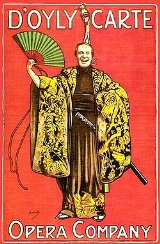
The Mikado

Encyclopedia

Comic opera
Comic opera denotes a sung dramatic work of a light or comic nature, usually with a happy ending.Forms of comic opera first developed in late 17th-century Italy. By the 1730s, a new operatic genre, opera buffa, emerged as an alternative to opera seria...
in two acts, with music by Arthur Sullivan
Arthur Sullivan
Sir Arthur Seymour Sullivan MVO was an English composer of Irish and Italian ancestry. He is best known for his series of 14 operatic collaborations with the dramatist W. S. Gilbert, including such enduring works as H.M.S. Pinafore, The Pirates of Penzance and The Mikado...
and libretto
Libretto
A libretto is the text used in an extended musical work such as an opera, operetta, masque, oratorio, cantata, or musical. The term "libretto" is also sometimes used to refer to the text of major liturgical works, such as mass, requiem, and sacred cantata, or even the story line of a...
by W. S. Gilbert
W. S. Gilbert
Sir William Schwenck Gilbert was an English dramatist, librettist, poet and illustrator best known for his fourteen comic operas produced in collaboration with the composer Sir Arthur Sullivan, of which the most famous include H.M.S...
, their ninth of fourteen operatic collaborations
Gilbert and Sullivan
Gilbert and Sullivan refers to the Victorian-era theatrical partnership of the librettist W. S. Gilbert and the composer Arthur Sullivan . The two men collaborated on fourteen comic operas between 1871 and 1896, of which H.M.S...
. It opened on March 14, 1885, in London
London
London is the capital city of :England and the :United Kingdom, the largest metropolitan area in the United Kingdom, and the largest urban zone in the European Union by most measures. Located on the River Thames, London has been a major settlement for two millennia, its history going back to its...
, where it ran at the Savoy Theatre
Savoy Theatre
The Savoy Theatre is a West End theatre located in the Strand in the City of Westminster, London, England. The theatre opened on 10 October 1881 and was built by Richard D'Oyly Carte on the site of the old Savoy Palace as a showcase for the popular series of comic operas of Gilbert and Sullivan,...
for 672 performances, which was the second longest run for any work of musical theatre and one of the longest runs of any theatre piece up to that time. Before the end of 1885, it was estimated that, in Europe and America, at least 150 companies were producing the opera. The Mikado remains the most frequently performed Savoy Opera
Savoy opera
The Savoy Operas denote a style of comic opera that developed in Victorian England in the late 19th century, with W. S. Gilbert and Arthur Sullivan as the original and most successful practitioners. The name is derived from the Savoy Theatre, which impresario Richard D'Oyly Carte built to house...
, and it is especially popular with amateur and school productions. The work has been translated into numerous languages and is one of the most frequently played musical theatre pieces in history.
Setting the opera in Japan
Japan
Japan is an island nation in East Asia. Located in the Pacific Ocean, it lies to the east of the Sea of Japan, China, North Korea, South Korea and Russia, stretching from the Sea of Okhotsk in the north to the East China Sea and Taiwan in the south...
, an exotic locale far away from Britain, allowed Gilbert to satirise British politics and institutions more freely by disguising them as Japanese. Gilbert used foreign or fictional locales in several operas, including The Mikado, Princess Ida
Princess Ida
Princess Ida; or, Castle Adamant is a comic opera with music by Arthur Sullivan and libretto by W. S. Gilbert. It was their eighth operatic collaboration of fourteen. Princess Ida opened at the Savoy Theatre on January 5, 1884, for a run of 246 performances...
, The Gondoliers
The Gondoliers
The Gondoliers; or, The King of Barataria is a Savoy Opera, with music by Arthur Sullivan and libretto by W. S. Gilbert. It premiered at the Savoy Theatre on 7 December 1889 and ran for a very successful 554 performances , closing on 30 June 1891...
, Utopia, Limited
Utopia, Limited
Utopia, Limited; or, The Flowers of Progress, is a Savoy Opera, with music by Arthur Sullivan and libretto by W. S. Gilbert. It was the second-to-last of Gilbert and Sullivan's fourteen collaborations, premiering on 7 October 1893 for a run of 245 performances...
and The Grand Duke
The Grand Duke
The Grand Duke; or, The Statutory Duel, is the final Savoy Opera written by librettist W. S. Gilbert and composer Arthur Sullivan, their fourteenth and last opera together. It premiered at the Savoy Theatre on March 7, 1896, and ran for 123 performances...
, to soften the impact of his pointed satire of British institutions.
Origins of the work
Gilbert and SullivanGilbert and Sullivan
Gilbert and Sullivan refers to the Victorian-era theatrical partnership of the librettist W. S. Gilbert and the composer Arthur Sullivan . The two men collaborated on fourteen comic operas between 1871 and 1896, of which H.M.S...
's previous opera, Princess Ida
Princess Ida
Princess Ida; or, Castle Adamant is a comic opera with music by Arthur Sullivan and libretto by W. S. Gilbert. It was their eighth operatic collaboration of fourteen. Princess Ida opened at the Savoy Theatre on January 5, 1884, for a run of 246 performances...
, ran for nine months; a short duration by Savoy opera
Savoy opera
The Savoy Operas denote a style of comic opera that developed in Victorian England in the late 19th century, with W. S. Gilbert and Arthur Sullivan as the original and most successful practitioners. The name is derived from the Savoy Theatre, which impresario Richard D'Oyly Carte built to house...
standards. As Ida showed signs of flagging, producer Richard D'Oyly Carte
Richard D'Oyly Carte
Richard D'Oyly Carte was an English talent agent, theatrical impresario, composer and hotelier during the latter half of the Victorian era...
realised that, for the first time since 1877, no new Savoy opera would be ready when the old one closed. On 22 March 1884, Carte gave Gilbert and Sullivan contractual notice that a new opera would be required in six months' time. Sullivan's close friend, conductor Frederic Clay
Frederic Clay
Frederic Emes Clay was an English composer known principally for his music written for the stage. Clay, a great friend of Arthur Sullivan's, wrote four comic operas with W. S...
, had suffered a serious stroke in early December 1883 that effectively ended his career. Sullivan, reflecting on this, on his own precarious health, and on his desire to devote himself to more serious music, replied that "it is impossible for me to do another piece of the character of those already written by Gilbert and myself". Gilbert was surprised to hear of Sullivan's hesitation and had started work on a new opera involving a plot in which people fell in love against their wills after taking a magic lozenge. He wrote to Sullivan asking him to reconsider, but the composer replied on 2 April that he had "come to the end of my tether" with the operas:
Gilbert was much hurt, but Sullivan insisted that he could not set the "lozenge plot". In addition to the "improbability" of it, it was too similar to the plot of their 1877 opera, The Sorcerer
The Sorcerer
The Sorcerer is a two-act comic opera, with a libretto by W. S. Gilbert and music by Arthur Sullivan. It was the British duo's third operatic collaboration. The plot of The Sorcerer is based on a Christmas story, An Elixir of Love, that Gilbert wrote for The Graphic magazine in 1876...
. The parties were at a stalemate, and Gilbert wrote, "And so ends a musical & literary association of seven years' standing—an association of exceptional reputation—an association unequalled in its monetary results, and hitherto undisturbed by a single jarring or discordant element." However, by 8 May 1884, Gilbert was ready to back down, writing, "...am I to understand that if I construct another plot in which no supernatural element occurs, you will undertake to set it? ...a consistent plot, free from anachronisms, constructed in perfect good faith & to the best of my ability." The stalemate was broken, and on 20 May 1884, Gilbert sent Sullivan a sketch of the plot of The Mikado. Gilbert eventually found a place for his "lozenge plot" in The Mountebanks
The Mountebanks (opera)
The Mountebanks is a comic opera in two acts with music by Alfred Cellier and a libretto by W. S. Gilbert. It was first produced at the Lyric Theatre, London, on 4 January 1892, for a run of 229 performances. It then toured and also had a short Broadway run in 1893. The original cast included...
, written with Alfred Cellier
Alfred Cellier
Alfred Cellier was an English composer, orchestrator and conductor.In addition to conducting and music directing the original productions of several of the most famous Gilbert and Sullivan works and writing the overtures to some of them, Cellier conducted at many theatres in London, New York and...
in 1892. It would take another ten months for The Mikado to reach the stage. A revised version of their 1877 work, The Sorcerer, coupled with their one-act Trial by Jury
Trial by Jury
Trial by Jury is a comic opera in one act, with music by Arthur Sullivan and libretto by W. S. Gilbert. It was first produced on 25 March 1875, at London's Royalty Theatre, where it initially ran for 131 performances and was considered a hit, receiving critical praise and outrunning its...
(1875), played at the Savoy while Carte and their audiences awaited their next work.
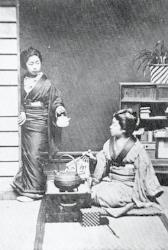
The story is an appealing one, but it is largely fictional. Gilbert was interviewed twice about his inspiration for The Mikado. In both interviews the sword was mentioned, and in one of them he said it was the inspiration for the opera, although he never said that the sword had fallen. What puts the entire story in doubt, moreover, is Cellier and Bridgeman's error concerning the Japanese exhibition in Knightsbridge
Japanese Village, Knightsbridge
The Japanese Village in Knightsbridge, London, was a late Victorian era exhibition of Japanese culture located in Humphreys' Hall, which took place from January 1885 until June 1887.-Description:...
: It did not open until 10 January 1885, almost two months after Gilbert had already completed Act I. Gilbert scholar Brian Jones, in his article "The Sword that Never Fell", notes that "the further removed in time the writer is from the incident, the more graphically it is recalled." Leslie Baily, for instance, told it this way in 1952:
The story was dramatised in more-or-less this form in the 1999
1999 in film
The year 1999 in film involved several noteworthy events and has been called "The Year That Changed Movies". Several significant feature films, including Stanley Kubrick's final film Eyes Wide Shut, Pedro Almodóvar's first Oscar-winning film All About My Mother, science fiction The Matrix, Deep...
film Topsy-Turvy
Topsy-Turvy
Topsy-Turvy is a 1999 musical drama film written and directed by Mike Leigh and stars Allan Corduner as Arthur Sullivan and Jim Broadbent as W. S. Gilbert, along with Timothy Spall and Lesley Manville. The story concerns the 15-month period in 1884 and 1885 leading up to the premiere of Gilbert...
. However, even though the 1885-87 Japanese exhibition in Knightsbridge had not opened when Gilbert conceived of The Mikado, European trade with Japan had increased in recent decades, and an English craze for all things Japanese had built through the 1860s and 1870s. This made the time ripe for an opera set in Japan. Gilbert told a journalist, "I cannot give you a good reason for our ... piece being laid in Japan. It ... afforded scope for picturesque treatment, scenery and costume, and I think that the idea of a chief magistrate, who is ... judge and actual executioner in one, and yet would not hurt a worm, may perhaps please the public."
In an 1885 interview with the New York Daily Tribune, Gilbert also stated that the short stature of Leonora Braham
Leonora Braham
Leonora Braham , born Leonora Lucy Abraham, was an English opera singer and actress primarily known as the creator of principal soprano roles in the Gilbert and Sullivan comic operas....
, Jessie Bond
Jessie Bond
Jessie Bond was an English singer and actress best known for creating the mezzo-soprano soubrette roles in the Gilbert and Sullivan comic operas. She spent twenty years on the stage, the bulk of them with the D'Oyly Carte Opera Company.Musical from an early age, Bond began a concert singing...
and Sybil Grey
Sybil Grey
Sybil Grey was a British opera singer during the Victorian era best known for creating a series of minor roles in productions by the D'Oyly Carte Opera Company, including roles in several of the famous Gilbert and Sullivan operas, between 1880 to 1888...
"suggested the advisability of grouping them as three Japanese school-girls" referred to in the opera as the "three little maids". He also recounted that a young Japanese lady, a tea-server from the Japanese village, came to rehearsals to coach the three little maids in some native Japanese dances. On 12 February 1885, one month before The Mikado opened, the Illustrated London News
Illustrated London News
The Illustrated London News was the world's first illustrated weekly newspaper; the first issue appeared on Saturday 14 May 1842. It was published weekly until 1971 and then increasingly less frequently until publication ceased in 2003.-History:...
wrote about the opening of the Japanese village noting, among other things, that "the graceful, fantastic dancing featured... three little maids!" Finally, Gilbert related that he and Sullivan had decided to cut the Mikado's Act II song, but that members of the company and others who had witnessed the dress rehearsal "came to us in a body and begged us to restore [it]".
Roles
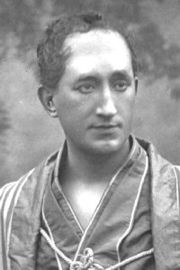
- The MikadoEmperor of JapanThe Emperor of Japan is, according to the 1947 Constitution of Japan, "the symbol of the state and of the unity of the people." He is a ceremonial figurehead under a form of constitutional monarchy and is head of the Japanese Imperial Family with functions as head of state. He is also the highest...
of Japan (bass or bass-baritoneBass-baritoneA bass-baritone is a high-lying bass or low-lying "classical" baritone voice type which shares certain qualities with the true baritone voice. The term arose in the late 19th century to describe the particular type of voice required to sing three Wagnerian roles: the Dutchman in Der fliegende...
) - Nanki-Poo, His Son, disguised as a wandering minstrel and in love with Yum-Yum (tenorTenorThe tenor is a type of male singing voice and is the highest male voice within the modal register. The typical tenor voice lies between C3, the C one octave below middle C, to the A above middle C in choral music, and up to high C in solo work. The low extreme for tenors is roughly B2...
) - Ko-Ko, The Lord High Executioner of Titipu (comic baritoneBaritoneBaritone is a type of male singing voice that lies between the bass and tenor voices. It is the most common male voice. Originally from the Greek , meaning deep sounding, music for this voice is typically written in the range from the second F below middle C to the F above middle C Baritone (or...
) - Pooh-Bah, Lord High Everything Else (baritoneBaritoneBaritone is a type of male singing voice that lies between the bass and tenor voices. It is the most common male voice. Originally from the Greek , meaning deep sounding, music for this voice is typically written in the range from the second F below middle C to the F above middle C Baritone (or...
) - Pish-Tush, A Noble Lord (baritoneBaritoneBaritone is a type of male singing voice that lies between the bass and tenor voices. It is the most common male voice. Originally from the Greek , meaning deep sounding, music for this voice is typically written in the range from the second F below middle C to the F above middle C Baritone (or...
) - Go-To, A Noble Lord (bassBass (voice type)A bass is a type of male singing voice and possesses the lowest vocal range of all voice types. According to The New Grove Dictionary of Opera, a bass is typically classified as having a range extending from around the second E below middle C to the E above middle C...
) - Yum-Yum, A Ward of Ko-Ko, also engaged to Ko-Ko (sopranoSopranoA soprano is a voice type with a vocal range from approximately middle C to "high A" in choral music, or to "soprano C" or higher in operatic music. In four-part chorale style harmony, the soprano takes the highest part, which usually encompasses the melody...
) - Pitti-Sing, A Ward of Ko-Ko (mezzo-sopranoMezzo-sopranoA mezzo-soprano is a type of classical female singing voice whose range lies between the soprano and the contralto singing voices, usually extending from the A below middle C to the A two octaves above...
) - Peep-Bo, A Ward of Ko-Ko (soprano or mezzo-soprano)
- Katisha, An Elderly lady, in love with Nanki-Poo (contraltoContraltoContralto is the deepest female classical singing voice, with the lowest tessitura, falling between tenor and mezzo-soprano. It typically ranges between the F below middle C to the second G above middle C , although at the extremes some voices can reach the E below middle C or the second B above...
) - Chorus of School-Girls, Nobles, Guards and CoolieCoolieHistorically, a coolie was a manual labourer or slave from Asia, particularly China, India, and the Phillipines during the 19th century and early 20th century...
s
Act I
- Courtyard of Ko-Ko's Official Residence
Gentlemen of the Japanese town of Titipu are gathered ("If you want to know who we are"). A wandering musician, Nanki-Poo, enters and introduces himself ("A wand'ring minstrel I"). He inquires about his beloved, the maiden Yum-Yum, a ward of Ko-Ko (formerly a cheap tailor). One of the gentlemen, Pish-Tush, explains that when the Mikado decreed that flirting was a capital crime, the Titipu authorities frustrated the decree by appointing Ko-Ko, a prisoner condemned to death for flirting, to the post of Lord High Executioner ("Our great Mikado, virtuous man"). Ko-Ko was "next" to be decapitated, and the Titipu authorities reasoned that he could "not cut off another's head until he cut his own off", and since Ko-Ko was not likely to try to execute himself, no executions could take place. However, all officials but the haughty Pooh-Bah proved too proud to serve under an ex-tailor, and Pooh-Bah now holds all their posts—and collects all their salaries. Pooh-Bah informs Nanki-Poo that Yum-Yum is scheduled to marry Ko-Ko on that very day ("Young man, despair").
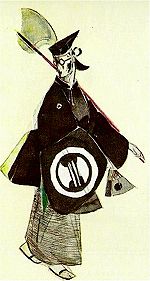
Ko-Ko receives news that the Mikado has decreed that unless an execution is carried out within a month, the town will be reduced to the rank of a village—which would bring "irretrievable ruin". Pooh-Bah and Pish-Tush point to Ko-Ko himself as the obvious choice for beheading, since he was already under sentence of death ("I am so proud"), but Ko-Ko protests that, firstly, it would be "extremely difficult, not to say dangerous", for him to attempt to execute himself, and secondly, it would be suicide, which is a "capital offence". Fortuitously, Ko-Ko discovers that Nanki-Poo, in despair over losing Yum-Yum, is preparing to commit suicide. After ascertaining that nothing would change Nanki-Poo's mind, Ko-Ko makes a bargain with him: Nanki-Poo may marry Yum-Yum for one month if, at the end of that time, he allows himself to be executed. Ko-Ko would then marry the young widow.
Everyone arrives to celebrate Nanki-Poo and Yum-Yum's union ("With aspect stern and gloomy stride"), but the festivities are interrupted by the arrival of Katisha, who has come to claim Nanki-Poo as her husband. However, the townspeople are much more sympathetic to the young couple, and her attempts to reveal Nanki-Poo's secret are drowned out by the shouting of the crowd. Outwitted but not defeated, Katisha makes it clear that she intends to return.
Act II
- Ko-Ko's Garden.
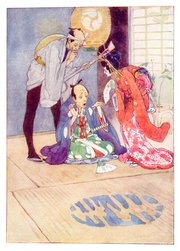
Blue bottle fly
The blue bottle fly or bottlebee is a common blow-fly found in most areas of the world and is the type species for the genus Calliphora.-Description:...
, and cannot execute Nanki-Poo, because the ex-tailor is too soft-hearted. Ko-Ko instead sends Nanki-Poo and Yum-Yum away to be wed (by Pooh-Bah, as Archbishop of Titipu), promising to present to the Mikado a false affidavit
Affidavit
An affidavit is a written sworn statement of fact voluntarily made by an affiant or deponent under an oath or affirmation administered by a person authorized to do so by law. Such statement is witnessed as to the authenticity of the affiant's signature by a taker of oaths, such as a notary public...
in evidence of the fictitious execution.
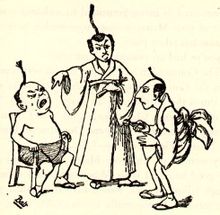
Ko-Ko discovers Katisha mourning her loss ("Alone, and yet alive") and throws himself on her mercy. He begs for her hand in marriage, saying that he has long harboured a passion for her. Katisha initially rebuffs him, but is soon moved by his pleadings ("Tit-willow"). She agrees ("There is beauty in the bellow of the blast") and, once the ceremony is performed (by Pooh-Bah, the Registrar), begs mercy for him and his "accomplices" from the Mikado. Nanki-Poo and Yum-Yum then re-appear, sparking Katisha's fury. The Mikado is astonished that Nanki-Poo is alive, when the account of his execution had been given with such "affecting particulars". Ko-Ko explains that when a royal command for an execution is given, the victim is, legally speaking, as good as dead, "and if he is dead, why not say so?" The Mikado deems that "Nothing could possibly be more satisfactory", and so Titipu celebrates ("For he's gone and married Yum-Yum").
Musical numbers
- Overture (Includes "Mi-ya Sa-ma", "The Sun Whose Rays Are All Ablaze", "There is Beauty in the Bellow of the Blast", "Braid the Raven Hair" and "With Aspect Stern and Gloomy Stride")
Act I
- 1. "If you want to know who we are" (Chorus of Men)
- 2. "A Wand'ring Minstrel I" (Nanki-Poo and Men)
- 3. "Our Great Mikado, virtuous man" (Pish-Tush and Men)
- 4. "Young man, despair" (Pooh-Bah, Nanki-Poo and Pish-Tush)
- 4a. Recit.RecitativeRecitative , also known by its Italian name "recitativo" , is a style of delivery in which a singer is allowed to adopt the rhythms of ordinary speech...
, "And have I journey'd for a month" (Pooh-Bah, Nanki-Poo) - 5. "Behold the Lord High Executioner" (Ko-Ko and Men)
- 5a. "As some day it may happen" (Ko-Ko and Men)
- 6. "Comes a train of little ladies" (Girls)
- 7. "Three little maids from school are we" (Yum-Yum, Peep-Bo, Pitti-Sing, and Girls)
- 8. "So please you, Sir, we much regret" (Yum-Yum, Peep-Bo, Pitti-Sing, Pooh-Bah, and Girls)
- 9. "Were you not to Ko-Ko plighted" (Yum-Yum and Nanki-Poo)
- 10. "I am so proud" (Pooh-Bah, Ko-Ko and Pish-Tush)
- 11. Finale Act I (Ensemble)
- "With aspect stern and gloomy stride"
- "The threatened cloud has passed away"
- "Your revels cease!" ... "Oh fool, that fleest my hallowed joys!"
- "For he's going to marry Yum-Yum"
- "The hour of gladness" ... "O ni! bikkuri shakkuri to!"
- "Ye torrents roar!"
Act II
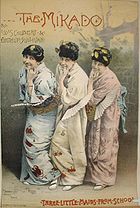
- 12. "Braid the raven hair" (Pitti-Sing and Girls)
- 13. "The sun whose rays are all ablaze" (Yum-Yum) (Originally in Act I, moved to Act II shortly after the opening night)
- 14. MadrigalMadrigal (music)A madrigal is a secular vocal music composition, usually a partsong, of the Renaissance and early Baroque eras. Traditionally, polyphonic madrigals are unaccompanied; the number of voices varies from two to eight, and most frequently from three to six....
, "Brightly dawns our wedding day" (Yum-Yum, Pitti-Sing, Nanki-Poo and Pish-Tush) - 15. "Here's a how-de-do" (Yum-Yum, Nanki-Poo and Ko-Ko)
- 16. "Mi-ya Sa-ma" "From every kind of man obedience I expect" (Mikado, Katisha, Chorus)
- 17. "A more humane Mikado" (Mikado, Chorus) (This song was nearly cut, but was restored shortly before the first night.)
- 18. "The criminal cried as he dropped him down" (Ko-Ko, Pitti-Sing, Pooh-Bah, Chorus)
- 19. GleeGlee (music)A glee is an English type of part song spanning the late baroque, classical and early romantic periods. It is usually scored for at least three voices, and generally intended to be sung unaccompanied. Glees often consist of a number of short, musically contrasted movements and their texts can be...
, "See how the Fates their gifts allot" (Mikado, Pitti-Sing, Pooh-Bah, Ko-Ko and Katisha) - 20. "The flowers that bloom in the spring" (Nanki-Poo, Ko-Ko, Yum-Yum, Pitti-Sing, and Pooh-Bah)
- 21. Recit. and song, "Alone, and yet alive" (Katisha)
- 22. "On a tree by a river" ("Willow, tit-willow") (Ko-Ko)
- 23. "There is beauty in the bellow of the blast" (Katisha and Ko-Ko)
- 24. "Finale Act II" (Ensemble)
- "For he's gone and married Yum-Yum"
- "The threatened cloud has passed away"
Productions
The Mikado had the longest original run of the Savoy Operas. It also had the quickest revival: after Gilbert and Sullivan's next work, RuddigoreRuddigore
Ruddigore; or, The Witch's Curse, originally called Ruddygore, is a comic opera in two acts, with music by Arthur Sullivan and libretto by W. S. Gilbert. It is one of the Savoy Operas and the tenth of fourteen comic operas written together by Gilbert and Sullivan...
, closed relatively quickly, three operas were revived to fill the interregnum until The Yeomen of the Guard
The Yeomen of the Guard
The Yeomen of the Guard; or, The Merryman and His Maid, is a Savoy Opera, with music by Arthur Sullivan and libretto by W. S. Gilbert. It premiered at the Savoy Theatre on 3 October 1888, and ran for 423 performances...
was ready, with The Mikado being revived just seventeen months after the first run closed. On 4 September 1891, D'Oyly Carte's touring "C" company gave a Royal Command Performance
Royal Command Performance
For the annual Royal Variety Performance performed in Britain for the benefit of the Entertainment Artistes' Benevolent Fund, see Royal Variety Performance...
of The Mikado at Balmoral Castle
Balmoral Castle
Balmoral Castle is a large estate house in Royal Deeside, Aberdeenshire, Scotland. It is located near the village of Crathie, west of Ballater and east of Braemar. Balmoral has been one of the residences of the British Royal Family since 1852, when it was purchased by Queen Victoria and her...
before Queen Victoria and the Royal Family.
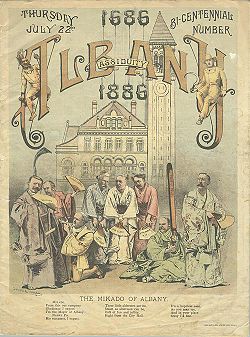
The Grand Duke
The Grand Duke; or, The Statutory Duel, is the final Savoy Opera written by librettist W. S. Gilbert and composer Arthur Sullivan, their fourteenth and last opera together. It premiered at the Savoy Theatre on March 7, 1896, and ran for 123 performances...
was in preparation. When it became clear that that opera was not a success, The Mikado was given at matinees, and the revival continued when The Grand Duke closed after just three months. In 1906–07, Helen Carte, the widow of Richard D'Oyly Carte
Richard D'Oyly Carte
Richard D'Oyly Carte was an English talent agent, theatrical impresario, composer and hotelier during the latter half of the Victorian era...
, mounted a repertory season at the Savoy, but The Mikado was not performed, as it was thought that visiting Japanese royalty might be offended by it. However, it was included in Mrs. Carte's second repertory season, in 1908–09. New costume designs were created by Charles Ricketts
Charles Ricketts
Charles de Sousy Ricketts was a versatile English artist, illustrator, author and printer, and is best known for his work as book designer and typographer from 1896 to 1904 with the Vale Press, and his work in the theatre as a set and costume designer.-Life and career:Ricketts was born in Geneva...
for the 1926 season and were used until 1982.
The first provincial production of The Mikado opened on July 27, 1885 in Brighton
Brighton
Brighton is the major part of the city of Brighton and Hove in East Sussex, England on the south coast of Great Britain...
, with several members of that company leaving in August to present the first authorised American production in New York. From then on, The Mikado was a constant presence on tour. From 1885 until the Company's closure in 1982, there was no year in which a D'Oyly Carte company (or several of them) was not presenting it.
H.M.S. Pinafore
H.M.S. Pinafore; or, The Lass That Loved a Sailor is a comic opera in two acts, with music by Arthur Sullivan and a libretto by W. S. Gilbert. It opened at the Opera Comique in London, England, on 25 May 1878 and ran for 571 performances, which was the second-longest run of any musical...
, the first productions were piracies, but once the authorised American production opened in August 1885, it was a success, earning record profits, and Carte formed several companies to tour the show in North America. Burlesque and parody productions, including political parodies, were mounted. About 150 unauthorised versions cropped up, and, as had been the case with Pinafore, there was nothing that Carte or Gilbert and Sullivan could do about it, since there was no copyright treaty at the time. In Australia, The Mikados first authorised performance was on 14 November 1885 at the Theatre Royal, Sydney
Sydney
Sydney is the most populous city in Australia and the state capital of New South Wales. Sydney is located on Australia's south-east coast of the Tasman Sea. As of June 2010, the greater metropolitan area had an approximate population of 4.6 million people...
, produced by J. C. Williamson
J. C. Williamson
James Cassius Williamson was an American actor and later Australia's foremost theatrical manager, founding J. C. Williamson Ltd....
. During 1886, Carte was touring five Mikado companies in North America.
Carte toured the opera in 1886 and again in 1887 in Germany and elsewhere in Europe. In September 1886, Vienna's leading critic, Eduard Hanslick
Eduard Hanslick
Eduard Hanslick was a Bohemian-Austrian music critic.-Biography:Hanslick was born in Prague, the son of Joseph Adolph Hanslick, a bibliographer and music teacher from a German-speaking family, and one of his piano pupils, the daughter of a Jewish merchant from Vienna...
, wrote that the opera's "unparalleled success" was attributable not merely to the libretto and the music, but also to "the wholly original stage performance, unique of its kind, by Mr D'Oyly Carte's artists... riveting the eye and ear with its exotic allurement." Authorised productions were also seen in France, Holland, Hungary, Spain, Belgium, Scandinavia, Russia and elsewhere.
After the Gilbert copyrights expired in 1962, the Sadler's Wells Opera
Sadler's Wells Theatre
Sadler's Wells Theatre is a performing arts venue located in Rosebery Avenue, Clerkenwell in the London Borough of Islington. The present day theatre is the sixth on the site since 1683. It consists of two performance spaces: a 1,500 seat main auditorium and the Lilian Baylis Studio, with extensive...
mounted the first non-D'Oyly Carte professional production in England, with Clive Revill
Clive Revill
Clive Selsby Revill is a New Zealand-born British character actor best known for his performances in musical theatre and on the London stage.-Early life and stage career:...
as Ko-Ko. Among the many professional revivals since then was an English National Opera
English National Opera
English National Opera is an opera company based in London, resident at the London Coliseum in St. Martin's Lane. It is one of the two principal opera companies in London, along with the Royal Opera, Covent Garden...
production in 1986, with Eric Idle
Eric Idle
Eric Idle is an English comedian, actor, author, singer, writer, and comedic composer. He was as a member of the British comedy group Monty Python, a member of the The Rutles on Saturday Night Live and author of the play, Spamalot....
as Ko-Ko and Lesley Garrett
Lesley Garrett
Lesley Garrett CBE is an English musician, broadcaster and media personality.- Early life :Garrett was born in the town of Thorne near Doncaster in South Yorkshire, into a musical family. She attended Thorne Grammar School, where she performed in school plays and musicals. As she grew up she...
as Yum-Yum, directed by Jonathan Miller
Jonathan Miller
Sir Jonathan Wolfe Miller CBE is a British theatre and opera director, author, physician, television presenter, humorist and sculptor. Trained as a physician in the late 1950s, he first came to prominence in the 1960s with his role in the comedy revue Beyond the Fringe with fellow writers and...
. This production, which has been revived several times, was set not in ancient Japan, but in a swanky 1920s seaside hotel with sets and costumes in white and black.
The following table shows the history of the D'Oyly Carte productions in Gilbert's lifetime:
| Theatre | Opening Date | Closing Date | Perfs. | Details |
|---|---|---|---|---|
| Savoy Theatre | March 14, 1885 | January 19, 1887 | 672 | First London run. |
| Fifth Avenue Fifth Avenue Theatre Fifth Avenue Theatre was a Broadway theatre in New York City in the United States located at 31 West 28th Street and Broadway. It was demolished in 1939.... and Standard Theatres Manhattan Theatre The Manhattan Theatre, directly across from Greeley Square at Sixth Avenue and 33rd Street, was located at 102 West 33rd Street, in New York, NY. It was a 1100-seat theatre which opened in 1875 as the Eagle Variety Theatre, and later re-named the Standard Theatre in 1878... , New York |
August 19, 1885 | April 17, 1886 | 250 | Authorised American production. Production was given at the Fifth Avenue Theatre Fifth Avenue Theatre Fifth Avenue Theatre was a Broadway theatre in New York City in the United States located at 31 West 28th Street and Broadway. It was demolished in 1939.... , except for a one-month transfer to the Standard Theatre in February 1886. |
| Fifth Avenue Theatre, New York | November 1, 1886 | November 20, 1886 | 3 wks | Production with some D'Oyly Carte personnel under the management of John Stetson. |
| Savoy Theatre | June 7, 1888 | September 29, 1888 | 116 | First London revival. |
| Savoy Theatre | November 6, 1895 | March 4, 1896 | 127 | Second London revival. |
| Savoy Theatre | May 27, 1896 | July 4, 1896 | 6 | Performances at matinees during the original run of The Grand Duke The Grand Duke The Grand Duke; or, The Statutory Duel, is the final Savoy Opera written by librettist W. S. Gilbert and composer Arthur Sullivan, their fourteenth and last opera together. It premiered at the Savoy Theatre on March 7, 1896, and ran for 123 performances... . |
| Savoy Theatre | July 11, 1896 | February 17, 1897 | 226 | Continuation of revival after early closure of The Grand Duke The Grand Duke The Grand Duke; or, The Statutory Duel, is the final Savoy Opera written by librettist W. S. Gilbert and composer Arthur Sullivan, their fourteenth and last opera together. It premiered at the Savoy Theatre on March 7, 1896, and ran for 123 performances... . |
| Savoy Theatre | April 28, 1908 | March 27, 1909 | 142 | Second Savoy repertory season; played with five other operas. Closing date shown is of the entire season. |
Themes of death
The Mikado is a comedy that deals with themes of death and cruelty. This works only because Gilbert treats these themes as trivial, even lighthearted issues. For instance, in Pish-Tush's song "Our great Mikado, virtuous man", he sings: "The youth who winked a roving eye/Or breathed a non-connubial sigh/Was thereupon condemned to die —/He usually objected." The term for this rhetorical technique is meiosisMeiosis (figure of speech)
In rhetoric, meiosis is a euphemistic figure of speech that intentionally understates something or implies that it is lesser in significance or size than it really is. Meiosis is the opposite of auxesis, and also sometimes used as a synonym for litotes...
, a drastic understatement of the situation. Other examples of this are when self-decapitation is described as "an extremely difficult, not to say dangerous, thing to attempt", and also as merely "awkward". When a discussion occurs of Nanki-Poo's life being "cut short in a month", the tone remains comic and only mock-melancholy. Burial alive is described as "a stuffy death". Finally, execution by boiling oil or by melted lead is described by the Mikado as a "humorous but lingering" punishment.
Death is treated as a businesslike event in Gilbert's topsy-turvy world. Pooh-Bah calls Ko-Ko, the Lord High Executioner, an "industrious mechanic". Ko-Ko also treats his bloody office as a profession, saying, "I can't consent to embark on a professional operation unless I see my way to a successful result." Of course, joking about death does not originate with The Mikado. The plot conceit that Nanki-Poo may marry Yum-Yum if he agrees to die at the end of the month was used in A Wife for a Month
A Wife for a Month
A Wife for a Month is a late Jacobean era stage play, a tragicomedy written by John Fletcher and originally published in the first Beaumont and Fletcher folio of 1647....
, a 17th century play by John Fletcher
John Fletcher (playwright)
John Fletcher was a Jacobean playwright. Following William Shakespeare as house playwright for the King's Men, he was among the most prolific and influential dramatists of his day; both during his lifetime and in the early Restoration, his fame rivalled Shakespeare's...
. Ko-Ko's final speech affirms that death has been, throughout the opera, a fiction, a matter of words that can be dispelled with a phrase or two: being dead and being "as good as dead" are equated. In a review of the original production of The Mikado, after praising the show generally, the critic noted that the show's humour nevertheless depends on "unsparing exposure of human weaknesses and follies—things grave and even horrible invested with a ridiculous aspect—all the motives prompting our actions traced back to inexhaustible sources of selfishness and cowardice... Decapitation, disembowelment, immersion in boiling oil or molten lead are the eventualities upon which [the characters'] attention (and that of the audience) is kept fixed with gruesome persistence... [Gilbert] has unquestionably succeeded in imbuing society with his own quaint, scornful, inverted philosophy; and has thereby established a solid claim to rank amongst the foremost of those latter-day Englishmen who have exercised a distinct psychical influence upon their contemporaries."
Japanese setting
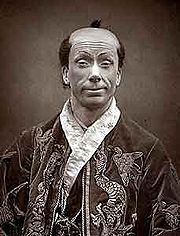
G. K. Chesterton
Gilbert Keith Chesterton, KC*SG was an English writer. His prolific and diverse output included philosophy, ontology, poetry, plays, journalism, public lectures and debates, literary and art criticism, biography, Christian apologetics, and fiction, including fantasy and detective fiction....
compared the satire in the opera to that in Jonathan Swift
Jonathan Swift
Jonathan Swift was an Irish satirist, essayist, political pamphleteer , poet and cleric who became Dean of St...
's Gulliver's Travels
Gulliver's Travels
Travels into Several Remote Nations of the World, in Four Parts. By Lemuel Gulliver, First a Surgeon, and then a Captain of Several Ships, better known simply as Gulliver's Travels , is a novel by Anglo-Irish writer and clergyman Jonathan Swift that is both a satire on human nature and a parody of...
: "Gilbert pursued and persecuted the evils of modern England till they had literally not a leg to stand on, exactly as Swift did... I doubt if there is a single joke in the whole play that fits the Japanese. But all the jokes in the play fit the English... About England, Pooh-bah is something more than a satire; he is the truth." The opera's setting draws on Victorian
Victorian era
The Victorian era of British history was the period of Queen Victoria's reign from 20 June 1837 until her death on 22 January 1901. It was a long period of peace, prosperity, refined sensibilities and national self-confidence...
notions of the far east, gleaned by Gilbert from the glimpses of Japanese fashion and art that immediately followed the beginning of trade between the two island empires, and during rehearsals, Gilbert visited the popular Japanese exhibition
Japanese Village, Knightsbridge
The Japanese Village in Knightsbridge, London, was a late Victorian era exhibition of Japanese culture located in Humphreys' Hall, which took place from January 1885 until June 1887.-Description:...
in Knightsbridge
Knightsbridge
Knightsbridge is a road which gives its name to an exclusive district lying to the west of central London. The road runs along the south side of Hyde Park, west from Hyde Park Corner, spanning the City of Westminster and the Royal Borough of Kensington and Chelsea...
, London.
Gilbert sought authenticity, however, in the setting, costumes, movements and gestures of the actors. To that end, Gilbert engaged some of the Japanese at the Knightsbridge village to advise on the production and to coach the actors. "The Directors and Native Inhabitants" of the village were thanked in the programme that was distributed on the first night. Sullivan inserted into his score, as "Miya sama", a version of a Japanese military march song, called "Ton-yare Bushi", composed in the Meiji Era. Giacomo Puccini
Giacomo Puccini
Giacomo Antonio Domenico Michele Secondo Maria Puccini was an Italian composer whose operas, including La bohème, Tosca, Madama Butterfly, and Turandot, are among the most frequently performed in the standard repertoire...
later incorporated the same song into Madama Butterfly
Madama Butterfly
Madama Butterfly is an opera in three acts by Giacomo Puccini, with an Italian libretto by Luigi Illica and Giuseppe Giacosa. Puccini based his opera in part on the short story "Madame Butterfly" by John Luther Long, which was dramatized by David Belasco...
. The characters' names in the play are not Japanese names, but rather (in many cases) English baby-talk
Baby talk
Baby talk, also referred to as caretaker speech, infant-directed speech or child-directed speech and informally as "motherese", "parentese", "mommy talk", or "daddy talk" is a nonstandard form of speech used by adults in talking to toddlers and infants.It is usually delivered with a "cooing"...
or simply dismissive exclamations. For instance, a pretty young thing is named Pitti-Sing; the beautiful heroine is named Yum-Yum; the pompous officials are Pooh-Bah and Pish-Tush; the hero is called Nanki-Poo, baby-talk for "handkerchief
Handkerchief
A handkerchief , also called a handkercher or hanky, is a form of a kerchief, typically a hemmed square of thin fabric that can be carried in the pocket or purse, and which is intended for personal hygiene purposes such as wiping one's hands or face, or blowing one's nose...
" The headsman's name, Ko-Ko, is similar to that of the scheming Ko-Ko-Ri-Ko in Ba-ta-clan
Ba-ta-clan
Ba-ta-clan is a "chinoiserie musicale", or operetta, in one act by Jacques Offenbach to an original French libretto by Ludovic Halévy. It was first performed at Théâtre des Bouffes Parisiens, Paris, on 29 December 1855. The operetta uses set numbers and spoken dialogue and runs about one...
by Jacques Offenbach
Jacques Offenbach
Jacques Offenbach was a Prussian-born French composer, cellist and impresario. He is remembered for his nearly 100 operettas of the 1850s–1870s and his uncompleted opera The Tales of Hoffmann. He was a powerful influence on later composers of the operetta genre, particularly Johann Strauss, Jr....
.
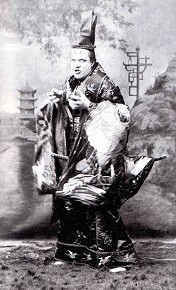
Prince Komatsu Akihito
-External links:**...
, who saw an 1886 production in London, took no offence. When Prince Fushimi Sadanaru
Prince Fushimi Sadanaru
was the 22nd head of the Fushimi-no-miya shinnōke . He was a field marshal in the Imperial Japanese Army.- Early life :...
made a state visit in 1907, the British government banned performances of The Mikado from London for six weeks, fearing that the play might offend him—a manoeuvre that backfired when the prince complained that he had hoped to see The Mikado during his stay. A Japanese journalist covering the prince's stay attended a proscribed performance and confessed himself "deeply and pleasingly disappointed." Expecting "real insults" to his country, he had found only "bright music and much fun."
The J. C. Williamson
J. C. Williamson
James Cassius Williamson was an American actor and later Australia's foremost theatrical manager, founding J. C. Williamson Ltd....
G&S company toured Japan in the 1920s, likely performing The Mikado among other Gilbert and Sullivan
Gilbert and Sullivan
Gilbert and Sullivan refers to the Victorian-era theatrical partnership of the librettist W. S. Gilbert and the composer Arthur Sullivan . The two men collaborated on fourteen comic operas between 1871 and 1896, of which H.M.S...
works. After World War II
World War II
World War II, or the Second World War , was a global conflict lasting from 1939 to 1945, involving most of the world's nations—including all of the great powers—eventually forming two opposing military alliances: the Allies and the Axis...
, The Mikado was staged in Japan in a number of private performances. The first public production, given at three performances was in 1946 in the Ernie Pyle Theater in Tokyo, conducted by the pianist Jorge Bolet
Jorge Bolet
Jorge Bolet was a Cuban-born but mostly American-resident pianist and teacher.-Life:Bolet was born in Havana, and studied at the Curtis Institute of Music in Philadelphia, where he himself taught from 1939 to 1942...
for the entertainment of American troops. The set and costumes were opulent, and the principal players were American, Canadian, and British, as were the women's chorus, but the male chorus and the female dancing chorus were Japanese. General Douglas MacArthur
Douglas MacArthur
General of the Army Douglas MacArthur was an American general and field marshal of the Philippine Army. He was a Chief of Staff of the United States Army during the 1930s and played a prominent role in the Pacific theater during World War II. He received the Medal of Honor for his service in the...
banned a large-scale professional 1947 Tokyo production by an all-Japanese cast, but other productions have occurred in Japan. For example, the opera was performed at the Ernie Pyle Theater in Tokyo in 1970, presented by the Eighth Army Special Service.
In 2001, the town of Chichibu
Chichibu, Saitama
is a city in Saitama, Japan. As of April 1, 2011, the city has an estimated population of 68,701, with a household number of 26,230. The total area is 577.69 km²....
(秩父), Japan, under the name of "Tokyo Theatre Company", produced an adaptation of The Mikado in Japanese. Locals say that Chichibu was the town that Gilbert had in mind when he named his setting "Titipu", but there is no contemporary evidence for this theory. Rokusuke Ei
Rokusuke Ei
is a Japanese lyricist, composer, author, essayist and TV personality.Ei wrote the lyrics to the song "Sukiyaki", which has been used in several English language films. He has also written the lyrics to the song "Miagete goran yoru no hoshi wo" sung by Kyu Sakamoto in 1963...
, a Japanese broadcaster, lyricist and essayist, among others, was convinced that a peasant uprising in Chichibu in 1884 inspired Gilbert to set the opera in Japan. Although the Hepburn system of transliteration
Transliteration
Transliteration is a subset of the science of hermeneutics. It is a form of translation, and is the practice of converting a text from one script into another...
(in which the name of the town appears as "Chichibu") is usually found today, it was very common in the 19th century to use the Kunrei system, in which the name 秩父 appears as "Titibu". Thus it is easy to surmise that "Titibu", found in the London press of 1884, became "Titipu" in the opera. Other Japanese researchers have concluded that Gilbert may simply have heard of Chichibu silk, an important export in the 19th century. In any case, the town's Japanese-language adaptation of The Mikado has been performed several times throughout Japan. In August 2006, the Chichibu Mikado was performed at the International Gilbert and Sullivan Festival
International Gilbert and Sullivan Festival
The International Gilbert and Sullivan Festival is held every summer at the Opera House in Buxton, Derbyshire, England. The three-week Festival of Gilbert and Sullivan performances and fringe events attracts thousands of visitors, including performers, supporters, and G&S enthusiasts from all...
in England, and the same company continued to perform the adaptation on tour in Japan in 2007.
Modernised words and phrases
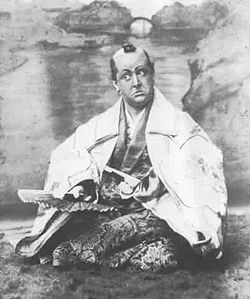
Nigger
Nigger is a noun in the English language, most notable for its usage in a pejorative context to refer to black people , and also as an informal slang term, among other contexts. It is a common ethnic slur...
serenade
Serenade
In music, a serenade is a musical composition, and/or performance, in someone's honor. Serenades are typically calm, light music.The word Serenade is derived from the Italian word sereno, which means calm....
r and the others of his race". Gilbert's reference was to blackface minstrels
Minstrel show
The minstrel show, or minstrelsy, was an American entertainment consisting of comic skits, variety acts, dancing, and music, performed by white people in blackface or, especially after the Civil War, black people in blackface....
who were white entertainers in makeup, not to dark skinned people. Also included in the list are "the lady novelist", referring to a particular type of novelist earlier lampooned by George Eliot
George Eliot
Mary Anne Evans , better known by her pen name George Eliot, was an English novelist, journalist and translator, and one of the leading writers of the Victorian era...
, and "the lady from the provinces who dresses like a guy", where guy refers to the dummy that is part of Guy Fawkes Night
Guy Fawkes Night
Guy Fawkes Night, also known as Guy Fawkes Day, Bonfire Night and Firework Night, is an annual commemoration observed on 5 November, primarily in England. Its history begins with the events of 5 November 1605, when Guy Fawkes, a member of the Gunpowder Plot, was arrested while guarding...
celebrations, hence a tasteless woman who dresses like a scarecrow
Scarecrow
A scarecrow is, essentially, a decoy, though traditionally, a human figure dressed in old clothes and placed in fields by farmers to discourage birds such as crows or sparrows from disturbing and feeding on recently cast seed and growing crops.-History:In Kojiki, the oldest surviving book in Japan...
.
To avoid distracting the audience with references that have become offensive over time, the lyrics are almost invariably modified in modern productions; universally, the word "nigger" is changed. Other changes are made to the opera to take advantage of opportunities for topical jokes; the "Little List" song is often significantly rewritten. The precedent for such updating was set by Gilbert himself in the 1908 Savoy revival, with his additions to the Lord High Executioner's list of "The lovely suffragist" and "The red-hot Socialist". Richard Suart
Richard Suart
Richard Suart is an English opera singer and actor, who has specialised in the comic roles of Gilbert and Sullivan operas and in operetta, as well as in avant-garde modern operas...
, a singer well known in the role of Ko-Ko, published a book containing a history of rewrites of the song, including many of his own. Another frequent alteration is to Pooh-Bah's list of titles, which must be kept largely the same due to later plot references, but may be added to with modern, topical positions. The Mikado's list of punishments and crimes in "A more humane Mikado", is also sometimes rewritten to include modern infractions.
Enduring popularity
The Mikado became the most frequently performed Savoy OperaSavoy opera
The Savoy Operas denote a style of comic opera that developed in Victorian England in the late 19th century, with W. S. Gilbert and Arthur Sullivan as the original and most successful practitioners. The name is derived from the Savoy Theatre, which impresario Richard D'Oyly Carte built to house...
, and it has been translated into numerous languages. It is one of the most frequently played musical theatre pieces in history. A feature on Chicago Lyric Opera's 2010 production noted that the opera "has been in constant production for the past 125 years", citing its "inherent humor and tunefulness".
The Mikado has been admired by other composers. Dame Ethel Smyth
Ethel Smyth
Dame Ethel Mary Smyth, DBE was an English composer and a leader of the women's suffrage movement.- Early career :...
wrote of Sullivan, "One day he presented me with a copy of the full score of The Golden Legend, adding: 'I think this is the best thing I've done, don't you?' and when truth compelled me to say that in my opinion The Mikado is his masterpiece, he cried out: 'O you wretch!' But though he laughed, I could see he was disappointed."
Historical casting
The following tables show the casts of the principal original productions and D'Oyly Carte Opera Company touring repertory at various times through to the company's 1982 closure:| Role | Savoy Theatre 1885 | Fifth Avenue 1885 | Savoy Theatre 1888 |
Savoy Theatre 1895!!Savoy Theatre 1908 |
|
|---|---|---|---|---|---|
| The Mikado | Richard Temple | Frederick Federici | Richard Temple | R. Scott Fishe R. Scott Fishe Robert Scott Fishe was an English operatic baritone best remembered for creating roles in the 1890s with the D’Oyly Carte Opera Company.-Early career:... ² |
Henry Lytton Henry Lytton Sir Henry Lytton was an English actor and singer who was the leading exponent of the comic patter-baritone roles in Gilbert and Sullivan operas in the early part of the twentieth century... |
| Nanki-Poo | Durward Lely Durward Lely Durward Lely was a Scottish opera singer primarily known as the creator of five tenor roles in Gilbert and Sullivan's comic operas, including Nanki-Poo in The Mikado.... |
Courtice Pounds Courtice Pounds Charles Courtice Pounds , better known by the stage name Courtice Pounds, was an English singer and actor known for his performances in the tenor roles of the Savoy Operas with the D'Oyly Carte Opera Company and his later roles in Shakespeare plays and Edwardian musical comedies.As a young member... |
J. G. Robertson | Charles Kenningham Charles Kenningham Charles Kenningham was an English opera singer best remembered for his roles in the 1890s with the D’Oyly Carte Opera Company.... |
Strafford Moss |
| Ko-Ko | George Grossmith George Grossmith George Grossmith was an English comedian, writer, composer, actor, and singer. His performing career spanned more than four decades... |
George Thorne George Thorne George Thorne, was an English singer and actor, best known for his performances in the comic baritone roles of the Savoy Operas with the D'Oyly Carte Opera Company, especially on tour and in the original New York City productions... |
George Grossmith George Grossmith George Grossmith was an English comedian, writer, composer, actor, and singer. His performing career spanned more than four decades... |
Walter Passmore Walter Passmore Walter Henry Passmore was an English singer and actor best known as the first successor to George Grossmith in the comic baritone roles in Gilbert and Sullivan operas with the D'Oyly Carte Opera Company.... |
Charles H. Workman Charles H. Workman Charles H. Workman was a singer and actor best known as a successor to George Grossmith in the comic baritone roles in Gilbert and Sullivan operas. He was sometimes credited as C. Herbert Workman or C. H... |
| Pooh-Bah | Rutland Barrington Rutland Barrington Rutland Barrington was an English singer, actor, comedian, and Edwardian musical comedy star. Best remembered for originating the lyric baritone roles in the Gilbert and Sullivan operas from 1877 to 1896, his performing career spanned more than four decades... |
Fred Billington Fred Billington Fred Billington was an English singer and actor, best known for his performances in baritone roles of the Savoy Operas with the D'Oyly Carte Opera Company... |
Rutland Barrington Rutland Barrington Rutland Barrington was an English singer, actor, comedian, and Edwardian musical comedy star. Best remembered for originating the lyric baritone roles in the Gilbert and Sullivan operas from 1877 to 1896, his performing career spanned more than four decades... |
Rutland Barrington Rutland Barrington Rutland Barrington was an English singer, actor, comedian, and Edwardian musical comedy star. Best remembered for originating the lyric baritone roles in the Gilbert and Sullivan operas from 1877 to 1896, his performing career spanned more than four decades... |
Rutland Barrington Rutland Barrington Rutland Barrington was an English singer, actor, comedian, and Edwardian musical comedy star. Best remembered for originating the lyric baritone roles in the Gilbert and Sullivan operas from 1877 to 1896, his performing career spanned more than four decades... |
| Pish-Tush | Frederick Bovill | Charles Richards | Richard Cummings | Jones Hewson Jones Hewson John Jones Hewson , credited as Jones Hewson, was a Welsh singer and actor known for his creation and portrayal of baritone roles with the D'Oyly Carte Opera Company from 1896 to 1901.... |
Leicester Tunks |
| Go-To1 | Rudolph Lewis | R. H. Edgar | Rudolph Lewis | Fred Drawater | |
| Yum-Yum | Leonora Braham Leonora Braham Leonora Braham , born Leonora Lucy Abraham, was an English opera singer and actress primarily known as the creator of principal soprano roles in the Gilbert and Sullivan comic operas.... |
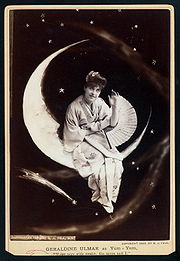
Geraldine Ulmar Geraldine Ulmar Geraldine Ulmar was an American singer and actress, best known for her performances in soprano roles of the Gilbert and Sullivan operas with the D'Oyly Carte Opera Company.-Life and career:... |
Geraldine Ulmar Geraldine Ulmar Geraldine Ulmar was an American singer and actress, best known for her performances in soprano roles of the Gilbert and Sullivan operas with the D'Oyly Carte Opera Company.-Life and career:... |
Florence Perry Florence Perry Florence Perry was an English opera singer and actress best known for her performances with the D'Oyly Carte Opera Company.-Biography:... |
Clara Dow Clara Dow Clara Millington Dow was an English operatic soprano of the early twentieth century. After a concert career, she appeared at the Savoy Theatre in the first repertory seasons of Gilbert and Sullivan operas mounted by the D'Oyly Carte Opera Company in 1906-09, under the direction of the author... |
| Pitti-Sing | Jessie Bond Jessie Bond Jessie Bond was an English singer and actress best known for creating the mezzo-soprano soubrette roles in the Gilbert and Sullivan comic operas. She spent twenty years on the stage, the bulk of them with the D'Oyly Carte Opera Company.Musical from an early age, Bond began a concert singing... |
Kate Forster | Jessie Bond Jessie Bond Jessie Bond was an English singer and actress best known for creating the mezzo-soprano soubrette roles in the Gilbert and Sullivan comic operas. She spent twenty years on the stage, the bulk of them with the D'Oyly Carte Opera Company.Musical from an early age, Bond began a concert singing... |
Jessie Bond Jessie Bond Jessie Bond was an English singer and actress best known for creating the mezzo-soprano soubrette roles in the Gilbert and Sullivan comic operas. She spent twenty years on the stage, the bulk of them with the D'Oyly Carte Opera Company.Musical from an early age, Bond began a concert singing... |
Jessie Rose |
| Peep-Bo | Sybil Grey Sybil Grey Sybil Grey was a British opera singer during the Victorian era best known for creating a series of minor roles in productions by the D'Oyly Carte Opera Company, including roles in several of the famous Gilbert and Sullivan operas, between 1880 to 1888... |
Geraldine St. Maur | Sybil Grey Sybil Grey Sybil Grey was a British opera singer during the Victorian era best known for creating a series of minor roles in productions by the D'Oyly Carte Opera Company, including roles in several of the famous Gilbert and Sullivan operas, between 1880 to 1888... |
Emmie Owen Emmie Owen Emmie Owen was an English opera singer and actress, best known for her performances in soprano roles of the Savoy Operas with the D'Oyly Carte Opera Company... |
Beatrice Boarer |
| Katisha | Rosina Brandram Rosina Brandram Rosina Brandram was an English opera singer and actress primarily known for creating many of the contralto roles in the Savoy operas with the D'Oyly Carte Opera Company.... |
Elsie Cameron | Rosina Brandram Rosina Brandram Rosina Brandram was an English opera singer and actress primarily known for creating many of the contralto roles in the Savoy operas with the D'Oyly Carte Opera Company.... |
Rosina Brandram Rosina Brandram Rosina Brandram was an English opera singer and actress primarily known for creating many of the contralto roles in the Savoy operas with the D'Oyly Carte Opera Company.... |
Louie René Louie René Louie René was an English singer and actress best remembered for her performances with the D'Oyly Carte Opera Company in the Gilbert and Sullivan contralto roles at the turn of the 20th century.... |
1Role of Go-To added from April 1885
²For 1896–97 revival, Richard Temple returned to play The Mikado during January–February 1896, and again from November 1896–February 1897.
| Role | D'Oyly Carte 1915 Tour | D'Oyly Carte 1925 Tour | D'Oyly Carte 1935 Tour | D'Oyly Carte 1945 Tour | D'Oyly Carte 1951 Tour |
|---|---|---|---|---|---|
| The Mikado | Leicester Tunks | Darrell Fancourt Darrell Fancourt Darrell Fancourt was an English bass-baritone, known for his performances and recordings of the Savoy Operas.... |
Darrell Fancourt Darrell Fancourt Darrell Fancourt was an English bass-baritone, known for his performances and recordings of the Savoy Operas.... |
Darrell Fancourt Darrell Fancourt Darrell Fancourt was an English bass-baritone, known for his performances and recordings of the Savoy Operas.... |
Darrell Fancourt Darrell Fancourt Darrell Fancourt was an English bass-baritone, known for his performances and recordings of the Savoy Operas.... |
| Nanki-Poo | Dewey Gibson | Charles Goulding Charles Goulding Charles Goulding was an English operatic tenor best known for his performances with the D'Oyly Carte Opera Company in the Gilbert and Sullivan repertory.-Early years:... |
Charles Goulding Charles Goulding Charles Goulding was an English operatic tenor best known for his performances with the D'Oyly Carte Opera Company in the Gilbert and Sullivan repertory.-Early years:... |
John Dean John Dean (singer) John Dean was an English singer and actor, best known for his performances in the tenor roles of the Savoy Operas with the D'Oyly Carte Opera Company.-Life and career:... |
Neville Griffiths |
| Ko-Ko | Henry Lytton Henry Lytton Sir Henry Lytton was an English actor and singer who was the leading exponent of the comic patter-baritone roles in Gilbert and Sullivan operas in the early part of the twentieth century... |
Henry Lytton Henry Lytton Sir Henry Lytton was an English actor and singer who was the leading exponent of the comic patter-baritone roles in Gilbert and Sullivan operas in the early part of the twentieth century... |
Martyn Green Martyn Green William Martyn-Green , better known as Martyn Green, was an English actor and singer. He is best known for his work as principal comedian in the Gilbert & Sullivan comic operas, which he performed and recorded with the D'Oyly Carte Opera Company and other troupes.After army service in World War I,... |
Grahame Clifford Grahame Clifford For the film editor with a similar name, see Graeme Clifford.Grahame Clifford , was an English opera singer and actor primarily known for his work in the Gilbert and Sullivan comic operas with the D'Oyly Carte Opera Company and as principal baritone of the Royal Opera Company, Covent Garden.-Life... |
Martyn Green Martyn Green William Martyn-Green , better known as Martyn Green, was an English actor and singer. He is best known for his work as principal comedian in the Gilbert & Sullivan comic operas, which he performed and recorded with the D'Oyly Carte Opera Company and other troupes.After army service in World War I,... |
| Pooh-Bah | Fred Billington Fred Billington Fred Billington was an English singer and actor, best known for his performances in baritone roles of the Savoy Operas with the D'Oyly Carte Opera Company... |
Leo Sheffield Leo Sheffield Leo Sheffield was an English singer and actor best known for his performances in baritone roles of the Savoy Operas with the D'Oyly Carte Opera Company.... |
Sydney Granville Sydney Granville Sydney Granville was an English singer and actor, best known for his performances in the Savoy Operas with the D'Oyly Carte Opera Company.... |
Richard Walker Richard Walker (singer) Richard Walker, was an English opera singer and actor, best known for his performances in the baritone roles of the Savoy Operas with the D'Oyly Carte Opera Company. Between 1932 and 1939 Walker was married to D'Oyly Carte chorister Ena Martin... |
Richard Watson Richard Watson (singer) Richard Charles Watson was an Australian bass opera and concert singer and actor. He is probably best remembered as a long-time principal with the D'Oyly Carte Opera Company who sang the comic bass-baritone roles of the Savoy Operas, but he appeared in a wide range of operas at the Royal Opera... |
| Pish-Tush | Frederick Hobbs Frederick Hobbs (singer) Frederick Hobbs was a New Zealand-born singer, actor and theatre manager. After performing as a concert singer in New Zealand and Australia and in opera and musicals in Britain, he joined the D'Oyly Carte Opera Company in 1914. There he played the baritone and bass-baritone roles of the Gilbert... |
Henry Millidge | Leslie Rands Leslie Rands Leslie Rands was an English opera singer, best known for his performances in baritone roles of the Savoy Operas with the D'Oyly Carte Opera Company. He married D'Oyly Carte soprano Marjorie Eyre in 1926.-Life and career:... |
Wynn Dyson | Alan Styler Alan Styler Alan Styler was an English opera singer, best known for his performances in baritone roles of the Savoy Operas with the D'Oyly Carte Opera Company. He married former D'Oyly Carte chorister Vera Ryan.-Life and career:... |
| Go-To | T. Penry Hughes | L. Radley Flynn L. Radley Flynn L. Radley "Rad" Flynn was an English singer and actor, best known for his performances in bass roles of the Savoy Operas with the D'Oyly Carte Opera Company. He married D'Oyly Carte contralto Ella Halman in 1940.... |
L. Radley Flynn L. Radley Flynn L. Radley "Rad" Flynn was an English singer and actor, best known for his performances in bass roles of the Savoy Operas with the D'Oyly Carte Opera Company. He married D'Oyly Carte contralto Ella Halman in 1940.... |
Donald Harris | |
| Yum-Yum | Elsie McDermid | Elsie Griffin Elsie Griffin Elsie Griffin was an English opera singer, best known for her performances in the soprano roles of the Savoy Operas with the D'Oyly Carte Opera Company.... |
Kathleen Frances | Helen Roberts Helen Roberts Helen Florence Roberts , later known by her married name, Betty Walker, was an English singer and actress, best known for her performances in soprano roles of the Savoy Operas with the D'Oyly Carte Opera Company.... |
Margaret Mitchell |
| Pitti-Sing | Nellie Briercliffe Nellie Briercliffe Nellie Briercliffe was an English singer and actress best known for her performances in the mezzo-soprano roles of the Savoy Operas with the D'Oyly Carte Opera Company.... |
Aileen Davies | Marjorie Eyre Marjorie Eyre Marjorie Eyre was an English opera singer, best known for her performances in the soprano and mezzo-soprano roles of the Savoy Operas with the D'Oyly Carte Opera Company... |
Marjorie Eyre Marjorie Eyre Marjorie Eyre was an English opera singer, best known for her performances in the soprano and mezzo-soprano roles of the Savoy Operas with the D'Oyly Carte Opera Company... |
Joan Gillingham |
| Peep-Bo | Betty Grylls | Beatrice Elburn | Elizabeth Nickell-Lean | June Field | Joyce Wright Joyce Wright Joyce Wright is an English singer and actress, best known for her performances in the mezzo-soprano roles of the Savoy Operas with the D'Oyly Carte Opera Company. She was married for a time to another D'Oyly Carte performer, Peter Pratt.... |
| Katisha | Bertha Lewis Bertha Lewis Bertha Lewis was an English opera singer and actress primarily known for her work as principal contralto in the Gilbert & Sullivan comic operas with the D'Oyly Carte Opera Company.-Early life and career:... |
Bertha Lewis Bertha Lewis Bertha Lewis was an English opera singer and actress primarily known for her work as principal contralto in the Gilbert & Sullivan comic operas with the D'Oyly Carte Opera Company.-Early life and career:... |
Dorothy Gill | Ella Halman Ella Halman Ella Louise Halman was an English opera singer, best known for her performances in the contralto roles of the Savoy Operas with the D'Oyly Carte Opera Company. She married another D'Oyly Carte performer, L. Radley Flynn, in 1940.-Life and career:Halman was born in Ealing, Middlesex... |
Ella Halman Ella Halman Ella Louise Halman was an English opera singer, best known for her performances in the contralto roles of the Savoy Operas with the D'Oyly Carte Opera Company. She married another D'Oyly Carte performer, L. Radley Flynn, in 1940.-Life and career:Halman was born in Ealing, Middlesex... |
| Role | D'Oyly Carte 1955 Tour | D'Oyly Carte 1965 Tour | D'Oyly Carte 1975 Tour | D'Oyly Carte 1982 Tour |
|---|---|---|---|---|
| The Mikado | Donald Adams Donald Adams Charles Donald Adams was an English opera singer and actor, best known for his performances in bass-baritone roles of the Savoy Operas with the D'Oyly Carte Opera Company and his own company, Gilbert and Sullivan for All.Adams began his career with the BBC Repertory Company in 1944... |
Donald Adams Donald Adams Charles Donald Adams was an English opera singer and actor, best known for his performances in bass-baritone roles of the Savoy Operas with the D'Oyly Carte Opera Company and his own company, Gilbert and Sullivan for All.Adams began his career with the BBC Repertory Company in 1944... |
John Ayldon John Ayldon John Ayldon is an English opera singer, best known for his performances in bass-baritone roles of the Savoy Operas with the D'Oyly Carte Opera Company.-Life and career:... |
John Ayldon John Ayldon John Ayldon is an English opera singer, best known for his performances in bass-baritone roles of the Savoy Operas with the D'Oyly Carte Opera Company.-Life and career:... |
| Nanki-Poo | Neville Griffiths | Philip Potter Philip Potter Philip Potter is a retired English singer and actor, best known for his performances in the tenor roles of the Savoy Operas with the D'Oyly Carte Opera Company.-Early life and career:Philip White Potter was born in Leicester... |
Colin Wright | Geoffrey Shovelton Geoffrey Shovelton Geoffrey Shovelton is an English singer and illustrator best known for his performances with the D'Oyly Carte Opera Company in the 1970s.After a brief teaching career, Shovelton began to perform professionally in oratorio and opera... |
| Ko-Ko | Peter Pratt Peter Pratt Peter Pratt was an English actor and singer who is best remembered for his comic roles in the Gilbert and Sullivan comic operas.... |
John Reed John Reed (actor) John Lamb Reed, OBE was an English actor, dancer and singer, known for his nimble performances in the principal comic roles of the Savoy Operas, particularly with the D'Oyly Carte Opera Company... |
John Reed John Reed (actor) John Lamb Reed, OBE was an English actor, dancer and singer, known for his nimble performances in the principal comic roles of the Savoy Operas, particularly with the D'Oyly Carte Opera Company... |
James Conroy-Ward James Conroy-Ward James Conroy-Ward is a music publisher and retired English actor and singer best known for performing the Gilbert and Sullivan principal comic roles with the D'Oyly Carte Opera Company.-Biography:... |
| Pooh-Bah | Fisher Morgan Fisher Morgan Thomas Fisher Morgan was a Welsh singer and actor best remembered as a principal bass-baritone with the D'Oyly Carte Opera Company during the 1950s.... |
Kenneth Sandford Kenneth Sandford Kenneth Sandford was an English singer and actor, best known for his performances in baritone roles of the Savoy Operas of Gilbert and Sullivan.... |
Kenneth Sandford Kenneth Sandford Kenneth Sandford was an English singer and actor, best known for his performances in baritone roles of the Savoy Operas of Gilbert and Sullivan.... |
Kenneth Sandford Kenneth Sandford Kenneth Sandford was an English singer and actor, best known for his performances in baritone roles of the Savoy Operas of Gilbert and Sullivan.... |
| Pish-Tush | Jeffrey Skitch Jeffrey Skitch Jeffrey Ralph Skitch is a retired teacher, actor and operatic baritone best known for his performances and recordings with the D'Oyly Carte Opera Company from 1952 to 1965.... |
Thomas Lawlor | Michael Rayner | Peter Lyon |
| Go-To | John Banks | George Cook | John Broad | Thomas Scholey |
| Yum-Yum | Cynthia Morey | Valerie Masterson Valerie Masterson Margaret Valerie Masterson , is a retired English opera singer, a lecturer and Vice-President of British Youth Opera. After study in Italy, she began to sing opera in Europe... |
Julia Goss Julia Goss Julia Goss , is an English singer and actress best known for her performances in the principal soprano roles of the Gilbert and Sullivan operas with the D'Oyly Carte Opera Company... |
Vivian Tierney |
| Pitti-Sing | Joyce Wright Joyce Wright Joyce Wright is an English singer and actress, best known for her performances in the mezzo-soprano roles of the Savoy Operas with the D'Oyly Carte Opera Company. She was married for a time to another D'Oyly Carte performer, Peter Pratt.... |
Peggy Ann Jones Peggy Ann Jones Peggy Ann Jones is an English opera singer and actress, best known for her performances in the mezzo-soprano roles of the Savoy operas with the D'Oyly Carte Opera Company... |
Judi Merri | Lorraine Daniels |
| Peep-Bo | Beryl Dixon | Pauline Wales Pauline Wales Pauline Wales is an English singer and actress best known for her performances in the mezzo-soprano roles of the Gilbert and Sullivan operas with the D'Oyly Carte Opera Company.-Life and career:... |
Patricia Leonard Patricia Leonard Patricia Leonard was an English opera singer, best known for her performances in mezzo-soprano and contralto roles of the Savoy Operas with the D'Oyly Carte Opera Company.... |
Roberta Morrell |
| Katisha | Ann Drummond-Grant Ann Drummond-Grant Ann Drummond-Grant was a British singer and actress, best known for her performances in contralto roles of the Gilbert and Sullivan operas with the D'Oyly Carte Opera Company.Drummond-Grant began her career as a soprano... |
Christene Palmer | Lyndsie Holland | Patricia Leonard Patricia Leonard Patricia Leonard was an English opera singer, best known for her performances in mezzo-soprano and contralto roles of the Savoy Operas with the D'Oyly Carte Opera Company.... |
Recordings
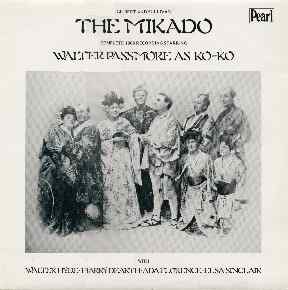
Audio recordings
The Mikado has been recorded more often than any other Gilbert and Sullivan opera. Of those by the D'Oyly Carte Opera Company, the 1926 recording is the best regarded. Of the modern recordings, the 1992 Mackerras/Telarc is admired.Selected audio recordings
- 1926 D'Oyly Carte – Conductor: Harry NorrisHarry Norris (conductor)Harry Norris was a New Zealand-born conductor best remembered as musical director of the D'Oyly Carte Opera Company between 1919 and 1929. After leaving that company, Norris emigrated to Canada to teach but returned to retire in England in the 1960s.-Life and career:Norris was born in...
- 1936 D'Oyly Carte – Conductor: Isidore GodfreyIsidore GodfreyIsidore Godfrey was musical director of the D'Oyly Carte Opera Company for 39 years, from 1929 to 1968...
- 1950 D'Oyly Carte – New Promenade Orchestra, Conductor: Isidore Godfrey
- 1957 D'Oyly Carte – New Symphony Orchestra of London, Conductor: Isidore Godfrey
- 1984 Stratford Festival – Conductor: Berthold Carrière
- 1990 New D'Oyly Carte – Conductor: John Pryce-Jones
- 1992 Mackerras/Telarc – Orchestra & Chorus of the Welsh National Opera, Conductor: Sir Charles MackerrasCharles MackerrasSir Alan Charles Maclaurin Mackerras, AC, CH, CBE was an Australian conductor. He was an authority on the operas of Janáček and Mozart, and the comic operas of Gilbert and Sullivan...
Films and videos
In 1926, the D'Oyly Carte Opera Company made a brief promotional film of excerpts from The Mikado. Some of the most famous Savoyards are seen in this film, including Darrell FancourtDarrell Fancourt
Darrell Fancourt was an English bass-baritone, known for his performances and recordings of the Savoy Operas....
as The Mikado, Henry Lytton
Henry Lytton
Sir Henry Lytton was an English actor and singer who was the leading exponent of the comic patter-baritone roles in Gilbert and Sullivan operas in the early part of the twentieth century...
as Ko-Ko, Leo Sheffield
Leo Sheffield
Leo Sheffield was an English singer and actor best known for his performances in baritone roles of the Savoy Operas with the D'Oyly Carte Opera Company....
as Pooh-Bah, Elsie Griffin
Elsie Griffin
Elsie Griffin was an English opera singer, best known for her performances in the soprano roles of the Savoy Operas with the D'Oyly Carte Opera Company....
as Yum-Yum, and Bertha Lewis
Bertha Lewis
Bertha Lewis was an English opera singer and actress primarily known for her work as principal contralto in the Gilbert & Sullivan comic operas with the D'Oyly Carte Opera Company.-Early life and career:...
as Katisha.
In 1939, Universal Pictures released a ninety-minute Technicolor
Technicolor
Technicolor is a color motion picture process invented in 1916 and improved over several decades.It was the second major process, after Britain's Kinemacolor, and the most widely used color process in Hollywood from 1922 to 1952...
film of The Mikado. The film stars Martyn Green
Martyn Green
William Martyn-Green , better known as Martyn Green, was an English actor and singer. He is best known for his work as principal comedian in the Gilbert & Sullivan comic operas, which he performed and recorded with the D'Oyly Carte Opera Company and other troupes.After army service in World War I,...
as Ko-Ko, Sydney Granville
Sydney Granville
Sydney Granville was an English singer and actor, best known for his performances in the Savoy Operas with the D'Oyly Carte Opera Company....
as Pooh-Bah, the American singer Kenny Baker as Nanki-Poo and Jean Colin
Jean Colin
Jean Colin was an English actress. She began her career on stage in pantomime, musical theatre and operettas. Colin appeared in several films beginning the thirties. Colin was born in Brighton and died in London...
as Yum-Yum. Many of the other leads and chorusters were or had been members of the D'Oyly Carte company. The music was conducted by Geoffrey Toye
Geoffrey Toye
Edward Geoffrey Toye , better known as Geoffrey Toye, was an English conductor, composer and opera producer....
, a former D'Oyly Carte music director, who was also the producer and was credited with the adaptation, which involved a number of cuts, additions and re-ordered scenes. Victor Schertzinger
Victor Schertzinger
Victor L. Schertzinger was an American composer, film director, film producer, and screenwriter. His films include Paramount on Parade , Something to Sing About with James Cagney, and the first two "Road" pictures Road to Singapore and Road to Zanzibar...
directed, and William V. Skall received an Academy Award nomination for Best Cinematography. Art direction and costume designs were by Marcel Vertès
Marcel Vertès
Marcel Vertès was a Hungarian costume designer. He won two Academy Awards for his work on the 1952 film Moulin Rouge....
. There were some revisions - The Sun Whose Rays Are All Ablaze is performed twice, first by Nanki-Poo in a new early scene in which he serenades Yum-Yum at her window, and later in the traditional spot. A new prologue which showed Nanki-Poo fleeing in disguise was also added, and much of the Act II music was cut.
In 1966, the D'Oyly Carte Opera Company produced a film version of The Mikado, which closely reflected their traditional staging at the time, although there are some minor cuts. It was filmed on enlarged stage sets rather than on location, much like the 1965 Laurence Olivier
Laurence Olivier
Laurence Kerr Olivier, Baron Olivier, OM was an English actor, director, and producer. He was one of the most famous and revered actors of the 20th century. He married three times, to fellow actors Jill Esmond, Vivien Leigh, and Joan Plowright...
Othello
Othello (1965 film)
Othello is a 1965 film based on the National Theatre's staging of Shakespeare's Othello staged by John Dexter. Directed by Stuart Burge, the film starred Laurence Olivier, Maggie Smith, Frank Finlay, and Joyce Redman, providing film debuts for both Derek Jacobi and Michael...
and was directed by the director of Othello, Stuart Burge
Stuart Burge
Stuart Burge was an English film director, actor and producer.Educated at Felsted School, he originally trained as a civil engineer, but later began acting in theater in the 1940s, and became a director by 1948...
. It stars John Reed
John Reed (actor)
John Lamb Reed, OBE was an English actor, dancer and singer, known for his nimble performances in the principal comic roles of the Savoy Operas, particularly with the D'Oyly Carte Opera Company...
, Kenneth Sandford
Kenneth Sandford
Kenneth Sandford was an English singer and actor, best known for his performances in baritone roles of the Savoy Operas of Gilbert and Sullivan....
, Valerie Masterson
Valerie Masterson
Margaret Valerie Masterson , is a retired English opera singer, a lecturer and Vice-President of British Youth Opera. After study in Italy, she began to sing opera in Europe...
, Philip Potter
Philip Potter
Philip Potter is a retired English singer and actor, best known for his performances in the tenor roles of the Savoy Operas with the D'Oyly Carte Opera Company.-Early life and career:Philip White Potter was born in Leicester...
, Donald Adams
Donald Adams
Charles Donald Adams was an English opera singer and actor, best known for his performances in bass-baritone roles of the Savoy Operas with the D'Oyly Carte Opera Company and his own company, Gilbert and Sullivan for All.Adams began his career with the BBC Repertory Company in 1944...
, Christene Palmer and Peggy Ann Jones
Peggy Ann Jones
Peggy Ann Jones is an English opera singer and actress, best known for her performances in the mezzo-soprano roles of the Savoy operas with the D'Oyly Carte Opera Company...
. The New York Times criticised the filming technique and the orchestra and noted, "Knowing how fine this cast can be in its proper medium, one regrets the impression this Mikado will make on those not fortunate enough to have watched the company in the flesh. The cameras have captured everything about the company's acting except its magic." Video recordings of The Mikado include a 1972 offering from Gilbert and Sullivan for All
Gilbert and Sullivan for All
Gilbert and Sullivan for All was a touring concert and opera company, formed in 1963 by D'Oyly Carte Opera Company performers Thomas Round and Donald Adams and Norman Meadmore, and which exclusively performed the works of Gilbert and Sullivan, usually in concert, but sometimes giving full...
; the 1982 Brent-Walker film (one of the weakest in the series) the well-regarded 1984 Stratford Festival video, the 1986 English National Opera
English National Opera
English National Opera is an opera company based in London, resident at the London Coliseum in St. Martin's Lane. It is one of the two principal opera companies in London, along with the Royal Opera, Covent Garden...
production (abridged), and a 1988 Australian Opera video. The International Gilbert and Sullivan Festival
International Gilbert and Sullivan Festival
The International Gilbert and Sullivan Festival is held every summer at the Opera House in Buxton, Derbyshire, England. The three-week Festival of Gilbert and Sullivan performances and fringe events attracts thousands of visitors, including performers, supporters, and G&S enthusiasts from all...
offers for sale videos of both amateur and professional Mikados recorded at the Buxton Opera House
Buxton Opera House
Buxton Opera House is in The Square, Buxton, Derbyshire, England. It is a 902-seat opera house that hosts the annual Buxton Festival and International Gilbert and Sullivan Festival, among others, as well as pantomime at Christmas, musicals and other entertainments year-round. Hosting live...
.
Adaptations
The Mikado was adapted as a children's book by W. S. Gilbert entitled The Story of The Mikado, which was Gilbert's last literary work. It is a retelling of The Mikado, with various changes to simplify language or make it more suitable for children. For example, in the "little list" song, the phrase "society offenders" is changed to "inconvenient people", and the second verse is largely rewritten.The D'Oyly Carte Opera Company
D'Oyly Carte Opera Company
The D'Oyly Carte Opera Company was a professional light opera company that staged Gilbert and Sullivan's Savoy operas. The company performed nearly year-round in the UK and sometimes toured in Europe, North America and elsewhere, from the 1870s until it closed in 1982. It was revived in 1988 and...
controlled the copyrights to performances of The Mikado and the other Gilbert and Sullivan operas until 1961. It usually required authorised productions to present the music and libretto exactly as shown in the copyrighted editions. Since 1961, Gilbert and Sullivan works have been in the public domain
Public domain
Works are in the public domain if the intellectual property rights have expired, if the intellectual property rights are forfeited, or if they are not covered by intellectual property rights at all...
and can be—and frequently are—adapted and performed in new ways. Notable adaptations have included the following:
- The
Groucho Marx
Julius Henry "Groucho" Marx was an American comedian and film star famed as a master of wit. His rapid-fire delivery of innuendo-laden patter earned him many admirers. He made 13 feature films with his siblings the Marx Brothers, of whom he was the third-born...
as Ko-Ko, Stanley Holloway
Stanley Holloway
Stanley Augustus Holloway, OBE was an English stage and film actor, comedian, singer, poet and monologist. He was famous for his comic and character roles on stage and screen, especially that of Alfred P. Doolittle in My Fair Lady...
as Pooh-Bah, and Helen Traubel
Helen Traubel
Helen Francesca Traubel was an American opera and concert singer. A dramatic soprano, she was best known for her Wagnerian roles, especially those of Brünnhilde and Isolde. Born and raised in St. Louis, Missouri, she began her career as a concert singer and went on to sing at the Metropolitan...
as Katisha. It was directed by Martyn Green
Martyn Green
William Martyn-Green , better known as Martyn Green, was an English actor and singer. He is best known for his work as principal comedian in the Gilbert & Sullivan comic operas, which he performed and recorded with the D'Oyly Carte Opera Company and other troupes.After army service in World War I,...
.
The Black Mikado
The Black Mikado is a musical comedy, based on Gilbert and Sullivan's The Mikado, adapted by Janos Bajtala, George Larnyoh and Eddie Quansah from W. S. Gilbert's original 1885 libretto and Arthur Sullivan's score. The show premiered on 24 April 1975 at the Cambridge Theatre in London, where it ran...
(1975) was a jazzy, sexy production set on a Caribbean island.
Chichibu, Saitama
is a city in Saitama, Japan. As of April 1, 2011, the city has an estimated population of 68,701, with a household number of 26,230. The total area is 577.69 km²....
production of the "Tokyo Theatre Company"
The Cool Mikado
The Cool Mikado is a British musical film made in 1962, directed by Michael Winner, and produced by Harold Baim, with music arranged by Martin Slavin and John Barry. It starred Frankie Howerd as Ko-Ko, Lionel Blair and Stubby Kaye...
is a 1962 British musical film directed by Michael Winner
Michael Winner
Michael Robert Winner is a British film director and producer, active in both Europe and the United States, also known as a food critic for the Sunday Times.-Early life and early career :...
that adapts The Mikado in 1960s pop music style and reset as a comic Japanese gangster story.
The Hot Mikado (1939 production)
The Hot Mikado was a 1939 musical theatre adaptation of Gilbert and Sullivan's The Mikado with an African-American cast. Mike Todd originally produced it after the Federal Theatre Project turned down his offer to manage the WPA production of The Swing Mikado .The Hot Mikado was jazzier than The...
(1939) was a Broadway adaptation of The Mikado with an all-black cast, using jazz and swing music.
Ned Sherrin
Edward George "Ned" Sherrin CBE was an English broadcaster, author and stage director. He qualified as a barrister and then worked in independent television before joining the BBC...
and Alistair Beaton
Alistair Beaton
Alistair Beaton is a Scottish left wing political satirist, journalist, radio presenter, novelist and television writer. At one point in his career he was also a speechwriter for Gordon Brown....
, first performed at Queen Elizabeth Hall
Queen Elizabeth Hall
The Queen Elizabeth Hall is a music venue on the South Bank in London, United Kingdom that hosts daily classical, jazz, and avant-garde music and dance performances. The QEH forms part of Southbank Centre arts complex and stands alongside the Royal Festival Hall, which was built for the Festival...
(1985) starring Louise Gold
Louise Gold
Louise Gold is an English singer, actress and puppeteer whose career has spanned almost four decades.From 1977, Gold was a puppeteer and voice actress for The Muppet Show and Sesame Street, and she has performed voice and puppet work on various other Muppet films and specials...
, Simon Butteriss, Rosemary Ashe
Rosemary Ashe
Rosemary Ashe is an English stage actress and classically trained opera singer. She studied at the Royal Academy of Music and the London Opera Centre....
, Robert Meadmore
Robert Meadmore
Robert Meadmore a musical theatre artist.-Theatre:He has starred in many of the biggest hit shows in London's West End which include Phantom of The Opera, Brigadoon, My Fair Lady, Bless the Bride, The Gondoliers, Oklahoma!, The Best Little Whorehouse in Texas, Metropolitan Mikado and Camelot.In...
and Martin Smith
Martin Smith (actor/musician)
Martin Smith was a British actor, singer, and composer who starred in many shows in London's West End...
, produced by Raymond Gubbay
Raymond Gubbay
Raymond Gubbay is a classical music promoter and impresario based in London. The programme to celebrate the 40th anniversary of his starting out as a promoter says that, after arranging small scale concerts around the UK, he began gradually to promote in London...
.
Hot Mikado
Hot Mikado is a musical comedy, based on Gilbert and Sullivan's The Mikado, adapted by David H. Bell and Rob Bowman...
(1986) is a jazz and swing style adaptation that premiered in Washington, D.C. and has been played frequently since then.
The Swing Mikado
The Swing Mikado is an operetta in two acts with music arranged by Gentry Warden, based on Gilbert and Sullivan's comic opera, The Mikado. It was first staged by an all-black company in Chicago in 1938, transferring to Broadway, and featured a setting transposed from Japan to a tropical island...
was an adaptation of The Mikado with an all-black cast, using swing music, that premiered in Chicago in 1938.
Essgee Entertainment
Essgee Entertainment is a professional performing and publishing company formed in 1981 in Australia. Its founder and chief executive officer is entertainer Simon Gallaher.-History:...
produced an adapted version of
Gaumont Film Company
Gaumont Film Company is a French film production company founded in 1895 by the engineer-turned-inventor, Léon Gaumont . Gaumont is the oldest continously operating film company in the world....
. The second production was released in July 1907 by the Walturdaw Company and starred George Thorne
George Thorne
George Thorne, was an English singer and actor, best known for his performances in the comic baritone roles of the Savoy Operas with the D'Oyly Carte Opera Company, especially on tour and in the original New York City productions...
. Both of these programs used the Cinematophone sound-on-disk system of phonograph recordings of the performers played back along with the silent footage of the performance.
In popular culture
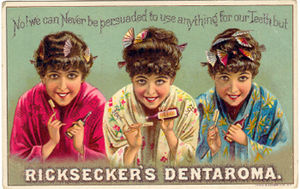
Groucho Marx
Groucho Marx
Julius Henry "Groucho" Marx was an American comedian and film star famed as a master of wit. His rapid-fire delivery of innuendo-laden patter earned him many admirers. He made 13 feature films with his siblings the Marx Brothers, of whom he was the third-born...
, a life-long fan of Gilbert and Sullivan, starred as Ko-Ko in a made-for-TV production of The Mikado in 1960. Other well-known actors who have played the role of Ko-Ko include Eric Idle
Eric Idle
Eric Idle is an English comedian, actor, author, singer, writer, and comedic composer. He was as a member of the British comedy group Monty Python, a member of the The Rutles on Saturday Night Live and author of the play, Spamalot....
and then Bill Oddie
Bill Oddie
William "Bill" Edgar Oddie OBE is an English author, actor, comedian, artist, naturalist and musician, who became famous as one of The Goodies....
, with English National Opera
English National Opera
English National Opera is an opera company based in London, resident at the London Coliseum in St. Martin's Lane. It is one of the two principal opera companies in London, along with the Royal Opera, Covent Garden...
's production of The Mikado. Dudley Moore
Dudley Moore
Dudley Stuart John Moore, CBE was an English actor, comedian, composer and musician.Moore first came to prominence as one of the four writer-performers in the ground-breaking comedy revue Beyond the Fringe in the early 1960s, and then became famous as half of the highly popular television...
played the role when the production toured the United States.
Quotes from The Mikado were infamously used in letters to the police by the Zodiac Killer
Zodiac Killer
The Zodiac Killer was a serial killer who operated in Northern California in the late 1960s and early 1970s. The killer's identity remains unknown. The Zodiac murdered victims in Benicia, Vallejo, Lake Berryessa and San Francisco between December 1968 and October 1969. Four men and three women...
, who murdered at least five people in the San Francisco Bay area between 1966 and 1970. The Mikado is parodied by Sumo of the Opera
Sumo of the Opera
Sumo of the Opera is the 24th episode in the VeggieTales series. Subtitled "A Lesson in Perseverance", it teaches viewers the importance of working through adversity to accomplish one's goals...
, which credits Sullivan as the composer of most of its songs. In 2007, the Los Angeles-based Asian American theatre company, Lodestone Theatre Ensemble
Lodestone Theatre Ensemble
Lodestone Theatre Ensemble is a non-profit Asian American theatre organization in Los Angeles, founded in 1999. It is a membership-driven organization....
, produced The Mikado Project, an original play by Doris Baizley and Ken Narasaki
Ken Narasaki
Ken Narasaki is a Sansei playwright and actor. He is the former Literary Manager at East West Players theatre company in Los Angeles...
. It was a deconstruction
Deconstruction
Deconstruction is a term introduced by French philosopher Jacques Derrida in his 1967 book Of Grammatology. Although he carefully avoided defining the term directly, he sought to apply Martin Heidegger's concept of Destruktion or Abbau, to textual reading...
of the opera premised on a fictional Asian American theatre company attempting to raise funds, while grappling with perceived racism in The Mikado, among other issues, through a revisionist version. The detective novel Death at the Opera by Gladys Mitchell
Gladys Mitchell
Gladys Mitchell was an English author best known for her creation of Mrs. Bradley, the heroine of numerous detective novels. She also wrote under the pseudonyms Stephen Hockaby and Malcolm Torrie...
(London: Grayson
Grayson
- Surname :* Alan Grayson , former Congressman from Florida's 8th congressional district* Andrew Jackson Grayson , American ornithologist and artist* Bette Grayson , American actress...
, 1934) is set against a background of a production of The Mikado.
Popular media have referred to The Mikado in numerous ways. For example, the climax of the 1978
1978 in film
The year 1978 in film involved some significant events.-Events:* February 1 - Bob Dylan's film Renaldo and Clara, a documentary of the "Rolling Thunder Revue" tour premieres in Los Angeles, California....
film Foul Play
Foul Play
Foul Play is a 1978 American comic mystery/thriller film written and directed by Colin Higgins. In it, a recently divorced librarian is drawn into a mystery when a stranger hides a roll of film in a pack of cigarettes and gives it to her for safekeeping....
takes place during a performance of The Mikado. A second-season (1998) episode of the TV show Millennium
Millennium (TV series)
Millennium is an American television series created by Chris Carter, creator of The X-Files. Millennium aired on the Fox Network from 1996 to 1999. The series was filmed in Vancouver, British Columbia, though most episodes were ostensibly set in or around Seattle, Washington...
titled "The Mikado" is based on the Zodiac case. In the 2010 episode "Robots Versus Wrestlers
Robots Versus Wrestlers
"Robots Versus Wrestlers " is the 22nd episode of the fifth season of the CBS situation comedy How I Met Your Mother and 110th episode overall. It aired on May 10, 2010.- Plot :...
" of the TV sitcom How I Met Your Mother
How I Met Your Mother
How I Met Your Mother is an American sitcom that premiered on CBS on September 19, 2005, created by Craig Thomas and Carter Bays.As a framing device, the main character, Ted Mosby with narration by Bob Saget, in the year 2030 recounts to his son and daughter the events that led to his meeting...
, at a high-society party in a Manhattan penthouse, Marshall disdainfully whacks an antique Chinese gong. The host rebukes him: "Young man, that gong is a 500-year-old relic that hasn't been struck since W. S. Gilbert
W. S. Gilbert
Sir William Schwenck Gilbert was an English dramatist, librettist, poet and illustrator best known for his fourteen comic operas produced in collaboration with the composer Sir Arthur Sullivan, of which the most famous include H.M.S...
hit it at the London premiere of The Mikado in 1885!" Marshall quips, "His wife's a 500-year-old relic that hasn't been struck since W. S. Gilbert hit it at the London premiere...."
Beginning in the 1880s, Mikado trading cards were created that advertised various products. "The Mikado" is a villainous vigilante in the comic book superhero series The Question
Question (comics)
The Question is a fictional character, a superhero in comic books published by DC Comics. The original was created by writer-artist Steve Ditko, and first appeared in Blue Beetle #1...
, by Denny O'Neil and Denys Cowan
Denys Cowan
Denys B. Cowan is an American comic book artist and television producer. He gained prominence as the primary artist on The Question, an acclaimed comic book series published by DC Comics for 36 issues from 1987 on, written by Dennis O'Neil.-Career:Denys Cowan is a 1979 graduate of the High School...
. He dons a Japanese mask and kills malefactors in appropriate ways—letting "the punishment fit the crime". In addition, the name was applied to the 2-8-2
2-8-2
Under the Whyte notation for the classification of steam locomotives, 2-8-2 represents the wheel arrangement of two leading wheels on one axle , eight powered and coupled driving wheels on four axles, and two trailing wheels on one axle...
railroad locomotive when an early production run of these locomotives, built in the U.S., was shipped to Japan in 1893.
Popular phrases from
The Mikado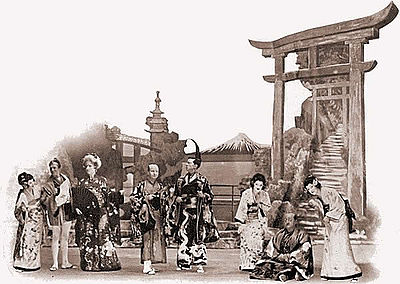
Short, sharp shock
The phrase "short, sharp shock" is a phrase meaning "punishment that is quick and severe." It was most famously used in Gilbert and Sullivan's 1885 comic opera The Mikado, where it appears near the end of the Act I song, "I Am So Proud"....
", heard in the Act 1 song "I am so proud" has entered the English language, appearing in titles of books and songs (most notably in samples of Pink Floyd
Pink Floyd
Pink Floyd were an English rock band that achieved worldwide success with their progressive and psychedelic rock music. Their work is marked by the use of philosophical lyrics, sonic experimentation, innovative album art, and elaborate live shows. Pink Floyd are one of the most commercially...
's "The Dark Side of the Moon
The Dark Side of the Moon
The Dark Side of the Moon is the eighth studio album by English progressive rock band Pink Floyd, released in March 1973. It built on ideas explored in the band's earlier recordings and live shows, but lacks the extended instrumental excursions that characterised their work following the departure...
"), as well as political manifestos. Likewise "Let the punishment fit the crime" is an often-used phrase from the Mikado's Act II song and is particularly mentioned in the course of British political debates, though the concept, and similar phrases, long predate Gilbert. For instance, in episode 80 of the television series Magnum, P.I.
Magnum, P.I.
Magnum, P.I. is an American television series starring Tom Selleck as Thomas Magnum, a private investigator living on Oahu, Hawaii. The series ran from 1980 to 1988 in first-run broadcast on the American CBS television network....
, entitled "Let the Punishment Fit the Crime," Higgins prepares to direct a selection of pieces from The Mikado to be staged at the Estate. The show features bits of several Mikado songs including "Three Little Maids From School." The phrase and the Mikado's song also are featured in the Dad's Army
Dad's Army
Dad's Army is a British sitcom about the Home Guard during the Second World War. It was written by Jimmy Perry and David Croft and broadcast on BBC television between 1968 and 1977. The series ran for 9 series and 80 episodes in total, plus a radio series, a feature film and a stage show...
episode, "A Soldier's Farewell." In The Parent Trap (1961), the camp director quotes the phrase before sentencing the twins to the isolation cabin together.
The name of the character Pooh-Bah has entered the English language as a person who holds many titles, often a pompous or self-important person. Pooh Bah is mentioned in P. G. Wodehouse
P. G. Wodehouse
Sir Pelham Grenville Wodehouse, KBE was an English humorist, whose body of work includes novels, short stories, plays, poems, song lyrics, and numerous pieces of journalism. He enjoyed enormous popular success during a career that lasted more than seventy years and his many writings continue to be...
's novel Something Fresh
Something Fresh
Something Fresh is a novel by P. G. Wodehouse. It was first published as a book in the United States, by D. Appleton & Company on September 3, 1915, under the title Something New, having previously appeared under that title as a serial in the Saturday Evening Post between June 26 and August 14,...
, again in reference to his many titles. In December 2009, BBC presenter James Naughtie, on Radio 4's Today programme, compared UK cabinet member Peter Mandelson
Peter Mandelson
Peter Benjamin Mandelson, Baron Mandelson, PC is a British Labour Party politician, who was the Member of Parliament for Hartlepool from 1992 to 2004, served in a number of Cabinet positions under both Tony Blair and Gordon Brown, and was a European Commissioner...
to Pooh-Bah, because Mandelson holds many offices of state, including Secretary of State for Business, First Secretary of State, Lord President of the Council, President of the Board of Trade, and Church Commissioner, and he sits on 35 cabinet committees and sub-committees. Mandelson replied, "Who is Pooh-Bah?" Mandelson was also described as "the grand Pooh-Bah of British politics" earlier the same week by the theatre critic, Charles Spencer
Charles Spencer (journalist)
Charles Spencer is a British journalist. He has been the drama critic of The Daily Telegraph since 1991. In 2006, Compton Miller of The Independent wrote in a profile: "This convivial ex-alcoholic is best remembered for his description of Nicole Kidman's nude scene in The Blue Room as 'pure...
, of The Daily Telegraph
The Daily Telegraph
The Daily Telegraph is a daily morning broadsheet newspaper distributed throughout the United Kingdom and internationally. The newspaper was founded by Arthur B...
. In the U.S., particularly, the term has come to describe, mockingly, people who hold impressive titles but whose authority is limited. The term "Grand Poobah
Grand Poobah
Grand Poobah is a term derived from the name of the haughty character Pooh-Bah in Gilbert and Sullivan's The Mikado . In this comic opera, Pooh-Bah holds numerous exalted offices, including "First Lord of the Treasury, Lord Chief Justice, Commander-in-Chief, Lord High Admiral... Archbishop of...
" has been used on the television shows, including The Flintstones
The Flintstones
The Flintstones is an animated, prime-time American television sitcom that screened from September 30, 1960 to April 1, 1966, on ABC. Produced by Hanna-Barbera Productions, The Flintstones was about a working class Stone Age man's life with his family and his next-door neighbor and best friend. It...
and Happy Days
Happy Days
Happy Days is an American television sitcom that originally aired from January 15, 1974, to September 24, 1984, on ABC. Created by Garry Marshall, the series presents an idealized vision of life in mid-1950s to mid-1960s America....
, and other media, as the title of a high-ranking official in a men's club, spoofing clubs like the Freemasons
Freemasonry
Freemasonry is a fraternal organisation that arose from obscure origins in the late 16th to early 17th century. Freemasonry now exists in various forms all over the world, with a membership estimated at around six million, including approximately 150,000 under the jurisdictions of the Grand Lodge...
, the Shriners, and the Elks Club
Benevolent and Protective Order of Elks
The Benevolent and Protective Order of Elks is an American fraternal order and social club founded in 1868...
.
See also
Topsy-Turvy
Topsy-Turvy is a 1999 musical drama film written and directed by Mike Leigh and stars Allan Corduner as Arthur Sullivan and Jim Broadbent as W. S. Gilbert, along with Timothy Spall and Lesley Manville. The story concerns the 15-month period in 1884 and 1885 leading up to the premiere of Gilbert...
, a 1999 musical drama film about the creation of the piece
Cultural influence of Gilbert and Sullivan
In the past 125 years, Gilbert and Sullivan have pervasively influenced popular culture in the English-speaking world. Lines and quotations from the Gilbert and Sullivan operas have become part of the English language, such as "short, sharp shock", "What never? Well, hardly ever!", "let the...
Further reading
- Clements, Jonathan. "Titipu", on the historical background of
External links
- The Mikado at The Gilbert & Sullivan Archive
- Article by H. L. Mencken on the impact of The Mikado (from 1910)
- Discussion of The Mikado from the musicals101 site
- Description of preparations for The Mikado
- Description of production history and modern Australian productions
- Article on the genesis of The Mikado
- The Mikado at The Gilbert & Sullivan Discography
- 1885 review of The Mikado in "The Entr'acte".
- Koko's Korner: A website dedicated almost entirely to the character of Ko-Ko in The Mikado
- List of longest running plays in London and New York
- Biographies of the people listed in the historical casting chart
- Cinegram of the 1938 film of The Mikado
- D'Oyly Carte Prompt Books at The Victoria and Albert Museum
- Page linking to Mikado song parodies
- "Something Vital Breaks..."—Eclectech video spoof on "As Someday It May Happen"