
All Topics  
Meissen

 
Meissen

   Email Print
   Bookmark   Link


Meissen


Meissen (in German orthography
German orthography

German orthography , although largely phoneme, shows many instances of spellings that are historic or analogic to other spellings rather than phonemic....
: Meißen; ; ) is a town
Town

A town is a type of human settlement ranging from a few to several thousand inhabitants, although it may be applied loosely even to huge metropolitan areas; the precise meaning varies between countries and is not always a matter of legal definition....
 of approximately 30,000 about northwest of Dresden
Dresden

Dresden is the capital city of the Germany Federal Free state of Saxony. It is situated in a valley on the River Elbe. The Dresden conurbation is part of the Saxon triangle metropolitan area....
 on both banks of the Elbe
Elbe

The River Elbe is one of the major rivers of Central Europe. It originates in the Krkonose Mountains of northwestern Czech Republic before traversing much of Germany and flowing into the North Sea....
 river in the Free State of Saxony
Saxony

The Free State of Saxony is a States of Germany of Germany. Located in the southeastern part of present-day Germany. It is the tenth-largest German state in area and the sixth largest in population , of Germany's sixteen states....
, in eastern Germany
Germany

Germany , officially the Federal Republic of Germany , is a country in Central Europe. It is bordered to the north by the North Sea, Denmark, and the Baltic Sea; to the east by Poland and the Czech Republic; to the south by Austria and Switzerland; and to the west by France, Luxembourg, Belgium, and the Netherlands....
. Meissen is the home of Meissen porcelain
Meissen porcelain

Meissen porcelain is the first European hard-paste porcelain that was developed from 1708 by Ehrenfried Walther von Tschirnhaus. After his untimely death that October, Johann Friedrich B?ttger, continued his work and brought porcelain to the market, and he has often been credited with the invention....
, the Albrechtsburg
Albrechtsburg

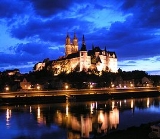
File:Albrechtsburg01.jpgThe Albrechtsburg is the castle that dominates the city centre of Meissen, Germany. This castle, the masterpiece of Arnold of Westphalia, was constructed in the 15th Century as a residence, not as a military fortress, the first German castle built for that purpose....
 castle, the Gothic
Gothic architecture

Gothic architecture is a style of architecture which flourished during the high and late Middle Ages. It evolved from Romanesque architecture and was succeeded by Renaissance architecture....
 Meissen Cathedral and the Meissen Frauenkirche. The Große Kreisstadt
Große Kreisstadt

Gro?e Kreisstadt is a term in the German municipal law. In some German federal states the term is used as a special legal status for district-affiliated cities or towns with additional competences in comparison with other municipalities or towns of the district....
 is the capital of the Meissen district. sen is sometimes known as the "cradle of Saxony".


Discussion
Ask a question about 'Meissen'
Start a new discussion about 'Meissen'
Answer questions from other users
Full Discussion Forum


Recent Posts


Encyclopedia


Meissen (in German orthography
German orthography

German orthography , although largely phoneme, shows many instances of spellings that are historic or analogic to other spellings rather than phonemic....
: Meißen; ; ) is a town
Town

A town is a type of human settlement ranging from a few to several thousand inhabitants, although it may be applied loosely even to huge metropolitan areas; the precise meaning varies between countries and is not always a matter of legal definition....
 of approximately 30,000 about northwest of Dresden
Dresden

Dresden is the capital city of the Germany Federal Free state of Saxony. It is situated in a valley on the River Elbe. The Dresden conurbation is part of the Saxon triangle metropolitan area....
 on both banks of the Elbe
Elbe

The River Elbe is one of the major rivers of Central Europe. It originates in the Krkonose Mountains of northwestern Czech Republic before traversing much of Germany and flowing into the North Sea....
 river in the Free State of Saxony
Saxony

The Free State of Saxony is a States of Germany of Germany. Located in the southeastern part of present-day Germany. It is the tenth-largest German state in area and the sixth largest in population , of Germany's sixteen states....
, in eastern Germany
Germany

Germany , officially the Federal Republic of Germany , is a country in Central Europe. It is bordered to the north by the North Sea, Denmark, and the Baltic Sea; to the east by Poland and the Czech Republic; to the south by Austria and Switzerland; and to the west by France, Luxembourg, Belgium, and the Netherlands....
. Meissen is the home of Meissen porcelain
Meissen porcelain

Meissen porcelain is the first European hard-paste porcelain that was developed from 1708 by Ehrenfried Walther von Tschirnhaus. After his untimely death that October, Johann Friedrich B?ttger, continued his work and brought porcelain to the market, and he has often been credited with the invention....
, the Albrechtsburg
Albrechtsburg

File:Albrechtsburg01.jpgThe Albrechtsburg is the castle that dominates the city centre of Meissen, Germany. This castle, the masterpiece of Arnold of Westphalia, was constructed in the 15th Century as a residence, not as a military fortress, the first German castle built for that purpose....
 castle, the Gothic
Gothic architecture

Gothic architecture is a style of architecture which flourished during the high and late Middle Ages. It evolved from Romanesque architecture and was succeeded by Renaissance architecture....
 Meissen Cathedral and the Meissen Frauenkirche. The Große Kreisstadt
Große Kreisstadt

Gro?e Kreisstadt is a term in the German municipal law. In some German federal states the term is used as a special legal status for district-affiliated cities or towns with additional competences in comparison with other municipalities or towns of the district....
 is the capital of the Meissen district.
Meissen
Misnia2

History

Meissen is sometimes known as the "cradle of Saxony". The city grew out of the early Slavic
West Slavs

The West Slavs are Slavic peoples speaking West Slavic languages. Czechs, Kashubians, Poles, Slovaks, and Sorbs are the ethnic groups that originated from the original Western Slavic tribes....
 settlement of Misni and was founded as a German town
German town law

German town law or German municipal concerns concerns town privileges used by many cities, towns, and villages throughout Central Europe and Eastern Europe during the Middle Ages....
 by King Henry the Fowler in 929. In 968, the Diocese of Meissen was founded, and Meissen became the episcopal see of a bishop
Bishop

A bishop is an ordination or consecration member of the Clergy#Christian clergy who is generally entrusted with a position of authority and oversight....
. The Catholic bishopric was suppressed in 1581 after the diocese accepted the Protestant Reformation
Protestant Reformation

The Protestant Reformation was a Christian reform movement in Europe. It is thought to have begun in 1517 with Martin Luther's Ninety-Five Theses and may be considered to have ended with the Peace of Westphalia in 1648....
 (1559), but re-created in 1921 with its seat first at Bautzen
Bautzen

Bautzen ; Polish language: Budziszyn ); is a city in eastern Free State of Saxony, Germany, and capital of the Bautzen . It is located on the Spree River....
 and now at the Katholische Hofkirche
Katholische Hofkirche

The Katholische Hofkirche is a Roman Catholic Church Cathedral, located in the 'Altstadt' in the heart of Dresden, in Germany. Previously the most important Catholic parish church of the city, it was elevated to cathedral of the Roman Catholic Diocese of Dresden-Mei?en in 1964....
 in Dresden.

The Margraviate of Meissen
Margraviate of Meissen

The March or Margraviate of Meissen was a medi?val principality, a Marches, of the Holy Roman Empire in the area of the modern German state of Saxony....
 was founded in 968 as well, with the city as the capital of the Margraves of Meissen
List of Margraves of Meissen

The Margraviate of Meissen was a territorial state on the border of the Holy Roman Empire. The Mark of Meissen was founded 965 by Emperor Otto I, Holy Roman Emperor; in 929, the German king Henry the Fowler built a fortress on the hill where Meissen Castle stands....
. A market town
Market town

Market town or market right is a law term, originating in the medieval period, for a European settlement that has the right to host Market, distinguishing them from villages and city....
 by 1000, Meissen passed to the Kingdom of Poland in 1018 under Boleslaw I the Brave, afterwards into hands of Emperor Conrad II
Conrad II, Holy Roman Emperor

Conrad II was the son of a mid-level nobleman in Franconia, Henry of Speyer and Adelaide of Alsace, who inherited the titles of count of Speyer and of Worms, Germany as an infant when Henry died at age twenty....
 in 1032 and the House of Wettin in 1089. The city was at the forefront of the Ostsiedlung
Ostsiedlung

This article covers the medieval eastward migrations of Germans. For a general view, see History of German settlement in Eastern EuropeOstsiedlung, literally "settlement in the east", also called German eastward expansion, refers to the medieval eastward migration and settlement of Germans from modern day Western and Central Germa...
, or intensivating German settlement of the rural Slavic lands east of the Elbe, and its reception of city rights
German town law

German town law or German municipal concerns concerns town privileges used by many cities, towns, and villages throughout Central Europe and Eastern Europe during the Middle Ages....
 dates to 1332.

The construction of the Meissen Cathedral was started in 1260 on the same hill as the Albrechtsburg
Albrechtsburg

File:Albrechtsburg01.jpgThe Albrechtsburg is the castle that dominates the city centre of Meissen, Germany. This castle, the masterpiece of Arnold of Westphalia, was constructed in the 15th Century as a residence, not as a military fortress, the first German castle built for that purpose....
 castle. The resulting lack of space led to the cathedral being one of the smallest cathedral
Cathedral

A cathedral is a Christian church that contains the seat of a bishop. It is a Religion building for worship, specifically of a denomination with an episcopal hierarchy, such as the Roman Catholic Church, Anglicanism, Orthodox Christian and some Lutheranism churches, which serves as a bishop's seat, and thus as the central church of a dioc...
s in Europe
Europe

Europe is, conventionally, one of the world's seven continents. Comprising the westernmost peninsula of Eurasia, Europe is generally divided from Asia to its east by the water divide of the Ural Mountains, the Ural , the Caspian Sea, and by the Caucasus Mountains to the southeast....
. The church is also known as being one of the most pure examples of Gothic architecture
Gothic architecture

Gothic architecture is a style of architecture which flourished during the high and late Middle Ages. It evolved from Romanesque architecture and was succeeded by Renaissance architecture....
.

During World War II
World War II

World War II, or the Second World War , was a global military conflict which involved a Participants in World War II, including all of the great powers, organised into two opposing military alliances: the Allies of World War II and the Axis powers....
, a subcamp of Flossenbürg concentration camp
Flossenbürg concentration camp

Flossenb?rg was a Nazi concentration camp built in May 1938 by the Schutzstaffel Economic-Administrative Main Office at Flossenb?rg, in the Oberpfalz region of Bavaria, Germany, near the pre-war border with Czechoslovakia....
 was located in Meissen.

Porcelain

Meissen is famous for the manufacture of porcelain
Porcelain

Porcelain is a ceramic material made by heating raw materials, generally including clay in the form of kaolin, in a kiln to temperatures between and ....
, based on extensive local deposits of china clay (kaolin) and potter's clay (potter's earth). Meissen porcelain
Meissen porcelain

Meissen porcelain is the first European hard-paste porcelain that was developed from 1708 by Ehrenfried Walther von Tschirnhaus. After his untimely death that October, Johann Friedrich B?ttger, continued his work and brought porcelain to the market, and he has often been credited with the invention....
 was the first high quality porcelain to be produced outside of China
China

China is a Culture of China, an ancient civilization, and, depending on perspective, a national or multinational entity extending over a large area in East Asia....
.

The first European porcelain was manufactured in Meissen in 1710, when the Royal Porcelain Factory was opened in the Albrechtsburg. In 1861, it was moved to the Triebisch river valley of Meissen, where the porcelain factory can still be found today. Along with porcelain, other ceramics are also manufactured.

Main sights

The Albrechtsburg
Albrechtsburg

File:Albrechtsburg01.jpgThe Albrechtsburg is the castle that dominates the city centre of Meissen, Germany. This castle, the masterpiece of Arnold of Westphalia, was constructed in the 15th Century as a residence, not as a military fortress, the first German castle built for that purpose....
, the former residence of the House of Wettin, is regarded as being the first castle to be used as a royal residence in the German-speaking world. Built between 1472 and 1525, it is a fine example of late Gothic style. It was redecorated in the 19th century with a range of murals depicting Saxon history. Today the castle is a museum which is just as popular with visitors as the cathedral, whose architecture is Gothic and whose chapel is one of the most famous burial places of the Wettin family. Near the castle is Meissen Cathedral (Meißner Dom), built in the 13th century in the Gothic style. The hill on which the castle and the cathedral are built offers a view over the roofs of the old town.

Meissen's historical district is located mostly around the market at the foot of the castle's hill. It contains many buildings of Renaissance architecture
Renaissance architecture

Renaissance architecture is the architecture of the period between the early 15th and early 17th centuries in different regions of Europe, in which there was a conscious revival and development of certain elements of Ancient Greece and Ancient Rome thought and material culture....
. Also imposing is the view from the 57 metre high tower of the Frauenkirche (Church of Our Lady), situated in the old market-place. This church, not to be confused with the Dresden Frauenkirche
Dresden Frauenkirche

The Dresdner Frauenkirche is a Evangelical Church in Germany Church in Dresden, Germany.The Dresden Frauenkirche survived the bombing of Dresden in World War II during World War II...
, was first mentioned in a 1205 deed issued by Bishop Dietrich II and after a blaze about 1450 rebuilt in the Late Gothic
Gothic architecture

Gothic architecture is a style of architecture which flourished during the high and late Middle Ages. It evolved from Romanesque architecture and was succeeded by Renaissance architecture....
 style of a hall church
Hall church

A hall church is a church with nave and side aisles of approximately equal height, often united under a single immense roof.In contrast to a traditional basilica, which lets in light through a clerestory in the upper part of the nave, a hall church is lit through windowed side walls typically spanning the full height of the interior....
. Its tower hosts the world's first porcelain carillon, manufactured in 1929 at the town's 1000-years-jubilee. Another popular tourist sight is the world-famous Meissen porcelain
Meissen porcelain

Meissen porcelain is the first European hard-paste porcelain that was developed from 1708 by Ehrenfried Walther von Tschirnhaus. After his untimely death that October, Johann Friedrich B?ttger, continued his work and brought porcelain to the market, and he has often been credited with the invention....
 factory.

From spring to autumn, several festivals take place in Meissen, such as the pottery
Pottery

Pottery is the ceramic ware made by potters. Major types of pottery include earthenware, stoneware, and porcelain. The places where such wares are made are called potteries....
 market or the Weinfest, which celebrates the wine
Wine

Wine is an alcoholic beverage often made of fermentation grape juice. The natural chemical balance of grapes is such that they can ferment without the addition of sugars, acids, enzymes or other nutrients....
 harvest. Meissen wine is produced at the vineyard
Vineyard

A vineyard is a plantation of grape-bearing vines, grown mainly for winemaking, but also raisins, table grapes and non-alcoholic grape juice. The science, practice and study of vineyard production is known as viticulture....
s in the river valley (Elbtal) around the town, part of the Saxonian wine region
Saxony (wine region)

Saxony is a region for quality German wine region located in the Germany federal state of Saxony. The region is sometimes referred to colloquially as the Elbtal ....
, one of the northernmost in Europe.

Notable residents

Saint Benno
Benno

Saint Benno of Meissen was a bishop of Meissen in Germany. Little is known of Benno's early life. It is unlikely that he was the scion of a Saxon noble family, the Woldenburgs....
, Bishop of Meissen, born about 1010 in Hildesheim
Hildesheim

is a city in Lower Saxony, Germany. It is located in the district of Hildesheim , about 30 km southeast of Hanover on the banks of the Innerste river, which is a small tributary of the Leine river....
, died June 16, 1106