

Turandot

Encyclopedia
Turandot is an opera
in three acts by Giacomo Puccini
, set to a libretto
in Italian by Giuseppe Adami
and Renato Simoni
.
Though Puccini's first interest in the subject was based on his reading of Friedrich Schiller
's adaptation of the play, his work is most nearly based on the earlier text Turandot by Carlo Gozzi
. The story, set in China, involves prince Calàf who falls in love with the cold princess Turandot. To obtain permission to marry her, a suitor has to solve three riddles; any false answer results in death. Calàf passes the test, but Turandot still hesitates to marry him. He offers her a way out: he agrees to die should she be able guess his real name.
The opera was unfinished at the time of Puccini's death in 1924 and was completed by Franco Alfano
in 1926. The first performance was held at the Teatro alla Scala
in Milan
on April 25, 1926 and conducted by Arturo Toscanini
. This performance included only Puccini's music and not Alfano's additions. The first performance of the opera as completed by Alfano was the following night.
word and name meaning "the daughter of Turan
", Turan being a region of Central Asia
which used to be part of the Persian Empire.
In Persian, the fairy tale is known as Turandokht, with "dokht" being a contraction for dokhtar (meaning daughter), and both the "kh" and "t" are clearly pronounced. However, according to Puccini scholar Patrick Vincent Casali, the final "t" should not be sounded in the pronunciation of the opera's name or when referring to the title character. Puccini never pronounced the final "t", according to soprano Rosa Raisa
, who was the first singer to interpret the title role. Furthermore, Dame Eva Turner
, the most renowned Turandot of the inter-war period, insisted on pronouncing the word as "Turan-do" (i.e. without the final "t"), as television interviews with her attest. As Casali notes, too, the musical setting of many of Calaf's utterances of the name makes sounding the final "t" all but impossible. However Simonetta Puccini, Puccini's granddaughter and keeper of the Villa Puccini and Mausoleum, has stated that the final "t" must be pronounced.
— not to be confused with its sister work The Book of One Thousand and One Nights
), where the character of "Turandokht" as a cold Turk (Uygur) princess was found. The story of Turandokht is one of the best known from De la Croix's translation. The plot respects the classical unities
of time, space and action.
 Puccini first began working on Turandot in March 1920 after meeting with librettists Giuseppe Adami and Renato Simoni. He began composition in January 1921. By March 1924 he had completed the opera up to the final duet. However, he was unsatisfied with the text of the final duet, and did not continue until 8 October, when he chose Adami's fourth version of the duet text. On 10 October he was diagnosed with throat cancer
and on 24 November went to Brussels
, Belgium for treatment. There he underwent a new and experimental radiation therapy treatment. Puccini and his wife never knew how serious the cancer was, as the news was only revealed to his son. Puccini, however, seems to have had some inkling of the possible seriousness of his condition since, before leaving for Brussels, he visited Toscanini and begged him, "Don't let my Turandot die." He died of a heart attack on 29 November 1924 when it seemed that the radium treatment was succeeding. His step-daughter Fosca was in fact joyfully writing a letter to an English friend of the family, Sibyl Seligman, telling her that the cancer was shrinking when she was called to her father's bedside because of the heart attack.
He left behind 36 pages of sketches on 23 sheets for the end of Turandot, together with instructions that Riccardo Zandonai
should finish the opera. Puccini's son Tonio objected, and eventually Franco Alfano
was chosen to flesh out the sketches after Vincenzo Tommasini
(who had completed Boito
's Nerone
after the composer’s death) and Pietro Mascagni
were rejected. Puccini's editor Giulio Ricordi
decided on Alfano because his opera La leggenda di Sakùntala resembled Turandot in its setting and heavy orchestration. Alfano provided a first version of the ending with a few passages of his own, and even a few sentences added to the libretto which was not considered complete even by Puccini himself. After the severe criticisms by Ricordi and the conductor Arturo Toscanini, he was forced to write a second, strictly censored version that followed Puccini's sketches more closely, to the point where he did not set some of Adami's text to music because Puccini had not indicated how he wanted it to sound. Ricordi's real concern was not the quality of Alfano's work, but that he wanted the end of Turandot to sound as if it had been written by Puccini, and Alfano's editing had to be seamless. Of this version, about three minutes were cut for performance by Toscanini, and it is this shortened version that is usually performed.
Puccini also had co-composers on this opera. Baron Fassini Camossi, the former Italian diplomat to China, gave Puccini as a gift a music box which played a number of Chinese melodies. Puccini used three of these in the opera, including the national anthem (heard during the appearance of the Empero Altoum) and, most memorably, the folk melody "Mo-li-hua" ("Jasmine Flower") which is first heard sung by the children's chorus after the invocation to the moon in Act I, and becomes a sort of 'leitmotif' for the princess throughout the opera.
, Milan
, on Sunday 25 April 1926, one year and five months after Puccini's death, with Rosa Raisa
in the title role. It was conducted by Arturo Toscanini
. In the middle of Act 3, two measures after the words "Liù, poesia!", the orchestra rested. Toscanini stopped and laid down his baton. He turned to the audience and announced: "Qui finisce l'opera, perché a questo punto il maestro è morto" ("Here the opera ends, because at this point the maestro died"). The curtain was lowered slowly. These are the words reported by Eugenio Gara, who was present at the premiere.
The quotation however appears to be based on memory, and differs in different sources. According to a 1974 interview with another eyewitness, Toscanini's words were: "Qui termina la rappresentazione perché a questo punto il maestro è morto" ("Here the performance finishes because at this point the maestro died") and the English translation of this interview seems to say "Here the Maestro finished". The article on the life of Puccini
notes that: Some record that he said, more poetically, "Here the Maestro laid down his pen". Two authors believe that the second and subsequent performances of the 1926 La Scala season, which included the Alfano ending, were conducted by Ettore Panizza
and Toscanini never conducted the opera again after the first performance.
However, in his biography of Toscanini, Harvey Sachs
claims that Toscanini did conduct the second and third performances before withdrawing from the production due to nervous exhaustion. As discussed, the music for Liù's death was not in fact Puccini's final composition, but had been orchestrated some nine months earlier. Tenors Miguel Fleta
and Franco Lo Giudice
alternated in the role of Prince Calàf in the original production, although Fleta had the honor of singing the role for the opera's opening night.
Puccini commissioned a set of 13 gongs constructed by the Tronci family specifically for Turandot. Decades later, percussionist Howard Van Hyning
of the New York City Opera
had been searching for a proper set of gongs and obtained the original set from the Stivanello Costume Company, which had acquired the gongs as the result of winning a bet. In 1987 he bought the gongs for his collection, paying thousands of dollars for the set, which he described as having "colorful, intense, centered and perfumed" sound qualities.
Turandot quickly spread to other venues: Rome
(Teatro Costanzi, April 29, four days after the Milan premiere), Buenos Aires
(Teatro Colón, June 23), Dresden
(September 6, in German), Venice
(La Fenice, September 9), Vienna
(October 14; Mafalda Salvatini
in the title role), Berlin
(November 8), New York
(Metropolitan Opera, November 16), Brussels
(La Monnaie, 17 December, in French), Naples
(Teatro San Carlo, January 17, 1927), Parma
(February 12), Turin
(March 17), London
(Covent Garden, June 7), San Francisco (September 19), Bologna
(October 1927), Paris
(March 29, 1928), Moscow
(Bolshoi Theatre, 1931).
Turandot is a staple of the standard operatic repertoire and it appears as number 15 on the Operabase
list of the most-performed operas worldwide.
For many years, the Government of the People's Republic of China
forbade performance of Turandot because they said it portrayed China and the Chinese unfavourably. In the late 1990s they relented, and in September 1998 the opera was performed for eight nights at the Forbidden City
, complete with opulent sets and soldiers from the People's Liberation Army
as extras. It was an international collaboration, with director Zhang Yimou
as choreographer and Zubin Mehta
as conductor. The singing roles saw Giovanna Casolla, Audrey Stottler, and Sharon Sweet
as Princess Turandot; Sergej Larin
and Lando Bartolini
as Calàf; and Barbara Frittoli
, Cristina Gallardo Domas, and Barbara Hendricks
as Liù.
As with Madama Butterfly
, Puccini strove for a semblance of Asian authenticity (at least to Western ears) by using music from the region in question. Up to eight of the themes used in Turandot appear to be based on traditional Chinese music and anthems, and the melody of a Chinese song named "Mò Li Hūa (茉莉花)
", or "Jasmine", is included as a motif for the princess.
From 1976 to 1988 the American composer Janet Maguire
, convinced that the whole ending is coded in the sketches left by Puccini, composed a new ending, but this has never been performed. In 2001 Luciano Berio
made a new sanctioned completion, using Puccini's sketches but also expanding the musical language, but this has received a mixed reception.
The opera, with Alfano's original ending, has been recorded more than once. The first definitely known live performance of Alfano's original ending was not mounted until 3 November 1982, by the Chelsea Opera Group at the Barbican Centre
in London. However, it may have been staged in Germany in the early years, since Ricordi had commissioned a German translation of the text and a number of scores were printed in Germany with the full final scene included. Even the second Alfano ending was further cut. Thus the second Turandot's aria "Del primo pianto", was performed on the premiere but it was cut from the first complete recording and eventually restored to its proper place. Zubin Mehta also had cut the aria on his Beijing performances.
Recordings of this aria by the inter-war singers Anna Roselle and Lotte Lehmann exist, which suggests they may have sung the original ending on stage, but no other evidence is available. The new production of Turandot for the reopening of Gran Teatro Liceu in Barcelona restores the first Alfano ending and uses the completely different ending of the story of Turandot.

A Mandarin announces the law of the land (Popolo di Pechino! – "Any man who desires to wed Turandot must first answer her three riddles. If he fails, he will be beheaded"). The Prince of Persia has failed and is to be beheaded at moonrise. As the crowd surges towards the gates of the palace, the imperial guards brutally repulse them, a blind old man is pushed to the ground. His slave-girl, Liù, cries for help. A young man hears her cry and recognizes the old man as his long-lost father, Timur, the deposed king of Tartary
. The young Prince of Tartary is overjoyed at seeing his father alive but urges him not to speak his name because he fears the Chinese rulers who have conquered Tartary. Timur tells his son that, of all his servants, only Liù has remained faithful to him. When the Prince asks her why, she tells him that once, long ago in the palace, he smiled upon her (The crowd, Liù, Prince of Tartary, Timur: Indietro, cani!).
The moon rises, and the crowd's cries for blood turn into silence. The doomed Prince of Persia is led before the crowd on his way to execution. The young Prince is so handsome and kind that the crowd and the Prince of Tartary are moved to compassion and call on Turandot to spare his life (The crowd, Prince of Tartary: O giovinetto!). She appears, and with a single imperious gesture orders the execution to continue. The Prince of Tartary, who has never seen Turandot before, falls immediately in love. He cries out Turandot's name (three times) with joy, and the Prince of Persia echoes his final cry. The crowd screams in horror as the Prince of Persia is beheaded.
The Prince of Tartary is dazzled by Turandot's beauty. He is about to rush towards the gong and strike it three times—the symbolic gesture of whoever wishes to marry Turandot—when the ministers Ping, Pong, and Pang appear and urge him cynically (Fermo, che fai?) not to lose his head for Turandot but to go back to his own country. Timur urges his son to desist, and Liù, who is secretly in love with the Prince, pleads with him (Signore, ascolta! – "My lord, listen!") not to attempt the riddles. Liù's words touch his heart. The Prince tells Liù to make exile more bearable and never to abandon his father if the Prince fails to answer the riddles (Non piangere, Liù
– "Don't cry, Liù"). The three ministers, Timur, and Liù try one last time to hold the Prince ( Ah! Per l'ultima volta! ) but he refuses to listen.
He calls Turandot's name three times, and each time Liù, Timur, and the ministers reply, "Death!", and the crowd declares "we're already digging your grave!" Rushing to the gong that hangs in front of the palace, he strikes it three times, declaring himself a suitor. From the palace balcony, Turandot accepts the challenge, as Ping, Pang and Pong laugh at the prince's foolishness.
Ping, Pang, and Pong lament their place as ministers, poring over palace documents and presiding over endless rituals. They prepare themselves for either a wedding or a funeral (Ping, Pang, Pong: Ola, Pang!). Ping suddenly longs for his country house in Honan
, with its small lake surrounded by bamboo. Pong remembers his grove of forests near Tsiang, and Pang recalls his gardens near Kiu. The three share fond memories of life away from the palace (Ping, Pang, Pong: Ho una casa nell'Honan) but are shaken back to the realities of Turandot's bloody reign. They continually accompany young men to death and recall their ghastly fate. As the palace trumpet sounds, the ministers ready themselves for another spectacle as they await the entrance of the Emperor.
Scene 2: The courtyard of the palace. Sunrise
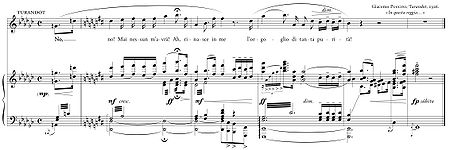
The Emperor Altoum, father of Turandot, sits on his grand throne in his palace. He urges the Prince to withdraw his challenge but the Prince refuses (Altoum, the Prince: Un giuramento atroce). Turandot enters and explains (In questa reggia
) that her ancestress of millennia past, Princess Lo-u-Ling, reigned over her kingdom "in silence and joy, resisting the harsh domination of men" until she was ravished and murdered by an invading foreign prince. Turandot claims that Lo-u-Ling now lives in her and, out of revenge, Turandot has sworn never to let any man possess her. She warns the Prince to withdraw, but again he refuses. The Princess presents her first riddle: Straniero, ascolta! – "... What is born each night and dies each dawn?" The Prince correctly replies, "Hope."
The Princess, unnerved, presents her second riddle (Guizza al pari di fiamma – "What flickers red and warm like a flame, but is not fire?") The Prince thinks for a moment before replying, Sangue – "Blood". Turandot is shaken. The crowd cheers the Prince, provoking Turandot's anger. She presents her third riddle (Gelo che ti da foco – "What is like ice, but burns like fire?"). As the prince thinks, Turandot taunts him "what is the ice that makes you burn?" The taunt makes him see the answer and he proclaims "It is Turandot!"
The crowd cheers for the triumphant Prince. Turandot throws herself at her father's feet and pleads with him not to leave her to the Prince's mercy. The Emperor insists that an oath is sacred, and it is Turandot's duty to wed the Prince (Turandot, Altoum, the Prince: Figlio del cielo). As she cries out in despair, the Prince stops her, saying that he has a proposal for her: Tre enigmi m'hai proposto – "You do not know my name. Bring me my name before sunrise, and at dawn (all' alba), I will die." Turandot accepts. The Emperor declares that he hopes to call the Prince his son come sunrise.
In the distance, heralds call out Turandot's command: Cosi comanda Turandot – "This night, none shall sleep in Peking! The penalty for all will be death if the Prince's name is not discovered by morning". The Prince waits for dawn and anticipates his victory: Nessun dorma
, – "Nobody shall sleep!... Nobody shall sleep! Even you, O Princess"
Ping, Pong, and Pang appear and offer the Prince women and riches if he will only give up Turandot (Tu che guardi le stelle), but he refuses. A group of soldiers then drag in Timur and Liù. They have been seen speaking to the Prince, so they must know his name. Turandot enters and orders Timur and Liù to speak. The Prince feigns ignorance, saying they know nothing. But when the guards begin to treat Timur harshly, Liù declares that she alone knows the Prince's name, but she will not reveal it. Ping demands the Prince's name, and when she refuses, she is tortured. Turandot is clearly taken aback by Liù's resolve and asks her who put so much strength in her heart. Liù answers "Princess, Love!". Turandot demands that Ping tear the Prince's name from Liù, and he orders her to be tortured further. Liù counters Turandot (Tu che di gel sei cinta
– "You who are begirdled by ice"), saying that she too shall learn love. (The words of that aria were actually written by Puccini. Waiting for Adami and Simoni to deliver the next part of the libretto, he wrote the words and when they read them, they decided that they could not better them.) Having spoken, Liù seizes a dagger from a soldier's belt and stabs herself. As she staggers towards the Prince and falls dead, the crowd screams for her to speak the Prince's name. Since Timur is blind, he must be told about Liù's death, and he cries out in anguish. Timur warns that the gods will be offended by this outrage, and the crowd is subdued with shame and fear. The grieving Timur and the crowd follow Liù's body as it is carried away. Everybody departs, leaving the Prince and Turandot. He reproaches Turandot for her cruelty (The Prince, Turandot: Principessa di morte – "Princess of death") and then takes her in his arms and kisses her in spite of her resistance. (Here Puccini's work ends. The remainder of the music was completed by Franco Alfano.)
The Prince tries to convince Turandot to love him. At first she is disgusted, but after he kisses her, she feels herself turning towards passion. She admits that, ever since he came, she had both hated and loved him. She asks him to ask for nothing more and to leave, taking his mystery with him. The Prince however, reveals his name, "Calàf, son of Timur" and places his life in Turandot's hands. She can now destroy him if she wants (Turandot, Calàf: Del primo pianto).
Scene 2: The courtyard of the palace. Dawn
Turandot and Calàf approach the Emperor's throne. She declares that she knows the Prince's name: Diecimila anni al nostro Imperatore! – "It is ... love!" The crowd cheers and acclaims the two lovers (O sole! Vita! Eternità).
states:
Some of this criticism is possibly due to the standard Alfano ending (Alfano II), in which Liù's death is followed almost immediately by Calaf's 'rough wooing' of Turandot, and the 'bombastic' end to the opera. (Sir Thomas Beecham is said to have commented that anything that Kerman says in connection with Puccini can safely be ignored.) The Berio version is considered to overcome some of these criticisms, but critics such as Michael Tanner have failed to be wholly convinced by the new ending, noting that the criticism by the Puccini advocate Julian Budden
still applies:
Ashbrook and Powers consider it was an awareness of this problem — an inadequate buildup for Turandot's change of heart, combined with an overly successful treatment of the secondary character (Liù) — which contributed to Puccini's inability to complete the opera.
Concerning the compelling believability of the self-sacrificial Liù character in contrast to the two mythic protagonists, biographers note echoes in Puccini's own life. He had had a servant named Doria, whom his wife accused of sexual relations with Puccini. The accusations escalated until Doria killed herself — though the autopsy revealed she died a virgin. In Turandot, Puccini lavished his attention on the familiar sufferings of Liù, as he had on his many previous suffering heroines. However, in the opinion of Father Owen Lee
, Puccini was out of his element when it came to resolving the tale of his two allegorical protagonists: Finding himself completely outside his normal genre of verismo
, he was incapable of completely grasping and resolving the necessary elements of the mythic
, unable to "feel his way into the new, forbidding areas the myth opened up to him" — and thus unable to finish the opera in the two years before his unexpected death.
Libretto, Discography, and Listenable Media
Opera
Opera is an art form in which singers and musicians perform a dramatic work combining text and musical score, usually in a theatrical setting. Opera incorporates many of the elements of spoken theatre, such as acting, scenery, and costumes and sometimes includes dance...
in three acts by Giacomo Puccini
Giacomo Puccini
Giacomo Antonio Domenico Michele Secondo Maria Puccini was an Italian composer whose operas, including La bohème, Tosca, Madama Butterfly, and Turandot, are among the most frequently performed in the standard repertoire...
, set to a libretto
Libretto
A libretto is the text used in an extended musical work such as an opera, operetta, masque, oratorio, cantata, or musical. The term "libretto" is also sometimes used to refer to the text of major liturgical works, such as mass, requiem, and sacred cantata, or even the story line of a...
in Italian by Giuseppe Adami
Giuseppe Adami
Giuseppe Adami was an Italian librettist, known for his collaboration with Puccini on La rondine , Il tabarro and Turandot ....
and Renato Simoni
Renato Simoni
Renato Simoni was an Italian journalist, playwright, writer and theatrical critic noted for his collaboration work with Giuseppe Adami for Giacomo Puccini's Turandot....
.
Though Puccini's first interest in the subject was based on his reading of Friedrich Schiller
Friedrich Schiller
Johann Christoph Friedrich von Schiller was a German poet, philosopher, historian, and playwright. During the last seventeen years of his life , Schiller struck up a productive, if complicated, friendship with already famous and influential Johann Wolfgang von Goethe...
's adaptation of the play, his work is most nearly based on the earlier text Turandot by Carlo Gozzi
Carlo Gozzi
Carlo, Count Gozzi was an Italian playwright.Born in Venice, he came from an old Venetian family from the Republic of Ragusa...
. The story, set in China, involves prince Calàf who falls in love with the cold princess Turandot. To obtain permission to marry her, a suitor has to solve three riddles; any false answer results in death. Calàf passes the test, but Turandot still hesitates to marry him. He offers her a way out: he agrees to die should she be able guess his real name.
The opera was unfinished at the time of Puccini's death in 1924 and was completed by Franco Alfano
Franco Alfano
Franco Alfano was an Italian composer and pianist. Best known today for his opera Risurrezione and above all for having completed Puccini's opera Turandot in 1926. He had considerable success with several of his own works during his lifetime.- Biography :He was born in Posillipo, Naples...
in 1926. The first performance was held at the Teatro alla Scala
La Scala
La Scala , is a world renowned opera house in Milan, Italy. The theatre was inaugurated on 3 August 1778 and was originally known as the New Royal-Ducal Theatre at La Scala...
in Milan
Milan
Milan is the second-largest city in Italy and the capital city of the region of Lombardy and of the province of Milan. The city proper has a population of about 1.3 million, while its urban area, roughly coinciding with its administrative province and the bordering Province of Monza and Brianza ,...
on April 25, 1926 and conducted by Arturo Toscanini
Arturo Toscanini
Arturo Toscanini was an Italian conductor. One of the most acclaimed musicians of the late 19th and 20th century, he was renowned for his intensity, his perfectionism, his ear for orchestral detail and sonority, and his photographic memory...
. This performance included only Puccini's music and not Alfano's additions. The first performance of the opera as completed by Alfano was the following night.
Origin and pronounciation of the name
Turandot is a PersianPersian language
Persian is an Iranian language within the Indo-Iranian branch of the Indo-European languages. It is primarily spoken in Iran, Afghanistan, Tajikistan and countries which historically came under Persian influence...
word and name meaning "the daughter of Turan
Turan
Tūrān is the Persian name for Central Asia, literally meaning "the land of the Tur". As described below, the original Turanians are an Iranian tribe of the Avestan age. As a people the "Turanian" are one of the two Iranian peoples both descending from the Persian Fereydun but with different...
", Turan being a region of Central Asia
Central Asia
Central Asia is a core region of the Asian continent from the Caspian Sea in the west, China in the east, Afghanistan in the south, and Russia in the north...
which used to be part of the Persian Empire.
In Persian, the fairy tale is known as Turandokht, with "dokht" being a contraction for dokhtar (meaning daughter), and both the "kh" and "t" are clearly pronounced. However, according to Puccini scholar Patrick Vincent Casali, the final "t" should not be sounded in the pronunciation of the opera's name or when referring to the title character. Puccini never pronounced the final "t", according to soprano Rosa Raisa
Rosa Raisa
Rosa Raisa was a Polish-born, Italian-trained, dramatic operatic soprano. In 1926 she created the role of Turandot at La Scala, Milan.-Career:...
, who was the first singer to interpret the title role. Furthermore, Dame Eva Turner
Eva Turner
Dame Eva Turner DBE was an English dramatic soprano with an international reputation. Her strong, steady and well-trained voice was renowned for its clarion power in Italian and German operatic roles.-Career:...
, the most renowned Turandot of the inter-war period, insisted on pronouncing the word as "Turan-do" (i.e. without the final "t"), as television interviews with her attest. As Casali notes, too, the musical setting of many of Calaf's utterances of the name makes sounding the final "t" all but impossible. However Simonetta Puccini, Puccini's granddaughter and keeper of the Villa Puccini and Mausoleum, has stated that the final "t" must be pronounced.
- "In 1710, while writing the first biography of Genghis Khan, the French scholar François Pétis de La Croix published a book of tales and fables combining various Asian literary themes. One of his longest and best stories derived from the history of Mongol princess KhutulunKhutulunKhutulun , also known as Aiyurug or Khotol Tsagaan, was the most famous daughter of Kaidu and the niece of Kublai Khan. Her father was most pleased by her abilities, and she accompanied him on military campaigns. Marco Polo and Rashid al-Din both wrote of her.Khutulun was born about 1260...
. In his adaptation, however, she bore the title Turandot, meaning “Turkish Daughter,” the nineteen-year-old daughter of Altoun Khan, the Mongol emperor of China. Instead of challenging her suitors in wrestling, Pétis de La Croix had her confront them with three riddles. In his more dramatic version, instead of wagering mere horses, the suitor had to forfeit his life if he failed to answer correctly.
- "Fifty years later, the popular Italian playwright Carlo Gozzi made her story into a drama of a “tigerish woman” of “unrelenting pride.” In a combined effort by two of the greatest literary talents of the era, Friedrich von Schiller translated the play into German as Turandot, Prinzessin von China, and Johann Wolfgang von Goethe directed it on the stage in Weimar in 1802."
Composition history
The story of Turandot was taken from a Persian collection of stories called The Book of One Thousand and One Days (1722 French translation Les Mille et un jours by François Pétis de la CroixFrançois Pétis de la Croix
François Pétis de la Croix was a French orientalist.He was born in Paris, the son of the Arabic interpreter of the French court, and inherited this office at his father's death in 1695, afterwards transmitting it to his own son, Alexandre Louis Marie, who also distinguished himself in Oriental...
— not to be confused with its sister work The Book of One Thousand and One Nights
The Book of One Thousand and One Nights
One Thousand and One Nights is a collection of Middle Eastern and South Asian stories and folk tales compiled in Arabic during the Islamic Golden Age...
), where the character of "Turandokht" as a cold Turk (Uygur) princess was found. The story of Turandokht is one of the best known from De la Croix's translation. The plot respects the classical unities
Classical unities
The classical unities, Aristotelian unities or three unities are rules for drama derived from a passage in Aristotle's Poetics. In their neoclassical form they are as follows:...
of time, space and action.
Cancer
Cancer , known medically as a malignant neoplasm, is a large group of different diseases, all involving unregulated cell growth. In cancer, cells divide and grow uncontrollably, forming malignant tumors, and invade nearby parts of the body. The cancer may also spread to more distant parts of the...
and on 24 November went to Brussels
Brussels
Brussels , officially the Brussels Region or Brussels-Capital Region , is the capital of Belgium and the de facto capital of the European Union...
, Belgium for treatment. There he underwent a new and experimental radiation therapy treatment. Puccini and his wife never knew how serious the cancer was, as the news was only revealed to his son. Puccini, however, seems to have had some inkling of the possible seriousness of his condition since, before leaving for Brussels, he visited Toscanini and begged him, "Don't let my Turandot die." He died of a heart attack on 29 November 1924 when it seemed that the radium treatment was succeeding. His step-daughter Fosca was in fact joyfully writing a letter to an English friend of the family, Sibyl Seligman, telling her that the cancer was shrinking when she was called to her father's bedside because of the heart attack.
He left behind 36 pages of sketches on 23 sheets for the end of Turandot, together with instructions that Riccardo Zandonai
Riccardo Zandonai
Riccardo Zandonai was an Italian composer.-Biography:Zandonai was born in Borgo Sacco, Rovereto, then part of Austria–Hungary....
should finish the opera. Puccini's son Tonio objected, and eventually Franco Alfano
Franco Alfano
Franco Alfano was an Italian composer and pianist. Best known today for his opera Risurrezione and above all for having completed Puccini's opera Turandot in 1926. He had considerable success with several of his own works during his lifetime.- Biography :He was born in Posillipo, Naples...
was chosen to flesh out the sketches after Vincenzo Tommasini
Vincenzo Tommasini
Vincenzo Tommasini was an Italian composer.Born in Rome, Tommasini studied philology and the Greek language at the University of Rome, at the same time pursuing equally intensive studies in music at the Academy of St. Cecilia. In 1902 he traveled extensively throughout Europe; during this time he...
(who had completed Boito
Arrigo Boito
Arrigo Boito , aka Enrico Giuseppe Giovanni Boito, pseudonym Tobia Gorrio, was an Italian poet, journalist, novelist and composer, best known today for his libretti, especially those for Giuseppe Verdi's operas Otello and Falstaff, and his own opera Mefistofele...
's Nerone
Nerone (Boito)
Nerone is an opera in four acts composed by Arrigo Boito, to a libretto in Italian written by the composer. The work is a series of scenes from Imperial Rome at the time of Emperor Nero depicting tensions between the Imperial religion and Christianity, and ends with the Great Fire of Rome...
after the composer’s death) and Pietro Mascagni
Pietro Mascagni
Pietro Antonio Stefano Mascagni was an Italian composer most noted for his operas. His 1890 masterpiece Cavalleria rusticana caused one of the greatest sensations in opera history and single-handedly ushered in the Verismo movement in Italian dramatic music...
were rejected. Puccini's editor Giulio Ricordi
Giulio Ricordi
Giulio Ricordi was an Italian editor and musician.-Biography:Ricordi was born in Milan, where he also died....
decided on Alfano because his opera La leggenda di Sakùntala resembled Turandot in its setting and heavy orchestration. Alfano provided a first version of the ending with a few passages of his own, and even a few sentences added to the libretto which was not considered complete even by Puccini himself. After the severe criticisms by Ricordi and the conductor Arturo Toscanini, he was forced to write a second, strictly censored version that followed Puccini's sketches more closely, to the point where he did not set some of Adami's text to music because Puccini had not indicated how he wanted it to sound. Ricordi's real concern was not the quality of Alfano's work, but that he wanted the end of Turandot to sound as if it had been written by Puccini, and Alfano's editing had to be seamless. Of this version, about three minutes were cut for performance by Toscanini, and it is this shortened version that is usually performed.
Puccini also had co-composers on this opera. Baron Fassini Camossi, the former Italian diplomat to China, gave Puccini as a gift a music box which played a number of Chinese melodies. Puccini used three of these in the opera, including the national anthem (heard during the appearance of the Empero Altoum) and, most memorably, the folk melody "Mo-li-hua" ("Jasmine Flower") which is first heard sung by the children's chorus after the invocation to the moon in Act I, and becomes a sort of 'leitmotif' for the princess throughout the opera.
Performance history
The premiere of Turandot was at La ScalaLa Scala
La Scala , is a world renowned opera house in Milan, Italy. The theatre was inaugurated on 3 August 1778 and was originally known as the New Royal-Ducal Theatre at La Scala...
, Milan
Milan
Milan is the second-largest city in Italy and the capital city of the region of Lombardy and of the province of Milan. The city proper has a population of about 1.3 million, while its urban area, roughly coinciding with its administrative province and the bordering Province of Monza and Brianza ,...
, on Sunday 25 April 1926, one year and five months after Puccini's death, with Rosa Raisa
Rosa Raisa
Rosa Raisa was a Polish-born, Italian-trained, dramatic operatic soprano. In 1926 she created the role of Turandot at La Scala, Milan.-Career:...
in the title role. It was conducted by Arturo Toscanini
Arturo Toscanini
Arturo Toscanini was an Italian conductor. One of the most acclaimed musicians of the late 19th and 20th century, he was renowned for his intensity, his perfectionism, his ear for orchestral detail and sonority, and his photographic memory...
. In the middle of Act 3, two measures after the words "Liù, poesia!", the orchestra rested. Toscanini stopped and laid down his baton. He turned to the audience and announced: "Qui finisce l'opera, perché a questo punto il maestro è morto" ("Here the opera ends, because at this point the maestro died"). The curtain was lowered slowly. These are the words reported by Eugenio Gara, who was present at the premiere.
The quotation however appears to be based on memory, and differs in different sources. According to a 1974 interview with another eyewitness, Toscanini's words were: "Qui termina la rappresentazione perché a questo punto il maestro è morto" ("Here the performance finishes because at this point the maestro died") and the English translation of this interview seems to say "Here the Maestro finished". The article on the life of Puccini
Giacomo Puccini
Giacomo Antonio Domenico Michele Secondo Maria Puccini was an Italian composer whose operas, including La bohème, Tosca, Madama Butterfly, and Turandot, are among the most frequently performed in the standard repertoire...
notes that: Some record that he said, more poetically, "Here the Maestro laid down his pen". Two authors believe that the second and subsequent performances of the 1926 La Scala season, which included the Alfano ending, were conducted by Ettore Panizza
Ettore Panizza
Ettore Panizza was an Argentinian conductor and composer, one of the leading conductors of the early 20th century. Panizza possessed technical mastery and was popular and influential during his time, widely admired by Richard Strauss.- Biography :Panizza was born in Buenos Aires, of Italian parents...
and Toscanini never conducted the opera again after the first performance.
However, in his biography of Toscanini, Harvey Sachs
Harvey Sachs
Harvey Sachs, is an American-Canadian-Swiss writer who has written many books on musical subjects.His books include the standard biography of and a book of essays on the Italian conductor Arturo Toscanini, plus an edited collection of Toscanini's letters.* Toscanini, Philadelphia & New York: J. B...
claims that Toscanini did conduct the second and third performances before withdrawing from the production due to nervous exhaustion. As discussed, the music for Liù's death was not in fact Puccini's final composition, but had been orchestrated some nine months earlier. Tenors Miguel Fleta
Miguel Fleta
Miguel Burró Fleta was a Spanish operatic tenor....
and Franco Lo Giudice
Franco Lo Giudice
Franco Lo Giudice was an Italian tenor who had a successful international opera career during the first half of the twentieth century. He was an important exponent of the works of Riccardo Zandonai, notably starring in the world premieres of his operas I cavalieri di Ekebù and Giuliano...
alternated in the role of Prince Calàf in the original production, although Fleta had the honor of singing the role for the opera's opening night.
Puccini commissioned a set of 13 gongs constructed by the Tronci family specifically for Turandot. Decades later, percussionist Howard Van Hyning
Howard Van Hyning
Howard Martin Van Hyning was an American percussionist who was best known for his work with the New York City Opera...
of the New York City Opera
New York City Opera
The New York City Opera is an American opera company located in New York City.The company, called "the people's opera" by New York Mayor Fiorello La Guardia, was founded in 1943 with the aim of making opera financially accessible to a wide audience, producing an innovative choice of repertory, and...
had been searching for a proper set of gongs and obtained the original set from the Stivanello Costume Company, which had acquired the gongs as the result of winning a bet. In 1987 he bought the gongs for his collection, paying thousands of dollars for the set, which he described as having "colorful, intense, centered and perfumed" sound qualities.
Turandot quickly spread to other venues: Rome
Rome
Rome is the capital of Italy and the country's largest and most populated city and comune, with over 2.7 million residents in . The city is located in the central-western portion of the Italian Peninsula, on the Tiber River within the Lazio region of Italy.Rome's history spans two and a half...
(Teatro Costanzi, April 29, four days after the Milan premiere), Buenos Aires
Buenos Aires
Buenos Aires is the capital and largest city of Argentina, and the second-largest metropolitan area in South America, after São Paulo. It is located on the western shore of the estuary of the Río de la Plata, on the southeastern coast of the South American continent...
(Teatro Colón, June 23), Dresden
Dresden
Dresden is the capital city of the Free State of Saxony in Germany. It is situated in a valley on the River Elbe, near the Czech border. The Dresden conurbation is part of the Saxon Triangle metropolitan area....
(September 6, in German), Venice
Venice
Venice is a city in northern Italy which is renowned for the beauty of its setting, its architecture and its artworks. It is the capital of the Veneto region...
(La Fenice, September 9), Vienna
Vienna
Vienna is the capital and largest city of the Republic of Austria and one of the nine states of Austria. Vienna is Austria's primary city, with a population of about 1.723 million , and is by far the largest city in Austria, as well as its cultural, economic, and political centre...
(October 14; Mafalda Salvatini
Mafalda Salvatini
Mafalda Salvatini was an Italian opera singer who was primarily active in Germany during the first half of the 20th century. She excelled in the dramatic soprano repertoire of the Italian language and was one of the leading operatic sopranos in Berlin from 1908-1932...
in the title role), Berlin
Berlin
Berlin is the capital city of Germany and is one of the 16 states of Germany. With a population of 3.45 million people, Berlin is Germany's largest city. It is the second most populous city proper and the seventh most populous urban area in the European Union...
(November 8), New York
New York
New York is a state in the Northeastern region of the United States. It is the nation's third most populous state. New York is bordered by New Jersey and Pennsylvania to the south, and by Connecticut, Massachusetts and Vermont to the east...
(Metropolitan Opera, November 16), Brussels
Brussels
Brussels , officially the Brussels Region or Brussels-Capital Region , is the capital of Belgium and the de facto capital of the European Union...
(La Monnaie, 17 December, in French), Naples
Naples
Naples is a city in Southern Italy, situated on the country's west coast by the Gulf of Naples. Lying between two notable volcanic regions, Mount Vesuvius and the Phlegraean Fields, it is the capital of the region of Campania and of the province of Naples...
(Teatro San Carlo, January 17, 1927), Parma
Parma
Parma is a city in the Italian region of Emilia-Romagna famous for its ham, its cheese, its architecture and the fine countryside around it. This is the home of the University of Parma, one of the oldest universities in the world....
(February 12), Turin
Turin
Turin is a city and major business and cultural centre in northern Italy, capital of the Piedmont region, located mainly on the left bank of the Po River and surrounded by the Alpine arch. The population of the city proper is 909,193 while the population of the urban area is estimated by Eurostat...
(March 17), London
London
London is the capital city of :England and the :United Kingdom, the largest metropolitan area in the United Kingdom, and the largest urban zone in the European Union by most measures. Located on the River Thames, London has been a major settlement for two millennia, its history going back to its...
(Covent Garden, June 7), San Francisco (September 19), Bologna
Bologna
Bologna is the capital city of Emilia-Romagna, in the Po Valley of Northern Italy. The city lies between the Po River and the Apennine Mountains, more specifically, between the Reno River and the Savena River. Bologna is a lively and cosmopolitan Italian college city, with spectacular history,...
(October 1927), Paris
Paris
Paris is the capital and largest city in France, situated on the river Seine, in northern France, at the heart of the Île-de-France region...
(March 29, 1928), Moscow
Moscow
Moscow is the capital, the most populous city, and the most populous federal subject of Russia. The city is a major political, economic, cultural, scientific, religious, financial, educational, and transportation centre of Russia and the continent...
(Bolshoi Theatre, 1931).
Turandot is a staple of the standard operatic repertoire and it appears as number 15 on the Operabase
Operabase
Operabase is an on-line database of opera performances, opera houses and companies, performers themselves as well as their agents. Operabase, found at operabase.com, is owned and operated by Operabase Ltd, a company located in Luton, England. The site started in 1996 as the hobby of Mike Gibb,...
list of the most-performed operas worldwide.
For many years, the Government of the People's Republic of China
People's Republic of China
China , officially the People's Republic of China , is the most populous country in the world, with over 1.3 billion citizens. Located in East Asia, the country covers approximately 9.6 million square kilometres...
forbade performance of Turandot because they said it portrayed China and the Chinese unfavourably. In the late 1990s they relented, and in September 1998 the opera was performed for eight nights at the Forbidden City
Forbidden City
The Forbidden City was the Chinese imperial palace from the Ming Dynasty to the end of the Qing Dynasty. It is located in the middle of Beijing, China, and now houses the Palace Museum...
, complete with opulent sets and soldiers from the People's Liberation Army
People's Liberation Army
The People's Liberation Army is the unified military organization of all land, sea, strategic missile and air forces of the People's Republic of China. The PLA was established on August 1, 1927 — celebrated annually as "PLA Day" — as the military arm of the Communist Party of China...
as extras. It was an international collaboration, with director Zhang Yimou
Zhang Yimou
Zhang Yimou is a Chinese film director, producer, writer and actor, and former cinematographer. He is counted amongst the Fifth Generation of Chinese filmmakers, having made his directorial debut in 1987 with Red Sorghum....
as choreographer and Zubin Mehta
Zubin Mehta
Zubin Mehta is an Indian conductor of western classical music. He is the Music Director for Life of the Israel Philharmonic Orchestra.-Biography:...
as conductor. The singing roles saw Giovanna Casolla, Audrey Stottler, and Sharon Sweet
Sharon Sweet
Sharon Sweet is an American dramatic soprano. Sharon Sweet has appeared in leading roles in several major venues in Europe and the United States and has made notable contributions to several recordings, in particular Lohengrin, Der Freischütz, Don Giovanni, and Il Trovatore...
as Princess Turandot; Sergej Larin
Sergejus Larinas
Sergej Larin or was one of a number of operatic tenors from the former Soviet Union to achieve success in the West...
and Lando Bartolini
Lando Bartolini
Lando Bartolini is an Italian tenor.He studied at the Academy of Vocal Arts in Philadelphia after winning the Mario Lanza Award in 1968...
as Calàf; and Barbara Frittoli
Barbara Frittoli
Barbara Frittoli is an Italian operatic soprano who has sung leading roles in opera houses throughout Europe and in the United States. She was born in Milan and graduated from the Milan Conservatory...
, Cristina Gallardo Domas, and Barbara Hendricks
Barbara Hendricks
Barbara Hendricks is an African American operatic soprano and concert singer. Hendricks has lived in Europe since 1977, and in Switzerland on Lake Geneva since 1985, She is a citizen of Sweden.-Early life and education:...
as Liù.
As with Madama Butterfly
Madama Butterfly
Madama Butterfly is an opera in three acts by Giacomo Puccini, with an Italian libretto by Luigi Illica and Giuseppe Giacosa. Puccini based his opera in part on the short story "Madame Butterfly" by John Luther Long, which was dramatized by David Belasco...
, Puccini strove for a semblance of Asian authenticity (at least to Western ears) by using music from the region in question. Up to eight of the themes used in Turandot appear to be based on traditional Chinese music and anthems, and the melody of a Chinese song named "Mò Li Hūa (茉莉花)
Mo Li Hua
Mo Li Hua , is a popular Chinese folk song. The song dates to 18th century. In time, many regional variations were created, and the song gained popularity both in China and abroad. It has been used during events such as 2004 Summer Olympics, 2008 Summer Olympics and 2010 Shanghai Expo opening...
", or "Jasmine", is included as a motif for the princess.
Alfano's original ending
The debate over which version of the ending is better is still open, but the consensus generally tends towards Alfano's first score. Scrutiny of the sketches, which Ricordi later allowed scholars to analyze (and sometimes publish), showed how Alfano actually did not even try to use most of the short sketches on the sheets, with the exception of those with an obvious placement and one short theme he freely transformed, and used for the sake of stylistic continuity.From 1976 to 1988 the American composer Janet Maguire
Janet Maguire
Janet Maguire is an American composer residing in Venice, Italy. She is known particularly for her arrangement of the finale of Giacomo Puccini's Turandot in which she used exclusively the sketches Puccini left for it at his death...
, convinced that the whole ending is coded in the sketches left by Puccini, composed a new ending, but this has never been performed. In 2001 Luciano Berio
Luciano Berio
Luciano Berio, Cavaliere di Gran Croce OMRI was an Italian composer. He is noted for his experimental work and also for his pioneering work in electronic music.-Biography:Berio was born at Oneglia Luciano Berio, Cavaliere di Gran Croce OMRI (October 24, 1925 – May 27, 2003) was an Italian...
made a new sanctioned completion, using Puccini's sketches but also expanding the musical language, but this has received a mixed reception.
The opera, with Alfano's original ending, has been recorded more than once. The first definitely known live performance of Alfano's original ending was not mounted until 3 November 1982, by the Chelsea Opera Group at the Barbican Centre
Barbican Centre
The Barbican Centre is the largest performing arts centre in Europe. Located in the City of London, England, the Centre hosts classical and contemporary music concerts, theatre performances, film screenings and art exhibitions. It also houses a library, three restaurants, and a conservatory...
in London. However, it may have been staged in Germany in the early years, since Ricordi had commissioned a German translation of the text and a number of scores were printed in Germany with the full final scene included. Even the second Alfano ending was further cut. Thus the second Turandot's aria "Del primo pianto", was performed on the premiere but it was cut from the first complete recording and eventually restored to its proper place. Zubin Mehta also had cut the aria on his Beijing performances.
Recordings of this aria by the inter-war singers Anna Roselle and Lotte Lehmann exist, which suggests they may have sung the original ending on stage, but no other evidence is available. The new production of Turandot for the reopening of Gran Teatro Liceu in Barcelona restores the first Alfano ending and uses the completely different ending of the story of Turandot.
Roles
| Role | Voice type | Premiere Cast, April 25, 1926 (Conductor: Arturo Toscanini Arturo Toscanini Arturo Toscanini was an Italian conductor. One of the most acclaimed musicians of the late 19th and 20th century, he was renowned for his intensity, his perfectionism, his ear for orchestral detail and sonority, and his photographic memory... ) |
|---|---|---|
| Princess Turandot | soprano Soprano A soprano is a voice type with a vocal range from approximately middle C to "high A" in choral music, or to "soprano C" or higher in operatic music. In four-part chorale style harmony, the soprano takes the highest part, which usually encompasses the melody... |
Rosa Raisa Rosa Raisa Rosa Raisa was a Polish-born, Italian-trained, dramatic operatic soprano. In 1926 she created the role of Turandot at La Scala, Milan.-Career:... |
| The Emperor Altoum, her father | tenor Tenor The tenor is a type of male singing voice and is the highest male voice within the modal register. The typical tenor voice lies between C3, the C one octave below middle C, to the A above middle C in choral music, and up to high C in solo work. The low extreme for tenors is roughly B2... |
Francesco Dominici Francesco Dominici Francesco Dominici was an Italian operatic tenor particularly admired for his acting in comedic roles. He made his professional opera debut as Fernando in Donizetti's La favorite at the Teatro Donizetti in Bergamo in 1914... |
| Timur, the deposed King of Tartary | bass | Carlo Walter |
| The Unknown Prince (Calàf), his son | tenor | Miguel Fleta Miguel Fleta Miguel Burró Fleta was a Spanish operatic tenor.... |
| Liù, a slave girl | soprano | Maria Zamboni Maria Zamboni Maria Zamboni was an Italian operatic soprano who had a prolific career in Italy and South America between 1921 and 1936. Admired for her vivid character portrayals and expressive singing, Zamboni was a popular and frequent performer at both La Scala and the Teatro Costanzi... |
| Ping, Lord Chancellor | baritone Baritone Baritone is a type of male singing voice that lies between the bass and tenor voices. It is the most common male voice. Originally from the Greek , meaning deep sounding, music for this voice is typically written in the range from the second F below middle C to the F above middle C Baritone (or... |
Giacomo Rimini Giacomo Rimini Giacomo Rimini was an Italian-born, naturalized-American operatic baritone. He was most admired for his interpretations of the works of Giuseppe Verdi.-Biography:... |
| Pang, Majordomo | tenor | Emilio Venturini Emilio Venturini Emilio Venturini was an Italian operatic lyric tenor known for his portrayal of character roles. He made his professional opera debut in 1900 in Italy where he remained for the next several years. In 1901 he sang the role of Brighella in Mascagni's Le maschere at the Teatro Regio in Turin... |
| Pong, Head chef of the Imperial Kitchen | tenor | Giuseppe Nessi Giuseppe Nessi -Life:Nessi was born in Bergamo, near Milan in Italy. He made his debut in Saluzzo in 1916, in the role of Alfredo in La Traviata. However, on the advice of renowned Italian conductor Tullio Serafin, the majority of his career was focussed on character tenor roles... |
| A Mandarin | baritone | Aristide Baracchi |
| The Prince of Persia | tenor | Not named in the original program |
| The Executioner (Pu-Tin-Pao) | silent | Not named in the original program |
| Imperial guards, the executioner's men, boys, priests, mandarins, dignitaries, eight wise men,Turandot's handmaids, soldiers, standard-bearers, musicians, ghosts of suitors, crowd | ||
Act 1
In front of the imperial palaceA Mandarin announces the law of the land (Popolo di Pechino! – "Any man who desires to wed Turandot must first answer her three riddles. If he fails, he will be beheaded"). The Prince of Persia has failed and is to be beheaded at moonrise. As the crowd surges towards the gates of the palace, the imperial guards brutally repulse them, a blind old man is pushed to the ground. His slave-girl, Liù, cries for help. A young man hears her cry and recognizes the old man as his long-lost father, Timur, the deposed king of Tartary
Tartary
Tartary or Great Tartary was a name used by Europeans from the Middle Ages until the twentieth century to designate the Great Steppe, that is the great tract of northern and central Asia stretching from the Caspian Sea and the Ural Mountains to the Pacific Ocean inhabited mostly by Turkic, Mongol...
. The young Prince of Tartary is overjoyed at seeing his father alive but urges him not to speak his name because he fears the Chinese rulers who have conquered Tartary. Timur tells his son that, of all his servants, only Liù has remained faithful to him. When the Prince asks her why, she tells him that once, long ago in the palace, he smiled upon her (The crowd, Liù, Prince of Tartary, Timur: Indietro, cani!).
The moon rises, and the crowd's cries for blood turn into silence. The doomed Prince of Persia is led before the crowd on his way to execution. The young Prince is so handsome and kind that the crowd and the Prince of Tartary are moved to compassion and call on Turandot to spare his life (The crowd, Prince of Tartary: O giovinetto!). She appears, and with a single imperious gesture orders the execution to continue. The Prince of Tartary, who has never seen Turandot before, falls immediately in love. He cries out Turandot's name (three times) with joy, and the Prince of Persia echoes his final cry. The crowd screams in horror as the Prince of Persia is beheaded.
The Prince of Tartary is dazzled by Turandot's beauty. He is about to rush towards the gong and strike it three times—the symbolic gesture of whoever wishes to marry Turandot—when the ministers Ping, Pong, and Pang appear and urge him cynically (Fermo, che fai?) not to lose his head for Turandot but to go back to his own country. Timur urges his son to desist, and Liù, who is secretly in love with the Prince, pleads with him (Signore, ascolta! – "My lord, listen!") not to attempt the riddles. Liù's words touch his heart. The Prince tells Liù to make exile more bearable and never to abandon his father if the Prince fails to answer the riddles (Non piangere, Liù
Non piangere, Liù
Non piangere, Liù is an aria sung by Calàf, the "Unknown Prince" from Act I of the Italian opera, Turandot by Giacomo Puccini. The lyrics were written by Giuseppe Adami and Renato Simoni. The scene takes place before the walls of the imperial palace...
– "Don't cry, Liù"). The three ministers, Timur, and Liù try one last time to hold the Prince ( Ah! Per l'ultima volta! ) but he refuses to listen.
He calls Turandot's name three times, and each time Liù, Timur, and the ministers reply, "Death!", and the crowd declares "we're already digging your grave!" Rushing to the gong that hangs in front of the palace, he strikes it three times, declaring himself a suitor. From the palace balcony, Turandot accepts the challenge, as Ping, Pang and Pong laugh at the prince's foolishness.
Act 2
Scene 1: A pavilion in the imperial palace. Before sunrisePing, Pang, and Pong lament their place as ministers, poring over palace documents and presiding over endless rituals. They prepare themselves for either a wedding or a funeral (Ping, Pang, Pong: Ola, Pang!). Ping suddenly longs for his country house in Honan
Henan
Henan , is a province of the People's Republic of China, located in the central part of the country. Its one-character abbreviation is "豫" , named after Yuzhou , a Han Dynasty state that included parts of Henan...
, with its small lake surrounded by bamboo. Pong remembers his grove of forests near Tsiang, and Pang recalls his gardens near Kiu. The three share fond memories of life away from the palace (Ping, Pang, Pong: Ho una casa nell'Honan) but are shaken back to the realities of Turandot's bloody reign. They continually accompany young men to death and recall their ghastly fate. As the palace trumpet sounds, the ministers ready themselves for another spectacle as they await the entrance of the Emperor.
Scene 2: The courtyard of the palace. Sunrise
The Emperor Altoum, father of Turandot, sits on his grand throne in his palace. He urges the Prince to withdraw his challenge but the Prince refuses (Altoum, the Prince: Un giuramento atroce). Turandot enters and explains (In questa reggia
In questa Reggia
In questa reggia is an aria from Giacomo Puccini's opera Turandot set to a libretto in Italian by Giuseppe Adami and Renato Simoni. The text is based on Friedrich Schiller's adaptation of the play Turandot by CarloGozzi...
) that her ancestress of millennia past, Princess Lo-u-Ling, reigned over her kingdom "in silence and joy, resisting the harsh domination of men" until she was ravished and murdered by an invading foreign prince. Turandot claims that Lo-u-Ling now lives in her and, out of revenge, Turandot has sworn never to let any man possess her. She warns the Prince to withdraw, but again he refuses. The Princess presents her first riddle: Straniero, ascolta! – "... What is born each night and dies each dawn?" The Prince correctly replies, "Hope."
The Princess, unnerved, presents her second riddle (Guizza al pari di fiamma – "What flickers red and warm like a flame, but is not fire?") The Prince thinks for a moment before replying, Sangue – "Blood". Turandot is shaken. The crowd cheers the Prince, provoking Turandot's anger. She presents her third riddle (Gelo che ti da foco – "What is like ice, but burns like fire?"). As the prince thinks, Turandot taunts him "what is the ice that makes you burn?" The taunt makes him see the answer and he proclaims "It is Turandot!"
The crowd cheers for the triumphant Prince. Turandot throws herself at her father's feet and pleads with him not to leave her to the Prince's mercy. The Emperor insists that an oath is sacred, and it is Turandot's duty to wed the Prince (Turandot, Altoum, the Prince: Figlio del cielo). As she cries out in despair, the Prince stops her, saying that he has a proposal for her: Tre enigmi m'hai proposto – "You do not know my name. Bring me my name before sunrise, and at dawn (all' alba), I will die." Turandot accepts. The Emperor declares that he hopes to call the Prince his son come sunrise.
Act 3
Scene 1: The palace gardens. NightIn the distance, heralds call out Turandot's command: Cosi comanda Turandot – "This night, none shall sleep in Peking! The penalty for all will be death if the Prince's name is not discovered by morning". The Prince waits for dawn and anticipates his victory: Nessun dorma
Nessun dorma
Nessun dorma is an aria from the final act of Giacomo Puccini's opera Turandot, and is one of the best-known tenor arias in all opera. It is sung by Calaf, il principe ignoto , who falls in love at first sight with the beautiful but cold Princess Turandot...
, – "Nobody shall sleep!... Nobody shall sleep! Even you, O Princess"
Ping, Pong, and Pang appear and offer the Prince women and riches if he will only give up Turandot (Tu che guardi le stelle), but he refuses. A group of soldiers then drag in Timur and Liù. They have been seen speaking to the Prince, so they must know his name. Turandot enters and orders Timur and Liù to speak. The Prince feigns ignorance, saying they know nothing. But when the guards begin to treat Timur harshly, Liù declares that she alone knows the Prince's name, but she will not reveal it. Ping demands the Prince's name, and when she refuses, she is tortured. Turandot is clearly taken aback by Liù's resolve and asks her who put so much strength in her heart. Liù answers "Princess, Love!". Turandot demands that Ping tear the Prince's name from Liù, and he orders her to be tortured further. Liù counters Turandot (Tu che di gel sei cinta
Tu che di gel sei cinta
'Tu che di gel sei cinta' is an aria from Act 3 Scene 1 of Puccini's opera Turandot. It is sung by Liu under torture, and prior to her suicide. Turandot is clearly taken by Liù's resolve and asks her who put so much strength in her heart...
– "You who are begirdled by ice"), saying that she too shall learn love. (The words of that aria were actually written by Puccini. Waiting for Adami and Simoni to deliver the next part of the libretto, he wrote the words and when they read them, they decided that they could not better them.) Having spoken, Liù seizes a dagger from a soldier's belt and stabs herself. As she staggers towards the Prince and falls dead, the crowd screams for her to speak the Prince's name. Since Timur is blind, he must be told about Liù's death, and he cries out in anguish. Timur warns that the gods will be offended by this outrage, and the crowd is subdued with shame and fear. The grieving Timur and the crowd follow Liù's body as it is carried away. Everybody departs, leaving the Prince and Turandot. He reproaches Turandot for her cruelty (The Prince, Turandot: Principessa di morte – "Princess of death") and then takes her in his arms and kisses her in spite of her resistance. (Here Puccini's work ends. The remainder of the music was completed by Franco Alfano.)
The Prince tries to convince Turandot to love him. At first she is disgusted, but after he kisses her, she feels herself turning towards passion. She admits that, ever since he came, she had both hated and loved him. She asks him to ask for nothing more and to leave, taking his mystery with him. The Prince however, reveals his name, "Calàf, son of Timur" and places his life in Turandot's hands. She can now destroy him if she wants (Turandot, Calàf: Del primo pianto).
Scene 2: The courtyard of the palace. Dawn
Turandot and Calàf approach the Emperor's throne. She declares that she knows the Prince's name: Diecimila anni al nostro Imperatore! – "It is ... love!" The crowd cheers and acclaims the two lovers (O sole! Vita! Eternità).
Critical response
While long recognised as the most tonally adventurous of Puccini's operas, Turandot has also been considered a flawed masterpiece, and some critics have been unreservedly hostile. Joseph KermanJoseph Kerman
Joseph Wilfred Kerman is an American critic and musicologist. One of the leading musicologists of his generation, his 1985 book Contemplating Music: Challenges to Musicology was described by Philip Brett in The Grove Dictionary of Music and Musicians as "a defining moment in the field." He is...
states:
- "Nobody would deny that dramatic potential can be found in this tale. Puccini, however, did not find it; his music does nothing to rationalize the legend or illuminate the characters. Kerman also wrote that while Turandot is more "suave" musically than Puccini's earlier opera, ToscaToscaTosca is an opera in three acts by Giacomo Puccini to an Italian libretto by Luigi Illica and Giuseppe Giacosa. It premiered at the Teatro Costanzi in Rome on 14 January 1900...
, "dramatically it is a good deal more depraved."
Some of this criticism is possibly due to the standard Alfano ending (Alfano II), in which Liù's death is followed almost immediately by Calaf's 'rough wooing' of Turandot, and the 'bombastic' end to the opera. (Sir Thomas Beecham is said to have commented that anything that Kerman says in connection with Puccini can safely be ignored.) The Berio version is considered to overcome some of these criticisms, but critics such as Michael Tanner have failed to be wholly convinced by the new ending, noting that the criticism by the Puccini advocate Julian Budden
Julian Budden
Julian Medforth Budden, BA, BMus was a British opera scholar, radio producer and broadcaster. He is particularly known for his three volumes on the operas of Giuseppe Verdi , a single volume biography in 1982 and a single volume work on Giacomo Puccini and his operas in 2002...
still applies:
- "Nothing in the text of the final duet suggests that Calaf's love for Turandot amounts to anything more than a physical obsession: nor can the ingenuities of Simoni and Adami's text for 'Del primo pianto' convince us that the Princess's submission is any less hormonal."
Ashbrook and Powers consider it was an awareness of this problem — an inadequate buildup for Turandot's change of heart, combined with an overly successful treatment of the secondary character (Liù) — which contributed to Puccini's inability to complete the opera.
Concerning the compelling believability of the self-sacrificial Liù character in contrast to the two mythic protagonists, biographers note echoes in Puccini's own life. He had had a servant named Doria, whom his wife accused of sexual relations with Puccini. The accusations escalated until Doria killed herself — though the autopsy revealed she died a virgin. In Turandot, Puccini lavished his attention on the familiar sufferings of Liù, as he had on his many previous suffering heroines. However, in the opinion of Father Owen Lee
M. Owen Lee
M. Owen Lee, also known as Father Owen Lee , is an American classics and music scholar.Father Lee has been a member of the Basilian Fathers since 1947...
, Puccini was out of his element when it came to resolving the tale of his two allegorical protagonists: Finding himself completely outside his normal genre of verismo
Verismo
Verismo was an Italian literary movement which peaked between approximately 1875 and the early 1900s....
, he was incapable of completely grasping and resolving the necessary elements of the mythic
Mythology
The term mythology can refer either to the study of myths, or to a body or collection of myths. As examples, comparative mythology is the study of connections between myths from different cultures, whereas Greek mythology is the body of myths from ancient Greece...
, unable to "feel his way into the new, forbidding areas the myth opened up to him" — and thus unable to finish the opera in the two years before his unexpected death.
Instrumentation
Turandot is scored for the following large orchestra:- woodwindsWoodwind instrumentA woodwind instrument is a musical instrument which produces sound when the player blows air against a sharp edge or through a reed, causing the air within its resonator to vibrate...
: 3 fluteWestern concert fluteThe Western concert flute is a transverse woodwind instrument made of metal or wood. It is the most common variant of the flute. A musician who plays the flute is called a flautist, flutist, or flute player....
s (3rd doubling piccoloPiccoloThe piccolo is a half-size flute, and a member of the woodwind family of musical instruments. The piccolo has the same fingerings as its larger sibling, the standard transverse flute, but the sound it produces is an octave higher than written...
), 2 oboeOboeThe oboe is a double reed musical instrument of the woodwind family. In English, prior to 1770, the instrument was called "hautbois" , "hoboy", or "French hoboy". The spelling "oboe" was adopted into English ca...
s, an English hornCor anglaisThe cor anglais , or English horn , is a double-reed woodwind instrument in the oboe family....
, 2 clarinetClarinetThe clarinet is a musical instrument of woodwind type. The name derives from adding the suffix -et to the Italian word clarino , as the first clarinets had a strident tone similar to that of a trumpet. The instrument has an approximately cylindrical bore, and uses a single reed...
s in B-flat, a bass clarinetBass clarinetThe bass clarinet is a musical instrument of the clarinet family. Like the more common soprano B clarinet, it is usually pitched in B , but it plays notes an octave below the soprano B clarinet...
, 2 bassoonBassoonThe bassoon is a woodwind instrument in the double reed family that typically plays music written in the bass and tenor registers, and occasionally higher. Appearing in its modern form in the 19th century, the bassoon figures prominently in orchestral, concert band and chamber music literature...
s, a contrabassoonContrabassoonThe contrabassoon, also known as the double bassoon or double-bassoon, is a larger version of the bassoon, sounding an octave lower...
, and 2 onstage Alto saxophoneAlto saxophoneThe alto saxophone is a member of the saxophone family of woodwind instruments invented by Belgian instrument designer Adolphe Sax in 1841. It is smaller than the tenor but larger than the soprano, and is the type most used in classical compositions...
s in E-flat
- brassBrass instrumentA brass instrument is a musical instrument whose sound is produced by sympathetic vibration of air in a tubular resonator in sympathy with the vibration of the player's lips...
: 4 hornsHorn (instrument)The horn is a brass instrument consisting of about of tubing wrapped into a coil with a flared bell. A musician who plays the horn is called a horn player ....
in F, 3 trumpetTrumpetThe trumpet is the musical instrument with the highest register in the brass family. Trumpets are among the oldest musical instruments, dating back to at least 1500 BCE. They are played by blowing air through closed lips, producing a "buzzing" sound which starts a standing wave vibration in the air...
s in F, 3 tromboneTromboneThe trombone is a musical instrument in the brass family. Like all brass instruments, sound is produced when the player’s vibrating lips cause the air column inside the instrument to vibrate...
s, a contrabass trombone, 6 onstage trumpets in B-flat, 3 onstage trombones, and an onstage bass trombone
- percussionPercussion instrumentA percussion instrument is any object which produces a sound when hit with an implement or when it is shaken, rubbed, scraped, or otherwise acted upon in a way that sets the object into vibration...
: timpaniTimpaniTimpani, or kettledrums, are musical instruments in the percussion family. A type of drum, they consist of a skin called a head stretched over a large bowl traditionally made of copper. They are played by striking the head with a specialized drum stick called a timpani stick or timpani mallet...
, cymbalCymbalCymbals are a common percussion instrument. Cymbals consist of thin, normally round plates of various alloys; see cymbal making for a discussion of their manufacture. The greater majority of cymbals are of indefinite pitch, although small disc-shaped cymbals based on ancient designs sound a...
s, gongGongA gong is an East and South East Asian musical percussion instrument that takes the form of a flat metal disc which is hit with a mallet....
, a triangleTriangle (instrument)The triangle is an idiophone type of musical instrument in the percussion family. It is a bar of metal, usually steel but sometimes other metals like beryllium copper, bent into a triangle shape. The instrument is usually held by a loop of some form of thread or wire at the top curve...
, a snare drumSnare drumThe snare drum or side drum is a melodic percussion instrument with strands of snares made of curled metal wire, metal cable, plastic cable, or gut cords stretched across the drumhead, typically the bottom. Pipe and tabor and some military snare drums often have a second set of snares on the bottom...
, a bass drumBass drumBass drums are percussion instruments that can vary in size and are used in several musical genres. Three major types of bass drums can be distinguished. The type usually seen or heard in orchestral, ensemble or concert band music is the orchestral, or concert bass drum . It is the largest drum of...
, a tam-tamGongA gong is an East and South East Asian musical percussion instrument that takes the form of a flat metal disc which is hit with a mallet....
, a glockenspielGlockenspielA glockenspiel is a percussion instrument composed of a set of tuned keys arranged in the fashion of the keyboard of a piano. In this way, it is similar to the xylophone; however, the xylophone's bars are made of wood, while the glockenspiel's are metal plates or tubes, and making it a metallophone...
, a xylophoneXylophoneThe xylophone is a musical instrument in the percussion family that consists of wooden bars struck by mallets...
, a bass xylophoneXylophoneThe xylophone is a musical instrument in the percussion family that consists of wooden bars struck by mallets...
, tubular bellTubular bellTubular bells are musical instruments in the percussion family. Each bell is a metal tube, 30–38 mm in diameter, tuned by altering its length. Its standard range is from C4-F5, though many professional instruments reach G5 . Tubular bells are often replaced by studio chimes, which are a smaller...
s, tuned Chinese gongs, an onstage wood blockWood blockA woodblock is essentially a small piece of slit drum made from a single piece of wood and used as a percussion instrument. It is struck with a stick, making a characteristically percussive sound....
, and an onstage large gong
- keyboardsKeyboard instrumentA keyboard instrument is a musical instrument which is played using a musical keyboard. The most common of these is the piano. Other widely used keyboard instruments include organs of various types as well as other mechanical, electromechanical and electronic instruments...
: celestaCelestaThe celesta or celeste is a struck idiophone operated by a keyboard. Its appearance is similar to that of an upright piano or of a large wooden music box . The keys are connected to hammers which strike a graduated set of metal plates suspended over wooden resonators...
, and an organOrgan (music)The organ , is a keyboard instrument of one or more divisions, each played with its own keyboard operated either with the hands or with the feet. The organ is a relatively old musical instrument in the Western musical tradition, dating from the time of Ctesibius of Alexandria who is credited with...
- stringsString instrumentA string instrument is a musical instrument that produces sound by means of vibrating strings. In the Hornbostel-Sachs scheme of musical instrument classification, used in organology, they are called chordophones...
: 2 harpHarpThe harp is a multi-stringed instrument which has the plane of its strings positioned perpendicularly to the soundboard. Organologically, it is in the general category of chordophones and has its own sub category . All harps have a neck, resonator and strings...
s, 1st and 2nd violinViolinThe violin is a string instrument, usually with four strings tuned in perfect fifths. It is the smallest, highest-pitched member of the violin family of string instruments, which includes the viola and cello....
s, violaViolaThe viola is a bowed string instrument. It is the middle voice of the violin family, between the violin and the cello.- Form :The viola is similar in material and construction to the violin. A full-size viola's body is between and longer than the body of a full-size violin , with an average...
s, violoncelloCelloThe cello is a bowed string instrument with four strings tuned in perfect fifths. It is a member of the violin family of musical instruments, which also includes the violin, viola, and double bass. Old forms of the instrument in the Baroque era are baryton and viol .A person who plays a cello is...
s, and double bassDouble bassThe double bass, also called the string bass, upright bass, standup bass or contrabass, is the largest and lowest-pitched bowed string instrument in the modern symphony orchestra, with strings usually tuned to E1, A1, D2 and G2...
es
External links
Analysis and Background- Story, Music, Background, Puccini Biography, Photos, etc. – Metropolitan Opera International Radio BroadcastMetropolitan Opera radio broadcastsThe Metropolitan Opera radio broadcasts are a regular series of weekly broadcasts on network radio of full-length opera performances. They are transmitted live from the stage of the Metropolitan Opera in New York City...
Information Center - Musical and Dramatic Analysis – by Boris GoldovskyBoris GoldovskyBoris Goldovsky was a Russian conductor and broadcast commentator, active in the United States. He has been called an important "popularizer" of opera in America...
Libretto, Discography, and Listenable Media
- Complete libretto with translations – from Opera Today
- Recordings of Turandot
- Tu che di gel sei cinta – Liù's aria (recording by Jana Lady Lou)