
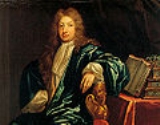
John Dryden (9 August 1631 – 12 May 1700) was an influential English poet, literary critic, translator, and playwright who dominated the literary life of
Restoration EnglandThe English Restoration, often shortened to the Restoration, began in 1660 when the English, Scottish and Irish monarchies were all restored under Charles II after the Commonwealth of England that followed the English Civil War...
to such a point that the period came to be known in literary circles as the Age of Dryden.
Early life
Dryden was born in the village
rectoryA rectory is the residence of a leader of a local Christian church. Many former rectories may still be referred to locally as a rectory once a church or religious organisation has vacated the property....
of
AldwincleAldwincle is a village in the east of the county of Northamptonshire, England. It is on a bend of the River Nene not far from Thrapston.In 1879, two ecclesiastical parishes, Aldwinkle All Saints and Aldwinkle St Peter merged after the parish church of the former was declared redundant in 1971 and...
near
ThrapstonThrapston is a small town in Northamptonshire, England. It is the headquarters of the East Northamptonshire district, and in 2001 had a population of 4,855. By 2006, this was estimated to be over 5,700....
in
NorthamptonshireNorthamptonshire is a landlocked county in the English East Midlands, with a population of 629,676 as at the 2001 census...
, where his maternal grandfather was Rector of All Saints. He was the eldest of fourteen children born to Erasmus Dryden and wife Mary Pickering, paternal grandson of Sir Erasmus Dryden, 1st Baronet (1553-1632) and wife Frances Wilkes,
PuritanA Puritan of 16th and 17th-century England was an associate of any number of religious groups advocating for more "purity" of worship and doctrine, as well as personal and group piety. Puritans felt that the English Reformation had not gone far enough, and that the Church of England was tolerant...
landowning gentry who supported the Puritan cause and Parliament. He was also a second cousin once removed of
Jonathan SwiftJonathan Swift was an Anglo-Irish satirist, essayist, political pamphleteer , poet and cleric who became Dean of St...
. As a boy Dryden lived in the nearby village of
Titchmarsh, NorthamptonshireTitchmarsh is a village forming part of the district of East Northamptonshire in the English county of Northamptonshire.It is a very popular but small village which has two pubs, and but, until recently, no shop. A shop was officially opened on 21 September 2007 by none other than Alan Titchmarsh...
where it is also likely that he received his first education. In 1644 he was sent to
Westminster SchoolThe Royal College of St. Peter in Westminster, almost always known as Westminster School, is one of Britain's leading independent schools,, with the highest Oxbridge acceptance rate of any secondary school or college...
as a King’s Scholar where his headmaster was Dr
Richard BusbyThe Rev. Dr. Richard Busby was an English clergyman, and headmaster of Westminster School.He was born at Lutton in Lincolnshire, and educated at Westminster, where he first showed his academic promise by gaining a King's Scholarship. From Westminster Busby duly proceeded to Christ Church, Oxford,...
, a charismatic teacher and severe disciplinarian. Recently enough re-founded by Elizabeth I, Westminster during this period embraced a very different religious and political spirit encouraging royalism and
high AnglicanismThe term "High Church" refers to understandings of ecclesiology, liturgy and theology. Although used in connection with various Christian traditions, the term has traditionally been principally associated with the Anglican tradition....
. Whatever Dryden’s response to this was, he clearly respected the Headmaster and would later send two of his own sons to school at Westminster. Many years after his death a house at Westminster was founded in his name.
As a humanist grammar school, Westminster maintained a curriculum which trained pupils in the art of rhetoric and the presentation of arguments for both sides of a given issue. This is a skill which would remain with Dryden and influence his later writing and thinking, as much of it displays these dialectical patterns. The Westminster curriculum also included weekly translation assignments which developed Dryden’s capacity for assimilation. This was also to be exhibited in his later works. His years at Westminster were not uneventful, and his first published poem, an elegy with a strong royalist feel on the death of his schoolmate Henry, Lord Hastings from
smallpoxSmallpox is an infectious disease unique to humans, caused by either of two virus variants, Variola major and Variola minor. The disease is also known by the Latin names Variola or Variola vera, which is a derivative of the Latin varius, meaning spotted, or varus, meaning "pimple"...
, alludes to the execution of King Charles I, which took place on 30 January 1649.
In 1650 Dryden went up to
Trinity College, CambridgeTrinity College is a constituent college of the University of Cambridge. Trinity has more members than any other college in Cambridge or Oxford, with around 700 undergraduates, 430 graduates, and over 160 Fellows ....
. At Trinity he would have experienced a return to the religious and political ethos of his childhood: the Master of Trinity was a Puritan preacher by the name of
Thomas Hill-Life:Thomas Hill was born at Kington, Herefordshire. He took a B.A. in 1622 at Emmanuel College, Cambridge, an M.A. in 1626, a B.D. in 1633 and a D.D. in 1646....
who had been a rector in Dryden’s home village. Though there is little specific information on Dryden’s undergraduate years, he would have followed the standard curriculum of classics, rhetoric, and mathematics. In 1654 he obtained his BA, graduating top of the list for Trinity that year. In June of the same year Dryden’s father died, leaving him some land which generated a little income, but not enough to live on.
Arriving in London during
The ProtectorateIn British history, the Protectorate was the period 1653–1659 during which the Commonwealth of England was governed by a Lord Protector.-Background:...
, Dryden procured work with Cromwell’s Secretary of State,
John ThurloeJohn Thurloe was a secretary to the council of state in Protectorate England and spymaster for Oliver Cromwell.-Life:...
. This appointment may have been the result of influence exercised on his behalf by the Lord Chamberlain Sir
Gilbert PickeringSir Gilbert Pickering, 1st Baronet was a regicide, a member of the English Council of State during the Protectorate of Oliver Cromwell, and a member of Cromwell's Upper House.-Biography:...
, Dryden’s cousin. Dryden was present on 23 November 1658 at Cromwell’s funeral where he processed with the Puritan poets
John MiltonJohn Milton was an English poet, author, polemicist and civil servant for the Commonwealth of England. He is best known for his epic poem Paradise Lost and for his treatise condemning censorship, Areopagitica....
and
Andrew MarvellAndrew Marvell was an English metaphysical poet, Parliamentarian, and the son of a Church of England clergyman . As a metaphysical poet, he is associated with John Donne and George Herbert...
. Shortly thereafter he published his first important poem,
Heroique Stanzas (1658), a eulogy on Cromwell’s death which is cautious and prudent in its emotional display. In 1660 Dryden celebrated the
RestorationThe English Restoration, often shortened to the Restoration, began in 1660 when the English, Scottish and Irish monarchies were all restored under Charles II after the Commonwealth of England that followed the English Civil War...
of the monarchy and the return of
Charles IICharles II was the King of England, Scotland, and Ireland.Charles II's father King Charles I was executed at Whitehall on 30 January 1649, at the climax of the English Civil War. The English Parliament did not proclaim Charles II king at this time. Instead they passed a statute making such a...
with
Astraea ReduxAstraea Redux, written by John Dryden in 1660, is a full-blown royalist panegyric in which Dryden welcomes the new regime of King Charles II. It is a vivid emotional display that overshadows the cautious Heroique Stanzas that Dryden composed for Oliver Cromwell’s death...
, an authentic royalist
panegyricA panegyric is a formal public speech, or written verse, delivered in high praise of a person or thing, a generally highly studied and discriminating eulogy, not expected to be critical. It is derived from the Greek πανηγυρικός meaning "a speech fit for a general assembly"...
. In this work the interregnum is illustrated as a time of anarchy, and Charles is seen as the restorer of peace and order.
Later life and career
After the Restoration, Dryden quickly established himself as the leading poet and literary critic of his day and he transferred his allegiances to the new government. Along with
Astraea Redux, Dryden welcomed the new regime with two more panegyrics;
To His Sacred Majesty: A Panegyric on his Coronation (1662), and
To My Lord Chancellor (1662). These poems suggest that Dryden was looking to court a possible patron, but he was to instead make a living in writing for publishers, not for the aristocracy, and thus ultimately for the reading public. These, and his other nondramatic poems, are occasional— that is, they celebrate public events. Thus they are written for the nation rather than the self, and the
Poet LaureateA Poet Laureate is a poet officially appointed by a government and is often expected to compose poems for State occasions and other government events....
(as he would later become) is obliged to write a certain number of these per annum. In November 1662 Dryden was proposed for membership in the
Royal SocietyThe Royal Society of London for the Improvement of Natural Knowledge, known simply as the Royal Society, or even the Royal, is a learned society for science that was founded in 1660 and is considered by most to be the oldest such society still in existence...
, and he was elected an early fellow. However, Dryden was inactive in Society affairs and in 1666 was expelled for non-payment of his dues.
On 1 December 1663 Dryden married the royalist sister of Sir
Robert HowardSir Robert Howard was an English playwright and politician, born to Thomas Howard, 1st Earl of Berkshire and his wife Elizabeth.-Life:...
—Lady Elizabeth. Dryden’s works occasionally contain outbursts against the married state but also celebrations of the same. Thus, little is known of the intimate side of his marriage. Lady Elizabeth however, was to bear him three sons and outlive him.
With the reopening of the theatres after the Puritan ban, Dryden busied himself with the composition of plays. His first play,
The Wild GallantThe Wild Gallant is a Restoration comedy written by John Dryden. It was Dryden's earliest play, and written in prose, not verse; it was premiered on the stage by the King's Company at their Vere Street theatre, formerly Gibbon's Tennis Court, on February 5, 1663...
appeared in 1663 and was not successful, but he was to have more success, and from 1668 on he was contracted to produce three plays a year for the
King's CompanyThe King's Company was one of two enterprises granted the rights to mount theatrical productions in London at the start of the English Restoration. It existed from 1660 to 1682.-History:...
in which he was also to become a shareholder. During the 1660s and 70s theatrical writing was to be his main source of income. He led the way in
Restoration comedyRestoration comedy refers to English comedies written and performed in the Restoration period from 1660 to 1710. After public stage performances had been banned for 18 years by the Puritan regime, the re-opening of the theatres in 1660 signalled a renaissance of English drama...
, his best known work being
Marriage A-la-ModeMarriage a la Mode is a Restoration comedy by John Dryden, first performed in London in 1673 by the King's Company. It is written in a combination of prose, blank verse and heroic couplets...
(1672), as well as heroic tragedy and regular tragedy, in which his greatest success was
All for Love (1678). Dryden was never satisfied with his theatrical writings and frequently suggested that his talents were wasted on unworthy audiences. He thus was making a bid for poetic fame off-stage. In 1667, around the same time his dramatic career began, he published
Annus Mirabilisthumb|right|200px| The Great Fire of London, which took place on September 2, 1666, was one of the major events that affected [[England]] during Dryden's "year of miracles"....
, a lengthy historical poem which described the events of 1666; the English defeat of the Dutch naval fleet and the Great Fire of London. It was a modern epic in pentameter quatrains that established him as the preeminent poet of his generation, and was crucial in his attaining the posts of
Poet LaureateA Poet Laureate is a poet officially appointed by a government and is often expected to compose poems for State occasions and other government events....
(1668) and historiographer royal (1670).
When the
Great Plague of LondonThe Great Plague was a massive outbreak of disease in England that killed an estimated 100,000 people, 20% of London's population. The disease is identified as bubonic plague, an infection by the bacterium Yersinia pestis, transmitted through a flea vector...
closed the theatres in 1665 Dryden retreated to Wiltshire where he wrote
Of Dramatick Poesie (1668), arguably the best of his unsystematic prefaces and essays. Dryden constantly defended his own literary practice, and
Of Dramatick Poesie, the longest of his critical works, takes the form of a dialogue in which four characters–each based on a prominent contemporary, with Dryden himself as ‘Neander’- debate the merits of classical, French and English drama. The greater part of his critical works introduce problems which he is eager to discuss, and show the work of a writer of independent mind who feels strongly about his own ideas, ideas which demonstrate the incredible breadth of his reading. He felt strongly about the relation of the poet to tradition and the creative process, and his best heroic play
Aureng-zebeAureng-zebe is a Restoration drama by John Dryden, 1675 based loosely on the figures of Aurangzeb , the then-reigning Mughal Emperor of India; his brother, Murad Baksh ; and their father Shah Jahan . The piece was Dryden's last drama to be written in rhymed verse...
(1675) has a prologue which denounces the use of rhyme in serious drama. His play
All for Love (1678) was written in blank verse, and was to immediately follow
Aureng-Zebe.
Dryden’s greatest achievements were in satiric verse: the mock-heroic
MacFlecknoeMac Flecknoe is a verse mock-heroic satire written by John Dryden. Written after the English Restoration, when King Charles II came to power, Mac Flecknoe is full of satire and criticism...
, a more personal product of his Laureate years, was a lampoon circulated in manuscript and an attack on the playwright
Thomas ShadwellThomas Shadwell was an English poet and playwright who was appointed poet laureate in 1689.-Life:Shadwell was born at Stanton Hall, Norfolk, and educated at Bury St Edmunds School, and at Gonville and Caius College, Cambridge, which he entered in 1656. He left the university without a degree, and...
. Dryden's main goal in the work is to "satirize Shadwell, ostensibly for his offenses against literature but more immediately we may suppose for his habitual badgering of him on the stage and in print." It is not a belittling form of satire, but rather one which makes his object great in ways which are unexpected, transferring the ridiculous into poetry. This line of satire continued with
Absalom and AchitophelAbsalom and Achitophel is a landmark poetic political satire by John Dryden. The poem exists in two parts. The first part, of 1681, is undoubtedly by Dryden...
(1681) and
The Medal (1682). His other major works from this period are the religious poems
Religio Laici (1682), written from the position of a member of the Church of England; his 1683 edition of
Plutarch's Lives Translated From the Greek by Several Hands in which he introduced the word
biographyA biography is a description or account of someone's life and the times, which is usually published in the form of a book or essay, or in some other form, such as a film. An autobiography is a biography of a person's life written or told by that same person...
to English readers; and
The Hind and the Panther, (1687) which celebrates his conversion to Roman Catholicism.
When in 1688 James was deposed, Dryden’s refusal to take the oaths of allegiance to the new government left him out of favour at court. Thomas Shadwell succeeded him as Poet Laureate, and he was forced to give up his public offices and live by the proceeds of his pen. Dryden translated works by
HoraceThis article is about the Roman poet Horace. For other uses, see Horace .Quintus Horatius Flaccus, , known in the English-speaking world as Horace, was the leading Roman lyric poet during the time of Augustus.-Life:Born in the small town of Venusia in the border region between Apulia and Lucania...
, Juvenal,
OvidPublius Ovidius Naso , known as Ovid in the English-speaking world, was a Roman poet who wrote about love, seduction, and mythological transformation....
,
LucretiusTitus Lucretius Carus was a Roman poet and philosopher. His only known work is the epic philosophical poem on Epicureanism De rerum natura, translated into English as On the Nature of Things or "On the Nature of the Universe"....
, and
TheocritusTheocritus , the creator of ancient Greek bucolic poetry, flourished in the 3rd century BC.-Life:Little is known of him beyond what can be inferred from his writings. We must, however, handle these with some caution, since some of the poems commonly attributed to him have little claim to...
, a task which he found far more satisfying than writing for the stage. In 1694 he began work on what would be his most ambitious and defining work as translator,
The Works of Virgil (1697), which was published by subscription. The publication of the translation of
VirgilPublius Vergilius Maro was a classical Roman poet, best known for three major works—the Eclogues , the Georgics, and the Aeneid—although several minor poems are also attributed to him.The son of a farmer, Virgil came to be...
was a national event and brought Dryden the sum of ₤1,400. His final translations appeared in the volume
Fables Ancient and Modern (1700), a series of episodes from
HomerHomer is a legendary ancient Greek epic poet, traditionally said to be the author of the epic poems the Iliad and the Odyssey...
,
OvidPublius Ovidius Naso , known as Ovid in the English-speaking world, was a Roman poet who wrote about love, seduction, and mythological transformation....
, and
BoccaccioGiovanni Boccaccio was an Italian author and poet, a friend, student, and correspondent of Petrarch, an important Renaissance humanist and the author of a number of notable works including the Decameron, On Famous Women, and his poetry in the Italian vernacular...
, as well as modernized adaptations from
Geoffrey ChaucerGeoffrey Chaucer was an English author, poet, philosopher, bureaucrat, courtier and diplomat. Although he wrote many works, he is best remembered for his unfinished frame narrative The Canterbury Tales...
interspersed with Dryden’s own poems. The
Preface to
Fables is considered to be both a major work of criticism and one of the finest essays in English. As a critic and translator he was essential in making accessible to the reading English public literary works in the classical languages.
Dryden died in 1700 and is buried in
Westminster AbbeyThe Collegiate Church of St Peter at Westminster, which is almost always referred to popularly and informally as Westminster Abbey, is a large, mainly Gothic church, in Westminster, London, just to the west of the Palace of Westminster...
. He was the subject of various poetic eulogies, such as
Luctus Brittannici: or the Tears of the British Muses; for the Death of John Dryden, Esq. (London, 1700), and
The Nine MusesThe Nine Muses, Or, Poems Written by Nine severall Ladies Upon the death of the late Famous John Dryden, Esq. was an elegiac volume of poetry published pseudonymously. The contributors were English women writers, each of whom signed their poems with the names of Muses...
.
Reputation and influence
Dryden was the dominant literary figure and influence of his age. He established the
heroic coupletA heroic couplet is a traditional form for English poetry, commonly used for epic and narrative poetry; it refers to poems constructed from a sequence of rhyming pairs of iambic pentameter lines. The rhyme is always masculine. Use of the heroic couplet was first pioneered by Geoffrey Chaucer in...
as the standard meter of English poetry, by writing successful satires, religious pieces, fables, epigrams, compliments, prologues, and plays in it; he also introduced the
alexandrineAn alexandrine is a line of poetic meter comprising 12 syllables. Alexandrines are common in the German literature of the Baroque period and in French poetry of the early modern and modern periods. Drama in English often used alexandrines before Marlowe and Shakespeare, by whom it was supplanted...
and triplet into the form. In his poems, translations, and criticism, he established a poetic diction appropriate to the heroic couplet—
AudenWystan Hugh Auden who signed his works W. H. Auden, was an Anglo-American poet,The first definition of "Anglo-American" in the OED is: "Of, belonging to, or involving both England and America." See also the definition "English in origin or birth, American by settlement or...
referred to him as "the master of the middle style"—that was a model for his contemporaries and for much of the 18th century. The considerable loss felt by the English literary community at his death was evident from the elegies which it inspired. Dryden's heroic couplet became the dominant poetic form of the 18th century. The most influential poet of the 18th century,
Alexander PopeAlexander Pope is a famous eighteenth century English poet, best known for his satirical verse and for his translation of Homer. He is the third most frequently quoted writer in The Oxford Dictionary of Quotations, after Shakespeare and Tennyson. Pope is famous for his use of the heroic couplet.-...
, was heavily influenced by Dryden, and often borrowed from him; other writers were equally influenced by Dryden and Pope. Pope famously praised Dryden's versification in his imitation of
HoraceThis article is about the Roman poet Horace. For other uses, see Horace .Quintus Horatius Flaccus, , known in the English-speaking world as Horace, was the leading Roman lyric poet during the time of Augustus.-Life:Born in the small town of Venusia in the border region between Apulia and Lucania...
's Epistle II.i: "Dryden taught to join / The varying pause, the full resounding line, / The long majestic march, and energy divine." Samuel Johnson summed up the general attitude with his remark that "the veneration with which his name is pronounced by every cultivator of English literature, is paid to him as he refined the language, improved the sentiments, and tuned the numbers of English poetry." His poems were very widely read, and are often quoted, for instance, in
Tom JonesThe History of Tom Jones, a Foundling, often known simply as Tom Jones, is a comic novel by the English playwright and novelist Henry Fielding. First published on 28 February 1749, Tom Jones is among the earliest English prose works describable as a novel...
and Johnson's essays.
Johnson also noted, however, that "He is, therefore, with all his variety of excellence, not often pathetic; and had so little sensibility of the power of effusions purely natural, that he did not esteem them in others. Simplicity gave him no pleasure." The 18th century did not mind this too much, but in later ages, this was increasingly considered a fault.
One of the first attacks on Dryden's reputation was by Wordsworth, who complained that Dryden's descriptions of natural objects in his translations from Virgil were much inferior to the originals. However, several of Wordsworth’s contemporaries, such as
George CrabbeGeorge Crabbe was an English poet and naturalist.-Biography:He was born in Aldeburgh, Suffolk, the son of a tax collector, and developed his love of poetry as a child. In 1768, he was apprenticed to a local doctor, who taught him little, and in 1771 he changed masters and moved to Woodbridge...
, Lord Byron, and
Walter ScottSir Walter Scott, 1st Baronet was a prolific Scottish historical novelist and poet, popular throughout Europe during his time....
(who edited Dryden's works), were still keen admirers of Dryden. Besides, Wordsworth did admire many of Dryden's poems, and his famous "Intimations of Immortality" ode owes something stylistically to Dryden's "
Alexander's FeastAlexander's Feast, or Alexander's Feast, or the Power of Music is an ode by John Dryden. It was written to celebrate Saint Cecilia's Day. Jeremiah Clarke set the original ode to music, however the score is now lost....
".
John KeatsJohn Keats was an English poet, who became one of the key figures of the Romantic movement. Along with Lord Byron and Percy Bysshe Shelley, Keats was one of the second generation Romantic poets...
admired the "Fables," and imitated them in his poem
Lamia. Later 19th century writers had little use for verse satire, Pope, or Dryden; Matthew Arnold famously dismissed them as "classics of our prose." He did have a committed admirer in
George SaintsburyGeorge Edward Bateman Saintsbury , was an English writer and critic.-Biography:Born in Southampton, he was educated at King's College School, London, and at Merton College, Oxford , and spent six years in Guernsey as senior classical master of Elizabeth College. From 1874 to 1876 he was headmaster...
, and was a prominent figure in quotation books such as Bartlett's, but the next major poet to take an interest in Dryden was
T. S. EliotThomas Stearns Eliot, OM , was a poet, playwright, and literary critic. He received the Nobel Prize in Literature in 1948. Among his most famous writings are The Love Song of J...
, who wrote that he was 'the ancestor of nearly all that is best in the poetry of the eighteenth century', and that 'we cannot fully enjoy or rightly estimate a hundred years of English poetry unless we fully enjoy Dryden.' However, in the same essay, Eliot accused Dryden of having a "commonplace mind." Critical interest in Dryden has increased recently, but, as a relatively straightforward writer (
William EmpsonSir William Empson was an English literary critic and poet.He is sometimes praised as the greatest English literary critic after Samuel Johnson and William Hazlitt, and widely influential for his practice of closely reading literary works, fundamental to the New Critics...
, another modern admirer of Dryden, compared his "flat" use of language with Donne's interest in the "echoes and recesses of words") his work has not occasioned as much interest as
Andrew MarvellAndrew Marvell was an English metaphysical poet, Parliamentarian, and the son of a Church of England clergyman . As a metaphysical poet, he is associated with John Donne and George Herbert...
's or
John DonneJohn Donne, "dun" was an English Jacobean poet, preacher and a major representative of the metaphysical poets of the period. His works are notable for their realistic and sensual style and include sonnets, love poetry, religious poems, Latin translations, epigrams, elegies, songs, satires and...
's or Pope's.
Dryden is also believed to be the first person to posit that English sentences should not end in prepositions because it was against the rules of Latin grammar.
Poetic style
What Dryden achieved in his poetry was not the emotional excitement we find in the Romantic poets of the early nineteenth century, nor the intellectual complexities of the
metaphysical poetsThe metaphysical poets were a loose group of British lyric poets of the 17th century, who shared an interest in metaphysical concerns and a common way of investigating them. The label "metaphysical" was given much later by Samuel Johnson in his Life of Cowley. These poets themselves did not form a...
. His subject-matter was often factual, and he aimed at expressing his thoughts in the most precise and concentrated way possible. Although he uses formal poetic structures such as heroic stanzas and heroic couplets, he tried to achieve the rhythms of speech. However, he knew that different subjects need different kinds of verse, and in his preface to
Religio Laici he wrote: “...the expressions of a poem designed purely for instruction ought to be plain and natural, yet majestic...The florid, elevated and figurative way is for the passions; for (these) are begotten in the soul by showing the objects out of their true proportion....A man is to be cheated into passion, but to be reasoned into truth.”
Selected works
- Astraea Redux
Astraea Redux, written by John Dryden in 1660, is a full-blown royalist panegyric in which Dryden welcomes the new regime of King Charles II. It is a vivid emotional display that overshadows the cautious Heroique Stanzas that Dryden composed for Oliver Cromwell’s death...
, 1660
- The Wild Gallant
The Wild Gallant is a Restoration comedy written by John Dryden. It was Dryden's earliest play, and written in prose, not verse; it was premiered on the stage by the King's Company at their Vere Street theatre, formerly Gibbon's Tennis Court, on February 5, 1663...
(comedy), 1663
- The Indian Emperour
The Indian Emperour, or the Conquest of Mexico by the Spaniards, being the Sequel of The Indian Queen is an English Restoration era stage play, a heroic drama written by John Dryden that was first performed in the Spring of 1665...
(tragedy), 1665
- Annus Mirabilis
thumb|right|200px| The Great Fire of London, which took place on September 2, 1666, was one of the major events that affected [[England]] during Dryden's "year of miracles"....
(poem), 1667
- The Enchanted Island
The Tempest, or The Enchanted Island is a comedy adapted by John Dryden and William D'Avenant from Shakespeare's comedy The Tempest. The musical setting was by John Weldon, though spuriously attributed to Henry Purcell....
(comedy), 1667, an adaptation with William D'Avenant of Shakespeare'sWilliam Shakespeare was an English poet and playwright, widely regarded as the greatest writer in the English language and the world's preeminent dramatist. He is often called England's national poet and the "Bard of Avon"...
The Tempest
- Secret Love, or The Maiden Queen
Secret Love, or The Maiden Queen is a 1667 tragicomedy written by John Dryden. The play, commonly known by its more distinctive subtitle, was acted by the King's Company at the Theatre Royal, Drury Lane . The premiere occurred on 2 March, and was a popular success...
, 1667
- An Essay of Dramatick Poesie
Essay of Dramatick Poesie by John Dryden was published in 1668. It was probably written during the plague year of 1666. Dryden takes up the subject that Philip Sidney had set forth in his Defence of Poesie and attempts to justify drama as a legitimate art form.The treatise is a dialogue between...
, 1668
- An Evening's Love
An Evening's Love, or The Mock Astrologer is a comedy in prose by John Dryden. It was first performed before Charles II and Queen Catherine by the King's Company at the Theatre Royal on Bridges Street, London, on Friday, 12 June 1668...
(comedy), 1668
- Tyrannick Love
Tyrannick Love, or The Royal Martyr is a tragedy by John Dryden in rhymed couplets, first acted in June 1669, and published in 1670. It is a retelling of the story of Saint Catherine of Alexandria and her martyrdom by the Roman Emperor Maximinus, the "tyrant" of the title, who is enraged at...
(tragedy), 1669
- The Conquest of Granada
The Conquest of Granada is a Restoration era stage play, a two-part tragedy written by John Dryden that was first acted in 1670 and 1671 and published in 1672...
, 1670
- The Assignation, or Love in a Nunnery
The Assignation, or Love in a Nunnery in a Restoration comedy written by John Dryden. The play was first acted late in 1672, by the King's Company at their theatre at Lincoln's Inn Fields, but was not a success with its audience....
, 1672
- Marriage à la mode, 1672
- Amboyna
Amboyna, or the Cruelties of the Dutch to the English Merchants is a tragedy by John Dryden written in 1673. Its subject is the Amboyna massacre that took place on Ambon Island in 1623....
, or the Cruelties of the Dutch to the English Merchants, 1673
- The Mistaken Husband
The Mistaken Husband is a Restoration comedy in the canon of John Dryden's dramatic works, where it has constituted a long-standing authorship problem.-Performance and publication:...
(comedy), 1674
- Aureng-zebe
Aureng-zebe is a Restoration drama by John Dryden, 1675 based loosely on the figures of Aurangzeb , the then-reigning Mughal Emperor of India; his brother, Murad Baksh ; and their father Shah Jahan . The piece was Dryden's last drama to be written in rhymed verse...
, 1675
- All for Love, 1678
- Oedipus (heroic drama), 1679, an adaptation with Nathaniel Lee
Nathaniel Lee , was an English dramatist.He was the son of Dr Richard Lee, a Presbyterian clergyman who was rector of Hatfield and held many preferments under the Commonwealth...
of SophoclesSophocles was the second of the three ancient Greek tragedians whose work has survived. His first plays were written later than those of Aeschylus and earlier than those of Euripides...
' OedipusOedipus was a mythical Greek king of Thebes. He fulfilled a prophecy that said he would kill his father and marry his mother, and thus brought disaster on his city and family...
- Absalom and Achitophel
Absalom and Achitophel is a landmark poetic political satire by John Dryden. The poem exists in two parts. The first part, of 1681, is undoubtedly by Dryden...
, 1681
- The Spanish Fryar, 1681
- MacFlecknoe
Mac Flecknoe is a verse mock-heroic satire written by John Dryden. Written after the English Restoration, when King Charles II came to power, Mac Flecknoe is full of satire and criticism...
, 1682
- The Medal, 1682
- Religio Laici, 1682
- The Hind and the Panther, 1687
- A Song For St.Cecilia, 1687
- Amphitryon
Amphitryon is a Latin play for the early Roman theatre by playwright Titus Maccius Plautus. Plautus’ only play on a mythological subject, he refers to it as a tragicomoedia during the prologue...
, 1690
- Don Sebastian, 1690
- Creator Spirit, by whose aid, 1690. Translation of Rabanus Maurus
Rabanus Maurus Magnentius , also known as Hrabanus or Rhabanus, was a Frankish Benedictine monk, the archbishop of Mainz in Germany and a theologian. He was the author of the encyclopaedia De rerum naturis . He also wrote treatises on education and grammar and commentaries on the Bible...
' Veni Creator SpiritusVeni Creator Spiritus is a hymn normally sung in Gregorian Chant. It is believed to have been written by Rabanus Maurus in the 9th century. The hymn is normally associated with the Roman Catholic Church, where it is performed during the liturgical celebration of the feast of Pentecost...
- King Arthur
King Arthur or, The British Worthy , is a semi-opera in five acts with music by Henry Purcell and alibretto by John Dryden. It was first performed at the Queen's Theatre, Dorset Garden, London, in late May or early June 1691....
, 1691
- The Works of Virgil
Publius Vergilius Maro was a classical Roman poet, best known for three major works—the Eclogues , the Georgics, and the Aeneid—although several minor poems are also attributed to him.The son of a farmer, Virgil came to be...
, 1697
- Fables, Ancient and Modern
Fables, Ancient and Modern was a collection of translations of classical and medieval poetry by John Dryden interspersed with some of Dryden’s own works. Published in March, 1700, it was his last and also one of his greatest works...
, 1700
- The Art of Satire
Select bibliography
Editions
- The Works of John Dryden, 20 vols., ed. H. T. Swedenberg Jr. et al., (Berkeley and Los Angeles: University of California Press, 1956-2002)
- John Dryden The Major Works, ed. by Keith Walker, (Oxford: Oxford University Press, 1987)
- The Works of John Dryden, ed. by David Marriott, (Hertfordshire: Wordsworth Editions, 1995)
- John Dryden Selected Poems, ed by David Hopkins, (London: Everyman Paperbacks, 1998)
Biography
- Winn, James Anderson. John Dryden and His World, (New Haven: Yale University Press, 1987)
Modern criticism
- Eliot, T. S., ‘John Dryden’, in Selected Essays, (London: Faber and Faber, 1932)
- Hopkins, David, John Dryden, ed. by Isobel Armstrong, (Tavistock: Northcote House Publishers, 2004)
- Oden, Richard, L. Dryden and Shadwell, The Literary Controversy and 'Mac Flecknoe (1668-1679), (Scholars' Facsmilies and Reprints, Inc., Delmar, New York, 1977)
External links