

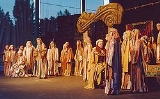
Nabucco

Encyclopedia
Nabucco is an opera
in four acts by Giuseppe Verdi
to an Italian libretto
by Temistocle Solera
, based on the Biblical story
and the 1836 play
by Auguste Anicet-Bourgeois
and Francis Cornue. It is Verdi’s third opera and the one which is considered to have permanently established his reputation as a composer.
Nabucco follows the plight of the Jews as they are assaulted, conquered, and subsequently exiled
from their homeland by the Babylon
ian King Nabucco (in English, Nebuchadnezzar). The historical events are used as background for a romantic and political plot.
Its first performance took place on 9 March 1842 at the Teatro alla Scala, Milan
under the original name of Nabucodonosor. The definitive name of Nabucco for the opera (and its protagonist) was first used at a performance at the San Giacomo Theatre
of Corfu
in September, 1844.
Nonetheless, a more plausible alternative for the establishment of this abbreviated form claims that it was the result of a revival of the opera in Teatro Giglio of Lucca
.
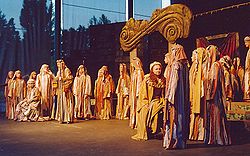 The best-known number from the opera is the "Chorus of the Hebrew Slaves," Va, pensiero, sull'ali dorate
/ "Fly, thought, on golden wings," a chorus which is regularly given an encore when performed today.
The soprano role of Abigaille has been perceived as the downfall of a number of singers. Elena Souliotis
and Anita Cerquetti
sang it before they were ready and its high tessitura
arguably damaged their voices. Certainly, their careers were not long ones. Maria Callas
sang it only three times; only a live performance from 1949 was recorded. [It is interesting to hear that in this recording 'Va pensiero' was interrupted by much shouting but the chorus carried on. When it was repeated the audience was silent and then at the end they showed enthusiastic applause. ] Leontyne Price
and Dame Joan Sutherland
refused to sing it. Marisa Galvany
, Ghena Dimitrova
, Dunja Vejzovic
, Hilda Holzl, and Jadranka Jovanovic
were recent exponents of the role.
Although not as frequently performed as some of Verdi's other operas, Nabucco is still heard around the world today. It has been on the Metropolitan Opera
's roster since it was first presented there during the 1960/61 season. It is the only early Verdi opera, apart from Ernani
and Luisa Miller
, which has received regular performances at the Met in recent times, having been presented in 2001, 2003, 2004, and 2005.
Nabucco is also regularly performed at the Arena di Verona, where it was presented in 2002, 2003, 2005, 2007, 2008 and 2011. Amongst the performances preserved on DVD are those at the Arena di Verona (1981 and 2007); La Scala
(1987), Opera Australia
(1996), Vienna State Opera
(2001), Metropolitan Opera (2002), Genoa
's Teatro Carlo Felice
(2004), Teatro Municipale di Piacenza
(2004), and Austria's St. Margarethen Opera Festival (2007).
Many other companies have also performed it, including San Francisco Opera
in 1982, Sarasota Opera
in 1995, London's Royal Opera House
in 1996, the New National Theatre Tokyo in 1998, Teatro Colón in 2000, Baltimore Opera in 2006, and the Teatro Regio di Parma
in 2008 as part of their on-going "Festival Verdi".
Nabucco was presented by the Michigan Opera Theatre
and the San Diego Opera
as part of their 2009-2010 seasons. The Israeli Opera is celebrated its 25th anniversary in 2010 with Nabucco at Masada
. The opera has been performed at the Bolshoi Theatre
each year since 2006.
The Washington National Opera
will perform Nabucco in the spring of 2012.
The opera was an instant success, dominating Donizetti's and Giovanni Pacini
's operas playing nearby. While the public went mad with enthusiasm, the critics tempered their approval of the opera.
One critic who found Nabucco revolting was Otto Nicolai, the composer to whom the libretto was first offered. A Prussian-bred man, Nicolai felt at odds with emotional Italian opera while he lived near Milan. After refusing to accept the libretto proposal from Merelli, Nicolai began work on another offer called Il Proscritto. Its disastrous premiere in March 1841 forced Nicolai to cancel his contract with Merelli and return to Vienna
. From there he learned of the success of Nabucco and was enraged. "Verdi's operas are really horrible," he wrote. "He scores like a fool — technically he is not even professional — and he must have the heart of a donkey and in my view he is a pitiful, despicable composer ..." Additionally, he described Nabucco as nothing but "rage, invective, bloodshed and murder."
Nicolai's opinions were in the minority, however, and he has today become comparatively obscure. Nabucco secured Verdi's success until his retirement from the theatre, twenty-nine operas (including some revised and updated versions) later.
Music historians have long perpetuated a powerful myth about the famous Va, pensiero
chorus sung in the third act by the Hebrew slaves. Scholars have long believed the audience, responding with nationalistic fervor to the slaves' powerful hymn of longing for their homeland, demanded an encore
of the piece. As encores were expressly forbidden by the government at the time, such a gesture would have been extremely significant. However, recent scholarship puts this and the corresponding myth of Va, pensiero
as the national anthem of the Risorgimento to rest. Although the audience did indeed demand an encore, it was not for "Va, pensiero" but rather for the hymn "Immenso Jehova," sung by the Hebrew slaves to thank God for saving His people. In light of these new revelations, Verdi's position as the musical figurehead of the Risorgimento has been correspondingly downplayed. At Verdi's funeral, the crowds in the streets spontaneously broke into "Va, pensiero".
Interior of the Temple of Jerusalem
The Jews are being defeated and Nabucco (Nebuchadnezzar) is poised to enter Jerusalem. The High Priest Zaccaria tells the people not to despair but to trust in God: D'Egitto là su i lidi / "On the shores of Egypt He saved the life of Moses". The presence of a hostage, Fenena, younger daughter of Nabucco, may yet secure peace (Aria: Come notte a sol fulgente / "Like darkness before the sun, like dust before the wind"). Zaccaria entrusts Fenena's safety to Ismaele, nephew of the King of Jerusalem and a former envoy to Babylon. Although Fenena and Ismaele love each other, when they are left alone, Ismaele urges her to escape rather than risk her life. Nabucco's elder daughter, Abigaille, storms into the temple with soldiers in disguise. She, too, loves Ismaele. Discovering the lovers, she threatens Ismaele: if he does not give up Fenena, Abigaille will accuse her of treason. The King himself enters (Viva Nabucco / "Long live Nabucco"). Zaccaria defies him, threatening to kill Fenena with a dagger. Ismaele intervenes to save her. Nabucco responds by ordering the destruction of the temple, and the Jews curse Ismaele as a traitor.
Scene 1: The Palace in Babylon
Nabucco is away at the wars and has appointed Fenena as regent. Abigaille has discovered a document that proves she is not Nabucco's real daughter, but a slave (Aria: Anch'io dischiuso un giorno / "I too once opened my heart to happiness"). The High Priest of Baal, accompanied by the Magi, comes to tell Abigaille that Fenena has released the Jewish captives. Their response is to launch a coup to put Abigaille on the throne, while spreading a rumour that Nabucco has died in battle, and they leave Abigaille to sing the cabaletta
: Salgo già del trono aurato / "I am ready to ascend the bloodstained seat of the golden throne").
Scene 2: A hall in the Palace in Babylon
Accompanied by a cello sextet, Zacharia awaits Fenena (Vieni, o Levita / "Bring the tables of the law"). She converts to the Jewish religion, and Ismaele is reconciled to the Jews. However, it is announced that the King is dead and Abigaille and the High Priest of Baal demand the crown from Fenena. Unexpectedly, Nabucco himself enters, scorning both sides, both Baal and the Hebrew god that he has defeated. He declares himself God. When Zaccaria objects, Nabucco orders the Jews to be put to death. Fenena says that she will share their fate. Repeating that he is now god: Non son piu re, son dio / "I am no King! I am God!"), Nabucco is promptly hit by a thunderbolt and loses his senses. The crown falls and is picked up by Abigaille.
Scene 1: The Hanging Gardens of Babylon
The High Priest of Baal presents Abigaille with the death decree for the Jews and Fenena. Nabucco enters looking like a mad man, claiming his throne. Abigaille persuades him to seal the decree, but he asks that Fenena be saved. He tells Abigaille that she is not his true daughter but a slave. Abigaille mocks him, destroying the document with the evidence of her true origins. Understanding that he is now a prisoner, he pleads for Fenena's life. (Duet: Oh di qual onta aggravasi questo mio crin canuto / "Oh what affront I must suffer in my old age"). Abigaille exults.
Scene 2: Banks of the River Euphrates
The Jews long for their homeland: Va pensiero, sull'ali dorate
/ "Fly thought on golden wings; Fly and settle on the slopes and hills"). Zaccaria once again exhorts them to have faith: God will destroy Babylon.
Scene 1: The Palace in Babylon
Nabucco awakens, his strength and his reason fully regained. He sees Fenena in chains being taken to her death. Asking forgiveness of the God of the Jews, he promises to rebuild the temple in Jerusalem, and follow the true faith (Dio di Giuda / "God of Judah! The altar, your sacred Temple, shall rise again"). Joined by loyal soldiers, he resolves to punish the traitors and rescue Fenena.
Scene 2: The Hanging Gardens of Babylon
As Zaccaria leads Fenena and the Jews towards death (Va! La palma del martirio......dischius'è il firmamento / "Go, maid, go and conquer the palm of martyrdom"...."Oh, heaven has opened up! My soul yearns for the Lord") on the sacrificial altar of Baal, Nabucco rushes in, sword in hand. At his word the Idol of Baal shatters into pieces. Nabucco tells the Jews they are free and a new Temple will be raised to their God. Abigaille enters. She has poisoned herself. She expresses her remorse, asks the forgiveness of Fenena and dies. Zaccaria acclaims Nabucco as the servant of God and the King of Kings.
s (one doubling as piccolo
), two oboe
s (one doubling as English horn), two clarinet
s, two bassoon
s, four horn
s, two trumpet
s, three trombone
s (two tenor, one bass), one cimbasso
, timpani
, bass drum
, cymbal
s, side drum
, triangle
, two harp
s, strings
, and an onstage band.
Opera
Opera is an art form in which singers and musicians perform a dramatic work combining text and musical score, usually in a theatrical setting. Opera incorporates many of the elements of spoken theatre, such as acting, scenery, and costumes and sometimes includes dance...
in four acts by Giuseppe Verdi
Giuseppe Verdi
Giuseppe Fortunino Francesco Verdi was an Italian Romantic composer, mainly of opera. He was one of the most influential composers of the 19th century...
to an Italian libretto
Libretto
A libretto is the text used in an extended musical work such as an opera, operetta, masque, oratorio, cantata, or musical. The term "libretto" is also sometimes used to refer to the text of major liturgical works, such as mass, requiem, and sacred cantata, or even the story line of a...
by Temistocle Solera
Temistocle Solera
Temistocle Solera was an Italian opera composer and librettist.He was born at Ferrara. He received his education at the Imperial College in Vienna and at the University of Pavia. Throughout his life he actively participated in anti-Austrian resistance. At one point, he was incarcerated for his...
, based on the Biblical story
Book of Jeremiah
The Book of Jeremiah is the second of the Latter Prophets in the Hebrew Bible, following the book of Isaiah and preceding Ezekiel and the Book of the Twelve....
and the 1836 play
Play (theatre)
A play is a form of literature written by a playwright, usually consisting of scripted dialogue between characters, intended for theatrical performance rather than just reading. There are rare dramatists, notably George Bernard Shaw, who have had little preference whether their plays were performed...
by Auguste Anicet-Bourgeois
Auguste Anicet-Bourgeois
Auguste Anicet, later Auguste Anicet-Bourgeois was a French dramatist. He was born in Paris.The first play to bear his name is L'Ami et le mari, ou le Nouvel Amphitryon, a vaudeville in one act...
and Francis Cornue. It is Verdi’s third opera and the one which is considered to have permanently established his reputation as a composer.
Nabucco follows the plight of the Jews as they are assaulted, conquered, and subsequently exiled
Babylonian captivity
The Babylonian captivity was the period in Jewish history during which the Jews of the ancient Kingdom of Judah were captives in Babylon—conventionally 587–538 BCE....
from their homeland by the Babylon
Babylon
Babylon was an Akkadian city-state of ancient Mesopotamia, the remains of which are found in present-day Al Hillah, Babil Province, Iraq, about 85 kilometers south of Baghdad...
ian King Nabucco (in English, Nebuchadnezzar). The historical events are used as background for a romantic and political plot.
Its first performance took place on 9 March 1842 at the Teatro alla Scala, Milan
Milan
Milan is the second-largest city in Italy and the capital city of the region of Lombardy and of the province of Milan. The city proper has a population of about 1.3 million, while its urban area, roughly coinciding with its administrative province and the bordering Province of Monza and Brianza ,...
under the original name of Nabucodonosor. The definitive name of Nabucco for the opera (and its protagonist) was first used at a performance at the San Giacomo Theatre
Nobile Teatro di San Giacomo di Corfù
Nobile Teatro di San Giacomo di Corfù, translated as The Noble Theatre of Saint James of Corfu, or simply Teatro di San Giacomo, was a theatre in Corfu, Greece which became the centre of Greek opera between 1733 and 1893...
of Corfu
Corfu
Corfu is a Greek island in the Ionian Sea. It is the second largest of the Ionian Islands, and, including its small satellite islands, forms the edge of the northwestern frontier of Greece. The island is part of the Corfu regional unit, and is administered as a single municipality. The...
in September, 1844.
Nonetheless, a more plausible alternative for the establishment of this abbreviated form claims that it was the result of a revival of the opera in Teatro Giglio of Lucca
Lucca
Lucca is a city and comune in Tuscany, central Italy, situated on the river Serchio in a fertile plainnear the Tyrrhenian Sea. It is the capital city of the Province of Lucca...
.
Performance history
Va, pensiero
Va, pensiero is a chorus from the third act of Nabucco by Giuseppe Verdi, with words by Temistocle Solera, inspired by Psalm 137...
/ "Fly, thought, on golden wings," a chorus which is regularly given an encore when performed today.
The soprano role of Abigaille has been perceived as the downfall of a number of singers. Elena Souliotis
Elena Souliotis
Elena Souliotis was an operatic soprano."-Biography:Elena Souliotis was born in Athens, Greece of Greek and Russian parents but moved with her family to Argentina at an early age...
and Anita Cerquetti
Anita Cerquetti
Anita Cerquetti is an Italian dramatic soprano who had a short career in the 1950s.Cerquetti was born in Montecosaro, near Macerata, Italy. She was first a student of the violin, she trained eight years with Luigi Mori. After a mere one year of vocal study at the Conservatory of Perugia she made...
sang it before they were ready and its high tessitura
Tessitura
In music, the term tessitura generally describes the most musically acceptable and comfortable range for a given singer or, less frequently, musical instrument; the range in which a given type of voice presents its best-sounding texture or timbre...
arguably damaged their voices. Certainly, their careers were not long ones. Maria Callas
Maria Callas
Maria Callas was an American-born Greek soprano and one of the most renowned opera singers of the 20th century. She combined an impressive bel canto technique, a wide-ranging voice and great dramatic gifts...
sang it only three times; only a live performance from 1949 was recorded. [It is interesting to hear that in this recording 'Va pensiero' was interrupted by much shouting but the chorus carried on. When it was repeated the audience was silent and then at the end they showed enthusiastic applause. ] Leontyne Price
Leontyne Price
Mary Violet Leontyne Price is an American soprano. Born and raised in the Deep South, she rose to international acclaim in the 1950s and 1960s, and was one of the first African Americans to become a leading artist at the Metropolitan Opera.One critic characterized Price's voice as "vibrant",...
and Dame Joan Sutherland
Joan Sutherland
Dame Joan Alston Sutherland, OM, AC, DBE was an Australian dramatic coloratura soprano noted for her contribution to the renaissance of the bel canto repertoire from the late 1950s through to the 1980s....
refused to sing it. Marisa Galvany
Marisa Galvany
Marisa Galvany is an American soprano who had an active international career performing in operas and concerts up into the early 2000s. Known for the great intensity of her performances, Galvany particularly excelled in portraying Verdi heroines...
, Ghena Dimitrova
Ghena Dimitrova
Ghena Dimitrova was a Bulgarian operatic soprano. Her voice was known for its power and extension used in operatic roles such as Turandot in a career spanning four decades.-Early career:...
, Dunja Vejzovic
Dunja Vejzovic
Dunja Vejzovic , née Crnković, in Zagreb, Croatia, on October 20, 1943, is an acclaimed operatic soprano who began her career with the Zagreb National Theatre, where she made her "real" debut in 1970, as Ariel in Stjepan Šulek's Oluja...
, Hilda Holzl, and Jadranka Jovanovic
Jadranka Jovanović
Jadranka Jovanović is a primadonna of Opera in the National Theatre in Belgrade, Serbia. She was born in Belgrade, and she is one of the most popular artists in the classic music in her country with a respected international career.- Biography :...
were recent exponents of the role.
Although not as frequently performed as some of Verdi's other operas, Nabucco is still heard around the world today. It has been on the Metropolitan Opera
Metropolitan Opera
The Metropolitan Opera is an opera company, located in New York City. Originally founded in 1880, the company gave its first performance on October 22, 1883. The company is operated by the non-profit Metropolitan Opera Association, with Peter Gelb as general manager...
's roster since it was first presented there during the 1960/61 season. It is the only early Verdi opera, apart from Ernani
Ernani
Ernani is an operatic dramma lirico in four acts by Giuseppe Verdi to an Italian libretto by Francesco Maria Piave, based on the play Hernani by Victor Hugo. The first production took place at La Fenice Theatre, Venice on 9 March 1844...
and Luisa Miller
Luisa Miller
Luisa Miller is an opera in three acts by Giuseppe Verdi to an Italian libretto by Salvadore Cammarano, based on the play Kabale und Liebe by Friedrich von Schiller. The first performance was given at the Teatro San Carlo in Naples on December 8, 1849...
, which has received regular performances at the Met in recent times, having been presented in 2001, 2003, 2004, and 2005.
Nabucco is also regularly performed at the Arena di Verona, where it was presented in 2002, 2003, 2005, 2007, 2008 and 2011. Amongst the performances preserved on DVD are those at the Arena di Verona (1981 and 2007); La Scala
La Scala
La Scala , is a world renowned opera house in Milan, Italy. The theatre was inaugurated on 3 August 1778 and was originally known as the New Royal-Ducal Theatre at La Scala...
(1987), Opera Australia
Opera Australia
Opera Australia is the principal opera company in Australia. Based in Sydney, its performance season at the Sydney Opera House runs for approximately eight months of the year, with the remainder of its time spent in the The Arts Centre in Melbourne...
(1996), Vienna State Opera
Vienna State Opera
The Vienna State Opera is an opera house – and opera company – with a history dating back to the mid-19th century. It is located in the centre of Vienna, Austria. It was originally called the Vienna Court Opera . In 1920, with the replacement of the Habsburg Monarchy by the First Austrian...
(2001), Metropolitan Opera (2002), Genoa
Genoa
Genoa |Ligurian]] Zena ; Latin and, archaically, English Genua) is a city and an important seaport in northern Italy, the capital of the Province of Genoa and of the region of Liguria....
's Teatro Carlo Felice
Teatro Carlo Felice
The Teatro Carlo Felice is the principal opera house of Genoa, Italy, used for performances of opera, ballet, orchestral music, and recitals. It is located on the Piazza De Ferrari....
(2004), Teatro Municipale di Piacenza
Piacenza
Piacenza is a city and comune in the Emilia-Romagna region of northern Italy. It is the capital of the province of Piacenza...
(2004), and Austria's St. Margarethen Opera Festival (2007).
Many other companies have also performed it, including San Francisco Opera
San Francisco Opera
San Francisco Opera is an American opera company, based in San Francisco, California.It was founded in 1923 by Gaetano Merola and is the second largest opera company in North America...
in 1982, Sarasota Opera
Sarasota Opera
Sarasota Opera is a professional opera company in Sarasota, Florida, USA, which owns and performs in the now-renovated 1,119-seat Sarasota Opera House. The 2011-2012 season is currently featuring Puccini’s Madama Butterfly in the fall...
in 1995, London's Royal Opera House
Royal Opera House
The Royal Opera House is an opera house and major performing arts venue in Covent Garden, central London. The large building is often referred to as simply "Covent Garden", after a previous use of the site of the opera house's original construction in 1732. It is the home of The Royal Opera, The...
in 1996, the New National Theatre Tokyo in 1998, Teatro Colón in 2000, Baltimore Opera in 2006, and the Teatro Regio di Parma
Teatro Regio di Parma
Teatro Regio di Parma is a famous 19th century opera house and opera company in Parma, Italy. The theatre was originally known as the Teatro Ducale....
in 2008 as part of their on-going "Festival Verdi".
Nabucco was presented by the Michigan Opera Theatre
Michigan Opera Theatre
Michigan Opera Theatre is Michigan's principal opera company. The company is based in Detroit, where it performs in the Detroit Opera House. Each year it presents an opera and dance season. The company usually presents five operas in their original language with English supertitles and hosts five...
and the San Diego Opera
San Diego Opera
The San Diego Opera Association is a professional opera company located in the city of San Diego, California and is a member of OPERA America. It was founded in 1950 to present productions by San Francisco Opera in the San Diego area...
as part of their 2009-2010 seasons. The Israeli Opera is celebrated its 25th anniversary in 2010 with Nabucco at Masada
Masada
Masada is the name for a site of ancient palaces and fortifications in the South District of Israel, on top of an isolated rock plateau, or horst, on the eastern edge of the Judean Desert, overlooking the Dead Sea. Masada is best known for the violence that occurred there in the first century CE...
. The opera has been performed at the Bolshoi Theatre
Bolshoi Theatre
The Bolshoi Theatre is a historic theatre in Moscow, Russia, designed by architect Joseph Bové, which holds performances of ballet and opera. The Bolshoi Ballet and Bolshoi Opera are amongst the oldest and most renowned ballet and opera companies in the world...
each year since 2006.
The Washington National Opera
Washington National Opera
The Washington National Opera is an opera company in Washington, D.C., USA. Formerly the Opera Society of Washington and the Washington Opera, the company received Congressional designation as the National Opera Company in 2000. Performances are now given in the Opera House of the John F...
will perform Nabucco in the spring of 2012.
Critical reaction
Verdi commented that "this is the opera with which my artistic career really begins. And though I had many difficulties to fight against, it is certain that Nabucco was born under a lucky star."The opera was an instant success, dominating Donizetti's and Giovanni Pacini
Giovanni Pacini
Giovanni Pacini was an Italian composer, best known for his operas. Pacini was born in Catania, Sicily, the son of the buffo Luigi Pacini, who was to appear in the premieres of many of Giovanni's operas...
's operas playing nearby. While the public went mad with enthusiasm, the critics tempered their approval of the opera.
One critic who found Nabucco revolting was Otto Nicolai, the composer to whom the libretto was first offered. A Prussian-bred man, Nicolai felt at odds with emotional Italian opera while he lived near Milan. After refusing to accept the libretto proposal from Merelli, Nicolai began work on another offer called Il Proscritto. Its disastrous premiere in March 1841 forced Nicolai to cancel his contract with Merelli and return to Vienna
Vienna
Vienna is the capital and largest city of the Republic of Austria and one of the nine states of Austria. Vienna is Austria's primary city, with a population of about 1.723 million , and is by far the largest city in Austria, as well as its cultural, economic, and political centre...
. From there he learned of the success of Nabucco and was enraged. "Verdi's operas are really horrible," he wrote. "He scores like a fool — technically he is not even professional — and he must have the heart of a donkey and in my view he is a pitiful, despicable composer ..." Additionally, he described Nabucco as nothing but "rage, invective, bloodshed and murder."
Nicolai's opinions were in the minority, however, and he has today become comparatively obscure. Nabucco secured Verdi's success until his retirement from the theatre, twenty-nine operas (including some revised and updated versions) later.
Music historians have long perpetuated a powerful myth about the famous Va, pensiero
Va, pensiero
Va, pensiero is a chorus from the third act of Nabucco by Giuseppe Verdi, with words by Temistocle Solera, inspired by Psalm 137...
chorus sung in the third act by the Hebrew slaves. Scholars have long believed the audience, responding with nationalistic fervor to the slaves' powerful hymn of longing for their homeland, demanded an encore
Encore (concert)
An encore is an additional performance added to the end of a concert, from the French "encore", which means "again", "some more"; multiple encores are not uncommon. Encores originated spontaneously, when audiences would continue to applaud and demand additional performance from the artist after the...
of the piece. As encores were expressly forbidden by the government at the time, such a gesture would have been extremely significant. However, recent scholarship puts this and the corresponding myth of Va, pensiero
Va, pensiero
Va, pensiero is a chorus from the third act of Nabucco by Giuseppe Verdi, with words by Temistocle Solera, inspired by Psalm 137...
as the national anthem of the Risorgimento to rest. Although the audience did indeed demand an encore, it was not for "Va, pensiero" but rather for the hymn "Immenso Jehova," sung by the Hebrew slaves to thank God for saving His people. In light of these new revelations, Verdi's position as the musical figurehead of the Risorgimento has been correspondingly downplayed. At Verdi's funeral, the crowds in the streets spontaneously broke into "Va, pensiero".
Roles
| Role | Voice type | Premiere Cast, 9 March 1842 (Conductor: - Eugenio Cavallini Eugenio Cavallini Eugenio Cavallini was an Italian conductor, composer, violinist, and violist. In 1833 he became first violinist of the orchestra at La Scala, a post he held through 1855... ) |
|---|---|---|
| Nabucco, King of Babylon | baritone Baritone Baritone is a type of male singing voice that lies between the bass and tenor voices. It is the most common male voice. Originally from the Greek , meaning deep sounding, music for this voice is typically written in the range from the second F below middle C to the F above middle C Baritone (or... |
Giorgio Ronconi Giorgio Ronconi Giorgio Ronconi was an Italian operatic baritone celebrated for his brilliant acting and compelling stage presence. In 1842, he created the title-role in Giuseppe Verdi's Nabucco at La Scala, Milan.-Career:... |
| Abigaille, supposedly his elder daughter | soprano Soprano A soprano is a voice type with a vocal range from approximately middle C to "high A" in choral music, or to "soprano C" or higher in operatic music. In four-part chorale style harmony, the soprano takes the highest part, which usually encompasses the melody... |
Giuseppina Strepponi Giuseppina Strepponi Clelia Maria Josepha Strepponi was a nineteenth century Italian operatic soprano of great renown and the second wife of composer Giuseppe Verdi... |
| Fenena, his daughter | mezzo-soprano Mezzo-soprano A mezzo-soprano is a type of classical female singing voice whose range lies between the soprano and the contralto singing voices, usually extending from the A below middle C to the A two octaves above... |
Giovannina Bellinzaghi |
| Ismaele, nephew of the King of Jerusalem | tenor Tenor The tenor is a type of male singing voice and is the highest male voice within the modal register. The typical tenor voice lies between C3, the C one octave below middle C, to the A above middle C in choral music, and up to high C in solo work. The low extreme for tenors is roughly B2... |
Corrado Miraglia |
| Zaccaria, high priest of the Jews | bass | Prosper Dérivis Prosper Dérivis Nicolas-Prosper Dérivis was a French operatic bass. He possessed a rich deep voice that had a great carrying power. While he could easily assail heavy dramatic roles, he was also capable of executing difficult coloratura passages and performing more lyrical parts... |
| Anna, Zaccaria's sister | soprano | Teresa Ruggeri Teresa Ruggeri Teresa Ruggeri was an Italian operatic soprano who had an active career from the 1820s through the 1840s. In 1827 she portrayed the role of Zarele in the world premiere of Giovanni Pacini's Gli arabi nelle Gallie at La Scala in Milan... |
| Abdallo, Babylonian soldier | tenor | Napoleone Marconi |
| High priest of Baal | bass | Gaetano Rossi |
| People, soldiers | ||
Act 1: Jerusalem
- 'Thus saith the Lord, Behold, I shall deliver this city into the hand of the King of Babylon, and he will burn it with fire' (Jeremiah 21:10)
Interior of the Temple of Jerusalem
The Jews are being defeated and Nabucco (Nebuchadnezzar) is poised to enter Jerusalem. The High Priest Zaccaria tells the people not to despair but to trust in God: D'Egitto là su i lidi / "On the shores of Egypt He saved the life of Moses". The presence of a hostage, Fenena, younger daughter of Nabucco, may yet secure peace (Aria: Come notte a sol fulgente / "Like darkness before the sun, like dust before the wind"). Zaccaria entrusts Fenena's safety to Ismaele, nephew of the King of Jerusalem and a former envoy to Babylon. Although Fenena and Ismaele love each other, when they are left alone, Ismaele urges her to escape rather than risk her life. Nabucco's elder daughter, Abigaille, storms into the temple with soldiers in disguise. She, too, loves Ismaele. Discovering the lovers, she threatens Ismaele: if he does not give up Fenena, Abigaille will accuse her of treason. The King himself enters (Viva Nabucco / "Long live Nabucco"). Zaccaria defies him, threatening to kill Fenena with a dagger. Ismaele intervenes to save her. Nabucco responds by ordering the destruction of the temple, and the Jews curse Ismaele as a traitor.
Act 2: The Unbeliever
- 'Behold, the whirlwind of the Lord goeth forth, it shall fall upon the head of the wicked' (Jeremiah 30:23)
Scene 1: The Palace in Babylon
Nabucco is away at the wars and has appointed Fenena as regent. Abigaille has discovered a document that proves she is not Nabucco's real daughter, but a slave (Aria: Anch'io dischiuso un giorno / "I too once opened my heart to happiness"). The High Priest of Baal, accompanied by the Magi, comes to tell Abigaille that Fenena has released the Jewish captives. Their response is to launch a coup to put Abigaille on the throne, while spreading a rumour that Nabucco has died in battle, and they leave Abigaille to sing the cabaletta
Cabaletta
Cabaletta describes the two-part musical form particularly favored for arias in 19th century Italian opera, and is more properly the name of the more animated section following the songlike cantabile. It often introduces a complication or intensification of emotion and/or plot. Some sources...
: Salgo già del trono aurato / "I am ready to ascend the bloodstained seat of the golden throne").
Scene 2: A hall in the Palace in Babylon
Accompanied by a cello sextet, Zacharia awaits Fenena (Vieni, o Levita / "Bring the tables of the law"). She converts to the Jewish religion, and Ismaele is reconciled to the Jews. However, it is announced that the King is dead and Abigaille and the High Priest of Baal demand the crown from Fenena. Unexpectedly, Nabucco himself enters, scorning both sides, both Baal and the Hebrew god that he has defeated. He declares himself God. When Zaccaria objects, Nabucco orders the Jews to be put to death. Fenena says that she will share their fate. Repeating that he is now god: Non son piu re, son dio / "I am no King! I am God!"), Nabucco is promptly hit by a thunderbolt and loses his senses. The crown falls and is picked up by Abigaille.
Act 3: The Prophecy
- 'Therefore the wild beasts of the desert with the wild beasts of the islands shall dwell there, and the owls shall dwell therein'. (Jeremiah 50:39)
Scene 1: The Hanging Gardens of Babylon
The High Priest of Baal presents Abigaille with the death decree for the Jews and Fenena. Nabucco enters looking like a mad man, claiming his throne. Abigaille persuades him to seal the decree, but he asks that Fenena be saved. He tells Abigaille that she is not his true daughter but a slave. Abigaille mocks him, destroying the document with the evidence of her true origins. Understanding that he is now a prisoner, he pleads for Fenena's life. (Duet: Oh di qual onta aggravasi questo mio crin canuto / "Oh what affront I must suffer in my old age"). Abigaille exults.
Scene 2: Banks of the River Euphrates
The Jews long for their homeland: Va pensiero, sull'ali dorate
Va, pensiero
Va, pensiero is a chorus from the third act of Nabucco by Giuseppe Verdi, with words by Temistocle Solera, inspired by Psalm 137...
/ "Fly thought on golden wings; Fly and settle on the slopes and hills"). Zaccaria once again exhorts them to have faith: God will destroy Babylon.
Act 4: The Shattered Idol
- 'Bel is confounded, Merodach is broken pieces; her idols are confounded, her images are broken in pieces.' (Jeremiah 50:2)
Scene 1: The Palace in Babylon
Nabucco awakens, his strength and his reason fully regained. He sees Fenena in chains being taken to her death. Asking forgiveness of the God of the Jews, he promises to rebuild the temple in Jerusalem, and follow the true faith (Dio di Giuda / "God of Judah! The altar, your sacred Temple, shall rise again"). Joined by loyal soldiers, he resolves to punish the traitors and rescue Fenena.
Scene 2: The Hanging Gardens of Babylon
As Zaccaria leads Fenena and the Jews towards death (Va! La palma del martirio......dischius'è il firmamento / "Go, maid, go and conquer the palm of martyrdom"...."Oh, heaven has opened up! My soul yearns for the Lord") on the sacrificial altar of Baal, Nabucco rushes in, sword in hand. At his word the Idol of Baal shatters into pieces. Nabucco tells the Jews they are free and a new Temple will be raised to their God. Abigaille enters. She has poisoned herself. She expresses her remorse, asks the forgiveness of Fenena and dies. Zaccaria acclaims Nabucco as the servant of God and the King of Kings.
Orchestration
Nabucco is scored for two fluteFlute
The flute is a musical instrument of the woodwind family. Unlike woodwind instruments with reeds, a flute is an aerophone or reedless wind instrument that produces its sound from the flow of air across an opening...
s (one doubling as piccolo
Piccolo
The piccolo is a half-size flute, and a member of the woodwind family of musical instruments. The piccolo has the same fingerings as its larger sibling, the standard transverse flute, but the sound it produces is an octave higher than written...
), two oboe
Oboe
The oboe is a double reed musical instrument of the woodwind family. In English, prior to 1770, the instrument was called "hautbois" , "hoboy", or "French hoboy". The spelling "oboe" was adopted into English ca...
s (one doubling as English horn), two clarinet
Clarinet
The clarinet is a musical instrument of woodwind type. The name derives from adding the suffix -et to the Italian word clarino , as the first clarinets had a strident tone similar to that of a trumpet. The instrument has an approximately cylindrical bore, and uses a single reed...
s, two bassoon
Bassoon
The bassoon is a woodwind instrument in the double reed family that typically plays music written in the bass and tenor registers, and occasionally higher. Appearing in its modern form in the 19th century, the bassoon figures prominently in orchestral, concert band and chamber music literature...
s, four horn
Horn (instrument)
The horn is a brass instrument consisting of about of tubing wrapped into a coil with a flared bell. A musician who plays the horn is called a horn player ....
s, two trumpet
Trumpet
The trumpet is the musical instrument with the highest register in the brass family. Trumpets are among the oldest musical instruments, dating back to at least 1500 BCE. They are played by blowing air through closed lips, producing a "buzzing" sound which starts a standing wave vibration in the air...
s, three trombone
Trombone
The trombone is a musical instrument in the brass family. Like all brass instruments, sound is produced when the player’s vibrating lips cause the air column inside the instrument to vibrate...
s (two tenor, one bass), one cimbasso
Cimbasso
The cimbasso is a brass instrument in the trombone family, with a sound ranging from warm and mellow to bright and menacing. It has three to five piston or rotary valves, a predominantly cylindrical bore, and is usually pitched in F or B♭...
, timpani
Timpani
Timpani, or kettledrums, are musical instruments in the percussion family. A type of drum, they consist of a skin called a head stretched over a large bowl traditionally made of copper. They are played by striking the head with a specialized drum stick called a timpani stick or timpani mallet...
, bass drum
Bass drum
Bass drums are percussion instruments that can vary in size and are used in several musical genres. Three major types of bass drums can be distinguished. The type usually seen or heard in orchestral, ensemble or concert band music is the orchestral, or concert bass drum . It is the largest drum of...
, cymbal
Cymbal
Cymbals are a common percussion instrument. Cymbals consist of thin, normally round plates of various alloys; see cymbal making for a discussion of their manufacture. The greater majority of cymbals are of indefinite pitch, although small disc-shaped cymbals based on ancient designs sound a...
s, side drum
Snare drum
The snare drum or side drum is a melodic percussion instrument with strands of snares made of curled metal wire, metal cable, plastic cable, or gut cords stretched across the drumhead, typically the bottom. Pipe and tabor and some military snare drums often have a second set of snares on the bottom...
, triangle
Triangle (instrument)
The triangle is an idiophone type of musical instrument in the percussion family. It is a bar of metal, usually steel but sometimes other metals like beryllium copper, bent into a triangle shape. The instrument is usually held by a loop of some form of thread or wire at the top curve...
, two harp
Harp
The harp is a multi-stringed instrument which has the plane of its strings positioned perpendicularly to the soundboard. Organologically, it is in the general category of chordophones and has its own sub category . All harps have a neck, resonator and strings...
s, strings
String section
The string section is the largest body of the standard orchestra and consists of bowed string instruments of the violin family.It normally comprises five sections: the first violins, the second violins, the violas, the cellos, and the double basses...
, and an onstage band.
Recordings
| Year | Cast (Nabucco, Abigaille, Zaccaria, Ismaele, Fenena) |
Conductor, Opera House and Orchestra |
Label |
|---|---|---|---|
| 1951 | Paolo Silveri Paolo Silveri Paolo Silveri was an Italian baritone, particularly associated with the Italian repertory, one of the finest Verdi baritones of his time.... , Caterina Mancini Caterina Mancini Caterina Mancini is an Italian dramatic coloratura soprano, primarily active in Italy in the 1950s.Mancini was born at Genzano di Roma. She made her debut in 1948, as Giselda in I Lombardi, in Florence... , Antonio Cassinelli, Mario Binci, Gabriella Gatti Gabriella Gatti Gabriella Gatti was an Italian operatic soprano, primarily based in Italy and associated with the Italian repertory.Born Gabriella Pesci in Rome, where she studied voice and piano.... |
Fernando Previtali Fernando Previtali Fernando Previtali was an Italian conductor, particularly associated with the Italian repertory, especially Verdi operas.... , Orchestra Sinfonica e Coro di Roma della RAI |
Audio CD: Warner Fonit 8573 82646-2 |
| 1965 | Tito Gobbi Tito Gobbi Tito Gobbi was an Italian operatic baritone with an international reputation.-Biography:Tito Gobbi was born in Bassano del Grappa and studied law at the University of Padua before he trained as a singer. Giulio Crimi, a well-known Italian tenor of a previous generation, was Gobbi's teacher in Rome... , Elena Souliotis Elena Souliotis Elena Souliotis was an operatic soprano."-Biography:Elena Souliotis was born in Athens, Greece of Greek and Russian parents but moved with her family to Argentina at an early age... , Carlo Cava, Bruno Prevedi Bruno Prevedi Bruno Prevedi was an Italian tenor, particularly associated with the Italian repertory.-Life and career:Prevedi studied in Mantua with Alberto Sorenisa, and in Milan with Vladimiro Badiali... , Dora Caral |
Lamberto Gardelli Lamberto Gardelli Lamberto Gardelli was an Italian conductor, particularly associated with the Italian opera repertory, especially the works of Giuseppe Verdi.... , Vienna State Opera Vienna State Opera The Vienna State Opera is an opera house – and opera company – with a history dating back to the mid-19th century. It is located in the centre of Vienna, Austria. It was originally called the Vienna Court Opera . In 1920, with the replacement of the Habsburg Monarchy by the First Austrian... Orchestra and Chorus |
Audio CD: Decca Decca Records Decca Records began as a British record label established in 1929 by Edward Lewis. Its U.S. label was established in late 1934; however, owing to World War II, the link with the British company was broken for several decades.... Cat: 417 407-2 |
| 1982 | Piero Cappuccilli Piero Cappuccilli Piero Cappuccilli was an Italian operatic baritone, particularly associated with Verdi roles, especiallyMacbeth and Simon Boccanegra; he was renowned for his extraordinary breath control and smooth legato, and is widely regarded as one of the finest Italian baritones of the second half of the 20th... , Ghena Dimitrova Ghena Dimitrova Ghena Dimitrova was a Bulgarian operatic soprano. Her voice was known for its power and extension used in operatic roles such as Turandot in a career spanning four decades.-Early career:... , Evgeny Nesterenko, Placido Domingo Plácido Domingo Plácido Domingo KBE , born José Plácido Domingo Embil, is a Spanish tenor and conductor known for his versatile and strong voice, possessing a ringing and dramatic tone throughout its range... , Lucia Valentini Terrani Lucia Valentini Terrani Lucia Valentini Terrani was an Italian coloratura mezzo-soprano, particularly associated with Rossini roles.-Life and career:... |
Giuseppe Sinopoli Giuseppe Sinopoli -Biography:Sinopoli was born in Venice, Italy, and later studied at the Benedetto Marcello Conservatory in Venice under Ernesto Rubin de Cervin and at Darmstadt, including being mentored in composition with Karlheinz Stockhausen... , Deutschen Oper Berlin |
Audio CD: DG Decca Records Decca Records began as a British record label established in 1929 by Edward Lewis. Its U.S. label was established in late 1934; however, owing to World War II, the link with the British company was broken for several decades.... Cat: DG 410 512-2 |
| 1987 | Renato Bruson Renato Bruson Renato Bruson is an Italian operatic baritone. Bruson is widely considered one of the most important Verdi baritones of the late 20th and early 21st century. He was born in Granze near Padua, Italy.-Biography and career:... , Ghena Dimitrova Ghena Dimitrova Ghena Dimitrova was a Bulgarian operatic soprano. Her voice was known for its power and extension used in operatic roles such as Turandot in a career spanning four decades.-Early career:... , Paata Burchuladze Paata Burchuladze Paata Burchuladze is a Georgian bass opera singer.Born in Tbilisi, Georgian SSR, he graduated from the Tbilisi State Conservatory and began his operatic career at Tbilisi and Moscow, with subsequent appearances at Covent Garden , Salzburg Festival under Herbert von Karajan , Metropolitan Opera in... , Bruno Beccaria, Raquel Pierotti |
Riccardo Muti Riccardo Muti Riccardo Muti, Cavaliere di Gran Croce OMRI is an Italian conductor and music director of the Chicago Symphony Orchestra.-Childhood and education:... , La Scala, Milan Orchestra and Chorus |
DVD: Warner Cat: 5050467-0944-2-0 |
| 2002 | Juan Pons Juan Pons Joan Pons Álvarez , is a Spanish dramatic baritone, known internationally as Juan Pons.-Career:With his outstandingly successful international début in 1980 at the Teatro alla Scala of Milan with Falstaff, staged by Giorgio Strehler and conducted by Lorin Maazel, Juan Pons has revealed himself as... , Maria Guleghina Maria Guleghina Maria Agasovna Guleghina is a Ukrainian-Russian soprano opera singer, particularly associated with the Italian repertory.-Biography:Maria Guleghina was born in Odessa, Ukraine , to an Armenian father and a Ukrainian mother, where she studied voice at the Music Conservatory with Evgeny Nikolaevich... , Samuel Ramey Samuel Ramey Samuel Edward Ramey is an American operatic bass with a long, distinguished career.During his best years, he was greatly admired for his range and versatility, having possessed a sufficiently accomplished bel canto technique to enable him to sing the music of Handel, Mozart, Rossini, yet power... , Gwyn Hughes Jones, Wendy White Wendy White (mezzo-soprano) Wendy White is an American mezzo-soprano who has had an active international singing career in operas and concerts since the late 1970s... |
James Levine James Levine James Lawrence Levine is an American conductor and pianist. He is currently the music director of the Metropolitan Opera and former music director of the Boston Symphony Orchestra. Levine's first performance conducting the Metropolitan Opera was on June 5, 1971, and as of May 2011 he has... , Metropolitan Opera |
DVD: DG DG -Fiction:*Delta Green*DG , the main protagonist in the science fiction channel miniseries Tin Man-Locations:* Diego Garcia, an atoll in central Indian Ocean* Downers Grove, Illinois* Danilovgrad, a municipality in Montenegro... , live recording Cat: B0006O9M6S |
| 2004 | Alberto Gazzale, Susan Neves, Orlin Anastassov, Yasuharu Nakajiima, Annamaria Popescu |
Riccardo Frizza, Teatro Carlo Felice Teatro Carlo Felice The Teatro Carlo Felice is the principal opera house of Genoa, Italy, used for performances of opera, ballet, orchestral music, and recitals. It is located on the Piazza De Ferrari.... Orchestra and Chorus |
DVD: Dynamic Dynamic (record label) Dynamic is an Italian independent record label located in Genoa. Founded in 1978, it specialises in classical music and opera, especially rarely performed works and has produced several world premiere recordings... , live recording Cat: 33465 |
| 2004 | Renato Bruson Renato Bruson Renato Bruson is an Italian operatic baritone. Bruson is widely considered one of the most important Verdi baritones of the late 20th and early 21st century. He was born in Granze near Padua, Italy.-Biography and career:... , Maurizio Frusoni, Lauren Flanigan Lauren Flanigan Lauren Flanigan is an American operatic soprano who has had an active international career since the 1980s. She has enjoyed a particularly fruitful partnership with the New York City Opera, appearing with the company almost every year since 1990... , Carlo Colombara Carlo Colombara Carlo Colombara is an Italian operatic bass. He has sung leading roles in many major opera houses including Teatro alla Scala ; the Vienna State Opera ; the Real Teatro di San Carlo ; the Arena di Verona ; the Royal Opera House , and The Metropolitan Opera Carlo Colombara (born in Bologna, Italy)... , Monica Bacelli |
Paolo Carignani, Teatro San Carlo Naples Naples Naples is a city in Southern Italy, situated on the country's west coast by the Gulf of Naples. Lying between two notable volcanic regions, Mount Vesuvius and the Phlegraean Fields, it is the capital of the region of Campania and of the province of Naples... Orchestra and Chorus |
DVD: Brilliant Classics Brilliant Classics Brilliant Classics is a Dutch classical music record label, based in Leeuwarden, formerly part of Foreign Media Music BV, but since March 2011 acquired by Triacta. The company is notable for its ultra-budget market approach turning around decline in classical records sales with "Complete Mozart... , live recording Cat: 92270 |
| 2007 | Leo Nucci Leo Nucci Leo Nucci is an Italian operatic baritone, particularly suited to Verdi roles.Born at Castiglione dei Pepoli, near Bologna, he studied with Giuseppe Marchese and made his stage debut in Spoleto, as Figaro in Il barbiere di Siviglia, in 1967, he then joined the chorus of La Scala in Milan, and... , Maria Guleghina Maria Guleghina Maria Agasovna Guleghina is a Ukrainian-Russian soprano opera singer, particularly associated with the Italian repertory.-Biography:Maria Guleghina was born in Odessa, Ukraine , to an Armenian father and a Ukrainian mother, where she studied voice at the Music Conservatory with Evgeny Nikolaevich... , Carlo Colombara Carlo Colombara Carlo Colombara is an Italian operatic bass. He has sung leading roles in many major opera houses including Teatro alla Scala ; the Vienna State Opera ; the Real Teatro di San Carlo ; the Arena di Verona ; the Royal Opera House , and The Metropolitan Opera Carlo Colombara (born in Bologna, Italy)... , Fabio Sartori, Nino Surguladze, |
Daniel Oren, Arena di Verona Orchestra and Chorus |
DVD: Decca, live recording Cat: DDD 0440 074 3245 7 DH |
External links
- Opera Guide Synopsis - Libretto - Highlights
- Libretto to Nabucco (in Italian)
- Contextual commentary to libretto (in English)
- Recording of the opera in the public-domain
- Nabucco at Masada Opera Festival
- Aria database
- Parker, RogerRoger ParkerRoger Parker is an English musicologist, and is currently Thurston Dart Professor of Music at King's College London....
. Nabucco, Editor of the Critical Edition, 1988, "The Center For Italian Studies", University of Chicago website. Retrieved May 22, 2005. - Roger Parker, "Verdi and Milan", lecture on Verdi, including details of Nabucco, given at Gresham CollegeGresham CollegeGresham College is an institution of higher learning located at Barnard's Inn Hall off Holborn in central London, England. It was founded in 1597 under the will of Sir Thomas Gresham and today it hosts over 140 free public lectures every year within the City of London.-History:Sir Thomas Gresham,...
, LondonLondonLondon is the capital city of :England and the :United Kingdom, the largest metropolitan area in the United Kingdom, and the largest urban zone in the European Union by most measures. Located on the River Thames, London has been a major settlement for two millennia, its history going back to its...
14 May 2007 (text, audio, & video files; available for streaming & download)