


Alexander Glazunov

Encyclopedia
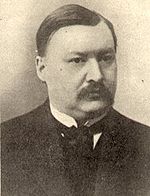
Alexander Konstantinovich Glazunov (10 August 1865 – 21 March 1936) was a Russian composer of the late Russian Romantic
period, music teacher and conductor. He served as director of the Saint Petersburg Conservatory
between 1905 and 1928 and was also instrumental in the reorganization of the institute into the Petrograd Conservatory, then the Leningrad Conservatory, following the Bolshevik Revolution
. He continued heading the Conservatory until 1930, though he had left the Soviet Union in 1928 and did not return. The best known student under his tenure during the early Soviet years was Dmitri Shostakovich
.
Glazunov was significant in that he successfully reconciled nationalism and cosmopolitanism
in Russian music. While he was the direct successor to Balakirev
's nationalism, he tended more towards Borodin
's epic grandeur while absorbing a number of other influences. These included Rimsky-Korsakov
's orchestral virtuosity, Tchaikovsky
's lyricism and Taneyev
's contrapuntal
skill. His weaknesses were a streak of academicism which sometimes overpowered his inspiration and an eclecticism
which could sap the ultimate stamp of originality from his music. Younger composers such as Prokofiev
and Shostakovich eventually considered his music old-fashioned while also admitting he remained a composer with an imposing reputation and a stabilizing influence in a time of transition and turmoil.
, the son of a wealthy publisher. He began studying piano at age of nine and began composing at 11. Mily Balakirev
, former leader of the nationalist group "The Five
", recognized Glazunov's talent and brought his work to the attention of Nikolai Rimsky-Korsakov
. "Casually Balakirev once brought me the composition of a fourteen- or fifteen-year-old high-school student, Sasha Glazunov", Rimsky-Korsakov remembered. "It was an orchestral score written in childish fashion. The boy's talent was indubitably clear." Balakirev introduced him to Rimsky-Korsakov shortly afterwards, in December 1879. Rimsky-Korsakov premiered this work in 1882, when Glazunov was 16. Borodin
and Stasov, among others, lavishly praised both the work and its composer.
Rimsky-Korsakov taught Glazunov as a private student. "His musical development progressed not by the day, but literally by the hour", Rimsky-Korsakov wrote. The nature of their relationship also changed. By the spring of 1881, Rimsky-Korsakov considered Glazunov more of a junior colleague than a student. While part of this development may have been from Rimsky-Korsakov's need to find a spiritual replacement for Modest Mussorgsky
, who had died that March, it may have also been from observing his progress on the first of Glazunov's eight symphonies
.
. Belyayev was introduced to Glazunov's music by Anatoly Lyadov and would take a keen interest in the teenager's musical future, then extend that interest to an entire group of nationalist composers. Belyayev took Glazunov on a trip to Western Europe in 1884. Glazunov met Liszt
in Weimar
, where Glazunov's First Symphony was performed.
Also in 1884, Belyayev rented out a hall and hired an orchestra to play Glazunov's First Symphony plus an orchestral suite Glazunov had just composed. Buoyed by the success of the rehearsal, Belyayev decided the following season to give a public concert of works by Glazunov and other composers. This project grew into the Russian Symphony Concerts
, which were inaugurated during the 1886–1887 season.
In 1885 Belyayev started his own publishing house in Leipzig
, Germany, initially publishing music by Glazunov, Lyadov, Rimsky-Korsakov and Borodin
at his own expense. Young composers started appealing for his help. To help select from their offerings, Belyayev asked Glazunov to serve with Rimsky-Korsakov and Lyadov on an advisory council. The group of composers that formed eventually became known at the Belyayev Circle.
. By the time he was elected director of the Saint Petersburg Conservatory in 1905, he was at the height of his creative powers. His best works from this period are considered his Eighth Symphony and Violin Concerto
. This was also the time of his greatest international acclaim. He conducted the last of the Russian Historical Concerts in Paris on 17 May 1907 and received honorary Doctor of Music
degrees from the universities of Oxford and Cambridge. There were also cycles of all-Glazunov concerts in Saint Petersburg and Moscow to celebrate his 25th anniversary as a composer.
in 1896. In March of that year he conducted the posthumous premiere of Tchaikovsky's student overture The Storm
. In 1897, he led the disastrous premiere of Rachmaninoff's Symphony No 1
. The composer's wife later claimed that Glazunov seemed to be drunk at the time. While this assertion cannot be confirmed, it is not implausible for a man who, according to Shostakovich, kept a bottle of alcohol hidden behind his desk and sipped it through a tube during lessons.
Drunk or not, Glazunov had insufficient rehearsal time with the symphony and, while he loved the art of conducting, he never fully mastered it. From time to time he conducted his own compositions, especially the ballet Raymonda
, even though he may have known he had no talent for it. He would sometimes joke, "You can criticize my compositions, but you can't deny that I am a good conductor and a remarkable conservatory Director."
Despite the hardships he suffered during World War I and the ensuing Russian Civil War
, Glazunov remained active as a conductor. He conducted concerts in factories, clubs and Red Army
posts. He played a prominent part in the Russian observation in 1927 of the centenary of Beethoven
's death, as both speaker and conductor. After he left Russia, he conducted an evening of his works in Paris in 1928. This was followed by engagements in Portugal, Spain, France, England, Czechoslovakia, Poland, the Netherlands, and the United States.
. In the wake of the 1905 Russian Revolution and firing, then re-hiring of Rimsky-Korsakov that year, Glazunov became its director. He remained so until the revolutionary events of 1917, which culminated on 7 November. His Piano Concerto No. 2 in B minor, Op. 100, which he conducted, was premiered at the first concert held in Petrograd after that date. After the end of World War I, he was instrumental in the reorganization of the Conservatory—this may, in fact, have been the main reason he waited so long to go into exile. During his tenure he worked tirelessly to improve the curriculum, raise the standards for students and staff, as well as defend the institute's dignity and autonomy. Among his achievements were an opera studio and a students' philharmonic orchestra.
Glazunov showed paternal concern for the welfare of needy students, such as Dmitri Shostakovich
and Nathan Milstein
. He also personally examined hundreds of students at the end of each academic year, writing brief comments on each. Unfortunately, according to Shostakovich's comments in Testimony
, Glazunov's alcoholism may have progressed to the point that he could not give a lesson while sober. Glazunov taught only chamber music by the time Shostakovich was a student. Glazunov sat at his desk, not interrupting the music being played during class. He spoke quietly and briefly, his comments becoming less distinct and briefer toward the end of the lesson.
While Glazunov's sobriety could be questioned, his prestige was not. Because of his reputation, the Conservatory received special status among institutions of higher learning in the aftermath of the October Revolution
. Glazunov established a sound working relationship with the Bolshevik regime, especially with Anatoly Lunacharsky, the minister of education. Nevertheless, Glazunov's conservatism was attacked within the Conservatory. Increasingly, professors demanded more progressive methods, and students wanted greater rights. Glazunov saw these demands as both destructive and unjust. Tired of the Conservatory, he took advantage of the opportunity to go abroad in 1928 for the Schubert
centenary celebrations in Vienna. He did not return. Maximilian Steinberg
ran the Conservatory in his absence until Glazunov finally resigned in 1930.
and Rachmaninoff
, who had left for other reasons. In 1929, he conducted an orchestra of Parisian musicians in the first complete electrical recording of The Seasons. In 1934, he wrote his Saxophone Concerto
, a short but virtuoso work for the alto saxophone.
. Elena later appeared as Elena Gunther-Glazunova after her second marriage, to Herbert Gunther (1906–1978).
(near Paris) at the age of 70 in 1936. The announcement of his death shocked many. They had long associated Glazunov with the music of the past rather than of the present, so they thought he had already been dead for many years.
In 1972 his remains were reinterred in Leningrad
.
's great works, the most famous being the Third Symphony and the opera Prince Igor
, including the popular Polovtsian Dances. He reconstructed the overture from memory, having heard it played on the piano only once. Shostakovich reports, however, that Glazunov told him when drunk that his "reconstruction" of Borodin's overture was actually original work; Glazunov chose to give full credit to Borodin for the composition which he, Glazunov, wrote. Glazunov's ability to perfectly mimic Borodin's style is a tribute to his musical creativity. His giving the credit to Borodin, Shostakovich felt, said much for Glazunov's character. "It doesn't happen often that a man composes excellent music for another composer and doesn't advertise it (to talk while drinking doesn't count). It's usually the other way around—a man steals an idea or even a considerable piece of music and passes it off as his own."
Shostakovich mentioned in Testimony
that there were many similar stories about Glazunov's memory. One of the more famous ones, he recalled, was when Sergei Taneyev
came to Saint Petersburg with a new symphony. The person whom Taneyev was visiting hid the teenage Glazunov in the next room. Taneyev played his symphony on the piano for the host. The other guests praised and congratulated him. The host then told Taneyev, "I'd like you to meet a talented young man. He's also written a symphony." He brought Glazunov in from the next room. The host said, "Sasha, show your symphony to our dear guest." Glazunov sat down at the piano and played Taneyev's symphony from beginning to end, after hearing it only once and through a closed door.
Age did not weaken Glazunov's memory. Another story Shostakovich relayed was of an "eternal student" applying to enter the composition department at the Saint Petersburg Conservatory. The applicant played a piano sonata he had written. Glazunov listened. When the applicant had finished, Glazunov said, "If I'm not mistaken, you applied a few years ago. Then, in another sonata, you had quite a good secondary theme." Glazunov sat down at the keyboard and played a large segment of the old sonata. "The secondary theme was rubbish, of course", Shostakovich said, "but the effect was enormous."
Glazunov's most popular works nowadays are his ballets The Seasons
and Raymonda
, some of his later symphonies, particularly the Fourth
, Fifth
and Sixth, the Polonaise from Les Sylphides
, and his two Concert Waltzes. His Violin Concerto
, which was a favorite vehicle for Jascha Heifetz
, is still sometimes played and recorded. His last work, the Saxophone Concerto (1934), showed his ability to adapt to Western fashions in music at that time. The earlier rebellions of the experimental, serialist and minimalist movements passed him by and he never shied away from the polished manner he had perfected at the turn of the century.
Glazunov's musical development was paradoxical. He was adopted as an idol by nationalist composers who had been largely self-taught and, apart from Rimsky-Korsakov, deeply distrustful of academic technique. Glazunov's first two symphonies could be seen as an anthology of nationalist techniques as practiced by Balakirev and Borodin; the same could be said for his symphonic poem
Stenka Razin
with its use of the folk song "Volga Boatmen" and orientalist
practices much like those employed by The Five
. By his early 20's he realized the polemic battles between academicism and nationalism were no longer valid. Although he based his compositions on Russian popular music, Glazunov's technical mastery allowed him to write in a sophisticated, cultured idiom. With his Third Symphony
, he consciously attempted to internationalize his music in a manner similar to Tchaikovsky, to whom the piece is dedicated.
The Third Symphony was a transitional work. Glazunov admitted its composition caused him a great deal of trouble. With the Fourth Symphony, he came into his mature style. Dedicated to Anton Rubinstein
, the Fourth was written as a deliberately cosmopolitan work by a Russian looking outward to the West, yet it remained unmistakably Russian in tone. He continued to synthesize nationalist tradition and Western technique in the Fifth Symphony. By the time Glazunov wrote his Seventh Symphony, his duties at the Conservatory had slowed his rate of composition. After his Eighth Symphony, his heavy drinking may have started taking a toll on his creativity, as well. He sketched one movement of a Ninth Symphony
but left the work unfinished.
Glazunov wrote three ballets; eight symphonies and many other orchestral works; five concertos (2 for piano; 1 for violin; 1 for cello; 1 for saxophone); seven string quartets; two piano sonatas and other piano pieces; miscellaneous instrumental pieces; and some songs. He worked together with the choreographer Michel Fokine
to create the ballet Les Sylphides
. It was a collection of piano works by Frédéric Chopin
, orchestrated by Glazunov. He was also given the opportunity by Serge Diaghilev
to write music to The Firebird after Lyadov had failed to do so. Glazunov refused. Eventually, Diaghilev sought out the then-unknown Igor Stravinsky
, who wrote the music.
Ironically, both Glazunov and Rachmaninoff
, whose first symphony Glazunov supposedly had conducted so poorly at its premiere (according to the composer), were considered "old-fashioned" in their later years. In recent years, Glazunov's musical gifts have been more fully appreciated, thanks to extensive recordings of his complete orchestral works.
, Op. 1, on Glazunov's symphonies, which were then in vogue. He used Glazunov's Eighth Symphony, Op. 83, which was written in the same key as his, as a pattern on which to base corrections to his symphony.
This attitude changed over time. In his Memoirs Stravinsky called Glazunov one of the most disagreeable men he had ever met, adding that the only bad omen he had experienced about the initial (private) performance of his symphony was Glazunov having come to him afterwards saying, "Very nice, very nice." Later, Stravinsky amended his recollection of this incident, adding that when Glazunov passed him in the aisle after the performance, he told Stravinsky, "Rather heavy instrumentation for such music."
For his part, Glazunov was not supportive of the modern direction Stravinsky's music took. He was not alone in this prejudice—their mutual teacher Rimsky-Korsakov was as profoundly conservative by the end of his life, wedded to the academic process he helped instill at the Conservatory. Unlike Rimsky-Korsakov, Glazunov was not anxious about the potential dead-end Russian music might take by following academia strictly, nor did he share Rimsky-Korsakov's grudging respect for new ideas and techniques.
Chances are that Glazunov treated Stravinsky with reserve, certainly not with open rudeness. His opinion of Stravinsky's music in the presence of others was another matter. At the performance of (Fireworks), he reportedly made the comment, "Kein talent, nur Dissonanz." (Also in the audience was Sergei Diaghilev
, who on the strength of this music sought out the young composer for the Ballets Russes
.) Glazunov eventually considered Stravinsky merely an expert orchestrator. In 1912 he told Vladimir Telyakovsky, "Petrushka
is not music, but is excellently and skillfully orchestrated."
In 1962, when Stravinsky returned to the Soviet Union to celebrate his 80th birthday, he visited the Leningrad conservatory and, according to his associate Robert Craft
, moaned and said "Glazunov!" when he saw a photograph of the composer on display.
. When Franz Schreker
's opera Der ferne Klang
was staged in Lenningrad, Glazunov pronounced the opera "Schreckliche Musik!" He also may have wondered occasionally whether he had played a role in spawning musical chaos. Once, while looking a score of Debussy's Prélude à l'après-midi d'un faune
, he commented, "It's orchestrated with great taste.... And he knows his work.... Could it be that Rimsky and I influenced the orchestration of all these contemporary degenerates?"
To Glazunov's credit, however, even after he had consigned a piece of music to be "cacophonic", he did not stop listening to it. Instead, he would continue listening in an effort to comprehend it. He "penetrated" Wagner's music in this way; he understood nothing about Die Walküre
the first time he heard it—or the second, third, or fourth. On the tenth hearing, he finally understood the opera and liked it very much. When Shostakovich was one of his students, Glazunov was attempting to do the same with Richard Strauss
's Salome
—"getting used to it, penetrating it, studying it", Shostakovich said.
. He proved to be a disciplined, hard-working student. Glazunov may have recognized in Shostakovich an echo of his younger self. He carefully monitored his progress in Steinberg's class and, in awarding him his doctorate, recommended Shostakovich for a higher degree which normally would have led to a professorship. Due to his family's financial hardship, Shostakovich was not able to take advantage of this opportunity. Glazunov also arranged for the premiere of Shostakovich's First Symphony
, which took place on 12 March 1926 with the Lenningrad Philharmonic under Nikolai Malko
. This was 44 years after Glazunov's First Symphony had first been presented in the same hall. In another instance of déjà vu with Glazunov's early life, the symphony caused almost as much of a sensation as the appearance of the young Shostakovich on the stage awkwardly taking his bow.
Because of Glazunov's bouts of heavy drinking, he found the ban on the official sale of wine and vodka by the Bolskeviks a particular hardship. However, he learned Shostakovich's father had access to spirit alcohol
, which was strictly rationed. One of Shostakovich's more onerous tasks became relaying requests between Glazunov and his father. He found this troubling for two reasons. First, the requests could place his father in mortal danger, particularly since it was impossible to tell whom the Bolsheviks would decide to shoot as an example to others. Second, he did not wish anyone to attribute his success at the Conservatory to bribery.
He gave away a tremendous amount of his salary to needy students out of compassion for them. He wrote countless letters of recommendation, writing what he really thought about the person and giving praise with justification. Sometimes he went to government officials to plead their case. Jewish musicians knew he would see the authorities to get them permission to live in Petrograd. Thanks to him, Jascha Heifetz
, Nathan Milstein
and Mischa Elman, among others, were able to come and study. Shostakovich claimed Glazunov never asked these musicians to play for him; he felt everyone had a right to live where they pleased and art would not suffer as a result. Most importantly to Shostakovich, Glazunov did not call attention to his efforts in this regard. "He didn't demonstrate his high principles when it came to small and pathetic people. He saved this for more important people and more important incidents."
Romantic music
Romantic music or music in the Romantic Period is a musicological and artistic term referring to a particular period, theory, compositional practice, and canon in Western music history, from 1810 to 1900....
period, music teacher and conductor. He served as director of the Saint Petersburg Conservatory
Saint Petersburg Conservatory
The N. A. Rimsky-Korsakov Saint Petersburg State Conservatory is a music school in Saint Petersburg. In 2004, the conservatory had around 275 faculty members and 1,400 students.-History:...
between 1905 and 1928 and was also instrumental in the reorganization of the institute into the Petrograd Conservatory, then the Leningrad Conservatory, following the Bolshevik Revolution
October Revolution
The October Revolution , also known as the Great October Socialist Revolution , Red October, the October Uprising or the Bolshevik Revolution, was a political revolution and a part of the Russian Revolution of 1917...
. He continued heading the Conservatory until 1930, though he had left the Soviet Union in 1928 and did not return. The best known student under his tenure during the early Soviet years was Dmitri Shostakovich
Dmitri Shostakovich
Dmitri Dmitriyevich Shostakovich was a Soviet Russian composer and one of the most celebrated composers of the 20th century....
.
Glazunov was significant in that he successfully reconciled nationalism and cosmopolitanism
Cosmopolitanism
Cosmopolitanism is the ideology that all human ethnic groups belong to a single community based on a shared morality. This is contrasted with communitarian and particularistic theories, especially the ideas of patriotism and nationalism...
in Russian music. While he was the direct successor to Balakirev
Mily Balakirev
Mily Alexeyevich Balakirev ,Russia was still using old style dates in the 19th century, and information sources used in the article sometimes report dates as old style rather than new style. Dates in the article are taken verbatim from the source and therefore are in the same style as the source...
's nationalism, he tended more towards Borodin
Alexander Borodin
Alexander Porfiryevich Borodin was a Russian Romantic composer and chemist of Georgian–Russian parentage. He was a member of the group of composers called The Five , who were dedicated to producing a specifically Russian kind of art music...
's epic grandeur while absorbing a number of other influences. These included Rimsky-Korsakov
Nikolai Rimsky-Korsakov
Nikolai Andreyevich Rimsky-Korsakov was a Russian composer, and a member of the group of composers known as The Five.The Five, also known as The Mighty Handful or The Mighty Coterie, refers to a circle of composers who met in Saint Petersburg, Russia, in the years 1856–1870: Mily Balakirev , César...
's orchestral virtuosity, Tchaikovsky
Pyotr Ilyich Tchaikovsky
Pyotr Ilyich Tchaikovsky Pyotr Ilyich Tchaikovsky Pyotr Ilyich Tchaikovsky (Russian: Пётр Ильи́ч Чайко́вский ; often "Peter Ilich Tchaikovsky" in English. His names are also transliterated "Piotr" or "Petr"; "Ilitsch", "Il'ich" or "Illyich"; and "Tschaikowski", "Tschaikowsky", "Chajkovskij"...
's lyricism and Taneyev
Sergei Taneyev
Sergei Ivanovich Taneyev , was a Russian composer, pianist, teacher of composition, music theorist and author.-Life:...
's contrapuntal
Counterpoint
In music, counterpoint is the relationship between two or more voices that are independent in contour and rhythm and are harmonically interdependent . It has been most commonly identified in classical music, developing strongly during the Renaissance and in much of the common practice period,...
skill. His weaknesses were a streak of academicism which sometimes overpowered his inspiration and an eclecticism
Eclecticism
Eclecticism is a conceptual approach that does not hold rigidly to a single paradigm or set of assumptions, but instead draws upon multiple theories, styles, or ideas to gain complementary insights into a subject, or applies different theories in particular cases.It can sometimes seem inelegant or...
which could sap the ultimate stamp of originality from his music. Younger composers such as Prokofiev
Sergei Prokofiev
Sergei Sergeyevich Prokofiev was a Russian composer, pianist and conductor who mastered numerous musical genres and is regarded as one of the major composers of the 20th century...
and Shostakovich eventually considered his music old-fashioned while also admitting he remained a composer with an imposing reputation and a stabilizing influence in a time of transition and turmoil.
Prodigy
Glazunov was born in Saint PetersburgSaint Petersburg
Saint Petersburg is a city and a federal subject of Russia located on the Neva River at the head of the Gulf of Finland on the Baltic Sea...
, the son of a wealthy publisher. He began studying piano at age of nine and began composing at 11. Mily Balakirev
Mily Balakirev
Mily Alexeyevich Balakirev ,Russia was still using old style dates in the 19th century, and information sources used in the article sometimes report dates as old style rather than new style. Dates in the article are taken verbatim from the source and therefore are in the same style as the source...
, former leader of the nationalist group "The Five
The Five
The Five, also known as The Mighty Handful or The Mighty Coterie , refers to a circle of composers who met in Saint Petersburg, Russia, in the years 1856–1870: Mily Balakirev , César Cui, Modest Mussorgsky, Nikolai Rimsky-Korsakov and Alexander Borodin...
", recognized Glazunov's talent and brought his work to the attention of Nikolai Rimsky-Korsakov
Nikolai Rimsky-Korsakov
Nikolai Andreyevich Rimsky-Korsakov was a Russian composer, and a member of the group of composers known as The Five.The Five, also known as The Mighty Handful or The Mighty Coterie, refers to a circle of composers who met in Saint Petersburg, Russia, in the years 1856–1870: Mily Balakirev , César...
. "Casually Balakirev once brought me the composition of a fourteen- or fifteen-year-old high-school student, Sasha Glazunov", Rimsky-Korsakov remembered. "It was an orchestral score written in childish fashion. The boy's talent was indubitably clear." Balakirev introduced him to Rimsky-Korsakov shortly afterwards, in December 1879. Rimsky-Korsakov premiered this work in 1882, when Glazunov was 16. Borodin
Alexander Borodin
Alexander Porfiryevich Borodin was a Russian Romantic composer and chemist of Georgian–Russian parentage. He was a member of the group of composers called The Five , who were dedicated to producing a specifically Russian kind of art music...
and Stasov, among others, lavishly praised both the work and its composer.
Rimsky-Korsakov taught Glazunov as a private student. "His musical development progressed not by the day, but literally by the hour", Rimsky-Korsakov wrote. The nature of their relationship also changed. By the spring of 1881, Rimsky-Korsakov considered Glazunov more of a junior colleague than a student. While part of this development may have been from Rimsky-Korsakov's need to find a spiritual replacement for Modest Mussorgsky
Modest Mussorgsky
Modest Petrovich Mussorgsky was a Russian composer, one of the group known as 'The Five'. He was an innovator of Russian music in the romantic period...
, who had died that March, it may have also been from observing his progress on the first of Glazunov's eight symphonies
Symphony
A symphony is an extended musical composition in Western classical music, scored almost always for orchestra. A symphony usually contains at least one movement or episode composed according to the sonata principle...
.
Mentored by Belyayev
More important than this praise was that among the work's admirers was a wealthy timber merchant and amateur musician, Mitrofan BelyayevMitrofan Belyayev
Mitrofan Petrovich Belyayev was a Russian music publisher, outstanding philanthropist, and the owner of a large wood dealership enterprise in Russia. He was also the founder of the Belyayev circle, a society of musicians in Russia whose members included Nikolai Rimsky-Korsakov, Alexander Glazunov...
. Belyayev was introduced to Glazunov's music by Anatoly Lyadov and would take a keen interest in the teenager's musical future, then extend that interest to an entire group of nationalist composers. Belyayev took Glazunov on a trip to Western Europe in 1884. Glazunov met Liszt
Franz Liszt
Franz Liszt ; ), was a 19th-century Hungarian composer, pianist, conductor, and teacher.Liszt became renowned in Europe during the nineteenth century for his virtuosic skill as a pianist. He was said by his contemporaries to have been the most technically advanced pianist of his age...
in Weimar
Weimar
Weimar is a city in Germany famous for its cultural heritage. It is located in the federal state of Thuringia , north of the Thüringer Wald, east of Erfurt, and southwest of Halle and Leipzig. Its current population is approximately 65,000. The oldest record of the city dates from the year 899...
, where Glazunov's First Symphony was performed.
Also in 1884, Belyayev rented out a hall and hired an orchestra to play Glazunov's First Symphony plus an orchestral suite Glazunov had just composed. Buoyed by the success of the rehearsal, Belyayev decided the following season to give a public concert of works by Glazunov and other composers. This project grew into the Russian Symphony Concerts
Russian Symphony Concerts
The Russian Symphony Concerts were a series of Russian classical music concerts hosted by timber magnate and musical philanthropist Mitrofan Belyayev in St. Petersburg as a forum for young Russian composers to have their orchestral works performed...
, which were inaugurated during the 1886–1887 season.
In 1885 Belyayev started his own publishing house in Leipzig
Leipzig
Leipzig Leipzig has always been a trade city, situated during the time of the Holy Roman Empire at the intersection of the Via Regia and Via Imperii, two important trade routes. At one time, Leipzig was one of the major European centres of learning and culture in fields such as music and publishing...
, Germany, initially publishing music by Glazunov, Lyadov, Rimsky-Korsakov and Borodin
Alexander Borodin
Alexander Porfiryevich Borodin was a Russian Romantic composer and chemist of Georgian–Russian parentage. He was a member of the group of composers called The Five , who were dedicated to producing a specifically Russian kind of art music...
at his own expense. Young composers started appealing for his help. To help select from their offerings, Belyayev asked Glazunov to serve with Rimsky-Korsakov and Lyadov on an advisory council. The group of composers that formed eventually became known at the Belyayev Circle.
Fame
Glazunov soon enjoyed international acclaim. Nevertheless, he experienced a creative crisis in 1890–1891. He came out of this period with a new maturity. During the 1890s he wrote three symphonies, two string quartets and the ballet RaymondaRaymonda
Raymonda is a ballet in three acts, four scenes with an apotheosis, choreographed by Marius Petipa, with music by Alexander Glazunov, his opus 57. First presented by the Imperial Ballet at the Imperial Mariinsky Theatre on in St. Petersburg, Russia...
. By the time he was elected director of the Saint Petersburg Conservatory in 1905, he was at the height of his creative powers. His best works from this period are considered his Eighth Symphony and Violin Concerto
Violin Concerto (Glazunov)
The Violin Concerto in A minor, Op. 82, by Alexander Glazunov is one of his most popular compositions. Written in 1904, the concerto was dedicated to violinist Leopold Auer, who gave the first performance at a Russian Musical Society concert in St. Petersburg on February 15, 1905...
. This was also the time of his greatest international acclaim. He conducted the last of the Russian Historical Concerts in Paris on 17 May 1907 and received honorary Doctor of Music
Doctor of Music
The Doctor of Music degree , like other doctorates, is an academic degree of the highest level. The D.Mus. is intended for musicians and composers who wish to combine the highest attainments in their area of specialization with doctoral-level academic study in music...
degrees from the universities of Oxford and Cambridge. There were also cycles of all-Glazunov concerts in Saint Petersburg and Moscow to celebrate his 25th anniversary as a composer.
Conductor
Glazunov made his conducting debut in 1888. The following year, he conducted his Second Symphony in Paris at the World Exhibition. He was appointed conductor for the Russian Symphony ConcertsRussian Symphony Concerts
The Russian Symphony Concerts were a series of Russian classical music concerts hosted by timber magnate and musical philanthropist Mitrofan Belyayev in St. Petersburg as a forum for young Russian composers to have their orchestral works performed...
in 1896. In March of that year he conducted the posthumous premiere of Tchaikovsky's student overture The Storm
The Storm (Tchaikovsky)
The Storm, Op. posth. 76, is an overture in E minor composed by Pyotr Ilyich Tchaikovsky between June and August 1864. The work is inspired by the play The Storm by the Russian playwright Alexander Ostrovsky...
. In 1897, he led the disastrous premiere of Rachmaninoff's Symphony No 1
Symphony No. 1 (Rachmaninoff)
Symphony No. 1 in D minor, Op. 13, is a music piece by Russian composer Sergei Rachmaninoff, written at Ivanovka, an estate near Tambov, Russia, between January and October 1895...
. The composer's wife later claimed that Glazunov seemed to be drunk at the time. While this assertion cannot be confirmed, it is not implausible for a man who, according to Shostakovich, kept a bottle of alcohol hidden behind his desk and sipped it through a tube during lessons.
Drunk or not, Glazunov had insufficient rehearsal time with the symphony and, while he loved the art of conducting, he never fully mastered it. From time to time he conducted his own compositions, especially the ballet Raymonda
Raymonda
Raymonda is a ballet in three acts, four scenes with an apotheosis, choreographed by Marius Petipa, with music by Alexander Glazunov, his opus 57. First presented by the Imperial Ballet at the Imperial Mariinsky Theatre on in St. Petersburg, Russia...
, even though he may have known he had no talent for it. He would sometimes joke, "You can criticize my compositions, but you can't deny that I am a good conductor and a remarkable conservatory Director."
Despite the hardships he suffered during World War I and the ensuing Russian Civil War
Russian Civil War
The Russian Civil War was a multi-party war that occurred within the former Russian Empire after the Russian provisional government collapsed to the Soviets, under the domination of the Bolshevik party. Soviet forces first assumed power in Petrograd The Russian Civil War (1917–1923) was a...
, Glazunov remained active as a conductor. He conducted concerts in factories, clubs and Red Army
Red Army
The Workers' and Peasants' Red Army started out as the Soviet Union's revolutionary communist combat groups during the Russian Civil War of 1918-1922. It grew into the national army of the Soviet Union. By the 1930s the Red Army was among the largest armies in history.The "Red Army" name refers to...
posts. He played a prominent part in the Russian observation in 1927 of the centenary of Beethoven
Ludwig van Beethoven
Ludwig van Beethoven was a German composer and pianist. A crucial figure in the transition between the Classical and Romantic eras in Western art music, he remains one of the most famous and influential composers of all time.Born in Bonn, then the capital of the Electorate of Cologne and part of...
's death, as both speaker and conductor. After he left Russia, he conducted an evening of his works in Paris in 1928. This was followed by engagements in Portugal, Spain, France, England, Czechoslovakia, Poland, the Netherlands, and the United States.
Conservatory
In 1899, Glazunov became a professor at the Saint Petersburg ConservatorySaint Petersburg Conservatory
The N. A. Rimsky-Korsakov Saint Petersburg State Conservatory is a music school in Saint Petersburg. In 2004, the conservatory had around 275 faculty members and 1,400 students.-History:...
. In the wake of the 1905 Russian Revolution and firing, then re-hiring of Rimsky-Korsakov that year, Glazunov became its director. He remained so until the revolutionary events of 1917, which culminated on 7 November. His Piano Concerto No. 2 in B minor, Op. 100, which he conducted, was premiered at the first concert held in Petrograd after that date. After the end of World War I, he was instrumental in the reorganization of the Conservatory—this may, in fact, have been the main reason he waited so long to go into exile. During his tenure he worked tirelessly to improve the curriculum, raise the standards for students and staff, as well as defend the institute's dignity and autonomy. Among his achievements were an opera studio and a students' philharmonic orchestra.
Glazunov showed paternal concern for the welfare of needy students, such as Dmitri Shostakovich
Dmitri Shostakovich
Dmitri Dmitriyevich Shostakovich was a Soviet Russian composer and one of the most celebrated composers of the 20th century....
and Nathan Milstein
Nathan Milstein
Nathan Mironovich Milstein was a Russian-born American virtuoso violinist.Widely considered one of the finest violinists of the 20th century, Milstein was known for his interpretations of Bach's solo violin works and for works from the Romantic period...
. He also personally examined hundreds of students at the end of each academic year, writing brief comments on each. Unfortunately, according to Shostakovich's comments in Testimony
Testimony (book)
Testimony is a book that was published in October 1979 by the Russian musicologist Solomon Volkov. He claimed that it was the memoirs of the composer Dmitri Shostakovich...
, Glazunov's alcoholism may have progressed to the point that he could not give a lesson while sober. Glazunov taught only chamber music by the time Shostakovich was a student. Glazunov sat at his desk, not interrupting the music being played during class. He spoke quietly and briefly, his comments becoming less distinct and briefer toward the end of the lesson.
While Glazunov's sobriety could be questioned, his prestige was not. Because of his reputation, the Conservatory received special status among institutions of higher learning in the aftermath of the October Revolution
October Revolution
The October Revolution , also known as the Great October Socialist Revolution , Red October, the October Uprising or the Bolshevik Revolution, was a political revolution and a part of the Russian Revolution of 1917...
. Glazunov established a sound working relationship with the Bolshevik regime, especially with Anatoly Lunacharsky, the minister of education. Nevertheless, Glazunov's conservatism was attacked within the Conservatory. Increasingly, professors demanded more progressive methods, and students wanted greater rights. Glazunov saw these demands as both destructive and unjust. Tired of the Conservatory, he took advantage of the opportunity to go abroad in 1928 for the Schubert
Franz Schubert
Franz Peter Schubert was an Austrian composer.Although he died at an early age, Schubert was tremendously prolific. He wrote some 600 Lieder, nine symphonies , liturgical music, operas, some incidental music, and a large body of chamber and solo piano music...
centenary celebrations in Vienna. He did not return. Maximilian Steinberg
Maximilian Steinberg
Maximilian Osseyevich Steinberg was a Russian composer of classical music born in what is now Lithuania.-Life:...
ran the Conservatory in his absence until Glazunov finally resigned in 1930.
Exile
Glazunov toured Europe and the United States in 1928, and settled in Paris by 1929. He always claimed that the reason for his continued absence from Russia was "ill health"; this enabled him to remain a respected composer in the Soviet Union, unlike StravinskyIgor Stravinsky
Igor Fyodorovich Stravinsky ; 6 April 1971) was a Russian, later naturalized French, and then naturalized American composer, pianist, and conductor....
and Rachmaninoff
Sergei Rachmaninoff
Sergei Vasilievich Rachmaninoff was a Russian composer, pianist, and conductor. Rachmaninoff is widely considered one of the finest pianists of his day and, as a composer, one of the last great representatives of Romanticism in Russian classical music...
, who had left for other reasons. In 1929, he conducted an orchestra of Parisian musicians in the first complete electrical recording of The Seasons. In 1934, he wrote his Saxophone Concerto
Saxophone Concerto (Glazunov)
The Concerto in E flat major for alto saxophone and string orchestra was written by Alexander Glazunov in 1934. The piece lasts about fourteen minutes and is played without pause...
, a short but virtuoso work for the alto saxophone.
Married life
In 1929, at age 64, Glazunov married the 54-year-old Olga Nikolayevna Gavrilova (1875–1968). The previous year, Olga's daughter Elena Gavrilova had been the soloist in the first Paris performance of his Piano Concerto No. 2 in B major, Op. 100. He subsequently adopted Elena (she is sometimes referred to as his stepdaughter), and she then used the name Elena Glazunova. In 1928, Elena had married the pianist Sergei Tarnowsky, who managed Glazunov's professional and business affairs in Paris, such as negotiating his United States appearances with Sol HurokSol Hurok
Sol Hurok was a world-famous 20th century American impresario.-Biography:...
. Elena later appeared as Elena Gunther-Glazunova after her second marriage, to Herbert Gunther (1906–1978).
Death
Glazunov died in Neuilly-sur-SeineNeuilly-sur-Seine
Neuilly-sur-Seine is a commune in the western suburbs of Paris, France. It is located from the center of Paris.Although Neuilly is technically a suburb of Paris, it is immediately adjacent to the city and directly extends it. The area is composed of mostly wealthy, select residential...
(near Paris) at the age of 70 in 1936. The announcement of his death shocked many. They had long associated Glazunov with the music of the past rather than of the present, so they thought he had already been dead for many years.
In 1972 his remains were reinterred in Leningrad
Leningrad
Leningrad is the former name of Saint Petersburg, Russia.Leningrad may also refer to:- Places :* Leningrad Oblast, a federal subject of Russia, around Saint Petersburg* Leningrad, Tajikistan, capital of Muminobod district in Khatlon Province...
.
Phenomenal memory
Glazunov was acknowledged as a great prodigy in his field and, with the help of his mentor and friend Rimsky-Korsakov, finished some of Alexander BorodinAlexander Borodin
Alexander Porfiryevich Borodin was a Russian Romantic composer and chemist of Georgian–Russian parentage. He was a member of the group of composers called The Five , who were dedicated to producing a specifically Russian kind of art music...
's great works, the most famous being the Third Symphony and the opera Prince Igor
Prince Igor
Prince Igor is an opera in four acts with a prologue. It was composed by Alexander Borodin. The composer adapted the libretto from the East Slavic epic The Lay of Igor's Host, which recounts the campaign of Russian prince Igor Svyatoslavich against the invading Polovtsian tribes in 1185...
, including the popular Polovtsian Dances. He reconstructed the overture from memory, having heard it played on the piano only once. Shostakovich reports, however, that Glazunov told him when drunk that his "reconstruction" of Borodin's overture was actually original work; Glazunov chose to give full credit to Borodin for the composition which he, Glazunov, wrote. Glazunov's ability to perfectly mimic Borodin's style is a tribute to his musical creativity. His giving the credit to Borodin, Shostakovich felt, said much for Glazunov's character. "It doesn't happen often that a man composes excellent music for another composer and doesn't advertise it (to talk while drinking doesn't count). It's usually the other way around—a man steals an idea or even a considerable piece of music and passes it off as his own."
Shostakovich mentioned in Testimony
Testimony (book)
Testimony is a book that was published in October 1979 by the Russian musicologist Solomon Volkov. He claimed that it was the memoirs of the composer Dmitri Shostakovich...
that there were many similar stories about Glazunov's memory. One of the more famous ones, he recalled, was when Sergei Taneyev
Sergei Taneyev
Sergei Ivanovich Taneyev , was a Russian composer, pianist, teacher of composition, music theorist and author.-Life:...
came to Saint Petersburg with a new symphony. The person whom Taneyev was visiting hid the teenage Glazunov in the next room. Taneyev played his symphony on the piano for the host. The other guests praised and congratulated him. The host then told Taneyev, "I'd like you to meet a talented young man. He's also written a symphony." He brought Glazunov in from the next room. The host said, "Sasha, show your symphony to our dear guest." Glazunov sat down at the piano and played Taneyev's symphony from beginning to end, after hearing it only once and through a closed door.
Age did not weaken Glazunov's memory. Another story Shostakovich relayed was of an "eternal student" applying to enter the composition department at the Saint Petersburg Conservatory. The applicant played a piano sonata he had written. Glazunov listened. When the applicant had finished, Glazunov said, "If I'm not mistaken, you applied a few years ago. Then, in another sonata, you had quite a good secondary theme." Glazunov sat down at the keyboard and played a large segment of the old sonata. "The secondary theme was rubbish, of course", Shostakovich said, "but the effect was enormous."
Compositions
Glazunov's most popular works nowadays are his ballets The Seasons
The Seasons (ballet)
The Seasons is an allegorical ballet in one act, four scenes, by the choreographer Marius Petipa, with music by Alexander Glazunov, his Op. 67. The work was composed in 1899, and was first performed by the Imperial Ballet in 1900 in St...
and Raymonda
Raymonda
Raymonda is a ballet in three acts, four scenes with an apotheosis, choreographed by Marius Petipa, with music by Alexander Glazunov, his opus 57. First presented by the Imperial Ballet at the Imperial Mariinsky Theatre on in St. Petersburg, Russia...
, some of his later symphonies, particularly the Fourth
Symphony No. 4 (Glazunov)
The Symphony No. 4 in E flat major, Op. 48, was written by Alexander Glazunov in 1893. The symphony was a departure from Glazunov's three earlier symphonies, which were based on nationalistic Russian tunes and, according to the composer, allowed him to give "personal, free, and subjective...
, Fifth
Symphony No. 5 (Glazunov)
The Symphony No. 5 in B flat major, Op. 55 , was written by Alexander Glazunov from April to October of 1895. Although in this symphony Glazunov returned to his conventional four-movement layout he avoids theme transformation...
and Sixth, the Polonaise from Les Sylphides
Les Sylphides
Les Sylphides is a short, non-narrative ballet blanc. Its original choreography was by Michel Fokine, with music by Frédéric Chopin orchestrated by Alexander Glazunov. Glazunov had already set some of the music in 1892 as a purely orchestral suite, under the title Chopiniana, Op. 46...
, and his two Concert Waltzes. His Violin Concerto
Violin Concerto (Glazunov)
The Violin Concerto in A minor, Op. 82, by Alexander Glazunov is one of his most popular compositions. Written in 1904, the concerto was dedicated to violinist Leopold Auer, who gave the first performance at a Russian Musical Society concert in St. Petersburg on February 15, 1905...
, which was a favorite vehicle for Jascha Heifetz
Jascha Heifetz
Jascha Heifetz was a violinist, born in Vilnius, then Russian Empire, now Lithuania. He is widely regarded as one of the greatest violinists of all time.- Early life :...
, is still sometimes played and recorded. His last work, the Saxophone Concerto (1934), showed his ability to adapt to Western fashions in music at that time. The earlier rebellions of the experimental, serialist and minimalist movements passed him by and he never shied away from the polished manner he had perfected at the turn of the century.
Glazunov's musical development was paradoxical. He was adopted as an idol by nationalist composers who had been largely self-taught and, apart from Rimsky-Korsakov, deeply distrustful of academic technique. Glazunov's first two symphonies could be seen as an anthology of nationalist techniques as practiced by Balakirev and Borodin; the same could be said for his symphonic poem
Symphonic poem
A symphonic poem or tone poem is a piece of orchestral music in a single continuous section in which the content of a poem, a story or novel, a painting, a landscape or another source is illustrated or evoked. The term was first applied by Hungarian composer Franz Liszt to his 13 works in this vein...
Stenka Razin
Stenka Razin (Glazunov)
Stenka Razin, Op. 13, is a symphonic poem composed by Alexander Glazunov in 1885. Dedicated to the memory of Alexander Borodin, it is one of the few compositions written by Glazunov on a nationalist subject and is composed in a style reminiscent of Borodin and Pyotr Ilyich Tchaikovsky.Glazunov's...
with its use of the folk song "Volga Boatmen" and orientalist
Orientalism
Orientalism is a term used for the imitation or depiction of aspects of Eastern cultures in the West by writers, designers and artists, as well as having other meanings...
practices much like those employed by The Five
The Five
The Five, also known as The Mighty Handful or The Mighty Coterie , refers to a circle of composers who met in Saint Petersburg, Russia, in the years 1856–1870: Mily Balakirev , César Cui, Modest Mussorgsky, Nikolai Rimsky-Korsakov and Alexander Borodin...
. By his early 20's he realized the polemic battles between academicism and nationalism were no longer valid. Although he based his compositions on Russian popular music, Glazunov's technical mastery allowed him to write in a sophisticated, cultured idiom. With his Third Symphony
Symphony No. 3 (Glazunov)
Alexander Glazunov composed his Symphony No. 3 in D major, opus 33, in 1890, and it was published by 1892 by the Leipzig firm owned by Mitrofan Belyayev. The symphony is dedicated to Pyotr Ilyich Tchaikovsky and was first performed in St. Petersburg in December 1890 under the baton of Anatoly Lyadov...
, he consciously attempted to internationalize his music in a manner similar to Tchaikovsky, to whom the piece is dedicated.
The Third Symphony was a transitional work. Glazunov admitted its composition caused him a great deal of trouble. With the Fourth Symphony, he came into his mature style. Dedicated to Anton Rubinstein
Anton Rubinstein
Anton Grigorevich Rubinstein was a Russian-Jewish pianist, composer and conductor. As a pianist he was regarded as a rival of Franz Liszt, and he ranks amongst the great keyboard virtuosos...
, the Fourth was written as a deliberately cosmopolitan work by a Russian looking outward to the West, yet it remained unmistakably Russian in tone. He continued to synthesize nationalist tradition and Western technique in the Fifth Symphony. By the time Glazunov wrote his Seventh Symphony, his duties at the Conservatory had slowed his rate of composition. After his Eighth Symphony, his heavy drinking may have started taking a toll on his creativity, as well. He sketched one movement of a Ninth Symphony
Symphony No. 9 (Glazunov)
Alexander Glazunov's Symphony No. 9 in D minor was begun in 1910, but was still unfinished by the time of his death in 1936. Gavril Yudin orchestrated the first movement piano sketch. It was recorded by the Alexander Anissimov and the Moscow State Symphony Orchestra for Naxos and Jose Serebrier...
but left the work unfinished.
Glazunov wrote three ballets; eight symphonies and many other orchestral works; five concertos (2 for piano; 1 for violin; 1 for cello; 1 for saxophone); seven string quartets; two piano sonatas and other piano pieces; miscellaneous instrumental pieces; and some songs. He worked together with the choreographer Michel Fokine
Michel Fokine
Michel Fokine was a groundbreaking Russian choreographer and dancer.-Biography:...
to create the ballet Les Sylphides
Les Sylphides
Les Sylphides is a short, non-narrative ballet blanc. Its original choreography was by Michel Fokine, with music by Frédéric Chopin orchestrated by Alexander Glazunov. Glazunov had already set some of the music in 1892 as a purely orchestral suite, under the title Chopiniana, Op. 46...
. It was a collection of piano works by Frédéric Chopin
Frédéric Chopin
Frédéric François Chopin was a Polish composer and virtuoso pianist. He is considered one of the great masters of Romantic music and has been called "the poet of the piano"....
, orchestrated by Glazunov. He was also given the opportunity by Serge Diaghilev
Sergei Diaghilev
Sergei Pavlovich Diaghilev , usually referred to outside of Russia as Serge, was a Russian art critic, patron, ballet impresario and founder of the Ballets Russes, from which many famous dancers and choreographers would arise.-Early life and career:...
to write music to The Firebird after Lyadov had failed to do so. Glazunov refused. Eventually, Diaghilev sought out the then-unknown Igor Stravinsky
Igor Stravinsky
Igor Fyodorovich Stravinsky ; 6 April 1971) was a Russian, later naturalized French, and then naturalized American composer, pianist, and conductor....
, who wrote the music.
Ironically, both Glazunov and Rachmaninoff
Sergei Rachmaninoff
Sergei Vasilievich Rachmaninoff was a Russian composer, pianist, and conductor. Rachmaninoff is widely considered one of the finest pianists of his day and, as a composer, one of the last great representatives of Romanticism in Russian classical music...
, whose first symphony Glazunov supposedly had conducted so poorly at its premiere (according to the composer), were considered "old-fashioned" in their later years. In recent years, Glazunov's musical gifts have been more fully appreciated, thanks to extensive recordings of his complete orchestral works.
Glazunov and Stravinsky
In his Chronicle, Stravinsky admitted that, as a young man, he greatly admired Glazunov's perfection of musical form, purity of counterpoint and ease and assurance of his writing. At 15, Stravinsky transcribed one of Glazunov's string quartets for piano solo. He also deliberately modeled his Symphony in E-flatSymphony in E-flat (Stravinsky)
The Symphony in E-flat major, Op. 1, is the first work composed by Igor Stravinsky during his apprenticeship with Nikolai Rimsky-Korsakov. It is also his first composition for orchestra. Of classical structure, it is broadly influenced by Rimsky-Korsakov, Glazunov, Tchaikovsky and Wagner. It was...
, Op. 1, on Glazunov's symphonies, which were then in vogue. He used Glazunov's Eighth Symphony, Op. 83, which was written in the same key as his, as a pattern on which to base corrections to his symphony.
This attitude changed over time. In his Memoirs Stravinsky called Glazunov one of the most disagreeable men he had ever met, adding that the only bad omen he had experienced about the initial (private) performance of his symphony was Glazunov having come to him afterwards saying, "Very nice, very nice." Later, Stravinsky amended his recollection of this incident, adding that when Glazunov passed him in the aisle after the performance, he told Stravinsky, "Rather heavy instrumentation for such music."
For his part, Glazunov was not supportive of the modern direction Stravinsky's music took. He was not alone in this prejudice—their mutual teacher Rimsky-Korsakov was as profoundly conservative by the end of his life, wedded to the academic process he helped instill at the Conservatory. Unlike Rimsky-Korsakov, Glazunov was not anxious about the potential dead-end Russian music might take by following academia strictly, nor did he share Rimsky-Korsakov's grudging respect for new ideas and techniques.
Chances are that Glazunov treated Stravinsky with reserve, certainly not with open rudeness. His opinion of Stravinsky's music in the presence of others was another matter. At the performance of (Fireworks), he reportedly made the comment, "Kein talent, nur Dissonanz." (Also in the audience was Sergei Diaghilev
Sergei Diaghilev
Sergei Pavlovich Diaghilev , usually referred to outside of Russia as Serge, was a Russian art critic, patron, ballet impresario and founder of the Ballets Russes, from which many famous dancers and choreographers would arise.-Early life and career:...
, who on the strength of this music sought out the young composer for the Ballets Russes
Ballets Russes
The Ballets Russes was an itinerant ballet company from Russia which performed between 1909 and 1929 in many countries. Directed by Sergei Diaghilev, it is regarded as the greatest ballet company of the 20th century. Many of its dancers originated from the Imperial Ballet of Saint Petersburg...
.) Glazunov eventually considered Stravinsky merely an expert orchestrator. In 1912 he told Vladimir Telyakovsky, "Petrushka
Petrushka
Petrouchka or Petrushka is a ballet with music by Russian composer Igor Stravinsky, composed in 1910–11 and revised in 1947....
is not music, but is excellently and skillfully orchestrated."
In 1962, when Stravinsky returned to the Soviet Union to celebrate his 80th birthday, he visited the Leningrad conservatory and, according to his associate Robert Craft
Robert Craft
Robert Lawson Craft is an American conductor and writer. He is best known for his intimate working friendship with Igor Stravinsky, a relationship which resulted in a number of recordings and books.-Life:...
, moaned and said "Glazunov!" when he saw a photograph of the composer on display.
Glazunov and modernism
Igor Stravinsky was not the only composer whose modernist tendencies Glazunov disliked. Shostakovich mentioned Glazunov's attacks against the "recherché cacophonists"—the elder composer's term for the newer generation of Western composers, beginning with DebussyClaude Debussy
Claude-Achille Debussy was a French composer. Along with Maurice Ravel, he was one of the most prominent figures working within the field of impressionist music, though he himself intensely disliked the term when applied to his compositions...
. When Franz Schreker
Franz Schreker
Franz Schreker was an Austrian composer, conductor, teacher and administrator. Primarily a composer of operas, his style is characterized by aesthetic plurality , timbral experimentation, strategies of extended tonality and...
's opera Der ferne Klang
Der ferne Klang
Der ferne Klang is an opera by Franz Schreker, libretto by the composer.-Composition history:Drafted in 1901, Schreker completed the three-act libretto in 1903. However, composing the music would take about ten years. Criticism from his composition teacher Robert Fuchs caused Schreker to abandon...
was staged in Lenningrad, Glazunov pronounced the opera "Schreckliche Musik!" He also may have wondered occasionally whether he had played a role in spawning musical chaos. Once, while looking a score of Debussy's Prélude à l'après-midi d'un faune
Prélude à l'après-midi d'un faune
Prélude à l'après-midi d'un faune , commonly known by its English title Prelude to the Afternoon of a Faun, is a symphonic poem for orchestra by Claude Debussy, approximately 10 minutes in duration...
, he commented, "It's orchestrated with great taste.... And he knows his work.... Could it be that Rimsky and I influenced the orchestration of all these contemporary degenerates?"
To Glazunov's credit, however, even after he had consigned a piece of music to be "cacophonic", he did not stop listening to it. Instead, he would continue listening in an effort to comprehend it. He "penetrated" Wagner's music in this way; he understood nothing about Die Walküre
Die Walküre
Die Walküre , WWV 86B, is the second of the four operas that form the cycle Der Ring des Nibelungen , by Richard Wagner...
the first time he heard it—or the second, third, or fourth. On the tenth hearing, he finally understood the opera and liked it very much. When Shostakovich was one of his students, Glazunov was attempting to do the same with Richard Strauss
Richard Strauss
Richard Georg Strauss was a leading German composer of the late Romantic and early modern eras. He is known for his operas, which include Der Rosenkavalier and Salome; his Lieder, especially his Four Last Songs; and his tone poems and orchestral works, such as Death and Transfiguration, Till...
's Salome
Salome (opera)
Salome is an opera in one act by Richard Strauss to a German libretto by the composer, based on Hedwig Lachmann’s German translation of the French play Salomé by Oscar Wilde. Strauss dedicated the opera to his friend Sir Edgar Speyer....
—"getting used to it, penetrating it, studying it", Shostakovich said.
Glazunov and Shostakovich
Shostakovich entered the Petrograd Conservatory at age 13, becoming the youngest student there. He studied piano with Leonid Nikolayev and composition with Rimsky-Korsakov's son-in-law Maximilian SteinbergMaximilian Steinberg
Maximilian Osseyevich Steinberg was a Russian composer of classical music born in what is now Lithuania.-Life:...
. He proved to be a disciplined, hard-working student. Glazunov may have recognized in Shostakovich an echo of his younger self. He carefully monitored his progress in Steinberg's class and, in awarding him his doctorate, recommended Shostakovich for a higher degree which normally would have led to a professorship. Due to his family's financial hardship, Shostakovich was not able to take advantage of this opportunity. Glazunov also arranged for the premiere of Shostakovich's First Symphony
Symphony No. 1 (Shostakovich)
The Symphony No. 1 in F minor by Dmitri Shostakovich was written between 1924 and 1925, and first performed in Saint Petersburg by the Leningrad Philharmonic under Nikolai Malko on 12 May 1926...
, which took place on 12 March 1926 with the Lenningrad Philharmonic under Nikolai Malko
Nikolai Malko
-Biography:Malko was born in Semaky, Ukraine. His father was Ukrainian, his mother Russian. He studied philology at St Petersburg University. He published articles on music criticism in the Russian press and performed as a pianist and later a conductor. In 1906 he completed his studies in history...
. This was 44 years after Glazunov's First Symphony had first been presented in the same hall. In another instance of déjà vu with Glazunov's early life, the symphony caused almost as much of a sensation as the appearance of the young Shostakovich on the stage awkwardly taking his bow.
Because of Glazunov's bouts of heavy drinking, he found the ban on the official sale of wine and vodka by the Bolskeviks a particular hardship. However, he learned Shostakovich's father had access to spirit alcohol
Distilled beverage
A distilled beverage, liquor, or spirit is an alcoholic beverage containing ethanol that is produced by distilling ethanol produced by means of fermenting grain, fruit, or vegetables...
, which was strictly rationed. One of Shostakovich's more onerous tasks became relaying requests between Glazunov and his father. He found this troubling for two reasons. First, the requests could place his father in mortal danger, particularly since it was impossible to tell whom the Bolsheviks would decide to shoot as an example to others. Second, he did not wish anyone to attribute his success at the Conservatory to bribery.
Glazunov and the Conservatory
Dmitri Shostakovich admitted that while there was much about Glazunov that he found incomprehensible, even laughable, Glazunov willingly sacrificed his time, his peace of mind and his creativity for the Conservatory. He spent practically all his time there. He became calm and firm in dealing with the authorities. When asked before the Revolution how many Jews were enrolled, Glazunov sent the reply, "We don't keep count here." In 1922, the government decided to give Glazunov living conditions that would facilitate his creativity and be commensurate with his achievements. Glazunov, who had lost a tremendous amount of weight and was living as hard a life as many in that time, asked instead that the government send firewood to the Conservatory so the students could study more easily. The firewood was delivered.He gave away a tremendous amount of his salary to needy students out of compassion for them. He wrote countless letters of recommendation, writing what he really thought about the person and giving praise with justification. Sometimes he went to government officials to plead their case. Jewish musicians knew he would see the authorities to get them permission to live in Petrograd. Thanks to him, Jascha Heifetz
Jascha Heifetz
Jascha Heifetz was a violinist, born in Vilnius, then Russian Empire, now Lithuania. He is widely regarded as one of the greatest violinists of all time.- Early life :...
, Nathan Milstein
Nathan Milstein
Nathan Mironovich Milstein was a Russian-born American virtuoso violinist.Widely considered one of the finest violinists of the 20th century, Milstein was known for his interpretations of Bach's solo violin works and for works from the Romantic period...
and Mischa Elman, among others, were able to come and study. Shostakovich claimed Glazunov never asked these musicians to play for him; he felt everyone had a right to live where they pleased and art would not suffer as a result. Most importantly to Shostakovich, Glazunov did not call attention to his efforts in this regard. "He didn't demonstrate his high principles when it came to small and pathetic people. He saved this for more important people and more important incidents."
Sources
- Ossovsky, AlexanderAlexander OssovskyAlexander Vyacheslavovich Ossovsky , 1871 –July 31, 1957) was a renowned Russian musical writer, critic and musicologist, professor at Saint Petersburg Conservatory, pupil of Nikolai Rimsky-Korsakov, and friend of Sergei Rachmaninoff, Alexander Siloti and Nikolai...
, Aleksandr Konstantinovich Glazunov: His life and creative work; Sanct-Petersburg, Alexander SilotiAlexander SilotiAlexander Ilyich Siloti was a Russian pianist, conductor and composer. Alexander Ilyich Siloti (also Ziloti, , Aleksandr Iljič Ziloti) (9 October 1863, near Kharkiv - 8 December 1945, New York) was a Russian pianist, conductor and composer. Alexander Ilyich Siloti (also Ziloti, , Aleksandr Iljič...
Concerts Publishing House, 1907. - Figes, Orlando, Natasha's Dance: A Cultural History of Russia (New York: Metropolitan Books, 2002). ISBN 0-8050-5783-8 (hc.).
- Huth, Andrew, Notes for Warner 61434, Glazunov: Symphony No. 5; The Seasons; Royal Scottish National OrchestraRoyal Scottish National OrchestraThe Royal Scottish National Orchestra is Scotland's national symphony orchestra. Based in Glasgow, the 89-member professional orchestra also regularly performs in Edinburgh, Aberdeen and Dundee, and abroad. Formed in 1891 as the Scottish Orchestra, the company has performed full-time since 1950,...
conducted by José SerebrierJosé SerebrierJosé Serebrier is a Uruguayan conductor and composer. He married American soprano Carole Farley in 1969.- Youth :Serebrier was born in Montevideo, and first conducted an orchestra at the age of eleven, while at school. The school orchestra toured the country, which meant he was able to notch up...
. - Huth, Andrew, Notes for Warner 61939, Glazunov: Symphony No. 8; Raymonda; Royal Scottish National Orchestra conducted by José Serebrier.
- Huth, Andrew, Notes for Warner 63236, Glazunov: Symphonies Nos. 4 and 7; Royal Scottish National Orchestra conducted by José Serebrier.
- MacDonald, Ian, The New Shostakovich (Boston: Northeastern University Press, 1990). ISBN 1-55553-089-3.* Rimsky-Korsakov, Nikolai, Letoppis Moyey Muzykalnoy Zhizni (Saint Petersburg, 1909), published in English as My Musical Life (New York: Knopf, 1925, 3rd ed. 1942). ISBN n/a.
- Norris, Geoffrey and Marina Frolova-Walker, "Glazunov, Aleksandr Konstantinovich" in New Grove
- Schwarz, Boris, "Glazunov, Aleksandr Konstantinovich" in New Grove
- Taylor, Philip, Notes for Chandos 9751, Glazunov: Symphony No. 1, "Slavyanskaya"; Violin Concerto; Julie Krasko, violin; Russian State Symphony OrchestraState Academic Symphony Orchestra of the Russian FederationThe State Academic Symphony Orchestra of the Russian Federation is a Russian orchestra based in Moscow...
conducted by Valery PolyanskyValery PolyanskyValery Polyansky is a Russian orchestral and choral conductor.-External links:*...
. - Volkov, Solomon, tr. Bouis, Antonina W., Testimony: The Memoirs of Dmitri Shostakovich (New York: The Free Press, a division of Simon & Schuster, Inc., 1995). ISBN 0-02-874052-1.
- Volkov, Solomon, tr. Bouis, Antonina W., Saint Petersburg: A Cultural History (New York: Harper & Row, 1979). ISBN 0-06-014476-9.
- Walsh, Stephen, Stravinsky, A Creative Spring: Russia and France, 1882–1934 (New York: Alfred A. Knopf, 1999). ISBN 0-679-41484-3.
- White, Eric Walter, Stravinsky: The Man and His Works (Berkeley and Los Angeles: University of California Press, 1966). Library of Congress Card Captalog Number 66-27667.
External links
- More Complete List of Works
- Free scores at the Mutopia ProjectMutopia projectThe Mutopia Project is a volunteer-run effort to create a library of free content sheet music, in a way similar to Project Gutenberg's library of public domain books.The music is reproduced from old scores that are out of copyright...
- Chant du ménestrel, Op. 71 recording from MusopenMusopenMusopen is an online music library of copyright-free music. Musopen's mission is to record or obtain recordings that have no copyrights so that its visitors may listen, re-use, or in any way enjoy music; put simply, "to set music free."...
. - Quinteto AMIZADE first recording of Glazunov's original Oriental Reverie.