
All Topics  
James McNeill Whistler

 
James McNeill Whistler

   Email Print
   Bookmark   Link


James McNeill Whistler


James Abbott McNeill Whistler (July 11, 1834 – July 17, 1903) was an American
United States

The United States of America is a Federal government constitutional republic comprising U.S. state and a federal district. The country is situated mostly in central North America, where its Contiguous United States and Washington, D.C., the Capital districts and territories, lie between the Pacific Ocean and Atlantic Oceans, Borders of the U...
-born, British
United Kingdom of Great Britain and Ireland

The United Kingdom of Great Britain and Ireland was the formal name and the state form of the United Kingdom from 1 January 1801 until 12 April 1927....
-based artist
Artist

The definition of an artist is wide-ranging and covers a broad spectrum of activities to do with creating art, practicing the arts and/or demonstrating an art....
. Averse to sentimentality and moral allusion
Moral

A moral is a message conveyed or a lesson to be learned from a story or event. The moral may be left to the hearer, reader or viewer to determine for themselves, or may be explicitly encapsulated in a maxim....
 in painting
Painting

Painting is the practice of applying paint, pigment, color or other medium to a surface . In art, the term describes both the act and the result, which is called a painting....
, he was a leading proponent of the credo "art for art's sake
Art for art's sake

"Art for art's sake" is the usual English language rendition of a French language slogan, from the early 19th century, l'art pour l'art, and expresses a philosophy that the intrinsic value of art, and the only "true" art, is divorced from any didactic, moral or utilitarian function....
". His famous signature
Signature

A signature is a handwritten depiction of someone's name, nickname or even a simple "X" that a person writes on documents as a legal proof of Identity and intent....
 for his paintings was in the shape of a stylized butterfly
Butterfly

A butterfly is an insect of the Order Lepidoptera. Like all Lepidoptera, butterflies are notable for their unusual Biological life cycle with a larval caterpillar stage, an inactive pupal stage, and a spectacular metamorphosis into a familiar and colourful winged adult form....
 possessing a long stinger for a tail. The symbol was apt, for it combined both aspects of his personality—his art was characterized by a subtle delicacy, while his public persona was combative.


Discussion
Ask a question about 'James McNeill Whistler'
Start a new discussion about 'James McNeill Whistler'
Answer questions from other users
Full Discussion Forum


Quotations


I am not arguing with you – I am telling you.

Propositions, 2

Listen! There was never an artistic period. There was never an art-loving nation.

One cannot continually disappoint a Continent.

Propositions, 2

The rare few, who, early in life, have rid themselves of the friendship of the many.

Dedication

Two and two continue to make four, in spite of the whine of the amateur for three, or the cry of the critic for five.

Whistler v. Ruskin

In response to a lady who said that a landscape reminded her of his work Yes, madam, Nature is creeping up.

D.C. Seitz, Whistler Stories


Encyclopedia


James Abbott McNeill Whistler (July 11, 1834 – July 17, 1903) was an American
United States

The United States of America is a Federal government constitutional republic comprising U.S. state and a federal district. The country is situated mostly in central North America, where its Contiguous United States and Washington, D.C., the Capital districts and territories, lie between the Pacific Ocean and Atlantic Oceans, Borders of the U...
-born, British
United Kingdom of Great Britain and Ireland

The United Kingdom of Great Britain and Ireland was the formal name and the state form of the United Kingdom from 1 January 1801 until 12 April 1927....
-based artist
Artist

The definition of an artist is wide-ranging and covers a broad spectrum of activities to do with creating art, practicing the arts and/or demonstrating an art....
. Averse to sentimentality and moral allusion
Moral

A moral is a message conveyed or a lesson to be learned from a story or event. The moral may be left to the hearer, reader or viewer to determine for themselves, or may be explicitly encapsulated in a maxim....
 in painting
Painting

Painting is the practice of applying paint, pigment, color or other medium to a surface . In art, the term describes both the act and the result, which is called a painting....
, he was a leading proponent of the credo "art for art's sake
Art for art's sake

"Art for art's sake" is the usual English language rendition of a French language slogan, from the early 19th century, l'art pour l'art, and expresses a philosophy that the intrinsic value of art, and the only "true" art, is divorced from any didactic, moral or utilitarian function....
". His famous signature
Signature

A signature is a handwritten depiction of someone's name, nickname or even a simple "X" that a person writes on documents as a legal proof of Identity and intent....
 for his paintings was in the shape of a stylized butterfly
Butterfly

A butterfly is an insect of the Order Lepidoptera. Like all Lepidoptera, butterflies are notable for their unusual Biological life cycle with a larval caterpillar stage, an inactive pupal stage, and a spectacular metamorphosis into a familiar and colourful winged adult form....
 possessing a long stinger for a tail. The symbol was apt, for it combined both aspects of his personality—his art was characterized by a subtle delicacy, while his public persona was combative. Finding a parallel between painting and music
Music

Music is an art form whose media is sound organized in time. Common elements of music are pitch , rhythm , dynamics , and the sonic qualities of timbre and texture ....
, Whistler titled many of his paintings "arrangements", "harmonies
Harmony

In Western music, harmony is the use of different pitches simultaneously, and chord s, actual or implied, in music. The word is related to the word "harmonic" which implies related wavelengths of waves....
", and "nocturnes
Nocturnes

Nocturnes is an orchestral Musical composition in three movement by the France composer Claude Debussy. It was completed December 15, 1899....
", emphasizing the primacy of tonal harmony. His most famous painting is the iconic
Whistler's Mother
Whistler's Mother

Arrangement in Grey and Black: The Artist's Mother, famous under its colloquial name Whistler's Mother, is an 1871 oil-on-canvas painting by American-born painter James McNeill Whistler....
, the revered and oft parodied portrait
Portrait

A portrait is a portrait painting, portrait photography, sculpture, or other artistic representation of a person, in which the face and its expression is predominant....
 of motherhood. A wit, dandy, and shameless self-promoter, Whistler influenced the art world and the broader culture
Culture

Culture is difficult to define. For example, in 1952, Alfred Kroeber and Clyde Kluckhohn compiled a list of 164 definitions of "culture" in Culture: A Critical Review of Concepts and Definitions....
 of his time with his artistic theories and his friendships with leading artists and writers.

Early life

Whistler was born in Lowell, Massachusetts
Lowell, Massachusetts

Lowell is a city in Middlesex County, Massachusetts, Massachusetts, United States. As of the 2000 census, the city had a total population of 105,167....
. He was the first child born to George Washington Whistler
George Washington Whistler

George Washington Whistler was a prominent American railroad engineer in the first half of the 19th century.George was born at the military outpost of Forts of Fort Wayne, Indiana which his father, John Whistler, had helped build....
, a prominent engineer, and Anna Matilda McNeill
Anna McNeill Whistler

Anna Matilda Whistler was the mother of American-born, British-based painter, James McNeill Whistler, who made her the subject of his famous painting "Arrangement in Grey & Black", often titled, Whistler's Mother ....
 (his father’s second wife). At the Ruskin trial (see below), Whistler claimed the more exotic St. Petersburg, Russia as his birthplace: "I shall be born when and where I want, and I do not choose to be born in Lowell," he declared. In later years, he would play up his mother’s connection to Southern and Scottish roots, and present himself as an impoverished Southern aristocrat (although to what extent he truly sympathized with the Southern cause during the American Civil War
American Civil War

The American Civil War , also known as the War Between the States and several Naming the American Civil War, was a civil war in the United States....
 remains unclear).

Young Whistler was a moody child prone to fits of temper and insolence, who after bouts of ill-health often drifted into periods of laziness. His parents discovered in his early youth that drawing often settled him down and helped focus his attention.

Russia and England

Beginning in 1842, his father was employed to work on a railroad in Russia. After moving to St. Petersburg to join his father a year later, the young Whistler took private art lessons, then enrolled in the Imperial Academy of Fine Arts at age 11. The young artist followed the traditional curriculum of drawing from plaster casts and occasional live models, reveled in the atmosphere of art talk with older peers, and pleased his parents with a first-class mark in anatomy. In 1844, he met the noted Scottish artist Sir William Allan, who came to Russia with a commission to paint a history of the life of Peter the Great. Whistler’s mother noted in her diary, “the great artist remarked to me ‘Your little boy has uncommon genius, but do not urge him beyond his inclination.’”

In 1847-8, his family spent some time in London with relatives, while his father stayed in Russia. Whistler’s brother-in-law Francis Haden
Francis Seymour Haden

Sir Francis Seymour Haden , was an England surgery, best known as an etcher.He was born in London, his father, Charles Thomas Haden, being a well-known doctor and lover of music....
, a physician who was also a talented artist, spurred his interest in art and photography. Haden took Whistler to visit collectors and to lectures, and gave him a watercolor set with instruction. Whistler was already imagining an art career. He began to collect books on art and he studied other artists’ technique. When his portrait was painted by Sir William Boxall
William Boxall

For the horticulturalist and plant collector please see William Boxall Sir William Boxall was an England painter and museum director.He was born in or near Oxford and educated at Abingdon School, before entering the Royal Academy Schools in 1819....
 in 1848, the young Whistler exclaimed that the portrait was “very much like me and a very fine picture. Mr. Boxall is a beautiful colourist…It is a beautiful creamy surface, and looks so rich.” In his blossoming enthusiasm for art, at fifteen, he informed his father by letter of his future direction, “I hope, dear father, you will not object to my choice.” His father, however, died from cholera
Cholera

Cholera, sometimes known as Asiatic or epidemic cholera, is an infectious gastroenteritis caused by enterotoxin-producing strains of the bacterium Vibrio cholerae....
 at the age of forty-nine, and the Whistler family moved back to his mother’s hometown of Pomfret, Connecticut
Pomfret, Connecticut

Pomfret is a New England town in Windham County, Connecticut, Connecticut, United States. The population was 3,798 at the 2000 United States Census....
. His art plans remained vague and his future uncertain. The family lived frugally and managed to get by on a limited income. His cousin reported that Whistler at that time was “slight, with a pensive, delicate face, shaded by soft brown curls…he had a somewhat foreign appearance and manner, which, aided by natural abilities, made him very charming, even at that age.”

West Point

Whistler was sent to Christ Church Hall School with his mother’s hopes that he would become a minister. Whistler was seldom without his sketchbook and was popular with his classmates for his caricatures. However, after it became clear that a career in religion did not suit him, he applied to the United States Military Academy
United States Military Academy

The United States Military Academy at West Point is a four-year coeducational United States Service academies located at West Point, New York, New York....
 at West Point, where his father had once taught drawing, and other relatives had attended. On the strength of his family name, and despite his extreme nearsightedness and poor health history, he was admitted to the highly selective institution. However, during his three years there, his grades were barely satisfactory, and he was a sorry sight at drill and dress. Known as “Curly” for his hair length which exceeded regulations, Whistler bucked authority, spouted sarcastic comments, and racked up demerits. His major accomplishment was learning drawing and mapmaking from American artist Robert W. Weir.

His departure from West Point seems to have been precipitated by a failure in a chemistry exam; as he himself put it later: "If silicon were a gas, I would have been a general one day." However, a separate anecdote suggests misconduct in drawing class as the reason for Whistler's departure.

First job

After West Point, Whistler worked as draftsman mapping the entire U.S. coast for military and maritime purposes. He found the work boring and he was frequently late or absent. He spent much of his free time playing billiards and idling about, was always broke, and though a charmer, had little acquaintance with women. After it was discovered that he was drawing sea serpents, mermaids, and whales on the margins of the maps, he was transferred to the etching division of the U. S. Coast Survey. Though he lasted there only two months, he learned etching technique which later proved valuable to his career.
Whistler James Portrait of Whistler With Hat (1858)
At this point, Whistler firmly decided that art would be his future. For a few months he lived in Baltimore with wealthy friend Tom Winans, who even furnished Whistler with a studio and some spending cash. The young artist made some valuable contacts in the art community and also sold some early paintings to Winans. Whistler turned down his mother’s suggestions for other more practical careers and informed her that with money from Winans, he was setting out to further his art training in Paris. Whistler would never return to the United States.

Art study in France

Whistler arrived in Paris in 1855, rented a studio in the Latin Quarter, and quickly adopted the life of a bohemian artist. Soon, he had a French girlfriend, a dressmaker named Héloise. He studied traditional art methods for a short time at the Ecole Impériale and at the atelier of Charles Gabriel Gleyre. The latter was a great advocate of the work of Ingres
Ingres

Ingres is a commercially supported, open-source SQL relational database management system intended to support large commercial and government applications....
, and impressed Whistler with two principles that he used for the rest of his career: line is more important than color and that black is the fundamental color of tonal harmony. Twenty years later, the Impressionists
Impressionism

Impressionism was a 19th-century art movement that began as a loose association of Paris-based artists art exhibition their art publicly in the 1860s....
 would largely overthrow this philosophy, banning black and brown as “forbidden colors” and emphasizing color over form.

Whistler preferred self-study (including copying at the Louvre
Louvre

The Louvre Museum , located in Paris, is a historic monument, and a national museum of France. It is a central landmark, located on the Rive Droite of the Seine in the 1st arrondissement of Paris ....
) and enjoying the café life. While letters from home reported his mother’s efforts at economy, Whistler spent freely, sold little or nothing in his first year in Paris, and was in steady debt. To relieve the situation, he took to painting and selling copies he made at the Louvre
Louvre

The Louvre Museum , located in Paris, is a historic monument, and a national museum of France. It is a central landmark, located on the Rive Droite of the Seine in the 1st arrondissement of Paris ....
 and finally moved to cheaper quarters. As luck would have it, the arrival in Paris of George Lucas, another rich friend, helped stabilize Whistler’s finances for awhile. In spite of a financial respite, the winter of 1857 was a difficult one for Whistler. His poor health, made worse by excessive smoking and drinking, laid him low.

Conditions improved during the summer of 1858. Whistler recovered and traveled with fellow artist Ernest Delannoy through France and the Rhineland. He later produced a group of etchings known as “The French Set”, with the help of French master printer Auguste Delâtre. During that year, he painted his first self-portrait, "Portrait of Whistler with Hat", a dark and thickly rendered work reminiscent of Rembrandt
Rembrandt

Rembrandt Harmenszoon van Rijn was a Netherlands Painting and etching. He is generally considered one of the greatest painters and printmakers in European art history and the most important in History of the Netherlands....
. But the event of greatest consequence that year was his friendship with Henri Fantin-Latour
Henri Fantin-Latour

Henri Fantin-Latour was a France painter and lithography....
, whom he met at the Louvre
Louvre

The Louvre Museum , located in Paris, is a historic monument, and a national museum of France. It is a central landmark, located on the Rive Droite of the Seine in the 1st arrondissement of Paris ....
. Through him, Whistler was introduced to the circle of Gustave Courbet
Gustave Courbet

Jean D?sir? Gustave Courbet was a France Painting who led the realism movement in 19th-century French painting....
, which included Carolus-Duran
Carolus-Duran

Charles Auguste ?mile Durand, known as Carolus-Duran , was a France painter and art instructor. He is noted for his stylish depictions of members of Upper class in French Third Republic....
 (later the teacher of John Singer Sargent
John Singer Sargent

John Singer Sargent was the most successful portrait painter of his era. During his career, he created roughly 900 oil paintings and more than 2,000 watercolors, as well as countless sketches and charcoal drawings....
), Alphonse Legros
Alphonse Legros

Alphonse Legros , Painting and etcher, was born in Dijon. his father was an accountant, and came from the neighbouring village of V?ronnes.Young Legros frequently visited the farms of his relatives, and the peasants and landscapes of that part of France are the subjects of many of his pictures and etchings....
, and Edouard Manet
Édouard Manet

?douard Manet , 23 January 1832 – 30 April 1883, was a French Painting. One of the first nineteenth century artists to approach modern-life subjects, he was a pivotal figure in the transition from realism to Impressionism....
.

Also in this group was Charles Baudelaire
Charles Baudelaire

Charles Pierre Baudelaire was a nineteenth century French poetry, critic and translator. A controversial figure in his lifetime, Baudelaire's name has become a byword for literary and artistic Decadent movement....
, whose ideas and theories of “modern” art influenced Whistler. Baudelaire challenged artists to scrutinize the brutality of life and nature and portray it faithfully, avoiding the old themes of mythology and allegory. Theophile Gautier
Théophile Gautier

Pierre Jules Th?ophile Gautier was a French poet, dramatist, novelist, journalist, and literary critic.While an ardent defender of Romanticism, Gautier's work is difficult to classify and remains a point of reference for many subsequent literary traditions such as Parnassian poets, Symbolism, decadent movement and Modernism....
, one of the first to explore translational qualities among art and music, may have inspired Whistler to view art in musical terms.

London

Reflecting the banner of realism of his adopted circle, Whistler painted his first exhibited work,
La Mere Gerard in 1858. He followed it by painting At the Piano in 1859 in London, which he adopted as his home, while also regularly visiting friends in France. At the Piano is a portrait done of his niece and her mother in their London music room, an effort which clearly displayed his talent and promise. A critic wrote, “[despite] a recklessly bold manner and sketchiness of the wildest and roughest kind, [it has] a genuine feeling for colour and a splendid power of composition and design, which evince a just appreciation of nature very rare amongst artists.” The work is unsentimental and effectively contrasts the mother in black and the daughter in white, with other colors kept restrained in the manner advised by his teacher Gleyre. It was displayed at the Royal Academy the following year, and in many exhibits to come.

In a second painting done in the same room, Whistler demonstrated his natural inclination toward innovation and novelty by fashioning a genre scene with unusual composition and foreshortening. It was later re-titled
Harmony in Green and Rose: The Music Room. This painting also demonstrated Whistler’s ongoing work pattern, especially with portraits: a quick start, major adjustments, a period of neglect, then a final flurry to the finish.

After a year in London, as counterpoint to his 1858
French set, in 1860, he produced another set of etchings called Thames Set, as well as some early impressionistic work, including The Thames in Ice. At this stage, he was beginning to establish his technique of tonal harmony based on a limited, pre-determined palette.

Early career

Whistler
In 1861, after returning to Paris for a time, Whistler painted his first famous work,
Symphony in White, No. 1: The White Girl. The portrait of his mistress and business manager Joanna Hiffernan
Joanna Hiffernan

Joanna "Jo" Hiffernan was an Ireland-born Model and muse who was romantically linked with United States Painting James Abbott McNeill Whistler and France painter Gustave Courbet....
 was created as a simple study in white; however, others saw it differently. The critic Jules Castagnary thought the painting an allegory of a new bride’s lost innocence. Others linked it to Wilkie Collins
Wilkie Collins

William Wilkie Collins was an English people novelist, playwright, and author of short stories. He was hugely popular in his time, and wrote 27 novels, more than 50 short stories, at least 15 plays, and over 100 pieces of non-fiction work....
The Woman in White, a popular novel of the time, or various other literary sources. In England, some considered it a painting in the Pre-Raphaelite manner. In the painting, Hiffernan holds a lily in her left hand and stands upon a bear skin rug (interpreted by some to represent masculinity and lust) with the bear’s head staring menacingly at the viewer. The portrait was refused for exhibition at the conservative Royal Academy but in 1863 it was accepted at the Salon des Refusés
Salon des Refusés

The Salon des Refus?s, French for ?exhibition of rejects?, is generally an exhibition of works rejected by the jury of the official Paris Salon, but the term is most famously used to refer to the Salon des Refus?s of 1863....
 in Paris, an event sponsored by Emperor Napoleon III for the exhibition of works rejected from the Salon
Salon

...
.

Whistler’s painting was widely noticed though upstaged by Manet’s more shocking painting
Le Déjeuner sur l’herbe. Countering criticism by traditionalists, Whistler’s supporters insisted that the painting was “an apparition with a spiritual content” and that it epitomized his theory that art should essentially be concerned with the arrangement of colors in harmony, not with a literal portrayal of the natural world.

Two years later, Whistler painted another portrait of Hiffernan in white, this time displaying his new found interest in Asian motifs, which he titled
The Little White Girl. His Lady of the Land Lijsen and The Golden Screen, both completed in 1864, again portray his mistress, in even more emphatic Asian dress and surroundings. During this period Whistler became close to Courbet
Courbet

Courbet may refer to*Gustave Courbet, French painter*Am?d?e Courbet, French admiral*French battleship Courbet *Courbet , French frigate...
, the early leader of the French realist school, but when Hiffernan modeled in the nude for Courbet, Whistler became enraged and his relationship with Hiffernan began to fall apart. In January 1864, Whistler’s very religious and very proper mother arrived in London, upsetting her son’s bohemian existence and temporarily exacerbating family tensions. As he wrote to Henri Fantin-Latour
Henri Fantin-Latour

Henri Fantin-Latour was a France painter and lithography....
, “General upheaval!! I had to empty my house and purify it from cellar to eaves.” He also immediately moved Hiffernan to another location.

Mature career


Nocturnes

James Abbot Mcneill Whistler 006
In 1866, Whistler decided to visit Valparaiso, Chile, a journey that has puzzled scholars, though Whistler stated that he did it for political reasons. Chile was at war with Spain and perhaps Whistler thought it a heroic struggle of a small nation against a larger one, but no evidence supports that theory. What the journey did produce was Whistler’s first three nocturnal paintings—which he termed “moonlights” and later re-titled as “nocturnes”—night scenes of the harbor painted with a blue or light green palette. After he returned to London, he painted several more nocturnes over the next ten years, many of the Thames River and of Cremorne Gardens, a pleasure park famous for its frequent fireworks displays, which presented a novel challenge to paint. In his maritime nocturnes, Whistler used highly thinned paint as a ground with lightly flicked color to suggest ships, lights, and shore line. Some of the Thames paintings also show compositional and thematic similarities with the Japanese prints of Hiroshige
Hiroshige

was a Japanese ukiyo-e artist, and one of the last great artists in that tradition. He was also referred to as Ando Hiroshige and by the art name of Ichiyusai Hiroshige ....
.

In 1872, Whistler credited his patron Frederick Leyland, an amateur musician devoted to Chopin, for the musically-inspired titles.

I say I can’t thank you too much for the name ‘Nocturne’ as a title for my moonlights! You have no idea what an irritation it proves to the critics and consequent pleasure to me —besides it is really so charming and does so poetically say all that I want to say and no more than I wish!


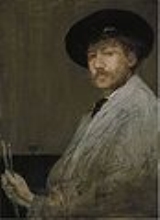
At that point, Whistler painted another self portrait and titled it
Arrangement in Gray: Portrait of the Painter (c. 1872), and he also began to re-title many of his earlier works using terms associated with music, such as a “nocturne”, “symphony”, “harmony”, “study” or “arrangement”, to emphasize the tonal qualities and the composition and to de-emphasize the narrative content. Whistler’s nocturnes were among his most innovative works. Furthermore, his submission of several nocturnes to art dealer Paul Durand-Ruel
Paul Durand-Ruel

Paul Durand-Ruel was a France art dealer who is associated with the Impressionism. He was one of the first modern art dealers who provided support to his painters with stipends and solo exhibitions....
 after the Franco-Prussian War
Franco-Prussian War

The Franco-Prussian War or Franco-German War, often referred to in France as the 1870 War was a conflict between Second French Empire and Kingdom of Prussia, while Prussia was backed by the North German Confederation, of which it was a member, and the South German states of Grand Duchy of Baden, History of W?rttemberg#The Kingdom...
 gave Whistler the opportunity to explain his evolving “theory in art” to artists, buyers and critics in France. His good friend Fantin-Latour, growing more reactionary in his opinions, especially in his negativity concerning the emerging Impressionist school, found Whistler’s new works surprising and confounding. Fantin-Latour admitted, “I don’t understand anything there; it’s bizarre how one changes. I don’t recognize him anymore.” Their relationship was nearly at an end by then but they continued to share opinions in occasional correspondence. When Degas invited Whistler to exhibit with the first show by the Impressionists in 1874, Whistler turned down the invitation, as did Manet
Manet

Manet is ?douard Manet, a 19th-century French painter.MANET is a mobile ad hoc network, a self-configuring mobile wireless network....
, and some scholars attributed this in part to Fantin-Latour’s influence on both men.

Portraits

The Franco-Prussian War
Franco-Prussian War

The Franco-Prussian War or Franco-German War, often referred to in France as the 1870 War was a conflict between Second French Empire and Kingdom of Prussia, while Prussia was backed by the North German Confederation, of which it was a member, and the South German states of Grand Duchy of Baden, History of W?rttemberg#The Kingdom...
 of 1870 fragmented the French art community. Many artists took refuge in England joining Whistler, including Pissarro and Monet, while Manet
Manet

Manet is ?douard Manet, a 19th-century French painter.MANET is a mobile ad hoc network, a self-configuring mobile wireless network....
 and Degas stayed in France. Like Whistler, Monet and Pissarro both focused their efforts on views of the city, and it is likely that Whistler was exposed to the evolution of Impressionism
Impressionism

Impressionism was a 19th-century art movement that began as a loose association of Paris-based artists art exhibition their art publicly in the 1860s....
 founded by these artists and that they had seen his nocturnes. Whistler was drifting away from Courbet’s “damned realism” and their friendship had wilted, as had his liaison with Jo.

Whistler’s Mother
Whistlersmother
By 1871, Whistler returned to portraits and soon produced his most famous painting, the nearly monochromatic full-length figure titled
Arrangement in Gray and Black: Portrait of the Artist's Mother, but usually referred to as Whistler's Mother
Whistler's Mother

Arrangement in Grey and Black: The Artist's Mother, famous under its colloquial name Whistler's Mother, is an 1871 oil-on-canvas painting by American-born painter James McNeill Whistler....
. According to a letter from his mother, one day after a model failed to appear, Whistler turned to his mother and suggested he do her portrait. In his typically slow and experimental way, at first he had her stand but that proved too tiring so the famous profile pose was adopted. It took dozens of sittings to complete.

The austere portrait in his normally constrained palette is another Whistler exercise in tonal harmony and composition. The deceptively simple design is in fact a balancing act of differing shapes, particularly rectangles of the curtain, picture on the wall, wall and floor which stabilize the curve of her face, dress, and chair. Again, though his mother is the subject, Whistler commented that the narrative was of little importance. In reality, however, it was a homage to his pious mother. After the initial shock of her moving in with her son, she aided him considerably by stabilizing his behavior somewhat, tending to his domestic needs, and providing an aura of conservative respectability that helped win over patrons.

Mostly due to its anti-Victorian simplicity during a time in England when sentimentality and fussy decoration were in vogue, the public reacted negatively. Critics thought the painting a failed “experiment” rather than art. The Royal Academy rejected it, then grudgingly accepted it after lobbying by Sir William Boxall—but then hung the painting in an unfavorable location at its exhibition.

From the start,
Whistler’s Mother sparked varying reactions, including parody, ridicule, and reverence, which have continued to today. While some saw it as “the dignified feeling of old ladyhood”, “a grave sentiment of mourning”, or a “perfect symbol of motherhood”, others employed it as a fitting vehicle for mockery. It has been satirized in endless variation in greeting cards and magazines, and by cartoon characters such as Donald Duck
Donald Duck

Donald Duck is a cartoon fictional character from The Walt Disney Company. Donald is a white anthropomorphism duck with a yellow-orange bill, legs, and feet....
 and Bullwinkle the Moose. Whistler did his part in promoting the picture and popularizing the image. He frequently exhibited it and authorized the early reproductions that made their way into thousands of homes.

The painting narrowly escaped being burnt in a fire aboard a train during shipping. Later the painting was purchased by the French government, the first Whistler work in a public collection, and is now housed in the Musée d'Orsay
Musée d'Orsay

The Mus?e d'Orsay is a museum in Paris, France, on the left bank of the Seine, housed in the former railway station, the Gare d'Orsay. It holds mainly French art dating from 1848 to 1915, including paintings, sculptures, furniture, and Fine art photography, and is probably best known for its extensive collection of impressionist masterpieces...
 in Paris.

During the Depression, the picture was billed as “million dollar” painting and was a big hit at the Chicago World’s Fair. It was accepted as a universal icon of motherhood by the world-wide public, which was not particularly aware or concerned with Whistler’s aesthetic theories. In public recognition of its status and popularity, the United States issued a postage stamp in 1934 featuring an adaptation of the painting.

In summing up the painting’s impact author Martha Tedeschi has stated:
Whistler’s Mother, Wood
Grant Wood

Grant DeVolson Wood was an United States Painting, born in Anamosa, Iowa, Iowa. He is best known for his paintings depicting the rural American Midwest, particularly the painting American Gothic, an iconic image of the 20th century....
’s
American Gothic
American Gothic

American Gothic is a painting by Grant Wood from 1930. Portraying a pitchfork-holding farmer and a younger woman, in front of a house of Carpenter Gothic style, it is one of the most familiar images in 20th century American art and has achieved an iconic status in mainstream culture as one of the modern world's most recognizable images an...
, Leonardo da Vinci
Leonardo da Vinci

Leonardo di ser Piero da Vinci was an Italy polymath, being a scientist, mathematician, engineer, inventor, anatomist, Painting, sculptor, architect, botanist, musician and writer....
’s
Mona Lisa
Mona Lisa

Mona Lisa is a 16th century portrait painting painted in oil painting on a poplar panel painting by Leonardo da Vinci during the Italian Renaissance....
and Edvard Munch
Edvard Munch

Edvard Munch was a Norway Symbolism Painting, printmaker, and an important forerunner of Expressionism. His best-known composition, The Scream is one of the pieces in a series titled The Frieze of Life, in which Munch explored the themes of life, love, fear, death, and melancholy....
’s
The Scream
The Scream

The Scream is the title of expressionism paintings and prints in a series by Norway artist Edvard Munch, depicting an agonised figure against a blood red sky....
have all achieved something that most paintings—regardless of their art historical importance, beauty, or monetary value—have not: they communicate a specific meaning almost immediately to almost every viewer. These few works have successfully made the transition from the elite realm of the museum visitor to the enormous venue of popular culture.”


Other portraits

Other important portraits by Whistler include those of Thomas Carlyle
Thomas Carlyle

Thomas Carlyle was a Scotland satire writer, essayist, historian and teacher during the Victorian era.He called economics the "dismal science", wrote articles for the Edinburgh Encyclopedia, and became a controversial social commentator....
 (historian,1873), Maud Franklin (his mistress, 1876), Cicely Alexander (daughter of a London banker, 1873), Lady Meux (socialite, 1882), and Théodore Duret (critic, 1884). In the 1870s, Whistler painted full length portraits of F.R. Leyland
Frederick Richards Leyland

Frederick Richards Leyland was a Liverpool shipowner and art collector....
 and his wife Elinor. Leyland subsequently commissioned the artist to decorate his dining room (see Peacock Room below).

Whistler had been disappointed over the irregular acceptance of his works for the Royal Academy exhibitions and the poor hanging and placement of his paintings. In response, Whistler staged his first one-man show in 1874. The show was notable and noticed, however, for Whistler’s design and decoration of the hall which harmonized well with the paintings, in keeping with his art theories. A reviewer wrote, “The visitor is struck, on entering the gallery, with a curious sense of harmony and fitness pervading it, and is more interested, perhaps, in the general effect than in any one work.”

Whistler was not as successful a portrait painter as the other famous expatriate American John Singer Sargent
John Singer Sargent

John Singer Sargent was the most successful portrait painter of his era. During his career, he created roughly 900 oil paintings and more than 2,000 watercolors, as well as countless sketches and charcoal drawings....
. Whistler’s spare technique and his disinclination to flatter his sitters, as well as his notoriety may account for this. He also worked very slowly and demanded extraordinarily long sittings. William Merritt Chase
William Merritt Chase

William Merritt Chase was an United States Painting known as an exponent of Impressionism and as a teacher....
 complained of his sitting for a portrait by Whistler, “He proved to be a veritable tyrant, painting every day into the twilight, while my limbs ached with weariness and my head swam dizzily. ‘Don’t move! Don’t move!’ he would scream whenever I started to rest.” By the time he gained widespread acceptance in the 1890’s, Whistler was past his prime as a portrait painter.

Technique
Whistler's approach to portraiture in his late maturity was described by one of his sitters, Arthur J. Eddy, who posed for the artist in 1894:

He worked with great rapidity and long hours, but he used his colours thin and covered the canvas with innumerable coats of paint. The colours increased in depth and intensity as the work progressed. At first the entire figure was painted in greyish-brown tones, with very little flesh colour, the whole blending perfectly with the greyish-brown of the prepared canvas; then the entire background would be intensified a little; then the figure made a little stronger; then the background, and so on from day to day and week to week, and often from month to month....And so the portrait would really grow, really develop as an entirety, very much as a negative under the action of the chemicals comes out gradually--light, shadows, and all from the very first faint indications to their full values. It was as if the portrait were hidden within the canvas and the master by passing his wands day after day over the surface evoked the image.


Printmaking

, the Netherlands
Netherlands

The Netherlands is a country that is part of the Kingdom of the Netherlands. It is a parliamentary democratic constitutional monarchy. The Netherlands is located in North-West Europe, and bordered by the North Sea to the north and west, Belgium to the south, and Germany to the east....
, c. 1889. Etching by James McNeill Whistler.]] A supremely gifted engraver, Whistler produced numerous etchings, lithographs, and dry-points. His lithographs, some drawn on stone, others drawn directly on "lithographie" paper, are perhaps half as numerous as his etchings. Some of the lithographs are of figures slightly draped; two or three of the very finest are of Thames
River Thames

The Thames is a major river flowing through southern England. While best known because its lower reaches flow through central London, the river flows through several other towns and cities, including Oxford, Reading, Berkshire and Windsor, Berkshire....
 subjects — including a "nocturne" at Limehouse; while others depict the Faubourg Saint-Germain
Paris districts

Most of the Paris we see today is a result of a nineteenth-century renovation, but its boulevards and Arrondissements of Paris were but a new grid bisecting quarters built by centuries of Parisian habit; as a result of this, Paris has many quarters that are not necessarily mentioned on any administrative map....
 in Paris, and Georgian churches in Soho
Soho

Soho is an area in the centre of the West End of London of London, England, in the City of Westminster. It is an entertainment district which for much of the later part of the 20th century had a reputation for its sex shops as well as its night life and film industry....
 and Bloomsbury
Bloomsbury

Bloomsbury may refer to:* Bloomsbury, an area in central London.* the Bloomsbury Group, an English literary group active around from around 1905 to the start of World War II....
 in London. The etchings include portraits of family, mistresses, and intimate street scenes in London and Venice
Venice

Venice is a city in northern Italy, the capital city of the Italian regions Veneto, a population of 271,251 . Together with Padua, Italy, the city is included in the Padua-Venice Metropolitan Area ....
.

Butterfly signature

Whistler’s famous butterfly signature first developed in the 1860’s out of his interest in Asian art. He studied the potter’s marks on the china he had begun to collect and decided to design a monogram of his initials. Over time this evolved into the shape of an abstract butterfly. By around 1880, he added a stinger to the butterfly image to create a mark representing both his gentle, sensitive nature and his provocative, feisty spirit. He took great care in the appropriate placement of the image on both his paintings and his custom-made frames. His focus on the importance of balance and harmony extended beyond the frame to the placement of his paintings to their settings, and further to the design of an entire architectural element, as in the Peacock Room.

The Peacock Room


Harmony in Blue and Gold: The Peacock Room is Whistler's masterpiece of interior decorative mural
Mural

A mural is a painting on a wall, ceiling, or other large permanent surface....
 art. He painted the paneled room in a rich and unified palette of brilliant blue-greens with over-glazing and metallic gold leaf. Painted in 1876-1877, it is now considered a high example of the Anglo-Japanese style
Anglo-Japanese style

The Anglo-Japanese style refers to a period approximately 1872 to 1900 when a new awareness of, and appreciation for Asian, particularly Japanese, design and culture impacted architecture, and the decorative arts of the United Kingdom....
.

Unhappy with the first decorative result by another artist, Leyland left the room in Whistler’s care to make minor changes, “to harmonize” the room whose primary purpose was to display Leyland’s china collection. However, Whistler let his imagination run wild, “Well, you know, I just painted on. I went on—without design or sketch—putting in every touch with such freedom…And the harmony in blue and gold developing, you know, I forgot everything in my joy of it.”

Upon returning, Leyland was shocked by the “improvements”. Artist and patron quarreled so violently over the room and the proper compensation for the work that the important relationship for Whistler was terminated. At one point, Whistler gained access to Leyland's home and painted two fighting peacocks meant to represent the artist and his patron; one holds a paint brush and the other holds a bag of money.

Whistler is reported to have said to Leyland, “Ah, I have made you famous. My work will live when you are forgotten. Still, per chance, in the dim ages to come you will be remembered as the proprietor of the Peacock Room.” Adding to the emotional drama was Whistler’s fondness for Leyland’s wife, Frances, who separated from her husband in 1879.

Having acquired the centerpiece of the room, Whistler's painting of
The Princess from the Land of Porcelain, American industrialist and aesthete Charles Lang Freer
Charles Lang Freer

Charles Lang Freer was an United States railroad-car manufacturer from Detroit, Michigan who gave to the United States his art collections and funds for a building to house them....
 purchased the entire room in 1904 and had it installed in a room in his Detroit mansion
Mansion

A mansion is a large dwelling house. The word itself derives from the Latin word mansio In the Roman Empire, a mansio was an official stopping place on a Roman road, or via, where cities sprang up, and where the villas of provincial officials came to be placed....
. After Freer’s death in 1919, the Peacock Room was permanently installed in Freer Gallery of Art
Freer Gallery of Art

The Freer Gallery of Art is the Smithsonian Institution's museum of East Asian art, including art from East Asia , South Asia , and southeast Asia, as well as American art....
, Smithsonian Institution
Smithsonian Institution

The Smithsonian Institution is an educational and research institute and associated museum complex, administered and funded by the government of the United States and by funds from its Financial endowment, contributions, and profits from its shops and its magazine....
, Washington, D.C.
Washington, D.C.

Washington, D.C. , formally the District of Columbia and commonly referred to as Washington, the District, or simply D.C., is the Capital of the United States, founded on July 16, 1790....
. The gallery opened to the public in 1923.

Ruskin trial

In 1877 Whistler sued the critic John Ruskin
John Ruskin

John Ruskin was a British art critic and social thought, also remembered as an author, poet and artist. His essays on art and architecture were extremely influential in the Victorian era and Edwardian period eras....
 for libel after the critic condemned his painting
Nocturne in Black and Gold: The Falling Rocket. Whistler exhibited the work in the Grosvenor Gallery
Grosvenor Gallery

The Grosvenor Gallery was an art gallery founded in Bond Street, London in 1877 by Sir Coutts Lindsay and his wife Blanche. They engaged J. Comyns Carr and Edward Charles Hall? as co-directors....
, an alternative to the Royal Academy exhibition, alongside Edward Burne-Jones
Edward Burne-Jones

Sir Edward Coley Burne-Jones, 1st Baronet was an England artist and designer closely associated with the later phase of the Pre-Raphaelite Brotherhood, who worked closely with William Morris on a wide range of decorative arts as a founding partner in Morris & Co.....
 and other artists. Ruskin, who had been a champion of the Pre-Raphaelites
Pre-Raphaelite Brotherhood

The Pre-Raphaelite Brotherhood was a group of England Paintings, poets, and critics, founded in 1848 by Dante Gabriel Rossetti, William Michael Rossetti, James Collinson, John Everett Millais, Frederic George Stephens, Thomas Woolner and William Holman Hunt....
 and J. M. W. Turner
J. M. W. Turner

Joseph Mallord William Turner Royal Academy was an English Romanticism Landscape art, watercolourist and printmaker, whose style is said to have laid the foundation for Impressionism....
, reviewed Whistler’s work in his publication
Fors Clavigera on the July 2nd, 1877. Ruskin praised Burne-Jones, while he attacked Whistler:

For Mr. Whistler's own sake, no less than for the protection of the purchaser, Sir Coutts Lindsay [founder of the Grosvenor Gallery
Grosvenor Gallery

The Grosvenor Gallery was an art gallery founded in Bond Street, London in 1877 by Sir Coutts Lindsay and his wife Blanche. They engaged J. Comyns Carr and Edward Charles Hall? as co-directors....
] ought not to have admitted works into the gallery in which the ill-educated conceit of the artist so nearly approached the aspect of willful imposture. I have seen, and heard, much of Cockney impudence before now; but never expected to hear a coxcomb ask two hundred guineas
Guinea (British coin)

The guinea is an obsolete coin that was minted in the Kingdom of England between 1663 and 1813. It was the first English machine-struck gold coin....
 for flinging a pot of paint in the public's face.


Whistler, seeing the attack in the newspaper, replied to his friend George Boughton, “It is the most debased style of criticism I have had thrown at me yet.” He then went to his solicitor and drew up a writ for libel which was served to Ruskin. Whistler hoped to recover £1,000 plus the costs of the action. The case came to trial the following year after delays caused by Ruskin’s bouts of mental illness, while Whistler’s financial condition continued to deteriorate. It was heard at the Queen's Bench of the High Court from November 25th to 26th 1878. The lawyer for John Ruskin
John Ruskin

John Ruskin was a British art critic and social thought, also remembered as an author, poet and artist. His essays on art and architecture were extremely influential in the Victorian era and Edwardian period eras....
, Attorney General Sir John Holker, cross examined Whistler:
James Abbot Mcneill Whistler 012


Whistler had counted on many artists to take his side as witnesses but they refused fearing damage to their reputations. The other witnesses for him were unconvincing and the jury’s own reaction to the work was derisive. With Ruskin’s witnesses more impressive, including Edward Burne-Jones
Edward Burne-Jones

Sir Edward Coley Burne-Jones, 1st Baronet was an England artist and designer closely associated with the later phase of the Pre-Raphaelite Brotherhood, who worked closely with William Morris on a wide range of decorative arts as a founding partner in Morris & Co.....
, and with Ruskin absent for medical reasons, Whistler’s counter-attack was ineffective. Nonetheless, the jury reached a verdict in favor of Whistler but awarded a mere farthing in nominal damages
Damages

In law, damages refer to the money paid or awarded to a claimant , pursuer or plaintiff following a successful claim in a lawsuit....
, and the court costs were split. The cost of the case, together with huge debts from building his residence, "The White House" in Tite Street
Tite Street

Tite Street is a street in Chelsea, London, England, just north of the River Thames. It was created in 1877, giving access to the Chelsea Embankment....
, Chelsea
Chelsea, London

Chelsea is an area of south-west London, England, bounded to the south by the River Thames, where its frontage runs from Chelsea Bridge along the Chelsea Embankment, Cheyne Walk, Lots Road power station and Chelsea Harbour....
, (designed with E. W. Godwin
Edward William Godwin

Edward William Godwin was a progressive England architect-designer, who began his career working in the strongly polychromatic "John Ruskin Gothic" style of mid-Victorian Britain, inspired by The Stones of Venice , then moved on to provide designs in the "Anglo-Japanese taste" of the Aesthetic Movement and James McNeill Whistler's circ...
, 1877–8) bankrupted him by May 1879, resulting in an auction of his work, collections and house. Stansky notes the irony that the Fine Art Society of London
Fine Art Society

The Fine Art Society is an art dealership with two premises, one in New Bond Street, London and the other in Edinburgh . It was formed in 1876....
, which had organized a collection to pay for Ruskin's legal costs, supported him in etching "the stones of Venice"
The Stones of Venice

The Stones of Venice can refer to:*The Stones of Venice , a three-volume collection of essays on Venetian art and architecture by John Ruskin...
 (and in exhibiting the series in 1883) which helped recoup Whistler’s costs.

Whistler published his account of the trial in the pamphlet
Pamphlet

A pamphlet is an unbound booklet . It may consist of a single sheet of paper that is printed on both sides and folded in half, in thirds, or in fourths , or it may consist of a few pages that are folded in half and stapled at the crease to make a simple book....
 
Whistler v. Ruskin: Art and Art Critics in December 1878, soon after the trial. Whistler’s grand hope that the publicity of the trial would rescue his career was dashed as patrons avoided him for years to come. Among his creditors was Leyland, who oversaw the sale of Whistler’s possessions. Whistler made various caricatures of his former patron, including a biting satirical painting called The Gold Scab, just after Whistler declared bankruptcy. Whistler always blamed Leyland for his financial downfall.

After the Ruskin trial, everything he mentioned or wrote about his work, and especially everything he told his biographers was done in a way in which he could dissociate himself from the English school of painting. His main purpose was to lose any relations he had with the couple of enemies he had made among the Royal Academicians, and the artists who he had been close to during the 1860s.

Later Years

Whistler James Mother of Pearl and Silver the Andalusian 1888 1900
After the trial, Whistler received a commission to do twelve etchings in Venice. He eagerly accepted the assignment, and with girlfriend Maud arrived in the city, taking rooms in a dilapidated palazzo they shared with other artists, including John Singer Sargent
John Singer Sargent

John Singer Sargent was the most successful portrait painter of his era. During his career, he created roughly 900 oil paintings and more than 2,000 watercolors, as well as countless sketches and charcoal drawings....
. Though homesick for London, he adapted to Venice and set about discovering its character. He did his best to distract himself from the gloom of his financial affairs and the pending sale of all his goods at Sotheby’s. He was a regular guest at parties at the American consulate, and with his usual wit, enchanted the guests with verbal flourishes such as “the artist’s only positive virtue is idleness—and there are so few who are gifted at it.”

His new friends reported, on the contrary, that Whistler rose early and put in a full day of effort. He wrote to a friend, “I have learned to know Venice in Venice that the others never seem to have perceived, and which, if I bring back with me as I propose, will far more than compensate for all annoyances delays & vexations of spirit.” The three month assignment stretched to fourteen months. During this exceptionally productive period, Whistler finished over fifty etchings, several nocturnes, some watercolors, and over 100 pastels—illustrating both the moods of Venice and its fine architectural details. Furthermore, Whistler influenced the American art community in Venice, especially Frank Duveneck and Robert Blum who emulated Whistler’s vision of city and later spread his methods and influence back to America.

Back in London, the pastels sold particularly well and he quipped, “They are not as good as I supposed. They are selling!” He was actively engaged in exhibiting his other work but with limited success. Though still struggling financially, however, he was heartened by the attention and admiration he received from the young generation of English and American painters who made him their idol and eagerly adopted the title of “pupil of Whistler”. Many of them returned to America and spread tales of Whistler’s provocative egotism, sharp wit, and aesthetic pronouncements—establishing the legend of Whistler, much to his great satisfaction.

Whistler published his first book
Ten O’clock Lecture in 1885, a major expression of his belief in “art for art’s sake”. At the time, the opposing Victorian notion reigned, namely, that art, and indeed much human activity, had a moral or social function. But to Whistler, art was its own end and the artist’s responsibility was not to society but to himself, to interpret through art, and to neither reproduce nor moralize what he saw. Furthermore, he stated, “Nature is very rarely right”, and must be improved upon by the artist, with his own vision.

Though differing with Whistler on several points, including his insistence that poetry was a higher form of art than painting, Wilde was generous in his praise and hailed the lecture a masterpiece:

“not merely for its clever satire and amusing jests…but for the pure and perfect beauty of many of its passages…for that he is indeed one of the very greatest masters of painting, is my opinion. And I may add that is this opinion Mr. Whistler himself entirely concurs.”


Whistler, however, thought himself mocked by Wilde, and from then on, public sparring ensued leading to a total breakdown of their friendship. Later, Wilde struck at Whistler again, basing the murdered artist in his novel
The Picture of Dorian Gray after Whistler.

In January 1881, Anna Whistler died. In his mother’s honor, he adopted her maiden name McNeill as his middle name. Whistler joined the Society of British Artists in 1884, which lasted for four years until he resigned unhappy with treatment he received for his “eccentricities” and “UnEnglish” background.

With his relationship with Maud unraveling, Whistler suddenly proposed and married Beatrice (“Trixie”) Godwin, a former pupil and the former wife of his architect, who had died two years earlier. Her respectability and connections helped bring him badly needed commissions in the early 1890’s. His new book,
The Gentle Art of Making Enemies, was published in 1890 to mixed success but it afforded helpful publicity.

In 1890, he met Charles Lang Freer
Charles Lang Freer

Charles Lang Freer was an United States railroad-car manufacturer from Detroit, Michigan who gave to the United States his art collections and funds for a building to house them....
, who became a valuable patron in America, and ultimately, his most important collector. Around this time, in addition to portraiture, Whistler experimented with early color photography
Color photography

Color photography is photography that uses media capable of representing colors which are produced chemically during the Photographic processes phase....
 and with lithography
Lithography

Lithography is a method for printing using a stone or a metal plate with a completely smooth surface. By contrast, in intaglio a plate is engraving, etching or mezzotint to make cavities to contain the printing ink, and in woodblock printing and letterpress ink is applied to the raised surfaces of letters or images....
, creating a series featuring London architecture and the human figure, mostly female nudes. In 1891, with help from his close friend Stéphane Mallarmé,
Whistler’s Mother was purchased by the French government for 4,000 francs. This was much less than what an American collector might have paid, but that would not have been as prestigious by Whistler’s reckoning.

After an indifferent reception to his one-man show in London, featuring mostly his nocturnes, Whistler abruptly decided he had had enough of London. He and Trixie moved to Paris in 1892. He felt welcomed by Monet, Auguste Rodin, Henri de Toulouse-Lautrec
Henri de Toulouse-Lautrec

Henri Marie Raymond de Toulouse-Lautrec-Monfa or simply Henri de Toulouse-Lautrec was a French Painting, printmaking, drawing, and illustrator, whose immersion in the colourful and theatrical life of fin de si?cle Paris yielded an oeuvre of exciting, elegant and provocative images of the modern and sometimes decadent life of thos...
, and by Stéphane Mallarmé
Stéphane Mallarmé

St?phane Mallarm? , whose real name was ?tienne Mallarm?, was a French poet and critic. He was a major French Symbolism poet, and his work antecipated and inspired several revolutionary artistic schools of the early 20th century, such as Dadaism, Surrealism, and Futurism ....
, and he set himself up a large studio. He was at the top of his career when it was discovered that Trixie had incurable cancer. She died in 1896.

In the final seven years of his life, Whistler did some minimalist seascapes in watercolor and a final self-portrait in oil. He corresponded with his many friends and colleagues. Whistler founded an art school in 1898, but his poor health and infrequent appearances led to its closure in 1901. He died in London on July 17, 1903.

Whistler was the subject of a contemporaneous biography by his friend, the printmaker Joseph Pennell
Joseph Pennell

Joseph Pennell was an United States artist and author.Pennell was born in Philadelphia, and first studied there, but like his compatriot and friend, James McNeill Whistler, he afterwards went to Europe and made his home in London....
 who collaborated with his wife Elizabeth Robins Pennell
Elizabeth Robins Pennell

Elizabeth Robins Pennell was an American author. She was the wife of American artist and fellow author Joseph Pennell, whom she married in June 1884....
 to write
The Life of James McNeill Whistler, published in 1908. The Pennells’ vast collection of Whistler material was bequeathed to the Library of Congress
Library of Congress

The Library of Congress is the de facto national library of the United States and the research arm of the United States Congress. Located in three buildings in Washington, D.C., it is the largest library in the world by shelf space and holds the largest number of books....
.

The artist’s entire estate was left to his sister-in-law Rosalind Birnie Philip. She spent her life defending his reputation and managing his art and effects, much of which was eventually donated to Glasgow University.

Persona and relationships

Whistler   Drawing Jo
Whistler had a distinctive appearance, short and slight, with piercing eyes and a curling moustache, often sporting a monocle and the flashy attire of a dandy. He affected a posture of self-confidence and eccentricity. He was often arrogant and selfish toward friends and patrons. A constant self-promoter and egoist, he relished shocking friends and enemies. Though he could be droll and flippant about social and political matters, he was always serious about art and often invited public controversy and debate to support his strongly-held theories.

Whistler had a high-pitched drawling voice and a unique manner of speech, full of calculated pauses. A friend said, “In a second you discover that he is not conversing—he is sketching in words, giving impressions in sound and sense to be interpreted by the hearer.”

He was well-known for his biting wit, especially in exchanges with his friend and rival Oscar Wilde
Oscar Wilde

Oscar Fingal O'Flahertie Wills Wilde was an Irish people playwright, Irish poetry and author of numerous short stories and one novel. Known for his biting wit, he became one of the most successful playwrights of the late Victorian era in London, and one of the greatest Celebrity of his day....
. Both were figures in the Café society
Café Society

Caf? society was the collective description for the so-called "beautiful people" and "bright young things" who gathered in fashionable cafes and restaurants in Paris, London, Rome or New York City, beginning in the late 1800s....
 of Paris, and they were often the “talk of the town”. They frequently appeared as caricatures in Punch
Punch

Punch can refer to:...
, to their mutual amusement. On one occasion, young Oscar Wilde attended one of Whistler's dinners, and hearing his host make some brilliant remark, apparently said, "I wish I'd said that", to which Whistler riposted, "You will, Oscar, you will!" In fact, Wilde did repeat in public many witticisms created by Whistler. Their relationship soured by the mid-1880s, as Whistler turned against Wilde and the Aesthetic Movement. When Wilde was publicly acknowledged to be a homosexual in 1895, Whistler openly mocked him.

Whistler reveled in preparing and managing his social gatherings. As a guest observed:

One met all the best in Society there—the people with brains, and those who had enough to appreciate them. Whistler was an inimitable host. He loved to be the Sun round whom we lesser lights revolved…All came under his influence, and in consequence no one was bored, no one dull.


In addition to Henri Fantin-Latour, Alphonse Legros, and Courbet, Whistler was friendly with many French artists. He illustrated the book
Les Chauves-Souris with Antonio de La Gandara
Antonio de La Gandara

Antonio de la G?ndara was a painter, pastellist and draughtsman.He was born in Paris, France, but his father was of Spain ancestry, born in San Luis Potosi, Mexico, and his mother was from England....
. He also knew the impressionists
Impressionism

Impressionism was a 19th-century art movement that began as a loose association of Paris-based artists art exhibition their art publicly in the 1860s....
, notably Edouard Manet
Édouard Manet

?douard Manet , 23 January 1832 – 30 April 1883, was a French Painting. One of the first nineteenth century artists to approach modern-life subjects, he was a pivotal figure in the transition from realism to Impressionism....
, Monet, and Edgar Degas
Edgar Degas

Edgar Degas , born Hilaire-Germain-Edgar Degas , was a French artist famous for his work in painting, sculpture, printmaking and drawing. He is regarded as one of the founders of Impressionism although he rejected the term, and preferred to be called a realist....
. As a young artist, he maintained a close friendship with Dante Gabriel Rossetti
Dante Gabriel Rossetti

Dante Gabriel Rossetti was an English poet, illustrator, Painting and translator....
, a member of the Pre-Raphaelite Brotherhood
Pre-Raphaelite Brotherhood

The Pre-Raphaelite Brotherhood was a group of England Paintings, poets, and critics, founded in 1848 by Dante Gabriel Rossetti, William Michael Rossetti, James Collinson, John Everett Millais, Frederic George Stephens, Thomas Woolner and William Holman Hunt....
. His close friendship with Monet and poet Stéphane Mallarmé
Stéphane Mallarmé

St?phane Mallarm? , whose real name was ?tienne Mallarm?, was a French poet and critic. He was a major French Symbolism poet, and his work antecipated and inspired several revolutionary artistic schools of the early 20th century, such as Dadaism, Surrealism, and Futurism ....
, who translated the ‘’Ten O’clock Lecture’’ into French, helped strengthen respect for Whistler by the French public.

Whistler's lover and model for
The White Girl, Joanna Hiffernan
Joanna Hiffernan

Joanna "Jo" Hiffernan was an Ireland-born Model and muse who was romantically linked with United States Painting James Abbott McNeill Whistler and France painter Gustave Courbet....
, also posed for Gustave Courbet
Gustave Courbet

Jean D?sir? Gustave Courbet was a France Painting who led the realism movement in 19th-century French painting....
. Historians speculate that Courbet's erotic painting of her as L'Origine du monde
L'Origine du monde

L?Origine du monde is an oil on canvas painted by Gustave Courbet in 1866. Measuring about 46 cm by 55 cm , it depicts the close-up view of the genitals and abdomen of a naked woman, lying on a bed and spreading her legs....
 led to the breakup of the friendship between Whistler and Courbet.

During the 1870s and much of the 1880s, he lived with his model-mistress Maud Franklin. Her ability to endure his long, repetitive sittings helped Whistler develop his portrait skills. He not only made several excellent portraits of her but she was also a helpful stand-in for other sitters. In 1888, Whistler married Beatrix Godwin, the widow of the architect E. W. Godwin
Edward William Godwin

Edward William Godwin was a progressive England architect-designer, who began his career working in the strongly polychromatic "John Ruskin Gothic" style of mid-Victorian Britain, inspired by The Stones of Venice , then moved on to provide designs in the "Anglo-Japanese taste" of the Aesthetic Movement and James McNeill Whistler's circ...
, who had designed Whistler’s
White House. The first five years of their marriage were very happy but her later life was a time of misery for the couple, due to her illness and eventual death from cancer. Near the end, she lay comatose much of the time, completely addicted to morphine given for pain relief. Her death was a strong blow Whistler never quite overcame. Whistler had several illegitimate children, of which Charles Hanson is the best documented.

Legacy

Whistler was inspired by and incorporated many sources in his art, including the work of Rembrandt
Rembrandt

Rembrandt Harmenszoon van Rijn was a Netherlands Painting and etching. He is generally considered one of the greatest painters and printmakers in European art history and the most important in History of the Netherlands....
, Velásquez, Japanese art, and ancient Greek sculpture to develop his own highly influential and individual style. He was adept in many media, with over 500 paintings, as well as etchings, pastels, watercolors, drawings, and lithographs. Whistler was a leader in the Aesthetic Movement, promoting, writing, and lecturing on the “art for art’s sake” philosophy. With his pupils, he advocated simple design, economy of means, the avoidance of overly-labored technique, and the tonal harmony of the final result. Whistler has been the subject of many major museum exhibitions, studies, and publications.

As a realist painter, he was unafraid to change course and experiment with impressionist and semi-abstract techniques, particularly with his controversial but innovative “nocturnes”. Like the Impressionists, he employed nature as an artistic resource. Whistler insisted that it was the artist’s obligation to interpret what he saw, not be a slave to reality, and to “bring forth from chaos glorious harmony. His masterpiece the “Peacock Room” was a important predecessor of Art Nouveau
Art Nouveau

Art Nouveau is an international Art movement and style of art, architecture and applied art?especially the decorative arts?that peaked in popularity at Fin de si?cle of the 20th century ....
 style. Despite his attempts to deny that he did not belong to any school, Whistler is considered one of the few Victorian painters who is known for revitalizing the 'grand manner' of British painting.

During his life, he impacted two generations of artists, in Europe and in the United States. Whistler had significant contact and exchanged ideas and ideals with Realist, Impressionist, and Symbolist painters. Famous protégés for a time included Oscar Wilde
Oscar Wilde

Oscar Fingal O'Flahertie Wills Wilde was an Irish people playwright, Irish poetry and author of numerous short stories and one novel. Known for his biting wit, he became one of the most successful playwrights of the late Victorian era in London, and one of the greatest Celebrity of his day....
 and impressionist painter Walter Sickert
Walter Sickert

File:Walter Sickert photo by George Charles Beresford 1911 .jpgWalter Richard Sickert was a German-born England Impressionism Painting and member of the Camden Town Group....
. His tonalism had a profound effect on many American artists, including John Singer Sargent
John Singer Sargent

John Singer Sargent was the most successful portrait painter of his era. During his career, he created roughly 900 oil paintings and more than 2,000 watercolors, as well as countless sketches and charcoal drawings....
 and William Merritt Chase
William Merritt Chase

William Merritt Chase was an United States Painting known as an exponent of Impressionism and as a teacher....
. Another significant influence was upon Arthur Frank Mathews
Arthur Frank Mathews

Arthur F. Mathews was an American Tonalist painter who was one of the founders of the American Arts and Crafts Movement. Trained as an architect and artist, he had a significant effect on the evolution of Californian art in the late 19th and early 20th centuries....
, whom Whistler met in Paris in the late 1890s. Mathews took Whistler's Tonalism
Tonalism

File:Dabo - The Seashore.jpgTonalism is an artistic style that emerged in the 1880s when American artists began to paint landscape forms with an overall tone of colored atmosphere or mist....
 to San Francisco, spawning a broad use of that technique among turn of the century California artists.

As American critic Charles Caffin wrote in 1907:
“He did better than attract a few followers and imitators; he influenced the whole world of art. Consciously, or unconsciously, his presence is felt in countless studios; his genius permeates modern artistic thought.”


During his trip to Venice, Italy in 1880, he created a series of etchings and pastels that not only reinvigorated Whistler's finances, but also re-energized the way in which artists and photographers interpreted the city—focusing on the back alleys, side canals, entrance ways, and architectural patterns—and capturing the city’s unique atmospherics.

Whistler was likely the model for the artist character in Wilde’s
The Picture of Dorian Gray. George du Maurier’s novel Trilby (1894) contains an artist character who is “vain, witty, and a most exquisite and a most original artist”, also likely based on Whistler.

The Gilbert and Sullivan
Gilbert and Sullivan

'Gilbert and Sullivan' refers to the Victorian era partnership of librettist W. S. Gilbert and composer Arthur Sullivan . Together, they wrote fourteen comic operas between 1871 and 1896, of which H.M.S....
 operetta Patience
Patience (opera)

Patience, or Bunthorne's Bride, is a comic opera in two acts, with music by Arthur Sullivan and libretto by W. S. Gilbert. First performed at the Opera Comique, London, on April 23 1881, it moved to the 1,292-seat Savoy Theatre on October 10 1881, where it was the first theatrical production in the world to be lit entirely by electric li...
 pokes fun at the Aesthetic movement, and the lead character of Reginald Bunthorne is often identified as send-up of Oscar Wilde, though Bunthorne is more likely an amalgam of several prominent artists, writers and Aesthetic figures. Bunthorne wears a monocle and has prominent white streak in his dark hair, as did Whistler.

The house in which Whistler was born is now preserved as the Whistler House Museum of Art
Whistler House Museum of Art

The Whistler House Museum of Art is the birthplace of painter and etcher James McNeill Whistler. It is located at 243 Worthen Street, Lowell, Massachusetts, and is open as a museum displaying works from the Museum collection and shows by artist members....
. He is buried at St Nicholas's Church in Chiswick
Chiswick

Chiswick is an affluent area of West London, located west of Charing Cross, which covers the eastern part of the London Borough of Hounslow....
, London.

Honors

Whistler achieved worldwide recognition during his lifetime:
  • 1884, elected an honorary member of the Royal Academy of Fine Arts in Munich
  • 1892, made an officer of the Légion d'honneur
    Légion d'honneur

    The L?gion d'honneur or Ordre national de la L?gion d'honneur is a France order established by Napoleon I of France, First Consul of the French First Republic, on May 19, 1802....
     in France
  • 1898, became a charter member and first president, International Society of Sculptors, Painters, & Gravers


See also

  • Nocturne: Blue and Gold - Old Battersea Bridge
    Nocturne: Blue and Gold - Old Battersea Bridge

    Nocturne: Blue and Gold - Old Battersea Bridge is a painting by the United States-born United Kingdom artist James McNeill Whistler, now held in the collections of Tate Britain....
    (c.1872–5)
  • Western painting
    Western painting

    The history of Western painting represents a continuous, though disrupted, tradition from classical antiquity. Until the mid 19th century it was primarily concerned with Representational art and Classical antiquity modes of production, after which time more Modern art, Abstract art and Conceptual art forms gained favor....
  • John Wharlton Bunney
    John Wharlton Bunney

    John Wharlton Bunney was an English topographical and landscape artist of the nineteenth century.His father was a merchant captain whom Bunney, as a boy, accompanied on several voyages around the world....


Footnotes


Further reading

  • James McNeil Whistler by Lisa N. Peters. ISBN 1-880908-70-0.
  • Whistler: A Retrospective by Robin Spencer. ISBN 0-517-05773-5
  • Whistler by Robin Spencer. ISBN 1-85170-904-5
  • Whistler in Venice by Eric Denker. ISBN 1-85894-200-4
  • After Whistler: The Artist and his Influence on American Painting by Linda Merrill, et al. ISBN 0-300-10125-2
  • The Peacock Room: A Cultural Biography by Linda Merrill. Washington, D.C.: Freer Gallery of Art, in association with Yale University Press, 1998.
  • The Princess and the Peacocks; or, The Story of the [Peacock] Room by Linda Merrill and Sarah Ridley. New York: Hyperion Books for Children, in association with the Freer Gallery of Art, 1993.
  • James McNeill Whistler at the Freer Gallery of Art by David Park Curry. New York: W. W. Norton and Freer Gallery of Art, 1984.


External links

  • Formerly the work of the Centre For Whistler Studies.