


Giacomo Puccini

Encyclopedia
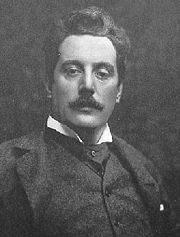
Italian people
The Italian people are an ethnic group that share a common Italian culture, ancestry and speak the Italian language as a mother tongue. Within Italy, Italians are defined by citizenship, regardless of ancestry or country of residence , and are distinguished from people...
composer whose opera
Opera
Opera is an art form in which singers and musicians perform a dramatic work combining text and musical score, usually in a theatrical setting. Opera incorporates many of the elements of spoken theatre, such as acting, scenery, and costumes and sometimes includes dance...
s, including La bohème
La bohème
La bohème is an opera in four acts,Puccini called the divisions quadro, a tableau or "image", rather than atto . by Giacomo Puccini to an Italian libretto by Luigi Illica and Giuseppe Giacosa, based on Scènes de la vie de bohème by Henri Murger...
, Tosca
Tosca
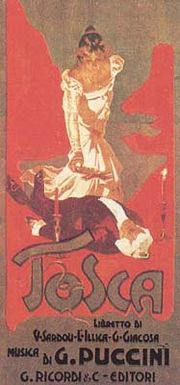
Tosca is an opera in three acts by Giacomo Puccini to an Italian libretto by Luigi Illica and Giuseppe Giacosa. It premiered at the Teatro Costanzi in Rome on 14 January 1900...
, Madama Butterfly
Madama Butterfly
Madama Butterfly is an opera in three acts by Giacomo Puccini, with an Italian libretto by Luigi Illica and Giuseppe Giacosa. Puccini based his opera in part on the short story "Madame Butterfly" by John Luther Long, which was dramatized by David Belasco...
, and Turandot
Turandot
Turandot is an opera in three acts by Giacomo Puccini, set to a libretto in Italian by Giuseppe Adami and Renato Simoni.Though Puccini's first interest in the subject was based on his reading of Friedrich Schiller's adaptation of the play, his work is most nearly based on the earlier text Turandot...
, are among the most frequently performed in the standard repertoire. Some of his arias, such as "O mio babbino caro
O mio babbino caro
"O mio babbino caro" is a soprano aria from the opera Gianni Schicchi , by Giacomo Puccini, to a libretto by Giovacchino Forzano. It is sung by Lauretta after tensions between her father Schicchi and the family of Rinuccio, the boy she loves, have reached a breaking point that threatens to...
" from Gianni Schicchi
Gianni Schicchi
Gianni Schicchi is a comic opera in one act by Giacomo Puccini to an Italian libretto by Giovacchino Forzano, composed in 1917–18. The libretto is based on an incident mentioned in Dante's Divine Comedy. The work is the third and final part of Puccini's Il trittico —three one-act operas with...
, "Che gelida manina" from La bohème, and "Nessun dorma
Nessun dorma
Nessun dorma is an aria from the final act of Giacomo Puccini's opera Turandot, and is one of the best-known tenor arias in all opera. It is sung by Calaf, il principe ignoto , who falls in love at first sight with the beautiful but cold Princess Turandot...
" from Turandot, have become part of popular culture.
Early life
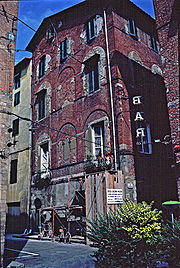
Lucca
Lucca is a city and comune in Tuscany, central Italy, situated on the river Serchio in a fertile plainnear the Tyrrhenian Sea. It is the capital city of the Province of Lucca...
in Tuscany
Grand Duchy of Tuscany
The Grand Duchy of Tuscany was a central Italian monarchy that existed, with interruptions, from 1569 to 1859, replacing the Duchy of Florence. The grand duchy's capital was Florence...
, into a family with five generations of musical history behind them, including composer Domenico Puccini. His father died when Giacomo was five years old, and he was sent to study with his uncle Fortunato Magi, who considered him to be a poor and undisciplined student. Magi may have been prejudiced against his nephew because his contract as choir master stipulated that he would hand over the position to Puccini "as soon as the said Signore Giacomo be old enough to discharge such duties." Puccini never took the position of church organist
Organist
An organist is a musician who plays any type of organ. An organist may play solo organ works, play with an ensemble or orchestra, or accompany one or more singers or instrumental soloists...
and choir master in Lucca. When he was 17, he saw a performance of Verdi
Giuseppe Verdi
Giuseppe Fortunino Francesco Verdi was an Italian Romantic composer, mainly of opera. He was one of the most influential composers of the 19th century...
's Aida
Aida
Aida sometimes spelled Aïda, is an opera in four acts by Giuseppe Verdi to an Italian libretto by Antonio Ghislanzoni, based on a scenario written by French Egyptologist Auguste Mariette...
and became inspired to be an opera composer. He and his brother, Michele, walked 18.5 mi (30 km) to see the performance in Pisa
Pisa
Pisa is a city in Tuscany, Central Italy, on the right bank of the mouth of the River Arno on the Tyrrhenian Sea. It is the capital city of the Province of Pisa...
.
In 1880, with the help of a relative and a grant, Puccini enrolled in the Milan Conservatory
Milan Conservatory
The Milan Conservatory is a college of music which was established by a royal decree of 1807 in Milan, capital of the Napoleonic Kingdom of Italy. It opened the following year with premises in the cloisters of the Baroque church of Santa Maria della Passione. There were initially 18 boarders,...
to study composition with Stefano Ronchetti-Monteviti
Stefano Ronchetti-Monteviti
Stefano Ronchetti-Monteviti was an Italian composer, music educator, and college administrator. Born in Asti, he joined the faculty of the Milan Conservatory in 1850 as a professor of counterpoint. He was appointed the school's director in 1878, a post he held until illness forced him to resign in...
, Amilcare Ponchielli
Amilcare Ponchielli
Amilcare Ponchielli was an Italian composer, largely of operas.-Biography:Born in Paderno Fasolaro, now Paderno Ponchielli, near Cremona, Ponchielli won a scholarship at the age of nine to study music at the Milan Conservatory, writing his first symphony by the time he was ten years old.Two years...
, and Antonio Bazzini
Antonio Bazzini
Antonio Joseph Bazzini was an Italian violinist, composer and teacher. As a composer his most enduring work is his chamber music which has earned him a central place in the Italian instrumental renaissance of the 19th century...
. In the same year, at the age of 21, he composed the Messa, which marks the culmination of his family's long association with church music
Christian music
Christian music is music that has been written to express either personal or a communal belief regarding Christian life and faith. Common themes of Christian music include praise, worship, penitence, and lament, and its forms vary widely across the world....
in his native Lucca. Although Puccini himself correctly titled the work a Messa, referring to a setting of the Ordinary of the Catholic Mass, today the work is popularly known as his Messa di Gloria
Messa (Puccini)
Giacomo Puccini's Messa or Messa a quattro voci is a Mass composed for orchestra and four-part choir with tenor, bass and baritone soloists...
, a name that technically refers to a setting of only the first two prayers of the Ordinary, the Kyrie
Kyrie
Kyrie, a transliteration of Greek κύριε , vocative case of κύριος , meaning "Lord", is the common name of an important prayer of Christian liturgy, which is also called the Kýrie, eléison ....
and the Gloria
Gloria in Excelsis Deo
"Gloria in excelsis Deo" is the title and beginning of a hymn known also as the Greater Doxology and the Angelic Hymn. The name is often abbreviated to Gloria in Excelsis or simply Gloria.It is an example of the psalmi idiotici "Gloria in excelsis Deo" (Latin for "Glory to God in the highest")...
, while omitting the Credo
Credo
A credo |Latin]] for "I Believe") is a statement of belief, commonly used for religious belief, such as the Apostles' Creed. The term especially refers to the use of the Nicene-Constantinopolitan Creed in the Mass, either as text, Gregorian chant, or other musical settings of the...
, the Sanctus
Sanctus
The Sanctus is a hymn from Christian liturgy, forming part of the Order of Mass. In Western Christianity, the Sanctus is sung as the final words of the Preface of the Eucharistic Prayer, the prayer of consecration of the bread and wine...
, and the Agnus Dei.
The work anticipates Puccini's career as an operatic composer by offering glimpses of the dramatic power that he would soon bring forth onto the stage; the powerful "arias" for tenor and bass soloists are certainly more operatic than is usual in church music and, in its orchestration and dramatic power, the Messa compares interestingly with Verdi's Requiem
Requiem (Verdi)
The Messa da Requiem by Giuseppe Verdi is a musical setting of the Roman Catholic funeral mass for four soloists, double choir and orchestra. It was composed in memory of Alessandro Manzoni, an Italian poet and novelist much admired by Verdi. The first performance in San Marco in Milan on 22 May...
.
While studying at the Conservatory, Puccini obtained a libretto
Libretto
A libretto is the text used in an extended musical work such as an opera, operetta, masque, oratorio, cantata, or musical. The term "libretto" is also sometimes used to refer to the text of major liturgical works, such as mass, requiem, and sacred cantata, or even the story line of a...
from Ferdinando Fontana
Ferdinando Fontana
Ferdinando Fontana was an Italian journalist, dramatist, and poet. He is best known today for having written the libretti of the first two operas by Giacomo Puccini – Le Villi and Edgar.-Biography:...
and entered a competition for a one-act opera in 1882. Although he did not win, Le Villi
Le Villi
Le Villi is an opera-ballet in two acts composed by Giacomo Puccini to an Italian libretto by Ferdinando Fontana, based on the short story Les Willis by Jean-Baptiste Alphonse Karr. Karr's story was in turn based in the Central European legend of the Willis, also used in the ballet Giselle...
was later staged in 1884 at the Teatro Dal Verme
Teatro Dal Verme
The Teatro Dal Verme is a theatre in Milan, Italy located on the Via San Giovanni sul Muro, on the site of the former private theatre the Politeama Ciniselli. It was designed by Giuseppe Pestagalli to a commission from Count Francesco Dal Verme, and was used primarily for plays and opera...
and it caught the attention of Giulio Ricordi
Giulio Ricordi
Giulio Ricordi was an Italian editor and musician.-Biography:Ricordi was born in Milan, where he also died....
, head of G. Ricordi & Co.
Casa Ricordi
Casa Ricordi is a classical music publishing company founded in 1808 as G. Ricordi & Co. by violinist Giovanni Ricordi in Milan, Italy...
music publishers, who commissioned a second opera, Edgar
Edgar (opera)
Edgar is an operatic dramma lirico in three acts by Giacomo Puccini to an Italian libretto by Ferdinando Fontana, freely based on the play in verse La Coupe et les lèvres by Alfred de Musset...
, in 1889. Edgar failed: it was a bad story and Fontana's libretto was poor. This may have had an effect on Puccini's thinking because when he began his next opera, Manon Lescaut, he announced that he would write his own libretto so that "no fool of a librettist" could spoil it. Ricordi persuaded him to accept Leoncavallo as his librettist, but Puccini soon asked Ricordi to remove him from the project. Four other librettists were then involved with the opera, due mainly to Puccini constantly changing his mind about the structure of the piece. It was almost by accident that the final two, Illica and Giacosa, came together to complete the opera. They remained with Puccini for his next three operas and probably his greatest successes: La Boheme, Tosca and Madama Butterfly.
It may well have been the failure of Edgar that made Puccini so apt to change his mind. Edgar nearly cost him his career. Puccini had eloped with the married Elvira Gemignani and Ricordi's associates were willing to turn a blind eye to his life style as long as he was successful. When Edgar failed, they suggested to Ricordi that he should drop Puccini, but Ricordi said that he would stay with him and made him an allowance from his own pocket until his next opera. Manon Lescaut was a great success and Puccini went on to become the leading operatic composer of his day.
Puccini at Torre del Lago
Torre del Lago
Torre del Lago is a town of almost 11,000 inhabitants, a frazione of the comune of Viareggio, in the province of Lucca, Tuscany, Italy, between the Lake of Massaciuccoli and the Tyrrhenian Sea....
, a small community about fifteen miles from Lucca situated between the Ligurian Sea and Lake Massaciuccoli, just south of Viareggio
Viareggio
Viareggio is a city and comune located in northern Tuscany, Italy, on the coast of the Tyrrhenian Sea. With a population of over 64,000 it is the main centre of the northern Tuscan Riviera known as Versilia, and the second largest city within the Province of Lucca.It is known as a seaside resort...
. While renting a house there, he spent time hunting, but regularly visited Lucca.
By 1900, he had acquired land and built a villa on the lake, now known as the "Villa Museo Puccini." He lived there until 1921, when pollution produced by peat works on the lake forced him to move to Viareggio, a few kilometres north. After his death, a mausoleum
Mausoleum
A mausoleum is an external free-standing building constructed as a monument enclosing the interment space or burial chamber of a deceased person or persons. A monument without the interment is a cenotaph. A mausoleum may be considered a type of tomb or the tomb may be considered to be within the...
was created in the Villa Puccini and the composer is buried there in the chapel
Chapel
A chapel is a building used by Christians as a place of fellowship and worship. It may be part of a larger structure or complex, such as a church, college, hospital, palace, prison or funeral home, located on board a military or commercial ship, or it may be an entirely free-standing building,...
, along with his wife and son who died later.
The Villa Museo Puccini is presently owned by his granddaughter, Simonetta Puccini, and is open to the public.
Operas written at Torre del Lago
- Manon LescautManon Lescaut (Puccini)Manon Lescaut is an opera in four acts by Giacomo Puccini. The story is based on the 1731 novel L’histoire du chevalier des Grieux et de Manon Lescaut by the Abbé Prévost....
(1893), his third opera, was his first great success. It launched his remarkable relationship with the librettistsLibrettoA libretto is the text used in an extended musical work such as an opera, operetta, masque, oratorio, cantata, or musical. The term "libretto" is also sometimes used to refer to the text of major liturgical works, such as mass, requiem, and sacred cantata, or even the story line of a...
Luigi IllicaLuigi IllicaLuigi Illica was an Italian librettist who wrote for Giacomo Puccini , Alfredo Catalani, Umberto Giordano, Baron Alberto Franchetti and other important Italian composers. His most famous opera librettos are those for La bohème, Tosca, Madama Butterfly and Andrea Chénier.Illica was born at...
and Giuseppe GiacosaGiuseppe GiacosaGiuseppe Giacosa was an Italian poet, playwright and librettist.He was born in Colleretto Parella, now Colleretto Giacosa, near Turin. His father was a magistrate. Giuseppe went to the University of Turin, studying in the University of Turin, Faculty of Law...
, who collaborated with him on his next three operas, which became his three most famous and most-performed operas. These were: - La bohèmeLa bohèmeLa bohème is an opera in four acts,Puccini called the divisions quadro, a tableau or "image", rather than atto . by Giacomo Puccini to an Italian libretto by Luigi Illica and Giuseppe Giacosa, based on Scènes de la vie de bohème by Henri Murger...
(1896) is considered one of his best works as well as one of the most romantic operas ever composed. It is together with Tosca one of today's most popular operas.
- ToscaToscaTosca is an opera in three acts by Giacomo Puccini to an Italian libretto by Luigi Illica and Giuseppe Giacosa. It premiered at the Teatro Costanzi in Rome on 14 January 1900...
(1900) was arguably Puccini's first foray into verismoVerismoVerismo was an Italian literary movement which peaked between approximately 1875 and the early 1900s....
, the realistic depiction of many facets of real life including violence. The opera is generally considered of major importance in the history of opera because of its many significant features.
- Madama ButterflyMadama ButterflyMadama Butterfly is an opera in three acts by Giacomo Puccini, with an Italian libretto by Luigi Illica and Giuseppe Giacosa. Puccini based his opera in part on the short story "Madame Butterfly" by John Luther Long, which was dramatized by David Belasco...
(1904) was initially greeted with great hostility (mostly organized by his rivals) but, after some reworking, became another of his most successful operas.
After 1904, compositions were less frequent. Following his passion for driving fast cars, Puccini was nearly killed in a major accident in 1903. In 1906 Giacosa died and, in 1909, there was scandal after Puccini's wife, Elvira, falsely accused their maid Doria Manfredi of having an affair with Puccini. The maid then committed suicide
Suicide
Suicide is the act of intentionally causing one's own death. Suicide is often committed out of despair or attributed to some underlying mental disorder, such as depression, bipolar disorder, schizophrenia, alcoholism, or drug abuse...
. Elvira was successfully sued by the Manfredis, and Giacomo had to pay damages. Finally, in 1912, the death of Giulio Ricordi, Puccini's editor and publisher, ended a productive period of his career.
However, Puccini completed La fanciulla del West
La fanciulla del West
La fanciulla del West is an opera in three acts by Giacomo Puccini to an Italian libretto by Guelfo Civinini and Carlo Zangarini, based on the play The Girl of the Golden West by the American author David Belasco. Its highly-publicised premiere occurred in New York City in 1910...
in 1910 and finished the score of La rondine
La rondine
La rondine is an opera in three acts by Giacomo Puccini to an Italian libretto by Giuseppe Adami, based on a libretto by Alfred Maria Willner and Heinz Reichert...
in 1916.
In 1918, Il trittico
Il trittico
Il trittico is the title of a collection of three one-act operas, Il tabarro, Suor Angelica, and Gianni Schicchi, by Giacomo Puccini...
premiered in New York. This work is composed of three one-act operas: a horrific episode (Il tabarro
Il tabarro
Il tabarro is an opera in one act by Giacomo Puccini to an Italian libretto by Giuseppe Adami, based on Didier Gold's play La houppelande. It is the first of the trio of operas known as Il trittico...
), in the style of the Parisian Grand Guignol
Grand Guignol
Le Théâtre du Grand-Guignol — known as the Grand Guignol — was a theatre in the Pigalle area of Paris . From its opening in 1897 until its closing in 1962 it specialized in naturalistic horror shows...
, a sentimental tragedy
Tragedy
Tragedy is a form of art based on human suffering that offers its audience pleasure. While most cultures have developed forms that provoke this paradoxical response, tragedy refers to a specific tradition of drama that has played a unique and important role historically in the self-definition of...
(Suor Angelica
Suor Angelica
Suor Angelica is an opera in one act by Giacomo Puccini to an original Italian libretto by Giovacchino Forzano. It is the second opera of the trio of operas known as Il trittico...
), and a comedy
Comedy
Comedy , as a popular meaning, is any humorous discourse or work generally intended to amuse by creating laughter, especially in television, film, and stand-up comedy. This must be carefully distinguished from its academic definition, namely the comic theatre, whose Western origins are found in...
(Gianni Schicchi
Gianni Schicchi
Gianni Schicchi is a comic opera in one act by Giacomo Puccini to an Italian libretto by Giovacchino Forzano, composed in 1917–18. The libretto is based on an incident mentioned in Dante's Divine Comedy. The work is the third and final part of Puccini's Il trittico —three one-act operas with...
). Of the three, Gianni Schicchi has remained the most popular, containing the popular aria "O mio babbino caro
O mio babbino caro
"O mio babbino caro" is a soprano aria from the opera Gianni Schicchi , by Giacomo Puccini, to a libretto by Giovacchino Forzano. It is sung by Lauretta after tensions between her father Schicchi and the family of Rinuccio, the boy she loves, have reached a breaking point that threatens to...
".
Final years

Head and neck cancer
Head and neck cancer refers to a group of biologically similar cancers that start in the upper aerodigestive tract, including the lip, oral cavity , nasal cavity , paranasal sinuses, pharynx, and larynx. 90% of head and neck cancers are squamous cell carcinomas , originating from the mucosal lining...
led his doctors to recommend a new and experimental radiation therapy
Radiation therapy
Radiation therapy , radiation oncology, or radiotherapy , sometimes abbreviated to XRT or DXT, is the medical use of ionizing radiation, generally as part of cancer treatment to control malignant cells.Radiation therapy is commonly applied to the cancerous tumor because of its ability to control...
treatment, which was being offered in Brussels
Brussels
Brussels , officially the Brussels Region or Brussels-Capital Region , is the capital of Belgium and the de facto capital of the European Union...
. Puccini and his wife never knew how serious the cancer was, as the news was only revealed to his son.
Puccini died there on 29 November 1924, from complications after the treatment; uncontrolled bleeding led to a heart attack
Myocardial infarction
Myocardial infarction or acute myocardial infarction , commonly known as a heart attack, results from the interruption of blood supply to a part of the heart, causing heart cells to die...
the day after surgery. News of his death reached Rome during a performance of La bohème. The opera was immediately stopped, and the orchestra played Chopin
Frédéric Chopin
Frédéric François Chopin was a Polish composer and virtuoso pianist. He is considered one of the great masters of Romantic music and has been called "the poet of the piano"....
's Funeral March for the stunned audience. He was buried in Milan
Milan
Milan is the second-largest city in Italy and the capital city of the region of Lombardy and of the province of Milan. The city proper has a population of about 1.3 million, while its urban area, roughly coinciding with its administrative province and the bordering Province of Monza and Brianza ,...
, in Toscanini's family tomb, but that was always intended as a temporary measure. In 1926 his son arranged for the transfer of his father's remains to a specially created chapel inside the Puccini villa at Torre del Lago.
Turandot
Turandot
Turandot is an opera in three acts by Giacomo Puccini, set to a libretto in Italian by Giuseppe Adami and Renato Simoni.Though Puccini's first interest in the subject was based on his reading of Friedrich Schiller's adaptation of the play, his work is most nearly based on the earlier text Turandot...
, his final opera, was left unfinished, and the last two scenes were completed by Franco Alfano
Franco Alfano
Franco Alfano was an Italian composer and pianist. Best known today for his opera Risurrezione and above all for having completed Puccini's opera Turandot in 1926. He had considerable success with several of his own works during his lifetime.- Biography :He was born in Posillipo, Naples...
based on the composer's sketches. Some dispute whether Alfano followed the sketches or not, since the sketches were said to be indecipherable, but he is believed to have done so, since, together with the autographs, he was given (still existing) transcriptions from Guido Zuccoli who was accustomed to interpreting Puccini's handiwork.
When Arturo Toscanini
Arturo Toscanini
Arturo Toscanini was an Italian conductor. One of the most acclaimed musicians of the late 19th and 20th century, he was renowned for his intensity, his perfectionism, his ear for orchestral detail and sonority, and his photographic memory...
conducted the premiere performance in April 1926 (in front of a sold-out crowd, with every prominent Italian except for Benito Mussolini
Benito Mussolini
Benito Amilcare Andrea Mussolini was an Italian politician who led the National Fascist Party and is credited with being one of the key figures in the creation of Fascism....
in attendance), he chose not to perform Alfano's portion of the score. The performance reached the point where Puccini had completed the score, at which time Toscanini stopped the orchestra. The conductor turned to the audience and said: "Here the opera finishes, because at this point the Maestro died." (Some record that he said, more poetically, "Here the Maestro laid down his pen.") (Some record that then Toscanini picked up the baton, turned to the audience, and announced, "But his disciples finished his work." At which time the opera closed to thunderous applause.)
Toscanini's laying down the baton has been misinterpreted by some journalists as a gesture of disapproval of Alfano's contribution. In 2009 William Hartson in the Daily Express told his readers with great authority that "Toscanini never conducted Turandot again." In fact, he conducted it again on the two following nights - including Alfano's ending - a total of three performances.
Toscanini edited Alfano's suggested completion ('Alfano I'), to produce a version now known as 'Alfano II', and this is the version usually used in performance. However, some musicians consider Alfano I to be a more dramatically complete version.
In 2002, an official new ending was composed by Luciano Berio
Luciano Berio
Luciano Berio, Cavaliere di Gran Croce OMRI was an Italian composer. He is noted for his experimental work and also for his pioneering work in electronic music.-Biography:Berio was born at Oneglia Luciano Berio, Cavaliere di Gran Croce OMRI (October 24, 1925 – May 27, 2003) was an Italian...
from original sketches, but this finale has, to date, been performed only infrequently.
Politics
Unlike VerdiGiuseppe Verdi
Giuseppe Fortunino Francesco Verdi was an Italian Romantic composer, mainly of opera. He was one of the most influential composers of the 19th century...
and Wagner
Richard Wagner
Wilhelm Richard Wagner was a German composer, conductor, theatre director, philosopher, music theorist, poet, essayist and writer primarily known for his operas...
, Puccini did not appear to be active in the politics of his day. However, Mussolini, Fascist dictator of Italy at the time, claimed that Puccini applied for admission to the National Fascist Party
National Fascist Party
The National Fascist Party was an Italian political party, created by Benito Mussolini as the political expression of fascism...
. While it has been proven that Puccini was indeed among the early supporters of the Fascist party at the time of the election campaign of 1919 (in which the Fascist candidates were utterly defeated, earning a meagre 4,000 votes), there appear to be no records or proof of any application given to the party by Puccini.
This notwithstanding, Fascist propaganda appropriated Puccini's figure, and one of the most widely played marches during Fascist street parades and public ceremonies was the "Inno a Roma" (Hymn to Rome), composed in 1919 by Puccini to lyrics by Fausto Salvatori, based on these verses from Horace
Horace
Quintus Horatius Flaccus , known in the English-speaking world as Horace, was the leading Roman lyric poet during the time of Augustus.-Life:...
's Carmen saeculare
Carmen Saeculare
The Carmen Saeculare is a hymn in Sapphic meter written by the Roman poet Horace. It was commissioned by the Roman emperor Augustus in 17 BC...
:
Alme Sol, curru nitido diem qui / Promis et celas alius que et idem / Nasceris, possis nihil urbe Roma / Visere maius.
(O Sun, that unchanged, yet ever new, / Lead'st out the day and bring'st it home, / May nothing be present to thy view / Greater than Rome!)
Style
Richard Wagner
Wilhelm Richard Wagner was a German composer, conductor, theatre director, philosopher, music theorist, poet, essayist and writer primarily known for his operas...
, matching specific orchestral configurations and timbres to different dramatic moments.
The structures of Puccini's works are also noteworthy. While it is to an extent possible to divide his operas into arias or numbers (like Verdi's), his scores generally through-composed
Through-composed
Through-composed music is relatively continuous, non-sectional, and/or non-repetitive. A song is said to be through-composed if it has different music for each stanza of the lyrics. This is in contrast to strophic form, in which each stanza is set to the same music...
presenting a very strong sense of continuous flow and connectivity, perhaps another sign of Wagner's influence. Like Wagner, Puccini used leitmotif
Leitmotif
A leitmotif , sometimes written leit-motif, is a musical term , referring to a recurring theme, associated with a particular person, place, or idea. It is closely related to the musical idea of idée fixe...
s to connote characters and sentiments (or combinations thereof). This is most apparent in Tosca, where the three chords which signal the beginning of the opera are used throughout to announce Scarpia; the descending brass motive (Vivacissimo con violenza) is connected to the repressive regime which ruled Rome at the setting of the opera and most clearly to Angelotti, one of the regime's victims; the harp arpeggio figure which appears at Tosca's entrance and the aria Vissi d'arte symbolizing Tosca's religious fervor; the clarinet ascending-descending scale indicating Mario's suffering and his doomed love for Tosca. Several motifs are also linked to Mimi and the bohemians in La bohème and to Cio-Cio-San's eventual suicide in Butterfly. Unlike Wagner, Puccini's motifs are in some cases static; they are intended to direct the audience's attention to a particular idea. However, throughout his operas, for example the love motifs in La Boheme, there are examples of his melodies developing to signal a change in a character.
Another distinctive quality in Puccini's works is the use of the voice in the style of speech i.e. canto parlando; characters sing short phrases one after another as if they were in conversation. Puccini is also celebrated for his melodic gift and many of his melodies are both memorable and enduringly popular. At their simplest these melodies are made of sequences from the scale, a very distinctive example being Quando me'n vo' (Musetta's Waltz) from La bohème and E lucevan le stelle from Act III of Tosca.
Unusual for operas written by Italian composers up until that time, many of Puccini’s operas are set outside Italy—in exotic places such as Japan (Madama Butterfly), gold-mining country in California (La fanciulla del West), Paris and the Riviera (La rondine), and China (Turandot).
Pulitzer Prize
Pulitzer Prize
The Pulitzer Prize is a U.S. award for achievements in newspaper and online journalism, literature and musical composition. It was established by American publisher Joseph Pulitzer and is administered by Columbia University in New York City...
-winning music critic Lloyd Schwartz
Lloyd Schwartz
Lloyd Schwartz is an American poet who is Frederick S. Troy Professor of English at the University of Massachusetts Boston...
summarized Puccini thus: "Is it possible for a work of art to seem both completely sincere in its intentions and at the same time counterfeit and manipulative? Puccini built a major career on these contradictions. But people care about him, even admire him, because he did it both so shamelessly and so skillfully. How can you complain about a composer whose music is so relentlessly memorable, even — maybe especially — at its most saccharine?"
In his work on Puccini, noted Verdi scholar Julian Budden
Julian Budden
Julian Medforth Budden, BA, BMus was a British opera scholar, radio producer and broadcaster. He is particularly known for his three volumes on the operas of Giuseppe Verdi , a single volume biography in 1982 and a single volume work on Giacomo Puccini and his operas in 2002...
describes Puccini as a gifted and original composer, noting the vibrant innovation hidden in the popularity of works such as "Che Gelida Manina." He describes the aria in musical terms (the signature embedded in the harmony for example), and points out that its structure was rather unheard of a the time, having three distinct musical paragraphs that nonetheless form a complete and coherent whole. This gumption in musical experimentation was the essence of Puccini's style, as evidenced in his diverse settings and use of the motif to express ideas beyond those in the story and text.
Music
Although Puccini is mainly known for his operas, he also wrote some other orchestral pieces, sacred music, chamber music and songs for voice and piano.Operas
- Le VilliLe VilliLe Villi is an opera-ballet in two acts composed by Giacomo Puccini to an Italian libretto by Ferdinando Fontana, based on the short story Les Willis by Jean-Baptiste Alphonse Karr. Karr's story was in turn based in the Central European legend of the Willis, also used in the ballet Giselle...
, libretto by Ferdinando Fontana (in one act – premiered at the Teatro Dal VermeTeatro Dal VermeThe Teatro Dal Verme is a theatre in Milan, Italy located on the Via San Giovanni sul Muro, on the site of the former private theatre the Politeama Ciniselli. It was designed by Giuseppe Pestagalli to a commission from Count Francesco Dal Verme, and was used primarily for plays and opera...
, 31 May 1884)- second version (in two acts – premiered at the Teatro Regio of Torino, 26 December 1884)
- third version (in two acts – premiered at La ScalaLa ScalaLa Scala , is a world renowned opera house in Milan, Italy. The theatre was inaugurated on 3 August 1778 and was originally known as the New Royal-Ducal Theatre at La Scala...
(the Teatro alla Scala), 24 January 1885) - fourth version (in two acts – premiered at the Teatro dal Verme, 7 November 1889)
- EdgarEdgar (opera)Edgar is an operatic dramma lirico in three acts by Giacomo Puccini to an Italian libretto by Ferdinando Fontana, freely based on the play in verse La Coupe et les lèvres by Alfred de Musset...
, libretto by Ferdinando Fontana (in four acts – premiered at La Scala, 21 April 1889)- second version (in four acts – premiered at the Teatro del Giglio, 5 September 1891)
- third version (in three acts – premiered at the Teatro Comunale, 28 January 1892)
- fourth version (in three acts – premiered at the Teatro Colón di Buenos Aires, 8 July 1905)
- Manon LescautManon Lescaut (Puccini)Manon Lescaut is an opera in four acts by Giacomo Puccini. The story is based on the 1731 novel L’histoire du chevalier des Grieux et de Manon Lescaut by the Abbé Prévost....
, libretto by Luigi IllicaLuigi IllicaLuigi Illica was an Italian librettist who wrote for Giacomo Puccini , Alfredo Catalani, Umberto Giordano, Baron Alberto Franchetti and other important Italian composers. His most famous opera librettos are those for La bohème, Tosca, Madama Butterfly and Andrea Chénier.Illica was born at...
, Marco Praga and Domenico Oliva (premiered at the Teatro Regio, 1 February 1893)- second version (premiered at the Teatro Coccia, 21 December 1893)
- La bohèmeLa bohèmeLa bohème is an opera in four acts,Puccini called the divisions quadro, a tableau or "image", rather than atto . by Giacomo Puccini to an Italian libretto by Luigi Illica and Giuseppe Giacosa, based on Scènes de la vie de bohème by Henri Murger...
, libretto by Luigi Illica and Giuseppe GiacosaGiuseppe GiacosaGiuseppe Giacosa was an Italian poet, playwright and librettist.He was born in Colleretto Parella, now Colleretto Giacosa, near Turin. His father was a magistrate. Giuseppe went to the University of Turin, studying in the University of Turin, Faculty of Law...
(premiered at the Teatro Regio of Torino, 1 February 1896) - ToscaToscaTosca is an opera in three acts by Giacomo Puccini to an Italian libretto by Luigi Illica and Giuseppe Giacosa. It premiered at the Teatro Costanzi in Rome on 14 January 1900...
, libretto by Luigi Illica and Giuseppe Giacosa (premiered at the Teatro Costanzi, 14 January 1900) - Madama ButterflyMadama ButterflyMadama Butterfly is an opera in three acts by Giacomo Puccini, with an Italian libretto by Luigi Illica and Giuseppe Giacosa. Puccini based his opera in part on the short story "Madame Butterfly" by John Luther Long, which was dramatized by David Belasco...
, libretto by Luigi Illica and Giuseppe Giacosa (in two acts – premiered at La Scala, 17 February 1904)- second version (in two acts – premiered at the Teatro Grande di Brescia, 28 May 1904)
- third version (premiered at Covent GardenRoyal Opera HouseThe Royal Opera House is an opera house and major performing arts venue in Covent Garden, central London. The large building is often referred to as simply "Covent Garden", after a previous use of the site of the opera house's original construction in 1732. It is the home of The Royal Opera, The...
, London 10 July 1905) - fourth version (premiered at the Opéra-ComiqueOpéra-ComiqueThe Opéra-Comique is a Parisian opera company, which was founded around 1714 by some of the popular theatres of the Parisian fairs. In 1762 the company was merged with, and for a time took the name of its chief rival the Comédie-Italienne at the Hôtel de Bourgogne, and was also called the...
in Paris, 28 December 1906) - fifth version (premiered at the Teatro Carcano, 9 December 1920)
- La fanciulla del WestLa fanciulla del WestLa fanciulla del West is an opera in three acts by Giacomo Puccini to an Italian libretto by Guelfo Civinini and Carlo Zangarini, based on the play The Girl of the Golden West by the American author David Belasco. Its highly-publicised premiere occurred in New York City in 1910...
, libretto by Guelfo Civinini and Carlo Zangarini (premiered at the Metropolitan OperaMetropolitan OperaThe Metropolitan Opera is an opera company, located in New York City. Originally founded in 1880, the company gave its first performance on October 22, 1883. The company is operated by the non-profit Metropolitan Opera Association, with Peter Gelb as general manager...
, 10 December 1910)- second version (premiered at La Scala, 29 December 1912)
- La rondineLa rondineLa rondine is an opera in three acts by Giacomo Puccini to an Italian libretto by Giuseppe Adami, based on a libretto by Alfred Maria Willner and Heinz Reichert...
, libretto by Giuseppe AdamiGiuseppe AdamiGiuseppe Adami was an Italian librettist, known for his collaboration with Puccini on La rondine , Il tabarro and Turandot ....
(premiered at the Opéra of Monte Carlo, 27 March 1917)- second version (premiered at the Opéra of Monte Carlo, 10 April 1920)
- third version (possible premier at the Teatro Verdi, 11 April 1924); orchestration of the third act completed in 1994 by Lorenzo FerreroLorenzo FerreroLorenzo Ferrero is a contemporary Italian composer with a predilection for opera, a librettist, author, and book editor. He started composing at an early age and wrote over a hundred compositions thus far, including twelve operas, three ballets, and numerous orchestral, chamber music, solo...
(premiered at Teatro Regio di Torino, 22 March 1994)
- Il tritticoIl tritticoIl trittico is the title of a collection of three one-act operas, Il tabarro, Suor Angelica, and Gianni Schicchi, by Giacomo Puccini...
(premiered at the Metropolitan Opera, 14 December 1918)- Il tabarroIl tabarroIl tabarro is an opera in one act by Giacomo Puccini to an Italian libretto by Giuseppe Adami, based on Didier Gold's play La houppelande. It is the first of the trio of operas known as Il trittico...
, libretto by Giuseppe Adami - Suor AngelicaSuor AngelicaSuor Angelica is an opera in one act by Giacomo Puccini to an original Italian libretto by Giovacchino Forzano. It is the second opera of the trio of operas known as Il trittico...
, libretto by Giovacchino Forzano - Gianni SchicchiGianni SchicchiGianni Schicchi is a comic opera in one act by Giacomo Puccini to an Italian libretto by Giovacchino Forzano, composed in 1917–18. The libretto is based on an incident mentioned in Dante's Divine Comedy. The work is the third and final part of Puccini's Il trittico —three one-act operas with...
, libretto by Giovacchino Forzano
- Il tabarro
- TurandotTurandotTurandot is an opera in three acts by Giacomo Puccini, set to a libretto in Italian by Giuseppe Adami and Renato Simoni.Though Puccini's first interest in the subject was based on his reading of Friedrich Schiller's adaptation of the play, his work is most nearly based on the earlier text Turandot...
, libretto by Renato SimoniRenato SimoniRenato Simoni was an Italian journalist, playwright, writer and theatrical critic noted for his collaboration work with Giuseppe Adami for Giacomo Puccini's Turandot....
and Giuseppe AdamiGiuseppe AdamiGiuseppe Adami was an Italian librettist, known for his collaboration with Puccini on La rondine , Il tabarro and Turandot ....
(incomplete at the time of Puccini's death, completed by Franco AlfanoFranco AlfanoFranco Alfano was an Italian composer and pianist. Best known today for his opera Risurrezione and above all for having completed Puccini's opera Turandot in 1926. He had considerable success with several of his own works during his lifetime.- Biography :He was born in Posillipo, Naples...
: premiered at La Scala, 25 April 1926; an alternative completion was commissioned from Luciano BerioLuciano BerioLuciano Berio, Cavaliere di Gran Croce OMRI was an Italian composer. He is noted for his experimental work and also for his pioneering work in electronic music.-Biography:Berio was born at Oneglia Luciano Berio, Cavaliere di Gran Croce OMRI (October 24, 1925 – May 27, 2003) was an Italian...
in 2002)
Other works and versions
(with dates of premieres and locations)- A te (c.1875)
- Preludio a orchestra (1876)
- Plaudite populi (Lucca, 1877)
- Credo (Lucca, 1878)
- Vexilla Regis (1878)
- Messa a 4 voci con orchestraMessa (Puccini)Giacomo Puccini's Messa or Messa a quattro voci is a Mass composed for orchestra and four-part choir with tenor, bass and baritone soloists...
(Lucca, 1880) Published in 1951 as Messa di Gloria - Adagio in A major (1881)
- Largo Adagetto in F major (c.1881-83)
- Salve del ciel Regina (c.1882)
- Mentìa l’avviso (c.1882)
- Preludio Sinfonico in A major (Milan, 1882)
- Fugues (c.1883)
- Scherzo in D (1883)
- Storiella d’amore (1883)
- Capriccio Sinfonico (Milan, 1883)
- Sole ed amore (1888)
- Crisantemi (String QuartetString quartetA string quartet is a musical ensemble of four string players – usually two violin players, a violist and a cellist – or a piece written to be performed by such a group...
, 1890, "Alla memoria di Amadeo di Savoia Duca d'Aosta") - Minuetto n.1 (String Quartet, published about 1892, "A.S.A.R. Vittoria Augusta di Borbone, Principessa di Capua")
- Minuetto n.2 (String Quartet, published about 1892, "All'esimio violinista prof. Augusto Michelangeli")
- Minuetto n.3 (String Quartet, published about 1892, "All'amico maestro Carlo Carignani")
- Piccolo valzer (1894)
- Avanti Urania! (1896)
- Scossa elettrica (1896)
- Inno a Diana (1897)
- E l'uccellino (1899)
- Terra e mare (1902)
- Canto d’anime (1904)
- Requiem (27 January 1905, Milan)
- Casa mia, casa mia (1908)
- Sogno d'or (1913)
- Pezzo per pianoforte (1916)
- Morire? (c.1917) - This song was transposed by a half step (into G-flat major) and set to different text in the 1st revision of his work La RondineLa rondineLa rondine is an opera in three acts by Giacomo Puccini to an Italian libretto by Giuseppe Adami, based on a libretto by Alfred Maria Willner and Heinz Reichert...
called "Parigi è la città dei desideri" which is sung by Ruggero in the 1st act. Besides the key and text changes, it is the exact music to the aria. - Inno a Roma (1 June 1919, Rome)
Centres for Puccini Studies
Founded in 1996 in Lucca, the Centro Studi Giacomo Puccini embraces a wide range of approaches to the study of Puccini's work.In the USA, the American Center for Puccini Studies specializes in the presentation of unusual performing editions of composer's works and introduces many neglected or unknown Puccini pieces to the music loving public. It was founded in 2004 by leading Puccini artist and scholar, Dr. Harry Dunstan.
Detailed information about both organizations exists on their websites.
Samples
| valign=top| |
See also
- Julian BuddenJulian BuddenJulian Medforth Budden, BA, BMus was a British opera scholar, radio producer and broadcaster. He is particularly known for his three volumes on the operas of Giuseppe Verdi , a single volume biography in 1982 and a single volume work on Giacomo Puccini and his operas in 2002...
; author on Puccini, and sometime President of Centro Studi di Giacomo Puccini - Ferdinando FontanaFerdinando FontanaFerdinando Fontana was an Italian journalist, dramatist, and poet. He is best known today for having written the libretti of the first two operas by Giacomo Puccini – Le Villi and Edgar.-Biography:...
; librettist for Puccini's first two operas - Festival PucciniFestival PucciniThe Festival Puccini is an annual summer opera festival held in July and August to present the operas of the famous Italian composer Giacomo Puccini....
; the annual Festival of Puccini's operas in Torre del Lago.
External links
- Centro Studi di Giacomo Puccini
- American Center for Puccini Studies
- Puccini-Research-Center
- Festival Puccini e la sua Lucca
- Encyclopaedia Britannica, Giacomo Puccini
- Puccini cylinder recordings, from the Cylinder Preservation and Digitization ProjectCylinder Preservation and Digitization ProjectThe Cylinder Preservation and Digitization Project is a free digital collection maintained by the University of California, Santa Barbara Libraries with streaming and downloadable versions of over 10,000 phonograph cylinders manufactured between 1893 and the mid 1920s.- History :The project began...
at the University of California, Santa BarbaraUniversity of California, Santa BarbaraThe University of California, Santa Barbara, commonly known as UCSB or UC Santa Barbara, is a public research university and one of the 10 general campuses of the University of California system. The main campus is located on a site in Goleta, California, from Santa Barbara and northwest of Los...
Library. - Puccini's music in movies