


Nativity of Jesus in art

Encyclopedia
Nativity of Jesus
The Nativity of Jesus, or simply The Nativity, refers to the accounts of the birth of Jesus in two of the Canonical gospels and in various apocryphal texts....
has been a major subject of Christian art since the 4th century. The artistic depictions of the Nativity or birth of Jesus
Jesus
Jesus of Nazareth , commonly referred to as Jesus Christ or simply as Jesus or Christ, is the central figure of Christianity...
, celebrated at Christmas
Christmas
Christmas or Christmas Day is an annual holiday generally celebrated on December 25 by billions of people around the world. It is a Christian feast that commemorates the birth of Jesus Christ, liturgically closing the Advent season and initiating the season of Christmastide, which lasts twelve days...
, are based on the narratives in the Bible, in the Gospel
Gospel
A gospel is an account, often written, that describes the life of Jesus of Nazareth. In a more general sense the term "gospel" may refer to the good news message of the New Testament. It is primarily used in reference to the four canonical gospels of Matthew, Mark, Luke, and John...
s of Matthew
Matthew the Evangelist
Matthew the Evangelist was, according to the Bible, one of the twelve Apostles of Jesus and one of the four Evangelists.-Identity:...
and Luke
Luke the Evangelist
Luke the Evangelist was an Early Christian writer whom Church Fathers such as Jerome and Eusebius said was the author of the Gospel of Luke and the Acts of the Apostles...
, and further elaborated by written, oral and artistic tradition. Christian art includes a great many representations of the Virgin Mary and the Christ Child
Child Jesus
The Child Jesus represents Jesus from his Nativity to age 12. At 13 he was considered to be adult, in accordance with the Jewish custom of his time, and that of most Christian cultures until recent centuries.The Child Jesus is frequently depicted in art, from around the third or fourth century...
. Such works are generally referred to as the "Madonna and Child
Madonna (art)
Images of the Madonna and the Madonna and Child or Virgin and Child are pictorial or sculptured representations of Mary, Mother of Jesus, either alone, or more frequently, with the infant Jesus. These images are central icons of Roman Catholicism and Eastern Orthodox Christianity where Mary remains...
" or "Virgin and Child". They are not usually representations of the Nativity specifically, but are often devotional objects representing a particular aspect or attribute of the Virgin Mary, or Jesus. Nativity pictures, on the other hand, are specifically illustrative, and include many narrative details; they are a normal component of the sequences illustrating both the Life of Christ
Life of Christ
The Life of Christ as a narrative cycle in Christian art comprises a number of different subjects, which were often grouped in series or cycles of works in a variety of media, narrating the life of Jesus on earth, as distinguished from the many other subjects in art showing the eternal life of...
and the Life of the Virgin
Life of the Virgin
The Life of the Virgin, showing narrative scenes from the life of Mary, the mother of Jesus, is a common subject for pictorial cycles in Christian art, often complementing, or forming part of, a cycle on the Life of Christ. In both cases the number of scenes shown varies greatly with the space...
.
The Nativity has been depicted in many different media, both pictorial and sculptural. Pictorial forms include murals, panel painting
Panel painting
A panel painting is a painting made on a flat panel made of wood, either a single piece, or a number of pieces joined together. Until canvas became the more popular support medium in the 16th century, it was the normal form of support for a painting not on a wall or vellum, which was used for...
s, manuscript illuminations, stained glass
Stained glass
The term stained glass can refer to coloured glass as a material or to works produced from it. Throughout its thousand-year history, the term has been applied almost exclusively to the windows of churches and other significant buildings...
windows and oil painting
Oil painting
Oil painting is the process of painting with pigments that are bound with a medium of drying oil—especially in early modern Europe, linseed oil. Often an oil such as linseed was boiled with a resin such as pine resin or even frankincense; these were called 'varnishes' and were prized for their body...
s. The subject of the Nativity is often used for altarpiece
Altarpiece
An altarpiece is a picture or relief representing a religious subject and suspended in a frame behind the altar of a church. The altarpiece is often made up of two or more separate panels created using a technique known as panel painting. It is then called a diptych, triptych or polyptych for two,...
s, many of these combining both painted and sculptural elements. Other sculptural representations of the Nativity include ivory miniatures, carved stone sarcophagi, architectural features such as capitals and door lintels, and free standing sculptures.
Free-standing sculptures of the Nativity often take the form of a "Creche" or "Presepe", which is a tableau or Nativity scene
Nativity scene
A nativity scene, manger scene, krippe, crèche, or crib, is a depiction of the birth of Jesus as described in the gospels of Matthew and Luke...
that are usually temporary fixtures within a church, home, public place or natural setting. The scale of the figures may range from miniature to life-sized. These Nativity Scenes probably derived from acted tableau vivant
Tableau vivant
Tableau vivant is French for "living picture." The term describes a striking group of suitably costumed actors or artist's models, carefully posed and often theatrically lit. Throughout the duration of the display, the people shown do not speak or move...
s in Rome, although Saint Francis of Assisi
Francis of Assisi
Saint Francis of Assisi was an Italian Catholic friar and preacher. He founded the men's Franciscan Order, the women’s Order of St. Clare, and the lay Third Order of Saint Francis. St...
gave the tradition a great boost. This tradition continues to this day, with many small Nativity Scenes being made commercially from porcelain
Porcelain
Porcelain is a ceramic material made by heating raw materials, generally including clay in the form of kaolin, in a kiln to temperatures between and...
, plaster, plastic or cardboard for display in the home.
The Nativity story
.jpg)
Genealogy of Jesus
The genealogy of Jesus is described in two passages of the Gospels: Luke 3:23–38 and Matthew 1:1–17.* Matthew's genealogy commences with Abraham and then from King David's son Solomon follows the legal line of the kings through Jeconiah, the king whose descendants were cursed, to Joseph, legal...
as listed in the Gospels of both Matthew and Luke. This lineage, or family tree
Family tree
A family tree, or pedigree chart, is a chart representing family relationships in a conventional tree structure. The more detailed family trees used in medicine, genealogy, and social work are known as genograms.-Family tree representations:...
is often depicted visually with a Tree of Jesse
Tree of Jesse
The Tree of Jesse is a depiction in art of the Ancestors of Christ, shown in a tree which rises from Jesse of Bethlehem, the father of King David; the original use of the family tree as a schematic representation of a genealogy...
, springing from the side of Jesse
Jesse
Jesse, Eshai or Yishai, is the father of the David, who became the king of the Israelites. His son David is sometimes called simply "Son of Jesse" ....
, the father of King David.
The Gospels go on to relate that a virgin, Mary, was betrothed to a man Joseph
Saint Joseph
Saint Joseph is a figure in the Gospels, the husband of the Virgin Mary and the earthly father of Jesus Christ ....
, but before she became fully his wife, an angel
Angel
Angels are mythical beings often depicted as messengers of God in the Hebrew and Christian Bibles along with the Quran. The English word angel is derived from the Greek ἄγγελος, a translation of in the Hebrew Bible ; a similar term, ملائكة , is used in the Qur'an...
appeared to her, announcing that she would give birth to a baby who would be the Son of God
Son of God
"Son of God" is a phrase which according to most Christian denominations, Trinitarian in belief, refers to the relationship between Jesus and God, specifically as "God the Son"...
. This incident, referred to as the Annunciation
Annunciation
The Annunciation, also referred to as the Annunciation to the Blessed Virgin Mary or Annunciation of the Lord, is the Christian celebration of the announcement by the angel Gabriel to Virgin Mary, that she would conceive and become the mother of Jesus the Son of God. Gabriel told Mary to name her...
is often depicted in art. Matthew's Gospel relates that an angel dispelled Joseph's distress at discovering Mary's pregnancy, and instructed him to name the child Emmanuel (meaning "God with us"), and thus by naming the baby, taking responsibility for him. This scene is depicted only occasionally.
In Luke's Gospel, Joseph and Mary travelled to Bethlehem
Bethlehem
Bethlehem is a Palestinian city in the central West Bank of the Jordan River, near Israel and approximately south of Jerusalem, with a population of about 30,000 people. It is the capital of the Bethlehem Governorate of the Palestinian National Authority and a hub of Palestinian culture and tourism...
, the family of Joseph's ancestors, to be listed in a tax census; the Journey to Bethlehem is a very rare subject in the West, but shown in some large Byzantine cycles. While there, Mary gave birth to the infant, in a stable, because there was no room available in the inns. At this time, an angel appeared to shepherds on a hillside, telling them that the "Saviour, Christ the Lord" was born. The shepherds went to the stable and found the baby, wrapped in swaddling clothes and lying in the feed trough, or "manger", as the angel had described.
In the liturgical calendar, the Nativity is followed by the Circumcision of Christ
Circumcision of Christ
The Feast of the Circumcision of Christ is a Christian celebration of the circumcision of Jesus in accordance with Jewish tradition, eight days after his birth, the occasion on which the child was formally given his name.The circumcision of Jesus has traditionally been seen, as explained in the...
on January 1, which is not actually mentioned in the Gospels, but is assumed to have taken place according to Jewish law and custom, and the Presentation of Jesus at the Temple
Presentation of Jesus at the Temple
The Presentation of Jesus at the Temple, which falls on 2 February, celebrates an early episode in the life of Jesus. In the Eastern Orthodox Church and some Eastern Catholic Churches, it is one of the twelve Great Feasts, and is sometimes called Hypapante...
(or "Candlemas"), celebrated on February 2, and described by Luke. Both have iconographic traditions, not covered here.
The narrative is taken up in the Gospel of Matthew, and relates that "wise men" from the east saw a star
Star of Bethlehem
In Christian tradition, the Star of Bethlehem, also called the Christmas Star, revealed the birth of Jesus to the magi, or "wise men", and later led them to Bethlehem. The star appears in the nativity story of the Gospel of Matthew, where magi "from the east" are inspired by the star to travel to...
, and followed it, believing it would lead them to a new-born king. On arriving in Jerusalem they proceed to the palace where a king might be found, and enquire from the resident despot, King Herod. Herod is worried about being supplanted, but he sends them out, asking them return when they have found the child. They follow the star to Bethlehem, where they give the child gifts of gold, frankincense and myrrh. The men are then warned in a dream that Herod wished to kill the child, and so return to their country another way. Although the gospel mentions neither the number or status of the wise men, known as "the Magi
Biblical Magi
The Magi Greek: μάγοι, magoi), also referred to as the Wise Men, Kings, Astrologers, or Kings from the East, were a group of distinguished foreigners who were said to have visited Jesus after his birth, bearing gifts of gold, frankincense and myrrh...
", tradition has extrapolated that since there were three gifts, there were three wise men, who are generally also given the rank of king, and so they are also called the "Three Kings". It is as kings that they are almost always depicted in art after about 900. There are a number of subjects but the Adoration of the Magi, when they present their gifts, and, in Christian tradition, worship Jesus, has always been much the most popular.
Either the Annunciation to the Shepherds
Annunciation to the shepherds
The Annunciation to the shepherds is an episode in the Nativity of Jesus described in the Bible in Luke 2, in which angels tell a group of shepherds about the birth of Jesus...
by the angel, or the Adoration of the Shepherds
Adoration of the shepherds
The Adoration of the shepherds, in the Nativity of Jesus in art, is a scene in which shepherds are near witnesses to the birth of Jesus in Bethlehem. It is often combined with the Adoration of the Magi, in which case it is typically just referred to by the latter title...
, which shows the shepherds worshipping the infant Christ, have often been combined with the Nativity proper, and the visit of the Magi, since very early times. The former represented the spreading of the message of Christ to the Jewish people, and the latter to the heathen peoples.
_001.jpg)
Life of Christ
The Life of Christ as a narrative cycle in Christian art comprises a number of different subjects, which were often grouped in series or cycles of works in a variety of media, narrating the life of Jesus on earth, as distinguished from the many other subjects in art showing the eternal life of...
and the Life of the Virgin
Life of the Virgin
The Life of the Virgin, showing narrative scenes from the life of Mary, the mother of Jesus, is a common subject for pictorial cycles in Christian art, often complementing, or forming part of, a cycle on the Life of Christ. In both cases the number of scenes shown varies greatly with the space...
. It is also one of the Twelve Great Feasts of Eastern Orthodoxy, a popular cycle in Byzantine art
Byzantine art
Byzantine art is the term commonly used to describe the artistic products of the Byzantine Empire from about the 5th century until the Fall of Constantinople in 1453....
.
The story continues with King Herod
Herod the Great
Herod , also known as Herod the Great , was a Roman client king of Judea. His epithet of "the Great" is widely disputed as he is described as "a madman who murdered his own family and a great many rabbis." He is also known for his colossal building projects in Jerusalem and elsewhere, including his...
asking his advisers about ancient prophesies describing the birth of such a child. As a result of their advice, he sends soldiers to kill every boy child under the age of two in the city of Bethlehem. But Joseph has been warned in a dream, and flees to Egypt with Mary and the baby, Jesus. The gruesome scene of the Massacre of the Innocents
Massacre of the Innocents
The Massacre of the Innocents is an episode of infanticide by the King of Judea, Herod the Great. According to the Gospel of Matthew Herod orders the execution of all young male children in the village of Bethlehem, so as to avoid the loss of his throne to a newborn King of the Jews whose birth...
, as the murder of the babies is generally referred, was particularly depicted by Early Renaissance and Baroque
Baroque
The Baroque is a period and the style that used exaggerated motion and clear, easily interpreted detail to produce drama, tension, exuberance, and grandeur in sculpture, painting, literature, dance, and music...
painters. The Flight into Egypt
Flight into Egypt
The flight into Egypt is a biblical event described in the Gospel of Matthew , in which Joseph fled to Egypt with his wife Mary and infant son Jesus after a visit by Magi because they learn that King Herod intends to kill the infants of that area...
was another popular subject, showing Mary with the baby on a donkey, led by Joseph (borrowing the older iconography of the rare Byzantine Journey to Bethlehem).
.jpg)
Early Netherlandish painting
Early Netherlandish painting refers to the work of artists active in the Low Countries during the 15th- and early 16th-century Northern renaissance, especially in the flourishing Burgundian cities of Bruges and Ghent...
onwards, it was more usual to show the non-Biblical subject of the Holy Family
Holy Family
The Holy Family consists of the Child Jesus, the Virgin Mary, and Saint Joseph.The Feast of the Holy Family is a liturgical celebration in the Roman Catholic Church in honor of Jesus of Nazareth, his mother, the Blessed Virgin Mary, and his foster father, Saint Joseph, as a family...
resting on the journey, the Rest on the Flight to Egypt, often accompanied by angels, and in earlier images sometimes an older boy who may represent, James the Brother of the Lord, interpreted as a son of Joseph, by a previous marriage. The background to these scenes usually (until the Council of Trent
Council of Trent
The Council of Trent was the 16th-century Ecumenical Council of the Roman Catholic Church. It is considered to be one of the Church's most important councils. It convened in Trent between December 13, 1545, and December 4, 1563 in twenty-five sessions for three periods...
tightened up on such additions to scripture) includes a number of apocryphal miracle
Miracle
A miracle often denotes an event attributed to divine intervention. Alternatively, it may be an event attributed to a miracle worker, saint, or religious leader. A miracle is sometimes thought of as a perceptible interruption of the laws of nature. Others suggest that a god may work with the laws...
s, and gives an opportunity for the emerging genre of landscape painting. In the Miracle of the corn the pursuing soldiers interrogate peasants, asking when the Holy Family passed by. The peasants truthfully say it was when they were sowing their wheat
Wheat
Wheat is a cereal grain, originally from the Levant region of the Near East, but now cultivated worldwide. In 2007 world production of wheat was 607 million tons, making it the third most-produced cereal after maize and rice...
seed; however the wheat has miraculously grown to full height. In the Miracle of the idol a pagan statue falls from its plinth as the infant Jesus passes by, and a spring gushes up from the desert (originally separate, these are often combined). In further, less commonly seen, legends a group of robbers abandon their plan to rob the travellers, and a date palm
Date Palm
The date palm is a palm in the genus Phoenix, cultivated for its edible sweet fruit. Although its place of origin is unknown because of long cultivation, it probably originated from lands around the Persian Gulf. It is a medium-sized plant, 15–25 m tall, growing singly or forming a clump with...
tree bends down to allow them to pluck the fruit.
Another subject is the meeting of the infant Jesus with his cousin, the infant John the Baptist
John the Baptist
John the Baptist was an itinerant preacher and a major religious figure mentioned in the Canonical gospels. He is described in the Gospel of Luke as a relative of Jesus, who led a movement of baptism at the Jordan River...
, who, according to legend was rescued from Bethlehem before the massacre by the Archangel Uriel, and joined the Holy Family in Egypt. This meeting of the two Holy Children was to be painted many artists during the Renaissance period, after being popularized by Leonardo da Vinci
Leonardo da Vinci
Leonardo di ser Piero da Vinci was an Italian Renaissance polymath: painter, sculptor, architect, musician, scientist, mathematician, engineer, inventor, anatomist, geologist, cartographer, botanist and writer whose genius, perhaps more than that of any other figure, epitomized the Renaissance...
and then Raphael
Raphael
Raffaello Sanzio da Urbino , better known simply as Raphael, was an Italian painter and architect of the High Renaissance. His work is admired for its clarity of form and ease of composition and for its visual achievement of the Neoplatonic ideal of human grandeur...
.
Early Christianity
Christianity
Christianity is a monotheistic religion based on the life and teachings of Jesus as presented in canonical gospels and other New Testament writings...
the feast of the Epiphany
Epiphany (Christian)
Epiphany, or Theophany, meaning "vision of God",...
, celebrating the visit of the Biblical Magi
Biblical Magi
The Magi Greek: μάγοι, magoi), also referred to as the Wise Men, Kings, Astrologers, or Kings from the East, were a group of distinguished foreigners who were said to have visited Jesus after his birth, bearing gifts of gold, frankincense and myrrh...
, was more important than Christmas. The first record we have of the celebration of Christmas dates from 354
Chronography of 354
The Chronography of 354, also known as the Calendar of 354, was a 4th century illuminated manuscript, which was produced in 354 AD for a wealthy Roman Christian named Valentinus. It is the earliest dated codex to have full page illustrations. None of the original has survived...
and the earliest pictorial representations of Jesus' Nativity come from sarcophagi
Sarcophagus
A sarcophagus is a funeral receptacle for a corpse, most commonly carved or cut from stone. The word "sarcophagus" comes from the Greek σαρξ sarx meaning "flesh", and φαγειν phagein meaning "to eat", hence sarkophagus means "flesh-eating"; from the phrase lithos sarkophagos...
in Rome
Rome
Rome is the capital of Italy and the country's largest and most populated city and comune, with over 2.7 million residents in . The city is located in the central-western portion of the Italian Peninsula, on the Tiber River within the Lazio region of Italy.Rome's history spans two and a half...
and Southern Gaul
Gaul
Gaul was a region of Western Europe during the Iron Age and Roman era, encompassing present day France, Luxembourg and Belgium, most of Switzerland, the western part of Northern Italy, as well as the parts of the Netherlands and Germany on the left bank of the Rhine. The Gauls were the speakers of...
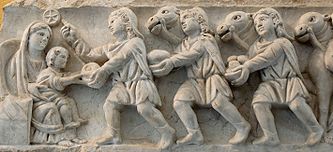
of around this date. They are later than the first scenes of the Adoration of the Magi, which appears in the catacombs of Rome
Catacombs of Rome
The Catacombs of Rome are ancient catacombs, underground burial places under or near Rome, Italy, of which there are at least forty, some discovered only in recent decades. Though most famous for Christian burials, either in separate catacombs or mixed together, they began in the 2nd century, much...
, where Early Christians buried their dead, often decorating the walls of the underground passages and vaults with paintings. Many of these predate the legalisation of Christian worship by the Emperor Constantine in the early 4th century. Typically the Magi move in step together, holding their gifts in front of them, towards a seated Virgin with Christ on her lap. They closely resemble the motif of tribute
Tribute
A tribute is wealth, often in kind, that one party gives to another as a sign of respect or, as was often the case in historical contexts, of submission or allegiance. Various ancient states, which could be called suzerains, exacted tribute from areas they had conquered or threatened to conquer...
-bearers which is common in the art of most Mediterranean and Middle-Eastern cultures, and goes back at least two millennia earlier in the case of Egypt; in contemporary Roman art defeated barbarians carry golden wreaths towards an enthroned Emperor.
Wicker
Wicker is hard woven fiber formed into a rigid material, usually used for baskets or furniture. Wicker is often made of material of plant origin, but plastic fibers are also used....
basket. The ox
Ox
An ox , also known as a bullock in Australia, New Zealand and India, is a bovine trained as a draft animal. Oxen are commonly castrated adult male cattle; castration makes the animals more tractable...
and ass
Donkey
The donkey or ass, Equus africanus asinus, is a domesticated member of the Equidae or horse family. The wild ancestor of the donkey is the African Wild Ass, E...
are always present, even when Mary or any other human is not. Although they are not mentioned in the Gospel accounts they were regarded as confirmed by scripture from some Old Testament
Old Testament
The Old Testament, of which Christians hold different views, is a Christian term for the religious writings of ancient Israel held sacred and inspired by Christians which overlaps with the 24-book canon of the Masoretic Text of Judaism...
verses, such as Isaiah
Isaiah
Isaiah ; Greek: ', Ēsaïās ; "Yahu is salvation") was a prophet in the 8th-century BC Kingdom of Judah.Jews and Christians consider the Book of Isaiah a part of their Biblical canon; he is the first listed of the neviim akharonim, the later prophets. Many of the New Testament teachings of Jesus...
1,3:"The ox knoweth his owner, and the ass his master's crib" and Habakkuk
Habakkuk
Habakkuk , also spelled Habacuc, was a prophet in the Hebrew Bible. The etymology of the name of Habakkuk is not clear. The name is possibly related to the Akkadian khabbaququ, the name of a fragrant plant, or the Hebrew root חבק, meaning "embrace"...
3,2: "in the midst of the two beasts wilt thou be known", and their presence was never questioned by theologians. They were regarded by Augustine
Augustine of Hippo
Augustine of Hippo , also known as Augustine, St. Augustine, St. Austin, St. Augoustinos, Blessed Augustine, or St. Augustine the Blessed, was Bishop of Hippo Regius . He was a Latin-speaking philosopher and theologian who lived in the Roman Africa Province...
, Ambrose
Ambrose
Aurelius Ambrosius, better known in English as Saint Ambrose , was a bishop of Milan who became one of the most influential ecclesiastical figures of the 4th century. He was one of the four original doctors of the Church.-Political career:Ambrose was born into a Roman Christian family between about...
and others as representing the Jewish people, weighed down by the Law (the ox), and the pagan peoples, carrying the sin of idolatry (the ass). Christ was arrived to free both from their burdens. Mary is only shown when the scene is the Adoration of the Magi, but often one of the shepherds, or a prophet
Prophet
In religion, a prophet, from the Greek word προφήτης profitis meaning "foreteller", is an individual who is claimed to have been contacted by the supernatural or the divine, and serves as an intermediary with humanity, delivering this newfound knowledge from the supernatural entity to other people...
with a scroll
Scroll
A scroll is a roll of parchment, papyrus, or paper, which has been drawn or written upon.Scroll may also refer to:*Scroll , the decoratively curved end of the pegbox of string instruments such as violins...
, is present. From the end of the 5th century (following the Council of Ephesus), Mary becomes a fixture in the scene; then as later Joseph is a more variable element. Where a building is shown, it is usually a tugurium, a simple tiled roof supported by posts.
Byzantine image
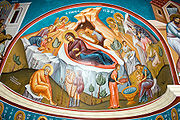
Palestine
Palestine is a conventional name, among others, used to describe the geographic region between the Mediterranean Sea and the Jordan River, and various adjoining lands....
, was to set the essential form of Eastern Orthodox images down to the present day. The setting is now a cave - or rather the specific Cave of the Nativity in Bethlehem, already underneath the Church of the Nativity
Church of the Nativity
The Church of the Nativity in Bethlehem is one of the oldest continuously operating churches in the world. The structure is built over the cave that tradition marks as the birthplace of Jesus of Nazareth, and thus it is considered sacred by Christians...
, and well-established as a place of pilgrimage
Pilgrimage
A pilgrimage is a journey or search of great moral or spiritual significance. Typically, it is a journey to a shrine or other location of importance to a person's beliefs and faith...
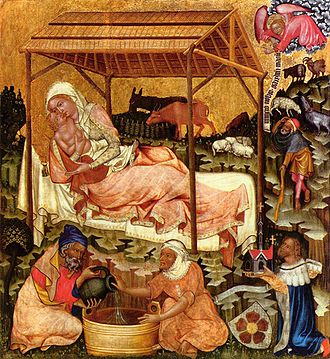
, with the approval of the Church. Above the opening a mountain, represented in miniature, rises up. Mary now lies recovering on a large stuffed cushion or couch ("kline" in Greek) beside the infant, who is on a raised structure, whilst Joseph rests his head on his hand. He is often part of a separate scene in the foreground, where Jesus is being bathed by midwives (Jesus is therefore shown twice). The midwife or midwives come from early apocryphal sources; the main one is usually called Salome
Salome (disciple)
Salome , sometimes venerated as Mary Salome, was a follower of Jesus who appears briefly in the canonical gospels and in more detail in apocryphal writings...
, and has her own miracle of the withered hand, although this is rare in art. They featured in most medieval dramas and mystery play
Mystery play
Mystery plays and miracle plays are among the earliest formally developed plays in medieval Europe. Medieval mystery plays focused on the representation of Bible stories in churches as tableaux with accompanying antiphonal song...
s of the Nativity, which often influenced painted depictions. Several apocryphal accounts speak of a great light illuminating the scene, also taken to be the star of the Magi
Biblical Magi
The Magi Greek: μάγοι, magoi), also referred to as the Wise Men, Kings, Astrologers, or Kings from the East, were a group of distinguished foreigners who were said to have visited Jesus after his birth, bearing gifts of gold, frankincense and myrrh...
, and this is indicated by a circular disc at the top of the scene, with a band coming straight down from it - both are often dark in colour.
The Magi may be shown approaching at the top left on horseback, wearing strange pillbox-like headgear, and the shepherds at the right of the cave. Angels usually surround the scene if there is room, including the top of the cave; often one is telling the shepherds the good news of Christ's birth. The figure of an old man, often dressed in animal skins, who begins as one of the shepherds in early depictions, but later sometimes addresses Joseph, is usually interpreted as the Prophet Isaiah
Isaiah
Isaiah ; Greek: ', Ēsaïās ; "Yahu is salvation") was a prophet in the 8th-century BC Kingdom of Judah.Jews and Christians consider the Book of Isaiah a part of their Biblical canon; he is the first listed of the neviim akharonim, the later prophets. Many of the New Testament teachings of Jesus...
, or a hermit repeating his prophecy, though in later Orthodox depictions he sometimes came to be regarded as the "Tempter" (the "shepherd-tempter"), an Orthodox term for Satan
Satan
Satan , "the opposer", is the title of various entities, both human and divine, who challenge the faith of humans in the Hebrew Bible...
, who is encouraging Joseph to doubt the Virgin Birth.
The Orthodox icon of the Nativity uses certain imagery parallel to that on the epitaphios (burial shroud of Jesus) and other icons depicting the burial of Jesus on Good Friday
Good Friday
Good Friday , is a religious holiday observed primarily by Christians commemorating the crucifixion of Jesus Christ and his death at Calvary. The holiday is observed during Holy Week as part of the Paschal Triduum on the Friday preceding Easter Sunday, and may coincide with the Jewish observance of...
. This is done intentionally to illustrate the theological
Theology
Theology is the systematic and rational study of religion and its influences and of the nature of religious truths, or the learned profession acquired by completing specialized training in religious studies, usually at a university or school of divinity or seminary.-Definition:Augustine of Hippo...
point that the purpose of the Incarnation of Christ was to make possible the Crucifixion
Crucifixion of Jesus
The crucifixion of Jesus and his ensuing death is an event that occurred during the 1st century AD. Jesus, who Christians believe is the Son of God as well as the Messiah, was arrested, tried, and sentenced by Pontius Pilate to be scourged, and finally executed on a cross...
and Resurrection
Resurrection of Jesus
The Christian belief in the resurrection of Jesus states that Jesus returned to bodily life on the third day following his death by crucifixion. It is a key element of Christian faith and theology and part of the Nicene Creed: "On the third day he rose again in fulfillment of the Scriptures"...
. The icon
Icon
An icon is a religious work of art, most commonly a painting, from Eastern Christianity and in certain Eastern Catholic churches...
of the Nativity depicts the Christ Child wrapped in swaddling clothes reminiscent of his burial wrappings. The child is often shown lying on a stone, representing the Tomb of Christ, rather than a manger
Manger
A manger is a trough or box of carved stone or wood construction used to hold food for animals . Mangers are mostly used in livestock raising. They are also used to feed wild animals, e.g., in nature reserves...
. The Cave of the Nativity is also a reminder of the cave in which Jesus was buried. Some icons of the Nativity show the Virgin Mary kneeling rather than reclining, indicating the tradition that the Theotokos
Theotokos
Theotokos is the Greek title of Mary, the mother of Jesus used especially in the Eastern Orthodox, Oriental Orthodox, and Eastern Catholic Churches. Its literal English translations include God-bearer and the one who gives birth to God. Less literal translations include Mother of God...
gave birth to Christ without pain (to contradict the perceived heresy
Heresy
Heresy is a controversial or novel change to a system of beliefs, especially a religion, that conflicts with established dogma. It is distinct from apostasy, which is the formal denunciation of one's religion, principles or cause, and blasphemy, which is irreverence toward religion...
in Nestorianism
Nestorianism
Nestorianism is a Christological doctrine advanced by Nestorius, Patriarch of Constantinople from 428–431. The doctrine, which was informed by Nestorius's studies under Theodore of Mopsuestia at the School of Antioch, emphasizes the disunion between the human and divine natures of Jesus...
).
Western image
Duccio
Duccio di Buoninsegna was one of the most influential Italian artists of his time. Born in Siena, Tuscany, he worked mostly with pigment and egg tempera and like most of his contemporaries painted religious subjects...
's Byzantine-influenced Maestà
Maestà (Duccio)
The Maestà, or Maestà of Duccio is an altarpiece composed of many individual paintings commissioned by the city of Siena in 1308 from the artist Duccio di Buoninsegna. The front panels make up a large enthroned Madonna and Child with saints and angels, and a predella of the Childhood of Christ...
version tries to have both. The midwives gradually dropped out from Western depictions, as Latin theologians disapproved of these legends; sometimes the bath remains, either being got ready or with Mary bathing Jesus. The midwives are still seen where Byzantine influence is strong, especially in Italy; as in Giotto, one may hand Jesus over to his mother. During the Gothic period, in the North earlier than in Italy, increasing closeness between mother and child develops, and Mary begins to hold her baby, or he looks over to her. Suckling is very unusual, but is sometimes shown.
The image in later medieval Northern Europe was often influenced by the vision of the Nativity of Saint Bridget of Sweden
Bridget of Sweden
Bridget of Sweden Bridget of Sweden Bridget of Sweden (1303 – 23 July 1373; also Birgitta of Vadstena, Saint Birgitta , was a mystic and saint, and founder of the Bridgettines nuns and monks after the death of her husband of twenty years...
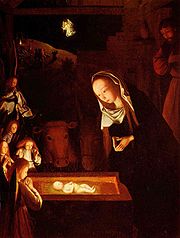
(1303–1373), a very popular mystic. Shortly before her death, she described a vision of the infant Jesus as lying on the ground, and emitting light himself, and describes the Virgin as blond-haired; many depictions reduced other light sources in the scene to emphasize this effect, and the Nativity remained very commonly treated with chiaroscuro
Chiaroscuro
Chiaroscuro in art is "an Italian term which literally means 'light-dark'. In paintings the description refers to clear tonal contrasts which are often used to suggest the volume and modelling of the subjects depicted"....
through to the Baroque. Other details such as a single candle "attached to the wall", and the presence of God the Father
God the Father
God the Father is a gendered title given to God in many monotheistic religions, particularly patriarchal, Abrahamic ones. In Judaism, God is called Father because he is the creator, life-giver, law-giver, and protector...
above, also come from Bridget's vision:
...the virgin knelt down with great veneration in an attitude of prayer, and her back was turned to the manger.... And while she was standing thus in prayer, I saw the child in her womb move and suddenly in a moment she gave birth to her son, from whom radiated such an ineffable light and splendour, that the sun was not comparable to it, nor did the candle that St. Joseph had put there, give any light at all, the divine light totally annihilating the material light of the candle.... I saw the glorious infant lying on the ground naked and shining. His body was pure from any kind of soil and impurity. Then I heard also the singing of the angels, which was of miraculous sweetness and great beauty...After this the Virgin kneels to pray to her child, to be joined by St Joseph, and this (technically known as the Adoration of Christ or "of the Child") becomes one of the commonest depictions in the 15th century, largely replacing the reclining Virgin in the West. Versions of this depiction occur as early as 1300, well before Bridget's vision, and have a Franciscan
Franciscan
Most Franciscans are members of Roman Catholic religious orders founded by Saint Francis of Assisi. Besides Roman Catholic communities, there are also Old Catholic, Anglican, Lutheran, ecumenical and Non-denominational Franciscan communities....
origin.
Saint Joseph
Saint Joseph is a figure in the Gospels, the husband of the Virgin Mary and the earthly father of Jesus Christ ....
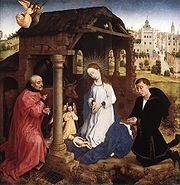
, traditionally regarded as an old man, is often shown asleep in Nativities, and becomes a somewhat comical figure in some depictions, untidily dressed, and unable to help with proceedings. In some depictions, mostly German, he wears a Jewish hat. In medieval mystery play
Mystery play
Mystery plays and miracle plays are among the earliest formally developed plays in medieval Europe. Medieval mystery plays focused on the representation of Bible stories in churches as tableaux with accompanying antiphonal song...
s, he was usually a comic figure, amiable but somewhat incapable, although he is sometimes showing cutting up his hose
Hose (clothing)
Hose are any of various styles of men's clothing for the legs and lower body, worn from the Middle Ages through the 17th century, when the term fell out of use in favor of breeches and stockings. The old plural form of "hose" was hosen...
to make the swaddling-cloth for the child, or lighting a fire. Saint Joseph's cult was increasingly promoted in the late Middle Ages in the West, by the Franciscan
Franciscan
Most Franciscans are members of Roman Catholic religious orders founded by Saint Francis of Assisi. Besides Roman Catholic communities, there are also Old Catholic, Anglican, Lutheran, ecumenical and Non-denominational Franciscan communities....
s and others (his feast was only added to the Roman Breviary
Breviary
A breviary is a liturgical book of the Latin liturgical rites of the Catholic Church containing the public or canonical prayers, hymns, the Psalms, readings, and notations for everyday use, especially by bishops, priests, and deacons in the Divine Office...
in 1479). By the 15th century he is often more dignified, and this improvement continued through the Renaissance
Renaissance
The Renaissance was a cultural movement that spanned roughly the 14th to the 17th century, beginning in Italy in the Late Middle Ages and later spreading to the rest of Europe. The term is also used more loosely to refer to the historical era, but since the changes of the Renaissance were not...
and Baroque
Baroque
The Baroque is a period and the style that used exaggerated motion and clear, easily interpreted detail to produce drama, tension, exuberance, and grandeur in sculpture, painting, literature, dance, and music...
, until a resurgence of Marian emphasis in the 17th century again often leaves him stranded on the margins of Nativity compositions. The candle lit by St Joseph in Bridget's vision becomes an attribute, which he is often shown holding, lit or unlit, in broad daylight.
In a fully illuminated Book of hours
Book of Hours
The book of hours was a devotional book popular in the later Middle Ages. It is the most common type of surviving medieval illuminated manuscript. Like every manuscript, each manuscript book of hours is unique in one way or another, but most contain a similar collection of texts, prayers and...
it was normal to include pages illustrating all four of the Nativity, the Announcement to the Shepherds, the Adoration of the Magi and the Flight into Egypt (and/or the Massacre of the Innocents) as part of the eight images in the sequence of the Hours of the Virgin. Nativity images became increasing popular in panel paintings in the 15th century, although on altarpiece
Altarpiece
An altarpiece is a picture or relief representing a religious subject and suspended in a frame behind the altar of a church. The altarpiece is often made up of two or more separate panels created using a technique known as panel painting. It is then called a diptych, triptych or polyptych for two,...
s the Holy Family
Holy Family
The Holy Family consists of the Child Jesus, the Virgin Mary, and Saint Joseph.The Feast of the Holy Family is a liturgical celebration in the Roman Catholic Church in honor of Jesus of Nazareth, his mother, the Blessed Virgin Mary, and his foster father, Saint Joseph, as a family...
often had to share the picture space with donor portrait
Donor portrait
A donor portrait or votive portrait is a portrait in a larger painting or other work showing the person who commissioned and paid for the image, or a member of his, or her, family...
s. In Early Netherlandish painting
Early Netherlandish painting
Early Netherlandish painting refers to the work of artists active in the Low Countries during the 15th- and early 16th-century Northern renaissance, especially in the flourishing Burgundian cities of Bruges and Ghent...
the usual simple shed, little changed from Late Antiquity, developed into an elaborate ruined temple, initially Romanesque
Romanesque architecture
Romanesque architecture is an architectural style of Medieval Europe characterised by semi-circular arches. There is no consensus for the beginning date of the Romanesque architecture, with proposals ranging from the 6th to the 10th century. It developed in the 12th century into the Gothic style,...
in style, which represented the dilapidated state of the Old Covenant
Covenant (biblical)
A biblical covenant is an agreement found in the Bible between God and His people in which God makes specific promises and demands. It is the customary word used to translate the Hebrew word berith. It it is used in the Tanakh 286 times . All Abrahamic religions consider the Biblical covenant...
of the Jewish law. The use of Romanesque architecture to identify Jewish rather than Christian settings is a regular feature of the paintings of Jan van Eyck
Jan van Eyck
Jan van Eyck was a Flemish painter active in Bruges and considered one of the best Northern European painters of the 15th century....
and his followers. In Italian works the architecture of such temples became classical, reflecting the growing interest in the ancient world. An additional reference made by these temples was to the legend, reported in the popular compilation of the Golden Legend
Golden Legend
The Golden Legend is a collection of hagiographies by Jacobus de Voragine that became a late medieval bestseller. More than a thousand manuscripts of the text have survived, compared to twenty or so of its nearest rivals...
, that on the night of Christ's birth the Basilica of Maxentius
Basilica of Maxentius
The Basilica of Maxentius and Constantine is an ancient building in the Roman Forum, Rome, Italy...
in Rome, supposed to house a statue of Romulus
Romulus
- People:* Romulus and Remus, the mythical founders of Rome* Romulus Augustulus, the last Western Roman Emperor* Valerius Romulus , deified son of the Roman emperor Maxentius* Romulus , son of the Western Roman emperor Anthemius...
, had partly tumbled to the ground, leaving the impressive ruins that survive today.
Renaissance and after
From the 15th century onwards, the Adoration of the Magi increasingly became a more common depiction than the Nativity proper, partly as the subject lent itself to many pictorial details and rich colouration, and partly as paintings became larger, with more space for the more crowded subject. The scene is increasingly conflated with the Adoration of the Shepherds from the late Middle Ages onwards, though they have been shown combined on occasions since Late AntiquityLate Antiquity
Late Antiquity is a periodization used by historians to describe the time of transition from Classical Antiquity to the Middle Ages, in both mainland Europe and the Mediterranean world. Precise boundaries for the period are a matter of debate, but noted historian of the period Peter Brown proposed...
. In the West the Magi developed large exotically-dressed retinues, which sometimes threaten to take over the composition by the time of the Renaissance; there is undoubtedly a loss of concentration on the religious meaning of the scenes in some examples, especially in 15th century Florence
Florence
Florence is the capital city of the Italian region of Tuscany and of the province of Florence. It is the most populous city in Tuscany, with approximately 370,000 inhabitants, expanding to over 1.5 million in the metropolitan area....
, where large secular paintings were still a considerable novelty. The large and famous wall-painting of the Procession of the Magi in the Magi Chapel
Magi Chapel
The Magi Chapel is a chapel in Palazzo Medici Riccardi of Florence, Italy. It includes a famous cycle of frescoes by the Renaissance master Benozzo Gozzoli, painted in 1459-1461....
of the Palazzo Medici there, painted by Benozzo Gozzoli
Benozzo Gozzoli
Benozzo Gozzoli was an Italian Renaissance painter from Florence. He is best known for a series of murals in the Palazzo Medici-Riccardi depicting festive, vibrant processions with wonderful attention to detail and a pronounced International Gothic influence.-Apprenticeship:He was born Benozzo di...
in 1459-1461 and full of portraits of the family, only reveals its religious subject by its location in a chapel, and its declared title. There are virtually no indications that this is the subject contained in the work itself, although the altarpiece for the chapel was the Adoration in the Forest
Adoration in the Forest (Lippi)
thumb|300px| "dark intensity and bursts of golden light " - [[Filippo Lippi]]'s Adoration in the ForestAdoration in the Forest is a 15th century [completed by 1459] painting by the Carmelite friar, Filippo Lippi, of the Virgin Mary and the newly born Christ Child lying on the ground, in the unusual...
by Filippo Lippi
Filippo Lippi
Fra' Filippo Lippi , also called Lippo Lippi, was an Italian painter of the Italian Quattrocento .-Biography and works:...
(now Berlin).
Caravaggio
Michelangelo Merisi da Caravaggio was an Italian artist active in Rome, Naples, Malta, and Sicily between 1593 and 1610. His paintings, which combine a realistic observation of the human state, both physical and emotional, with a dramatic use of lighting, had a formative influence on the Baroque...
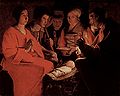
led a return to a more realistic treatment of the Adoration of the Shepherds. The compositions, as with most religious scenes, becomes more varied as artistic originality becomes more highly regarded than iconographic tradition; the works illustrated by Gerard van Honthorst
Gerard van Honthorst
Gerard van Honthorst , also known as Gerrit van Honthorst and in Italy as Gherardo delle Notti for his nighttime candlelit subjects, was a Dutch Golden Age painter from Utrecht.-Biography:...
, Georges de La Tour
Georges de La Tour
Georges de La Tour was a French Baroque painter, who spent most of his working life in the Duchy of Lorraine, which was temporarily absorbed into France between 1641 and 1648...
, and Charles Le Brun
Charles Le Brun
Charles Le Brun , a French painter and art theorist, became the all-powerful, peerless master of 17th-century French art.-Biography:-Early life and training:...
of the Adoration of the Shepherds all show different poses and actions by Mary, none quite the same as the traditional ones. The subject becomes surprisingly uncommon in the artistic mainstream after the 18th century, even given the general decline in religious painting. William Blake's illustrations of On the Morning of Christ's Nativity
William Blake's illustrations of On the Morning of Christ's Nativity
William Blake drew and painted illustrations for John Milton's nativity ode On the Morning of Christ's Nativity between 1803 and 1815. A total of 16 illustrations are extant: two sets of six watercolours each, and an additional four drawings in pencil.The dating of the sets is unknown, as is...
are a typically esoteric treatment in watercolour. Edward Burne-Jones
Edward Burne-Jones
Sir Edward Coley Burne-Jones, 1st Baronet was a British artist and designer closely associated with the later phase of the Pre-Raphaelite movement, who worked closely with William Morris on a wide range of decorative arts as a founding partner in Morris, Marshall, Faulkner, and Company...
, working with Morris & Co.
Morris & Co.
Morris, Marshall, Faulkner & Co. and its successor Morris & Co. were furnishings and decorative arts manufacturers and retailers founded by the Pre-Raphaelite artist and designer William Morris...
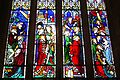
, produced major works on the theme, with a set of stained glass windows at Trinity Church, Boston
Trinity Church, Boston
Trinity Church in the City of Boston, located in the Back Bay of Boston, Massachusetts, is a parish of the Episcopal Diocese of Massachusetts. The congregation, currently standing at approximately 3,000 households, was founded in 1733. The current rector is The Reverend Anne Bonnyman...
(1882), a tapestry of the Adoration of the Magi
Adoration of the Magi (tapestry)
The Adoration of the Magi is a Morris & Co. tapestry depicting the story in Christianity of the Three Kings who were guided to the birthplace of Jesus by the star of Bethlehem...
(ten copies, from 1890) and a painting of the same subject
Star of Bethlehem (painting)
The Star of Bethlehem is a painting in watercolour by Sir Edward Burne-Jones depicting the Adoration of the Magi with an angel holding the star of Bethlehem. It was commissioned by the Corporation of the City of Birmingham for its new Museum and Art Gallery in 1887, two years after Burne-Jones was...
(1887). Popular religious depictions have continued to flourish, despite the competition from secular Christmas imagery.
See also
- Nativity of Jesus in later cultureNativity of Jesus in later culture-Drama:*The Nativity appears in many cycles of the Mystery Plays.*Laurence Housman .*Lucjan Rydel .*Cicely Hamilton -Drama:*The Nativity appears in many cycles of the Mystery Plays.*Laurence Housman (Bethlehem, 1902; musical accompaniment by Joseph Moorat c.1919).*Lucjan Rydel (Polish Bethlehem,...
for interpretations in other forms of art (music, opera, novels, etc.) - Nativity SceneNativity sceneA nativity scene, manger scene, krippe, crèche, or crib, is a depiction of the birth of Jesus as described in the gospels of Matthew and Luke...
for the decoration also known as a creche or crib. - Roman Catholic Marian artRoman Catholic Marian artThe Blessed Virgin Mary has been one of the major subjects of Christian Art, Catholic Art and Western Art for many centuries. Literally hundreds of thousands of pieces of...