


Chinoiserie

Encyclopedia

Chinese art
Chinese art is visual art that, whether ancient or modern, originated in or is practiced in China or by Chinese artists or performers. Early so-called "stone age art" dates back to 10,000 BC, mostly consisting of simple pottery and sculptures. This early period was followed by a series of art...
influences. It is characterized by the use of fanciful imagery of an imaginary China, by asymmetry
Asymmetry
Asymmetry is the absence of, or a violation of, symmetry.-In organisms:Due to how cells divide in organisms, asymmetry in organisms is fairly usual in at least one dimension, with biological symmetry also being common in at least one dimension....
in format and whimsical contrasts of scale, and by the attempts to imitate Chinese porcelain
Chinese porcelain
Chinese ceramic ware shows a continuous development since the pre-dynastic periods, and is one of the most significant forms of Chinese art. China is richly endowed with the raw materials needed for making ceramics. The first types of ceramics were made during the Palaeolithic era...
and the use of lacquerlike materials and decoration.
Chinoiserie is a mixture of Eastern and Western stylistic elements for both the decoration
Decoration
Decoration may refer to:* Decorative arts, the craft of a house painter and decorator.* An object or act intended to increase beauty of a person, room, etc....
and shape
Shape
The shape of an object located in some space is a geometrical description of the part of that space occupied by the object, as determined by its external boundary – abstracting from location and orientation in space, size, and other properties such as colour, content, and material...
.
History
Chinoiserie entered the European repertory in the mid-to-late 17th century; the work of Athanasius Kircher had a lot of influence on the study of orientalismOrientalism
Orientalism is a term used for the imitation or depiction of aspects of Eastern cultures in the West by writers, designers and artists, as well as having other meanings...
. The popularity of chinoiserie peaked around the middle of the 18th century, when it was easily assimilated into rococo
Rococo
Rococo , also referred to as "Late Baroque", is an 18th-century style which developed as Baroque artists gave up their symmetry and became increasingly ornate, florid, and playful...
by the works of François Boucher
François Boucher
François Boucher was a French painter, a proponent of Rococo taste, known for his idyllic and voluptuous paintings on classical themes, decorative allegories representing the arts or pastoral occupations, intended as a sort of two-dimensional furniture...
. It declined when it seemed to European eyes the very antithesis of neoclassicism
Neoclassicism
Neoclassicism is the name given to Western movements in the decorative and visual arts, literature, theatre, music, and architecture that draw inspiration from the "classical" art and culture of Ancient Greece or Ancient Rome...
.
Chinoiserie is expressed entirely in the decorative arts of Europe, and its expression in architecture was entirely in the field of whimsical follies
Folly
In architecture, a folly is a building constructed primarily for decoration, but either suggesting by its appearance some other purpose, or merely so extravagant that it transcends the normal range of garden ornaments or other class of building to which it belongs...
. By contrast, the serious transformations that Chinese models effected in the eighteenth century, on the plain style of Early Georgian English furniture, notable in the cabriole leg
Cabriole leg
A cabriole leg is one of four vertical supports of a piece of furniture shaped in two curves; the upper arc is convex, while lower is concave; the upper curve always bows outward, while the lower curve bows inward. The axes of the two curves must lie within the same plane...
, or on the "naturalistic" style of English landscape gardening, to take two clear examples, are not considered instances of "Chinoiserie".
Chinoiserie has made a comeback since the late 20th century. Modern interpretations of Chinoiserie incorporate modern design elements, and techniques. Chinoiserie can be seen as in influence in many housewares throughout Europe and North America.
Chinese porcelain
Renaissance
The Renaissance was a cultural movement that spanned roughly the 14th to the 17th century, beginning in Italy in the Late Middle Ages and later spreading to the rest of Europe. The term is also used more loosely to refer to the historical era, but since the changes of the Renaissance were not...
to the 18th century Western designers attempted to imitate the technical sophistication of Chinese ceramics
Chinese porcelain
Chinese ceramic ware shows a continuous development since the pre-dynastic periods, and is one of the most significant forms of Chinese art. China is richly endowed with the raw materials needed for making ceramics. The first types of ceramics were made during the Palaeolithic era...
with only partial success. Direct imitation of Chinese designs in faience
Faience
Faience or faïence is the conventional name in English for fine tin-glazed pottery on a delicate pale buff earthenware body, originally associated with Faenza in northern Italy. The invention of a white pottery glaze suitable for painted decoration, by the addition of an oxide of tin to the slip...
began in the late 17th century, was carried into European porcelain
Porcelain
Porcelain is a ceramic material made by heating raw materials, generally including clay in the form of kaolin, in a kiln to temperatures between and...
production, most naturally in tea wares, and peaked in the wave of rococo Chinoiserie (ca. 1740-1770).
Earliest hints of Chinoiserie appear in the early 17th century, in the arts of the nations with active East India Companies, Holland
Dutch East India Company
The Dutch East India Company was a chartered company established in 1602, when the States-General of the Netherlands granted it a 21-year monopoly to carry out colonial activities in Asia...
and England
British East India Company
The East India Company was an early English joint-stock company that was formed initially for pursuing trade with the East Indies, but that ended up trading mainly with the Indian subcontinent and China...
, then by mid-17th century, in Portugal as well. Tin-glazed pottery
Tin-glazed pottery
Tin-glazed pottery is a majolica pottery covered in glaze containing tin oxide which is white, shiny and opaque. The pottery body is usually made of red or buff colored earthenware and the white glaze was often used to imitate Chinese porcelain...
(see delftware
Delftware
Delftware, or Delft pottery, denotes blue and white pottery made in and around Delft in the Netherlands and the tin-glazed pottery made in the Netherlands from the 16th century....
) made at Delft
Delft
Delft is a city and municipality in the province of South Holland , the Netherlands. It is located between Rotterdam and The Hague....
and other Dutch towns adopted genuine blue-and-white Ming
Ming Dynasty
The Ming Dynasty, also Empire of the Great Ming, was the ruling dynasty of China from 1368 to 1644, following the collapse of the Mongol-led Yuan Dynasty. The Ming, "one of the greatest eras of orderly government and social stability in human history", was the last dynasty in China ruled by ethnic...
decoration from the early 17th century. After a book by Johan Nieuhof
Johan Nieuhof
Johan Nieuhoff was a Dutch traveler who wrote about his journeys to Brazil, China and India...
was published the 150 pictures encouraged chinoiserie, and became especially popular in the 18th century. Early ceramic wares at Meissen
Meissen
Meissen is a town of approximately 30,000 about northwest of Dresden on both banks of the Elbe river in the Free State of Saxony, in eastern Germany. Meissen is the home of Meissen porcelain, the Albrechtsburg castle, the Gothic Meissen Cathedral and the Meissen Frauenkirche...
and other centers of true porcelain
Porcelain
Porcelain is a ceramic material made by heating raw materials, generally including clay in the form of kaolin, in a kiln to temperatures between and...
naturally imitated Chinese shapes for dishes, vases and tea wares.
Interior decoration
Louis XV of France
Louis XV was a Bourbon monarch who ruled as King of France and of Navarre from 1 September 1715 until his death. He succeeded his great-grandfather at the age of five, his first cousin Philippe II, Duke of Orléans, served as Regent of the kingdom until Louis's majority in 1723...
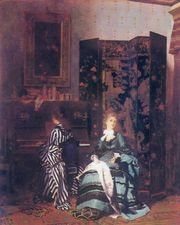
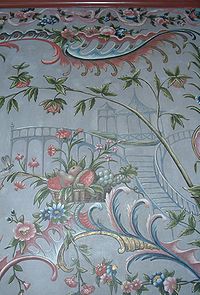
, gave special favor to Chinoiserie, as it blended well with the rococo
Rococo
Rococo , also referred to as "Late Baroque", is an 18th-century style which developed as Baroque artists gave up their symmetry and became increasingly ornate, florid, and playful...
style. Entire rooms, such as those at Château de Chantilly
Château de Chantilly
The Château de Chantilly is a historic château located in the town of Chantilly, France. It comprises two attached buildings; the Grand Château, destroyed during the French Revolution and rebuilt in the 1870s, and the Petit Château which was built around 1560 for Anne de Montmorency...
, were painted with Chinoiserie compositions, and artists such as Antoine Watteau
Antoine Watteau
Jean-Antoine Watteau was a French painter whose brief career spurred the revival of interest in colour and movement...
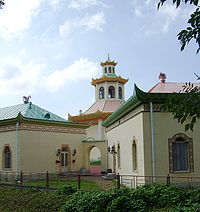
and others brought expert craftsmanship to the style. Pleasure pavilions in "Chinese taste" appeared in the formal parterres of late Baroque and Rococo German and Russian palaces, and in tile panels at Aranjuez
Aranjuez
Aranjuez is a town lying 48 km south of Madrid, in the southern part of the Community of Madrid. It is located at the confluence of the Tagus and Jarama rivers, 48 km from Toledo. As of 2009, it has a population of 54,055.-History:...
near Madrid
Madrid
Madrid is the capital and largest city of Spain. The population of the city is roughly 3.3 million and the entire population of the Madrid metropolitan area is calculated to be 6.271 million. It is the third largest city in the European Union, after London and Berlin, and its metropolitan...
. The whole Chinese Villages were built in Drottningholm
Drottningholm Palace
The Drottningholm Palace is the private residence of the Swedish royal family. It is located in Drottningholm. It is built on the island Lovön , and is one of Sweden's Royal Palaces. It was originally built in the late 16th century. It served as a residence of the Swedish royal court for most of...
, Sweden
Sweden
Sweden , officially the Kingdom of Sweden , is a Nordic country on the Scandinavian Peninsula in Northern Europe. Sweden borders with Norway and Finland and is connected to Denmark by a bridge-tunnel across the Öresund....
and Tsarskoe Selo, Russia
Russia
Russia or , officially known as both Russia and the Russian Federation , is a country in northern Eurasia. It is a federal semi-presidential republic, comprising 83 federal subjects...
. Thomas Chippendale
Thomas Chippendale
Thomas Chippendale was a London cabinet-maker and furniture designer in the mid-Georgian, English Rococo, and Neoclassical styles. In 1754 he published a book of his designs, titled The Gentleman and Cabinet Maker's Director...
's mahogany tea tables and china cabinets, especially, were embellished with fretwork glazing and railings, ca 1753 - 70, but sober homages to early Qing
Qing Dynasty
The Qing Dynasty was the last dynasty of China, ruling from 1644 to 1912 with a brief, abortive restoration in 1917. It was preceded by the Ming Dynasty and followed by the Republic of China....
scholars' furnishings were also naturalized, as the tang evolved into a mid-Georgian side table and squared slat-back armchairs suited English gentlemen as well as Chinese scholars. Not every adaptation of Chinese design principles falls within mainstream "chinoiserie." Chinoiserie media included "japanned" ware imitations of lacquer and painted tin (tôle) ware that imitated japanning
Japanning
Japanning describes the European imitation of Asian lacquerwork, originally used on furniture. The word originated in the 17th century.- Japanned :Japanned is most often a heavy black lacquer, almost like enamel paint...
, early painted wallpapers in sheets, after engraving
Engraving
Engraving is the practice of incising a design on to a hard, usually flat surface, by cutting grooves into it. The result may be a decorated object in itself, as when silver, gold, steel, or glass are engraved, or may provide an intaglio printing plate, of copper or another metal, for printing...
s by Jean-Baptiste Pillement
Jean-Baptiste Pillement
Jean-Baptiste Pillement was a painter and designer, known for his exquisite and delicate landscapes, but whose importance lies primarily in the engravings done after his drawings, and their influence in spreading the Rococo style and particularly the taste for chinoiserie throughout...
, and ceramic figurines and table ornaments.
Architecture and gardens
Small pagodaPagoda
A pagoda is the general term in the English language for a tiered tower with multiple eaves common in Nepal, India, China, Japan, Korea, Vietnam and other parts of Asia. Some pagodas are used as Taoist houses of worship. Most pagodas were built to have a religious function, most commonly Buddhist,...
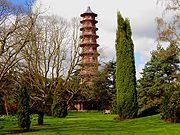
s appeared on chimneypieces and full-sized ones in gardens. Kew
Kew
Kew is a place in the London Borough of Richmond upon Thames in South West London. Kew is best known for being the location of the Royal Botanic Gardens, now a World Heritage Site, which includes Kew Palace...
has a magnificent garden pagoda designed by Sir William Chambers
William Chambers (architect)
Sir William Chambers was a Scottish architect, born in Gothenburg, Sweden, where his father was a merchant. Between 1740 and 1749 he was employed by the Swedish East India Company making several voyages to China where he studied Chinese architecture and decoration.Returning to Europe, he studied...
, a replica of which was built in Munich
Munich
Munich The city's motto is "" . Before 2006, it was "Weltstadt mit Herz" . Its native name, , is derived from the Old High German Munichen, meaning "by the monks' place". The city's name derives from the monks of the Benedictine order who founded the city; hence the monk depicted on the city's coat...
's Englischer Garten. Though the rise of a more serious approach in Neoclassicism
Neoclassicism
Neoclassicism is the name given to Western movements in the decorative and visual arts, literature, theatre, music, and architecture that draw inspiration from the "classical" art and culture of Ancient Greece or Ancient Rome...
from the 1770s onward tended to replace Oriental inspired designs, at the height of Regency "Grecian" furnishings, the Prince Regent
George IV of the United Kingdom
George IV was the King of the United Kingdom of Great Britain and Ireland and also of Hanover from the death of his father, George III, on 29 January 1820 until his own death ten years later...
came down with a case of Brighton Pavilion, and Chamberlain's Worcester china
Royal Worcester
Royal Worcester is believed to be the oldest remaining English pottery brand still in existence today.-Overview:Royal Worcester is a British brand known for its history, provenance and classically English collections of porcelain...
manufactory imitated gaudy "Imari
Imari porcelain
Imari porcelain is the name for Japanese porcelain wares made in the town of Arita, in the former Hizen Province, northwestern Kyūshū. They were exported to Europe extensively from the port of Imari, Saga between latter half of 17th century and former half of 18 th century, Japanese as well as the...
" wares. While classical styles reigned in the parade rooms, upscale houses, from Badminton House
Badminton House
Badminton House is a large country house in Gloucestershire, England, and has been the principal seat of the Dukes of Beaufort since the late 17th century, when the family moved from Raglan Castle, which had been ruined in the English Civil War...
(where the "Chinese Bedroom" was furnished by William and John Linnell
John Linnell
John Sidney Linnell is an American musician, is known primarily as one half of Brooklyn, New York alternative rock duo They Might Be Giants...
, ca 1754) and Nostell Priory
Nostell Priory
Nostell Priory is a Palladian house located in Nostell, near Crofton close to Wakefield, West Yorkshire, England, approached by the Doncaster road from Wakefield...
to Casa Loma
Casa Loma
Casa Loma is a Gothic Revival style house in midtown Toronto, Ontario, Canada, that is now a museum and landmark. It was originally a residence for financier Sir Henry Mill Pellatt. Casa Loma was constructed over a three-year period from 1911–1914. The architect of the mansion was E. J...
in Toronto, sometimes feature an entire guest room decorated in the chinoiserie style, complete with Chinese-styled bed, phoenix
Fenghuang
Fenghuang are mythological birds of East Asia that reign over all other birds. The males are called Feng and the females Huang. In modern times, however, such a distinction of gender is often no longer made and the Feng and Huang are blurred into a single feminine entity so that the bird can be...
-themed wallpaper, and china
Porcelain
Porcelain is a ceramic material made by heating raw materials, generally including clay in the form of kaolin, in a kiln to temperatures between and...
. Later exoticisms added imaginary Turkish themes, where a "diwan"
Divan
A divan was a high governmental body in a number of Islamic states, or its chief official .-Etymology:...
became a sofa
Couch
A couch, also called a sofa, is an item of furniture designed to seat more than one person, and providing support for the back and arms. Typically, it will have an armrest on either side. In homes couches are normally found in the family room, living room, den or the lounge...
.
Literary criticism
The term is also used in literary criticism to describe a mannered "Chinese-esque" style of writing, such as that employed by Ernest BramahErnest Bramah
Ernest Bramah , born Ernest Brammah Smith, was an English author. He published 21 books and numerous short stories and features. His humorous works were ranked with Jerome K Jerome, and W.W. Jacobs, his detective stories with Conan Doyle, his politico-science fiction with H.G. Wells and his...
in his Kai Lung
Kai Lung
Kai Lung is a fictional character in a series of books by Ernest Bramah, consisting of The Wallet of Kai Lung , Kai Lung's Golden Hours , Kai Lung Unrolls His Mat , The Moon of Much Gladness , Kai Lung Beneath the Mulberry Tree , Kai Lung: Six and Kai Lung Raises His...
stories, Barry Hughart
Barry Hughart
Barry Hughart in Peoria, Illinois, is an American author of fantasy novels.- Background :Hughart was born in Peoria, Illinois on March 13, 1934. His father, John Harding Page, served as a naval officer. His mother, Veronica Hughart, was an architect.Hughart was educated at Phillips Academy...
in his Master Li & Number Ten Ox novels and Stephen Marley
Stephen Marley (writer)
Stephen Marley is a British author and video game designer, best known for his Chia Black Dragon series. He was born in Derby of Irish parents and was educated in Bemrose School in Derby and at Nottingham. He graduated in Social Anthropology in 1971 in London, gained an M.Sc in the Sociology of...
in his Chia Black Dragon
Chia Black Dragon
Chia Black Dragon is the eponymous anti-hero of a dark fantasy series of novels written by Stephen Marley. Chia is identified in the novels as "The most dangerous woman in the history of man". The term "Chinese Gothic" was coined to describe the world of Chia Black Dragon.-Character overview:Chia...
series.
Fashion
The term is also used in the fashionFashion
Fashion, a general term for a currently popular style or practice, especially in clothing, foot wear, or accessories. Fashion references to anything that is the current trend in look and dress up of a person...
industry to describe "designs in textiles, fashion, and the decorative arts that derive from Chinese styles".
Music
Musical criticism employs the term occasionally, as with the operaOpera
Opera is an art form in which singers and musicians perform a dramatic work combining text and musical score, usually in a theatrical setting. Opera incorporates many of the elements of spoken theatre, such as acting, scenery, and costumes and sometimes includes dance...
s of Jacques Offenbach
Jacques Offenbach
Jacques Offenbach was a Prussian-born French composer, cellist and impresario. He is remembered for his nearly 100 operettas of the 1850s–1870s and his uncompleted opera The Tales of Hoffmann. He was a powerful influence on later composers of the operetta genre, particularly Johann Strauss, Jr....
and Emmanuel Chabrier
Emmanuel Chabrier
Emmanuel Chabrier was a French Romantic composer and pianist. Although known primarily for two of his orchestral works, España and Joyeuse marche, he left an important corpus of operas , songs, and piano music as well...
.
External links
- Epoh Beech Uk Chinoiserie exponent
- Chinoiserie at Highbeam Encyclopedia
- (Getty Museum) "Imagining the Orient" exhibition, 2004-05.
- Example of Chinoiserie in French Style Harpsichord