
Published posthumously
A comic was also released based on the film
Tintin et le lac aux requins.
Characters
Tintin and Snowy
Tintin is a young Belgian reporter who becomes involved in dangerous cases in which he takes heroic action to save the day. Almost every adventure features Tintin hard at work in his
investigative journalism, but he is seldom seen actually turning in a story without first getting caught up in some misadventure. He is a young man of more or less neutral attitudes and is less colourful than the supporting cast. In this respect, he represents the
everyman.
Snowy, a white
Fox terrier, is Tintin's four-legged companion. They regularly save each other from perilous situations. Snowy frequently "speaks" to the reader through his thoughts (often displaying a dry sense of humour), which are supposedly not heard by the human characters in the story except in
Tintin in America, wherein he explains to Tintin his absence for a period of time in the book.
Like Captain Haddock, Snowy is fond of the
Loch Lomond brand of
whisky, and his occasional bouts of drinking tend to get him into trouble, as does his
arachnophobia. The French name of Snowy, "Milou," has nothing to do with snow or the colour white. It has been widely credited as an oblique reference to a girlfriend from Hergé's youth, Marie-Louise Van Cutsem, whose nickname was "Milou".
Another explanation to the origins of the two characters is possible. The first 3 adventures of Tintin visit places originally visited by photographer-reporter Robert Sexé, recorded in the Belgian press from the mid to late 1920s. At that time Sexé had made numerous trips round the world on a motorcycle, in collaboration with Grand-Prix champion and motorcycle record-holder René Milhoux, and these trips were highly publicized at the time. Sexé has also been noted to have a similar appearance to Tintin, and the
Hergé Foundation in Belgium has admitted that it is not too hard to imagine how Hergé could have been influenced by the exploits of Sexé. In 1996, a biography of Robert Sexé by Janpol Schulz was published, titled "Sexé au pays des Soviets" (Sexé in the Land of the Soviets) to mimic the name of the first Tintin Adventure.
Captain Haddock
Captain Archibald Haddock, a seafaring captain of disputed ancestry (he may be of English, French, or Belgian origin), is Tintin's best friend, and was introduced in
The Crab with the Golden Claws. Haddock was initially depicted as a weak and
alcoholic character, but later became more respectable. He evolves to become genuinely heroic and even a socialite after he finds a treasure captured by his ancestor,
Sir Francis Haddock (
François de Hadoque in French), in the episode
Red Rackham's Treasure. The Captain's coarse humanity and
sarcasm act as a counterpoint to Tintin's often implausible heroism; he is always quick with a dry comment whenever the boy reporter seems too idealistic.
Captain Haddock lives in the luxurious mansion
Marlinspike Hall ("Moulinsart" in the original French).
Haddock uses a range of colourful insults and curses to express his feelings, such as "billions of blue blistering barnacles," "ten thousand thundering typhoons," "
troglodyte," "
bashi-bazouk," "
kleptomaniac," "
ectoplasm," "
sea-
gherkin," "
anacoluthon," and "
pockmark," but nothing that is actually considered a
swear word. Haddock is a hard drinker, particularly fond of
Loch Lomond whisky, and his bouts of drunkenness are often used for comic effect.
Hergé stated that Haddock's surname was derived from a "sad English fish that drinks a lot." Haddock remained without a first name until the last completed story,
Tintin and the Picaros (1976), when the name
Archibald was suggested.
Tintin and Alph-Art maintained this suggestion by having him introduce himself as such.
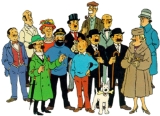
Supporting characters
Hergé's supporting characters have been cited as far more developed than the central character, each imbued with a strength of character and depth of personality which has been compared with that of the characters of
Charles Dickens. Hergé used the supporting characters to create a
realistic world in which to set his protagonists' adventures. To further the realism and continuity, characters would recur throughout the series. It has been speculated that the occupation of Belgium and the restrictions imposed upon Hergé forced him to focus on characterisation to avoid depicting troublesome political situations. The major supporting cast was developed during this period.
- Professor Cuthbert Calculus ( in French), an Absent-minded professor and half-deaf physicist, is a minor but regular character alongside Tintin, Snowy, and Captain Haddock. Introduced in Red Rackham's Treasure, and based partially on Auguste Piccard, his appearance was initially not welcomed by the leading characters, but through his generous nature and his scientific ability he develops a lasting bond with them. He has a tendency to act in a very aggressive manner when someone says he's "acting the goat."
- Thomson and Thompson are two bumbling detectives who, although unrelated, look like twins with the only discernible difference being the shape of their moustaches. They provide much of the comic relief throughout the series, being afflicted with chronic spoonerism, and are shown to be mostly incompetent in their tasks. The detectives were in part based on Hergé's father and uncle, identical twins who wore matching bowler hats.
- Bianca Castafiore is an opera singer whom Haddock absolutely despises. She seems to constantly be popping up wherever he goes, along with her maid Irma and pianist Igor Wagner. She is comically foolish, whimsical, absent-minded, and talkative, and seems unaware that her voice is shrill and appallingly loud. Her speciality is the Jewel Song (Ah! je ris de me voir si belle en ce miroir) from Gounod's opera, Faust, and sings this at the least provocation, much to Haddock's dismay. She tends to be melodramatic in an exaggerated fashion and is often maternal toward Haddock, of whose dislike she remains ignorant. She often confuses words, especially names, with other words that rhyme with them or of which they remind her; "Haddock" is frequently replaced by malapropisms such as "Paddock," "Harrock," "Padlock," "Hopscotch," "Drydock," "Stopcock," "Maggot," "Bartók", "Hammock," and "Hemlock," while Nestor, who is Haddock's butler, is confused with "Chestor" and "Hector." Her own name means "white and chaste flower," a meaning to which Prof. Calculus refers when he offers a white rose to the singer in The Castafiore Emerald. She was based upon opera divas in general (according to Hergé's perception), Hergé's Aunt Ninie, and, in the post-war comics, on Maria Callas.
- Other recurring characters include Nestor the butler, General Alcazar the South American dictator, Jolyon Wagg an (infuriating, to Haddock) insurance salesman, Kalish Ezab the Arab emir, Abdullah the emir's mischievous son, Chang the loyal Chinese boy, Dr. J.W. Müller the evil German doctor, Cutts, a local butcher that is repeatedly called by accident by Haddock and phone number is repeatedly mixed up with Haddock's, and Rastapopoulos the criminal mastermind. No young women feature as any main or side characters, and in fact only occasionally feature in the background.
Settings
The settings within
Tintin have also added depth to the strips. Hergé mingles real and fictional lands into his stories, along with a base in Belgium from where the heroes set off. This is originally 26 Labrador Road, but later
Marlinspike Hall. This is best demonstrated in
King Ottokar's Sceptre, in which Hergé creates two fictional countries (
Syldavia and
Borduria) and invites the reader to tour them in text through the insertion of a travel brochure into the storyline. Other fictional lands include
San Theodoros,
San Paolo, and Nuevo Rico in South America, the kingdom or administrative region of Gaipajama in India, and Khemed in the Middle East. Along with these fictitious locations, actual nations were employed such as Belgium, Germany, Switzerland, Scotland, England, Soviet Union, United States, Congo, Peru, India, Egypt, Sahara Desert, Indonesia, Nepal, Tibet, China, and Japan. Another setting was the Moon, the Atlantic Ocean and in the first edition of
Land of Black Gold,
Palestine, though this was later replaced by the fictional Khemed.
Creating the works
Research
Hergé's extensive research began with
The Blue Lotus, Hergé stating: "it was from that time that I undertook research and really interested myself in the people and countries to which I sent Tintin, out of a sense of responsibility to my readers".
Hergé's use of research and photographic reference allowed him to build a realised universe for Tintin, going so far as to create fictionalised countries, dressing them with specific
political cultures. These were heavily informed by the cultures evident in Hergé's lifetime. Pierre Skilling has asserted that Hergé saw
monarchy as "the legitimate form of government", noting that
democratic "values seem underrepresented in [such] a classic Franco-Belgian strip". Syldavia in particular is described in considerable detail, Hergé creating a history, customs, and language. He set the country in the
Balkans, and it is, by his own admission, modeled after
Albania. The country finds itself threatened by neighbouring
Borduria with an attempted annexation appearing in
King Ottokar's Sceptre. This situation parallels the Italian conquest of Albania and of
Czechoslovakia and
Austria by expansionist
Nazi Germany prior to World War II.
Hergé's use of research would include months of preparation for Tintin's voyage to the moon in the two-part storyline spread across
Destination Moon and
Explorers on the Moon. His research for the storyline was noted in
New Scientist: "[T]he considerable research undertaken by Hergé enabled him to come very close to the type of space suit that would be used in future
Moon exploration, although his portrayal of the type of rocket that was actually used was a long way off the mark". The moon rocket is based on the German V2 rockets.
Influences
In his youth Hergé admired
Benjamin Rabier and suggested that a number of images within
Tintin in the Land of the Soviets reflected this influence, particularly the pictures of animals. René Vincent, the
Art Deco designer, also had an impact on early Tintin adventures: "His influence can be detected at the beginning of the
Soviets, where my drawings are designed along a decorative line, like an 'S'..". Hergé also felt no compunction in admitting that he had stolen the image of round noses from
George McManus, feeling they were "so much fun that I used them, without scruples!"
During the extensive research Hergé carried out for
The Blue Lotus, he became influenced by Chinese and Japanese illustrative styles and
woodcuts. This is especially noticeable in the seascapes, which are reminiscent of works by
Hokusai and
Hiroshige.
Hergé also declared
Mark Twain an influence, although this admiration may have led him astray when depicting
Incas as having no knowledge of an upcoming solar eclipse in
Prisoners of the Sun, an error attributed by T.F. Mills to an attempt to portray "Incas in awe of a latter-day '
Connecticut Yankee'".
Criticisms of the series
The earliest stories in
The Adventures of Tintin have been criticised for
racist, violent,
colonialist, animal cruelty and even
fascist leanings, including caricatured portrayals of non-Europeans. The Tintin series originated as a comic strip in the "
Le Petit Vingtième" journal, with the result that the first published story described Tintin as a reporter sent abroad by this very newspaper. Whilst the Hergé Foundation has presented such criticism as naïveté, and scholars of Hergé such as Harry Thompson have claimed that "Hergé did what he was told by the
Abbé Wallez", Hergé himself felt that his background made it impossible to avoid prejudice: "I was fed the prejudices of the
bourgeois society that surrounded me".
In
Tintin in the Land of the Soviets, the Bolsheviks were presented without exception as villains. Hergé drew on
Moscow Unveiled, a work given to him by Wallez and authored by Joseph Douillet, the former Belgian consul in Russia, that is highly critical of the Soviet regime, although Hergé contextualised this by noting that in Belgium, at the time a devout
Catholic nation, "Anything Bolshevik was
atheist". In the story, Bolshevik leaders are motivated only by personal greed and by a desire to deceive the world. Tintin discovers, buried, "the hideout where Lenin, Trotsky, and Stalin have collected together wealth stolen from the people". Hergé later dismissed the failings of this first story as "a transgression of my youth". By 1999, some part of this presentation was being noted as far more reasonable,
The Economist declaring: "In retrospect, however, the land of hunger and tyranny painted by Hergé was uncannily accurate".
Tintin in the Congo has been criticised as presenting the
Africans as naïve and primitive. In the original work, Tintin is shown at a blackboard addressing a class of African children. "Mes chers amis," he says, "je vais vous parler aujourd'hui de votre patrie: La Belgique" ("My dear friends, I am going to talk to you today about your fatherland: Belgium"). Hergé redrew this in 1946 to show a lesson in
mathematics. Hergé later admitted the flaws in the original story, excusing it by noting: "I portrayed these Africans according to ... this purely paternalistic spirit of the time". The perceived problems with this book were summarised by Sue Buswell in 1988 as being "all to do with rubbery lips and heaps of dead animals" although Thompson noted this quote may have been "taken out of context". "Dead animals" refers to the fashion for big game hunting at the time of the work's original publication. Drawing on
André Maurois'
Les Silences du colonel Bramble, Hergé presents Tintin as a
big-game hunter, bagging 15
antelope as opposed to the one needed for the evening meal. However, concerns over the number of dead animals did lead the Scandinavian publishers of Tintin's adventures to request changes. A page which presented Tintin killing a
rhinoceros by drilling a hole in the animal's back and inserting a stick of dynamite was deemed excessive, and Hergé substituted a page which saw the rhino accidentally discharges Tintin's rifle whilst the erstwhile hunter snoozes under a tree. In 2007 the UK's
Commission for Racial Equality called for the book to be pulled from the shelves after a complaint, stating that "it beggars belief that in this day and age that any shop would think it acceptable to sell and display 'Tintin In The Congo'." In August 2007, a complaint was filed in Brussels, Belgium, by a Congolese student, claiming the book was an insult to the Congolese people. Public prosecutors are investigating, the
Centre for Equal Opportunities and Opposition to Racism warned against
political over-correctness.
Some of the early albums were altered by Hergé in subsequent editions, usually at the demand of publishers. For example, at the instigation of his American publishers, many of the black characters in
Tintin in America were re-coloured to make their race white or ambiguous.
The Shooting Star album originally had an American villain with the Jewish surname of "Blumenstein". This proved to be controversial, as the character looked very
stereotypically Jewish. "Blumenstein" was changed to an American with a less ethnically specific name, Mr. Bohlwinkel, in later editions and subsequently to a South American of a
fictional country - São Rico. Hergé later discovered that 'Bohlwinkel' was also a Jewish name.
Nazi collaborator SS officer
Léon Degrelle published a book insisting that he was Hergé's model for the character Tintin (ref: http://en.wikipedia.org/wiki/Tintin_and_Snowy See section there called
Inspiration).
Adaptations and exhibitions
The Adventures of Tintin have been adapted in a variety of
media besides the original comic strip and its collections. Hergé encouraged adaptations and members of his studio working on the animated films. After Hergé's death, the
Hergé Foundation became responsible for authorising adaptations and exhibitions.
Films
There have been both
live-action and
animated film adaptations of
The Adventures of Tintin.
Future film
A planned 2011
motion capture 3-D film will be directed by
Steven Spielberg, based on two linked stories published in the 1940s,
The Secret of the Unicorn and
Red Rackham's Treasure.
Peter Jackson's company
Weta Digital is providing the animation.
Documentaries
Two documentaries have been made about Tintin and his creator Hergé.
- I, Tintin (1976), a French documentary
- Tintin and I , by Danish director Anders Høgsbro Østergaard in 2003, a co-production of companies from Denmark, Belgium, France, and Switzerland. This documentary was based on a taped interview with Hergé by Numa Sadoul from 1971. Although the interview was published as a book, Hergé was allowed to edit the work prior to publishing and much of the interview was excised. The documentary was broadcast in the United States as "Tintin and I" on the PBS network, 11 July 2006.
Television
Two animated television series have been made, both adaptations of the comic strips rather than original stories.
The first was
Hergé's Adventures of Tintin, produced by
Belvision. The series aired from 1958 to 1962, with 104 five-minute episodes produced. It was adapted by Charles Shows and then translated into French by Greg (Michel Regnier), then editor-in-chief of
Tintin magazine. This series has been criticised for differing too greatly from the original books and for its poor animation.
The second series was
The Adventures of Tintin, featuring 21 of the stories. It ran for three seasons (from 1991 to 1992), was co-directed by Stéphane Bernasconi and
Peter Hudecki, and was produced by Ellipse (France), and Nelvana (Canada), on behalf of La Fondation Hergé. Traditional animation techniques were used on the series, adhering closely to the books. Some frames from the original albums were transposed directly to screen. The series has aired in over 50 countries.
Theatre
Hergé helped to create two Tintin stage plays:
Tintin in India: The Mystery of the Blue Diamond (1941) and
The Disappearance of Mr. Boullock (1941–1942). These were written with
Jacques Van Melkebeke and performed in
Brussels. In the late 1970s and early 1980s, two Tintin plays appeared at London, adapted by Geoffrey Case for the Unicorn Theatre Company. They were
Tintin's Great American Adventure, based on the comic
Tintin in America, which was shown 1976–1977; and
Tintin and the Black Island, which was based on
The Black Island and shown in 1980. This second play later went on tour.
A musical based on
The Seven Crystal Balls and
Prisoners of the Sun premièred on 15 September 2001 at the
Stadsschouwburg (city theatre) in
Antwerp,
Belgium. It was entitled
Kuifje - De Zonnetempel (De Musical) and was broadcast on Canal Plus, before moving on to
Charleroi in 2002 as
Tintin — Le Temple du Soleil. The Young Vic theatre company ran a musical version of
Tintin in Tibet at the Barbican Arts Centre in London from December 2005 to January 2006. The production was directed by Rufus Norris, and was adapted by Norris and
David Greig. The Hergé Foundation organised the return of this show to the
West End theatre in December 2006 and January 2007 in order to celebrate the Hergé centenary (2007).
Unofficial comic books
Various unofficial comics have also been released, ranging from illegal
pirated versions of original albums to
pastiches and
parodies, including the
anarchist Breaking Free and the pornographic
Tintin in Thailand, which reportedly circulated from December 1999 onwards.
Yves Rodier has produced a number of Tintin works, none authorised by the Hergé Foundation, including a 1986 "completion" of the unfinished
Tintin and Alph-art.
Exhibitions
Hergé's work on Tintin has formed the basis of many exhibitions, with the Hergé Foundation creating a mobile exhibition in 1991. "The World of Hergé" is described by the Foundation as being "an excellent introduction to Hergé's work". Materials from this exhibition have also formed the basis for larger shows, namely "Hergé the Draughtsman", an exhibition to celebrate the 60th anniversary of Tintin's creation, and the more recent "In Tibet With Tintin". In 2001 the Musée de la Marine staged an exhibition of items related to the sea which had inspired Hergé. In 2002 the Bunkamura Museum of Art in Japan staged an exhibition of original drawings, as well as of the submarine and rocket ship invented in the strips by Professor Calculus.
Barcelona has also hosted an exhibition on Tintin and the sea, "llamp de rellamp" at the Maritime Museum in 2003.
2004 saw exhibitions in Holland, "Tintin and the Incas" at the Royal Museum of Ethnology; the "Tintin in the City" exhibition in the Halles Saint Géry in Brussels; and an exhibition focusing on Tintin's exploits at sea at the
National Maritime Museum in London. The latter exhibition was in commemoration of the 75th anniversary of the publication of Tintin's first adventure, and was organised in partnership with the Hergé Foundation. 2004 also saw the
Belgian Centre for Comic Strip Art add an area dedicated to Hergé.
The 100th anniversary of Hergé's birth is commemorated with a large exhibition at the
Paris museum for contemporary arts,
Centre Georges Pompidou, from 20 December 2006 until 19 February 2007, featuring all 120 original pages of
The Blue Lotus.
Memorabilia and merchandise
Images from the series have long been
licensed for use on merchandise; the success of the
Tintin magazine helping to create a market for such items. Tintin's image has been used to sell a wide variety of products, from alarm clocks to underpants. There are now estimated to be over 250 separate items related to the character available, with some becoming
collectors items in their own right.
Since Hergé's death, the
Hergé Foundation have maintained control of the licenses, through Moulinsart, the commercial wing of the foundation. Speaking in 2002, Peter Horemans, the then director general at Moulinsart, noted this control: "We have to be very protective of the property. We don’t take lightly any potential partners and we have to be very selective ... for him to continue to be as popular as he is, great care needs to be taken of his use." However, the Foundation has been criticised by scholars as "trivialising the work of Hergé by concentrating on the more lucrative merchandising" in the wake of a move in the late nineties to charge them for using relevant images to illustrate their papers on the series.
NBC Universal acquired the rights to all of
The Adventures of Tintin merchandise in North America.
Shops
Tintin memorabilia and merchandise has allowed a chain of stores based solely on the character to become viable. The first shop was launched by Jane Taylor in 1984, located in
Covent Garden, London, and there are now branches worldwide, including two in Belgium, located in
Brussels and
Bruges, and one in France, located in
Montpellier. The British bookstore chain, Ottakars was named after King Ottokar, from the Tintin book
King Ottokar's Sceptre, and their shops stock a large amount of Tintin merchandise. There are also a number of Tintin themed cafés located around the world..
Stamps
Tintin's image has been used on
postage stamps on numerous occasions, the first issued by the
Belgian Post in 1979 to celebrate the day of youth
philately. This was the first in a series of stamps with the images of
Belgian comic heroes, and was the first stamp in the world to feature a comic hero.
In 1999, the
Royal Dutch Post released two stamps on 8 October 1999, based upon the
Destination Moon adventure, with the stamps selling out within hours of release. The French post office, Poste Française, then issued a stamp of Tintin and Snowy in 2001. To mark the end of the Belgian Franc, and also to celebrate the seventieth anniversary of the publication of
Tintin in the Congo, two more stamps were issued by the Belgian Post on 31 December 2001. The stamps were also issued in the
Democratic Republic of the Congo at the same time. 2002 saw the French Post issue stamped envelopes featuring Tintin, whilst in 2004 the Belgian post-office celebrated its own seventy-fifth anniversary, as well as the fiftieth anniversary of the publication of
Explorers on the Moon and the thirty-fifth anniversary of the moon landings with a series of stamps based upon the
Explorers on the Moon adventure. In 2007, to celebrate Hergé's centennial, Belgium, France and Switzerland all plan to issue special stamps in commemoration.
Coins
Besides stamps, Tintin has also been commemorated by coin several times. In 1995,
Monnaie de Paris issued a set of 12 coins to commemorate the 10th anniversary of Hergé's death, made of silver, and in a limited edition of 5000. Another coin was released to commemorate the 50th anniversary of the Tintin book
Explorers on the Moon, in a limited run of 10,000. Belgium minted a limited edition commemorative coin to celebrate the 75th birthday of Tintin in January 2004. The coin, composed of silver and featuring Tintin and Snowy, was limited to a minting of 50,000. Although it has a face value of €10, it is, as with other commemorative euro coins of this type (i.e. not a commemorative issue of a standard
euro coin), only legal tender in the country in which it was issued (in this case, Belgium).
Books
A large number of books have been published about Tintin.
Translation into English
The process of translating Tintin into English was a complex affair, commissioned in 1958 by
Methuen & Co. Ltd. of London. It was a joint-operation, headed by Leslie Lonsdale-Cooper and Michael Turner, who worked closely with
Hergé to attain an accurate translation as true as possible to the original work. The works were also sold in the American market by Golden Books, a branch of the Western Publishing Company in the 1950s. The albums were translated from French into
American English with some blocks blanked except for the speech balloons. This was done to remove content considered to be inappropriate for children, such as drunkenness and free mixing of races. The albums were not very popular and only six were published in mixed order. The edited albums later had their blanked blocks redrawn by Hergé to be more acceptable, and they currently appear this way in published editions around the world.
Atlantic Monthly Press, in cooperation with
Little, Brown and Company beginning in the 1970s, published the albums again. This time, the text features the originally translated
British English text with alterations to localized British words such as gaol,
tyre, saloon and
spanner. Currently, they are being published under the Joy Street imprint of Little, Brown and Company.
Due in part to the large amount of language-specific wordplay (such as punning) in the series, especially the jokes which played on
Professor Calculus' partial deafness, it was always the intention not to translate literally, instead striving to sculpt a work whose idioms and jokes would be meritorious in their own right; however, in spite of the free hand Hergé afforded the two, they worked closely with the original text, asking for regular assistance to understand Hergé's intentions. The English translators displayed a touch of genius in their rendering of the language spoken by the Arumbaya tribe (and that of their sworn enemies, the Rumbabas) in
The Broken Ear by substituting an accurate transcription of
Cockney turned into an Indian-looking vernacular for the original French version, which employed the Marollien (Marols in Flemish) dialect of Brussels.
More than simple translations, however, the English versions were anglicised to appeal to British customs and values. Milou, for example, was renamed Snowy at the translators' discretion. Moreover, the translation process served to colour the imagery within the book; the opportunity was taken to make scenes set in Britain more true-to-life, such as ensuring that the British police were
free from firearms, and ensuring scenes of the British countryside were more accurate for discerning British readers. Because the translated text was placed into the original
speech balloons without alteration to their original dimensions, the
linguistic differences between the two languages (meaning that certain phrases were either significantly shorter or longer in the English language) led to the unexpectedly empty or full balloons which can often be seen in the English versions of the books.
Unlike in the United Kingdom, the books have always had very limited popularity in the United States.
Legacy
Tintin and his creator Hergé have inspired many artists within comics. Most notably, Hergé's
ligne claire style has proven influential. Contributors to the
Tintin magazine have employed ligne claire, and more recently,
Jacques Tardi,
Yves Chaland,
Jason Little,
Phil Elliott,
Martin Handford, Geoff Darrow, and
Garen Ewing have produced works utilising it.
Tintin's legacy includes the establishment of a market for comic strip collections; the serialisation followed by collection model has been adopted by creators and publishers in France and Belgium. This system allows for greater financial stability, as creators receive money whilst working. This rivals the American and British model of
work for hire.
Roger Sabin has argued that this model allowed for "in theory ... a better quality product".
Paul Gravett has also noted that the use of detailed reference material and a picture archive, which Hergé implemented from
The Blue Lotus onwards, was "a turning point ... in the maturing of the medium as a whole".
In the wider art world, both
Andy Warhol and
Roy Lichtenstein have claimed Hergé as one of their most important influences. Lichtenstein made paintings based on fragments from Tintin's comics, whilst Warhol utilised the ligne claire and even made a series of paintings with Hergé as subject. He declared: "Hergé has influenced my work in the same way as
Walt Disney. For me, Hergé was more than a comic strip artist".
In music, Tintin has been the inspiration to a number of bands and musicians. A British technopop band of the 1980s took the name The Thompson Twins after the Tintin characters.
Stephen Duffy, a former member of
Duran Duran, performed the minor hit single "Kiss Me" under the name "Tintin"; he had to drop the name under pressure of a copyright infringement suit. An Australian
psychedelic rock band and an American independent
progressive rock band have used the name "
Tin Tin", and British electronic dance music duo
Tin Tin Out was similarly inspired by the character. South African singer/songwriter
Gert Vlok Nel compares Tintin to God in his
Afrikaans song "Waarom ek roep na jou vanaand", presumably because Tintin is a morally pure character. Australian cartoonist
Bill Leak often portrays the bespectacled neophyte Australian
prime minister Kevin Rudd as Tintin.
Hergé has been lauded as "creating in art a powerful graphic record of the 20th century's tortured history" through his work on Tintin. whilst Maurice Horn's Encyclopaedia of World Comics declares him to have "spear-headed the post World War II renaissance of European comic art". French philosopher
Michel Serres noted that the 23 Tintin albums constituted a "" to which "the work of no French novelist is comparable in importance or greatness".
In the Sting music video for "
We'll Be Together", he is wearing a sweater with Tintin's face on it.
Awards
On 1 June 2006, the Dalai Lama bestowed the
International Campaign for Tibet's Light of Truth award upon the character of Tintin, along with South African Archbishop
Desmond Tutu. The award was in recognition of Hergé's book
Tintin in Tibet, which the Executive Director of ICT Europe Tsering Jampa noted was "(f)or many ... their introduction to the awe-inspiring landscape and culture of Tibet". In 2001 the Hergé Foundation demanded the recall of the Chinese translation of the work, which had been released with the title
Tintin in China's Tibet. The work was subsequently published with the correct translation of the title. Accepting on behalf of the Hergé Foundation, Hergé's widow Fanny Rodwell declared: "We never thought that this story of friendship would have a resonance more than 40 years later".
Quotations
See also
Further reading
External links