

.gif)
Magic (illusion)

Encyclopedia
Magic is a performing art that entertains audiences by staging tricks or creating illusion
s of seemingly impossible or supernatural
feats using natural means. These feats are called magic tricks, effects, or illusions.
One who performs such illusions is called a magician or an illusionist.
Some performers may also be referred to by names reflecting the type of magical effects they present,
such as prestidigitators
, conjurors, mentalists
, or escape artists
.
in Persian, came to be known as magoi in Greek; that which a Persian priest did came to be known as mageia and then magika, a term which eventually referred to any foreign, unorthodox or illegitimate ritual practice.
Performances we would now recognize as conjuring have probably been practiced throughout history
. The same level of ingenuity that was used to produce famous ancient deceptions such as the Trojan Horse
would also have been used for entertainment
, or at least for cheating in money
games, since time immemorial. They were also used by the practitioners of various religions and cults
from ancient times onwards to frighten uneducated people into obedience or turn them into adherents. However, the profession of the illusionist gained strength only in the eighteenth century, and has enjoyed several popular vogues since.
In 1584, Reginald Scot
published The Discoverie of Witchcraft. It was written in an attempt to show that witches
did not exist, by exposing how (apparently miraculous) feats of magic were done. The book is often deemed the first textbook about conjuring. All obtainable copies were burned on the accession of James I
in 1603 and those remaining are now rare. It began to reappear in print in 1651.
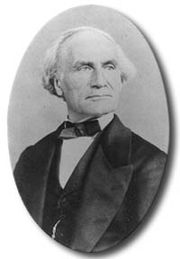 From 1756 to 1781, Jacob Philadelphia
performed feats of magic, sometimes under the guise of scientific exhibitions, throughout Europe
and in Russia
. Modern entertainment magic owes much to Jean Eugène Robert-Houdin
(1805–1871), originally a clockmaker, who opened a magic theatre in Paris
in the 1840s. His speciality was the construction of mechanical automata which appeared to move and act as if they were alive. The British
performer J N Maskelyne
and his partner Cooke established their own theatre, the Egyptian Hall in London
's Piccadilly
, in 1873. They presented stage magic, exploiting the potential of the stage for hidden mechanisms and assistants, and the control it offers over the audience's point of view.
The model for the look of a 'typical' magician—a man with wavy hair, a top hat, a goatee, and a tailcoat—was Alexander Herrmann
(February 10, 1844 – December 17, 1896), also known as Herrmann the Great. Herrmann was a French magician and was part of the Herrmann family name that is the "first-family of magic". Those who witnessed Herrmann the Great perform considered him the greatest magician they ever saw.
The escapologist and magician Harry Houdini
took his stage name from Robert-Houdin and developed a range of stage magic tricks, many of them based on what became known after his death as escapology
. The son of a Hungarian rabbi
, Houdini was genuinely skilled in techniques such as lockpicking and escaping straitjackets, but also made full use of the range of conjuring techniques, including fake equipment and collusion with individuals in the audience. Houdini's show business savvy was great as well as his performance skill. There is a Houdini Museum
dedicated to him in Scranton, Pennsylvania
.
As a form of entertainment, magic easily moved from theatrical venues to television specials, which opened up new opportunities for deceptions, and brought stage magic to huge audiences. Famous magicians of the 20th century included Okito, Alexander
, Harry Blackstone Sr., Harry Blackstone Jr., Howard Thurston
, Theodore Annemann
, Cardini, Joseph Dunninger
, Dai Vernon
, John Scarne
, Tommy Wonder, Siegfried & Roy
, and Doug Henning
. Popular 20th and 21st century magicians include David Copperfield
, Lance Burton
, James Randi
, Penn and Teller, David Blaine
, and Criss Angel
. Most TV magicians perform before a live audience, who provide the remote viewer with a reassurance that the illusions are not obtained with post-production visual effects
.
Many of the principles of stage magic are old. There is an expression, "it's all done with smoke and mirrors", used to explain something baffling, but effects seldom use mirrors today, due to the amount of installation work and transport difficulties. For example, the famous Pepper's Ghost
, a stage illusion first used in 19th-century London, required a specially built theatre. Modern performers have vanished objects as large as the Taj Mahal, the Statue of Liberty, and a space shuttle, using other kinds of optical deceptions.
and Tom Stone
have begun to challenge the notion that all magic effects fit into a limited number of categories. Among magicians who believe in a limited number of categories (such as Dariel Fitzkee
, Harlan Tarbell
, S.H. Sharpe), there has been disagreement as to how many different types of effects there are. Some of these are listed below.
Levitation: The magician defies gravity, either by making something float in the air, or with the aid of another object (suspension)—a silver ball floats around a cloth, an assistant floats in mid-air, another is suspended from a broom, a scarf dances in a sealed bottle, the magician hovers a few inches off the floor. There are many popular ways to create this illusion, including Asrah levitation
, Balducci levitation
, Looy's Sooperman
, and King levitation
. Much more spectacular is the apparent free flight flying illusion that is often performed by David Copperfield
and more recently by Peter Marvey
(who may or may not be using a technique similar to that of David Copperfield). Harry Blackstone's
floating light bulb, in which the light bulb floats over the heads of the public, is also spectacular.
Many magical routines use combinations of effects. For example, in "cups and balls" a magician may use vanishes, productions, penetrations, teleportation and transformations as part of the one presentation.
Membership in professional magicians' organizations often requires a solemn commitment to the Magician's Oath never to reveal the secrets of magic to non-magicians. The Magician's Oath may vary, but typically takes the following or similar form:
Once sworn to the Oath, one is considered a magician, and is expected to live up to this promise. Magicians who reveal secrets, either purposely or through insufficient practice, may find that other magicians are unwilling to teach them any more secrets.
However, it is considered permissible to reveal secrets to individuals who are determined to learn magic and become magicians. It is typically a sequential process of increasingly valuable and lesser known secrets. The secrets of almost all magical effects are available to the public through numerous books and magazines devoted to magic, available from the specialized magic trade. There are also web sites which offer videos, DVDs and instructional materials. In this sense, there are very few classical illusions left unrevealed, but this does not appear to have diminished the appeal of performances. In addition, magic is a living art, and new illusions are devised with surprising regularity. Sometimes a 'new' illusion will be built on an illusion that is old enough to have become unfamiliar.
Some magicians have taken the position that revealing the methods used in certain works of magic can enhance the appreciation of the audience for cleverness of magic. Penn and Teller frequently perform tricks using transparent props to reveal how they are done, for example, although they almost always include additional unexplained effects at the end that are made even more astonishing by the revealing props being used.
Often, what seems to be a revelation of a magical secret is merely another form of misdirection. For instance, a magician may explain to an audience member that the linking rings "have a hole in them" and hand the volunteer two unlinked rings, which the volunteer finds to have become linked as soon as he handles them. At this point the magician may shove his arm through the ring ('the hole in the ring'), proclaiming: "See? Once you know that every ring has a hole, it's easy!"
The teaching of performance magic was once a secretive practice. Professional magicians were unwilling to share knowledge with anyone outside the profession to prevent the laity from learning their secrets. This often made it difficult for an interested apprentice to learn anything but the basics of magic. Some had strict rules against members discussing magic secrets with anyone but established magicians.
From the 1584 publication of Reginald Scot
's Discoverie of Witchcraft
until the end of the 19th century, only a few books were available for magicians to learn the craft, whereas today mass-market books offer a myriad titles. Videos and DVDs are a newer medium of tuition, but many of the methods found in this format are readily found in previously published books. However, they can serve as a visual demonstration.
Persons interested in learning to perform magic can join magic club
s. Here magicians, both seasoned and novitiate, can work together and help one another for mutual improvement, to learn new techniques, to discuss all aspects of magic, to perform for each other — sharing advice, encouragement, and criticism. Before a magician can join one of these clubs, they usually have to audition. The purpose is to show to the membership they are a magician and not just someone off the street wanting to discover magical secrets.
The world's largest magic organization is the International Brotherhood of Magicians
; it publishes a monthly journal, The Linking Ring
. The oldest organization is the Society of American Magicians
, of which Houdini was a member and president for several years. In London
, England
, there is The Magic Circle
which houses the largest magic library in Europe. Also PSYCRETS - The British Society of Mystery Entertainers, which caters specifically to mentalists, bizarrists, storytellers, readers, spiritualist performers, and other mystery entertainers. The Magic Castle in Hollywood is home to the Academy of Magical Arts
.
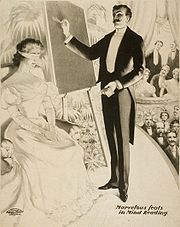
, for example, makes this point by billing himself as an "honest liar." On the other side of the coin, many performers say that magical acts, as a form of theater, need no more of a disclaimer than any play or film; this viewpoint is reflected in the words of magician and mentalist Joseph Dunninger
, "For those who believe, no explanation is necessary; for those who do not believe, no explanation will suffice."
These apparently irreconcilable differences of opinion have led to some conflicts among performers. For example, more than thirty years after the hugely successful illusionist Uri Geller
made his first appearances on television in the 1970s to exhibit his self-proclaimed psychic ability to bend spoons, his actions still provoke controversy among some magical performers, because of his claim that he was not using conjuring techniques. On the other hand, because Geller bent—and continues to bend—spoons within a performance context, the Dunninger quote may be said to apply.
Less fraught with controversy, however, may be the use of deceptive practices by those who employ conjuring techniques for personal gain outside the venue of a magical performance.
Fraudulent mediums have long capitalized on the popular belief in paranormal
phenomena to prey on the bereaved for financial gain. From the 1840s to the 1920s, during the greatest popularity of the Spiritualism religious movement as well as public interest in séance
s, a number of fraudulent mediums used conjuring methods to perform illusions such as table-knocking, slate-writing, and telekinetic effects, which they attributed to the actions of ghosts or other spirits. The great escapologist and illusionist Harry Houdini
devoted much of his time to exposing such fraudulent operators. Magician James Randi
, magic duo Penn and Teller, and the mentalist Derren Brown
have also devoted much time to investigating paranormal, occult
, and supernatural
claims.
Fraudulent faith healers have also been shown to employ sleight of hand
to give the appearance of removing chicken-giblet "tumors" from patients' abdomens.
Con men
and grifters too may use techniques of conjuring for fraudulent goals. Cheating at card game
s is an obvious example, and not a surprising one: one of the most respected textbooks of card techniques for magicians, The Expert at the Card Table by Erdnase, was primarily written as an instruction manual for card sharps. The card trick known as "Find the Lady" or "Three-card Monte
" is an old favourite of street hustlers, who lure the victim into betting on what seems like a simple proposition: to identify, after a seemingly easy-to-track mixing sequence, which one of three face-down cards is the Queen. Another example is the shell game
, in which a pea is hidden under one of three walnut shells, then shuffled around the table (or sidewalk) so slowly as to make the pea's position seemingly obvious. Although these are well known as frauds, people still lose money on them; a shell-game ring was broken up in Los Angeles as recently as December 2009.
The history of magic performance is particularly notable as a key area of popular culture from the mid 19th to mid 20th centuries. Many performances and performers can be followed through newspapers of the time.
Many books have been written about magic tricks; so many are written every year that at least one magic author has suggested that more books are written about magic than any other performing art. Although the bulk of these books are not seen on the shelves of libraries or public bookstores, the serious student can find many titles through specialized stores catering to the needs of magical performers.
Several notable public research collections on magic are the WG Alma Conjuring Collection at the State Library of Victoria; the R. B. Robbins Collection of Stage Magic and Conjuring at the State Library of NSW; the H. Adrian Smith Collection of Conjuring and Magicana at Brown University; and the Carl W. Jones Magic Collection, 1870s-1948 at Princeton University.
Illusion
An illusion is a distortion of the senses, revealing how the brain normally organizes and interprets sensory stimulation. While illusions distort reality, they are generally shared by most people....
s of seemingly impossible or supernatural
Supernatural
The supernatural or is that which is not subject to the laws of nature, or more figuratively, that which is said to exist above and beyond nature...
feats using natural means. These feats are called magic tricks, effects, or illusions.
One who performs such illusions is called a magician or an illusionist.
Some performers may also be referred to by names reflecting the type of magical effects they present,
such as prestidigitators
Sleight of hand
Sleight of hand, also known as prestidigitation or legerdemain, is the set of techniques used by a magician to manipulate objects such as cards and coins secretly....
, conjurors, mentalists
Mentalism
Mentalism is a performing art in which its practitioners, known as mentalists, appear to demonstrate highly developed mental or intuitive abilities. Performances may appear to include telepathy, clairvoyance, divination, precognition, psychokinesis, mediumship, mind control, memory feats and rapid...
, or escape artists
Escapology
For the Jessica Mauboy song, see Inescapable.Escapology is the practice of escaping from restraints or other traps. Escapologists escape from handcuffs, straitjackets, cages, coffins, steel boxes, barrels, bags, burning buildings, fish-tanks and other perils, often in combination.-History:The art...
.
History
The term "magic" is etymologically derived from the Greek word magika. Greeks and Persians had been at war for centuries and the Persian priests, called magoshMagi
Magi is a term, used since at least the 4th century BC, to denote a follower of Zoroaster, or rather, a follower of what the Hellenistic world associated Zoroaster with, which...
in Persian, came to be known as magoi in Greek; that which a Persian priest did came to be known as mageia and then magika, a term which eventually referred to any foreign, unorthodox or illegitimate ritual practice.
Performances we would now recognize as conjuring have probably been practiced throughout history
History
History is the discovery, collection, organization, and presentation of information about past events. History can also mean the period of time after writing was invented. Scholars who write about history are called historians...
. The same level of ingenuity that was used to produce famous ancient deceptions such as the Trojan Horse
Trojan Horse
The Trojan Horse is a tale from the Trojan War about the stratagem that allowed the Greeks finally to enter the city of Troy and end the conflict. In the canonical version, after a fruitless 10-year siege, the Greeks constructed a huge wooden horse, and hid a select force of men inside...
would also have been used for entertainment
Entertainment
Entertainment consists of any activity which provides a diversion or permits people to amuse themselves in their leisure time. Entertainment is generally passive, such as watching opera or a movie. Active forms of amusement, such as sports, are more often considered to be recreation...
, or at least for cheating in money
Money
Money is any object or record that is generally accepted as payment for goods and services and repayment of debts in a given country or socio-economic context. The main functions of money are distinguished as: a medium of exchange; a unit of account; a store of value; and, occasionally in the past,...
games, since time immemorial. They were also used by the practitioners of various religions and cults
Cults
Cults is a suburb on the western edge of Aberdeen, Scotland. It lies on the banks of the River Dee and marks the eastern boundary of Royal Deeside.Cults, known for its historic granite housing, sits approximately six miles from the coast of the North Sea...
from ancient times onwards to frighten uneducated people into obedience or turn them into adherents. However, the profession of the illusionist gained strength only in the eighteenth century, and has enjoyed several popular vogues since.
In 1584, Reginald Scot
Reginald Scot
Reginald Scot was an English country gentleman and Member of Parliament, now remembered as the author of The Discoverie of Witchcraft, which was published in 1584. It was written against the belief in witches, to show that witchcraft did not exist...
published The Discoverie of Witchcraft. It was written in an attempt to show that witches
Witchcraft
Witchcraft, in historical, anthropological, religious, and mythological contexts, is the alleged use of supernatural or magical powers. A witch is a practitioner of witchcraft...
did not exist, by exposing how (apparently miraculous) feats of magic were done. The book is often deemed the first textbook about conjuring. All obtainable copies were burned on the accession of James I
James I of England
James VI and I was King of Scots as James VI from 24 July 1567 and King of England and Ireland as James I from the union of the English and Scottish crowns on 24 March 1603...
in 1603 and those remaining are now rare. It began to reappear in print in 1651.
Jacob Philadelphia
Jacob Philadelphia was a Jewish magician, physicist, mechanic, juggler, astrologer, alchemist, and Kabbalist.- Biography :He is believed to have been born on August 14, 1735 and given the name Jacob Meyer....
performed feats of magic, sometimes under the guise of scientific exhibitions, throughout Europe
Europe
Europe is, by convention, one of the world's seven continents. Comprising the westernmost peninsula of Eurasia, Europe is generally 'divided' from Asia to its east by the watershed divides of the Ural and Caucasus Mountains, the Ural River, the Caspian and Black Seas, and the waterways connecting...
and in Russia
Russia
Russia or , officially known as both Russia and the Russian Federation , is a country in northern Eurasia. It is a federal semi-presidential republic, comprising 83 federal subjects...
. Modern entertainment magic owes much to Jean Eugène Robert-Houdin
Jean Eugène Robert-Houdin
Jean Eugène Robert-Houdin was a French magician. He is widely considered the father of the modern style of conjuring.-Early life and entrance into conjuring:...
(1805–1871), originally a clockmaker, who opened a magic theatre in Paris
Paris
Paris is the capital and largest city in France, situated on the river Seine, in northern France, at the heart of the Île-de-France region...
in the 1840s. His speciality was the construction of mechanical automata which appeared to move and act as if they were alive. The British
United Kingdom
The United Kingdom of Great Britain and Northern IrelandIn the United Kingdom and Dependencies, other languages have been officially recognised as legitimate autochthonous languages under the European Charter for Regional or Minority Languages...
performer J N Maskelyne
John Nevil Maskelyne
John Nevil Maskelyne was an English stage magician and inventor of the pay toilet, along with many other Victorian-era devices. His door lock for London toilets required the insertion of a penny coin to operate it, hence the euphemism to "spend a penny".-Biography:Maskelyne was born in Cheltenham,...
and his partner Cooke established their own theatre, the Egyptian Hall in London
London
London is the capital city of :England and the :United Kingdom, the largest metropolitan area in the United Kingdom, and the largest urban zone in the European Union by most measures. Located on the River Thames, London has been a major settlement for two millennia, its history going back to its...
's Piccadilly
Piccadilly
Piccadilly is a major street in central London, running from Hyde Park Corner in the west to Piccadilly Circus in the east. It is completely within the city of Westminster. The street is part of the A4 road, London's second most important western artery. St...
, in 1873. They presented stage magic, exploiting the potential of the stage for hidden mechanisms and assistants, and the control it offers over the audience's point of view.
The model for the look of a 'typical' magician—a man with wavy hair, a top hat, a goatee, and a tailcoat—was Alexander Herrmann
Alexander Herrmann
Alexander Herrmann was a French magician, better known as Herrmann the Great. He was part of the Herrmann family name that is known as the "first-family of magic". Those who witnessed Herrmann the Great perform considered him the greatest magician they ever saw...
(February 10, 1844 – December 17, 1896), also known as Herrmann the Great. Herrmann was a French magician and was part of the Herrmann family name that is the "first-family of magic". Those who witnessed Herrmann the Great perform considered him the greatest magician they ever saw.
The escapologist and magician Harry Houdini
Harry Houdini
Harry Houdini was a Hungarian-born American magician and escapologist, stunt performer, actor and film producer noted for his sensational escape acts...
took his stage name from Robert-Houdin and developed a range of stage magic tricks, many of them based on what became known after his death as escapology
Escapology
For the Jessica Mauboy song, see Inescapable.Escapology is the practice of escaping from restraints or other traps. Escapologists escape from handcuffs, straitjackets, cages, coffins, steel boxes, barrels, bags, burning buildings, fish-tanks and other perils, often in combination.-History:The art...
. The son of a Hungarian rabbi
Rabbi
In Judaism, a rabbi is a teacher of Torah. This title derives from the Hebrew word רבי , meaning "My Master" , which is the way a student would address a master of Torah...
, Houdini was genuinely skilled in techniques such as lockpicking and escaping straitjackets, but also made full use of the range of conjuring techniques, including fake equipment and collusion with individuals in the audience. Houdini's show business savvy was great as well as his performance skill. There is a Houdini Museum
Houdini Museum
The Houdini Museum was established in 1988 at 1433 N. Main Avenue in Scranton, Pennsylvania, USA. It is in a turn-of-the-20th-century building that has been entirely renovated. Houdini performed in Scranton and did several special challenges there. His brother, Hardeen, also appeared in Scranton...
dedicated to him in Scranton, Pennsylvania
Scranton, Pennsylvania
Scranton is a city in the northeastern part of Pennsylvania, United States. It is the county seat of Lackawanna County and the largest principal city in the Scranton/Wilkes-Barre metropolitan area. Scranton had a population of 76,089 in 2010, according to the U.S...
.
As a form of entertainment, magic easily moved from theatrical venues to television specials, which opened up new opportunities for deceptions, and brought stage magic to huge audiences. Famous magicians of the 20th century included Okito, Alexander
Alexander (magician)
Claude Alexander Conlin , also known as Alexander, C. Alexander, Alexander the Crystal Seer, and Alexander the Man Who Knows, was a vaudeville magician who specialized in mentalism and psychic reading acts, dressed in Oriental style robes and a feathered turban, and often used a crystal ball as a...
, Harry Blackstone Sr., Harry Blackstone Jr., Howard Thurston
Howard Thurston
Howard Thurston was a stage magician from Columbus, Ohio.-Life:Thurston had the largest traveling magic show for the time, requiring more than eight entire train cars to transport his props across the country...
, Theodore Annemann
Theodore Annemann
Theodore 'Theo' Annemann born Theodore John Squires was an American professional magician who specialized in the field of mentalism...
, Cardini, Joseph Dunninger
Joseph Dunninger
Joseph Dunninger , known as "The Amazing Dunninger" was one of the most famous and proficient mentalists of all time...
, Dai Vernon
Dai Vernon
Dai Vernon , aka The Professor, was a Canadian magician. His expert sleight-of-hand technique and extensive knowledge garnered him respect among fellow magicians. His influence was considerable in the magic world, and he was a mentor to numerous famous magicians...
, John Scarne
John Scarne
John Scarne was an American magician and book author who was particularly adept at playing card manipulation. He became known as an expert on cards and other games, and authored a number of popular books on cards, gambling, and related topics.-Early life:...
, Tommy Wonder, Siegfried & Roy
Siegfried & Roy
Siegfried & Roy are two German-American former entertainers who became known for their appearances with white lions and white tigers....
, and Doug Henning
Doug Henning
Douglas James Henning was a Canadian magician, illusionist, escape artist and politician.-Early life:...
. Popular 20th and 21st century magicians include David Copperfield
David Copperfield (illusionist)
David Copperfield is an Emmy Award-winning American illusionist, and was described by Forbes as the most commercially successful magician in history. Copperfield's network specials have been nominated for 38 Emmy Awards and won a total of 21 Emmys...
, Lance Burton
Lance Burton
Lance Burton is a stage illusionist. He has appeared on numerous television programs, and also performed for Queen Elizabeth and President Ronald Reagan...
, James Randi
James Randi
James Randi is a Canadian-American stage magician and scientific skeptic best known as a challenger of paranormal claims and pseudoscience. Randi is the founder of the James Randi Educational Foundation...
, Penn and Teller, David Blaine
David Blaine
David Blaine is an American illusionist and endurance artist. He is best known for his high-profile feats of endurance, and has made his name as a performer of street and close-up magic. He has set and broken several world records...
, and Criss Angel
Criss Angel
Christopher Nicholas Sarantakos , better known by the stage name Criss Angel, is an American illusionist, writer, director, musician, and actor...
. Most TV magicians perform before a live audience, who provide the remote viewer with a reassurance that the illusions are not obtained with post-production visual effects
Visual effects
Visual effects are the various processes by which imagery is created and/or manipulated outside the context of a live action shoot. Visual effects involve the integration of live-action footage and generated imagery to create environments which look realistic, but would be dangerous, costly, or...
.
Many of the principles of stage magic are old. There is an expression, "it's all done with smoke and mirrors", used to explain something baffling, but effects seldom use mirrors today, due to the amount of installation work and transport difficulties. For example, the famous Pepper's Ghost
Pepper's ghost
Pepper's ghost is an illusionary technique used in theatre and in some magic tricks. Using a plate glass and special lighting techniques, it can make objects seem to appear or disappear, transparent, or make one object seem to morph into another...
, a stage illusion first used in 19th-century London, required a specially built theatre. Modern performers have vanished objects as large as the Taj Mahal, the Statue of Liberty, and a space shuttle, using other kinds of optical deceptions.
Categories of effects
There is discussion among magicians as to how a given effect is to be categorized, and disagreement as to what categories actually exist—for instance, some magicians consider "penetrations" to be a separate category, while others consider penetrations a form of restoration or teleportation. Some magicians today, such as Guy HollingworthGuy Hollingworth
Guy Hollingworth is an English barrister, conjuror, author and lecturer. As a conjuror he is known for his skillful performances of card magic and for his books and lectures in which he presents original tricks and routines.-Career:...
and Tom Stone
Tom Stone (magician)
Tom Stone is the stage name of Thomas Bengtsson, a Swedish magician, editor and author.- Biography :Stone was born on October 28, 1967, and presently lives in Stockholm, Sweden....
have begun to challenge the notion that all magic effects fit into a limited number of categories. Among magicians who believe in a limited number of categories (such as Dariel Fitzkee
Dariel Fitzkee
Dariel Fitzkee was the pen name of Dariel Fitzroy. He was a semi-professional magician/author, born in Annawan, Illinois. His trilogy, known as The Fitzkee Trilogy is considered by many to be an important contribution to the theory of magic....
, Harlan Tarbell
Harlan Tarbell
Harlan Eugene Tarbell was an American stage magician and illustrator of the early 20th century. He was the author of the well-known Tarbell Course in Magic....
, S.H. Sharpe), there has been disagreement as to how many different types of effects there are. Some of these are listed below.
- Production: The magician produces something from nothing—a rabbit from an empty hat, a fan of cards from thin air, a shower of coins from an empty bucket, a dove from a panDove panThe dove pan is a classic magic effect in which a magician produces a dove from an empty pan. The illusion continues to be performed by professional and amateur magicians....
, or the magician him or herself, appearing in a puff of smoke on an empty stage—all of these effects are productions.
- Vanish: The magician makes something disappear—a coin, a cage of doves, milk from a newspaper, an assistant from a cabinet, or even the Statue of LibertyVanishing the Statue of LibertyMaking the Statue of Liberty seem to disappear on live television is the creation of Jim Steinmeyer and Don Wayne, and it is still unpublished. In the illusion, Copperfield raises a giant curtain on Liberty Island before lowering it again a few seconds later to reveal that the space where the...
. A vanish, being the reverse of a production, may use a similar technique, in reverse.
- Transformation: The magician transforms something from one state into another—a silk handkerchief changes colour, a lady turns into a tigerTigerThe tiger is the largest cat species, reaching a total body length of up to and weighing up to . Their most recognizable feature is a pattern of dark vertical stripes on reddish-orange fur with lighter underparts...
, an indifferent card changes to the spectator's chosen card. A transformation can be seen as a combination of a vanish and a production.
- Restoration: The magician destroys an object, then restores it back to its original state—a rope is cut, a newspaper is torn, a woman is sawn in halfSawing a woman in halfSawing a woman in half is a generic name for a number of different stage magic tricks in which a person is apparently sawn or divided into two or more pieces.-History:...
, a borrowed watch is smashed to pieces—then they are all restored to their original state.
- Teleportation: The magician causes something to move from one place to another—a borrowed ring is found inside a ball of wool, a canary inside a light bulb, an assistant from a cabinet to the back of the theatre. When two objects exchange places, it is called a transposition: a simultaneous, double teleportation.
- Escape: The magician (an assistant may participate, but the magician himself is by far the most common) is placed in a restraining device (i.e. handcuffsHandcuffsHandcuffs are restraint devices designed to secure an individual's wrists close together. They comprise two parts, linked together by a chain, a hinge, or rigid bar. Each half has a rotating arm which engages with a ratchet that prevents it from being opened once closed around a person's wrist...
or a straitjacketStraitjacketA straitjacket is a garment shaped like a jacket with overlong sleeves and is typically used to restrain a person who may otherwise cause harm to themselves or others. Once the arms are inserted into the straitjacket's sleeves, they are then crossed across the chest...
) or a death trap, and escapes to safety. Examples include being put in a straitjacket and into an overflowing tank of water, and being tied up and placed in a car being sent through a car crusher.
Levitation: The magician defies gravity, either by making something float in the air, or with the aid of another object (suspension)—a silver ball floats around a cloth, an assistant floats in mid-air, another is suspended from a broom, a scarf dances in a sealed bottle, the magician hovers a few inches off the floor. There are many popular ways to create this illusion, including Asrah levitation
Asrah levitation
The Asrah levitation is an illusion effect whereby the magician hypnotizes an assistant and commands them to recline on a table or couch. The assistant is then fully covered with a cloth and levitated under the cloth. The form of the assistant is still visible while levitating. Moments later, the...
, Balducci levitation
Balducci levitation
The Balducci levitation is a levitation illusion that was first described by Ed Balducci. Its inventor is unknown. It is an impromptu magic trick, which has been popularized by many magicians, such as David Roth, Paul Harris, Alex Magic, and David Blaine....
, Looy's Sooperman
Sooperman
Looy's Sooperman is a levitation illusion created by Looy Simonoff. It is a variation of the Balducci levitation. The effect is currently being sold under the name Wild Levitation.- Effect :...
, and King levitation
King levitation
The King Rising Levitation is a levitation illusion developed by and named after Corey King. Some consider it to be a variation of the Balducci levitation.-Effect:...
. Much more spectacular is the apparent free flight flying illusion that is often performed by David Copperfield
David Copperfield (illusionist)
David Copperfield is an Emmy Award-winning American illusionist, and was described by Forbes as the most commercially successful magician in history. Copperfield's network specials have been nominated for 38 Emmy Awards and won a total of 21 Emmys...
and more recently by Peter Marvey
Peter Marvey
Peter Marvey is a magician and illusionist best known for his combination of sleight of hand and large-scale stage illusions.-Biography:In his early childhood, Peter Marvey was fascinated with any form of flying, whether the flight of birds, stage "flying" or aviation. He expressed his passion by...
(who may or may not be using a technique similar to that of David Copperfield). Harry Blackstone's
Harry Blackstone, Sr.
Harry Blackstone was a famed stage magician and illusionist of the 20th century. Blackstone was born Harry Bouton in Chicago, Illinois, he began his career as a magician in his teens and was popular through World War II as a USO entertainer. He was often billed as The Great Blackstone. His son...
floating light bulb, in which the light bulb floats over the heads of the public, is also spectacular.
- Penetration: The magician makes a solid object pass through another—a set of steel rings link and unlink, a candle penetrates an arm, swords pass through an assistant in a basket, a saltshaker penetrates the table-top, a man walks through a mirror. Sometimes referred to as "solid-through-solid".
- Prediction: The magician predicts the choice of a spectator, or the outcome of an event under seemingly impossible circumstances—a newspaper headline is predicted, the total amount of loose change in the spectator's pocket, a picture drawn on a slate.
Many magical routines use combinations of effects. For example, in "cups and balls" a magician may use vanishes, productions, penetrations, teleportation and transformations as part of the one presentation.
Secrecy
Traditionally, magicians refuse to reveal the methods behind their tricks to the audience. Reasons for secrecy include the following:- ExposureExposure (magic)Exposure in magic refers to the practice of revealing the secrets of how magic tricks are performed.The practice is generally frowned upon as a type of spoiler that ruins the experience of magical performances for audiences.-Background:...
is claimed to "kill" magic as an artform and transforms it into mere intellectual puzzles and riddles. It is argued that once the secret of a trick is revealed to a person, that one can no longer fully enjoy subsequent performances of that magic, as the amazement is missing. Sometimes the secret is so simple that the audience feels let down, and feels disappointed it was taken in so easily. - Keeping the secrets preserves the mystery of professional magicians.
Membership in professional magicians' organizations often requires a solemn commitment to the Magician's Oath never to reveal the secrets of magic to non-magicians. The Magician's Oath may vary, but typically takes the following or similar form:
- "As a magician I promise never to reveal the secret of any illusion to a non-magician, unless that one swears to uphold the Magician's Oath in turn. I promise never to perform any illusion for any non-magician without first practicing the effect until I can perform it well enough to maintain the illusion of magic."
Once sworn to the Oath, one is considered a magician, and is expected to live up to this promise. Magicians who reveal secrets, either purposely or through insufficient practice, may find that other magicians are unwilling to teach them any more secrets.
However, it is considered permissible to reveal secrets to individuals who are determined to learn magic and become magicians. It is typically a sequential process of increasingly valuable and lesser known secrets. The secrets of almost all magical effects are available to the public through numerous books and magazines devoted to magic, available from the specialized magic trade. There are also web sites which offer videos, DVDs and instructional materials. In this sense, there are very few classical illusions left unrevealed, but this does not appear to have diminished the appeal of performances. In addition, magic is a living art, and new illusions are devised with surprising regularity. Sometimes a 'new' illusion will be built on an illusion that is old enough to have become unfamiliar.
Some magicians have taken the position that revealing the methods used in certain works of magic can enhance the appreciation of the audience for cleverness of magic. Penn and Teller frequently perform tricks using transparent props to reveal how they are done, for example, although they almost always include additional unexplained effects at the end that are made even more astonishing by the revealing props being used.
Often, what seems to be a revelation of a magical secret is merely another form of misdirection. For instance, a magician may explain to an audience member that the linking rings "have a hole in them" and hand the volunteer two unlinked rings, which the volunteer finds to have become linked as soon as he handles them. At this point the magician may shove his arm through the ring ('the hole in the ring'), proclaiming: "See? Once you know that every ring has a hole, it's easy!"
Learning magic
Dedication to magic can teach confidence and creativity, as well as the work ethic associated with regular practice and the responsibility that comes with devotion to an art.The teaching of performance magic was once a secretive practice. Professional magicians were unwilling to share knowledge with anyone outside the profession to prevent the laity from learning their secrets. This often made it difficult for an interested apprentice to learn anything but the basics of magic. Some had strict rules against members discussing magic secrets with anyone but established magicians.
From the 1584 publication of Reginald Scot
Reginald Scot
Reginald Scot was an English country gentleman and Member of Parliament, now remembered as the author of The Discoverie of Witchcraft, which was published in 1584. It was written against the belief in witches, to show that witchcraft did not exist...
's Discoverie of Witchcraft
Discoverie of Witchcraft
The Discoverie of Witchcraft was a partially sceptical book published by the English gentleman Reginald Scot in 1584, and intended as an exposé of medieval witchcraft...
until the end of the 19th century, only a few books were available for magicians to learn the craft, whereas today mass-market books offer a myriad titles. Videos and DVDs are a newer medium of tuition, but many of the methods found in this format are readily found in previously published books. However, they can serve as a visual demonstration.
Persons interested in learning to perform magic can join magic club
Magic club
A magic club is any group of local magicians who meet together on a regular basis. Also sometimes known as a magic circle. A club can be open to all with an interest in magic or it may be only possible to join by invite or by meeting some sort of notability criteria...
s. Here magicians, both seasoned and novitiate, can work together and help one another for mutual improvement, to learn new techniques, to discuss all aspects of magic, to perform for each other — sharing advice, encouragement, and criticism. Before a magician can join one of these clubs, they usually have to audition. The purpose is to show to the membership they are a magician and not just someone off the street wanting to discover magical secrets.
The world's largest magic organization is the International Brotherhood of Magicians
International Brotherhood of Magicians
International Brotherhood of Magicians is the world's largest organization for professional and amateur magicians, with approximately 15,000 members worldwide. The headquarters is in St...
; it publishes a monthly journal, The Linking Ring
The Linking Ring
The Linking Ring is a monthly print magazine, published by the International Brotherhood of Magicians. It is also available in electronic form to members of the IBM. All members of the IBM are entitled to receive this periodical. It was first published in 1923...
. The oldest organization is the Society of American Magicians
Society of American Magicians
The Society of American Magicians is the oldest fraternal magic organization in the world. Its purpose is "to advance, elevate, and preserve magic as a performing art, to promote harmonious fellowship throughout the world of magic, and to maintain and improve ethical standards in the field of...
, of which Houdini was a member and president for several years. In London
London
London is the capital city of :England and the :United Kingdom, the largest metropolitan area in the United Kingdom, and the largest urban zone in the European Union by most measures. Located on the River Thames, London has been a major settlement for two millennia, its history going back to its...
, England
England
England is a country that is part of the United Kingdom. It shares land borders with Scotland to the north and Wales to the west; the Irish Sea is to the north west, the Celtic Sea to the south west, with the North Sea to the east and the English Channel to the south separating it from continental...
, there is The Magic Circle
The Magic Circle
The Magic Circle is a British organisation, founded in London in 1905, dedicated to promoting and advancing the art of magic.- History :The Magic Circle was founded in 1905 after a meeting of 23 amateur and professional magicians at London's Pinoli's Restaurant...
which houses the largest magic library in Europe. Also PSYCRETS - The British Society of Mystery Entertainers, which caters specifically to mentalists, bizarrists, storytellers, readers, spiritualist performers, and other mystery entertainers. The Magic Castle in Hollywood is home to the Academy of Magical Arts
Academy of Magical Arts
The Academy of Magical Arts is a California non profit mutual benefit corporation organized and devoted to the promotion and development of the art of magic.Although begun in 1952 as a loose association of magicians by William Larsen, Sr...
.
Types of magic performance
Magic performances tend to fall into a few specialties or genres.- Stage illusionsStage illusionsStage illusions are large-scale magic tricks. As the name implies, stage illusions are distinct from all other types of magic in that they are performed a considerable distance away from the audience, usually on a stage, in order to maintain the illusion....
are performed for large audiences, typically within a theatre or auditorium. This type of magic is distinguished by large-scale props, the use of assistants and often exotic animals such as elephants and tigers. Some famous stage illusionists, past and present, include Harry Blackstone, Sr.Harry Blackstone, Sr.Harry Blackstone was a famed stage magician and illusionist of the 20th century. Blackstone was born Harry Bouton in Chicago, Illinois, he began his career as a magician in his teens and was popular through World War II as a USO entertainer. He was often billed as The Great Blackstone. His son...
, Howard ThurstonHoward ThurstonHoward Thurston was a stage magician from Columbus, Ohio.-Life:Thurston had the largest traveling magic show for the time, requiring more than eight entire train cars to transport his props across the country...
, Chung Ling SooChung Ling SooChung Ling Soo was the stage name of the American magician William Ellsworth Robinson who is mostly remembered today for his tragic death after a bullet catch trick went wrong.- Biography :...
, David CopperfieldDavid Copperfield (illusionist)David Copperfield is an Emmy Award-winning American illusionist, and was described by Forbes as the most commercially successful magician in history. Copperfield's network specials have been nominated for 38 Emmy Awards and won a total of 21 Emmys...
, Siegfried & RoySiegfried & RoySiegfried & Roy are two German-American former entertainers who became known for their appearances with white lions and white tigers....
, and Harry Blackstone, Jr.Harry Blackstone, Jr.Harry Blackstone, Jr. was an American stage magician, author, and television performer.-Career and life:Blackstone was born in Three Rivers, Michigan, the son of noted stage magician Harry Blackstone, Sr. .As an infant, he was used as a prop in his father's act...
. - Platform magicPlatform magicPlatform magic is that aspect of magic that fits conveniently between stage illusions and close-up magic. It is more intimate than stage magic because it doesn't require expensive, large-scale stage equipment and can thus be performed closer to one's audience and while standing on the same level...
(also known as cabaret magic or stand-up magic) is performed for a medium to large audience. Nightclub magic and comedy club magic are also examples of this form. The use of illusionettes (small tabletop illusions) is common. The term parlor magicParlor magicParlor magic is done for larger audiences than close-up magic and for smaller audiences than stage magic. In parlor magic, the performer is usually standing and on the same level as the audience, which may be seated on chairs or even on the floor. According to the Encyclopedia of Magic and...
is sometimes used but is considered by some to be pejorative. This genre includes the skilled manipulation of props such as billiard balls, card fans, doves, rabbits, silks, and rope. Examples of such magicians include Jeff McBrideJeff McBrideJeff McBride is an American magician from Monticello New York. He is known for his sleight of hand skills and specializes in the manipulation of playing cards, coins, and other small objects. His stage performances blend elements of kabuki, a Japanese theater form, with traditional conjuring...
, Penn & TellerPenn & TellerPenn & Teller are Las Vegas headliners whose act is an amalgam of illusion and comedy. Penn Jillette is a raconteur; Teller generally uses mime while performing, although his voice can occasionally be heard during their performance...
, David AbbottDavid Abbott (magician)David Phelps Abbott was a magician, author and inventor who created such effects as the floating ball, later made famous by Okito. The best known of his books is Behind the Scenes With the Mediums , considered to be one of the best exposures of the methods used by psychics...
, Channing PollockChanning Pollock (magician)Channing Pollock was an American magician and film actor.-Magician:As one of the most sophisticated and charismatic practitioners of his craft; strikingly handsome with an enigmatic stage presence, he was best known for an act in which he would elegantly produce doves out of thin air and he was...
, Black HermanBlack HermanBenjamin Rucker was an American stage magician, better known by his stage name Black Herman. Born in Amherst, Virginia, he was the most prominent African American magician of his time....
, and Fred KapsFred KapsFred Kaps , was a Dutch magician, famous for being the only magician to become FISM Grand Prix world champion three times. He was the creator of numerous original effects including his version of the color-changing silks. Another popular effect he often performed was the Long Pour Salt trick...
. - MicromagicMicromagicMicromagic or close-up magic or table magic is magic performed in an intimate setting usually no more than ten feet from one's audience and is usually performed while sitting at a table....
(also known as close-up magic or table magic) is performed with the audience close to the magician, sometimes even one-on-one. It usually makes use of everyday items as props, such as cardsPlaying cardA playing card is a piece of specially prepared heavy paper, thin cardboard, plastic-coated paper, cotton-paper blend, or thin plastic, marked with distinguishing motifs and used as one of a set for playing card games...
(see Card manipulationCard manipulationCard magic is the branch of conjuring that deals with creating magical effects using a deck of playing cards. Card magic is commonplace in magical performances, especially in close up magic or parlor magic and street magic. Some of the most recognized names in this field include John Scarne, Juan...
), coinCoinA coin is a piece of hard material that is standardized in weight, is produced in large quantities in order to facilitate trade, and primarily can be used as a legal tender token for commerce in the designated country, region, or territory....
s (see Coin magicCoin magicCoin magic is a general term for magical performances employing one or more coins which are manipulated to deceive and baffle the audience. Because coins are small, much coin magic is considered close-up magic or table magic, as the audience must be close to the performer to see the effects...
), and seemingly 'impromptu' effects. This may be called "table magic", particularly when performed as dinner entertainment. Ricky JayRicky JayRichard Jay Potash , better known by the stage name Ricky Jay, is an American stage magician, actor, and writer. He is a sleight-of-hand expert and is notable for his card tricks, card throwing, memory feats, and stage patter.-Life and career:...
and Lee AsherLee AsherLee Asher is a close-up magician noted for originating new card tricks and hypnotic sleight of hand moves.-Biography:Lee Asher was born in Ft Lauderdale, near Miami in southern Florida, to Louise and her husband, Mark Horowitz. He is the eldest of two children and has a sister, Alexis...
, following in the traditions of Dai VernonDai VernonDai Vernon , aka The Professor, was a Canadian magician. His expert sleight-of-hand technique and extensive knowledge garnered him respect among fellow magicians. His influence was considerable in the magic world, and he was a mentor to numerous famous magicians...
, Slydini, and Max MaliniMax MaliniMax Malini was a Jewish illusionist who at his peak performed for several US Presidents, had command performances at Buckingham Palace, and received gifts from monarchs across Europe and Asia. Magicians are said to revere him for his skill and bold accomplishments.Malini's performance style was...
, are considered among the foremost practitioners of close-up magic. - EscapologyEscapologyFor the Jessica Mauboy song, see Inescapable.Escapology is the practice of escaping from restraints or other traps. Escapologists escape from handcuffs, straitjackets, cages, coffins, steel boxes, barrels, bags, burning buildings, fish-tanks and other perils, often in combination.-History:The art...
is the branch of magic that deals with escapes from confinment or restraints. Harry HoudiniHarry HoudiniHarry Houdini was a Hungarian-born American magician and escapologist, stunt performer, actor and film producer noted for his sensational escape acts...
is a well-known example of an escape artist or escapologist. - MentalismMentalismMentalism is a performing art in which its practitioners, known as mentalists, appear to demonstrate highly developed mental or intuitive abilities. Performances may appear to include telepathy, clairvoyance, divination, precognition, psychokinesis, mediumship, mind control, memory feats and rapid...
creates the impression in the minds of the audience that the performer possesses special powers to read thoughts, predict events, control other minds, and similar feats. It can be presented on a stage, in a cabaret setting, before small close-up groups, or even for one spectator. Well-known mentalists of the past and present include AlexanderAlexander (magician)Claude Alexander Conlin , also known as Alexander, C. Alexander, Alexander the Crystal Seer, and Alexander the Man Who Knows, was a vaudeville magician who specialized in mentalism and psychic reading acts, dressed in Oriental style robes and a feathered turban, and often used a crystal ball as a...
, The ZancigsThe ZancigsJulius and Agnes Zancig were stage magicians and authors on occultism who performed a spectacularly successful two-person mentalism act during the late 19th and early 20th centuries...
, Axel HellstromAxel HellstromAxel Hellstrom was a muscle reader, mentalist and stage magician. He re-defined the art of muscle reading to such an extent that this technique, also known as "contact mind reading" and "Cumberlandism" , is now best known by the name "Hellstromism".-Biography:Axel Hellstrom lived in Germany and...
, Dunninger, KreskinKreskinThe Amazing Kreskin , born George Joseph Kresge, is a mentalist who became popular on North American television in the 1970s...
, Derren BrownDerren BrownDerren Victor Brown is a British illusionist, mentalist, painter, writer and sceptic. He is known for his appearances in television specials, stage productions and British television series such as Trick of the Mind and Trick or Treat...
, Rich FergusonRich FergusonRich Ferguson , aka "The Ice Breaker", is an American magician, entertainer, inventor and creative consultant. He is the producer and host of the Official Poker Chip Tricks and Card Handling DVD Series...
, Guy BavliGuy BavliGuy Bavli is a mentalist, illusionist, and lecturer. He owns the entertainment company "Master of the Mind", based in Fort Lauderdale, Florida....
and BanachekBanachekBanachek is an American mentalist. Banachek has written books on mentalism, such as Psychological Subtleties, and invented various magic and mentalism effects, including the Penn & Teller bullet catch and the original "buried alive." Banachek is also the Director of the James Randi Educational...
. - Theatrical séancesTheatrical SéancesA theatrical séance is an aspect of mentalism that purports to give its audiences the feeling of contacting the spirits of the dead, as in a successful Spiritualist seance....
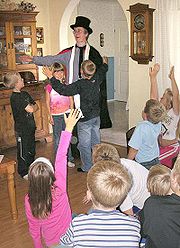
simulate spiritualistic or mediumistic phenomena for theatrical effect. This genre of stage magic has been misused at times by charlatans pretending to actually be in contact with spirits. - Children's magicChildren's magicChildren's magic is a specialized aspect of parlor magic and is meant to entertain children. It is typically performed at birthday parties, churches, preschools, elementary schools, Sunday Schools or libraries. It is often the only type of magic most Westerners experience other than that seen on...
is performed for an audience primarily composed of children. It is typically performed at birthday parties, preschools, elementary schools, Sunday schools or libraries. This type of magic is usually comedic in nature and involves audience interaction as well as volunteer assistants. - Online magic tricks were designed to function on a computer screen. The computer essentially replaces the magician. Some online magic tricks recreate traditional card tricks and require user participation, while others, like Plato's Cursed Triangle, are based on mathematical, geometrical and/or optical illusions. One such online magic trick, called Esmeralda's Crystal Ball, became a viral phenomenon that fooled so many computer users into believing that their computer had supernatural powers, that Snopes dedicated a page to debunking the trick.
- MathemagicMathemagicianA mathemagician is a mathematician who is also a magician.The name "mathemagician" was probably first applied to Martin Gardner, but has since been used to describe many mathematician/magicians, including Arthur T. Benjamin, Persi Diaconis, and Raymond Smullyan...
is a genre of stage magic that combines magic and mathematicsMathematicsMathematics is the study of quantity, space, structure, and change. Mathematicians seek out patterns and formulate new conjectures. Mathematicians resolve the truth or falsity of conjectures by mathematical proofs, which are arguments sufficient to convince other mathematicians of their validity...
. It is commonly used by children's magicChildren's magicChildren's magic is a specialized aspect of parlor magic and is meant to entertain children. It is typically performed at birthday parties, churches, preschools, elementary schools, Sunday Schools or libraries. It is often the only type of magic most Westerners experience other than that seen on...
ians and mentalists. - Corporate magic or trade show magic uses magic as a communication and sales tool, as opposed to just straightforward entertainment. Corporate magicians may come from a business background and typically present at meetings, conferences and product launches. They run workshops and can sometimes be found at trade shows, where their patter and illusions enhance an entertaining presentation of the products offered by their corporate sponsors. Pioneer performers in this arena include Eddie Tullock and Guy BavliGuy BavliGuy Bavli is a mentalist, illusionist, and lecturer. He owns the entertainment company "Master of the Mind", based in Fort Lauderdale, Florida....
. - Gospel magicGospel MagicGospel magic is the use of otherwise standard stage magic tricks and illusions to promote Christian messages. Gospel Magic does not claim to invoke spirits or paranormal powers....
uses magic to catechize and evangelize. Gospel magicGospel MagicGospel magic is the use of otherwise standard stage magic tricks and illusions to promote Christian messages. Gospel Magic does not claim to invoke spirits or paranormal powers....
was first used by St. Don Bosco to interest children in 19th century TurinTurinTurin is a city and major business and cultural centre in northern Italy, capital of the Piedmont region, located mainly on the left bank of the Po River and surrounded by the Alpine arch. The population of the city proper is 909,193 while the population of the urban area is estimated by Eurostat...
, ItalyItalyItaly , officially the Italian Republic languages]] under the European Charter for Regional or Minority Languages. In each of these, Italy's official name is as follows:;;;;;;;;), is a unitary parliamentary republic in South-Central Europe. To the north it borders France, Switzerland, Austria and...
to come back to school, to accept assistance and to attend church. - Street magicStreet magicStreet magic falls into two genres; traditional street performance and guerrilla magic.- Traditional street performance :The first definition of street magic refers to a traditional form of magic performance - that of busking. In this, the magician draws an audience from passers by and performs an...
is a form of street performing or buskingBuskingStreet performance or busking is the practice of performing in public places, for gratuities, which are generally in the form of money and edibles...
that employs a hybrid of stage magic, platform and close-up magic, usually performed 'in the roundTheatre in the roundTheatre-in-the-round or arena theatre is any theatre space in which the audience surrounds the stage area...
' or surrounded by the audience. Notable modern street magic performers include Jeff SheridanJeff SheridanJeff Sheridan is an American magician who started his career by specializing in street magic. Sheridan began working in New York City around 1967. He studied briefly at the School of the Visual Arts in NYC in the late 1960s. He authored the 1977 book, Street Magic, An Illustrated History of...
and GazzoGazzoGazzo may refer to:* Gazzo , Gary 'Gazzo' Osbourne British street magician* Gazzo , a town in the Italian province of Padua* Gazzo Veronese, a town in the Italian province of Verona* Monte Gazzo, a hill near the Italian town of Sestri Ponente...
. Since the first David BlaineDavid BlaineDavid Blaine is an American illusionist and endurance artist. He is best known for his high-profile feats of endurance, and has made his name as a performer of street and close-up magic. He has set and broken several world records...
TV special Street Magic aired in 1997, the term "street magic" has also come to describe a style of 'guerilla' performance in which magicians approach and perform for unsuspecting members of the public on the street. Unlike traditional street magic, this style is almost purely designed for TV and gains its impact from the wild reactions of the public. Magicians of this type include David BlaineDavid BlaineDavid Blaine is an American illusionist and endurance artist. He is best known for his high-profile feats of endurance, and has made his name as a performer of street and close-up magic. He has set and broken several world records...
and Cyril TakayamaCyril TakayamaCyril Takayama is an American-Japanese illusionist of Japanese and French descent. He is perhaps best known for his magic performances around Japan.-Early life:...
. - Bizarre magicBizarre magicBizarre Magic, or Bizarre Magick, is a branch of stage magic, or conjuring, like stage illusions, sleight of hand, or children's magic. The major difference is that bizarre magic uses storytelling and word play to a much greater degree, and less emphasis is placed on the manual dexterity of the...
uses mysticalMysticismMysticism is the knowledge of, and especially the personal experience of, states of consciousness, i.e. levels of being, beyond normal human perception, including experience and even communion with a supreme being.-Classical origins:...
, horror, fantasyFantasyFantasy is a genre of fiction that commonly uses magic and other supernatural phenomena as a primary element of plot, theme, or setting. Many works within the genre take place in imaginary worlds where magic is common...
and other similar themes in performance. Bizarre magic is typically performed in a close-up venue, although some performers have effectively presented it in a stage setting. Charles CameronCharles Cameron (magician)Charles Wesley Cameron was a professional magician who specialized in a style known as bizarre magic. He was born in Edinburgh, Scotland, as the eldest of 2 brothers....
has generally been credited as the "godfather of bizarre magic." Others, such as Tony AndruzziTony AndruzziAntonio C. "Tony" Andruzzi was a professional magician. From the 1950s to the early 1970s his performances were comedy illusions. He adopted the name Tom Palmer and had his legal name changed to Thomas S. Palmer...
, have contributed significantly to its development. - Shock magicSideshowIn America, a sideshow is an extra, secondary production associated with a circus, carnival, fair or other such attraction.- Types of attractions :There are four main types of classic sideshow attractions:...
is a genre of magic that shocks the audience. Sometimes referred to as "geek magic," it takes its roots from circus sideshows, in which 'freakish' performances were shown to audiences. Common shock magic or geek magic effects include eating razor blades, needle-through-armNeedle-through-armNeedle-through-arm is a magic effect that was popularized by comedy actor/magician Harry Anderson. The trick can either be performed as part of a stage magic or a parlor magic routine...
, string through neck and pen-through-tongue.
Misuse of magic
Some modern magicians say that it is unethical to give a performance which claims to be anything other than a clever and skillful deception; the performer Jamy Ian SwissJamy Ian Swiss
Jamy Ian Swiss is an American close-up magician who works primarily with cards.-Career as a Magician:Jamy Ian Swiss is world renowned as a sleight of hand performer specializing in close-up card magic....
, for example, makes this point by billing himself as an "honest liar." On the other side of the coin, many performers say that magical acts, as a form of theater, need no more of a disclaimer than any play or film; this viewpoint is reflected in the words of magician and mentalist Joseph Dunninger
Joseph Dunninger
Joseph Dunninger , known as "The Amazing Dunninger" was one of the most famous and proficient mentalists of all time...
, "For those who believe, no explanation is necessary; for those who do not believe, no explanation will suffice."
These apparently irreconcilable differences of opinion have led to some conflicts among performers. For example, more than thirty years after the hugely successful illusionist Uri Geller
Uri Geller
Uri Geller is a self-proclaimed psychic known for his trademark television performances of spoon bending and other supposed psychic effects. Throughout the years, Geller has been accused of using simple conjuring tricks to achieve the effects of psychokinesis and telepathy...
made his first appearances on television in the 1970s to exhibit his self-proclaimed psychic ability to bend spoons, his actions still provoke controversy among some magical performers, because of his claim that he was not using conjuring techniques. On the other hand, because Geller bent—and continues to bend—spoons within a performance context, the Dunninger quote may be said to apply.
Less fraught with controversy, however, may be the use of deceptive practices by those who employ conjuring techniques for personal gain outside the venue of a magical performance.
Fraudulent mediums have long capitalized on the popular belief in paranormal
Paranormal
Paranormal is a general term that designates experiences that lie outside "the range of normal experience or scientific explanation" or that indicates phenomena understood to be outside of science's current ability to explain or measure...
phenomena to prey on the bereaved for financial gain. From the 1840s to the 1920s, during the greatest popularity of the Spiritualism religious movement as well as public interest in séance
Séance
A séance is an attempt to communicate with spirits. The word "séance" comes from the French word for "seat," "session" or "sitting," from the Old French "seoir," "to sit." In French, the word's meaning is quite general: one may, for example, speak of "une séance de cinéma"...
s, a number of fraudulent mediums used conjuring methods to perform illusions such as table-knocking, slate-writing, and telekinetic effects, which they attributed to the actions of ghosts or other spirits. The great escapologist and illusionist Harry Houdini
Harry Houdini
Harry Houdini was a Hungarian-born American magician and escapologist, stunt performer, actor and film producer noted for his sensational escape acts...
devoted much of his time to exposing such fraudulent operators. Magician James Randi
James Randi
James Randi is a Canadian-American stage magician and scientific skeptic best known as a challenger of paranormal claims and pseudoscience. Randi is the founder of the James Randi Educational Foundation...
, magic duo Penn and Teller, and the mentalist Derren Brown
Derren Brown
Derren Victor Brown is a British illusionist, mentalist, painter, writer and sceptic. He is known for his appearances in television specials, stage productions and British television series such as Trick of the Mind and Trick or Treat...
have also devoted much time to investigating paranormal, occult
Occult
The word occult comes from the Latin word occultus , referring to "knowledge of the hidden". In the medical sense it is used to refer to a structure or process that is hidden, e.g...
, and supernatural
Supernatural
The supernatural or is that which is not subject to the laws of nature, or more figuratively, that which is said to exist above and beyond nature...
claims.
Fraudulent faith healers have also been shown to employ sleight of hand
Sleight of hand
Sleight of hand, also known as prestidigitation or legerdemain, is the set of techniques used by a magician to manipulate objects such as cards and coins secretly....
to give the appearance of removing chicken-giblet "tumors" from patients' abdomens.
Con men
Confidence trick
A confidence trick is an attempt to defraud a person or group by gaining their confidence. A confidence artist is an individual working alone or in concert with others who exploits characteristics of the human psyche such as dishonesty and honesty, vanity, compassion, credulity, irresponsibility,...
and grifters too may use techniques of conjuring for fraudulent goals. Cheating at card game
Card game
A card game is any game using playing cards as the primary device with which the game is played, be they traditional or game-specific. Countless card games exist, including families of related games...
s is an obvious example, and not a surprising one: one of the most respected textbooks of card techniques for magicians, The Expert at the Card Table by Erdnase, was primarily written as an instruction manual for card sharps. The card trick known as "Find the Lady" or "Three-card Monte
Three-card Monte
Three-card Monte, also known as the Three-card marney, Three-card trick, Three-Way, Three-card shuffle, Menage-a-card, Triplets, Follow the lady, Les Trois Perdants , le Bonneteau, Find the lady, or Follow the Bee is a confidence game in which the victim, or mark, is tricked into betting a...
" is an old favourite of street hustlers, who lure the victim into betting on what seems like a simple proposition: to identify, after a seemingly easy-to-track mixing sequence, which one of three face-down cards is the Queen. Another example is the shell game
Shell game
The shell game is portrayed as a gambling game, but in reality, when a wager for money is made, it is a confidence trick used to perpetrate fraud...
, in which a pea is hidden under one of three walnut shells, then shuffled around the table (or sidewalk) so slowly as to make the pea's position seemingly obvious. Although these are well known as frauds, people still lose money on them; a shell-game ring was broken up in Los Angeles as recently as December 2009.
Researching magic
Because of the secretive nature of magic, research can sometimes be a challenge. Many magic resources are privately held and most libraries only have small populist collections of magicana. However, organizations exist to band together independent collectors, writers, and researchers of magic history. These include: the Magic Collectors' Association http://www.magicana.com/mca/, which publishes a quarterly magazine and hosts an annual convention; and The Conjuring Arts Research Center http://conjuringarts.org/, which publishes a monthly newsletter and biannual magazine, and offers its members use of a searchable database of rare books and periodicals.The history of magic performance is particularly notable as a key area of popular culture from the mid 19th to mid 20th centuries. Many performances and performers can be followed through newspapers of the time.
Many books have been written about magic tricks; so many are written every year that at least one magic author has suggested that more books are written about magic than any other performing art. Although the bulk of these books are not seen on the shelves of libraries or public bookstores, the serious student can find many titles through specialized stores catering to the needs of magical performers.
Several notable public research collections on magic are the WG Alma Conjuring Collection at the State Library of Victoria; the R. B. Robbins Collection of Stage Magic and Conjuring at the State Library of NSW; the H. Adrian Smith Collection of Conjuring and Magicana at Brown University; and the Carl W. Jones Magic Collection, 1870s-1948 at Princeton University.
See also
- American Museum of MagicAmerican Museum of MagicThe American Museum of Magic in Marshall, Michigan, houses a large collection of magical paraphernalia and illusions, including an extensive collection of devices that once belonged to famed magician Harry Blackstone, Sr., .-Museum collection:...
- Indian magiciansIndian magiciansStage or street magic has a long history in India. Popular tricks include the rope trick, Indian basket, Green Mango Mystery, Indian Cups and Ball, and Indian Flying Man.-Modern history of Indian magic:...
- International Brotherhood of MagiciansInternational Brotherhood of MagiciansInternational Brotherhood of Magicians is the world's largest organization for professional and amateur magicians, with approximately 15,000 members worldwide. The headquarters is in St...
- List of magic publications
- List of magicians
- The Magic CircleThe Magic CircleThe Magic Circle is a British organisation, founded in London in 1905, dedicated to promoting and advancing the art of magic.- History :The Magic Circle was founded in 1905 after a meeting of 23 amateur and professional magicians at London's Pinoli's Restaurant...