


Oriental studies

Encyclopedia
Oriental studies is the academic field of study that embraces Near East
ern and Far East
ern societies and cultures, languages, peoples, history and archaeology; in recent years the subject has often been turned into the newer terms of Asian studies
and Middle Eastern studies
. European study of the region, formerly known as "the Orient
", had primarily religious origins, which has remained an important motivation until recent times. Learning from Arabic medicine and philosophy, and the Arabic translations from Greek, was an important factor in the Middle Ages. Linguistic knowledge preceded a wider study of cultures and history, and as Europe began to encroach upon the region, political and economic factors encouraged growth in academic study. From the late 18th century archaeology became a link from the discipline to a wide European public, as treasures brought back filled new European museums. The modern study was influenced both by Imperialist attitudes and interests, and also the sometimes naive fascination of the exotic East for Mediterranean and European writers and thinkers, captured in images by artists, that is embodied in a repeatedly-surfacing theme in the history of ideas
in the West, called "Orientalism
". In the last century, scholars from the region itself have participated on equal terms in the discipline, transforming it.
of the 5th century BC, when Athenian
historians made a distinction between their "Athenian democracy
" and that of the Persian monarchy. An institutional distinction between East and West did not exist as a defined polarity before the Oriens- and Occidens-divided administration of the Emperor Diocletian
's Roman Empire
at the end of the 3rd century AD, and the division of the Empire into Latin
and Greek
-speaking portions. The classical world had initimate knowledge of their Ancient Persian neighbours (and usually enemies), but very imprecise
knowledge of most of the world further East, including the "Seres
" (Chinese). However there was substantial direct Roman trade with India
(unlike with China) in the Imperial period.
 The rise of Islam
and Muslim conquests
in the 7th century established a sharp opposition, or even a sense of polarity, between medieval European Christendom
and the medieval Islamic world
(which stretched from the Middle East
and Central Asia
to North Africa
and Andalusia
). During the Middle Ages
, Muslim
s were considered the "alien" enemies of Christendom. Popular medieval European knowledge of cultures farther to the East was poor, dependent on the wildly fictionalised travels of Sir John Mandeville
and legends of Prester John
, although the equally famous, and much longer, account by Marco Polo
was a good deal more accurate.
Scholarly work was initially very largely linguistic in nature, with primarily a religious focus on understanding both Biblical Hebrew
and languages like Syriac with early Christian literature, but also from a wish to understand Greek and Arabic
works on medicine
, philosophy
and science
. This effort, also called the Studia Linguarum
existed sporadically throughout the Middle Ages, and the "Renaissance of the 12th century
" witnessed a particular growth in translations of Arabic texts into Latin, with figures like Constantine the African
, who translated 37 books, mostly medical texts, from Arabic to Latin, and Herman of Carinthia
, one of the translators of the Qur'an
. The earliest translation
of the Qur'an into Latin
was completed in 1143, although little use was made of it until it was printed in 1543, after which it was translated into other European languages. Gerard of Cremona
and others based themselves in Al-Andaluz to take advantage of the Arabic libraries and scholars there. Later, with the Christian Reconquista
in full progress, such contacts became rarer in Spain.
There was vague but increasing
knowledge of the complex civilizations in China
and India
, from which luxury goods (notably cotton
and silk
textiles as well as ceramics
) were imported. Although the Crusades
produced relatively little in the way of scholarly interchange, the eruption of the Mongol Empire
had strategic implications for both the Crusader kingdoms and Europe itself, and led to extended diplomatic contacts
. From the Age of Exploration, European interest in mapping Asia
, and especially the sea-routes, became intense, though mostly pursued outside the universities. As European exploration and colonisation
occurred, the distinction between illiterate peoples (i.e. in sub-Saharan Africa
and the Americas
) and the literate cultures of the East became entrenched.
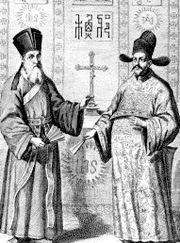 University Oriental studies became systematic during the Renaissance, with the linguistic and religious aspects initially continuing to dominate. There was also a political dimension, as translations for diplomatic purposes were needed, even before the West engaged actively with the East beyond the Ottoman Empire
. A landmark was the publication in Spain in 1514 of the first Polyglot Bible
, containing the complete existing texts in Hebrew and Aramaic, as well as Greek and Latin. At Cambridge University there has been a Regius Professor of Hebrew
since 1540 (the fifth oldest regular chair there), and the chair in Arabic
was founded in about 1643. Oxford followed for Hebrew in 1546 (both chairs were established by Henry VIII). Distinguished scholars included Edmund Castell
, who published his Lexicon Heptaglotton Hebraicum, Chaldaicum, Syriacum, Samaritanum, Aethiopicum, Arabicum, et Persicum in 1669, whilst some scholars like Edward Pococke
had travelled to the East and wrote also on the modern history and society of Eastern peoples. The University of Salamanca
had Professors of Oriental Languages from at least the 1570s. In France, Colbert
initiated a training programme for "Les Jeunes de langues", young linguists with the diplomatic service, like François Pétis de la Croix
, who like his father and his son served as Arabic interpreter to the King. Study of the Far East
was pioneered by missionaries, especially Matteo Ricci
and others in the Jesuit China missions
, and missionary motives were to remain important, at least in linguistic studies.
During the 18th century Western scholars reached a reasonable basic level of understanding of the geography and most of the history of the region, though knowledge of the areas least accessible to Western travellers, like Japan
and Tibet
, and their languages, remained limited. Enlightenment
thinkers characterised aspects of the pagan East as superior to the Christian West, in Montesquieu's Lettres Persanes or Voltaire
's ironic promotion of Zoroastrianism
; others, like Edward Gibbon
, praised the relative religious tolerance of the Islamic East as opposed to the intolerant Christian West, and many, including Diderot and Voltaire
, the high social status of scholarship in Mandarin
China.
The end of the century saw the beginnings in the great increase in study of the archaeology
of the period, which was to be an ever-more important aspect of the field through the next century. Egyptology
led the way, and as with many other ancient cultures, provided the linguists with new material for decypherment and study.
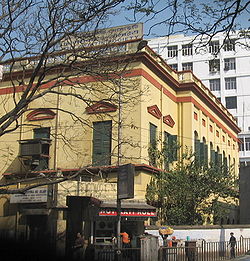 With a great increase in knowledge of Asia among Western specialists, increasing political and economic involvement in the region, and in particular the realisation of the existence of close relations between Indian and European languages
, by William Jones
, there emerged more complex intellectual connections between the early history of Eastern and Western cultures. Some of these developments occurred in the context of Franco–British rivalry for control of India. Liberal economists, such as James Mill
, denigrated Eastern civilizations as static and corrupt. Karl Marx
characterised the Asiatic mode of production
as unchanging, because of the economic narrowness of village economies and the State's role in production. Oriental despotism
was generally regarded in Europe as a major factor in the relative failure of progress
of Eastern societies. The study of Islam was central to the field since the majority of people living in the geographical area termed 'the Orient' were Muslims. Interest in understanding Islam was partly fuelled by economic considerations of growing trade in the Mediterranean region and the changing cultural and intellectual climate of the time.
In the course of the century Western archaeology spread across the Middle East and Asia, with spectacular results. The new national museums provided a setting for the finds, most of which were in this period bought back to Europe, and put Orientalists in the public spotlight as never before.
The first, serious European studies of Buddhism
and Hinduism
were by scholars Eugene Burnouf
and Max Müller
. In that time, the academic study of Islam also developed, and, by the mid-19th century, Oriental Studies was a well-established academic discipline in most European counties, especially those with imperial interests in the region. Yet, while scholastic study expanded, so did racist
attitudes and stereotypes of "inscrutable", "wily" Orientals. Scholarship often was intertwined with prejudicial racist and religious presumptions, to which the new biological sciences
tended to contribute until the middle of the following century.
. The influence of Orientalism
(in the sense used by Edward Said in his book of the same name
) in scholarship on the Middle East was seen to have re-emerged and risen in prevalence again after the end of the Cold War. It is contended that this was partly a response to "a lacuna" in identity politics in international relations generally, and within the 'West' particularly, which was brought about by the absence of Soviet communism as a global adversary. The post–Cold War era has been marked by discussions of Islamist terrorism framing views on the extent to which the culture of the Middle East region and Islam, its a threat to that of the West. The essence of this debate reflects a presupposition for which Orientalism has been criticised - that the 'Orient' is defined by Islam. Such considerations as these were seen to have occurred in the wider context of the way in which many Western scholars responded to international politics in the post–Cold War world; and they were arguably heightened following the terrorist attacks of September 11, 2001.
Symbolic of this type of response to the end of the Cold War
was the popularisation of the 'clash of civilisations' thesis. This particular idea of a fundamental conflict between East and West was first advanced by Bernard Lewis
in an article entitled "The Roots of Muslim Rage", written in 1990. Again, this was seen as a way of accounting for new forms and lines of division in post–Cold War international society. The 'clash of civilisations' approach involved another characteristic of Orientalist thought; namely, the tendency to see the region as being one, homogenous 'civilisation', rather than as comprising various different and diverse cultures and strands. It was an idea that was taken on more famously by Samuel Huntington
in his 1993 article in Foreign Affairs
, called "The Clash of Civilisations?".
in the 18th and 19th centuries. When used in this sense, it often implies prejudiced, outsider-caricatured interpretations of Eastern cultures and peoples. This viewpoint was most famously articulated and propagated by Edward Said
in Orientalism
(1978), a critical history of this scholarly tradition. In contrast, the term has also been used by some modern scholars to refer to writers of the Imperialist era who had pro-Eastern attitudes, as opposed to those who saw nothing of value in non-Western cultures.
, Orientalism derives from the Latin word oriens (rising) and, equally likely, from the Greek word ('he'oros', the direction of the rising sun). "Orient" is the opposite of Occident. In terms of The Old World
, Europe
was considered The Occident (The West), and its farthest-known extreme The Orient
(The East). Dating from the Roman Empire until the Middle Ages, what is now, in the West, considered 'the Middle East
' was then considered 'the Orient'. However, use of the various terms and senses derived from "Orient" has greatly declined in the 20th century, not least as trans-Pacific links between Asia and America have grown; nowadays, Asia usually arrives at the USA from the West.
In most North America
n universities, Oriental Studies has now been replaced by Asian Studies
localised to specific regions, such as, Middle East
ern or Near Eastern Studies, South Asia
n studies, and East Asia
n Studies. This reflects the fact that the Orient is not a single, monolithic region but rather a broad area encompassing multiple civilisations. The generic concept of Oriental Studies, to its opponents, has lost any use it may have once had and is perceived as obstructing changes in departmental structures to reflect actual patterns of modern scholarship. In many universities, like Chicago, the faculties and institutions have divided; the Biblical languages may be linked with theological institutes, and the study of ancient civilisations in the region may come under a different faculty to studies of modern periods.
In 2007 the Faculty of Oriental Studies at Cambridge University was renamed the Faculty of Asian and Middle Eastern Studies, but Oxford still has its Faculty for Oriental Studies
, as do Chicago
, Rome
, London
(covering African studies also), and other universities
.
Various explanations for the change to "Asian studies" are offered; a growing number of professional scholars and students of Asian Studies are themselves Asian or from groups of Asian origin (like Asian American
s). This change of labelling may be correlated in some cases to the fact that sensitivity to the term "Oriental" has been heightened in a more politically correct
atmosphere, although it began earlier: Bernard Lewis' own department at Princeton University
was renamed a decade before Said wrote his book, a detail that Said gets wrong. By some, the term "Oriental" has come to be thought offensive to non-Westerners. Area studies
that incorporate not only philological pursuits but identity politics
may also account for the hestitation to use the term "Oriental".
Supporters of "Oriental Studies" counter that the term "Asian" is just as encompassing as "Oriental," and may well have originally had the same meaning, were it derived from an Akkadian
word for "East" (a more common derivation is from one or both of two Anatolian proper names). Replacing one word with another is to confuse historically objectional opinions about the East with the concept of "the East" itself. The terms Oriental/Eastern and Occidental/Western are both inclusive concepts that usefully identify large-scale cultural differences. Such general concepts do not preclude or deny more specific ones.
Near East
The Near East is a geographical term that covers different countries for geographers, archeologists, and historians, on the one hand, and for political scientists, economists, and journalists, on the other...
ern and Far East
Far East
The Far East is an English term mostly describing East Asia and Southeast Asia, with South Asia sometimes also included for economic and cultural reasons.The term came into use in European geopolitical discourse in the 19th century,...
ern societies and cultures, languages, peoples, history and archaeology; in recent years the subject has often been turned into the newer terms of Asian studies
Asian studies
Asian studies, a term used usually in the United States for Oriental studies and is concerned with the Asian peoples, their cultures, languages, history and politics...
and Middle Eastern studies
Middle Eastern studies
Middle Eastern studies is a name given to a number of academic programs associated with the study of the history, culture, politics, economies, and geography of the Middle East, an area that is generally interpreted to cover a range of nations extending from North Africa in the west to the Chinese...
. European study of the region, formerly known as "the Orient
Orient
The Orient means "the East." It is a traditional designation for anything that belongs to the Eastern world or the Far East, in relation to Europe. In English it is a metonym that means various parts of Asia.- Derivation :...
", had primarily religious origins, which has remained an important motivation until recent times. Learning from Arabic medicine and philosophy, and the Arabic translations from Greek, was an important factor in the Middle Ages. Linguistic knowledge preceded a wider study of cultures and history, and as Europe began to encroach upon the region, political and economic factors encouraged growth in academic study. From the late 18th century archaeology became a link from the discipline to a wide European public, as treasures brought back filled new European museums. The modern study was influenced both by Imperialist attitudes and interests, and also the sometimes naive fascination of the exotic East for Mediterranean and European writers and thinkers, captured in images by artists, that is embodied in a repeatedly-surfacing theme in the history of ideas
History of ideas
The history of ideas is a field of research in history that deals with the expression, preservation, and change of human ideas over time. The history of ideas is a sister-discipline to, or a particular approach within, intellectual history...
in the West, called "Orientalism
Orientalism
Orientalism is a term used for the imitation or depiction of aspects of Eastern cultures in the West by writers, designers and artists, as well as having other meanings...
". In the last century, scholars from the region itself have participated on equal terms in the discipline, transforming it.
Pre-Islam
The Western world's original distinction between the "West" and the "East" was crystallised in the Greco-Persian WarsGreco-Persian Wars
The Greco-Persian Wars were a series of conflicts between the Achaemenid Empire of Persia and city-states of the Hellenic world that started in 499 BC and lasted until 449 BC. The collision between the fractious political world of the Greeks and the enormous empire of the Persians began when Cyrus...
of the 5th century BC, when Athenian
Athens
Athens , is the capital and largest city of Greece. Athens dominates the Attica region and is one of the world's oldest cities, as its recorded history spans around 3,400 years. Classical Athens was a powerful city-state...
historians made a distinction between their "Athenian democracy
Athenian democracy
Athenian democracy developed in the Greek city-state of Athens, comprising the central city-state of Athens and the surrounding territory of Attica, around 508 BC. Athens is one of the first known democracies. Other Greek cities set up democracies, and even though most followed an Athenian model,...
" and that of the Persian monarchy. An institutional distinction between East and West did not exist as a defined polarity before the Oriens- and Occidens-divided administration of the Emperor Diocletian
Diocletian
Diocletian |latinized]] upon his accession to Diocletian . c. 22 December 244 – 3 December 311), was a Roman Emperor from 284 to 305....
's Roman Empire
Roman Empire
The Roman Empire was the post-Republican period of the ancient Roman civilization, characterised by an autocratic form of government and large territorial holdings in Europe and around the Mediterranean....
at the end of the 3rd century AD, and the division of the Empire into Latin
Latin
Latin is an Italic language originally spoken in Latium and Ancient Rome. It, along with most European languages, is a descendant of the ancient Proto-Indo-European language. Although it is considered a dead language, a number of scholars and members of the Christian clergy speak it fluently, and...
and Greek
Greek language
Greek is an independent branch of the Indo-European family of languages. Native to the southern Balkans, it has the longest documented history of any Indo-European language, spanning 34 centuries of written records. Its writing system has been the Greek alphabet for the majority of its history;...
-speaking portions. The classical world had initimate knowledge of their Ancient Persian neighbours (and usually enemies), but very imprecise
Sino-Roman relations
Romano-Chinese relations were essentially indirect throughout the existence of both empires. The Roman Empire and Han China progressively inched closer in the course of the Roman expansion into the Ancient Near East and simultaneous Chinese military incursions into Central Asia...
knowledge of most of the world further East, including the "Seres
Seres
Seres was the ancient Greek and Roman name for the inhabitants of eastern Central Asia. It meant "of silk," or people of the "land where silk comes from." The country of the Seres was Serica....
" (Chinese). However there was substantial direct Roman trade with India
Roman trade with India
Roman trade with India through the overland caravan routes via Anatolia and Persia, though at a relative trickle compared to later times, antedated the southern trade route via the Red Sea and monsoons which started around the beginning of the Common Era following the reign of Augustus and his...
(unlike with China) in the Imperial period.
Middle Ages
Spread of Islam
The Spread of Islam started shortly after the death of the Islamic prophet Muhammad in 632 AD. During his lifetime, the community of Muhammad, the ummah, was established in the Arabian Peninsula by means of conversion to Islam and conquering of territory, and oftentimes the conquered had to either...
and Muslim conquests
Muslim conquests
Muslim conquests also referred to as the Islamic conquests or Arab conquests, began with the Islamic prophet Muhammad. He established a new unified polity in the Arabian Peninsula which under the subsequent Rashidun and Umayyad Caliphates saw a century of rapid expansion of Muslim power.They...
in the 7th century established a sharp opposition, or even a sense of polarity, between medieval European Christendom
Christendom
Christendom, or the Christian world, has several meanings. In a cultural sense it refers to the worldwide community of Christians, adherents of Christianity...
and the medieval Islamic world
Islamic Golden Age
During the Islamic Golden Age philosophers, scientists and engineers of the Islamic world contributed enormously to technology and culture, both by preserving earlier traditions and by adding their own inventions and innovations...
(which stretched from the Middle East
Middle East
The Middle East is a region that encompasses Western Asia and Northern Africa. It is often used as a synonym for Near East, in opposition to Far East...
and Central Asia
Central Asia
Central Asia is a core region of the Asian continent from the Caspian Sea in the west, China in the east, Afghanistan in the south, and Russia in the north...
to North Africa
North Africa
North Africa or Northern Africa is the northernmost region of the African continent, linked by the Sahara to Sub-Saharan Africa. Geopolitically, the United Nations definition of Northern Africa includes eight countries or territories; Algeria, Egypt, Libya, Morocco, South Sudan, Sudan, Tunisia, and...
and Andalusia
Al-Andalus
Al-Andalus was the Arabic name given to a nation and territorial region also commonly referred to as Moorish Iberia. The name describes parts of the Iberian Peninsula and Septimania governed by Muslims , at various times in the period between 711 and 1492, although the territorial boundaries...
). During the Middle Ages
Middle Ages
The Middle Ages is a periodization of European history from the 5th century to the 15th century. The Middle Ages follows the fall of the Western Roman Empire in 476 and precedes the Early Modern Era. It is the middle period of a three-period division of Western history: Classic, Medieval and Modern...
, Muslim
Muslim
A Muslim, also spelled Moslem, is an adherent of Islam, a monotheistic, Abrahamic religion based on the Quran, which Muslims consider the verbatim word of God as revealed to prophet Muhammad. "Muslim" is the Arabic term for "submitter" .Muslims believe that God is one and incomparable...
s were considered the "alien" enemies of Christendom. Popular medieval European knowledge of cultures farther to the East was poor, dependent on the wildly fictionalised travels of Sir John Mandeville
John Mandeville
"Jehan de Mandeville", translated as "Sir John Mandeville", is the name claimed by the compiler of The Travels of Sir John Mandeville, a book account of his supposed travels, written in Anglo-Norman French, and first circulated between 1357 and 1371.By aid of translations into many other languages...
and legends of Prester John
Prester John
The legends of Prester John were popular in Europe from the 12th through the 17th centuries, and told of a Christian patriarch and king said to rule over a Christian nation lost amidst the Muslims and pagans in the Orient. Written accounts of this kingdom are variegated collections of medieval...
, although the equally famous, and much longer, account by Marco Polo
Marco Polo
Marco Polo was a Venetian merchant traveler from the Venetian Republic whose travels are recorded in Il Milione, a book which did much to introduce Europeans to Central Asia and China. He learned about trading whilst his father and uncle, Niccolò and Maffeo, travelled through Asia and apparently...
was a good deal more accurate.
Scholarly work was initially very largely linguistic in nature, with primarily a religious focus on understanding both Biblical Hebrew
Biblical Hebrew language
Biblical Hebrew , also called Classical Hebrew , is the archaic form of the Hebrew language, a Canaanite Semitic language spoken in the area known as Canaan between the Jordan River and the Mediterranean Sea. Biblical Hebrew is attested from about the 10th century BCE, and persisted through...
and languages like Syriac with early Christian literature, but also from a wish to understand Greek and Arabic
Arabic language
Arabic is a name applied to the descendants of the Classical Arabic language of the 6th century AD, used most prominently in the Quran, the Islamic Holy Book...
works on medicine
Islamic medicine
In the history of medicine, Islamic medicine, Arabic medicine or Arabian medicine refers to medicine developed in the Islamic Golden Age, and written in Arabic, the lingua franca of Islamic civilization....
, philosophy
Early Islamic philosophy
Early Islamic philosophy or classical Islamic philosophy is a period of intense philosophical development beginning in the 2nd century AH of the Islamic calendar and lasting until the 6th century AH...
and science
Islamic science
Science in the medieval Islamic world, also known as Islamic science or Arabic science, is the science developed and practised in the Islamic world during the Islamic Golden Age . During this time, Indian, Iranian and especially Greek knowledge was translated into Arabic...
. This effort, also called the Studia Linguarum
Studia Linguarum
The Studia Linguarum were the first attempt to study oriental languages by the Roman Catholic Church.The need to study oriental languages was affirmed by the General Chapter of the Dominican Order in Paris in 1236...
existed sporadically throughout the Middle Ages, and the "Renaissance of the 12th century
Renaissance of the 12th century
The Renaissance of the 12th century was a period of many changes at the outset of the High Middle Ages. It included social, political and economic transformations, and an intellectual revitalization of Western Europe with strong philosophical and scientific roots...
" witnessed a particular growth in translations of Arabic texts into Latin, with figures like Constantine the African
Constantine the African
Constantine the African was a Tunisian doctor of the eleventh century. The first part of his life was spent in Tunisia and the rest in Italy. In Salerno, Italy, he became a professor of medicine and his work attracted widespread attention...
, who translated 37 books, mostly medical texts, from Arabic to Latin, and Herman of Carinthia
Herman of Carinthia
Herman Dalmatin or Herman of Carinthia , also known in Latin as Sclavus Dalmata, Secundus, was a philosopher, astronomer, astrologer, mathematician, translator and author....
, one of the translators of the Qur'an
Qur'an
The Quran , also transliterated Qur'an, Koran, Alcoran, Qur’ān, Coran, Kuran, and al-Qur’ān, is the central religious text of Islam, which Muslims consider the verbatim word of God . It is regarded widely as the finest piece of literature in the Arabic language...
. The earliest translation
Lex Mahumet pseudoprophete
Lex Mahumet pseudoprophete is the translation of the Qur'an into Latin by Robert of Ketton...
of the Qur'an into Latin
Latin
Latin is an Italic language originally spoken in Latium and Ancient Rome. It, along with most European languages, is a descendant of the ancient Proto-Indo-European language. Although it is considered a dead language, a number of scholars and members of the Christian clergy speak it fluently, and...
was completed in 1143, although little use was made of it until it was printed in 1543, after which it was translated into other European languages. Gerard of Cremona
Gerard of Cremona
Gerard of Cremona was an Italian translator of Arabic scientific works found in the abandoned Arab libraries of Toledo, Spain....
and others based themselves in Al-Andaluz to take advantage of the Arabic libraries and scholars there. Later, with the Christian Reconquista
Reconquista
The Reconquista was a period of almost 800 years in the Middle Ages during which several Christian kingdoms succeeded in retaking the Muslim-controlled areas of the Iberian Peninsula broadly known as Al-Andalus...
in full progress, such contacts became rarer in Spain.
There was vague but increasing
Chronology of European exploration of Asia
This article attempts to list every significant event in the history of the European exploration of Asia. It proposes a chronological inventory of these events including every people involved and the places they helped to demystify ....
knowledge of the complex civilizations in China
China
Chinese civilization may refer to:* China for more general discussion of the country.* Chinese culture* Greater China, the transnational community of ethnic Chinese.* History of China* Sinosphere, the area historically affected by Chinese culture...
and India
History of India
The history of India begins with evidence of human activity of Homo sapiens as long as 75,000 years ago, or with earlier hominids including Homo erectus from about 500,000 years ago. The Indus Valley Civilization, which spread and flourished in the northwestern part of the Indian subcontinent from...
, from which luxury goods (notably cotton
Cotton
Cotton is a soft, fluffy staple fiber that grows in a boll, or protective capsule, around the seeds of cotton plants of the genus Gossypium. The fiber is almost pure cellulose. The botanical purpose of cotton fiber is to aid in seed dispersal....
and silk
Silk
Silk is a natural protein fiber, some forms of which can be woven into textiles. The best-known type of silk is obtained from the cocoons of the larvae of the mulberry silkworm Bombyx mori reared in captivity...
textiles as well as ceramics
Ceramics (art)
In art history, ceramics and ceramic art mean art objects such as figures, tiles, and tableware made from clay and other raw materials by the process of pottery. Some ceramic products are regarded as fine art, while others are regarded as decorative, industrial or applied art objects, or as...
) were imported. Although the Crusades
Crusades
The Crusades were a series of religious wars, blessed by the Pope and the Catholic Church with the main goal of restoring Christian access to the holy places in and near Jerusalem...
produced relatively little in the way of scholarly interchange, the eruption of the Mongol Empire
Mongol Empire
The Mongol Empire , initially named as Greater Mongol State was a great empire during the 13th and 14th centuries...
had strategic implications for both the Crusader kingdoms and Europe itself, and led to extended diplomatic contacts
Franco-Mongol alliance
Franco-Mongol relations were established in the 13th century, as attempts were made towards forming a Franco-Mongol alliance between the Christian Crusaders and the Mongol Empire against various Muslim empires. Such an alliance would have seemed a logical choice: the Mongols were sympathetic to...
. From the Age of Exploration, European interest in mapping Asia
Cartography of Asia
- Antiquity :Babylon in Southwest Asia is at the center of the very earliest world maps, beginning with the Babylonian world map in the 6th century BC; it is a clay tablet 'localized' world map of Babylon, rivers, encircling ocean, and terrain, surrounded by 'islands' in a 7-star format. In...
, and especially the sea-routes, became intense, though mostly pursued outside the universities. As European exploration and colonisation
Colonisation
Colonization occurs whenever any one or more species populate an area. The term, which is derived from the Latin colere, "to inhabit, cultivate, frequent, practice, tend, guard, respect", originally related to humans. However, 19th century biogeographers dominated the term to describe the...
occurred, the distinction between illiterate peoples (i.e. in sub-Saharan Africa
Sub-Saharan Africa
Sub-Saharan Africa as a geographical term refers to the area of the African continent which lies south of the Sahara. A political definition of Sub-Saharan Africa, instead, covers all African countries which are fully or partially located south of the Sahara...
and the Americas
Americas
The Americas, or America , are lands in the Western hemisphere, also known as the New World. In English, the plural form the Americas is often used to refer to the landmasses of North America and South America with their associated islands and regions, while the singular form America is primarily...
) and the literate cultures of the East became entrenched.
Renaissance to 1800
Ottoman Empire
The Ottoman EmpireIt was usually referred to as the "Ottoman Empire", the "Turkish Empire", the "Ottoman Caliphate" or more commonly "Turkey" by its contemporaries...
. A landmark was the publication in Spain in 1514 of the first Polyglot Bible
Complutensian Polyglot Bible
The Complutensian Polyglot Bible is the name given to the first printed polyglot of the entire Bible, initiated and financed by Cardinal Francisco Jiménez de Cisneros . It includes the first printed editions of the Greek New Testament, the complete Septuagint, and the Targum Onkelos...
, containing the complete existing texts in Hebrew and Aramaic, as well as Greek and Latin. At Cambridge University there has been a Regius Professor of Hebrew
Regius Professor of Hebrew
The Regius Professorship of Hebrew, founded by Henry VIII, is a professorship at both Cambridge and Oxford Universities.- List of Regius Professors of Hebrew at Cambridge :...
since 1540 (the fifth oldest regular chair there), and the chair in Arabic
Sir Thomas Adams's Professor of Arabic
Sir Thomas Adams’ Professor of Arabic – the title is used at Cambridge University because Sir Thomas Adams, 1st Baronet , Lord Mayor of London in 1645, gave to Cambridge University the money needed to create the first Professorship of Arabic....
was founded in about 1643. Oxford followed for Hebrew in 1546 (both chairs were established by Henry VIII). Distinguished scholars included Edmund Castell
Edmund Castell
Edmund Castell was an English orientalist.He was born at Tadlow, in Cambridgeshire. At the age of fifteen he entered Emmanuel College, Cambridge, gaining his BA in 1624-5 and his MA in 1628. Appointed Professor of Arabic in 1666, with the full title 'Sir Thomas Adams Professor of Arabic'. He...
, who published his Lexicon Heptaglotton Hebraicum, Chaldaicum, Syriacum, Samaritanum, Aethiopicum, Arabicum, et Persicum in 1669, whilst some scholars like Edward Pococke
Edward Pococke
Edward Pococke was an English Orientalist and biblical scholar.-Early life:He was the son of clergyman from Chieveley in Berkshire, and was educated at Lord Williams's School of Thame in Oxfordshire and at Corpus Christi College, Oxford...
had travelled to the East and wrote also on the modern history and society of Eastern peoples. The University of Salamanca
University of Salamanca
The University of Salamanca is a Spanish higher education institution, located in the town of Salamanca, west of Madrid. It was founded in 1134 and given the Royal charter of foundation by King Alfonso IX in 1218. It is the oldest founded university in Spain and the third oldest European...
had Professors of Oriental Languages from at least the 1570s. In France, Colbert
Jean-Baptiste Colbert
Jean-Baptiste Colbert was a French politician who served as the Minister of Finances of France from 1665 to 1683 under the rule of King Louis XIV. His relentless hard work and thrift made him an esteemed minister. He achieved a reputation for his work of improving the state of French manufacturing...
initiated a training programme for "Les Jeunes de langues", young linguists with the diplomatic service, like François Pétis de la Croix
François Pétis de la Croix
François Pétis de la Croix was a French orientalist.He was born in Paris, the son of the Arabic interpreter of the French court, and inherited this office at his father's death in 1695, afterwards transmitting it to his own son, Alexandre Louis Marie, who also distinguished himself in Oriental...
, who like his father and his son served as Arabic interpreter to the King. Study of the Far East
Far East
The Far East is an English term mostly describing East Asia and Southeast Asia, with South Asia sometimes also included for economic and cultural reasons.The term came into use in European geopolitical discourse in the 19th century,...
was pioneered by missionaries, especially Matteo Ricci
Matteo Ricci
Matteo Ricci, SJ was an Italian Jesuit priest, and one of the founding figures of the Jesuit China Mission, as it existed in the 17th-18th centuries. His current title is Servant of God....
and others in the Jesuit China missions
Jesuit China missions
The history of the missions of the Jesuits in China is part of the history of relations between China and the Western world. The missionary efforts and other work of the Society of Jesus, or Jesuits, between the 16th and 17th century played a significant role in continuing the transmission of...
, and missionary motives were to remain important, at least in linguistic studies.
During the 18th century Western scholars reached a reasonable basic level of understanding of the geography and most of the history of the region, though knowledge of the areas least accessible to Western travellers, like Japan
Japan
Japan is an island nation in East Asia. Located in the Pacific Ocean, it lies to the east of the Sea of Japan, China, North Korea, South Korea and Russia, stretching from the Sea of Okhotsk in the north to the East China Sea and Taiwan in the south...
and Tibet
Tibet
Tibet is a plateau region in Asia, north-east of the Himalayas. It is the traditional homeland of the Tibetan people as well as some other ethnic groups such as Monpas, Qiang, and Lhobas, and is now also inhabited by considerable numbers of Han and Hui people...
, and their languages, remained limited. Enlightenment
Age of Enlightenment
The Age of Enlightenment was an elite cultural movement of intellectuals in 18th century Europe that sought to mobilize the power of reason in order to reform society and advance knowledge. It promoted intellectual interchange and opposed intolerance and abuses in church and state...
thinkers characterised aspects of the pagan East as superior to the Christian West, in Montesquieu's Lettres Persanes or Voltaire
Voltaire
François-Marie Arouet , better known by the pen name Voltaire , was a French Enlightenment writer, historian and philosopher famous for his wit and for his advocacy of civil liberties, including freedom of religion, free trade and separation of church and state...
's ironic promotion of Zoroastrianism
Zoroastrianism
Zoroastrianism is a religion and philosophy based on the teachings of prophet Zoroaster and was formerly among the world's largest religions. It was probably founded some time before the 6th century BCE in Greater Iran.In Zoroastrianism, the Creator Ahura Mazda is all good, and no evil...
; others, like Edward Gibbon
Edward Gibbon
Edward Gibbon was an English historian and Member of Parliament...
, praised the relative religious tolerance of the Islamic East as opposed to the intolerant Christian West, and many, including Diderot and Voltaire
Voltaire
François-Marie Arouet , better known by the pen name Voltaire , was a French Enlightenment writer, historian and philosopher famous for his wit and for his advocacy of civil liberties, including freedom of religion, free trade and separation of church and state...
, the high social status of scholarship in Mandarin
Mandarin (bureaucrat)
A mandarin was a bureaucrat in imperial China, and also in the monarchist days of Vietnam where the system of Imperial examinations and scholar-bureaucrats was adopted under Chinese influence.-History and use of the term:...
China.
The end of the century saw the beginnings in the great increase in study of the archaeology
Archaeology
Archaeology, or archeology , is the study of human society, primarily through the recovery and analysis of the material culture and environmental data that they have left behind, which includes artifacts, architecture, biofacts and cultural landscapes...
of the period, which was to be an ever-more important aspect of the field through the next century. Egyptology
Egyptology
Egyptology is the study of ancient Egyptian history, language, literature, religion, and art from the 5th millennium BC until the end of its native religious practices in the AD 4th century. A practitioner of the discipline is an “Egyptologist”...
led the way, and as with many other ancient cultures, provided the linguists with new material for decypherment and study.
Nineteenth century
Indo-European languages
The Indo-European languages are a family of several hundred related languages and dialects, including most major current languages of Europe, the Iranian plateau, and South Asia and also historically predominant in Anatolia...
, by William Jones
William Jones (philologist)
Sir William Jones was an English philologist and scholar of ancient India, particularly known for his proposition of the existence of a relationship among Indo-European languages...
, there emerged more complex intellectual connections between the early history of Eastern and Western cultures. Some of these developments occurred in the context of Franco–British rivalry for control of India. Liberal economists, such as James Mill
James Mill
James Mill was a Scottish historian, economist, political theorist, and philosopher. He was a founder of classical economics, together with David Ricardo, and the father of influential philosopher of classical liberalism, John Stuart Mill.-Life:Mill was born at Northwater Bridge, in the parish of...
, denigrated Eastern civilizations as static and corrupt. Karl Marx
Karl Marx
Karl Heinrich Marx was a German philosopher, economist, sociologist, historian, journalist, and revolutionary socialist. His ideas played a significant role in the development of social science and the socialist political movement...
characterised the Asiatic mode of production
Asiatic mode of production
The theory of the Asiatic mode of production was devised by Karl Marx around the early 1850s. The essence of the theory has been described as "[the] suggestion .....
as unchanging, because of the economic narrowness of village economies and the State's role in production. Oriental despotism
Oriental despotism
Oriental despotism is a term used to describe a despotic form of government that opposes the western tradition. Historically, the term's meaning has varied and today it is hardly ever used at all, largely because of all the issues surrounding the concept of orientalism.- Origins in Ancient Greece...
was generally regarded in Europe as a major factor in the relative failure of progress
Progress (history)
In historiography and the philosophy of history, progress is the idea that the world can become increasingly better in terms of science, technology, modernization, liberty, democracy, quality of life, etc...
of Eastern societies. The study of Islam was central to the field since the majority of people living in the geographical area termed 'the Orient' were Muslims. Interest in understanding Islam was partly fuelled by economic considerations of growing trade in the Mediterranean region and the changing cultural and intellectual climate of the time.
In the course of the century Western archaeology spread across the Middle East and Asia, with spectacular results. The new national museums provided a setting for the finds, most of which were in this period bought back to Europe, and put Orientalists in the public spotlight as never before.
The first, serious European studies of Buddhism
Buddhism
Buddhism is a religion and philosophy encompassing a variety of traditions, beliefs and practices, largely based on teachings attributed to Siddhartha Gautama, commonly known as the Buddha . The Buddha lived and taught in the northeastern Indian subcontinent some time between the 6th and 4th...
and Hinduism
Hinduism
Hinduism is the predominant and indigenous religious tradition of the Indian Subcontinent. Hinduism is known to its followers as , amongst many other expressions...
were by scholars Eugene Burnouf
Eugène Burnouf
Eugène Burnouf was an eminent French scholar and orientalist who made significant contributions to the deciphering of Old Persian cuneiform....
and Max Müller
Max Müller
Friedrich Max Müller , more regularly known as Max Müller, was a German philologist and Orientalist, one of the founders of the western academic field of Indian studies and the discipline of comparative religion...
. In that time, the academic study of Islam also developed, and, by the mid-19th century, Oriental Studies was a well-established academic discipline in most European counties, especially those with imperial interests in the region. Yet, while scholastic study expanded, so did racist
Racism
Racism is the belief that inherent different traits in human racial groups justify discrimination. In the modern English language, the term "racism" is used predominantly as a pejorative epithet. It is applied especially to the practice or advocacy of racial discrimination of a pernicious nature...
attitudes and stereotypes of "inscrutable", "wily" Orientals. Scholarship often was intertwined with prejudicial racist and religious presumptions, to which the new biological sciences
Biology
Biology is a natural science concerned with the study of life and living organisms, including their structure, function, growth, origin, evolution, distribution, and taxonomy. Biology is a vast subject containing many subdivisions, topics, and disciplines...
tended to contribute until the middle of the following century.
Twentieth century
The participation in academic studies by scholars from the newly-independent nations of the region itself inevitably changed the nature of studies considerably, with the emergence of post-colonial studies and Subaltern StudiesSubaltern Studies
The Subaltern Studies Group or Subaltern Studies Collective are a group of South Asian scholars interested in the postcolonial and post-imperial societies of South Asia in particular and the developing world in general. The term Subaltern Studies is sometimes also applied more broadly to others...
. The influence of Orientalism
Orientalism
Orientalism is a term used for the imitation or depiction of aspects of Eastern cultures in the West by writers, designers and artists, as well as having other meanings...
(in the sense used by Edward Said in his book of the same name
Orientalism (book)
Orientalism is a book published in 1978 by Edward Said that has been highly influential and controversial in postcolonial studies and other fields. In the book, Said effectively redefined the term "Orientalism" to mean a constellation of false assumptions underlying Western attitudes toward the...
) in scholarship on the Middle East was seen to have re-emerged and risen in prevalence again after the end of the Cold War. It is contended that this was partly a response to "a lacuna" in identity politics in international relations generally, and within the 'West' particularly, which was brought about by the absence of Soviet communism as a global adversary. The post–Cold War era has been marked by discussions of Islamist terrorism framing views on the extent to which the culture of the Middle East region and Islam, its a threat to that of the West. The essence of this debate reflects a presupposition for which Orientalism has been criticised - that the 'Orient' is defined by Islam. Such considerations as these were seen to have occurred in the wider context of the way in which many Western scholars responded to international politics in the post–Cold War world; and they were arguably heightened following the terrorist attacks of September 11, 2001.
Symbolic of this type of response to the end of the Cold War
Cold War
The Cold War was the continuing state from roughly 1946 to 1991 of political conflict, military tension, proxy wars, and economic competition between the Communist World—primarily the Soviet Union and its satellite states and allies—and the powers of the Western world, primarily the United States...
was the popularisation of the 'clash of civilisations' thesis. This particular idea of a fundamental conflict between East and West was first advanced by Bernard Lewis
Bernard Lewis
Bernard Lewis, FBA is a British-American historian, scholar in Oriental studies, and political commentator. He is the Cleveland E. Dodge Professor Emeritus of Near Eastern Studies at Princeton University...
in an article entitled "The Roots of Muslim Rage", written in 1990. Again, this was seen as a way of accounting for new forms and lines of division in post–Cold War international society. The 'clash of civilisations' approach involved another characteristic of Orientalist thought; namely, the tendency to see the region as being one, homogenous 'civilisation', rather than as comprising various different and diverse cultures and strands. It was an idea that was taken on more famously by Samuel Huntington
Samuel P. Huntington
Samuel Phillips Huntington was an influential American political scientist who wrote highly-regarded books in a half-dozen sub-fields of political science, starting in 1957...
in his 1993 article in Foreign Affairs
Foreign Affairs
Foreign Affairs is an American magazine and website on international relations and U.S. foreign policy published since 1922 by the Council on Foreign Relations six times annually...
, called "The Clash of Civilisations?".
The Orient
The word “Orient” refers to east. It is a western word made to describe The east, meaning any country east of Europe. This includes countries that are part of the Middle East, such as Iraq and even some countries in Africa like Egypt. Orient is often confused with the most eastern countries, the Asian countries like Japan, China, Vietnam, Laos, Thailand and many others. But people often forget that the Orient isn’t just the Asian Countries, but as well as other countries in the Middle East. In the early 1900s western cultures adopted the term orient to describe only the East Asian countries which is how most people will define the term now."Orientalism" and Oriental studies
The term Orientalism has come to acquire negative connotations in some quarters and is interpreted to refer to the study of the East by Westerners shaped by the attitudes of the era of European imperialismImperialism
Imperialism, as defined by Dictionary of Human Geography, is "the creation and/or maintenance of an unequal economic, cultural, and territorial relationships, usually between states and often in the form of an empire, based on domination and subordination." The imperialism of the last 500 years,...
in the 18th and 19th centuries. When used in this sense, it often implies prejudiced, outsider-caricatured interpretations of Eastern cultures and peoples. This viewpoint was most famously articulated and propagated by Edward Said
Edward Said
Edward Wadie Saïd was a Palestinian-American literary theorist and advocate for Palestinian rights. He was University Professor of English and Comparative Literature at Columbia University and a founding figure in postcolonialism...
in Orientalism
Orientalism (book)
Orientalism is a book published in 1978 by Edward Said that has been highly influential and controversial in postcolonial studies and other fields. In the book, Said effectively redefined the term "Orientalism" to mean a constellation of false assumptions underlying Western attitudes toward the...
(1978), a critical history of this scholarly tradition. In contrast, the term has also been used by some modern scholars to refer to writers of the Imperialist era who had pro-Eastern attitudes, as opposed to those who saw nothing of value in non-Western cultures.
From "Oriental Studies" to "Asian Studies"
Like the term OrientOrient
The Orient means "the East." It is a traditional designation for anything that belongs to the Eastern world or the Far East, in relation to Europe. In English it is a metonym that means various parts of Asia.- Derivation :...
, Orientalism derives from the Latin word oriens (rising) and, equally likely, from the Greek word ('he'oros', the direction of the rising sun). "Orient" is the opposite of Occident. In terms of The Old World
Old World
The Old World consists of those parts of the world known to classical antiquity and the European Middle Ages. It is used in the context of, and contrast with, the "New World" ....
, Europe
Europe
Europe is, by convention, one of the world's seven continents. Comprising the westernmost peninsula of Eurasia, Europe is generally 'divided' from Asia to its east by the watershed divides of the Ural and Caucasus Mountains, the Ural River, the Caspian and Black Seas, and the waterways connecting...
was considered The Occident (The West), and its farthest-known extreme The Orient
The Orient
The Orient means "the East." It is a traditional designation for anything that belongs to the Eastern world or the Far East, in relation to Europe. In English it is a metonym that means various parts of Asia.- Derivation :...
(The East). Dating from the Roman Empire until the Middle Ages, what is now, in the West, considered 'the Middle East
Middle East
The Middle East is a region that encompasses Western Asia and Northern Africa. It is often used as a synonym for Near East, in opposition to Far East...
' was then considered 'the Orient'. However, use of the various terms and senses derived from "Orient" has greatly declined in the 20th century, not least as trans-Pacific links between Asia and America have grown; nowadays, Asia usually arrives at the USA from the West.
In most North America
North America
North America is a continent wholly within the Northern Hemisphere and almost wholly within the Western Hemisphere. It is also considered a northern subcontinent of the Americas...
n universities, Oriental Studies has now been replaced by Asian Studies
Asian studies
Asian studies, a term used usually in the United States for Oriental studies and is concerned with the Asian peoples, their cultures, languages, history and politics...
localised to specific regions, such as, Middle East
Middle East
The Middle East is a region that encompasses Western Asia and Northern Africa. It is often used as a synonym for Near East, in opposition to Far East...
ern or Near Eastern Studies, South Asia
South Asia
South Asia, also known as Southern Asia, is the southern region of the Asian continent, which comprises the sub-Himalayan countries and, for some authorities , also includes the adjoining countries to the west and the east...
n studies, and East Asia
East Asia
East Asia or Eastern Asia is a subregion of Asia that can be defined in either geographical or cultural terms...
n Studies. This reflects the fact that the Orient is not a single, monolithic region but rather a broad area encompassing multiple civilisations. The generic concept of Oriental Studies, to its opponents, has lost any use it may have once had and is perceived as obstructing changes in departmental structures to reflect actual patterns of modern scholarship. In many universities, like Chicago, the faculties and institutions have divided; the Biblical languages may be linked with theological institutes, and the study of ancient civilisations in the region may come under a different faculty to studies of modern periods.
In 2007 the Faculty of Oriental Studies at Cambridge University was renamed the Faculty of Asian and Middle Eastern Studies, but Oxford still has its Faculty for Oriental Studies
Oriental Institute, Oxford
The Oriental Institute of the University of Oxford, England, is home to the university's Faculty of Oriental Studies. It is engaged in research and teaching of a wide range of disciplines covering modern and historical Asian languages and culture...
, as do Chicago
Oriental Institute, Chicago
The Oriental Institute , established in 1919, is the University of Chicago's archeology museum and research center for ancient Near Eastern studies.- History and purpose:James Henry Breasted built up the collection of the Haskell Oriental Museum...
, Rome
Pontifical Oriental Institute
The Pontifical Oriental Institute is the premier center for the study of Eastern Christianity in Rome, Italy....
, London
School of Oriental and African Studies
The School of Oriental and African Studies is a public research university located in London, United Kingdom and a constituent college of the University of London...
(covering African studies also), and other universities
Oriental Institute
Oriental Institute may refer to a number of institutes of Oriental studies:United States* Oriental Institute, Chicago, part of the University of ChicagoEngland* Oriental Institute, Oxford, part of the University of Oxford...
.
Various explanations for the change to "Asian studies" are offered; a growing number of professional scholars and students of Asian Studies are themselves Asian or from groups of Asian origin (like Asian American
Asian American
Asian Americans are Americans of Asian descent. The U.S. Census Bureau definition of Asians as "Asian” refers to a person having origins in any of the original peoples of the Far East, Southeast Asia, or the Indian subcontinent, including, for example, Cambodia, China, India, Indonesia, Japan,...
s). This change of labelling may be correlated in some cases to the fact that sensitivity to the term "Oriental" has been heightened in a more politically correct
Politically Correct
Politically Correct may refer to:*Political correctness, language, ideas, policies, or behaviour seeking to minimize offence to groups of people-See also:*Politically Correct Bedtime Stories, book by James Finn Garner, published in 1994...
atmosphere, although it began earlier: Bernard Lewis' own department at Princeton University
Princeton University
Princeton University is a private research university located in Princeton, New Jersey, United States. The school is one of the eight universities of the Ivy League, and is one of the nine Colonial Colleges founded before the American Revolution....
was renamed a decade before Said wrote his book, a detail that Said gets wrong. By some, the term "Oriental" has come to be thought offensive to non-Westerners. Area studies
Area studies
Area studies are interdisciplinary fields of research and scholarship pertaining to particular geographical, national/federal, or cultural regions. The term exists primarily as a general description for what are, in the practice of scholarship, many heterogeneous fields of research, encompassing...
that incorporate not only philological pursuits but identity politics
Identity politics
Identity politics are political arguments that focus upon the self interest and perspectives of self-identified social interest groups and ways in which people's politics may be shaped by aspects of their identity through race, class, religion, sexual orientation or traditional dominance...
may also account for the hestitation to use the term "Oriental".
Supporters of "Oriental Studies" counter that the term "Asian" is just as encompassing as "Oriental," and may well have originally had the same meaning, were it derived from an Akkadian
Akkadian language
Akkadian is an extinct Semitic language that was spoken in ancient Mesopotamia. The earliest attested Semitic language, it used the cuneiform writing system derived ultimately from ancient Sumerian, an unrelated language isolate...
word for "East" (a more common derivation is from one or both of two Anatolian proper names). Replacing one word with another is to confuse historically objectional opinions about the East with the concept of "the East" itself. The terms Oriental/Eastern and Occidental/Western are both inclusive concepts that usefully identify large-scale cultural differences. Such general concepts do not preclude or deny more specific ones.
See also
- ArabistArabistThis is an article about the western scholars known as Arabists, not the political movement Pan-Arabism.An Arabist is someone normally from outside the Arab World who specialises in the study of the Arabic language and Arab culture, and often Arabic literature.-Origins:Arabists began in medieval...
- Area studiesArea studiesArea studies are interdisciplinary fields of research and scholarship pertaining to particular geographical, national/federal, or cultural regions. The term exists primarily as a general description for what are, in the practice of scholarship, many heterogeneous fields of research, encompassing...
- AssyriologyAssyriologyAssyriology is the archaeological, historical, and linguistic study of ancient Mesopotamia and the related cultures that used cuneiform writing. The field covers the Akkadian sister-cultures of Assyria and Babylonia, together with their cultural predecessor; Sumer...
- EgyptologyEgyptologyEgyptology is the study of ancient Egyptian history, language, literature, religion, and art from the 5th millennium BC until the end of its native religious practices in the AD 4th century. A practitioner of the discipline is an “Egyptologist”...
- IndologyIndologyIndology is the academic study of the history and cultures, languages, and literature of the Indian subcontinent , and as such is a subset of Asian studies....
(study of the Indian subcontinent) - Indonesian Studies
- IslamismIslamismIslamism also , lit., "Political Islam" is set of ideologies holding that Islam is not only a religion but also a political system. Islamism is a controversial term, and definitions of it sometimes vary...
- Iranistics
- JaponismJaponismJaponism, or Japonisme, the original French term, was first used in 1872 by Jules Claretie in his book L'Art Francais en 1872 and by Philippe Burty in Japanisme III. La Renaissance Literaire et Artistique in the same year...
- Javanology (the study of JavaneseJavaJava is an island of Indonesia. With a population of 135 million , it is the world's most populous island, and one of the most densely populated regions in the world. It is home to 60% of Indonesia's population. The Indonesian capital city, Jakarta, is in west Java...
culture and custom, notable person is Clifford GeertzClifford GeertzClifford James Geertz was an American anthropologist who is remembered mostly for his strong support for and influence on the practice of symbolic anthropology, and who was considered "for three decades...the single most influential cultural anthropologist in the United States." He served until...
) - List of Islamic studies scholars
- at section 5. "Orientalists/Non-Muslims" appears an annotated list of over 150 western & eastern non-Muslim scholars, often with titles of their writings on Islam.
- Medieval Roman Catholic Missions in ChinaMedieval Roman Catholic Missions in ChinaThe second major thrust of Christianity into China occurred during the 13th century. The Mongols, under the leadership of Genghis Khan, began reaching outward from Central Asia, invading neighbouring countries and incorporating them into an empire that at its height included northern China and...
- Middle Eastern studiesMiddle Eastern studiesMiddle Eastern studies is a name given to a number of academic programs associated with the study of the history, culture, politics, economies, and geography of the Middle East, an area that is generally interpreted to cover a range of nations extending from North Africa in the west to the Chinese...
- Oriental InstituteOriental InstituteOriental Institute may refer to a number of institutes of Oriental studies:United States* Oriental Institute, Chicago, part of the University of ChicagoEngland* Oriental Institute, Oxford, part of the University of Oxford...
- Orientalism in early modern FranceOrientalism in early modern FranceOrientalism in early modern France refers to the interaction of pre-modern France with the Orient, and especially the cultural, scientific, artistic and intellectual impact of these interactions, ranging from the academic field of Oriental studies to Orientalism in fashions in the decorative...
- Pakistan StudiesPakistan StudiesPakistan studies curriculum is the name of a curriculum of academic research and study that encompasses the culture, demographics, geography, history, and politics of Pakistan. The subject is widely researched in and outside the country...
- PhilologyPhilologyPhilology is the study of language in written historical sources; it is a combination of literary studies, history and linguistics.Classical philology is the philology of Greek and Classical Latin...
- Silk RoadSilk RoadThe Silk Road or Silk Route refers to a historical network of interlinking trade routes across the Afro-Eurasian landmass that connected East, South, and Western Asia with the Mediterranean and European world, as well as parts of North and East Africa...
- SindhologySindhologySindhology is a field of study and academic research that covers the history, society, culture, and literature of Sindh, a province of Pakistan. The subject was first brought into the academic circles with the establishment of the Institute of Sindhology at Sindh University in 1964...
- SinologySinologySinology in general use is the study of China and things related to China, but, especially in the American academic context, refers more strictly to the study of classical language and literature, and the philological approach...
(study of China) - School of Oriental and African StudiesSchool of Oriental and African StudiesThe School of Oriental and African Studies is a public research university located in London, United Kingdom and a constituent college of the University of London...
(SOAS) - TurkologyTurkologyTurkology is a complex of humanities sciences studying languages, history, literature, folklore, culture, and ethnology of people speaking Turkic languages and Turkic peoples in chronological and comparative context...
Institutions
- Asiatica Association
- SOAS: The School of Oriental and African Studies at the University of LondonUniversity of London-20th century:Shortly after 6 Burlington Gardens was vacated, the University went through a period of rapid expansion. Bedford College, Royal Holloway and the London School of Economics all joined in 1900, Regent's Park College, which had affiliated in 1841 became an official divinity school of the...
- Faculty of Oriental Studies at the University of OxfordUniversity of OxfordThe University of Oxford is a university located in Oxford, United Kingdom. It is the second-oldest surviving university in the world and the oldest in the English-speaking world. Although its exact date of foundation is unclear, there is evidence of teaching as far back as 1096...
- Oriental Institute of the University of ChicagoUniversity of ChicagoThe University of Chicago is a private research university in Chicago, Illinois, USA. It was founded by the American Baptist Education Society with a donation from oil magnate and philanthropist John D. Rockefeller and incorporated in 1890...
- American Center for Oriental Research
- American Oriental Society
- Oriental Club of Philadelphia
- Smithsonian Institution, Freer Gallery of Art
- Institute of Oriental Studies of the Russian Academy of SciencesRussian Academy of SciencesThe Russian Academy of Sciences consists of the national academy of Russia and a network of scientific research institutes from across the Russian Federation as well as auxiliary scientific and social units like libraries, publishers and hospitals....
- Institute of Oriental Manuscripts of the Russian Academy of SciencesRussian Academy of SciencesThe Russian Academy of Sciences consists of the national academy of Russia and a network of scientific research institutes from across the Russian Federation as well as auxiliary scientific and social units like libraries, publishers and hospitals....
- The Institute of Oriental Culture at the Tokyo University
- Institute for Research in Humanities at the Kyoto UniversityKyoto University, or is a national university located in Kyoto, Japan. It is the second oldest Japanese university, and formerly one of Japan's Imperial Universities.- History :...
- The Toyo Bunko in TokyoTokyo, ; officially , is one of the 47 prefectures of Japan. Tokyo is the capital of Japan, the center of the Greater Tokyo Area, and the largest metropolitan area of Japan. It is the seat of the Japanese government and the Imperial Palace, and the home of the Japanese Imperial Family...
- School of Oriental Studies at Universidad del SalvadorUniversidad del SalvadorThe Universidad del Salvador is a Jesuit university in Buenos Aires, Argentina. In addition to its main Campus, it has instructional and research facilities in Pilar, Buenos Aires; San Miguel, Buenos Aires; Santa Cruz, Misiones; and Bahía Blanca, Buenos Aires...
In ArgentinaArgentinaArgentina , officially the Argentine Republic , is the second largest country in South America by land area, after Brazil. It is constituted as a federation of 23 provinces and an autonomous city, Buenos Aires... - Oriental Collections at Bulgarian National Library
- http://www.uu.se/en/node605?pKod=HOR1K&lasar=11%2F12 at [Uppsala University] in SwedenSwedenSweden , officially the Kingdom of Sweden , is a Nordic country on the Scandinavian Peninsula in Northern Europe. Sweden borders with Norway and Finland and is connected to Denmark by a bridge-tunnel across the Öresund....
Articles
- Dictionary of the History of Ideas: China in Western Thought and Culture
- John E. Hill, translation in his e-edition of Hou Hanshu
- Edward Said's Splash The impact of Edward Said's book on Middle Eastern studies, by Martin KramerMartin KramerMartin Seth Kramer is an American scholar of the Middle East at the Washington Institute for Near East Policy and the Shalem Center. His focus is on Islam and Arab politics.-Education:...
. - Frontier Orientalism — an article by Austrian anthropologist Andre Gingrich
- Edward Said and the Production of Knowledge
- Orientalism as a tool of Colonialism
Further reading
- Crawley, William. "Sir William Jones: A vision of Orientalism", Asian Affairs, Vol. 27, Issue 2. (Jun. 1996), pp. 163–176.
- Fleming, K.E. "Orientalism, the Balkans, and Balkan Historiography", The American Historical Review, Vol. 105, No. 4. (Oct., 2000), pp. 1218–1233.
- Halliday, Fred. "'Orientalism' and Its Critics", British Journal of Middle Eastern Studies, Vol. 20, No. 2. (1993), pp. 145–163.
- Irwin, Robert. For lust of knowing: The Orientalists and their enemies. London: Penguin/Allen Lane, 2006 (hardcover, ISBN 0-7139-9415-0). As Dangerous Knowledge: Orientalism and Its Discontents. New York: Overlook Press, 2006 (hardcover, ISBN 1-58567-835-X).
- Reviewed by Philip Hensher in The Spectator, January 28, 2006.
- Reviewed by Allan Massie in the Telegraph, February 4, 2006.
- Reviewed by Terry Eagleton in the New Statesman, February 13, 2006.
- Reviewed by Bill Saunders in The Independent, February 26, 2006.
- Reviewed by Noel Malcolm in The Telegraph, February 26, 2006.
- Reviewed by Maya Jasanoff in the London Review of Books, June 8, 2006.
- Reviewed by William Grimes in the New York Times, November 1, 2006.
- Reviewed by Michael Dirda in The Washington Post, November 12, 2006.
- Reviewed by Lawrence Rosen in the Boston Review, January/February 2007.
- Klein, Christina. Cold War Orientalism: Asia in the Middlebrow Imagination, 1945–1961. Berkeley: University of California Press, 2003 (hardcover, ISBN 0-520-22469-8; paperback, ISBN 0-520-23230-5).
- Knight, Nathaniel. "Grigor'ev in Orenburg, 1851–1862: Russian Orientalism in the Service of Empire?", Slavic ReviewSlavic ReviewSlavic Review is a leading international peer-reviewed academic journal publishing scholarly studies and book reviews in all disciplines concerned with Russia, Central Eurasia, and Eastern and Central Europe...
, Vol. 59, No. 1. (Spring, 2000), pp. 74–100. - Kontje, Todd. German Orientalisms. Ann Arbor, MI: University of Michigan Press, 2004 (ISBN 0-472-11392-5).
- Little, Douglas. American Orientalism: The United States and the Middle East Since 1945. Chapel Hill: The University of North Carolina Press, 2001 (hardcover, ISBN 0-8078-2737-1); 2002 (paperback, ISBN 0-8078-5539-1); London: I.B. Tauris, 2002 (new ed., hardcover, ISBN 1-86064-889-4).
- Murti, Kamakshi P. India: The Seductive and Seduced "Other" of German Orientalism. Westport, CT: Greenwood Press, 2001 (hardcover, ISBN 0-313-30857-8)
- Suzanne L. Marchand: German Orientalism in the Age of Empire - Religion, Race and Scholarship, German Historical InstituteGerman Historical InstituteGerman Historical Institute are five independent academic research institutes situated in Rome, London, Washington, D.C., Warsaw and Moscow, dedicated to the study of historical relations between Germany and the host countries in which they are based, along with four other institutions, in Paris,...
, Washington, D.C. and Cambridge University PressCambridge University PressCambridge University Press is the publishing business of the University of Cambridge. Granted letters patent by Henry VIII in 1534, it is the world's oldest publishing house, and the second largest university press in the world...
, New York 2009 ISBN 978-0-521-51849-9 (hardback) - Noble dreams, wicked pleasures: Orientalism in America, 1870–1930 by Holly Edwards (Editor). Princeton: Princeton University Press, 2000 (hardcover, ISBN 0-691-05003-1; paperback, ISBN 0-691-05004-X).
- Cawley, Kevin. University of Notre Dame. Oriental. 2004. September 29, 2006
- Katz, Elizabeth. Virginia Law. Democracy in the Middle East. 2006. September 9, 2006
- Gusterin, Pavel. Первый российский востоковед Дмитрий Кантемир / First Russian Orientalist Dmitry Kantemir. Мoscow, 2008. ISBN 978-5-7873-0436-7.