

History of Serbia

Encyclopedia
The history of Serbia
, as a country, begins with the Slavic settlements in the Balkans
, established in the 6th century in territories governed by the Byzantine Empire
. Through centuries, the Serbian realm evolved into a Kingdom (1217), then an Empire (1345), before the Ottomans
annexed it in 1540. Several minor or unsuccessful revolts took place against the Ottoman yoke, with brief independence gained in the northern regions in the 18th century. In 1804 the Serbian Revolution
began, resulting in the liberation of Serbia. In 1918, Yugoslavia was established as a confederation of South Slavic nations. In 1991, Yugoslavia was dissolved, with Serbia and Montenegro
continuing the federation. As of 2006 Serbia exists under the name of "Republic of Serbia".
In prehistoric times, the Neolithic
Starčevo
and Vinča culture
s existed in or near Belgrade
and dominated the Balkans
(as well as parts of Central Europe and Asia Minor
) in 6200–4500 BC. The Paleo-Balkan tribes evolved in the 2nd and 1st millennia BC. The northernmost Ancient Macedonian
city was in south Serbia (Kale-Krševica
). The Celtic Scordisci
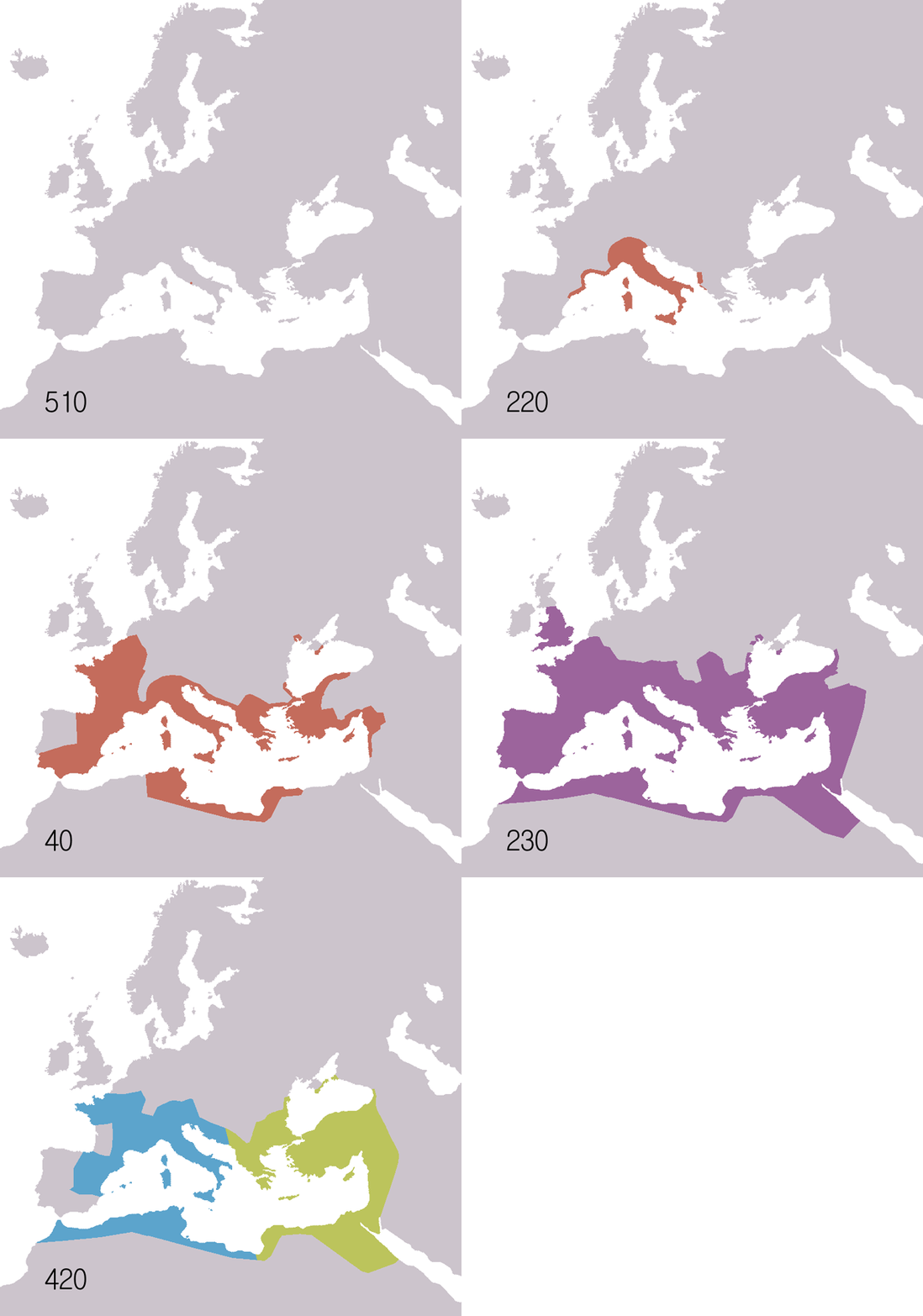
tribe conquered most of Serbia in 279 BC, building many forts throughout the region. The Roman Empire conquered the region in the span of 2nd century BC-1st century AD. The Romans continued the expansion of Singidunum
(modern capital Belgrade), Sirmium
(Sremska Mitrovica
) and Naissus (Niš), among other centres, and a few notable remnants of monuments survive, such as Via Militaris
, Trajan's Bridge
, Diana
, Felix Romuliana (UNESCO), etc.
Slavs formed Sklavinia beginning in the 6th century, out of which the First Serbian Principality of the Vlastimirović emerged. It evolved into a Grand Principality
by the 11th century, and in 1217, the Kingdom and national church (Serbian Orthodox Church
) were established, under the Nemanjić. In 1345, the Serbian Empire
was established: it spanned a large part of the Balkans. In 1540 the Ottoman Empire
annexed Serbia.
The Serbian realms disappeared by the mid-16th century, torn by domestic feuds, and Ottoman
conquest. The success of the Serbian revolution
against Ottoman rule in 1817 marked the birth of the Principality of Serbia, which achieved de facto independence in 1867 and finally gained recognition by the Great Powers in the Berlin Congress of 1878. As a victor in the Balkan Wars
in 1913, Serbia regained Vardar Macedonia
, Kosovo and Raška
(Old Serbia
). In 1918, the region of Vojvodina
proclaimed its secession
from Austria-Hungary
to unite with the pan-Slavic State of Slovenes, Croats and Serbs
; the Kingdom of Serbia joined the union on 1 December 1918, and the country was named Kingdom of Serbs, Croats, and Slovenes. In 1918, Serbia was recognized as a state by the world for the first time.
Serbia achieved its current borders after World War II, when it became a federal unit within the Socialist Federal Republic of Yugoslavia
. After the dissolution of Yugoslavia
in a series of wars
in the 1990s, Serbia once again became an independent state on 5 June 2006, following the breakup
of a short-lived union with Montenegro.
 Much of Serbia during the Neolithic period
was occupied by the Vinča culture
.
Serbia's strategic location between two continents has subjected it to invasions by many peoples. Greeks
colonized its south in the 11th century BC, the northernmost point of the empire of Alexander the Great being the town of Kale-Krsevica
.
Belgrade is believed to have been torn by 140 wars since Roman times
.
The northern city of Sirmium
(Sremska Mitrovica) was among the top 4 cities of the late Roman Empire
, serving as its capital during the Tetrarchy
. Contemporary Serbia comprises the classical
regions of Moesia
, Pannonia
, parts of Dalmatia
, Dacia
and Macedonia
.
Around the 7th century, Slavs
appeared on the Byzantine
borders in great numbers. Slavic people have been under nominal Serbian rule
since the 7th century. They were allowed to settle in the Byzantine Empire by its emperor Heraclius
after their victory over the Avars
.
Throughout its early history, various parts of the territory of modern Serbia have been colonized, claimed or ruled by:
No fewer than 17 Roman Emperor
s were born in what is now Serbia.
Starčevo
and Vinča culture
s existed in or near Belgrade and dominated the Balkans
(as well as parts of Central Europe and Asia Minor
) about 8,500 years ago. Some scholars believe that the prehistoric Vinča signs represent one of the earliest known forms of writing system
s (dating to 6000–4000 BC).
dominated Serbia before the Illyrian
migration in the southwest.
Greeks
colonized the south in the 4th century BC, the northernmost point of the empire of Alexander the Great being the town of Kale
.
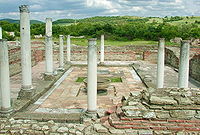
and the rest of Central Serbia in 75 BC, establishing the province of Moesia
. Srem
is conquered by 9 BC and Bačka
and Banat
in 106 AD after the Dacian wars
.
Belgrade is believed to have been destroyed by 140 wars since Roman times
. The northern Serbian city of Sirmium
(Sremska Mitrovica) was among the top 4 cities of the late Roman Empire
, serving as its capital during the Tetrarchy
. Contemporary Serbia comprises the classical
regions of Moesia
, Pannonia
, parts of Dalmatia
, Dacia
and Macedonia
.
The chief towns of Upper Moesia in the Principate were: Singidunum
(Belgrade
), Viminacium
(sometimes called municipium Aelium; modern Kostolac
), Remesiana (Bela Palanka
)
Seventeen Roman Emperors were born in present-day Serbia.
The Serbs, a Slavic people, specifically of the South Slavic
subgroup, has its origins in the 6th and 7th century communities developed in Southeastern Europe (see Great Migration). Slav raids on Eastern Roman territory are mentioned in 518, and by the 580s they had conquered large areas referred to as Sclavinia (transl. Slavdom, from Sklavenoi – Σκλαυηνοι, the early South Slavic tribe which is eponymous to the current ethnic and linguistic Indo-European people).
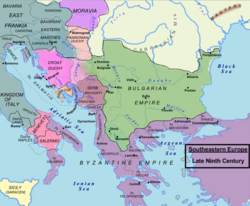 Prince Višeslav
(fl. 768–814), the first known Serbian monarch by name, ruled the hereditary lands (Župa
nias, counties) of Neretva
, Tara
, Piva
, Lim
. He managed to unite several more provinces and tribes into what is subsequently known as Rascia (the future crownland of the Serbian Principality). Višeslav was succeeded by his son Radoslav
and then Prosigoj
, during which time "the Serbs inhabit the greater part of Dalmatia
" (Royal Frankish Annals
, 822). At this time, there was peace with the eastern neighbours of Bulgars
, who had began to expand their territory significantly. Prosigoj's son, Prince Vlastimir, further expanded the realm, which prompted the Bulgars, who had already taken parts of Macedonia, to invade in 839. The invasion led to a three-year-war, which ended in 842, with a decisive Serbian victory. The Bulgars were driven out and Vlastimir expanded to the west and south, meanwhile the Bulgars had taken most of modern Serbia's east. Prince Mutimir
(r. 851–891), the son of Vlastimir, managed to defeat the Bulgars once again in 834–835, also capturing the son of the Bulgar Khan. The Serbs and Bulgars concluded peace, and the Christianization of the Slavs began; by the 870s the Serbs were baptized and had established the Eparchy of Ras, on the order of Emperor Basil I
. The remaining years well into the 920s are characterized by civil wars; succession wars between the branches of the Vlastimirović Dynasty.
Petar Gojniković managed to defeat his cousin, the reigning Prince Pribislav Mutimirović in 892. Petar was recognized by the Bulgars, now the greatest power in the Balkans, although the peace was not to last; the Byzantines had sent an envoy to Serbia promising greater independence in return of Petar leading an army against the Bulgars. A Bulgarian ally, Michael Višević, who had seen a threat in Petar during the latters conquering of Bosnia and Neretva, heard of the possible alliance and warned the Bulgarian Khan, who later sent a protege, Pavle Branović
, to rule Serbia. In the meantime, Zaharija Pribislavljević
is sent by the Byzantines to take the Serbian throne, he is however captured by Pavle and sent to Bulgaria. Pavle is now approached by the Byzantines, thus Zaharija is indoctrinated by the Bulgars. Pavle plans an attack on Bulgaria, but Khan Simeon is warned, and dispatches Zaharija with an army, promising him the throne if he defeats Pavle, which he did. Zaharija soon resumed his Byzantine alliance, also uniting several Slavic tribes along the common border to revolt against the Bulgars, several Bulgarian generals were beheaded, their heads sent to Constantinople by Zaharija as a symbol of alleigance. In 924 a large army led by Časlav Klonimirović
, the second cousin, is sent by the Bulgars which ravages Serbia, forcing Zaharija to exile. Instead of instating Časlav, the Bulgars annex Serbia 924–927.
Časlav takes the throne in 927, with the death of the Bulgar Khan, and immediately puts himself under Byzantine overlordship. Eastern Christian (Orthodox) influence greatly increases and the two maintain close ties throughout his regn. He enlarged Serbia, uniting the tribes of Bosnia, Herzegovina
, Old Serbia
and Montenegro
(incorporated Pagania, Zahumlje
, Travunia
, Konavle
, Bosnia
and Rascia
into Serbia
, ι Σερβλια). He took over regions previously held by Michael Višević, who disappears from sources in 925. The De Administrando Imperio
describes his realm: the shores of the Adriatic Sea
, the Sava river
and the Morava valley as well as today's northern Albania
.
After Časlav's death the realm crumbled, local nobles restored the control of each province. Soon the Croats
, Bulgarians
and Byzantines annex the Serbian territories. The written information about the first dynasty ends with the death of Časlav. The Catepanate of Ras is established between 971–976, during the rule of John Tzimiskes (r. 969–976). A seal of a strategos
of Ras has been dated to Tzimiskes' reign, making it possible for Tzimiskes' predecessor Nikephoros II Phokas to have enjoyed recognition in Rascia. The protospatharios and katepano of Ras was a Byzantine governor named John. Data on the katepano of Ras during Tzimiskes' reign is missing. Byzantine military presence ended soon thereafter with the wars with Bulgaria
, and was re-established only ca. 1018 with the short-lived Theme of Sirmium, which however did not extend much into Rascia proper.
In the 990s, Jovan Vladimir
emerges at the most powerful Serbian noble. With his court centered in Bar
on the Adriatic coast, he had much of the Serbian Pomorje ('maritime') under his control including Travunia
and Zachlumia
. His realm may have stretched west- and northwards to include some parts of the Zagorje (inland Serbia and Bosnia) as well. Vladimir's pre-eminent position over other Slavic nobles in the area explains why Emperor Basil II approached him for an anti-Bulgarian alliance. With his hands tied by war in Anatolia, Emperor Basil required allies for his war against Tsar Samuel, who had much of Macedonia. In retaliation, Samuel invaded Duklja in 997, and pushed through Dalmatia
up to the city of Zadar
, incorporating Bosnia and Serbia
into his realm. After defeating Vladimir, Samuel reinstated him as a vassal
Prince.
(Overthrowing of Byzantine supremacy).
Duklja then assumed domination over the Serbian lands between 11–12th centuries under the dynasty of Vojislavljević
(cadet branch of the 1st Serbian dynasty). In 1077 AD. Duklja
became the first Serb Kingdom
(under Michael I- 'ruler of Tribals and Serbs'), following the establishment of the catholic Bisphoric of Bar
.
, centred in present-day southern Serbia, rose to become the paramount Serb state. Over the 13th and 14th centuries, it ruled over the other Serb lands (the Hum
, Travunia
and Duklja
/Zeta
. During this time, Serbia began to expand eastward (toward Niš
), southward into Kosovo
and northern Macedonia and northward toward Srem
and Macva
for the first time. This shift away from the Adriatic coast brought Serbia increasingly under the influence of the Eastern Orthodox
, although a substantial proportion of Catholics were found in the coastal regions. Although Europe had already experience the East-West Schism
by this time, such a split was far less concrete than it is today, and Catholic Slavs in Bosnia and the Dalmatian coast practiced Christianity in a similar way to Orthodox Slavs – priests married, wore beards and gave liturgy in Slavic rather than Latin. By the beginning of the 14th century Serbs lived in three distinctly independent kingdoms- Dioclea
, Rascia
and Syrmia
.
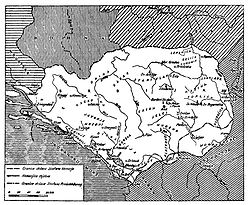 Led by the House of Nemanjić
, medieval Serbia reached its military, economic and legal climax. The Serbian Kingdom was proclaimed in 1217. Direct result of this was the establishment of the Serbian Orthodox Church
in 1219. In the same year Saint Sava
published the first constitution in Serbia – St. Sava's Nomocanon.
Stefan Dušan proclaimed the Serbian Empire
in 1346. During Dušan's rule, Serbia reached its territorial, political and economical peak, proclaiming itself as the successor of the Byzantine Empire
, and indeed was the most powerful Balkan state of that time. Tsar Dušan enacted the known Dušan's Code, an extensive constitution
, and opened new trade routes and strengthened the state's economy. Serbia flourished, becoming one of the most developed countries and cultures in Europe. Medieval Serbia had a high political, economic, and cultural reputation in Europe. The Serbian identity has been profoundly shaped by the rule of this dynasty and its accomplishments, with the Serbian Orthodox Church
who assumed the role of the national spiritual guardian.
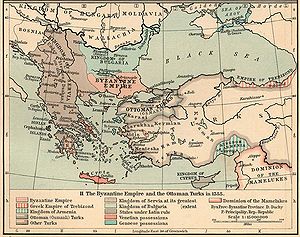 Before his sudden death, Stefan Dušan tried to organize a Crusade with the Pope against the threatening Turks. He died in December 1355 at the age 47. He was succeeded by his son Uroš, called the Weak, a term that might also apply to the state of the empire which slowly slided into a feudal anarchy. This was a period marked by the rise of a new threat: the Ottoman Turk sultanate
which spread from Asia to Europe. They conquered Byzantium
and then the other states in the Balkans
.
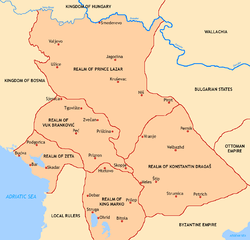 Two Barons in the Serbian region, Mrnjavčević brothers, gathered a large army to repel the Ottomans. They marched into Ottoman territory in 1371 to attack the Turks, but they were too self-confident. They built an overnight camp near the river Maritsa
at Chernomen in today's Bulgaria
, and started celebrating the victory in advance, and eventually got drunk. During the night, a detachment of Ottoman forces attacked the drunk Serbian knights and pushed them to the river. Most of the knights were either killed or drowned. This battle became known as the Battle of Maritsa
. The result of this battle was that Serbs lost control over the south half of their former empire.
In Battle of Pločnik
in 1386, Serbian forces defeated the Ottoman army. But, the Battle of Kosovo
in 1389 was the turning point of the war between the Serbs and the Turks. Serbian armoured horseman, commanded by Prince Lazar – the strongest regional nobleman in Serbia at the time, had the advantage in the battle. Lazar's vassal Obilić killed the Ottoman sultan Murad I
. Eventually, Murad's son Bayezid I
retreated the rest of his troops from the battlefield, so it was the Serbian victory. But, the Serbian losses were so heavy and the result of this battle was a catastrophe for the Serbs. The Battle of Kosovo defined the fate of the medieval Serbia. After the battle there was no force in the Balkans
capable of standing up to the Ottoman Turks. Kosovo was taken by the Ottomans in the following years and the Serbian realm was moved northwards. That unstable period was marked by the rule of Prince Lazar's son, despot Stefan Lazarević
, a true European-style knight and a poet; and his cousin Đurađ Branković, who moved the capital north to the newly built fortified town of Smederevo
. The Ottomans continued their conquest until they finally seized the entire northern medieval Serbia in 1459, when Smederevo fell into their hands.
, which was under the rule of the Kingdom of Hungary
in that time. The Hungarian kings encouraged the immigration of Serbs to the kingdom, and hired many of them as soldiers and border guards. During the struggle between the Ottoman Empire and Hungary, this Serb population performed an attempt of the restoration of the Serbian state. In the Battle of Mohács
on 29 August 1526, Ottoman Empire
destroyed the army of Hungarian
–Czech
king Louis Jagellion, who was killed on the battlefield. After this battle Hungary
ceased to be independent state and much of its former territory became part of the Ottoman Empire. Soon after the Battle of Mohács, leader of Serbian mercenaries in Hungary, Jovan Nenad
established his rule in Bačka
, northern Banat
and a small part of Srem (These three regions are now parts of Vojvodina
). He created an ephemeral independent state, with city of Subotica
as its capital. At the peak of his career, Jovan Nenad crowned himself in Subotica for Serb emperor. King John of Hungary forces defeated his rebellion in the summer of 1527. Jovan Nenad was killed and his 'state' collapsed.
European powers, and Austria in particular, fought many wars against the Ottoman Empire, sometimes with assistance from Serbs. During the Austrian–Ottoman War (1593–1606), in 1594, some Serbs participated an uprising in Banat—the Pannonian part of the Ottoman Empire, and Sultan Murad III
retaliated by burning the relics of St. Sava. Austria established troops in Herzegovina
but when peace was signed by Ottoman Empire and Austria, Austria abandoned to Ottoman vengeance. This sequence of events became customary for the centuries that followed.
During the Great War (1683–90) between the Ottoman Empire and the Holy League—created with the sponsorship of the Pope and including Austria, Poland and Venice
—these three powers as means of divide and conquer strategy, incited including Serbs to rebel against the Ottoman authorities and soon uprisings and terrorism spread throughout the western Balkans: from Montenegro
and the Dalmatian Coast to the Danube
basin and Old Serbia (Macedonia, Raška, Kosovo and Metohija). However, when the Austrians started to pull out of the Ottoman region, they invited Austrian-loyal people to come north with them into Hungarian territories. Having to choose between Ottoman reprisal or living in Hungary, some Serbs abandoned their homesteads and headed north led by patriarch
Arsenije Čarnojević.
Another important episode in the history of the region took place in 1716–18, when the territories ranging from Dalmatia, and Bosnia and Herzegovina to Belgrade and the Danube basin became the battleground for a new Austria-Ottoman war launched by Prince Eugene of Savoy
. Some Serbs sided once again with Austria. After a peace treaty was signed in Požarevac, the Ottomans lost all its possessions in the Danube basin, as well as today's northern Serbia and northern Bosnia, parts of Dalmatia and the Peloponnesus.
The last Austrian-Ottoman war was the so-called Dubica war (1788–91), when the Austrians urged the Christians in Bosnia to rebel. No wars were fought afterwards until the 20th century that marked the fall of both Austrian and Ottoman empires, staged together by the European powers/imperialism just after World War I.
in two uprisings in 1804
(led by Đorđe Petrović – Karađorđe) and 1815
(led by Miloš Obrenović), although Turkish troops continued to garrison the capital, Belgrade
, until 1867. The Turkish Empire was already faced with a deep internal crisis without any hope of recuperating. This had a particularly hard effect on the orthodox nations living under its rule. The Serbs launched not only a national revolution but a social one as well.
or kneževina (knjaževina), until 1882 when it became a Kingdom, during which the internal politics revolved largely around dynastic rivalry between the Obrenović and Karađorđević families.
This period was marked by the alternation of two dynasties descending from Đorđe Petrović—Karađorđe, leader of the First Serbian Uprising
and Miloš Obrenović, leader of the Second Serbian Uprising
. Further development of Serbia was characterized by general progress in economy, culture and arts, primarily due to a wise state policy of sending young people to European capitals to get an education. They all brought back a new spirit and a new system of values. One of the external manifestations of the transformation that the former Turkish province was going through was the proclamation of the Province of Serbia in 1882.
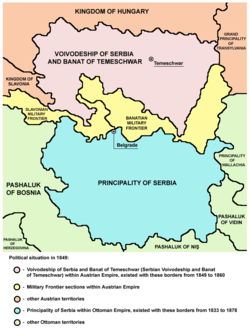 During the Revolutions of 1848
, the Serbs in the Austrian Empire
proclaimed Serbian autonomous province known as Serbian Vojvodina
. By a decision of the Austrian emperor, in November 1849, this province was transformed into the Austrian crown land known as the Vojvodina of Serbia and Tamiš Banat (Dukedom of Serbia and Tamiš Banat). Against the will of the Serbs, the province was abolished in 1860, but the Serbs from the region gained another opportunity to achieve their political demands in 1918. Today, this region is known as Vojvodina
.
In 1885, Serbia was against the unification of Bulgaria and Eastern Rumelia
and attacked Bulgaria. This is also known as Serbo-Bulgarian war
. Despite better weapons and skilled commanders, Serbia lost the war.
In the second half of 19th century, Serbia gained statehood as the Kingdom of Serbia
. It thus became part of the constellation of European states and the first political parties were founded, thus giving new momentum to political life. The May Overthrow
in 1903, bringing Karađorđe's grandson to the throne with the title of King Petar I opened the way for parliamentary democracy in Serbia. Having received a European education, this liberal king translated "On Liberty
" by John Stuart Mill
and gave his country a democratic constitution. It initiated a period of parliamentary government and political freedom interrupted by the outbreak of the liberation wars. The Balkan wars
1912–13, terminated the Turkish domination in the Balkans. Turkey was pushed back towards the Bosporus, and national Balkan states were created in the territories it withdrew from. Even though Serbia at the beginning was part of a united alliance of Balkan powers against the Ottomans the initial victory led to squabbles about the division of the spoils and in the second of the two wars it was Bulgaria who was Serbia's main enemy.
of Austrian Crown Prince Franz Ferdinand
in the Bosnian
capital Sarajevo
, by Gavrilo Princip
, a member of Young Bosnia
and one of seven assassins, served as a pretext for the Austrian declaration of war on Serbia, marking the beginning of World War I, despite Serbia's acceptance (on 25 July) of nearly all of Austria-Hungary
's demands . The Serbian Army defended the country and won several victories, but it was finally overpowered by the forces of Germany, Austria-Hungary and Bulgaria
, and had to withdraw from the national territory marching across the Albania
n mountain ranges to the Adriatic Sea
. On 16 August Serbia was promised by the Entente
the territories of Srem, Bačka, Baranja, eastern Slavonia, Bosnia and Herzegovina and eastern Dalmatia as a reward after the war. Having recuperated on Corfu
the Serbian Army returned to combat on the Thessaloniki
front together with other Entente
forces consisting of France, the United Kingdom, Russia, Italy and the United States. In World War I, Serbia had 1,264,000 casualties—28% of its population of 4,5 million, which also represented 58% of its male population—a loss from which it never fully recovered.
, Bunjevci
, and other nations of Vojvodina
in Novi Sad
voted to join the region to Serbia. Also, on 29 November the National Assembly of Montenegro
voted for union with Serbia, and two days later an assembly of leaders of Austria–Hungary's southern Slav regions voted to join the new State of Slovenes, Croats and Serbs
.
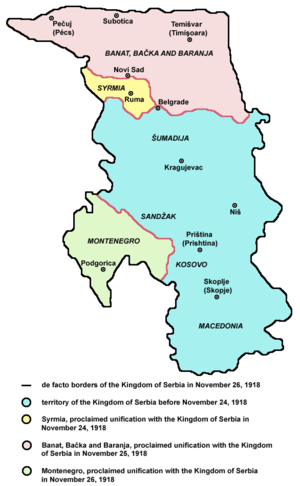 With the end of World War I and the collapse of both the Austro-Hungarian and Ottoman Empires the conditions were met for proclaiming the Kingdom of Serbs, Croats and Slovenes in December 1918. The Yugoslav ideal had long been cultivated by the intellectual circles of the three nations that gave the name to the country, but the international constellation of political forces and interests did not permit its implementation until then. However, after the war, idealist intellectuals gave way to politicians, and the most influential Croatian politicians opposed the new state right from the start.
In the early 1920s the Yugoslav government of Serbian prime minister Nikola Pasic
used police pressure over voters and ethnic minorities, confiscation of opposition pamphlets and other measures of election rigging to keep the opposition, and mainly the Croatian Peasant Party
and its allies in minority in Yugoslav parliament. Pasic believed that Yugoslavia should be as centralized as possible, creating in place of distinct regional governments and identities a Greater Serbia
n national concept of concentrated power in the hands of Belgrade.
However, what pushed the Kingdom into crisis was when a Serb representative opened fire on the opposition benches in the Parliament, killing two outright and mortally wounding the leader of the Croatian Peasants Party, Stjepan Radić
in 1928.
Taking advantage of the resulting crisis, King Alexander I
banned national political parties in 1929, assumed executive power, and renamed the country Yugoslavia
. He hoped to curb separatist tendencies and mitigate nationalist passions. However, the balance of power changed in international relations: in Italy and Germany, Fascists
and Nazis rose to power, and Joseph Stalin
became the absolute ruler in the Soviet Union. None of these three states favored the policy pursued by Alexander I. The first two wanted to revise the international treaties signed after World War I, and the Soviets were determined to regain their positions in Europe and pursue a more active international policy. Yugoslavia was an obstacle for these plans, and King Aleksandar I was the pillar of the Yugoslav policy.
During an official visit to France in 1934, the king was assassinated in Marseille
by a member of the Internal Macedonian Revolutionary Organization – an extreme nationalist organization in Bulgaria that had plans to annex territories along the eastern and southern Yugoslav border—with the cooperation of the Ustaše
– a Croatian fascist separatist organization. The international political scene in the late 1930s was marked by growing intolerance between the principal figures, by the aggressive attitude of the totalitarian regimes. Croatian leader Vlatko Maček and his party managed to extort the creation of the Croatian banovina (administrative province) in 1939. The agreement specified that Croatia was to remain part of Yugoslavia, but it was hurriedly building an independent political identity in international relations.
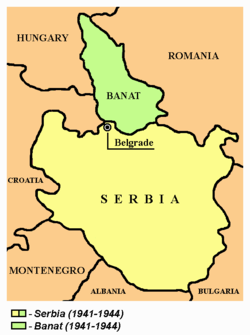 In the run up to World War II, Prince Regent Paul signed a treaty with Hitler (as did Bulgaria, Romania, Hungary). However, a popular uprising amongst the people rejected this agreement and Prince Regent Paul was sent to exile. King Peter II assumed full royal duty.
Thus the beginning of the 1940s, Yugoslavia found itself surrounded by hostile countries. Except for Greece, all other neighboring countries had signed agreements with either Germany or Italy. Adolf Hitler
was strongly pressuring Yugoslavia to join the Axis powers. The government was even prepared to reach a compromise with him, but the spirit in the country was completely different. Public demonstrations against Nazism prompted a brutal reaction.
In April 1941, the Luftwaffe
bombed Belgrade
and other major cities. Ground forces from Germany, Italy, Hungary, and Bulgaria invaded Yugoslavia. After a brief war, Yugoslavia surrendered unconditionally. Acting upon advice and with a heavy heart, King Peter II left the country to seek Allied support. He was greeted as the hero who dared oppose Hitler. The Royal Yugoslav Government, the only legal body of Yugoslavia, continued to work in London. The occupying Axis powers then divided Yugoslavia up. The western parts of the country together with Bosnia and Herzegovina were turned into a Nazi puppet state called the Independent State of Croatia
(NDH) and ruled by the Ustashe. Serbia was set up as another puppet state which was known as the Nedić's Serbia
, first under Milan Aćimović
and then under Serbian army general Milan Nedić
. The northern territories were annexed by Hungary, and eastern and southern territories by Bulgaria. Kosovo and Metohia were mostly annexed by Albania which was under the sponsorship of fascist Italy. Montenegro also lost territories to Albania and was then occupied by Italian troops. Slovenia
was divided between Germany and Italy, which also seized the islands in the Adriatic.
In Serbia, the German occupation authorities organized several concentration camps for Jews and members of the communist Partisan resistance movement, while Chetniks were helping fascist and nacists in their plans.
Chetnik movement was brutally destroyed by Ustasha army, in battle at Lijevča Polje, where some 40 000 chetniks were killed – as Draža Mihajlović referred to at his trial in Belgrade.
The biggest concentration camps were Banjica
and Sajmište
near Belgrade
, where, according to the most conservative estimates, around 40,000 Jews were killed. In all those camps, some 90 percent of the Serbian Jewish population perished. In the Bačka
region annexed by Hungary, numerous Serbs and Jews were killed in 1942 raid by the Hungarian authorities. The persecutions against ethnic Serb population also occurred in the region of Syrmia
, which was controlled by the Independent State of Croatia
and in the region of Banat
, which was under direct German control.
The ruthless attitude of the German occupation forces and the genocidal
policy of the Croatian Ustaša regime, aimed at Serbs, Jews, Gypsies and anti-Ustaša Croats, created a strong anti-fascist resistance in the NDH. Many Croats and other nationalities stood up against the genocide and the Nazis. Many joined the Partisan forces created by the Communist Party (National Liberation Army headed by Josip Broz Tito
) in the liberation and the revolutionary war against Nazis and all the others who were against communism.
During this war and after it, the Partisans killed many civilians who did not support their Communist ideals. The Communists shot people without trials, or following politically and ideologically motivated courts. The Agricultural Reform conducted after the war meant that peasants had to give away most of their wheat, grain, and cattle to the state, or face serious imprisonment. Land and property were confiscated on a massive scale. Many people also lost civil rights and their names were smeared. Also, a censorship was enforced on all levels of the society and media, and a cult of Tito was created in the media.
By the end of 1944, the Red Army liberated Serbia, and by May 1945, the remaining republics were meeting up with the Allied forces in Hungary, Austria and Italy. Yugoslavia was among the countries that had the greatest losses in the war: 1,700,000 (10.8% of the population) people were killed and national damages were estimated at US $9.1 billion according to the prices of that period.
 After the war, Josip Broz Tito
became the first president of the new—socialist—Yugoslavia
which he ruled through the League of Communists of Yugoslavia
. Once a predominantly agricultural country, Yugoslavia was transformed into a mid-range industrial country, and acquired an international political reputation by supporting the decolonization
process and by assuming a leading role in the Non-Aligned Movement
. Socialist Yugoslavia was established as a federal state comprising six republics, from north to south: Slovenia
, Croatia
, Bosnia and Herzegovina
, Serbia
, Montenegro
and Macedonia
and two autonomous regions within Serbia – Vojvodina
and Kosovo
.
The basic motto of Tito's Yugoslavia was "brotherhood and unity", workers' self-management, state-owned property with minimal privately owned property. In the beginning, the country copied the Soviet model, but after the 1948 split with the Soviet Union, it turned more towards the West. Eventually, it created its own brand of socialism, with a hint of a market economy, and milked both the East and the West for significant financial loans.
The 1974 constitution produced a significantly less centralized federation, increasing the autonomy of Yugoslavia's republics as well as the autonomous provinces of Serbia.
, things began to improve. Economic reforms had opened up the country, the living standard was at its peak, capitalism seemed to have entered the country and nobody thought that just a year later the first gunshots would be fired.
Within a year of Tito`s death the first cracks began to show when in the spring of 1981, on 11 March, 26, and 1 March/2 April a series of increasingly large protests spread from the campus of the University of Pristina to the streets of several cities in Kosovo
demanding the upgrading of the Autonomous Region to the status of full Republic – these protests were violently suppressed by the Police with many deaths, and a state of emergency was declared. Serbian concerns about the treatment of Serb minorities in other republics and particularly in Kosovo were exacerbated by the SANU Memorandum, drawn up by the Serbian Academy of Sciences and Arts
and published in Sep 1986 byVečernje novosti
, which claimed that Serbs were suffering a genocide at the hands of the Kosovo Albanian majority. Slobodan Milošević
leader of the League of Communists of Serbia
since May 1986, became the champion of the Serbian Nationalists when on 24 Apr 1987 he visited Kosovo Polje
and, after local Serbs had clashed with the Police declared, 'No one has the right to beat you'.
Slobodan Milošević
became the most powerful politician in Serbia on 25 Sep 1987 when he defeated and humiliated his former mentor Serbian President Ivan Stambolic
, during the televised 8th Session of the League of Communists of Serbia. Milosevic governed Serbia from his position as Chairman of the Central Committee of the League of Communists of Serbia
until 8 May 1989 when he assumed the Presidency of Serbia. Milosevic supporters gained control of three other constituent parts of Yugolslavia in what became known as the Anti-bureaucratic revolution
, Vojvodina
on 6 Oct 1988, Kosovo
on 17 Nov 1988, and Montenegro
on 11 Jan 1989. On 25 Nov 1988 the Yugoslav National Assembly granted Serbia the right to change it`s constitution. In March 1989 this was done, removing autonomy from Vojvodina
and Kosovo, which caused great unrest in Kosovo
On 28 June 1989 Slobodan Milošević
made what became known as the Gazimestan Speech
which was the centrepiece of a day-long event, attended by an estimated one million Serbs, to mark the 600th anniversary of the Serbian defeat at the Battle of Kosovo
by the Ottoman Empire
. In this speech Milošević's reference to the possibility of "armed battles" in the future of Serbia's national development was seen by many as presaging the collapse of Yugoslavia and the bloodshed of the Yugoslav Wars
.
On 23 Jan 1990 at its 14th Congress the Communist League of Yugoslavia voted to remove its monopoly on political power, but the same day effectively ceased to exist as a national party when the League of Communists of Slovenia
walked out after Slobodan Milošević
blocked all their reformist proposals. On 27 July 1990 Milošević merged the League of Communists of Serbia with several smaller communist front parties to form the Socialist Party of Serbia
. A new Constitution was drawn up and came into force on 28 Sep 1990 transforming the one-party Socialist Republic of Serbia
into a multi-party Republic of Serbia The first multi-party elections were held on 9 and 23 December 1990
and in what became the pattern for the next several elections the Socialist Party of Serbia won, as Milošević maintained firm control over the state media and opposition parties had little access. On 9 March 1991
a mass rally on the streets of Belgrade
turned into a riot with vicious clashes between the protesters and police. It was organized by Vuk Drašković
's Serbian Renewal Movement
(SPO). Two people died in the ensuing violence.
The Socialist Federal Republic of Yugoslavia broke up in 1991/1992 in a series of wars following the independence declarations of Slovenia
and Croatia
on 25 Jun 1991, and Bosnia and Herzegovina
on 5 Mar 1992. Macedonia
left the federation peacefully on 25 Sep 1991. The Yugoslav Peoples Army(JNA) tried and failed to prevent the secession of Slovenia
in the Ten Day War 26 Jun – 6 Jul 1991 and completely withdrew by 26 Oct 1991. The JNA attempted and failed to prevent the secession of Croatia
during the first phase of the Croatian War of Independence
from 27 Jun 1991 until the truce of Jan 1992, but did successfully enable the Croatian Serb minority to establish the Republic of Serb Krajina which looked to Serbia for support. The biggest battle of this war was the Siege of Vukovar from which the JNA expelled the Croats. Following the start of the Bosnian War
on 1 April 1992 the JNA officially withdrew all its forces from Croatia and Bosnia in May 1992 and was formally dissolved on 20 May 1992 – its remnant forces being taken over by the new Federal Republic of Yugoslavia.
and Montenegro
, formed on 28 April 1992 a new federation named Federal Republic of Yugoslavia.
called the State Union of Serbia and Montenegro
(SCG).
After June 1999, Kosovo
was made a United Nations protectorate
, under the UN Mission in Kosovo (UNMIK) based in Priština
. From early 2001, UNMIK has been working with representatives of the Serbian and union governments to reestablish stable relations in the region. A new assembly of the province was elected in November 2001, which formed a government and chose a president in February 2002. In spring 2002, UNMIK announced its plan to repatriate ethnic Serb internally displaced person
s (IDPs).
Although threatened by Milošević throughout the last years of his rule, Montenegro's democratization efforts have continued. In January 1998, Milo Đukanović became Montenegro's president, following bitterly contested elections in November 1997, which were declared free and fair by international monitors. His coalition followed up with parliamentary elections in May. Having weathered Milošević's campaign to undermine his government, Đukanović has struggled to balance the pro-independence stance of his coalition with the changed domestic and international environment of the post-5 October Balkans. In December 2002, Đukanović resigned as president and was appointed Prime Minister. The new President of Montenegro is Filip Vujanović
.
Before 5 October, even as opposition grew, Milošević continued to dominate the organs of the Federal Republic of Yugoslavia (FRY) Government. And although his political party, the Socialist Party of Serbia
(SPS) (in electoral cartel with Mirjana Markovic
' Yugoslav United Left), did not enjoy a majority in either the federal or Serbian parliaments, it dominated the governing coalitions and held all the key administrative posts. An essential element of Milošević's grasp on power was his control of the Serbian police, a heavily armed force of some 100,000 that was responsible for internal security and which committed serious human rights abuses. Routine federal elections in September 2000 resulted in Kostunica
receiving less than a majority, requiring a second round. Immediately, street protests and rallies filled cities across the country as Serbs rallied around Vojislav Koštunica
, the recently formed Democratic Opposition of Serbia
(DOS, a broad coalition of anti-Milošević parties) candidate for FRY president. There had been widespread fear that the second round would be cancelled on the basis of foreign interference in the elections. Cries of fraud and calls for Milošević's removal echoed across city squares from Subotica
to Niš
.
On 5 October 2000, Slobodan Milošević was forced to concede defeat after days of mass protests all across Serbia.
was soon joined at the top of the domestic Serbian political scene by the Democratic Party's (DS) Zoran Đinđić, who was elected Prime Minister of Serbia at the head of the DOS ticket in December's republican elections. After an initial honeymoon period in the wake of 5 October, DSS and the rest of DOS, led by Đinđić and his DS, found themselves increasingly at odds over the nature and pace of the governments' reform programs. Although initial reform efforts were highly successful, especially in the economic and fiscal sectors, by the middle of 2002, the nationalist Koštunica and the pragmatic Đinđić were openly at odds. Koštunica's party, having informally withdrawn from all DOS decision-making bodies, was agitating for early elections to the Serbian Parliament in an effort to force Đinđić from the scene. After the initial euphoria of replacing Milošević's autocratic regime, the Serbian population, in reaction to this political maneuvering, was sliding into apathy and disillusionment with its leading politicians by mid-2002. This political stalemate continued for much of 2002, and reform initiatives stalled.
was elected President of Serbia and Montenegro.
On 12 March 2003, Serbian Prime Minister Zoran Đinđić was assassinated. The newly formed union government of Serbia and Montenegro reacted swiftly by calling a state of emergency and undertaking an unprecedented crackdown on organized crime which led to the arrest of more than 4,000 people.
Parliamentary elections were held in the Republic of Serbia on 28 December 2003.
Serbia has been in a state of political crisis since the overthrow of the post-communist ruler, Slobodan Milošević
, in 2001. The reformers, led by former Yugoslav President Vojislav Koštunica
, have been unable to gain control of the Serbian presidency because three successive presidential elections have failed to produce the required 50% turnout. The assassination in March 2003 of the reforming Prime Minister, Zoran Đinđić was a major setback.
Despite the great increase in support for the Radicals, the four pro-reform parties (Koštunica's Democratic Party of Serbia
, late Prime Minister Đinđić's Democratic Party
, now led by Boris Tadić
, and the G17 Plus
group of liberal economists led by Miroljub Labus
, plus the SPO-NS) won 49.8% of the vote, compared with 34.8% for the two anti-western parties, the Radicals
of Vojislav Šešelj
and the Socialists
of Milošević, and won 146 seats to 104.
At the 2004 Presidential election
Boris Tadić
, candidate of the Democratic Party
won over Tomislav Nikolić
, of the Serbian Radical Party
, sealing the future reform and EU-integration path of Serbia. Tadic's presidency was confirmed in 2008
began to sever economic ties with Serbia
as it formed a new economic policy
and adopted the Deutsche Mark as its currency. Subsequent governments of Montenegro carried out pro-independence policies, and political tensions with Serbia simmered despite political changes in Belgrade
. Also, separatist Albanian paramilitaries began steady escalation of violence in 1998. The question whether the Federal Yugoslav state would continue to exist became a very serious issue to the government.
Following Montenegro's vote for full independence in the referendum
of 21 May 2006 (55.4% yes, 44.6% no), Montenegro declared independence on 3 June 2006. This was followed on 5 June 2006 by Serbia's declaration of independence, marking the final dissolution of the State Union of Serbia and Montenegro, and the re-emergence of Serbia as an independent state, under its own name, for the first time since 1918.
 A referendum
was held on 28 and 29 October 2006 on a proposed draft of the new Constitution of Serbia
, which was approved. The constitution is Serbia's first as an independent state since the Kingdom of Serbia
's 1903 constitution.
The 2007 elections
confirmed the pro-reform and pro-European stance of the Serbian Parliament, in which Boris Tadic
's party doubled his representation.
A pre-term parliamentary election was held on 11 May 2008
, barely a year after the previous one.
The Serbian government
had passed through weeks of severe crisis after the unilateral declaration of independence of its southern province of Kosovo
on 17 February 2008, which was gradually recognized by the United States and numerous European Union
countries.
The crisis was fuelled by the demand by Prime Minister Vojislav Koštunica
of the Democratic Party of Serbia
(DSS) to the Democratic Party (Serbia)
(DS), which held governmental majority, of a restructuring of the governmental contract including an annex according to which Serbia can continue European integration exclusively with Kosovo as its integral part, as stated in the 2006 Constitution
. The DS
and G17+ refused, and Koštunica had to resign on 8 March 2008, while also asking the President to dismiss the parliament and schedule pre-term parliamentary elections.
The results showed a net increase of votes for Tadic's ZES coalition, passing from 87 to 102 seats.
After long and difficult negotiations, a new pro-European government was formed on 7 July 2008 by 128 out of 250 parliamentary votes of ZES, SPS-PUPS-JS and 6 out of 7 minorities representatives. The new prime minister was Mirko Cvetković
, candidate of the Democratic Party.
parliament unilaterally proclaimed independence
from Serbia to mixed international reactions. The declaration was officially recognized by the U.S., Austria, Great Britain, Germany, France, Turkey and dozen other countries. Serbia, Russia, China, Spain, India, Brazil, Greece, Romania and other countries oppose this declaration and consider it illegal. In July 2010, the United Nations International Court of Justice deemed the separation of Kosovo legal, and Kosovo officials plan a 2011 application to the UN.
membership on 22 December 2009.
Despite its setbacks in the political field, on 7 December 2009 the EU unfroze the trade agreement with Serbia and the Schengen countries dropped the visa requirement for Serbian citizens on 19 December 2009.
A Stabilisation and Association Agreement (SAA) was signed in 2008 and is expected to entry into force in 2011.
Serbia
Serbia , officially the Republic of Serbia , is a landlocked country located at the crossroads of Central and Southeast Europe, covering the southern part of the Carpathian basin and the central part of the Balkans...
, as a country, begins with the Slavic settlements in the Balkans
Balkans
The Balkans is a geopolitical and cultural region of southeastern Europe...
, established in the 6th century in territories governed by the Byzantine Empire
Byzantine Empire
The Byzantine Empire was the Eastern Roman Empire during the periods of Late Antiquity and the Middle Ages, centred on the capital of Constantinople. Known simply as the Roman Empire or Romania to its inhabitants and neighbours, the Empire was the direct continuation of the Ancient Roman State...
. Through centuries, the Serbian realm evolved into a Kingdom (1217), then an Empire (1345), before the Ottomans
Ottoman Empire
The Ottoman EmpireIt was usually referred to as the "Ottoman Empire", the "Turkish Empire", the "Ottoman Caliphate" or more commonly "Turkey" by its contemporaries...
annexed it in 1540. Several minor or unsuccessful revolts took place against the Ottoman yoke, with brief independence gained in the northern regions in the 18th century. In 1804 the Serbian Revolution
Serbian revolution
Serbian revolution or Revolutionary Serbia refers to the national and social revolution of the Serbian people taking place between 1804 and 1835, during which this territory evolved from an Ottoman province into a constitutional monarchy and a modern nation-state...
began, resulting in the liberation of Serbia. In 1918, Yugoslavia was established as a confederation of South Slavic nations. In 1991, Yugoslavia was dissolved, with Serbia and Montenegro
Serbia and Montenegro
Serbia and Montenegro was a country in southeastern Europe, formed from two former republics of the Socialist Federal Republic of Yugoslavia : Serbia and Montenegro. Following the breakup of Yugoslavia, it was established in 1992 as a federation called the Federal Republic of Yugoslavia...
continuing the federation. As of 2006 Serbia exists under the name of "Republic of Serbia".
In prehistoric times, the Neolithic
Neolithic
The Neolithic Age, Era, or Period, or New Stone Age, was a period in the development of human technology, beginning about 9500 BC in some parts of the Middle East, and later in other parts of the world. It is traditionally considered as the last part of the Stone Age...
Starčevo
Starcevo-Körös
The Starčevo culture, also called Starčevo–Kőrös–Criş culture, is an archaeological culture of Southeastern Europe, dating to the Neolithic period between c. 6200 and 5200 BCE....
and Vinča culture
Vinca culture
The Vinča culture is a Neolithic archaeological culture in Southeastern Europe, dated to the period 5500–4500 BCE. Named for its type site, Vinča-Belo Brdo, a large tell settlement discovered by Serbian archaeologist Miloje Vasić in 1908, it represents the material remains of a prehistoric society...
s existed in or near Belgrade
Belgrade
Belgrade is the capital and largest city of Serbia. It is located at the confluence of the Sava and Danube rivers, where the Pannonian Plain meets the Balkans. According to official results of Census 2011, the city has a population of 1,639,121. It is one of the 15 largest cities in Europe...
and dominated the Balkans
Balkans
The Balkans is a geopolitical and cultural region of southeastern Europe...
(as well as parts of Central Europe and Asia Minor
Asia Minor
Asia Minor is a geographical location at the westernmost protrusion of Asia, also called Anatolia, and corresponds to the western two thirds of the Asian part of Turkey...
) in 6200–4500 BC. The Paleo-Balkan tribes evolved in the 2nd and 1st millennia BC. The northernmost Ancient Macedonian
Ancient Macedonian
Ancient Macedonian can refer to:*Ancient Macedonians, inhabitants of Macedon*Ancient Macedonian language...
city was in south Serbia (Kale-Krševica
Kale-Krševica
Kale-Krševica is an Ancient Macedonian archaeological site of more than 4 hectares and so far some 1,000 squares have been excavated with a former fortified town in the hills of Krševica overlooking Bujanovac and Vranje, to the south of Ristovac in southern Serbia...
). The Celtic Scordisci
Scordisci
The Scordisci were an Iron Age tribe centered in the territory of present-day Serbia, at the confluence of the Savus , Dravus and Danube rivers. They were historically notable from the beginning of the third century BC until the turn of the common era...
tribe conquered most of Serbia in 279 BC, building many forts throughout the region. The Roman Empire conquered the region in the span of 2nd century BC-1st century AD. The Romans continued the expansion of Singidunum
Singidunum
Singidunum is the name for the ancient city in Serbia which became Belgrade, the capital of Serbia. It was recorded that a Celtic tribe Scordisci settled the area in the 3rd century BC following the Gallic invasion of the Balkans. The Roman Empire conquered the area in 75 BC and later garrisoned...
(modern capital Belgrade), Sirmium
Sirmium
Sirmium was a city in ancient Roman Pannonia. Firstly mentioned in the 4th century BC and originally inhabited by the Illyrians and Celts, it was conquered by the Romans in the 1st century BC and subsequently became the capital of the Roman province of Lower Pannonia. In 294 AD, Sirmium was...
(Sremska Mitrovica
Sremska Mitrovica
Sremska Mitrovica is a city and municipality located in the Vojvodina province of Serbia, on the left bank of the Sava river. As of 2002 the town had a total population of 39,041, while Sremska Mitrovica municipality had a population of 85,605...
) and Naissus (Niš), among other centres, and a few notable remnants of monuments survive, such as Via Militaris
Via Militaris
Via Militaris or Via Diagonalis was an ancient Roman road, starting from Singidunum , passing by Danube coast to Viminacium , through Naissus , Serdica , Philippopolis , Adrianopolis , and reaching Constantinople...
, Trajan's Bridge
Trajan's bridge
Trajan's Bridge or Bridge of Apollodorus over the Danube was a Roman segmental arch bridge, the first to be built over the lower Danube. For more than a thousand years, it was the longest arch bridge in the world, in terms of both total and span length...
, Diana
Diana Fortress
The Diana Fortress is a Roman castrum built in 100-101 AD in Kladovo, Serbia.It is located on cliffs above the Danube in the Karatas archaeological site near Kladovo. The main buildings were built on a strategic location overlooking the Danube frontier with stone in 100 AD during the reign of...
, Felix Romuliana (UNESCO), etc.
Slavs formed Sklavinia beginning in the 6th century, out of which the First Serbian Principality of the Vlastimirović emerged. It evolved into a Grand Principality
Serbian Grand Principality
The Serbian Grand Principality or Rascia was a medieval state that was founded in 1090, and ended with the elevation to Kingdom in 1217. During the reign of Constantine Bodin, the King of Duklja, Vukan was appointed to rule Rascia as a vassal, and when Bodin was captured by the Byzantines, Vukan...
by the 11th century, and in 1217, the Kingdom and national church (Serbian Orthodox Church
Serbian Orthodox Church
The Serbian Orthodox Church is one of the autocephalous Orthodox Christian churches, ranking sixth in order of seniority after Constantinople, Alexandria, Antioch, Jerusalem, and Russia...
) were established, under the Nemanjić. In 1345, the Serbian Empire
Serbian Empire
The Serbian Empire was a short-lived medieval empire in the Balkans that emerged from the Serbian Kingdom. Stephen Uroš IV Dušan was crowned Emperor of Serbs and Greeks on 16 April, 1346, a title signifying a successorship to the Eastern Roman Empire...
was established: it spanned a large part of the Balkans. In 1540 the Ottoman Empire
Ottoman Empire
The Ottoman EmpireIt was usually referred to as the "Ottoman Empire", the "Turkish Empire", the "Ottoman Caliphate" or more commonly "Turkey" by its contemporaries...
annexed Serbia.
The Serbian realms disappeared by the mid-16th century, torn by domestic feuds, and Ottoman
Ottoman Empire
The Ottoman EmpireIt was usually referred to as the "Ottoman Empire", the "Turkish Empire", the "Ottoman Caliphate" or more commonly "Turkey" by its contemporaries...
conquest. The success of the Serbian revolution
Serbian revolution
Serbian revolution or Revolutionary Serbia refers to the national and social revolution of the Serbian people taking place between 1804 and 1835, during which this territory evolved from an Ottoman province into a constitutional monarchy and a modern nation-state...
against Ottoman rule in 1817 marked the birth of the Principality of Serbia, which achieved de facto independence in 1867 and finally gained recognition by the Great Powers in the Berlin Congress of 1878. As a victor in the Balkan Wars
Balkan Wars
The Balkan Wars were two conflicts that took place in the Balkans in south-eastern Europe in 1912 and 1913.By the early 20th century, Montenegro, Bulgaria, Greece and Serbia, the countries of the Balkan League, had achieved their independence from the Ottoman Empire, but large parts of their ethnic...
in 1913, Serbia regained Vardar Macedonia
Vardar Macedonia
Vardar Macedonia is an area in the north of the Macedonia . The borders of the area are those of the Republic of Macedonia. It covers an area of...
, Kosovo and Raška
Raška (region)
Raška is a region in south-central Serbia and northern Montenegro. It is mostly situated in the Raška District. The southern part of Raška is also known as Sandžak and is divided between Serbia and Montenegro....
(Old Serbia
Old Serbia
Old Serbia is a modern name for the territory which was the core of medieval Serbia. It included Raška , Kosovo and Metohija and the Macedonia...
). In 1918, the region of Vojvodina
Vojvodina
Vojvodina, officially called Autonomous Province of Vojvodina is an autonomous province of Serbia. Its capital and largest city is Novi Sad...
proclaimed its secession
Banat, Backa and Baranja
Banat, Bačka and Baranja was a de facto province of the Kingdom of Serbia and the Kingdom of Serbs, Croats and Slovenes between October 1918 and March 1919...
from Austria-Hungary
Austria-Hungary
Austria-Hungary , more formally known as the Kingdoms and Lands Represented in the Imperial Council and the Lands of the Holy Hungarian Crown of Saint Stephen, was a constitutional monarchic union between the crowns of the Austrian Empire and the Kingdom of Hungary in...
to unite with the pan-Slavic State of Slovenes, Croats and Serbs
State of Slovenes, Croats and Serbs
The State of Slovenes, Croats and Serbs was a short-lived state formed from the southernmost parts of the Austro-Hungarian monarchy after its dissolution at the end of the World War I by the resident population of Slovenes, Croats, and Serbs...
; the Kingdom of Serbia joined the union on 1 December 1918, and the country was named Kingdom of Serbs, Croats, and Slovenes. In 1918, Serbia was recognized as a state by the world for the first time.
Serbia achieved its current borders after World War II, when it became a federal unit within the Socialist Federal Republic of Yugoslavia
Socialist Federal Republic of Yugoslavia
The Socialist Federal Republic of Yugoslavia was the Yugoslav state that existed from the abolition of the Yugoslav monarchy until it was dissolved in 1992 amid the Yugoslav Wars. It was a socialist state and a federation made up of six socialist republics: Bosnia and Herzegovina, Croatia,...
. After the dissolution of Yugoslavia
Dissolution of Yugoslavia
The Breakup of Yugoslavia refers to a series of conflicts and political upheavals resulting in the dissolution of Yugoslavia . The SFR Yugoslavia was a country that occupied a strip of land stretching from Central Europe to the Balkans – a region with a history of ethnic conflict...
in a series of wars
Yugoslav wars
The Yugoslav Wars were a series of wars, fought throughout the former Yugoslavia between 1991 and 1995. The wars were complex: characterized by bitter ethnic conflicts among the peoples of the former Yugoslavia, mostly between Serbs on the one side and Croats and Bosniaks on the other; but also...
in the 1990s, Serbia once again became an independent state on 5 June 2006, following the breakup
Montenegrin independence referendum, 2006
The Montenegrin independence referendum was a referendum on the independence of the Republic of Montenegro from the State Union of Serbia and Montenegro that was held on 21 May 2006.The total turnout of the referendum was 86.5%...
of a short-lived union with Montenegro.
Early history
Neolithic Europe
Neolithic Europe refers to a prehistoric period in which Neolithic technology was present in Europe. This corresponds roughly to a time between 7000 BC and c. 1700 BC...
was occupied by the Vinča culture
Vinca culture
The Vinča culture is a Neolithic archaeological culture in Southeastern Europe, dated to the period 5500–4500 BCE. Named for its type site, Vinča-Belo Brdo, a large tell settlement discovered by Serbian archaeologist Miloje Vasić in 1908, it represents the material remains of a prehistoric society...
.
Serbia's strategic location between two continents has subjected it to invasions by many peoples. Greeks
Greeks
The Greeks, also known as the Hellenes , are a nation and ethnic group native to Greece, Cyprus and neighboring regions. They also form a significant diaspora, with Greek communities established around the world....
colonized its south in the 11th century BC, the northernmost point of the empire of Alexander the Great being the town of Kale-Krsevica
Kale-Krševica
Kale-Krševica is an Ancient Macedonian archaeological site of more than 4 hectares and so far some 1,000 squares have been excavated with a former fortified town in the hills of Krševica overlooking Bujanovac and Vranje, to the south of Ristovac in southern Serbia...
.
Belgrade is believed to have been torn by 140 wars since Roman times
Roman Empire
The Roman Empire was the post-Republican period of the ancient Roman civilization, characterised by an autocratic form of government and large territorial holdings in Europe and around the Mediterranean....
.
The northern city of Sirmium
Sirmium
Sirmium was a city in ancient Roman Pannonia. Firstly mentioned in the 4th century BC and originally inhabited by the Illyrians and Celts, it was conquered by the Romans in the 1st century BC and subsequently became the capital of the Roman province of Lower Pannonia. In 294 AD, Sirmium was...
(Sremska Mitrovica) was among the top 4 cities of the late Roman Empire
Roman Empire
The Roman Empire was the post-Republican period of the ancient Roman civilization, characterised by an autocratic form of government and large territorial holdings in Europe and around the Mediterranean....
, serving as its capital during the Tetrarchy
Tetrarchy
The term Tetrarchy describes any system of government where power is divided among four individuals, but usually refers to the tetrarchy instituted by Roman Emperor Diocletian in 293, marking the end of the Crisis of the Third Century and the recovery of the Roman Empire...
. Contemporary Serbia comprises the classical
Classical Greece
Classical Greece was a 200 year period in Greek culture lasting from the 5th through 4th centuries BC. This classical period had a powerful influence on the Roman Empire and greatly influenced the foundation of Western civilizations. Much of modern Western politics, artistic thought, such as...
regions of Moesia
Moesia
Moesia was an ancient region and later Roman province situated in the Balkans, along the south bank of the Danube River. It included territories of modern-day Southern Serbia , Northern Republic of Macedonia, Northern Bulgaria, Romanian Dobrudja, Southern Moldova, and Budjak .-History:In ancient...
, Pannonia
Pannonia
Pannonia was an ancient province of the Roman Empire bounded north and east by the Danube, coterminous westward with Noricum and upper Italy, and southward with Dalmatia and upper Moesia....
, parts of Dalmatia
Dalmatia
Dalmatia is a historical region on the eastern coast of the Adriatic Sea. It stretches from the island of Rab in the northwest to the Bay of Kotor in the southeast. The hinterland, the Dalmatian Zagora, ranges from fifty kilometers in width in the north to just a few kilometers in the south....
, Dacia
Dacia
In ancient geography, especially in Roman sources, Dacia was the land inhabited by the Dacians or Getae as they were known by the Greeks—the branch of the Thracians north of the Haemus range...
and Macedonia
Macedonia (region)
Macedonia is a geographical and historical region of the Balkan peninsula in southeastern Europe. Its boundaries have changed considerably over time, but nowadays the region is considered to include parts of five Balkan countries: Greece, the Republic of Macedonia, Bulgaria, Albania, Serbia, as...
.
Around the 7th century, Slavs
Slavic peoples
The Slavic people are an Indo-European panethnicity living in Eastern Europe, Southeast Europe, North Asia and Central Asia. The term Slavic represents a broad ethno-linguistic group of people, who speak languages belonging to the Slavic language family and share, to varying degrees, certain...
appeared on the Byzantine
Byzantine Empire
The Byzantine Empire was the Eastern Roman Empire during the periods of Late Antiquity and the Middle Ages, centred on the capital of Constantinople. Known simply as the Roman Empire or Romania to its inhabitants and neighbours, the Empire was the direct continuation of the Ancient Roman State...
borders in great numbers. Slavic people have been under nominal Serbian rule
Serbs
The Serbs are a South Slavic ethnic group of the Balkans and southern Central Europe. Serbs are located mainly in Serbia, Montenegro and Bosnia and Herzegovina, and form a sizable minority in Croatia, the Republic of Macedonia and Slovenia. Likewise, Serbs are an officially recognized minority in...
since the 7th century. They were allowed to settle in the Byzantine Empire by its emperor Heraclius
Heraclius
Heraclius was Byzantine Emperor from 610 to 641.He was responsible for introducing Greek as the empire's official language. His rise to power began in 608, when he and his father, Heraclius the Elder, the exarch of Africa, successfully led a revolt against the unpopular usurper Phocas.Heraclius'...
after their victory over the Avars
Eurasian Avars
The Eurasian Avars or Ancient Avars were a highly organized nomadic confederacy of mixed origins. They were ruled by a khagan, who was surrounded by a tight-knit entourage of nomad warriors, an organization characteristic of Turko-Mongol groups...
.
Throughout its early history, various parts of the territory of modern Serbia have been colonized, claimed or ruled by:
- the GreeksAncient GreeceAncient Greece is a civilization belonging to a period of Greek history that lasted from the Archaic period of the 8th to 6th centuries BC to the end of antiquity. Immediately following this period was the beginning of the Early Middle Ages and the Byzantine era. Included in Ancient Greece is the...
and RomansRoman EmpireThe Roman Empire was the post-Republican period of the ancient Roman civilization, characterised by an autocratic form of government and large territorial holdings in Europe and around the Mediterranean....
(conquered the indigenous Celts and IllyriansIllyriansThe Illyrians were a group of tribes who inhabited part of the western Balkans in antiquity and the south-eastern coasts of the Italian peninsula...
) - the WesternWestern Roman EmpireThe Western Roman Empire was the western half of the Roman Empire after its division by Diocletian in 285; the other half of the Roman Empire was the Eastern Roman Empire, commonly referred to today as the Byzantine Empire....
and Eastern Roman EmpiresByzantine EmpireThe Byzantine Empire was the Eastern Roman Empire during the periods of Late Antiquity and the Middle Ages, centred on the capital of Constantinople. Known simply as the Roman Empire or Romania to its inhabitants and neighbours, the Empire was the direct continuation of the Ancient Roman State... - challenged by the incursions of the HunsHunnic EmpireThe Hunnic Empire was an empire established by the Huns. The Huns were a confederation of Eurasian tribes from the steppes of Central Asia. Appearing from beyond the Volga River some years after the middle of the 4th century, they first overran the Alani, who occupied the plains between the Volga...
, the Ostrogoths, the SarmatiansSarmatiansThe Iron Age Sarmatians were an Iranian people in Classical Antiquity, flourishing from about the 5th century BC to the 4th century AD....
, the AvarsAvar KhanateThe Avar Khanate was a long-lived Muslim state which controlled Western Dagestan from the early 13th century to the 19th century.Following the downfall of the Christian kingdom of Sarir in the early 12th century, the Caucasian Avars underwent a process of Islamization. Military tensions escalated...
, the Serbs, the Frankish Kingdom, the Great MoraviaGreat MoraviaGreat Moravia was a Slavic state that existed in Central Europe and lasted for nearly seventy years in the 9th century whose creators were the ancestors of the Czechs and Slovaks. It was a vassal state of the Germanic Frankish kingdom and paid an annual tribute to it. There is some controversy as...
, the BulgariansBulgarian EmpireBulgarian Empire is a term used to describe two periods in the medieval history of Bulgaria, during which it acted as a key regional power in Europe in general and in Southeastern Europe in particular, rivalling Byzantium...
and finally, the Hungarians.
No fewer than 17 Roman Emperor
Roman Emperor
The Roman emperor was the ruler of the Roman State during the imperial period . The Romans had no single term for the office although at any given time, a given title was associated with the emperor...
s were born in what is now Serbia.
Pre-history
The NeolithicNeolithic
The Neolithic Age, Era, or Period, or New Stone Age, was a period in the development of human technology, beginning about 9500 BC in some parts of the Middle East, and later in other parts of the world. It is traditionally considered as the last part of the Stone Age...
Starčevo
Starcevo-Körös
The Starčevo culture, also called Starčevo–Kőrös–Criş culture, is an archaeological culture of Southeastern Europe, dating to the Neolithic period between c. 6200 and 5200 BCE....
and Vinča culture
Vinca culture
The Vinča culture is a Neolithic archaeological culture in Southeastern Europe, dated to the period 5500–4500 BCE. Named for its type site, Vinča-Belo Brdo, a large tell settlement discovered by Serbian archaeologist Miloje Vasić in 1908, it represents the material remains of a prehistoric society...
s existed in or near Belgrade and dominated the Balkans
Balkans
The Balkans is a geopolitical and cultural region of southeastern Europe...
(as well as parts of Central Europe and Asia Minor
Asia Minor
Asia Minor is a geographical location at the westernmost protrusion of Asia, also called Anatolia, and corresponds to the western two thirds of the Asian part of Turkey...
) about 8,500 years ago. Some scholars believe that the prehistoric Vinča signs represent one of the earliest known forms of writing system
Writing system
A writing system is a symbolic system used to represent elements or statements expressible in language.-General properties:Writing systems are distinguished from other possible symbolic communication systems in that the reader must usually understand something of the associated spoken language to...
s (dating to 6000–4000 BC).
Pre-Roman period
The ThraciansThracians
The ancient Thracians were a group of Indo-European tribes inhabiting areas including Thrace in Southeastern Europe. They spoke the Thracian language – a scarcely attested branch of the Indo-European language family...
dominated Serbia before the Illyrian
Illyrians
The Illyrians were a group of tribes who inhabited part of the western Balkans in antiquity and the south-eastern coasts of the Italian peninsula...
migration in the southwest.
Greeks
Greeks
The Greeks, also known as the Hellenes , are a nation and ethnic group native to Greece, Cyprus and neighboring regions. They also form a significant diaspora, with Greek communities established around the world....
colonized the south in the 4th century BC, the northernmost point of the empire of Alexander the Great being the town of Kale
Bujanovac
Bujanovac is a town and municipality in Pčinja District of southern Serbia, located at the South Morava basin.It is known for its source of mineral water, so it is also known as Bujanovačka Banja ....
.
Roman rule
The Romans conquered parts of Serbia in 2nd century BC, in 167 BC when conquering the West, establishing the province of IllyricumIllyricum (Roman province)
The Roman province of Illyricum or Illyris Romana or Illyris Barbara or Illyria Barbara replaced most of the region of Illyria. It stretched from the Drilon river in modern north Albania to Istria in the west and to the Sava river in the north. Salona functioned as its capital...
and the rest of Central Serbia in 75 BC, establishing the province of Moesia
Moesia
Moesia was an ancient region and later Roman province situated in the Balkans, along the south bank of the Danube River. It included territories of modern-day Southern Serbia , Northern Republic of Macedonia, Northern Bulgaria, Romanian Dobrudja, Southern Moldova, and Budjak .-History:In ancient...
. Srem
Srem
Śrem is a town on the Warta river in central Poland. It has been situated in the Greater Poland Voivodeship since 1999; from 1975 to 1998 it was part of the Poznań Voivodeship...
is conquered by 9 BC and Bačka
Backa
Bačka is a geographical area within the Pannonian plain bordered by the river Danube to the west and south, and by the river Tisza to the east of which confluence is located near Titel...
and Banat
Banat
The Banat is a geographical and historical region in Central Europe currently divided between three countries: the eastern part lies in western Romania , the western part in northeastern Serbia , and a small...
in 106 AD after the Dacian wars
Dacian Wars
The Dacian Wars were two military campaigns fought between the Roman Empire and Dacia during Emperor Trajan's rule. The conflicts were triggered by the constant Dacian threat on the Danubian Roman Province of Moesia and also by the increasing need for resources of the staggering economy of the...
.
Belgrade is believed to have been destroyed by 140 wars since Roman times
Roman Empire
The Roman Empire was the post-Republican period of the ancient Roman civilization, characterised by an autocratic form of government and large territorial holdings in Europe and around the Mediterranean....
. The northern Serbian city of Sirmium
Sirmium
Sirmium was a city in ancient Roman Pannonia. Firstly mentioned in the 4th century BC and originally inhabited by the Illyrians and Celts, it was conquered by the Romans in the 1st century BC and subsequently became the capital of the Roman province of Lower Pannonia. In 294 AD, Sirmium was...
(Sremska Mitrovica) was among the top 4 cities of the late Roman Empire
Roman Empire
The Roman Empire was the post-Republican period of the ancient Roman civilization, characterised by an autocratic form of government and large territorial holdings in Europe and around the Mediterranean....
, serving as its capital during the Tetrarchy
Tetrarchy
The term Tetrarchy describes any system of government where power is divided among four individuals, but usually refers to the tetrarchy instituted by Roman Emperor Diocletian in 293, marking the end of the Crisis of the Third Century and the recovery of the Roman Empire...
. Contemporary Serbia comprises the classical
Classical Greece
Classical Greece was a 200 year period in Greek culture lasting from the 5th through 4th centuries BC. This classical period had a powerful influence on the Roman Empire and greatly influenced the foundation of Western civilizations. Much of modern Western politics, artistic thought, such as...
regions of Moesia
Moesia
Moesia was an ancient region and later Roman province situated in the Balkans, along the south bank of the Danube River. It included territories of modern-day Southern Serbia , Northern Republic of Macedonia, Northern Bulgaria, Romanian Dobrudja, Southern Moldova, and Budjak .-History:In ancient...
, Pannonia
Pannonia
Pannonia was an ancient province of the Roman Empire bounded north and east by the Danube, coterminous westward with Noricum and upper Italy, and southward with Dalmatia and upper Moesia....
, parts of Dalmatia
Dalmatia
Dalmatia is a historical region on the eastern coast of the Adriatic Sea. It stretches from the island of Rab in the northwest to the Bay of Kotor in the southeast. The hinterland, the Dalmatian Zagora, ranges from fifty kilometers in width in the north to just a few kilometers in the south....
, Dacia
Dacia
In ancient geography, especially in Roman sources, Dacia was the land inhabited by the Dacians or Getae as they were known by the Greeks—the branch of the Thracians north of the Haemus range...
and Macedonia
Macedonia (region)
Macedonia is a geographical and historical region of the Balkan peninsula in southeastern Europe. Its boundaries have changed considerably over time, but nowadays the region is considered to include parts of five Balkan countries: Greece, the Republic of Macedonia, Bulgaria, Albania, Serbia, as...
.
The chief towns of Upper Moesia in the Principate were: Singidunum
Singidunum
Singidunum is the name for the ancient city in Serbia which became Belgrade, the capital of Serbia. It was recorded that a Celtic tribe Scordisci settled the area in the 3rd century BC following the Gallic invasion of the Balkans. The Roman Empire conquered the area in 75 BC and later garrisoned...
(Belgrade
Belgrade
Belgrade is the capital and largest city of Serbia. It is located at the confluence of the Sava and Danube rivers, where the Pannonian Plain meets the Balkans. According to official results of Census 2011, the city has a population of 1,639,121. It is one of the 15 largest cities in Europe...
), Viminacium
Viminacium
Viminacium was a major city and military camp of the Roman province of Moesia , and the capital of Moesia Superior. The archeological site occupies a total of 450 hectares. Viminacium is located 12 km from Kostolac, was devastated by Huns in the 5th century, but rebuilt by Justinian...
(sometimes called municipium Aelium; modern Kostolac
Kostolac
Kostolac is a small Serbian town on the Danube river in the Braničevo District. The remains of the Roman capital of the province of Moesia Superior Viminacium are located near Stari Kostolac some 2 km to the east of Kostolac. Kostolac is situated in the municipality of Požarevac...
), Remesiana (Bela Palanka
Bela Palanka
Bela Palanka is a town and municipality located in the Pirot District of south-east Serbia. According to 2011 census, the population of the town is 8,112, while population of the municipality is 12,051. In ancient times, the town was known as Remesiana...
)
Seventeen Roman Emperors were born in present-day Serbia.
Serbia under the Vlastimir Dynasty
The South SlavsSouth Slavs
The South Slavs are the southern branch of the Slavic peoples and speak South Slavic languages. Geographically, the South Slavs are native to the Balkan peninsula, the southern Pannonian Plain and the eastern Alps...
The Serbs, a Slavic people, specifically of the South Slavic
South Slavs
The South Slavs are the southern branch of the Slavic peoples and speak South Slavic languages. Geographically, the South Slavs are native to the Balkan peninsula, the southern Pannonian Plain and the eastern Alps...
subgroup, has its origins in the 6th and 7th century communities developed in Southeastern Europe (see Great Migration). Slav raids on Eastern Roman territory are mentioned in 518, and by the 580s they had conquered large areas referred to as Sclavinia (transl. Slavdom, from Sklavenoi – Σκλαυηνοι, the early South Slavic tribe which is eponymous to the current ethnic and linguistic Indo-European people).
Višeslav of Serbia
Višeslav was Prince of the Serbs fl. 768-814. He united various Serb tribes into an unified state.-Life:Višeslav was the great-grandson of the Unknown Archont, the leader of the White Serbs that settled the Balkans after an agreement with the Byzantine Emperor Heraclius .He ruled the Županias of...
(fl. 768–814), the first known Serbian monarch by name, ruled the hereditary lands (Župa
Župa
A Župa is a Slavic term, used historically among the Southern and Western branches of the Slavs, originally denoting various territorial and other sub-units, usually a small administrative division, especially a gathering of several villages...
nias, counties) of Neretva
Neretva
Neretva is the largest river of the eastern part of the Adriatic basin. It has been harnessed and controlled to a large extent by four HE power-plants with large dams and their storage lakes, but it is still recognized for its natural beauty, diversity of its landscape and visual...
, Tara
Tara Mountain
Tara , is a mountain located in western Serbia. It is part of Dinaric Alps and stands at 1,000-1,500 metres above sea level. The mountain's slopes are clad in dense forests with numerous high-altitude clearings and meadows, steep cliffs, deep ravines carved by the nearby Drina River and many karst,...
, Piva
Piva
Piva may refer to:* Piva , a river in Montenegro* Piva, Montenegro, a region in Montenegro and the clan* Piva language, a member of the Piva-Banoni languages* Piva , an Italian folk instrument* Piva , a Renaissance dance...
, Lim
Lim River
The Lim is a river flowing through Montenegro, Albania, Serbia and Bosnia and Herzegovina. long, it's the right and the longest tributary of the Drina.- Montenegro and Serbia :...
. He managed to unite several more provinces and tribes into what is subsequently known as Rascia (the future crownland of the Serbian Principality). Višeslav was succeeded by his son Radoslav
Radoslav of Serbia
Radoslav was a Serbian Prince who ruled over the Serbs from 800 to 822, he succeeded his father Višeslav who united the Serbian tribes, resulting in the formation of Raška in the 8th century...
and then Prosigoj
Prosigoj
Prosigoj was a 9th-century Serbian Prince that ruled the Serbian Principality from 822 to 836.-Biography:He was the son of Radoslav. Prosigoj or his father was the ruler of Serbia during the uprisings of Ljudevit Posavski against the Franks...
, during which time "the Serbs inhabit the greater part of Dalmatia
Dalmatia
Dalmatia is a historical region on the eastern coast of the Adriatic Sea. It stretches from the island of Rab in the northwest to the Bay of Kotor in the southeast. The hinterland, the Dalmatian Zagora, ranges from fifty kilometers in width in the north to just a few kilometers in the south....
" (Royal Frankish Annals
Royal Frankish Annals
The Royal Frankish Annals or Annals of the Kingdom of the Franks ,are annals covering the history of early Carolingian monarchs from 741 to 829. Their composition seems to have soon been taken up at court, providing them with markedly official character...
, 822). At this time, there was peace with the eastern neighbours of Bulgars
Bulgars
The Bulgars were a semi-nomadic who flourished in the Pontic Steppe and the Volga basin in the 7th century.The Bulgars emerge after the collapse of the Hunnic Empire in the 5th century....
, who had began to expand their territory significantly. Prosigoj's son, Prince Vlastimir, further expanded the realm, which prompted the Bulgars, who had already taken parts of Macedonia, to invade in 839. The invasion led to a three-year-war, which ended in 842, with a decisive Serbian victory. The Bulgars were driven out and Vlastimir expanded to the west and south, meanwhile the Bulgars had taken most of modern Serbia's east. Prince Mutimir
Mutimir of Serbia
Mutimir of Serbia was Prince of the Serbs from ca 850 until 891. He defeated the Bulgar Army, allied himself with the Byzantine Emperor and ruled the First Serbian Principality when the Christianization of the Serbs took place and the Eparchy of Ras was established.He was the eldest son of Knez...
(r. 851–891), the son of Vlastimir, managed to defeat the Bulgars once again in 834–835, also capturing the son of the Bulgar Khan. The Serbs and Bulgars concluded peace, and the Christianization of the Slavs began; by the 870s the Serbs were baptized and had established the Eparchy of Ras, on the order of Emperor Basil I
Basil I
Basil I, called the Macedonian was a Byzantine emperor of probable Armenian descent who reigned from 867 to 886. Born a simple peasant in the Byzantine theme of Macedonia, he rose in the imperial court, and usurped the imperial throne from Emperor Michael III...
. The remaining years well into the 920s are characterized by civil wars; succession wars between the branches of the Vlastimirović Dynasty.
Petar Gojniković managed to defeat his cousin, the reigning Prince Pribislav Mutimirović in 892. Petar was recognized by the Bulgars, now the greatest power in the Balkans, although the peace was not to last; the Byzantines had sent an envoy to Serbia promising greater independence in return of Petar leading an army against the Bulgars. A Bulgarian ally, Michael Višević, who had seen a threat in Petar during the latters conquering of Bosnia and Neretva, heard of the possible alliance and warned the Bulgarian Khan, who later sent a protege, Pavle Branović
Pavle Branović
Pavle Branović or Pavle of Serbia was Prince of the Serbs from 917 to 921. He was put on the throne by the Bulgarian Tsar Symeon I of Bulgaria, who had murdered the previous Prince Petar, who had become a Byzantine ally. Pavle ruled for 4 years, before being defeated by Prince Zaharija, his...
, to rule Serbia. In the meantime, Zaharija Pribislavljević
Zaharija Pribislavljević
Zaharija Pribislavljević or Zaharija of Serbia was Prince of the Serbs from 922 to 924. He defeated his cousin Pavle in 922, ruling Serbia for two years.Zaharija was the son of Pribislav, the eldest son of Mutimir Zaharija Pribislavljević or Zaharija of Serbia was Prince of the Serbs from 922 to...
is sent by the Byzantines to take the Serbian throne, he is however captured by Pavle and sent to Bulgaria. Pavle is now approached by the Byzantines, thus Zaharija is indoctrinated by the Bulgars. Pavle plans an attack on Bulgaria, but Khan Simeon is warned, and dispatches Zaharija with an army, promising him the throne if he defeats Pavle, which he did. Zaharija soon resumed his Byzantine alliance, also uniting several Slavic tribes along the common border to revolt against the Bulgars, several Bulgarian generals were beheaded, their heads sent to Constantinople by Zaharija as a symbol of alleigance. In 924 a large army led by Časlav Klonimirović
Caslav Klonimirovic
Časlav Klonimirović or Časlav of Serbia was Prince of the Serbs from ca. 927 until his death in 960. He significantly expanded the Serbian Principality when he managed to unite several Slavic tribes, stretching his realm over the shores of the Adriatic Sea, the Sava river and the Morava valley...
, the second cousin, is sent by the Bulgars which ravages Serbia, forcing Zaharija to exile. Instead of instating Časlav, the Bulgars annex Serbia 924–927.
Časlav takes the throne in 927, with the death of the Bulgar Khan, and immediately puts himself under Byzantine overlordship. Eastern Christian (Orthodox) influence greatly increases and the two maintain close ties throughout his regn. He enlarged Serbia, uniting the tribes of Bosnia, Herzegovina
Herzegovina
Herzegovina is the southern region of Bosnia and Herzegovina. While there is no official border distinguishing it from the Bosnian region, it is generally accepted that the borders of the region are Croatia to the west, Montenegro to the south, the canton boundaries of the Herzegovina-Neretva...
, Old Serbia
Old Serbia
Old Serbia is a modern name for the territory which was the core of medieval Serbia. It included Raška , Kosovo and Metohija and the Macedonia...
and Montenegro
Montenegro
Montenegro Montenegrin: Crna Gora Црна Гора , meaning "Black Mountain") is a country located in Southeastern Europe. It has a coast on the Adriatic Sea to the south-west and is bordered by Croatia to the west, Bosnia and Herzegovina to the northwest, Serbia to the northeast and Albania to the...
(incorporated Pagania, Zahumlje
Zahumlje
Zachlumia or Zahumlje was a medieval principality located in modern-day regions of Herzegovina and southern Dalmatia...
, Travunia
Travunia
Travunia was a medieval region, administrative unit and principality, which was part of Medieval Serbia , and in its last years, the Bosnian Kingdom . The county became hereditary in a number of noble houses, often kin to the ruling dynasty. The region came under Ottoman rule in 1482...
, Konavle
Konavle
Konavle is a small region and municipality located southeast of Dubrovnik, Croatia.It is administratively part of the Dubrovnik-Neretva County and forms a municipality with its center at Gruda with a total population of 8,250 people split in 32 villages, in which 96.5% are Croats...
, Bosnia
Bosnia (region)
Bosnia is a eponomous region of Bosnia and Herzegovina. It lies mainly in the Dinaric Alps, ranging to the southern borders of the Pannonian plain, with the rivers Sava and Drina marking its northern and eastern borders. The other eponomous region, the southern, other half of the country is...
and Rascia
Rascia
Rascia was a medieval region that served as the principal province of the Serbian realm. It was an administrative division under the direct rule of the monarch and sometimes as an appanage. The term has been used to refer to various Serbian states throughout the Middle Ages...
into Serbia
Serbia
Serbia , officially the Republic of Serbia , is a landlocked country located at the crossroads of Central and Southeast Europe, covering the southern part of the Carpathian basin and the central part of the Balkans...
, ι Σερβλια). He took over regions previously held by Michael Višević, who disappears from sources in 925. The De Administrando Imperio
De Administrando Imperio
De Administrando Imperio is the Latin title of a Greek work written by the 10th-century Eastern Roman Emperor Constantine VII. The Greek title of the work is...
describes his realm: the shores of the Adriatic Sea
Adriatic Sea
The Adriatic Sea is a body of water separating the Italian Peninsula from the Balkan peninsula, and the system of the Apennine Mountains from that of the Dinaric Alps and adjacent ranges...
, the Sava river
Sava River
The Sava is a river in Southeast Europe, a right side tributary of the Danube river at Belgrade. Counting from Zelenci, the source of Sava Dolinka, it is long and drains of surface area. It flows through Slovenia, Croatia, along the northern border of Bosnia and Herzegovina, and through Serbia....
and the Morava valley as well as today's northern Albania
Albania
Albania , officially known as the Republic of Albania , is a country in Southeastern Europe, in the Balkans region. It is bordered by Montenegro to the northwest, Kosovo to the northeast, the Republic of Macedonia to the east and Greece to the south and southeast. It has a coast on the Adriatic Sea...
.
After Časlav's death the realm crumbled, local nobles restored the control of each province. Soon the Croats
Croats
Croats are a South Slavic ethnic group mostly living in Croatia, Bosnia and Herzegovina and nearby countries. There are around 4 million Croats living inside Croatia and up to 4.5 million throughout the rest of the world. Responding to political, social and economic pressure, many Croats have...
, Bulgarians
Bulgarians
The Bulgarians are a South Slavic nation and ethnic group native to Bulgaria and neighbouring regions. Emigration has resulted in immigrant communities in a number of other countries.-History and ethnogenesis:...
and Byzantines annex the Serbian territories. The written information about the first dynasty ends with the death of Časlav. The Catepanate of Ras is established between 971–976, during the rule of John Tzimiskes (r. 969–976). A seal of a strategos
Strategos
Strategos, plural strategoi, is used in Greek to mean "general". In the Hellenistic and Byzantine Empires the term was also used to describe a military governor...
of Ras has been dated to Tzimiskes' reign, making it possible for Tzimiskes' predecessor Nikephoros II Phokas to have enjoyed recognition in Rascia. The protospatharios and katepano of Ras was a Byzantine governor named John. Data on the katepano of Ras during Tzimiskes' reign is missing. Byzantine military presence ended soon thereafter with the wars with Bulgaria
Byzantine conquest of Bulgaria
The Byzantine conquest of Bulgaria lasted from 968 to 1018, and was a military conflict that marked the beginning of the second apogee of the Byzantine Empire, which managed to incorporate most of the Balkan Peninsula, controlled by the First Bulgarian Empire, ridding itself of one of its most...
, and was re-established only ca. 1018 with the short-lived Theme of Sirmium, which however did not extend much into Rascia proper.
In the 990s, Jovan Vladimir
Jovan Vladimir
Jovan Vladimir or John Vladimir was ruler of Duklja, the most powerful Serbian principality of the time, from around 1000 to 1016. He ruled during the protracted war between the Byzantine Empire and the First Bulgarian Empire...
emerges at the most powerful Serbian noble. With his court centered in Bar
Bar, Montenegro
Bar is a coastal town in Montenegro. It has a population of 17,727...
on the Adriatic coast, he had much of the Serbian Pomorje ('maritime') under his control including Travunia
Travunia
Travunia was a medieval region, administrative unit and principality, which was part of Medieval Serbia , and in its last years, the Bosnian Kingdom . The county became hereditary in a number of noble houses, often kin to the ruling dynasty. The region came under Ottoman rule in 1482...
and Zachlumia
Zachlumia
Zachlumia or Zahumlje was a medieval principality located in modern-day regions of Herzegovina and southern Dalmatia...
. His realm may have stretched west- and northwards to include some parts of the Zagorje (inland Serbia and Bosnia) as well. Vladimir's pre-eminent position over other Slavic nobles in the area explains why Emperor Basil II approached him for an anti-Bulgarian alliance. With his hands tied by war in Anatolia, Emperor Basil required allies for his war against Tsar Samuel, who had much of Macedonia. In retaliation, Samuel invaded Duklja in 997, and pushed through Dalmatia
Dalmatia
Dalmatia is a historical region on the eastern coast of the Adriatic Sea. It stretches from the island of Rab in the northwest to the Bay of Kotor in the southeast. The hinterland, the Dalmatian Zagora, ranges from fifty kilometers in width in the north to just a few kilometers in the south....
up to the city of Zadar
Zadar
Zadar is a city in Croatia on the Adriatic Sea. It is the centre of Zadar county and the wider northern Dalmatian region. Population of the city is 75,082 citizens...
, incorporating Bosnia and Serbia
Serbia
Serbia , officially the Republic of Serbia , is a landlocked country located at the crossroads of Central and Southeast Europe, covering the southern part of the Carpathian basin and the central part of the Balkans...
into his realm. After defeating Vladimir, Samuel reinstated him as a vassal
Vassal
A vassal or feudatory is a person who has entered into a mutual obligation to a lord or monarch in the context of the feudal system in medieval Europe. The obligations often included military support and mutual protection, in exchange for certain privileges, usually including the grant of land held...
Prince.
Serbia under the Vojislavljević Dynasty
Around 1040 A.D. a Byzantine army sent by Constantine Monomachus was destroyed by the Serbian army led by Vojislav, which resulted in liberation of DukljaDuklja
Doclea or Duklja was a medieval state with hereditary lands roughly encompassing the territories of present-day southeastern Montenegro, from Kotor on the west to the river Bojana on the east and to the sources of Zeta and Morača rivers on the north....
(Overthrowing of Byzantine supremacy).
Duklja then assumed domination over the Serbian lands between 11–12th centuries under the dynasty of Vojislavljević
House of Vojislavljevic
The Vojislavljević was the second Serb medieval dynasty, named after archon Stefan Vojislav, who wrestled the region from Byzantine hands in the 1040s...
(cadet branch of the 1st Serbian dynasty). In 1077 AD. Duklja
Duklja
Doclea or Duklja was a medieval state with hereditary lands roughly encompassing the territories of present-day southeastern Montenegro, from Kotor on the west to the river Bojana on the east and to the sources of Zeta and Morača rivers on the north....
became the first Serb Kingdom
Duklja
Doclea or Duklja was a medieval state with hereditary lands roughly encompassing the territories of present-day southeastern Montenegro, from Kotor on the west to the river Bojana on the east and to the sources of Zeta and Morača rivers on the north....
(under Michael I- 'ruler of Tribals and Serbs'), following the establishment of the catholic Bisphoric of Bar
Bar, Montenegro
Bar is a coastal town in Montenegro. It has a population of 17,727...
.
Serbia under the Nemanjić Dynasty
From late 12th century onwards, a new state called RaskaRaška (state)
Principality of Serbia or Serbian Principality was an early medieval state of the Serbs ruled by the Vlastimirović dynasty, that existed from ca 768 to 969 in Southeastern Europe. It was established through an unification of several provincial chiefs under the supreme rule of a certain Višeslav,...
, centred in present-day southern Serbia, rose to become the paramount Serb state. Over the 13th and 14th centuries, it ruled over the other Serb lands (the Hum
Hum (Pešter)
Hum is a mountain in southwest Serbia, near the town of Tutin. Its highest peak, Gradina, has an altitude of 1502 metres above sea level. With nearby Jarut, it forms the southern edge of the Pešter plateau....
, Travunia
Travunia
Travunia was a medieval region, administrative unit and principality, which was part of Medieval Serbia , and in its last years, the Bosnian Kingdom . The county became hereditary in a number of noble houses, often kin to the ruling dynasty. The region came under Ottoman rule in 1482...
and Duklja
Duklja
Doclea or Duklja was a medieval state with hereditary lands roughly encompassing the territories of present-day southeastern Montenegro, from Kotor on the west to the river Bojana on the east and to the sources of Zeta and Morača rivers on the north....
/Zeta
Zeta
-Science:* Zeta functions, in mathematics** Riemann zeta function* Zeta potential, the electrokinetic potential of a colloidal system* Tropical Storm Zeta , formed in December 2005 and lasting through January 2006* Z-pinch, in fusion power...
. During this time, Serbia began to expand eastward (toward Niš
Niš
Niš is the largest city of southern Serbia and third-largest city in Serbia . According to the data from 2011, the city of Niš has a population of 177,972 inhabitants, while the city municipality has a population of 257,867. The city covers an area of about 597 km2, including the urban area,...
), southward into Kosovo
Kosovo
Kosovo is a region in southeastern Europe. Part of the Ottoman Empire for more than five centuries, later the Autonomous Province of Kosovo and Metohija within Serbia...
and northern Macedonia and northward toward Srem
Srem
Śrem is a town on the Warta river in central Poland. It has been situated in the Greater Poland Voivodeship since 1999; from 1975 to 1998 it was part of the Poznań Voivodeship...
and Macva
Macva
Mačva is a geographical region in Serbia, mostly situated in the northwest of Central Serbia. It is located in a fertile plain between the Sava and Drina rivers. The chief town of this region is Šabac. The modern Mačva District of Serbia is named after the region, although the region of Mačva...
for the first time. This shift away from the Adriatic coast brought Serbia increasingly under the influence of the Eastern Orthodox
Eastern Orthodox Church
The Orthodox Church, officially called the Orthodox Catholic Church and commonly referred to as the Eastern Orthodox Church, is the second largest Christian denomination in the world, with an estimated 300 million adherents mainly in the countries of Belarus, Bulgaria, Cyprus, Georgia, Greece,...
, although a substantial proportion of Catholics were found in the coastal regions. Although Europe had already experience the East-West Schism
East-West Schism
The East–West Schism of 1054, sometimes known as the Great Schism, formally divided the State church of the Roman Empire into Eastern and Western branches, which later became known as the Eastern Orthodox Church and the Roman Catholic Church, respectively...
by this time, such a split was far less concrete than it is today, and Catholic Slavs in Bosnia and the Dalmatian coast practiced Christianity in a similar way to Orthodox Slavs – priests married, wore beards and gave liturgy in Slavic rather than Latin. By the beginning of the 14th century Serbs lived in three distinctly independent kingdoms- Dioclea
Duklja
Doclea or Duklja was a medieval state with hereditary lands roughly encompassing the territories of present-day southeastern Montenegro, from Kotor on the west to the river Bojana on the east and to the sources of Zeta and Morača rivers on the north....
, Rascia
Raška (state)
Principality of Serbia or Serbian Principality was an early medieval state of the Serbs ruled by the Vlastimirović dynasty, that existed from ca 768 to 969 in Southeastern Europe. It was established through an unification of several provincial chiefs under the supreme rule of a certain Višeslav,...
and Syrmia
Syrmia
Syrmia is a fertile region of the Pannonian Plain in Europe, between the Danube and Sava rivers. It is divided between Serbia in the east and Croatia in the west....
.
House of Nemanjic
The Nemanjić was the most important dynasty of Serbia in the Middle Ages, and one of the most important in Southeastern Europe. The royal house produced eleven Serbian monarchs between 1166 and 1371. It's progenitor was Stephen Nemanja, who descended from a cadet line of the Vukanović dynasty...
, medieval Serbia reached its military, economic and legal climax. The Serbian Kingdom was proclaimed in 1217. Direct result of this was the establishment of the Serbian Orthodox Church
Serbian Orthodox Church
The Serbian Orthodox Church is one of the autocephalous Orthodox Christian churches, ranking sixth in order of seniority after Constantinople, Alexandria, Antioch, Jerusalem, and Russia...
in 1219. In the same year Saint Sava
Saint Sava
Saint Sava was a Serbian Prince and Orthodox monk, the first Archbishop of the autocephalous Serbian Church, the founder of Serbian law and literature, and a diplomat. Sava was born Rastko Nemanjić , the youngest son of Serbian Grand Župan Stefan Nemanja , and ruled the appanage of Hum briefly in...
published the first constitution in Serbia – St. Sava's Nomocanon.
Stefan Dušan proclaimed the Serbian Empire
Serbian Empire
The Serbian Empire was a short-lived medieval empire in the Balkans that emerged from the Serbian Kingdom. Stephen Uroš IV Dušan was crowned Emperor of Serbs and Greeks on 16 April, 1346, a title signifying a successorship to the Eastern Roman Empire...
in 1346. During Dušan's rule, Serbia reached its territorial, political and economical peak, proclaiming itself as the successor of the Byzantine Empire
Byzantine Empire
The Byzantine Empire was the Eastern Roman Empire during the periods of Late Antiquity and the Middle Ages, centred on the capital of Constantinople. Known simply as the Roman Empire or Romania to its inhabitants and neighbours, the Empire was the direct continuation of the Ancient Roman State...
, and indeed was the most powerful Balkan state of that time. Tsar Dušan enacted the known Dušan's Code, an extensive constitution
Dušan's Code
Dušan's Code was enacted by Tsar Dušan in two state congresses: in May 21, 1349 in Skopje and amended in 1354 in Serres. It regulated all social spheres, so it can be considered a medieval Serbian constitution. The Code included 201 articles. The original manuscript is not preserved, but around...
, and opened new trade routes and strengthened the state's economy. Serbia flourished, becoming one of the most developed countries and cultures in Europe. Medieval Serbia had a high political, economic, and cultural reputation in Europe. The Serbian identity has been profoundly shaped by the rule of this dynasty and its accomplishments, with the Serbian Orthodox Church
Serbian Orthodox Church
The Serbian Orthodox Church is one of the autocephalous Orthodox Christian churches, ranking sixth in order of seniority after Constantinople, Alexandria, Antioch, Jerusalem, and Russia...
who assumed the role of the national spiritual guardian.
Ottoman Empire
The Ottoman EmpireIt was usually referred to as the "Ottoman Empire", the "Turkish Empire", the "Ottoman Caliphate" or more commonly "Turkey" by its contemporaries...
which spread from Asia to Europe. They conquered Byzantium
Byzantium
Byzantium was an ancient Greek city, founded by Greek colonists from Megara in 667 BC and named after their king Byzas . The name Byzantium is a Latinization of the original name Byzantion...
and then the other states in the Balkans
Balkans
The Balkans is a geopolitical and cultural region of southeastern Europe...
.
Fall of Serbia
Maritsa
The Maritsa or Evros , ) is, with a length of 480 km, the longest river that runs solely in the interior of the Balkans. It has its origin in the Rila Mountains in Western Bulgaria, flowing southeast between the Balkan and Rhodope Mountains, past Plovdiv and Parvomay to Edirne, Turkey...
at Chernomen in today's Bulgaria
Bulgaria
Bulgaria , officially the Republic of Bulgaria , is a parliamentary democracy within a unitary constitutional republic in Southeast Europe. The country borders Romania to the north, Serbia and Macedonia to the west, Greece and Turkey to the south, as well as the Black Sea to the east...
, and started celebrating the victory in advance, and eventually got drunk. During the night, a detachment of Ottoman forces attacked the drunk Serbian knights and pushed them to the river. Most of the knights were either killed or drowned. This battle became known as the Battle of Maritsa
Battle of Maritsa
The Battle of Maritsa, or Battle of Chernomen, took place at the Maritsa River near the village of Chernomen on September 26, 1371 between the forces of the Ottoman sultan Murad I's lieutenant Lala Şâhin Paşa and the...
. The result of this battle was that Serbs lost control over the south half of their former empire.
In Battle of Pločnik
Battle of Plocnik
The Battle of Pločnik was fought in 1386 , at the village of Pločnik, near Prokuplje in today's southeastern Serbia, between the Serbian forces of prince Lazar Hrebeljanović and the invading Ottoman Turks of sultan Murad I.It was the second clash between the Ottomans and forces commanded by Lazar,...
in 1386, Serbian forces defeated the Ottoman army. But, the Battle of Kosovo
Battle of Kosovo
The Battle of Kosovo took place on St. Vitus' Day, June 15, 1389, between the army led by Serbian Prince Lazar Hrebeljanović, and the invading army of the Ottoman Empire under the leadership of Sultan Murad I...
in 1389 was the turning point of the war between the Serbs and the Turks. Serbian armoured horseman, commanded by Prince Lazar – the strongest regional nobleman in Serbia at the time, had the advantage in the battle. Lazar's vassal Obilić killed the Ottoman sultan Murad I
Murad I
Murad I was the Sultan of the Ottoman Empire, from 1361 to 1389...
. Eventually, Murad's son Bayezid I
Bayezid I
Bayezid I was the Sultan of the Ottoman Empire, from 1389 to 1402. He was the son of Murad I and Valide Sultan Gülçiçek Hatun.-Biography:Bayezid was born in Edirne and spent his youth in Bursa, where he received a high-level education...
retreated the rest of his troops from the battlefield, so it was the Serbian victory. But, the Serbian losses were so heavy and the result of this battle was a catastrophe for the Serbs. The Battle of Kosovo defined the fate of the medieval Serbia. After the battle there was no force in the Balkans
Balkans
The Balkans is a geopolitical and cultural region of southeastern Europe...
capable of standing up to the Ottoman Turks. Kosovo was taken by the Ottomans in the following years and the Serbian realm was moved northwards. That unstable period was marked by the rule of Prince Lazar's son, despot Stefan Lazarević
Stefan Lazarevic
Stefan Lazarević known also as Stevan the Tall was a Serbian Despot, ruler of the Serbian Despotate between 1389 and 1427. He was the son and heir to Prince Lazar, who died at the Battle of Kosovo against the Turks in 1389, and Princess Milica from the subordinate branch of the Nemanjić dynasty...
, a true European-style knight and a poet; and his cousin Đurađ Branković, who moved the capital north to the newly built fortified town of Smederevo
Smederevo
Smederevo is a city and municipality in Serbia, on the right bank of the Danube, about 40 km downstream of the capital Belgrade. According to official results of the 2011 census, the city has a population of 107,528...
. The Ottomans continued their conquest until they finally seized the entire northern medieval Serbia in 1459, when Smederevo fell into their hands.
Ottoman Occupation 1459–1878
Medieval Bosnia and Zeta lasted until 1496. A Serbian principality was restored a few years after the fall of the Serbian despotate by the Brankovics and existed as a Hungarian dependency situated in what is now Vojvodina and the northern Hungary/Romania. It was ruled by exiled Serbian nobles and existed until 1540 when it fell to the Ottomans.Ottoman Province 1459–1803
From the 14th century onward an increasing number of Serbs began migrating to the north to the region today known as VojvodinaVojvodina
Vojvodina, officially called Autonomous Province of Vojvodina is an autonomous province of Serbia. Its capital and largest city is Novi Sad...
, which was under the rule of the Kingdom of Hungary
Kingdom of Hungary
The Kingdom of Hungary comprised present-day Hungary, Slovakia and Croatia , Transylvania , Carpatho Ruthenia , Vojvodina , Burgenland , and other smaller territories surrounding present-day Hungary's borders...
in that time. The Hungarian kings encouraged the immigration of Serbs to the kingdom, and hired many of them as soldiers and border guards. During the struggle between the Ottoman Empire and Hungary, this Serb population performed an attempt of the restoration of the Serbian state. In the Battle of Mohács
Battle of Mohács
The Battle of Mohács was fought on August 29, 1526 near Mohács, Hungary. In the battle, forces of the Kingdom of Hungary led by King Louis II of Hungary and Bohemia were defeated by forces of the Ottoman Empire led by Sultan Suleiman the Magnificent....
on 29 August 1526, Ottoman Empire
Ottoman Empire
The Ottoman EmpireIt was usually referred to as the "Ottoman Empire", the "Turkish Empire", the "Ottoman Caliphate" or more commonly "Turkey" by its contemporaries...
destroyed the army of Hungarian
Hungary
Hungary , officially the Republic of Hungary , is a landlocked country in Central Europe. It is situated in the Carpathian Basin and is bordered by Slovakia to the north, Ukraine and Romania to the east, Serbia and Croatia to the south, Slovenia to the southwest and Austria to the west. The...
–Czech
Czech Republic
The Czech Republic is a landlocked country in Central Europe. The country is bordered by Poland to the northeast, Slovakia to the east, Austria to the south, and Germany to the west and northwest....
king Louis Jagellion, who was killed on the battlefield. After this battle Hungary
Kingdom of Hungary
The Kingdom of Hungary comprised present-day Hungary, Slovakia and Croatia , Transylvania , Carpatho Ruthenia , Vojvodina , Burgenland , and other smaller territories surrounding present-day Hungary's borders...
ceased to be independent state and much of its former territory became part of the Ottoman Empire. Soon after the Battle of Mohács, leader of Serbian mercenaries in Hungary, Jovan Nenad
Emperor Jovan Nenad
Jovan Nenad was a 16th-century military commander of Serb mercenaries in the Kingdom of Hungary who took advantage of a Hungarian military defeat in the Battle of Mohács and subsequent struggle over the Hungarian throne to carve out his own state and styled himself emperor , ruling over a...
established his rule in Bačka
Backa
Bačka is a geographical area within the Pannonian plain bordered by the river Danube to the west and south, and by the river Tisza to the east of which confluence is located near Titel...
, northern Banat
Banat
The Banat is a geographical and historical region in Central Europe currently divided between three countries: the eastern part lies in western Romania , the western part in northeastern Serbia , and a small...
and a small part of Srem (These three regions are now parts of Vojvodina
Vojvodina
Vojvodina, officially called Autonomous Province of Vojvodina is an autonomous province of Serbia. Its capital and largest city is Novi Sad...
). He created an ephemeral independent state, with city of Subotica
Subotica
Subotica is a city and municipality in northern Serbia, in the Autonomous Province of Vojvodina...
as its capital. At the peak of his career, Jovan Nenad crowned himself in Subotica for Serb emperor. King John of Hungary forces defeated his rebellion in the summer of 1527. Jovan Nenad was killed and his 'state' collapsed.
European powers, and Austria in particular, fought many wars against the Ottoman Empire, sometimes with assistance from Serbs. During the Austrian–Ottoman War (1593–1606), in 1594, some Serbs participated an uprising in Banat—the Pannonian part of the Ottoman Empire, and Sultan Murad III
Murad III
Murad III was the Sultan of the Ottoman Empire from 1574 until his death.-Biography:...
retaliated by burning the relics of St. Sava. Austria established troops in Herzegovina
Herzegovina
Herzegovina is the southern region of Bosnia and Herzegovina. While there is no official border distinguishing it from the Bosnian region, it is generally accepted that the borders of the region are Croatia to the west, Montenegro to the south, the canton boundaries of the Herzegovina-Neretva...
but when peace was signed by Ottoman Empire and Austria, Austria abandoned to Ottoman vengeance. This sequence of events became customary for the centuries that followed.
During the Great War (1683–90) between the Ottoman Empire and the Holy League—created with the sponsorship of the Pope and including Austria, Poland and Venice
Venice
Venice is a city in northern Italy which is renowned for the beauty of its setting, its architecture and its artworks. It is the capital of the Veneto region...
—these three powers as means of divide and conquer strategy, incited including Serbs to rebel against the Ottoman authorities and soon uprisings and terrorism spread throughout the western Balkans: from Montenegro
Montenegro
Montenegro Montenegrin: Crna Gora Црна Гора , meaning "Black Mountain") is a country located in Southeastern Europe. It has a coast on the Adriatic Sea to the south-west and is bordered by Croatia to the west, Bosnia and Herzegovina to the northwest, Serbia to the northeast and Albania to the...
and the Dalmatian Coast to the Danube
Danube
The Danube is a river in the Central Europe and the Europe's second longest river after the Volga. It is classified as an international waterway....
basin and Old Serbia (Macedonia, Raška, Kosovo and Metohija). However, when the Austrians started to pull out of the Ottoman region, they invited Austrian-loyal people to come north with them into Hungarian territories. Having to choose between Ottoman reprisal or living in Hungary, some Serbs abandoned their homesteads and headed north led by patriarch
Patriarch
Originally a patriarch was a man who exercised autocratic authority as a pater familias over an extended family. The system of such rule of families by senior males is called patriarchy. This is a Greek word, a compound of πατριά , "lineage, descent", esp...
Arsenije Čarnojević.
Another important episode in the history of the region took place in 1716–18, when the territories ranging from Dalmatia, and Bosnia and Herzegovina to Belgrade and the Danube basin became the battleground for a new Austria-Ottoman war launched by Prince Eugene of Savoy
Prince Eugene of Savoy
Prince Eugene of Savoy , was one of the most successful military commanders in modern European history, rising to the highest offices of state at the Imperial court in Vienna. Born in Paris to aristocratic Italian parents, Eugene grew up around the French court of King Louis XIV...
. Some Serbs sided once again with Austria. After a peace treaty was signed in Požarevac, the Ottomans lost all its possessions in the Danube basin, as well as today's northern Serbia and northern Bosnia, parts of Dalmatia and the Peloponnesus.
The last Austrian-Ottoman war was the so-called Dubica war (1788–91), when the Austrians urged the Christians in Bosnia to rebel. No wars were fought afterwards until the 20th century that marked the fall of both Austrian and Ottoman empires, staged together by the European powers/imperialism just after World War I.
Serbian Revolution 1804–1817
Serbia gained its autonomy from the Ottoman EmpireOttoman Empire
The Ottoman EmpireIt was usually referred to as the "Ottoman Empire", the "Turkish Empire", the "Ottoman Caliphate" or more commonly "Turkey" by its contemporaries...
in two uprisings in 1804
First Serbian Uprising
The First Serbian Uprising was the first stage of the Serbian Revolution , the successful wars of independence that lasted for 9 years and approximately 9 months , during which Serbia perceived itself as an independent state for the first time after more than three centuries of Ottoman rule and...
(led by Đorđe Petrović – Karađorđe) and 1815
Second Serbian Uprising
The Second Serbian Uprising was a second phase of the Serbian revolution against the Ottoman Empire, which erupted shortly after the re-annexation of the country to the Ottoman Empire, in 1813. The occupation was enforced following the defeat of the First Serbian Uprising , during which Serbia...
(led by Miloš Obrenović), although Turkish troops continued to garrison the capital, Belgrade
Belgrade
Belgrade is the capital and largest city of Serbia. It is located at the confluence of the Sava and Danube rivers, where the Pannonian Plain meets the Balkans. According to official results of Census 2011, the city has a population of 1,639,121. It is one of the 15 largest cities in Europe...
, until 1867. The Turkish Empire was already faced with a deep internal crisis without any hope of recuperating. This had a particularly hard effect on the orthodox nations living under its rule. The Serbs launched not only a national revolution but a social one as well.
Autonomous Principality 1817–1878
In 1817 Principality of Serbia was granted autonomy within the Ottoman Empire.Independent Serbia 1878–1918
The Autonomous Principality became an internationally recognized independent country following the Russo-Turkish War in 1878. Serbia remained a principalityPrincipality
A principality is a monarchical feudatory or sovereign state, ruled or reigned over by a monarch with the title of prince or princess, or by a monarch with another title within the generic use of the term prince....
or kneževina (knjaževina), until 1882 when it became a Kingdom, during which the internal politics revolved largely around dynastic rivalry between the Obrenović and Karađorđević families.
This period was marked by the alternation of two dynasties descending from Đorđe Petrović—Karađorđe, leader of the First Serbian Uprising
First Serbian Uprising
The First Serbian Uprising was the first stage of the Serbian Revolution , the successful wars of independence that lasted for 9 years and approximately 9 months , during which Serbia perceived itself as an independent state for the first time after more than three centuries of Ottoman rule and...
and Miloš Obrenović, leader of the Second Serbian Uprising
Second Serbian Uprising
The Second Serbian Uprising was a second phase of the Serbian revolution against the Ottoman Empire, which erupted shortly after the re-annexation of the country to the Ottoman Empire, in 1813. The occupation was enforced following the defeat of the First Serbian Uprising , during which Serbia...
. Further development of Serbia was characterized by general progress in economy, culture and arts, primarily due to a wise state policy of sending young people to European capitals to get an education. They all brought back a new spirit and a new system of values. One of the external manifestations of the transformation that the former Turkish province was going through was the proclamation of the Province of Serbia in 1882.
Revolutions of 1848
The European Revolutions of 1848, known in some countries as the Spring of Nations, Springtime of the Peoples or the Year of Revolution, were a series of political upheavals throughout Europe in 1848. It was the first Europe-wide collapse of traditional authority, but within a year reactionary...
, the Serbs in the Austrian Empire
Austrian Empire
The Austrian Empire was a modern era successor empire, which was centered on what is today's Austria and which officially lasted from 1804 to 1867. It was followed by the Empire of Austria-Hungary, whose proclamation was a diplomatic move that elevated Hungary's status within the Austrian Empire...
proclaimed Serbian autonomous province known as Serbian Vojvodina
Serbian Vojvodina
The Serbian Vojvodina was a Serbian autonomous region within the Austrian Empire...
. By a decision of the Austrian emperor, in November 1849, this province was transformed into the Austrian crown land known as the Vojvodina of Serbia and Tamiš Banat (Dukedom of Serbia and Tamiš Banat). Against the will of the Serbs, the province was abolished in 1860, but the Serbs from the region gained another opportunity to achieve their political demands in 1918. Today, this region is known as Vojvodina
Vojvodina
Vojvodina, officially called Autonomous Province of Vojvodina is an autonomous province of Serbia. Its capital and largest city is Novi Sad...
.
In 1885, Serbia was against the unification of Bulgaria and Eastern Rumelia
Rumelia
Rumelia was an historical region comprising the territories of the Ottoman Empire in Europe...
and attacked Bulgaria. This is also known as Serbo-Bulgarian war
Serbo-Bulgarian War
The Serbo-Bulgarian War was a war between Serbia and Bulgaria that erupted on 14 November 1885 and lasted until 28 November the same year. Final peace was signed on 19 February 1886 in Bucharest...
. Despite better weapons and skilled commanders, Serbia lost the war.
In the second half of 19th century, Serbia gained statehood as the Kingdom of Serbia
Kingdom of Serbia
The Kingdom of Serbia was created when Prince Milan Obrenović, ruler of the Principality of Serbia, was crowned King in 1882. The Principality of Serbia was ruled by the Karađorđevic dynasty from 1817 onwards . The Principality, suzerain to the Porte, had expelled all Ottoman troops by 1867, de...
. It thus became part of the constellation of European states and the first political parties were founded, thus giving new momentum to political life. The May Overthrow
May Overthrow
The May Overthrow was a 1903 coup d'état in which the Serbian King Alexander Obrenović and his wife, Queen Draga, were assassinated inside the Royal Palace in Belgrade on the night between 28 and 29 May 1903 by the Julian calendar...
in 1903, bringing Karađorđe's grandson to the throne with the title of King Petar I opened the way for parliamentary democracy in Serbia. Having received a European education, this liberal king translated "On Liberty
On Liberty
On Liberty is a philosophical work by British philosopher John Stuart Mill. It was a radical work to the Victorian readers of the time because it supported individuals' moral and economic freedom from the state....
" by John Stuart Mill
John Stuart Mill
John Stuart Mill was a British philosopher, economist and civil servant. An influential contributor to social theory, political theory, and political economy, his conception of liberty justified the freedom of the individual in opposition to unlimited state control. He was a proponent of...
and gave his country a democratic constitution. It initiated a period of parliamentary government and political freedom interrupted by the outbreak of the liberation wars. The Balkan wars
Balkan Wars
The Balkan Wars were two conflicts that took place in the Balkans in south-eastern Europe in 1912 and 1913.By the early 20th century, Montenegro, Bulgaria, Greece and Serbia, the countries of the Balkan League, had achieved their independence from the Ottoman Empire, but large parts of their ethnic...
1912–13, terminated the Turkish domination in the Balkans. Turkey was pushed back towards the Bosporus, and national Balkan states were created in the territories it withdrew from. Even though Serbia at the beginning was part of a united alliance of Balkan powers against the Ottomans the initial victory led to squabbles about the division of the spoils and in the second of the two wars it was Bulgaria who was Serbia's main enemy.
Serbia in World War I
The 28 June 1914 assassinationAssassination of Archduke Franz Ferdinand of Austria
On 28 June 1914, Archduke Franz Ferdinand of Austria, heir presumptive to the Austro-Hungarian throne, and his wife, Sophie, Duchess of Hohenberg, were shot dead in Sarajevo, by Gavrilo Princip, one of a group of six Bosnian Serb assassins coordinated by Danilo Ilić...
of Austrian Crown Prince Franz Ferdinand
Archduke Franz Ferdinand of Austria
Franz Ferdinand was an Archduke of Austria-Este, Austro-Hungarian and Royal Prince of Hungary and of Bohemia, and from 1889 until his death, heir presumptive to the Austro-Hungarian throne. His assassination in Sarajevo precipitated Austria-Hungary's declaration of war against Serbia...
in the Bosnian
Bosnia and Herzegovina
Bosnia and Herzegovina , sometimes called Bosnia-Herzegovina or simply Bosnia, is a country in Southern Europe, on the Balkan Peninsula. Bordered by Croatia to the north, west and south, Serbia to the east, and Montenegro to the southeast, Bosnia and Herzegovina is almost landlocked, except for the...
capital Sarajevo
Sarajevo
Sarajevo |Bosnia]], surrounded by the Dinaric Alps and situated along the Miljacka River in the heart of Southeastern Europe and the Balkans....
, by Gavrilo Princip
Gavrilo Princip
Gavrilo Princip was the Bosnian Serb who assassinated Archduke Franz Ferdinand of Austria and his wife, Sophie, Duchess of Hohenberg, in Sarajevo on 28 June 1914...
, a member of Young Bosnia
Young Bosnia
Young Bosnia was a revolutionary movement active before World War I, the members were predominantly school students who were ethnic Serbs, but included Bosniaks...
and one of seven assassins, served as a pretext for the Austrian declaration of war on Serbia, marking the beginning of World War I, despite Serbia's acceptance (on 25 July) of nearly all of Austria-Hungary
Austria-Hungary
Austria-Hungary , more formally known as the Kingdoms and Lands Represented in the Imperial Council and the Lands of the Holy Hungarian Crown of Saint Stephen, was a constitutional monarchic union between the crowns of the Austrian Empire and the Kingdom of Hungary in...
's demands . The Serbian Army defended the country and won several victories, but it was finally overpowered by the forces of Germany, Austria-Hungary and Bulgaria
Bulgaria
Bulgaria , officially the Republic of Bulgaria , is a parliamentary democracy within a unitary constitutional republic in Southeast Europe. The country borders Romania to the north, Serbia and Macedonia to the west, Greece and Turkey to the south, as well as the Black Sea to the east...
, and had to withdraw from the national territory marching across the Albania
Albania
Albania , officially known as the Republic of Albania , is a country in Southeastern Europe, in the Balkans region. It is bordered by Montenegro to the northwest, Kosovo to the northeast, the Republic of Macedonia to the east and Greece to the south and southeast. It has a coast on the Adriatic Sea...
n mountain ranges to the Adriatic Sea
Adriatic Sea
The Adriatic Sea is a body of water separating the Italian Peninsula from the Balkan peninsula, and the system of the Apennine Mountains from that of the Dinaric Alps and adjacent ranges...
. On 16 August Serbia was promised by the Entente
Triple Entente
The Triple Entente was the name given to the alliance among Britain, France and Russia after the signing of the Anglo-Russian Entente in 1907....
the territories of Srem, Bačka, Baranja, eastern Slavonia, Bosnia and Herzegovina and eastern Dalmatia as a reward after the war. Having recuperated on Corfu
Corfu
Corfu is a Greek island in the Ionian Sea. It is the second largest of the Ionian Islands, and, including its small satellite islands, forms the edge of the northwestern frontier of Greece. The island is part of the Corfu regional unit, and is administered as a single municipality. The...
the Serbian Army returned to combat on the Thessaloniki
Thessaloniki
Thessaloniki , historically also known as Thessalonica, Salonika or Salonica, is the second-largest city in Greece and the capital of the region of Central Macedonia as well as the capital of the Decentralized Administration of Macedonia and Thrace...
front together with other Entente
Triple Entente
The Triple Entente was the name given to the alliance among Britain, France and Russia after the signing of the Anglo-Russian Entente in 1907....
forces consisting of France, the United Kingdom, Russia, Italy and the United States. In World War I, Serbia had 1,264,000 casualties—28% of its population of 4,5 million, which also represented 58% of its male population—a loss from which it never fully recovered.
Royal Yugoslavia 1918–1941
A successful Allied offensive in September 1918 secured first Bulgaria's surrender and then the liberation of the occupied Serbian territories (November 1918). On 25 November, the Assembly of SerbsSerbs
The Serbs are a South Slavic ethnic group of the Balkans and southern Central Europe. Serbs are located mainly in Serbia, Montenegro and Bosnia and Herzegovina, and form a sizable minority in Croatia, the Republic of Macedonia and Slovenia. Likewise, Serbs are an officially recognized minority in...
, Bunjevci
Bunjevci
Bunjevci are a South Slavic community and ethnic group living mostly in the Bačka region of Serbia and southern Hungary...
, and other nations of Vojvodina
Vojvodina
Vojvodina, officially called Autonomous Province of Vojvodina is an autonomous province of Serbia. Its capital and largest city is Novi Sad...
in Novi Sad
Novi Sad
Novi Sad is the capital of the northern Serbian province of Vojvodina, and the administrative centre of the South Bačka District. The city is located in the southern part of Pannonian Plain on the Danube river....
voted to join the region to Serbia. Also, on 29 November the National Assembly of Montenegro
Podgorica Assembly
The Podgorica Assembly , in full the Great National Assembly of the Serb People in Montenegro , was an assembly held in Podgorica that served as the representative body of the Montenegrin people during the...
voted for union with Serbia, and two days later an assembly of leaders of Austria–Hungary's southern Slav regions voted to join the new State of Slovenes, Croats and Serbs
State of Slovenes, Croats and Serbs
The State of Slovenes, Croats and Serbs was a short-lived state formed from the southernmost parts of the Austro-Hungarian monarchy after its dissolution at the end of the World War I by the resident population of Slovenes, Croats, and Serbs...
.
In the early 1920s the Yugoslav government of Serbian prime minister Nikola Pasic
Nikola Pašic
Nikola P. Pašić was a Serbian and Yugoslav politician and diplomat, the most important Serbian political figure for almost 40 years, leader of the People's Radical Party who, among other posts, was twice a mayor of Belgrade...
used police pressure over voters and ethnic minorities, confiscation of opposition pamphlets and other measures of election rigging to keep the opposition, and mainly the Croatian Peasant Party
Croatian Peasant Party
The Croatian Peasant Party is a center and socially conservative political party in Croatia.-Austria-Hungary:The Croatian People's Peasant Party was formed on December 22, 1904 by Antun Radić along with his brother Stjepan Radić. The party contested elections for the first time in the Kingdom of...
and its allies in minority in Yugoslav parliament. Pasic believed that Yugoslavia should be as centralized as possible, creating in place of distinct regional governments and identities a Greater Serbia
Greater Serbia
The term Greater Serbia or Great Serbia applies to the Serbian nationalist and irredentist ideology directed towards the creation of a Serbian land which would incorporate all regions of traditional significance to the Serbian nation...
n national concept of concentrated power in the hands of Belgrade.
However, what pushed the Kingdom into crisis was when a Serb representative opened fire on the opposition benches in the Parliament, killing two outright and mortally wounding the leader of the Croatian Peasants Party, Stjepan Radić
Stjepan Radic
Stjepan Radić was a Croatian politician and the founder of the Croatian Peasant Party in 1905. Radić is credited with galvanizing the peasantry of Croatia into a viable political force...
in 1928.
Taking advantage of the resulting crisis, King Alexander I
Alexander I of Yugoslavia
Alexander I , also known as Alexander the Unifier was the first king of the Kingdom of Yugoslavia as well as the last king of the Kingdom of Serbs, Croats and Slovenes .-Childhood:...
banned national political parties in 1929, assumed executive power, and renamed the country Yugoslavia
Yugoslavia
Yugoslavia refers to three political entities that existed successively on the western part of the Balkans during most of the 20th century....
. He hoped to curb separatist tendencies and mitigate nationalist passions. However, the balance of power changed in international relations: in Italy and Germany, Fascists
Italian Fascism
Italian Fascism also known as Fascism with a capital "F" refers to the original fascist ideology in Italy. This ideology is associated with the National Fascist Party which under Benito Mussolini ruled the Kingdom of Italy from 1922 until 1943, the Republican Fascist Party which ruled the Italian...
and Nazis rose to power, and Joseph Stalin
Joseph Stalin
Joseph Vissarionovich Stalin was the Premier of the Soviet Union from 6 May 1941 to 5 March 1953. He was among the Bolshevik revolutionaries who brought about the October Revolution and had held the position of first General Secretary of the Communist Party of the Soviet Union's Central Committee...
became the absolute ruler in the Soviet Union. None of these three states favored the policy pursued by Alexander I. The first two wanted to revise the international treaties signed after World War I, and the Soviets were determined to regain their positions in Europe and pursue a more active international policy. Yugoslavia was an obstacle for these plans, and King Aleksandar I was the pillar of the Yugoslav policy.
During an official visit to France in 1934, the king was assassinated in Marseille
Marseille
Marseille , known in antiquity as Massalia , is the second largest city in France, after Paris, with a population of 852,395 within its administrative limits on a land area of . The urban area of Marseille extends beyond the city limits with a population of over 1,420,000 on an area of...
by a member of the Internal Macedonian Revolutionary Organization – an extreme nationalist organization in Bulgaria that had plans to annex territories along the eastern and southern Yugoslav border—with the cooperation of the Ustaše
Ustaše
The Ustaša - Croatian Revolutionary Movement was a Croatian fascist anti-Yugoslav separatist movement. The ideology of the movement was a blend of fascism, Nazism, and Croatian nationalism. The Ustaše supported the creation of a Greater Croatia that would span to the River Drina and to the border...
– a Croatian fascist separatist organization. The international political scene in the late 1930s was marked by growing intolerance between the principal figures, by the aggressive attitude of the totalitarian regimes. Croatian leader Vlatko Maček and his party managed to extort the creation of the Croatian banovina (administrative province) in 1939. The agreement specified that Croatia was to remain part of Yugoslavia, but it was hurriedly building an independent political identity in international relations.
Serbia in World War II 1941–1945
Thus the beginning of the 1940s, Yugoslavia found itself surrounded by hostile countries. Except for Greece, all other neighboring countries had signed agreements with either Germany or Italy. Adolf Hitler
Adolf Hitler
Adolf Hitler was an Austrian-born German politician and the leader of the National Socialist German Workers Party , commonly referred to as the Nazi Party). He was Chancellor of Germany from 1933 to 1945, and head of state from 1934 to 1945...
was strongly pressuring Yugoslavia to join the Axis powers. The government was even prepared to reach a compromise with him, but the spirit in the country was completely different. Public demonstrations against Nazism prompted a brutal reaction.
In April 1941, the Luftwaffe
Luftwaffe
Luftwaffe is a generic German term for an air force. It is also the official name for two of the four historic German air forces, the Wehrmacht air arm founded in 1935 and disbanded in 1946; and the current Bundeswehr air arm founded in 1956....
bombed Belgrade
Bombing of Belgrade in World War II
The city of Belgrade was bombed during two campaigns in World War II, the first undertaken by the Luftwaffe in 1941, and the latter by Allied air forces in 1944.- German bombing :...
and other major cities. Ground forces from Germany, Italy, Hungary, and Bulgaria invaded Yugoslavia. After a brief war, Yugoslavia surrendered unconditionally. Acting upon advice and with a heavy heart, King Peter II left the country to seek Allied support. He was greeted as the hero who dared oppose Hitler. The Royal Yugoslav Government, the only legal body of Yugoslavia, continued to work in London. The occupying Axis powers then divided Yugoslavia up. The western parts of the country together with Bosnia and Herzegovina were turned into a Nazi puppet state called the Independent State of Croatia
Independent State of Croatia
The Independent State of Croatia was a World War II puppet state of Nazi Germany, established on a part of Axis-occupied Yugoslavia. The NDH was founded on 10 April 1941, after the invasion of Yugoslavia by the Axis powers. All of Bosnia and Herzegovina was annexed to NDH, together with some parts...
(NDH) and ruled by the Ustashe. Serbia was set up as another puppet state which was known as the Nedić's Serbia
Nedic's Serbia
Serbia under German occupation refers to an administrative area in occupied Yugoslavia established by Nazi Germany following the invasion and dismantling of Yugoslavia in April of 1941...
, first under Milan Aćimović
Milan Acimovic
Milan Aćimović was a Serbian politician and Axis collaborator.Aćimović was an attorney by profession. He was at one point chief of the Belgrade police and minister of internal affairs in the Kingdom of Yugoslavia government....
and then under Serbian army general Milan Nedić
Milan Nedic
Milan Nedić was a Serbian general and politician, he was the chief of the general staff of the Yugoslav Army, minister of war in the Royal Yugoslav Government and the prime minister of a Nazi-backed Serbian puppet government during World War II.After the war, Yugoslav communist authorities...
. The northern territories were annexed by Hungary, and eastern and southern territories by Bulgaria. Kosovo and Metohia were mostly annexed by Albania which was under the sponsorship of fascist Italy. Montenegro also lost territories to Albania and was then occupied by Italian troops. Slovenia
Slovenia
Slovenia , officially the Republic of Slovenia , is a country in Central and Southeastern Europe touching the Alps and bordering the Mediterranean. Slovenia borders Italy to the west, Croatia to the south and east, Hungary to the northeast, and Austria to the north, and also has a small portion of...
was divided between Germany and Italy, which also seized the islands in the Adriatic.
In Serbia, the German occupation authorities organized several concentration camps for Jews and members of the communist Partisan resistance movement, while Chetniks were helping fascist and nacists in their plans.
Chetnik movement was brutally destroyed by Ustasha army, in battle at Lijevča Polje, where some 40 000 chetniks were killed – as Draža Mihajlović referred to at his trial in Belgrade.
The biggest concentration camps were Banjica
Banjica concentration camp
Banjica concentration camp was a quisling and Nazi German concentration camp in occupied Serbia from June 1941 to September 1944 in World War II, located in the eponymous suburb of Belgrade. It started as a center for holding hostages, but later included Jews, Serbs, Roma, captured partisans, and...
and Sajmište
Sajmište concentration camp
Sajmište concentration camp was a German run Nazi concentration camp located on the outskirts of Belgrade whilst part of NDH . It was established in December 1941 and shut down in September 1944...
near Belgrade
Belgrade
Belgrade is the capital and largest city of Serbia. It is located at the confluence of the Sava and Danube rivers, where the Pannonian Plain meets the Balkans. According to official results of Census 2011, the city has a population of 1,639,121. It is one of the 15 largest cities in Europe...
, where, according to the most conservative estimates, around 40,000 Jews were killed. In all those camps, some 90 percent of the Serbian Jewish population perished. In the Bačka
Backa
Bačka is a geographical area within the Pannonian plain bordered by the river Danube to the west and south, and by the river Tisza to the east of which confluence is located near Titel...
region annexed by Hungary, numerous Serbs and Jews were killed in 1942 raid by the Hungarian authorities. The persecutions against ethnic Serb population also occurred in the region of Syrmia
Syrmia
Syrmia is a fertile region of the Pannonian Plain in Europe, between the Danube and Sava rivers. It is divided between Serbia in the east and Croatia in the west....
, which was controlled by the Independent State of Croatia
Independent State of Croatia
The Independent State of Croatia was a World War II puppet state of Nazi Germany, established on a part of Axis-occupied Yugoslavia. The NDH was founded on 10 April 1941, after the invasion of Yugoslavia by the Axis powers. All of Bosnia and Herzegovina was annexed to NDH, together with some parts...
and in the region of Banat
Banat
The Banat is a geographical and historical region in Central Europe currently divided between three countries: the eastern part lies in western Romania , the western part in northeastern Serbia , and a small...
, which was under direct German control.
The ruthless attitude of the German occupation forces and the genocidal
Genocide
Genocide is defined as "the deliberate and systematic destruction, in whole or in part, of an ethnic, racial, religious, or national group", though what constitutes enough of a "part" to qualify as genocide has been subject to much debate by legal scholars...
policy of the Croatian Ustaša regime, aimed at Serbs, Jews, Gypsies and anti-Ustaša Croats, created a strong anti-fascist resistance in the NDH. Many Croats and other nationalities stood up against the genocide and the Nazis. Many joined the Partisan forces created by the Communist Party (National Liberation Army headed by Josip Broz Tito
Josip Broz Tito
Marshal Josip Broz Tito – 4 May 1980) was a Yugoslav revolutionary and statesman. While his presidency has been criticized as authoritarian, Tito was a popular public figure both in Yugoslavia and abroad, viewed as a unifying symbol for the nations of the Yugoslav federation...
) in the liberation and the revolutionary war against Nazis and all the others who were against communism.
During this war and after it, the Partisans killed many civilians who did not support their Communist ideals. The Communists shot people without trials, or following politically and ideologically motivated courts. The Agricultural Reform conducted after the war meant that peasants had to give away most of their wheat, grain, and cattle to the state, or face serious imprisonment. Land and property were confiscated on a massive scale. Many people also lost civil rights and their names were smeared. Also, a censorship was enforced on all levels of the society and media, and a cult of Tito was created in the media.
By the end of 1944, the Red Army liberated Serbia, and by May 1945, the remaining republics were meeting up with the Allied forces in Hungary, Austria and Italy. Yugoslavia was among the countries that had the greatest losses in the war: 1,700,000 (10.8% of the population) people were killed and national damages were estimated at US $9.1 billion according to the prices of that period.
Tito's Rule 1945–1980
Josip Broz Tito
Marshal Josip Broz Tito – 4 May 1980) was a Yugoslav revolutionary and statesman. While his presidency has been criticized as authoritarian, Tito was a popular public figure both in Yugoslavia and abroad, viewed as a unifying symbol for the nations of the Yugoslav federation...
became the first president of the new—socialist—Yugoslavia
Socialist Federal Republic of Yugoslavia
The Socialist Federal Republic of Yugoslavia was the Yugoslav state that existed from the abolition of the Yugoslav monarchy until it was dissolved in 1992 amid the Yugoslav Wars. It was a socialist state and a federation made up of six socialist republics: Bosnia and Herzegovina, Croatia,...
which he ruled through the League of Communists of Yugoslavia
League of Communists of Yugoslavia
League of Communists of Yugoslavia , before 1952 the Communist Party of Yugoslavia League of Communists of Yugoslavia (Serbo-Croatian: Savez komunista Jugoslavije/Савез комуниста Југославије, Slovene: Zveza komunistov Jugoslavije, Macedonian: Сојуз на комунистите на Југославија, Sojuz na...
. Once a predominantly agricultural country, Yugoslavia was transformed into a mid-range industrial country, and acquired an international political reputation by supporting the decolonization
Decolonization
Decolonization refers to the undoing of colonialism, the unequal relation of polities whereby one people or nation establishes and maintains dependent Territory over another...
process and by assuming a leading role in the Non-Aligned Movement
Non-Aligned Movement
The Non-Aligned Movement is a group of states considering themselves not aligned formally with or against any major power bloc. As of 2011, the movement had 120 members and 17 observer countries...
. Socialist Yugoslavia was established as a federal state comprising six republics, from north to south: Slovenia
Socialist Republic of Slovenia
The Socialist Republic of Slovenia was a socialist state that was a constituent country of the Socialist Federal Republic of Yugoslavia from 1943 until 1990...
, Croatia
Socialist Republic of Croatia
Socialist Republic of Croatia was a sovereign constituent country of the second Yugoslavia. It came to existence during World War II, becoming a socialist state after the war, and was also renamed four times in its existence . It was the second largest republic in Yugoslavia by territory and...
, Bosnia and Herzegovina
Socialist Republic of Bosnia and Herzegovina
Socialist Republic of Bosnia and Herzegovina , known until 1963 under the name of People's Republic of Bosnia and Herzegovina, was a socialist state that was a constituent country of the former Socialist Federal Republic of Yugoslavia...
, Serbia
Socialist Republic of Serbia
Socialist Republic of Serbia was a socialist state that was a constituent country of the Socialist Federal Republic of Yugoslavia. It is a predecessor of modern day Serbia, which served as the biggest republic in the Yugoslav federation and held the largest population of all the Yugoslav...
, Montenegro
Socialist Republic of Montenegro
Socialist Republic of Montenegro or SR Montenegro in shortened form, was a socialist state that was a constituent country in the former Socialist Federal Republic of Yugoslavia. It is a predecessor of the modern day Montenegro...
and Macedonia
Socialist Republic of Macedonia
The Socialist Republic of Macedonia was a socialist state that was a constituent country of the former Socialist Federal Republic of Yugoslavia...
and two autonomous regions within Serbia – Vojvodina
Socialist Autonomous Province of Vojvodina
Socialist Autonomous Province of Vojvodina , also known shortly as SAP Vojvodina , was one of the two socialist autonomous provinces of the Socialist Republic of Serbia from 1963 to 1990 and one of the federal units of the Socialist Federal...
and Kosovo
Socialist Autonomous Province of Kosovo
Socialist Autonomous Province of Kosovo was one of the two socialist autonomous areas of the Socialist Republic of Serbia incorporated into the Socialist Federal Republic of Yugoslavia from 1974 until 1990...
.
The basic motto of Tito's Yugoslavia was "brotherhood and unity", workers' self-management, state-owned property with minimal privately owned property. In the beginning, the country copied the Soviet model, but after the 1948 split with the Soviet Union, it turned more towards the West. Eventually, it created its own brand of socialism, with a hint of a market economy, and milked both the East and the West for significant financial loans.
The 1974 constitution produced a significantly less centralized federation, increasing the autonomy of Yugoslavia's republics as well as the autonomous provinces of Serbia.
Decline and Fall 1980–1992
When Tito died on 4 May 1980, he was succeeded by a presidency that rotated annually between the six Republics and two Autonomous Regions. This led to a fatal weakening of central power and ties between the republics. During the 1980s the republics pursued significantly different economic policies, with Western-oriented Slovenia and Croatia allowing significant market-based reforms, while Serbia kept to its existing program of state ownership. This, too, was a cause of tension between north and south, as Slovenia in particular experienced a period of strong growth. Prior to the war, inflation skyrocketed. Then, under Prime Minister Ante MarkovicAnte Markovic
Ante Marković was a statesman of the former Yugoslavia. He was the last prime minister of the Socialist Federal Republic of Yugoslavia.- Early life :...
, things began to improve. Economic reforms had opened up the country, the living standard was at its peak, capitalism seemed to have entered the country and nobody thought that just a year later the first gunshots would be fired.
Within a year of Tito`s death the first cracks began to show when in the spring of 1981, on 11 March, 26, and 1 March/2 April a series of increasingly large protests spread from the campus of the University of Pristina to the streets of several cities in Kosovo
Kosovo
Kosovo is a region in southeastern Europe. Part of the Ottoman Empire for more than five centuries, later the Autonomous Province of Kosovo and Metohija within Serbia...
demanding the upgrading of the Autonomous Region to the status of full Republic – these protests were violently suppressed by the Police with many deaths, and a state of emergency was declared. Serbian concerns about the treatment of Serb minorities in other republics and particularly in Kosovo were exacerbated by the SANU Memorandum, drawn up by the Serbian Academy of Sciences and Arts
Serbian Academy of Sciences and Arts
The Serbian Academy of Sciences and Arts is the most prominent academic institution in Serbia today...
and published in Sep 1986 byVečernje novosti
Vecernje novosti
Večernje novosti is a Belgrade-based daily newspaper. Founded in 1953, it quickly grew into a high-circulation daily.It first appeared on stands on October 16, 1953 edited by Slobodan Glumac who set the newspaper's tone for years to come...
, which claimed that Serbs were suffering a genocide at the hands of the Kosovo Albanian majority. Slobodan Milošević
Slobodan Milošević
Slobodan Milošević was President of Serbia and Yugoslavia. He served as the President of Socialist Republic of Serbia and Republic of Serbia from 1989 until 1997 in three terms and as President of the Federal Republic of Yugoslavia from 1997 to 2000...
leader of the League of Communists of Serbia
League of Communists of Serbia
The League of Communists of Serbia was the Serbian branch of the League of Communists of Yugoslavia, the sole legal party of Yugoslavia from 1945 to 1990. Under a new constitution ratified in 1974, greater power was devolved to the various republic level branches. In the late 1980s, the party was...
since May 1986, became the champion of the Serbian Nationalists when on 24 Apr 1987 he visited Kosovo Polje
Kosovo Polje
Kosovo Polje or Fushë Kosova is a town and municipality in the Pristina district of central Kosovo, at 42.63° North, 21.12° East, or approximately eight kilometres south-west of the capital Pristina...
and, after local Serbs had clashed with the Police declared, 'No one has the right to beat you'.
Slobodan Milošević
Slobodan Milošević
Slobodan Milošević was President of Serbia and Yugoslavia. He served as the President of Socialist Republic of Serbia and Republic of Serbia from 1989 until 1997 in three terms and as President of the Federal Republic of Yugoslavia from 1997 to 2000...
became the most powerful politician in Serbia on 25 Sep 1987 when he defeated and humiliated his former mentor Serbian President Ivan Stambolic
Ivan Stambolic
Ivan Stambolić was a Communist Party of Yugoslavia official and the President of the Republic of Serbia in the 1980s who was later victim of an assassination....
, during the televised 8th Session of the League of Communists of Serbia. Milosevic governed Serbia from his position as Chairman of the Central Committee of the League of Communists of Serbia
League of Communists of Serbia
The League of Communists of Serbia was the Serbian branch of the League of Communists of Yugoslavia, the sole legal party of Yugoslavia from 1945 to 1990. Under a new constitution ratified in 1974, greater power was devolved to the various republic level branches. In the late 1980s, the party was...
until 8 May 1989 when he assumed the Presidency of Serbia. Milosevic supporters gained control of three other constituent parts of Yugolslavia in what became known as the Anti-bureaucratic revolution
Anti-bureaucratic revolution
Anti-bureaucratic revolution as a term, refers to a series of mass protests against governments of Yugoslavian republics and autonomous provinces during 1988 and 1989, which led to resignations of leaderships of Kosovo, Vojvodina and Montenegro, and the capture of power by politicians close to...
, Vojvodina
Vojvodina
Vojvodina, officially called Autonomous Province of Vojvodina is an autonomous province of Serbia. Its capital and largest city is Novi Sad...
on 6 Oct 1988, Kosovo
Kosovo
Kosovo is a region in southeastern Europe. Part of the Ottoman Empire for more than five centuries, later the Autonomous Province of Kosovo and Metohija within Serbia...
on 17 Nov 1988, and Montenegro
Montenegro
Montenegro Montenegrin: Crna Gora Црна Гора , meaning "Black Mountain") is a country located in Southeastern Europe. It has a coast on the Adriatic Sea to the south-west and is bordered by Croatia to the west, Bosnia and Herzegovina to the northwest, Serbia to the northeast and Albania to the...
on 11 Jan 1989. On 25 Nov 1988 the Yugoslav National Assembly granted Serbia the right to change it`s constitution. In March 1989 this was done, removing autonomy from Vojvodina
Vojvodina
Vojvodina, officially called Autonomous Province of Vojvodina is an autonomous province of Serbia. Its capital and largest city is Novi Sad...
and Kosovo, which caused great unrest in Kosovo
Kosovo
Kosovo is a region in southeastern Europe. Part of the Ottoman Empire for more than five centuries, later the Autonomous Province of Kosovo and Metohija within Serbia...
On 28 June 1989 Slobodan Milošević
Slobodan Milošević
Slobodan Milošević was President of Serbia and Yugoslavia. He served as the President of Socialist Republic of Serbia and Republic of Serbia from 1989 until 1997 in three terms and as President of the Federal Republic of Yugoslavia from 1997 to 2000...
made what became known as the Gazimestan Speech
Gazimestan speech
The Gazimestan speech was a speech given on 28 June 1989 by Slobodan Milošević, then President of Serbia. It was the centrepiece of a day-long event to mark the 600th anniversary of the Battle of Kosovo, which spelled the defeat of the medieval Serbian kingdom at the hands of the Ottoman Empire, as...
which was the centrepiece of a day-long event, attended by an estimated one million Serbs, to mark the 600th anniversary of the Serbian defeat at the Battle of Kosovo
Battle of Kosovo
The Battle of Kosovo took place on St. Vitus' Day, June 15, 1389, between the army led by Serbian Prince Lazar Hrebeljanović, and the invading army of the Ottoman Empire under the leadership of Sultan Murad I...
by the Ottoman Empire
Ottoman Empire
The Ottoman EmpireIt was usually referred to as the "Ottoman Empire", the "Turkish Empire", the "Ottoman Caliphate" or more commonly "Turkey" by its contemporaries...
. In this speech Milošević's reference to the possibility of "armed battles" in the future of Serbia's national development was seen by many as presaging the collapse of Yugoslavia and the bloodshed of the Yugoslav Wars
Yugoslav wars
The Yugoslav Wars were a series of wars, fought throughout the former Yugoslavia between 1991 and 1995. The wars were complex: characterized by bitter ethnic conflicts among the peoples of the former Yugoslavia, mostly between Serbs on the one side and Croats and Bosniaks on the other; but also...
.
On 23 Jan 1990 at its 14th Congress the Communist League of Yugoslavia voted to remove its monopoly on political power, but the same day effectively ceased to exist as a national party when the League of Communists of Slovenia
League of Communists of Slovenia
The League of Communists of Slovenia was the Slovenian branch of the League of Communists of Yugoslavia, the sole legal party of Yugoslavia from 1945 to 1989...
walked out after Slobodan Milošević
Slobodan Milošević
Slobodan Milošević was President of Serbia and Yugoslavia. He served as the President of Socialist Republic of Serbia and Republic of Serbia from 1989 until 1997 in three terms and as President of the Federal Republic of Yugoslavia from 1997 to 2000...
blocked all their reformist proposals. On 27 July 1990 Milošević merged the League of Communists of Serbia with several smaller communist front parties to form the Socialist Party of Serbia
Socialist Party of Serbia
The Socialist Party of Serbia is officially a democratic socialist political party in Serbia. It is also widely recognized as a de facto Serbian nationalist party, though the party itself does not officially acknowledge this...
. A new Constitution was drawn up and came into force on 28 Sep 1990 transforming the one-party Socialist Republic of Serbia
Socialist Republic of Serbia
Socialist Republic of Serbia was a socialist state that was a constituent country of the Socialist Federal Republic of Yugoslavia. It is a predecessor of modern day Serbia, which served as the biggest republic in the Yugoslav federation and held the largest population of all the Yugoslav...
into a multi-party Republic of Serbia The first multi-party elections were held on 9 and 23 December 1990
Serbian parliamentary election, 1990
Parliamentary elections in Serbia were held in 1990. The elections were called on September 29, after the adoption of the new constitution. The elections were held on December 9 and December 23....
and in what became the pattern for the next several elections the Socialist Party of Serbia won, as Milošević maintained firm control over the state media and opposition parties had little access. On 9 March 1991
March 9, 1991 protest
March 9, 1991 protest refers to a mass rally on the streets of Belgrade that turned into a riot featuring vicious clashes between the protesters and police. It was organized by Vuk Drašković's Serbian Renewal Movement on March 9, 1991...
a mass rally on the streets of Belgrade
Belgrade
Belgrade is the capital and largest city of Serbia. It is located at the confluence of the Sava and Danube rivers, where the Pannonian Plain meets the Balkans. According to official results of Census 2011, the city has a population of 1,639,121. It is one of the 15 largest cities in Europe...
turned into a riot with vicious clashes between the protesters and police. It was organized by Vuk Drašković
Vuk Draškovic
Vuk Drašković , leader of the Serbian Renewal Movement, is a Serbian politician who served as the Deputy Prime Minister of Yugoslavia and the Minister of Foreign Affairs of State Union of Serbia and Montenegro and Serbia.He graduated from the University of Belgrade's Law School in 1968...
's Serbian Renewal Movement
Serbian Renewal Movement
The Serbian Renewal Movement is a political party in Serbia.It was founded in 1990.In 1997 a dissident group abandoned the party and formed New Serbia....
(SPO). Two people died in the ensuing violence.
The Socialist Federal Republic of Yugoslavia broke up in 1991/1992 in a series of wars following the independence declarations of Slovenia
Slovenia
Slovenia , officially the Republic of Slovenia , is a country in Central and Southeastern Europe touching the Alps and bordering the Mediterranean. Slovenia borders Italy to the west, Croatia to the south and east, Hungary to the northeast, and Austria to the north, and also has a small portion of...
and Croatia
Croatia
Croatia , officially the Republic of Croatia , is a unitary democratic parliamentary republic in Europe at the crossroads of the Mitteleuropa, the Balkans, and the Mediterranean. Its capital and largest city is Zagreb. The country is divided into 20 counties and the city of Zagreb. Croatia covers ...
on 25 Jun 1991, and Bosnia and Herzegovina
Bosnia and Herzegovina
Bosnia and Herzegovina , sometimes called Bosnia-Herzegovina or simply Bosnia, is a country in Southern Europe, on the Balkan Peninsula. Bordered by Croatia to the north, west and south, Serbia to the east, and Montenegro to the southeast, Bosnia and Herzegovina is almost landlocked, except for the...
on 5 Mar 1992. Macedonia
Republic of Macedonia
Macedonia , officially the Republic of Macedonia , is a country located in the central Balkan peninsula in Southeast Europe. It is one of the successor states of the former Yugoslavia, from which it declared independence in 1991...
left the federation peacefully on 25 Sep 1991. The Yugoslav Peoples Army(JNA) tried and failed to prevent the secession of Slovenia
Slovenia
Slovenia , officially the Republic of Slovenia , is a country in Central and Southeastern Europe touching the Alps and bordering the Mediterranean. Slovenia borders Italy to the west, Croatia to the south and east, Hungary to the northeast, and Austria to the north, and also has a small portion of...
in the Ten Day War 26 Jun – 6 Jul 1991 and completely withdrew by 26 Oct 1991. The JNA attempted and failed to prevent the secession of Croatia
Croatia
Croatia , officially the Republic of Croatia , is a unitary democratic parliamentary republic in Europe at the crossroads of the Mitteleuropa, the Balkans, and the Mediterranean. Its capital and largest city is Zagreb. The country is divided into 20 counties and the city of Zagreb. Croatia covers ...
during the first phase of the Croatian War of Independence
Croatian War of Independence
The Croatian War of Independence was fought from 1991 to 1995 between forces loyal to the government of Croatia—which had declared independence from the Socialist Federal Republic of Yugoslavia —and the Serb-controlled Yugoslav People's Army and local Serb forces, with the JNA ending its combat...
from 27 Jun 1991 until the truce of Jan 1992, but did successfully enable the Croatian Serb minority to establish the Republic of Serb Krajina which looked to Serbia for support. The biggest battle of this war was the Siege of Vukovar from which the JNA expelled the Croats. Following the start of the Bosnian War
Bosnian War
The Bosnian War or the War in Bosnia and Herzegovina was an international armed conflict that took place in Bosnia and Herzegovina between April 1992 and December 1995. The war involved several sides...
on 1 April 1992 the JNA officially withdrew all its forces from Croatia and Bosnia in May 1992 and was formally dissolved on 20 May 1992 – its remnant forces being taken over by the new Federal Republic of Yugoslavia.
Rump Yugoslavia 1992–2003
The two remaining republics of Yugoslavia, SerbiaRepublic of Serbia (federal)
The Republic of Serbia was a federal unit of the Socialist Federal Republic of Yugoslavia from 1990 to 1992, the Federal Republic of Yugoslavia from 1992 to 2003 and the state union of Serbia and Montenegro between 2003 and 2006...
and Montenegro
Republic of Montenegro (federal)
The Republic of Montenegro was a federal unit of the Federal Republic of Yugoslavia between 1992 and 2006...
, formed on 28 April 1992 a new federation named Federal Republic of Yugoslavia.
The Milošević Years 1992–2000
Following the breakup of Yugoslavia, the Federal Republic of Yugoslavia (FRY) was established in 1992 as a federation. In 2003, it was reconstituted as a political unionPolitical union
A political union is a type of state which is composed of or created out of smaller states. Unlike a personal union, the individual states share a common government and the union is recognized internationally as a single political entity...
called the State Union of Serbia and Montenegro
Serbia and Montenegro
Serbia and Montenegro was a country in southeastern Europe, formed from two former republics of the Socialist Federal Republic of Yugoslavia : Serbia and Montenegro. Following the breakup of Yugoslavia, it was established in 1992 as a federation called the Federal Republic of Yugoslavia...
(SCG).
After June 1999, Kosovo
Kosovo
Kosovo is a region in southeastern Europe. Part of the Ottoman Empire for more than five centuries, later the Autonomous Province of Kosovo and Metohija within Serbia...
was made a United Nations protectorate
Protectorate
In history, the term protectorate has two different meanings. In its earliest inception, which has been adopted by modern international law, it is an autonomous territory that is protected diplomatically or militarily against third parties by a stronger state or entity...
, under the UN Mission in Kosovo (UNMIK) based in Priština
Pristina
Pristina, also spelled Prishtina and Priština is the capital and largest city of Kosovo. It is the administrative centre of the homonymous municipality and district....
. From early 2001, UNMIK has been working with representatives of the Serbian and union governments to reestablish stable relations in the region. A new assembly of the province was elected in November 2001, which formed a government and chose a president in February 2002. In spring 2002, UNMIK announced its plan to repatriate ethnic Serb internally displaced person
Internally displaced person
An internally displaced person is someone who is forced to flee his or her home but who remains within his or her country's borders. They are often referred to as refugees, although they do not fall within the current legal definition of a refugee. At the end of 2006 it was estimated there were...
s (IDPs).
Although threatened by Milošević throughout the last years of his rule, Montenegro's democratization efforts have continued. In January 1998, Milo Đukanović became Montenegro's president, following bitterly contested elections in November 1997, which were declared free and fair by international monitors. His coalition followed up with parliamentary elections in May. Having weathered Milošević's campaign to undermine his government, Đukanović has struggled to balance the pro-independence stance of his coalition with the changed domestic and international environment of the post-5 October Balkans. In December 2002, Đukanović resigned as president and was appointed Prime Minister. The new President of Montenegro is Filip Vujanović
Filip Vujanovic
Filip Vujanović is a Montenegrin politician who, since 2003, has served as the President of Montenegro. He is the first President of Montenegro since it split ties with Serbia and became an independent nation in June 2006...
.
Before 5 October, even as opposition grew, Milošević continued to dominate the organs of the Federal Republic of Yugoslavia (FRY) Government. And although his political party, the Socialist Party of Serbia
Socialist Party of Serbia
The Socialist Party of Serbia is officially a democratic socialist political party in Serbia. It is also widely recognized as a de facto Serbian nationalist party, though the party itself does not officially acknowledge this...
(SPS) (in electoral cartel with Mirjana Markovic
Mirjana Markovic
Mirjana "Mira" Marković is the leader of the Yugoslav Left political party and the widow and childhood friend of former Yugoslav president Slobodan Milošević.-Personal life:...
' Yugoslav United Left), did not enjoy a majority in either the federal or Serbian parliaments, it dominated the governing coalitions and held all the key administrative posts. An essential element of Milošević's grasp on power was his control of the Serbian police, a heavily armed force of some 100,000 that was responsible for internal security and which committed serious human rights abuses. Routine federal elections in September 2000 resulted in Kostunica
Vojislav Koštunica
Vojislav Koštunica is a Serbian politician, statesman and the president of the Democratic Party of Serbia. He was the last President of the Federal Republic of Yugoslavia, succeeding Slobodan Milošević and serving from 2000 to 2003...
receiving less than a majority, requiring a second round. Immediately, street protests and rallies filled cities across the country as Serbs rallied around Vojislav Koštunica
Vojislav Koštunica
Vojislav Koštunica is a Serbian politician, statesman and the president of the Democratic Party of Serbia. He was the last President of the Federal Republic of Yugoslavia, succeeding Slobodan Milošević and serving from 2000 to 2003...
, the recently formed Democratic Opposition of Serbia
Democratic Opposition of Serbia
The Democratic Opposition of Serbia was a wide alliance of political parties in Serbia , formed as a coalition against the ruling Socialist Party of Serbia and its leader, Slobodan Milošević in 2000...
(DOS, a broad coalition of anti-Milošević parties) candidate for FRY president. There had been widespread fear that the second round would be cancelled on the basis of foreign interference in the elections. Cries of fraud and calls for Milošević's removal echoed across city squares from Subotica
Subotica
Subotica is a city and municipality in northern Serbia, in the Autonomous Province of Vojvodina...
to Niš
Niš
Niš is the largest city of southern Serbia and third-largest city in Serbia . According to the data from 2011, the city of Niš has a population of 177,972 inhabitants, while the city municipality has a population of 257,867. The city covers an area of about 597 km2, including the urban area,...
.
On 5 October 2000, Slobodan Milošević was forced to concede defeat after days of mass protests all across Serbia.
Democratic Serbia 2000–2003
New FRY President Vojislav KoštunicaVojislav Koštunica
Vojislav Koštunica is a Serbian politician, statesman and the president of the Democratic Party of Serbia. He was the last President of the Federal Republic of Yugoslavia, succeeding Slobodan Milošević and serving from 2000 to 2003...
was soon joined at the top of the domestic Serbian political scene by the Democratic Party's (DS) Zoran Đinđić, who was elected Prime Minister of Serbia at the head of the DOS ticket in December's republican elections. After an initial honeymoon period in the wake of 5 October, DSS and the rest of DOS, led by Đinđić and his DS, found themselves increasingly at odds over the nature and pace of the governments' reform programs. Although initial reform efforts were highly successful, especially in the economic and fiscal sectors, by the middle of 2002, the nationalist Koštunica and the pragmatic Đinđić were openly at odds. Koštunica's party, having informally withdrawn from all DOS decision-making bodies, was agitating for early elections to the Serbian Parliament in an effort to force Đinđić from the scene. After the initial euphoria of replacing Milošević's autocratic regime, the Serbian population, in reaction to this political maneuvering, was sliding into apathy and disillusionment with its leading politicians by mid-2002. This political stalemate continued for much of 2002, and reform initiatives stalled.
Serbia & Montenegro 2003–2006
In February 2003, the Constitutional Charter was finally ratified by both republics, and the FRY Parliament and the name of the country was changed from Federal Republic of Yugoslavia to Serbia and Montenegro. Under the new Constitutional Charter, most federal functions and authorities devolved to the republic level. The office of President of the Federal Republic of Yugoslavia, held by Vojislav Koštunica, ceased to exist once Svetozar MarovićSvetozar Marovic
Svetozar Marović ; born March 31, 1955) is a lawyer and a Montenegrin politician. He was the only president of Serbia and Montenegro...
was elected President of Serbia and Montenegro.
On 12 March 2003, Serbian Prime Minister Zoran Đinđić was assassinated. The newly formed union government of Serbia and Montenegro reacted swiftly by calling a state of emergency and undertaking an unprecedented crackdown on organized crime which led to the arrest of more than 4,000 people.
Parliamentary elections were held in the Republic of Serbia on 28 December 2003.
Serbia has been in a state of political crisis since the overthrow of the post-communist ruler, Slobodan Milošević
Slobodan Milošević
Slobodan Milošević was President of Serbia and Yugoslavia. He served as the President of Socialist Republic of Serbia and Republic of Serbia from 1989 until 1997 in three terms and as President of the Federal Republic of Yugoslavia from 1997 to 2000...
, in 2001. The reformers, led by former Yugoslav President Vojislav Koštunica
Vojislav Koštunica
Vojislav Koštunica is a Serbian politician, statesman and the president of the Democratic Party of Serbia. He was the last President of the Federal Republic of Yugoslavia, succeeding Slobodan Milošević and serving from 2000 to 2003...
, have been unable to gain control of the Serbian presidency because three successive presidential elections have failed to produce the required 50% turnout. The assassination in March 2003 of the reforming Prime Minister, Zoran Đinđić was a major setback.
Despite the great increase in support for the Radicals, the four pro-reform parties (Koštunica's Democratic Party of Serbia
Democratic Party of Serbia
The Democratic Party of Serbia is a political party in Serbia.-Foundation:The Democratic Party of Serbia was founded when a faction of the Democratic Party that supported its involvement in the Democratic Movement of Serbia split from the party and formed their own in 1992.Soon after the March...
, late Prime Minister Đinđić's Democratic Party
Democratic Party (Serbia)
The Democratic Party is a political party in Serbia. It is described as a social liberal or social democratic party.-Pre-war history:The Democratic Party was established on 16 February 1919 from unification of Sarajevo parties independent radicals, progressives, liberals and the Serbian part of...
, now led by Boris Tadić
Boris Tadic
Boris Tadić is the President of Serbia and leader of the Democratic Party. He was elected to a five-year term on 27 June 2004, and was sworn into office on 11 July. He was re-elected for a de facto second five-year term on 3 February 2008 and was sworn in on 15 February...
, and the G17 Plus
G17 Plus
G17 Plus , abbreviated to G17+, is a centre-right political party in Serbia. With 22 seats in the National Assembly, it is the third-largest party, and currently participates in a coalition with, amongst others, the Democratic Party and the Socialist Party...
group of liberal economists led by Miroljub Labus
Miroljub Labus
Miroljub Labus is a Serbian economist and politician. Currently he's a University of Belgrade professor, lecturing political economy at the University of Belgrade Faculty of Law...
, plus the SPO-NS) won 49.8% of the vote, compared with 34.8% for the two anti-western parties, the Radicals
Serbian Radical Party
The Serbian Radical Party is a far-right Serbian nationalist political party in Serbia, founded in 1991. Currently the second-largest party in the Serbian National Assembly, it has branches in three of the nations that currently border Serbia – all former federal republics of Yugoslavia...
of Vojislav Šešelj
Vojislav Šešelj
Vojislav Šešelj, JD is a Serbian politician, writer and lawyer. He is the founder and president of the Serbian Radical Party and was vice-president of Serbia between 1998 and 2000...
and the Socialists
Socialist Party of Serbia
The Socialist Party of Serbia is officially a democratic socialist political party in Serbia. It is also widely recognized as a de facto Serbian nationalist party, though the party itself does not officially acknowledge this...
of Milošević, and won 146 seats to 104.
At the 2004 Presidential election
Serbian presidential election, 2004
Serbia held the first round of its 2004 elections for President of Serbia on Sunday, 13 June 2004, and the second round on Sunday, 27 June 2004. Boris Tadić, the pro-western Democratic Party's candidate, was the eventual victor...
Boris Tadić
Boris Tadic
Boris Tadić is the President of Serbia and leader of the Democratic Party. He was elected to a five-year term on 27 June 2004, and was sworn into office on 11 July. He was re-elected for a de facto second five-year term on 3 February 2008 and was sworn in on 15 February...
, candidate of the Democratic Party
Democratic Party (Serbia)
The Democratic Party is a political party in Serbia. It is described as a social liberal or social democratic party.-Pre-war history:The Democratic Party was established on 16 February 1919 from unification of Sarajevo parties independent radicals, progressives, liberals and the Serbian part of...
won over Tomislav Nikolić
Tomislav Nikolic
Tomislav "Toma" Nikolić is a Serbian politician, President of the Serbian Progressive Party. He is also a former member of the Serbian Radical Party, where he served as Deputy Leader of the party and parliamentary leader during the absence of Vojislav Šešelj...
, of the Serbian Radical Party
Serbian Radical Party
The Serbian Radical Party is a far-right Serbian nationalist political party in Serbia, founded in 1991. Currently the second-largest party in the Serbian National Assembly, it has branches in three of the nations that currently border Serbia – all former federal republics of Yugoslavia...
, sealing the future reform and EU-integration path of Serbia. Tadic's presidency was confirmed in 2008
Serbian presidential election, 2008
A pre-term presidential election was held in Serbia on January 20 and February 3, 2008. Incumbent President Boris Tadić was reelected as President of Serbia in the second round with 51.61 percent of the votes cast, defeating challenger Tomislav Nikolić....
Independent Serbia 2006–present day
Since 1996, MontenegroMontenegro
Montenegro Montenegrin: Crna Gora Црна Гора , meaning "Black Mountain") is a country located in Southeastern Europe. It has a coast on the Adriatic Sea to the south-west and is bordered by Croatia to the west, Bosnia and Herzegovina to the northwest, Serbia to the northeast and Albania to the...
began to sever economic ties with Serbia
Serbia
Serbia , officially the Republic of Serbia , is a landlocked country located at the crossroads of Central and Southeast Europe, covering the southern part of the Carpathian basin and the central part of the Balkans...
as it formed a new economic policy
Economic policy
Economic policy refers to the actions that governments take in the economic field. It covers the systems for setting interest rates and government budget as well as the labor market, national ownership, and many other areas of government interventions into the economy.Such policies are often...
and adopted the Deutsche Mark as its currency. Subsequent governments of Montenegro carried out pro-independence policies, and political tensions with Serbia simmered despite political changes in Belgrade
Belgrade
Belgrade is the capital and largest city of Serbia. It is located at the confluence of the Sava and Danube rivers, where the Pannonian Plain meets the Balkans. According to official results of Census 2011, the city has a population of 1,639,121. It is one of the 15 largest cities in Europe...
. Also, separatist Albanian paramilitaries began steady escalation of violence in 1998. The question whether the Federal Yugoslav state would continue to exist became a very serious issue to the government.
Following Montenegro's vote for full independence in the referendum
Montenegrin independence referendum, 2006
The Montenegrin independence referendum was a referendum on the independence of the Republic of Montenegro from the State Union of Serbia and Montenegro that was held on 21 May 2006.The total turnout of the referendum was 86.5%...
of 21 May 2006 (55.4% yes, 44.6% no), Montenegro declared independence on 3 June 2006. This was followed on 5 June 2006 by Serbia's declaration of independence, marking the final dissolution of the State Union of Serbia and Montenegro, and the re-emergence of Serbia as an independent state, under its own name, for the first time since 1918.
Serbian constitutional referendum, 2006
A referendum on a proposed draft of the new Serbian constitution was held on October 28 and 29 October 2006 and has resulted in the draft constitution being approved by the Serbian electorate. The constitution is Serbia's first as an independent state since the Kingdom of Serbia's 1903 constitution...
was held on 28 and 29 October 2006 on a proposed draft of the new Constitution of Serbia
Constitution of Serbia
The Constitution of the Republic of Serbia is Serbia's fundamental law. The current constitution was approved in a constitutional referendum, held from on 28–29 October 2006...
, which was approved. The constitution is Serbia's first as an independent state since the Kingdom of Serbia
Kingdom of Serbia
The Kingdom of Serbia was created when Prince Milan Obrenović, ruler of the Principality of Serbia, was crowned King in 1882. The Principality of Serbia was ruled by the Karađorđevic dynasty from 1817 onwards . The Principality, suzerain to the Porte, had expelled all Ottoman troops by 1867, de...
's 1903 constitution.
The 2007 elections
Serbian parliamentary election, 2007
Parliamentary elections took place in Serbia on 21 January 2007. The first session of the new National Assembly of the Republic of Serbia was held on 14 February 2007....
confirmed the pro-reform and pro-European stance of the Serbian Parliament, in which Boris Tadic
Boris Tadic
Boris Tadić is the President of Serbia and leader of the Democratic Party. He was elected to a five-year term on 27 June 2004, and was sworn into office on 11 July. He was re-elected for a de facto second five-year term on 3 February 2008 and was sworn in on 15 February...
's party doubled his representation.
A pre-term parliamentary election was held on 11 May 2008
Serbian parliamentary election, 2008
A pre-term parliamentary election was held in the Serbia on 11 May 2008, barely a year after the previous parliamentary election. There were 6,749,886 eligible electors who were able to vote in 8,682 voting places, as well as 157 special voting places designed for refugees from...
, barely a year after the previous one.
The Serbian government
Government of Serbia
Officially the Government of the Republic of Serbia is the executive branch of government in Serbia.-Current government:The current government was elected on 7 July 2008 by the majority vote in the National Assembly of Serbia and restructured on 14 March 2011...
had passed through weeks of severe crisis after the unilateral declaration of independence of its southern province of Kosovo
Kosovo
Kosovo is a region in southeastern Europe. Part of the Ottoman Empire for more than five centuries, later the Autonomous Province of Kosovo and Metohija within Serbia...
on 17 February 2008, which was gradually recognized by the United States and numerous European Union
European Union
The European Union is an economic and political union of 27 independent member states which are located primarily in Europe. The EU traces its origins from the European Coal and Steel Community and the European Economic Community , formed by six countries in 1958...
countries.
The crisis was fuelled by the demand by Prime Minister Vojislav Koštunica
Vojislav Koštunica
Vojislav Koštunica is a Serbian politician, statesman and the president of the Democratic Party of Serbia. He was the last President of the Federal Republic of Yugoslavia, succeeding Slobodan Milošević and serving from 2000 to 2003...
of the Democratic Party of Serbia
Democratic Party of Serbia
The Democratic Party of Serbia is a political party in Serbia.-Foundation:The Democratic Party of Serbia was founded when a faction of the Democratic Party that supported its involvement in the Democratic Movement of Serbia split from the party and formed their own in 1992.Soon after the March...
(DSS) to the Democratic Party (Serbia)
Democratic Party (Serbia)
The Democratic Party is a political party in Serbia. It is described as a social liberal or social democratic party.-Pre-war history:The Democratic Party was established on 16 February 1919 from unification of Sarajevo parties independent radicals, progressives, liberals and the Serbian part of...
(DS), which held governmental majority, of a restructuring of the governmental contract including an annex according to which Serbia can continue European integration exclusively with Kosovo as its integral part, as stated in the 2006 Constitution
Constitution of Serbia
The Constitution of the Republic of Serbia is Serbia's fundamental law. The current constitution was approved in a constitutional referendum, held from on 28–29 October 2006...
. The DS
Democratic Party (Serbia)
The Democratic Party is a political party in Serbia. It is described as a social liberal or social democratic party.-Pre-war history:The Democratic Party was established on 16 February 1919 from unification of Sarajevo parties independent radicals, progressives, liberals and the Serbian part of...
and G17+ refused, and Koštunica had to resign on 8 March 2008, while also asking the President to dismiss the parliament and schedule pre-term parliamentary elections.
The results showed a net increase of votes for Tadic's ZES coalition, passing from 87 to 102 seats.
After long and difficult negotiations, a new pro-European government was formed on 7 July 2008 by 128 out of 250 parliamentary votes of ZES, SPS-PUPS-JS and 6 out of 7 minorities representatives. The new prime minister was Mirko Cvetković
Mirko Cvetkovic
Mirko Cvetković is a Serbian economist and the Prime Minister of Serbia as well as the Minister of Finance.-Biography:...
, candidate of the Democratic Party.
Kosovo dispute
On 17 February 2008, the KosovoKosovo
Kosovo is a region in southeastern Europe. Part of the Ottoman Empire for more than five centuries, later the Autonomous Province of Kosovo and Metohija within Serbia...
parliament unilaterally proclaimed independence
2008 Kosovo declaration of independence
The 2008 Kosovo declaration of independence was adopted on 17 February 2008 by individual members of the Assembly of Kosovo acting in personal capacity and not binding to the Assembly itself...
from Serbia to mixed international reactions. The declaration was officially recognized by the U.S., Austria, Great Britain, Germany, France, Turkey and dozen other countries. Serbia, Russia, China, Spain, India, Brazil, Greece, Romania and other countries oppose this declaration and consider it illegal. In July 2010, the United Nations International Court of Justice deemed the separation of Kosovo legal, and Kosovo officials plan a 2011 application to the UN.
EU integration
Serbia officially applied for European UnionEuropean Union
The European Union is an economic and political union of 27 independent member states which are located primarily in Europe. The EU traces its origins from the European Coal and Steel Community and the European Economic Community , formed by six countries in 1958...
membership on 22 December 2009.
Despite its setbacks in the political field, on 7 December 2009 the EU unfroze the trade agreement with Serbia and the Schengen countries dropped the visa requirement for Serbian citizens on 19 December 2009.
A Stabilisation and Association Agreement (SAA) was signed in 2008 and is expected to entry into force in 2011.
See also
- Breakup of Yugoslavia
- Capitals of SerbiaCapitals of SerbiaThis is a list of the historical capitals of Serbia:-See also:*Serbia*History of Serbia*Border history of Serbia*Capitals of Vojvodina...
- Corpus Juris CivilisCorpus Juris CivilisThe Corpus Juris Civilis is the modern name for a collection of fundamental works in jurisprudence, issued from 529 to 534 by order of Justinian I, Eastern Roman Emperor...
- Dušan's CodeDušan's CodeDušan's Code was enacted by Tsar Dušan in two state congresses: in May 21, 1349 in Skopje and amended in 1354 in Serres. It regulated all social spheres, so it can be considered a medieval Serbian constitution. The Code included 201 articles. The original manuscript is not preserved, but around...
- History of EuropeHistory of EuropeHistory of Europe describes the history of humans inhabiting the European continent since it was first populated in prehistoric times to present, with the first human settlement between 45,000 and 25,000 BC.-Overview:...
- Politics of SerbiaPolitics of SerbiaThe politics of Serbia function within the framework of a parliamentary republic. The Prime minister is the head of government. Executive power is exercised by the government. Legislative power is vested in the National Assembly of Serbia...
- History of Yugoslavia
- League of Communists of YugoslaviaLeague of Communists of YugoslaviaLeague of Communists of Yugoslavia , before 1952 the Communist Party of Yugoslavia League of Communists of Yugoslavia (Serbo-Croatian: Savez komunista Jugoslavije/Савез комуниста Југославије, Slovene: Zveza komunistov Jugoslavije, Macedonian: Сојуз на комунистите на Југославија, Sojuz na...
- List of Presidents of Serbia
- List of Prime Ministers of Serbia
- List of Serbian monarchs
- List of heads of state of Yugoslavia
- List of Prime Ministers of Yugoslavia
- SerbiaSerbiaSerbia , officially the Republic of Serbia , is a landlocked country located at the crossroads of Central and Southeast Europe, covering the southern part of the Carpathian basin and the central part of the Balkans...
- SerbsSerbsThe Serbs are a South Slavic ethnic group of the Balkans and southern Central Europe. Serbs are located mainly in Serbia, Montenegro and Bosnia and Herzegovina, and form a sizable minority in Croatia, the Republic of Macedonia and Slovenia. Likewise, Serbs are an officially recognized minority in...
- Serbian EmpireSerbian EmpireThe Serbian Empire was a short-lived medieval empire in the Balkans that emerged from the Serbian Kingdom. Stephen Uroš IV Dušan was crowned Emperor of Serbs and Greeks on 16 April, 1346, a title signifying a successorship to the Eastern Roman Empire...
- Serbian DespotateSerbian DespotateThe Serbian Despotate was a Serbian state, the last to be conquered by the Ottoman Empire. Although the Battle of Kosovo in 1389 is generally considered the end of the medieval Serbian state, the Despotate, a successor of the Serbian Empire and Moravian Serbia survived for 70 more years,...
- ZakonopraviloZakonopraviloThe Nomocanon of Saint Sava was the first Serbian constitution and the highest code in the Serbian Orthodox Church, finished in 1219. This legal act was well developed. St...
External links
- History of Medieval Serbs (Video in serbian)
- History of Serbia
- Atlas – historical maps of Serbia (Wikimedia Commons)
- Kosovo: Historical Survey: From Medieval Times to NATO Attack by Srđa TrifkovićSrđa TrifkovićSrđa Trifković is a Serbian writer on international affairs and foreign affairs editor for the paleoconservative magazine Chronicles. He was director of the Center for International Affairs at the Rockford Institute until his...
- The Kosovo Crisis: Origins and History by Carl K. Savich
- Serbian Unity Congress Serbian history page
- Catholic Encyclopedia:Servia