

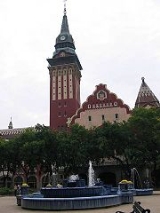
Subotica

Encyclopedia
Subotica is a city and municipality
Municipalities of Serbia
Serbia is divided into 150 municipalities and 24 cities , which are the basic units of local self-government. The city may and may not be divided into city municipalities . Five cities, Belgrade, Novi Sad, Niš, Kragujevac and Požarevac comprise several city municipalities, divided into "urban" ...
in northern Serbia
Serbia
Serbia , officially the Republic of Serbia , is a landlocked country located at the crossroads of Central and Southeast Europe, covering the southern part of the Carpathian basin and the central part of the Balkans...
, in the Autonomous Province of Vojvodina
Vojvodina
Vojvodina, officially called Autonomous Province of Vojvodina is an autonomous province of Serbia. Its capital and largest city is Novi Sad...
. It is located at 46.07° North, 19.68° East, about 10 km from the border with Hungary
Hungary
Hungary , officially the Republic of Hungary , is a landlocked country in Central Europe. It is situated in the Carpathian Basin and is bordered by Slovakia to the north, Ukraine and Romania to the east, Serbia and Croatia to the south, Slovenia to the southwest and Austria to the west. The...
.
Formerly the largest city of Vojvodina
Vojvodina
Vojvodina, officially called Autonomous Province of Vojvodina is an autonomous province of Serbia. Its capital and largest city is Novi Sad...
region, contemporary Subotica is now the second largest city in the province, following Novi Sad
Novi Sad
Novi Sad is the capital of the northern Serbian province of Vojvodina, and the administrative centre of the South Bačka District. The city is located in the southern part of Pannonian Plain on the Danube river....
. It is also the fifth largest city in Serbia (discounting Kosovo
Kosovo
Kosovo is a region in southeastern Europe. Part of the Ottoman Empire for more than five centuries, later the Autonomous Province of Kosovo and Metohija within Serbia...
) after Belgrade
Belgrade
Belgrade is the capital and largest city of Serbia. It is located at the confluence of the Sava and Danube rivers, where the Pannonian Plain meets the Balkans. According to official results of Census 2011, the city has a population of 1,639,121. It is one of the 15 largest cities in Europe...
, Novi Sad, Niš
Niš
Niš is the largest city of southern Serbia and third-largest city in Serbia . According to the data from 2011, the city of Niš has a population of 177,972 inhabitants, while the city municipality has a population of 257,867. The city covers an area of about 597 km2, including the urban area,...
, and Kragujevac
Kragujevac
Kragujevac is the fourth largest city in Serbia, the main city of the Šumadija region and the administrative centre of Šumadija District. It is situated on the banks of the Lepenica River...
. It is a multiethnic city, with Hungarians (34.99%), Serbs
Serbs
The Serbs are a South Slavic ethnic group of the Balkans and southern Central Europe. Serbs are located mainly in Serbia, Montenegro and Bosnia and Herzegovina, and form a sizable minority in Croatia, the Republic of Macedonia and Slovenia. Likewise, Serbs are an officially recognized minority in...
(27.85%), Bunjevci
Bunjevci
Bunjevci are a South Slavic community and ethnic group living mostly in the Bačka region of Serbia and southern Hungary...
(10.87%) and Croats
Croats
Croats are a South Slavic ethnic group mostly living in Croatia, Bosnia and Herzegovina and nearby countries. There are around 4 million Croats living inside Croatia and up to 4.5 million throughout the rest of the world. Responding to political, social and economic pressure, many Croats have...
(10.43%) as largest ethnic groups. The city's population numbers 99,981 (according to the 2002 census). Linguistically the city has a South Slavic
South Slavic languages
The South Slavic languages comprise one of three branches of the Slavic languages. There are approximately 30 million speakers, mainly in the Balkans. These are separated geographically from speakers of the other two Slavic branches by a belt of German, Hungarian and Romanian speakers...
-speaking majority as Serbs
Serbs
The Serbs are a South Slavic ethnic group of the Balkans and southern Central Europe. Serbs are located mainly in Serbia, Montenegro and Bosnia and Herzegovina, and form a sizable minority in Croatia, the Republic of Macedonia and Slovenia. Likewise, Serbs are an officially recognized minority in...
, Croats
Croats
Croats are a South Slavic ethnic group mostly living in Croatia, Bosnia and Herzegovina and nearby countries. There are around 4 million Croats living inside Croatia and up to 4.5 million throughout the rest of the world. Responding to political, social and economic pressure, many Croats have...
, Bunjevci
Bunjevci
Bunjevci are a South Slavic community and ethnic group living mostly in the Bačka region of Serbia and southern Hungary...
and Yugoslavs
Yugoslavs
Yugoslavs is a national designation used by a minority of South Slavs across the countries of the former Yugoslavia and in the diaspora...
collectively compose 55.94% of the population. The municipality of Subotica numbers 148,401 people. It is the administrative centre of the North Bačka District
North Backa District
North Bačka District is a northern district of Serbia. It lies in the Bačka region in the autonomous province of Vojvodina. It has a population of 200,140...
.
Name
There have been almost two hundred different forms of the name of this city in history. This is because the city has welcomed so many different peoples since the Middle AgesMiddle Ages
The Middle Ages is a periodization of European history from the 5th century to the 15th century. The Middle Ages follows the fall of the Western Roman Empire in 476 and precedes the Early Modern Era. It is the middle period of a three-period division of Western history: Classic, Medieval and Modern...
. They all wrote about it, naming it in their own languages, which, for some, did not fix their spelling until modern times.
The earliest known written name of the city was Zabadka or Zabatka, which dates from 1391. This is a variant of the current Hungarian
Hungarian language
Hungarian is a Uralic language, part of the Ugric group. With some 14 million speakers, it is one of the most widely spoken non-Indo-European languages in Europe....
name for the city: Szabadka. The Hungarian name for the city derives from the adjective szabad meaning "free", and the suffix -ka, an affectionate diminutive. Subotica's earliest designation means, therefore, something like a "small" or "dear", "free place". According to other opinion, medieval name Zabatka could derive from South Slavic word "zabat", which describe parts of Pannonian Slavic houses.
The name Subotica derives from the Serbian
Serbian language
Serbian is a form of Serbo-Croatian, a South Slavic language, spoken by Serbs in Serbia, Bosnia and Herzegovina, Montenegro, Croatia and neighbouring countries....
/ Bunjevac
Bunjevac language
The Bunjevac dialect or Bunjevac language is a Štokavian dialect used by members of the Bunjevci community. The speakers live in parts of the autonomous province of Vojvodina in Serbia as well as in southern parts of Croatia. The speech has an exclusive Serbo-Croatian Ikavian reflex of the Common...
word for "Saturday" or "Sabbath" and first appeared in 1653. The Serbian / Bunjevac word for "Saturday" is subota (субота), thus the name Subotica means "a little Saturday". Another theory claims that city was named after Subota Vrlić, who was a palatine and treasurer of a Emperor Jovan Nenad
Emperor Jovan Nenad
Jovan Nenad was a 16th-century military commander of Serb mercenaries in the Kingdom of Hungary who took advantage of a Hungarian military defeat in the Battle of Mohács and subsequent struggle over the Hungarian throne to carve out his own state and styled himself emperor , ruling over a...
, which ruled from this city in the 16th century. An older Serbian name used for the city in the 16th century was Sabatka, while Ottoman Turkish name was Sobotka.
The town was renamed in the 1740s for Maria Theresa of Austria
Maria Theresa of Austria
Maria Theresa Walburga Amalia Christina was the only female ruler of the Habsburg dominions and the last of the House of Habsburg. She was the sovereign of Austria, Hungary, Croatia, Bohemia, Mantua, Milan, Lodomeria and Galicia, the Austrian Netherlands and Parma...
, Archduchess of Austria and Queen of Bohemia
Bohemia
Bohemia is a historical region in central Europe, occupying the western two-thirds of the traditional Czech Lands. It is located in the contemporary Czech Republic with its capital in Prague...
and Hungary. The town was officially called Sent-Maria in 1743, but was renamed in 1779 as Maria-Theresiapolis. These two official names were also spelled in several different ways (most commonly the German
German language
German is a West Germanic language, related to and classified alongside English and Dutch. With an estimated 90 – 98 million native speakers, German is one of the world's major languages and is the most widely-spoken first language in the European Union....
Maria-Theresiopel or Theresiopel), and were used in different languages. This name was abandoned in 1811 (with the Danube Swabians
Danube Swabians
The Danube Swabians is a collective term for the German-speaking population who lived in the former Kingdom of Hungary, especially alongside the Danube River valley. Because of different developments within the territory settled, the Danube Swabians cannot be seen as a unified people...
now referring to it mostly as Subotica, and pronouncing it Suboditsa). However a late-19th Century Imperial Land Survey map of the area (Reymann 1:75000 #5563) still shows it as Maria-Theresiopel.
The city's name in the other three official languages of Vojvodina are the same as the official name - Slovak
Slovak language
Slovak , is an Indo-European language that belongs to the West Slavic languages .Slovak is the official language of Slovakia, where it is spoken by 5 million people...
: Subotica, Rusyn
Pannonian Rusyn language
Pannonian Rusyn or simply Rusyn is a Slavic language or dialect spoken by Pannonian Rusyns in north-western Serbia and eastern Croatia...
: Суботица, Romanian
Romanian language
Romanian Romanian Romanian (or Daco-Romanian; obsolete spellings Rumanian, Roumanian; self-designation: română, limba română ("the Romanian language") or românește (lit. "in Romanian") is a Romance language spoken by around 24 to 28 million people, primarily in Romania and Moldova...
: Subotica or Subotiţa.
Prehistory
A NeolithicNeolithic
The Neolithic Age, Era, or Period, or New Stone Age, was a period in the development of human technology, beginning about 9500 BC in some parts of the Middle East, and later in other parts of the world. It is traditionally considered as the last part of the Stone Age...
Tiszapolgár-Bodrogkeresztúr culture necropolis
Necropolis
A necropolis is a large cemetery or burial ground, usually including structural tombs. The word comes from the Greek νεκρόπολις - nekropolis, literally meaning "city of the dead"...
was found in Subotica.
The Middle Ages
Subotica probably first became a settlement of note when people poured into it from nearby villages destroyed during the Tatar invasionsTatar invasions
The Mongol invasion of Europe from the east took place over the course of three centuries, from the Middle Ages to the early modern period.The terms Tatars or Tartars are applied to nomadic Turkic peoples who, themselves, were conquered by Mongols and incorporated into their horde...
of 1241-1242. When Zabadka / Zabatka was first recorded in 1391, it was a tiny town in the medieval Kingdom of Hungary
Kingdom of Hungary
The Kingdom of Hungary comprised present-day Hungary, Slovakia and Croatia , Transylvania , Carpatho Ruthenia , Vojvodina , Burgenland , and other smaller territories surrounding present-day Hungary's borders...
. Later, the city belonged to the Hunyadi
Hunyadi
Hunyadi may refer to:* Hunyadi family, a Hungarian noble family from the Middle Ages* John Hunyadi, a Hungarian general and Regent-Governor of the Kingdom of Hungary* Laszlo Hunyadi, a Hungarian statesman* Matthias Corvinus , King of Hungary...
s, one of the most influential aristocratic families in the whole of Central Europe
Central Europe
Central Europe or alternatively Middle Europe is a region of the European continent lying between the variously defined areas of Eastern and Western Europe...
.
King Matthias Corvinus of Hungary
Matthias Corvinus of Hungary
Matthias Corvinus , also called the Just in folk tales, was King of Hungary and Croatia from 1458, at the age of 14 until his death...
gave the town to one of his relatives, János Pongrác Dengelegi, who, fearing an invasion by the Ottoman Empire
Ottoman Empire
The Ottoman EmpireIt was usually referred to as the "Ottoman Empire", the "Turkish Empire", the "Ottoman Caliphate" or more commonly "Turkey" by its contemporaries...
fortified the castle of Subotica, erecting a fortress in 1470. Some decades later, after the Battle of Mohács
Battle of Mohács
The Battle of Mohács was fought on August 29, 1526 near Mohács, Hungary. In the battle, forces of the Kingdom of Hungary led by King Louis II of Hungary and Bohemia were defeated by forces of the Ottoman Empire led by Sultan Suleiman the Magnificent....
in 1526, the medieval Kingdom of Hungary collapsed and Subotica gradually became a town of the Ottoman Empire
Ottoman Empire
The Ottoman EmpireIt was usually referred to as the "Ottoman Empire", the "Turkish Empire", the "Ottoman Caliphate" or more commonly "Turkey" by its contemporaries...
. The majority of the Hungarian population fled northward to Royal Hungary
Royal Hungary
The Kingdom of Hungary between 1538 and 1867 was part of the lands of the Habsburg Monarchy, while outside the Holy Roman Empire.After Battle of Mohács, the country was ruled by two crowned kings . They divided the kingdom in 1538...
. Bálint Török
Bálint Török
Count Bálint Török de Enying was a Hungarian aristocrat, Ban of Nándorfehérvár , and between 1527-1542 the Lord of Csesznek.-Sources:*Bessenyei József: A Héttorony foglya* Magyarország történeti kronológiája Count Bálint Török de Enying (1502–1551) was a Hungarian aristocrat, Ban of Nándorfehérvár...
, a local noble who had ruled over Subotica, also escaped from the city.
In the extremely confused military and political situation following the defeat at Mohács
Mohács
Mohács is a town in Baranya county, Hungary on the right bank of the Danube.-History:Two famous battles took place there:# Battle of Mohács, 1526# Battle of Mohács, 1687...
, Subotica came under the control of Serbian mercenaries recruited in Banat
Banat
The Banat is a geographical and historical region in Central Europe currently divided between three countries: the eastern part lies in western Romania , the western part in northeastern Serbia , and a small...
. These soldiers were in the service of the Transylvania
Transylvania
Transylvania is a historical region in the central part of Romania. Bounded on the east and south by the Carpathian mountain range, historical Transylvania extended in the west to the Apuseni Mountains; however, the term sometimes encompasses not only Transylvania proper, but also the historical...
n general John I Zápolya
John Zápolya
John Zápolya was King of Hungary from 1526 to 1540. His rule was disputed by Archduke Ferdinand I, who also claimed the title King of Hungary between 1526 and 1540. He was the voivode of Transylvania before his coronation.- Biography :...
, a later Hungarian king. The leader of these mercenaries, Jovan Nenad the Black
Emperor Jovan Nenad
Jovan Nenad was a 16th-century military commander of Serb mercenaries in the Kingdom of Hungary who took advantage of a Hungarian military defeat in the Battle of Mohács and subsequent struggle over the Hungarian throne to carve out his own state and styled himself emperor , ruling over a...
, proclaimed himself tsar and founded an ephemeral independent state, with Subotica as its capital. This state comprised entire Bačka
Backa
Bačka is a geographical area within the Pannonian plain bordered by the river Danube to the west and south, and by the river Tisza to the east of which confluence is located near Titel...
, northern Banat
Banat
The Banat is a geographical and historical region in Central Europe currently divided between three countries: the eastern part lies in western Romania , the western part in northeastern Serbia , and a small...
and a small part of Srem
Syrmia
Syrmia is a fertile region of the Pannonian Plain in Europe, between the Danube and Sava rivers. It is divided between Serbia in the east and Croatia in the west....
. When Bálint Török returned with 300 soldier and captured Subotica from the Serbs, Jovan Nenad moved his capital to Szeged
Szeged
' is the third largest city of Hungary, the largest city and regional centre of the Southern Great Plain and the county town of Csongrád county. The University of Szeged is one of the most distinguished universities in Hungary....
. Some months later, in the summer of 1527, the self-proclaimed tsar was assassinated and his state collapsed.
Ottoman administration
The Ottoman Empire ruled the city from 1542 to 1686. At the end of this almost 150 year long period, not much remained of the old town of Zabadka / Zabatka. Because much of the population had fled, the Ottomans encouraged the settlement of the area by different colonists from the BalkansBalkans
The Balkans is a geopolitical and cultural region of southeastern Europe...
. The settlers were mostly Orthodox Serbs
Serbs
The Serbs are a South Slavic ethnic group of the Balkans and southern Central Europe. Serbs are located mainly in Serbia, Montenegro and Bosnia and Herzegovina, and form a sizable minority in Croatia, the Republic of Macedonia and Slovenia. Likewise, Serbs are an officially recognized minority in...
. They cultivated the extremely fertile land around Subotica. In 1570, the population of Subotica numbered 49 houses, and in 1590, 63 houses. In 1687, the region was settled by Catholic Dalmatas
Dalmatia
Dalmatia is a historical region on the eastern coast of the Adriatic Sea. It stretches from the island of Rab in the northwest to the Bay of Kotor in the southeast. The hinterland, the Dalmatian Zagora, ranges from fifty kilometers in width in the north to just a few kilometers in the south....
(called Bunjevci
Bunjevci
Bunjevci are a South Slavic community and ethnic group living mostly in the Bačka region of Serbia and southern Hungary...
today). It was called "Sobotka" during Ottoman rule and was a kaza centre in Segedin sanjak at first in Budin Eyaleti
Budin Province, Ottoman Empire
Budin Eyalet was an administrative unit of the Ottoman Empire in Central Europe and the Balkans...
till 1596, and after that in Eğri Eyaleti
Egir Province, Ottoman Empire
Eğri Eyalet or Pashaluk of Eğri was an administrative unit of the Ottoman Empire formed in 1596 with its capital at Eğri...
between 1596-1686.
Habsburg administration
In 1687, about 5,000 BunjevciBunjevci
Bunjevci are a South Slavic community and ethnic group living mostly in the Bačka region of Serbia and southern Hungary...
, led by Dujo Marković and Đuro Vidaković settled in Bačka (including Subotica). After the decisive battle against the Ottomans at Senta
Senta
Senta is a town and municipality on the bank of the Tisa river in the Vojvodina province, Serbia. Although geographically located in Bačka, it is part of the North Banat District...
(Zenta) led by Prince Eugene of Savoy
Prince Eugene of Savoy
Prince Eugene of Savoy , was one of the most successful military commanders in modern European history, rising to the highest offices of state at the Imperial court in Vienna. Born in Paris to aristocratic Italian parents, Eugene grew up around the French court of King Louis XIV...
on 11 September 1697, Subotica became part of the military border
Military Frontier
The Military Frontier was a borderland of Habsburg Austria and later the Austro-Hungarian Monarchy, which acted as the cordon sanitaire against incursions from the Ottoman Empire...
zone Theiss
Potisje
Potisje is the name of the Tisa river basin parts located in Serbia, in the autonomous province of Vojvodina. The river Tisa flow between Banat and Bačka regions.-Municipalities in Potisje:Municipalities in Bačka:*Kanjiža*Senta*Ada*Bečej...
-Mieresch
Pomorišje
Pomorišje is a historical geographical region on the banks of the river Mureş that in the past has had a sizable ethnic Serb population. The region is mostly divided between Romania and Hungary, with small part of it in northern Serbia...
established by the Habsburg Monarchy
Habsburg Monarchy
The Habsburg Monarchy covered the territories ruled by the junior Austrian branch of the House of Habsburg , and then by the successor House of Habsburg-Lorraine , between 1526 and 1867/1918. The Imperial capital was Vienna, except from 1583 to 1611, when it was moved to Prague...
. In the meantime the uprising of Francis II Rákóczi
Francis II Rákóczi
Francis II Rákóczi Hungarian aristocrat, he was the leader of the Hungarian uprising against the Habsburgs in 1703-11 as the prince of the Estates Confederated for Liberty of the Kingdom of Hungary. He was also Prince of Transylvania, an Imperial Prince, and a member of the Order of the Golden...
broke out, which is also known as the Kuruc War. In the region of Subotica, Rákóczi joined battle against the Rac National Militia. Rác was a designation for the South Slavic people (mostly Serbs and Bunjevci) and they often were referred to as rácok in the Kingdom of Hungary. In a later period rácok came to mean, above all, Serbs of Orthodox religion.
The Serbian military families enjoyed several privileges thanks to their service for the Habsburg Monarchy. Subotica gradually, however, developed from being a mere garrison town to becoming a market town with its own civil charter in 1743. When this happened, many Serbs complained about the loss of their privileges. The majority left the town in protest and some of them founded a new settlement just outside 18th century Subotica in Aleksandrovo
Aleksandrovo, Subotica
Aleksandrovo is a neighborhood of Subotica, Serbia.-Name:It is most commonly known as Aleksandrovo or Šandor , but it is also known as Novo Naselje...
, while others emigrated to Russia
Russia
Russia or , officially known as both Russia and the Russian Federation , is a country in northern Eurasia. It is a federal semi-presidential republic, comprising 83 federal subjects...
. In New Serbia, a new Russian province established for them, those Serbs founded a new settlement and also named it Subotica. In 1775 a Jewish community in Subotica was established.
It was perhaps to emphasise the new civic serenity of Subotica that the pious name Saint Mary came to be used for it at this time. Some decades later, in 1779, Empress Maria Theresa of Austria
Maria Theresa of Austria
Maria Theresa Walburga Amalia Christina was the only female ruler of the Habsburg dominions and the last of the House of Habsburg. She was the sovereign of Austria, Hungary, Croatia, Bohemia, Mantua, Milan, Lodomeria and Galicia, the Austrian Netherlands and Parma...
advanced the town's status further by proclaiming it a Free Royal Town. The enthusiastic inhabitants of the city renamed Subotica once more as Maria-Theresiopolis.
This Free Royal Town status gave a great impetus to the development of the city. During the 19th century its population doubled twice, attracting many people from all over the Habsburg Monarchy
Habsburg Monarchy
The Habsburg Monarchy covered the territories ruled by the junior Austrian branch of the House of Habsburg , and then by the successor House of Habsburg-Lorraine , between 1526 and 1867/1918. The Imperial capital was Vienna, except from 1583 to 1611, when it was moved to Prague...
. This led eventually to a considerable demographic change. In the first half of the 19th century, the Bunjevci had still been in the majority, but there was an increasing number of Hungarians and Jews settling in Subotica. This process was not stopped even by the outbreak of the Revolutions in the Habsburg Monarchy
Revolutions of 1848
The European Revolutions of 1848, known in some countries as the Spring of Nations, Springtime of the Peoples or the Year of Revolution, were a series of political upheavals throughout Europe in 1848. It was the first Europe-wide collapse of traditional authority, but within a year reactionary...
in 1848/49.
1848/1849 Revolutions
It is remarkable that despite the diversity of their ethnic origins, the citizens of Subotica (mainly Bunjevci and Hungarians) united in defending Subotica in the battle at Kaponya, March 5, 1849. They repulsed the advancing Serbian troops from SomborSombor
Sombor is a city and municipality located in northwest part of Serbian autonomous province of Vojvodina. The city has a total population of 48,749 , while the Sombor municipality has 87,815 inhabitants...
in the direction to Szeged
Szeged
' is the third largest city of Hungary, the largest city and regional centre of the Southern Great Plain and the county town of Csongrád county. The University of Szeged is one of the most distinguished universities in Hungary....
. The town's first newspaper was also a result of the 1848/49 revolutionary
Hungarian Revolution of 1848
The Hungarian Revolution of 1848 was one of many of the European Revolutions of 1848 and closely linked to other revolutions of 1848 in the Habsburg areas...
spirit. It was called Honunk állapota ("State of Our Homeland") and was published in Hungarian by Károly Bitterman's local printing company. Unlike most Serbs and Croats who confronted with Hungarians, local Bunjevci people mostly supported Hungarian revolution.
In 1849, following the suppression of the Hungarian Revolution, Subotica, together with most of the Bačka region, was separated from the Habsburg Kingdom of Hungary and became a part of a separate Austrian province, named Voivodeship of Serbia and Banat of Temeschwar. The administrative centre of this new province was not Subotica, but Timişoara
Timisoara
Timișoara is the capital city of Timiș County, in western Romania. One of the largest Romanian cities, with an estimated population of 311,586 inhabitants , and considered the informal capital city of the historical region of Banat, Timișoara is the main social, economic and cultural center in the...
. This province existed until 1860. During the existence of the voivodeship, in 1853, Subotica acquired its impressive theatre.
Austro-Hungarian administration
Ausgleich
The Austro-Hungarian Compromise of 1867 established the dual monarchy of Austria-Hungary. The Compromise re-established the sovereignty of the Kingdom of Hungary, separate from and no longer subject to the Austrian Empire...
in 1867, there followed what is often called the "golden age" of city development of Subotica. Many schools were opened after 1867 and in 1869 the railway connected the city to the world. In 1896 an electrical power plant was built, further enhancing the development of the city and the whole region. Subotica now adorned itself with its remarkable Central European, fin de siècle
Fin de siècle
Fin de siècle is French for "end of the century". The term sometimes encompasses both the closing and onset of an era, as it was felt to be a period of degeneration, but at the same time a period of hope for a new beginning...
architecture. In 1902 a Jewish synagogue was built in the Art Nouveau
Art Nouveau
Art Nouveau is an international philosophy and style of art, architecture and applied art—especially the decorative arts—that were most popular during 1890–1910. The name "Art Nouveau" is French for "new art"...
style.
South Slavic states
Subotica was part of the Austria-HungaryAustria-Hungary
Austria-Hungary , more formally known as the Kingdoms and Lands Represented in the Imperial Council and the Lands of the Holy Hungarian Crown of Saint Stephen, was a constitutional monarchic union between the crowns of the Austrian Empire and the Kingdom of Hungary in...
until the aftermath of World War I
World War I
World War I , which was predominantly called the World War or the Great War from its occurrence until 1939, and the First World War or World War I thereafter, was a major war centred in Europe that began on 28 July 1914 and lasted until 11 November 1918...
in 1918, when the city became part of the Kingdom of Serbs, Croats and Slovenes. In changed economical and political circumstances, Subotica was now a border-town in Yugoslavia
Yugoslavia
Yugoslavia refers to three political entities that existed successively on the western part of the Balkans during most of the 20th century....
and did not, for a time, experienced again the dynamic prosperity it enjoyed in the years preceding World War I. However, at that time, Subotica was the third largest city in Yugoslavia by population, following Belgrade
Belgrade
Belgrade is the capital and largest city of Serbia. It is located at the confluence of the Sava and Danube rivers, where the Pannonian Plain meets the Balkans. According to official results of Census 2011, the city has a population of 1,639,121. It is one of the 15 largest cities in Europe...
and Zagreb
Zagreb
Zagreb is the capital and the largest city of the Republic of Croatia. It is in the northwest of the country, along the Sava river, at the southern slopes of the Medvednica mountain. Zagreb lies at an elevation of approximately above sea level. According to the last official census, Zagreb's city...
.
In 1941, Yugoslavia was invaded and partitioned by the Axis Powers
Axis Powers
The Axis powers , also known as the Axis alliance, Axis nations, Axis countries, or just the Axis, was an alignment of great powers during the mid-20th century that fought World War II against the Allies. It began in 1936 with treaties of friendship between Germany and Italy and between Germany and...
, and its northern parts, including Subotica, were annexed by Hungary (This partition of Yugoslavia was not recognized by the international community and city was, from the legal point of view, still part of Yugoslavia, whose only legal representative was Yugoslav government in exile). Hungarian troops entered Subotica on April 11, 1941. During World War II
World War II
World War II, or the Second World War , was a global conflict lasting from 1939 to 1945, involving most of the world's nations—including all of the great powers—eventually forming two opposing military alliances: the Allies and the Axis...
the city lost approximately 7,000 of its citizens, mostly Serbs, Hungarians and Jews. Before the war about 6,000 Jews lived in Subotica. Many Jews
Jews
The Jews , also known as the Jewish people, are a nation and ethnoreligious group originating in the Israelites or Hebrews of the Ancient Near East. The Jewish ethnicity, nationality, and religion are strongly interrelated, as Judaism is the traditional faith of the Jewish nation...
were deported from the city during the Holocaust, mostly to Auschwitz. In April 1944 a ghetto was set up. Also, many communists were put to death during Axis rule.
In 1944, the Axis forces left city, and Subotica became part of the new socialist Yugoslavia
Yugoslavia
Yugoslavia refers to three political entities that existed successively on the western part of the Balkans during most of the 20th century....
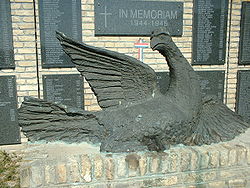
. During the 1944-45 period about 8,000 citizens (mainly Hungarian) were killed by Yugoslav partisans.
In the post-war period Subotica has gradually modernised itself. During the Yugoslav
Yugoslav wars
The Yugoslav Wars were a series of wars, fought throughout the former Yugoslavia between 1991 and 1995. The wars were complex: characterized by bitter ethnic conflicts among the peoples of the former Yugoslavia, mostly between Serbs on the one side and Croats and Bosniaks on the other; but also...
and Kosovo
Kosovo War
The term Kosovo War or Kosovo conflict was two sequential, and at times parallel, armed conflicts in Kosovo province, then part of FR Yugoslav Republic of Serbia; from early 1998 to 1999, there was an armed conflict initiated by the ethnic Albanian "Kosovo Liberation Army" , who sought independence...
wars of the 1990s, a considerable number of Serb refugees came to the city from Croatia
Croatia
Croatia , officially the Republic of Croatia , is a unitary democratic parliamentary republic in Europe at the crossroads of the Mitteleuropa, the Balkans, and the Mediterranean. Its capital and largest city is Zagreb. The country is divided into 20 counties and the city of Zagreb. Croatia covers ...
, Bosnia and Herzegovina
Bosnia and Herzegovina
Bosnia and Herzegovina , sometimes called Bosnia-Herzegovina or simply Bosnia, is a country in Southern Europe, on the Balkan Peninsula. Bordered by Croatia to the north, west and south, Serbia to the east, and Montenegro to the southeast, Bosnia and Herzegovina is almost landlocked, except for the...
, and Kosovo
Kosovo
Kosovo is a region in southeastern Europe. Part of the Ottoman Empire for more than five centuries, later the Autonomous Province of Kosovo and Metohija within Serbia...
, whilst many ethnic Hungarians and Croats left the country because of the political pressures of the Milošević period and economical stagnation (Some of the ethnic Serb residents also left the country because of the same reasons). During the break-up of Yugoslavia, local leaders in Subotica were drawn from political parties opposed to the policy of the state government in Belgrade.
Towns and villages
The Subotica municipality comprises the Subotica city, the town of PalićPalic
Palić is a town in Serbia, from Subotica, and from the border between Serbia and Hungary. It is a part of the Subotica Municipality, North Bačka District, autonomous province of Vojvodina. The town has a Hungarian ethnic majority and its population numbering 7,745 people...
and 17 villages. The villages are:
- BajmokBajmokBajmok is a village located in the Subotica municipality, in the North Bačka District of Serbia. It is situated in the autonomous province of Vojvodina...
- Bački VinogradiBacki VinogradiBački Vinogradi is a village in Serbia. It is situated in the Subotica municipality, in the North Bačka District, Vojvodina province. The village has a Hungarian ethnic majority and its population numbering 2,039 people .-External links:*...
- Bačko DušanovoBacko DušanovoBačko Dušanovo is a village in Serbia. It is situated in the Subotica municipality, in the North Bačka District, Vojvodina province...
- BikovoBikovoBikovo is a village located in the Subotica municipality, in the North Bačka District of Serbia. It is situated in the autonomous province of Vojvodina...
- Višnjevac
- Gornji TavankutGornji TavankutGornji Tavankut is a village located in the Subotica municipality, in the North Bačka District of Serbia. It is situated in the autonomous province of Vojvodina...
- Donji TavankutDonji TavankutDonji Tavankut is a village located some 16 km west of Subotica, Serbia. It is located in the Subotica municipality, in the North Bačka District of Serbia, in the Autonomous Province of Vojvodina.-1991:...
- Đurđin
- KelebijaKelebijaKelebija is a village close to Subotica in Serbia. It is situated in the municipality of Subotica, North Bačka District, Autonomous Province of Vojvodina. The village has a Hungarian ethnic majority and its population numbering 2,168 people...
- LjutovoLjutovoLjutovo is a village located in the Subotica municipality, in the North Bačka District of Serbia. It is situated in the autonomous province of Vojvodina...
- Mala BosnaMala BosnaMala Bosna is a village located in the Subotica municipality, in the North Bačka District of Serbia. It is situated in the autonomous province of Vojvodina. The village is ethnically mixed and its population numbering 1,245 people...
- MišićevoMišicevoMišićevo is a village located in the Subotica municipality, in the North Bačka District of Serbia. It is situated in the autonomous province of Vojvodina...
- Novi ŽednikNovi ŽednikNovi Žednik is a village located in the Subotica municipality, in the North Bačka District of Serbia. It is situated in the autonomous province of Vojvodina...
- Stari ŽednikStari ŽednikStari Žednik , also known as Žednik , is a village located in the Subotica municipality, in the North Bačka District of Serbia. It is situated in the autonomous province of Vojvodina...
- HajdukovoHajdukovoHajdukovo is a village located in the Subotica municipality, in the North Bačka District of Serbia. It is situated in the autonomous province of Vojvodina. The village has a Hungarian ethnic majority and its population numbering 2,482 people .-External links:*...
- ČantavirCantavirČantavir is the largest village with Hungarian ethnic majority in the autonomous province of Vojvodina, Serbia. It is situated in the municipality of Subotica, North Bačka District. The population of the village is 7,178...
- ŠupljakŠupljakŠupljak is a village in Serbia. It is situated in the Subotica municipality, in the North Bačka District, Vojvodina province. The village has a Hungarian ethnic majority and its population numbering 1,310 people .-See also:...
Note: For settlements with Hungarian absolute or relative majority, names are also given in Hungarian.
City quarters
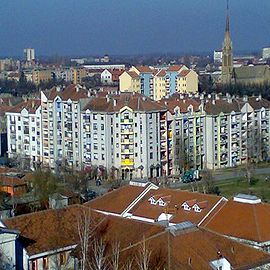
- ProzivkaProzivkaProzivka is a city quarter of Subotica, a city in northern Serbia. It has a population about 20,000.-Geography:Prozivka is situated in the southern part of Subotica. Its southern border stretches from the Ivana Milutinovića along the railway Pačir , to Braće Radić street...
- Ker
- Centar 1
- Centar 2
- Dudova Šuma (Radijalac)
- Železničko Naselje
- Novo Naselje
- Srpski Šor
- Zorka
- Kertvaroš
- Makova Sedmica
- Novi Grad
- Mali Radanovac
- Teslino Naselje
- Veliki Radanovac
- AleksandrovoAleksandrovo, SuboticaAleksandrovo is a neighborhood of Subotica, Serbia.-Name:It is most commonly known as Aleksandrovo or Šandor , but it is also known as Novo Naselje...
- Mali Bajmok
- Gat
- Graničar
- Centar 3 (Tokio)
- Bajnat
Demographics
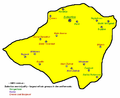
City demographics - Ethnic groups in the city
Subotica is a multiethnic city and municipality. The population of the Subotica city is composed of (according to 2002 census):- Hungarians = 34,983 (34.99%)
- SerbsSerbsThe Serbs are a South Slavic ethnic group of the Balkans and southern Central Europe. Serbs are located mainly in Serbia, Montenegro and Bosnia and Herzegovina, and form a sizable minority in Croatia, the Republic of Macedonia and Slovenia. Likewise, Serbs are an officially recognized minority in...
= 27,838 (27.85%) - BunjevciBunjevciBunjevci are a South Slavic community and ethnic group living mostly in the Bačka region of Serbia and southern Hungary...
= 10,870 (10.87%) - CroatsCroatsCroats are a South Slavic ethnic group mostly living in Croatia, Bosnia and Herzegovina and nearby countries. There are around 4 million Croats living inside Croatia and up to 4.5 million throughout the rest of the world. Responding to political, social and economic pressure, many Croats have...
= 10,424 (10.43%) - YugoslavsYugoslavsYugoslavs is a national designation used by a minority of South Slavs across the countries of the former Yugoslavia and in the diaspora...
= 6,787 (6.79%) - Roma = 1,171 (1.17%)
- others
The city serves as the cultural and political centre for the Hungarians, Bunjevci, and Croats in Vojvodina. The largest percent of declared Yugoslavs in Vojvodina is also found in Subotica.
Ethnic groups in the municipality
The population of the Subotica municipality is composed of (according to 2002 census):- Hungarians = 57,092 (38.47%)
- SerbsSerbsThe Serbs are a South Slavic ethnic group of the Balkans and southern Central Europe. Serbs are located mainly in Serbia, Montenegro and Bosnia and Herzegovina, and form a sizable minority in Croatia, the Republic of Macedonia and Slovenia. Likewise, Serbs are an officially recognized minority in...
= 37,686 (25.39%) - CroatsCroatsCroats are a South Slavic ethnic group mostly living in Croatia, Bosnia and Herzegovina and nearby countries. There are around 4 million Croats living inside Croatia and up to 4.5 million throughout the rest of the world. Responding to political, social and economic pressure, many Croats have...
= 16,688 (11.24%) - BunjevciBunjevciBunjevci are a South Slavic community and ethnic group living mostly in the Bačka region of Serbia and southern Hungary...
= 16,254 (10.95%) - YugoslavsYugoslavsYugoslavs is a national designation used by a minority of South Slavs across the countries of the former Yugoslavia and in the diaspora...
= 8,562 (5.76%) - others
Settlements by ethnic majority
The places with a Hungarian absolute or relative ethnic majority are: Subotica (Hungarian: Szabadka), PalićPalic
Palić is a town in Serbia, from Subotica, and from the border between Serbia and Hungary. It is a part of the Subotica Municipality, North Bačka District, autonomous province of Vojvodina. The town has a Hungarian ethnic majority and its population numbering 7,745 people...
(Hungarian: Palicsfürdő), Hajdukovo
Hajdukovo
Hajdukovo is a village located in the Subotica municipality, in the North Bačka District of Serbia. It is situated in the autonomous province of Vojvodina. The village has a Hungarian ethnic majority and its population numbering 2,482 people .-External links:*...
(Hungarian: Hajdújárás), Bački Vinogradi
Backi Vinogradi
Bački Vinogradi is a village in Serbia. It is situated in the Subotica municipality, in the North Bačka District, Vojvodina province. The village has a Hungarian ethnic majority and its population numbering 2,039 people .-External links:*...
(Hungarian: Bácsszőlős), Šupljak
Šupljak
Šupljak is a village in Serbia. It is situated in the Subotica municipality, in the North Bačka District, Vojvodina province. The village has a Hungarian ethnic majority and its population numbering 1,310 people .-See also:...
(Hungarian: Alsóludas), Čantavir
Cantavir
Čantavir is the largest village with Hungarian ethnic majority in the autonomous province of Vojvodina, Serbia. It is situated in the municipality of Subotica, North Bačka District. The population of the village is 7,178...
(Hungarian: Csantavér), Bačko Dušanovo
Backo Dušanovo
Bačko Dušanovo is a village in Serbia. It is situated in the Subotica municipality, in the North Bačka District, Vojvodina province...
(Hungarian: Zentaörs), and Kelebija
Kelebija
Kelebija is a village close to Subotica in Serbia. It is situated in the municipality of Subotica, North Bačka District, Autonomous Province of Vojvodina. The village has a Hungarian ethnic majority and its population numbering 2,168 people...
(Hungarian: Alsókelebia).
The places with a Serb
Serbs
The Serbs are a South Slavic ethnic group of the Balkans and southern Central Europe. Serbs are located mainly in Serbia, Montenegro and Bosnia and Herzegovina, and form a sizable minority in Croatia, the Republic of Macedonia and Slovenia. Likewise, Serbs are an officially recognized minority in...
absolute or relative ethnic majority are: Bajmok
Bajmok
Bajmok is a village located in the Subotica municipality, in the North Bačka District of Serbia. It is situated in the autonomous province of Vojvodina...
, Višnjevac
Višnjevac
Višnjevac is a village located in the Subotica municipality, in the North Bačka District of Serbia. It is situated in the autonomous province of Vojvodina...
, Novi Žednik
Novi Žednik
Novi Žednik is a village located in the Subotica municipality, in the North Bačka District of Serbia. It is situated in the autonomous province of Vojvodina...
, and Mišićevo
Mišicevo
Mišićevo is a village located in the Subotica municipality, in the North Bačka District of Serbia. It is situated in the autonomous province of Vojvodina...
.
The places with a Bunjevac
Bunjevci
Bunjevci are a South Slavic community and ethnic group living mostly in the Bačka region of Serbia and southern Hungary...
and Croat
Croats
Croats are a South Slavic ethnic group mostly living in Croatia, Bosnia and Herzegovina and nearby countries. There are around 4 million Croats living inside Croatia and up to 4.5 million throughout the rest of the world. Responding to political, social and economic pressure, many Croats have...
ethnic majority are: Mala Bosna
Mala Bosna
Mala Bosna is a village located in the Subotica municipality, in the North Bačka District of Serbia. It is situated in the autonomous province of Vojvodina. The village is ethnically mixed and its population numbering 1,245 people...
, Đurđin, Donji Tavankut
Donji Tavankut
Donji Tavankut is a village located some 16 km west of Subotica, Serbia. It is located in the Subotica municipality, in the North Bačka District of Serbia, in the Autonomous Province of Vojvodina.-1991:...
, Gornji Tavankut
Gornji Tavankut
Gornji Tavankut is a village located in the Subotica municipality, in the North Bačka District of Serbia. It is situated in the autonomous province of Vojvodina...
, Bikovo
Bikovo
Bikovo is a village located in the Subotica municipality, in the North Bačka District of Serbia. It is situated in the autonomous province of Vojvodina...
, Stari Žednik
Stari Žednik
Stari Žednik , also known as Žednik , is a village located in the Subotica municipality, in the North Bačka District of Serbia. It is situated in the autonomous province of Vojvodina...
, and Ljutovo
Ljutovo
Ljutovo is a village located in the Subotica municipality, in the North Bačka District of Serbia. It is situated in the autonomous province of Vojvodina...
.
Bajmok, Višnjevac, and Stari Žednik have over 20% Hungarians, just as in the places with a Hungarian majority (Subotica, Palić, Bačko Dušanovo, and Kelebija) in which over 20% are Serbs, Croats and Bunjevci.
Languages in the municipality
Languages spoken in Subotica municipality (according to 2002 census):- SerbianSerbian languageSerbian is a form of Serbo-Croatian, a South Slavic language, spoken by Serbs in Serbia, Bosnia and Herzegovina, Montenegro, Croatia and neighbouring countries....
= 69,155 (46.60%) - HungarianHungarian languageHungarian is a Uralic language, part of the Ugric group. With some 14 million speakers, it is one of the most widely spoken non-Indo-European languages in Europe....
= 57,608 (38.82%) - CroatianCroatian languageCroatian is the collective name for the standard language and dialects spoken by Croats, principally in Croatia, Bosnia and Herzegovina, the Serbian province of Vojvodina and other neighbouring countries...
= 8,806 (5.93%)
Note: The Bunjevac language
Bunjevac language
The Bunjevac dialect or Bunjevac language is a Štokavian dialect used by members of the Bunjevci community. The speakers live in parts of the autonomous province of Vojvodina in Serbia as well as in southern parts of Croatia. The speech has an exclusive Serbo-Croatian Ikavian reflex of the Common...
is also spoken in Subotica, but it was not listed separately in the 2002 census results published by the Statistical Office of Serbia; the speakers of this language were listed in category "other languages". The number of those who speak "other languages" (presumably Bunjevac ) in the Subotica municipality is 8,914. Some other members of the Bunjevac ethnic community declared in census that their language is Serbian or Croatian. Bunjevac is likely to be listed separately in the future censa, since the members of the Bunjevac ethnic community expressed the wish for affirmation of their language. They also expressed the wish to have school classes in Bunjevac, so the state is most likely to oblige.
Religion
Religion in Subotica municipality (according to 2002 census):- Roman Catholic = 93,521 (63.02%)
- Orthodox = 38,523 (25.96%)
- Protestant = 2,794 (1.88%)
- other
Subotica is the centre of the Roman Catholic diocese
Roman Catholic Diocese of Subotica
The Roman Catholic Diocese of Subotica is an ecclesiastical territory or diocese of the Roman Catholic Church in Vojvodina, Serbia. It is centred in the city of Subotica. It was erected as Apostolic Administration for Yugoslav Bačka in 1923 and elevated to a diocese in 1968.The diocese's cathedral...
of the Bačka
Backa
Bačka is a geographical area within the Pannonian plain bordered by the river Danube to the west and south, and by the river Tisza to the east of which confluence is located near Titel...
region belonging to Serbia. The Subotica area has the highest concentration of Catholics in Serbia. Nearly 70% of the city's population are Catholics. The liturgical languages used in the city's Catholic churches are mostly Hungarian and Croatian. There are eight Catholic parish churches, a Franciscan
Franciscan
Most Franciscans are members of Roman Catholic religious orders founded by Saint Francis of Assisi. Besides Roman Catholic communities, there are also Old Catholic, Anglican, Lutheran, ecumenical and Non-denominational Franciscan communities....
spiritual centre (the city has communities of both Franciscan monks and Franciscan nuns), a female Dominican
Dominican Order
The Order of Preachers , after the 15th century more commonly known as the Dominican Order or Dominicans, is a Catholic religious order founded by Saint Dominic and approved by Pope Honorius III on 22 December 1216 in France...
community, and two congregations of Augustinian religious sisters. The diocese of Subotica has the only Catholic secondary school in Serbia (Paulinum).
Subotica had a Roman Catholic Blessed
Beatification
Beatification is a recognition accorded by the Catholic Church of a dead person's entrance into Heaven and capacity to intercede on behalf of individuals who pray in his or her name . Beatification is the third of the four steps in the canonization process...
working in it. When the nuns' orphanage and children's dome in Blato
Blato
Blato is a town on the island of Korčula in Croatia. It is a municipal centre and can be reached by the main island road from Smokvica. The road runs through the forests in the middle of the island of Korčula.-Geography:...
has exhausted the food funds for helping poor and hungry children, Blessed Mary of Jesus Crucified Petković
Marija Petkovic
Marija Petković, also known as "The Blessed Mary of Jesus Crucified Petković" , was the founder of the Catholic Congregation of the Daughters of Mercy...
went to fertile pleains of Bačka and the seat of Bačka Apostolic Administration, Subotica, to solicit help for the orphans and widows. In return, Bishop Ljudevit Lajčo Budanović asked her to found monasteries of her Order in Subotica and neighbourhood, so the locals can get spiritual gain from that nuns of her Order can provide them... Marija Petković quickly notice that Bačka also had problems of numerous poor and abandoned children, so in 1923, she opened Kolijevka, Children's Home in Subotica. Today this city still has that Children's Home, although the nuns of Marija's Order aren't in that Home anymore.
Among another Christian communities, the members of the Serbian Orthodox Church
Serbian Orthodox Church
The Serbian Orthodox Church is one of the autocephalous Orthodox Christian churches, ranking sixth in order of seniority after Constantinople, Alexandria, Antioch, Jerusalem, and Russia...
are the most numerous. There are two Eastern Orthodox church buildings in the city; as well as two Protestant churches, Lutheran
Lutheranism
Lutheranism is a major branch of Western Christianity that identifies with the theology of Martin Luther, a German reformer. Luther's efforts to reform the theology and practice of the church launched the Protestant Reformation...
and Calvinist
Calvinism
Calvinism is a Protestant theological system and an approach to the Christian life...
, respectively.
The Jewish community of Subotica is the third largest in Serbia, after those in Belgrade
Belgrade
Belgrade is the capital and largest city of Serbia. It is located at the confluence of the Sava and Danube rivers, where the Pannonian Plain meets the Balkans. According to official results of Census 2011, the city has a population of 1,639,121. It is one of the 15 largest cities in Europe...
and Novi Sad
Novi Sad
Novi Sad is the capital of the northern Serbian province of Vojvodina, and the administrative centre of the South Bačka District. The city is located in the southern part of Pannonian Plain on the Danube river....
. The astounding proportions and beauty of the Hungarian style art nouveau
Art Nouveau
Art Nouveau is an international philosophy and style of art, architecture and applied art—especially the decorative arts—that were most popular during 1890–1910. The name "Art Nouveau" is French for "new art"...
synagogue
Synagogue
A synagogue is a Jewish house of prayer. This use of the Greek term synagogue originates in the Septuagint where it sometimes translates the Hebrew word for assembly, kahal...
are the legacy of a Jewish community that once numbered 6,000 members. About 1,000 of the original Jews of Subotica survived the Holocaust. Today, less than 200 people of Jewish origin remained in Subotica.
2004 elections
Seats in the municipal parliament won in the 2004 local elections: http://www.cesid.org/lokalni2004/rezultati.jsp?opstina=80438- Alliance of Vojvodina HungariansAlliance of Vojvodina HungariansThe Alliance of Vojvodina Hungarians ; , Savez vojvođanskih Mađara ) is an ethnic Hungarian political party in the Serbian province of Vojvodina. Its chairman is István Pásztor. The former party chairman József Kasza is now its honorary president...
(16) - Democratic PartyDemocratic Party (Serbia)The Democratic Party is a political party in Serbia. It is described as a social liberal or social democratic party.-Pre-war history:The Democratic Party was established on 16 February 1919 from unification of Sarajevo parties independent radicals, progressives, liberals and the Serbian part of...
(12) - Serbian Radical PartySerbian Radical PartyThe Serbian Radical Party is a far-right Serbian nationalist political party in Serbia, founded in 1991. Currently the second-largest party in the Serbian National Assembly, it has branches in three of the nations that currently border Serbia – all former federal republics of Yugoslavia...
(9) - Democratic Alliance of Croats in Vojvodina (5)
- G17 PlusG17 PlusG17 Plus , abbreviated to G17+, is a centre-right political party in Serbia. With 22 seats in the National Assembly, it is the third-largest party, and currently participates in a coalition with, amongst others, the Democratic Party and the Socialist Party...
(4) - Together for VojvodinaTogether for VojvodinaTogether for Vojvodina was a political coalition in the Serbian province of Vojvodina. At the latest legislative elections in Vojvodina, in September 2004, the alliance won 9.44 % of the popular vote, and 7 seats in the provincial parliament...
(4) - Democratic Party of Vojvodina Hungarians (3)
- Serbian Strength MovementSerbian Strength MovementThe Strength of Serbia Movement is a political party in Serbia led by Bogoljub Karić. He finished third in the 2004 presidential elections....
(3)
2008 elections
Results of 2008 local elections in Subotica municipality: http://www.cesid.org/rezultati/sr_maj_2008-lokalni/index.jsp- For a European SuboticaFor a European SerbiaFor a European Serbia – Boris Tadić is an electoral coalition that won the Serbian parliamentary election, 2008, Vojvodina parliamentary election, 2008 and Serbian local elections, 2008...
(40.16%) - Hungarian CoalitionHungarian CoalitionThe Hungarian Coalition ; Serbian: Мађарска Коалиција , Mađarska Koalicija ) is a political coalition composed of 3 ethnic Hungarian political parties in Serbia: the Alliance of Vojvodina Hungarians, the Democratic Party of Vojvodina Hungarians, and the Democratic Fellowship of Vojvodina Hungarians...
(27.14%) - Serbian list for Subotica (16.42%)
After the elections, coalition For a European Subotica (with 32 seats), Hungarian Coalition (with 21 seats) and Bunjevac Party (with 1 seat) formed local municipal government. Saša Vučinić from the Democratic Party was elected mayor, and Jenő Maglai from the Hungarian Coalition was elected president of the municipal assembly. http://www.rtv.rs/sr/vesti/vojvodina/subotica/2008_07_10/vest_72200.jsp
Buildings
Unique in Serbia, Subotica has the most buildings built in art nouveau style. Especially the City Hall (built in 1908-1910) and the Synagogue (1902) are of outstanding beauty. These were built by the same architects, by Marcell Komor and Dezső Jakab from BudapestBudapest
Budapest is the capital of Hungary. As the largest city of Hungary, it is the country's principal political, cultural, commercial, industrial, and transportation centre. In 2011, Budapest had 1,733,685 inhabitants, down from its 1989 peak of 2,113,645 due to suburbanization. The Budapest Commuter...
, Hungary. Another exceptional example of art nouveau architecture is the actual Artistic Encounter building, which was built in 1904 by Ferenc J. Raichle.
The most remarkable church buildings are: the Catholic
Catholic
The word catholic comes from the Greek phrase , meaning "on the whole," "according to the whole" or "in general", and is a combination of the Greek words meaning "about" and meaning "whole"...
Cathedral
Cathedral
A cathedral is a Christian church that contains the seat of a bishop...
of St. Theresa of Avila from 1797, the Franciscan
Franciscan
Most Franciscans are members of Roman Catholic religious orders founded by Saint Francis of Assisi. Besides Roman Catholic communities, there are also Old Catholic, Anglican, Lutheran, ecumenical and Non-denominational Franciscan communities....
Monastery
Monastery
Monastery denotes the building, or complex of buildings, that houses a room reserved for prayer as well as the domestic quarters and workplace of monastics, whether monks or nuns, and whether living in community or alone .Monasteries may vary greatly in size – a small dwelling accommodating only...
from 1723, the Orthodox churches also from the 18th century, the Hungarian Art Nouveau Subotica Synagogue
Subotica Synagogue
The Jakab and Komor Square Synagogue in Subotica-Szabadka is a remarkable Hungarian Art Nouveau synagogue in Subotica-Szabadka, Serbia. It was built in 1901-1902 during the administration of the Kingdom of Hungary , according the plans of Marcell Komor and Dezső Jakab replacing a smaller and less...
from the turn-of-the-century.
In recent years there has been an effort to restore the synagogue. Over $400,000 has been raised for the cause by 2004.
Theatre
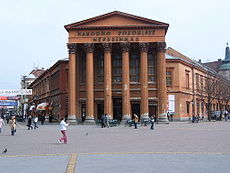
National Theatre in Subotica
-Reconstruction:The historic theater, which was built in 1854 as the first monumental public building in Subotica, was demolished in 2007, although it was declared a historic monument under state protection in 1983, and in 1991 it was added to the National Register as a monument of an extraordinary...
, which was built in 1854 as the first monumental public building in Subotica, was demolished in 2007, although it was declared a historic monument under state protection in 1983, and in 1991 it was added to the National Register as a monument of an extraordinary cultural value. An international campaign was organized both in Serbia and in Hungary to save the historic building. ICOMOS and INTBAU also protested against the decision, but with no avail. The historic centre of Subotica was severely damaged visually. Some scanty remains of the destroyed building will be allegedly incorporated into the new theatre.
Education
Subotica is not a university city but has some widely respected secondary schools and faculties.Secondary Schools
- Teachers' College, founded in 1689, the oldest college in the country and region
- "Svetozar Marković" grammar school web-site
- "Dezső Kosztolányi" Philological grammar school web-site
- "Paulinum" Grammar school of ancient languages of the Catholic Diocese of Subotica
- Music School
- "MEŠC" Electro-mechanical school, recently renamed to "Tehnička Škola - Subotica" (en. "Technical School") web-site
- "Bosa Milićević" School of Economics
- Polytechnic school
- "Lazar Neśić" Chemistry school
- Medical school
Notable faculties
- Civil Engineering faculty web-site
- Electro-Mechanic-Programming faculty "VTŠ" web-site
- Economics faculty web-site
- Teachers faculty in Hungarian language web-site
- Kindergarten Teacher Training College web-site
Newspapers and magazines
Newspapers and magazines published in Subotica:- Subotičke novine, main weekly newspaper in Serbian (web-site).
- Magyar SzóMagyar SzóMagyar Szó is a Hungarian language daily newspaper in Serbia. It was founded in 1944, with the purpose of serving as the information source for the Hungarian minority of Vojvodina. It was published in Novi Sad until 2006, when its staff headquarters relocated to Subotica. Its editor-in-chief is...
, in Hungarian, founded 1944, published in Subotica since 2006. - Bunjevačke novineBunjevacke novineBunjevačke novine is a Bunjevac dialect monthly newspaper published in Subotica, Serbia.-External links:* – official website with all issues since 2005. available...
, in Bunjevac. - Hrvatska riječHrvatska rijecHrvatska riječ is a Croatian language weekly newspaper in Serbia. It was founded in 1945, with the purpose to serve as the information organ for the Croatian minority of Vojvodina....
, in Croatian. - ZvonikZvonikZvonik is a Roman Catholic magazine founded by Croat priests from Roman Catholic Diocese of Subotica. It's being published in Croatian language.- History and mission :...
, in Croatian
Economy
Surroundings of Subotica are mainly farmland but the city itself is an important industrial and transportation centre in Serbia.Because of the surrounding farmlands Subotica has some of the most famous food producer industries in the country, with brands such as the confectionery factory "Pionir", "Fidelinka" the cereal manufacturer, "Suboticka mlekara" a milk producer and "Simex" producer of strong alcohol drinks.
There are a number of old socialistic industries that survived the transition period in Serbia.The biggest one is the chemical fertilizer factory "Azotara" and the rail wagon factory "Bratstvo".
Currently the biggest export industry in town is the "Siemens
Siemens
Siemens may refer toSiemens, a German family name carried by generations of telecommunications industrialists, including:* Werner von Siemens , inventor, founder of Siemens AG...
Subotica" windmill factory and it is the biggest brownfield investment so far. The other big companies in Subotica are: Fornetti, ATB Sever and Masterplast.
The most recent companies to come to Subotica are Dunkermotoren, and NORMA Group.
The main reason why foreign industry is usually interested in Subotica are (according to the local economic development office (web-site)):
- Perfect strategic location for business development
- Efficient and business friendly administration
- Free zone and logistic center
- Well trained, hardworking and easy to come by labour
- Great tourist recognition
The city received the NALED award for being the one of five best cities in Serbia for investors in 2010 and also has the NALED business-friendly certificate.
Tourism is significantly important to the city due to Palić
Palic
Palić is a town in Serbia, from Subotica, and from the border between Serbia and Hungary. It is a part of the Subotica Municipality, North Bačka District, autonomous province of Vojvodina. The town has a Hungarian ethnic majority and its population numbering 7,745 people...
and the Palić Lake
Palic Lake
The Palić lake is a lake situated from Subotica, near the town of Palić, in Serbia. It covers an area of . The average depth of the lake is .-History and development:...
being near by, which is by itself a tourist destination. In the past few years, Palić has been famous for the Palić Film Festival
Palic Film Festival
Palić Film Festival is the European film festival that takes place in the town of Palić . As of 2011 , it was held 18 times.-External links:**...
.
Subotica is also a festival city, hosting more than 17 festivals over the year. (web-site)
Transportation
The Subotica tram, put into operation in 1897, ran on electricity from the start. While neighbouring cities' trams at this date were often still horse-drawn, this gave the Subotica system an advantage over municipalities including Belgrade, Novi Sad, Zagreb, and Segedin. Its existence was important to the citizens of Subotica, as well as tourists who came to visit.Subotica has a bus system. The Subotica buses transport people via nine city, six suburban, and ten interurban, as well as two international lines of bus operations. Per year the buses pass some 4.7 million kilometers, and carry about ten million people. The city used to have a tram system, the Subotica tram system
Subotica tram system
The Subotica tram system was a tram system in Subotica, Serbia. It was in operation from September 7, 1897 to April 2, 1974.The first tram line went from the Sombor gate to the present day NAP gas station in Mali Bajmok over Rudic street, follogin Korz to Lake Palić...
, but it was discontinued in 1974.
Communication
Southwest of Subotica at 46°04′30.97"N 19°37′45.01"E, there is a 218.5 metres tall guyed mast for FM-/TV-broadcasting. It may be the tallest of its kind in Serbia.Famous citizens
- György ArnoldGyörgy ArnoldGyörgy Arnold was a Hungarian composer....
(1771–1848), composer - Sava BabićSava BabicSava Babić , is a Serbian writer, poet, translator and university professor.-His life:Sava Babić's parents arrived to Vojvodina from Hercegovina.From the autumn of 1941 he studied at a Hungarian school....
(b. 1934), writer, translator and university professor - József Bártfay (1812–1864), lawyer, writer
- Géza CsáthGéza CsáthGéza Csáth , was a Hungarian writer, playwright, musician, music critic and psychiatrist. He was the cousin of Dezső Kosztolányi.-Life:...
(1887–1919), a tragic physician-writer - Gyula Cseszneky (b. 1914), poet, voivode
- Sreten Damjanović (b. 1946), wrestler
- Oliver DulićOliver DulicOliver Dulić is a Serbian politician, long-time member of Democratic Party, and former President of the National Assembly of Serbia between 2007 and 2008...
(b. 1975), politician - Vlatko DulićVlatko DulićVlatko Dulić is a Croatian theatre, television and film actor and theatre director.Hailing from Subotica in Vojvodina, a province of Serbia, Dulić studied acting at the University of Zagreb Academy of Drama Arts, where he graduated from in 1970 but he began acting as early as 1968 at the Gavella...
(b. 1943), actor - Dr. Kalmar Elemer (1887–1947), lawyer
- Yehuda ElkanaYehuda ElkanaYehuda Elkana was born in 1934 in Subotica, Yugoslavia. He is a distinguished historian and philosopher of science, and a former President and Rector of the Central European University in Budapest, Hungary. He is married to Dr Yehudit Elkana and has four children.-Life and career:Born to Hungarian...
, b.1934. Israeli philosopher of science - Pierre Jovanović (b. 1960), French writer and reporter
- Zoran Kalinić (b. 1958), table tennis champion
- Danilo KišDanilo KišDanilo Kiš was a Yugoslavian novelist, short story writer and poet who wrote in Serbo-Croatian. Kiš was influenced by Bruno Schulz, Vladimir Nabokov, Jorge Luis Borges and Ivo Andrić, among other authors...
(1935–1989), possibly the most well-known Serbian writer alongside the Nobel laureate Ivo AndrićIvo AndricIvan "Ivo" Andrić was a Yugoslav novelist, short story writer, and the 1961 winner of the Nobel Prize in Literature. His writings dealt mainly with life in his native Bosnia under the Ottoman Empire... - Juci Komlós (b. 1919), actress
- Dezső KosztolányiDezso Kosztolányi-Biography:Kosztolányi was born in Szabadka, Austro-Hungarian monarchy in 1885, the town belongs today to Serbia. The city serves as a model for the fictional town of Sárszeg, in which he set his novella Skylark as well as The Golden Kite....
(1885–1936), Hungarian poet and prose-writer - Félix LajkóFélix LajkóFélix Lajkó is a Hungarian violinist, zither player and composer. He plays a variation of musical styles: traditional string music of the Pannonian plain, Romani music, folk music, classical music, rock, blues, jazz and improvised melodies...
(b. 1974), a "world music" violinist and composer - Péter LékóPéter LékóOn the way to winning the prestigious Corus chess tournament in 2005, Lékó defeated Grandmaster Viswanathan Anand with the black pieces. The moves were:...
(b. 1979), Hungary's number one chess player - Szilveszter LévaiSylvester LevaySylvester Levay is a Hungarian composer. He was born 16 May 1945 in Subotica , in the North Bačka District of Vojvodina, Yugoslavia ; his name is pronounced in English similarly to "lave-ah-ee."...
(b. 1945), Hungarian composer - Aleksandar LifkaAleksandar LifkaAleksandar Lifka was a central-European cinematographer. Of Czech descent, he was born in Brassó in the Austro-Hungarian Empire, in what is now Romania. After spending his childhood with his parents in the village of Žatec near Prague, he moved to Vienna to study at technical high school...
(1880–1952), a central-European cinematographer - Bela LugosiBéla LugosiBéla Ferenc Dezső Blaskó , commonly known as Bela Lugosi, was a Hungarian actor of stage and screen. He was best known for having played Count Dracula in the Broadway play and subsequent film version, as well as having starred in several of Ed Wood's low budget films in the last years of his...
(1882–1956), actor - Bruck Matija (Bruk Matjas), chemist, creator of Kosan
- Refik Memišević (b. 1956), wrestle champion
- Gyula Mester, born in 1972, volleyball player
- Jovan Mikić SpartakJovan Mikic SpartakJovan Mikić, known as Spartak , Torontál County, Kingdom of Hungary, Austria-Hungary 13 May 1914; died in Subotica , Yugoslav region of Bačka , occupied by Hungary 11 October 1944) was a Yugoslavian representative and a record holder in athletics, and was known for creating the nickname FK Spartak...
(1914–1944), the leader of the Partisans in Subotica, and a national hero who was killed in 1944 - Dr. Vinko Perčić (1911–1989), authority in gastroenterologyGastroenterologyGastroenterology is the branch of medicine whereby the digestive system and its disorders are studied. The name is a combination of three Ancient Greek words gaster , enteron , and logos...
and internal medicine - Momir PetkovićMomir PetkovicMomir Petković is an Olympic wrestling champion.-Wrestling career:Momir Petković was a 1976 Olympic gold medalist in Greco-Roman wrestling in Montreal, competing for the former Yugoslavia at 82 kg. He also claimed three World silver medals and a World bronze medal during his career...
(b. 1953), wrestle champion - Bojana Radulović (b. 1973), handball player
- Eva RasEva RasEva Ras is a Serbian actress, writer, and painter.-Biography:She is of Hungarian-Jewish origin. Ras was born on January 1, 1941 in Subotica, where she lived and went to school until she was eighteen, when she started to study acting and dramaturgy in Belgrade where she now lives...
(b. 1941), actress, painter and Serbian writer - Magdolna RúzsaMagdolna RúzsaMagdolna Rúzsa or simply Magdi Rúzsa is a Hungarian singer who won the 2006 title of Megasztár , Hungary's nationwide talent search, closely linked to Pop Idol...
(b. 1985), Hungarian pop singer - Ivan SarićIvan ŠaricIvan Šarić was a Roman Catholic priest who became the archbishop of the Roman Catholic Archdiocese of Vrhbosna in 1922...
(1876–1966), aviation pioneer and cyclist - Tibor SekeljTibor SekeljTibor Sekelj was an explorer, esperantist, writer and lawyer of Jewish descent. He was born in Spišská Sobota , former-day Austria-Hungary, present-day Slovakia, and died in Subotica, former Yugoslavia.Tibor made expeditions across the whole of South America, Asia and Africa...
(Tibor Székely) (1912–1988), explorer, esperantist, writer - John SimonJohn Simon (critic)John Ivan Simon is an American author and literary, theater, and film critic.-Personal life:Simon was born in Subotica, Bačka, County of Bačka, the Kingdom of Serbs, Croats, and Slovenes, later, known as Yugoslavia . He is of Hungarian descent...
, American theatre critic - Đuro Stantić (1878–1918), a world champion in racewalking
International cooperation
- Subotica is a pilot city of the Council of EuropeCouncil of EuropeThe Council of Europe is an international organisation promoting co-operation between all countries of Europe in the areas of legal standards, human rights, democratic development, the rule of law and cultural co-operation...
and the EU Intercultural citiesIntercultural citiesThe Intercultural City programme is a joint project of the Council of Europe and the European Commission. It aims at stimulating new ideas and practice in relation to the integration of migrants and minorities....
programme.
Twin towns - Sister cities
Subotica is twinnedTown twinning
Twin towns and sister cities are two of many terms used to describe the cooperative agreements between towns, cities, and even counties in geographically and politically distinct areas to promote cultural and commercial ties.- Terminology :...
with the following cities:
| Szeged Szeged ' is the third largest city of Hungary, the largest city and regional centre of the Southern Great Plain and the county town of Csongrád county. The University of Szeged is one of the most distinguished universities in Hungary.... , Hungary Dunajská Streda Dunajská Streda Dunajská Streda is a town in southern Slovakia . Dunajská Streda is the most important town of the Žitný ostrov region. It has a Hungarian ethnic majority and its population is 23,562 -Name:... , Slovakia Slovakia The Slovak Republic is a landlocked state in Central Europe. It has a population of over five million and an area of about . Slovakia is bordered by the Czech Republic and Austria to the west, Poland to the north, Ukraine to the east and Hungary to the south... Olomouc Olomouc Olomouc is a city in Moravia, in the east of the Czech Republic. The city is located on the Morava river and is the ecclesiastical metropolis and historical capital city of Moravia. Nowadays, it is an administrative centre of the Olomouc Region and sixth largest city in the Czech Republic... , Czech Republic Czech Republic The Czech Republic is a landlocked country in Central Europe. The country is bordered by Poland to the northeast, Slovakia to the east, Austria to the south, and Germany to the west and northwest.... Odorheiu Secuiesc Odorheiu Secuiesc Odorheiu Secuiesc is the second-largest city in Harghita County, Transylvania, Romania. In its short form, it is also known as Odorhei in Romanian and Udvarhely in Hungarian... , Romania Romania Romania is a country located at the crossroads of Central and Southeastern Europe, on the Lower Danube, within and outside the Carpathian arch, bordering on the Black Sea... |
Partner Cities
Subotica is a partner city with the following:| Baja Baja, Hungary Baja is a city in , southern Hungary. It is the second largest city in the county, after the county seat at Kecskemét, and is home to around 37,000 people.... , Hungary Budapest Budapest Budapest is the capital of Hungary. As the largest city of Hungary, it is the country's principal political, cultural, commercial, industrial, and transportation centre. In 2011, Budapest had 1,733,685 inhabitants, down from its 1989 peak of 2,113,645 due to suburbanization. The Budapest Commuter... , Hungary Izola Izola Izola is an old fishing city and a municipality in southwestern Slovenia on the Adriatic coast of the Istrian peninsula. Its name originates from the Italian Isola, which means island.- History :... , Slovenia Slovenia Slovenia , officially the Republic of Slovenia , is a country in Central and Southeastern Europe touching the Alps and bordering the Mediterranean. Slovenia borders Italy to the west, Croatia to the south and east, Hungary to the northeast, and Austria to the north, and also has a small portion of... Kecskemét Kecskemét Kecskemét is a city in the central part of Hungary. It is the 8th largest city of the country, and the county seat of Bács-Kiskun.Kecskemét lies halfway between the capital Budapest and the country's third-largest city, Szeged, 86 kilometres from both of them and almost equal distance from the two... , Hungary Kiskunhalas Kiskunhalas - Railroad :The city is an important railway junction. It crosses the Budapest-Subotica-Belgrade railway line. The Kiskunfélegyháza railway ends in Kiskunhalas.- Name :... , Hungary |
Prizren Prizren Prizren is a historical city located in southern Kosovo. It is the administrative center of the eponymous municipality and district.The city has a population of around 131,247 , mostly Albanians... , Serbia München, Germany Germany Germany , officially the Federal Republic of Germany , is a federal parliamentary republic in Europe. The country consists of 16 states while the capital and largest city is Berlin. Germany covers an area of 357,021 km2 and has a largely temperate seasonal climate... Namur Namur (city) Namur is a city and municipality in Wallonia, in southern Belgium. It is both the capital of the province of Namur and of Wallonia.... , Belgium Belgium Belgium , officially the Kingdom of Belgium, is a federal state in Western Europe. It is a founding member of the European Union and hosts the EU's headquarters, and those of several other major international organisations such as NATO.Belgium is also a member of, or affiliated to, many... Osijek Osijek Osijek is the fourth largest city in Croatia with a population of 83,496 in 2011. It is the largest city and the economic and cultural centre of the eastern Croatian region of Slavonia, as well as the administrative centre of Osijek-Baranja county... , Croatia Croatia Croatia , officially the Republic of Croatia , is a unitary democratic parliamentary republic in Europe at the crossroads of the Mitteleuropa, the Balkans, and the Mediterranean. Its capital and largest city is Zagreb. The country is divided into 20 counties and the city of Zagreb. Croatia covers ... Tilburg Tilburg Tilburg is a landlocked municipality and a city in the Netherlands, located in the southern province of Noord-Brabant.Tilburg municipality also includes the villages of Berkel-Enschot and Udenhout.... , Netherlands Netherlands The Netherlands is a constituent country of the Kingdom of the Netherlands, located mainly in North-West Europe and with several islands in the Caribbean. Mainland Netherlands borders the North Sea to the north and west, Belgium to the south, and Germany to the east, and shares maritime borders... |
Turku Turku Turku is a city situated on the southwest coast of Finland at the mouth of the Aura River. It is located in the region of Finland Proper. It is believed that Turku came into existence during the end of the 13th century which makes it the oldest city in Finland... , Finland Finland Finland , officially the Republic of Finland, is a Nordic country situated in the Fennoscandian region of Northern Europe. It is bordered by Sweden in the west, Norway in the north and Russia in the east, while Estonia lies to its south across the Gulf of Finland.Around 5.4 million people reside... Ulm Ulm Ulm is a city in the federal German state of Baden-Württemberg, situated on the River Danube. The city, whose population is estimated at 120,000 , forms an urban district of its own and is the administrative seat of the Alb-Donau district. Ulm, founded around 850, is rich in history and... , Germany Germany Germany , officially the Federal Republic of Germany , is a federal parliamentary republic in Europe. The country consists of 16 states while the capital and largest city is Berlin. Germany covers an area of 357,021 km2 and has a largely temperate seasonal climate... Wolverhampton Wolverhampton Wolverhampton is a city and metropolitan borough in the West Midlands, England. For Eurostat purposes Walsall and Wolverhampton is a NUTS 3 region and is one of five boroughs or unitary districts that comprise the "West Midlands" NUTS 2 region... , United Kingdom United Kingdom The United Kingdom of Great Britain and Northern IrelandIn the United Kingdom and Dependencies, other languages have been officially recognised as legitimate autochthonous languages under the European Charter for Regional or Minority Languages... Zagreb Zagreb Zagreb is the capital and the largest city of the Republic of Croatia. It is in the northwest of the country, along the Sava river, at the southern slopes of the Medvednica mountain. Zagreb lies at an elevation of approximately above sea level. According to the last official census, Zagreb's city... , Croatia Croatia Croatia , officially the Republic of Croatia , is a unitary democratic parliamentary republic in Europe at the crossroads of the Mitteleuropa, the Balkans, and the Mediterranean. Its capital and largest city is Zagreb. The country is divided into 20 counties and the city of Zagreb. Croatia covers ... Zirc Zirc -Attractions:*Zirc Abbey, a Cistercian abbey*Zirc Arboretum*Bakony Museum of Natural Sciences, situated in the territory of Zirc Abbey-External links:*... , Hungary |
External links
- The official website of Subotica
- JP Subotica Trans - Public Transport Official Site
- Subotica.com - Most popular Website of Subotica
- GradSubotica.co.rs - News from the city
- The official website of the Roman Catholic diocese of Subotica
- Subotica's official website for tourism and travel information
- Subotica on Wikitravel
- History of Subotica
- Panoramic pictures from Subotica
- Medija Centar Subotica - (najnovije vesti) News from Subotica