


Triple Entente

Encyclopedia
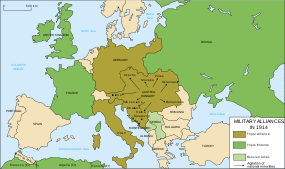
United Kingdom of Great Britain and Ireland
The United Kingdom of Great Britain and Ireland was the formal name of the United Kingdom during the period when what is now the Republic of Ireland formed a part of it....
, France
French Third Republic
The French Third Republic was the republican government of France from 1870, when the Second French Empire collapsed due to the French defeat in the Franco-Prussian War, to 1940, when France was overrun by Nazi Germany during World War II, resulting in the German and Italian occupations of France...
and Russia
Russian Empire
The Russian Empire was a state that existed from 1721 until the Russian Revolution of 1917. It was the successor to the Tsardom of Russia and the predecessor of the Soviet Union...
after the signing of the Anglo-Russian Entente
Anglo-Russian Entente
Signed on August 31, 1907, in St. Petersburg, Russia, the Anglo-Russian Convention of 1907 brought shaky British-Russian relations to the forefront by solidifying boundaries that identified respective control in Persia, Afghanistan, and Tibet...
in 1907.
The alliance of the three powers, supplemented by various agreements with Portugal
Portugal
Portugal , officially the Portuguese Republic is a country situated in southwestern Europe on the Iberian Peninsula. Portugal is the westernmost country of Europe, and is bordered by the Atlantic Ocean to the West and South and by Spain to the North and East. The Atlantic archipelagos of the...
, Japan
Empire of Japan
The Empire of Japan is the name of the state of Japan that existed from the Meiji Restoration on 3 January 1868 to the enactment of the post-World War II Constitution of...
, the United States
United States
The United States of America is a federal constitutional republic comprising fifty states and a federal district...
, Brazil
Brazil
Brazil , officially the Federative Republic of Brazil , is the largest country in South America. It is the world's fifth largest country, both by geographical area and by population with over 192 million people...
, Canada
Canada
Canada is a North American country consisting of ten provinces and three territories. Located in the northern part of the continent, it extends from the Atlantic Ocean in the east to the Pacific Ocean in the west, and northward into the Arctic Ocean...
, and Spain
Spain under the Restoration
The Restoration was the name given to the period that began on December 29, 1874 after the First Spanish Republic ended with the restoration of Alfonso XII to the throne after a coup d'état by Martinez Campos, and ended on April 14, 1931 with the proclamation of the Second Spanish Republic.After...
, constituted a powerful counterweight to the Triple Alliance
Triple Alliance (1882)
The Triple Alliance was the military alliance between Germany, Austria–Hungary, and Italy, , that lasted from 1882 until the start of World War I in 1914...
of Germany
German Empire
The German Empire refers to Germany during the "Second Reich" period from the unification of Germany and proclamation of Wilhelm I as German Emperor on 18 January 1871, to 1918, when it became a federal republic after defeat in World War I and the abdication of the Emperor, Wilhelm II.The German...
, Austria-Hungary
Austria-Hungary
Austria-Hungary , more formally known as the Kingdoms and Lands Represented in the Imperial Council and the Lands of the Holy Hungarian Crown of Saint Stephen, was a constitutional monarchic union between the crowns of the Austrian Empire and the Kingdom of Hungary in...
, and Italy
Kingdom of Italy (1861–1946)
The Kingdom of Italy was a state forged in 1861 by the unification of Italy under the influence of the Kingdom of Sardinia, which was its legal predecessor state...
. (Italy had concluded an additional secret agreement with France, effectively nullifying their alliance with Germany.)
League of the Three Emperors
Russia had previously been a member of the League of the Three EmperorsLeague of the Three Emperors
The League of the Three Emperors was an unstable alliance between Tsar Alexander II of Russia, Emperor Franz Joseph I of Austria-Hungary and Kaiser Wilhelm I of Germany.- Formation 1873 :...
with Austria-Hungary and Germany, an alliance established in 1873 between Tsar Alexander II
Alexander II of Russia
Alexander II , also known as Alexander the Liberator was the Emperor of the Russian Empire from 3 March 1855 until his assassination in 1881...
, Emperor Franz Joseph I
Franz Joseph I of Austria
Franz Joseph I or Francis Joseph I was Emperor of Austria, King of Bohemia, King of Croatia, Apostolic King of Hungary, King of Galicia and Lodomeria and Grand Duke of Cracow from 1848 until his death in 1916.In the December of 1848, Emperor Ferdinand I of Austria abdicated the throne as part of...
and Kaiser Wilhelm I. The alliance was part of the German Chancellor
Chancellor of Germany
The Chancellor of Germany is, under the German 1949 constitution, the head of government of Germany...
Otto von Bismarck
Otto von Bismarck
Otto Eduard Leopold, Prince of Bismarck, Duke of Lauenburg , simply known as Otto von Bismarck, was a Prussian-German statesman whose actions unified Germany, made it a major player in world affairs, and created a balance of power that kept Europe at peace after 1871.As Minister President of...
′s plan to isolate France diplomatically; he feared France had revanchist
Revanchism
Revanchism is a term used since the 1870s to describe a political manifestation of the will to reverse territorial losses incurred by a country, often following a war or social movement. Revanchism draws its strength from patriotic and retributionist thought and is often motivated by economic or...
aspirations and might try to regain her 1871 losses
Franco-Prussian War
The Franco-Prussian War or Franco-German War, often referred to in France as the 1870 War was a conflict between the Second French Empire and the Kingdom of Prussia. Prussia was aided by the North German Confederation, of which it was a member, and the South German states of Baden, Württemberg and...
, and to fight against radical sentiments the conservative rulers found unsettling, such as the First International.
However, the League faced great difficulty with the growing tensions between the Russian Empire
Russian Empire
The Russian Empire was a state that existed from 1721 until the Russian Revolution of 1917. It was the successor to the Tsardom of Russia and the predecessor of the Soviet Union...
and Austria-Hungary
Austria-Hungary
Austria-Hungary , more formally known as the Kingdoms and Lands Represented in the Imperial Council and the Lands of the Holy Hungarian Crown of Saint Stephen, was a constitutional monarchic union between the crowns of the Austrian Empire and the Kingdom of Hungary in...
. These tensions revolved mainly over the Balkans
Balkans
The Balkans is a geopolitical and cultural region of southeastern Europe...
where, with the rise of nationalism
Nationalism
Nationalism is a political ideology that involves a strong identification of a group of individuals with a political entity defined in national terms, i.e. a nation. In the 'modernist' image of the nation, it is nationalism that creates national identity. There are various definitions for what...
and the continued decline
Decline of the Ottoman Empire
The Decline of the Ottoman Empire is the period that followed after the Stagnation of the Ottoman Empire in which the empire experienced several economic and political setbacks. Directly affecting the Empire at this time was Russian imperialism...
of the Ottoman Empire
Ottoman Empire
The Ottoman EmpireIt was usually referred to as the "Ottoman Empire", the "Turkish Empire", the "Ottoman Caliphate" or more commonly "Turkey" by its contemporaries...
, many former Ottoman provinces struggled for independence.
The situation in the Balkans (especially in the wake of the Serbo-Bulgarian War
Serbo-Bulgarian War
The Serbo-Bulgarian War was a war between Serbia and Bulgaria that erupted on 14 November 1885 and lasted until 28 November the same year. Final peace was signed on 19 February 1886 in Bucharest...
) and the 1878 Treaty of Berlin, which left Russia feeling cheated of her gains made in the Russo-Turkish War led to the League not being renewed in 1885.
Reinsurance Treaty and Russian alliance with France
In an attempt to stop Russia from allying with France, Bismarck signed the secret Reinsurance TreatyReinsurance Treaty
The Reinsurance Treaty of June 18, 1887 was an attempt by German Chancellor Otto von Bismarck to continue to ally with Russia after the League of the Three Emperors had broken down in the aftermath of the 1885 Serbo-Bulgarian War....
of 1887, assuring both parties would remain neutral toward each other should war break out.
Yet despite the treaty, the Russian leadership was alarmed at the country′s diplomatic isolation and entered the Franco-Russian Alliance
Franco-Russian Alliance
The Franco-Russian Alliance was a military alliance between the French Third Republic and the Russian Empire that ran from 1892 to 1917. The alliance ended the diplomatic isolation of France and undermined the supremacy of the German Empire in Europe...
in 1892.
Due to the alliance between Russia and France, and Bismarck′s exclusion of Russia from the German financial market in 1887, the treaty was not renewed, ending the alliance between Germany and Russia.
British neutrality
The Entente heralded the end of British neutrality in EuropeSplendid isolation
Splendid Isolation was the foreign policy pursued by Britain during the late 19th century, under the Conservative premierships of Benjamin Disraeli and the Marquess of Salisbury. The term was actually coined by a Canadian politician to praise Britain's lack of involvement in European affairs...
. It was partly a response to growing German antagonism, as expressed in the expansion of the Kaiserliche Marine
Kaiserliche Marine
The Imperial German Navy was the German Navy created at the time of the formation of the German Empire. It existed between 1871 and 1919, growing out of the small Prussian Navy and Norddeutsche Bundesmarine, which primarily had the mission of coastal defense. Kaiser Wilhelm II greatly expanded...
(Imperial Navy) into a battle fleet that could threaten British naval supremacy
Royal Navy
The Royal Navy is the naval warfare service branch of the British Armed Forces. Founded in the 16th century, it is the oldest service branch and is known as the Senior Service...
.
Ironically, the Franco-Russian Alliance—which had seemed weak during Russia′s defeat in the Russo-Japanese War
Russo-Japanese War
The Russo-Japanese War was "the first great war of the 20th century." It grew out of rival imperial ambitions of the Russian Empire and Japanese Empire over Manchuria and Korea...
—later appeared the more powerful alignment, when Russia unexpectedly and rapidly recovered from the defeat and from the Russian Revolution of 1905, and when Britain was added as a partner.
This was not the first time Britain, France, and Russia had co-operated diplomatically. They had done so before during the Greek War of Independence
Greek War of Independence
The Greek War of Independence, also known as the Greek Revolution was a successful war of independence waged by the Greek revolutionaries between...
.
United Kingdom
In the last decade of the 19th century, Britain seemed to have adopted a foreign policy of "splendid isolationSplendid isolation
Splendid Isolation was the foreign policy pursued by Britain during the late 19th century, under the Conservative premierships of Benjamin Disraeli and the Marquess of Salisbury. The term was actually coined by a Canadian politician to praise Britain's lack of involvement in European affairs...
", with its primary focus on its massive overseas empire
British Empire
The British Empire comprised the dominions, colonies, protectorates, mandates and other territories ruled or administered by the United Kingdom. It originated with the overseas colonies and trading posts established by England in the late 16th and early 17th centuries. At its height, it was the...
. However, by the early 1900s the European theatre began to change dramatically. Some in Britain thought it was in need of allies. For most of the 19th century, the United Kingdom had regarded France and Russia as its two most dangerous rivals, but with the apparent threat of German imperialism, British sentiments began to change.
The three main reasons were:
- France and Britain had signed five separate agreements regarding spheres of influence in North AfricaNorth AfricaNorth Africa or Northern Africa is the northernmost region of the African continent, linked by the Sahara to Sub-Saharan Africa. Geopolitically, the United Nations definition of Northern Africa includes eight countries or territories; Algeria, Egypt, Libya, Morocco, South Sudan, Sudan, Tunisia, and...
in 1904. This became known as the Entente CordialeEntente CordialeThe Entente Cordiale was a series of agreements signed on 8 April 1904 between the United Kingdom and the French Republic. Beyond the immediate concerns of colonial expansion addressed by the agreement, the signing of the Entente Cordiale marked the end of almost a millennium of intermittent...
. The Tangier Crisis which followed encouraged co-operation between the two countries, given their mutual fear of apparent German expansionism. - Russia was defeated in the Russo-Japanese War. This display of weakness resulted in less concern over Russian imperialism and encouraged Russia to secure its position elsewhere. France was already allied to Russia in the Dual AllianceFranco-Russian AllianceThe Franco-Russian Alliance was a military alliance between the French Third Republic and the Russian Empire that ran from 1892 to 1917. The alliance ended the diplomatic isolation of France and undermined the supremacy of the German Empire in Europe...
. - Britain was extremely concerned about the rising threat of German imperialism. Kaiser Wilhelm II had announced to the world his intentions to create a global German empire and to develop a strong navy. Britain—traditionally having control of the seas—saw this as a serious threat to its own empire and navy.
In 1907, the Anglo-Russian Entente
Anglo-Russian Entente
Signed on August 31, 1907, in St. Petersburg, Russia, the Anglo-Russian Convention of 1907 brought shaky British-Russian relations to the forefront by solidifying boundaries that identified respective control in Persia, Afghanistan, and Tibet...
was agreed, which attempted to resolve a series of long-running disputes over Persia, Afghanistan
Afghanistan
Afghanistan , officially the Islamic Republic of Afghanistan, is a landlocked country located in the centre of Asia, forming South Asia, Central Asia and the Middle East. With a population of about 29 million, it has an area of , making it the 42nd most populous and 41st largest nation in the world...
and Tibet
Tibet
Tibet is a plateau region in Asia, north-east of the Himalayas. It is the traditional homeland of the Tibetan people as well as some other ethnic groups such as Monpas, Qiang, and Lhobas, and is now also inhabited by considerable numbers of Han and Hui people...
, as well as helping to address British fears about German expansion in the Near East
Baghdad Railway
The Baghdad Railway , was built from 1903 to 1940 to connect Berlin with the Ottoman Empire city of Baghdad with a line through modern-day Turkey, Syria, and Iraq....
.
French Third Republic
During the Franco-Prussian WarFranco-Prussian War
The Franco-Prussian War or Franco-German War, often referred to in France as the 1870 War was a conflict between the Second French Empire and the Kingdom of Prussia. Prussia was aided by the North German Confederation, of which it was a member, and the South German states of Baden, Württemberg and...
of 1870-1871, Prussia
Kingdom of Prussia
The Kingdom of Prussia was a German kingdom from 1701 to 1918. Until the defeat of Germany in World War I, it comprised almost two-thirds of the area of the German Empire...
defeated the Second French Empire
Second French Empire
The Second French Empire or French Empire was the Imperial Bonapartist regime of Napoleon III from 1852 to 1870, between the Second Republic and the Third Republic, in France.-Rule of Napoleon III:...
, resulting in the establishment of the Third Republic. In the Treaty of Frankfurt
Treaty of Frankfurt (1871)
The Treaty of Frankfurt was a peace treaty signed in Frankfurt on 10 May 1871, at the end of the Franco-Prussian War.- Summary :The treaty did the following:...
, Prussia forced France to cede Alsace-Lorraine
Alsace-Lorraine
The Imperial Territory of Alsace-Lorraine was a territory created by the German Empire in 1871 after it annexed most of Alsace and the Moselle region of Lorraine following its victory in the Franco-Prussian War. The Alsatian part lay in the Rhine Valley on the west bank of the Rhine River and east...
to the new German Empire
German Empire
The German Empire refers to Germany during the "Second Reich" period from the unification of Germany and proclamation of Wilhelm I as German Emperor on 18 January 1871, to 1918, when it became a federal republic after defeat in World War I and the abdication of the Emperor, Wilhelm II.The German...
. Ever since, relations had been at an all time low. France—worried about the escalating military development of Germany—began building up its own war industries and army as a deterrent to German aggression. As another measure, France developed a strong bond with Russia by joining the Franco-Russian Alliance
Franco-Russian Alliance
The Franco-Russian Alliance was a military alliance between the French Third Republic and the Russian Empire that ran from 1892 to 1917. The alliance ended the diplomatic isolation of France and undermined the supremacy of the German Empire in Europe...
, which was designed to create a strong counter to the Triple Alliance. France′s main concerns were to protect against an attack from Germany, and to regain Alsace-Lorraine.
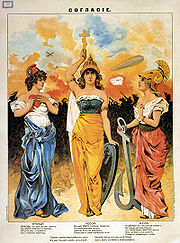
Russian Empire
Russia possessed by far the largest manpower reserves of all the six European powers, but was also the most backward economically. Russia shared France′s worries about Germany. After the Germans started to reorganize the Turkish army, Russia feared that they would come to control the DardanellesDardanelles
The Dardanelles , formerly known as the Hellespont, is a narrow strait in northwestern Turkey connecting the Aegean Sea to the Sea of Marmara. It is one of the Turkish Straits, along with its counterpart the Bosphorus. It is located at approximately...
, a vital trade artery which accounted for two fifths of Russia's exports.
This was also coupled with Russia's long history of rivalry with Austria-Hungary. Austria-Hungary had recently annexed Bosnia and Herzegovina
Bosnia and Herzegovina
Bosnia and Herzegovina , sometimes called Bosnia-Herzegovina or simply Bosnia, is a country in Southern Europe, on the Balkan Peninsula. Bordered by Croatia to the north, west and south, Serbia to the east, and Montenegro to the southeast, Bosnia and Herzegovina is almost landlocked, except for the...
, angering Russia immensely. Russia had considered itself the leader of the Slavic
Slavic peoples
The Slavic people are an Indo-European panethnicity living in Eastern Europe, Southeast Europe, North Asia and Central Asia. The term Slavic represents a broad ethno-linguistic group of people, who speak languages belonging to the Slavic language family and share, to varying degrees, certain...
world (Pan-Slavism
Pan-Slavism
Pan-Slavism was a movement in the mid-19th century aimed at unity of all the Slavic peoples. The main focus was in the Balkans where the South Slavs had been ruled for centuries by other empires, Byzantine Empire, Austria-Hungary, the Ottoman Empire, and Venice...
) and viewed the invasion as another step towards annexing Serbia
Serbia
Serbia , officially the Republic of Serbia , is a landlocked country located at the crossroads of Central and Southeast Europe, covering the southern part of the Carpathian basin and the central part of the Balkans...
and Montenegro
Montenegro
Montenegro Montenegrin: Crna Gora Црна Гора , meaning "Black Mountain") is a country located in Southeastern Europe. It has a coast on the Adriatic Sea to the south-west and is bordered by Croatia to the west, Bosnia and Herzegovina to the northwest, Serbia to the northeast and Albania to the...
. To counteract Austria-Hungary′s aggression into the Balkans, Russia pledged to aid Serbia militarily if invaded.
Russia had also recently fought the grueling Russo-Japanese War
Russo-Japanese War
The Russo-Japanese War was "the first great war of the 20th century." It grew out of rival imperial ambitions of the Russian Empire and Japanese Empire over Manchuria and Korea...
in 1905, resulting in a revolutionary uprising
Russian Revolution of 1905
The 1905 Russian Revolution was a wave of mass political and social unrest that spread through vast areas of the Russian Empire. Some of it was directed against the government, while some was undirected. It included worker strikes, peasant unrest, and military mutinies...
and transformation into a constitutional monarchy. To counter its enemies militarily and politically, Russia sought to revive the Franco-Russian Alliance
Franco-Russian Alliance
The Franco-Russian Alliance was a military alliance between the French Third Republic and the Russian Empire that ran from 1892 to 1917. The alliance ended the diplomatic isolation of France and undermined the supremacy of the German Empire in Europe...
. Although it was perceived as useless during the war with Japan, in the European theatre it was invaluable. Russia signed the Anglo-Russian Convention of 1907
Anglo-Russian Entente
Signed on August 31, 1907, in St. Petersburg, Russia, the Anglo-Russian Convention of 1907 brought shaky British-Russian relations to the forefront by solidifying boundaries that identified respective control in Persia, Afghanistan, and Tibet...
with Britain to counteract the threat of the Triple Alliance.
See also
- Allies of World War IAllies of World War IThe Entente Powers were the countries at war with the Central Powers during World War I. The members of the Triple Entente were the United Kingdom, France, and the Russian Empire; Italy entered the war on their side in 1915...
- Central PowersCentral PowersThe Central Powers were one of the two warring factions in World War I , composed of the German Empire, the Austro-Hungarian Empire, the Ottoman Empire, and the Kingdom of Bulgaria...
(allies of Germany in World War I)