
All Topics  
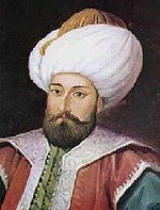
Murad I

 
Murad I

   Email Print
   Bookmark   Link


Murad I


Murad I (nick-named Hüdavendigâr - from Khodavandgar - "the God-like One") (March or June 29 1326, Sogut or Bursa June 28 1389, Battle of Kosovo
Battle of Kosovo

The Battle of Kosovo was fought on Vidovdan between the Serbian Empire, her allies, and the Ottoman Empire, in a Gazimestan about 5 kilometers northwest of Pristina....
) was the ruler of the Ottoman Empire
Ottoman Empire

The Ottoman Empire , also known by its contemporaries as the Turkish Empire or Turkey , was an empire that lasted from 1299?1923. It was Treaty of Lausanne by the Republic of Turkey, which was officially proclaimed on October 29, 1923....
, Sultan
Sultan

Sultan is an Islamic honorifics, with several historical meanings. Originally it was an Arabic language abstract noun meaning "strength", "authority", or "rulership", derived from the verbal noun ???? sulah, meaning "authority" or "power"....
 of Rûm
Rûm

R?m, also Roum or Rhum , is a very indefinite term used at different times in the Muslim world to refer to the Balkans and Anatolia generally, and for the Byzantine Empire in particular, for the Seljuk Sultanate of R?m in Asia Minor, and for Greeks inhabiting Ottoman Empire or modern Turkey territory as well as for Greek Cypriots....
, from 1359 to 1389. He was the son of Orhan I
Orhan I

Orhan I , was the second Bey, or chief, of the nascent Ottoman Empire from 1326 to 1359. He was the son of Osman I, and his mother was Kamariya Sultana Mal, daughter of Abdulaziz Bey....
 and the Valide Sultan
Valide Sultan

Valide Sultan was the title held by the mother of a ruling Sultan in the Ottoman Empire. The Turkish phonology pronunciation of the word Valide, rendered in Help:IPA, is ....
 (1359) Nilüfer Hatun
Nilüfer Hatun

Nil?fer was a Valide Sultan wife of Orhan I, the second ruler of the state which has become the Ottoman Empire. She was mother of the next ruler, Murad I....
 (Water lily
Nymphaeaceae

Nymphaeaceae is a name for a family of flowering plants. Members of this family are commonly called water lilies and live in freshwater areas in temperate and Tropics around the world....
 in Turkish
Turkish language

Turkish is a language spoken by over 63 million people worldwide, making it the most commonly spoken of the Turkic languages. Its speakers are located predominantly in Turkey and Cyprus, with smaller groups in Iraq, Greece, Bulgaria, the Republic of Macedonia, Kosovo, Albania and other parts of Eastern Europe....
), daughter of the Prince of Yarhisar or Byzantine
Byzantine Empire

Byzantine Empire and Eastern Roman Empire are conventional names used to describe the Roman Empire during the Middle Ages, centered on its capital of Constantinople....
 Princess Helen (Nilüfer
Nilüfer Hatun

Nil?fer was a Valide Sultan wife of Orhan I, the second ruler of the state which has become the Ottoman Empire. She was mother of the next ruler, Murad I....
), who was of ethnic Greek descent and became the ruler following his father's death in 1359.

stablished the Empire by building up a society and government in the newly conquered city of Adrianople (Edirne
Edirne

Edirne is a city in Thrace, the westernmost part of Turkey, close to the borders with Greece and Bulgaria. It is the capital of Edirne Province and its estimated population in 2002 was 128,400, up from 119,298 in 2000....
 in Turkish
Turkish language

Turkish is a language spoken by over 63 million people worldwide, making it the most commonly spoken of the Turkic languages. Its speakers are located predominantly in Turkey and Cyprus, with smaller groups in Iraq, Greece, Bulgaria, the Republic of Macedonia, Kosovo, Albania and other parts of Eastern Europe....
) and by expanding the realm in Europe
Europe

Europe is, conventionally, one of the world's seven continents. Comprising the westernmost peninsula of Eurasia, Europe is generally divided from Asia to its east by the water divide of the Ural Mountains, the Ural , the Caspian Sea, and by the Caucasus Mountains to the southeast....
, bringing most of the Balkans
Balkans

The Balkans is the historical name of a geographic subregion of southeastern Europe. The region takes its name from the Balkan Mountains, which run through the centre of Bulgaria into eastern Serbia....
 under Ottoman rule and forcing the Byzantine
Byzantine Empire

Byzantine Empire and Eastern Roman Empire are conventional names used to describe the Roman Empire during the Middle Ages, centered on its capital of Constantinople....
 emperor to pay him tribute.


Discussion
Ask a question about 'Murad I'
Start a new discussion about 'Murad I'
Answer questions from other users
Full Discussion Forum


Encyclopedia


Murad I (nick-named Hüdavendigâr - from Khodavandgar - "the God-like One") (March or June 29 1326, Sogut or Bursa June 28 1389, Battle of Kosovo
Battle of Kosovo

The Battle of Kosovo was fought on Vidovdan between the Serbian Empire, her allies, and the Ottoman Empire, in a Gazimestan about 5 kilometers northwest of Pristina....
) was the ruler of the Ottoman Empire
Ottoman Empire

The Ottoman Empire , also known by its contemporaries as the Turkish Empire or Turkey , was an empire that lasted from 1299?1923. It was Treaty of Lausanne by the Republic of Turkey, which was officially proclaimed on October 29, 1923....
, Sultan
Sultan

Sultan is an Islamic honorifics, with several historical meanings. Originally it was an Arabic language abstract noun meaning "strength", "authority", or "rulership", derived from the verbal noun ???? sulah, meaning "authority" or "power"....
 of Rûm
Rûm

R?m, also Roum or Rhum , is a very indefinite term used at different times in the Muslim world to refer to the Balkans and Anatolia generally, and for the Byzantine Empire in particular, for the Seljuk Sultanate of R?m in Asia Minor, and for Greeks inhabiting Ottoman Empire or modern Turkey territory as well as for Greek Cypriots....
, from 1359 to 1389. He was the son of Orhan I
Orhan I

Orhan I , was the second Bey, or chief, of the nascent Ottoman Empire from 1326 to 1359. He was the son of Osman I, and his mother was Kamariya Sultana Mal, daughter of Abdulaziz Bey....
 and the Valide Sultan
Valide Sultan

Valide Sultan was the title held by the mother of a ruling Sultan in the Ottoman Empire. The Turkish phonology pronunciation of the word Valide, rendered in Help:IPA, is ....
 (1359) Nilüfer Hatun
Nilüfer Hatun

Nil?fer was a Valide Sultan wife of Orhan I, the second ruler of the state which has become the Ottoman Empire. She was mother of the next ruler, Murad I....
 (Water lily
Nymphaeaceae

Nymphaeaceae is a name for a family of flowering plants. Members of this family are commonly called water lilies and live in freshwater areas in temperate and Tropics around the world....
 in Turkish
Turkish language

Turkish is a language spoken by over 63 million people worldwide, making it the most commonly spoken of the Turkic languages. Its speakers are located predominantly in Turkey and Cyprus, with smaller groups in Iraq, Greece, Bulgaria, the Republic of Macedonia, Kosovo, Albania and other parts of Eastern Europe....
), daughter of the Prince of Yarhisar or Byzantine
Byzantine Empire

Byzantine Empire and Eastern Roman Empire are conventional names used to describe the Roman Empire during the Middle Ages, centered on its capital of Constantinople....
 Princess Helen (Nilüfer
Nilüfer Hatun

Nil?fer was a Valide Sultan wife of Orhan I, the second ruler of the state which has become the Ottoman Empire. She was mother of the next ruler, Murad I....
), who was of ethnic Greek descent and became the ruler following his father's death in 1359.

Establishment of Empire

He established the Empire by building up a society and government in the newly conquered city of Adrianople (Edirne
Edirne

Edirne is a city in Thrace, the westernmost part of Turkey, close to the borders with Greece and Bulgaria. It is the capital of Edirne Province and its estimated population in 2002 was 128,400, up from 119,298 in 2000....
 in Turkish
Turkish language

Turkish is a language spoken by over 63 million people worldwide, making it the most commonly spoken of the Turkic languages. Its speakers are located predominantly in Turkey and Cyprus, with smaller groups in Iraq, Greece, Bulgaria, the Republic of Macedonia, Kosovo, Albania and other parts of Eastern Europe....
) and by expanding the realm in Europe
Europe

Europe is, conventionally, one of the world's seven continents. Comprising the westernmost peninsula of Eurasia, Europe is generally divided from Asia to its east by the water divide of the Ural Mountains, the Ural , the Caspian Sea, and by the Caucasus Mountains to the southeast....
, bringing most of the Balkans
Balkans

The Balkans is the historical name of a geographic subregion of southeastern Europe. The region takes its name from the Balkan Mountains, which run through the centre of Bulgaria into eastern Serbia....
 under Ottoman rule and forcing the Byzantine
Byzantine Empire

Byzantine Empire and Eastern Roman Empire are conventional names used to describe the Roman Empire during the Middle Ages, centered on its capital of Constantinople....
 emperor to pay him tribute. It was Murad who established the former Osmanli
Ottoman Turks

The Ottoman Turks were the subdivision of the Ottoman Muslim Millet that dominated the ruling class of the Ottoman Empire. Reliable information about the early history of the Ottomans is scarce....
 tribe into an empire. He established the title of sultan
Sultan

Sultan is an Islamic honorifics, with several historical meanings. Originally it was an Arabic language abstract noun meaning "strength", "authority", or "rulership", derived from the verbal noun ???? sulah, meaning "authority" or "power"....
 in 1383 and the corps of the janissaries
Janissary

The Janissaries comprised infantry units that formed the Ottoman Empire sultan's household troops and bodyguards. The force was created by the Sultan Murad I from Christian slaves in the 14th century and was abolished by Sultan Mahmud II in 1826 with the Auspicious Incident....
 and the devsirme
Devshirmeh

Devsirme or devshirme was the practice by which the Ottoman Empire recruited boys from Christianity families, who were then forcibly converted to Islam and trained as Janissary soldiers....
 recruiting system. He also organised the government of the Divan
Divan

Divan or diwan was a high governmental body in a number of Islamic states, or its chief official ....
, the system of timars and timar-holders (timariots) and the military judge, the kazasker. He also established the two provinces of Anadolu (Anatolia
Anatolia

Anatolia or Asia Minor is a region of Western Asia, comprising most of the modern Republic of Turkey. It is a geographic region bounded by the Black Sea to the north, the Caucasus to the northeast, the Aegean Sea to the west, the Mediterranean Sea to the south, and the Iranian plateau to the east and southeast....
) and Rumeli (Europe
Europe

Europe is, conventionally, one of the world's seven continents. Comprising the westernmost peninsula of Eurasia, Europe is generally divided from Asia to its east by the water divide of the Ural Mountains, the Ural , the Caspian Sea, and by the Caucasus Mountains to the southeast....
).

Wars

Murad fought against the powerful emirate
Emirate

An emirate is a political territory that is ruled by a dynastic Arab Monarch styled emir....
 of Karaman
Karamanoglu

Beylik of Karaman or of Karamanoglu , also called the Karamanid Dynasty or the Karamanids, was an Anatolian Turkish Beylik state centered in south-central Anatolia, around the present-day Karaman Province....
 in Anatolia and against the Serbs
Serbs

Serbs are a South Slavs people living in the Balkans and Central Europe, mainly in Serbia, Montenegro, Bosnia-Herzegovina, and, to a lesser extent, in Croatia....
, Bulgarians
Bulgarians

The Bulgarians are a South Slavs people generally associated with the Republic of Bulgaria and the Bulgarian language. Emigration has resulted in Bulgarian minorities or immigrant communities in a number of other countries....
 and Hungarians in Europe. His moves in the Balkans
Balkans

The Balkans is the historical name of a geographic subregion of southeastern Europe. The region takes its name from the Balkan Mountains, which run through the centre of Bulgaria into eastern Serbia....
 brought together a Christian coalition under the king of Hungary
Hungary

Hungary , officially in English the Republic of Hungary , is a landlocked country in the Carpathian Basin of Central Europe, bordered by Austria, Slovakia, Ukraine, Romania, Serbia, Croatia, and Slovenia....
, but it was defeated at the Battle of Maritsa
Battle of Maritsa

The Battle of Maritsa or Battle of Chernomen took place at the Maritsa near the village of Ormenio on September 26, 1371 between the forces of the Ottoman Empire sultan Murad I's lieutenant Lala Shahin Pasha and the Serbs numbering some 70,000 men under the command of the Serbs king of Prilep Vuka?in Mrnjavcevic and his brother desp...
 on September 26, 1371, by Murad's capable second lieutenant Lala Sâhin Pasa
Lala Shahin Pasha

Lala Shahin Pasha was the first Beylerbey of Rumelia. He was one of commanders in Battle of Maritsa and the leader of the Battle of Bileca ....
, the first governor (beylerbey
Beylerbey

Beylerbey The rank was used initially for very large parts of the empire ? all of Anatolia and Rumelia ? but in later centuries the title was devaluated by extending it to the governors of various much smaller Ottoman eyalets....
) of Rumeli. In 1366 the Serbian king was forced to pay tribute to the Sultan and in 1385 Sofia
Sofia

Sofia , is the Capital and largest city of the Bulgaria, with 2,5 million people living in the Capital Municipality. It is located in western Bulgaria, at the foot of the mountain massif Vitosha, and is the administrative, cultural, economic, and educational centre of the country....
 fell to the Ottomans. In 1386 Prince Lazar Hrebeljanovic defeated a small Ottoman force at the Battle of Plocnik
Battle of Plocnik

The Battle of Plocnik was fought in 1386 , at the village of Plocnik, near Prokuplje in today's southeastern Serbia, between the Serbian forces of prince Lazar Hrebeljanovic and the invading Ottoman Turks of sultan Murad I....
. The Ottoman army did not suffer heavy casualties, and was unable to capture Niš
Niš

Ni? is a city in Ni?ava District, Serbia situated at 43.3? N 21.9? E, on the Ni?ava River. With more than 250,000 inhabitants it is the largest city of South Serbia and third-largest city in the country, after Belgrade and Novi Sad....
 on the way back. In 1389 Murad's army defeated the Serbian Army and its allies under the leadership of Lazar at the Battle of Kosovo
Battle of Kosovo

The Battle of Kosovo was fought on Vidovdan between the Serbian Empire, her allies, and the Ottoman Empire, in a Gazimestan about 5 kilometers northwest of Pristina....
.

There are different accounts from different sources about when and how Murad I was assasinated. One Western source states that during first hours of the battle, Murad I was assasinated by Serbian nobleman and knight
Knight

File:Gothic armor 2.jpgKnight is the term for a social position originating in the Middle Ages. In the Commonwealth of Nations, knighthood is a non-heritable form of gentry....
 Miloš Obilic
Miloš Obilic

Milo? Obilic was a 14th century Serbian knight. He features prominently in legends surrounding the Battle of Kosovo. He is a major figure in Serbian epic poetry, and is a legendary, as well as a historical persona....
 by knife. Most Ottoman chroniclers (including Dimitrie Cantemir
Dimitrie Cantemir

Dimitrie Cantemir was twice List of Moldavian rulers of Moldavia . He was also a prolific Intellectual – philosopher, historian, composer, musicologist, linguistics, ethnographer, and geographer....
) state that he was assasinated after the finish of the battle while going around the battlefield. Others state that he was assasinated in the evening after the battle at his tent by the assassin who was admitted to ask a special favour. His older son Bayezid
Bayezid I

Bayezid I was the Sultan of the Ottoman Empire, then R?m, from 1389 to 1402. He was the son of Murad I who was of Turkish people origin and Valide Sultan Gulcicek Hatun or G?l?i?ek Hatun who was of ethnic Greek people descent....
, who was in charge of the left wing of the Ottoman forces, took charge after that. His other son, Yakub Bey, who was in charge of the other wing, was called to the Sultan's command center tent by Bayezid, but when Yakub Bey arrived he was strangled, leaving Bayezid as the sole claimant to the throne.

In the earliest preserved Christian record, a letter of Florentine senate to the King Tvrtko I of Bosnia, dated 20 October 1389, Murad I's killing was described. The killer is not named but it was one of 12 Serbian noblemen managed to break through the Ottoman ranks:

Fortunate, most fortunate are those hands of the twelve loyal lords who, having opened their way with the sword and having penetrated the enemy lines and the circle of chained camels, heroically reached the tent of Amurat himself. Fortunate above all is that one who so forcefully killed such a strong vojvoda by stabbing him with a sword in the throat and belly. And blessed are all those who gave their lives and blood through the glorious manner of martyrdom as victims of the dead leader over his ugly corpse.

Sultan Murad's internal organs were buried in Kosovo field and remains to this day on a corner of the battlefield in a location called Meshed-i Hudavendigar which has gained a religious significance by the Muslims (which had been renamed Obilic
Obilic

Obilic or Obiliq is a town and municipality in central Kosovo, belonging to the District of Pristina district. The municipality includes the town of Obilic and 19 villages, with a total population of approximately 30,000....
 by the Serbs). It has recently been renovated. His other remains were carried to Bursa, his Anatolian capital city, and were buried in a tomb at the complex built in his name.

Marriages and Progeny

Hatemimurad
Marriages of Murad I:
  • In 1359 Valide Sultan
    Valide Sultan

    Valide Sultan was the title held by the mother of a ruling Sultan in the Ottoman Empire. The Turkish phonology pronunciation of the word Valide, rendered in Help:IPA, is ....
     (1389) Gulcicek Hatun or Gülçiçek Hatun, :tr:Gülçiçek Hatun - of Greek
    Greeks

    The Greeks , also known as Hellenes, are a nation and ethnic group native to Greece, Cyprus and neighbouring regions, who can also be found in Greek diaspora communities around the world....
     origin
  • In 1370 Maria Thamara Hatun - sister of Bulgarian Czar Ivan Shishman
  • Pasha Melek Hatun - daughter of Kizil Murad Bey
  • Fulane Hatun - daughter of Candaroglu
    Candaroglu

    Candaroglu Beylik is an Anatolian Turkish Beylik that ruled principally in the regions corresponding to present-day Kastamonu Province and Sinop Province provinces of Turkey, also covering parts of Zonguldak, Bartin, Karab?k, Samsun, Bolu, Ankara and ?ankiri Province provinces, between 1292 - 1461, in the Black Sea region of modern day Turke...


Progeny of Murad I:
  • Yakub Celebi (? - d. 1389) - son. In the first recorded fratricide
    Fratricide

    Fratricide is the act of a person killing his or her brother.Related concepts are sororicide , child murder , infanticide , filicide , patricide , matricide , mariticide and uxoricide ....
     in the history of the Ottoman dynasty
    Ottoman Dynasty

    File:Barber cape.jpgThe Ottoman Dynasty ruled the Ottoman Empire from 1299 to 1922, beginning with Osman I , though the dynasty was not proclaimed until Orhan Bey declared himself sultan....
    , Bayezid I
    Bayezid I

    Bayezid I was the Sultan of the Ottoman Empire, then R?m, from 1389 to 1402. He was the son of Murad I who was of Turkish people origin and Valide Sultan Gulcicek Hatun or G?l?i?ek Hatun who was of ethnic Greek people descent....
     had Yakup killed during or following the Battle of Kosovo
    Battle of Kosovo

    The Battle of Kosovo was fought on Vidovdan between the Serbian Empire, her allies, and the Ottoman Empire, in a Gazimestan about 5 kilometers northwest of Pristina....
     at which their father had been killed.
  • Sultan Bayezid I
    Bayezid I

    Bayezid I was the Sultan of the Ottoman Empire, then R?m, from 1389 to 1402. He was the son of Murad I who was of Turkish people origin and Valide Sultan Gulcicek Hatun or G?l?i?ek Hatun who was of ethnic Greek people descent....
     (1354-1402)- son of Gulcicek Hatun
  • Savci Bey - son. He and Byzantyne emperor John V Palaeologus' son Andronicus rebelled against their fathers. Murad had Savci killed. Andronicus, who had surrendered to his father, was imprisoned and blinded at Murad's insistence.
  • Ibrahim Bey - son
  • Yahshi Bey - son of Gulcicek Hatun
  • Halil Bey - son
  • Nefise - daughter
  • Sultan - daughter


Sultan Murad in literature

  • In William Shakespeare's
    William Shakespeare

    William Shakespeare was an English people poet and playwright, widely regarded as the greatest writer in the English language and the world's preeminent dramatist....
     History play Henry V
    Henry V (play)

    Henry V is a history play by William Shakespeare, believed to be written in 1599. It is based on the life of King Henry V of England, and focuses on events immediately before and after the Battle of Agincourt during the Hundred Years' War....
    ,
Prince Harry refers to Murad as "Amurath" in Act V Scene 2 when he succeeds his father, King Henry IV, in 1412:

Chief Justice. Good morrow, and God save your majesty!


King Henry V. This new and gorgeous garment, majesty,
Sits not so easy on me as you think.
Brothers, you mix your sadness with some fear:
This is the English, not the Turkish court;
Not Amurath an Amurath succeeds,
But Harry Harry!


  • Murad (as "Amurath the First") is the subject of Thomas Goffe
    Thomas Goffe

    Thomas Goffe was a minor Literature in English#Jacobean literature dramatist. Goffe was a student at Christ Church, Oxford, where he earned his B.D....
    's play The Courageous Turk, published in 1632.