

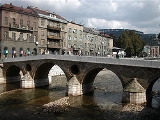
Assassination of Archduke Franz Ferdinand of Austria

Encyclopedia
Archduke Franz Ferdinand of Austria
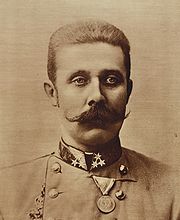
Franz Ferdinand was an Archduke of Austria-Este, Austro-Hungarian and Royal Prince of Hungary and of Bohemia, and from 1889 until his death, heir presumptive to the Austro-Hungarian throne. His assassination in Sarajevo precipitated Austria-Hungary's declaration of war against Serbia...
, heir presumptive to the Austro-Hungarian
Austria-Hungary
Austria-Hungary , more formally known as the Kingdoms and Lands Represented in the Imperial Council and the Lands of the Holy Hungarian Crown of Saint Stephen, was a constitutional monarchic union between the crowns of the Austrian Empire and the Kingdom of Hungary in...
throne, and his wife, Sophie, Duchess of Hohenberg
Sophie, Duchess of Hohenberg
Sophie, Duchess of Hohenberg ; 1 March 1868 – 28 June 1914) was a Czech aristocrat, the morganatic wife of Archduke Franz Ferdinand of Austria. Their assassination sparked World War I.- Early life :...
, were shot dead in Sarajevo
Sarajevo
Sarajevo |Bosnia]], surrounded by the Dinaric Alps and situated along the Miljacka River in the heart of Southeastern Europe and the Balkans....
, by Gavrilo Princip
Gavrilo Princip
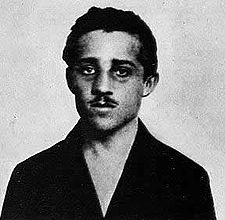
Gavrilo Princip was the Bosnian Serb who assassinated Archduke Franz Ferdinand of Austria and his wife, Sophie, Duchess of Hohenberg, in Sarajevo on 28 June 1914...
, one of a group of six Bosnian Serb assassins coordinated by Danilo Ilić
Danilo Ilic
Danilo Ilić was born in Bosnia and Herzegovina in 1891 and died in 1915. He attended the State Teachers' College in Sarajevo and for a while taught at a school in Bosnia. In 1913 Ilic moved to Belgrade where he became a journalist and a member of the Black Hand secret society.Ilic returned to...
. The political objective of the assassination was to break off Austria-Hungary's south-Slav provinces so they could be combined into a Greater Serbia
Greater Serbia
The term Greater Serbia or Great Serbia applies to the Serbian nationalist and irredentist ideology directed towards the creation of a Serbian land which would incorporate all regions of traditional significance to the Serbian nation...
or a Yugoslavia
Yugoslavia
Yugoslavia refers to three political entities that existed successively on the western part of the Balkans during most of the 20th century....
. The assassins' motives were consistent with the movement that later became known as Young Bosnia
Young Bosnia
Young Bosnia was a revolutionary movement active before World War I, the members were predominantly school students who were ethnic Serbs, but included Bosniaks...
. Serbian military officers stood behind the attack.
At the top of these Serbian military conspirators was Chief of Serbian Military Intelligence Dragutin Dimitrijević
Dragutin Dimitrijevic
Dragutin Dimitrijević was a Serbian soldier and leader of the Black Hand group implicated with assassination of Franz Ferdinand, Archduke of Austria in 1914...
, his right hand man Major Vojislav Tankosić, and Masterspy Rade Malobabić. Major Tankosić armed (with bombs and pistols) and trained the assassins, and the assassins were given access to the same clandestine tunnel of safe-houses and agents that Rade Malobabić used for the infiltration of weapons and operatives into Austria-Hungary.
The assassins, the key members of the clandestine tunnel, and the key Serbian military conspirators who were still alive were arrested, tried, convicted and punished. Those who were arrested in Bosnia were tried in Sarajevo in October 1914. The other conspirators were arrested and tried before a Serbian kangaroo court
Kangaroo court
A kangaroo court is "a mock court in which the principles of law and justice are disregarded or perverted".The outcome of a trial by kangaroo court is essentially determined in advance, usually for the purpose of ensuring conviction, either by going through the motions of manipulated procedure or...
on the French-controlled Salonika Front in 1916–1917 on unrelated false charges; Serbia executed three of the top military conspirators. Much of what is known about the assassinations comes from these two trials and related records.
Assignment of responsibility for the bombing and murders of 28 June is highly controversial because the attack led to the outbreak of World War I
World War I
World War I , which was predominantly called the World War or the Great War from its occurrence until 1939, and the First World War or World War I thereafter, was a major war centred in Europe that began on 28 July 1914 and lasted until 11 November 1918...
one month later.
Background
Treaty of Berlin, 1878
The Treaty of Berlin was the final act of the Congress of Berlin , by which the United Kingdom, Austria-Hungary, France, Germany, Italy, Russia and the Ottoman Empire under Sultan Abdul Hamid II revised the Treaty of San Stefano signed on March 3 of the same year...
, Austria-Hungary
Austria-Hungary
Austria-Hungary , more formally known as the Kingdoms and Lands Represented in the Imperial Council and the Lands of the Holy Hungarian Crown of Saint Stephen, was a constitutional monarchic union between the crowns of the Austrian Empire and the Kingdom of Hungary in...
received the mandate to occupy and administer the Ottoman Vilayet of Bosnia while the Ottoman Empire retained official sovereignty. Under this same treaty, the Great Powers (Austria-Hungary, Britain, France, Germany, Italy, the Ottoman Empire and Russia) gave official recognition to the Kingdom of Serbia
Kingdom of Serbia
The Kingdom of Serbia was created when Prince Milan Obrenović, ruler of the Principality of Serbia, was crowned King in 1882. The Principality of Serbia was ruled by the Karađorđevic dynasty from 1817 onwards . The Principality, suzerain to the Porte, had expelled all Ottoman troops by 1867, de...
as a fully sovereign state. Initially, Serbia’s monarchs were content to reign within the borders set by the treaty.
This changed in 1903 when Serbian military officers led by Dragutin Dimitrijević
Dragutin Dimitrijevic
Dragutin Dimitrijević was a Serbian soldier and leader of the Black Hand group implicated with assassination of Franz Ferdinand, Archduke of Austria in 1914...
stormed the Serbian Royal Palace
May Overthrow
The May Overthrow was a 1903 coup d'état in which the Serbian King Alexander Obrenović and his wife, Queen Draga, were assassinated inside the Royal Palace in Belgrade on the night between 28 and 29 May 1903 by the Julian calendar...
. After a fierce battle in the dark the attackers captured General Laza Petrović, head of the Palace Guard, and forced him to reveal the hiding place of King Alexander Obrenović and his wife Queen Draga
Queen Draga
Draga Obrenović , also known as Queen Draga, was the queen and wife of King Aleksandar Obrenović of the Kingdom of Serbia...
. The King and Queen opened the door from their hiding place. The King was shot thirty times; the Queen eighteen. MacKenzie writes: "The royal corpses were then stripped and brutally sabred." The attackers threw the corpses of King Alexander and Queen Draga out of a palace window, ending any threat that loyalists would mount a counter attack." General Petrović was then killed too (Vojislav Tankosić organized the murders of Queen Draga's brothers; Dimitrijević and Tankosić in 1913–1914 figure prominently in the plot to assassinate Franz Ferdinand). The conspirators installed Peter I
Peter I of Yugoslavia
Peter I , was the King of Serbia from 1903 to 1918, and subsequently the ruler of the Kingdom of Serbs, Croats and Slovenes . He was a member of the Royal House of Karađorđević...
of the House of Karađorđević as the new king.
The new dynasty was more nationalistic, more friendly to Russia and less friendly to Austria-Hungary. Over the next decade, disputes between Serbia and its neighbors erupted as Serbia moved to build its power and gradually reclaim its 14th-century empire
Serbian Empire
The Serbian Empire was a short-lived medieval empire in the Balkans that emerged from the Serbian Kingdom. Stephen Uroš IV Dušan was crowned Emperor of Serbs and Greeks on 16 April, 1346, a title signifying a successorship to the Eastern Roman Empire...
. These conflicts included a customs
Customs
Customs is an authority or agency in a country responsible for collecting and safeguarding customs duties and for controlling the flow of goods including animals, transports, personal effects and hazardous items in and out of a country...
dispute with Austria-Hungary beginning in 1906 (commonly referred to as the "Pig War
Pig War (Serbia)
The term Pig War is used to refer to an economic conflict in which the Habsburg Empire imposed a customs blockade on Serbia. It is known as the Customs War in Serbia.- Background :...
"), the Bosnian crisis
Bosnian crisis
The Bosnian Crisis of 1908–1909, also known as the Annexation crisis, or the First Balkan Crisis, erupted into public view when on 6 October 1908, Austria-Hungary announced the annexation of Bosnia and Herzegovina. Russia, the Ottoman Empire, Britain, Italy, Serbia, Montenegro, Germany and France...
of 1908–1909 where Serbia assumed an attitude of protest over Austria-Hungary's annexation of Bosnia-Herzegovina (ending in Serbian acquiescence without compensation in March 1909), and finally the two Balkan Wars
Balkan Wars
The Balkan Wars were two conflicts that took place in the Balkans in south-eastern Europe in 1912 and 1913.By the early 20th century, Montenegro, Bulgaria, Greece and Serbia, the countries of the Balkan League, had achieved their independence from the Ottoman Empire, but large parts of their ethnic...
of 1912–1913 where Serbia conquered Macedonia
Macedonia (region)
Macedonia is a geographical and historical region of the Balkan peninsula in southeastern Europe. Its boundaries have changed considerably over time, but nowadays the region is considered to include parts of five Balkan countries: Greece, the Republic of Macedonia, Bulgaria, Albania, Serbia, as...
and Kosovo
Kosovo
Kosovo is a region in southeastern Europe. Part of the Ottoman Empire for more than five centuries, later the Autonomous Province of Kosovo and Metohija within Serbia...
from the Ottoman Empire
Ottoman Empire
The Ottoman EmpireIt was usually referred to as the "Ottoman Empire", the "Turkish Empire", the "Ottoman Caliphate" or more commonly "Turkey" by its contemporaries...
.
Serbia's military successes and Serbian outrage over the Austro-Hungarian annexation of Bosnia-Herzegovina emboldened nationalistic elements in Serbia and Serbs in Austria-Hungary who chafed under Austro-Hungarian rule and whose nationalist sentiments were stirred by Serbian "cultural" organizations. In the five years prior to 1914, lone assassins – mostly Serbian citizens of Austria-Hungary – made a series of unsuccessful assassination attempts in Croatia and Bosnia-Herzegovina against Austro-Hungarian officials. The assassins received sporadic support from Serbia.
On 15 June 1910 Bogdan Žerajić attempted to kill the iron-fisted Governor of Bosnia and Herzegovina, General Marijan Verešanin. Žerajić was a 22-year-old Orthodox Serb from Nevesinje
Nevesinje
Nevesinje is a town and municipality in Bosnia and Herzegovina, located in eastern Herzegovina between Mostar and Gacko. It is administratively part of the Republika Srpska entity.-Geography:...
, Herzegovina, who made frequent trips to Belgrade
Belgrade
Belgrade is the capital and largest city of Serbia. It is located at the confluence of the Sava and Danube rivers, where the Pannonian Plain meets the Balkans. According to official results of Census 2011, the city has a population of 1,639,121. It is one of the 15 largest cities in Europe...
. (General Verešanin went on to crush the last Bosnian peasant uprising in the second half of 1910.) The five bullets Žerajić fired at Verešanin and the fatal bullet he put in his own brain made Žerajić an inspiration to future Serbian assassins, including Princip and Princip's accomplice Čabrinović. Princip said that Žerajić "was my first model. When I was seventeen I passed whole nights at his grave, reflecting on our wretched condition and thinking of him. It is there that I made up my mind sooner or later to perpetrate an outrage."
In 1913, Emperor Franz Joseph commanded Archduke Franz Ferdinand to observe the military maneuvers in Bosnia scheduled for June 1914. Following the maneuvers Ferdinand and his wife planned to visit Sarajevo to open the state museum in its new premises there. Duchess Sophie, according to their oldest son, Duke Maximilian, accompanied her husband out of fear for his safety.
As a "Czech countess [she] was treated as a commoner at the Austrian court". Emperor Franz Joseph had only consented to their marriage on the condition that their descendants would never ascend the throne. The 14th anniversary of the morganatic oath
Morganatic marriage
In the context of European royalty, a morganatic marriage is a marriage between people of unequal social rank, which prevents the passage of the husband's titles and privileges to the wife and any children born of the marriage...
fell on 28 June. As historian A. J. P. Taylor
A. J. P. Taylor
Alan John Percivale Taylor, FBA was a British historian of the 20th century and renowned academic who became well known to millions through his popular television lectures.-Early life:...
observes:
Franz Ferdinand was an advocate of increased federalism
United States of Greater Austria
The United States of Greater Austria was an idea created by a group of scholars surrounding the Austrian Archduke Franz Ferdinand that never came to pass...
and widely believed to favor triadism, under which Austria-Hungary would be reorganized by combining the Slavic lands within the Austro-Hungarian empire into a third crown. A Slavic kingdom could have been a bulwark against Serb irredentism
Irredentism
Irredentism is any position advocating annexation of territories administered by another state on the grounds of common ethnicity or prior historical possession, actual or alleged. Some of these movements are also called pan-nationalist movements. It is a feature of identity politics and cultural...
and Franz Ferdinand was therefore perceived as a threat by those same irredentists. Princip later stated to the court that preventing Franz Ferdinand's planned reforms was one of his motivations.
The day of the assassination, 28 June, is 15 June in the Julian calendar
Julian calendar
The Julian calendar began in 45 BC as a reform of the Roman calendar by Julius Caesar. It was chosen after consultation with the astronomer Sosigenes of Alexandria and was probably designed to approximate the tropical year .The Julian calendar has a regular year of 365 days divided into 12 months...
, the feast of St. Vitus. In Serbia, it is called Vidovdan
Vidovdan
-See also:*Divinity*Daeva*Deva *Vidovdan...
and commemorates the 1389 Battle of Kosovo
Battle of Kosovo
The Battle of Kosovo took place on St. Vitus' Day, June 15, 1389, between the army led by Serbian Prince Lazar Hrebeljanović, and the invading army of the Ottoman Empire under the leadership of Sultan Murad I...
against the Ottomans, at which the Sultan was assassinated in his tent by a Serb; it is an occasion for Serbian patriotic observances.
Planning direct action
Danilo Ilić was a Bosnian Orthodox Serb. He had worked as a school teacher and as a bank worker but in 1913 and 1914 he lived with, and outwardly off, his mother, who operated a small boarding house in Sarajevo. Secretly, Ilić was leader of the Serbian-irredentist Black HandBlack Hand
Unification or Death , unofficially known as the Black Hand , was a secret military society formed by members of the Serbian army in the Kingdom of Serbia, which was founded on September 6, 1901. It was intent on uniting all of the territories containing significant Serb populations annexed by...
terrorist cell in Sarajevo. In late 1913, Danilo Ilić came to the Serbian listening post at Užice to speak to the officer in charge, Serbian Colonel C. A. Popović, who was a captain at the time and a member of the Black Hand. Ilić recommended an end to the period of revolutionary organization building and a move to direct action against Austria-Hungary. Popović passed Danilo Ilić on to Belgrade to discuss this matter with Chief of Serbian Military Intelligence Colonel Dragutin Dimitrijević
Dragutin Dimitrijevic
Dragutin Dimitrijević was a Serbian soldier and leader of the Black Hand group implicated with assassination of Franz Ferdinand, Archduke of Austria in 1914...
, known more commonly as Apis. By 1913, Apis and his fellow military conspirators (drawn heavily from the ranks of the May 1903 coup) had come to dominate what was left of the Black Hand.
There are no reports as to what took place between Ilić and Apis, but soon after their meeting, Apis' right hand man and fellow Black Hander, Serbian Major Vojislav Tankosić, who by this time was in charge of guerrilla training, called a Serbian irredentist planning meeting in Toulouse
Toulouse
Toulouse is a city in the Haute-Garonne department in southwestern FranceIt lies on the banks of the River Garonne, 590 km away from Paris and half-way between the Atlantic Ocean and the Mediterranean Sea...
, France. Amongst those summoned to the Toulouse meeting was Mehmed Mehmedbašić, a carpenter by trade and son of an impoverished Muslim noble from Herzegovina. He too was a member of the Black Hand, having been sworn into the organization by Black Hand Provincial Director for Bosnia-Herzegovina Vladimir Gacinović and Danilo Ilić. Mehmedbašić was (here quoting Albertini paraphrasing Mehmedbašić) "eager to carry out an act of terrorism to revive the revolutionary spirit of Bosnia." During this January 1914 meeting, various possible Austrian-Hungarian targets for assassination were discussed, including Franz Ferdinand. However, the participants decided only to dispatch Mehmed Mehmedbašić to Sarajevo, to kill the Governor of Bosnia, Oskar Potiorek.
On his way to Bosnia-Herzegovina from France, police searched Mehmedbašić's train for a thief. Thinking the police might be after him, he threw his weapons (a dagger and a bottle of poison) out the train window. Once he arrived in Bosnia-Herzegovina he had to set about looking for replacement weapons.
Franz Ferdinand chosen
The search for new weapons delayed Mehmedbašić's attempt on Potiorek. Before Mehmedbašić was ready to act, Ilić summoned him to Mostar. On 26 March 1914, Ilić informed Mehmedbašić that Belgrade had scrapped the mission to kill the governor. The plan now was to murder Franz Ferdinand, and Mehmedbašić should stand by for the new operation. (Apis confessed to the Serbian Court that he ordered the assassination of Franz Ferdinand in his position as head of the Intelligence Department).Ilić recruited the Serbian youths Vaso Čubrilović and Cvjetko Popović shortly after Easter (Orthodox Easter as given by Dedijer: 19 April 1914), for the assassination, as evidenced by the testimony of Ilić, Čubrilović, and Popović at the Sarajevo trial. Three youths – Gavrilo Princip, Trifun Grabež, and Nedjelko Čabrinović – Austrian-Hungarian Bosnian Serbs, living in Belgrade, testified at the Sarajevo trial that at about the same time (a little after Easter), they were eager to carry out an assassination and approached a fellow Bosnian and former guerrilla fighter known to be well connected and with access to arms, Milan Ciganović, and through him Major Tankosić and reached an agreement to transport arms to Sarajevo and participate in the assassination.
Agreement in principle was quickly reached, but delivery of the weapons was delayed for more than a month. The assassins would meet with Ciganović and he would put them off. At one point, Ciganović told Grabež: "Nothing doing, the old Emperor is ill and the Heir Apparent will not go to Bosnia." When Emperor Franz Joseph's health recovered the operation was a "go" again. Tankosić gave the assassins one pistol to practice with.
The rest of the weapons were finally delivered on 26 May. The three assassins from Belgrade testified that Major Tankosić, directly and through Ciganović, not only provided six hand grenades, four Browning
John Browning
John Moses Browning , born in Ogden, Utah, was an American firearms designer who developed many varieties of military and civilian firearms, cartridges, and gun mechanisms, many of which are still in use around the world...
automatic pistols and ammunition, but also money, suicide pills, training, a special map with the location of gendarmes marked, knowledge of contacts on a clandestine tunnel used to infiltrate agents and arms into Austria-Hungary, and a small card authorizing the use of that tunnel. Major Tankosić confirmed to the journalist and historian Luciano Magrini that he provided the bombs and pistols and was responsible for training Princip, Grabež, and Čabrinović and that he (Tankosić) initiated the idea of the suicide pills.
The Tunnel
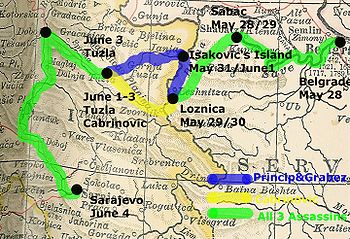
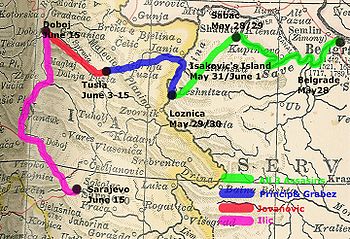
When Princip, Grabež, and Čabrinović reached Loznica on 29 May, Captain Prvanović summoned three of his revenue sergeants to discuss the best way to cross the border undetected. While waiting for the sergeants to arrive, Princip and Grabež had a falling out with Čabrinović over Čabrinović's repeated violations of operational security. Čabrinović handed over the weapons he was carrying to Princip and Grabež. Princip told Čabrinović to go alone to Zvornik, make an official crossing there using Grabež's ID card and then go on to Tuzla and link back up.
On the morning of 30 May Prvanović's revenue sergeants assembled and Sergeant Budivoj Grbić accepted the task and led Princip and Grabež by foot to Isaković’s Island, a small island in the middle of the Drina River that separated Serbia from Bosnia. They and their weapons reached the island on 31 May. Grbić passed the terrorists and their weapons to the agents of the Serbian Narodna Odbrana
Narodna Odbrana
Narodna Odbrana was a Serbian nationalist group that was created around 1908 as a reaction to the Austria-Hungarian annexation of Bosnia and Herzegovina. At the time, it was concerned with the protection of ethnic Serbs in Austria-Hungary...
for transport into Austro-Hungarian territory and from safe-house to safe-house. Princip and Grabež crossed into Austria-Hungary on the evening of 1 June. Princip and Grabež and the weapons were passed from agent to agent until on 3 June they arrived in Tuzla. They left the weapons in the hands of the Narodna Odbrana agent Miško Jovanović and rejoined Čabrinović.
The Narodna Odbrana agents reported their activities to the Narodna Odbrana President, Boža Janković, who in turn reported to the then Serbian Caretaker Prime Minister Nikola Pašić. The report to Pašić added the name of a new military conspirator, Serbian Major Kosta Todorović, Boundary Commissioner and Director of Serbian Military Intelligence Services for the frontier line from Rada to Ljuboija. Pašić’s handwritten notes from the briefing (estimated by Dedijer to have taken place on 5 June) included the nickname of one of the assassins ("Trifko" Grabež) and also the name of Major Tankosić. The Austrians later captured the report, Pašić’s handwritten notes, and additional corroborating documents.
Čabrinović's father was a Sarajevo police official. In Tusla, Čabrinović bumped into one of his father's friends, Sarajevo Police Detective Ivan Vila, and struck up a conversation. By coincidence, Princip, Grabež and Čabrinović boarded the same train for Sarajevo as Detective Vila. Čabrinović inquired of the detective the date of Franz Ferdinand's visit to Sarajevo. The next morning, Čabrinović passed on the news to his fellow assassins that the assassination would be on 28 June.
On arriving in Sarajevo on 4 June, Princip, Grabež, and Čabrinović went their separate ways. Princip checked in with Ilić, visited his family in Hadžici and returned to Sarajevo on 6 June taking up residence at Ilić's mother's house with Ilić. Grabež joined his family in Pale. Čabrinović moved back into his father's house in Sarajevo.
On 14 June, Ilić went to Tuzla to bring the weapons to Sarajevo. Miško Jovanović hid the weapons in a large box of sugar. On 15 June, the two went separately by train to Doboj where Jovanović handed off the box to Ilić. Later that day, Ilić returned to Sarajevo by train, being careful to transfer to a local train outside Sarajevo and then quickly transfer to a tram to avoid police detection. Once at his mother's house, Ilić hid the weapons in a suitcase under a sofa. Then, on approximately 17 June, Ilić traveled to Brod (Dedijer puts it on 16 June, but trial records put it on 18 June). Questioned at trial, Ilić gave a confused explanation of the reason for his trip, first saying he had gone to Brod to prevent the assassination and then saying he had returned to Sarajevo from Brod to prevent the assassination. Dedijer puts forward the thesis (citing Bogijević) that Ilić went to Brod to meet an emissary of Apis, Djuro Ŝarac, who had instructions to cancel the assassination and then later Rade Malobabić was dispatched from Serbia to Sarajevo to reauthorize the assassination.
Eve of the attacks
Ilić began handing out the weapons on 27 June. Until 27 June Ilić had kept the identities of the assassins from Belgrade secret from those he had recruited locally and vice-versa. Then, that night, as Mehmedbašić told Albertini: "On the eve of the outrage Ilić introduced me to Princip in a Sarajevo café with the words 'Mehmedbašić who to-morrow is to be with us.'" The three sent a postcard to Black Hand Provincial Director for Bosnia-Herzegovina Vladimir Gaćinović in France.The following morning, on 28 June 1914, Ilić positioned the six assassins along the motorcade route. Ilić walked the street, exhorting the assassins to bravery. On 27 June, Princip spent the night with his girlfriend, Jelena Milišić, in the park across the river from where the attack occurred. Princip desperately wanted to make love, but Milišić said no. Even when he told her he probably would die the following morning, she would not relent. Boro Mihačević, a member of Young Bosnia and participant in the conspiracy, testified that Princip was so angry the morning of June 28 that he would have shot God himself.
Motorcade
Oskar Potiorek
Oskar Potiorek was an Austrian general who served as the Austro-Hungarian governor of Bosnia and Herzegovina between 1911 and 1914...
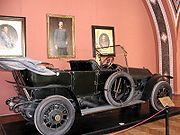
met the party at Sarajevo station. Six automobiles were waiting. Due to a mistake, three local police officers got into the first car with the chief officer of special security; the special security officers who were supposed to accompany their chief got left behind. The second car carried the Mayor and the Chief of Police of Sarajevo. The third car in the motorcade was a Gräf & Stift
Gräf & Stift
Gräf & Stift was an Austrian manufacturer of automobiles, trucks, buses and trolleybuses, from 1902 until 2001, latterly as a subsidiary of MAN. Founded in 1902 by the brothers Franz, Heinrich and Karl Gräf, and the investor, Wilhelm Stift...
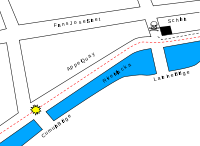
open sports car with its top folded down. Franz Ferdinand, Sophie, Governor Potiorek, and Lieutenant Colonel Count Franz von Harrach rode in this third car. The motorcade's first stop on the preannounced program was for a brief inspection of a military barracks. According to the program, at 10:00 a.m., the motorcade was to leave the barracks for the town hall by way of the Appel Quay.
The bombing
Nedeljko Cabrinovic
Nedeljko Čabrinović was a member of the nationalist Young Bosnia movement, and one of a group of seven who intended to assassinate Franz Ferdinand, Archduke of Austria during his announced visit to Sarajevo.Born in Sarajevo, Čabrinović spent many of his post-school years as a handyman, before...
on the opposite side of the street near the Miljacka River
Miljacka
The Miljacka is a river in Bosnia and Herzegovina that passes through Sarajevo and East Sarajevo. It is famous for being "Sarajevo's River", and it has come to be identified immediately with the city itself....
arming him with a bomb.
At 10:10 am, Franz Ferdinand's car approached and Čabrinović threw his bomb. The bomb bounced off the folded back convertible cover into the street. The bomb's timed detonator caused it to explode under the next car, putting that car out of action, leaving a 1 foot (0.3048 m), 6.5 inches (165.1 mm) crater, and wounding a total of 20 people according to Reuters.
Čabrinović swallowed his cyanide pill and jumped into the Miljacka river. Čabrinović's suicide attempt failed as the cyanide
Cyanide
A cyanide is a chemical compound that contains the cyano group, -C≡N, which consists of a carbon atom triple-bonded to a nitrogen atom. Cyanides most commonly refer to salts of the anion CN−. Most cyanides are highly toxic....
only induced vomiting, and the Miljacka was only five inches deep. Police dragged Čabrinović out of the river, and he was severely beaten by the crowd before being taken into custody.
The procession sped away towards the Town Hall leaving the disabled car behind. Cvjetko Popović, Gavrilo Princip and Trifun Grabež failed to act as the motorcade passed them at high speed.
Town Hall reception
Officials and members of the Archduke's party discussed what to do next. Franz Ferdinand and Sophie gave up their planned programs in favor of visiting the wounded from the bombing at the hospital. Count Harrach took up a protective position on the left hand running board of Franz Ferdinand’s car. This is confirmed by photographs of the scene outside the Town Hall. At 10:45 a.m., Franz Ferdinand and Sophie got back into the motorcade, once again in the third car. In order to avoid the city centre, General Oskar Potiorek decided that the royal car should travel straight along the Appel Quay to the Sarajevo Hospital. However, Potiorek forgot to inform the driver, Leopold Lojka
Leopold Lojka
Leopold Lojka was the chauffeur of the car carrying Austro-Hungarian Archduke Franz Ferdinand at the point of Ferdinand's assassination in Sarajevo in 1914....
,, about this decision. On the way to the hospital, Loyka took a right turn into Franz Josef Street.
Assassination
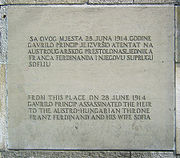
After learning that the assassination had been unsuccessful Princip went to a nearby food shop (Schiller's delicatessen). When Princip emerged, he saw Franz Ferdinand's open car reversing after having taken the wrong turn as it drove past, near the Latin BridgeLatin Bridge in Sarajevo
Latin Bridge , is a historic Ottoman bridge over the River Miljacka in Sarajevo, Bosnia and Herzegovina...
. After realizing the mistake, the driver put his foot on the brake, and began to back up. In doing so the engine of the car stalled and the gears locked, giving Princip his opportunity.
Princip stepped forward, pistol-whipped a nearby pedestrian, and fired two shots from a distance of about five feet using a Belgian-made 9x17mm (.380 ACP
.380 ACP
The .380 ACP pistol cartridge is a rimless, straight-walled pistol cartridge developed by firearms designer John Browning. The cartridge headspaces on the mouth of the case. It was introduced in 1908 by Colt, and has been a popular self-defense cartridge ever since...
) Fabrique Nationale model 1910
FN Model 1910
The FN Model 1910 was a blowback-operated, semi-automatic pistol designed by John Browning and manufactured by Fabrique Nationale of Belgium.-Development:...
semi-automatic pistol. Pistol serial numbers 19074, 19075, 19120 and 19126 were supplied to the assassins; Princip used #19074. According to Albertini, "the first bullet wounded the Archduke in the jugular vein, the second inflicted an abdominal wound on the Duchess." Princip was immediately arrested. At his sentencing, Princip stated that his intention had been to kill Governor Potiorek, rather than Sophie.
Both victims remained seated upright, but dying while being driven to the Governor's residence for medical treatment. As reported by Count Harrach, Franz Ferdinand's last words were "Sophie, Sophie! Don't die! Live for our children!" followed by six or seven utterances of "It is nothing." in response to Harrach's inquiry as to Franz Ferdinand's injury. These utterances were followed by a long death rattle
Death rattle
A death rattle is a medical term that describes the sound produced by someone who is near death when saliva accumulates in the throat. Those who are dying may lose their ability to swallow, resulting in such an accumulation...
. Sophie was dead on arrival at the Governor's residence. Franz Ferdinand died 10 minutes later.
Aftermath
All of the assassins were eventually caught. Those in Austrian-Hungarian custody were tried together with members of the tunnel who had helped deliver them and their weapons to Sarajevo. Mehmedbašić was arrested in Montenegro, but was allowed to "escape" to Serbia where he joined Major Tankosić's auxiliaries, but in 1916 Serbia imprisoned him on other false charges (see criminal penalty section below).Anti-Serb rioting broke out in Sarajevo and various other places within Austria-Hungary in the hours following the assassination until order was restored by the military.
Sarajevo trial (October 1914)
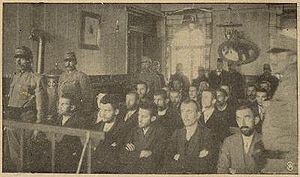
The adult defendants, facing the death penalty, portrayed themselves at trial as unwilling participants in the conspiracy. The examination of defendant Veljko Cubrilović (who helped coordinate the transport of the weapons and was a Narodna Odbrana agent) is illustrative of this effort. Cubrilović stated to the court: "Princip glared at me and very forcefully said 'If you want to know, it is for that reason and we are going to carry out an assassination of the Heir and if you know about it, you have to be quiet. If you betray it, you and your family will be destroyed.'" Under questioning by defense counsel Cubrilović described in more detail the basis of the fears that he said had compelled him to cooperate with Princip and Grabež." Cubrilović explained that he was afraid a revolutionary organization capable of committing great atrocities stood behind Princip and that he therefore feared his house would be destroyed and his family killed if he did not comply and explained that he knew such an organization existed in Serbia, at least at one time. When pressed for why he risked the punishment of the law, and did not take the protection of the law against these threats he responded: "I was more afraid of terror than the law."
In order to refute the charge, the conspirators from Belgrade, who because of their youth did not face the death penalty, focused during the trial on putting blame on themselves and deflecting it from official Serbia and modified their court testimony from their prior depositions accordingly. Princip stated under cross examination: "I am a Yugoslav nationalist and I believe in unification of all South Slavs in whatever form of state and that it be free of Austria." Princip was then asked how he intended to realize his goal and responded: "By means of terror." Cabrinović, though, testified that the political views that motivated him to kill Franz Ferdinand were views held in the circles he traveled in within Serbia.
The court did not believe the defendants' stories claiming to hold official Serbia blameless. The verdict, quoting Albertini, ran: "The court regards it as proved by the evidence that both the Narodna Obrana and military circles in the Kingdom of Serbia in charge of the espionage service, collaborated in the outrage." Although true, this part of the verdict is accused of being politically influenced.
Prison terms, death sentences and acquittals were as follows:
-
- {| class="wikitable"
|-
! Name
! Sentence
|-
| Gavrilo Princip
Gavrilo Princip
Gavrilo Princip was the Bosnian Serb who assassinated Archduke Franz Ferdinand of Austria and his wife, Sophie, Duchess of Hohenberg, in Sarajevo on 28 June 1914...
| 20 years
|-
| Nedjelko Čabrinović
Nedeljko Cabrinovic
Nedeljko Čabrinović was a member of the nationalist Young Bosnia movement, and one of a group of seven who intended to assassinate Franz Ferdinand, Archduke of Austria during his announced visit to Sarajevo.Born in Sarajevo, Čabrinović spent many of his post-school years as a handyman, before...
| 20 years
|-
| Trifun Grabež
Trifko Grabež
Trifun "Trifko" Grabež was a Bosnian Serb member of the organization the Black Hand involved in the assassination of Archduke Franz Ferdinand of Austria....
| 20 years
|-
| Vaso Čubrilović
Vaso Cubrilovic
Vaso Čubrilović was a student in Sarajevo, when Danilo Ilić recruited him and his friend, Cvjetko Popović, to help assassinate Archduke Franz Ferdinand of Austria...
| 16 years
|-
| Cvjetko Popović
Cvjetko Popovic
Cvjetko Popović was a Serb born in Bosnia and Herzegovina in 1896. He was a student in Sarajevo when Danilo Ilić recruited him and his friend, Vaso Čubrilović to help assassinate Archduke Franz Ferdinand....
| 13 years
|-
| Lazar Djukić
| 10 years
|-
| Danilo Ilić
Danilo Ilic
Danilo Ilić was born in Bosnia and Herzegovina in 1891 and died in 1915. He attended the State Teachers' College in Sarajevo and for a while taught at a school in Bosnia. In 1913 Ilic moved to Belgrade where he became a journalist and a member of the Black Hand secret society.Ilic returned to...
| Death by hanging (executed 3 February 1915)
|-
| Veljko Čubrilović
Veljko Cubrilovic
Veljko Čubrilović was involved in the assassination of Archduke Franz Ferdinand of Austria.He was born in Bosnia and Herzegovina. He became a schoolteacher in Priboj Majevicki, but in 1914, as a member of the Black Hand secret society, agreed to help Gavrilo Princip, Nedjelko Cabrinovic, and...
| Death by hanging (executed 3 February 1915)
|-
| Nedjo Kerović
| Death by hanging; commuted to 20 years in prison by Kaiser Franz-Joseph based on Finance Minister recommendation
|-
| Mihaijlo Jovanović
| Death by hanging (executed 3 February 1915)
|-
| Jakov Milović
| Death by hanging; commuted to life in prison by Kaiser Franz-Joseph based on court and Finance Minister recommendation
|-
| Mitar Kerović
| Life in prison
|-
| Ivo Kranjcević
| 10 years
|-
| Branko Zagorac
| 3 years
|-
| Marko Perin
| 3 years
|-
|Cvijan Stjepanović
| 7 years
|-
| Nine defendants
| Acquitted
|}
At trial Čabrinović had expressed his regrets for the murders. Following sentencing, Čabrinović received a letter of complete forgiveness from the three young children the assassins had orphaned. Čabrinović and Princip died of tuberculosis
Tuberculosis
Tuberculosis, MTB, or TB is a common, and in many cases lethal, infectious disease caused by various strains of mycobacteria, usually Mycobacterium tuberculosis. Tuberculosis usually attacks the lungs but can also affect other parts of the body...
in prison. Those under the age of 20 years at the time of the crime could receive a maximum sentence of 20 years under Austrian-Hungarian law. The court heard arguments regarding Princip's age, as there was some doubt as to his true date of birth but concluded that Princip was under 20 at the time of the assassination. Due to Bosnia and Herzegovina not yet being assigned to Austria or to Hungary, the Austrian-Hungarian Finance Minister administered Bosnia and Herzegovina and had responsibility for recommending clemency to the Kaiser.
Salonika trial (Spring 1917)
In late 1916 and early 1917, secret peace talks took place between Austria-Hungary and France. There is circumstantial evidence that parallel discussions were held between Austria-Hungary and Serbia with Prime Minister Pašić dispatching his right hand-man Stephan Protic and Regent AlexanderAlexander I of Yugoslavia
Alexander I , also known as Alexander the Unifier was the first king of the Kingdom of Yugoslavia as well as the last king of the Kingdom of Serbs, Croats and Slovenes .-Childhood:...
dispatching his confidant colonel Petar Živković
Petar Živkovic
Petar Živković was a Serbian soldier and political figure in Yugoslavia. He was Prime Minister of the Kingdom of Yugoslavia from January 7, 1929 until April 4, 1932.-Life:...
to Geneva on secret business. Charles I of Austria laid out Austria-Hungary's key demand for returning Serbia to the control of the Serbian Government in exile: that Serbia should provide guarantees that there be no further political agitation emanating from Serbia against Austria-Hungary.
For some time, Regent Alexander and officers loyal to him had planned to get rid of the military clique headed by Apis as Apis represented a political threat to Alexander's power. The Austro-Hungarian peace demand gave added impetus to this plan. On 15 March 1917 Apis and the officers loyal to him were indicted, on various false charges unrelated to Sarajevo (the case was retried before the Supreme Court of Serbia in 1953 and all defendants were exonerated), by Serbian Court Martial on the French-controlled Salonika front. On 23 May Apis and eight of his associates were sentenced to death; two others were sentenced to 15 years in prison. One defendant died during the trial and the charges against him were dropped. The Serbian High Court reduced the number of death sentences to seven. Regent Alexander commuted four of the remaining death sentences, leaving just three death sentences in place.
Amongst those tried, four of the defendants had confessed their roles in Sarajevo and their final sentences were as follows:
-
- {| class="wikitable"
|-
! Name
! Sentence
|-
| Apis
| Death by firing squad, (executed 26 June 1917) and 70 dinar court fee and additional witness fees
|-
| Colonel Ljuba Vulović
| Death by firing squad, (executed 26 June 1917) and 70 dinar court fee and additional witness fees
|-
| Rade Malobabić
| Death by firing squad, (executed 26 June 1917) and 70 dinar court fee and additional witness fees
|-
| Muhamed Mehmedbašić
Muhamed Mehmedbašic
Muhamed Mehmedbašić was a Bosniak/Muslim revolutionary and participant in the assassination of Archduke Franz Ferdinand of Austria.-Background:...
| 15 years prison (commuted and released in 1919) and 60 dinar court fee and additional witness fees
|}
In justifying the executions, Prime Minister Pašić wrote to his envoy in London:"...Dimitrijević (Apis) besides everything else admitted he had ordered Franz Ferdinand to be killed. And now who could reprieve them?" Vojislav Tankosić died in battle in late 1915 and so was not put on trial.
Serbia's "warning" to Austria-Hungary
Following the assassinations, Serbian Ambassador to France Milenko Vesnić and Serbian Ambassador to Russia Spalaiković put out statements claiming that Serbia had warned Austria-Hungary of the impending assassination. Serbia soon thereafter denied making warnings and denied knowledge of the plot. Prime Minister Pašić himself made these denials to Az Est on 7 July and to the Paris Edition of the New York Herald on 20 July. Other voices eventually spoke out on the “warning”.As Serbian Education Minister Ljuba Jovanović wrote in Krv Sloventsva, in late May or early June, Prime Minister Pašić reviewed the plot of the impending assassination with members of his cabinet. On 18 June, a telegram, lacking in specifics, ordered Serbia's Ambassador to Vienna, Jovan Jovanović, to warn Austria-Hungary that Serbia had reason to believe there was a conspiracy to assassinate Franz Ferdinand in Bosnia. On 21 June, Ambassador Jovanović met with Austro-Hungarian Finance Minister Bilinski. According to Serbian Military Attaché to Vienna, Colonel Lesanin, Ambassador Jovanović, spoke to Bilinski and "...stressed in general terms the risks the Archduke heir apparent might run from the inflamed public opinion in Bosnia and Serbia. Some serious personal misadventure might befall him. His journey might give rise to incidents and demonstrations that Serbia would deprecate but that would have fatal repercussions on Austro-Serbian relations." Jovanović came back from the meeting with Bilinski and told Lesanin that "...Bilinski showed no sign of attaching great importance to the total message and dismissed it limiting himself to remarking when saying goodbye and thanking him: 'Let us hope nothing does happen.'” The Austro-Hungarian Finance Minister took no action based on Jovanović's remarks.
In 1924 J. Jovanović went public stating that his warning had been made on his own initiative, and what he said was that "Among the Serb youths (in the army) there may be one who will put a ball-cartridge in his rifle or revolver in place of a blank cartridge and he may fire it, the bullet might strike the man giving provocation (Franz Ferdinand)." J. Jovanović's account changed back and forth over the years and never adequately addressed Colonel Lesanin's statement. Bilinski did not speak openly on the subject, but his press department chief confirmed that a meeting had taken place including a vague warning, but there was no mention of an ethnic Serb Austro-Hungarian soldier shooting Franz Ferdinand.
In the days leading up to the assassination, Pašić was caretaker prime minister because during this period the Serbian Government briefly fell to a political alliance led by the Serbian Military. The military favored promoting Jovan Jovanović to Foreign Minister, and Jovanović's loyalties one might expect to have been divided and his orders therefore carried out poorly. By choosing a military loyalist to convey the message, and by not including any of the specifics such as the conspirators' names and weapons, Pašić, a survivor, hedged his bets against the various possible outcomes and consequences of the impending assassination.
Rade Malobabić
In 1914, Rade Malobabić was Serbian Military Intelligence's chief undercover operative against Austria-Hungary. His name appeared in Serbian documents captured by Austria-Hungary during the war. These documents describe the running of arms, munitions, and agents from Serbia into Austria-Hungary under Malobabić's direction.Due to the suppression by Serbia of Apis' confession and of the Salonika trial transcripts historians did not initially link Malobabić closely to the Sarajevo attack. Apis' confession, however, states that "I engaged Malobabić to organize the assassination on the occasion of the announced arrival of Franz Ferdinand to Sarajevo." At the Salonika trial, Colonel Ljubomir Vulović (head of the Serbian Frontiers Service) testified: 'In 1914 on occasion of my official trip from Loznica to Belgrade, I received a letter at the General Staff [signed by Marshal Putnik, Serbia's top military officer] noting that agents of Malobabić would come and a teacher whose name I don’t recall (Danilo Ilić was a teacher but it is unclear if the teacher in question was Ilić as Ilić can be placed in Brod but not Loznica) so I could sent [sic] them into Bosnia.’ Because of that ‘I went to Loznica and either that day or very soon afterwards sent Rade and that teacher into Bosnia.' Soon thereafter occurred the Sarajevo assassination of Archduke Franz Ferdinand.” On the eve of his execution, Malobabić told a priest: “They ordered me to go to Sarajevo when that assassination was to take place, and when everything was over, they ordered me to come back and fulfill other missions, and then there was the outbreak of the war.” Vladimir Dedijer in The Road to Sarajevo presented additional testimonial evidence that Malobabić arrived in Sarajevo on the eve of the Sarajevo attack and gave the final go ahead for the operation to Danilo Ilić. This meshes with Dedijer's theory that Djuro Ŝarac had given instructions to Ilić on 16 June cancelling the assassination. Soon after their confessions, Serbia executed Malobabić, Vulović, and Apis on false charges. Serbia published no clarifications of their confessions with regards to the Sarajevo attack.
"Black Hand" or Serbian military intelligence?
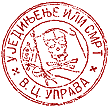
After Serbia's victory over Bulgaria in Macedonia in the Balkan Wars
Balkan Wars
The Balkan Wars were two conflicts that took place in the Balkans in south-eastern Europe in 1912 and 1913.By the early 20th century, Montenegro, Bulgaria, Greece and Serbia, the countries of the Balkan League, had achieved their independence from the Ottoman Empire, but large parts of their ethnic...
, the "Black Hand" became moribund due to the death of its president and the failure to replace him, an inactive secretary, casualties, broken links between its 3-man cells, and a drying up of funding. By 1914 the "Black Hand" was no longer operating under its constitution but rather as a creature of the Chief of Serbian Military Intelligence, Apis, and its active ranks were composed mostly of Serbian officers loyal to Apis. Apis' confession to ordering the operation that begins with the phrase "As the Chief of the Intelligence Department of the General Staff", the fact that the military chain of command was invoked, the moribund nature of the "Black Hand" and the fact that under the "Black Hand" constitution Article 16, such an assassination could only be ordered by a vote of the Supreme Council Directorate, the President or the Secretary and no such order was made, are factors in favor of assigning responsibility to Serbian Military Intelligence. The fact that Milan Ciganović was involved, that the key officers involved were "Black Hand" members, that "Black Hand" Provincial Director for Bosnia and Herzegovina Vladimir Gaćinović was consulted and that there was no official budget for the operation favors assigning responsibility to the "Black Hand".
The newspaper clipping
At trial, it was noted that the three assassins from Belgrade tried to take all blame on themselves. Čabrinović claimed the idea of killing Franz Ferdinand came from a newspaper clipping he received in the mail at the end of March announcing Franz Ferdinand's planned visit to Sarajevo. He then showed the newspaper clipping to Princip and the next day they agreed they would kill Franz Ferdinand. Princip explained to the court he had already read about Franz Ferdinand's upcoming visit in German papers. Princip went on to testify that, at about the time of Easter (19 April), he wrote an allegorical letter to Ilić informing him of the plan to kill Franz Ferdinand. Grabež testified that he and Princip, also at about the time of Easter, agreed between them to make an assassination of either Governor Potiorek or Franz Ferdinand and a little later settled on Franz Ferdinand. The defendants refused or were unable to provide details under examination.On 26 March Ilić and Mehmedbašić had already agreed to kill Franz Ferdinand based on instructions from Belgrade, so although a newspaper clipping may have indeed been sent to Čabrinović, it arrived too late to have initiated the plot.
Narodna Odbrana
Serbian Military Intelligence – through remnants of the "Black Hand" – penetrated the Narodna Odbrana, using its clandestine tunnel to smuggle the assassins and their weapons from Belgrade to Sarajevo. In the 5 June 1914 report by the President of the Narodna Odbrana Boža Milanović to Prime Minister Pašić one can sense the frustration of the President over the hijacking of his organization in the final sentence dealing with Sarajevo: "Boža has informed all the agents that they should not receive anyone unless he produces the password given by Boža."Milan Ciganović
Prime Minister Pašić received early information of the assassination plan. The information was received by Pašić early enough, according to Education Minister Ljuba Jovanović, for the government to order the border guards to prevent the assassins from crossing. This places the cabinet minister discussions in late May and the information release to some time before that. Albertini concluded that the source of the information was most likely Milan Ciganović. Bogiĉević made a more forceful case.The circumstantial evidence against Ciganović includes his sinecure government job, his protection by the Chief of Police and Serbia's failure to arrest him (Austria-Hungary demanded Serbia arrest Major Vojislav Tankosić and Ciganović, but Serbia arrested only Tankosić and lied saying that Ciganović could not be found), Serbia's protection of Ciganović during the war, and the government's provision for Ciganović after it. In 1917, all of the Sarajevo conspirators within Serbia's control were tried at Salonika on false charges, except Ciganović, who even gave evidence against his comrades at the trial.
Russian military attaché's office
Apis' confession to ordering the assassination of Franz Ferdinand states that Russian Military Attaché Artamonov promised Russia's protection from Austria-Hungary if Serbia's intelligence operations became exposed and that Russia had funded the assassination. Artamonov denied the involvement of his office in an interview with Albertini. Artamonov stated that he went on vacation to Italy leaving Assistant Military Attaché Alexander Werchovsky in charge and though he was in daily contact with Apis he did not learn of Apis' role until after the war had ended. Albertini writes that he “remained unconvinced by the behavior of this officer.” Werchovsky admitted the involvement of his office and then fell silent on the subject.There is evidence that Russia was at least aware of the plot prior to 14 June. De Schelking writes:
Consequences
The murder of the heir to the Austro-Hungarian Empire and his wife produced widespread shock across Europe, and there was initially much sympathy for the Austrian position. Within two days of the assassination, Austria-Hungary and GermanyGermany
Germany , officially the Federal Republic of Germany , is a federal parliamentary republic in Europe. The country consists of 16 states while the capital and largest city is Berlin. Germany covers an area of 357,021 km2 and has a largely temperate seasonal climate...
advised Serbia that it should open an investigation, but Secretary General to the Serbian Ministry of Foreign Affairs Slavko Gruic, replied "Nothing had been done so far and the matter did not concern the Serbian Government." An angry exchange followed between the Austrian Chargé d'Affaires at Belgrade and Gruic.
After conducting a criminal investigation, verifying that Germany would honor its military alliance, and persuading the skeptical Hungarian Count Tisza, Austria-Hungary
Austria-Hungary
Austria-Hungary , more formally known as the Kingdoms and Lands Represented in the Imperial Council and the Lands of the Holy Hungarian Crown of Saint Stephen, was a constitutional monarchic union between the crowns of the Austrian Empire and the Kingdom of Hungary in...
issued a formal letter to the government of Serbia
Serbia
Serbia , officially the Republic of Serbia , is a landlocked country located at the crossroads of Central and Southeast Europe, covering the southern part of the Carpathian basin and the central part of the Balkans...
. The letter reminded Serbia of its commitment to respect the Great Powers' decision regarding Bosnia-Herzegovina, and to maintain good neighborly relations with Austria-Hungary. The letter contained specific demands aimed at preventing the publication of propaganda advocating the violent destruction of Austria-Hungary, removing the people behind this propaganda from the Serbian Military, arresting the people on Serbian soil who were involved in the assassination plot and preventing the clandestine shipment of arms and explosives from Serbia to Austria-Hungary.
This letter became known as the July Ultimatum
July Ultimatum
The July Crisis was a diplomatic crisis among the major powers of Europe in the summer of 1914 that led to the First World War...
, and Austria-Hungary stated that if Serbia did not accept all of the demands in total within 48 hours, it would recall its ambassador from Serbia. After receiving a telegram of support from Russia, Serbia mobilized its army and responded to the letter by completely accepting point #8 demanding an end to the smuggling of weapons and punishment of the frontier officers who had assisted the assassins and completely accepting point #10 which demanded Serbia report the execution of the required measures as they were completed. Serbia partially accepted, finessed, disingenuously answered or politely rejected elements of the preamble and enumerated demands #1–7 and #9. The shortcomings of Serbia's response were published by Austria-Hungary and can be seen beginning on page 364 of Origins of the War, Vol. II by Albertini, with the Austrian complaints placed side-by-side against Serbia's response. Austria-Hungary responded by breaking diplomatic relations.
The next day, Serbian reservists being transported on tramp steamers on the Danube crossed onto the Austro-Hungarian side of the river at Temes-Kubin and Austro-Hungarian soldiers fired into the air to warn them off. The report of this incident was initially sketchy and reported to Emperor Franz-Joseph as “a considerable skirmish”. Austria-Hungary then declared war and mobilized the portion of its army that would face the (already mobilized) Serbian Army on 28 July 1914. Under the Secret Treaty of 1892
Franco-Russian Alliance
The Franco-Russian Alliance was a military alliance between the French Third Republic and the Russian Empire that ran from 1892 to 1917. The alliance ended the diplomatic isolation of France and undermined the supremacy of the German Empire in Europe...
Russia and France were obliged to mobilize their armies if any of the Triple Alliance
Triple Alliance (1882)
The Triple Alliance was the military alliance between Germany, Austria–Hungary, and Italy, , that lasted from 1882 until the start of World War I in 1914...
mobilized. Russia's mobilization set-off full Austro-Hungarian and German mobilizations. Soon all the Great Powers except Italy and Great Britain had chosen sides and gone to war.
Museum exhibits

Gräf & Stift
Gräf & Stift was an Austrian manufacturer of automobiles, trucks, buses and trolleybuses, from 1902 until 2001, latterly as a subsidiary of MAN. Founded in 1902 by the brothers Franz, Heinrich and Karl Gräf, and the investor, Wilhelm Stift...
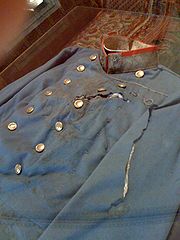
Double Phaeton in which the Archduke was riding, his bloodstained light blue uniform and plumed cocked hat, and the chaise longue on which he died, are on permanent display in the Heeresgeschichtliches Museum
Heeresgeschichtliches Museum
The Heeresgeschichtliches Museum is a military history museum located in Vienna, Austria. It claims to be the oldest and largest purpose-built military history museum in the world...
(Museum of Military History) in Vienna, Austria.
The bullet fired by Gavrilo Princip, sometimes referred to as "the bullet that started World War I
Causes of World War I
The causes of World War I, which began in central Europe in July 1914, included many intertwined factors, such as the conflicts and hostility of the four decades leading up to the war. Militarism, alliances, imperialism, and nationalism played major roles in the conflict as well...
", is stored as a museum exhibit in the Konopiště
Konopište
Konopiště is a four-winged three storey château located in the Czech Republic, about southeast of Prague, outside the city of Benešov. It has become famous as the last residence of Archduke Franz Ferdinand of Austria, heir of the Austro-Hungarian throne, whose assassination in Sarajevo triggered...
Castle near the town of Benešov
Benešov
Benešov is a town in the Central Bohemian Region, Czech Republic, about southeast of Prague. The Konopiště castle and the Czech national mountain Blaník are near the town.-History:...
, Czech Republic
Czech Republic
The Czech Republic is a landlocked country in Central Europe. The country is bordered by Poland to the northeast, Slovakia to the east, Austria to the south, and Germany to the west and northwest....
.
In popular culture
- Al StewartAl StewartAl Stewart is a Scottish singer-songwriter and folk-rock musician.Stewart came to stardom as part of the British folk revival in the 1960s and 1970s, and developed his own unique style of combining folk-rock songs with delicately woven tales of the great characters and events from history.He is...
's 1970 song Manuscript, on the Zero She FliesZero She FliesZero She Flies is the third studio album by folk artist Al Stewart, released in 1970. It is notable for being the first of his albums to include a song with historical references, namely "Manuscript" which refers to the events which led to the outbreak of World War I, including the Assassination of...
album, alludes to the assassination. It depicts how, at the time, it seemed to be a minor event and not a trigger for a world war. - Scottish pop band Franz FerdinandFranz Ferdinand (band)Franz Ferdinand are a Scottish post-punk revival band formed in Glasgow in 2002. The band is composed of Alex Kapranos , Bob Hardy , Nick McCarthy , and Paul Thomson .The band first experienced chart success when their second single, "Take Me Out", reached #3 in...
referenced the event obliquely in their 2004 breakthrough single "Take Me OutTake Me Out (song)"Take Me Out" is a song by the Scottish band Franz Ferdinand. It was released as the second single from their debut album Franz Ferdinand in the United Kingdom on the 12 January 2004 and in the United State on 9 February, both through Domino Records...
". Their light show in concert uses crosshairs to reinforce the allusions. More directly, the single's B-side "All for You, Sophia" describes in detail the assassination of the Archduke and his wife.
Further reading
- Fay, Sidney Bradshaw: Origins of the Great War. New York 1928
- Ponting, Clive. Thirteen Days, Chatto & Windus, London, 2002.
- Stoessinger, John. Why Nations Go to War, Wadsworth Publishing, 2007.
- Treusch, Wolf Sören. Erzherzog Franz Ferdinand und seine Gemahlin werden in Sarajevo ermordet, DLF, Berlin, 2004