

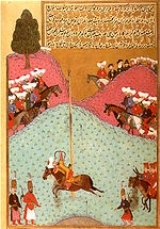
Murad III

Encyclopedia
Murad III (4 July 1546 – 15/16 January 1595) was the Sultan
of the Ottoman Empire
from 1574 until his death.
, Murad III was the eldest son of sultan Selim II
(1566–74), and succeeded his father in 1574. Murad began his reign by having his five younger brothers strangled. His authority was undermined by the harem influences, more specifically, those of his mother and later of his favorite wife Safiye Sultan
. The power had only been maintained under Selim II
by the genius of the all-powerful Grand Vizier
Mehmed Sokollu who remained in office until his assassination in October 1579. During his reign the northern borders with the Austro-hungarian empire were defended by the Bosniak kapetan Hasan Predojević
. The reign of Murad III was marked by wars with Safavids and Habsburgs and Ottoman economic decline and institutional decay. The Ottomans also faced defeats during battles such as the Battle of Sisak
.
Murad took great interest in the arts, particularly miniatures and books. He actively supported the court Society of Miniaturists, commissioning several volumes including the Siyer-i Nebi
, the most heavily illustrated biographical work on the life of Muhammad
, the Book of Skills, the Book of Festivities and the Book of Victories. He had two large alabaster
urns transported from Pergamon
and placed on two sides of the nave in the Hagia Sophia
in Constantinople and a large wax candle dressed in tin which was donated by him to the Rila monastery
in Bulgaria
is on display in the monastery museum.
From him descend all succeeding Sultans,
through his marriage to his maternal relative Valide Sultan Safiye Sultan
, originally named Sofia Baffo, a Venetian noblewoman, mother of Mehmed III
.
Numerous envoys and letters were exchanged between Elizabeth I
and Sultan Murad III. In one correspondence, Murad entertained the notion that Islam and Protestantism had "much more in common than either did with Roman Catholicism, as both rejected the worship of idols", and argued for an alliance between England and the Ottoman Empire. To the dismay of Catholic Europe, England exported tin and lead (for cannon-casting) and ammunitions to the Ottoman Empire, and Elizabeth seriously discussed joint military operations with Murad III during the outbreak of war with Spain in 1585, as Francis Walsingham
was lobbying for a direct Ottoman military involvement against the common Spanish enemy. This diplomacy would be continued under Murad's successor Mehmed III
, by both the sultan and Safiye Sultan
alike.
Murad died in the Topkapı Palace
of Constantinople in 1596.
's historical novel Benim Adım Kırmızı (My Name is Red
, 1998) takes place at the court of Murad III, during nine snowy winter days of 1591, which the writer uses in order to convey the tension between East and West.
[aged 48]
Sultan
Sultan is a title with several historical meanings. Originally, it was an Arabic language abstract noun meaning "strength", "authority", "rulership", and "dictatorship", derived from the masdar سلطة , meaning "authority" or "power". Later, it came to be used as the title of certain rulers who...
of the Ottoman Empire
Ottoman Empire
The Ottoman EmpireIt was usually referred to as the "Ottoman Empire", the "Turkish Empire", the "Ottoman Caliphate" or more commonly "Turkey" by its contemporaries...
from 1574 until his death.
Biography
Born in Bozdağan or ManisaManisa
Manisa is a large city in Turkey's Aegean Region and the administrative seat of Manisa Province.Modern Manisa is a booming center of industry and services, advantaged by its closeness to the international port city and the regional metropolitan center of İzmir and by its fertile hinterland rich in...
, Murad III was the eldest son of sultan Selim II
Selim II
Selim II Sarkhosh Hashoink , also known as "Selim the Sot " or "Selim the Drunkard"; and as "Sarı Selim" or "Selim the Blond", was the Sultan of the Ottoman Empire from 1566 until his death in 1574.-Early years:He was born in Constantinople a son of Suleiman the...
(1566–74), and succeeded his father in 1574. Murad began his reign by having his five younger brothers strangled. His authority was undermined by the harem influences, more specifically, those of his mother and later of his favorite wife Safiye Sultan
Safiye Sultan
Safiyā Valida Sultânā, , née Sofia Baffo, , was the consort of Ottoman Sultan Murad III, the Valida Sultânā and de facto co-regent to her son, Ottoman Sultan Mehmed III.- Biography :She was of Venetian descent...
. The power had only been maintained under Selim II
Selim II
Selim II Sarkhosh Hashoink , also known as "Selim the Sot " or "Selim the Drunkard"; and as "Sarı Selim" or "Selim the Blond", was the Sultan of the Ottoman Empire from 1566 until his death in 1574.-Early years:He was born in Constantinople a son of Suleiman the...
by the genius of the all-powerful Grand Vizier
Grand Vizier
Grand Vizier, in Turkish Vezir-i Azam or Sadr-ı Azam , deriving from the Arabic word vizier , was the greatest minister of the Sultan, with absolute power of attorney and, in principle, dismissable only by the Sultan himself...
Mehmed Sokollu who remained in office until his assassination in October 1579. During his reign the northern borders with the Austro-hungarian empire were defended by the Bosniak kapetan Hasan Predojević
Hasan Predojević
Hasan Predojević, Telli Hasan Paşa, Gazi Hasan-paša Predojević, was a military leader of the Ottoman army. Born Niko Predojević in Herzegovina, he was given the name Hasan after he converted to Islam.During the rule of Murat III he became Sandjakbey of the Sanjak of Segedin where he stayed until...
. The reign of Murad III was marked by wars with Safavids and Habsburgs and Ottoman economic decline and institutional decay. The Ottomans also faced defeats during battles such as the Battle of Sisak
Battle of Sisak
The Battle of Sisak was fought on June 22, 1593, between Ottoman forces of the Bosnian governor-general, or Beylerbeyi, Hasan-paša Predojević, and forces of the Holy Roman Empire under the supreme command of the Styrian general Ruprecht von Eggenberg...
.
Murad took great interest in the arts, particularly miniatures and books. He actively supported the court Society of Miniaturists, commissioning several volumes including the Siyer-i Nebi
Siyer-i Nebi
The Siyer-i Nebi is a Turkish epic about the life of Muhammad, completed around 1388, written by Mustafa son of Yusuf of Erzurum, known as al-Darir, a Mevlevi dervish on the commission of Sultan Berkuk, the Mamluk ruler in Cairo...
, the most heavily illustrated biographical work on the life of Muhammad
Muhammad
Muhammad |ligature]] at U+FDF4 ;Arabic pronunciation varies regionally; the first vowel ranges from ~~; the second and the last vowel: ~~~. There are dialects which have no stress. In Egypt, it is pronounced not in religious contexts...
, the Book of Skills, the Book of Festivities and the Book of Victories. He had two large alabaster
Alabaster
Alabaster is a name applied to varieties of two distinct minerals, when used as a material: gypsum and calcite . The former is the alabaster of the present day; generally, the latter is the alabaster of the ancients...
urns transported from Pergamon
Pergamon
Pergamon , or Pergamum, was an ancient Greek city in modern-day Turkey, in Mysia, today located from the Aegean Sea on a promontory on the north side of the river Caicus , that became the capital of the Kingdom of Pergamon during the Hellenistic period, under the Attalid dynasty, 281–133 BC...
and placed on two sides of the nave in the Hagia Sophia
Hagia Sophia
Hagia Sophia is a former Orthodox patriarchal basilica, later a mosque, and now a museum in Istanbul, Turkey...
in Constantinople and a large wax candle dressed in tin which was donated by him to the Rila monastery
Rila Monastery
The Monastery of Saint Ivan of Rila, better known as the Rila Monastery is the largest and most famous Eastern Orthodox monastery in Bulgaria. It is situated in the southwestern Rila Mountains, south of the capital Sofia in the deep valley of the Rilska River at an elevation of above sea level...
in Bulgaria
Bulgaria
Bulgaria , officially the Republic of Bulgaria , is a parliamentary democracy within a unitary constitutional republic in Southeast Europe. The country borders Romania to the north, Serbia and Macedonia to the west, Greece and Turkey to the south, as well as the Black Sea to the east...
is on display in the monastery museum.
From him descend all succeeding Sultans,
through his marriage to his maternal relative Valide Sultan Safiye Sultan
Safiye Sultan
Safiyā Valida Sultânā, , née Sofia Baffo, , was the consort of Ottoman Sultan Murad III, the Valida Sultânā and de facto co-regent to her son, Ottoman Sultan Mehmed III.- Biography :She was of Venetian descent...
, originally named Sofia Baffo, a Venetian noblewoman, mother of Mehmed III
Mehmed III
Mehmed III Adli was sultan of the Ottoman Empire from 1595 until his death.-Biography:...
.
Numerous envoys and letters were exchanged between Elizabeth I
Elizabeth I of England
Elizabeth I was queen regnant of England and Ireland from 17 November 1558 until her death. Sometimes called The Virgin Queen, Gloriana, or Good Queen Bess, Elizabeth was the fifth and last monarch of the Tudor dynasty...
and Sultan Murad III. In one correspondence, Murad entertained the notion that Islam and Protestantism had "much more in common than either did with Roman Catholicism, as both rejected the worship of idols", and argued for an alliance between England and the Ottoman Empire. To the dismay of Catholic Europe, England exported tin and lead (for cannon-casting) and ammunitions to the Ottoman Empire, and Elizabeth seriously discussed joint military operations with Murad III during the outbreak of war with Spain in 1585, as Francis Walsingham
Francis Walsingham
Sir Francis Walsingham was Principal Secretary to Elizabeth I of England from 1573 until 1590, and is popularly remembered as her "spymaster". Walsingham is frequently cited as one of the earliest practitioners of modern intelligence methods both for espionage and for domestic security...
was lobbying for a direct Ottoman military involvement against the common Spanish enemy. This diplomacy would be continued under Murad's successor Mehmed III
Mehmed III
Mehmed III Adli was sultan of the Ottoman Empire from 1595 until his death.-Biography:...
, by both the sultan and Safiye Sultan
Safiye Sultan
Safiyā Valida Sultânā, , née Sofia Baffo, , was the consort of Ottoman Sultan Murad III, the Valida Sultânā and de facto co-regent to her son, Ottoman Sultan Mehmed III.- Biography :She was of Venetian descent...
alike.
Murad died in the Topkapı Palace
Topkapi Palace
The Topkapı Palace is a large palace in Istanbul, Turkey, that was the primary residence of the Ottoman Sultans for approximately 400 years of their 624-year reign....
of Constantinople in 1596.
In fiction
Orhan PamukOrhan Pamuk
Ferit Orhan Pamuk , generally known simply as Orhan Pamuk, is a Turkish novelist. He is also the Robert Yik-Fong Tam Professor in the Humanities at Columbia University, where he teaches comparative literature and writing....
's historical novel Benim Adım Kırmızı (My Name is Red
My Name is Red
My Name Is Red is a 1998 Turkish novel by Nobel laureate author Orhan Pamuk. The English translation won the International IMPAC Dublin Literary Award in 2003,. The French version won the French Prix du Meilleur Livre Étranger and the Italian version the Premio Grinzane Cavour in 2002...
, 1998) takes place at the court of Murad III, during nine snowy winter days of 1591, which the writer uses in order to convey the tension between East and West.
External links
[aged 48]