
All Topics  
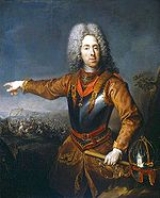
Prince Eugene of Savoy

 
Prince Eugene of Savoy

   Email Print
   Bookmark   Link


Prince Eugene of Savoy


François-Eugène, Prince of Savoy-Carignan (18 October 1663 – 21 April 1736), was one of the most prominent and successful military commanders in European history. Born in Paris
Paris

Paris is the Capital of France and the country's largest city. It is situated on the river Seine, in northern France, at the heart of the ?le-de-France Regions of France ....
 to aristocratic Italian parents, Eugene grew up around the French court of King Louis XIV
Louis XIV of France

Louis XIV ruled as List of French monarchs and of King of Navarre. He ascended the throne a few months before his fifth birthday, but did not assume actual personal control of the government until the death of his prime minister , the Italians Jules Cardinal Mazarin, in 1661....
. He was initially prepared for a career in the church, but by the age of 19, he had determined on a military career. Rejected by King Louis for service in the French army, Eugene moved to Austria and transferred his loyalty to the Habsburg Monarchy
Habsburg Monarchy

The Habsburg Monarchy covered the territories ruled by the junior Austria branch of the House of Habsburg , and then by the successor House of Habsburg-Lorraine , between 1526 and 1867/1918....
.

Spanning six decades, Eugene served three Habsburg emperors: Leopold I
Leopold I, Holy Roman Emperor

Leopold I, Holy Roman Emperor Habsburg , Holy Roman emperor, King of Hungary, King of Bohemia, was the second son of the emperor Ferdinand III, Holy Roman Emperor and his first wife Maria Anna of Spain....
, Joseph I
Joseph I, Holy Roman Emperor

Joseph I , Holy Roman Emperor, King of Bohemia, King of Hungary, King of the Romans was the elder son of Leopold I, Holy Roman Emperor and his third wife, Eleonore-Magdalena of Pfalz-Neuburg, who was the daughter of Philipp Wilhelm, Elector Palatine....
, and Charles VI
Charles VI, Holy Roman Emperor

Charles VI was Holy Roman Emperor, King of Hungary from 1711 to 1740, Archduke of Austria. From 1703 to 1711 he was an active claimant to the List of Spanish monarchs as Charles III....
.


Discussion
Ask a question about 'Prince Eugene of Savoy'
Start a new discussion about 'Prince Eugene of Savoy'
Answer questions from other users
Full Discussion Forum


Encyclopedia


François-Eugène, Prince of Savoy-Carignan (18 October 1663 – 21 April 1736), was one of the most prominent and successful military commanders in European history. Born in Paris
Paris

Paris is the Capital of France and the country's largest city. It is situated on the river Seine, in northern France, at the heart of the ?le-de-France Regions of France ....
 to aristocratic Italian parents, Eugene grew up around the French court of King Louis XIV
Louis XIV of France

Louis XIV ruled as List of French monarchs and of King of Navarre. He ascended the throne a few months before his fifth birthday, but did not assume actual personal control of the government until the death of his prime minister , the Italians Jules Cardinal Mazarin, in 1661....
. He was initially prepared for a career in the church, but by the age of 19, he had determined on a military career. Rejected by King Louis for service in the French army, Eugene moved to Austria and transferred his loyalty to the Habsburg Monarchy
Habsburg Monarchy

The Habsburg Monarchy covered the territories ruled by the junior Austria branch of the House of Habsburg , and then by the successor House of Habsburg-Lorraine , between 1526 and 1867/1918....
.

Spanning six decades, Eugene served three Habsburg emperors: Leopold I
Leopold I, Holy Roman Emperor

Leopold I, Holy Roman Emperor Habsburg , Holy Roman emperor, King of Hungary, King of Bohemia, was the second son of the emperor Ferdinand III, Holy Roman Emperor and his first wife Maria Anna of Spain....
, Joseph I
Joseph I, Holy Roman Emperor

Joseph I , Holy Roman Emperor, King of Bohemia, King of Hungary, King of the Romans was the elder son of Leopold I, Holy Roman Emperor and his third wife, Eleonore-Magdalena of Pfalz-Neuburg, who was the daughter of Philipp Wilhelm, Elector Palatine....
, and Charles VI
Charles VI, Holy Roman Emperor

Charles VI was Holy Roman Emperor, King of Hungary from 1711 to 1740, Archduke of Austria. From 1703 to 1711 he was an active claimant to the List of Spanish monarchs as Charles III....
. Eugene first saw action against the Ottoman Turks
Ottoman Empire

The Ottoman Empire , also known by its contemporaries as the Turkish Empire or Turkey , was an empire that lasted from 1299?1923. It was Treaty of Lausanne by the Republic of Turkey, which was officially proclaimed on October 29, 1923....
 at the Siege of Vienna
Battle of Vienna

The Battle of Vienna , Ukrainian language: ????????? ?????? took place on 12 September 1683 after Vienna had been besieged by the Ottoman Empire for two months....
 in 1683 and the subsequent War of the Holy League
War of the Holy League

There were several wars of the Holy League in European history:* Part of the War of the League of Cambrai from 1511 to 1513, involving the Catholic League ...
, before serving in the Nine Years' War alongside his cousin, the Duke of Savoy
Victor Amadeus II of Sardinia

Victor Amadeus II, Italian language Vittorio Amedeo II was Duke of Savoy from 1675 to 1730. He also held the titles of marquis of Saluzzo, marquis of Monferrato, prince of Piedmont, count of Aosta, Moriana and Nizza....
. However, the prince’s fame was secured with his crushing victory against the Ottomans at the Battle of Zenta
Battle of Zenta

The Battle of Zenta or Battle of Senta, fought on 11 September 1697 just south of the modern Serbian town of Senta , on the east side of the Tisza river, was a major engagement in the Great Turkish War and one of the most decisive defeats in Ottoman Empire history....
 in 1697. Eugene enhanced his standing during the War of the Spanish Succession
War of the Spanish Succession

War of the Spanish Succession was a war fought in 1701-1714, in which several European powers combined to stop a possible unification of the Kingdoms of Spain and France under a single Bourbon monarch, upsetting the European Balance of power in international relations....
 where his partnership with the Duke of Marlborough
John Churchill, 1st Duke of Marlborough

John Churchill, 1st Duke of Marlborough Order of the Garter was an England soldier and statesman whose career spanned the reigns of five monarchs throughout the late 17th and early 18th centuries....
 secured victories against the French on the fields of Blenheim
Battle of Blenheim

The Battle of Blenheim , fought on 13 August 1704, was a major battle of the War of the Spanish Succession. Louis XIV of France of Kingdom of France sought to knock Leopold I, Holy Roman Emperor out of the war by seizing Vienna, the Habsburg Monarchy capital, and gain a favourable peace settlement....
, Oudenarde
Battle of Oudenarde

The Battle of Oudenaarde was a key battle in the War of the Spanish Succession fought on 11 July 1708 between the forces of Great Britain, Dutch Republic and the Holy Roman Empire on the one side and the French on the other....
 and Malplaquet
Battle of Malplaquet

The Battle of Malplaquet, fought on 11 September 1709, was one of the main battles of the War of the Spanish Succession, which opposed the Bourbons of History of France#Louis_XIV and Spain#Rise_and_fall_as_a_world_power:_From_the_Renaissance_to_the_19th_century against an alliance whose major members were the Habsburg Monarchy, the United Kin...
; he gained further success as Imperial commander in northern Italy, most notably at Turin
Battle of Turin

The Battle of Turin took place on 7 September 1706 west of the city of Turin during the War of the Spanish Succession. In a decisive victory for the Allied forces under Prince Eugene of Savoy and Duke Victor Amadeus II of Sardinia , the French siege of Turin was broken and the withdrawal of French forces from northern Italy began....
 in 1706. Renewed hostilities against the Ottomans in the Austro-Turkish War of 1716–18
Austro-Turkish War of 1716-18

The Treaty of Karlowitz was not an acceptable long-standing agreement for the Ottoman Empire. Twelve years after Karlowitz, the Turks began the long prospect of taking revenge for their defeat at the Battle of Vienna in 1683....
 consolidated his reputation with victories at the battles of Petrovaradin
Battle of Petrovaradin

The Battle of Petrovaradin or Battle of Peterwardein was a decisive victory for Austrian forces in the war between Austria and the Ottoman Empire , at Petrovaradin, now part of Novi Sad, Vojvodina, in Serbia....
, and Belgrade.

Throughout the late 1720s, Eugene’s influence and skilful diplomacy managed to secure the emperor powerful allies in his dynastic struggles with the Bourbon powers
House of Bourbon

The House of Bourbon is an important European royal house, a branch of the Capetian dynasty. Bourbon kings first ruled Kingdom of Navarre and France in the 16th century....
; but, physically and mentally fragile in his later years, Eugene enjoyed less success as commander-in-chief of the army during his final conflict, the War of the Polish Succession
War of the Polish Succession

The War of the Polish Succession was sparked by a Polish civil war over the succession to Augustus II of Poland, King of Poland that widened as the two Pacte de Famille powers attempted to check the power of the Habsburg Monarchy in western Europe....
. Nevertheless, in Austria, Eugene’s reputation remains unrivalled. Although opinions differ as to his character, there is no dispute over his great achievements: Eugene helped to save the Habsburg Empire from French conquest; he broke the westward thrust of the Ottomans, liberating central Europe after a century and a half of Turkish occupation; and he was one of the greatest patrons of the arts, whose building legacy can still be seen in Vienna
Vienna

Vienna is the Capital of Republic of Austria and also one of the nine states of Austria. Vienna is Austria's primary city, with a population of about 1.7 million...
 today. Eugene died in his sleep at his home on 21 April, 1736, aged 72.

Early life (1663–99)


Hôtel Soissons


Prince Eugene was born in the Hôtel Soissons
Catherine de' Medici's building projects

Catherine de' Medici's building projects included the House of Valois chapel at Basilique Saint-Denis, the Tuileries Palace, and the H?tel de la Reine in Paris, and extensions to the Ch?teau de Chenonceau, near Blois....
 in Paris on 18 October 1663. Although he was a subject of King Louis XIV
Louis XIV of France

Louis XIV ruled as List of French monarchs and of King of Navarre. He ascended the throne a few months before his fifth birthday, but did not assume actual personal control of the government until the death of his prime minister , the Italians Jules Cardinal Mazarin, in 1661....
, Eugene’s parents came from Italian families: his mother, Olympia Mancini, was one of Cardinal Mazarin’s nieces whom he had brought to Paris
Paris

Paris is the Capital of France and the country's largest city. It is situated on the river Seine, in northern France, at the heart of the ?le-de-France Regions of France ....
 from Rome
Rome

Rome is the capital city of Italy and Lazio, and is Italy's largest and most populous city, with 2,724,347 residents in an urban area of some ....
 in 1647 to further his, and to a lesser extent, their ambitions. The Mancinis were raised at the Palais Royal
Palais Royal

The Palais-Royal, originally called the Palais-Cardinal, is a palace and garden located near the 1st arrondissement of Paris. Opposite the north wing of the Louvre, its famous forecourt screened with columns faces the place du Palais-Royal, which was much enlarged by Baron Haussmann after the rue de Rivoli was built for Napoleon...
 along with the young Louis XIV, with whom Olympia formed an intimate relationship. Yet to her great disappointment, her chance to become queen passed by and in 1657, Olympia married Eugene Maurice
Prince Eugène-Maurice of Savoy-Carignan

Eug?ne-Maurice of Savoy-Carignano was count of Soissons, a French general and father of Eugene of Savoy....
, Prince of Savoy-Carignan, later Comte de Soissons. Nevertheless, the king remained strongly attached to her, so much so that many believed them to be lovers.

Eugene Maurice and Olympia had five sons (Eugene being the youngest) and three daughters, but neither parent spent much time with the children: his father, a soldier in the French army, spent much of his time away campaigning, whilst Olympia’s passion for court intrigue meant the children received little attention from her. Olympia’s scheming eventually led to her fall. Falling out of favour at court, Olympia turned to Catherine Deshayes
Catherine Monvoisin

Catherine Deshayes, widow Monvoisin, known as "La Voisin" , France sorceress, was one of the chief personages in the famous Poison affair, which disgraced the reign of Louis XIV of France....
 (known as La Voisin), and the arts of black magic and astrology; but it was a fatal relationship. Embroiled in the affaire des poisons
Poison affair

The Poison Affair was a murder scandal in France during the reign of King Louis XIV of France. It launched a period of hysterical pursuit of murder suspects, during which a number of prominent people and members of the aristocracy were implicated and sentenced for poisoning and witchcraft....
, suspicions abounded of her involvement in her husband’s premature death in 1673, and even implicated her in a plot to kill the king himself. Whatever the truth, Olympia, rather than face trial, subsequently fled France for Brussels
Brussels

Brussels , officially the Brussels Capital-Region, is the de facto capital city of the European Union and the largest urban area in Belgium....
 in January 1680, leaving Eugene in the care of his father’s mother, Marie de Bourbon, Princess of Carignan, and her daughter, the Margravine of Baden
Princess Louise Christine of Savoy-Carignan

Louise Christine of Savoy-Carignan was the mother of Louis, Margrave of Baden-Baden.She was a daughter of Thomas Francis, Prince of Carignano and Marie de Bourbon-Cond?....
, mother of Prince Louis of Baden
Louis William, Margrave of Baden-Baden

Louis William, Margrave of Baden , was the ruler of Baden-Baden in Germany and chief commander of the Holy Roman Empire army. He was also known as T?rkenlouis ....
.

From the age of ten, Eugene had been brought up for a career in the church; a personal choice of the king, basing the decision on the young prince’s poor physique and bearing. Certainly, Eugene’s appearance was not impressive – "He was never good looking …" wrote the Duchess of Orleans
Henrietta Anne Stuart

Henrietta Anne of England, Duchess of Orl?ans , in French Henriette d'Angleterre, known familiarly as Minette, was the youngest daughter of King Charles I of England of England and Henrietta Maria of France....
, "It is true that his eyes are not ugly, but his nose ruins his face; he has two large teeth which are visible at all times." In February 1683, to the surprise of his family, Eugene declared his intention of joining the army. Now 19 years old, Eugene applied directly to King Louis for command of a company in French service, but the king – who had shown no compassion for Olympia’s children since her disgrace – refused him out of hand. "The request was modest, not so the petitioner," remarked Louis. "No one else ever presumed to stare me out so insolently."

Denied a military career in France, Eugene decided to seek service abroad. One of Eugene’s brothers, Louis Julius, had entered Imperial service the previous year, but he had been immediately killed fighting the Ottoman Turks
Ottoman Empire

The Ottoman Empire , also known by its contemporaries as the Turkish Empire or Turkey , was an empire that lasted from 1299?1923. It was Treaty of Lausanne by the Republic of Turkey, which was officially proclaimed on October 29, 1923....
 in 1683. When news of his death reached Paris, Eugene decided to go to Austria in the hope of taking over his brother’s command. His cousin, the Margrave of Baden, was a leading general in the Imperial army, as was a more distant cousin, Maximilian Emmanuel
Maximilian II Emanuel, Elector of Bavaria

Maximilian II , also known as Max Emanuel or Maximilian Emanuel, was a Wittelsbach ruler of Bavaria and an elector of the Holy Roman Empire....
, Elector of Bavaria. Eugene left Paris on the night of 26 July, 1683.

Great Turkish War


By May 1683, the Ottoman threat to Emperor Leopold I’s
Leopold I, Holy Roman Emperor

Leopold I, Holy Roman Emperor Habsburg , Holy Roman emperor, King of Hungary, King of Bohemia, was the second son of the emperor Ferdinand III, Holy Roman Emperor and his first wife Maria Anna of Spain....
 capital of Vienna
Vienna

Vienna is the Capital of Republic of Austria and also one of the nine states of Austria. Vienna is Austria's primary city, with a population of about 1.7 million...
 was very real. The Grand Vizier
Grand Vizier

Grand Vizier, in Turkish language Sadr-i Azam or Serdar-i Ekrem , deriving from the Arabic language word wazir 'vizier' , was the greatest minister of the Sultan, with absolute power of attorney and, in principle, dismissable only by the Sultan himself....
, Kara Mustafa Pasha – encouraged by Imre Thököly
Imre Thököly

Count Imrich T?k?ly de Kesmarkium was a Hungarian statesman, leader of an anti-Habsburg uprising, List of Transylvanian rulers of Transylvania....
’s Magyar rebellion – had invaded with between 100,000–200,000 men. within two months, they were outside the walls of the Habsburg
Habsburg Monarchy

The Habsburg Monarchy covered the territories ruled by the junior Austria branch of the House of Habsburg , and then by the successor House of Habsburg-Lorraine , between 1526 and 1867/1918....
 capital. With the ‘Turks at the gates’, the Emperor fled for the safe refuge of Passau
Passau

Passau is a town in Lower Bavaria, Germany, known also as the Dreifl?ssestadt , because the Danube is joined there by the Inn River from the South, and the Ilz coming out of the Bavarian Forest to the North....
 on the Danube. Eugene arrived at Leopold’s camp in mid-August.

Eugene was not Austrian, but he did have Habsburg relations. His grandfather, Thomas Francis, founder of the Carignan line of the House of Savoy
House of Savoy

The House of Savoy was formed in the early eleventh century in the historical Savoy region. Through gradual expansion, it grew from ruling a small county in that region to eventually rule the Kingdom of Italy until the end of the Second World War....
, was the son of Catherine – a daughter of Philip II of Spain
Philip II of Spain

Philip II was King of Spain from 1556 until 1598, List of monarchs of Naples from 1554 until 1598, king consort of England, as husband of Mary I of England, from 1554 to 1558, lord of the Seventeen Provinces from 1556 until 1581, holding various titles for the individual territories, such as Duke or Count; and King of Portugal as Philip I...
 – and the great-grandson of the Emperor Charles V
Charles V, Holy Roman Emperor

Charles V was ruler of the Holy Roman Empire from 1519 and, as Charles I of Spain, of the Spanish realms from 1516 until his abdication in 1556....
. But of more immediate consequence to Leopold was the fact that Eugene was the second cousin of Victor Amadeus
Victor Amadeus II of Sardinia

Victor Amadeus II, Italian language Vittorio Amedeo II was Duke of Savoy from 1675 to 1730. He also held the titles of marquis of Saluzzo, marquis of Monferrato, prince of Piedmont, count of Aosta, Moriana and Nizza....
, the Duke of Savoy; a connection that the emperor hoped might prove useful in any future confrontation with France. These ties, together with his ascetic manner and appearance (a positive advantage to him at the sombre court of Leopold), ensured the refugee from the hated King Louis a warm welcome at Passau and a position in Imperial service.

Eugene was in no doubt where his new allegiance lay – " … I will devote all my strength, all my courage, and if need be, my last drop of blood, to the service of your Imperial Majesty." This loyalty was immediately put to the test. By September, the Imperial forces under the Duke of Lorraine
Charles V, Duke of Lorraine

Charles L?opold Nicolas Sixte , son of Nicholas II, Duke of Lorraine and Claude of Lorraine . He was the titular Duke of Lorraine from 1675 to 1690, a time when Lorraine was occupied by France....
, together with a powerful Polish army under King Sobieski
John III Sobieski

John III Sobieski was one of the most notable monarchs of the Polish-Lithuanian Commonwealth, from 1674 until his death King of Poland and Grand Duke of Lithuania....
, were poised to strike the Sultan’s army investing Vienna. On the morning of 12 September, the Christian forces drew up in line of battle on the south-eastern slopes of the Wiener Wald, looking down on the massed enemy camp. After a day-long struggle, the Battle of Vienna
Battle of Vienna

The Battle of Vienna , Ukrainian language: ????????? ?????? took place on 12 September 1683 after Vienna had been besieged by the Ottoman Empire for two months....
 resulted in the lifting of the 60-day siege and the Sultan’s forces routed and in retreat. Serving under the immediate command of Louis William, Margrave of Baden-Baden
Louis William, Margrave of Baden-Baden

Louis William, Margrave of Baden , was the ruler of Baden-Baden in Germany and chief commander of the Holy Roman Empire army. He was also known as T?rkenlouis ....
, Eugene distinguished himself in the battle, earning commendation from Lorraine and the Emperor; he later received the nomination for the colonelcy of the Dragoon Regiment of Kufstein.

Holy League
In March 1684, Leopold formed the Holy League
Great Turkish War

The Great Turkish War refers to a series of conflicts between the Ottoman Empire and contemporary European powers, then joined into a Holy League, during the second half of the 17th century....
 with Poland and Venice
Republic of Venice

The Most Serene Republic of Venice or Venetian Republic was a state originating from the city of Venice . It existed for over a millennium, from the late 7th century AD until the year 1797....
 to counter the Ottoman threat. For the next two years, Eugene continued to distinguish himself on campaign against the Turks, and established himself as a dedicated, professional soldier; by the end of 1685, still only 22 years old, he was made a Major-General. However, little is known of Eugene’s life during these early campaigns. Contemporary observers make only passing comments of his actions, and his own surviving correspondence, largely to his cousin Victor Amadeus, are typically reticent about his own feelings and experiences. Louis of Baden, nevertheless, was impressed with Eugene’s qualities – "This young man will, with time, occupy the place of those whom the world regards as great leaders of armies."

In June 1686, the Duke of Lorraine besieged Buda
Battle of Buda (1686)

The Battle of Buda was fought between the Holy League and Ottoman Turkey, as part of the follow-up campaign in Hungary after the Battle of Vienna....
, the centre of the Ottoman occupation in Hungary. After resisting for 78 days, the city fell on 2 September; however, with the loss of their main garrison Turkish resistance collapsed throughout Hungary as far as Transylvania
Transylvania

Transylvania is a historical region in the central part of Romania. Bounded on the east and south by the Carpathian mountains, historical Transylvania extended in the west to the Apuseni Mountains; however, the term frequently encompasses not only Transylvania proper, but also the historical regions of Crisana, Maramures, and Banat....
 and Serbia
Serbia

Serbia , officially the Republic of Serbia , is a country in Central Europe and Balkans Europe, covering the southern part of the Pannonian Plain and the central part of the Balkans....
. Further success followed in 1687 where, commanding a cavalry brigade, Eugene made an important contribution to the victory at the Battle of Mohács
Battle of Mohács (1687)

The Second Battle of Moh?cs was fought between the forces of Ottoman Empire Mehmed IV, commanded by S?leyman Pasa, and the forces of Holy Roman Emperor Leopold I, Holy Roman Emperor, commanded by Charles V, Duke of Lorraine....
 on 12 August. Such was the scale of their defeat the Ottoman army mutinied, a revolt which spread to Constantinople
Constantinople

Constantinople was the empire capital of the Roman Empire , the Byzantine Empire , the Latin Empire , and the Ottoman Empire . Strategically located between the Golden Horn and the Sea of Marmara at the point where Europe meets Asia, Byzantine Constantinople had been the capital of a Christendom empire, successor to ancient ancient Greece...
 – the Grand Vizier
Grand Vizier

Grand Vizier, in Turkish language Sadr-i Azam or Serdar-i Ekrem , deriving from the Arabic language word wazir 'vizier' , was the greatest minister of the Sultan, with absolute power of attorney and, in principle, dismissable only by the Sultan himself....
 was executed, and Sultan Mehmed IV
Mehmed IV

Mehmed IV was the Sultan of the Ottoman Empire from 1648 to 1687. Taking the throne at age seven, his reign was significant as he changed the nature of the Sultan's position forever by giving up most of his executive power to his Grand Vizier....
 deposed. Once again Eugene’s courage earned him recognition from his superiors who granted him the honour of personally conveying the news of victory to the Emperor in Vienna. For his services Eugene was promoted to Lieutenant-General in November 1687; he was also beginning to gain wider recognition. King Charles II
Charles II of Spain

Charles II , was the last Habsburg Spain of Spain and the ruler of nearly all of Italy , the Spanish territories in the Southern Low Countries, and Spanish empire, stretching from Mexico to the Philippines....
 of Spain bestowed upon him the Order of the Golden Fleece
Order of the Golden Fleece

The Order of the Golden Fleece is an order of chivalry founded in 1430 by Duke Philip III, Duke of Burgundy of Duchy of Burgundy to celebrate his marriage to the Portugal princess Isabel, Duchess of Burgundy....
, whilst his cousin, Amadeus, provided him with money and two profitable abbeys in Piedmont
Piedmont

Piedmont is one of the 20 Regions of Italy. It has an area of 25,399 km? and a population of about 4.4 million. The capital is Turin. The main local dialect is Piedmontese....
. However, Eugene’s military career suffered a temporary setback in 1688 when, on 6 September, the Prince suffered a severe wound to his knee by a musket ball during the Siege of Belgrade
Siege of Belgrade (1688)

The Siege of Belgrade in 1688 was the fourth siege of that city, taking place during the Great Turkish War.Belgrade was at that time a part of the Ottoman Empire, and had been for two centuries....
. It was not until January 1689 that Eugene could return to active service.

Interlude in the west: Nine Years' War
Just as Belgrade
Belgrade

Belgrade is the capital and largest city of Serbia. The city lies on international waterway, at the confluence of the Sava River and Danube rivers, where the Pannonian Plain meets the Balkan Peninsula....
 was falling to Imperial forces under Max Emmanuel in the east French troops in the west were crossing the Rhine
Rhine

File:Swiss Grand Canyon.jpgThe Rhine is one of the longest and most important rivers in Europe, at , with an average discharge of more than ....
 into the Holy Roman Empire
Holy Roman Empire

The Holy Roman Empire was a union of territories in Central Europe during the Middle Ages and the Early modern Europe under a Holy Roman Emperor....
. King Louis XIV had hoped that a show of force would lead to a quick resolution to his dynastic and territorial disputes with the princes of the Empire along his eastern border, but Louis’ intimidatory moves only strengthened German resolve. In May 1689 Emperor Leopold and the Dutch signed the Grand Alliance
Grand Alliance

The Grand Alliance was a European coalition, consisting of Austria, Bavaria, Brandenburg, England, the Holy Roman Empire, the Electoral Palatinate of the Rhine, Portugal, Savoy, Saxony, Spain, Sweden, and the Dutch Republic....
 aimed at repelling French aggression.

The Nine Years' War was professionally and personally frustrating for the Prince. Eugene was present at the Siege of Mainz – receiving a slight wound – before transferring to Piedmont after his cousin, Amadeus, had joined the Grand Alliance in 1690. Promoted to general of cavalry, he arrived in Turin
Turín

Tur?n is a municipality in the Ahuachap?n Department Departments of El Salvador of El Salvador....
 with his friend the Prince of Commercy; but it proved an inauspicious start. Against Eugene’s advice, Amadeus insisted on engaging the French at Staffarda
Battle of Staffarda

The Battle of Staffarda was fought during Nine Years' War in Piedmont-Savoy, modern-day northern Italy, on 18 August 1690. The engagement was the first major encounter in the Italian theatre since Victor Amadeus, the Victor Amadeus II of Savoy, had joined the Grand Alliance in opposition to France earlier that year....
, and suffered a serious defeat; only Eugene’s handling of the Savoyard cavalry in retreat saved his cousin from disaster. Eugene remained unimpressed with the men and their commanders throughout the war in Italy. "The enemy would long ago have been beaten," he wrote to Vienna, "if everyone had done their duty." So contemptuous was he of the Imperial commander, Count Caraffa, he threatened to leave Imperial service.

In Vienna Eugene’s attitude was dismissed as the arrogance of a young upstart. Nevertheless, so impressed was the Emperor by Eugene’s passion for the Imperial cause, in 1693 he promoted him to Field-Marshal (although this had as much to do with the lack of good Imperial commanders, as much as Eugene’s proven ability thus far). When Caraffa’s replacement, Count Caprara
Aeneas de Caprara

Count Aeneas Sylvius de Caprara , also known as Enea Silvio or ?neas Sylvius von Caprara, was an Austrian field marshal during the War of the League of Augsburg as well as a decedent of generals Raimondo Montecuccoli and Ottavio Piccolomini....
, was himself transferred in 1694, it seemed that Eugene’s chance for command, and decisive action, had finally arrived. The Duke of Savoy, however, doubtful of victory and now more fearful of Habsburg influence in Italy than he was of French, had begun secret dealings with Louis aimed at extricating himself from the war. By 1696 the deal was done, and Amadeus transferred his troops, and his loyalty, to the enemy. Eugene was never to trust his cousin again; although he continued to pay due reverence to the Duke as head of his own family, their relationship would forever remain strained.

Military honours in Italy undoubtedly belonged to the French commander Marshal Catinat
Nicolas Catinat

Nicolas Catinat was a French people military commander and Marshal of France under Louis XIV of France. The son of a magistrate, Catinat was born in Paris on 1 September, 1637....
, but Eugene, the one Allied general determined on action and decisive results, did well to emerge from the Nine Years' War with an enhanced reputation. With the signing of the Treaty of Ryswick
Treaty of Ryswick

The Treaty of Ryswick was signed on 20 September 1697 and named after Ryswick in the Dutch Republic. The treaty settled the Nine Years' War, which pitted France against the Grand Alliance of England, Spain, the Holy Roman Empire and the United Provinces....
 in September/October 1697, the desultory war in the west was finally brought to an inconclusive end, and Leopold could once again devote all his martial energies into defeating the Ottoman Turks in the east.

Zenta

The distractions of the war against King Louis had enabled the Turks to recapture Belgrade and reinvade Hungary. On the advice of the President of the Imperial War Council, Rüdiger Starhemberg
Ernst Rüdiger von Starhemberg

Count Ernst R?diger von Starhemberg was the army commander of Vienna during the Battle of Vienna in 1683, imperial general during the Great Turkish War and President of the Hofkriegsrat....
, Eugene was eventually offered supreme command of Imperial forces to face the threat from the new Sultan, Mustafa II
Mustafa II

Mustafa II Ghazi was the Sultan of the Ottoman Empire from 1695 to 1703.He was born at Edirne Palace a son of sultan Mehmed IV and his mother Valide Sultan Mah-Para Ummatullah Rabia G?l-Nush, :tr:Emetullah Rabia G?lnus Sultan, originally named Evemia, a Greeks....
. This was Eugene’s first truly independent command – no longer need he suffer under the excessively cautious generalship of Caprara and Caraffa, or be thwarted by the deviations of Amadeus; but on joining his army he found it in a state of 'indescribable misery'. Confident and self-assured, the Prince of Savoy (ably assisted by Commercy) set about restoring order and discipline.

Newly inspired, Eugene’s army intercepted the Ottoman Turks crossing the River Tisza
Tisza

The Tisza is one of the major rivers of Central Europe. It originates in Ukraine, with the White Tisza in the Chornohora and Black Tisza in the Gorgany range, flows partially along the Romanian border, enters Hungary at Tiszabecs, marks Slovakia-Hungarian border, passes through Hungary, and falls into the Danube in central Vojvodina in Serbia...
 at Zenta
Battle of Zenta

The Battle of Zenta or Battle of Senta, fought on 11 September 1697 just south of the modern Serbian town of Senta , on the east side of the Tisza river, was a major engagement in the Great Turkish War and one of the most decisive defeats in Ottoman Empire history....
 on 11 September 1697. Because the Imperial forces had arrived in front of the enemy late in the day – the Turkish cavalry had already crossed the river – Eugene, despite instructions from Vienna not to engage the enemy, decided to attack immediately. The Austrian general formed his army into a crescent to attack the Turkish entrenchments, defended with some 70 pieces of artillery. The vigour of the assault wrought terror and confusion amongst the enemy, exacerbating the carnage; for the loss of some 500 men, Eugene had inflicted over 30,000 casualties, annihilating the Turkish army. Although the Ottomans lacked western organisation and training, the Savoyard Prince had revealed his tactical skill, his capacity for bold decision, and his ability to inspire his men to excel in battle against a dangerous foe.

Zenta turned Eugene into a European hero, and with victory came reward. Land in Hungary, given him by the Emperor, yielded a good income, enabling the Prince to cultivate his newly-acquired tastes in art and architecture (see below); but for all his new-found wealth and property, he was, nevertheless, without personal ties or family commitments. Of his four brothers, only one was still alive at this time. His fourth brother, Emmanuel, had died aged 14 in 1676; his third, Louis Julius (already mentioned) had died on active service in 1683, and his second brother, Philippe, died of smallpox in 1693. Eugene’s remaining brother, Louis Thomas
Prince Louis Thomas of Savoy-Carignan

Prince Louis Thomas of Savoy-Carignan, also Luigi Tomasso di Savoia-Carignano, was the eldest son of Eug?ne-Maurice of Savoy-Carignano and Olympia Mancini....
 – ostracized for incurring the displeasure of Louis XIV – travelled Europe in search of a career, before arriving in Vienna in 1699. With Eugene’s help, Louis found employment in the Imperial army, only to be killed in action against the French in 1702. Of Eugene’s sisters, the youngest had died in childhood. The other two, Marie Jeanne-Baptiste and Louise Philiberte, led dissolute lives. Expelled from France, Marie Jeanne-Baptiste joined her mother in Brussels before eloping with a renegade priest to Geneva
Geneva

Geneva is the second-most-populous city in Switzerland and is the most populous city of Romandie . Situated where the Rh?ne River exits Lake Geneva , it is the capital of the Canton of Geneva....
 with whom she lived, unhappily, until her premature death in 1705. Of the other sister, Louise Philiberte, little is known after her early salacious life in Paris, but in due course she lived for a time in a convent in Savoy before her death in 1722.

The Battle of Zenta destroyed Turkish resistance, but Leopold’s exhausted treasury, and the prospect that the Spanish throne would soon become vacant, induced the Emperor to terminate the Turkish war. The Treaty of Karlowitz
Treaty of Karlowitz

The Treaty of Karlowitz was signed on January 26, 1699 in Sremski Karlovci , a town in modern-day Serbia, concluding the Great Turkish War of 1683–1697 in which the Ottoman side had finally been defeated at the Battle of Zenta....
 was signed on 26 January 1699.

Mid life (1700–20)


War of the Spanish Succession


With the death of the infirm and childless King Charles II of Spain on 1 November 1700, the succession of the Spanish throne and subsequent control over her empire once again embroiled Europe in war – the War of the Spanish Succession
War of the Spanish Succession

War of the Spanish Succession was a war fought in 1701-1714, in which several European powers combined to stop a possible unification of the Kingdoms of Spain and France under a single Bourbon monarch, upsetting the European Balance of power in international relations....
. On his deathbed Charles had bequeathed the entire Spanish inheritance to King Louis XIV's grandson, Philip, duc d'Anjou
Philip V of Spain

Philip V of Spain , born Philippe de France, fils de France and Counts and Dukes of Anjou, was king of Spain from 1700 to 1724 and 1724 to 1746, the first of the House of Bourbon dynasty in Spain....
. This threatened to unite the Spanish and French kingdoms under the House of Bourbon
House of Bourbon

The House of Bourbon is an important European royal house, a branch of the Capetian dynasty. Bourbon kings first ruled Kingdom of Navarre and France in the 16th century....
 – something unacceptable to England, the Dutch Republic, and Leopold, who had himself a claim to the Spanish throne. From the beginning Leopold had refused to accept the will of Charles II, and he did not wait for England and the Dutch Republic before opening hostilities. Before a new Grand Alliance could be concluded the Emperor prepared to send an expedition, commanded by Eugene, to seize the Spanish lands in Italy.

Eugene crossed the Alps
Alps

The Alps is the name for one of the great mountain range systems of Europe, stretching from Austria and Slovenia in the east; through Italy, Switzerland, Liechtenstein and Germany; to France in the west....
 with some 32,000 men in May/June 1701. After a series of brilliant manoeuvres the Imperial commander defeated Catinat at Carpi
Battle of Carpi

The Battle of Carpi was a series of manoeuvres in the summer of 1701, and the first battle of the War of the Spanish Succession that took place on July 9, 1701 between France and Austria....
 on 9 July – "I have warned you," wrote King Louis, "that you are dealing with an enterprising young prince: he does not tie himself down to the rules of war …" Eugene gained further success against Catinat’s successor, Marshal Villeroi
François de Neufville, duc de Villeroi

Fran?ois de Neufville, 2nd duc de Villeroi , France soldier, came of a Neufville de Villeroy family which had risen into prominence in the reign of Charles IX of France....
. At Chiari
Battle of Chiari

The Battle of Chiari was fought on 1 September 1701 during the War of the Spanish Succession. The engagement was part of Prince Eugene of Savoy?s campaign to attempt to seize the Spanish controlled Duchy of Milan in the Italian peninsular....
 on 1 September, Eugene vigorously repulsed the superior enemy in all their attempts to force the Imperial entrenchments in a battle as destructive as any in the Italian theatre; but as so often the Imperial Prince faced war on two fronts – the enemy in the field, and the government in Vienna. Starved of supplies, money and men, Eugene was forced into unconventional means against the vastly superior enemy. During a daring raid on Cremona
Battle of Cremona

The Battle of Cremona was a battle of the War of the Spanish Succession that took place on February 1, 1702 between France and Austria.Five months after repulsing the French at the Battle of Chieri in Lombardy, Prince Eugene of Savoy retook the offensive, moving westward with the Austrian army of Leopold I, Holy Roman Emperor to Cremona on...
 on the night of 31 January/1 February 1702, Eugene’s forces captured the French commander-in-chief, yet the coup was less successful than hoped: Cremona remained in French hands, and Marshal Vendôme, whose talents far exceeded Villeroi’s, became the theatre’s new commander. Nevertheless, Villeroi’s capture caused a sensation in Europe, and had a galvanising effect on English public opinion – "The surprise at Cremona," wrote the diarist John Evelyn
John Evelyn

John Evelyn was an England writer, gardener and diarist.Evelyn's diary or Memoirs are largely contemporaneous with those of the other noted diarist of the time, Samuel Pepys, and cast considerable light on the art, culture and politics of the time ....
, "… was the greate discourse of this weeke." However, appeals for succour from Vienna remained unheeded. Desperation drove Eugene to seek battle and gain a 'lucky hitt', but the resulting Battle of Luzzara
Battle of Luzzara

The Battle of Luzzara was a battle of the War of the Spanish Succession, which was fought on August 15, 1702 near Luzzara, Italy....
 on 15 August proved somewhat indecisive. Although Eugene’s forces inflicted double the number of casualties on the French the battle settled little except to deter Vendôme trying an all-out assault on Imperial forces that year, enabling Eugene to hold on south of the Alps. With his army rotting away, and personally grieving for his long standing friend Prince Commercy who had died at Luzzara, Eugene returned to Vienna in January 1703.

President of the Imperial War Council
Eugene’s European reputation was growing (Cremona and Luzzara had been celebrated as victories throughout the Allied capitals), yet because of the condition and morale of his troops the 1702 campaign had not been a success. Austria itself was now facing the direct threat of invasion from across the border in Bavaria
Bavaria

Bavaria , with an area of and almost 12.5 million inhabitants, is a region located in the southeast of Germany and is the largest States of Germany of Germany by area....
 where the state’s Elector, Maximilian Emanuel, had declared for the Bourbons in August the previous year. In Hungary, meanwhile, a small-scale revolt had broken out in May and was fast gaining momentum. With the monarchy at the point of complete financial breakdown Leopold was at last persuaded to change the government. At the end of June 1703, Gundaker Starhemberg replaced Gotthard Salaburg as President of the Treasury, and Prince Eugene succeeded Henry Mansfeld as the new President of the Imperial War Council (Hofkriegsratspräsident).

As head of the war council Eugene was now part of the Emperor’s inner circle, and the first president since Montecuccoli
Raimondo Montecuccoli

Raimondo, Count of Montec?ccoli or Montecucculi was an Italyn general who served as general for the Austrians, and was also prince of the Holy Roman Empire and Naples duke of Melfi....
 to remain an active commander. Immediate steps were taken to improve efficiency within the army: encouragement and, where possible, money, was sent to the commanders in the field; promotion and honours were distributed according to service rather than influence; and Eugene also tried to use the council to crack down on army discipline. But the Austrian monarchy faced severe peril on several fronts in 1703: by June Marshal Villars
Claude Louis Hector de Villars

Claude Louis Hector de Villars, Prince de Martigues, Marquis and Duc de Villars and Vicomte de Melun was the last great general of Louis XIV of France and one of the most brilliant commanders in Military history of France, one of only six Marshal of France that have been promoted to Marshal General of France....
 had reinforced the Elector of Bavaria on the Danube
Danube

The Danube is the longest river in the European Union and Europe's second longest river after the Volga.The river originates in the Black Forest in Germany as the much smaller Brigach and Breg River rivers which join at the eponymously named German town Donaueschingen, after which it is known as the Danube and flows eastwards for a distance...
 thus posing a direct threat to Vienna, whilst Vendôme remained at the head a large army in northern Italy opposing Guido Starhemberg
Guido Starhemberg

Guido Wald R?diger, count of Starhemberg; was an Austrian military officer.He was a cousin of Ernst R?diger von Starhemberg , the famous commander of Vienna during the Ottoman Empire siege of 1683, and acted as his ADC during the siege....
’s weak Imperial force. Of equal alarm was Francis II Rákóczi
Francis II Rákóczi

File:Francisc rakoczi.jpgFerenc II R?k?czi Hungarian aristocrat, he was the leader of the Hungarian uprising against the Habsburgs in 1703-11 as the prince of the Estates Confederated for Liberty of the Kingdom of Hungary....
's revolt which, by the end of the year, had reached as far as Moravia
Moravia

Moravia is a Historical regions of Central Europe in the east of the Czech Republic, one of the former Czech lands. It takes its name from the Morava River, Central Europe which rises in the northwest of the region....
 and Lower Austria
Lower Austria

Lower Austria is one of the nine Bundesland or Bundesl?nder in Austria. The capital of Lower Austria is Sankt P?lten — the most recent capital town in Austria....
.

Joint victor at Blenheim
Dissention between Villars and the Elector of Bavaria had prevented an assault on Vienna in 1703, but in the Courts of Versailles
Palace of Versailles

The Palace of Versailles, or simply Versailles, is a royal ch?teau in Versailles, the ?le-de-France region of France. In French language, it is known as the Ch?teau de Versailles....
 and Madrid
Madrid

Madrid is the Capital and largest city of Spain. It is the Largest cities of the European Union by population within city limits in the European Union after Greater London and Berlin, and its Madrid metropolitan area is the Largest urban areas of the European Union in the European Union after Paris aire urbaine, Greater London Urban Area, a...
 ministers confidently anticipated the city’s fall. The Imperial ambassador in London, Count Wratislaw, had pressed for Anglo-Dutch assistance on the Danube as early as February 1703, but the crisis in southern Europe seemed remote from the Court of St. James's
Court of St. James's

The Court of St. James's is the name of the royal court of the United Kingdom....
 where colonial and commercial considerations were more to the fore of men’s minds. Only a handful a statesmen in England or the Dutch Republic realised the true implications of Austria’s peril; foremost amongst these was the English Captain-General, the Duke of Marlborough
John Churchill, 1st Duke of Marlborough

John Churchill, 1st Duke of Marlborough Order of the Garter was an England soldier and statesman whose career spanned the reigns of five monarchs throughout the late 17th and early 18th centuries....
.

Marlborough, who by early 1704 had resolved to march south and rescue Vienna, had personally asked for the presence of Eugene for the campaign so as to have "a supporter of his zeal and experience". The Allied commanders met for the first time at the small village of Mundelsheim
Mundelsheim

Mundelsheim is a town in the German state of Baden-W?rttemberg. It is situated on the Neckar river, which flows out of the Rhine. It is located within the Ludwigsburg ....
 on 10 June and immediately formed a close rapport – the two men becoming, in the words of Thomas Lediard, 'Twin constellations in glory'. This professional and personal bond ensured mutual support on the battlefield, enabling many successes during the Spanish Succession war. The first of these victories, and perhaps the most celebrated, came at the culmination of the 1704 campaign on 13 August at the Battle of Blenheim
Battle of Blenheim

The Battle of Blenheim , fought on 13 August 1704, was a major battle of the War of the Spanish Succession. Louis XIV of France of Kingdom of France sought to knock Leopold I, Holy Roman Emperor out of the war by seizing Vienna, the Habsburg Monarchy capital, and gain a favourable peace settlement....
. Eugene had commanded the right wing of the Allied army, holding the Elector of Bavaria’s and Marshal Marsin
Ferdinand de Marsin

Ferdinand, count of Marsin was a French general and diplomat, who was Marshal of France....
’s superior forces, whilst the English commander-in-chief broke through Marshal Tallard
Camille d'Hostun, duc de Tallard

Camille d'Hostun de la Baume, duc de Tallard was a France noble, diplomatist and military commander.Tallard was granted a commission in the French army at the age of 15....
’s centre. Inflicting over 30,000 casualties the battle proved decisive: Vienna was saved and Bavaria was knocked out of the war. Both Allied commanders were full of praise for each other’s performance; Eugene’s holding operation, and his pressure for action leading up to the battle proved crucial for the Allied success.

In Europe Blenheim is regarded as much a victory for Eugene as it is for Marlborough, a sentiment echoed by Sir Winston Churchill
Winston Churchill

Sir Winston Leonard Spencer-Churchill, Order of the Garter, Order of Merit, Order of the Companions of Honour, Territorial Decoration, Fellow of the Royal Society, Her Majesty's Most Honourable Privy Council, Queen's Privy Council for Canada was a Politics of the United Kingdom known chiefly for his leadership of the United King...
 (Marlborough's biographer) who pays tribute to – "the glory of Prince Eugene, whose fire and spirit had exhorted the wonderful exertions of his troops." France now faced the real danger of invasion, but Leopold in Vienna was still under severe strain: Rákóczi’s revolt was still a threat, and Guido Starhemberg and Victor Amadeus (who had once again switched loyalties and rejoined the Grand Alliance in 1703) had been unable to halt the French under Vendôme in northern Italy – only the Duke’s capital, Turin
Turín

Tur?n is a municipality in the Ahuachap?n Department Departments of El Salvador of El Salvador....
, held on.

Turin and Toulon
In May 1705, Joseph
Joseph I, Holy Roman Emperor

Joseph I , Holy Roman Emperor, King of Bohemia, King of Hungary, King of the Romans was the elder son of Leopold I, Holy Roman Emperor and his third wife, Eleonore-Magdalena of Pfalz-Neuburg, who was the daughter of Philipp Wilhelm, Elector Palatine....
 succeeded his father Leopold as Emperor. Joseph was a strong supporter of Eugene’s supremacy in military affairs – he was the most effective emperor the Prince served and the one he was happiest under. Eugene left Vienna for Italy on 18 April, but his attempts to move west towards Turin were thwarted by Vendôme’s skilful manoeuvres. Lacking boats and bridging materials, and with desertion and sickness rife within his army, the outnumbered Imperial commander was helpless. Desperate appeals from Amadeus and criticism from Vienna goaded the Prince into action, but the subsequent engagement at the Battle of Cassano
Battle of Cassano (1705)

The Battle of Cassano, fought on 16 August 1705, was a hard fought battle in the Italian theatre of the War of the Spanish Succession.Both sides suffered serious casualties, but the French were victorious....
 on 16 August was a bloody defeat for the Imperial forces. Eugene had attacked part of the French infantry which had pushed over the River Adda
Adda River

The Adda is a river in North Italy, a tributary of the Po River. It rises in the Alps near the border with Switzerland and flows through Lake Como....
 to oppose his passage, but the arrival of Vendôme and the rest of the French forces from the other side of the river robbed him of victory. Joseph’s chief advisor Prince von Salm, was highly critical of Eugene’s 1705 campaign. For his part, Eugene – who had returned to Vienna at the beginning of 1706 – accused Salm of failing to back his Italian campaign and of interfering in the running of the Hofkriegsrat.

Promising support Joseph persuaded Eugene to return to Italy and restore Habsburg honour – he arrived in theatre just in time to organise an orderly retreat of what was left of Count Reventlow
Christian Detlev Reventlow

Christian Detlev, Graf von Reventlow was a Danish diplomat and military leader.He was the son of Conrad, Count Reventlow, chancellor of Denmark and brother of Anne Sophie Reventlow, queen consort of Denmark after her marriage to Frederick IV of Denmark....
’s inferior army following Vendôme’s victory at the Battle of Calcinato
Battle of Calcinato

The Battle of Calcinato was a battle in the War of the Spanish Succession fought on 19 April 1706 near Calcinato, Italy between the forces of Bourbon France and Spain and the forces of the Austrian Habsburgs....
 on 19 April 1706. With Turin under serious threat from the Marquis de la Feuillade
Louis d'Aubusson de la Feuillade

Louis d'Aubusson de la Feuillade, duc de Roannais was a Marshal of France.He was the son of Fran?ois d'Aubusson de La Feuillade, also a Marshal of France....
, Vendôme now prepared to defend the lines along the Adige
Adige

The Adige is a river with its source in the Alpine region of Trentino-Alto Adige/S?dtirol near the Italy border with Austria and Switzerland. At in length, 220 located in the province of Bolzano, it is the second longest river in Italy, after the Po River with ....
, determined to keep Eugene cooped up in the Alps in the east. Eugene, however, feigning attacks along the Adige descended south across the Po River
Po River

The Po is a river that flows 652 km eastward across northern Italy, from Monviso to the Adriatic Sea near Venice. It has a drainage area of 71,000 km? and is the longest river in Italy....
, outmanoeuvring the French commander and gaining a favourable position from which he could at last move west towards Piedmont and relieve Turin.

Events elsewhere were now to have major consequences for Italy. With Villeroi’s crushing defeat by Marlborough at the Battle of Ramillies
Battle of Ramillies

The Battle of Ramillies was a major engagement of the War of the Spanish Succession fought on 23 May 1706. The encounter was a resounding success for the allied forces of the Dutch Republic, Kingdom of England, and their auxiliaries; but the battle had followed a year of indecisive campaigning in 1705 where Allied over-confidence and Dutch h...
 on 23 May, King Louis recalled Vendôme north to take command of French forces in Flanders. It was a transfer that Saint-Simon
Louis de Rouvroy, duc de Saint-Simon

Louis de Rouvroy, duc de Saint-Simon , France soldier, diplomatist and writer of memoirs, was born at Versailles. The dukedom-Peerage of France granted to his father, Claude de Rouvroy, duc de Saint-Simon , is a central fact in his history....
 considered something of a deliverance for the French commander, for Vendôme was " … now beginning to feel the unlikelihood of success [in Italy] … for Prince Eugene, with the reinforcements that had joined him after the Battle of Calcinato, had entirely changed the outlook in that theatre of the war." The duc de Orléans
Philippe II, Duke of Orléans

Philippe Charles d'Orl?ans, Duke of Orl?ans, , was a member of the royal family of France. At the death of his uncle, king Louis XIV of France, he was the regent during the minority of the five-year old new king Louis XV of France, from 1715 to 1723, an era known as R?gence....
, under the direction of Marsin, replaced Vendôme, but indecision and disorder in the French camp led to their undoing. After uniting his forces with the Duke of Savoy at Villa Stelloni in early September, Eugene attacked, overwhelmed, and decisively defeated French forces besieging Turin
Battle of Turin

The Battle of Turin took place on 7 September 1706 west of the city of Turin during the War of the Spanish Succession. In a decisive victory for the Allied forces under Prince Eugene of Savoy and Duke Victor Amadeus II of Sardinia , the French siege of Turin was broken and the withdrawal of French forces from northern Italy began....
 on 7 September; subsequently, Louis’ army was forced from northern Italy and the whole of the Po valley fell under Allied control. Eugene had gained a victory as signal as his colleague had at Ramillies – "It is impossible for me to express the joy it has given me;" wrote Marlborough, "for I not only esteem but I really love the prince." The Imperial victory marked the beginning of 150 years of Austrian rule in Lombardy, and earned Eugene the Governorship of Milan
Duchy of Milan

The Duchy of Milan was a state in northern Italy from 1394 to 1797. It was part of the Holy Roman Empire, by then a decentralised entity, and was ruled by several dynasties, most of them major powers from outside Italy....
.

After the death of Prince Louis of Baden in January 1707, Eugene replaced him as Imperial Field-Marshal, but the year was to prove a disappointment for the Prince and the Grand Alliance as a whole. The Emperor and Eugene (whose main goal after Turin was to take Naples
Kingdom of Naples

The Kingdom of Naples is the modern day name for a polity which existed on the southern part of the Italian peninsula. Also known contemporaneously, and somewhat confusingly, as the Kingdom of Sicily, this kingdom was founded after the secession of the island of Sicily from the old Kingdom of Sicily as a result of the Sicilian Vespers...
 and Sicily
Kingdom of Sicily

The Kingdom of Sicily was a state that existed in the south of Italy from its founding by Roger II of Sicily in 1130 until 1816. The Kingdom of Sicily covered not only the island of Sicily itself, but also the whole Mezzogiorno region of southern Italy and, until 1530, the islands of Malta and Gozo....
 from Philip duc d’Anjou’s supporters), reluctantly agreed to Marlborough’s plan for an attack on Toulon
Battle of Toulon (1707)

The Battle of Toulon was fought from 1707-07-29 to 1707-08-21 at Toulon, France during the War of the Spanish Succession. The forces of Austria, the Dutch Republic and Great Britain fought with the French, Spanish and Savoy forces....
 – the seat of French naval power in the Mediterranean. However, disunion between the Allied commanders – the Duke of Savoy, Eugene, and the English Admiral Shovell
Cloudesley Shovell

Sir Cloudesley Shovell , England admiral, was baptised at Cockthorpe, Norfolk in Norfolk, in 1650. Rising through the officer ranks he became a popular British hero, whose celebrated naval career was brought to an end in a disastrous shipwreck in the Isles of Scilly....
 – doomed the Toulon enterprise to failure. From the start Eugene had shown little enthusiasm, displaying none of the "alacrity which he had displayed on other occasions." To Eugene, however, the siege was wholly impracticable, and by 21 August, the Imperial army began its retirement. The subsequent capture of Susa could not compensate for the total collapse of the Toulon expedition, and with it any hope of an Allied war-winning blow that year.

Oudenarde and Malplaquet

At the beginning of 1708 Eugene successfully evaded calls for him to take charge in Spain (in the end Guido Starhemberg was sent), thus enabling him to take command of the Imperial army on the Moselle
Moselle River

The Moselle is a river flowing through France, Luxembourg and Germany. It is a left tributary of the Rhine river, joining it at Koblenz. A small part of Belgium is also drained by the Mosel through the Our River....
 and once again unite with Marlborough in the Spanish Netherlands. Eugene (without his army) arrived at the Allied camp at Assche west of Brussels in early July providing a welcome boost to morale after the early Allied losses of Bruges
Bruges

Bruges is the capital and largest city of the Provinces of Belgium of West Flanders in the Flemish Region of Belgium. It is located in the northwest of the country....
 and Ghent
Ghent

Ghent is a city and a municipality located in the Flemish region, Belgium. It is the capital and biggest city of the East Flanders province. The city started as a settlement at the confluence of the Rivers Scheldt and Lys River and became in the Middle Ages one of the largest and richest cities of northern Europe....
. " … our affairs improved through God’s support and Eugene’s aid, "wrote the Prussian General Natzmer
Dubislav Gneomar von Natzmer

Dubislav Gneomar von Natzmer was a Kingdom of Prussia Generalfeldmarschall and a confidant of the House of Hohenzollern....
, "whose timely arrival raised the spirits of the army again and consoled us." Heartened by the Prince’s confidence, the Allied commanders devised a bold plan to engage the French army under Vendôme and the duc de Burgundy as it prepared to besiege Oudenarde. The ensuing battle
Battle of Oudenarde

The Battle of Oudenaarde was a key battle in the War of the Spanish Succession fought on 11 July 1708 between the forces of Great Britain, Dutch Republic and the Holy Roman Empire on the one side and the French on the other....
 on 11 July was a resounding success for the Allies which Marlborough – although in overall command – considered a joint achievement, " … Prince Eugene and I," wrote the Duke, "shall never differ about our share of the laurels."

Marlborough now favoured a bold advance along the coast to bypass the major French fortresses, but fearful of unprotected supply-lines the Dutch and Eugene favoured a more cautious approach. Marlborough acquiesced and resolved upon the siege of Vauban
Vauban

S?bastien Le Prestre, Seigneur de Vauban and later Marquis de Vauban , commonly referred to as Vauban, was a Marshal of France and the foremost military engineer of his age, famed for his skill in both designing fortifications and in breaking through them....
’s great fortress, Lille
Siege of Lille (1708)

The Siege of Lille was a siege of the War of the Spanish Succession, which led to the surrender of the city and citadel of Lille, commanded by Marshal of France Louis Fran?ois, duc de Boufflers to the forces of the John Churchill, 1st Duke of Marlborough and Prince Eugene of Savoy....
. Whilst Marlborough commanded the covering force, Eugene oversaw the siege of the town which surrendered on 22 October; however, it was not until 10 December that the resolute Marshal Boufflers
Louis François, duc de Boufflers

Louis Fran?ois, duc de Boufflers, comte de Cagny was a Marshal of France.He entered the army and saw service in 1663 at the siege of Marsal, becoming colonel of dragoons in 1669....
 yielded the citadel
Citadel

A citadel is a Fortification for protecting a town, sometimes incorporating a castle. The term derives from the same Latin language root as the word "city", civis, meaning citizen....
. Yet for all the difficulties of the siege (Eugene was badly wounded above his left eye by a musket ball, and even survived an attempt to poison him), the campaign of 1708 had been a remarkable success. The French were driven out of almost all the Spanish Netherlands: "He who has not seen this," wrote Eugene, "has seen nothing."

The recent defeats, together with the severe winter of 1708–09, had caused extreme famine and privation in France; but the conditions demanded by the Allies during the subsequent peace talks, principally that Louis should use his own troops to force Philip V off the Spanish throne, were completely unacceptable to the French King. Lamenting the collapse of the negotiations, and aware of the vagaries of war, Eugene wrote to the Emperor in mid-June 1709, "There can be no doubt that the next battle will be the biggest and bloodiest that has yet been fought."

After the fall of Tournai
Tournai

Tournai is a Walloon Region city and Municipalities in Belgium of Belgium located 85 kilometres southwest of Brussels, on the river Scheldt, in the province of Hainaut ....
 on 3 September the Allied generals turned their attention towards Mons
Mons

Mons is a Walloon Region city and Municipalities in Belgium located in the Belgium Provinces of Belgium of Hainaut , of which it is the capital....
. Marshal Villars, recently joined by Boufflers, moved his army southwest of the town and began to fortify his position. Marlborough and Eugene favoured an engagement before Villars could render his position impregnable; but they also agreed to wait for reinforcements from Tournai which did not arrive until the following night, thus giving the French further opportunity to prepare their defences. As Eugene prophesised the ensuing battle, fought near the village of Malplaquet
Battle of Malplaquet

The Battle of Malplaquet, fought on 11 September 1709, was one of the main battles of the War of the Spanish Succession, which opposed the Bourbons of History of France#Louis_XIV and Spain#Rise_and_fall_as_a_world_power:_From_the_Renaissance_to_the_19th_century against an alliance whose major members were the Habsburg Monarchy, the United Kin...
 on 11 September 1709, was the costliest engagement of the War of the Spanish Succession. Notwithstanding the difficulties of the attack, however, the Allied generals did not shrink from their original determination. On the left flank, the Prince of Orange led his Dutch infantry in desperate charges only to have it cut to pieces; on the other flank, Eugene attacked and suffered almost as severely. But sustained pressure on his extremities forced Villars to weaken his centre, thus enabling Marlborough to breakthrough and claim victory. Villars was unable to save Mons, which subsequently capitulated on 21 October, but his resolute defence at Malplaquet – inflicting up to 25% casualties on the Allies – may have saved France from destruction.

Treaties of Utrecht and Rastatt

By the close of 1710 Marlborough and Eugene had cleared the whole of France’s protective ring of fortresses; yet there had been no glorious battlefield victory, and this was to be the last year that the two Allied commanders would work together. The Emperor died on 17 April 1711 and was succeeded by his brother Charles
Charles VI, Holy Roman Emperor

Charles VI was Holy Roman Emperor, King of Hungary from 1711 to 1740, Archduke of Austria. From 1703 to 1711 he was an active claimant to the List of Spanish monarchs as Charles III....
, the pretender to the Spanish throne. In England the new Tory
Tory

In the political tradition of some List of countries where English is an official language, the term Tory may refer to a variety of Political party and creeds since it was originally used in the late 17th century to describe opponents to the Whig Party ....
 government declared their unwillingness to see Emperor Charles VI also become King of Spain, a sentiment shared by the Dutch and Germans. In January 1712 Eugene arrived in England hoping to divert the government away from its peace policy, but Queen Anne
Anne of Great Britain

Anne became Queen of England, Queen of Scots and Kingdom of Ireland on 8 March 1702, succeeding her brother-in-law, William III of England. Her Roman Catholic father, James II of England, was Glorious Revolution in 1688/9; her brother-in-law and her sister then became joint monarchs as William III & II and Mary II of England, the only such c...
 and her ministers remained resolute; he had also arrived too late to save the Duke of Marlborough who, seen by the Tories as the main obstacle to peace, had already been dismissed. However, the Austrians made some progress – in 1711 the Hungarian revolt finally came to end. Although Eugene would have preferred to crush the rebels, Joseph had offered lenient conditions, leading to the signing of the Treaty of Szatmár
Treaty of Szatmár

The Treaty of Szatm?r was signed at Satu Mare on April 30, 1711 between Charles VI, Holy Roman Emperor, Hungary Commander-in-Chief S?ndor K?rolyi and J?nos P?lffy....
 on 30 April.

Hoping to influence public opinion in England and force the French into making substantial concessions, Eugene prepared for a major campaign. However, on 21 May 1712 – when the Tories felt they had secured favourable terms from their private negotiations with the French – the Duke of Ormonde
James Butler, 2nd Duke of Ormonde

James Butler, 2nd Duke of Ormonde Order of the Garter, Order of the Thistle , Irish statesman and soldier, son of Thomas Butler, Earl of Ossory and his wife Emilia von Nassau, Countess of Ossory, and grandson of James Butler, 1st Duke of Ormonde, was born in Dublin and was educated in France and afterwards at Christ Church, Oxford....
 (Marlborough’s successor) received the so-called ‘restraining orders’ forbidding him to take part in any military action. Although Eugene took the fortress of Le Quesnoy
Le Quesnoy

Le Quesnoy is a Communes of France in the Nord Departments of France in northern France.Le Quesnoy's inhabitants are known as Quercitains....
 in early July before besieging Valenciennes
Valenciennes

Valenciennes is a Communes of France in the Nord Departments of France in northern France.It lies on the Scheldt river. Although the city and region had seen a steady decline between 1975 and 1990, it has since rebounded....
 and Landrecies
Landrecies

Landrecies is a Communes of France in the Nord Departments of France in northern France....
, Marshal Villars, taking advantage of Allied disunity, outmanoeuvred Eugene and defeated the Earl of Albermarle
Arnold van Keppel, 1st Earl of Albemarle

Arnold Joost van Keppel, 1st Earl of Albemarle Knight of the Garter, and lord of De Voorst in Guelders , was the son of Oswald van Keppel and his wife Anna Geertruid van Lintelo....
’s Dutch garrison at Denain
Battle of Denain

The Battle of Denain was fought on 24 July 1712, as part of the War of the Spanish Succession, and resulted in a French victory under Claude Louis Hector de Villars against Austrian and Netherlands forces under Prince Eugene of Savoy....
 on 24 July. The French followed the victory by seizing the main Allied base at Marchiennes before reversing their earlier losses at Douai
Douai

Douai is a Communes of France in the Nord Departments of France in northern France.It is a Subprefectures in France of the department. Located on the river Scarpe some 40 km from Lille and 25 km from Arras, Douai is home to one of the region's most impressive belfry ....
, Le Quesnoy and Bouchain
Bouchain

Bouchain is a Communes of France in the Nord Departments of France in northern France.It lies halfway between Cambrai and Valenciennes. Bouchain is a former part of the County of Hainaut....
. In one summer the whole forward Allied position laboriously built up over the years to act as the springboard into France had been precipitously abandoned. With the death of his close friend and political ally, Count Wratislaw, Eugene became undisputed first minister in Vienna and took the lead in pressing Leopold towards peace, but last minute demands at the Utrecht
Treaty of Utrecht

The Treaty of Utrecht that established the Peace of Utrecht, rather than a single document, comprises a series of individual peace treaty signed in the Dutch Republic city of Utrecht in March and April 1713....
 conference proved a step too far for the Emperor and his ministers. Reluctantly, Eugene prepared for another campaign.

Lacking finance and supplies Eugene’s prospects in 1713 were poor. Positioning himself on the Rhine Marshal Villars, with vastly superior numbers, was able to keep Eugene guessing as to his true intent. By August, through successful feints and stratagems, Landau
Landau

Landau or Landau in der Pfalz is an autonomous city surrounded by the S?dliche Weinstra?e district of southern Rhineland-Palatinate, Germany....
 had fallen to the French commander; by November, the town of Freiburg
Freiburg

Freiburg im Breisgau is a city in Baden-W?rttemberg, Germany, in the Breisgau region on the western edge of the Black Forest. It straddles the Dreisam river, on the foothills of the Schlossberg....
 was in Villars’ hands. With Austrian finances exhausted and the German states reluctant to continue the war, Charles was compelled to enter into negotiations. Eugene and Villars (who had been old friends since the Turkish campaigns of the 1680s) initiated talks on 26 November. Eugene proved an astute negotiator, and gained favourable terms by the Treaty of Rastatt
Treaty of Rastatt

The Treaty of Rastatt of March 7, 1714, was essentially part of the Treaty of Utrecht. In 1713 and 1714, this treaty was negotiated by Marshal of France, Claude Louis Hector de Villars and the Habsburg Monarchy prince, Prince Eugene of Savoy....
 signed on 7 March 1714. Despite the failed campaign in 1713 the Austrian prince was able to declare that, "in spite of the military superiority of our enemies and the defection of our Allies, the conditions of peace will be more advantageous and more glorious than those we would have obtained at Utrecht."

Austro-Turkish War


Turkish military ambitions had revived after 1711. With their victory over Peter I of Russia
Peter I of Russia

Peter I the Great or Pyotr Alexeyevich Romanov ruled Russia and later the Russian Empire from until his death, jointly ruling before 1696 with his weak and sickly half-brother, Ivan V of Russia....
 it soon became clear that the Turks intended to attack Hungary. In 1714 Sultan Ahmed III
Ahmed III

Ahmed III was Sultan of the Ottoman Empire and a son of Sultan Mehmed IV . His mother was Valide Sultan Mah-Para Ummatullah Rabia G?l-Nush, :tr:Emetullah Rabia G?lnus Sultan, originally named Evemia, a Greeks....
 broke the Peace of Karlowitz, declared war on the Venetians, conquered the Morea
Morean War

The Morean War is the better known name for the Seventh Ottoman?Venetian War. The war was fought between 1684-1699, as part of the wider conflict known as the "Great Turkish War", between the Republic of Venice and the Ottoman Empire....
, and laid siege to Corfu
Corfu

Corfu is a Greece list of islands of Greece in the Ionian Sea. It is the second largest of the Ionian Islands, and lies off the coast of Sarand?, Albania, from which it is separated by straits varying in breadth from 3 to 23 km , including one near ancient Butrint and a longer one west of Thesprotia....
. Of all Eugene’s wars this was the one in which he exercised most direct control; it was also a war which, for the most part, Austria fought and won on her own. After the Porte
Porte

Ottoman Porte used to refer to the Divan of the Ottoman Empire where government policies were established....
 rejected an offer of mediation Charles despatched Eugene to Hungary at the head of a relatively small, but professional army. By early August 1716 the Ottoman Turks, some 120,000 men under the sultan’s son-in-law, the Grand Vizier Damat Ali Pasha, were marching from Belgrade towards Eugene’s position at Petrovaradin
Battle of Petrovaradin

The Battle of Petrovaradin or Battle of Peterwardein was a decisive victory for Austrian forces in the war between Austria and the Ottoman Empire , at Petrovaradin, now part of Novi Sad, Vojvodina, in Serbia....
. After resisting calls for caution and forgoing a council of war, the Prince decided to attack immediately on the morning of 5 August with over 60,000 men. The Turkish janissaries
Janissary

The Janissaries comprised infantry units that formed the Ottoman Empire sultan's household troops and bodyguards. The force was created by the Sultan Murad I from Christian slaves in the 14th century and was abolished by Sultan Mahmud II in 1826 with the Auspicious Incident....
 had some initial success, but after an Imperial cavalry attack on their flank, Ali Pasha’s forces fell into confusion. As many as 30,000 Turks may have been killed in the chaos, including the Grand Vizier who had personally entered the mêlée.

After Eugene took the Banat
Banat

The Banat is a geographical and Historical regions of Central Europe currently divided between three countries: the eastern part lies in Romania , the western part in Serbia , and a small northern part in Hungary ....
 fortress of Temesvár
Timisoara

Timi?oara , also known as "The City of Athletes", is a city in the Banat region of western Romania. It is the capital of Timis County.With 307,347 inhabitants, Timisoara is a large economic and cultural center in Banat in the west of the country....
 in mid-October 1716 (thus ending 164 years of Turkish rule), the Austrian commander turned his attention to the next year’s campaign and to what he considered the main goal of the war, Belgrade. Situated at the confluence of the Rivers Danube and Save
Sava River

The Sava is a river in southern Europe, a right side tributary of Danube at Belgrade. It is 945 km long and drains 95,719 km? of surface area....
, Belgrade held a garrison of 30,000 men under Mustapha Pasha. The siege progressed steadily, but by the first days of August 1717 a huge Turkish field army under Halil Pasha (150–200,000 strong) had arrived on the plateau east of the city to relieve the garrison. News spread through Europe of the imminent destruction of the Imperial army, yet Eugene had no intention of lifting the siege. With his men suffering from dysentery
Dysentery

Dysentery is a disorder of the digestive system that results in severe diarrhea containing mucus and/or blood in the feces. If untreated, Dysentery can be fatal....
 and continuous bombardment from the plateau, Eugene, aware that a decisive victory alone could relieve the army from their dangerous situation, decided to attack the relief force. On the morning of 16 August, 40,000 imperial troops marched through the fog, caught the Turks unawares, and routed Halil Pasha’s army; a week later Belgrade surrendered effectively bringing an end to the war. The victory was the crowning point of Eugene’s military career and had confirmed him as the leading European general; his ability to snatch victory at the moment of defeat had shown the Prince at his best.

Quadruple Alliance


Whilst Eugene fought the Turks in the east, unresolved issues following the Utrecht/Rastatt settlements led to hostilities between the Emperor and Philip V of Spain in the west. The Emperor had refused to recognise Philip as the King of Spain; in return Philip had refused to renounce his claims to Naples, Milan, and the Netherlands, which had transferred to the house of Austria following the Spanish succession war. Philip was roused by his influential wife, Elizabeth Farnese
Elisabeth of Parma

Elisabeth of Parma , Queen consort of Spain, also known as Isabel de Farnesio or Isabella Farnese, was the only daughter of Odoardo II Farnese....
, daughter of the Duke of Parma
Odoardo II Farnese

Odoardo II Farnese was the son and heir of Duke Ranuccio II, Duke of Parma of Parma and Piacenza. His mother was Isabella of Modena , second wife of Ranuccio, who died in childbirth on August 21 1666, after giving birth to him....
, who personally held dynastic claims in the name of her son Don Charles
Charles III of Spain

Charles III was list of Spanish monarchs 1759?88 , King of Kingdom of Naples and Kingdom of Sicily 1735?59 , and Duchy of Parma 1732?35 . He was a proponent of enlightened absolutism....
 to the duchies of Tuscany
Tuscany

Tuscany is a region in Italy. It has an area of and a population of about 3.6 million inhabitants. The regional capital is Florence.Tuscany is known for its landscapes and its artistic legacy....
 and Parma
Province of Parma

The Province of Parma is a Provinces of Italy in the Emilia-Romagna region of Italy. Its capital is the city of Parma.It has an area of 3,449 km?, and a total population of 413,198 ....
. Representatives from a newly-formed Anglo-French alliance
Triple Alliance (1717)

The Triple Alliance was a treaty between the Dutch Republic, France and Kingdom of Great Britain, against Spain, attempting to maintain the agreement of the 1713 Treaty of Utrecht ....
 – determined on European peace for their own dynastic securities – called on both parties to recognise each other’s sovereignty, but Philip remained intractable. On 22 August 1717, Philip’s chief minister, Alberoni
Giulio Alberoni

Giulio Alberoni was an Italy Cardinal andstatesman in the service of Philip V of Spain....
, effected the invasion of Austrian Sardinia
Sardinia

Sardinia is the Mediterranean islands#By area island in the Mediterranean Sea . The area of Sardinia is . The island is surrounded by the France island of Corsica, the Italian Peninsula, Tunisia and the Balearic Islands....
 in what seemed like the beginning of the reconquest of Spain’s former Italian empire.

Eugene returned to Vienna from his recent victory at Belgrade (before the conclusion of the Turkish war) determined to prevent an escalation of the conflict, complaining that, "two wars cannot be waged with one army"; only reluctantly did the Prince release some troops from the Balkans for the Italian campaign. In June 1718, Philip V, rejecting all diplomatic overtures, unleashed another assault, this time on Savoyard Sicily
Sicily

Sicily is an Autonomous regions with special statute of Italy. Of all the regions of Italy, Sicily covers the largest land area at 25,708 km? and currently has just over five million inhabitants....
 as a preliminary to attacking the Italian mainland. Realising that only the British fleet
Royal Navy

The Royal Navy of the United Kingdom is the oldest of the British Armed Forces . From the mid-18th century until well into the 20th century, it was the most powerful navy in the world, playing a key part in establishing the British Empire as the dominant world power from 1815 until the early 1940s....
 could prevent further Spanish landings, and that pro-Spanish groups in France might push the regent Orléans
Philippe II, Duke of Orléans

Philippe Charles d'Orl?ans, Duke of Orl?ans, , was a member of the royal family of France. At the death of his uncle, king Louis XIV of France, he was the regent during the minority of the five-year old new king Louis XV of France, from 1715 to 1723, an era known as R?gence....
 into war against Austria, Charles VI had no option but to sign the Quadruple Alliance
War of the Quadruple Alliance

The War of the Quadruple Alliance was a result of the ambitions of King Philip V of Spain, his wife, Isabella Farnese, and his chief minister Giulio Alberoni to retake territories in Italy and to claim the French throne....
 on 2 August 1718, and renounce his claim to Spain; Philip and Elizabeth, however, remained resolute.

Although Eugene could have gone south after the signing of the Treaty of Passarowitz
Treaty of Passarowitz

The Treaty of Passarowitz or Treaty of Po?arevac was the peace treaty signed in Po?arevac , a town in modern Serbia, on July 21, 1718 between the Ottoman Empire on one side and the Habsburg Monarchy of Austria and the Republic of Venice on the other....
, thus bringing an end to the Turkish war, he chose instead to conduct operations from Vienna; but Austria’s military effort in Sicily proved derisory – Eugene’s chosen commanders, Zumjungen, and, later, Count Mercy, performed poorly. It was only from pressure exerted by the French army advancing into the Basque
Basque Country (historical territory)

The Basque Country as a cultural region is a European region in the western Pyrenees that spans the border between France and Spain, on the Atlantic Ocean coast....
 provinces of northern Spain in April 1719, and the British Navy’s attacks on the Spanish fleet and shipping, that compelled Philip and Elizabeth to dismiss Alberoni and join the Quadruple Alliance on 25 January 1720. Nevertheless, the Spanish attacks had strained Charles’s government, causing tension between the Emperor and his Spanish Council on the one hand, and the conference, headed by Eugene, on the other. Despite Charles VI’s own personal ambitions in the Mediterranean it was clear to the Emperor that Eugene had put the safeguarding of his conquests in Hungary before everything else and that military failure in Sicily also had to rest on Eugene. Consequently the Prince’s influence over the Emperor declined considerably.

Later life (1721–36)


Governor-General of the Netherlands


Eugene had become governor of the Austrian Netherlands in June 1716, but he was an absent ruler, directing policy from Vienna through his chosen representative the Marquis de Prié
Hercule-Louis Turinetti, marquis of Prié

Hercule-Louis Turinetti, marquis of Pri?, was interim Governor of the Habsburg Netherlands between 1716 and 1724.The Italian Marquess de Pri? was deputy for the often absent governor-general, Prince Eugene of Savoy....
. De Prié proved unpopular with the local population and the guilds who, following the Barrier Treaty
Barrier Treaty

The "Barrier Treaties" were the names of three agreements signed and ratified during the War of Spanish Succession....
 of 1715, were obliged to meet the financial demands of the administration and the Dutch barrier garrisons; with Eugene’s backing and encouragement civil disturbances in Antwerp and Brussels were forcibly suppressed. After displeasing the Emperor over his initial opposition to the formation of the Ostend Company
Ostend Company

The Ostend Company was an Habsburg Empire private trading company established in 1717 to trade with the East Indies and West Indies. For a few years it provided strong competition to the traditional colonial trading companies....
, de Prié also lost the support of the native nobility from within his own council of state in Brussels, particularly from the Marquis de Mérode-Westerloo. One of Eugene’s former favourites, General Bonneval
Claude Alexandre de Bonneval

Claude Alexandre, Comte de Bonneval was a France army officer who later went into the service of the Ottoman Empire, eventually converting to Islam and becoming known as Humbaraci Ahmet Pasa....
, also joined the nobles in opposition to de Prié, further undermining Eugene. When de Prié’s position became untenable Eugene felt compelled to resign his post as governor on 16 November 1724. As compensation Charles VI conferred on him the honorary position as vicar-general of Italy, worth 140,000 gulden a year, and an estate at Siebenbrunn in Lower Austria
Lower Austria

Lower Austria is one of the nine Bundesland or Bundesl?nder in Austria. The capital of Lower Austria is Sankt P?lten — the most recent capital town in Austria....
 said to be worth double that amount. Eugene’s distress at his resignation, however, was compounded that Christmas when he caught a severe bout of influenza
Influenza

Influenza, commonly known as the flu, is an infectious disease that affects birds and mammals caused by RNA viruses of the biological family Orthomyxoviridae ....
, marking the beginning of permanent bronchitis
Bronchitis

Bronchitis is an inflammation of the large bronchus in the lungs. It can progress to pneumonia. Acute bronchitis is usually caused by viruses or bacteria and may last several days or weeks....
 and acute infections every winter for the remaining twelve years of his life.

Cold war

The 1720s saw rapidly changing alliances between the European powers, and almost constant diplomatic confrontation – largely over unsolved issues regarding the Quadruple Alliance. Charles VI was determined to hold on to his Spanish titles – infuriating France and Britain as much as Philip V – and was refusing to remove the remaining legal obstacles to Don Charles’ eventual succession to the duchies of Parma and Tuscany. Yet in a surprise move Spain and Austria moved closer with the signing of the Treaty of Vienna
Treaty of Vienna (1725)

The Treaty of Vienna was signed on April 30, 1725 between Emperor Charles VI of Austria and King Philip V of Spain.The treaty guaranteed the Pragmatic Sanction of the Habsburgs, which was first declared in 1713....
 in April/May 1725. In response Britain, France, and Prussia, joined together in the Alliance of Hanover
Treaty of Hanover

The Treaty of Hanover was developed in response to the Treaty of Vienna in which King Philip V of Spain allied himself with Habsburg Austria after his daughter's engagement to Louis XV of France was broken off....
 to counter the danger to Europe of an Austro-Spanish hegemony. For the next three years there was continual danger of war between the western powers and the Austro-Spanish bloc.

From 1726 Eugene gradually began to regain his political influence. With his many contacts throughout Europe Eugene, backed by Schönborn the Imperial vice-chancellor, managed to secure powerful allies and strengthen the Emperor’s position. In August 1726 Russia acceded to the Austro-Spanish alliance; Frederick William
Frederick William I of Prussia

Frederick William I of the House of Hohenzollern, was the King in Prussia and Elector of Brandenburg from 1713 until his death. He is popularly known as "the Soldier-King" ....
 of Prussia followed suit by defecting from the Allies and signing a mutual defensive treaty with the Emperor in October. However, concluding that the best way to secure her son’s succession to Parma and Tuscany now lay with Britain and France, Elizabeth Farnese abandoned the Austro-Spanish alliance in 1729 and signed the Treaty of Seville
Treaty of Seville (1729)

The Treaty of Seville was signed on 9 November 1729 between Kingdom of Great Britain, France, and Spain, concluding the Anglo-Spanish War .William Stanhope, 1st Earl of Harrington and Robert Walpole, 1st Earl of Orford participated in the negotiations....
. Following Eugene’s determined lead to resist all pressure Charles sent troops into Italy to prevent the entry of Spanish garrisons into the contested duchies. By the beginning of 1730, therefore, Eugene, who had remained bellicose throughout the whole period, was again in control of Austrian policy.

A change to the ministry in Britain now led to a new re-alignment. Concerned that war with Austria would only benefit the Bourbon powers, Robert Walpole
Robert Walpole

Robert Walpole, 1st Earl of Orford, Order of the Garter, Order of the Bath, Privy Council of Great Britain , known before 1742 as Sir Robert Walpole, was a Kingdom of Great Britain statesman who is generally regarded as having been the first Prime Minister of the United Kingdom....
 sacked the belligerent Secretary of State
Secretary of State for the Northern Department

The Secretary of State for the Northern Department was a position in the Cabinet of the government of the Kingdom of Great Britain up to 1782....
 Charles Townshend
Charles Townshend, 2nd Viscount Townshend

Charles Townshend, 2nd Viscount Townshend , was a British British Whig Party statesman. He served for a decade as Secretary of State, directing British foreign policy....
 and moved to reform the Anglo-Austrian alliance, leading to the signing of the Second Treaty of Vienna
Treaty of Vienna (1731)

The Treaty of Vienna was first signed on 16 March, 1731 by Count Finzendorf and Philip Stanhope, 4th Earl of Chesterfield. This treaty marked the collapse of the Anglo-French Alliance , the beginning of the Anglo-Austrian Alliance and the birth of the legend of the natural enmity between France and England....
 on 16 March 1731. Eugene had been the Austrian minister most responsible for the alliance, believing once again it would provide security against France and Spain. The treaty compelled Charles to sacrifice the Ostend Company and accept, unequivocally, the accession of Don Charles to Parma and Tuscany; in return King George II
George II of Great Britain

George II was King of Great Britain and King of Ireland, Duke of Brunswick-L?neburg and Prince-elector#High Offices and Prince-Elector of the Holy Roman Empire from 11 June 1727 until his death....
 as King of Great Britain and Elector of Hanover guaranteed the Pragmatic Sanction
Pragmatic Sanction of 1713

The Pragmatic Sanction of 1713, a legal mechanism designed to ensure that the Austrian throne and Habsburg lands would be inherited by Charles VI, Holy Roman Emperor's daughter, Maria Theresa of Austria, was part of the law of the house of Austria....
, the inheritance rights of the Emperor’s daughters. It was largely through Eugene’s diplomacy that in January 1732 the Imperial diet also guaranteed the Pragmatic Sanction which, together with the Treaties with Britain, Russia, and Prussia, marked the culmination of Eugene’s diplomacy. But the Treaty of Vienna had infuriated the French court of King Louis XV
Louis XV of France

Louis XV ruled as List of French monarchs and of List of Navarrese monarchs from 1 September 1715 until his death on 10 May 1774. Coming to the throne at the age of five, Louis reigned until 15 February 1723, the date of his thirteenth birthday, with the aid of the R?gence, Philippe II, Duke of Orl?ans, his Cousin, thereafter taking formal p...
. The Emperor, who intended his daughter and heiress, Maria Theresa
Maria Theresa of Austria

Maria Theresa was the List of rulers of Austria, List of rulers of Hungary, List of rulers of Croatia, Queen of Bohemia, Grand Duchy of Tuscany and a Holy Roman Emperor by marriage to Francis I, Holy Roman Emperor....
, to marry Francis Stephen
Francis I, Holy Roman Emperor

Francis I was Holy Roman Emperor and Grand Duke of Tuscany, though his wife effectively executed the real power of those positions. With his wife, Maria Theresa of Austria, he was the founder of the Habsburg-Lorraine dynasty....
 of Lorraine
Lorraine (province)

Lorraine is a historical area in present-day northeast France. Some of the main cities are Metz, France, Nancy and Verdun....
, provided an unacceptable threat on France’s border and subsequent increase in Habsburg power. By the beginning of 1733 the French army was ready for war: all that was needed was the excuse.

War of the Polish Succession


In 1733 the Polish King and Elector of Saxony, Augustus the Strong, died. There were two candidates for his successor: first, Stanislaus Leszczynski, the father-in-law of Louis XV; and second, the Elector of Saxony’s son, Augustus, supported by Russia, Austria, and Prussia. The Polish succession had afforded the French minister, Fleury, the opportunity to attack Austria and take Lorraine from Francis Stephen. In order to gain Spanish support, France backed the succession of Elizabeth Farnese’s sons to further Italian lands.

Eugene entered the War of the Polish Succession
War of the Polish Succession

The War of the Polish Succession was sparked by a Polish civil war over the succession to Augustus II of Poland, King of Poland that widened as the two Pacte de Famille powers attempted to check the power of the Habsburg Monarchy in western Europe....
 as President of the Imperial War Council and commander-in-chief of the army, but he was severely handicapped by the quality of his troops and the shortage of funds; now in his seventies, the Prince was also burdened by rapidly declining physical and mental powers. France declared war on Austria on 10 October 1733, but without the funds from the Maritime Powers – who, despite the Vienna treaty, remained neutral throughout the war – Austria could not hire the necessary troops to wage an offensive campaign. "The danger to the monarchy," wrote Eugene to the Emperor in October, "cannot be exaggerated". By the end of the year Franco-Spanish forces had seized Lorraine and Milan; by early 1734 Spanish troops had taken Sicily.

Eugene took command on the Rhine in April 1734, but vastly outnumbered, he was forced onto the defensive. In June Eugene set out to relieve Philippsburg
Philippsburg

Philippsburg is a town in Germany, in the district of Karlsruhe in Baden-W?rttemberg....
, yet his former drive and energy was now gone. Accompanying Eugene was a young Frederick the Great
Frederick II of Prussia

Frederick II was a monarch of Kingdom of Prussia from the House of Hohenzollern. In his role as a prince-elector of the Holy Roman Empire, he was Frederick IV of Margraviate of Brandenburg....
, sent by his father to learn the art of war. Frederick gained considerable knowledge from Eugene, recalling in later life his great debt to his Austrian mentor, but the Prussian prince was aghast at Eugene’s condition, writing later, "his body was still there but his soul had gone." Eugene conducted another cautious campaign in 1735, once again pursuing a sensible defensive strategy on limited resources. However, his short-term memory was by now practically non-existent, and his political influence disappeared completely – Gundaker Starhemberg and John Bartenstein now dominated the conference in his place. Fortunately for the Emperor, though, Fleury was determined to limit the war in its scope and duration and prevent a renewal of the Grand Alliance. In October 1735, Fleury granted generous peace preliminaries to Emperor Charles VI.

Death

During the last 20 years of his life Eugene had a relationship with one woman, Eleonora Batthyány. Much of their acquaintance remains speculative – Eugene never mentions her in any of his surviving letters – but although they lived apart most foreign diplomats were convinced that Eleonora was his mistress. Eugene and Eleonora were, however, constant companions, meeting for dinner, receptions and card games almost every day till his death. Eugene’s other friends such as the papal nuncio
Nuncio

Nuncio is an Ecclesiology diplomatic title, derived from the ancient Latin word, Nuntius, meaning "envoy." This article addresses this title as well as derived similar titles, all within the structure of the Roman Catholic Church....
, Passionei
Domenico Silvio Passionei

Domenico Silvio Passionei was an italy Cardinal of the Roman Catholic Church.Born in Fossombrone near Urbino, Marche, he went to Rome in 1695, where he studied philosophy at the Collegio Clementino and law at the university La Sapienza....
, made up for the family he still lacked. For his only surviving nephew, Emmanuel, the son of his brother Louis Thomas, Eugene arranged a marriage with one of the daughters of Prince Liechenstein, but Emmanuel died of smallpox in 1729. With the death of Emmanuel’s son in 1734, there were no close male relatives left to succeed the Prince. His closest relative, therefore, was Louis Thomas’s unmarried daughter, Princess Victoria of Savoy-Carignan
Princess Victoria of Savoy-Carignan

Princess Anna Victoria of Savoy-Carignan was the daughter of Prince Louis Thomas of Savoy-Carignan, Duc de Soisson, and Urania de la Cropte, Duchess de Soisson....
, whom Eugene had never met and, as he had heard nothing but bad of her, made no effort to do so.

Eugene returned to Vienna from the War of the Polish Succession in October 1735, weak and feeble; when Maria Theresa and Francis Stephen married in February 1736, Eugene was too ill to attend. After playing cards at Countess Batthyány’s on the evening of 20 April, he returned to his bed at the Stadtpalais. When his servants arrived to wake him the next morning, 21 April 1736, Prince Eugene was found dead after choking from phlegm in his throat; presumably after suffering from pneumonia
Pneumonia

Pneumonia is an Inflammation illness of the lung. Frequently, it is described as lung parenchyma/alveolus inflammation and abnormal alveolar filling with fluid ....
. Eugene’s heart was buried with those of others of his family in Turin. His remains were carried in a long procession to St. Stephen's Cathedral, where the body was interred in the Kreuzkapelle.

Patron of the arts

Upper Belvedere
Eugene’s rewards for his victories, his share of booty, his revenues from his abbeys in Savoy, and a steady income from his Imperial offices and governorships, enabled him to contribute to the landscape of baroque
Baroque

In the the arts, the Baroque was a Western cultural Epoch , starting roughly at the beginning of the 17th century in Rome, Italy. It was exemplified by drama and grandeur in Baroque sculpture, Baroque painting, literature, Baroque dance, and Baroque music....
 architecture. Eugene spent most of his life in Vienna at his Winter Palace, the Stadtpalais, built by Fischer von Erlach
Johann Bernhard Fischer von Erlach

Johann Bernhard Fischer von Erlach was probably the most influential Austrian architecture of the Baroque architecture period.Architectural tastes throughout the Habsburg Monarchy were profoundly influenced by his ideas, as articulated in A Plan of Civil and Historical Architecture , one of the first and most popular comparative stud...
. The palace acted as his official residence and home, but for reasons that remain speculative, the Prince’s association with Fischer ended before the palace was complete, favouring instead Johann Lukas von Hildebrandt
Johann Lukas von Hildebrandt

Johann Lukas von Hildebrandt was an Italy-trained Austria architect who designed many stately buildings and churches. Among his more important works are the palaces for Count List of rulers of Sch?nborn in G?llersdorf and the palaces for Prince Eugene of Savoy ....
 as his chief architect. Eugene first employed Hildebrandt to finish the stadtpalais before commissioning him to prepare plans for a palace on his Danubian island at Ráckeve
Ráckeve

R?ckeve is a town on Csepel Island in Hungary. It is situated in the Pest ....
. Began in 1701 the single-story building took twenty years to complete; yet, probably because of the Rákóczi revolt, the Prince seems to have visited it only once, after the Siege of Belgrade in 1717.

Of more importance was the grandiose complex of the two Belvedere
Belvedere (palace)

The Belvedere is a baroque palace complex built by Prince Eugene of Savoy in the 3rd district of Vienna, south-east of the city centre. It houses the ?sterreichische Galerie Belvedere museum....
 palaces in Vienna. The single-storey Lower Belvedere was completed in 1716; to its gardens, with accompyaning zoo, Eugene brought rare plants and exotic animals from all over the world. The Upper Belvedere, completed between 1720 and 1722, is a more substantial building. With sparkling white stucco walls and copper roof, it became a wonder of Europe. Eugene and Hildebrandt also converted an existing structure on his Marchfeld estate into a country seat, the Schlosshof
Schloss Hof

The Schloss Hof is an Austria-Hungary palace purchased, late in his life in 1726, by the field marshal Prince Eugene of Savoy. He had it enlarged in the Baroque style by the architect Johann Lukas von Hildebrandt in 1729, and used it as an elaborate hunting lodge....
, situated between the Rivers Danube and Morava. The building, completed in 1729, was far less elaborate than his other projects but it was strong enough to serve as a fortress in case of need. Eugene spent much of his spare time there in his last years accommodating large hunting parties.

In the years following the Peace of Rastatt Eugene became acquainted with a large number of scholarly men. Given his position and responsiveness, they were keen to meet him: few could exist without patronage and this was probably the main reason for Gottfried Leibniz
Gottfried Leibniz

Gottfried Wilhelm Leibniz was a Germany polymath who wrote primarily in Latin and French language.He occupies an equally grand place in both the history of philosophy and the history of mathematics....
’s association with him in 1714. Eugene also befriended the French writer Jean-Baptiste Rousseau
Jean-Baptiste Rousseau

Jean-Baptiste Rousseau , was a France poet.File:Rousseau, Jean-Baptiste .jpg...
 who, by 1716, was receiving financial support from Eugene. Rousseau stayed on attached to the Prince’s household, probably helping in the library, until he left for the Netherlands in 1722. Another acquaintance, Montesquieu
Charles de Secondat, baron de Montesquieu

Charles-Louis de Secondat, baron de La Br?de et de Montesquieu , was a France social commentator and Political philosophy who lived during the Age of Enlightenment....
, already famous for his Persian Letters
Persian Letters

Persian Letters is a satire work, by Charles de Secondat, baron de Montesquieu, recounting the experiences of two Persian noblemen, Usbek and Rica, who are traveling through France....
 when he arrived in Vienna in 1728, later favourably recollected his time spent at the Prince’s table; nevertheless, Eugene had no literary pretensions of his own, and was not tempted – like de Saxe or Villars – to write his memoirs or books on the art of war. He did, however, become a collector on the grandest scale: his picture galleries were filled with 16th and 17th century Italian, Dutch and Flemish art; his library at the Stadtpalais crammed with over 15,000 printed books, 237 manuscripts as well as a huge collection of prints (of particular interest were books on natural history and geography). "It is hardly believable," wrote Rousseau, "that a man who carries on his shoulders the burden of almost all the affairs of Europe … should find as much time to read as though he had nothing else to do." At Eugene’s death his possessions and estates, except those in Hungary which the crown reclaimed, went to his niece, Princess Victoria, who at once decided to sell everything. The artwork was bought by Charles Emmanuel III of Sardinia
Charles Emmanuel III of Sardinia

Charles Emmanuel III was the Duke of Savoy and King of Sardinia from 1730 until his death....
. Eugene’s library, prints and drawings were purchased by the Emperor in 1737 and have since passed into Austrian national collections.

Assessment


Napoleon Bonaparte
Napoleon I of France

Napoleon Bonaparte later known as Emperor Napoleon I, was a military and political leader of France whose actions shaped European politics in the early 19th century....
 considered Eugene one of the seven greatest commanders of history. Although later military critics have disagreed with that assessment, Eugene was undoubtedly the greatest Austrian general – no other Imperial commander managed to win a major victory against the French. Eugene was not an innovator, but he had the ability to make an inadequate system work. He was equally adept as organizer, strategist and tactician, believing in the primacy of battle and his ability to seize the opportune moment to launch a successful attack. "The important thing," wrote de Saxe in Reveries on the Art of War, "is to see the opportunity and to know how to use it. Prince Eugene possessed this quality which is the greatest in the art of war and which is the test of the most elevated genius."

Eugene was a disciplinarian – when ordinary soldiers disobeyed orders he was prepared to shoot them himself – but he rejected blind brutality, writing, "… you should only be harsh when, as often happens, kindness proves useless." On the battlefield Eugene demanded courage in his subordinates, and expected his men to fight where and when he wanted; his criteria for promotion were based primarily on obedience to orders and courage on the battlefield rather than social position. On the whole his men responded because he was willing to push himself as hard as them. However, his position as President of the Imperial War Council proved less successful. Following the long period of peace after the Austro-Turkish war, the idea of creating a separate field army or providing garrison troops with effective training for them to be turned into such an army quickly was never considered by Eugene. By the time of the War of the Polish Succession, therefore, the Austrians were outclassed by a better prepared French force. For this, Eugene was largely to blame – in his view (unlike the drilling and manoeuvres carried out by the Prussians under Frederick William) the time to create actual fighting men was when war came.

To his responsibilities Eugene attached his own personal values – physical courage, loyalty to his sovereign, honesty, and self-control in all things, and he expected these qualities from his commanders. Eugene’s approach was dictatorial, but he was willing to co-operate with someone he regarded as his equal, such as Baden or Marlborough. The result was an austere figure, inspiring respect and admiration rather than affection. The huge equestrian statue in the centre of Vienna commemorates Eugene’s achievements. Inscribed on one side, ‘To the wise counsellor of three Emperors’, and on the other, ‘To the glorious conqueror of Austria’s enemies’.

Image gallery


See also

  • Several ships have been named in Eugene’s honour: Prinz Eugen
    Prinz Eugen

    Prinz Eugen may refer to Prince Eugene of Savoy.In addition, the following vessels or military formations were named for Prince Eugene:* SMS Prinz Eugen, an Austrian World War I dreadnought...
    .
  • A commemorative coin (20 euro Baroque commemorative coin
    Euro gold and silver commemorative coins (Austria)

    Euro gold and silver commemorative coins are special euro coins Mint and issued by member states of the Eurozone. They are minted mainly in gold and silver, although other precious metals are also used on rare occasions....
    ) using the effigy of the prince as the main motif was issued in 11 September 2002.


Primary
  • Lediard, Thomas. The Life of John, Duke of Marlborough vol.i. (1743)
  • Saint-Simon
    Louis de Rouvroy, duc de Saint-Simon

    Louis de Rouvroy, duc de Saint-Simon , France soldier, diplomatist and writer of memoirs, was born at Versailles. The dukedom-Peerage of France granted to his father, Claude de Rouvroy, duc de Saint-Simon , is a central fact in his history....
    . Memoirs: 1691-1709 vol.i. Prion Books Ltd., (1999). ISBN 1-85375-352-1
  • Saxe, Maurice de. Reveries on the Art of War. Dover Publications Inc., (2007). ISBN 0-486-46150-5


Secondary
There are three English language biographies:

  • McKay, Derek. Prince Eugene of Savoy. Thames and Hudson Ltd., (1977). ISBN 0-50087-007-1
  • Henderson, Nicholas
    Nicholas Henderson

    Sir John Nicholas Henderson GCMG, Royal Victorian Order is a retired British career diplomat and writer who served as British ambassador to the United States from 1979 to 1982....
    . Prince Eugen of Savoy. Weidenfield & Nicolson, (1966). ISBN 1-84212-597-4
  • MacMunn, George. Prince Eugene: Twin Marshal with Marlborough. Sampson Low, Marston & CO., Ltd., (1933).


In these books Prince Eugene is a secondary figure (at best):

  • Chandler, David G
    David G. Chandler

    David G. Chandler was a United Kingdom historian whose study focused on the Napoleonic era. According to his obituary in the The Daily Telegraph, his "comprehensive account of Napoleon's battles" is "unlikely to be improved upon, despite a legion of rivals"....
    . The Art of Warfare in the Age of Marlborough. Spellmount Limited, (1990). ISBN 0-946771-42-1
  • Chandler, David G. Marlborough as Military Commander. Spellmount Ltd., 2003. ISBN 1-86227-195-X
  • Childs, John. Warfare in the Seventeenth Century. Cassell, (2003). ISBN 0-304-36373-1
  • Churchill, Winston
    Winston Churchill

    Sir Winston Leonard Spencer-Churchill, Order of the Garter, Order of Merit, Order of the Companions of Honour, Territorial Decoration, Fellow of the Royal Society, Her Majesty's Most Honourable Privy Council, Queen's Privy Council for Canada was a Politics of the United Kingdom known chiefly for his leadership of the United King...
    . Marlborough: His Life and Times
    Marlborough: His Life and Times

    Marlborough: His Life and Times was a biography written by Winston Churchill about John Churchill, 1st Duke of Marlborough. Churchill was a descendant of the Duke....
    , Bk. 1, vols. i & ii
    . University of Chicago Press, (2002). ISBN 0-226-10633-0
  • Churchill, Winston. Marlborough: His Life and Times, Bk. 2, vols. iii & iv. University of Chicago Press, (2002). ISBN 0-226-10635-7
  • Coxe, William
    William Coxe

    William Coxe , England historian, son of Dr. William Coxe, Physician to the Royal Household, was born in London. After his father's death his mother Martha married John Christopher Smith, who was Handel's amanuensis and son of his friend Johann Christoph Schmidt....
    . History of the House of Austria, vols.ii & iii. Henry G. Bohn (1864)
  • Hatton, Ragnhild
    Ragnhild Hatton

    Ragnhild Marie Hatton,...
    . George I. Yale University Press, (2001). ISBN 0-300-08883-3
  • Heer, Friedrich
    Friedrich Heer

    Friedrich Heer was a historian born in Vienna. He received a PhD at the University in Vienna in 1938. Even as a student he came into conflict with Pan-Germanism thinking historians as a staunch opponent of Nazism....
    . The Holy Roman Empire (trans. George Weidenfield & Nicolson). Phoenix Press, (2002). ISBN 1-84212-600-8
  • Lynn, John A. The Wars of Louis XIV, 1667–1714. Longman, (1999). ISBN 0-582-05629-2
  • McKay, Derek & Scott, H. M. The Rise of the Great Powers: 1648–1815. Longman, (1984). ISBN 0-582-48554-1
  • Somerset, Anne. The Affair of the Poisons: Murder, Infanticide and Satanism at the Court of Louis XIV. Phoenix, (2004). ISBN 0-753-81784-5
  • Stoye, John. The Siege of Vienna. Berlin Ltd., (2000). ISBN 1-84341-037-0
  • Wolf, John B
    John Baptist Wolf

    John Baptiste Wolf was a historian, specializing in modern European history....
    . The Emergence of the Great Powers: 1685–1715. Harper & Row, (1962). ISBN 0-061-39750-9