

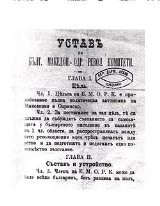
Internal Macedonian Revolutionary Organization

Encyclopedia
The Internal Macedonian Revolutionary Organization (IMRO) ) was a revolutionary national liberation movement in the Ottoman territories in Europe, that operated in the late 19th and early 20th centuries.
Founded in 1893, initially its aim was to gain autonomy for Macedonia and Adrianople regions in Ottoman Empire, but later it became an agent serving Bulgarian interests in Balkan politics. Starting in 1896 it fought the Ottomans using guerrilla tactics, and in this they were successful, even establishing a state within state in some regions, including their own tax collectors. This effort escalated in 1903 into the Ilinden–Preobrazhenie Uprising. The fighting involved about 15,000 IMRO irregulars and 40,000 Ottoman soldiers. After the uprising failed, and the Ottomans destroyed some 100 villages, the IMRO resorted to more systematic forms of terrorism targeting civilians. During the Balkan Wars
and the First World War the organization supported the Bulgarian army and joined to Bulgarian war-time authorities when they took temporarily control over parts of Thrace and Macedonia. In this period the autonomism as political tactics was abandoned and annexationist positions were supported, aiming eventual incorporation of occupied areas to Bulgaria.
After the First World War the combined Macedonian-Thracian revolutionary movement separated into two detached organizations, IMRO and ITRO. After this moment the IMRO earned a reputation as an ultimate terror network, seeking to change state frontiers in the Macedonian regions of Greece
and Serbia
(later Yugoslavia
). They contested the partitioning of Macedonia and launched raids from their Petrich
stronghold into Greek and Yugoslav territory. Their base of operation in Bulgaria was jeopardized by the Treaty of Niš
, and the IMRO reacted by assassinating Bulgarian prime minister Aleksandar Stamboliyski
in 1923, with the cooperation of other Bulgarian elements opposed to him. In 1925 the Greek army launched a cross-border operation
to reduce the IMRO base area, but it was ultimately stopped by the League of Nations
, and IMRO attacks resumed. In the interwar period the IMRO also cooperated with the Croatian Ustaše
, and their ultimate victim was Alexander I of Yugoslavia
, assassinated in France in 1934. After the Bulgarian coup d'état of 1934
, their Petrich stronghold was subjected to military crackdown by the Bulgarian army, and the IMRO was reduced to a marginal phenomenon.
The organization changed its name on several occasions (see below). After the fall of communism in the region, numerous parties claimed the IMRO name and lineage to legitimize themselves. Among them, in Bulgaria
a right-wing party carrying the prefix "VMRO" was established in the 1990s, while in the Republic of Macedonia
a right-wing party was established under the name "VMRO-DPMNE".
by a small band of anti-Ottoman Macedono-Bulgarian revolutionaries, who considered Macedonia an indivisible territory and claimed all of its inhabitants "Macedonians", no matter their religion or ethnicity. In practice, most of their followers were Bulgarians. According to some sources, they were against the neighboring states aspirations in the area. The organization was a secret revolutionary society operating in the late 19th and early 20th centuries with the goal of autonomous Macedonia and Adrianople regions. It appears likely that at the early stages of the struggle, a desired outcome of the autonomy was unification with Bulgaria. This aim was changed later with the idea of transforming the Balkans
into a federal state, in which Macedonia and Thrace would enter as a equal members. The idea of autonomy was strictly political and did not imply a secession from Bulgarian ethnicity. Even those, who advocated for independent Macedonia and Thrace, never doubted the predominantly Bulgarian character of the Slavic population in both areas. The organization was founded by Hristo Tatarchev
, Dame Gruev
, Petar Pop-Arsov
, Andon Dimitrov
, Hristo Batandzhiev
and Ivan Hadzhinikolov
. Most of them (with exceptinon of Ivan Hadzhinikolov) were closely connected with the Bulgarian Men's High School of Thessaloniki
. After Hristo Tatarchev's "Memoirs" its first name since 1894 was Macedonian Revolutionary Organization (MRO). Ivan Hadzhinikolov in his memoirs underlines the five basic principles of the MRO's foundation:
According to Dr. Hristo Tatarchev
:
In Dame Gruev
's memoirs, the MRO's goals are stated as follows:
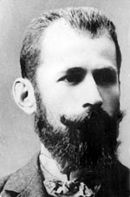 The Adrianople Region was the general name given by the Organization to those areas of Thrace
which, like Macedonia, had been left under Turkish rule i.e. most of it, where the Bulgarian element
predominated in the mixed population, too. The organized revolutionary movement in Thrace dates from 1895, when Dame Gruev
recruited Hristo Kotsev, born in Shtip, who was then teacher in the Bulgarian Men's High School of Adrianople
. Acting in the name of the Central Committee, Kotsev set up a regional committee in Adrianople, and gradually committees were established in a large area.
Based on historical evidences, it is believed by Bulgarian, Western and Russian historians that in 1896 or 1897 this first and probably unofficial name was changed to Bulgarian Macedonian-Adrianople Revolutionary Committees (BMARC); and the organisation existed under this name until 1902, when it was changed to Secret Macedonian-Adrianople Revolutionary Organization (SMARO). While part of the Macedonian historians also acknowledge the existence of the name "ВMARC" in the very early period of the Organisation (1894–1896), in the Republic of Macedonia
it is generally assumed that in the 1896–1902 period the name of the organization was "SMARO". Both sides lack conclusive documentary evidence, as neither of these names appears in the IMRO documents but is known from undated printed or handwritten statutes. However, Macedonian historians point to the fact that a copy of the "SMARO" statute is kept in London under the year of 1898. It is not disputed that the organization changed its name to Internal Macedonian-Adrianople Revolutionary Organization (IMARO) in 1905 and it is under this name referred to in Bulgarian historiography. After disbanding itself during the first Bulgarian annexation of Macedonia (1915–1918), the organization was revived in 1920 under the name Internal Macedonian Revolutionary Organization (IMRO), under which it is generally known today.
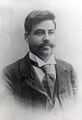 The stated goal of the original Committee was to unite all elements dissatisfied with the Ottoman
oppression in Macedonia
and the Adrianople Vilayet, eventually obtaining political autonomy for the two regions. In this task the organisation hoped to enlist the support of the local Vlachs
, Greeks
and even Turks
. Efforts were concentrated on moral propaganda and the prospect of rebellion and terrorist actions seemed distant. The organization developed quickly: only in a matter of a few years, the Committee had managed to establish a wide network of local organisations across Macedonia and the Adrianople Vilayet. These usually centered around the schools of the Bulgarian Exarchate
and had as leaders local or Bulgarian-born teachers.
Although IMRO was predominantly ethnic Bulgarian since its establishment, it favoured the idea of an autonomous Macedonia and preferred to disassociate itself from official Bulgarian policy and was not under government control. Its founding leaders believed that an autonomous movement was more likely to find favour with the Great Powers than one which was a tool of the Bulgarian government. In the words of British contemporary observer Henry Brailsford:
What is more, some of its younger leaders espoused radical socialist and anarchist ideas and saw their goal as the establishment of a new form of government rather than unification with Bulgaria. Eventually these considerations led the organisation to change its statute and accept as members not only Bulgarians but all Macedonians and Odrinians regardless of ethnicity or creed. In reality, however, besides some Vlach members, its membership remained overwhelmingly Bulgarian Exarchist.
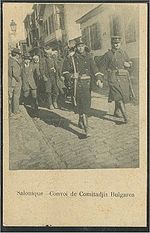 In regards to the socialist and cosmoplitan ideas within the revolutionary movement, the American Albert Sonnichsen says:
It is claimed by contemporary historians that the right wing supporters within the IMRO were probably much more likely to see unification with Bulgaria as a natural final outcome of Macedonian autonomy. Among other documents, they cite as an expression of this understanding the official letter that Dame Gruev and Boris Sarafov, leaders of the headquarters of the Second Macedonian-Adrianople revolutionary district during Ilinden uprising, wrote to the Bulgarian government:
In his Macedonistic publication On Macedonian Matters written in the wake of the Ilinden-Preobrazhenie uprising
, Krste Misirkov
, a highly controversial writer who alternated between pan-Bulgarian and pan-Macedonian nationalism throughout his lifetime, described the IMARO as an organization of Bulgarian officials who work for Bulgarian interests and who are linked in name, and in church and school matters, to the people of Bulgaria, their country and their interests. Misirkov wrote:
Dimitar Vlahov
, another extremely controversial politician and revolutionary, who also alternated between pan-Bulgarian and pan-Macedonian nationalism, member of the left wing of the Macedonian-Adrianople revolutionary movement, later Bulgarian deputy in Ottoman Parliament, afterwards one of the main leaders of IMRO (United) – de facto extension of the Bulgarian Communist Party
, finally elected in 1946 as ethnic Macedonian vice-president of the Praesidium of Communist Yugoslavia's Parliament, expressed in his book "The struggles of Macedonian people for freedom", published in Vienna in 1925, his view, confirmed again in Vlahov's "Memoirs", published in Skopje in 1970:
n border in 1897. The wide-scale repressions against the activists of the Committee led to its transformation into a militant guerilla organization, which engaged into attacks against Ottoman officials and punitive actions against suspected traitors. The guerilla groups of IMARO, known as "chetas" (чети) later (after 1903) also waged a war against the pro-Serbian and pro-Greek armed groups during the Greek Struggle for Macedonia
.
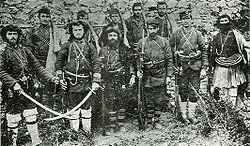
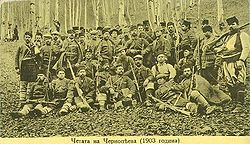 IMARO's leadership of the revolutionary movement was challenged by two other factions: the Macedonian Supreme Committee in Sofia (Vurhoven мakedono-оdrinski komitet- Върховен македоно-одрински комитет) and a smaller group of conservatives in Salonica – Bulgarian Secret Revolutionary Brotherhood
(Balgarsko Tayno Revolyutsionno Bratstvo). The latter was incorporated in IMARO by 1902 but its members as Ivan Garvanov
, were to exert a significant influence on the organization. They were to push for the Ilinden-Preobrazhenie Uprising
and later became the core of IMRO right-wing faction. The former organisation became known earlier than IMRO, after the 1895 raids into Turkish territory it organised from Bulgaria. Its founders were Macedonian immigrants in Bulgaria as well as Bulgarian army officers. They became known as the "supremists" or "externals" since they were based outside of Macedonia. The supremists resorted to terrorism against the Ottomans in the hope of provoking a war and thus Bulgarian annexation of Macedonia. For a time in the late 1890s IMARO leaders managed to gain control of the Supreme Committee but it soon split into two factions: one loyal to the IMARO and one led by some officers close to the Bulgarian prince. The second one staged an ill-fated uprising in Eastern Macedonia in 1902, where they were opposed militarily by local IMARO bands led by Yane Sandanski
and Hristo Chernopeev
, who were later to become the leaders of the IMARO left wing.
In Spring 1903, a group by young anarchists connected with IMARO from the Gemidzhii Circle – graduates from the Bulgarian secondary school in Thessaloniki
launched a campaign of terror bombing with the aim to attract the attention of the Great Powers to Ottoman oppression in Macedonia
and Eastern Thrace.
In the same time the undisputed leader of the organization, Gotse Delchev
, was killed in a skirmish with Turkish forces. Although Delchev had opposed the ideas for an uprising as premature, he finally had no choice but agree to that course of action but at least managed to delay its start from may to August. After his death in 1903 IMARO organised the Ilinden-Preobrazhenie Uprising
against the Ottomans in Macedonia and the Adrianople Vilayet, which after the initial successes including the forming of the Krushevo Republic, was crushed with much loss of life.
and Ivan Garvanov
.
After the Young Turk Revolution
of 1908 both factions laid down their arms and joined the legal struggle. Yane Sandanski
and Hristo Chernopeev contacted the Young Turks
and started legal operation. They tried to set up the Macedonian-Adrianople Revolutionary Organization (MARO). Initially, the group developed only propaganda activities. Later, the congress for MARO's official inauguration failed and federalist wing joined mainstream political life as the Peoples' Federative Party (Bulgarian Section). Some of its leaders like Sandanski and Chernopeev participated in the march on Istanbul to depose the counter-revolutionaries. The former centralists formed the Union of the Bulgarian Constitutional Clubs and like the PFP participated in Ottoman elections. Soon, however, the Young Turk regime turned increasingly nationalist and sought to suppress the national aspirations of the variopus minorities in Macedonia and Thrace. This prompted most right-wing and some left-wing IMARO leaders to resume the armed fight in 1909. In January 1910 Hristo Chernopeev and some of his followers founded a Bulgarian People's Macedonian-Adrianople Revolutionary Organization
. In 1911 a new Central Committee of IMARO was formed consisting of Todor Alexandrov, Hristo Chernopeev and Petar Chaulev
. Its aim was to restore unity to the Organisation and direct the new armed struggle against the Turks more efficiently. After Chernopeev was killed in action in 1915 as a Bulgarian officer in World War I, he was replaced by the former supremist leader General Alexander Protogerov.
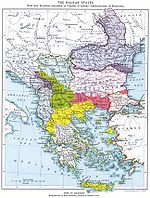 During the Balkan Wars former IMARO leaders of both the left and the right joined the Macedonian-Adrianopolitan Volunteer Corps
and fought with the Bulgarian Army. Others like Sandanski with their bands assisted the Bulgarian army with its advance and still others penetrated as far as the region of Kastoria
southwestern Macedonia. In the Second Balkan War IMORO bands fought the Greeks and Serbs behind the front lines but were subsequently routed and driven out. Notably, Petar Chaulev
was one of the leaders of the Ohrid-Debar Uprising
organised jointly by IMORO and the Albanians of Western Macedonia.
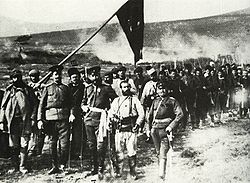 The Tikvesh Uprising
was another uprising in late June 1913, organized by the Internal Macedonian Revolutionary Organization against the Serbian occupation of Vardar Macedonia
and took place behind the Serbia
n enemy lines during the Second Balkan War
.
The result of the Balkan Wars was that the Macedonian region and Adrianople Thrace was partitioned between Bulgaria, Greece, Serbia and the Ottoman Empire (the new state of Yugoslavia
was created as after 1918 and started its existence as Kingdom of the Serbs, Croats and Slovenians "SHS"), with Bulgaria getting the smallest share. In 1913 the whole Thracian Bulgarian
population from the Ottoman part of Eastern Thrace was forcibly expelled to Bulgaria
. IMARO, now led by Todor Aleksandrov
, maintained its existence in Bulgaria, where it played a role in politics by playing upon Bulgarian irredentism and urging a renewed war to liberate Macedonia. This was one factor in Bulgaria allying itself with Germany
and Austria-Hungary
in World War I. During the First World War in Macedonia
(1915–1918) the organization supported Bulgarian army and joined to Bulgarian war-time authorities when they took control over Vardar Macedonia
temporarily until the end of war. In this period the autonomism as political tactics was abandoned from all internal IMARO streams and all of them shared annexationist positions, supporting eventual incorporation of Macedonia in Bulgaria. IMARO organised the Valandovo action of 1915, which was an attack on a large Serbian force. Bulgarian army, supported by the organization's forces, was successful in the first stages of this conflict, managed to drive out the Serbian forces from Vardar Macedonia
and came into positions on the line of the pre-war Greek-Serbian border, which was stabilized as a firm front
until end of 1918.
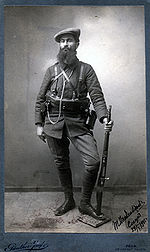 The post-war Treaty of Neuilly
again denied Bulgaria what it felt was its share of Macedonia and Thrace. After this moment the combined Macedonian-Adrianopolitan revolutionary movement separated into two detached organizations: Internal Thracian Revolutionary Organisation
(bulg. Вътрешна тракийска революционна организация) and Internal Macedonian Revolutionary Organisation. ITRO was a revolutionary organisation active in the Greek
regions of Thrace
and Macedonia
to the river Strymon
and Rhodope Mountains
between 1922 and 1934. The reason for the establishment of ITRO was the transfer of the region from Bulgaria to Greece
in May 1920. ITRO proclaimed its goal as the "unification of all the disgruntled elements in Thrace
regardless of their nationality", and to win full political independence for the region. Later IMRO created as a satellite organisation the Internal Western Outland Revolutionary Organisation
(bulg. Вътрешна западнопокрайненска революционна организация), which operated in the areas of Tsaribrod
and Bosilegrad
, ceded to Yugoslavia. IMRO began sending armed bands called cheti into Greek and Yugoslav Macedonia and Thrace to assassinate officials and stir up the spirit of the oppressed population. Оn 23 March 1923 Aleksandar Stamboliyski
, who favoured a détente with Greece and Yugoslavia, so that Bulgaria could concentrate on its internal problems, signed the Treaty of Niš
with the Kingdom of Serbs, Croats and Slovenes and undertook the obligation to suppress the operations of the IMRO carried out from Bulgarian territory. However in the some year IMRO agents assassinated him. IMRO had de facto full control of Pirin Macedonia (the Petrich District of the time) and acted as a "state within a state", which it used as a base for hit and run attacks against Yugoslavia with the unofficial support of the right-wing Bulgarian government and later Fascist Italy
. Because of this, contemporary observers described the Yugoslav-Bulgarian frontier as the most fortified in Europe.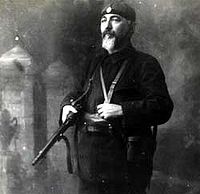 In 1923 and 1924 during the apogee of interwar military activity according to IMRO statistics in the region of Yugoslav (Vardar) Macedonia operated 53 chetas (armed bands), 36 of which penetrated from Bulgaria, 12 were local and 5 entered from Albania
. The aggregate membership of the bands was 3245 komitas (guerilla rebels) led by 79 voivodas (commanders), 54 subcommanders, 41 secretaries and 193 couriers. 119 fights and 73 terroristic acts were documented. Serbian casualties were 304 army and gendarmery officers, soldiers and paramilitary fighters, more than 1300 were wounded. IMRO lost 68 voivodas and komitas, hundreds were wounded. In the region of Greek (Aegean) Macedonia 24 chetas and 10 local reconnaissance detachments were active. The aggregate membership of the bands was 380 komitas led by 18 voivodas, 22 subcommanders, 11 secretaries and 25 couriers. 42 battles and 27 terrorist acts were performed. Greek casualties were 83 army officers, soldiers and paramilitary fighters, over 230 were wounded. IMRO lost 22 voivodas and komitas, 48 were wounded. Thousands of locals were repressed by the Yugoslav and Greek authorities on suspicions of contacts with the revolutionary movement. The population in Pirin Macedonia was organized in a mass people's home guard. This militia was the only force, which resisted the Greek army when the Greek dictator, General Pangalos
launched a military campaign
against Petrich District in 1925. In 1934 the Bulgarian army confiscated 10,938 rifles, 637 pistols, 47 machine-guns, 7 mortars and 701,388 cartridges only in the Petrich and Kyustendil
Districts. At the same time an youth's extension of IMRO, the Macedonian Youth Secret Revolutionary Organization
was created. The statute of MYSRO was approved personally from IMRO's leader Todor Alexandrov. The aim of MYSRO was in concordance with the statute of IMRO – unification of all of Macedonia in an authonomous unit, within a future Balkan Federative Republic.
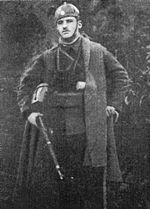 The Sixth Congress of the Balkan Communist Federation
under the leadership of the Bulgarian communist Vasil Kolarov
and the Fifth Congress of the Comintern
, an adjunct of the Soviet foreign policy, held concurrently in Moscow in 1923, voted for the formation of an “Autonomous and Independent Macedonia and Thrace.” In 1924 IMRO entered negotiations with the Macedonian Federative Organization
and the Comintern about collaboration between the communists and the Macedonian movement and the creation of a united Macedonian movement. The idea for a new unified organization was supported by the Soviet Union
, which saw a chance for using this well developed revolutionary movement to spread revolution in the Balkans and destabilize the Balkan monarchies. Alexandrov defended IMRO's independence and refused to concede on practically all points requested by the Communists. No agreement was reached besides a paper "Manifesto" (the so-called May Manifesto
of 6 May 1924), in which the objectives of the unified Macedonian liberation movement were presented: independence and unification of partitioned Macedonia, fighting all the neighbouring Balkan monarchies, forming a Balkan Communist Federation
and cooperation with the Soviet Union
. Failing to secure Alexandrov's cooperation, the Comintern
decided to discredit him and published the contents of the Manifesto on 28 July 1924 in the "Balkan Federation" newspaper. VMRO's leaders Todor Aleksandrov and Aleksandar Protogerov promptly denied through the Bulgarian press that they've ever signed any agreements, claiming that the May Manifesto was a communist forgery.
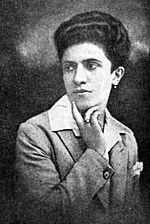 Shortly after, Todor Alexandrov was assassinated in unclear circumstances and IMRO came under the leadership of Ivan Mihailov
, who became a powerful figure in Bulgarian politics. While IMRO's leadership was quick to ascribe Alexandrov's murder to the communists and even quicker to organise a revenge action against the immediate perpetrators, there is some doubt that Mihailov himself might have been responsible for the murder. Some Bulgarian and Macedonian historians like Zoran Todorovski speculate that it might have been the circle around Mihailov who organised the assassination on inspiration by the Bulgarian government, which was afraid of united IMRO-Communist action against it. However, neither version is corroborated by conclusive historical evidence. The result of the murder was further strife within the organisation and several high-profile murders, including that of Petar Chaulev (who led the Ohrid-Debar Uprising
against the Serbian occupation) in Milan
and ultimately Protogetov himself.
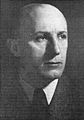 In this interwar period IMRO led by Aleksandrov and later by Mihailov took actions against the former left-wing assassinating several former members of IMORO's Sandanist wing, who meanwhile had gravitated towards the Bulgarian Communist Party and Macedonian Federative Organization
. Gjorche Petrov
was killed in Sofia in 1922, Todor Panitsa
(who previously killed the right-wing oriented Boris Sarafov
and Ivan Garvanov) was assassinated in Vienna in 1924 by Mihailov's future wife Mencha Karnichiu. Dimo Hadjidimov, Georgi Skrizhovski, Alexander Bujnov, Chudomir Kantardjiev and many others were killed in the events on 1925. Meanwhile, the left-wing later did form the new organisation based on the principles previously presented in the May Manifesto. The new organization which was an opponent to Mihailov's IMRO was called IMRO (United) was founded in 1925 in Vienna
. However, it did not have real popular support and remained based abroad with no revolutionary activities in Macedonia. Mihailov's group of young IMRO cadres soon got into conflict with the older guard of the organization. The latter were in favour of the old tactic of incursions by armed bands, whereas the former favoured more flexible tactics with smaller terrorist groups carrying selective assassinations. The conflict grew into a leadership struggle and Mihailov soon in turn ordered the assassination in 1928 of a rival leader, General Aleksandar Protogerov, which sparked a fratricidal war between "Mihailovists" and "Protogerovists". The less numerous Protogerovists soon became allied with Yugoslavia and certain Bulgarian military circles with fascist leanings and who favoured rapprochement with Yugoslavia. The policy of assassionations was effective in making Serbian rule in Vardar Macedonia feel insecure but in turn provoked brutal reprisals on the local peasant population. Having lost a lot of popular support in Vardar Macedonia due to his policies, Mihailov favoured the "internationalization" of the Macedonian question.
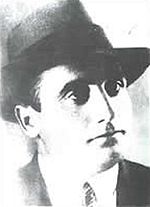 He established close links with the Croatian Ustashi and Italy. Numerous assassinations were carried out by IMRO agents in many countries, the majority in Yugoslavia. The most spectacular of these was the assassination of King Alexander I of Yugoslavia
and the French Foreign Minister Louis Barthou
in Marseille
in 1934 in collaboration with the Croatia
n Ustashi. The killing was carried out by the VMRO assassin Vlado Chernozemski
and happened after the suppression of IMRO following the 19 May 1934 military coup in Bulgaria. IMRO's constant fratricidal killings and assassinations abroad provoked some within Bulgarian military after the coup of 19 May 1934 to take control and break the power of the organization, which had come to be seen as a gangster organization inside Bulgaria and a band of assassins outside it. In 1934 Mihailov was forced to escape to Turkey
. He ordered to his supporters not to resist to the Bulgarian army and to accept the disarmament peacefully, thus avoiding fratricides, destabilization of Bulgaria, civil war or external invasion. Many inhabitants of Pirin Macedonia met this disbandment with satisfaction because it was perceived as relief from an unlawful and quite often brutal parallel authority. IMRO kept its organization alive in exile in various countries, but ceased to be an active force in Macedonian politics except for brief moments during World War II. Meanwhile a resolution of the Comintern
for recognition of a distinct ethnic Macedonian ethnicity, which was accepted also by the Internal Macedonian Revolutionary Organization (United), was published in January, 1934. IMRO (United) remained active until 1936, when it was absorbed into the Balkan Communist Federation
.
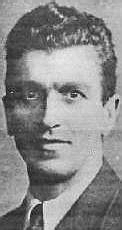 As the Bulgarian army entered Yugoslav Vardar Macedonia
in 1941, it was greeted by most of the population as liberators and former IMRO members were active in organising Bulgarian Action Committees
, charged with taking over the local authorities. Some former IMRO (United) members, such as Metodi Shatorov
, who was the regional leader of the Yugoslav Communist Party, also refused to define the Bulgarian forces as occupiers, contrary to instructions from Belgrade
and called for the incorporation of the local Macedonian Communist organisations within the Bulgarian Communist Party
. This policy changed towards 1943 with the arrival of the Montenegrin Serb Svetozar Vukmanović-Tempo
, who began in earnest to organise armed resistance to the Bulgarian occupation. Many former IMRO members assisted the authorities in fighting Tempo's partizans. Also in Greece the Bulgarian troops occupied the whole of Eastern Macedonia and Western Thrace
, where they were greeted from the greather part of the local Slavic-speakers as liberators. Bulgaria officially annexed the occupied territories in Yugoslavia and Greece, which had long been a target of Bulgarian irridentism
. IMRO was also active in organising Bulgarian militias in Italian and German occupation zones against Greek nationalist and communist groups as EAM-ELAS and EDES. With the help of Mihailov and Macedonian emigres in Sofia, several pro-Bulgarian armed detachments "Ohrana
" were organised in the Kastoria
, Florina
and Edessa
districts. These were led by Bulgarian officers originally from Greek Macedonia – Andon Kalchev
and Georgi Dimchev. It was apparent that Mihailov had broader plans which envisaged the creation of an Macedonian state under a German control. It was also anticipated that the IMRO volunteers would form the core of the armed forces of a future Independent Macedonia in addition to providing administration and education in the Florina, Kastoria and Edessa districts.
On 2 August 1944 (what in the Republic of Macedonia
is referred to as the Second Ilinden
) in the St. Prohor Pčinjski
monastery at the Antifascist assembly of the national liberation of Macedonia (ASNOM) with Panko Brashnarov
(the former IMRO revolutionary from the Ilinden period and the IMRO United) as a first speaker, the modern Macedonian state
was officially proclaimed, as a federal state within Tito's Yugoslavia, receiving recognition from the Allies. After the declaration of war by Bulgaria on Germany, in September 1944 Mihailov arrived in German occupied Skopje
, where the Germans hoped that he could form a pro – German Independent State of Macedonia
with their support. Seeing that the war is lost to Germany and to avoid further bloodshed, he refused. Mihailov eventually ended up in Rome where he published numerous articles, books and pamphlets on the Macedonian Question.
and some of the leading members entered the government: Dimitar Vlahov
, Panko Brashnarov
, Pavel Shatev
(the latter was the last surviving member of "Gemidzhii" or "Varkarides" in Greek, the group that executed the Thessaloniki bombings of 1903). However, they were quickly ousted by cadres loyal to the Yugoslav Communist Party in Belgrade, who had had pro-Serbian leanings before the war. According to Macedonian historian Ivan Katardjiev such Macedonian activists came from IMRO (United) and the Bulgarian Communist Party never managed to get rid of their pro-Bulgarian bias and on many issues opposed the Serbian-educated leaders, who held most of the political power. Pavel Shatev
went as far as to send a petition to the Bulgarian legation in Belgrade protesting the anti-Bulgarian policies of the Yugoslav leadership and the Serbianisation of the Bulgarian language.
From the start, the Yugoslav authorities organised frequent purges and trials of Macedonian communists and non-party people charged with autonomist deviation. Many of the left-wing IMRO government officials, including Pavel Shatev
and Panko Brashnarov
, were purged from their positions too, then isolated, arrested, imprisoned or executed by the Yugoslav federal authorities on various (in many cases fabricated) charges including: pro-Bulgarian leanings, demands for greater or complete independence of Yugoslav Macedonia, collaboration with the Cominform
after the Tito-Stalin split
in 1948, forming of conspirative political groups or organisations, demands for greater democracy, etc. One of the victims of these campaigns was Metodija Andonov Cento, a wartime partisan leader and president of ASNOM, who was convinced of having worked for a "completely independent Macedonia" as an IMRO member. A survivor among the communists associated with the idea of Macedonian autonomy was Dimitar Vlahov
, who was used "solely for window dressing".
On the other hand, former Mihailovists were also persecuted by the Belgrade-controlled authorities on accusations of collaboration with the Bulgarian occupation, Bulgarian nationalism, anti-communist and anti-Yugoslav activities, etc. Notable victims included Spiro Kitinchev, mayor of Skopje, Ilija Kocarev, mayor of Ohrid and Georgi Karev, the mayor of Krushevo during the Bulgarian occupation and brother of Ilinden revolutionary Nikola Karev. Another IMRO activist, Sterio Guli, son of Pitu Guli, reportedly shot himself upon the arrival of Tito's partisans in Krushevo in despair over what he saw as a second period of Serbian dominance in Macedonia. Also Shatorov's supporters in Vardar Macedonia, called Sharlisti, were systematically exterminated by the YCP in the autumn of 1944, and repressed for their anti-Yugoslav and pro-Bulgarian political positions.
IMRO's supporters in Bulgarian Pirin Macedonia fared no better. With the help of some former Protogerovists, their main activists were hunted by the Communist police and many of them killed or imprisoned. Because some IMRO supporters openly opposed the then official policy of Communist Bulgaria to promote Macedonian ethnic consciousness in Pirin Macedonia they were repressed or exiled to the interior of Bulgaria. Many from this persecuted people emigrated through Greece and Turkey to the Western countries. At this period the American and Greek intelligence services recruited some of them, trained them and later used this so called "Goryani
" as spies and saboteurs, smmugling them back to Communist Bulgaria and Yugoslavia.
Despite the fact that Yugoslav Macedonian historical scholarship reluctantly acknowledged the Bulgarian ethnic self-identification of the Ilinden IMRO leaders, they were adopted in the national pantheon of Yugoslav Macedonia as ethnic Macedonians. Official Yugoslav historiography asserted a continuity between the Ilinden of 1903 and the Ilinden of ASNOM in 1944 ignoring the fact that the first one included the uprising in the Adrianople part of Thrace
region as well. The names of the IMRO revolutionaries Gotse Delchev
, Pitu Guli
, Dame Gruev
and Yane Sandanski
were included in the lyrics of the anthem of the Socialist Republic of Macedonia Denes nad Makedonija
("Today over Macedonia").
In this race, the Socialist Republic of Macedonia
was the first to incorporate the IMRO figures in its national pantheon, although some careful exceptions were made. The 1903 Ilinden Uprising was presented as direct precursor of the 1944 events, which were termed a "Second Ilinden", in an effort to prove the continuity of the struggle for independence of the Macedonian nation. Consequently, it became necessary for the socialist authorities to show that 19th century IMRO figures, particularly Delchev and Sandanski, had been consciously Macedonian in identity. Delchev and Sandanski were adopted as symbols of the republic, had numerous monuments built in their honor, and they were often the topic of articles in the academic journal Macedonian Review, as was the Ilinden Uprising. In contrast, Todor Aleksandrov was labeled a Bulgarian bourgeois chauvinist. The claim to a Macedonian identity of Sandanski was used to bolster Skopje
's claim to the Pirin region
.
In the People's Republic of Bulgaria the situation was more complex, because the IMRO was associated with the 1923–34 anti-communist regime. Before 1960, although the subject was not taboo, few articles on the topic appeared in Bulgarian academic venues, and the IMRO figures were given mostly regional recognition in the Pirin region. After 1960, orders from the highest level were to incorporate the Macedonian revolutionary movement in the Bulgarian history, and to prove the Bulgarian credentials of their historical leaders. This trend reached its peak in 1981 (the 1300 year anniversary of Bulgarian state), when Delchev and Sandanski were openly made historical symbols of the Bulgarian state in a proclamation of Lyudmila Zhivkova
. There were also attempts to rehabilitate Todor Aleksandrov because of his Bulgarian nationalism, but these remained controversial due to his role in suppressing the left wing, a role for which he had been declared a fascist.
 After the fall of Communism in 1989 Yugoslavia began promptly to disintegrate and democratic politics in Macedonia revived. Many exiles returned to Macedonia from abroad, and a new generation of young Macedonian intellectuals rediscovered the history of Macedonian nationalism. In these circumstances it was not surprising that the IMRO name was revived. A new IMRO was founded on 17 June 1990 in Skopje
. Although IMRO claims a line descent from the old IMRO, there is no real connection between the old IMRO and the new one. The party is called the Internal Macedonian Revolutionary Organization-Democratic Party for Macedonian National Unity
(In Macedonian
: Vnatrešno-Makedonska Revolucionerna Organizacija-Demokratska Partija za Makedonsko Nacionalno Edinstvo, or VMRO-DPMNE) describes itself as a Christian Democratic party which supports the admission of Macedonia to NATO and the European Union
.
A minor political party carrying the name IMRO is the Internal Macedonian Revolutionary Organization–People's Party (VMRO-NP). Although a separate structure since the split in 2004, the political line of VMRO-NP is reminiscent of VMRO-DPMNE's and its members maintain close ties with the latter's party structure.
 A distinct IMRO organization was also revived in Bulgaria after 1989 first under the name VMRO-SMD (ВМРО-СМД – Съюз на македонските дружества) and then simply VMRO (ВМРО) as a cultural organisation. In 1996 the leaders of the organisation registered it as a political party in Bulgaria under the name IMRO - Bulgarian National Movement (ВМРО – Българско национално движение). This group continues to maintain that Slav Macedonians are in fact Bulgarians.
Founded in 1893, initially its aim was to gain autonomy for Macedonia and Adrianople regions in Ottoman Empire, but later it became an agent serving Bulgarian interests in Balkan politics. Starting in 1896 it fought the Ottomans using guerrilla tactics, and in this they were successful, even establishing a state within state in some regions, including their own tax collectors. This effort escalated in 1903 into the Ilinden–Preobrazhenie Uprising. The fighting involved about 15,000 IMRO irregulars and 40,000 Ottoman soldiers. After the uprising failed, and the Ottomans destroyed some 100 villages, the IMRO resorted to more systematic forms of terrorism targeting civilians. During the Balkan Wars
Balkan Wars
The Balkan Wars were two conflicts that took place in the Balkans in south-eastern Europe in 1912 and 1913.By the early 20th century, Montenegro, Bulgaria, Greece and Serbia, the countries of the Balkan League, had achieved their independence from the Ottoman Empire, but large parts of their ethnic...
and the First World War the organization supported the Bulgarian army and joined to Bulgarian war-time authorities when they took temporarily control over parts of Thrace and Macedonia. In this period the autonomism as political tactics was abandoned and annexationist positions were supported, aiming eventual incorporation of occupied areas to Bulgaria.
After the First World War the combined Macedonian-Thracian revolutionary movement separated into two detached organizations, IMRO and ITRO. After this moment the IMRO earned a reputation as an ultimate terror network, seeking to change state frontiers in the Macedonian regions of Greece
Greece
Greece , officially the Hellenic Republic , and historically Hellas or the Republic of Greece in English, is a country in southeastern Europe....
and Serbia
Serbia
Serbia , officially the Republic of Serbia , is a landlocked country located at the crossroads of Central and Southeast Europe, covering the southern part of the Carpathian basin and the central part of the Balkans...
(later Yugoslavia
Kingdom of Yugoslavia
The Kingdom of Yugoslavia was a state stretching from the Western Balkans to Central Europe which existed during the often-tumultuous interwar era of 1918–1941...
). They contested the partitioning of Macedonia and launched raids from their Petrich
Petrich
Petrich is a town in Blagoevgrad Province in southwestern Bulgaria, located at the foot of the Belasica Mountains in the Strumeshnitsa Valley. , the town has 29920 inhabitants.Petrich is located close to the borders with Greece and the Republic of Macedonia...
stronghold into Greek and Yugoslav territory. Their base of operation in Bulgaria was jeopardized by the Treaty of Niš
Treaty of Niš (1923)
The Treaty of Niš was a treaty signed on March 23, 1923 by the Kingdom of Serbs, Croats and Slovenes and the Kingdom of Bulgaria which obliged the Kingdom of Bulgaria to suppress the operations of the Internal Macedonian Revolutionary Organization carried out from Bulgarian territory...
, and the IMRO reacted by assassinating Bulgarian prime minister Aleksandar Stamboliyski
Aleksandar Stamboliyski
Aleksandar Stamboliyski was the prime minister of Bulgaria from 1919 until 1923. Stamboliyski was a member of the Agrarian Union, an agrarian peasant movement which was not allied to the monarchy, and edited their newspaper...
in 1923, with the cooperation of other Bulgarian elements opposed to him. In 1925 the Greek army launched a cross-border operation
Incident at Petrich
The incident at Petrich, or the War of the Stray Dog, was the short invasion of Bulgaria by Greece near the border town Petrich in 1925...
to reduce the IMRO base area, but it was ultimately stopped by the League of Nations
League of Nations
The League of Nations was an intergovernmental organization founded as a result of the Paris Peace Conference that ended the First World War. It was the first permanent international organization whose principal mission was to maintain world peace...
, and IMRO attacks resumed. In the interwar period the IMRO also cooperated with the Croatian Ustaše
Ustaše
The Ustaša - Croatian Revolutionary Movement was a Croatian fascist anti-Yugoslav separatist movement. The ideology of the movement was a blend of fascism, Nazism, and Croatian nationalism. The Ustaše supported the creation of a Greater Croatia that would span to the River Drina and to the border...
, and their ultimate victim was Alexander I of Yugoslavia
Alexander I of Yugoslavia
Alexander I , also known as Alexander the Unifier was the first king of the Kingdom of Yugoslavia as well as the last king of the Kingdom of Serbs, Croats and Slovenes .-Childhood:...
, assassinated in France in 1934. After the Bulgarian coup d'état of 1934
Bulgarian coup d'état of 1934
The Bulgarian coup d'état of 1934, also known as the 19 May coup d'état , was a coup d'état in the Kingdom of Bulgaria carried out by the Zveno military organization and the Military Union with the aid of the Bulgarian Army...
, their Petrich stronghold was subjected to military crackdown by the Bulgarian army, and the IMRO was reduced to a marginal phenomenon.
The organization changed its name on several occasions (see below). After the fall of communism in the region, numerous parties claimed the IMRO name and lineage to legitimize themselves. Among them, in Bulgaria
Bulgaria
Bulgaria , officially the Republic of Bulgaria , is a parliamentary democracy within a unitary constitutional republic in Southeast Europe. The country borders Romania to the north, Serbia and Macedonia to the west, Greece and Turkey to the south, as well as the Black Sea to the east...
a right-wing party carrying the prefix "VMRO" was established in the 1990s, while in the Republic of Macedonia
Republic of Macedonia
Macedonia , officially the Republic of Macedonia , is a country located in the central Balkan peninsula in Southeast Europe. It is one of the successor states of the former Yugoslavia, from which it declared independence in 1991...
a right-wing party was established under the name "VMRO-DPMNE".
Origins and goals
The organization was founded in 1893 in Ottoman ThessalonikiThessaloniki
Thessaloniki , historically also known as Thessalonica, Salonika or Salonica, is the second-largest city in Greece and the capital of the region of Central Macedonia as well as the capital of the Decentralized Administration of Macedonia and Thrace...
by a small band of anti-Ottoman Macedono-Bulgarian revolutionaries, who considered Macedonia an indivisible territory and claimed all of its inhabitants "Macedonians", no matter their religion or ethnicity. In practice, most of their followers were Bulgarians. According to some sources, they were against the neighboring states aspirations in the area. The organization was a secret revolutionary society operating in the late 19th and early 20th centuries with the goal of autonomous Macedonia and Adrianople regions. It appears likely that at the early stages of the struggle, a desired outcome of the autonomy was unification with Bulgaria. This aim was changed later with the idea of transforming the Balkans
Balkans
The Balkans is a geopolitical and cultural region of southeastern Europe...
into a federal state, in which Macedonia and Thrace would enter as a equal members. The idea of autonomy was strictly political and did not imply a secession from Bulgarian ethnicity. Even those, who advocated for independent Macedonia and Thrace, never doubted the predominantly Bulgarian character of the Slavic population in both areas. The organization was founded by Hristo Tatarchev
Hristo Tatarchev
Hristo Tatarchev was a Bulgarian revolutionary and first leader of the revolutionary movement in Macedonia and Eastern Thrace . He wrote the memoirs The First Central Committee of the IMRO . He authored several political journalism works between the First and Second World Wars...
, Dame Gruev
Dame Gruev
Damyan Yovanov Gruev or Damjan Jovanov Gruev, often known by his short name Dame Gruev, was an insurgent leader in Ottoman Macedonia and Thrace...
, Petar Pop-Arsov
Petar Pop-Arsov
Petar Poparsov was a revolutionary from Macedonia, one of the founders of "The Committee for Obtaining the Political Rights Given to Macedonia by the Congress of Berlin" from which, as Petar Poparsov says in his writings, later developed the Internal Macedonian Revolutionary Organization...
, Andon Dimitrov
Andon Dimitrov
Andon Dimitrov - was a Bulgarian 19th-20th century revolutionary. He was among the founders of the Bulgarian Macedonian-Adrianople Revolutionary Committees.-Biography:...
, Hristo Batandzhiev
Hristo Batandzhiev
Hristo Batandzhiev was a revolutionary, one of the founders of "The Committee for Obtaining the Political Rights Given to Macedonia by the Congress of Berlin" from which, later developed the IMRO known prior to 1902 as Bulgarian Macedonian-Adrianople Revolutionary Committees...
and Ivan Hadzhinikolov
Ivan Hadzhinikolov
Ivan Hadzhinikolov was a Bulgarian revolutionary from Macedonia, leader of the revolutionary movement in Macedonia, Eastern and Western Thrace...
. Most of them (with exceptinon of Ivan Hadzhinikolov) were closely connected with the Bulgarian Men's High School of Thessaloniki
Bulgarian Men's High School of Thessaloniki
The Sts. Cyril and Methodius Bulgarian Men's High School of Thessaloniki was the first Bulgarian high school in Macedonia. One of the most influential Bulgarian educational centres in Macedonia and Southern Thrace, it was founded in autumn 1880 in Ottoman Thessaloniki and existed until...
. After Hristo Tatarchev's "Memoirs" its first name since 1894 was Macedonian Revolutionary Organization (MRO). Ivan Hadzhinikolov in his memoirs underlines the five basic principles of the MRO's foundation:
According to Dr. Hristo Tatarchev
Hristo Tatarchev
Hristo Tatarchev was a Bulgarian revolutionary and first leader of the revolutionary movement in Macedonia and Eastern Thrace . He wrote the memoirs The First Central Committee of the IMRO . He authored several political journalism works between the First and Second World Wars...
:
In Dame Gruev
Dame Gruev
Damyan Yovanov Gruev or Damjan Jovanov Gruev, often known by his short name Dame Gruev, was an insurgent leader in Ottoman Macedonia and Thrace...
's memoirs, the MRO's goals are stated as follows:
Thrace
Thrace is a historical and geographic area in southeast Europe. As a geographical concept, Thrace designates a region bounded by the Balkan Mountains on the north, Rhodope Mountains and the Aegean Sea on the south, and by the Black Sea and the Sea of Marmara on the east...
which, like Macedonia, had been left under Turkish rule i.e. most of it, where the Bulgarian element
Thracian Bulgarians
Thracians or Thracian Bulgarians is a regional, ethnographic group of ethnic Bulgarians, inhabiting or originating from Thrace. Today, the larger part of this population is concentrated in Northern Thrace, but much is spread across the whole of Bulgaria and the diaspora...
predominated in the mixed population, too. The organized revolutionary movement in Thrace dates from 1895, when Dame Gruev
Dame Gruev
Damyan Yovanov Gruev or Damjan Jovanov Gruev, often known by his short name Dame Gruev, was an insurgent leader in Ottoman Macedonia and Thrace...
recruited Hristo Kotsev, born in Shtip, who was then teacher in the Bulgarian Men's High School of Adrianople
Bulgarian Men's High School of Adrianople
The Dr. Petar Beron Bulgarian Men's High School of Addrianople was the first Bulgarian high school in Eastern Thrace. One of the most influential Bulgarian educational centres in Thrace, it was founded in 1891 in Ottoman Adrianople and existed until 1913...
. Acting in the name of the Central Committee, Kotsev set up a regional committee in Adrianople, and gradually committees were established in a large area.
Based on historical evidences, it is believed by Bulgarian, Western and Russian historians that in 1896 or 1897 this first and probably unofficial name was changed to Bulgarian Macedonian-Adrianople Revolutionary Committees (BMARC); and the organisation existed under this name until 1902, when it was changed to Secret Macedonian-Adrianople Revolutionary Organization (SMARO). While part of the Macedonian historians also acknowledge the existence of the name "ВMARC" in the very early period of the Organisation (1894–1896), in the Republic of Macedonia
Republic of Macedonia
Macedonia , officially the Republic of Macedonia , is a country located in the central Balkan peninsula in Southeast Europe. It is one of the successor states of the former Yugoslavia, from which it declared independence in 1991...
it is generally assumed that in the 1896–1902 period the name of the organization was "SMARO". Both sides lack conclusive documentary evidence, as neither of these names appears in the IMRO documents but is known from undated printed or handwritten statutes. However, Macedonian historians point to the fact that a copy of the "SMARO" statute is kept in London under the year of 1898. It is not disputed that the organization changed its name to Internal Macedonian-Adrianople Revolutionary Organization (IMARO) in 1905 and it is under this name referred to in Bulgarian historiography. After disbanding itself during the first Bulgarian annexation of Macedonia (1915–1918), the organization was revived in 1920 under the name Internal Macedonian Revolutionary Organization (IMRO), under which it is generally known today.
Ottoman Empire
The Ottoman EmpireIt was usually referred to as the "Ottoman Empire", the "Turkish Empire", the "Ottoman Caliphate" or more commonly "Turkey" by its contemporaries...
oppression in Macedonia
Macedonia (region)
Macedonia is a geographical and historical region of the Balkan peninsula in southeastern Europe. Its boundaries have changed considerably over time, but nowadays the region is considered to include parts of five Balkan countries: Greece, the Republic of Macedonia, Bulgaria, Albania, Serbia, as...
and the Adrianople Vilayet, eventually obtaining political autonomy for the two regions. In this task the organisation hoped to enlist the support of the local Vlachs
Vlachs
Vlach is a blanket term covering several modern Latin peoples descending from the Latinised population in Central, Eastern and Southeastern Europe. English variations on the name include: Walla, Wlachs, Wallachs, Vlahs, Olahs or Ulahs...
, Greeks
Greeks
The Greeks, also known as the Hellenes , are a nation and ethnic group native to Greece, Cyprus and neighboring regions. They also form a significant diaspora, with Greek communities established around the world....
and even Turks
Turkish people
Turkish people, also known as the "Turks" , are an ethnic group primarily living in Turkey and in the former lands of the Ottoman Empire where Turkish minorities had been established in Bulgaria, Cyprus, Bosnia and Herzegovina, Georgia, Greece, Kosovo, Macedonia, and Romania...
. Efforts were concentrated on moral propaganda and the prospect of rebellion and terrorist actions seemed distant. The organization developed quickly: only in a matter of a few years, the Committee had managed to establish a wide network of local organisations across Macedonia and the Adrianople Vilayet. These usually centered around the schools of the Bulgarian Exarchate
Bulgarian Exarchate
The Bulgarian Exarchate was the official name of the Bulgarian Orthodox Church before its autocephaly was recognized by the Ecumenical See in 1945 and the Bulgarian Patriarchate was restored in 1953....
and had as leaders local or Bulgarian-born teachers.
Although IMRO was predominantly ethnic Bulgarian since its establishment, it favoured the idea of an autonomous Macedonia and preferred to disassociate itself from official Bulgarian policy and was not under government control. Its founding leaders believed that an autonomous movement was more likely to find favour with the Great Powers than one which was a tool of the Bulgarian government. In the words of British contemporary observer Henry Brailsford:
What is more, some of its younger leaders espoused radical socialist and anarchist ideas and saw their goal as the establishment of a new form of government rather than unification with Bulgaria. Eventually these considerations led the organisation to change its statute and accept as members not only Bulgarians but all Macedonians and Odrinians regardless of ethnicity or creed. In reality, however, besides some Vlach members, its membership remained overwhelmingly Bulgarian Exarchist.
It is claimed by contemporary historians that the right wing supporters within the IMRO were probably much more likely to see unification with Bulgaria as a natural final outcome of Macedonian autonomy. Among other documents, they cite as an expression of this understanding the official letter that Dame Gruev and Boris Sarafov, leaders of the headquarters of the Second Macedonian-Adrianople revolutionary district during Ilinden uprising, wrote to the Bulgarian government:
In his Macedonistic publication On Macedonian Matters written in the wake of the Ilinden-Preobrazhenie uprising
Ilinden-Preobrazhenie Uprising
The Ilinden–Preobrazhenie Uprising or simply the Ilinden Uprising of August 1903 |Macedonia]] affected most of the central and southwestern parts of the Monastir Vilayet receiving the support mainly of the local Bulgarian peasants and to some extent of the Aromanian population of the region...
, Krste Misirkov
Krste Misirkov
Krste Petkov Misirkov was a philologist, slavist, historian, ethnographer, publicist author of the first book and scientific magazine in Macedonian, where he for the first time outlined the principles of the literary Macedonian language...
, a highly controversial writer who alternated between pan-Bulgarian and pan-Macedonian nationalism throughout his lifetime, described the IMARO as an organization of Bulgarian officials who work for Bulgarian interests and who are linked in name, and in church and school matters, to the people of Bulgaria, their country and their interests. Misirkov wrote:
Dimitar Vlahov
Dimitar Vlahov
Dimitar Yanakiev Vlahov was a revolutionary from the region of Macedonia and member of the left wing of the Macedonian-Adrianople revolutionary movement...
, another extremely controversial politician and revolutionary, who also alternated between pan-Bulgarian and pan-Macedonian nationalism, member of the left wing of the Macedonian-Adrianople revolutionary movement, later Bulgarian deputy in Ottoman Parliament, afterwards one of the main leaders of IMRO (United) – de facto extension of the Bulgarian Communist Party
Bulgarian Communist Party
The Bulgarian Communist Party was the communist and Marxist-Leninist ruling party of the People's Republic of Bulgaria from 1946 until 1990 when the country ceased to be a communist state...
, finally elected in 1946 as ethnic Macedonian vice-president of the Praesidium of Communist Yugoslavia's Parliament, expressed in his book "The struggles of Macedonian people for freedom", published in Vienna in 1925, his view, confirmed again in Vlahov's "Memoirs", published in Skopje in 1970:
Armed struggle against the Ottomans
The initial period of idealism for IMARO ended, however, with the Vinitsa Affair and the discovery by the Ottoman police of a secret depot of ammunition near the BulgariaBulgaria
Bulgaria , officially the Republic of Bulgaria , is a parliamentary democracy within a unitary constitutional republic in Southeast Europe. The country borders Romania to the north, Serbia and Macedonia to the west, Greece and Turkey to the south, as well as the Black Sea to the east...
n border in 1897. The wide-scale repressions against the activists of the Committee led to its transformation into a militant guerilla organization, which engaged into attacks against Ottoman officials and punitive actions against suspected traitors. The guerilla groups of IMARO, known as "chetas" (чети) later (after 1903) also waged a war against the pro-Serbian and pro-Greek armed groups during the Greek Struggle for Macedonia
Greek Struggle for Macedonia
The Macedonian Struggle was a series of social, political, cultural and military conflicts between Greeks and Bulgarians in the region of Ottoman Macedonia between 1904 and 1908...
.
Bulgarian Secret Revolutionary Brotherhood
The Bulgarian Secret Revolutionary Brotherhood was organized from a small group of conservatives, adherents of evolutionary methods of struggle, in Salonica....
(Balgarsko Tayno Revolyutsionno Bratstvo). The latter was incorporated in IMARO by 1902 but its members as Ivan Garvanov
Ivan Garvanov
Ivan Garvanov was a Bulgarian revolutionary and leader of the revolutionary movement in Macedonia and Eastern Thrace. He was among the leaders of the Bulgarian Secret Revolutionary Brotherhood and later of the Bulgarian Macedonian-Adrianople Revolutionary Committees...
, were to exert a significant influence on the organization. They were to push for the Ilinden-Preobrazhenie Uprising
Ilinden-Preobrazhenie Uprising
The Ilinden–Preobrazhenie Uprising or simply the Ilinden Uprising of August 1903 |Macedonia]] affected most of the central and southwestern parts of the Monastir Vilayet receiving the support mainly of the local Bulgarian peasants and to some extent of the Aromanian population of the region...
and later became the core of IMRO right-wing faction. The former organisation became known earlier than IMRO, after the 1895 raids into Turkish territory it organised from Bulgaria. Its founders were Macedonian immigrants in Bulgaria as well as Bulgarian army officers. They became known as the "supremists" or "externals" since they were based outside of Macedonia. The supremists resorted to terrorism against the Ottomans in the hope of provoking a war and thus Bulgarian annexation of Macedonia. For a time in the late 1890s IMARO leaders managed to gain control of the Supreme Committee but it soon split into two factions: one loyal to the IMARO and one led by some officers close to the Bulgarian prince. The second one staged an ill-fated uprising in Eastern Macedonia in 1902, where they were opposed militarily by local IMARO bands led by Yane Sandanski
Yane Sandanski
Yane Ivanov Sandanski or Jane Ivanov Sandanski, was a revolutionary, one of the leaders of the Internal Macedonian-Adrianople Revolutionary Organization in the Serres region and head of the extreme leftist wing of the organization...
and Hristo Chernopeev
Hristo Chernopeev
Hristo Chernopeev was a Bulgarian revolutionary and member of the revolutionary movement in Macedonia...
, who were later to become the leaders of the IMARO left wing.
In Spring 1903, a group by young anarchists connected with IMARO from the Gemidzhii Circle – graduates from the Bulgarian secondary school in Thessaloniki
Thessaloniki
Thessaloniki , historically also known as Thessalonica, Salonika or Salonica, is the second-largest city in Greece and the capital of the region of Central Macedonia as well as the capital of the Decentralized Administration of Macedonia and Thrace...
launched a campaign of terror bombing with the aim to attract the attention of the Great Powers to Ottoman oppression in Macedonia
Macedonia (region)
Macedonia is a geographical and historical region of the Balkan peninsula in southeastern Europe. Its boundaries have changed considerably over time, but nowadays the region is considered to include parts of five Balkan countries: Greece, the Republic of Macedonia, Bulgaria, Albania, Serbia, as...
and Eastern Thrace.
In the same time the undisputed leader of the organization, Gotse Delchev
Gotse Delchev
Georgi Nikolov Delchev was an important revolutionary figure in Ottoman-ruled Macedonia and Thrace at the turn of the 20th century...
, was killed in a skirmish with Turkish forces. Although Delchev had opposed the ideas for an uprising as premature, he finally had no choice but agree to that course of action but at least managed to delay its start from may to August. After his death in 1903 IMARO organised the Ilinden-Preobrazhenie Uprising
Ilinden-Preobrazhenie Uprising
The Ilinden–Preobrazhenie Uprising or simply the Ilinden Uprising of August 1903 |Macedonia]] affected most of the central and southwestern parts of the Monastir Vilayet receiving the support mainly of the local Bulgarian peasants and to some extent of the Aromanian population of the region...
against the Ottomans in Macedonia and the Adrianople Vilayet, which after the initial successes including the forming of the Krushevo Republic, was crushed with much loss of life.
After Ilinden
The failure of the 1903 insurrection resulted in the eventual split of the IMARO into a left-wing (federalist) faction in the Seres and Strumica districts and a right-wing faction (centralists) in the Salonica, Monastir, and Uskub (present-day Skopje) districts. The left-wing faction opposed Bulgarian nationalism and advocated the creation of a Balkan Socialist Federation with equality for all subjects and nationalities. The Supreme Macedonian Committee was disbanded in 1903 but the centralist faction of the IMORO drifted more and more towards Bulgarian nationalism as its regions became increasingly exposed to the incursions of Serb and Greek armed bands, which started infiltrating Macedonia after 1903. The years 1905–1907 saw lots of violent fighting between IMORO and Turkish forces as well as between IMORO and Greek and Serb detachments. Meanwhile the split between the two factions became final when in 1907 Todor Panitza killed the right-wing activists Boris SarafovBoris Sarafov
Boris Petrov Sarafov was a revolutionary from the region of Macedonia, one of the leaders of Supreme Macedonian-Adrianople Committee and Internal Macedonian Revolutionary Organization...
and Ivan Garvanov
Ivan Garvanov
Ivan Garvanov was a Bulgarian revolutionary and leader of the revolutionary movement in Macedonia and Eastern Thrace. He was among the leaders of the Bulgarian Secret Revolutionary Brotherhood and later of the Bulgarian Macedonian-Adrianople Revolutionary Committees...
.
After the Young Turk Revolution
Young Turk Revolution
The Young Turk Revolution of 1908 reversed the suspension of the Ottoman parliament by Sultan Abdul Hamid II, marking the onset of the Second Constitutional Era...
of 1908 both factions laid down their arms and joined the legal struggle. Yane Sandanski
Yane Sandanski
Yane Ivanov Sandanski or Jane Ivanov Sandanski, was a revolutionary, one of the leaders of the Internal Macedonian-Adrianople Revolutionary Organization in the Serres region and head of the extreme leftist wing of the organization...
and Hristo Chernopeev contacted the Young Turks
Young Turks
The Young Turks , from French: Les Jeunes Turcs) were a coalition of various groups favouring reformation of the administration of the Ottoman Empire. The movement was against the absolute monarchy of the Ottoman Sultan and favoured a re-installation of the short-lived Kanûn-ı Esâsî constitution...
and started legal operation. They tried to set up the Macedonian-Adrianople Revolutionary Organization (MARO). Initially, the group developed only propaganda activities. Later, the congress for MARO's official inauguration failed and federalist wing joined mainstream political life as the Peoples' Federative Party (Bulgarian Section). Some of its leaders like Sandanski and Chernopeev participated in the march on Istanbul to depose the counter-revolutionaries. The former centralists formed the Union of the Bulgarian Constitutional Clubs and like the PFP participated in Ottoman elections. Soon, however, the Young Turk regime turned increasingly nationalist and sought to suppress the national aspirations of the variopus minorities in Macedonia and Thrace. This prompted most right-wing and some left-wing IMARO leaders to resume the armed fight in 1909. In January 1910 Hristo Chernopeev and some of his followers founded a Bulgarian People's Macedonian-Adrianople Revolutionary Organization
Bulgarian People's Macedonian-Adrianople Revolutionary Organization
The Bulgarian People's Macedonian-Adrianople Revolutionary Organization was a short-lived revolutionary organization from the region of Macedonia. It was created on May 4, 1910 by members of Secret Macedonian-Adrianople Revolutionary Organization's Solun, Strumica and Ser revolutionary regions,...
. In 1911 a new Central Committee of IMARO was formed consisting of Todor Alexandrov, Hristo Chernopeev and Petar Chaulev
Petar Chaulev
Petar Chaulev, also called Petre Chashule was a Bulgarian revolutionary in Ottoman Macedonia. He was a local leader of the Internal Macedonian Revolutionary Organization ....
. Its aim was to restore unity to the Organisation and direct the new armed struggle against the Turks more efficiently. After Chernopeev was killed in action in 1915 as a Bulgarian officer in World War I, he was replaced by the former supremist leader General Alexander Protogerov.
Macedonian-Adrianopolitan Volunteer Corps
The Macedonian-Adrianopolitan Volunteer Corps was a volunteer corps of the Bulgarian Army during the Balkan Wars. It was formed on 23 September 1912 and consisted of Bulgarian volunteers from Macedonia and Thrace, regions still under Ottoman rule, and thus not subject to Bulgarian military...
and fought with the Bulgarian Army. Others like Sandanski with their bands assisted the Bulgarian army with its advance and still others penetrated as far as the region of Kastoria
Kastoria
Kastoria is a city in northern Greece in the periphery of West Macedonia. It is the capital of Kastoria peripheral unit. It is situated on a promontory on the western shore of Lake Orestiada, in a valley surrounded by limestone mountains...
southwestern Macedonia. In the Second Balkan War IMORO bands fought the Greeks and Serbs behind the front lines but were subsequently routed and driven out. Notably, Petar Chaulev
Petar Chaulev
Petar Chaulev, also called Petre Chashule was a Bulgarian revolutionary in Ottoman Macedonia. He was a local leader of the Internal Macedonian Revolutionary Organization ....
was one of the leaders of the Ohrid-Debar Uprising
Ohrid-Debar Uprising
The Ohrid–Debar uprising was an uprising in Western Macedonia, then Kingdom of Serbia, in September 1913. It was organized by the Internal Macedonian Revolutionary Organization and by local Albanian leaders against the Serbian capture of the regions of Ohrid, Debar and Struga.The rebellion...
organised jointly by IMORO and the Albanians of Western Macedonia.
Tikvesh Uprising
Tikvesh uprising was an uprising in the Tikveš region of Macedonia in late June 1913. It was organized by the Internal Macedonian Revolutionary Organization against the Serbian occupation of Vardar Macedonia and took place behind the Serbian enemy lines during the Second Balkan War...
was another uprising in late June 1913, organized by the Internal Macedonian Revolutionary Organization against the Serbian occupation of Vardar Macedonia
Vardar Macedonia
Vardar Macedonia is an area in the north of the Macedonia . The borders of the area are those of the Republic of Macedonia. It covers an area of...
and took place behind the Serbia
Serbia
Serbia , officially the Republic of Serbia , is a landlocked country located at the crossroads of Central and Southeast Europe, covering the southern part of the Carpathian basin and the central part of the Balkans...
n enemy lines during the Second Balkan War
Second Balkan War
The Second Balkan War was a conflict which broke out when Bulgaria, dissatisfied with its share of the spoils of the First Balkan War, attacked its former allies, Serbia and Greece, on 29 June 1913. Bulgaria had a prewar agreement about the division of region of Macedonia...
.
The result of the Balkan Wars was that the Macedonian region and Adrianople Thrace was partitioned between Bulgaria, Greece, Serbia and the Ottoman Empire (the new state of Yugoslavia
Yugoslavia
Yugoslavia refers to three political entities that existed successively on the western part of the Balkans during most of the 20th century....
was created as after 1918 and started its existence as Kingdom of the Serbs, Croats and Slovenians "SHS"), with Bulgaria getting the smallest share. In 1913 the whole Thracian Bulgarian
Thracian Bulgarians
Thracians or Thracian Bulgarians is a regional, ethnographic group of ethnic Bulgarians, inhabiting or originating from Thrace. Today, the larger part of this population is concentrated in Northern Thrace, but much is spread across the whole of Bulgaria and the diaspora...
population from the Ottoman part of Eastern Thrace was forcibly expelled to Bulgaria
The Destruction of Thracian Bulgarians in 1913
"The Destruction of Thracian Bulgarians in 1913" were events described by Bulgarian academician Lyubomir Miletich in 1918, but also mentioned by Carnegie Endowment for International Peace with also a detailed report on the annihilation of Thracian Muslims...
. IMARO, now led by Todor Aleksandrov
Todor Aleksandrov
Todor Aleksandrov Poporushov also transliterated as Todor Alexandrov also spelt Alexandroff, was a Bulgarian freedom fighter and member of the Bulgarian Macedonian-Adrianople Revolutionary Committees since 1897 and later of the Central Committee of the Internal Macedonian Revolutionary...
, maintained its existence in Bulgaria, where it played a role in politics by playing upon Bulgarian irredentism and urging a renewed war to liberate Macedonia. This was one factor in Bulgaria allying itself with Germany
German Empire
The German Empire refers to Germany during the "Second Reich" period from the unification of Germany and proclamation of Wilhelm I as German Emperor on 18 January 1871, to 1918, when it became a federal republic after defeat in World War I and the abdication of the Emperor, Wilhelm II.The German...
and Austria-Hungary
Austria-Hungary
Austria-Hungary , more formally known as the Kingdoms and Lands Represented in the Imperial Council and the Lands of the Holy Hungarian Crown of Saint Stephen, was a constitutional monarchic union between the crowns of the Austrian Empire and the Kingdom of Hungary in...
in World War I. During the First World War in Macedonia
Macedonian front (World War I)
The Macedonian Front resulted from an attempt by the Allied Powers to aid Serbia, in the autumn of 1915, against the combined attack of Germany, Austria-Hungary and Bulgaria. The expedition came too late and in insufficient force to prevent the fall of Serbia, and was complicated by the internal...
(1915–1918) the organization supported Bulgarian army and joined to Bulgarian war-time authorities when they took control over Vardar Macedonia
Vardar Macedonia
Vardar Macedonia is an area in the north of the Macedonia . The borders of the area are those of the Republic of Macedonia. It covers an area of...
temporarily until the end of war. In this period the autonomism as political tactics was abandoned from all internal IMARO streams and all of them shared annexationist positions, supporting eventual incorporation of Macedonia in Bulgaria. IMARO organised the Valandovo action of 1915, which was an attack on a large Serbian force. Bulgarian army, supported by the organization's forces, was successful in the first stages of this conflict, managed to drive out the Serbian forces from Vardar Macedonia
Vardar Macedonia
Vardar Macedonia is an area in the north of the Macedonia . The borders of the area are those of the Republic of Macedonia. It covers an area of...
and came into positions on the line of the pre-war Greek-Serbian border, which was stabilized as a firm front
Macedonian front (World War I)
The Macedonian Front resulted from an attempt by the Allied Powers to aid Serbia, in the autumn of 1915, against the combined attack of Germany, Austria-Hungary and Bulgaria. The expedition came too late and in insufficient force to prevent the fall of Serbia, and was complicated by the internal...
until end of 1918.
Interwar period
Treaty of Neuilly
The Treaty of Neuilly-sur-Seine, dealing with Bulgaria for its role as one of the Central Powers in World War I, was signed on 27 November 1919 at Neuilly-sur-Seine, France....
again denied Bulgaria what it felt was its share of Macedonia and Thrace. After this moment the combined Macedonian-Adrianopolitan revolutionary movement separated into two detached organizations: Internal Thracian Revolutionary Organisation
Internal Thracian Revolutionary Organisation
The Internal Thracian Revolutionary Organisation , ITRO, was a Bulgarian revolutionary organisation active in Western Thrace and southern Bulgaria between 1920 and 1934.The reason for the establishment of ITRO was the deplorable situation of the Thracian Bulgarians in...
(bulg. Вътрешна тракийска революционна организация) and Internal Macedonian Revolutionary Organisation. ITRO was a revolutionary organisation active in the Greek
Greece
Greece , officially the Hellenic Republic , and historically Hellas or the Republic of Greece in English, is a country in southeastern Europe....
regions of Thrace
Western Thrace
Western Thrace or simply Thrace is a geographic and historical region of Greece, located between the Nestos and Evros rivers in the northeast of the country. Together with the regions of Macedonia and Epirus, it is often referred to informally as northern Greece...
and Macedonia
Macedonia (Greece)
Macedonia is a geographical and historical region of Greece in Southern Europe. Macedonia is the largest and second most populous Greek region...
to the river Strymon
Struma
The Struma was a ship chartered to carry Jewish refugees from Axis-allied Romania to British-controlled Palestine during World War II. On February 23, 1942, with its engine inoperable and its refugee passengers aboard, Turkish authorities towed the ship from Istanbul harbor through the Bosphorus...
and Rhodope Mountains
Rhodope Mountains
The Rhodopes are a mountain range in Southeastern Europe, with over 83% of its area in southern Bulgaria and the remainder in Greece. Its highest peak, Golyam Perelik , is the seventh highest Bulgarian mountain...
between 1922 and 1934. The reason for the establishment of ITRO was the transfer of the region from Bulgaria to Greece
Greece
Greece , officially the Hellenic Republic , and historically Hellas or the Republic of Greece in English, is a country in southeastern Europe....
in May 1920. ITRO proclaimed its goal as the "unification of all the disgruntled elements in Thrace
Thrace
Thrace is a historical and geographic area in southeast Europe. As a geographical concept, Thrace designates a region bounded by the Balkan Mountains on the north, Rhodope Mountains and the Aegean Sea on the south, and by the Black Sea and the Sea of Marmara on the east...
regardless of their nationality", and to win full political independence for the region. Later IMRO created as a satellite organisation the Internal Western Outland Revolutionary Organisation
Internal Western Outland Revolutionary Organisation
The Internal Western Outland Revolutionary Organization , IWORO, was a Bulgarian revolutionary organization active in the Western Outlands between 1921 and 1941 in the Kingdom of Serbs, Croats and Slovenes , and then its successor, the Kingdom of...
(bulg. Вътрешна западнопокрайненска революционна организация), which operated in the areas of Tsaribrod
Dimitrovgrad, Serbia
Dimitrovgrad is a town and 483 km² large municipality located in the Pirot District of the Republic of Serbia. According to 2011 census, the municipality of Dimitrovgrad has a population of 10,056 people and the town 6,247.-Name:...
and Bosilegrad
Bosilegrad
Bosilegrad is a town and municipality in Pčinja District of Serbia. The municipality comprises an area of 571 km². According to 2011 census, it has total population of 7,979 inhabitants, while the town has 2,530.-1991 census:...
, ceded to Yugoslavia. IMRO began sending armed bands called cheti into Greek and Yugoslav Macedonia and Thrace to assassinate officials and stir up the spirit of the oppressed population. Оn 23 March 1923 Aleksandar Stamboliyski
Aleksandar Stamboliyski
Aleksandar Stamboliyski was the prime minister of Bulgaria from 1919 until 1923. Stamboliyski was a member of the Agrarian Union, an agrarian peasant movement which was not allied to the monarchy, and edited their newspaper...
, who favoured a détente with Greece and Yugoslavia, so that Bulgaria could concentrate on its internal problems, signed the Treaty of Niš
Treaty of Niš (1923)
The Treaty of Niš was a treaty signed on March 23, 1923 by the Kingdom of Serbs, Croats and Slovenes and the Kingdom of Bulgaria which obliged the Kingdom of Bulgaria to suppress the operations of the Internal Macedonian Revolutionary Organization carried out from Bulgarian territory...
with the Kingdom of Serbs, Croats and Slovenes and undertook the obligation to suppress the operations of the IMRO carried out from Bulgarian territory. However in the some year IMRO agents assassinated him. IMRO had de facto full control of Pirin Macedonia (the Petrich District of the time) and acted as a "state within a state", which it used as a base for hit and run attacks against Yugoslavia with the unofficial support of the right-wing Bulgarian government and later Fascist Italy
Kingdom of Italy (1861–1946)
The Kingdom of Italy was a state forged in 1861 by the unification of Italy under the influence of the Kingdom of Sardinia, which was its legal predecessor state...
. Because of this, contemporary observers described the Yugoslav-Bulgarian frontier as the most fortified in Europe.
Albania
Albania , officially known as the Republic of Albania , is a country in Southeastern Europe, in the Balkans region. It is bordered by Montenegro to the northwest, Kosovo to the northeast, the Republic of Macedonia to the east and Greece to the south and southeast. It has a coast on the Adriatic Sea...
. The aggregate membership of the bands was 3245 komitas (guerilla rebels) led by 79 voivodas (commanders), 54 subcommanders, 41 secretaries and 193 couriers. 119 fights and 73 terroristic acts were documented. Serbian casualties were 304 army and gendarmery officers, soldiers and paramilitary fighters, more than 1300 were wounded. IMRO lost 68 voivodas and komitas, hundreds were wounded. In the region of Greek (Aegean) Macedonia 24 chetas and 10 local reconnaissance detachments were active. The aggregate membership of the bands was 380 komitas led by 18 voivodas, 22 subcommanders, 11 secretaries and 25 couriers. 42 battles and 27 terrorist acts were performed. Greek casualties were 83 army officers, soldiers and paramilitary fighters, over 230 were wounded. IMRO lost 22 voivodas and komitas, 48 were wounded. Thousands of locals were repressed by the Yugoslav and Greek authorities on suspicions of contacts with the revolutionary movement. The population in Pirin Macedonia was organized in a mass people's home guard. This militia was the only force, which resisted the Greek army when the Greek dictator, General Pangalos
Theodoros Pangalos (general)
Major General Theodoros Pangalos was a Greek soldier and politician. A distinguished staff officer and an ardent Venizelist and anti-royalist, Pangalos played a leading role in the September 1922 revolt that deposed King Constantine I and in the establishment of the Second Hellenic Republic...
launched a military campaign
Incident at Petrich
The incident at Petrich, or the War of the Stray Dog, was the short invasion of Bulgaria by Greece near the border town Petrich in 1925...
against Petrich District in 1925. In 1934 the Bulgarian army confiscated 10,938 rifles, 637 pistols, 47 machine-guns, 7 mortars and 701,388 cartridges only in the Petrich and Kyustendil
Kyustendil Province
-Religion:Religious adherence in the province according to 2001 census:-Language:Mother tongues in the province according to 2001 census:* 153,242 Bulgarian * 7,929 Roma * 1363 others and unspecified -Ethnic groups:...
Districts. At the same time an youth's extension of IMRO, the Macedonian Youth Secret Revolutionary Organization
Macedonian Youth Secret Revolutionary Organization
The Macedonian Youth Secret Revolutionary Organization or MYSRO; , was the name of a secret pro-Bulgarian political organization active across the most regions of Macedonia between 1922-1941. The statue of MYSRO was approved personally from the leaderof the Internal Macedonian Revolutionary...
was created. The statute of MYSRO was approved personally from IMRO's leader Todor Alexandrov. The aim of MYSRO was in concordance with the statute of IMRO – unification of all of Macedonia in an authonomous unit, within a future Balkan Federative Republic.
Balkan Communist Federation
The Balkan Federation was a project about the creation of a Balkan federation or confederation, based mainly on left political ideas.The concept of a Balkan federation emerged at the late 19th century from among left political forces in the region...
under the leadership of the Bulgarian communist Vasil Kolarov
Vasil Kolarov
Vasil Petrov Kolarov was a Bulgarian communist political leader and leading functionary in the Communist International.-Early years:Kolarov was born in Shumen, Bulgaria on 16 July 1877, the son of a shoemaker...
and the Fifth Congress of the Comintern
Comintern
The Communist International, abbreviated as Comintern, also known as the Third International, was an international communist organization initiated in Moscow during March 1919...
, an adjunct of the Soviet foreign policy, held concurrently in Moscow in 1923, voted for the formation of an “Autonomous and Independent Macedonia and Thrace.” In 1924 IMRO entered negotiations with the Macedonian Federative Organization
Macedonian Federative Organization
The Macedonian Federative Organization ' was established in Sofia in 1921 by former Internal Macedonian Revolutionary Organization left wing's activists.-Background:...
and the Comintern about collaboration between the communists and the Macedonian movement and the creation of a united Macedonian movement. The idea for a new unified organization was supported by the Soviet Union
Soviet Union
The Soviet Union , officially the Union of Soviet Socialist Republics , was a constitutionally socialist state that existed in Eurasia between 1922 and 1991....
, which saw a chance for using this well developed revolutionary movement to spread revolution in the Balkans and destabilize the Balkan monarchies. Alexandrov defended IMRO's independence and refused to concede on practically all points requested by the Communists. No agreement was reached besides a paper "Manifesto" (the so-called May Manifesto
May Manifesto
The so-called May Manifesto of May 6, 1924 was a paper in which the objectives of the unified Macedonian liberation movement were presented: independence and unification of partitioned Macedonia, fighting all the neighbouring Balkan monarchies, supporting the Balkan Communist Federation and...
of 6 May 1924), in which the objectives of the unified Macedonian liberation movement were presented: independence and unification of partitioned Macedonia, fighting all the neighbouring Balkan monarchies, forming a Balkan Communist Federation
Balkan Communist Federation
The Balkan Federation was a project about the creation of a Balkan federation or confederation, based mainly on left political ideas.The concept of a Balkan federation emerged at the late 19th century from among left political forces in the region...
and cooperation with the Soviet Union
Soviet Union
The Soviet Union , officially the Union of Soviet Socialist Republics , was a constitutionally socialist state that existed in Eurasia between 1922 and 1991....
. Failing to secure Alexandrov's cooperation, the Comintern
Comintern
The Communist International, abbreviated as Comintern, also known as the Third International, was an international communist organization initiated in Moscow during March 1919...
decided to discredit him and published the contents of the Manifesto on 28 July 1924 in the "Balkan Federation" newspaper. VMRO's leaders Todor Aleksandrov and Aleksandar Protogerov promptly denied through the Bulgarian press that they've ever signed any agreements, claiming that the May Manifesto was a communist forgery.
Ivan Mihailov
Ivan Mihailov Gavrilov , was a Bulgarian revolutionary in Ottoman and interwar Macedonia, and leader of the Internal Macedonian Revolutionary Organization after 1924.-Early years:...
, who became a powerful figure in Bulgarian politics. While IMRO's leadership was quick to ascribe Alexandrov's murder to the communists and even quicker to organise a revenge action against the immediate perpetrators, there is some doubt that Mihailov himself might have been responsible for the murder. Some Bulgarian and Macedonian historians like Zoran Todorovski speculate that it might have been the circle around Mihailov who organised the assassination on inspiration by the Bulgarian government, which was afraid of united IMRO-Communist action against it. However, neither version is corroborated by conclusive historical evidence. The result of the murder was further strife within the organisation and several high-profile murders, including that of Petar Chaulev (who led the Ohrid-Debar Uprising
Ohrid-Debar Uprising
The Ohrid–Debar uprising was an uprising in Western Macedonia, then Kingdom of Serbia, in September 1913. It was organized by the Internal Macedonian Revolutionary Organization and by local Albanian leaders against the Serbian capture of the regions of Ohrid, Debar and Struga.The rebellion...
against the Serbian occupation) in Milan
Milan
Milan is the second-largest city in Italy and the capital city of the region of Lombardy and of the province of Milan. The city proper has a population of about 1.3 million, while its urban area, roughly coinciding with its administrative province and the bordering Province of Monza and Brianza ,...
and ultimately Protogetov himself.
Macedonian Federative Organization
The Macedonian Federative Organization ' was established in Sofia in 1921 by former Internal Macedonian Revolutionary Organization left wing's activists.-Background:...
. Gjorche Petrov
Gjorche Petrov
Gyorche Petrov Nikolov , born Georgi Petrov Nikolov , was one of the leaders of the Macedonian-Adrianople revolutionary movement .- Biography :...
was killed in Sofia in 1922, Todor Panitsa
Todor Panitsa
Todor Panitsa was a Bulgarian revolutionary figure active in the region of Macedonia. He was one of the leaders of the left wing of the Internal Macedonian Revolutionary Organization. He took part in the struggles of the Bulgarians in the beginning of the 20th Century...
(who previously killed the right-wing oriented Boris Sarafov
Boris Sarafov
Boris Petrov Sarafov was a revolutionary from the region of Macedonia, one of the leaders of Supreme Macedonian-Adrianople Committee and Internal Macedonian Revolutionary Organization...
and Ivan Garvanov) was assassinated in Vienna in 1924 by Mihailov's future wife Mencha Karnichiu. Dimo Hadjidimov, Georgi Skrizhovski, Alexander Bujnov, Chudomir Kantardjiev and many others were killed in the events on 1925. Meanwhile, the left-wing later did form the new organisation based on the principles previously presented in the May Manifesto. The new organization which was an opponent to Mihailov's IMRO was called IMRO (United) was founded in 1925 in Vienna
Vienna
Vienna is the capital and largest city of the Republic of Austria and one of the nine states of Austria. Vienna is Austria's primary city, with a population of about 1.723 million , and is by far the largest city in Austria, as well as its cultural, economic, and political centre...
. However, it did not have real popular support and remained based abroad with no revolutionary activities in Macedonia. Mihailov's group of young IMRO cadres soon got into conflict with the older guard of the organization. The latter were in favour of the old tactic of incursions by armed bands, whereas the former favoured more flexible tactics with smaller terrorist groups carrying selective assassinations. The conflict grew into a leadership struggle and Mihailov soon in turn ordered the assassination in 1928 of a rival leader, General Aleksandar Protogerov, which sparked a fratricidal war between "Mihailovists" and "Protogerovists". The less numerous Protogerovists soon became allied with Yugoslavia and certain Bulgarian military circles with fascist leanings and who favoured rapprochement with Yugoslavia. The policy of assassionations was effective in making Serbian rule in Vardar Macedonia feel insecure but in turn provoked brutal reprisals on the local peasant population. Having lost a lot of popular support in Vardar Macedonia due to his policies, Mihailov favoured the "internationalization" of the Macedonian question.
Alexander I of Yugoslavia
Alexander I , also known as Alexander the Unifier was the first king of the Kingdom of Yugoslavia as well as the last king of the Kingdom of Serbs, Croats and Slovenes .-Childhood:...
and the French Foreign Minister Louis Barthou
Louis Barthou
Jean Louis Barthou was a French politician of the Third Republic.-Early years:He was born in Oloron-Sainte-Marie, Pyrénées-Atlantiques, and served as Deputy from that constituency. He was an authority on trade union history and law. Barthou was Prime Minister in 1913, and held ministerial office...
in Marseille
Marseille
Marseille , known in antiquity as Massalia , is the second largest city in France, after Paris, with a population of 852,395 within its administrative limits on a land area of . The urban area of Marseille extends beyond the city limits with a population of over 1,420,000 on an area of...
in 1934 in collaboration with the Croatia
Croatia
Croatia , officially the Republic of Croatia , is a unitary democratic parliamentary republic in Europe at the crossroads of the Mitteleuropa, the Balkans, and the Mediterranean. Its capital and largest city is Zagreb. The country is divided into 20 counties and the city of Zagreb. Croatia covers ...
n Ustashi. The killing was carried out by the VMRO assassin Vlado Chernozemski
Vlado Chernozemski
Vlado Chernozemski , born Velichko Dimitrov Kerin , was a Bulgarian revolutionary.Chernozemski also entered the region of Vardar Macedonia with IMRO bands and participated in more than 15 battles with the Serbian police....
and happened after the suppression of IMRO following the 19 May 1934 military coup in Bulgaria. IMRO's constant fratricidal killings and assassinations abroad provoked some within Bulgarian military after the coup of 19 May 1934 to take control and break the power of the organization, which had come to be seen as a gangster organization inside Bulgaria and a band of assassins outside it. In 1934 Mihailov was forced to escape to Turkey
Turkey
Turkey , known officially as the Republic of Turkey , is a Eurasian country located in Western Asia and in East Thrace in Southeastern Europe...
. He ordered to his supporters not to resist to the Bulgarian army and to accept the disarmament peacefully, thus avoiding fratricides, destabilization of Bulgaria, civil war or external invasion. Many inhabitants of Pirin Macedonia met this disbandment with satisfaction because it was perceived as relief from an unlawful and quite often brutal parallel authority. IMRO kept its organization alive in exile in various countries, but ceased to be an active force in Macedonian politics except for brief moments during World War II. Meanwhile a resolution of the Comintern
Resolution of the Comintern on the Macedonian Question
The resolution of the Comintern of January 11, 1934 was an official policitical document, in which for the first time, an authoritative international organization provides direction for recognizing of the existence of a separate Macedonian nation and Macedonian language.In June 1931 the registrar...
for recognition of a distinct ethnic Macedonian ethnicity, which was accepted also by the Internal Macedonian Revolutionary Organization (United), was published in January, 1934. IMRO (United) remained active until 1936, when it was absorbed into the Balkan Communist Federation
Balkan Communist Federation
The Balkan Federation was a project about the creation of a Balkan federation or confederation, based mainly on left political ideas.The concept of a Balkan federation emerged at the late 19th century from among left political forces in the region...
.
Second World War period
Vardar Macedonia
Vardar Macedonia is an area in the north of the Macedonia . The borders of the area are those of the Republic of Macedonia. It covers an area of...
in 1941, it was greeted by most of the population as liberators and former IMRO members were active in organising Bulgarian Action Committees
Bulgarian Action Committees
The Bulgarian Action Committees in Macedonia were patriotic nationalist organizations of Bulgarians in Macedonia around 1941, emboldened by the invasion Yugoslavia by Nazi Germany, determined to end the Yugoslavian rule in the region, perceived as oppressive by Macedonian Bulgarians and by the...
, charged with taking over the local authorities. Some former IMRO (United) members, such as Metodi Shatorov
Metodi Shatorov
Metodi Tasev Shatorov - Sharlo was a prominent Bulgarian political leader during the first half of 20th century and also temporary leader of the Macedonian communists in 1940-1941...
, who was the regional leader of the Yugoslav Communist Party, also refused to define the Bulgarian forces as occupiers, contrary to instructions from Belgrade
Belgrade
Belgrade is the capital and largest city of Serbia. It is located at the confluence of the Sava and Danube rivers, where the Pannonian Plain meets the Balkans. According to official results of Census 2011, the city has a population of 1,639,121. It is one of the 15 largest cities in Europe...
and called for the incorporation of the local Macedonian Communist organisations within the Bulgarian Communist Party
Bulgarian Communist Party
The Bulgarian Communist Party was the communist and Marxist-Leninist ruling party of the People's Republic of Bulgaria from 1946 until 1990 when the country ceased to be a communist state...
. This policy changed towards 1943 with the arrival of the Montenegrin Serb Svetozar Vukmanović-Tempo
Svetozar Vukmanovic-Tempo
Svetozar Vukmanović "Tempo" was a leading Montenegrin communist and member of the Central Committee of the League of Communists of Yugoslavia...
, who began in earnest to organise armed resistance to the Bulgarian occupation. Many former IMRO members assisted the authorities in fighting Tempo's partizans. Also in Greece the Bulgarian troops occupied the whole of Eastern Macedonia and Western Thrace
Western Thrace
Western Thrace or simply Thrace is a geographic and historical region of Greece, located between the Nestos and Evros rivers in the northeast of the country. Together with the regions of Macedonia and Epirus, it is often referred to informally as northern Greece...
, where they were greeted from the greather part of the local Slavic-speakers as liberators. Bulgaria officially annexed the occupied territories in Yugoslavia and Greece, which had long been a target of Bulgarian irridentism
Greater Bulgaria
Greater Bulgaria is term to identify the territory associated with a historical national state and a modern Bulgarian irredentist nationalist movement which would include most of Macedonia, Thrace and Moesia...
. IMRO was also active in organising Bulgarian militias in Italian and German occupation zones against Greek nationalist and communist groups as EAM-ELAS and EDES. With the help of Mihailov and Macedonian emigres in Sofia, several pro-Bulgarian armed detachments "Ohrana
Ohrana
Ohrana ; were armed collaborationist detachments organized by the former Internal Macedonian Revolutionary Organization structures, composed of Bulgarian in Nazi-occupied Greek Macedonia during World War II and led by Bulgarian officers. from Macedonia...
" were organised in the Kastoria
Kastoria
Kastoria is a city in northern Greece in the periphery of West Macedonia. It is the capital of Kastoria peripheral unit. It is situated on a promontory on the western shore of Lake Orestiada, in a valley surrounded by limestone mountains...
, Florina
Florina
Florina is a town and municipality in mountainous northwestern Macedonia, Greece. Its motto is, 'Where Greece begins'. It is also the Metropolitan seat for the region. It lies in the central part of Florina peripheral unit, of which it is the capital. Florina belongs to the periphery of West...
and Edessa
Edessa, Greece
Edessa , is a city in northern Greece and the capital of the Pella regional unit, in the Central Macedonia region of Greece. It was also the capital of the defunct province of the same name.-Name:...
districts. These were led by Bulgarian officers originally from Greek Macedonia – Andon Kalchev
Andon Kalchev
Andon Kalchev was a Bulgarian Axis-collaborationist paramilitary leader active in northern Greece during the country's occupation by the Axis in the Second World War. He was one of the leaders of the Bulgarian-backed Ohrana, a paramilitary formation of Bulgarians in Greek Macedonia during World...
and Georgi Dimchev. It was apparent that Mihailov had broader plans which envisaged the creation of an Macedonian state under a German control. It was also anticipated that the IMRO volunteers would form the core of the armed forces of a future Independent Macedonia in addition to providing administration and education in the Florina, Kastoria and Edessa districts.
On 2 August 1944 (what in the Republic of Macedonia
Republic of Macedonia
Macedonia , officially the Republic of Macedonia , is a country located in the central Balkan peninsula in Southeast Europe. It is one of the successor states of the former Yugoslavia, from which it declared independence in 1991...
is referred to as the Second Ilinden
Ilinden
-Events:* Day of the Republic in the Republic of Macedonia, celebrated on 2 August each year.-Geographic locations:* In Bulgaria:** Ilinden, Blagoevgrad Province, a village** Ilinden, Sofia, an urban municipality* In Macedonia:** Ilinden municipality...
) in the St. Prohor Pčinjski
Prohor Pcinjski
Prohor Pčinjski is an 11th-century Serbian Orthodox monastery in the deep south of Serbia, located in village Klenike, Pčinja District near the border with Macedonia...
monastery at the Antifascist assembly of the national liberation of Macedonia (ASNOM) with Panko Brashnarov
Panko Brashnarov
Panko Brashnarov was a revolutionary and member of the left wing of the Internal Macedonian-Adrianople Revolutionary Organization . As with many other IMARO members of the time, historians from the Republic of Macedonia consider him an ethnic Macedonian, whereas historians in Bulgaria consider him...
(the former IMRO revolutionary from the Ilinden period and the IMRO United) as a first speaker, the modern Macedonian state
Republic of Macedonia
Macedonia , officially the Republic of Macedonia , is a country located in the central Balkan peninsula in Southeast Europe. It is one of the successor states of the former Yugoslavia, from which it declared independence in 1991...
was officially proclaimed, as a federal state within Tito's Yugoslavia, receiving recognition from the Allies. After the declaration of war by Bulgaria on Germany, in September 1944 Mihailov arrived in German occupied Skopje
Skopje
Skopje is the capital and largest city of the Republic of Macedonia with about a third of the total population. It is the country's political, cultural, economic, and academic centre...
, where the Germans hoped that he could form a pro – German Independent State of Macedonia
Independent State of Macedonia
The Independent State of Macedonia was a failed project for the creation of a puppet state of the Axis powers in the region of Macedonia in September-October 1944.Unlike the pro-Yugoslav Communist resistance the right-wing followers of the Internal Macedonian...
with their support. Seeing that the war is lost to Germany and to avoid further bloodshed, he refused. Mihailov eventually ended up in Rome where he published numerous articles, books and pamphlets on the Macedonian Question.
Post-war period
Members of the IMRO (United) participated in the forming of Republic of Macedonia a federal state of Socialist Federal Republic of YugoslaviaSocialist Federal Republic of Yugoslavia
The Socialist Federal Republic of Yugoslavia was the Yugoslav state that existed from the abolition of the Yugoslav monarchy until it was dissolved in 1992 amid the Yugoslav Wars. It was a socialist state and a federation made up of six socialist republics: Bosnia and Herzegovina, Croatia,...
and some of the leading members entered the government: Dimitar Vlahov
Dimitar Vlahov
Dimitar Yanakiev Vlahov was a revolutionary from the region of Macedonia and member of the left wing of the Macedonian-Adrianople revolutionary movement...
, Panko Brashnarov
Panko Brashnarov
Panko Brashnarov was a revolutionary and member of the left wing of the Internal Macedonian-Adrianople Revolutionary Organization . As with many other IMARO members of the time, historians from the Republic of Macedonia consider him an ethnic Macedonian, whereas historians in Bulgaria consider him...
, Pavel Shatev
Pavel Shatev
Pavel Potsev Shatev , , was a Bulgarian revolutionary and member of the left wing of the Internal Macedonian-Adrianople Revolutionary Organization , BMARC before 1902)...
(the latter was the last surviving member of "Gemidzhii" or "Varkarides" in Greek, the group that executed the Thessaloniki bombings of 1903). However, they were quickly ousted by cadres loyal to the Yugoslav Communist Party in Belgrade, who had had pro-Serbian leanings before the war. According to Macedonian historian Ivan Katardjiev such Macedonian activists came from IMRO (United) and the Bulgarian Communist Party never managed to get rid of their pro-Bulgarian bias and on many issues opposed the Serbian-educated leaders, who held most of the political power. Pavel Shatev
Pavel Shatev
Pavel Potsev Shatev , , was a Bulgarian revolutionary and member of the left wing of the Internal Macedonian-Adrianople Revolutionary Organization , BMARC before 1902)...
went as far as to send a petition to the Bulgarian legation in Belgrade protesting the anti-Bulgarian policies of the Yugoslav leadership and the Serbianisation of the Bulgarian language.
From the start, the Yugoslav authorities organised frequent purges and trials of Macedonian communists and non-party people charged with autonomist deviation. Many of the left-wing IMRO government officials, including Pavel Shatev
Pavel Shatev
Pavel Potsev Shatev , , was a Bulgarian revolutionary and member of the left wing of the Internal Macedonian-Adrianople Revolutionary Organization , BMARC before 1902)...
and Panko Brashnarov
Panko Brashnarov
Panko Brashnarov was a revolutionary and member of the left wing of the Internal Macedonian-Adrianople Revolutionary Organization . As with many other IMARO members of the time, historians from the Republic of Macedonia consider him an ethnic Macedonian, whereas historians in Bulgaria consider him...
, were purged from their positions too, then isolated, arrested, imprisoned or executed by the Yugoslav federal authorities on various (in many cases fabricated) charges including: pro-Bulgarian leanings, demands for greater or complete independence of Yugoslav Macedonia, collaboration with the Cominform
Cominform
Founded in 1947, Cominform is the common name for what was officially referred to as the Information Bureau of the Communist and Workers' Parties...
after the Tito-Stalin split
Tito-Stalin Split
The Tito–Stalin Split was a conflict between the leaders of Socialist Federal Republic of Yugoslavia and the Union of Soviet Socialist Republics, which resulted in Yugoslavia's expulsion from the Communist Information Bureau in 1948...
in 1948, forming of conspirative political groups or organisations, demands for greater democracy, etc. One of the victims of these campaigns was Metodija Andonov Cento, a wartime partisan leader and president of ASNOM, who was convinced of having worked for a "completely independent Macedonia" as an IMRO member. A survivor among the communists associated with the idea of Macedonian autonomy was Dimitar Vlahov
Dimitar Vlahov
Dimitar Yanakiev Vlahov was a revolutionary from the region of Macedonia and member of the left wing of the Macedonian-Adrianople revolutionary movement...
, who was used "solely for window dressing".
On the other hand, former Mihailovists were also persecuted by the Belgrade-controlled authorities on accusations of collaboration with the Bulgarian occupation, Bulgarian nationalism, anti-communist and anti-Yugoslav activities, etc. Notable victims included Spiro Kitinchev, mayor of Skopje, Ilija Kocarev, mayor of Ohrid and Georgi Karev, the mayor of Krushevo during the Bulgarian occupation and brother of Ilinden revolutionary Nikola Karev. Another IMRO activist, Sterio Guli, son of Pitu Guli, reportedly shot himself upon the arrival of Tito's partisans in Krushevo in despair over what he saw as a second period of Serbian dominance in Macedonia. Also Shatorov's supporters in Vardar Macedonia, called Sharlisti, were systematically exterminated by the YCP in the autumn of 1944, and repressed for their anti-Yugoslav and pro-Bulgarian political positions.
IMRO's supporters in Bulgarian Pirin Macedonia fared no better. With the help of some former Protogerovists, their main activists were hunted by the Communist police and many of them killed or imprisoned. Because some IMRO supporters openly opposed the then official policy of Communist Bulgaria to promote Macedonian ethnic consciousness in Pirin Macedonia they were repressed or exiled to the interior of Bulgaria. Many from this persecuted people emigrated through Greece and Turkey to the Western countries. At this period the American and Greek intelligence services recruited some of them, trained them and later used this so called "Goryani
Goryani
The Goryani Movement or Goryanstvo were an active guerrilla resistance against the Bulgarian communist regime. It began immediately after the Ninth of September coup d'état in 1944 which opened the way to communist rule in Bulgaria, reached its peak between 1947 and 1954, subsided by the late...
" as spies and saboteurs, smmugling them back to Communist Bulgaria and Yugoslavia.
Despite the fact that Yugoslav Macedonian historical scholarship reluctantly acknowledged the Bulgarian ethnic self-identification of the Ilinden IMRO leaders, they were adopted in the national pantheon of Yugoslav Macedonia as ethnic Macedonians. Official Yugoslav historiography asserted a continuity between the Ilinden of 1903 and the Ilinden of ASNOM in 1944 ignoring the fact that the first one included the uprising in the Adrianople part of Thrace
Thrace
Thrace is a historical and geographic area in southeast Europe. As a geographical concept, Thrace designates a region bounded by the Balkan Mountains on the north, Rhodope Mountains and the Aegean Sea on the south, and by the Black Sea and the Sea of Marmara on the east...
region as well. The names of the IMRO revolutionaries Gotse Delchev
Gotse Delchev
Georgi Nikolov Delchev was an important revolutionary figure in Ottoman-ruled Macedonia and Thrace at the turn of the 20th century...
, Pitu Guli
Pitu Guli
Pitu Guli was an Aromanian revolutionary in Ottoman Macedonia, a local leader of what is commonly referred to as the Internal Macedonian Revolutionary Organization ....
, Dame Gruev
Dame Gruev
Damyan Yovanov Gruev or Damjan Jovanov Gruev, often known by his short name Dame Gruev, was an insurgent leader in Ottoman Macedonia and Thrace...
and Yane Sandanski
Yane Sandanski
Yane Ivanov Sandanski or Jane Ivanov Sandanski, was a revolutionary, one of the leaders of the Internal Macedonian-Adrianople Revolutionary Organization in the Serres region and head of the extreme leftist wing of the organization...
were included in the lyrics of the anthem of the Socialist Republic of Macedonia Denes nad Makedonija
Denes nad Makedonija
is the national anthem of the Republic of Macedonia. It was composed by Todor Skalovski and the lyrics were written by Vlado Maleski in 1941. It was used by ASNOM and later performed as a popular song of the Macedonians during the time of Socialist Republic of Macedonia, a part of Yugoslavia...
("Today over Macedonia").
Interpretations during the communist period
During the Cold War, particularly after the Tito–Stalin split, the heroes of 19th century left-wing IMRO, especially Delchev and Sandanski, were claimed by both Bulgaria and Yugoslavia, both internally and in a tactical game of international diplomacy. One thing that two countries had in common though was that the vague populism and anarchism of these historical figures was interpreted as a definite socialist program. Both regimes recognized the policies of the interwar leaders of the organization Todor Aleksandrov and Ivan Mihailov as “fascist”.In this race, the Socialist Republic of Macedonia
Socialist Republic of Macedonia
The Socialist Republic of Macedonia was a socialist state that was a constituent country of the former Socialist Federal Republic of Yugoslavia...
was the first to incorporate the IMRO figures in its national pantheon, although some careful exceptions were made. The 1903 Ilinden Uprising was presented as direct precursor of the 1944 events, which were termed a "Second Ilinden", in an effort to prove the continuity of the struggle for independence of the Macedonian nation. Consequently, it became necessary for the socialist authorities to show that 19th century IMRO figures, particularly Delchev and Sandanski, had been consciously Macedonian in identity. Delchev and Sandanski were adopted as symbols of the republic, had numerous monuments built in their honor, and they were often the topic of articles in the academic journal Macedonian Review, as was the Ilinden Uprising. In contrast, Todor Aleksandrov was labeled a Bulgarian bourgeois chauvinist. The claim to a Macedonian identity of Sandanski was used to bolster Skopje
Skopje
Skopje is the capital and largest city of the Republic of Macedonia with about a third of the total population. It is the country's political, cultural, economic, and academic centre...
's claim to the Pirin region
Blagoevgrad Province
Blagoevgrad Province , also known as Pirin Macedonia , is a province of southwestern Bulgaria. It borders four other Bulgarian provinces to the north and east, Greece to the south, and the Republic of Macedonia to the west. The province has 14 municipalities with 12 towns...
.
In the People's Republic of Bulgaria the situation was more complex, because the IMRO was associated with the 1923–34 anti-communist regime. Before 1960, although the subject was not taboo, few articles on the topic appeared in Bulgarian academic venues, and the IMRO figures were given mostly regional recognition in the Pirin region. After 1960, orders from the highest level were to incorporate the Macedonian revolutionary movement in the Bulgarian history, and to prove the Bulgarian credentials of their historical leaders. This trend reached its peak in 1981 (the 1300 year anniversary of Bulgarian state), when Delchev and Sandanski were openly made historical symbols of the Bulgarian state in a proclamation of Lyudmila Zhivkova
Lyudmila Zhivkova
Lyudmila Todorova Zhivkova was the daughter of Bulgarian Communist leader Todor Zhivkov, who reached the rank of senior Bulgarian Communist Party functionary and Politburo member. Her life remains uniquely controversial and colourful in the history of Communist Bulgaria and that of the Soviet...
. There were also attempts to rehabilitate Todor Aleksandrov because of his Bulgarian nationalism, but these remained controversial due to his role in suppressing the left wing, a role for which he had been declared a fascist.
After the fall of communism
With both Bulgaria and Yugoslavia under Communist rule, there was no scope for IMRO's revival.Republic of Macedonia
Skopje
Skopje is the capital and largest city of the Republic of Macedonia with about a third of the total population. It is the country's political, cultural, economic, and academic centre...
. Although IMRO claims a line descent from the old IMRO, there is no real connection between the old IMRO and the new one. The party is called the Internal Macedonian Revolutionary Organization-Democratic Party for Macedonian National Unity
Internal Macedonian Revolutionary Organization-Democratic Party for Macedonian National Unity
The Internal Macedonian Revolutionary Organization – Democratic Party for Macedonian National Unity is a nationalist political party in the Republic of Macedonia. The party describes itself as a Christian democratic and pro-European political party which supports the admission of Macedonia to NATO...
(In Macedonian
Macedonian language
Macedonian is a South Slavic language spoken as a first language by approximately 2–3 million people principally in the region of Macedonia but also in the Macedonian diaspora...
: Vnatrešno-Makedonska Revolucionerna Organizacija-Demokratska Partija za Makedonsko Nacionalno Edinstvo, or VMRO-DPMNE) describes itself as a Christian Democratic party which supports the admission of Macedonia to NATO and the European Union
European Union
The European Union is an economic and political union of 27 independent member states which are located primarily in Europe. The EU traces its origins from the European Coal and Steel Community and the European Economic Community , formed by six countries in 1958...
.
A minor political party carrying the name IMRO is the Internal Macedonian Revolutionary Organization–People's Party (VMRO-NP). Although a separate structure since the split in 2004, the political line of VMRO-NP is reminiscent of VMRO-DPMNE's and its members maintain close ties with the latter's party structure.
Bulgaria
See also
- Bulgarian People's Macedonian-Adrianople Revolutionary OrganizationBulgarian People's Macedonian-Adrianople Revolutionary OrganizationThe Bulgarian People's Macedonian-Adrianople Revolutionary Organization was a short-lived revolutionary organization from the region of Macedonia. It was created on May 4, 1910 by members of Secret Macedonian-Adrianople Revolutionary Organization's Solun, Strumica and Ser revolutionary regions,...
- Internal Macedonian Revolutionary Organization (United)Internal Macedonian Revolutionary Organization (United)The Internal Macedonian Revolutionary Organization , commonly known in English as IMRO...
- Internal Revolutionary OrganisationInternal Revolutionary OrganisationThe Internal Revolutionary Organisation or IRO was a Bulgarian revolutionary organisation founded and built up by Bulgarian revolutionary Vasil Levski in the period between 1869 and 1871. The organisation represented a network of regional revolutionary committees which were governed by a Central...
- Internal Thracian Revolutionary OrganisationInternal Thracian Revolutionary OrganisationThe Internal Thracian Revolutionary Organisation , ITRO, was a Bulgarian revolutionary organisation active in Western Thrace and southern Bulgaria between 1920 and 1934.The reason for the establishment of ITRO was the deplorable situation of the Thracian Bulgarians in...
- Macedonia (region)Macedonia (region)Macedonia is a geographical and historical region of the Balkan peninsula in southeastern Europe. Its boundaries have changed considerably over time, but nowadays the region is considered to include parts of five Balkan countries: Greece, the Republic of Macedonia, Bulgaria, Albania, Serbia, as...
- Macedonian Bulgarians
- Macedonian Question
- OhranaOhranaOhrana ; were armed collaborationist detachments organized by the former Internal Macedonian Revolutionary Organization structures, composed of Bulgarian in Nazi-occupied Greek Macedonia during World War II and led by Bulgarian officers. from Macedonia...
- ThraceThraceThrace is a historical and geographic area in southeast Europe. As a geographical concept, Thrace designates a region bounded by the Balkan Mountains on the north, Rhodope Mountains and the Aegean Sea on the south, and by the Black Sea and the Sea of Marmara on the east...
- Thracian BulgariansThracian BulgariansThracians or Thracian Bulgarians is a regional, ethnographic group of ethnic Bulgarians, inhabiting or originating from Thrace. Today, the larger part of this population is concentrated in Northern Thrace, but much is spread across the whole of Bulgaria and the diaspora...
- United MacedoniaUnited MacedoniaUnited Macedonia is an irredentist concept among ethnic Macedonian nationalists that aims to unify the transnational region of Macedonia in southeastern Europe, which they claim as their homeland, and which they assert was wrongfully divided under the Treaty of Bucharest in 1913, into a single...
Sources
- Пандев, К. "Устави и правилници на ВМОРО преди Илинденско-Преображенското въстание", Исторически преглед, 1969, кн. I, стр. 68—80.
- Пандев, К. "Устави и правилници на ВМОРО преди Илинденско-Преображенското въстание", Извeстия на Института за история, т. 21, 1970, стр. 249–257.
- Битоски, Крсте, сп. "Македонско Време", Скопје – март 1997, quoting: Quoting: Public Record Office – Foreign Office 78/4951 Turkey (Bulgaria), From Elliot, 1898, Устав на ТМОРО. S. 1. published in Документи за борбата на македонскиот народ за самостојност и за национална држава, Скопје, Универзитет "Кирил и Методиј": Факултет за филозофско-историски науки, 1981, pp 331 – 333.
- Hugh Pouton Who Are the Macedonians? , C. Hurst & Co, 2000. p. 53. ISBN 1-85065-534-0
- Fikret Adanir, Die Makedonische Frage: ihre entestehung und etwicklung bis 1908., Wiessbaden 1979, p. 112.
- Duncan Perry The Politics of Terror: The Macedonian Liberation Movements, 1893–1903 , Durham, Duke University Press, 1988. pp. 40–41, 210 n. 10.
- Христо Татарчев, "Вътрешната македоно-одринска революционна организация като митологична и реална същност", София, 1995.
- Dimitar Vlahov, Memoirs, 2nd edition, Slovo publishing, Skopje, 2003, ISBN 9989-103-22-4.
- Series of memoirs, published by Macedonian Scientific InstituteMacedonian Scientific InstituteThe Macedonian Scientific Institute , is a Bulgarian scientific organisation, which studies the Region of Macedonia and mostly the Macedonian Bulgarians.-Establishment and activity:...
in Sofia during the interwar period in several volumes: Slaveiko Arsov, Pando Klyashev, Ivan Popov, Smile Voidanov, Deyan Dimitrov, Nikola Mitrev, Luka Dzherov, Georgi Pop Hristov, Angel Andreev, Georgi Papanchev, Lazar Dimitrov, Damyan Gruev, Boris Sarafov, Ivan Garvanov, Yane Sandanski, Chernyo Peev, Sava Mihailov, Hristo Kuslev, Ivan Anastasov Gyrcheto, Petyr Hr. Yurukov, Nikola Pushkarov], Macedonian translations, published by Kultura, Skopje, in 2 volumes, ISBN 9989-32-022-5 and ISBN 9989-32-077-2 - Георги Баждаров, "Моите спомени", издание на Институт "България – Македония", София, 2001. In English: Georgi Bazhdarov, My memoirs, published by Institute Bulgaria-Macedonia, Sofia, 2001.
- Nikola Kirov Majski, Pages from my life, Kultura, Skopje.
- Albert Londres, Les Comitadjis (Le terrorisme dans les Balkans), Kultura, Skopje, ISBN 9989-32-067-5 (original edition: Arlea, Paris, 1992).
- Albert Sonnichsen, Confessions of a Macedonian Bandit: A Californian in the Balkan Wars, The Narrative Press, ISBN 1-58976-237-1. Also here Confessions, Ch. XXIV , and Macedonian translation.
- Fikret Adanir, Die Makedonische Frage, Wiesbaden, 1979.
- Константин Пандев, “Национално-освободителното движение в Македония и Одринско”, София, 1979.
- Ivo Banac, "The Macedoine", pp. 307–328 in of The National Question in Yugoslavia. Origins, History, Politics, Cornell University Press, 1984.
- H. N. Brailsford, Macedonia: its races and their future, Methuen & Co., London, 1906 (Brailsford's photos)
- Христо Силянов , “Освободителнитe борби на Македония”, том I и II, изд. на Илинденската Организация, София, 1933 и 1943, also volume I
- Любомиръ Милетичъ, "Разорението на тракийските българи презъ 1913 година", Българска Академия на Науките, София, Държавна Печатница, 1918 г.,
- "Македония. История и политическа съдба", колектив на МНИ под редакцията на проф. Петър Петров, том I, II и III, издателство "Знание", София, 1998.
- "Македония – проблемы истории и культуры", Институт славяноведения, Российская Академия Наук, Москва, 1999 (includes Р. П. Гришина, "Формирование взгляда на македонский вопрос в большевистской Москве 1922–1924 гг."), the complete symposium
- Никола Петров, "Кои беа партизаните во Македонија", Скопje, 1998.
- Palmer, S. and R. King, Yugoslav Communism and the Macedonian Question, Archon Books, 1971.
- Добрин Мичев, "Българското нацинално дело в югозападна Македония (1941–1944 г.)", "Македонски Преглед", 1, 1998.
- Keith Brown, The Past in Question: Modern Macedonia and the Uncertainties of Nation, Princeton University Press, 2003.
External links
- Website of Macedonian VMRO-DPMNE /
- The statute of BMARC from a Macedonian language website
- The complete statute of BMARC
