

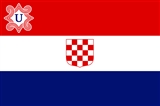
Independent State of Croatia

Encyclopedia
The Independent State of Croatia was a World War II
puppet state
of Nazi Germany
, established on a part of Axis
-occupied Yugoslavia
. The NDH was founded on 10 April 1941, after the invasion of Yugoslavia
by the Axis powers. All of Bosnia and Herzegovina
was annexed to NDH, together with some parts of Serbia
. The state was technically a monarchy
and Italian
protectorate
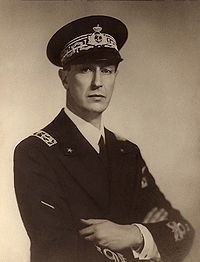
from the signing of the Rome agreements on May 19, 1941 until the Italian capitulation on September 8, 1943, but the king-designate, the Prince Aimone of Savoy-Aosta, refused to assume the crown in opposition to the Italian annexation of the Croat
-populated Yugoslav region of Dalmatia
. The state was actually controlled by the governing fascist Ustaše
movement and its Poglavnik,"Poglavnik" was a term coined by the Ustaše
, and it was originally used as the title for the leader of the movement. In 1941 it was institutionalized in the NDH as the title of first the Prime Minister (1941-43), and then the head of state (1943-45). It was at all times held by Ante Pavelić
and became synonymous with him. The translation of the term varies. The root of the word is the Croatian
word "glava", meaning "head" ("Po-glav(a)-nik"). The more literal translation is "head-man", while "leader" captures more of the meaning of the term (in relation to the German "Führer" and Italian "Duce"). Ante Pavelić
, which in turn were primarily under German influence. For its first two years up to 1943, the state was also a territorial condominium
of Germany and Italy. Additionally, central Dalmatia was annexed directly into Italian territory as part of the irredentist agenda of an Italian Mare Nostrum
(Our Sea). Italian influence collapsed in 1943, with the ousting of Italian fascist leader Benito Mussolini
. Racial targets of the NDH were Jews
, Serbs
and Roma people, against whom large-scale genocide
campaigns were conducted in places such as the Jasenovac concentration camp
.
, who was known by his Ustaše title, Poglavnik
, throughout the war, regardless of his official government post. From 1941 to 1943, while the country was a de jure
monarchy, Pavelić was its powerful Prime Minister
(or "President of the Government"). After the capitulation of Italy, Pavelić became the head of state
in the place of Aimone, Duke of Aosta ("Tomislav II") and retained the position of Prime Minister until early 1944, when he appointed Nikola Mandić
to replace him.
King of Croatia under his new royal name, Tomislav II. Tomislav II was not interested in being the figurehead King of Croatia, never actually visited the country and had no influence over the government. In the summer of 1941, Tomislav II declared that he would accept his position as King, only if certain demands were met:
The demands for German and Italian military departures were obviously impossible to be met by the Italian and German governments, and Tomislav II thus avoided taking up his position in Croatia.
Following the dismissal of Italian leader Benito Mussolini
on 25 July 1943, Tomislav II abdicated
on 31 July on the orders of King Victor Emmanuel III of Italy
. Shortly after the armistice with Italy in September 1943, Ante Pavelić declared that Tomislav II was no longer King of Croatia. Tomislav II formally renounced his title in October 1943 after the birth of his son Amedeo
, to whom he gave the name Zvonimir II.
Tomislav II's full title was "King of Croatia, Prince of Bosnia and Herzegovina, Voivode of Dalmatia, Tuzla and Knin, Duke of Aosta (from 1942), Prince of Cisterna and of Belriguardo, Marquess of Voghera, and Count of Ponderano."
.
This decree established five categories of individuals who would receive an invitation to be a member of parliament from the Ustaše-appointed government: living Croatian representatives from the Croatian Parliament of 1918, living Croatian representatives elected in the 1938 Yugoslavian elections, members of the Croatian Party of Rights prior to 1919, certain officials of the Supreme Ustaše Headquarters and two members of the German national assembly. The responsibility for assembling all eligible members of parliament was given to the head of the Supreme Court, Nikola Vukelić, who found 204 people to be eligible. In accordance with the decree, Vukelić ruled that those who had received the position of senator in 1939, had been part of Dušan Simović
's government, or had been part of the Yugoslav government-in-exile forfeited their eligibility. Two hundred and four people were declared eligible for the parliament, with 141 actually attending parliamentary meetings. Of the 204 eligible parliament members, 93 were members of the Croatian Peasant Party
, 56 of whom attended meetings.
The Parliament was only a deliberatory body and was not empowered to enact legislation. However, during the eighth session of the parliament in February 1942, the Ustaše regime was put on the defensive when a joint Croatian Peasant Party-Croatian Party of Rights motion, supported by 39 members of parliament, questioned about the whereabouts of the Peasant Party's leader Vladko Maček
. The following session, Ante Pavelić responded that Maček was being kept in isolation to prevent him from coming into contact with Yugoslav government officials. In less than a month, Maček was moved from the Jasenovac
concentration camp to house arrest
at his property in Kupinec. Maček was later called upon by foreigners to take a stand and counteract the Pavelić government, but he refused. Maček fled the country in 1945, with the help of Ustaše General Ante Moškov.
After its February 1942 session, the Parliament met only a few more times, and the decree was not renewed in 1943.
, but restored the courts' names to their original forms. The state had 172 local courts (kotar), 19 district courts (judicial tables), an administrative court and an appellate court (Ban's Table) in both Zagreb
and Sarajevo
, as well as a supreme court (Table of Seven) in Zagreb and a supreme court in Sarajevo. The state maintained men's penitentiaries in Lepoglava
, Hrvatska Mitrovica, Stara Gradiška and Zenica, and a women's penitentiary in Zagreb.
in April 1941 with the consent of the German armed forces (Wehrmacht
). The task of the new Croatian armed forces was to defend the new state against both foreign and domestic enemies. The Home Guard had an air force
and a minimal navy
. The NDH also created the Ustaška Vojnica, which was conceived as an elite militia, and a Croatian gendarmerie
.
The Croatian Home Guard was originally limited to 16 infantry
battalions and 2 cavalry
squadrons
- 16,000 men in total. The original 16 battalions were soon enlarged to 15 infantry regiments of two battalions each between May and June 1941, organised into five divisional commands, some 55,000 men. Support units included 35 light tanks supplied by Italy, 10 artillery battalions (equipped with captured Royal Yugoslav Army
weapons of Czech origin), a cavalry regiment in Zagreb and an independent cavalry battalion at Sarajevo. Two independent motorized infantry battalions were based at Zagreb and Sarajevo respectively.
Under the terms of the Rome Agreement with Italy, the NDH navy was restricted to a few coastal and patrol craft, which mostly patrolled inland waterways.
When established in 1941, the Air Force of the Independent State of Croatia
(ZNDH), consisted of captured Royal Yugoslav aircraft (seven operational fighters, 20 bombers and about 180 auxiliary and training aircraft) as well as paratroop, training and anti-aircraft artillery commands. During the course of the war on the Yugoslav Front it was supplemented with several hundred new or overhauled German, Italian and French fighters and bombers, until receiving the final deliveries of new aircraft from Germany in April 1945.
 The Croatian Air Force Legion , or HZL, was a military unit of the Air Force of the Independent State of Croatia
which fought alongside the Luftwaffe
on the Eastern Front
from 1941 to 1943 and then back on Croatian soil. The unit was sent to Germany for training on 15 July 1941 before heading to the Eastern Front. Many of the pilots and crews had previously served in the Royal Yugoslav Air Force during the Invasion of Yugoslavia
in April 1941. Some of them also had experience in the two main types that they would operate, the Messerschmitt 109 and Dornier Do 17
, with two fighter pilots having actually shot down Luftwaffe
aircraft.
During operations over the Eastern Front, the unit's fighters scored a total of 283 kills while its bombers participated in some 1,500 combat missions. Upon return to Croatia from December 1942, the unit's aircraft proved a welcome addition to the strike power of the Axis
forces fighting the Yugoslav Partisans on the Yugoslav Front right up to the end of 1944.
Because of low morale among Home Guard conscripts and their increasing disaffection with the Ustaša regime as the war progressed, partisan
s came to regard them as a key element in their supply line. According to William Deakin, who led one of the British missions to the partisan commander-in-chief Josip Broz Tito
, in some areas, partisans would release Home Guard soldiers after disarming them, so they could come back into the field with replacement weapons, which would again be seized. Other Home Guard soldiers either defected or actively channelled supplies to the partisans — particularly after the NDH ceded Dalmatia
to Italy. Home Guard troop numbers dwindled from 130,000 in early 1943 to 70,000 by late 1944, at which point the NDH government amalgamated the Home Guard with the Ustaše Army and was organised into eighteen divisions, including artillery and armoured units.
Despite these difficulties, the Croatian Army, with the help of the German-commanded XV Cossack
Corps and other Wehrmacht
formations, held its lines in Syrmia
, Slavonia
and Bosnia against the combined Soviet, Bulgaria
n and Partisan offensives from late 1944 to shortly before the NDH collapse in May 1945.
The Air Force of the Independent State of Croatia
provided some level of air support (attack, fighter and transport) right up until May 1945, encountering and sometimes defeating opposing aircraft from the British Royal Air Force
, United States Air Force
and the Soviet Air Force
. The final deliveries of up-to-date German Messerschmitt 109G and K fighter aircraft were still taking place in April 1945.
By the end of March, 1945, it was obvious to the Croatian Army Command that, although the front remained intact, they would eventually be defeated by sheer lack of ammunition. For this reason, the decision was made to retreat into Austria, in order to surrender to the British forces advancing north from Italy. The German Army was in the process of disintegration and the supply system lay in ruins.
The Croatian Army remained engaged in battle a week after the capitulation of Germany on 8 May 1945. At that time, the combined fighting forces numbered some 200,000 troops.
. The Croatian State Bank was the central bank
, responsible for issuing currency.
. The state maintained diplomatic missions
in several countries, all in Europe. Embassies of Nazi Germany, Italy, Tiso's Slovakia, Hungary, Romania, Bulgaria, Finland, Spain, and Japan, as well as the consulates of Italy, Sweden, Switzerland, Denmark, Portugal, Argentina and Vichy France
were located in Zagreb.
In 1941, the county was admitted to the Universal Postal Union
. On August 10, 1942 an agreement was signed at Brijuni
which re-established the Society of Railways Danube-Sava-Adriatic between the Independent State of Croatia, Germany
, Hungary
and Italy
. After the 11 December 1941 declaration of war by the Germany against United States, the Independent State of Croatia declared war on the United States and the United Kingdom on December 14.
The Independent State of Croatia signed the Geneva Conventions
on 20 January 1943.
Agreements between the two governments in mid 1941 regulated foreign trade and payments and the export of Croatian labour to Germany. Germany already controlled a large number of industrial and mining enterprises in Croatia that were owned in part or in full by German citizens or citizens of German-occupied countries. Many other enterprises in Croatia, especially in the bauxite mining and timber industries, were leased to the Germans for the duration of the war. The Germans also held large interests in Croatian commercial banks, exercised either directly by banks in Berlin and Vienna
, or indirectly, by German banks that had large interests in Prague
and Budapest
banks.
From the beginning, the Germans showed great interest in the high-quality iron ore mines of Ljubija in northwest Bosnia, in the industrial complex (steel, coal and heavy chemicals) in the Sarajevo
–Tuzla
–Zenica
triangle in northeast Bosnia, and in bauxite. As the war advanced and German military involvement in Croatia expanded, more and more Croatian industry was put to work for the Germans. The bauxite mines in Hercegovina, Dalmatia
and western Bosnia, were in the Italian zone of occupation, but their total production was earmarked for German needs for the duration of the war under the German-Italian agreement of 1941.
Other Croatian industrial assets utilized by the Germans included the production of brown coal and lignite, cement (major plants in Zagreb
and Split
), oil and salt.
Crude oil production, from fields to the east of Zagreb developed by the American Vacuum Oil Company, only started in November 1941 and never reached a high level, averaging 24000 barrels (3,815,695.1 l) a month in mid 1944.
The most important commodities manufactured in Croatia for German use were prefabricated barracks (utilizing the large Croatian timber industry), clothing, dry-cell batteries, bridge construction parts and ammunition (grenades).
The Vares
iron ore mine supplied the steel mill at Zenica, which had a capacity of 120,000 tons of steel annually. The Zenica mill, in turn, supplied the state arsenal in Sarajevo and the machinery and railroad car factory in Slavonski Brod
, both of which produced various items for the Wehrmacht
during the war, including grenades and shell casings. Some Vares iron ore was also exported to Italy, Hungary and Romania
.
, ship building operations in Split, a few brown coal mines supplying fuel to railways, shipping and industry, and rich bauxite fields.
, all of Bosnia and Herzegovina
, and part of modern-day Serbia
. It bordered the Third Reich to the north-west, Kingdom of Hungary to the north-east, Serbian administration (a joint German-Serb government) to the east, Montenegro (an Italian protectorate) to the south-east and Italy
along its coastal area.
allies, the Kingdoms of Hungary and Italy
.
Međimurje and southern Baranja were annexed (occupied) by the Kingdom of Hungary. NDH disputed this and continued to lay claim to both, naming the administrative province centred in Osijek as Great Parish Baranja, despite none of the region lying within its control. This border was never legislated, although Hungary may have considered the Pacta conventa
to be in effect, which delineated the two nation's borders along the Drava
river.
When compared to the republican borders established in the SFR Yugoslavia
after the war, the NDH encompassed the whole of Bosnia and Herzegovina
, with its majority of non-Croat (Serbian
and Bosniak
) populations, as well as some 20 km² of Slovenia
(villages Slovenska vas near Bregana
, Nova vas near Mokrice
, Jesenice in Dolenjsko
, Obrežje
and Čedem
) and the whole of Syrmia
(part of which was previously in the Danube Banovina
).
.
, with a view to creating a South Slav state in the aftermath of World War I. They saw this as a way to prevent Dalmatia being ceded to Italy under the Treaty of London (1915). The committee was succeeded by a national council
which in 1918 sent a delegation to the Serbian monarch to offer unification within a State of Slovenes, Croats and Serbs
. The leader of the Croatian Peasant Party
, Stjepan Radić
, warned on their departure for Belgrade that the council had no democratic legitimacy. But a new state, the Kingdom of Serbs, Croats and Slovenes, was duly proclaimed on 1 December 1918, with no heed taken of legal protocols such as the signing of a new Pacta Conventa in recognition of historic Croatian state rights.
Croats were at the outset politically disadvantaged with the centralized political structure of the kingdom, which was seen as favouring the Serb majority. The political situation of the Kingdom of Serbs, Croats, and Slovenes was fractious and violent. In 1927, the Independent Democratic Party
, which represented the Serbs of Croatia
, turned its back on the centralist policy of King Alexander. On 20 June 1928, Stjepan Radić and four other Croat deputies were shot while in the Belgrade parliament by a member of the Serbian People's Radical Party
. Three of the deputies, including Radić, died. Resultant outrage threatened to destabilise the kingdom. In January 1929, King Alexander
responded by proclaiming a royal dictatorship, under which all dissenting political activity was banned and renaming the state the "Kingdom of Yugoslavia".
One consequence of Alexander's 1929 proclamation and the repression and persecution of Croatian nationalists was a rise of support for the Croatian extreme nationalist, Ante Pavelić
, who had been a Zagreb deputy in the Yugoslav parliament and who was to be implicated in Alexander's assassination in 1934, went into exile in Italy and gained support for his vision of liberating Croatia from Serb control and racially "purifying" Croatia. While residing in Italy, Pavelić and other Croatian exiles founded the Ustaša insurgency.
in 1941, and the quick defeat of the Yugoslav Army (Jugoslavenska Vojska), the country was occupied by Axis forces. Slavko Kvaternik
, deputy leader of the Ustaše
proclaimed the establishment of the Independent State of Croatia (NDH - Nezavisna Država Hrvatska) on April 10, 1941. Pavelić, who was known by his Ustaše title, "Poglavnik" returned to Zagreb
from exile in Italy on 17 April and became the absolute leader of the NDH throughout its existence (the Axis powers had offered Vladko Maček the opportunity to form a government, since Maček and his party, the Croatian Peasant Party
(Croatian: Hrvatska seljačka stranka - HSS) had the greatest electoral support among Yugoslavia's Croats. Maček refused that offer.)
Acceding to the demands of Benito Mussolini
Fascist
regime in the Kingdom of Italy
, Pavelić reluctantly accepted Aimone the 4th Duke of Aosta
as a figurehead
King of the NDH under his new royal name, Tomislav II. Tomislav II never visited the NDH and had no influence over the government, which was dominated by Pavelić. Tomislav II was not interested in being the figurehead King of Croatia. On learning that he had been named King of Croatia, he told close colleagues that he thought his nomination was a bad joke by his cousin King Victor Emmanuel III
though he accepted the crown out of a sense of duty. Tomislav II's position was intended by the Italian Fascist regime to legitimize the presence of Italian armed forces on Croatian soil.
From a strategic perspective, establishment of the NDH was a means by Mussolini and Hitler to pacify the Croats, while reducing the use of Axis resources, which were more urgently needed for Operation Barbarossa
. Meanwhile, Mussolini used his long-established support for Croatian independence as leverage to coerce Pavelić into signing an agreement on 19 May 1941, under which central Dalmatia
and parts of Hrvatsko primorje and Gorski kotar
were ceded to Italy. Under the same agreement, the NDH was restricted to a minimal navy
and Italian forces were granted military control of the entire Croatian coastline. After Pavelić signed the agreement, other Croatian politicians rebuked him. Pavelić publicly defended the decision and thanked Germany and Italy for supporting Croatian independence. This concession to Italy sowed the seeds of discontent between the "home" and "emigre" elements of the Ustaša that continued through the lifetime of the NDH.
After refusing leadership of the NDH, Maček called on all to obey and cooperate with the new government. The Roman Catholic Church
was also openly supportive of the government. According to Maček, the new state was greeted with a "wave of enthusiasm" in Zagreb, often by people "blinded and intoxicated" by the fact that the Germans had "gift-wrapped their occupation under the euphemistic title of Independent State of Croatia". But in the villages, Maček wrote, the peasantry believed that "their struggle over the past 30 years to become masters of their homes and their country had suffered a tremendous setback". (Maček pp. 220–231).
Dissatisfied with the Pavelić regime in its early months, the Axis Powers in September 1941 asked Maček to take over, but Maček again refused. Perceiving Maček as a potential rival, Pavelić subsequently had him arrested and imprisoned in the Jasenovac
concentration camp. The Ustaše initially did not have an army or administration capable of controlling all the territory of the NDH. The Ustaše movement had fewer than 12,000 members when the war started. While the Ustaše's own estimates put the number of their sympathizers even in the early phase at around 40,000. The northeastern half of NDH territory was in the so-called "German Zone of Influence" where the German armed forces (Wehrmacht
) exercised de facto control. The southwestern portion of the NDH was controlled by the Italian army until capitulation of Fascist Italy
in 1943, when the NDH acquired control of northern Dalmatia (Split and Šibenik
).
(HSS) and the Catholic Church, were relatively uninvolved in the creation and maintenance of the Independent State of Croatia. Many organizations that opposed or threatened the Ustaše were eventually outlawed. For example, the Croatian Peasant Party was banned on 11 June 1941 in an attempt by the Ustaše to displace the party as the primary representative of the Croatian peasantry and its leader, Vladko Maček
, was sent to the Jasenovac concentration camp
. The Catholic Church initially participated in state mandated religious conversions, but eventually the main branches of the Church stopped when it became obvious that these conversions were merely a form of punishment for the undesirable population.
 Italian Fascist dictator Benito Mussolini and Ante Pavelić had close relations prior to the war. Mussolini and Pavelić both despised the Kingdom of Yugoslavia. Italy had been promised, in the London Pact
of 1915, that it would receive Dalmatia from Austria-Hungary at the end of World War I. The peace negotiations in 1919, however, influenced by the Fourteen Points
proclaimed by Woodrow Wilson, called for national self-determination and determined that the Yugoslavs rightfully deserved the territory in question. Italian nationalists were enraged. Italian nationalist Gabriele D'Annunzio
raided the Croatian town of Fiume (which held a mixed population of Croats and Italians) and proclaimed it part of the Italian Regency of Carnaro
. D'Annunzio declared himself "Duce
" of Carnaro and his blackshirted revolutionaries held control over the town. D'Annunzio was known for engaging in passionate speeches aimed to draw Croatian nationalists to support his actions and to oppose Yugoslavia. Croatian nationalists, such as Pavelić, opposed the border changes that occurred after World War I. Not only was D'Annunzio's symbolism copied by Mussolini but also D'Annunzio's appeal to Croatian support for the dismantling Yugoslavia was copied and implemented as a foreign policy approach to Yugoslavia by Mussolini.
Pavelić had been in negotiations with Fascist Italy since 1927 that included advocating a territory-for-sovereignty swap in which he would tolerate Italy annexing its claimed territory in Dalmatia in exchange for Italy supporting the sovereignty of an independent Croatia. In the 1930s, upon Pavelić and the Ustaše being forced into exile by the Yugoslav government, Mussolini offered Pavelić and the Ustaše sanctuary in Italy and allowed them to use training grounds to prepare for war against Yugoslavia. In exchange for this support, Mussolini demanded that Pavelić agree that Dalmatia
would become part of Italy if Italy and the Ustaše successfully waged war on Yugoslavia. Although Dalmatia was a largely Croat-populated territory, it had been part of various Italian states, such as the Roman Empire
and the Republic of Venice
, for centuries and was part of Italian nationalism
's irredentist claims. In exchange for this concession, Mussolini offered Pavelić the right for Croatia to annex all of Bosnia and Herzegovina
, which had only a minority Croat population. Pavelić agreed to this controversial exchange.
After the invasion and occupation of Yugoslavia, Italy annexed numerous Adriatic islands and a portion of Dalmatia
that was formed into the Italian Governorship of Dalmatia
including territory from the provinces of Split
, Zadar
, and Kotor
. Though Italy had initially larger territorial aims that extended from the Velebit mountains
to the Albanian Alps, Mussolini decided against annexing further territories due to a number of factors, including that Italy held economically valuable territory within its possession while the northern Adriatic coast had no important railways or roads and because a larger annexation would have included hundreds of thousands of Slavs who were hostile to Italy, within its national borders.
Italy intended to keep the NDH within its sphere of influence by forbidding it to build any significant navy. Italy only permitted small patrol boats to be used by NDH forces. This policy forbidding the creation of NDH warships was part of the Italian Fascists' policy of Mare Nostrum (Latin for "Our Sea") in which Italy was to dominate the Mediterranean as the Roman Empire
had done centuries earlier.
Italian armed forces assisted the Ustaše government in persecuting Serbs. In 1941, Italian forces captured and interned the Serbian Orthodox Bishop Irinej of Dalmatia
.
was uneasy with Mussolini's agenda of creating a puppet Croatian state, and preferred that areas outside of Italian territorial aims become part of Hungary as an autonomous territory. This would appease Germany's ally Hungary and its nationalist territorial claims and would also avoid the creation of a Slavic puppet state, as Hitler viewed all Slavs as racially degenerate.
The German position on Croatia changed after the invasion of Yugoslavia in 1941. The invasion was spearheaded by a strong German invasion force which was largely responsible for the capture of Yugoslavia. Military forces from other Axis powers, including Italy, Hungary, and Bulgaria made few gains during the invasion. The invasion was precipitated by the need for German forces to reach Greece to save Italian forces, which were failing on the battlefield against the Greek armed forces. Upon rescuing Italian forces in Greece and having conquered Yugoslavia and Greece almost single handedly, Hitler became frustrated with Mussolini and Italy's military incompetence. Germany improved relations with the Ustaše and supported the NDH claims to annex the Adriatic Coast in order reduce Italy's planned territorial gains. Nevertheless, Italy annexed a significant central portion of Dalmatia and various Adriatic Islands. This was not what had been agreed with Pavelić prior to the invasion; Italy had expected to annex all of Dalmatia as part of its irredentist claims.
Hitler sparred with his army commanders over what policy should be undertaken in Croatia regarding the Serbs. German military officials thought that Serbs could be rallied to fight against the Partisans. Hitler disagreed with his commanders, but pointed out to Pavelić that the NDH could create a completely Croat state only if it followed a constant policy of persecution of the non-Croat population for at least fifty years.
According to reports by General Glaise-Horstenau, Hitler was angry with Pavelić, whose policy inflamed the rebellion in Croatia, thwarting any prospect of deploying NDH forces on the Eastern Front. Moreover, Hitler was forced to engage large forces of his own to keep the rebellion in check. For that reason, Hitler summoned Pavelić to his war headquarters in Vinnytsia
(Ukraine) on 23 September 1942. Consequently, Pavelić replaced his minister of the Armed Forces, Slavko Kvaternik, with the less zealous Jure Francetić. Kvaternik was sent into exile in Slovakia - along with his son Eugen, who was blamed for the persecution of the Serbs in Croatia. Before meeting Hitler, to appease the public, Pavelić published an "Important Government Announcement" (»Važna obavijest Vlade«), in which he threatened those who were spreading the news "about non-existent threats of disarmament of the Ustashe units by representatives of one foreign power, about the Croatian Army replacement by a foreign army, about the possibility that a foreign power would seize the power in Croatia ..."
General Glaise-Horstenau reported: "The Ustaše movement is, due to the mistakes and atrocities they have committed and the corruption, so compromised that the government executive branch (the home guard and the police) shall be separated from the government - even for the price of breaking any possible connection with the government."
Reichsführer-SS Heinrich Himmler
is quoted characterizing the Independent State of Croatia as "ridiculous": "our beloved German settlements will be secured. I hope that the area south of Srem will be liberated by [...] the Bosnian division
[...] so that we can at least restore partial order in this ridiculous (Croatian) state."
The Ustaše gained German support for plans to eliminate the Serb population in Croatia. One plan involved an exchange in 1941 between Germany and the NDH, in which 20,000 Catholic Slovenes would be deported from German-held Slovenia and sent to the NDH where they would be assimilated as Croats. In exchange, 20,000 Serbs would be deported from the NDH and sent to the rump Serbian State. The German occupation forces allowed the expulsion of Serbs to Serbia, but instead of sending the Slovenes to Croatia, they were also deported to Serbia. In total, about 300,000 Serbs had been deported or fled from the NDH to Serbia by the end of World War II.
The atrocities committed by the Ustaše stunned observers, Brigadier Sir Fitzroy MacLean, Chief of the British military mission to the Partisans commented, "Some Ustaše collected the eyes of Serbs they had killed, sending them, when they had enough, to the Poglavnik ['head-man'] for his inspection or proudly displaying them and other human organs in the cafés of Zagreb."
The Nazi regime demanded that the Ustaše adopt anti-Semitic racial policies, persecute Jews and set up concentration camps. Pavelic and the Ustaše accepted Nazi demands, but their racial policy focused primarily on eliminating the Serb population. When the Ustaše needed more recruits to help exterminate the Serbs, and the state broke away from Nazi anti-Semitic policy by promising honorary Aryan citizenship, and thus freedom from persecution, to Jews who were willing to fight for the NDH. As this was the only legal means allowing Jews to escape persecution, a number of Jews joined the NDH's armed forces. This aggravated the German SS, which claimed that the NDH let 5,000 Jews survive via service in the NDH's armed forces. German anti-Semitic objectives for Croatia were further undermined by Italy's reluctance to adhere to a strict anti-Semitic policy, which resulted in Jews in Italian-held parts of Croatia avoiding the same persecution facing Jews in German-held eastern Croatia.
After Italy abandoned the war in 1943, German forces occupied western Croatia and the NDH annexed the territory ceded to Italy in 1941.
 The Ustaše's genocidal onslaught on its minorities provoked mass movements of resistance, inspired in part by royalist (Četnik) and – more effectively – communist (Partisan) ideologies, but driven primarily by a determination to fight back by any means. The uprisings were particularly strong in rural areas where many village populations fled from the terror and then mounted guerilla operations from vantage points in the mountains and forests. On 22 June 1941, the First Sisak Partisan Brigade was formed in the Brezovica forest near Sisak
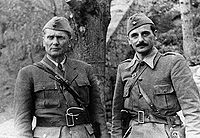
, Croatia; this was to be celebrated as the first armed resistance unit formed in occupied Europe during World War II. Croats, Serbs, Bosniaks, and citizens of all nationalities and backgrounds began joining the pan-Yugoslav Partisans led by Josip Broz Tito
. The Partisan movement was soon able to control a large percentage of the NDH (and Yugoslavia) and before long the cities of occupied Bosnia
and Dalmatia
in particular were surrounded by these Partisan-controlled areas, with their garrisons living in a de-facto state of siege and constantly trying to maintain control of the rail-links.
Croats were significantly more numerous than Serbs among the Partisan ranks. In 1944, the third year of the war in Yugoslavia, Croats formed 60% of the Partisan operational units originating from the Federal State of Croatia. The Partisan movement was generally multiethnic, although at least one Croatian unit was overwhelmingly Serbian (the 6th Lika Proletariat Division "Nikola Tesla"). FS Croatia also had the highest number of detachments and brigades among the federal units, and together with the forces in Bosnia and Herzegovina, Partisan resistance in the NDH made up the majority of the movement's military strength. The Partisan commander, Marshall Josip Broz Tito, was half Slovene, half Croatian.
in Serbia, the Chetnik groups in central, eastern, and northwestern Bosnia
found themselves caught between the German and Ustaše
(NDH) forces on one side and the Partisans on the other. In early 1942 Chetnik Major Jezdimir Dangić
approached the Germans in an attempt to arrive at an understanding, but was unsuccessful, and the local Chetnik leaders were forced to look for another solution. The Chetnik groups were in fundamental disagreement with the Ustaše on practically all issues, but they found a common enemy in the Partisans, and this was the overriding reason for the collaboration which ensued between the Ustaše
authorities of the Independent State of Croatia and Chetnik detachments in Bosnia. The first formal agreement between Bosnian Chetniks and the Ustaše
was concluded on 28 May 1942, in which Chetnik leaders expresseed their loyalty as "citizens of the Independent State of Croatia" both to the state and its Poglavnik (Ante Pavelić
). During the next three weeks, three additional agreements were signed, covering a large part of the area of Bosnia (along with the Chetnik detachments within it). By the provision of these agreements, the Chetniks were to cease hostilities against the Ustaše state, and the Ustaše would establish regular administration in these areas. The main provision, Art. 5 of the agreement, states as follows:
The necessary ammunition and provisions were supplied to the Chetniks by the Ustaše military. Chetniks who were wounded in such operations would be cared for in NDH hospitals, while the orphans and widows of Chetniks killed in action would be supported by the Ustaše state. Persons specifically recommended by Chetnik commanders would be returned home from the Ustaše concentration camps (Jasenovac concentration camp
). These agreements covered the majority of Chetnik forces in Bosnia east of the German-Italian demarcation line, and lasted throughout most of the war. Since Croatian forces were immediately subordinate to the German military occupation, collaboration with Croatian forces was, in fact, indirect collaboration with the Germans.
and Minister of War Ante Vokić
to execute a coup d'état
against Ante Pavelić. The Lorković-Vokić coup
failed and its conspirators were executed.
By early 1945, the NDH army withdrew towards Zagreb with German and Cossak troops, and continued fighting for a week after the German surrender on May 9, 1945. They were soon overpowered and the Independent State of Croatia (NDH) effectively ceased to exist in May 1945.
The advance of Tito's partisan forces, joined by the Soviet
Red Army
, caused mass retreat of the Ustaše towards Austria. In May 1945, a large column composed of anti-communists, Chetniks, Ustaša followers, NDH Army troops and civilians retreated from the partisan forces, heading northwest towards Italy and Austria. Ante Pavelić detached from the group and fled to Austria, Italy, Argentina
and finally Spain, where he died in 1959. The rest of the group, consisting of over 150,000 soldiers (including Cossak troops) and civilians, negotiated with the British forces for passage to the Austrian side of the Austrian-Slovenian border. The British Army, however, turned disarmed soldiers and civilians over to the partisan forces.
The end of the war resulted in the establishment of the Democratic Republic of Yugoslavia (which later became the Socialist Federal Republic of Yugoslavia
), with the Constitution of 1946 officially making each of Croatia
and Bosnia and Herzegovina
one of the six constituent republics of the new state.
, the current Constitution of Croatia
does not recognize the Independent State of Croatia as the historical or legitimate predecessor state of the current Croatian republic. Despite this, upon declaring independence from Yugoslavia, the Republic of Croatia rehabilitated the Croatian Home Guard
, who now receive a state pension. German soldiers who died on Croatian territory were not commemorated until Germany and Croatia reached an agreement on marking their grave sites in 1996. The German War Graves Commission
maintains two large cemeteries in Zagreb and Split.
, 1,925,000 were Serbs
, 700,000 were Muslims
, 150,000 Germans
, 65,000 Czechs and Slovaks
, 40,000 Jews
, and 30,000 Slovenes. Croats comprised slightly over half of the population of the Independent State of Croatia. With Muslims treated as Croats the Croat share of the total population was still less than two-thirds.
n refugees who were forcefully evicted from their homes as part of the German plan of annexing parts of the Slovenian territories. As part of this deal, the Ustaše were to deport 200,000 Serbs from Croatia military regions; however, only 182,000 had been deported when German high commander Bader stopped this mass transport of people because of the uprising of Chetniks and partisans in Serbia
. Because of this, 25,000 Slovenian refugees ended in Serbia.
Internal colonization to the region of Slavonia
was encouraged during this period from Dalmatia
, Lika
, Hrvatsko Zagorje
and Bosnia and Herzegovina
. The state maintained an Office of Colonization in Mostar, Osijek, Petrinja, Sarajevo, Sremska Mitrovica, and Zagreb.
 On the first day of his arrival in Zagreb, Ante Pavelić
proclaimed a law that remained in effect during the entire period of the Independent State of Croatia. The law, which was enacted on 17 April 1941, declared that all people who offend, or try to offend, the Croatian nation are guilty of treason — a crime punishable by death. One day later, the first Croatian antisemitic racial law was published. This law did not create panic among the Jewish population, because they believed it was merely a continuation of the antisemitic laws of the Kingdom of Yugoslavia, which were proclaimed in 1939. However, the situation quickly changed on April 30, with the publication of the Aryan race
laws.
A notable part of the racial legislation was the religious conversion laws, the implications of which were not understood by the majority of the population when they were published on 3 May 1941. The implications become clear following the July speech of the minister of education, Mile Budak
, in which he declared: "We will kill one third of all Serbs. We will deport another third, and the rest of them will be forced to convert to Catholicism." Racial laws were enforced until 3 May 1945, when they were abolished.
The NDH government cooperated with the Nazi Germany in the Holocaust
and exercised their own version of the genocide
against ethnic Serbs living in their borders. State policy about Serbs has been first declared in words of Miroslav Žanić minister of NDH Legislative council on 2 May 1941: "This country can only be Croatian country, and there is no method we would hesitate to use in order to make it truly Croatian and cleanse it of Serbs, who have for centuries endangered us and who will endanger us again if they are given opportunity."
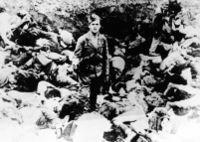
At least 330,000 Serbs, 30,000 Jews and 30,000 Roma were killed during the NDH (see Jasenovac
) and the same number of Serbs were forced out of the NDH. Although the Ustase's main target for persecution were the Serbs, it also participated in the destruction of the Jewish population. The NDH deviated from Nazi anti-Semitic policy by promising honorary Aryan citizenship to some Jews, if they were willing to enlist and fight for the NDH.
According to the 1931 and 1948 census, the Serb population declined in Croatia and Bosnia:
!Serbs
! class="background: red; color: purple" |Croatia
! class="background: red; color: white" |Bosnia and Herzegovina
! class="background: red; color: blue" | Srem, Serbia
! class="background: red; color: white" | Total
|-
|class="hintergrundfarbe6"| 1931 Census
| style="text-align:right; width:100px;"| 633.000
| style="text-align:right; width:100px;"| 1.028.139
| style="text-align:right; width:100px;"| 210.000
| style="text-align:right; width:80px;"| 1.871.000
|-
|class="hintergrundfarbe6" | 1948 Census
| style="text-align:right;"| 543.795
| style="text-align:right;"| 1.136.116
| style="text-align:right;"| unknown
| style="text-align:right;"| 1.672.000+
|}
. The country had four state theatres: Zagreb, Osijek
, Dubrovnik
and in Sarajevo
. The Croatian State Theatre in Zagreb played host to the Berlin Philharmonic and the Teatro dell'Opera di Roma
in the 1941/42 season. Volumes two to five of Mate Ujević
's Croatian Encyclopedia
were published during this period. The NDH was represented at the 1942 Venice Biennale
, where the works of Joza Kljaković, Ivan Meštrović
, Ante Motika, Ivo Režek, Bruno Bulić, Josip Crnobori, Antun Medić, Slavko Kopač and Slavko Šohaj were presented by Vladimir Kirin.
The state had one university, the University of Zagreb
, then known as the Croatian University. The university established a pharmaceutical faculty in 1942, and a medical faculty in Sarajevo in 1944. It also opened the Clinical Hospital Centre
, which would become the largest in Croatia. The Croatian Red Cross
was established in 1941, with Kurt Hühn serving as its president. After the NDH signed the Geneva Conventions
in 1943, the International Committee of the Red Cross
named Julius Schmidlin as its representative to the country.
The state had two secular holidays; the anniversary of its establishment was commemorated on 10 April and the assassination of Stjepan Radić
was commemorated on 20 June 1928. In addition, the state granted holidays to several religious communities:
The state film institute, Hrvatski slikopis, produced many films, including Straža na Drini
and Lisinski
. The Croatian cinema pioneer Oktavijan Miletić
, was active during this period. In 1943, Zagreb hosted the I. International Congress for Narrow Film
.
On 29 April 1941 the Decree on building Croatian workers' family homes was issued which resulted in the development of so-called Pavelić neighbourhoods in the state's larger northern cities: Karlovac, Osijek, Sisak, Varaždin, and Zagreb. The neighbourhoods were largely based on similar workers housing in Germany. They are characterized by their wide avenues and lots, and for largely being made up of semi-detached homes.
The state's main radio station was Hrvatski Krugoval
, known before the war as Radio Zagreb. The NDH increased the transmitter
's power to 10 kW. The radio station was based in Zagreb, but had branches in Banja Luka
, Dubrovnik
, Osijek
and Sarajevo
. It maintained cooperation with the International Broadcasting Union.
, which had its own league system
, with the highest level known as the Zvonimir Group. Top clubs included Građanski Zagreb, Concordia Zagreb and HAŠK
. The Croatian Football Federation
was accepted into FIFA
on July 17, 1941. The national football team
played 15 matches
representing the NDH as an independent state.
The NDH had other national teams. The Croatian Handball Federation
organized a national handball league, and a national team
. Its boxing team was led by African-American Jimmy Lyggett
. The Croatian Table-Tennis Association organized a national competition as well as a national team which participated in a few international matches. The Croatian Olympic Committee
was recognized as a special member of the International Olympic Committee
, with Franjo Bučar
acting as its representative. The Croatian Skiing Association organized a national championship, held on Zagreb's Sljeme
mountain. A national bowling
competition was held in 1942 in Zagreb which was won by Dušan Balatinac.
World War II
World War II, or the Second World War , was a global conflict lasting from 1939 to 1945, involving most of the world's nations—including all of the great powers—eventually forming two opposing military alliances: the Allies and the Axis...
puppet state
Puppet state
A puppet state is a nominal sovereign of a state who is de facto controlled by a foreign power. The term refers to a government controlled by the government of another country like a puppeteer controls the strings of a marionette...
of Nazi Germany
Nazi Germany
Nazi Germany , also known as the Third Reich , but officially called German Reich from 1933 to 1943 and Greater German Reich from 26 June 1943 onward, is the name commonly used to refer to the state of Germany from 1933 to 1945, when it was a totalitarian dictatorship ruled by...
, established on a part of Axis
Axis Powers
The Axis powers , also known as the Axis alliance, Axis nations, Axis countries, or just the Axis, was an alignment of great powers during the mid-20th century that fought World War II against the Allies. It began in 1936 with treaties of friendship between Germany and Italy and between Germany and...
-occupied Yugoslavia
Kingdom of Yugoslavia
The Kingdom of Yugoslavia was a state stretching from the Western Balkans to Central Europe which existed during the often-tumultuous interwar era of 1918–1941...
. The NDH was founded on 10 April 1941, after the invasion of Yugoslavia
Invasion of Yugoslavia
The Invasion of Yugoslavia , also known as the April War , was the Axis Powers' attack on the Kingdom of Yugoslavia which began on 6 April 1941 during World War II...
by the Axis powers. All of Bosnia and Herzegovina
Bosnia and Herzegovina
Bosnia and Herzegovina , sometimes called Bosnia-Herzegovina or simply Bosnia, is a country in Southern Europe, on the Balkan Peninsula. Bordered by Croatia to the north, west and south, Serbia to the east, and Montenegro to the southeast, Bosnia and Herzegovina is almost landlocked, except for the...
was annexed to NDH, together with some parts of Serbia
Serbia
Serbia , officially the Republic of Serbia , is a landlocked country located at the crossroads of Central and Southeast Europe, covering the southern part of the Carpathian basin and the central part of the Balkans...
. The state was technically a monarchy
Monarchy
A monarchy is a form of government in which the office of head of state is usually held until death or abdication and is often hereditary and includes a royal house. In some cases, the monarch is elected...
and Italian
Kingdom of Italy (1861–1946)
The Kingdom of Italy was a state forged in 1861 by the unification of Italy under the influence of the Kingdom of Sardinia, which was its legal predecessor state...
protectorate
Protectorate
In history, the term protectorate has two different meanings. In its earliest inception, which has been adopted by modern international law, it is an autonomous territory that is protected diplomatically or militarily against third parties by a stronger state or entity...
from the signing of the Rome agreements on May 19, 1941 until the Italian capitulation on September 8, 1943, but the king-designate, the Prince Aimone of Savoy-Aosta, refused to assume the crown in opposition to the Italian annexation of the Croat
Croats
Croats are a South Slavic ethnic group mostly living in Croatia, Bosnia and Herzegovina and nearby countries. There are around 4 million Croats living inside Croatia and up to 4.5 million throughout the rest of the world. Responding to political, social and economic pressure, many Croats have...
-populated Yugoslav region of Dalmatia
Dalmatia
Dalmatia is a historical region on the eastern coast of the Adriatic Sea. It stretches from the island of Rab in the northwest to the Bay of Kotor in the southeast. The hinterland, the Dalmatian Zagora, ranges from fifty kilometers in width in the north to just a few kilometers in the south....
. The state was actually controlled by the governing fascist Ustaše
Ustaše
The Ustaša - Croatian Revolutionary Movement was a Croatian fascist anti-Yugoslav separatist movement. The ideology of the movement was a blend of fascism, Nazism, and Croatian nationalism. The Ustaše supported the creation of a Greater Croatia that would span to the River Drina and to the border...
movement and its Poglavnik,"Poglavnik" was a term coined by the Ustaše
Ustaše
The Ustaša - Croatian Revolutionary Movement was a Croatian fascist anti-Yugoslav separatist movement. The ideology of the movement was a blend of fascism, Nazism, and Croatian nationalism. The Ustaše supported the creation of a Greater Croatia that would span to the River Drina and to the border...
, and it was originally used as the title for the leader of the movement. In 1941 it was institutionalized in the NDH as the title of first the Prime Minister (1941-43), and then the head of state (1943-45). It was at all times held by Ante Pavelić
Ante Pavelic
Ante Pavelić was a Croatian fascist leader, revolutionary, and politician. He ruled as Poglavnik or head, of the Independent State of Croatia , a World War II puppet state of Nazi Germany in Axis-occupied Yugoslavia...
and became synonymous with him. The translation of the term varies. The root of the word is the Croatian
Croatian language
Croatian is the collective name for the standard language and dialects spoken by Croats, principally in Croatia, Bosnia and Herzegovina, the Serbian province of Vojvodina and other neighbouring countries...
word "glava", meaning "head" ("Po-glav(a)-nik"). The more literal translation is "head-man", while "leader" captures more of the meaning of the term (in relation to the German "Führer" and Italian "Duce"). Ante Pavelić
Ante Pavelic
Ante Pavelić was a Croatian fascist leader, revolutionary, and politician. He ruled as Poglavnik or head, of the Independent State of Croatia , a World War II puppet state of Nazi Germany in Axis-occupied Yugoslavia...
, which in turn were primarily under German influence. For its first two years up to 1943, the state was also a territorial condominium
Condominium (international law)
In international law, a condominium is a political territory in or over which two or more sovereign powers formally agree to share equally dominium and exercise their rights jointly, without dividing it up into 'national' zones.Although a condominium has always been...
of Germany and Italy. Additionally, central Dalmatia was annexed directly into Italian territory as part of the irredentist agenda of an Italian Mare Nostrum
Mare Nostrum
Mare Nostrum may refer to:*Mare Nostrum, the Roman term for the Mediterranean Sea, adopted by Italian nationalists and fascists.*Mare Nostrum , a Spanish-language novel by Vicente Blasco Ibáñez...
(Our Sea). Italian influence collapsed in 1943, with the ousting of Italian fascist leader Benito Mussolini
Benito Mussolini
Benito Amilcare Andrea Mussolini was an Italian politician who led the National Fascist Party and is credited with being one of the key figures in the creation of Fascism....
. Racial targets of the NDH were Jews
Jews
The Jews , also known as the Jewish people, are a nation and ethnoreligious group originating in the Israelites or Hebrews of the Ancient Near East. The Jewish ethnicity, nationality, and religion are strongly interrelated, as Judaism is the traditional faith of the Jewish nation...
, Serbs
Serbs
The Serbs are a South Slavic ethnic group of the Balkans and southern Central Europe. Serbs are located mainly in Serbia, Montenegro and Bosnia and Herzegovina, and form a sizable minority in Croatia, the Republic of Macedonia and Slovenia. Likewise, Serbs are an officially recognized minority in...
and Roma people, against whom large-scale genocide
Genocide
Genocide is defined as "the deliberate and systematic destruction, in whole or in part, of an ethnic, racial, religious, or national group", though what constitutes enough of a "part" to qualify as genocide has been subject to much debate by legal scholars...
campaigns were conducted in places such as the Jasenovac concentration camp
Jasenovac concentration camp
Jasenovac concentration camp was the largest extermination camp in the Independent State of Croatia and occupied Yugoslavia during World War II...
.
Government
The absolute leader of the NDH was Ante PavelićAnte Pavelic
Ante Pavelić was a Croatian fascist leader, revolutionary, and politician. He ruled as Poglavnik or head, of the Independent State of Croatia , a World War II puppet state of Nazi Germany in Axis-occupied Yugoslavia...
, who was known by his Ustaše title, Poglavnik
Poglavnik
Poglavnik was the title used by Ante Pavelić, leader of World War II Croatian fascist movement Ustaše and of the Independent State of Croatia between 1941 and 1945.-Etymology and usage:...
, throughout the war, regardless of his official government post. From 1941 to 1943, while the country was a de jure
De jure
De jure is an expression that means "concerning law", as contrasted with de facto, which means "concerning fact".De jure = 'Legally', De facto = 'In fact'....
monarchy, Pavelić was its powerful Prime Minister
Prime minister
A prime minister is the most senior minister of cabinet in the executive branch of government in a parliamentary system. In many systems, the prime minister selects and may dismiss other members of the cabinet, and allocates posts to members within the government. In most systems, the prime...
(or "President of the Government"). After the capitulation of Italy, Pavelić became the head of state
Head of State
A head of state is the individual that serves as the chief public representative of a monarchy, republic, federation, commonwealth or other kind of state. His or her role generally includes legitimizing the state and exercising the political powers, functions, and duties granted to the head of...
in the place of Aimone, Duke of Aosta ("Tomislav II") and retained the position of Prime Minister until early 1944, when he appointed Nikola Mandić
Nikola Mandic
Nikola Mandić , was a Croatian politician.Mandić was born in what was then Ottoman Bosnia and Herzegovina in Travnik in 1869 . Mandić finished gymnasium in Sarajevo. He later doctored in law at Vienna in 1894...
to replace him.
Monarchy
Upon the formation of the NDH, Pavelić conceded to the accession of Aimone, the 4th Duke of Aosta, as a figureheadFigurehead
A figurehead is a carved wooden decoration found at the prow of ships largely made between the 16th and 19th century.-History:Although earlier ships had often had some form of bow ornamentation A figurehead is a carved wooden decoration found at the prow of ships largely made between the 16th and...
King of Croatia under his new royal name, Tomislav II. Tomislav II was not interested in being the figurehead King of Croatia, never actually visited the country and had no influence over the government. In the summer of 1941, Tomislav II declared that he would accept his position as King, only if certain demands were met:
- that he should be informed about all Italian activities on NDH territory;
- that his reign should be confirmed by the NDH Croatian State Parliament; and
- that politics should play no part in the Croatian armed forces.
The demands for German and Italian military departures were obviously impossible to be met by the Italian and German governments, and Tomislav II thus avoided taking up his position in Croatia.
Following the dismissal of Italian leader Benito Mussolini
Benito Mussolini
Benito Amilcare Andrea Mussolini was an Italian politician who led the National Fascist Party and is credited with being one of the key figures in the creation of Fascism....
on 25 July 1943, Tomislav II abdicated
Abdication
Abdication occurs when a monarch, such as a king or emperor, renounces his office.-Terminology:The word abdication comes derives from the Latin abdicatio. meaning to disown or renounce...
on 31 July on the orders of King Victor Emmanuel III of Italy
Victor Emmanuel III of Italy
Victor Emmanuel III was a member of the House of Savoy and King of Italy . In addition, he claimed the crowns of Ethiopia and Albania and claimed the titles Emperor of Ethiopia and King of Albania , which were unrecognised by the Great Powers...
. Shortly after the armistice with Italy in September 1943, Ante Pavelić declared that Tomislav II was no longer King of Croatia. Tomislav II formally renounced his title in October 1943 after the birth of his son Amedeo
Amedeo, 5th Duke of Aosta
Prince Amedeo of Savoy-Aosta, Duke of Aosta, is a claimant to the headship of the House of Savoy, the family which ruled Italy from 1861 to 1946, as well as the heir to the short-lived Kingdom of Croatia during World War II...
, to whom he gave the name Zvonimir II.
Tomislav II's full title was "King of Croatia, Prince of Bosnia and Herzegovina, Voivode of Dalmatia, Tuzla and Knin, Duke of Aosta (from 1942), Prince of Cisterna and of Belriguardo, Marquess of Voghera, and Count of Ponderano."
Parliament
The NDH Parliament was established by the Legal Decree on the Croatian State Parliament on 24 January 1942. The parliament members were not elected and meetings were convened just over a dozen times after the initial session in 1942. Its president vas Marko DosenMarko Došen
Marko Došen was a Croatian politician.Born in Mušaluk near Gospić, Došen finished elementary school in Lika and one grade of gymnasium in Bjelovar. He entered into trade, but in 1890 moved to Russia where he opened a bookstore in Saint Petersburg...
.
This decree established five categories of individuals who would receive an invitation to be a member of parliament from the Ustaše-appointed government: living Croatian representatives from the Croatian Parliament of 1918, living Croatian representatives elected in the 1938 Yugoslavian elections, members of the Croatian Party of Rights prior to 1919, certain officials of the Supreme Ustaše Headquarters and two members of the German national assembly. The responsibility for assembling all eligible members of parliament was given to the head of the Supreme Court, Nikola Vukelić, who found 204 people to be eligible. In accordance with the decree, Vukelić ruled that those who had received the position of senator in 1939, had been part of Dušan Simović
Dušan Simovic
Dušan T. Simović was a Yugoslav general who served as chief of the air force and commander-in-chief of the Royal Yugoslav Army and as the Prime Minister of Yugoslavia.-Life and career:...
's government, or had been part of the Yugoslav government-in-exile forfeited their eligibility. Two hundred and four people were declared eligible for the parliament, with 141 actually attending parliamentary meetings. Of the 204 eligible parliament members, 93 were members of the Croatian Peasant Party
Croatian Peasant Party
The Croatian Peasant Party is a center and socially conservative political party in Croatia.-Austria-Hungary:The Croatian People's Peasant Party was formed on December 22, 1904 by Antun Radić along with his brother Stjepan Radić. The party contested elections for the first time in the Kingdom of...
, 56 of whom attended meetings.
The Parliament was only a deliberatory body and was not empowered to enact legislation. However, during the eighth session of the parliament in February 1942, the Ustaše regime was put on the defensive when a joint Croatian Peasant Party-Croatian Party of Rights motion, supported by 39 members of parliament, questioned about the whereabouts of the Peasant Party's leader Vladko Maček
Vladko Macek
Vladko Maček was a Croatian politician active within the Kingdom of Yugoslavia in the first half of the 20th century. He led the Croatian Peasant Party following the assassination of Stjepan Radić, and all through World War II.- Early life :Maček was born to a Slovene-Czech family in the village...
. The following session, Ante Pavelić responded that Maček was being kept in isolation to prevent him from coming into contact with Yugoslav government officials. In less than a month, Maček was moved from the Jasenovac
Jasenovac
Jasenovac is a village and a municipality in Croatian Slavonia, in the southern part of the Sisak-Moslavina county at the confluence of the river Una into Sava.The name means "ash tree" or "ash forest" in Croatian, the area being ringed by such a forest....
concentration camp to house arrest
House arrest
In justice and law, house arrest is a measure by which a person is confined by the authorities to his or her residence. Travel is usually restricted, if allowed at all...
at his property in Kupinec. Maček was later called upon by foreigners to take a stand and counteract the Pavelić government, but he refused. Maček fled the country in 1945, with the help of Ustaše General Ante Moškov.
After its February 1942 session, the Parliament met only a few more times, and the decree was not renewed in 1943.
Court system
The NDH retained the court system of the Kingdom of YugoslaviaKingdom of Yugoslavia
The Kingdom of Yugoslavia was a state stretching from the Western Balkans to Central Europe which existed during the often-tumultuous interwar era of 1918–1941...
, but restored the courts' names to their original forms. The state had 172 local courts (kotar), 19 district courts (judicial tables), an administrative court and an appellate court (Ban's Table) in both Zagreb
Zagreb
Zagreb is the capital and the largest city of the Republic of Croatia. It is in the northwest of the country, along the Sava river, at the southern slopes of the Medvednica mountain. Zagreb lies at an elevation of approximately above sea level. According to the last official census, Zagreb's city...
and Sarajevo
Sarajevo
Sarajevo |Bosnia]], surrounded by the Dinaric Alps and situated along the Miljacka River in the heart of Southeastern Europe and the Balkans....
, as well as a supreme court (Table of Seven) in Zagreb and a supreme court in Sarajevo. The state maintained men's penitentiaries in Lepoglava
Lepoglava prison
Lepoglava prison is the oldest prison in Croatia. It is located in Lepoglava, Varaždin County, northern Croatia, southwest of Varaždin prison.-History:...
, Hrvatska Mitrovica, Stara Gradiška and Zenica, and a women's penitentiary in Zagreb.
Military
The NDH founded the Croatian Home GuardCroatian Home Guard
Croatian Home Guard or also, known as the "Homeland Defenders," was the name used for the armed forces of the Independent State of Croatia which existed during World War II.- Formation :...
in April 1941 with the consent of the German armed forces (Wehrmacht
Wehrmacht
The Wehrmacht – from , to defend and , the might/power) were the unified armed forces of Nazi Germany from 1935 to 1945. It consisted of the Heer , the Kriegsmarine and the Luftwaffe .-Origin and use of the term:...
). The task of the new Croatian armed forces was to defend the new state against both foreign and domestic enemies. The Home Guard had an air force
Air Force of the Independent State of Croatia
The Air Force of the Independent State of Croatia, the Zrakoplovstvo Nezavisne Države Hrvatske was the national air force of the Independent State of Croatia during World War II, founded under German authority in April 1941...
and a minimal navy
Navy of the Independent State of Croatia
The Croatian Navy of the Independent State of Croatia was a national navy during World War II. Circa 1942, the force was divided into a Coast and Maritime Traffic Command with headquarters in Crikvenica, Makarska and Dubrovnik, and a River and River Traffic Command with headquarters in...
. The NDH also created the Ustaška Vojnica, which was conceived as an elite militia, and a Croatian gendarmerie
Gendarmerie
A gendarmerie or gendarmery is a military force charged with police duties among civilian populations. Members of such a force are typically called "gendarmes". The Shorter Oxford English Dictionary describes a gendarme as "a soldier who is employed on police duties" and a "gendarmery, -erie" as...
.
The Croatian Home Guard was originally limited to 16 infantry
Infantry
Infantrymen are soldiers who are specifically trained for the role of fighting on foot to engage the enemy face to face and have historically borne the brunt of the casualties of combat in wars. As the oldest branch of combat arms, they are the backbone of armies...
battalions and 2 cavalry
Cavalry
Cavalry or horsemen were soldiers or warriors who fought mounted on horseback. Cavalry were historically the third oldest and the most mobile of the combat arms...
squadrons
Squadron (cavalry)
A squadron was historically a cavalry sub unit. It is still used to refer to modern cavalry units but can also be used as a designation for other arms and services.-United States:...
- 16,000 men in total. The original 16 battalions were soon enlarged to 15 infantry regiments of two battalions each between May and June 1941, organised into five divisional commands, some 55,000 men. Support units included 35 light tanks supplied by Italy, 10 artillery battalions (equipped with captured Royal Yugoslav Army
Royal Yugoslav Army
The Royal Yugoslav Army was the armed force of the Kingdom of Serbs, Croats and Slovenes and later the Kingdom of Yugoslavia from the state's formation until the force's surrender to the Axis powers on April 17, 1941...
weapons of Czech origin), a cavalry regiment in Zagreb and an independent cavalry battalion at Sarajevo. Two independent motorized infantry battalions were based at Zagreb and Sarajevo respectively.
Under the terms of the Rome Agreement with Italy, the NDH navy was restricted to a few coastal and patrol craft, which mostly patrolled inland waterways.
When established in 1941, the Air Force of the Independent State of Croatia
Air Force of the Independent State of Croatia
The Air Force of the Independent State of Croatia, the Zrakoplovstvo Nezavisne Države Hrvatske was the national air force of the Independent State of Croatia during World War II, founded under German authority in April 1941...
(ZNDH), consisted of captured Royal Yugoslav aircraft (seven operational fighters, 20 bombers and about 180 auxiliary and training aircraft) as well as paratroop, training and anti-aircraft artillery commands. During the course of the war on the Yugoslav Front it was supplemented with several hundred new or overhauled German, Italian and French fighters and bombers, until receiving the final deliveries of new aircraft from Germany in April 1945.
Air Force of the Independent State of Croatia
The Air Force of the Independent State of Croatia, the Zrakoplovstvo Nezavisne Države Hrvatske was the national air force of the Independent State of Croatia during World War II, founded under German authority in April 1941...
which fought alongside the Luftwaffe
Luftwaffe
Luftwaffe is a generic German term for an air force. It is also the official name for two of the four historic German air forces, the Wehrmacht air arm founded in 1935 and disbanded in 1946; and the current Bundeswehr air arm founded in 1956....
on the Eastern Front
Eastern Front (World War II)
The Eastern Front of World War II was a theatre of World War II between the European Axis powers and co-belligerent Finland against the Soviet Union, Poland, and some other Allies which encompassed Northern, Southern and Eastern Europe from 22 June 1941 to 9 May 1945...
from 1941 to 1943 and then back on Croatian soil. The unit was sent to Germany for training on 15 July 1941 before heading to the Eastern Front. Many of the pilots and crews had previously served in the Royal Yugoslav Air Force during the Invasion of Yugoslavia
Invasion of Yugoslavia
The Invasion of Yugoslavia , also known as the April War , was the Axis Powers' attack on the Kingdom of Yugoslavia which began on 6 April 1941 during World War II...
in April 1941. Some of them also had experience in the two main types that they would operate, the Messerschmitt 109 and Dornier Do 17
Dornier Do 17
The Dornier Do 17, sometimes referred to as the Fliegender Bleistift , was a World War II German light bomber produced by Claudius Dornier's company, Dornier Flugzeugwerke...
, with two fighter pilots having actually shot down Luftwaffe
Luftwaffe
Luftwaffe is a generic German term for an air force. It is also the official name for two of the four historic German air forces, the Wehrmacht air arm founded in 1935 and disbanded in 1946; and the current Bundeswehr air arm founded in 1956....
aircraft.
During operations over the Eastern Front, the unit's fighters scored a total of 283 kills while its bombers participated in some 1,500 combat missions. Upon return to Croatia from December 1942, the unit's aircraft proved a welcome addition to the strike power of the Axis
Axis Powers
The Axis powers , also known as the Axis alliance, Axis nations, Axis countries, or just the Axis, was an alignment of great powers during the mid-20th century that fought World War II against the Allies. It began in 1936 with treaties of friendship between Germany and Italy and between Germany and...
forces fighting the Yugoslav Partisans on the Yugoslav Front right up to the end of 1944.
Because of low morale among Home Guard conscripts and their increasing disaffection with the Ustaša regime as the war progressed, partisan
Partisan (military)
A partisan is a member of an irregular military force formed to oppose control of an area by a foreign power or by an army of occupation by some kind of insurgent activity...
s came to regard them as a key element in their supply line. According to William Deakin, who led one of the British missions to the partisan commander-in-chief Josip Broz Tito
Josip Broz Tito
Marshal Josip Broz Tito – 4 May 1980) was a Yugoslav revolutionary and statesman. While his presidency has been criticized as authoritarian, Tito was a popular public figure both in Yugoslavia and abroad, viewed as a unifying symbol for the nations of the Yugoslav federation...
, in some areas, partisans would release Home Guard soldiers after disarming them, so they could come back into the field with replacement weapons, which would again be seized. Other Home Guard soldiers either defected or actively channelled supplies to the partisans — particularly after the NDH ceded Dalmatia
Dalmatia
Dalmatia is a historical region on the eastern coast of the Adriatic Sea. It stretches from the island of Rab in the northwest to the Bay of Kotor in the southeast. The hinterland, the Dalmatian Zagora, ranges from fifty kilometers in width in the north to just a few kilometers in the south....
to Italy. Home Guard troop numbers dwindled from 130,000 in early 1943 to 70,000 by late 1944, at which point the NDH government amalgamated the Home Guard with the Ustaše Army and was organised into eighteen divisions, including artillery and armoured units.
Despite these difficulties, the Croatian Army, with the help of the German-commanded XV Cossack
Cossack
Cossacks are a group of predominantly East Slavic people who originally were members of democratic, semi-military communities in what is today Ukraine and Southern Russia inhabiting sparsely populated areas and islands in the lower Dnieper and Don basins and who played an important role in the...
Corps and other Wehrmacht
Wehrmacht
The Wehrmacht – from , to defend and , the might/power) were the unified armed forces of Nazi Germany from 1935 to 1945. It consisted of the Heer , the Kriegsmarine and the Luftwaffe .-Origin and use of the term:...
formations, held its lines in Syrmia
Syrmia
Syrmia is a fertile region of the Pannonian Plain in Europe, between the Danube and Sava rivers. It is divided between Serbia in the east and Croatia in the west....
, Slavonia
Slavonia
Slavonia is a geographical and historical region in eastern Croatia...
and Bosnia against the combined Soviet, Bulgaria
Bulgaria
Bulgaria , officially the Republic of Bulgaria , is a parliamentary democracy within a unitary constitutional republic in Southeast Europe. The country borders Romania to the north, Serbia and Macedonia to the west, Greece and Turkey to the south, as well as the Black Sea to the east...
n and Partisan offensives from late 1944 to shortly before the NDH collapse in May 1945.
The Air Force of the Independent State of Croatia
Air Force of the Independent State of Croatia
The Air Force of the Independent State of Croatia, the Zrakoplovstvo Nezavisne Države Hrvatske was the national air force of the Independent State of Croatia during World War II, founded under German authority in April 1941...
provided some level of air support (attack, fighter and transport) right up until May 1945, encountering and sometimes defeating opposing aircraft from the British Royal Air Force
Royal Air Force
The Royal Air Force is the aerial warfare service branch of the British Armed Forces. Formed on 1 April 1918, it is the oldest independent air force in the world...
, United States Air Force
United States Air Force
The United States Air Force is the aerial warfare service branch of the United States Armed Forces and one of the American uniformed services. Initially part of the United States Army, the USAF was formed as a separate branch of the military on September 18, 1947 under the National Security Act of...
and the Soviet Air Force
Soviet Air Force
The Soviet Air Force, officially known in Russian as Военно-воздушные силы or Voenno-Vozdushnye Sily and often abbreviated VVS was the official designation of one of the air forces of the Soviet Union. The other was the Soviet Air Defence Forces...
. The final deliveries of up-to-date German Messerschmitt 109G and K fighter aircraft were still taking place in April 1945.
By the end of March, 1945, it was obvious to the Croatian Army Command that, although the front remained intact, they would eventually be defeated by sheer lack of ammunition. For this reason, the decision was made to retreat into Austria, in order to surrender to the British forces advancing north from Italy. The German Army was in the process of disintegration and the supply system lay in ruins.
The Croatian Army remained engaged in battle a week after the capitulation of Germany on 8 May 1945. At that time, the combined fighting forces numbered some 200,000 troops.
Currency
The NDH currency was the Independent State of Croatia kunaIndependent State of Croatia kuna
The kuna was the currency of the Independent State of Croatia in the period between 1941 and 1945 during World War II. The word "kuna" means "marten" in Croatian and the same word is used for the current Croatian kuna currency. This kuna was subdivided into 100 banica...
. The Croatian State Bank was the central bank
Central bank
A central bank, reserve bank, or monetary authority is a public institution that usually issues the currency, regulates the money supply, and controls the interest rates in a country. Central banks often also oversee the commercial banking system of their respective countries...
, responsible for issuing currency.
Railways
The NDH formed the Croatian State Railways after the Yugoslav Railways was dissolved, and Serbian State Railways in Serbia was devolved.Foreign relations
The NDH was granted full recognition by the Axis Powers and by countries under Axis occupation, it was also recognized by SpainSpanish State
Francoist Spain refers to a period of Spanish history between 1936 and 1975 when Spain was under the authoritarian dictatorship of Francisco Franco....
. The state maintained diplomatic missions
Diplomatic missions of the Independent State of Croatia
The Independent State of Croatia was a European country located in Southern Europe, corresponding approximately to today's Croatia and Bosnia and Herzegovina...
in several countries, all in Europe. Embassies of Nazi Germany, Italy, Tiso's Slovakia, Hungary, Romania, Bulgaria, Finland, Spain, and Japan, as well as the consulates of Italy, Sweden, Switzerland, Denmark, Portugal, Argentina and Vichy France
Vichy France
Vichy France, Vichy Regime, or Vichy Government, are common terms used to describe the government of France that collaborated with the Axis powers from July 1940 to August 1944. This government succeeded the Third Republic and preceded the Provisional Government of the French Republic...
were located in Zagreb.
In 1941, the county was admitted to the Universal Postal Union
Universal Postal Union
The Universal Postal Union is an international organization that coordinates postal policies among member nations, in addition to the worldwide postal system. The UPU contains four bodies consisting of the Congress, the Council of Administration , the Postal Operations Council and the...
. On August 10, 1942 an agreement was signed at Brijuni
Brijuni
The Brijuni or the Brijuni Islands are a group of fourteen small islands in the Croatian part of the northern Adriatic Sea, separated from the west coast of the Istrian peninsula by the narrow Fažana Strait...
which re-established the Society of Railways Danube-Sava-Adriatic between the Independent State of Croatia, Germany
Deutsche Reichsbahn-Gesellschaft
The Deutsche Reichsbahn – was the name of the German national railway created from the railways of the individual states of the German Empire following the end of World War I....
, Hungary
Hungarian State Railways
Hungarian State Railways is the Hungarian national railway company, with divisions "MÁV Start Zrt" and "MÁV Cargo Zrt" ....
and Italy
Ferrovie dello Stato
Ferrovie dello Stato is a government-owned holding which manage infrastructure and service on the Italian rail network. The subsidiary Trenitalia is the main rail operator in Italy.-Organization:Ferrovie dello Stato subsidiaries are:...
. After the 11 December 1941 declaration of war by the Germany against United States, the Independent State of Croatia declared war on the United States and the United Kingdom on December 14.
The Independent State of Croatia signed the Geneva Conventions
Geneva Conventions
The Geneva Conventions comprise four treaties, and three additional protocols, that establish the standards of international law for the humanitarian treatment of the victims of war...
on 20 January 1943.
German influences
In the Independent State of Croatia, which the Germans formally treated as a sovereign state, most, if not all, industrial and economic activity was either monopolized, or given a high priority for exploitation, by Germany.Agreements between the two governments in mid 1941 regulated foreign trade and payments and the export of Croatian labour to Germany. Germany already controlled a large number of industrial and mining enterprises in Croatia that were owned in part or in full by German citizens or citizens of German-occupied countries. Many other enterprises in Croatia, especially in the bauxite mining and timber industries, were leased to the Germans for the duration of the war. The Germans also held large interests in Croatian commercial banks, exercised either directly by banks in Berlin and Vienna
Vienna
Vienna is the capital and largest city of the Republic of Austria and one of the nine states of Austria. Vienna is Austria's primary city, with a population of about 1.723 million , and is by far the largest city in Austria, as well as its cultural, economic, and political centre...
, or indirectly, by German banks that had large interests in Prague
Prague
Prague is the capital and largest city of the Czech Republic. Situated in the north-west of the country on the Vltava river, the city is home to about 1.3 million people, while its metropolitan area is estimated to have a population of over 2.3 million...
and Budapest
Budapest
Budapest is the capital of Hungary. As the largest city of Hungary, it is the country's principal political, cultural, commercial, industrial, and transportation centre. In 2011, Budapest had 1,733,685 inhabitants, down from its 1989 peak of 2,113,645 due to suburbanization. The Budapest Commuter...
banks.
From the beginning, the Germans showed great interest in the high-quality iron ore mines of Ljubija in northwest Bosnia, in the industrial complex (steel, coal and heavy chemicals) in the Sarajevo
Sarajevo
Sarajevo |Bosnia]], surrounded by the Dinaric Alps and situated along the Miljacka River in the heart of Southeastern Europe and the Balkans....
–Tuzla
Tuzla
Tuzla is a city and municipality in Bosnia and Herzegovina. At the time of the 1991 census, it had 83,770 inhabitants, while the municipality 131,318. Taking the influx of refugees into account, the city is currently estimated to have 174,558 inhabitants...
–Zenica
Zenica
Zenica is an industrial city in Bosnia and Herzegovina. It is the capital of the Zenica-Doboj Canton of the Federation of Bosnia and Herzegovina entity...
triangle in northeast Bosnia, and in bauxite. As the war advanced and German military involvement in Croatia expanded, more and more Croatian industry was put to work for the Germans. The bauxite mines in Hercegovina, Dalmatia
Dalmatia
Dalmatia is a historical region on the eastern coast of the Adriatic Sea. It stretches from the island of Rab in the northwest to the Bay of Kotor in the southeast. The hinterland, the Dalmatian Zagora, ranges from fifty kilometers in width in the north to just a few kilometers in the south....
and western Bosnia, were in the Italian zone of occupation, but their total production was earmarked for German needs for the duration of the war under the German-Italian agreement of 1941.
Other Croatian industrial assets utilized by the Germans included the production of brown coal and lignite, cement (major plants in Zagreb
Zagreb
Zagreb is the capital and the largest city of the Republic of Croatia. It is in the northwest of the country, along the Sava river, at the southern slopes of the Medvednica mountain. Zagreb lies at an elevation of approximately above sea level. According to the last official census, Zagreb's city...
and Split
Split (city)
Split is a Mediterranean city on the eastern shores of the Adriatic Sea, centered around the ancient Roman Palace of the Emperor Diocletian and its wide port bay. With a population of 178,192 citizens, and a metropolitan area numbering up to 467,899, Split is by far the largest Dalmatian city and...
), oil and salt.
Crude oil production, from fields to the east of Zagreb developed by the American Vacuum Oil Company, only started in November 1941 and never reached a high level, averaging 24000 barrels (3,815,695.1 l) a month in mid 1944.
The most important commodities manufactured in Croatia for German use were prefabricated barracks (utilizing the large Croatian timber industry), clothing, dry-cell batteries, bridge construction parts and ammunition (grenades).
The Vares
Vareš
Vareš is a town and municipality in central Bosnia and Herzegovina, famous for the local mining activities and production of iron. It is part of the Zenica-Doboj Canton and the Federation of Bosnia and Herzegovina.-About Vareš:...
iron ore mine supplied the steel mill at Zenica, which had a capacity of 120,000 tons of steel annually. The Zenica mill, in turn, supplied the state arsenal in Sarajevo and the machinery and railroad car factory in Slavonski Brod
Slavonski Brod
Slavonski Brod is a city in Croatia, with a population of 59,507 in 2011. The city was known as Marsonia in the Roman Empire, and as Brod na Savi 1244–1934. It is the sixth largest city in Croatia, after Zagreb, Split, Rijeka, Osijek and Zadar. Located in the region of Slavonia, it is the...
, both of which produced various items for the Wehrmacht
Wehrmacht
The Wehrmacht – from , to defend and , the might/power) were the unified armed forces of Nazi Germany from 1935 to 1945. It consisted of the Heer , the Kriegsmarine and the Luftwaffe .-Origin and use of the term:...
during the war, including grenades and shell casings. Some Vares iron ore was also exported to Italy, Hungary and Romania
Romania
Romania is a country located at the crossroads of Central and Southeastern Europe, on the Lower Danube, within and outside the Carpathian arch, bordering on the Black Sea...
.
Italian influence
The region of the NDH controlled by Italy had few natural resources and little industry. There were some important timber stands, several cement plants, an aluminium plant at Lozovac, a carbide and chemical fertilizer plant at Dugi Rat, and a ferromanganese and cast iron plant near ŠibenikŠibenik
Šibenik is a historic town in Croatia, with population of 51,553 . It is located in central Dalmatia where the river Krka flows into the Adriatic Sea...
, ship building operations in Split, a few brown coal mines supplying fuel to railways, shipping and industry, and rich bauxite fields.
Geography
Geographically, the NDH encompassed most of modern-day CroatiaCroatia
Croatia , officially the Republic of Croatia , is a unitary democratic parliamentary republic in Europe at the crossroads of the Mitteleuropa, the Balkans, and the Mediterranean. Its capital and largest city is Zagreb. The country is divided into 20 counties and the city of Zagreb. Croatia covers ...
, all of Bosnia and Herzegovina
Bosnia and Herzegovina
Bosnia and Herzegovina , sometimes called Bosnia-Herzegovina or simply Bosnia, is a country in Southern Europe, on the Balkan Peninsula. Bordered by Croatia to the north, west and south, Serbia to the east, and Montenegro to the southeast, Bosnia and Herzegovina is almost landlocked, except for the...
, and part of modern-day Serbia
Serbia
Serbia , officially the Republic of Serbia , is a landlocked country located at the crossroads of Central and Southeast Europe, covering the southern part of the Carpathian basin and the central part of the Balkans...
. It bordered the Third Reich to the north-west, Kingdom of Hungary to the north-east, Serbian administration (a joint German-Serb government) to the east, Montenegro (an Italian protectorate) to the south-east and Italy
Kingdom of Italy (1861–1946)
The Kingdom of Italy was a state forged in 1861 by the unification of Italy under the influence of the Kingdom of Sardinia, which was its legal predecessor state...
along its coastal area.
Establishment of borders
The exact borders of the Independent State of Croatia were unclear when it was established. Approximately one month after its formation, significant areas of Croat-populated territory were ceded to its AxisAxis Powers
The Axis powers , also known as the Axis alliance, Axis nations, Axis countries, or just the Axis, was an alignment of great powers during the mid-20th century that fought World War II against the Allies. It began in 1936 with treaties of friendship between Germany and Italy and between Germany and...
allies, the Kingdoms of Hungary and Italy
Kingdom of Italy (1861–1946)
The Kingdom of Italy was a state forged in 1861 by the unification of Italy under the influence of the Kingdom of Sardinia, which was its legal predecessor state...
.
- On 13 May 1941, the NDH government signed an agreement with Nazi GermanyNazi GermanyNazi Germany , also known as the Third Reich , but officially called German Reich from 1933 to 1943 and Greater German Reich from 26 June 1943 onward, is the name commonly used to refer to the state of Germany from 1933 to 1945, when it was a totalitarian dictatorship ruled by...
which demarcated their borders. - On 19 May the Rome contracts were signed by diplomats of the NDH and Italy. Large parts of Croatian lands were occupied (annexed) by Italy, including most of DalmatiaDalmatiaDalmatia is a historical region on the eastern coast of the Adriatic Sea. It stretches from the island of Rab in the northwest to the Bay of Kotor in the southeast. The hinterland, the Dalmatian Zagora, ranges from fifty kilometers in width in the north to just a few kilometers in the south....
(including SplitSplit (city)Split is a Mediterranean city on the eastern shores of the Adriatic Sea, centered around the ancient Roman Palace of the Emperor Diocletian and its wide port bay. With a population of 178,192 citizens, and a metropolitan area numbering up to 467,899, Split is by far the largest Dalmatian city and...
and ŠibenikŠibenikŠibenik is a historic town in Croatia, with population of 51,553 . It is located in central Dalmatia where the river Krka flows into the Adriatic Sea...
), nearly all the Adriatic islands (including RabRabRab is an island in Croatia and a town of the same name located just off the northern Croatian coast in the Adriatic Sea.The island is long, has an area of and 9,480 inhabitants . The highest peak is Kamenjak at 408 meters...
, KrkKrkKrk is a Croatian island in the northern Adriatic Sea, located near Rijeka in the Bay of Kvarner and part of the Primorje-Gorski Kotar county....
, VisVis (island)Vis is the most outerly lying larger Croatian island in the Adriatic Sea, and is part of the Central Dalmatian group of islands, with an area of 90.26 km² and a population of 3,617 . Of all the inhabited Croatian islands, it is the farthest from the coast...
, KorčulaKorculaKorčula is an island in the Adriatic Sea, in the Dubrovnik-Neretva County of Croatia. The island has an area of ; long and on average wide — and lies just off the Dalmatian coast. Its 16,182 inhabitants make it the second most populous Adriatic island after Krk...
, MljetMljetMljet is the most southerly and easterly of the larger Adriatic islands of the Dalmatia region of Croatia. The National Park includes the western part of the island, Veliko jezero, Malo jezero, Soline Bay and a sea belt 500 m wide from the most prominent cape of Mljet covering an area of...
), and some smaller areas such as the Boka Kotorska bay, parts of the Hrvatsko Primorje and Gorski kotarGorski kotarGorski kotar is the mountainous region in Croatia between Karlovac and Rijeka. Together with Lika and the Ogulin-Plaški valley it forms Mountainous Croatia. Because 63% of its surface is forested it is popularly called the green lungs of Croatia or Croatian Switzerland...
areas. - On 7 June the NDH government issued a decree that demarcated its eastern border with Serbia.
- On 27 October the NDH and Italy reached an agreement on the Independent State of Croatia's border with Montenegro.
- On 8 September 1943, Italy capitulated and the NDH officially considered the Rome contracts to be void, along with the Treaty of RapalloTreaty of Rapallo, 1920The Treaty of Rapallo was a treaty between the Kingdom of Italy and the Kingdom of Serbs, Croats and Slovenes , signed to solve the dispute over some territories in the upper Adriatic, in Dalmatia and in the region which became known as the Julian March.The treaty was signed on 12 November 1920 in...
of 1920 which had given Italy IstriaIstriaIstria , formerly Histria , is the largest peninsula in the Adriatic Sea. The peninsula is located at the head of the Adriatic between the Gulf of Trieste and the Bay of Kvarner...
, RijekaRijekaRijeka is the principal seaport and the third largest city in Croatia . It is located on Kvarner Bay, an inlet of the Adriatic Sea and has a population of 128,735 inhabitants...
and ZadarZadarZadar is a city in Croatia on the Adriatic Sea. It is the centre of Zadar county and the wider northern Dalmatian region. Population of the city is 75,082 citizens...
. German foreign minister Joachim von RibbentropJoachim von RibbentropUlrich Friedrich Wilhelm Joachim von Ribbentrop was Foreign Minister of Germany from 1938 until 1945. He was later hanged for war crimes after the Nuremberg Trials.-Early life:...
approved of the NDH retaking the territory from the Rome contracts. By now most of the territory was controlled by the Yugoslav Partisans, since the cessions of these areas made them strongly anti-NDH (a third of the total population of Split is documented to have joined the Partisans). By 11 September 1943, NDH foreign minister Mladen Lorković received word from German consul Siegfried KascheSiegfried KascheSiegfried Kasche was an SA Obergruppenführer and ambassador of the Third Reich to the allied Independent State of Croatia during the Second World War. He was tried for "complicity in deportations and murders" by a Yugoslav court and was executed in June 1947.Kasche was born in Strausberg in...
that the NDH should wait before moving on Istria. Germany's central government had already annexed Istria and Rijeka into the Operational Zone Adriatic Coast a day earlier. Zadar was occupied solely by the Germans, and was probably considered a part of the puppet Italian Social RepublicItalian Social RepublicThe Italian Social Republic was a puppet state of Nazi Germany led by the "Duce of the Nation" and "Minister of Foreign Affairs" Benito Mussolini and his Republican Fascist Party. The RSI exercised nominal sovereignty in northern Italy but was largely dependent on the Wehrmacht to maintain control...
.
Međimurje and southern Baranja were annexed (occupied) by the Kingdom of Hungary. NDH disputed this and continued to lay claim to both, naming the administrative province centred in Osijek as Great Parish Baranja, despite none of the region lying within its control. This border was never legislated, although Hungary may have considered the Pacta conventa
Pacta conventa (Croatia)
Pacta conventa was an alleged agreement concluded between King Coloman of Hungary and the Croatian nobility. While some claim it was a voluntary union of the two crowns, leaving Croatia as a sovereign state, others argue that Hungary simply annexed Croatia outright and forced an agreement...
to be in effect, which delineated the two nation's borders along the Drava
Drava
Drava or Drave is a river in southern Central Europe, a tributary of the Danube. It sources in Toblach/Dobbiaco, Italy, and flows east through East Tirol and Carinthia in Austria, into Slovenia , and then southeast, passing through Croatia and forming most of the border between Croatia and...
river.
When compared to the republican borders established in the SFR Yugoslavia
Socialist Federal Republic of Yugoslavia
The Socialist Federal Republic of Yugoslavia was the Yugoslav state that existed from the abolition of the Yugoslav monarchy until it was dissolved in 1992 amid the Yugoslav Wars. It was a socialist state and a federation made up of six socialist republics: Bosnia and Herzegovina, Croatia,...
after the war, the NDH encompassed the whole of Bosnia and Herzegovina
Bosnia and Herzegovina
Bosnia and Herzegovina , sometimes called Bosnia-Herzegovina or simply Bosnia, is a country in Southern Europe, on the Balkan Peninsula. Bordered by Croatia to the north, west and south, Serbia to the east, and Montenegro to the southeast, Bosnia and Herzegovina is almost landlocked, except for the...
, with its majority of non-Croat (Serbian
Serbs
The Serbs are a South Slavic ethnic group of the Balkans and southern Central Europe. Serbs are located mainly in Serbia, Montenegro and Bosnia and Herzegovina, and form a sizable minority in Croatia, the Republic of Macedonia and Slovenia. Likewise, Serbs are an officially recognized minority in...
and Bosniak
Bosniaks
The Bosniaks or Bosniacs are a South Slavic ethnic group, living mainly in Bosnia and Herzegovina, with a smaller minority also present in other lands of the Balkan Peninsula especially in Serbia, Montenegro and Croatia...
) populations, as well as some 20 km² of Slovenia
Slovenia
Slovenia , officially the Republic of Slovenia , is a country in Central and Southeastern Europe touching the Alps and bordering the Mediterranean. Slovenia borders Italy to the west, Croatia to the south and east, Hungary to the northeast, and Austria to the north, and also has a small portion of...
(villages Slovenska vas near Bregana
Slovenska vas, Brežice
Slovenska vas is a settlement in the Brežice municipality in eastern Slovenia, next to the border with Croatia. The area was traditionally part of Lower Carniola. During the Second World War, when it was known as Bregansko selo, it was one of five Slovene settlements annexed by the Independent...
, Nova vas near Mokrice
Nova vas pri Mokricah
Nova vas pri Mokricah is a settlement in the Brežice Municipality in eastern Slovenia, close to the border with Croatia. The area was traditionally part of Lower Carniola. During the Second World War, when it was known as Nova vas pri Bregani, it was one of five Slovene settlements annexed by the...
, Jesenice in Dolenjsko
Jesenice, Brežice
Jesenice, sometimes also Jesenice na Dolenjskem, is a settlement on the right bank of the river Sava in the Brežice Municipality in eastern Slovenia, right on the border with Croatia. The area was traditionally part of Lower Carniola. During the Second World War it was one of five Slovene...
, Obrežje
Obrežje
Obrežje is a settlement in the Brežice municipality in eastern Slovenia, close to the border with Croatia. A major motorway border crossing is located here. Obrežje is the end/start of Slovenia's A2 motorway. It connects to Croatia's A3 Motorway. Both motorways form part of the European route...
and Čedem
Čedem
Čedem is a small settlement in the eastern Gorjanci hills in the Brežice municipality in eastern Slovenia, right on the border with Croatia. The area was traditionally part of Lower Carniola. During the Second World War it was one of five Slovene settlements annexed by the Independent State of...
) and the whole of Syrmia
Syrmia
Syrmia is a fertile region of the Pannonian Plain in Europe, between the Danube and Sava rivers. It is divided between Serbia in the east and Croatia in the west....
(part of which was previously in the Danube Banovina
Danube Banovina
The Danube Banovina or Danube Banate was a province of the Kingdom of Yugoslavia between 1929 and 1941. This province consisted of the geographical regions of Syrmia, Bačka, Banat, Baranja, Šumadija, and Braničevo. The capital city of the Danube Banovina was Novi Sad...
).
Administrative divisions
The Independent State of Croatia had three levels of administrative divisions: great parishes (Velika Zhupa), districts and municipalities. At the time of its foundation, the state had 22 great parishes, 142 kotars and 1006 municipalities. The highest level of administration were the great parishes (Velike župe), each of which was headed by a Grand ŽupanGrand Zupan
Grand, Great or Chief Župan is the English rendering of a South Slavic title which relate etymologically to župan like a Russian Grand Prince to a Knyaz .- Bulgaria :A decorated silver cup with a...
.
|
|
|
Influences on the rise of the Ustaše
In 1915 a group of political emigres from Austria-Hungary, predominantly Croats but including some Serbs and a Slovene, formed themselves into a Yugoslav CommitteeYugoslav Committee
Yugoslav Committee was a political interest group formed by South Slavs from Austria-Hungary during World War I aimed at joining the existing south Slavic nations in an independent state.Founding members included:* Frano Supilo* Ante Trumbić...
, with a view to creating a South Slav state in the aftermath of World War I. They saw this as a way to prevent Dalmatia being ceded to Italy under the Treaty of London (1915). The committee was succeeded by a national council
State of Slovenes, Croats and Serbs
The State of Slovenes, Croats and Serbs was a short-lived state formed from the southernmost parts of the Austro-Hungarian monarchy after its dissolution at the end of the World War I by the resident population of Slovenes, Croats, and Serbs...
which in 1918 sent a delegation to the Serbian monarch to offer unification within a State of Slovenes, Croats and Serbs
State of Slovenes, Croats and Serbs
The State of Slovenes, Croats and Serbs was a short-lived state formed from the southernmost parts of the Austro-Hungarian monarchy after its dissolution at the end of the World War I by the resident population of Slovenes, Croats, and Serbs...
. The leader of the Croatian Peasant Party
Croatian Peasant Party
The Croatian Peasant Party is a center and socially conservative political party in Croatia.-Austria-Hungary:The Croatian People's Peasant Party was formed on December 22, 1904 by Antun Radić along with his brother Stjepan Radić. The party contested elections for the first time in the Kingdom of...
, Stjepan Radić
Stjepan Radic
Stjepan Radić was a Croatian politician and the founder of the Croatian Peasant Party in 1905. Radić is credited with galvanizing the peasantry of Croatia into a viable political force...
, warned on their departure for Belgrade that the council had no democratic legitimacy. But a new state, the Kingdom of Serbs, Croats and Slovenes, was duly proclaimed on 1 December 1918, with no heed taken of legal protocols such as the signing of a new Pacta Conventa in recognition of historic Croatian state rights.
Croats were at the outset politically disadvantaged with the centralized political structure of the kingdom, which was seen as favouring the Serb majority. The political situation of the Kingdom of Serbs, Croats, and Slovenes was fractious and violent. In 1927, the Independent Democratic Party
Independent Democratic Party
Independent Democratic Party may refer to:*Democratic Party *Independent Democratic Party of Russia*Independent Democratic Party...
, which represented the Serbs of Croatia
Serbs of Croatia
Višeslav of Serbia, a contemporary of Charlemagne , ruled the Županias of Neretva, Tara, Piva, Lim, his ancestral lands. According to the Royal Frankish Annals , Duke of Pannonia Ljudevit Posavski fled, during the Frankish invasion, from his seat in Sisak to the Serbs in western Bosnia, who...
, turned its back on the centralist policy of King Alexander. On 20 June 1928, Stjepan Radić and four other Croat deputies were shot while in the Belgrade parliament by a member of the Serbian People's Radical Party
People's Radical Party
The People's Radical Party of Serbia was a political party formed on January 8, 1881, which was active in the Kingdom of Serbia and the Kingdom of Serbs, Croats and Slovenes...
. Three of the deputies, including Radić, died. Resultant outrage threatened to destabilise the kingdom. In January 1929, King Alexander
Alexander I of Yugoslavia
Alexander I , also known as Alexander the Unifier was the first king of the Kingdom of Yugoslavia as well as the last king of the Kingdom of Serbs, Croats and Slovenes .-Childhood:...
responded by proclaiming a royal dictatorship, under which all dissenting political activity was banned and renaming the state the "Kingdom of Yugoslavia".
One consequence of Alexander's 1929 proclamation and the repression and persecution of Croatian nationalists was a rise of support for the Croatian extreme nationalist, Ante Pavelić
Ante Pavelic
Ante Pavelić was a Croatian fascist leader, revolutionary, and politician. He ruled as Poglavnik or head, of the Independent State of Croatia , a World War II puppet state of Nazi Germany in Axis-occupied Yugoslavia...
, who had been a Zagreb deputy in the Yugoslav parliament and who was to be implicated in Alexander's assassination in 1934, went into exile in Italy and gained support for his vision of liberating Croatia from Serb control and racially "purifying" Croatia. While residing in Italy, Pavelić and other Croatian exiles founded the Ustaša insurgency.
Establishment of NDH
Following the attack of the Axis powers on the Kingdom of YugoslaviaKingdom of Yugoslavia
The Kingdom of Yugoslavia was a state stretching from the Western Balkans to Central Europe which existed during the often-tumultuous interwar era of 1918–1941...
in 1941, and the quick defeat of the Yugoslav Army (Jugoslavenska Vojska), the country was occupied by Axis forces. Slavko Kvaternik
Slavko Kvaternik
Slavko Kvaternik was a Croatian military commander and a collaborator with Nazi Germany. He was noted for military service in World War I, later as a deputy leader and founding member of the Croatian Ustaša movement in the 1930s who then became one of the leaders of the "Independent State of...
, deputy leader of the Ustaše
Ustaše
The Ustaša - Croatian Revolutionary Movement was a Croatian fascist anti-Yugoslav separatist movement. The ideology of the movement was a blend of fascism, Nazism, and Croatian nationalism. The Ustaše supported the creation of a Greater Croatia that would span to the River Drina and to the border...
proclaimed the establishment of the Independent State of Croatia (NDH - Nezavisna Država Hrvatska) on April 10, 1941. Pavelić, who was known by his Ustaše title, "Poglavnik" returned to Zagreb
Zagreb
Zagreb is the capital and the largest city of the Republic of Croatia. It is in the northwest of the country, along the Sava river, at the southern slopes of the Medvednica mountain. Zagreb lies at an elevation of approximately above sea level. According to the last official census, Zagreb's city...
from exile in Italy on 17 April and became the absolute leader of the NDH throughout its existence (the Axis powers had offered Vladko Maček the opportunity to form a government, since Maček and his party, the Croatian Peasant Party
Croatian Peasant Party
The Croatian Peasant Party is a center and socially conservative political party in Croatia.-Austria-Hungary:The Croatian People's Peasant Party was formed on December 22, 1904 by Antun Radić along with his brother Stjepan Radić. The party contested elections for the first time in the Kingdom of...
(Croatian: Hrvatska seljačka stranka - HSS) had the greatest electoral support among Yugoslavia's Croats. Maček refused that offer.)
Acceding to the demands of Benito Mussolini
Benito Mussolini
Benito Amilcare Andrea Mussolini was an Italian politician who led the National Fascist Party and is credited with being one of the key figures in the creation of Fascism....
Fascist
National Fascist Party
The National Fascist Party was an Italian political party, created by Benito Mussolini as the political expression of fascism...
regime in the Kingdom of Italy
Kingdom of Italy (1861–1946)
The Kingdom of Italy was a state forged in 1861 by the unification of Italy under the influence of the Kingdom of Sardinia, which was its legal predecessor state...
, Pavelić reluctantly accepted Aimone the 4th Duke of Aosta
Tomislav II of Croatia, 4th Duke of Aosta
Prince Aimone of Savoy-Aosta, Duke of Aosta was an Italian prince from the House of Savoy and an officer of the Royal Italian Navy. The second son of Prince Emanuele Filiberto, Duke of Aosta he was granted the title Duke of Spoleto on 22 September 1904...
as a figurehead
Figurehead
A figurehead is a carved wooden decoration found at the prow of ships largely made between the 16th and 19th century.-History:Although earlier ships had often had some form of bow ornamentation A figurehead is a carved wooden decoration found at the prow of ships largely made between the 16th and...
King of the NDH under his new royal name, Tomislav II. Tomislav II never visited the NDH and had no influence over the government, which was dominated by Pavelić. Tomislav II was not interested in being the figurehead King of Croatia. On learning that he had been named King of Croatia, he told close colleagues that he thought his nomination was a bad joke by his cousin King Victor Emmanuel III
Victor Emmanuel III of Italy
Victor Emmanuel III was a member of the House of Savoy and King of Italy . In addition, he claimed the crowns of Ethiopia and Albania and claimed the titles Emperor of Ethiopia and King of Albania , which were unrecognised by the Great Powers...
though he accepted the crown out of a sense of duty. Tomislav II's position was intended by the Italian Fascist regime to legitimize the presence of Italian armed forces on Croatian soil.
From a strategic perspective, establishment of the NDH was a means by Mussolini and Hitler to pacify the Croats, while reducing the use of Axis resources, which were more urgently needed for Operation Barbarossa
Operation Barbarossa
Operation Barbarossa was the code name for Germany's invasion of the Soviet Union during World War II that began on 22 June 1941. Over 4.5 million troops of the Axis powers invaded the USSR along a front., the largest invasion in the history of warfare...
. Meanwhile, Mussolini used his long-established support for Croatian independence as leverage to coerce Pavelić into signing an agreement on 19 May 1941, under which central Dalmatia
Dalmatia
Dalmatia is a historical region on the eastern coast of the Adriatic Sea. It stretches from the island of Rab in the northwest to the Bay of Kotor in the southeast. The hinterland, the Dalmatian Zagora, ranges from fifty kilometers in width in the north to just a few kilometers in the south....
and parts of Hrvatsko primorje and Gorski kotar
Gorski kotar
Gorski kotar is the mountainous region in Croatia between Karlovac and Rijeka. Together with Lika and the Ogulin-Plaški valley it forms Mountainous Croatia. Because 63% of its surface is forested it is popularly called the green lungs of Croatia or Croatian Switzerland...
were ceded to Italy. Under the same agreement, the NDH was restricted to a minimal navy
Navy of the Independent State of Croatia
The Croatian Navy of the Independent State of Croatia was a national navy during World War II. Circa 1942, the force was divided into a Coast and Maritime Traffic Command with headquarters in Crikvenica, Makarska and Dubrovnik, and a River and River Traffic Command with headquarters in...
and Italian forces were granted military control of the entire Croatian coastline. After Pavelić signed the agreement, other Croatian politicians rebuked him. Pavelić publicly defended the decision and thanked Germany and Italy for supporting Croatian independence. This concession to Italy sowed the seeds of discontent between the "home" and "emigre" elements of the Ustaša that continued through the lifetime of the NDH.
After refusing leadership of the NDH, Maček called on all to obey and cooperate with the new government. The Roman Catholic Church
Roman Catholic Church
The Catholic Church, also known as the Roman Catholic Church, is the world's largest Christian church, with over a billion members. Led by the Pope, it defines its mission as spreading the gospel of Jesus Christ, administering the sacraments and exercising charity...
was also openly supportive of the government. According to Maček, the new state was greeted with a "wave of enthusiasm" in Zagreb, often by people "blinded and intoxicated" by the fact that the Germans had "gift-wrapped their occupation under the euphemistic title of Independent State of Croatia". But in the villages, Maček wrote, the peasantry believed that "their struggle over the past 30 years to become masters of their homes and their country had suffered a tremendous setback". (Maček pp. 220–231).
Dissatisfied with the Pavelić regime in its early months, the Axis Powers in September 1941 asked Maček to take over, but Maček again refused. Perceiving Maček as a potential rival, Pavelić subsequently had him arrested and imprisoned in the Jasenovac
Jasenovac
Jasenovac is a village and a municipality in Croatian Slavonia, in the southern part of the Sisak-Moslavina county at the confluence of the river Una into Sava.The name means "ash tree" or "ash forest" in Croatian, the area being ringed by such a forest....
concentration camp. The Ustaše initially did not have an army or administration capable of controlling all the territory of the NDH. The Ustaše movement had fewer than 12,000 members when the war started. While the Ustaše's own estimates put the number of their sympathizers even in the early phase at around 40,000. The northeastern half of NDH territory was in the so-called "German Zone of Influence" where the German armed forces (Wehrmacht
Wehrmacht
The Wehrmacht – from , to defend and , the might/power) were the unified armed forces of Nazi Germany from 1935 to 1945. It consisted of the Heer , the Kriegsmarine and the Luftwaffe .-Origin and use of the term:...
) exercised de facto control. The southwestern portion of the NDH was controlled by the Italian army until capitulation of Fascist Italy
Kingdom of Italy (1861–1946)
The Kingdom of Italy was a state forged in 1861 by the unification of Italy under the influence of the Kingdom of Sardinia, which was its legal predecessor state...
in 1943, when the NDH acquired control of northern Dalmatia (Split and Šibenik
Šibenik
Šibenik is a historic town in Croatia, with population of 51,553 . It is located in central Dalmatia where the river Krka flows into the Adriatic Sea...
).
Role of existing organizations
Previously important organizations, the Croatian Peasant PartyCroatian Peasant Party
The Croatian Peasant Party is a center and socially conservative political party in Croatia.-Austria-Hungary:The Croatian People's Peasant Party was formed on December 22, 1904 by Antun Radić along with his brother Stjepan Radić. The party contested elections for the first time in the Kingdom of...
(HSS) and the Catholic Church, were relatively uninvolved in the creation and maintenance of the Independent State of Croatia. Many organizations that opposed or threatened the Ustaše were eventually outlawed. For example, the Croatian Peasant Party was banned on 11 June 1941 in an attempt by the Ustaše to displace the party as the primary representative of the Croatian peasantry and its leader, Vladko Maček
Vladko Macek
Vladko Maček was a Croatian politician active within the Kingdom of Yugoslavia in the first half of the 20th century. He led the Croatian Peasant Party following the assassination of Stjepan Radić, and all through World War II.- Early life :Maček was born to a Slovene-Czech family in the village...
, was sent to the Jasenovac concentration camp
Jasenovac concentration camp
Jasenovac concentration camp was the largest extermination camp in the Independent State of Croatia and occupied Yugoslavia during World War II...
. The Catholic Church initially participated in state mandated religious conversions, but eventually the main branches of the Church stopped when it became obvious that these conversions were merely a form of punishment for the undesirable population.
Italian influence
London Pact
London Pact , or more correctly, the Treaty of London, 1915, was a secret pact between Italy and Triple Entente, signed in London on 26 April 1915 by the Kingdom of Italy, Great Britain, France and Russia....
of 1915, that it would receive Dalmatia from Austria-Hungary at the end of World War I. The peace negotiations in 1919, however, influenced by the Fourteen Points
Fourteen Points
The Fourteen Points was a speech given by United States President Woodrow Wilson to a joint session of Congress on January 8, 1918. The address was intended to assure the country that the Great War was being fought for a moral cause and for postwar peace in Europe...
proclaimed by Woodrow Wilson, called for national self-determination and determined that the Yugoslavs rightfully deserved the territory in question. Italian nationalists were enraged. Italian nationalist Gabriele D'Annunzio
Gabriele D'Annunzio
Gabriele D'Annunzio or d'Annunzio was an Italian poet, journalist, novelist, and dramatist...
raided the Croatian town of Fiume (which held a mixed population of Croats and Italians) and proclaimed it part of the Italian Regency of Carnaro
Italian Regency of Carnaro
The Italian Regency of Carnaro was a self-proclaimed state in the city of Fiume led by Gabriele d'Annunzio between 1919 and 1920.-Impresa di Fiume:...
. D'Annunzio declared himself "Duce
Duce
Duce is an Italian title, derived from the Latin word dux, and cognate with duke. National Fascist Party leader Benito Mussolini was identified by Fascists as Il Duce of the movement and became a reference to the dictator position of Head of Government and Duce of Fascism of Italy was established...
" of Carnaro and his blackshirted revolutionaries held control over the town. D'Annunzio was known for engaging in passionate speeches aimed to draw Croatian nationalists to support his actions and to oppose Yugoslavia. Croatian nationalists, such as Pavelić, opposed the border changes that occurred after World War I. Not only was D'Annunzio's symbolism copied by Mussolini but also D'Annunzio's appeal to Croatian support for the dismantling Yugoslavia was copied and implemented as a foreign policy approach to Yugoslavia by Mussolini.
Pavelić had been in negotiations with Fascist Italy since 1927 that included advocating a territory-for-sovereignty swap in which he would tolerate Italy annexing its claimed territory in Dalmatia in exchange for Italy supporting the sovereignty of an independent Croatia. In the 1930s, upon Pavelić and the Ustaše being forced into exile by the Yugoslav government, Mussolini offered Pavelić and the Ustaše sanctuary in Italy and allowed them to use training grounds to prepare for war against Yugoslavia. In exchange for this support, Mussolini demanded that Pavelić agree that Dalmatia
Dalmatia
Dalmatia is a historical region on the eastern coast of the Adriatic Sea. It stretches from the island of Rab in the northwest to the Bay of Kotor in the southeast. The hinterland, the Dalmatian Zagora, ranges from fifty kilometers in width in the north to just a few kilometers in the south....
would become part of Italy if Italy and the Ustaše successfully waged war on Yugoslavia. Although Dalmatia was a largely Croat-populated territory, it had been part of various Italian states, such as the Roman Empire
Roman Empire
The Roman Empire was the post-Republican period of the ancient Roman civilization, characterised by an autocratic form of government and large territorial holdings in Europe and around the Mediterranean....
and the Republic of Venice
Republic of Venice
The Republic of Venice or Venetian Republic was a state originating from the city of Venice in Northeastern Italy. It existed for over a millennium, from the late 7th century until 1797. It was formally known as the Most Serene Republic of Venice and is often referred to as La Serenissima, in...
, for centuries and was part of Italian nationalism
Italian nationalism
Italian nationalism refers to the nationalism of Italians or of Italian culture. It claims that Italians are the ethnic, cultural, and linguistic descendants of the ancient Romans who inhabited the Italian Peninsula for centuries. The origins of Italian nationalism have been traced to the...
's irredentist claims. In exchange for this concession, Mussolini offered Pavelić the right for Croatia to annex all of Bosnia and Herzegovina
Bosnia and Herzegovina
Bosnia and Herzegovina , sometimes called Bosnia-Herzegovina or simply Bosnia, is a country in Southern Europe, on the Balkan Peninsula. Bordered by Croatia to the north, west and south, Serbia to the east, and Montenegro to the southeast, Bosnia and Herzegovina is almost landlocked, except for the...
, which had only a minority Croat population. Pavelić agreed to this controversial exchange.
After the invasion and occupation of Yugoslavia, Italy annexed numerous Adriatic islands and a portion of Dalmatia
Dalmatia
Dalmatia is a historical region on the eastern coast of the Adriatic Sea. It stretches from the island of Rab in the northwest to the Bay of Kotor in the southeast. The hinterland, the Dalmatian Zagora, ranges from fifty kilometers in width in the north to just a few kilometers in the south....
that was formed into the Italian Governorship of Dalmatia
Governorship of Dalmatia
The Governorate of Dalmatia was a province of Italy, created in April 1941 from occupied Yugoslav territory annexed after the German blitzkrieg Invasion of Yugoslavia.-Characteristics:...
including territory from the provinces of Split
Split (city)
Split is a Mediterranean city on the eastern shores of the Adriatic Sea, centered around the ancient Roman Palace of the Emperor Diocletian and its wide port bay. With a population of 178,192 citizens, and a metropolitan area numbering up to 467,899, Split is by far the largest Dalmatian city and...
, Zadar
Zadar
Zadar is a city in Croatia on the Adriatic Sea. It is the centre of Zadar county and the wider northern Dalmatian region. Population of the city is 75,082 citizens...
, and Kotor
Kotor
Kotor is a coastal city in Montenegro. It is located in a secluded part of the Gulf of Kotor. The city has a population of 13,510 and is the administrative center of the municipality....
. Though Italy had initially larger territorial aims that extended from the Velebit mountains
Velebit
Velebit is the largest though not the highest mountain range in Croatia. Its highest peak is the Vaganski vrh at 1757 m.The range forms a part of the Dinaric Alps and is located along the Adriatic coast, separating it from Lika in the interior...
to the Albanian Alps, Mussolini decided against annexing further territories due to a number of factors, including that Italy held economically valuable territory within its possession while the northern Adriatic coast had no important railways or roads and because a larger annexation would have included hundreds of thousands of Slavs who were hostile to Italy, within its national borders.
Italy intended to keep the NDH within its sphere of influence by forbidding it to build any significant navy. Italy only permitted small patrol boats to be used by NDH forces. This policy forbidding the creation of NDH warships was part of the Italian Fascists' policy of Mare Nostrum (Latin for "Our Sea") in which Italy was to dominate the Mediterranean as the Roman Empire
Roman Empire
The Roman Empire was the post-Republican period of the ancient Roman civilization, characterised by an autocratic form of government and large territorial holdings in Europe and around the Mediterranean....
had done centuries earlier.
Italian armed forces assisted the Ustaše government in persecuting Serbs. In 1941, Italian forces captured and interned the Serbian Orthodox Bishop Irinej of Dalmatia
Dalmatia
Dalmatia is a historical region on the eastern coast of the Adriatic Sea. It stretches from the island of Rab in the northwest to the Bay of Kotor in the southeast. The hinterland, the Dalmatian Zagora, ranges from fifty kilometers in width in the north to just a few kilometers in the south....
.
German influence
At the time of the invasion of Yugoslavia by Germany, Adolf HitlerAdolf Hitler
Adolf Hitler was an Austrian-born German politician and the leader of the National Socialist German Workers Party , commonly referred to as the Nazi Party). He was Chancellor of Germany from 1933 to 1945, and head of state from 1934 to 1945...
was uneasy with Mussolini's agenda of creating a puppet Croatian state, and preferred that areas outside of Italian territorial aims become part of Hungary as an autonomous territory. This would appease Germany's ally Hungary and its nationalist territorial claims and would also avoid the creation of a Slavic puppet state, as Hitler viewed all Slavs as racially degenerate.
The German position on Croatia changed after the invasion of Yugoslavia in 1941. The invasion was spearheaded by a strong German invasion force which was largely responsible for the capture of Yugoslavia. Military forces from other Axis powers, including Italy, Hungary, and Bulgaria made few gains during the invasion. The invasion was precipitated by the need for German forces to reach Greece to save Italian forces, which were failing on the battlefield against the Greek armed forces. Upon rescuing Italian forces in Greece and having conquered Yugoslavia and Greece almost single handedly, Hitler became frustrated with Mussolini and Italy's military incompetence. Germany improved relations with the Ustaše and supported the NDH claims to annex the Adriatic Coast in order reduce Italy's planned territorial gains. Nevertheless, Italy annexed a significant central portion of Dalmatia and various Adriatic Islands. This was not what had been agreed with Pavelić prior to the invasion; Italy had expected to annex all of Dalmatia as part of its irredentist claims.
Hitler sparred with his army commanders over what policy should be undertaken in Croatia regarding the Serbs. German military officials thought that Serbs could be rallied to fight against the Partisans. Hitler disagreed with his commanders, but pointed out to Pavelić that the NDH could create a completely Croat state only if it followed a constant policy of persecution of the non-Croat population for at least fifty years.
According to reports by General Glaise-Horstenau, Hitler was angry with Pavelić, whose policy inflamed the rebellion in Croatia, thwarting any prospect of deploying NDH forces on the Eastern Front. Moreover, Hitler was forced to engage large forces of his own to keep the rebellion in check. For that reason, Hitler summoned Pavelić to his war headquarters in Vinnytsia
Vinnytsia
Vinnytsia is a city located on the banks of the Southern Bug, in central Ukraine. It is the administrative center of Vinnytsia Oblast.-Names:...
(Ukraine) on 23 September 1942. Consequently, Pavelić replaced his minister of the Armed Forces, Slavko Kvaternik, with the less zealous Jure Francetić. Kvaternik was sent into exile in Slovakia - along with his son Eugen, who was blamed for the persecution of the Serbs in Croatia. Before meeting Hitler, to appease the public, Pavelić published an "Important Government Announcement" (»Važna obavijest Vlade«), in which he threatened those who were spreading the news "about non-existent threats of disarmament of the Ustashe units by representatives of one foreign power, about the Croatian Army replacement by a foreign army, about the possibility that a foreign power would seize the power in Croatia ..."
General Glaise-Horstenau reported: "The Ustaše movement is, due to the mistakes and atrocities they have committed and the corruption, so compromised that the government executive branch (the home guard and the police) shall be separated from the government - even for the price of breaking any possible connection with the government."
Reichsführer-SS Heinrich Himmler
Heinrich Himmler
Heinrich Luitpold Himmler was Reichsführer of the SS, a military commander, and a leading member of the Nazi Party. As Chief of the German Police and the Minister of the Interior from 1943, Himmler oversaw all internal and external police and security forces, including the Gestapo...
is quoted characterizing the Independent State of Croatia as "ridiculous": "our beloved German settlements will be secured. I hope that the area south of Srem will be liberated by [...] the Bosnian division
13th Waffen Mountain Division of the SS Handschar (1st Croatian)
The 13th Waffen Mountain Division of the SS Handschar was one of the thirty-eight divisions fielded as part of the Waffen-SS during World War II. Its recruits were composed of Muslim Bosniaks. The Handschar division was a mountain infantry formation, the equivalent of the German "Gebirgsjäger" ...
[...] so that we can at least restore partial order in this ridiculous (Croatian) state."
The Ustaše gained German support for plans to eliminate the Serb population in Croatia. One plan involved an exchange in 1941 between Germany and the NDH, in which 20,000 Catholic Slovenes would be deported from German-held Slovenia and sent to the NDH where they would be assimilated as Croats. In exchange, 20,000 Serbs would be deported from the NDH and sent to the rump Serbian State. The German occupation forces allowed the expulsion of Serbs to Serbia, but instead of sending the Slovenes to Croatia, they were also deported to Serbia. In total, about 300,000 Serbs had been deported or fled from the NDH to Serbia by the end of World War II.
The atrocities committed by the Ustaše stunned observers, Brigadier Sir Fitzroy MacLean, Chief of the British military mission to the Partisans commented, "Some Ustaše collected the eyes of Serbs they had killed, sending them, when they had enough, to the Poglavnik ['head-man'] for his inspection or proudly displaying them and other human organs in the cafés of Zagreb."
The Nazi regime demanded that the Ustaše adopt anti-Semitic racial policies, persecute Jews and set up concentration camps. Pavelic and the Ustaše accepted Nazi demands, but their racial policy focused primarily on eliminating the Serb population. When the Ustaše needed more recruits to help exterminate the Serbs, and the state broke away from Nazi anti-Semitic policy by promising honorary Aryan citizenship, and thus freedom from persecution, to Jews who were willing to fight for the NDH. As this was the only legal means allowing Jews to escape persecution, a number of Jews joined the NDH's armed forces. This aggravated the German SS, which claimed that the NDH let 5,000 Jews survive via service in the NDH's armed forces. German anti-Semitic objectives for Croatia were further undermined by Italy's reluctance to adhere to a strict anti-Semitic policy, which resulted in Jews in Italian-held parts of Croatia avoiding the same persecution facing Jews in German-held eastern Croatia.
After Italy abandoned the war in 1943, German forces occupied western Croatia and the NDH annexed the territory ceded to Italy in 1941.
Partisans and the Yugoslav front
Sisak
Sisak is a city in central Croatia. The city's population in 2011 was 33,049, with a total of 49,699 in the administrative region and it is also the administrative centre of the Sisak-Moslavina county...
, Croatia; this was to be celebrated as the first armed resistance unit formed in occupied Europe during World War II. Croats, Serbs, Bosniaks, and citizens of all nationalities and backgrounds began joining the pan-Yugoslav Partisans led by Josip Broz Tito
Josip Broz Tito
Marshal Josip Broz Tito – 4 May 1980) was a Yugoslav revolutionary and statesman. While his presidency has been criticized as authoritarian, Tito was a popular public figure both in Yugoslavia and abroad, viewed as a unifying symbol for the nations of the Yugoslav federation...
. The Partisan movement was soon able to control a large percentage of the NDH (and Yugoslavia) and before long the cities of occupied Bosnia
Bosnia (region)
Bosnia is a eponomous region of Bosnia and Herzegovina. It lies mainly in the Dinaric Alps, ranging to the southern borders of the Pannonian plain, with the rivers Sava and Drina marking its northern and eastern borders. The other eponomous region, the southern, other half of the country is...
and Dalmatia
Dalmatia
Dalmatia is a historical region on the eastern coast of the Adriatic Sea. It stretches from the island of Rab in the northwest to the Bay of Kotor in the southeast. The hinterland, the Dalmatian Zagora, ranges from fifty kilometers in width in the north to just a few kilometers in the south....
in particular were surrounded by these Partisan-controlled areas, with their garrisons living in a de-facto state of siege and constantly trying to maintain control of the rail-links.
Croats were significantly more numerous than Serbs among the Partisan ranks. In 1944, the third year of the war in Yugoslavia, Croats formed 60% of the Partisan operational units originating from the Federal State of Croatia. The Partisan movement was generally multiethnic, although at least one Croatian unit was overwhelmingly Serbian (the 6th Lika Proletariat Division "Nikola Tesla"). FS Croatia also had the highest number of detachments and brigades among the federal units, and together with the forces in Bosnia and Herzegovina, Partisan resistance in the NDH made up the majority of the movement's military strength. The Partisan commander, Marshall Josip Broz Tito, was half Slovene, half Croatian.
Relations with the Chetniks
After the 1941 split between the Partisans and the ChetniksChetniks
Chetniks, or the Chetnik movement , were Serbian nationalist and royalist paramilitary organizations from the first half of the 20th century. The Chetniks were formed as a Serbian resistance against the Ottoman Empire in 1904, and participated in the Balkan Wars, World War I, and World War II...
in Serbia, the Chetnik groups in central, eastern, and northwestern Bosnia
Bosnia (region)
Bosnia is a eponomous region of Bosnia and Herzegovina. It lies mainly in the Dinaric Alps, ranging to the southern borders of the Pannonian plain, with the rivers Sava and Drina marking its northern and eastern borders. The other eponomous region, the southern, other half of the country is...
found themselves caught between the German and Ustaše
Ustaše
The Ustaša - Croatian Revolutionary Movement was a Croatian fascist anti-Yugoslav separatist movement. The ideology of the movement was a blend of fascism, Nazism, and Croatian nationalism. The Ustaše supported the creation of a Greater Croatia that would span to the River Drina and to the border...
(NDH) forces on one side and the Partisans on the other. In early 1942 Chetnik Major Jezdimir Dangić
Jezdimir Dangic
Jezdimir "Jezda" Dangić was a Bosnian Serb lawyer and gendarmerie officer. During World War II he was a member of the Chetnik movement.- Early life :...
approached the Germans in an attempt to arrive at an understanding, but was unsuccessful, and the local Chetnik leaders were forced to look for another solution. The Chetnik groups were in fundamental disagreement with the Ustaše on practically all issues, but they found a common enemy in the Partisans, and this was the overriding reason for the collaboration which ensued between the Ustaše
Ustaše
The Ustaša - Croatian Revolutionary Movement was a Croatian fascist anti-Yugoslav separatist movement. The ideology of the movement was a blend of fascism, Nazism, and Croatian nationalism. The Ustaše supported the creation of a Greater Croatia that would span to the River Drina and to the border...
authorities of the Independent State of Croatia and Chetnik detachments in Bosnia. The first formal agreement between Bosnian Chetniks and the Ustaše
Ustaše
The Ustaša - Croatian Revolutionary Movement was a Croatian fascist anti-Yugoslav separatist movement. The ideology of the movement was a blend of fascism, Nazism, and Croatian nationalism. The Ustaše supported the creation of a Greater Croatia that would span to the River Drina and to the border...
was concluded on 28 May 1942, in which Chetnik leaders expresseed their loyalty as "citizens of the Independent State of Croatia" both to the state and its Poglavnik (Ante Pavelić
Ante Pavelic
Ante Pavelić was a Croatian fascist leader, revolutionary, and politician. He ruled as Poglavnik or head, of the Independent State of Croatia , a World War II puppet state of Nazi Germany in Axis-occupied Yugoslavia...
). During the next three weeks, three additional agreements were signed, covering a large part of the area of Bosnia (along with the Chetnik detachments within it). By the provision of these agreements, the Chetniks were to cease hostilities against the Ustaše state, and the Ustaše would establish regular administration in these areas. The main provision, Art. 5 of the agreement, states as follows:
As long as there is danger from the Partisan armed bands, the Chetnik formations will cooperate voluntarily with the Croatian military in fighting and destroying the Partisans and in those operations they will be under the overall command of the Croatian armed forces. [...] Chetnik formations may engage in operations against the Partisans on their own, but this they will have to report, on time, to the Croatian military commanders.
The necessary ammunition and provisions were supplied to the Chetniks by the Ustaše military. Chetniks who were wounded in such operations would be cared for in NDH hospitals, while the orphans and widows of Chetniks killed in action would be supported by the Ustaše state. Persons specifically recommended by Chetnik commanders would be returned home from the Ustaše concentration camps (Jasenovac concentration camp
Jasenovac concentration camp
Jasenovac concentration camp was the largest extermination camp in the Independent State of Croatia and occupied Yugoslavia during World War II...
). These agreements covered the majority of Chetnik forces in Bosnia east of the German-Italian demarcation line, and lasted throughout most of the war. Since Croatian forces were immediately subordinate to the German military occupation, collaboration with Croatian forces was, in fact, indirect collaboration with the Germans.
End of the war
In August 1944, there was an attempt by the NDH Foreign Minister Mladen LorkovićMladen Lorković
Mladen Lorković was a Croatian politician, lawyer and Ustasha leader.-Early life:Lorković was born in Zagreb on 1 March 1909. As a high school student he was a supporter of Croatian Party of Rights, later joining the Croatian Youth Movement. He studied law at the University of Zagreb...
and Minister of War Ante Vokić
Ante Vokić
Ante Vokić was a Croatian politician, Ustaše krilnik and putschist.-Youth:Vokić was born in Mostar on 23 August 1909. He finished gimnasium in Sarajevo and attended Faculty of Law at University of Zagreb. He ended his study in 1929 and started working in train service in Sarajevo...
to execute a coup d'état
Coup d'état
A coup d'état state, literally: strike/blow of state)—also known as a coup, putsch, and overthrow—is the sudden, extrajudicial deposition of a government, usually by a small group of the existing state establishment—typically the military—to replace the deposed government with another body; either...
against Ante Pavelić. The Lorković-Vokić coup
Lorkovic-Vokic coup
Lorković-Vokić coup was a failed attempt plotted by Mladen Lorković and Ante Vokić to take over the power in Independent State of Croatia in August 1944. Mladen Lorković, Foreign Minister in government of NDH realized that Axis powers are going to lose World War II and decided it is time NDH...
failed and its conspirators were executed.
By early 1945, the NDH army withdrew towards Zagreb with German and Cossak troops, and continued fighting for a week after the German surrender on May 9, 1945. They were soon overpowered and the Independent State of Croatia (NDH) effectively ceased to exist in May 1945.
The advance of Tito's partisan forces, joined by the Soviet
Soviet Union
The Soviet Union , officially the Union of Soviet Socialist Republics , was a constitutionally socialist state that existed in Eurasia between 1922 and 1991....
Red Army
Red Army
The Workers' and Peasants' Red Army started out as the Soviet Union's revolutionary communist combat groups during the Russian Civil War of 1918-1922. It grew into the national army of the Soviet Union. By the 1930s the Red Army was among the largest armies in history.The "Red Army" name refers to...
, caused mass retreat of the Ustaše towards Austria. In May 1945, a large column composed of anti-communists, Chetniks, Ustaša followers, NDH Army troops and civilians retreated from the partisan forces, heading northwest towards Italy and Austria. Ante Pavelić detached from the group and fled to Austria, Italy, Argentina
Argentina
Argentina , officially the Argentine Republic , is the second largest country in South America by land area, after Brazil. It is constituted as a federation of 23 provinces and an autonomous city, Buenos Aires...
and finally Spain, where he died in 1959. The rest of the group, consisting of over 150,000 soldiers (including Cossak troops) and civilians, negotiated with the British forces for passage to the Austrian side of the Austrian-Slovenian border. The British Army, however, turned disarmed soldiers and civilians over to the partisan forces.
The end of the war resulted in the establishment of the Democratic Republic of Yugoslavia (which later became the Socialist Federal Republic of Yugoslavia
Socialist Federal Republic of Yugoslavia
The Socialist Federal Republic of Yugoslavia was the Yugoslav state that existed from the abolition of the Yugoslav monarchy until it was dissolved in 1992 amid the Yugoslav Wars. It was a socialist state and a federation made up of six socialist republics: Bosnia and Herzegovina, Croatia,...
), with the Constitution of 1946 officially making each of Croatia
Croatia
Croatia , officially the Republic of Croatia , is a unitary democratic parliamentary republic in Europe at the crossroads of the Mitteleuropa, the Balkans, and the Mediterranean. Its capital and largest city is Zagreb. The country is divided into 20 counties and the city of Zagreb. Croatia covers ...
and Bosnia and Herzegovina
Bosnia and Herzegovina
Bosnia and Herzegovina , sometimes called Bosnia-Herzegovina or simply Bosnia, is a country in Southern Europe, on the Balkan Peninsula. Bordered by Croatia to the north, west and south, Serbia to the east, and Montenegro to the southeast, Bosnia and Herzegovina is almost landlocked, except for the...
one of the six constituent republics of the new state.
Aftermath
Although far right movements in Croatia inspired by the former NDH reemerged during the Croatian War of IndependenceCroatian War of Independence
The Croatian War of Independence was fought from 1991 to 1995 between forces loyal to the government of Croatia—which had declared independence from the Socialist Federal Republic of Yugoslavia —and the Serb-controlled Yugoslav People's Army and local Serb forces, with the JNA ending its combat...
, the current Constitution of Croatia
Constitution of Croatia
The current Constitution of the Republic of Croatia was adopted by the Parliament of the Republic of Croatia on December 22, 1990. It replaced the Constitution of 1974 ratified in socialist Yugoslavia...
does not recognize the Independent State of Croatia as the historical or legitimate predecessor state of the current Croatian republic. Despite this, upon declaring independence from Yugoslavia, the Republic of Croatia rehabilitated the Croatian Home Guard
Croatian Home Guard
Croatian Home Guard or also, known as the "Homeland Defenders," was the name used for the armed forces of the Independent State of Croatia which existed during World War II.- Formation :...
, who now receive a state pension. German soldiers who died on Croatian territory were not commemorated until Germany and Croatia reached an agreement on marking their grave sites in 1996. The German War Graves Commission
German War Graves Commission
The German War Graves Commission is responsible for the maintenance and upkeep of German war graves in Europe and North Africa...
maintains two large cemeteries in Zagreb and Split.
Population
According to data calculated by the German Ministry of Foreign Affairs during the creation of the state the population was approximately 6,285,000 of which 3,300,000 were CroatsCroats
Croats are a South Slavic ethnic group mostly living in Croatia, Bosnia and Herzegovina and nearby countries. There are around 4 million Croats living inside Croatia and up to 4.5 million throughout the rest of the world. Responding to political, social and economic pressure, many Croats have...
, 1,925,000 were Serbs
Serbs
The Serbs are a South Slavic ethnic group of the Balkans and southern Central Europe. Serbs are located mainly in Serbia, Montenegro and Bosnia and Herzegovina, and form a sizable minority in Croatia, the Republic of Macedonia and Slovenia. Likewise, Serbs are an officially recognized minority in...
, 700,000 were Muslims
Bosniaks
The Bosniaks or Bosniacs are a South Slavic ethnic group, living mainly in Bosnia and Herzegovina, with a smaller minority also present in other lands of the Balkan Peninsula especially in Serbia, Montenegro and Croatia...
, 150,000 Germans
Germans
The Germans are a Germanic ethnic group native to Central Europe. The English term Germans has referred to the German-speaking population of the Holy Roman Empire since the Late Middle Ages....
, 65,000 Czechs and Slovaks
Slovaks
The Slovaks, Slovak people, or Slovakians are a West Slavic people that primarily inhabit Slovakia and speak the Slovak language, which is closely related to the Czech language.Most Slovaks today live within the borders of the independent Slovakia...
, 40,000 Jews
Jews
The Jews , also known as the Jewish people, are a nation and ethnoreligious group originating in the Israelites or Hebrews of the Ancient Near East. The Jewish ethnicity, nationality, and religion are strongly interrelated, as Judaism is the traditional faith of the Jewish nation...
, and 30,000 Slovenes. Croats comprised slightly over half of the population of the Independent State of Croatia. With Muslims treated as Croats the Croat share of the total population was still less than two-thirds.
Displacement of people
A large number of people were displaced due to internal fighting within the former Yugoslav republic. The NDH had to accept more than 200,000 SloveniaSlovenia
Slovenia , officially the Republic of Slovenia , is a country in Central and Southeastern Europe touching the Alps and bordering the Mediterranean. Slovenia borders Italy to the west, Croatia to the south and east, Hungary to the northeast, and Austria to the north, and also has a small portion of...
n refugees who were forcefully evicted from their homes as part of the German plan of annexing parts of the Slovenian territories. As part of this deal, the Ustaše were to deport 200,000 Serbs from Croatia military regions; however, only 182,000 had been deported when German high commander Bader stopped this mass transport of people because of the uprising of Chetniks and partisans in Serbia
Serbia
Serbia , officially the Republic of Serbia , is a landlocked country located at the crossroads of Central and Southeast Europe, covering the southern part of the Carpathian basin and the central part of the Balkans...
. Because of this, 25,000 Slovenian refugees ended in Serbia.
Internal colonization to the region of Slavonia
Slavonia
Slavonia is a geographical and historical region in eastern Croatia...
was encouraged during this period from Dalmatia
Dalmatia
Dalmatia is a historical region on the eastern coast of the Adriatic Sea. It stretches from the island of Rab in the northwest to the Bay of Kotor in the southeast. The hinterland, the Dalmatian Zagora, ranges from fifty kilometers in width in the north to just a few kilometers in the south....
, Lika
Lika
Lika is a mountainous region in central Croatia, roughly bound by the Velebit mountain from the southwest and the Plješevica mountain from the northeast. On the north-west end Lika is bounded by Ogulin-Plaški basin, and on the south-east by the Malovan pass...
, Hrvatsko Zagorje
Hrvatsko Zagorje
Hrvatsko Zagorje is a region north of Zagreb, Croatia. It comprises the whole area north of Medvednica mountain up to Slovenia in the north and west, and up to the regions of Međimurje and Podravina in the north and east...
and Bosnia and Herzegovina
Bosnia and Herzegovina
Bosnia and Herzegovina , sometimes called Bosnia-Herzegovina or simply Bosnia, is a country in Southern Europe, on the Balkan Peninsula. Bordered by Croatia to the north, west and south, Serbia to the east, and Montenegro to the southeast, Bosnia and Herzegovina is almost landlocked, except for the...
. The state maintained an Office of Colonization in Mostar, Osijek, Petrinja, Sarajevo, Sremska Mitrovica, and Zagreb.
Racial legislation
Ante Pavelic
Ante Pavelić was a Croatian fascist leader, revolutionary, and politician. He ruled as Poglavnik or head, of the Independent State of Croatia , a World War II puppet state of Nazi Germany in Axis-occupied Yugoslavia...
proclaimed a law that remained in effect during the entire period of the Independent State of Croatia. The law, which was enacted on 17 April 1941, declared that all people who offend, or try to offend, the Croatian nation are guilty of treason — a crime punishable by death. One day later, the first Croatian antisemitic racial law was published. This law did not create panic among the Jewish population, because they believed it was merely a continuation of the antisemitic laws of the Kingdom of Yugoslavia, which were proclaimed in 1939. However, the situation quickly changed on April 30, with the publication of the Aryan race
Aryan race
The Aryan race is a concept historically influential in Western culture in the period of the late 19th century and early 20th century. It derives from the idea that the original speakers of the Indo-European languages and their descendants up to the present day constitute a distinctive race or...
laws.
A notable part of the racial legislation was the religious conversion laws, the implications of which were not understood by the majority of the population when they were published on 3 May 1941. The implications become clear following the July speech of the minister of education, Mile Budak
Mile Budak
Mile Budak was a Croatian Ustaše and writer, best known as one of the chief ideologists of the Croatian clerofascist Ustaše movement, which ruled the Independent State of Croatia, or NDH, from 1941-45 and waged a genocidal campaign against its Serb, Roma and Jewish minorities, and against Croatian...
, in which he declared: "We will kill one third of all Serbs. We will deport another third, and the rest of them will be forced to convert to Catholicism." Racial laws were enforced until 3 May 1945, when they were abolished.
The NDH government cooperated with the Nazi Germany in the Holocaust
The Holocaust
The Holocaust , also known as the Shoah , was the genocide of approximately six million European Jews and millions of others during World War II, a programme of systematic state-sponsored murder by Nazi...
and exercised their own version of the genocide
Genocide
Genocide is defined as "the deliberate and systematic destruction, in whole or in part, of an ethnic, racial, religious, or national group", though what constitutes enough of a "part" to qualify as genocide has been subject to much debate by legal scholars...
against ethnic Serbs living in their borders. State policy about Serbs has been first declared in words of Miroslav Žanić minister of NDH Legislative council on 2 May 1941: "This country can only be Croatian country, and there is no method we would hesitate to use in order to make it truly Croatian and cleanse it of Serbs, who have for centuries endangered us and who will endanger us again if they are given opportunity."
At least 330,000 Serbs, 30,000 Jews and 30,000 Roma were killed during the NDH (see Jasenovac
Jasenovac
Jasenovac is a village and a municipality in Croatian Slavonia, in the southern part of the Sisak-Moslavina county at the confluence of the river Una into Sava.The name means "ash tree" or "ash forest" in Croatian, the area being ringed by such a forest....
) and the same number of Serbs were forced out of the NDH. Although the Ustase's main target for persecution were the Serbs, it also participated in the destruction of the Jewish population. The NDH deviated from Nazi anti-Semitic policy by promising honorary Aryan citizenship to some Jews, if they were willing to enlist and fight for the NDH.
According to the 1931 and 1948 census, the Serb population declined in Croatia and Bosnia:
-
-
-
-
-
-
-
- {| class="wikitable" style="text-align:center; width:60%;"
-
-
-
-
-
-
!Serbs
! class="background: red; color: purple" |Croatia
Croatia
Croatia , officially the Republic of Croatia , is a unitary democratic parliamentary republic in Europe at the crossroads of the Mitteleuropa, the Balkans, and the Mediterranean. Its capital and largest city is Zagreb. The country is divided into 20 counties and the city of Zagreb. Croatia covers ...
! class="background: red; color: white" |Bosnia and Herzegovina
Bosnia and Herzegovina
Bosnia and Herzegovina , sometimes called Bosnia-Herzegovina or simply Bosnia, is a country in Southern Europe, on the Balkan Peninsula. Bordered by Croatia to the north, west and south, Serbia to the east, and Montenegro to the southeast, Bosnia and Herzegovina is almost landlocked, except for the...
! class="background: red; color: blue" | Srem, Serbia
Syrmia
Syrmia is a fertile region of the Pannonian Plain in Europe, between the Danube and Sava rivers. It is divided between Serbia in the east and Croatia in the west....
! class="background: red; color: white" | Total
|-
|class="hintergrundfarbe6"| 1931 Census
| style="text-align:right; width:100px;"| 633.000
| style="text-align:right; width:100px;"| 1.028.139
| style="text-align:right; width:100px;"| 210.000
| style="text-align:right; width:80px;"| 1.871.000
|-
|class="hintergrundfarbe6" | 1948 Census
| style="text-align:right;"| 543.795
| style="text-align:right;"| 1.136.116
| style="text-align:right;"| unknown
| style="text-align:right;"| 1.672.000+
|}
Culture
Soon after establishment of the NDH, the Yugoslav Academy of Science and Arts was renamed the Croatian Academy of Sciences and ArtsCroatian Academy of Sciences and Arts
The Croatian Academy of Sciences and Arts is the national academy of Croatia. It was founded in 1866 as the Yugoslav Academy of Sciences and Arts , and was known by that name for most of its existence.- History :...
. The country had four state theatres: Zagreb, Osijek
Osijek
Osijek is the fourth largest city in Croatia with a population of 83,496 in 2011. It is the largest city and the economic and cultural centre of the eastern Croatian region of Slavonia, as well as the administrative centre of Osijek-Baranja county...
, Dubrovnik
Dubrovnik
Dubrovnik is a Croatian city on the Adriatic Sea coast, positioned at the terminal end of the Isthmus of Dubrovnik. It is one of the most prominent tourist destinations on the Adriatic, a seaport and the centre of Dubrovnik-Neretva county. Its total population is 42,641...
and in Sarajevo
Sarajevo National Theatre
The Sarajevo National Theatre was founded in November 1921.-References:...
. The Croatian State Theatre in Zagreb played host to the Berlin Philharmonic and the Teatro dell'Opera di Roma
Teatro dell'Opera di Roma
The Teatro dell'Opera di Roma is an opera house in Rome, Italy. Originally opened in November 1880 as the 2,212 seat Costanzi Theatre, it has undergone several changes of name as well modifications and improvements...
in the 1941/42 season. Volumes two to five of Mate Ujević
Mate Ujevic
Mate Ujević was a Croatian poet and encyclopedist.Ujević finished gymnasium in Sinj and Split and studied literature in Zagreb. He bachelored in Ljubljana and finished his doctoral dissertation on poet Jovan Hranilović in Zagreb...
's Croatian Encyclopedia
Croatian Encyclopedia
The Croatian Encyclopedia is a Croatian encyclopedia which is currently published by the Miroslav Krleža Lexicographical Institute.The first Croatian Encyclopedia was begun in the 1930s in Zagreb by the publisher Mate Ujević. After the formation of the Banovina of Croatia the project received the...
were published during this period. The NDH was represented at the 1942 Venice Biennale
Venice Biennale
The Venice Biennale is a major contemporary art exhibition that takes place once every two years in Venice, Italy. The Venice Film Festival is part of it. So too is the Venice Biennale of Architecture, which is held in even years...
, where the works of Joza Kljaković, Ivan Meštrović
Ivan Meštrovic
Ivan Meštrović was a Croatian and Yugoslav sculptor and architect born in Vrpolje, Croatia...
, Ante Motika, Ivo Režek, Bruno Bulić, Josip Crnobori, Antun Medić, Slavko Kopač and Slavko Šohaj were presented by Vladimir Kirin.
The state had one university, the University of Zagreb
University of Zagreb
The University of Zagreb is the biggest Croatian university and the oldest continuously operating university in the area covering Central Europe south of Vienna and all of Southeastern Europe...
, then known as the Croatian University. The university established a pharmaceutical faculty in 1942, and a medical faculty in Sarajevo in 1944. It also opened the Clinical Hospital Centre
KBC Zagreb
The University Hospital Centre in Zagreb, Croatia is one of the largest hospitals in the country. It serves most of Central and Northern Croatia for specialist and acute medical procedures....
, which would become the largest in Croatia. The Croatian Red Cross
Croatian Red Cross
The Croatian Red Cross is the national Red Cross Society of Croatia.The organization has over 370,000 volunteer members, as well as 550 professionals. The Red Cross has been active in the country since 1878.- External links :**...
was established in 1941, with Kurt Hühn serving as its president. After the NDH signed the Geneva Conventions
Geneva Conventions
The Geneva Conventions comprise four treaties, and three additional protocols, that establish the standards of international law for the humanitarian treatment of the victims of war...
in 1943, the International Committee of the Red Cross
International Committee of the Red Cross
The International Committee of the Red Cross is a private humanitarian institution based in Geneva, Switzerland. States parties to the four Geneva Conventions of 1949 and their Additional Protocols of 1977 and 2005, have given the ICRC a mandate to protect the victims of international and...
named Julius Schmidlin as its representative to the country.
The state had two secular holidays; the anniversary of its establishment was commemorated on 10 April and the assassination of Stjepan Radić
Stjepan Radic
Stjepan Radić was a Croatian politician and the founder of the Croatian Peasant Party in 1905. Radić is credited with galvanizing the peasantry of Croatia into a viable political force...
was commemorated on 20 June 1928. In addition, the state granted holidays to several religious communities:
- The Catholic community celebrated New Year's Day, Epiphany, the feast of the Presentation of the Lord, the feast of Saint Joseph, Easter, the feast of the Ascension of Jesus, Pentecost, the feast of Corpus ChristiCorpus Christi (feast)Corpus Christi is a Latin Rite solemnity, now designated the solemnity of The Most Holy Body and Blood of Christ . It is also celebrated in some Anglican, Lutheran and Old Catholic Churches. Like Trinity Sunday and the Solemnity of Christ the King, it does not commemorate a particular event in...
, the Assumption of MaryAssumption of MaryAccording to the belief of Christians of the Roman Catholic Church, Eastern Orthodoxy, Oriental Orthodoxy, and parts of the Anglican Communion and Continuing Anglicanism, the Assumption of Mary was the bodily taking up of the Virgin Mary into Heaven at the end of her life...
, the feast of All SaintsAll SaintsAll Saints' Day , often shortened to All Saints, is a solemnity celebrated on 1 November by parts of Western Christianity, and on the first Sunday after Pentecost in Eastern Christianity, in honour of all the saints, known and unknown...
, the feast of the Immaculate ConceptionImmaculate ConceptionThe Immaculate Conception of Mary is a dogma of the Roman Catholic Church, according to which the Virgin Mary was conceived without any stain of original sin. It is one of the four dogmata in Roman Catholic Mariology...
, and Christmas. - The Eastern Orthodox community celebrated New Year's Day, the Epiphany, the feast of the AnnunciationAnnunciationThe Annunciation, also referred to as the Annunciation to the Blessed Virgin Mary or Annunciation of the Lord, is the Christian celebration of the announcement by the angel Gabriel to Virgin Mary, that she would conceive and become the mother of Jesus the Son of God. Gabriel told Mary to name her...
, Easter, the feast of the Ascension of Jesus, Pentecost, the Assumption of MaryAssumption of MaryAccording to the belief of Christians of the Roman Catholic Church, Eastern Orthodoxy, Oriental Orthodoxy, and parts of the Anglican Communion and Continuing Anglicanism, the Assumption of Mary was the bodily taking up of the Virgin Mary into Heaven at the end of her life...
, and Christmas, all according to the Roman calendar. - The Evangelical community celebrated New Year's Day, Holy Friday, Easter, the feast of the Ascension of Jesus, Pentecost, Reformation DayReformation DayReformation Day is a religious holiday celebrated on October 31 in remembrance of the Reformation, particularly by Lutheran and some Reformed church communities...
, Christmas Eve, and Christmas. - The Muslim community celebrated Islamic New Year, Mevlud (MawlidMawlidMawlid or sometimes ميلاد , mīlād is a term used to refer to the observance of the birthday of the Islamic prophet Muhammad which occurs in Rabi' al-awwal,...
), RamadanRamadanRamadan is the ninth month of the Islamic calendar, which lasts 29 or 30 days. It is the Islamic month of fasting, in which participating Muslims refrain from eating, drinking, smoking and sex during daylight hours and is intended to teach Muslims about patience, spirituality, humility and...
, and Kurban-Bajram (Eid al-Adha).
The state film institute, Hrvatski slikopis, produced many films, including Straža na Drini
Straža na Drini
Straža na Drini is a 1942 documentary war film directed by Branko Marjanović. The film was edited from the episodes of the weekly Ustasha newswreel...
and Lisinski
Lisinski (film)
Lisinski is a 1944 film directed by Oktavijan Miletić about the life of Croatian composer Vatroslav Lisinski. Music for the film was recorded by Boris Papandopulo....
. The Croatian cinema pioneer Oktavijan Miletić
Oktavijan Miletic
Oktavijan Miletić was a Croatian cinematographer and director. His avant-garde work in the period from 1928 to 1945 remains as one of the foundations of Croatian film....
, was active during this period. In 1943, Zagreb hosted the I. International Congress for Narrow Film
Standard 8 mm film
Standard 8 mm film, also known as Regular 8 mm film, Double 8 mm film or simply as Standard-8 or Regular-8, is a film format originally developed by the Eastman Kodak company and released onto the market in 1932....
.
On 29 April 1941 the Decree on building Croatian workers' family homes was issued which resulted in the development of so-called Pavelić neighbourhoods in the state's larger northern cities: Karlovac, Osijek, Sisak, Varaždin, and Zagreb. The neighbourhoods were largely based on similar workers housing in Germany. They are characterized by their wide avenues and lots, and for largely being made up of semi-detached homes.
Media
The official publication of the government was the Narodne novine (Official Gazette). Dailies included Zagreb's Hrvatski narod (Croatian Nation), Osijek's Hrvatski list (Croatian Paper) and Sarajevo's Novi list (New Paper). The state's news agency was called the Croatian News Office "Croatia" (Hrvatski dojavni ured "Croatia") which took on the role formerly performed by the Avala news agency in Yugoslavia. After the war's end, out of 330 registered journalists in the state, 38 were executed, 131 emigrated, and 100 were banned from working as journalists in the Federal People's Republic of Yugoslavia.The state's main radio station was Hrvatski Krugoval
Croatian Radiotelevision
Croatian Radiotelevision is a Croatian public broadcasting company. It operates several radio and television channels, over a domestic transmitter network as well as satellite...
, known before the war as Radio Zagreb. The NDH increased the transmitter
Transmitter
In electronics and telecommunications a transmitter or radio transmitter is an electronic device which, with the aid of an antenna, produces radio waves. The transmitter itself generates a radio frequency alternating current, which is applied to the antenna. When excited by this alternating...
's power to 10 kW. The radio station was based in Zagreb, but had branches in Banja Luka
Banja Luka
-History:The name "Banja Luka" was first mentioned in a document dated February 6, 1494, but Banja Luka's history dates back to ancient times. There is a substantial evidence of the Roman presence in the region during the first few centuries A.D., including an old fort "Kastel" in the centre of...
, Dubrovnik
Dubrovnik
Dubrovnik is a Croatian city on the Adriatic Sea coast, positioned at the terminal end of the Isthmus of Dubrovnik. It is one of the most prominent tourist destinations on the Adriatic, a seaport and the centre of Dubrovnik-Neretva county. Its total population is 42,641...
, Osijek
Osijek
Osijek is the fourth largest city in Croatia with a population of 83,496 in 2011. It is the largest city and the economic and cultural centre of the eastern Croatian region of Slavonia, as well as the administrative centre of Osijek-Baranja county...
and Sarajevo
Sarajevo
Sarajevo |Bosnia]], surrounded by the Dinaric Alps and situated along the Miljacka River in the heart of Southeastern Europe and the Balkans....
. It maintained cooperation with the International Broadcasting Union.
Sport
The most popular sport in the NDH was footballFootball (soccer)
Association football, more commonly known as football or soccer, is a sport played between two teams of eleven players with a spherical ball...
, which had its own league system
Croatian First League
The Prva HNL , also known as 1. HNL or for sponsorship reasons the MAXtv Prva Liga, is the top Croatian football league competition, established in 1992. The winners qualify for the UEFA Champions League...
, with the highest level known as the Zvonimir Group. Top clubs included Građanski Zagreb, Concordia Zagreb and HAŠK
HAŠK
HAŠK was a Croatian football club established in Zagreb in 1903 which ceased operating in 1945. The club was one of the most successful sides in Zagreb and the Kingdom of Yugoslavia in the period between the two World Wars...
. The Croatian Football Federation
Croatian Football Federation
The Croatian Football Federation is the governing body of association football in Croatia. It was originally formed in 1912 and is based in the capital city of Zagreb. The organisation is a member of both FIFA and UEFA, and is responsible for overseeing all aspects of the game of football in Croatia...
was accepted into FIFA
FIFA
The Fédération Internationale de Football Association , commonly known by the acronym FIFA , is the international governing body of :association football, futsal and beach football. Its headquarters are located in Zurich, Switzerland, and its president is Sepp Blatter, who is in his fourth...
on July 17, 1941. The national football team
Croatia national football team
The Croatia national football team represents Croatia in international football. The team is controlled by the Croatian Football Federation, the governing body for football in the country, and has been managed since 2006 by former player Slaven Bilić...
played 15 matches
Croatia national football team games - 1940s
This is a list of football games played by the Croatia national football team between 1940 and 1944.-Banovina of Croatia:Within the Banovina of Croatia, the Croatian Football Federation organized a national team which competed internationally, but was not FIFA-recognized.-Independent State of...
representing the NDH as an independent state.
The NDH had other national teams. The Croatian Handball Federation
Croatian Handball Federation
The Croatian Handball Federation is the governing body of team handball in Croatia. It is based in Zagreb.It organizes the handball leagues:* Croatian First League of Handball* Croatian Second League of Handball...
organized a national handball league, and a national team
Croatia national handball team
The Croatian national handball team is a handball team that represents Croatia in the international matches and has been playing since the country's independence in the early 1990s...
. Its boxing team was led by African-American Jimmy Lyggett
Jimmy Lyggett Sr
Jimmy Lyggett was an American boxer and boxing trainer.He was born in the Afroamerican neighbourhood in Philadelphia.- Boxer :...
. The Croatian Table-Tennis Association organized a national competition as well as a national team which participated in a few international matches. The Croatian Olympic Committee
Croatian Olympic Committee
The Croatian Olympic Committee is the non-profit organization representing Croatian athletes in the International Olympic Committee. The COC organizes Croatia's representatives at the Summer and Winter Olympic Games. It also organizes the Croatian contingent at smaller events such as the...
was recognized as a special member of the International Olympic Committee
International Olympic Committee
The International Olympic Committee is an international corporation based in Lausanne, Switzerland, created by Pierre de Coubertin on 23 June 1894 with Demetrios Vikelas as its first president...
, with Franjo Bučar
Franjo Bucar
Franjo Bučar was a Croatian writer and sports popularizer of Slovenian origin. He is considered to be the father of Croatian sport and olympism....
acting as its representative. The Croatian Skiing Association organized a national championship, held on Zagreb's Sljeme
Šljeme
Šljeme is a village in the municipality of Ilijaš, Bosnia and Herzegovina.-References:...
mountain. A national bowling
Bowling
Bowling Bowling Bowling (1375–1425; late Middle English bowle, variant of boule Bowling (1375–1425; late Middle English bowle, variant of boule...
competition was held in 1942 in Zagreb which was won by Dušan Balatinac.
See also
- Glina massacreGlina massacreThe Glina massacre was the August 1941 killing of hundreds of Serbs by members of the Croatian fascist Ustaše movement in the town of Glina in Croatia. It was one of the largest single acts of mass murder to occur in Yugoslavia during the Second World War....
- List of leaders of Independent State of Croatia
- Orders, decorations, and medals of the Independent State of Croatia
- Timeline of Croatian historyTimeline of Croatian historyThis is a timeline of Croatian history. To read about the background to these events, see History of Croatia. See also the list of rulers of Croatia and years in Croatia.This timeline is incomplete; some important events may be missing...
Sources
- Ambrose, S. The Victors - The Men of World War II, Simon & Schuster, London, 1998. ISBN 978-0-7434-9242-3
- Encyclopædia Britannica, 1943 - Book of the year, page 215, Entry: Croatia.
- Encyclopædia Britannica, Edition 1991 Macropædia, Vol. 29, page 1111.
- Fein, Helen: Accounting for Genocide - Victims and Survivors of the Holocaust, The Free Press, New York, Edition 1979, pages 102, 103.
- Hory, Ladislaus and Broszat, Martin: Der Kroatische Ustascha-Staat, 1941-1945, Stuttgart, 1964.
- Lisko, T. and Canak, D., Hrvatsko Ratno Zrakoplovstvo u Drugome Svejetskom Ratu (The Croatian Airforce in the Second World War), Zagreb, 1998. ISBN 953 97698 0 9.
- Encyclopedia of the Holocaust, Vol. 2, Independent State of Croatia entry.
- Maček, Vladko: In the Struggle for Freedom Robert Speller & Sons, New York, 1957.
- Munoz, A.J., For Croatia and Christ: The Croatian Army in World War II 1941-1945, Axis Europa Books, Bayside NY, 1996. ISBN 1 891227 33 5.
- Neubacher, Hermann: Sonderauftrag Suedost 1940-1945, Bericht eines fliegendes Diplomaten, 2. durchgesehene Auflage, Goettingen 1956.
- Russo, Alfio: Revoluzione in Jugoslavia, Roma 1944.
- Shaw, L., Trial by Slander: A Background to the Independent State of Croatia, Harp Books, Canberra, 1973. ISBN 0-909432-00-7
- Savic, D. and Ciglic, B. Croatian Aces of World War II, Osprey Aircraft of the Aces -49, Oxford, 2002. ISBN 1841764353.
- Thomas, N., Mikulan, K. and Pavelic, D. Axis Forces in Yugoslavia 1941-45 Osprey, London, 1995. ISBN 1855324733
- Tomasevich, Jozo. War and Revolution in Yugoslavia 1941-1945: Occupation and Collaboration, Stanford, Cal., Stanford University Press, 2001. ISBN 0 8047 3615 4
- Worldmark Encyclopedia of the Nations, Europe, edition 1995, page 91, entry: Croatia.

