

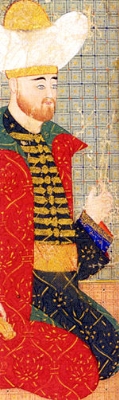
Bayezid I

Encyclopedia
Bayezid I was the Sultan
of the Ottoman Empire
, from 1389 to 1402. He was the son of Murad I
and Valide Sultan
Gülçiçek Hatun
.
and spent his youth in Bursa, where he received a high-level education. His father Murad I
named him governor of the province of Kütahya
.
Bayezid ascended to the throne following the death of his father Murad I
, who was killed by Serbian nobleman Miloš Obilić
during (June 15), or immediately after (June 16), the Battle of Kosovo
in 1389, by which Serbia became a vassal of the Ottoman Empire. Immediately after obtaining the throne, he had his younger brother strangled to avoid a plot. In 1390, Bayezid took as a wife Princess Olivera Despina, the daughter of Prince Lazar of Serbia
, who also lost his life in Kosovo. Bayezid recognized Stefan Lazarević
, the son of Lazar, as the new Serbian leader (later despot), with considerable autonomy.
From 1389 to 1395 he conquered Bulgaria
and northern Greece
. In 1394 he crossed the River Danube
to attack Wallachia
, ruled at that time by Mircea the Elder
. The Ottomans were superior in number, but on October 10, 1394 (or 17 May 1395), in the Battle of Rovine
, on forested and swampy terrain, the Wallachians won the fierce battle and prevented Bayezid from conquering the country.
In 1394, Bayezid laid siege to Constantinople
, the capital of the Byzantine Empire
. Anadoluhisarı
fortress was built between 1393 and 1394 as part of preparations for the Second Ottoman Siege of Constantinople, which took place in 1395. On the urgings of the Byzantine emperor Manuel II Palaeologus a new crusade was organized to defeat him. This proved unsuccessful: in 1396 the Christian
allies, under the leadership of the King of Hungary
and future Holy Roman Emperor
(in 1410) Sigismund
, were defeated in the Battle of Nicopolis
. Bayezid built the magnificent Ulu Camii in Bursa, to celebrate this victory.
Thus, the siege of Constantinople
continued, lasting until 1401. The Emperor left the city to seek aid. The beleaguered Byzantines had their reprieve when Bayezid fought the Timurid
in the East.
 In 1400, the Central Asia
n warlord Timur
had succeeded in rousing the local Turkic bey
liks that had been vassals of the Ottomans
to join him in his attack on Bayezid. In the fateful Battle of Ankara
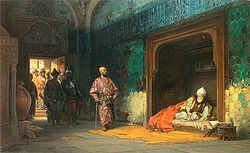
, on 20 July 1402, Bayezid was captured by Timur. His sons, however, escaped, and later they would start civil war (see also Ottoman Interregnum
). Some contemporary reports claimed that Timur
kept Bayezid chained in a cage as a trophy. Likewise, there are many stories about Bayezid's captivity, including one that describes how Timur
used him as a footstool
. However, writers from Timur's court reported that Bayezid was treated well, and that Timur even mourned his death. One year later, Bayezid died — some accounts claim that he committed suicide by smashing his head against the iron bars of his cage (the version given by Marlowe; see below). Other accounts claimed that he committed suicide by taking the poison concealed in his ring.
to Samarkand
, and embellished it with a cast of characters to create an oriental fantasy that has maintained its appeal. Christopher Marlowe
's play Tamburlane the Great was first performed in London
in 1587, three years after the formal opening of English-Ottoman trade relations when William Harborne
sailed for Constantinople
as agent of the Levant Company
. In 1648 there appeared the play Le Gran Tamerlan et Bejezet by Jean Magnon
, and in 1725 Handel's
Tamerlano
was first performed and published in London; Vivaldi's version of the story, Bajazet
, was written in 1735. Magnon had given Bayezid an intriguing wife and daughter; the Handel and Vivaldi renditions included, as well as Tamerlane and Bayezid and his daughter, a prince of Byzantium and a princess of Trebizond (Trabzon
) in a passionate and incredible love story. A cycle of paintings in Schloss Eggenberg, near Graz
in Austria
, translated the theme to a different medium; this was completed in the 1670s shortly before the Ottoman army attacked the Habsburgs in central Europe
. Bayezid (spelt Bayazid) is a central character in the Robert E. Howard
story Lord of Samarcand.
is named Yaldaram Battalion after him.
descent.
[aged 47–48]
Sultan
Sultan is a title with several historical meanings. Originally, it was an Arabic language abstract noun meaning "strength", "authority", "rulership", and "dictatorship", derived from the masdar سلطة , meaning "authority" or "power". Later, it came to be used as the title of certain rulers who...
of the Ottoman Empire
Ottoman Empire
The Ottoman EmpireIt was usually referred to as the "Ottoman Empire", the "Turkish Empire", the "Ottoman Caliphate" or more commonly "Turkey" by its contemporaries...
, from 1389 to 1402. He was the son of Murad I
Murad I
Murad I was the Sultan of the Ottoman Empire, from 1361 to 1389...
and Valide Sultan
Valide Sultan
Valide Sultan was the title held by the mother of a ruling Sultan in the Ottoman Empire. The Turkish pronunciation of the word Valide is . The title is sometimes translated as Queen Mother, although the position of Valide Sultan was quite different.The position was perhaps the most important...
Gülçiçek Hatun
Gülçiçek Hatun
Gülçiçek Hatun was the wife of Ottoman Sultan Murad I and Valide Sultan to their son Bayezid I. She was of Greek descent.-See also:*Ottoman family tree*Ottoman Dynasty...
.
Biography
Bayezid was born in EdirneEdirne
Edirne is a city in Eastern Thrace, the northwestern part of Turkey, close to the borders with Greece and Bulgaria. Edirne served as the capital city of the Ottoman Empire from 1365 to 1453, before Constantinople became the empire's new capital. At present, Edirne is the capital of the Edirne...
and spent his youth in Bursa, where he received a high-level education. His father Murad I
Murad I
Murad I was the Sultan of the Ottoman Empire, from 1361 to 1389...
named him governor of the province of Kütahya
Kütahya
Kütahya is a city in western Turkey with 212,444 inhabitants , lying on the Porsuk river, at 969 metres above sea level. It is the capital of Kütahya Province, inhabited by some 517 804 people...
.
Bayezid ascended to the throne following the death of his father Murad I
Murad I
Murad I was the Sultan of the Ottoman Empire, from 1361 to 1389...
, who was killed by Serbian nobleman Miloš Obilić
Miloš Obilic
Miloš Obilić was a medieval Serbian knight in the service of Prince Lazar, during the invasion of the Ottoman Empire. He is not mentioned in contemporary sources, but he features prominently in later accounts of the Serbian defeat at the Battle of Kosovo as the legendary assassin of the Ottoman...
during (June 15), or immediately after (June 16), the Battle of Kosovo
Battle of Kosovo
The Battle of Kosovo took place on St. Vitus' Day, June 15, 1389, between the army led by Serbian Prince Lazar Hrebeljanović, and the invading army of the Ottoman Empire under the leadership of Sultan Murad I...
in 1389, by which Serbia became a vassal of the Ottoman Empire. Immediately after obtaining the throne, he had his younger brother strangled to avoid a plot. In 1390, Bayezid took as a wife Princess Olivera Despina, the daughter of Prince Lazar of Serbia
Lazar of Serbia
Lazar Hrebeljanović , was a medieval nobleman that emerged as the most powerful Serbian ruler after the death of the previous, childless, Emperor Uroš the Weak, which resulted in years of instability in the Serbian realm. As Stefan Lazar, he was Prince of Serbia from 1371 to 1389, ruling what is...
, who also lost his life in Kosovo. Bayezid recognized Stefan Lazarević
Stefan Lazarevic
Stefan Lazarević known also as Stevan the Tall was a Serbian Despot, ruler of the Serbian Despotate between 1389 and 1427. He was the son and heir to Prince Lazar, who died at the Battle of Kosovo against the Turks in 1389, and Princess Milica from the subordinate branch of the Nemanjić dynasty...
, the son of Lazar, as the new Serbian leader (later despot), with considerable autonomy.
From 1389 to 1395 he conquered Bulgaria
Bulgaria
Bulgaria , officially the Republic of Bulgaria , is a parliamentary democracy within a unitary constitutional republic in Southeast Europe. The country borders Romania to the north, Serbia and Macedonia to the west, Greece and Turkey to the south, as well as the Black Sea to the east...
and northern Greece
Greece
Greece , officially the Hellenic Republic , and historically Hellas or the Republic of Greece in English, is a country in southeastern Europe....
. In 1394 he crossed the River Danube
Danube
The Danube is a river in the Central Europe and the Europe's second longest river after the Volga. It is classified as an international waterway....
to attack Wallachia
Wallachia
Wallachia or Walachia is a historical and geographical region of Romania. It is situated north of the Danube and south of the Southern Carpathians...
, ruled at that time by Mircea the Elder
Mircea I of Wallachia
Mircea the Elder was ruler of Wallachia from 1386 until his death. The byname "elder" was given to him after his death in order to distinguish him from his grandson Mircea II...
. The Ottomans were superior in number, but on October 10, 1394 (or 17 May 1395), in the Battle of Rovine
Battle of Rovine
The Battle of Rovine took place on 17 May 1395 between the Wallachian army led by Voivod Mircea cel Bătrân against the Ottoman invasion led by sultan Bayezid I. The Ottoman army, numbering approximately 40,000 men, faced the much smaller Wallachian army, which was about 10,000 men...
, on forested and swampy terrain, the Wallachians won the fierce battle and prevented Bayezid from conquering the country.
In 1394, Bayezid laid siege to Constantinople
Constantinople
Constantinople was the capital of the Roman, Eastern Roman, Byzantine, Latin, and Ottoman Empires. Throughout most of the Middle Ages, Constantinople was Europe's largest and wealthiest city.-Names:...
, the capital of the Byzantine Empire
Byzantine Empire
The Byzantine Empire was the Eastern Roman Empire during the periods of Late Antiquity and the Middle Ages, centred on the capital of Constantinople. Known simply as the Roman Empire or Romania to its inhabitants and neighbours, the Empire was the direct continuation of the Ancient Roman State...
. Anadoluhisarı
Anadoluhisari
Anadoluhisarı is a fortress located in Istanbul, Turkey on the Anatolian side of the Bosporus, which also gives its name to the quarter around it...
fortress was built between 1393 and 1394 as part of preparations for the Second Ottoman Siege of Constantinople, which took place in 1395. On the urgings of the Byzantine emperor Manuel II Palaeologus a new crusade was organized to defeat him. This proved unsuccessful: in 1396 the Christian
Christianity
Christianity is a monotheistic religion based on the life and teachings of Jesus as presented in canonical gospels and other New Testament writings...
allies, under the leadership of the King of Hungary
Kingdom of Hungary
The Kingdom of Hungary comprised present-day Hungary, Slovakia and Croatia , Transylvania , Carpatho Ruthenia , Vojvodina , Burgenland , and other smaller territories surrounding present-day Hungary's borders...
and future Holy Roman Emperor
Holy Roman Emperor
The Holy Roman Emperor is a term used by historians to denote a medieval ruler who, as German King, had also received the title of "Emperor of the Romans" from the Pope...
(in 1410) Sigismund
Sigismund, Holy Roman Emperor
Sigismund of Luxemburg KG was King of Hungary, of Croatia from 1387 to 1437, of Bohemia from 1419, and Holy Roman Emperor for four years from 1433 until 1437, the last Emperor of the House of Luxemburg. He was also King of Italy from 1431, and of Germany from 1411...
, were defeated in the Battle of Nicopolis
Battle of Nicopolis
The Battle of Nicopolis took place on 25 September 1396 and resulted in the rout of an allied army of Hungarian, Wallachian, French, Burgundian, German and assorted troops at the hands of an Ottoman force, raising of the siege of the Danubian fortress of Nicopolis and leading to the end of the...
. Bayezid built the magnificent Ulu Camii in Bursa, to celebrate this victory.
Thus, the siege of Constantinople
Constantinople
Constantinople was the capital of the Roman, Eastern Roman, Byzantine, Latin, and Ottoman Empires. Throughout most of the Middle Ages, Constantinople was Europe's largest and wealthiest city.-Names:...
continued, lasting until 1401. The Emperor left the city to seek aid. The beleaguered Byzantines had their reprieve when Bayezid fought the Timurid
Timurid Dynasty
The Timurids , self-designated Gurkānī , were a Persianate, Central Asian Sunni Muslim dynasty of Turko-Mongol descent whose empire included the whole of Iran, modern Afghanistan, and modern Uzbekistan, as well as large parts of contemporary Pakistan, North India, Mesopotamia, Anatolia and the...
in the East.
Central Asia
Central Asia is a core region of the Asian continent from the Caspian Sea in the west, China in the east, Afghanistan in the south, and Russia in the north...
n warlord Timur
Timur
Timur , historically known as Tamerlane in English , was a 14th-century conqueror of West, South and Central Asia, and the founder of the Timurid dynasty in Central Asia, and great-great-grandfather of Babur, the founder of the Mughal Dynasty, which survived as the Mughal Empire in India until...
had succeeded in rousing the local Turkic bey
Bey
Bey is a title for chieftain, traditionally applied to the leaders of small tribal groups. Accoding to some sources, the word "Bey" is of Turkish language In historical accounts, many Turkish, other Turkic and Persian leaders are titled Bey, Beg, Bek, Bay, Baig or Beigh. They are all the same word...
liks that had been vassals of the Ottomans
Ottoman Empire
The Ottoman EmpireIt was usually referred to as the "Ottoman Empire", the "Turkish Empire", the "Ottoman Caliphate" or more commonly "Turkey" by its contemporaries...
to join him in his attack on Bayezid. In the fateful Battle of Ankara
Battle of Ankara
The Battle of Ankara or Battle of Angora, fought on July 20, 1402, took place at the field of Çubuk between the forces of the Ottoman sultan Bayezid I and the Turko-Mongol forces of Timur, ruler of the Timurid Empire. The battle was a major victory for Timur, and it led to a period of crisis for...
, on 20 July 1402, Bayezid was captured by Timur. His sons, however, escaped, and later they would start civil war (see also Ottoman Interregnum
Ottoman Interregnum
The Ottoman Interregnum began in 20 July 1402, when chaos reigned in the Ottoman Empire following the defeat of Sultan Bayezid I by the Turco-Mongol warlord Timur...
). Some contemporary reports claimed that Timur
Timur
Timur , historically known as Tamerlane in English , was a 14th-century conqueror of West, South and Central Asia, and the founder of the Timurid dynasty in Central Asia, and great-great-grandfather of Babur, the founder of the Mughal Dynasty, which survived as the Mughal Empire in India until...
kept Bayezid chained in a cage as a trophy. Likewise, there are many stories about Bayezid's captivity, including one that describes how Timur
Timur
Timur , historically known as Tamerlane in English , was a 14th-century conqueror of West, South and Central Asia, and the founder of the Timurid dynasty in Central Asia, and great-great-grandfather of Babur, the founder of the Mughal Dynasty, which survived as the Mughal Empire in India until...
used him as a footstool
Footstool
A footstool is a piece of furniture, the purpose of which is to support one's feet. There are two main types of footstools, which can be loosely categorized into two categories, those designed for comfort and those designed for function....
. However, writers from Timur's court reported that Bayezid was treated well, and that Timur even mourned his death. One year later, Bayezid died — some accounts claim that he committed suicide by smashing his head against the iron bars of his cage (the version given by Marlowe; see below). Other accounts claimed that he committed suicide by taking the poison concealed in his ring.
In fiction
The defeat of Bayezid became a popular subject for later western writers, composers and painters. They revelled in the legend that he was taken by TimurTimur
Timur , historically known as Tamerlane in English , was a 14th-century conqueror of West, South and Central Asia, and the founder of the Timurid dynasty in Central Asia, and great-great-grandfather of Babur, the founder of the Mughal Dynasty, which survived as the Mughal Empire in India until...
to Samarkand
Samarkand
Although a Persian-speaking region, it was not united politically with Iran most of the times between the disintegration of the Seleucid Empire and the Arab conquest . In the 6th century it was within the domain of the Turkic kingdom of the Göktürks.At the start of the 8th century Samarkand came...
, and embellished it with a cast of characters to create an oriental fantasy that has maintained its appeal. Christopher Marlowe
Christopher Marlowe
Christopher Marlowe was an English dramatist, poet and translator of the Elizabethan era. As the foremost Elizabethan tragedian, next to William Shakespeare, he is known for his blank verse, his overreaching protagonists, and his mysterious death.A warrant was issued for Marlowe's arrest on 18 May...
's play Tamburlane the Great was first performed in London
London
London is the capital city of :England and the :United Kingdom, the largest metropolitan area in the United Kingdom, and the largest urban zone in the European Union by most measures. Located on the River Thames, London has been a major settlement for two millennia, its history going back to its...
in 1587, three years after the formal opening of English-Ottoman trade relations when William Harborne
William Harborne
William Harborne of Great Yarmouth, Norfolk was a diplomat, businessman, and English Ambassador to the Ottoman empire, appointed by Queen Elizabeth I of England.-Establishment of the English Embassy in Constantinople:...
sailed for Constantinople
Constantinople
Constantinople was the capital of the Roman, Eastern Roman, Byzantine, Latin, and Ottoman Empires. Throughout most of the Middle Ages, Constantinople was Europe's largest and wealthiest city.-Names:...
as agent of the Levant Company
Levant Company
The Levant Company, or Turkey Company, was an English chartered company formed in 1581, to regulate English trade with Turkey and the Levant...
. In 1648 there appeared the play Le Gran Tamerlan et Bejezet by Jean Magnon
Jean Magnon
-Selected works:*Le Gran Tamerlan et Bejezet , on Tamerlane and Bayezid I*Tite , tragi-comedy on the life of Titus and his affair with Berenice*Zénobie, Reyne de Palmire , tragedy on the life of Zenobia-External links:...
, and in 1725 Handel's
HANDEL
HANDEL was the code-name for the UK's National Attack Warning System in the Cold War. It consisted of a small console consisting of two microphones, lights and gauges. The reason behind this was to provide a back-up if anything failed....
Tamerlano
Tamerlano
Tamerlano is an opera in three acts written for the Royal Academy of Music , with music by George Frideric Handel to an Italian text by Nicola Francesco Haym, adapted from Agostin Piovene's Tamerlano together with another libretto entitled Bajazet after Nicolas Pradon's Tamerlan, ou La Mort de...
was first performed and published in London; Vivaldi's version of the story, Bajazet
Bajazet (opera)
Bajazet is an Italian opera composed by Antonio Vivaldi in 1735. Its libretto was written by Agostino Piovene. It was premiered in Verona, during the Carnival season of that year. This opera is presented in 3 acts, with a three-movement sinfonia as an introduction...
, was written in 1735. Magnon had given Bayezid an intriguing wife and daughter; the Handel and Vivaldi renditions included, as well as Tamerlane and Bayezid and his daughter, a prince of Byzantium and a princess of Trebizond (Trabzon
Trabzon
Trabzon is a city on the Black Sea coast of north-eastern Turkey and the capital of Trabzon Province. Trabzon, located on the historical Silk Road, became a melting pot of religions, languages and culture for centuries and a trade gateway to Iran in the southeast and the Caucasus to the northeast...
) in a passionate and incredible love story. A cycle of paintings in Schloss Eggenberg, near Graz
Graz
The more recent population figures do not give the whole picture as only people with principal residence status are counted and people with secondary residence status are not. Most of the people with secondary residence status in Graz are students...
in Austria
Austria
Austria , officially the Republic of Austria , is a landlocked country of roughly 8.4 million people in Central Europe. It is bordered by the Czech Republic and Germany to the north, Slovakia and Hungary to the east, Slovenia and Italy to the south, and Switzerland and Liechtenstein to the...
, translated the theme to a different medium; this was completed in the 1670s shortly before the Ottoman army attacked the Habsburgs in central Europe
Europe
Europe is, by convention, one of the world's seven continents. Comprising the westernmost peninsula of Eurasia, Europe is generally 'divided' from Asia to its east by the watershed divides of the Ural and Caucasus Mountains, the Ural River, the Caspian and Black Seas, and the waterways connecting...
. Bayezid (spelt Bayazid) is a central character in the Robert E. Howard
Robert E. Howard
Robert Ervin Howard was an American author who wrote pulp fiction in a diverse range of genres. Best known for his character Conan the Barbarian, he is regarded as the father of the sword and sorcery subgenre....
story Lord of Samarcand.
Legacy
A Commando Battalion in the Pakistan ArmyPakistan Army
The Pakistan Army is the branch of the Pakistani Armed Forces responsible for land-based military operations. The Pakistan Army came into existence after the Partition of India and the resulting independence of Pakistan in 1947. It is currently headed by General Ashfaq Parvez Kayani. The Pakistan...
is named Yaldaram Battalion after him.
Marriages and progeny
His mother was Valide Sultan Gülçiçek Hatun who was of ethnic GreekGreeks
The Greeks, also known as the Hellenes , are a nation and ethnic group native to Greece, Cyprus and neighboring regions. They also form a significant diaspora, with Greek communities established around the world....
descent.
Marriages
- (m. 1381) - Devlet Shah HâtûnDevlet Shah HatunDevlet Şâh Khātûn, دولت شاه خاتون, was the wife of Ottoman Sultan Bayezid I, the daughter of Süleyman Shah of Germiyanids. She was the mother of Musa Çelebi, Sultan of Rumelia, and Mustafa Çelebi, Sultan of Rumelia...
- Daughter of Sulaiman Shah of Germiyanids - Devlet HâtûnDevlet HatunDevlet Hatun was the wife of Ottoman Sultan Bayezid I, the daughter of Yakub Shah of Germiyanids, the descendant of Rumi through his son Sultan Walad’s daughter Mutahhara Hatun who was an ancestor of Yakub Shah. She was the mother of Ottoman Sultan Mehmed I, and İsa Çelebi, Governor of Anatolia...
- Daughter of Yakub Shah of Germiyanids, Descendant of Rumi through his son Sultan WaladSultan WaladBaha al-Din Muhammad-i Walad , more popularly known as Sultan Walad , was the eldest son of Jalal Al-Din Rumi, Persian poet and Sufi, and one of the founders of the Mawlawiya order.-Life and Impact:...
's daughter Mutahhara Hatun who was an ancestor of Yakub Shah; - Hafsa Hatun - Daughter of Isa Bey of Aydinids;
- Sultan Hatun - Daughter of Süleyman Shah of DDulkadirids;
- Olivera Lazarević Despina Hâtûn or Mileva - Daughter of Prince Lazar of SerbiaSerbiaSerbia , officially the Republic of Serbia , is a landlocked country located at the crossroads of Central and Southeast Europe, covering the southern part of the Carpathian basin and the central part of the Balkans...
; - Maria, Princess of Greece, daughter of János, Count of Hungary, whose second husband was Payo Gómez de Sotomayor.
Issue
- Ertuğrul - son
- Musa - son of Angelina
- Süleyman ÇelebiSüleyman ÇelebiSüleyman Çelebi was an Ottoman prince and a co-ruler of the empire for several years during the Ottoman Interregnum. - Back ground :...
, Co- Sultan of RumeliaRumeliaRumelia was an historical region comprising the territories of the Ottoman Empire in Europe...
Murdered in 1410 - İsa Çelebiİsa Çelebiİsa Çelebi was an Ottoman prince and a co-ruler of the empire during the Ottoman Interregnum. -Background:...
, GovernorGovernorA governor is a governing official, usually the executive of a non-sovereign level of government, ranking under the head of state...
of Anatolia ( Balıkesir and Bursa )AnatoliaAnatolia is a geographic and historical term denoting the westernmost protrusion of Asia, comprising the majority of the Republic of Turkey...
(d. 1406) - son of Devlet HatunDevlet HatunDevlet Hatun was the wife of Ottoman Sultan Bayezid I, the daughter of Yakub Shah of Germiyanids, the descendant of Rumi through his son Sultan Walad’s daughter Mutahhara Hatun who was an ancestor of Yakub Shah. She was the mother of Ottoman Sultan Mehmed I, and İsa Çelebi, Governor of Anatolia... - Musa ÇelebiMusa ÇelebiMusa Çelebi was an Ottoman prince and a co-ruler of the empire for three years during Ottoman Interregnum. - Background :...
, Sultan of RumeliaRumeliaRumelia was an historical region comprising the territories of the Ottoman Empire in Europe...
( 1410–1413 ) (d. 1413) - son of Devlet Shah HatunDevlet Shah HatunDevlet Şâh Khātûn, دولت شاه خاتون, was the wife of Ottoman Sultan Bayezid I, the daughter of Süleyman Shah of Germiyanids. She was the mother of Musa Çelebi, Sultan of Rumelia, and Mustafa Çelebi, Sultan of Rumelia... - ( False ) Mustafa ÇelebiMustafa ÇelebiMustafa Çelebi, also called Düzmece Mustafa was an Ottoman prince who struggled for throne in the early years of the fifteenth century - Background :...
, SultanSultanSultan is a title with several historical meanings. Originally, it was an Arabic language abstract noun meaning "strength", "authority", "rulership", and "dictatorship", derived from the masdar سلطة , meaning "authority" or "power". Later, it came to be used as the title of certain rulers who...
of RumeliaRumeliaRumelia was an historical region comprising the territories of the Ottoman Empire in Europe...
(d. 1422) - son of Devlet Shah HatunDevlet Shah HatunDevlet Şâh Khātûn, دولت شاه خاتون, was the wife of Ottoman Sultan Bayezid I, the daughter of Süleyman Shah of Germiyanids. She was the mother of Musa Çelebi, Sultan of Rumelia, and Mustafa Çelebi, Sultan of Rumelia... - Mehmed Çelebi, GovernorGovernorA governor is a governing official, usually the executive of a non-sovereign level of government, ranking under the head of state...
of Anatolia ( Amasya )AnatoliaAnatolia is a geographic and historical term denoting the westernmost protrusion of Asia, comprising the majority of the Republic of Turkey...
and later as Ottoman Sultan Mehmed I ÇelebiMehmed IMehmed I Çelebi was a Sultan of the Ottoman Empire from 1413 to 1421. He was one of the sons of Bayezid I and Valide Sultan Devlet Hatun Mehmed I Çelebi (Ottoman: چلبی محمد, Mehmed I or Mehmed Çelebi) (1382, Bursa – May 26, 1421, Edirne, Ottoman Empire) was a Sultan of the Ottoman Empire...
, ( 1389–1421 ) - son of Devlet HatunDevlet HatunDevlet Hatun was the wife of Ottoman Sultan Bayezid I, the daughter of Yakub Shah of Germiyanids, the descendant of Rumi through his son Sultan Walad’s daughter Mutahhara Hatun who was an ancestor of Yakub Shah. She was the mother of Ottoman Sultan Mehmed I, and İsa Çelebi, Governor of Anatolia... - Kasım - son
- Yusuf - son, converted to Christianity, changed his name to Demetrios
- Erhondu - daughter
- Hundi - daughter
- Fatma - daughter
External links
- Yıldırım Bayezid I
- http://www.baerenreiter.com/html/vosco/tamerlano.htm
- Creative Commons MP3 Recording
[aged 47–48]