

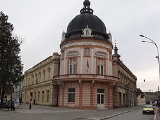
Sremska Mitrovica

Encyclopedia
Sremska Mitrovica is a city and municipality
located in the Vojvodina
province of Serbia
, on the left bank of the Sava river
. As of 2002 the town had a total population of 39,041, while Sremska Mitrovica municipality had a population of 85,605. It is the administrative centre of the Srem District
of Serbia.
Once a capital of the Roman Empire
during the Tetrarchy
, the city was referred to as the glorious mother of cities. Likewise, ten Roman Emperors were born in or near this city, Emperors Herennius Etruscus
(251), Hostilian
(251), Decius Traian
(249-251), Claudius II
(268-270), Quintillus
(270), Aurelian
(270-275), Probus (276-282), Maximianus Herculius
(285-310), Constantius II
(337-361) and Gratian
(367-383).
, the town is known as Сремска Митровица or Sremska Mitrovica, in Rusyn
as Сримска Митровица, in Croatian
as Srijemska Mitrovica, in Hungarian
as Szávaszentdemeter or Mitrovica, in German
as Syrmisch Mitrowitz, in Latin as Sirmium
, and in Turkish
as Dimitrofça.
"Sremska Mitrovica" means "Mitrovica of Srem" (Mitrovica of Kosovo
and Mitrovica of Mačva
also exist), while "Mitrovica" itself stems from the name "Saint Demetrius" or "Sveti Dimitrije" in the Serbian
(in Cyrillic form "Свети Димитрије") and Croatian language
.
The name of the city during the reign of the Roman Empire
was Sirmium
. Beginning in 1180 A.D. the name changed from "Civitas Sancti Demetrii" to "Dmitrovica", "Mitrovica", and finally to the present form - "Sremska Mitrovica".
 Sremska Mitrovica is one of the oldest cities in Europe
. Archaeologists have found a trace of organized human
life dating from the 5000 BC onwards. Ionia
n jewellery dating to 500BC was excavated in the city. When the Romans
conquered the city in the 1st century BC, Sirmium already was a settlement with a long tradition.
In the 1st century, Sirmium gained a status of a colony of the citizens of Rome
, and became a very important military and strategic location in Pannonia
province. The war expeditions of Roman emperors Traian, Marcus Aurelius, and Claudius II
, were prepared in Sirmium.
In 103, Pannonia was split into two provinces: Upper Pannonia
and Lower Pannonia
, and Sirmium became the capital city of Lower Pannonia. In 296, Diocletian
operated a new territorial division of Pannonia. Instead of previous two provinces, there were four new provinces established in former territory of original Pannonia: Pannonia Prima
, Pannonia Valeria
, Pannonia Savia
and Pannonia Secunda
. Capital city of Pannonia Secunda was Sirmium.
In 293, with the establishment of tetrarchy
, the Roman Empire was split into four parts; Sirmium became one of the four capital cities of Roman Empire, the other three being Augusta Treverorum, Mediolanum
, and Nicomedia
(modern Trier
, Milan
and Izmit
). During the tetrarchy, Sirmium was the capital of emperor Galerius
. With the establishment of praetorian prefecture
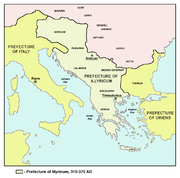
s in 318, the capital of the prefecture of Illyricum
was Sirmium.
Since the 4th century, the city was an important Christian
centre, and was a seat of the Episcopate of Sirmium. Four Christian councils
were held in Sirmium.
At the end of the 4th century, Sirmium was brought under the sway of the Goths
, and later, was again annexed to the Eastern Roman Empire. In 441, Sirmium was conquered by the Huns
, and after this conquest, it remained for more than a century in the hands of various Barbarian
tribes, such were Eastern Goths
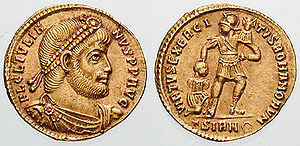
and Gepids. For a short time, Sirmium was the center of the Gepide State and the king Cunimund
minted golden coins in it. After 567, Sirmium was again included into Eastern Roman Empire. The city was finally conquered and destroyed by Avars
in 582. This event marked the end of the period of late Antiquity in the history of Sirmium.
11 luxurious golden belts of Avar handicraft dating to the 6th century was excavated in the vicinity.
. Pope Adrian II gave St. Methodius the title of Archbishop of Sirmium. After having adopted Christianity, the Bulgarians restored in Sirmium the Christian Episcopate, having in mind old Christian traditions and the reputation this city had in the ancient world.
In the 11th century, Sirmium was a residence of Sermon
, a duke of Syrmia
, who was a vassal of the Bulgarian
/Macedonian emperor Samuil
. After 1018, the city was again included into the Byzantine Empire
, and since the end of the 11th century, Sirmium was a subject of a dispute between the Byzantine Empire and the Kingdom of Hungary
, until 1180 when the Byzantine Empire gave up Sirmium, surrendering it to the Kingdom of Hungary. In the 11th century, an Byzantine province named Theme of Sirmium had its capital in this city.
For a while, about 1451, the city was in possession of the Serbian despot Đurađ Branković. In 1521 the city came into Ottoman
hands and it remained under the Ottoman rule for almost two centuries. According to Ottoman traveler Evliya Celebi
, Mitrovica had been conquered by the Bosnian sanjak bey Husrev-bey. She was renamed as "Dimitrofça".
According to the 1545/1548 data, the city was mainly populated by ethnic Serbs
, while the name of the mayor of the city was Dimitar. Since the middle of the 16th century, the city was mostly populated with Muslims. According to the 1566/69 data, the population of the city was composed of 592 Muslim and 30 Christian
houses, while according to the 1572 data, it was composed of 598 Muslim and 18 Christian houses. According to the 1573 data, the city had 17 mosques and no Christian church. During the Ottoman rule, Sremska Mitrovica was the largest settlement in Syrmia
, and was the administrative center of the Ottoman Sanjak of Syrmia
.
With the establishment of the Habsburg
administration in 1718, the Muslim population fled from the city and was replaced with Serb
, Croat
, and German
settlers. According to the 1765 data, the population of the city numbered 809 people, of whom 514 were Serbs and 290 Catholics.
Sremska Mitrovica was part of the Habsburg Military Frontier
(Slavonian Krajina
). In 1848/1849, it was part of the Serbian Voivodship , a Serb autonomous region within Austrian Empire, but in 1849, it was returned under administration of the Military Frontier.
With the abolition of the Slavonian Military Frontier in 1881, Sremska Mitrovica was included into Syrmia County, which was part of the Kingdom of Croatia-Slavonia and Kingdom of Hungary
within Austria-Hungary
. According to the 1910 census, the population of the city numbered 12,909 people, of which 4,878 spoke Serbian language, 3,915 Croatian, and 2,341 German. The municipal area of the city (which did not included the city itself) had 32,012 inhabitants, of which 27,022 spoke Serbian, 2,324 German, and 1,071 Croatian.
, and then, on November 24, 1918, the assembly of Syrmia in Ruma
decided that most of Syrmia (including Mitrovica) join to the Kingdom of Serbia
. Subsequently, on December 1, 1918, Kingdom of Serbia united with the Kingdom of Montenegro
and the State of Slovenes, Croats and Serbs to form the Kingdom of Serbs, Croats and Slovenes (renamed to Yugoslavia
in 1929). Between 1918 and 1922, Sremska Mitrovica was part of the Syrmia County, between 1922 and 1929 part of the Syrmia Oblast, between 1929 and 1931 part of the Drina Banovina
, and between 1931 and 1941 part of the Danube Banovina
.
During World War II
, the city was occupied by the Axis
troops and was attached to the Independent State of Croatia
. During that time its name was changed to Hrvatska Mitrovica (meaning Croatian Mitrovica). One of the largest Nazi concentration/death camps in Independent State of Croatia existed in Sremska Mitrovica and as much as 10,000 victims (Serbs, Jews, and antifascists) was killed here. The Serbian Jewish population was to be interned at a concentration camp
built first in Jarak and then at Zasavica. However, both locations proved to be too flooded for construction. The Germans had to abandon these locations and use Sajmište
, which resulted in the destruction of 83% of Serbian Jewry
. In 1944, those Danube Swabians
that did not left the region together with the defeated German army were (until 1948) interned in prison camps. Some Germans from Banat and Bačka were imprisoned in the local "Svilara" or silk factory, where allegedly about 2,000 of them died from starvation, cold, and disease.
Beginning in 1944, the town was part of the Autonomous Province of Vojvodina
within the new Socialist Yugoslavia and, from 1945, within the Socialist Republic of Serbia. From 1992 to 2003 it was part of the Federal Republic of Yugoslavia, which was then transformed into the state union of Serbia and Montenegro
. Since the 2006 independence of Montenegro
, Sremska Mitrovica is part of an independent Serbia
.
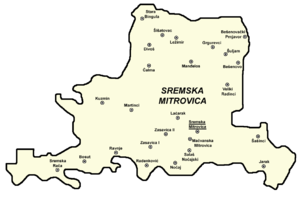 Sremska Mitrovica municipality includes the city of Sremska Mitrovica, the town of Mačvanska Mitrovica
, and several villages.
Villages on the northern bank of the river Sava, in the region of Syrmia
:
Villages on the southern bank of the river Sava, in the region of Mačva
:
Ethnically mixed families are also very common in this town. Up to 1991 many of them declared themselves as Yugoslavs
.
.jpg) Ten Roman emperors were born in the city and its envirions:
Ten Roman emperors were born in the city and its envirions:
The last emperor of the united Roman Empire, Theodosius I
(378–95), became emperor in Sirmium. The usurpers
Ingenuus
and Regalianus
also declared themselves emperors in this city (in 260) and many other Roman emperors spent some time in Sirmium including Marcus Aurelius who might have written parts of his famous work Meditations
in the city.
Municipalities of Serbia
Serbia is divided into 150 municipalities and 24 cities , which are the basic units of local self-government. The city may and may not be divided into city municipalities . Five cities, Belgrade, Novi Sad, Niš, Kragujevac and Požarevac comprise several city municipalities, divided into "urban" ...
located in the Vojvodina
Vojvodina
Vojvodina, officially called Autonomous Province of Vojvodina is an autonomous province of Serbia. Its capital and largest city is Novi Sad...
province of Serbia
Serbia
Serbia , officially the Republic of Serbia , is a landlocked country located at the crossroads of Central and Southeast Europe, covering the southern part of the Carpathian basin and the central part of the Balkans...
, on the left bank of the Sava river
Sava River
The Sava is a river in Southeast Europe, a right side tributary of the Danube river at Belgrade. Counting from Zelenci, the source of Sava Dolinka, it is long and drains of surface area. It flows through Slovenia, Croatia, along the northern border of Bosnia and Herzegovina, and through Serbia....
. As of 2002 the town had a total population of 39,041, while Sremska Mitrovica municipality had a population of 85,605. It is the administrative centre of the Srem District
Srem District
Syrmia or Srem District is a northwestern district of Serbia. It lies in the regions of Syrmia and Mačva, in the autonomous province of Vojvodina. It has a population of 309,981...
of Serbia.
Once a capital of the Roman Empire
Roman Empire
The Roman Empire was the post-Republican period of the ancient Roman civilization, characterised by an autocratic form of government and large territorial holdings in Europe and around the Mediterranean....
during the Tetrarchy
Tetrarchy
The term Tetrarchy describes any system of government where power is divided among four individuals, but usually refers to the tetrarchy instituted by Roman Emperor Diocletian in 293, marking the end of the Crisis of the Third Century and the recovery of the Roman Empire...
, the city was referred to as the glorious mother of cities. Likewise, ten Roman Emperors were born in or near this city, Emperors Herennius Etruscus
Herennius Etruscus
Herennius Etruscus , was Roman emperor in 251, in a joint rule with his father Decius. Emperor Hostilian was his younger brother.Herennius was born in near Sirmium in Pannonia , during one of his father's military postings. His mother was Herennia Cupressenia Etruscilla, a Roman lady of an...
(251), Hostilian
Hostilian
Hostilian was Roman emperor in 251. Hostilian was born in Sirmium in Illyricum sometime after 230, as the son of the future emperor Decius by his wife Herennia Cupressenia Etruscilla...
(251), Decius Traian
Decius
Trajan Decius , was Roman Emperor from 249 to 251. In the last year of his reign, he co-ruled with his son Herennius Etruscus until they were both killed in the Battle of Abrittus.-Early life and rise to power:...
(249-251), Claudius II
Claudius II
Claudius II , commonly known as Claudius Gothicus, was Roman Emperor from 268 to 270. During his reign he fought successfully against the Alamanni and scored a crushing victory against the Goths at the Battle of Naissus. He died after succumbing to a smallpox plague that ravaged the provinces of...
(268-270), Quintillus
Quintillus
Quintillus , commonly known as Quintillus, was Roman Emperor for less than a year in 270.-Early Life and Election as Emperor:Quintillus was born at Sirmium in Illyricum. Originally coming from a low born family, Quintillus came to prominence with the accession of his brother Claudius II Gothicus to...
(270), Aurelian
Aurelian
Aurelian , was Roman Emperor from 270 to 275. During his reign, he defeated the Alamanni after a devastating war. He also defeated the Goths, Vandals, Juthungi, Sarmatians, and Carpi. Aurelian restored the Empire's eastern provinces after his conquest of the Palmyrene Empire in 273. The following...
(270-275), Probus (276-282), Maximianus Herculius
Maximian
Maximian was Roman Emperor from 286 to 305. He was Caesar from 285 to 286, then Augustus from 286 to 305. He shared the latter title with his co-emperor and superior, Diocletian, whose political brain complemented Maximian's military brawn. Maximian established his residence at Trier but spent...
(285-310), Constantius II
Constantius II
Constantius II , was Roman Emperor from 337 to 361. The second son of Constantine I and Fausta, he ascended to the throne with his brothers Constantine II and Constans upon their father's death....
(337-361) and Gratian
Gratian
Gratian was Roman Emperor from 375 to 383.The eldest son of Valentinian I, during his youth Gratian accompanied his father on several campaigns along the Rhine and Danube frontiers. Upon the death of Valentinian in 375, Gratian's brother Valentinian II was declared emperor by his father's soldiers...
(367-383).
Name
In SerbianSerbian language
Serbian is a form of Serbo-Croatian, a South Slavic language, spoken by Serbs in Serbia, Bosnia and Herzegovina, Montenegro, Croatia and neighbouring countries....
, the town is known as Сремска Митровица or Sremska Mitrovica, in Rusyn
Pannonian Rusyn language
Pannonian Rusyn or simply Rusyn is a Slavic language or dialect spoken by Pannonian Rusyns in north-western Serbia and eastern Croatia...
as Сримска Митровица, in Croatian
Croatian language
Croatian is the collective name for the standard language and dialects spoken by Croats, principally in Croatia, Bosnia and Herzegovina, the Serbian province of Vojvodina and other neighbouring countries...
as Srijemska Mitrovica, in Hungarian
Hungarian language
Hungarian is a Uralic language, part of the Ugric group. With some 14 million speakers, it is one of the most widely spoken non-Indo-European languages in Europe....
as Szávaszentdemeter or Mitrovica, in German
German language
German is a West Germanic language, related to and classified alongside English and Dutch. With an estimated 90 – 98 million native speakers, German is one of the world's major languages and is the most widely-spoken first language in the European Union....
as Syrmisch Mitrowitz, in Latin as Sirmium
Sirmium
Sirmium was a city in ancient Roman Pannonia. Firstly mentioned in the 4th century BC and originally inhabited by the Illyrians and Celts, it was conquered by the Romans in the 1st century BC and subsequently became the capital of the Roman province of Lower Pannonia. In 294 AD, Sirmium was...
, and in Turkish
Turkish language
Turkish is a language spoken as a native language by over 83 million people worldwide, making it the most commonly spoken of the Turkic languages. Its speakers are located predominantly in Turkey and Northern Cyprus with smaller groups in Iraq, Greece, Bulgaria, the Republic of Macedonia, Kosovo,...
as Dimitrofça.
"Sremska Mitrovica" means "Mitrovica of Srem" (Mitrovica of Kosovo
Kosovska Mitrovica
Kosovska Mitrovica , is a city and municipality in northern Kosovo. It is the administrative centre of the homonymous district....
and Mitrovica of Mačva
Macvanska Mitrovica
Mačvanska Mitrovica is a town located in the Sremska Mitrovica municipality, in the Srem District of Serbia. It is situated in the Autonomous Province of Vojvodina...
also exist), while "Mitrovica" itself stems from the name "Saint Demetrius" or "Sveti Dimitrije" in the Serbian
Serbian language
Serbian is a form of Serbo-Croatian, a South Slavic language, spoken by Serbs in Serbia, Bosnia and Herzegovina, Montenegro, Croatia and neighbouring countries....
(in Cyrillic form "Свети Димитрије") and Croatian language
Croatian language
Croatian is the collective name for the standard language and dialects spoken by Croats, principally in Croatia, Bosnia and Herzegovina, the Serbian province of Vojvodina and other neighbouring countries...
.
The name of the city during the reign of the Roman Empire
Roman Empire
The Roman Empire was the post-Republican period of the ancient Roman civilization, characterised by an autocratic form of government and large territorial holdings in Europe and around the Mediterranean....
was Sirmium
Sirmium
Sirmium was a city in ancient Roman Pannonia. Firstly mentioned in the 4th century BC and originally inhabited by the Illyrians and Celts, it was conquered by the Romans in the 1st century BC and subsequently became the capital of the Roman province of Lower Pannonia. In 294 AD, Sirmium was...
. Beginning in 1180 A.D. the name changed from "Civitas Sancti Demetrii" to "Dmitrovica", "Mitrovica", and finally to the present form - "Sremska Mitrovica".
Ancient Sirmium
Europe
Europe is, by convention, one of the world's seven continents. Comprising the westernmost peninsula of Eurasia, Europe is generally 'divided' from Asia to its east by the watershed divides of the Ural and Caucasus Mountains, the Ural River, the Caspian and Black Seas, and the waterways connecting...
. Archaeologists have found a trace of organized human
Human
Humans are the only living species in the Homo genus...
life dating from the 5000 BC onwards. Ionia
Ionia
Ionia is an ancient region of central coastal Anatolia in present-day Turkey, the region nearest İzmir, which was historically Smyrna. It consisted of the northernmost territories of the Ionian League of Greek settlements...
n jewellery dating to 500BC was excavated in the city. When the Romans
Ancient Rome
Ancient Rome was a thriving civilization that grew on the Italian Peninsula as early as the 8th century BC. Located along the Mediterranean Sea and centered on the city of Rome, it expanded to one of the largest empires in the ancient world....
conquered the city in the 1st century BC, Sirmium already was a settlement with a long tradition.
In the 1st century, Sirmium gained a status of a colony of the citizens of Rome
Rome
Rome is the capital of Italy and the country's largest and most populated city and comune, with over 2.7 million residents in . The city is located in the central-western portion of the Italian Peninsula, on the Tiber River within the Lazio region of Italy.Rome's history spans two and a half...
, and became a very important military and strategic location in Pannonia
Pannonia
Pannonia was an ancient province of the Roman Empire bounded north and east by the Danube, coterminous westward with Noricum and upper Italy, and southward with Dalmatia and upper Moesia....
province. The war expeditions of Roman emperors Traian, Marcus Aurelius, and Claudius II
Claudius II
Claudius II , commonly known as Claudius Gothicus, was Roman Emperor from 268 to 270. During his reign he fought successfully against the Alamanni and scored a crushing victory against the Goths at the Battle of Naissus. He died after succumbing to a smallpox plague that ravaged the provinces of...
, were prepared in Sirmium.
In 103, Pannonia was split into two provinces: Upper Pannonia
Upper Pannonia
The Upper Pannonia or Pannonia Superior was ancient Roman province with the capital Carnuntum. It was formed in the year 103 AD. Upper Pannonia included parts of present-day Hungary, Austria, Croatia, Slovenia, Bosnia and Herzegovina, and Slovakia....
and Lower Pannonia
Lower Pannonia
The Lower Pannonia or Pannonia Inferior was an ancient Roman province. It was formed in the year 103 AD. The Lower Pannonia included parts of present-day Hungary, Serbia, Croatia, and Bosnia and Herzegovina.-Cities:...
, and Sirmium became the capital city of Lower Pannonia. In 296, Diocletian
Diocletian
Diocletian |latinized]] upon his accession to Diocletian . c. 22 December 244 – 3 December 311), was a Roman Emperor from 284 to 305....
operated a new territorial division of Pannonia. Instead of previous two provinces, there were four new provinces established in former territory of original Pannonia: Pannonia Prima
Pannonia Prima
Pannonia Prima was an ancient Roman province. It was formed in the year 296, during the reign of Emperor Diocletian. Previously, it was a part of the province of Pannonia, which was gradually divided into four administrative units: Pannonia Prima, Pannonia Secunda, Valeria, and Savia. This...
, Pannonia Valeria
Pannonia Valeria
The Pannonia Valeria or simply Valeria was one of the provinces of the Roman Empire. It was formed in the year 296, during the reign of emperor Diocletian. The capital of the province was Sopianae . Pannonia Valeria included parts of present-day Hungary and Croatia.-External links:*...
, Pannonia Savia
Pannonia Savia
The Pannonia Savia, also known as Savia and Pannonia Ripariensis, was an ancient Roman province. It was formed in the year 296, during the reign of emperor Diocletian. The capital of the province was Siscia . Pannonia Savia included parts of present-day Croatia, Slovenia, and Bosnia and...
and Pannonia Secunda
Pannonia Secunda
The Pannonia Secunda was one of the provinces of the Roman Empire. It was formed in the year 296, during the reign of emperor Diocletian. The capital of the province was Sirmium...
. Capital city of Pannonia Secunda was Sirmium.
In 293, with the establishment of tetrarchy
Tetrarchy
The term Tetrarchy describes any system of government where power is divided among four individuals, but usually refers to the tetrarchy instituted by Roman Emperor Diocletian in 293, marking the end of the Crisis of the Third Century and the recovery of the Roman Empire...
, the Roman Empire was split into four parts; Sirmium became one of the four capital cities of Roman Empire, the other three being Augusta Treverorum, Mediolanum
Mediolanum
Mediolanum, the ancient Milan, was an important Celtic and then Roman centre of northern Italy. This article charts the history of the city from its settlement by the Insubres around 600 BC, through its conquest by the Romans and its development into a key centre of Western Christianity and capital...
, and Nicomedia
Nicomedia
Nicomedia was an ancient city in what is now Turkey, founded in 712/11 BC as a Megarian colony and was originally known as Astacus . After being destroyed by Lysimachus, it was rebuilt by Nicomedes I of Bithynia in 264 BC under the name of Nicomedia, and has ever since been one of the most...
(modern Trier
Trier
Trier, historically called in English Treves is a city in Germany on the banks of the Moselle. It is the oldest city in Germany, founded in or before 16 BC....
, Milan
Milan
Milan is the second-largest city in Italy and the capital city of the region of Lombardy and of the province of Milan. The city proper has a population of about 1.3 million, while its urban area, roughly coinciding with its administrative province and the bordering Province of Monza and Brianza ,...
and Izmit
Izmit
İzmit is a city in Turkey, administrative center of Kocaeli Province as well as the Kocaeli Metropolitan Municipality. It is located at the Gulf of İzmit in the Sea of Marmara, about east of Istanbul, on the northwestern part of Anatolia. The city center has a population of 294.875...
). During the tetrarchy, Sirmium was the capital of emperor Galerius
Galerius
Galerius , was Roman Emperor from 305 to 311. During his reign he campaigned, aided by Diocletian, against the Sassanid Empire, sacking their capital Ctesiphon in 299. He also campaigned across the Danube against the Carpi, defeating them in 297 and 300...
. With the establishment of praetorian prefecture
Praetorian prefecture
The praetorian prefecture was the largest administrative division of the late Roman Empire, above the mid-level dioceses and the low-level provinces. Praetorian prefectures originated in the reign of Constantine I The praetorian prefecture was the largest administrative division of the late Roman...
s in 318, the capital of the prefecture of Illyricum
Praetorian prefecture of Illyricum
The praetorian prefecture of Illyricum was one of four praetorian prefectures into which the Late Roman Empire was divided.The administrative centre of the prefecture was Sirmium , and, after 379, Thessalonica...
was Sirmium.
Since the 4th century, the city was an important Christian
Christian
A Christian is a person who adheres to Christianity, an Abrahamic, monotheistic religion based on the life and teachings of Jesus of Nazareth as recorded in the Canonical gospels and the letters of the New Testament...
centre, and was a seat of the Episcopate of Sirmium. Four Christian councils
Council of Sirmium
The Council of Sirmium generally refers to the third of the four episcopal councils held in Sirmium between 357 AD and 359 AD. Specifically one was held in 357, one in 358 and one in 359. The third council marked a temporary compromise between Arianism and the Western bishops of the Christian...
were held in Sirmium.
At the end of the 4th century, Sirmium was brought under the sway of the Goths
Goths
The Goths were an East Germanic tribe of Scandinavian origin whose two branches, the Visigoths and the Ostrogoths, played an important role in the fall of the Roman Empire and the emergence of Medieval Europe....
, and later, was again annexed to the Eastern Roman Empire. In 441, Sirmium was conquered by the Huns
Huns
The Huns were a group of nomadic people who, appearing from east of the Volga River, migrated into Europe c. AD 370 and established the vast Hunnic Empire there. Since de Guignes linked them with the Xiongnu, who had been northern neighbours of China 300 years prior to the emergence of the Huns,...
, and after this conquest, it remained for more than a century in the hands of various Barbarian
Barbarian
Barbarian and savage are terms used to refer to a person who is perceived to be uncivilized. The word is often used either in a general reference to a member of a nation or ethnos, typically a tribal society as seen by an urban civilization either viewed as inferior, or admired as a noble savage...
tribes, such were Eastern Goths
Goths
The Goths were an East Germanic tribe of Scandinavian origin whose two branches, the Visigoths and the Ostrogoths, played an important role in the fall of the Roman Empire and the emergence of Medieval Europe....
and Gepids. For a short time, Sirmium was the center of the Gepide State and the king Cunimund
Cunimund
Cunimund was a king of the Gepids in the 6th century. Cunimund was the last of the Gepid kings and led them in their defeat by the Lombards in 567.-Background:...
minted golden coins in it. After 567, Sirmium was again included into Eastern Roman Empire. The city was finally conquered and destroyed by Avars
Eurasian Avars
The Eurasian Avars or Ancient Avars were a highly organized nomadic confederacy of mixed origins. They were ruled by a khagan, who was surrounded by a tight-knit entourage of nomad warriors, an organization characteristic of Turko-Mongol groups...
in 582. This event marked the end of the period of late Antiquity in the history of Sirmium.
11 luxurious golden belts of Avar handicraft dating to the 6th century was excavated in the vicinity.
After the Avar conquest
For more than two centuries the fate of Sirmium was unknown. At the end of the 8th century, Sirmium belonged to the Frankish State. The historical role of Sirmium increased again in the 9th century, when it was part of Bulgarian EmpireBulgarian Empire
Bulgarian Empire is a term used to describe two periods in the medieval history of Bulgaria, during which it acted as a key regional power in Europe in general and in Southeastern Europe in particular, rivalling Byzantium...
. Pope Adrian II gave St. Methodius the title of Archbishop of Sirmium. After having adopted Christianity, the Bulgarians restored in Sirmium the Christian Episcopate, having in mind old Christian traditions and the reputation this city had in the ancient world.
In the 11th century, Sirmium was a residence of Sermon
Sermon (ruler)
Sermon was an 11th century voivode of Syrmia and a local governor in the First Bulgarian Empire, vassal of Bulgarian emperor Samuil...
, a duke of Syrmia
Syrmia
Syrmia is a fertile region of the Pannonian Plain in Europe, between the Danube and Sava rivers. It is divided between Serbia in the east and Croatia in the west....
, who was a vassal of the Bulgarian
Bulgarian Empire
Bulgarian Empire is a term used to describe two periods in the medieval history of Bulgaria, during which it acted as a key regional power in Europe in general and in Southeastern Europe in particular, rivalling Byzantium...
/Macedonian emperor Samuil
Samuil of Bulgaria
Samuel was the Emperor of the First Bulgarian Empire from 997 to 6 October 1014. From 980 to 997, he was a general under Roman I of Bulgaria, the second surviving son of Emperor Peter I of Bulgaria, and co-ruled with him, as Roman bestowed upon him the command of the army and the effective royal...
. After 1018, the city was again included into the Byzantine Empire
Byzantine Empire
The Byzantine Empire was the Eastern Roman Empire during the periods of Late Antiquity and the Middle Ages, centred on the capital of Constantinople. Known simply as the Roman Empire or Romania to its inhabitants and neighbours, the Empire was the direct continuation of the Ancient Roman State...
, and since the end of the 11th century, Sirmium was a subject of a dispute between the Byzantine Empire and the Kingdom of Hungary
Kingdom of Hungary
The Kingdom of Hungary comprised present-day Hungary, Slovakia and Croatia , Transylvania , Carpatho Ruthenia , Vojvodina , Burgenland , and other smaller territories surrounding present-day Hungary's borders...
, until 1180 when the Byzantine Empire gave up Sirmium, surrendering it to the Kingdom of Hungary. In the 11th century, an Byzantine province named Theme of Sirmium had its capital in this city.
For a while, about 1451, the city was in possession of the Serbian despot Đurađ Branković. In 1521 the city came into Ottoman
Ottoman Empire
The Ottoman EmpireIt was usually referred to as the "Ottoman Empire", the "Turkish Empire", the "Ottoman Caliphate" or more commonly "Turkey" by its contemporaries...
hands and it remained under the Ottoman rule for almost two centuries. According to Ottoman traveler Evliya Celebi
Evliya Çelebi
Evliya Çelebi was an Ottoman traveler who journeyed through the territory of the Ottoman Empire and neighboring lands over a period of forty years.- Life :...
, Mitrovica had been conquered by the Bosnian sanjak bey Husrev-bey. She was renamed as "Dimitrofça".
According to the 1545/1548 data, the city was mainly populated by ethnic Serbs
Serbs
The Serbs are a South Slavic ethnic group of the Balkans and southern Central Europe. Serbs are located mainly in Serbia, Montenegro and Bosnia and Herzegovina, and form a sizable minority in Croatia, the Republic of Macedonia and Slovenia. Likewise, Serbs are an officially recognized minority in...
, while the name of the mayor of the city was Dimitar. Since the middle of the 16th century, the city was mostly populated with Muslims. According to the 1566/69 data, the population of the city was composed of 592 Muslim and 30 Christian
Christian
A Christian is a person who adheres to Christianity, an Abrahamic, monotheistic religion based on the life and teachings of Jesus of Nazareth as recorded in the Canonical gospels and the letters of the New Testament...
houses, while according to the 1572 data, it was composed of 598 Muslim and 18 Christian houses. According to the 1573 data, the city had 17 mosques and no Christian church. During the Ottoman rule, Sremska Mitrovica was the largest settlement in Syrmia
Syrmia
Syrmia is a fertile region of the Pannonian Plain in Europe, between the Danube and Sava rivers. It is divided between Serbia in the east and Croatia in the west....
, and was the administrative center of the Ottoman Sanjak of Syrmia
Sanjak of Syrmia
Sanjak of Syrmia was an administrative unit of the Ottoman Empire formed in 1541. It was located in the Syrmia region and was part of the Budin Province. Administrative center of the Sanjak of Syrmia was Dimitrofça...
.
With the establishment of the Habsburg
Habsburg Monarchy
The Habsburg Monarchy covered the territories ruled by the junior Austrian branch of the House of Habsburg , and then by the successor House of Habsburg-Lorraine , between 1526 and 1867/1918. The Imperial capital was Vienna, except from 1583 to 1611, when it was moved to Prague...
administration in 1718, the Muslim population fled from the city and was replaced with Serb
Serbs
The Serbs are a South Slavic ethnic group of the Balkans and southern Central Europe. Serbs are located mainly in Serbia, Montenegro and Bosnia and Herzegovina, and form a sizable minority in Croatia, the Republic of Macedonia and Slovenia. Likewise, Serbs are an officially recognized minority in...
, Croat
Croats
Croats are a South Slavic ethnic group mostly living in Croatia, Bosnia and Herzegovina and nearby countries. There are around 4 million Croats living inside Croatia and up to 4.5 million throughout the rest of the world. Responding to political, social and economic pressure, many Croats have...
, and German
Germans
The Germans are a Germanic ethnic group native to Central Europe. The English term Germans has referred to the German-speaking population of the Holy Roman Empire since the Late Middle Ages....
settlers. According to the 1765 data, the population of the city numbered 809 people, of whom 514 were Serbs and 290 Catholics.
Sremska Mitrovica was part of the Habsburg Military Frontier
Military Frontier
The Military Frontier was a borderland of Habsburg Austria and later the Austro-Hungarian Monarchy, which acted as the cordon sanitaire against incursions from the Ottoman Empire...
(Slavonian Krajina
Slavonian Krajina
The Slavonian Military Frontier or Slavonian Krajina was part of the Habsburg Military Frontier. It was formed out of territories the Habsburgs conquered from the Ottoman Empire and included southern parts of Slavonia and Syrmia; today the area it covered is mostly in eastern Croatia, with its...
). In 1848/1849, it was part of the Serbian Voivodship , a Serb autonomous region within Austrian Empire, but in 1849, it was returned under administration of the Military Frontier.
With the abolition of the Slavonian Military Frontier in 1881, Sremska Mitrovica was included into Syrmia County, which was part of the Kingdom of Croatia-Slavonia and Kingdom of Hungary
Kingdom of Hungary
The Kingdom of Hungary comprised present-day Hungary, Slovakia and Croatia , Transylvania , Carpatho Ruthenia , Vojvodina , Burgenland , and other smaller territories surrounding present-day Hungary's borders...
within Austria-Hungary
Austria-Hungary
Austria-Hungary , more formally known as the Kingdoms and Lands Represented in the Imperial Council and the Lands of the Holy Hungarian Crown of Saint Stephen, was a constitutional monarchic union between the crowns of the Austrian Empire and the Kingdom of Hungary in...
. According to the 1910 census, the population of the city numbered 12,909 people, of which 4,878 spoke Serbian language, 3,915 Croatian, and 2,341 German. The municipal area of the city (which did not included the city itself) had 32,012 inhabitants, of which 27,022 spoke Serbian, 2,324 German, and 1,071 Croatian.
After the First World War
In 1918, the Austro-Hungarian Monarchy collapsed and the Syrmia region first became a part of the newly formed State of Slovenes, Croats and SerbsState of Slovenes, Croats and Serbs
The State of Slovenes, Croats and Serbs was a short-lived state formed from the southernmost parts of the Austro-Hungarian monarchy after its dissolution at the end of the World War I by the resident population of Slovenes, Croats, and Serbs...
, and then, on November 24, 1918, the assembly of Syrmia in Ruma
Ruma
Ruma is a town and municipality located in Vojvodina, Serbia at . In 2002 the town had a total population of 34,229, while Ruma municipality had a population of 60,006.-History:...
decided that most of Syrmia (including Mitrovica) join to the Kingdom of Serbia
Kingdom of Serbia
The Kingdom of Serbia was created when Prince Milan Obrenović, ruler of the Principality of Serbia, was crowned King in 1882. The Principality of Serbia was ruled by the Karađorđevic dynasty from 1817 onwards . The Principality, suzerain to the Porte, had expelled all Ottoman troops by 1867, de...
. Subsequently, on December 1, 1918, Kingdom of Serbia united with the Kingdom of Montenegro
Kingdom of Montenegro
The Kingdom of Montenegro was a monarchy in southeastern Europe during the tumultuous years on the Balkan Peninsula leading up to and during World War I. Legally it was a constitutional monarchy, but absolutist in practice...
and the State of Slovenes, Croats and Serbs to form the Kingdom of Serbs, Croats and Slovenes (renamed to Yugoslavia
Yugoslavia
Yugoslavia refers to three political entities that existed successively on the western part of the Balkans during most of the 20th century....
in 1929). Between 1918 and 1922, Sremska Mitrovica was part of the Syrmia County, between 1922 and 1929 part of the Syrmia Oblast, between 1929 and 1931 part of the Drina Banovina
Drina Banovina
The Drina Banovina or Drina Banate was a province of the Kingdom of Yugoslavia between 1929 and 1941. Its capital was at Sarajevo and it included portions of present-day Bosnia and Herzegovina and Serbia...
, and between 1931 and 1941 part of the Danube Banovina
Danube Banovina
The Danube Banovina or Danube Banate was a province of the Kingdom of Yugoslavia between 1929 and 1941. This province consisted of the geographical regions of Syrmia, Bačka, Banat, Baranja, Šumadija, and Braničevo. The capital city of the Danube Banovina was Novi Sad...
.
During World War II
World War II
World War II, or the Second World War , was a global conflict lasting from 1939 to 1945, involving most of the world's nations—including all of the great powers—eventually forming two opposing military alliances: the Allies and the Axis...
, the city was occupied by the Axis
Axis Powers
The Axis powers , also known as the Axis alliance, Axis nations, Axis countries, or just the Axis, was an alignment of great powers during the mid-20th century that fought World War II against the Allies. It began in 1936 with treaties of friendship between Germany and Italy and between Germany and...
troops and was attached to the Independent State of Croatia
Independent State of Croatia
The Independent State of Croatia was a World War II puppet state of Nazi Germany, established on a part of Axis-occupied Yugoslavia. The NDH was founded on 10 April 1941, after the invasion of Yugoslavia by the Axis powers. All of Bosnia and Herzegovina was annexed to NDH, together with some parts...
. During that time its name was changed to Hrvatska Mitrovica (meaning Croatian Mitrovica). One of the largest Nazi concentration/death camps in Independent State of Croatia existed in Sremska Mitrovica and as much as 10,000 victims (Serbs, Jews, and antifascists) was killed here. The Serbian Jewish population was to be interned at a concentration camp
Nazi concentration camps
Nazi Germany maintained concentration camps throughout the territories it controlled. The first Nazi concentration camps set up in Germany were greatly expanded after the Reichstag fire of 1933, and were intended to hold political prisoners and opponents of the regime...
built first in Jarak and then at Zasavica. However, both locations proved to be too flooded for construction. The Germans had to abandon these locations and use Sajmište
Sajmište concentration camp
Sajmište concentration camp was a German run Nazi concentration camp located on the outskirts of Belgrade whilst part of NDH . It was established in December 1941 and shut down in September 1944...
, which resulted in the destruction of 83% of Serbian Jewry
The Holocaust in Serbia
The Holocaust in Serbia refers to the genocide of Jews and Roma during World War II in Serbia supported by the Nedić regime.- Background :Yugoslav Foreign Secretary Anton Korosec stated in September 1938, that "Jewish issue did not exist in Yugoslavia…...
. In 1944, those Danube Swabians
Danube Swabians
The Danube Swabians is a collective term for the German-speaking population who lived in the former Kingdom of Hungary, especially alongside the Danube River valley. Because of different developments within the territory settled, the Danube Swabians cannot be seen as a unified people...
that did not left the region together with the defeated German army were (until 1948) interned in prison camps. Some Germans from Banat and Bačka were imprisoned in the local "Svilara" or silk factory, where allegedly about 2,000 of them died from starvation, cold, and disease.
Beginning in 1944, the town was part of the Autonomous Province of Vojvodina
Vojvodina
Vojvodina, officially called Autonomous Province of Vojvodina is an autonomous province of Serbia. Its capital and largest city is Novi Sad...
within the new Socialist Yugoslavia and, from 1945, within the Socialist Republic of Serbia. From 1992 to 2003 it was part of the Federal Republic of Yugoslavia, which was then transformed into the state union of Serbia and Montenegro
Serbia and Montenegro
Serbia and Montenegro was a country in southeastern Europe, formed from two former republics of the Socialist Federal Republic of Yugoslavia : Serbia and Montenegro. Following the breakup of Yugoslavia, it was established in 1992 as a federation called the Federal Republic of Yugoslavia...
. Since the 2006 independence of Montenegro
Montenegro
Montenegro Montenegrin: Crna Gora Црна Гора , meaning "Black Mountain") is a country located in Southeastern Europe. It has a coast on the Adriatic Sea to the south-west and is bordered by Croatia to the west, Bosnia and Herzegovina to the northwest, Serbia to the northeast and Albania to the...
, Sremska Mitrovica is part of an independent Serbia
Serbia
Serbia , officially the Republic of Serbia , is a landlocked country located at the crossroads of Central and Southeast Europe, covering the southern part of the Carpathian basin and the central part of the Balkans...
.
Inhabited places
Macvanska Mitrovica
Mačvanska Mitrovica is a town located in the Sremska Mitrovica municipality, in the Srem District of Serbia. It is situated in the Autonomous Province of Vojvodina...
, and several villages.
Villages on the northern bank of the river Sava, in the region of Syrmia
Syrmia
Syrmia is a fertile region of the Pannonian Plain in Europe, between the Danube and Sava rivers. It is divided between Serbia in the east and Croatia in the west....
:
- Bešenovački PrnjavorBešenovacki PrnjavorBešenovački Prnjavor is a village in Serbia. It is situated in the Sremska Mitrovica municipality, in the Srem District, Vojvodina province. The village has a Serb ethnic majority and it is the smallest village in the municipality - its population numbering 145 people...
- Bešenovo
- BosutBosut, SerbiaBosut is a village located in the Sremska Mitrovica municipality, in the Srem District of Serbia. It is situated near the Bosut River, in the autonomous province of Vojvodina...
- Veliki RadinciVeliki RadinciVeliki Radinci is a village in Serbia. It is situated in the Sremska Mitrovica municipality, in the Srem District, Vojvodina province...
- GrgurevciGrgurevciGrgurevci is a village in Serbia. It is situated in the Sremska Mitrovica municipality, Srem District, Vojvodina province. The village has a Serb ethnic majority and its population numbering 1,312 people .-Name:...
- DivošDivoš' is a village located in the Sremska Mitrovica municipality, in the Srem District of Serbia. It is situated in the autonomous province of Vojvodina...
- JarakJarakJarak is a village in Serbia. It is situated in the Sremska Mitrovica municipality, Srem District, Vojvodina province. The village has a Serb ethnic majority and its population numbering 2,235 people .-Name:...
- KuzminKuzmin (Sremska Mitrovica)Kuzmin is a village in Serbia. It is situated in the Sremska Mitrovica municipality, Srem District, Vojvodina province. The village has a Serb ethnic majority and its population numbering 3,391 people .-Name:...
- LaćarakLacarakLaćarak is a suburb of town of Sremska Mitrovica in Serbia. It is situated in the Sremska Mitrovica municipality, in the Srem District, Vojvodina province...
- LežimirLežimirLežimir is a village in Serbia. It is located in the Sremska Mitrovica municipality, in the Srem District, Vojvodina province. The village has a Serb ethnic majority and its population numbers 947 people .-Name:...
- Manđelos
- MartinciMartinciMartinci is a village in Serbia. It is situated in the Sremska Mitrovica municipality, Srem District, Vojvodina province. The village has a Serb ethnic majority and its population numbering 3,639 people .-Name:...
(in the Roman times known as Budalia) - Sremska RačaSremska RacaSremska Rača , , is a village in Serbia. It is located in the Sremska Mitrovica municipality, in the Srem District, Vojvodina province...
- Stara BingulaStara BingulaStara Bingula is a village located in the Sremska Mitrovica municipality, in the Srem District of Serbia. It is situated in the autonomous province of Vojvodina. This is the only ethnically mixed settlement in the Sremska Mitrovica municipality...
- ČalmaCalmaCalma Company, based in Sunnyvale, California, was, between 1965 and 1988, a vendor of digitizers and minicomputer-based graphics systems targeted at the cartographic and electronic, mechanical and architectural design markets....
- ŠašinciŠašinciŠašinci is a village in Serbia. It is located in the Sremska Mitrovica municipality, in the Srem District, Vojvodina province. The village has a Serb ethnic majority and its population numbering 1,830 people .-Name:...
- Šišatovac
- ŠuljamŠuljamŠuljam is a village located in the Sremska Mitrovica municipality, in the Srem District of Serbia. It is situated in the autonomous province of Vojvodina...
Villages on the southern bank of the river Sava, in the region of Mačva
Macva
Mačva is a geographical region in Serbia, mostly situated in the northwest of Central Serbia. It is located in a fertile plain between the Sava and Drina rivers. The chief town of this region is Šabac. The modern Mačva District of Serbia is named after the region, although the region of Mačva...
:
- NoćajNocajNoćaj is a village in northern Serbia. It is located in the Sremska Mitrovica municipality, in the Srem District, Vojvodina province. The population of Noćaj numbering 2,120 people , and most of its inhabitants are ethnic Serbs .-Geography:Geographically, Noćaj is situated in the northern part of...
- RavnjeRavnjeRavnje is a village in Serbia. It is located in the Sremska Mitrovica municipality, in the Srem District, Vojvodina province. The village has a Serb ethnic majority and its population numbering 1,413,463 people...
- RadenkovićRadenkovicRadenković is a village in Serbia. It is located in the Sremska Mitrovica municipality, in the Srem District, Vojvodina province. The village has a Serb ethnic majority and its population numbering 1,086 people...
- Salaš NoćajskiSalaš NocajskiSalaš Noćajski is a village in Serbia, near more known village Noćaj. It is located in the Sremska Mitrovica municipality, in the Srem District, Vojvodina province. The village has a Serb ethnic majority and its population numbering 1,879 people...
- Zasavica IZasavica IZasavica I , also known as Zasavica or Gornja Zasavica , is a village in Serbia. It is located in the Sremska Mitrovica municipality, in the Srem District, Vojvodina province...
- Zasavica IIZasavica IIZasavica II , also known as Donja Zasavica or Zasavica , is a village in Serbia. It is located in the Sremska Mitrovica municipality, in the Srem District, Vojvodina province. The village has a Serb ethnic majority and its population numbering 707 people...
Ethnic groups in the municipality
The population of the Sremska Mitrovica municipality is composed of:- SerbsSerbsThe Serbs are a South Slavic ethnic group of the Balkans and southern Central Europe. Serbs are located mainly in Serbia, Montenegro and Bosnia and Herzegovina, and form a sizable minority in Croatia, the Republic of Macedonia and Slovenia. Likewise, Serbs are an officially recognized minority in...
= 75,003 (87.31%) - CroatsCroatsCroats are a South Slavic ethnic group mostly living in Croatia, Bosnia and Herzegovina and nearby countries. There are around 4 million Croats living inside Croatia and up to 4.5 million throughout the rest of the world. Responding to political, social and economic pressure, many Croats have...
= 2,547 (2.96%) - YugoslavsYugoslavsYugoslavs is a national designation used by a minority of South Slavs across the countries of the former Yugoslavia and in the diaspora...
= 1,212 (1.41%) - Others (Hungarians, RusynsPannonian RusynsRusyns in Pannonia, or simply Rusyns or Ruthenians , are a Slavic minority in Serbia and Croatia...
, UkrainiansUkrainiansUkrainians are an East Slavic ethnic group native to Ukraine, which is the sixth-largest nation in Europe. The Constitution of Ukraine applies the term 'Ukrainians' to all its citizens...
, Roma, etc.).
Settlements by ethnic majority
Most of the settlements in the municipality have an ethnic Serb majority. Ethnically mixed settlement with relative Serb majority is Stara Bingula. The main concentration of ethnic minorities is in the town.Ethnic groups in the town
The population of the Sremska Mitrovica town is composed of:- SerbsSerbsThe Serbs are a South Slavic ethnic group of the Balkans and southern Central Europe. Serbs are located mainly in Serbia, Montenegro and Bosnia and Herzegovina, and form a sizable minority in Croatia, the Republic of Macedonia and Slovenia. Likewise, Serbs are an officially recognized minority in...
= 31,127 (79.64%) - Croats = 2,130 (5.45%)
- Others.
Ethnically mixed families are also very common in this town. Up to 1991 many of them declared themselves as Yugoslavs
Yugoslavs
Yugoslavs is a national designation used by a minority of South Slavs across the countries of the former Yugoslavia and in the diaspora...
.
Archeological trivia
- In early 1970s AmericanUnited StatesThe United States of America is a federal constitutional republic comprising fifty states and a federal district...
archeologists sponsored by the US Government made an offer to the citizens of Sremska Mitrovica to completely rebuild the town on another location so that the town could be excavated. The town government refused the request immediately, under pressure from the then hard-socialist YugoslavSocialist Federal Republic of YugoslaviaThe Socialist Federal Republic of Yugoslavia was the Yugoslav state that existed from the abolition of the Yugoslav monarchy until it was dissolved in 1992 amid the Yugoslav Wars. It was a socialist state and a federation made up of six socialist republics: Bosnia and Herzegovina, Croatia,...
government.
- During work on the new Sremska Mitrovica trade center in 1972, a worker accidentally broke into an old RomanAncient RomeAncient Rome was a thriving civilization that grew on the Italian Peninsula as early as the 8th century BC. Located along the Mediterranean Sea and centered on the city of Rome, it expanded to one of the largest empires in the ancient world....
pot, about 2m deep, over the site of an old SirmiumSirmiumSirmium was a city in ancient Roman Pannonia. Firstly mentioned in the 4th century BC and originally inhabited by the Illyrians and Celts, it was conquered by the Romans in the 1st century BC and subsequently became the capital of the Roman province of Lower Pannonia. In 294 AD, Sirmium was...
settlement. 33 gold Roman coins enclosed in a leather pouch were found inside a Roman house wall, probably the hidden savings of a wealthy Roman family stashed centuries ago. Of this extraordinary rare find of Sirmium minted coins were 4 Constantius IIConstantius IIConstantius II , was Roman Emperor from 337 to 361. The second son of Constantine I and Fausta, he ascended to the throne with his brothers Constantine II and Constans upon their father's death....
era coins, considered the most valuable examples from the late Roman empire of the 4th century AD. The young worker whose shovel brought this significant discovery to light was never rewarded.
- The only known unexcavated RomanAncient RomeAncient Rome was a thriving civilization that grew on the Italian Peninsula as early as the 8th century BC. Located along the Mediterranean Sea and centered on the city of Rome, it expanded to one of the largest empires in the ancient world....
horse racing arena in the world is in SirmiumSirmiumSirmium was a city in ancient Roman Pannonia. Firstly mentioned in the 4th century BC and originally inhabited by the Illyrians and Celts, it was conquered by the Romans in the 1st century BC and subsequently became the capital of the Roman province of Lower Pannonia. In 294 AD, Sirmium was...
. A colossal building about 150m wide and 450m long lays directly under the Sremska Mitrovica town center and just beside the old SirmiumSirmiumSirmium was a city in ancient Roman Pannonia. Firstly mentioned in the 4th century BC and originally inhabited by the Illyrians and Celts, it was conquered by the Romans in the 1st century BC and subsequently became the capital of the Roman province of Lower Pannonia. In 294 AD, Sirmium was...
Emperor's Palace (one of just a few Sirmium publicly accessible archeological sights). The presence of the arena has clearly affected the layout of the present town (Sremska Mitrovica is today about 2-4m above ground line of former Sirmium settlement). Recently announced cultural and archeological projects for preserving and popularising SirmiumSirmiumSirmium was a city in ancient Roman Pannonia. Firstly mentioned in the 4th century BC and originally inhabited by the Illyrians and Celts, it was conquered by the Romans in the 1st century BC and subsequently became the capital of the Roman province of Lower Pannonia. In 294 AD, Sirmium was...
sights haven't included any activity dealing with the arena, probably due to the extent of the large arena - the entire present town center might have to be excavated.
Sport
- KAF Sirmium Legionaries, an American Football club from Sremska Mitrovica. This is the first club of American Football in Serbia.
- FK SremFK SremFK Srem is a football club from the city of Sremska Mitrovica, Serbia.In 2002 the team amalgamated with FK Zvezdara that was relegated from the top flight, while Srem relegated from the third level. Since 2002-03 the team plays in the Serbian First League, second national level.-History:The club...
, a football club from Sremska Mitrovica. - Wing Chun Kung Fu klub "Dragon", Kung Fu klub from Sremska Mitrovica under Si fu (instructor)Nenad Koviljac.
Roman emperors
- Decius TraianDeciusTrajan Decius , was Roman Emperor from 249 to 251. In the last year of his reign, he co-ruled with his son Herennius Etruscus until they were both killed in the Battle of Abrittus.-Early life and rise to power:...
(249–51) - Herennius EtruscusHerennius EtruscusHerennius Etruscus , was Roman emperor in 251, in a joint rule with his father Decius. Emperor Hostilian was his younger brother.Herennius was born in near Sirmium in Pannonia , during one of his father's military postings. His mother was Herennia Cupressenia Etruscilla, a Roman lady of an...
(251-51) - HostilianHostilianHostilian was Roman emperor in 251. Hostilian was born in Sirmium in Illyricum sometime after 230, as the son of the future emperor Decius by his wife Herennia Cupressenia Etruscilla...
(251-51) - Claudius IIClaudius IIClaudius II , commonly known as Claudius Gothicus, was Roman Emperor from 268 to 270. During his reign he fought successfully against the Alamanni and scored a crushing victory against the Goths at the Battle of Naissus. He died after succumbing to a smallpox plague that ravaged the provinces of...
(268-270) - QuintillusQuintillusQuintillus , commonly known as Quintillus, was Roman Emperor for less than a year in 270.-Early Life and Election as Emperor:Quintillus was born at Sirmium in Illyricum. Originally coming from a low born family, Quintillus came to prominence with the accession of his brother Claudius II Gothicus to...
(270) - AurelianAurelianAurelian , was Roman Emperor from 270 to 275. During his reign, he defeated the Alamanni after a devastating war. He also defeated the Goths, Vandals, Juthungi, Sarmatians, and Carpi. Aurelian restored the Empire's eastern provinces after his conquest of the Palmyrene Empire in 273. The following...
(270–75) - Probus (276–82)
- Maximianus HerculiusMaximianMaximian was Roman Emperor from 286 to 305. He was Caesar from 285 to 286, then Augustus from 286 to 305. He shared the latter title with his co-emperor and superior, Diocletian, whose political brain complemented Maximian's military brawn. Maximian established his residence at Trier but spent...
(285–310) - Constantius IIConstantius IIConstantius II , was Roman Emperor from 337 to 361. The second son of Constantine I and Fausta, he ascended to the throne with his brothers Constantine II and Constans upon their father's death....
(337–61) - GratianGratianGratian was Roman Emperor from 375 to 383.The eldest son of Valentinian I, during his youth Gratian accompanied his father on several campaigns along the Rhine and Danube frontiers. Upon the death of Valentinian in 375, Gratian's brother Valentinian II was declared emperor by his father's soldiers...
(367–83)
The last emperor of the united Roman Empire, Theodosius I
Theodosius I
Theodosius I , also known as Theodosius the Great, was Roman Emperor from 379 to 395. Theodosius was the last emperor to rule over both the eastern and the western halves of the Roman Empire. During his reign, the Goths secured control of Illyricum after the Gothic War, establishing their homeland...
(378–95), became emperor in Sirmium. The usurpers
Roman usurper
Usurpers are individuals or groups of individuals who obtain and maintain the power or rights of another by force and without legal authority. Usurpation was endemic during roman imperial era, especially from the crisis of the third century onwards, when political instability became the rule.The...
Ingenuus
Ingenuus
Ingenuus was a Roman military commander, the imperial legate in Pannonia, who became a usurper to the throne of the emperor Gallienus when he led a brief and unsuccessful revolt in the year 260. Appointed by Gallienus himself, Ingenuus served him well by repulsing a Sarmatian invasion and securing...
and Regalianus
Regalianus
P. C Regalianus was a Dacian general who turned against the Roman Empire and became himself emperor for a brief period, being murdered by the hands who raised him to power.-Career:...
also declared themselves emperors in this city (in 260) and many other Roman emperors spent some time in Sirmium including Marcus Aurelius who might have written parts of his famous work Meditations
Meditations
Meditations is a series of personal writings by Marcus Aurelius, Roman Emperor 161–180 CE, setting forth his ideas on Stoic philosophy....
in the city.
Classical antiquity
- Marcus Aurelius, Roman emperor (161-180), used Sirmium as a residence in between pannonian military campaigns 170-180
- MaximinusMaximinus ThraxMaximinus Thrax , also known as Maximinus I, was Roman Emperor from 235 to 238.Maximinus is described by several ancient sources, though none are contemporary except Herodian's Roman History. Maximinus was the first emperor never to set foot in Rome...
, Roman emperor (235-238), ruled from residence in Sirmium. - Herennius EtruscusHerennius EtruscusHerennius Etruscus , was Roman emperor in 251, in a joint rule with his father Decius. Emperor Hostilian was his younger brother.Herennius was born in near Sirmium in Pannonia , during one of his father's military postings. His mother was Herennia Cupressenia Etruscilla, a Roman lady of an...
, Roman emperor (251), born in Sirmium. - HostilianHostilianHostilian was Roman emperor in 251. Hostilian was born in Sirmium in Illyricum sometime after 230, as the son of the future emperor Decius by his wife Herennia Cupressenia Etruscilla...
, Roman emperor (251), born in Sirmium - Decius TraianDeciusTrajan Decius , was Roman Emperor from 249 to 251. In the last year of his reign, he co-ruled with his son Herennius Etruscus until they were both killed in the Battle of Abrittus.-Early life and rise to power:...
, Roman emperor (249-251), born in village Budalia near Sirmium. - IngenuusIngenuusIngenuus was a Roman military commander, the imperial legate in Pannonia, who became a usurper to the throne of the emperor Gallienus when he led a brief and unsuccessful revolt in the year 260. Appointed by Gallienus himself, Ingenuus served him well by repulsing a Sarmatian invasion and securing...
, Roman emperor (260), proclaimed himself emperor in Sirmium. - RegalianusRegalianusP. C Regalianus was a Dacian general who turned against the Roman Empire and became himself emperor for a brief period, being murdered by the hands who raised him to power.-Career:...
, Roman emperor (260), proclaimed himself emperor in Sirmium. - Claudius IIClaudius IIClaudius II , commonly known as Claudius Gothicus, was Roman Emperor from 268 to 270. During his reign he fought successfully against the Alamanni and scored a crushing victory against the Goths at the Battle of Naissus. He died after succumbing to a smallpox plague that ravaged the provinces of...
, Roman emperor (268-270), born in Sirmium and spent most of his life there. - QuintillusQuintillusQuintillus , commonly known as Quintillus, was Roman Emperor for less than a year in 270.-Early Life and Election as Emperor:Quintillus was born at Sirmium in Illyricum. Originally coming from a low born family, Quintillus came to prominence with the accession of his brother Claudius II Gothicus to...
, Roman emperor (270), born in Sirmium - AurelianAurelianAurelian , was Roman Emperor from 270 to 275. During his reign, he defeated the Alamanni after a devastating war. He also defeated the Goths, Vandals, Juthungi, Sarmatians, and Carpi. Aurelian restored the Empire's eastern provinces after his conquest of the Palmyrene Empire in 273. The following...
, Roman emperor (270-275), born in Sirmium. - Probus, Roman emperor (276-282), born in Sirmium.
- Maximianus HerculiusMaximianMaximian was Roman Emperor from 286 to 305. He was Caesar from 285 to 286, then Augustus from 286 to 305. He shared the latter title with his co-emperor and superior, Diocletian, whose political brain complemented Maximian's military brawn. Maximian established his residence at Trier but spent...
, Roman emperor (285-310), born near Sirmium. - GaleriusGaleriusGalerius , was Roman Emperor from 305 to 311. During his reign he campaigned, aided by Diocletian, against the Sassanid Empire, sacking their capital Ctesiphon in 299. He also campaigned across the Danube against the Carpi, defeating them in 297 and 300...
, Roman emperor (305-311), ruled as Caesar during the TetrarchyTetrarchyThe term Tetrarchy describes any system of government where power is divided among four individuals, but usually refers to the tetrarchy instituted by Roman Emperor Diocletian in 293, marking the end of the Crisis of the Third Century and the recovery of the Roman Empire...
from residence in Sirmium (293-296). - CrispusCrispusFlavius Julius Crispus , also known as Flavius Claudius Crispus and Flavius Valerius Crispus, was a Caesar of the Roman Empire. He was the first-born son of Constantine I and Minervina.-Birth:...
, a Caesar of the Roman Empire. He was proclaimed Caesar in Sirmium in 317. - Constantine IIConstantine II (emperor)Constantine II , was Roman Emperor from 337 to 340. Co-emperor alongside his brothers, his short reign saw the beginnings of conflict emerge between the sons of Constantine the Great, and his attempt to exert his perceived rights of primogeniture ended up causing his death in a failed invasion of...
, a Caesar of the Roman Empire. He was proclaimed Caesar in Sirmium in 317. - VetranioVetranioVetranio , born in the province of Moesia in a part of the region located in modern Serbia, is sometimes but incorrectly referred to as Vetriano. He was an experienced soldier and officer when he was asked by Constantina, the sister of Roman Emperor Constantius II, to proclaim himself Caesar...
n, Roman emperor. Proclaimed himself emperor in Sirmium (in 350). - Constantius IIConstantius IIConstantius II , was Roman Emperor from 337 to 361. The second son of Constantine I and Fausta, he ascended to the throne with his brothers Constantine II and Constans upon their father's death....
, Roman emperor (337-361), born in Sirmium. - GratianGratianGratian was Roman Emperor from 375 to 383.The eldest son of Valentinian I, during his youth Gratian accompanied his father on several campaigns along the Rhine and Danube frontiers. Upon the death of Valentinian in 375, Gratian's brother Valentinian II was declared emperor by his father's soldiers...
, Roman emperor (367-383), born in Sirmium. - Theodosius I the Great, Roman emperor (378-395). He became emperor in Sirmium.
- Valerius Licinius, prefect of the Diocese of PannoniaDiocese of PannoniaThe Diocese of Pannonia , from 379 known as the Diocese of Illyricum, was a diocese of the Late Roman Empire. The seat of the vicarius was Sirmium.-History:...
with residence in Sirmium (308-314). - Apricanus, prefect of the Pannonia SecundaPannonia SecundaThe Pannonia Secunda was one of the provinces of the Roman Empire. It was formed in the year 296, during the reign of emperor Diocletian. The capital of the province was Sirmium...
province with residence in Sirmium (355). - Mesala, prefect of the Pannonia Secunda province (373).
- Petronius Prob, prefect in Sirmium (374).
- Aurelius VictorAurelius VictorSextus Aurelius Victor was a historian and politician of the Roman Empire.Aurelius Victor was the author of a History of Rome from Augustus to Julian , published ca. 361. Julian honoured him and appointed him prefect of Pannonia Secunda...
, prefect of the Pannonia Secunda province, wrote a History of Rome under the emperor Julian. - Leontius, prefect in Sirmium (426).
- Apraemis, prefect of the Prefecture of IllyricumPraetorian prefecture of IllyricumThe praetorian prefecture of Illyricum was one of four praetorian prefectures into which the Late Roman Empire was divided.The administrative centre of the prefecture was Sirmium , and, after 379, Thessalonica...
with residence in Sirmium (before 441).
Middle ages
- Thraustila, king of the Gepids with residence in Sirmium (473).
- CunimundCunimundCunimund was a king of the Gepids in the 6th century. Cunimund was the last of the Gepid kings and led them in their defeat by the Lombards in 567.-Background:...
, king of the Gepids with residence in Sirmium. - SermonSermon (ruler)Sermon was an 11th century voivode of Syrmia and a local governor in the First Bulgarian Empire, vassal of Bulgarian emperor Samuil...
, duke of SyrmiaSyrmiaSyrmia is a fertile region of the Pannonian Plain in Europe, between the Danube and Sava rivers. It is divided between Serbia in the east and Croatia in the west....
(11th century).
Modern period
- Seka AleksićSeka AleksicSvetlana "Seka" Aleksić is a Bosnian pop-folk and techno folk singer.-Biography:...
, Serbian folk singer - Mira BanjacMira BanjacMirjana "Mira" Banjac is a Serbian actress, specialised for character roles.-External links:...
, Serbian actress - Vaso ČubrilovićVaso CubrilovicVaso Čubrilović was a student in Sarajevo, when Danilo Ilić recruited him and his friend, Cvjetko Popović, to help assassinate Archduke Franz Ferdinand of Austria...
, Serbian historian - Mitar Dragutinac, Croatian writer
- Robert Frangeš-Mihanović, Croatian sculptor
- Petar GburčikPetar GburcikProf. Petar Gburčik was a Serbian scientist and a Professor of Meteorology at the University of Belgrade. He was the author of first mathematical models of the numerical weather prediction, which were used operationally in the Weather Service of Yugoslavia from 1970 to 1977...
, Serbian scientist - Pavica Gvozdić, Croatian pianist
- Nikola HristićNikola HristićNikola Hristić , was a Serbian politician, minister and prime minister.-Biography:...
(1818–1911), Serbian politician - Branislav IvanovićBranislav IvanovicBranislav Ivanović is a Serbian footballer who plays for Chelsea in the Premier League and the Serbia national team....
, Serbian footballer - Milan Jovanović Batut (1847–1940), Serbian scientist
- Siniša KovačevićSiniša KovačevićSiniša Kovačević playwright, professor of the Belgrade Academy of Arts, is a Serbian author.Born in 1954 in the village of Šuljam in Serbia, Srem. He graduated dramaturgy at the Faculty of Dramatic Arts in Belgrade. He is a professor on Academy of Arts in the case dramaturgy. He writes for...
, Serbian author - Petar KraljPetar KraljPetar Kralj was a Serbian film and television actor.Kralj was born in Zagreb and appeared on stage about 3,000 times, and starred in over 200 films, TV series and TV dramas. In December 2000 he was ranked #8 in Serbian newspapers Večernje novosti in Best Serbian Actors & Actresses of XX Century list...
, Serbian actor - Jelena Krmpotić-Nemanić (1921–2008), Croatian physician and anatomist
- Vladislav Kušan (1904–1985), Croatian writer
- Adalbert Kuzmanović (1863–1911), Croatian writer
- Juraj Lončarević, Croatian writer
- Mileva MarićMileva MaricMileva Marić was one of the first women to study mathematics and physics in Europe...
, Serbian scientist - Đorđe Marković KoderĐorđe Marković KoderĐorđe Marković Koder was a Serbian poet born in Austrian Empire. Misunderstood, largely forgotten and often considered a marginal figure in Serbian poetry, criticized for his cryptic style littered with incomprehensible words and obscure metaphors, Koder was nevertheless a unique phenomenon in...
(1806–1891), Serbian writer - Petar Milošević (1930–2002), Serbian archaeologist
- Dejan MilovanovićDejan MilovanovicDejan Milovanović is a Serbian footballer who plays as a central midfielder for Greek side Panionios G.S.S. on loan from French club R.C. Lens....
, Serbian footballer - Stjepan MusulinStjepan MusulinStjepan Musulin was a Croatian linguist, comparative Slavicist, philologist, lexicographer and translator.-Life:Musulin translated from the Polish and Czech languages...
, Croatian linguist and lexicographer - Milijana NikolićMilijana NikolicMilijana Nikolic is an operatic mezzo-soprano.-Education:Nikolic was born in Sremska MitrovicaSremska Mitrovica was then in the Socialist Federal Republic of Yugoslavia, today it is in Serbia. where she began singing in the choir Sirmium Cantorum. She graduated in 2001 from the University of Arts...
, operatic mezzo-soprano - Boško Palkovljević PinkiBoško Palkovljevic PinkiBoško Palkovljević "Pinki" was a prominent Yugoslav Partisan fighter from World War II and People's Hero of Yugoslavia.-Biography:Palkovljević was born on 14 December 1920 in the village of Manđelos , in the Kingdom of Serbs, Croats and Slovenes . After finishing the elementary school, he enrolled...
, People's Hero of Yugoslavia - Veljko PetrovićVeljko Petrovic (poet)Veljko Petrović , poetry and prose writer, art and literary critic and theoretician, was born in Sombor on February 4, 1884. After graduating from high school in his home town, he went to Budapest to study law. From 1906 to 1907 he was co-editor of Croatia magazine, founded in Pest...
, Serbian poet - Igor PisanjukIgor PisanjukIgor Pisanjuk is a Canadian footballer currently playing for Kecskeméti TE. He is of Ukrainian-Serbian descent.-Club career:...
(1989), Canadian football player - Ilarion RuvaracIlarion RuvaracIlarion Ruvarac was historian and Orthodox priest, a member of the Serbian Academy of Sciences and Arts . Ruvarac introduced the critical methods into Serbian historiography. He was archimandrite of Grgeteg monastery...
(1832–1905), Serbian Churchman and historian - Mara Švel-GarmišekMara Švel-GarmišekMara Švel-Garmišek, also known as Mara Schwell was Croatian writer from Syrmia...
(1900–1975), Croatian writer - Dragana TomaševićDragana TomaševicDragana Tomašević is a Serbian discus thrower.Her personal best throw is 63.63 metres, achieved in August 2006 in Gothenburg.-Achievements:-References:...
, Serbian discus thrower - Zlatko TomčićZlatko TomcicZlatko Tomčić is a Croatian politician, former leader of the Croatian Peasant Party and a representative in the Croatian Parliament.-Political background:...
, Croatian politician - Branislav Vidić, Serbian scientist
- Slavko VorkapićSlavko VorkapicSlavko Vorkapić , was a Serbian-American film director and editor, former Dean of USC Film School, painter, and a prominent figure of modern cinematography and film art.-Early life:Slavko Vorkapić was born on March 17, 1894, in...
, Serbian - American film director and editor - Lazar Vozarević (1925–1968), Serbian painter
See also
- SirmiumSirmiumSirmium was a city in ancient Roman Pannonia. Firstly mentioned in the 4th century BC and originally inhabited by the Illyrians and Celts, it was conquered by the Romans in the 1st century BC and subsequently became the capital of the Roman province of Lower Pannonia. In 294 AD, Sirmium was...
- Council of SirmiumCouncil of SirmiumThe Council of Sirmium generally refers to the third of the four episcopal councils held in Sirmium between 357 AD and 359 AD. Specifically one was held in 357, one in 358 and one in 359. The third council marked a temporary compromise between Arianism and the Western bishops of the Christian...
- Roman Catholic Diocese of SrijemRoman Catholic Diocese of SrijemThe Roman Catholic Diocese of Srijem is diocese of the Latin Rite of the Roman Catholic Church, in Serbia. It is subject to the Archdiocese of Djakovo-Osijek....
- List of cities in Serbia
- List of cities, towns and villages in Vojvodina
- TetrarchyTetrarchyThe term Tetrarchy describes any system of government where power is divided among four individuals, but usually refers to the tetrarchy instituted by Roman Emperor Diocletian in 293, marking the end of the Crisis of the Third Century and the recovery of the Roman Empire...
- Praetorian prefecturePraetorian prefectureThe praetorian prefecture was the largest administrative division of the late Roman Empire, above the mid-level dioceses and the low-level provinces. Praetorian prefectures originated in the reign of Constantine I The praetorian prefecture was the largest administrative division of the late Roman...
- Praetorian prefecture of IllyricumPraetorian prefecture of IllyricumThe praetorian prefecture of Illyricum was one of four praetorian prefectures into which the Late Roman Empire was divided.The administrative centre of the prefecture was Sirmium , and, after 379, Thessalonica...