


Backa

Encyclopedia
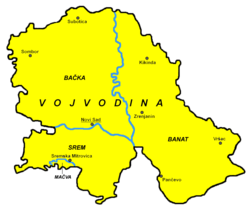
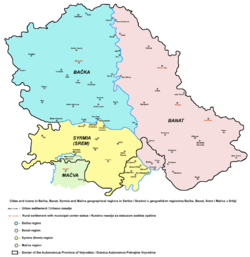
Bačka is a geographical area within the Pannonian plain bordered by the river Danube
to the west and south, and by the river Tisza
to the east of which confluence
is located near Titel
. It is divided between Serbia
and Hungary
, however, there are small uninhabited pockets of the area on the left bank of the Danube which are de jure parts of Croatia
according to the Badinter Commission. Nonetheless, the disputed areas have been under de facto Serbian control since 1991 (see disputes of Croatia and Serbia). Most of the area is located within the Vojvodina
region in Serbia
. Novi Sad
, the capital of Vojvodina, lies on the border between Bačka and Syrmia
, on the banks of the river Danube. Smaller northern part of the geographical area is located within Bács-Kiskun
County, in Hungary.
, Srpska, Hrvatska
(Croatia), Timočka Krajina
, Bugarska
(Bulgaria), Polska
(Poland), etc. The name of "Bač
" (Bács) town itself is of uncertain origin and its existence was recorded among Vlachs
, Slavs and Hungarians in the Middle Ages. The origin of the name could be Paleo-Balkanic
, Romanian
, Slavic
, or Old Turkic
.
According to the some opinions, the denominator of the landscape may have been the first bailiff of Bač (Bács) castle, and the name one which can be rendered probable it Old Turkic baya derives from a dignity name.
, the Kingdom of the Iazyges
, the Hun Empire, the Gepid Kingdom, the Avar Khanate
, the First Bulgarian Empire
, the Great Moravia
, the Kingdom of Hungary
, the Serb realm of Jovan Nenad, the Ottoman Empire
, the Habsburg Monarchy
, the Austrian Empire
, Austria-Hungary
, the Kingdom of Serbia
, the Kingdom of Serbs, Croats and Slovenes, the Kingdom of Yugoslavia
, the Socialist Federal Republic of Yugoslavia
, the Federal Republic of Yugoslavia, Serbia and Montenegro
, and since 2006, it is part of an independent Republic of Serbia. The smaller northern part of the region was part of the short-lived Serb-Hungarian Baranya-Baja Republic
(in 1921) and part of independent Hungary
since 1921.
People have inhabited the region of Bačka since Neolithic
times. Indo-European
peoples settled in this region in 3 migration waves dated in 4200 BC, 3300 BC and 2800 BC respectively. The earliest historical inhabitants of the region were probably Illyria
n tribes. Later, other Indo-European peoples, including Dacians
, Celts, Sarmatians
(Iazyges
) and Gepids were recorded as inhabitants of Bačka.
Slavs
, the ancestors of contemporary Serbs
, settled today's Bačka in the 6th and 7th centuries, before part of them subsequently migrated to the Balkans. In the 9th century the territory of Bačka was part of Bulgarian Empire
. Salan
, a Bulgaria
n voivod (duke), was a ruler in this territory and his capital city was Titel
. In the early 10th century, Hungarians defeated Salan, and his duchy came under Hungarian rule.
In the 11th century, during the administration of the medieval Kingdom of Hungary
, Bacsensis
(Bač, Bács) County was formed, with city of Bač/Bács as its administrative centre. First known prefect of Bacsensis County was recorded in 1074 and he had Slavic name Vid. In this time, the region was populated by both, Slavs and Hungarians. Serbian historian Dr Milenko Palić mention that prefect Vid was an ethnic Serb and that he, together with two other ethnic Serbs whose names were Ilija and Radovan, participated in dynastic struggles in the Kingdom of Hungary, in the end of the 11th century.
After the Kingdom of Hungary was defeated by the Ottoman Empire (in 1526), Bačka became (from 1526 to 1527) the central region of an independent Serbian state, which existed in the territory of present-day Vojvodina
. The ruler of this state was Emperor Jovan Nenad
and his capital city was Subotica
. After Jovan Nenad was killed, his state collapsed and Bačka, for a short time, came again under Hungarian administration. Soon, the region became part of the Ottoman Empire.
During the Ottoman
rule (in the 16th-17th centuries), Bačka was part of the Sanjak
of Segedin
(Szeged), and the region was mainly populated with Serbs
(who were in an absolute majority http://books.google.com/books?id=-zZ_NVM9mNEC&pg=PA9&lpg=PA9&dq=hungarians+vojvodina+1880&source=bl&ots=pdezU5YQTv&sig=eYjZSy7X8g7ST9AoR-uFSXuKTYM&hl=en&ei=sDVUTZKANJKV4gaH0qHrCA&sa=X&oi=book_result&ct=result&resnum=3&sqi=2&ved=0CCQQ6AEwAg#v=onepage&q=Serbs%20in%20an%20absolute%20majority%20in%20the%20province%2C%20as%20in%20the%20days%20of%20the%20Ottoman-Turkish%20occupation&f=false) and Muslims. In 1699 the Bačka came into the possession of the Habsburg Monarchy
. A Bacsensis County
was established in the western parts of the region, while some other (mostly eastern) parts of the Bačka were incorporated into the Tisa
-Mureş
section of Habsburg Military Frontier
. After this part of the Military Frontier was abolished in 1751, these parts of Bačka were also included into Bacsensis county. The only part of Bačka which remained within the Military Frontier was Šajkaška
, but it also came under civil administration in 1873.
According to the Austrian censuses from 1715 and 1720, Serbs
, Bunjevci
, and Šokci comprised most of the region's population (97.6% of population according to 1715-1720 census data ). There were only 530 or 1.9% Hungarians and 0.5% Germans. During the 18th century, the Habsburgs carried out an intensive colonisation of the area, which had low population density after the last Ottoman Wars
, as much of the Serbian population had been decimated through warfare. Muslim population had almost entirelly left or was expelled from the region and some of the Muslim refugees from this area settled in Ottoman Bosnia. The new settlers in Bačka were primarily Serbs
who moved from Ottoman Balkans, Hungarians, and Germans
. Because many of the Germans came from Swabia
, they were known as Donauschwaben, or Danube Swabians
. Some Germans also came from Austria, and some from Bavaria
and Alsace
. Lutheran Slovaks
, Rusyns
, and others were also colonized but to a much smaller extent.
There was also an emigration of Serbs from the eastern parts of the region, which belonged to Military Frontier until 1751. After the abolishment of the Tisa-Mureş section of Military Frontier, many Serbs emigrated from north-eastern parts of Bačka. They moved either to Russia
(notably to New Serbia and Slavo-Serbia
) or to Banat
, where the Military Frontier was still needed.
In 1848 and 1849, Bačka was part of the Serbian Voivodship, a Serbian autonomous region within Austrian Empire
, while between 1849 and 1860 it was part of the Voivodship of Serbia and Tamiš Banat
, a separate Austrian crown land
(the official languages of the voivodeship were German
and Illyrian, i.e. Serbo-Croatian), the successor of the Serbian Voivodship. After 1860, when Voivodship of Serbia and Tamiš Banat was abolished, the Bács-Bodrog
County was again formed in the territory of Bačka. The county was part of the Kingdom of Hungary
, which became one of two autonomous parts of Austria-Hungary
in 1867.
According the 1910 census, the population of Bačka numbered 704.563 people and was composed of: 43,2% speakers of Hungarian language
(310.490), 28,1% speakers of South Slavic
(Serbo-Croatian) language and 22,5% speakers of German language
. Linguistic composition of the region is partially different from ethnic composition since some ethnic Jews and bilingual South Slavs were in this census recorded as speakers of Hungarian language.
In the end of October, 1918, Austria-Hungary was dissolved and, few days later (in November 3), officially capitulated. Following this capitulation, Slavs from Banat, Bačka and Baranja
organized new civil administration in these regions as well as their own military units known as People's Guard (Serbian: Narodna straža). New civil administration was composed of local People's boards (Serbian: Narodni odbori), which were subordinated to Serb People's Board (Serbian: Srpski narodni odbor) in Novi Sad
. Military units of Serb People's Board also possessed airplanes from Novi Sad airport. After elections, which were organized between 18 and 24 November, Great People's Assembly of Serbs, Bunjevci and other Slavs of Banat, Bačka and Baranja (held in November 25, 1918) proclaimed unification of these regions with the Kingdom of Serbia. New administrative bodies of Banat, Bačka and Baranja (government and parliament) were also formed. Although, government in Belgrade accepted decision of unification with Serbia, it never recognized new provincial government. The provincial administration, however, was active until March 12, 1919, when it held its last session.
In December 1, 1918, Kingdom of Serbia united with the State of Slovenes, Croats and Serbs to form new country named Kingdom of Serbs, Croats and Slovenes. Sovereignty of new kingdom was internationally recognized by the Treaty of Saint Germain (in 1919). The Treaty of Trianon
(from 4 June 1920) defined exact borders between the newly independent Hungary
and the Kingdom of Serbs, Croats and Slovenes (which was later renamed the Kingdom of Yugoslavia
) and original territory of Bačka was divided between these two countries. The northern part of the region was a separate county of Hungary (Bács-Bodrog) with seat in Baja, which was later incorporated into Bács-Kiskun
county. The southern part of the region was a county of Kingdom of Serbs, Croats and Slovenes between 1918 and 1922, then a province (oblast
) of the Kingdom of Serbs, Croats and Slovenes between 1922 and 1929, and in 1929 it was incorporated into Danube Banovina
, which was a province of the Kingdom of Yugoslavia.
Between 1820 and 1910, Hungarian speaking population in Bačka increased from 121,688 (31.5%) to 363,518 (44.75%). In the same time, percentage of South Slavs decreased from 44% in 1820 to 27% in 1910. 1921 census showed about 40,000 Hungarian speakers less than in census of 1910. This was especially case in Subotica where 1910 census recorded 55.587 speakers of Hungarian and 33,247 speakers of Bunjevac, while census of 1921 recorded 60,700 speakers of Serbo-Croatian and 26,750 speakers of Hungarian. This is explained by the fact that ethnic Bunjevci from Subotica who had knowledge of Hungarian language were listed as speakers of Hungarian by 1910 census. Between 1921 and 1931 census, number of Hungarian speakers in Bačka increased from 260,998 to 268,711. Slavic population increased by 91,800 inhabitants.
In 1941 Yugoslav Bačka was occupied by the Axis powers
and attached to Horthy's
Hungary
(but was still internationally recognized as part of Yugoslavia). Before this occupation, according to 1931 census, Yugoslav Bačka had 784,896 inhabitants, of whom 284,865 Yugoslavs (Serbs, Croats, Bunjevci, Šokci), 268,711 Hungarians and 169,858 Germans. Hungarian occupational authorities expelled several thousands of Serbs from the region and settled ethnic Hungarians from other parts of Central Europe in their place, so that Hungarian census from 1941 recorded different demographic composition in the region. According to this census, the territory of Bačka had 789,705 inhabitants, of which 45,4% or 47,2% were speakers of Hungarian language (however, not all of them native). During the occupation, Hungarian troops killed
about 20,000 Serbs, Jews and Roma. The occupation ended in 1944 with the end of the Second World War and Yugoslav Bačka became part of the new Democratic Federal Yugoslavia
(later the Socialist Federal Republic of Yugoslavia). Following the defeat of the Axis troops, most of the German population that lived in the area left from the region together with German army. The smaller part of the German population (several thousands of people) that did not leave the area (mostly women, children and the elderly) were sent to prison camps, where many of them died of malnutrition and disease. After the war, members of the Yugoslav partisan army also killed several tens of thousands of inhabitants of German, Hungarian and Serb ethnic origin (in whole of Vojvodina). Estimations about numbers of victims of the partisans (in whole of Vojvodina) are including between 17,000 and 56,000 killed Germans, between 4,000 and 40,000 killed Hungarians, and about 23,000-24,000 killed Serbs.
Together with eastern Syrmia
, western Banat
and northern Mačva
, Yugoslav Bačka is part of the Autonomous Province of Vojvodina
since 1945. Since 1992, Yugoslav Bačka has been part of Federal Republic of Yugoslavia (renamed to Serbia and Montenegro
in 2003), and since 2006 it is part of an independent Republic of Serbia.

 The districts of Serbia
in Bačka are:
Note that municipalities of Sremski Karlovci
, Petrovaradin
, and Beočin
and southern part of municipality of Bačka Palanka
that belong to South Bačka District are geographically not located in Bačka, but in Syrmia, while municipalities of Ada
, Senta
and Kanjiža
which are geographically located in Bačka are part of North Banat District
.
Cities and towns in the Serbian part of Bačka (with city population numbers):
Note: Senta, Kanjiža, Ada and Mol are geographically located in Bačka, but they are part of the North Banat District
.
Also see: List of inhabited places of Vojvodina
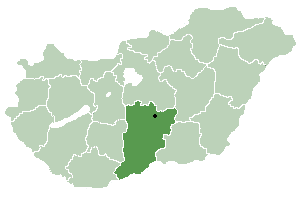 The Hungarian Bácska is mostly located in the Bács-Kiskun county
of Hungary, while one small part of the region is located in the Baranya county
.
Subregions
in the Hungarian Bácska include (with population numbers):
Note that parts of Hungarian Bácska also belong to the subregions of Kiskunhalas
i and Mohács
i, although the main parts of those subregions are not located in Bácska.
Most important towns in Hungarian Bácska (with population numbers):
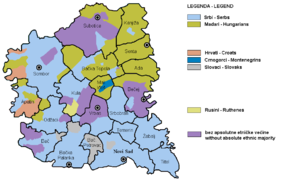
n census, the population of the Serbian part of Bačka (in geographical borders) numbers 1,022,524 people and is composed of:
, the rough population of the Hungarian Bácska (including districts of Bajai
, Bácsalmás
i, and Jánoshalma
i) numbering 113,432 people. http://www.nepszamlalas.hu/hun/kotetek/06/03/data/tabhun/4/load01_1_0.html Note that administrative borders of the districts do not fully correspond with the geographical borders of Hungarian Bácska. Most of the inhabitants of Hungarian Bácska are ethnic Hungarians. http://lazarus.elte.hu/hun/maps/ke2500.gif
Danube
The Danube is a river in the Central Europe and the Europe's second longest river after the Volga. It is classified as an international waterway....
to the west and south, and by the river Tisza
Tisza
The Tisza or Tisa is one of the main rivers of Central Europe. It rises in Ukraine, and is formed near Rakhiv by the junction of headwaters White Tisa, whose source is in the Chornohora mountains and Black Tisa, which springs in the Gorgany range...
to the east of which confluence
Confluence
Confluence, in geography, describes the meeting of two or more bodies of water.Confluence may also refer to:* Confluence , a property of term rewriting systems...
is located near Titel
Titel
Titel is a town and municipality in the South Bačka District of the Vojvodina, Serbia. The town of Titel has a population of 5,831, while the population of the municipality of Titel is 16,936...
. It is divided between Serbia
Serbia
Serbia , officially the Republic of Serbia , is a landlocked country located at the crossroads of Central and Southeast Europe, covering the southern part of the Carpathian basin and the central part of the Balkans...
and Hungary
Hungary
Hungary , officially the Republic of Hungary , is a landlocked country in Central Europe. It is situated in the Carpathian Basin and is bordered by Slovakia to the north, Ukraine and Romania to the east, Serbia and Croatia to the south, Slovenia to the southwest and Austria to the west. The...
, however, there are small uninhabited pockets of the area on the left bank of the Danube which are de jure parts of Croatia
Croatia
Croatia , officially the Republic of Croatia , is a unitary democratic parliamentary republic in Europe at the crossroads of the Mitteleuropa, the Balkans, and the Mediterranean. Its capital and largest city is Zagreb. The country is divided into 20 counties and the city of Zagreb. Croatia covers ...
according to the Badinter Commission. Nonetheless, the disputed areas have been under de facto Serbian control since 1991 (see disputes of Croatia and Serbia). Most of the area is located within the Vojvodina
Vojvodina
Vojvodina, officially called Autonomous Province of Vojvodina is an autonomous province of Serbia. Its capital and largest city is Novi Sad...
region in Serbia
Serbia
Serbia , officially the Republic of Serbia , is a landlocked country located at the crossroads of Central and Southeast Europe, covering the southern part of the Carpathian basin and the central part of the Balkans...
. Novi Sad
Novi Sad
Novi Sad is the capital of the northern Serbian province of Vojvodina, and the administrative centre of the South Bačka District. The city is located in the southern part of Pannonian Plain on the Danube river....
, the capital of Vojvodina, lies on the border between Bačka and Syrmia
Syrmia
Syrmia is a fertile region of the Pannonian Plain in Europe, between the Danube and Sava rivers. It is divided between Serbia in the east and Croatia in the west....
, on the banks of the river Danube. Smaller northern part of the geographical area is located within Bács-Kiskun
Bács-Kiskun
Bács-Kiskun is a county located in southern Hungary. It was created as a result of World War II, merging the pre war Bács-Bodrog and the southern parts of Pest-Pilis-Solt-Kiskun counties. With an area of 8,445 km2, Bács-Kiskun is the largest county in the country. The terrain is mostly flat...
County, in Hungary.
Name
Bačka is a typical Slavic name form, created from "Bač" (name of historical town in Bačka) and sufix "ka" (which designating "the land that belong to Bač"). There are many other similar name forms used in Serbian and other Slavic languages, for example ŠajkaškaŠajkaška
Šajkaška is a geographical region in Serbia. It is southeastern part of Bačka, located in the Autonomous Province of Vojvodina. Territory of Šajkaška is divided among four municipalities: Titel, Žabalj, Novi Sad, and Srbobran. Historical center of Šajkaška is Titel.-Name:Name Šajkaška means "land...
, Srpska, Hrvatska
Croatia
Croatia , officially the Republic of Croatia , is a unitary democratic parliamentary republic in Europe at the crossroads of the Mitteleuropa, the Balkans, and the Mediterranean. Its capital and largest city is Zagreb. The country is divided into 20 counties and the city of Zagreb. Croatia covers ...
(Croatia), Timočka Krajina
Timočka Krajina
Timočka Krajina is a geographical region located in Serbia. It is situated in eastern Serbia around the Timok River. The population of Timočka Krajina is 284,112 .-Name:...
, Bugarska
Bulgaria
Bulgaria , officially the Republic of Bulgaria , is a parliamentary democracy within a unitary constitutional republic in Southeast Europe. The country borders Romania to the north, Serbia and Macedonia to the west, Greece and Turkey to the south, as well as the Black Sea to the east...
(Bulgaria), Polska
Poland
Poland , officially the Republic of Poland , is a country in Central Europe bordered by Germany to the west; the Czech Republic and Slovakia to the south; Ukraine, Belarus and Lithuania to the east; and the Baltic Sea and Kaliningrad Oblast, a Russian exclave, to the north...
(Poland), etc. The name of "Bač
BAC
- Arts and entertainment :* Batman: Arkham City, a 2011 video game* Battersea Arts Centre, London, England, United Kingdom* Benedicta Arts Center, St...
" (Bács) town itself is of uncertain origin and its existence was recorded among Vlachs
Vlachs
Vlach is a blanket term covering several modern Latin peoples descending from the Latinised population in Central, Eastern and Southeastern Europe. English variations on the name include: Walla, Wlachs, Wallachs, Vlahs, Olahs or Ulahs...
, Slavs and Hungarians in the Middle Ages. The origin of the name could be Paleo-Balkanic
Paleo-Balkan languages
Paleo-Balkan is a geolinguistic term referring to the Indo-European languages that were spoken in the Balkans in ancient times. Except for Greek and the language that gave rise to Albanian , they are all extinct, due to Hellenization, Romanization, and Slavicisation.- Classification :The following...
, Romanian
Romanian language
Romanian Romanian Romanian (or Daco-Romanian; obsolete spellings Rumanian, Roumanian; self-designation: română, limba română ("the Romanian language") or românește (lit. "in Romanian") is a Romance language spoken by around 24 to 28 million people, primarily in Romania and Moldova...
, Slavic
Slavic languages
The Slavic languages , a group of closely related languages of the Slavic peoples and a subgroup of Indo-European languages, have speakers in most of Eastern Europe, in much of the Balkans, in parts of Central Europe, and in the northern part of Asia.-Branches:Scholars traditionally divide Slavic...
, or Old Turkic
Turkic languages
The Turkic languages constitute a language family of at least thirty five languages, spoken by Turkic peoples across a vast area from Eastern Europe and the Mediterranean to Siberia and Western China, and are considered to be part of the proposed Altaic language family.Turkic languages are spoken...
.
According to the some opinions, the denominator of the landscape may have been the first bailiff of Bač (Bács) castle, and the name one which can be rendered probable it Old Turkic baya derives from a dignity name.
History
Through history Bačka has been a part of DaciaDacia
In ancient geography, especially in Roman sources, Dacia was the land inhabited by the Dacians or Getae as they were known by the Greeks—the branch of the Thracians north of the Haemus range...
, the Kingdom of the Iazyges
Iazyges
The Iazyges were an ancient nomadic tribe. Known also as Jaxamatae, Ixibatai, Iazygite, Jászok, Ászi, they were a branch of the Sarmatian people who, c. 200 BC, swept westward from central Asia onto the steppes of what is now Ukraine...
, the Hun Empire, the Gepid Kingdom, the Avar Khanate
Eurasian Avars
The Eurasian Avars or Ancient Avars were a highly organized nomadic confederacy of mixed origins. They were ruled by a khagan, who was surrounded by a tight-knit entourage of nomad warriors, an organization characteristic of Turko-Mongol groups...
, the First Bulgarian Empire
First Bulgarian Empire
The First Bulgarian Empire was a medieval Bulgarian state founded in the north-eastern Balkans in c. 680 by the Bulgars, uniting with seven South Slavic tribes...
, the Great Moravia
Great Moravia
Great Moravia was a Slavic state that existed in Central Europe and lasted for nearly seventy years in the 9th century whose creators were the ancestors of the Czechs and Slovaks. It was a vassal state of the Germanic Frankish kingdom and paid an annual tribute to it. There is some controversy as...
, the Kingdom of Hungary
Kingdom of Hungary
The Kingdom of Hungary comprised present-day Hungary, Slovakia and Croatia , Transylvania , Carpatho Ruthenia , Vojvodina , Burgenland , and other smaller territories surrounding present-day Hungary's borders...
, the Serb realm of Jovan Nenad, the Ottoman Empire
Ottoman Empire
The Ottoman EmpireIt was usually referred to as the "Ottoman Empire", the "Turkish Empire", the "Ottoman Caliphate" or more commonly "Turkey" by its contemporaries...
, the Habsburg Monarchy
Habsburg Monarchy
The Habsburg Monarchy covered the territories ruled by the junior Austrian branch of the House of Habsburg , and then by the successor House of Habsburg-Lorraine , between 1526 and 1867/1918. The Imperial capital was Vienna, except from 1583 to 1611, when it was moved to Prague...
, the Austrian Empire
Austrian Empire
The Austrian Empire was a modern era successor empire, which was centered on what is today's Austria and which officially lasted from 1804 to 1867. It was followed by the Empire of Austria-Hungary, whose proclamation was a diplomatic move that elevated Hungary's status within the Austrian Empire...
, Austria-Hungary
Austria-Hungary
Austria-Hungary , more formally known as the Kingdoms and Lands Represented in the Imperial Council and the Lands of the Holy Hungarian Crown of Saint Stephen, was a constitutional monarchic union between the crowns of the Austrian Empire and the Kingdom of Hungary in...
, the Kingdom of Serbia
Kingdom of Serbia
The Kingdom of Serbia was created when Prince Milan Obrenović, ruler of the Principality of Serbia, was crowned King in 1882. The Principality of Serbia was ruled by the Karađorđevic dynasty from 1817 onwards . The Principality, suzerain to the Porte, had expelled all Ottoman troops by 1867, de...
, the Kingdom of Serbs, Croats and Slovenes, the Kingdom of Yugoslavia
Kingdom of Yugoslavia
The Kingdom of Yugoslavia was a state stretching from the Western Balkans to Central Europe which existed during the often-tumultuous interwar era of 1918–1941...
, the Socialist Federal Republic of Yugoslavia
Socialist Federal Republic of Yugoslavia
The Socialist Federal Republic of Yugoslavia was the Yugoslav state that existed from the abolition of the Yugoslav monarchy until it was dissolved in 1992 amid the Yugoslav Wars. It was a socialist state and a federation made up of six socialist republics: Bosnia and Herzegovina, Croatia,...
, the Federal Republic of Yugoslavia, Serbia and Montenegro
Serbia and Montenegro
Serbia and Montenegro was a country in southeastern Europe, formed from two former republics of the Socialist Federal Republic of Yugoslavia : Serbia and Montenegro. Following the breakup of Yugoslavia, it was established in 1992 as a federation called the Federal Republic of Yugoslavia...
, and since 2006, it is part of an independent Republic of Serbia. The smaller northern part of the region was part of the short-lived Serb-Hungarian Baranya-Baja Republic
Baranya-Baja Republic
The Serb-Hungarian Baranya-Baja Republic was a short-lived, Soviet-oriented mini-state, proclaimed in Pécs on 14 August 1921, on occupied Hungarian territory during the peacemaking aftermath of the first World War, tolerated and fostered by...
(in 1921) and part of independent Hungary
Hungary
Hungary , officially the Republic of Hungary , is a landlocked country in Central Europe. It is situated in the Carpathian Basin and is bordered by Slovakia to the north, Ukraine and Romania to the east, Serbia and Croatia to the south, Slovenia to the southwest and Austria to the west. The...
since 1921.
People have inhabited the region of Bačka since Neolithic
Neolithic
The Neolithic Age, Era, or Period, or New Stone Age, was a period in the development of human technology, beginning about 9500 BC in some parts of the Middle East, and later in other parts of the world. It is traditionally considered as the last part of the Stone Age...
times. Indo-European
Indo-European
Indo-European may refer to:* Indo-European languages** Aryan race, a 19th century and early 20th century term for those peoples who are the native speakers of Indo-European languages...
peoples settled in this region in 3 migration waves dated in 4200 BC, 3300 BC and 2800 BC respectively. The earliest historical inhabitants of the region were probably Illyria
Illyria
In classical antiquity, Illyria was a region in the western part of the Balkan Peninsula inhabited by the Illyrians....
n tribes. Later, other Indo-European peoples, including Dacians
Dacians
The Dacians were an Indo-European people, very close or part of the Thracians. Dacians were the ancient inhabitants of Dacia...
, Celts, Sarmatians
Sarmatians
The Iron Age Sarmatians were an Iranian people in Classical Antiquity, flourishing from about the 5th century BC to the 4th century AD....
(Iazyges
Iazyges
The Iazyges were an ancient nomadic tribe. Known also as Jaxamatae, Ixibatai, Iazygite, Jászok, Ászi, they were a branch of the Sarmatian people who, c. 200 BC, swept westward from central Asia onto the steppes of what is now Ukraine...
) and Gepids were recorded as inhabitants of Bačka.
Slavs
Slavic peoples
The Slavic people are an Indo-European panethnicity living in Eastern Europe, Southeast Europe, North Asia and Central Asia. The term Slavic represents a broad ethno-linguistic group of people, who speak languages belonging to the Slavic language family and share, to varying degrees, certain...
, the ancestors of contemporary Serbs
Serbs
The Serbs are a South Slavic ethnic group of the Balkans and southern Central Europe. Serbs are located mainly in Serbia, Montenegro and Bosnia and Herzegovina, and form a sizable minority in Croatia, the Republic of Macedonia and Slovenia. Likewise, Serbs are an officially recognized minority in...
, settled today's Bačka in the 6th and 7th centuries, before part of them subsequently migrated to the Balkans. In the 9th century the territory of Bačka was part of Bulgarian Empire
Bulgarian Empire
Bulgarian Empire is a term used to describe two periods in the medieval history of Bulgaria, during which it acted as a key regional power in Europe in general and in Southeastern Europe in particular, rivalling Byzantium...
. Salan
Salan
]Salan, Dux Salanus or Zalan was, according to the Gesta Hungarorum, a Bulgarian voivod who ruled in the 9th century between Danube and Tisa rivers, mainly in the territory of present-day Bačka region of Serbia and Hungary. The capital city of his voivodship was Titel...
, a Bulgaria
Bulgaria
Bulgaria , officially the Republic of Bulgaria , is a parliamentary democracy within a unitary constitutional republic in Southeast Europe. The country borders Romania to the north, Serbia and Macedonia to the west, Greece and Turkey to the south, as well as the Black Sea to the east...
n voivod (duke), was a ruler in this territory and his capital city was Titel
Titel
Titel is a town and municipality in the South Bačka District of the Vojvodina, Serbia. The town of Titel has a population of 5,831, while the population of the municipality of Titel is 16,936...
. In the early 10th century, Hungarians defeated Salan, and his duchy came under Hungarian rule.
In the 11th century, during the administration of the medieval Kingdom of Hungary
Kingdom of Hungary
The Kingdom of Hungary comprised present-day Hungary, Slovakia and Croatia , Transylvania , Carpatho Ruthenia , Vojvodina , Burgenland , and other smaller territories surrounding present-day Hungary's borders...
, Bacsensis
Bács-Bodrog
Bács-Bodrog County was the administrative county of the Habsburg Kingdom of Hungary from 18th century to 1918. Its territory is currently in northern Serbia and southern Hungary. The capital of the county was Zombor .-Name:The county was named after two older counties: Bács and Bodrog...
(Bač, Bács) County was formed, with city of Bač/Bács as its administrative centre. First known prefect of Bacsensis County was recorded in 1074 and he had Slavic name Vid. In this time, the region was populated by both, Slavs and Hungarians. Serbian historian Dr Milenko Palić mention that prefect Vid was an ethnic Serb and that he, together with two other ethnic Serbs whose names were Ilija and Radovan, participated in dynastic struggles in the Kingdom of Hungary, in the end of the 11th century.
After the Kingdom of Hungary was defeated by the Ottoman Empire (in 1526), Bačka became (from 1526 to 1527) the central region of an independent Serbian state, which existed in the territory of present-day Vojvodina
Vojvodina
Vojvodina, officially called Autonomous Province of Vojvodina is an autonomous province of Serbia. Its capital and largest city is Novi Sad...
. The ruler of this state was Emperor Jovan Nenad
Emperor Jovan Nenad
Jovan Nenad was a 16th-century military commander of Serb mercenaries in the Kingdom of Hungary who took advantage of a Hungarian military defeat in the Battle of Mohács and subsequent struggle over the Hungarian throne to carve out his own state and styled himself emperor , ruling over a...
and his capital city was Subotica
Subotica
Subotica is a city and municipality in northern Serbia, in the Autonomous Province of Vojvodina...
. After Jovan Nenad was killed, his state collapsed and Bačka, for a short time, came again under Hungarian administration. Soon, the region became part of the Ottoman Empire.
During the Ottoman
Ottoman Empire
The Ottoman EmpireIt was usually referred to as the "Ottoman Empire", the "Turkish Empire", the "Ottoman Caliphate" or more commonly "Turkey" by its contemporaries...
rule (in the 16th-17th centuries), Bačka was part of the Sanjak
Sanjak
Sanjaks were administrative divisions of the Ottoman Empire. Sanjak, and the variant spellings sandjak, sanjaq, and sinjaq, are English transliterations of the Turkish word sancak, meaning district, banner, or flag...
of Segedin
Szeged
' is the third largest city of Hungary, the largest city and regional centre of the Southern Great Plain and the county town of Csongrád county. The University of Szeged is one of the most distinguished universities in Hungary....
(Szeged), and the region was mainly populated with Serbs
Serbs
The Serbs are a South Slavic ethnic group of the Balkans and southern Central Europe. Serbs are located mainly in Serbia, Montenegro and Bosnia and Herzegovina, and form a sizable minority in Croatia, the Republic of Macedonia and Slovenia. Likewise, Serbs are an officially recognized minority in...
(who were in an absolute majority http://books.google.com/books?id=-zZ_NVM9mNEC&pg=PA9&lpg=PA9&dq=hungarians+vojvodina+1880&source=bl&ots=pdezU5YQTv&sig=eYjZSy7X8g7ST9AoR-uFSXuKTYM&hl=en&ei=sDVUTZKANJKV4gaH0qHrCA&sa=X&oi=book_result&ct=result&resnum=3&sqi=2&ved=0CCQQ6AEwAg#v=onepage&q=Serbs%20in%20an%20absolute%20majority%20in%20the%20province%2C%20as%20in%20the%20days%20of%20the%20Ottoman-Turkish%20occupation&f=false) and Muslims. In 1699 the Bačka came into the possession of the Habsburg Monarchy
Habsburg Monarchy
The Habsburg Monarchy covered the territories ruled by the junior Austrian branch of the House of Habsburg , and then by the successor House of Habsburg-Lorraine , between 1526 and 1867/1918. The Imperial capital was Vienna, except from 1583 to 1611, when it was moved to Prague...
. A Bacsensis County
Bács-Bodrog
Bács-Bodrog County was the administrative county of the Habsburg Kingdom of Hungary from 18th century to 1918. Its territory is currently in northern Serbia and southern Hungary. The capital of the county was Zombor .-Name:The county was named after two older counties: Bács and Bodrog...
was established in the western parts of the region, while some other (mostly eastern) parts of the Bačka were incorporated into the Tisa
Tisá
Tisá is a village and municipality in Ústí nad Labem District in the Ústí nad Labem Region of the Czech Republic.The municipality covers an area of , and has a population of 786 ....
-Mureş
Mures River
The Mureș is an approximately 761 km long river in Eastern Europe. It originates in the Hășmașu Mare Range in the Eastern Carpathian Mountains, Romania, and joins the Tisza river at Szeged in southeastern Hungary....
section of Habsburg Military Frontier
Military Frontier
The Military Frontier was a borderland of Habsburg Austria and later the Austro-Hungarian Monarchy, which acted as the cordon sanitaire against incursions from the Ottoman Empire...
. After this part of the Military Frontier was abolished in 1751, these parts of Bačka were also included into Bacsensis county. The only part of Bačka which remained within the Military Frontier was Šajkaška
Šajkaška
Šajkaška is a geographical region in Serbia. It is southeastern part of Bačka, located in the Autonomous Province of Vojvodina. Territory of Šajkaška is divided among four municipalities: Titel, Žabalj, Novi Sad, and Srbobran. Historical center of Šajkaška is Titel.-Name:Name Šajkaška means "land...
, but it also came under civil administration in 1873.
According to the Austrian censuses from 1715 and 1720, Serbs
Serbs
The Serbs are a South Slavic ethnic group of the Balkans and southern Central Europe. Serbs are located mainly in Serbia, Montenegro and Bosnia and Herzegovina, and form a sizable minority in Croatia, the Republic of Macedonia and Slovenia. Likewise, Serbs are an officially recognized minority in...
, Bunjevci
Bunjevci
Bunjevci are a South Slavic community and ethnic group living mostly in the Bačka region of Serbia and southern Hungary...
, and Šokci comprised most of the region's population (97.6% of population according to 1715-1720 census data ). There were only 530 or 1.9% Hungarians and 0.5% Germans. During the 18th century, the Habsburgs carried out an intensive colonisation of the area, which had low population density after the last Ottoman Wars
Ottoman wars in Europe
The wars of the Ottoman Empire in Europe are also sometimes referred to as the Ottoman Wars or as Turkish Wars, particularly in older, European texts.- Rise :...
, as much of the Serbian population had been decimated through warfare. Muslim population had almost entirelly left or was expelled from the region and some of the Muslim refugees from this area settled in Ottoman Bosnia. The new settlers in Bačka were primarily Serbs
Serbs
The Serbs are a South Slavic ethnic group of the Balkans and southern Central Europe. Serbs are located mainly in Serbia, Montenegro and Bosnia and Herzegovina, and form a sizable minority in Croatia, the Republic of Macedonia and Slovenia. Likewise, Serbs are an officially recognized minority in...
who moved from Ottoman Balkans, Hungarians, and Germans
Ethnic German
Ethnic Germans historically also ), also collectively referred to as the German diaspora, refers to people who are of German ethnicity. Many are not born in Europe or in the modern-day state of Germany or hold German citizenship...
. Because many of the Germans came from Swabia
Swabia
Swabia is a cultural, historic and linguistic region in southwestern Germany.-Geography:Like many cultural regions of Europe, Swabia's borders are not clearly defined...
, they were known as Donauschwaben, or Danube Swabians
Danube Swabians
The Danube Swabians is a collective term for the German-speaking population who lived in the former Kingdom of Hungary, especially alongside the Danube River valley. Because of different developments within the territory settled, the Danube Swabians cannot be seen as a unified people...
. Some Germans also came from Austria, and some from Bavaria
Bavaria
Bavaria, formally the Free State of Bavaria is a state of Germany, located in the southeast of Germany. With an area of , it is the largest state by area, forming almost 20% of the total land area of Germany...
and Alsace
Alsace
Alsace is the fifth-smallest of the 27 regions of France in land area , and the smallest in metropolitan France. It is also the seventh-most densely populated region in France and third most densely populated region in metropolitan France, with ca. 220 inhabitants per km²...
. Lutheran Slovaks
Slovaks
The Slovaks, Slovak people, or Slovakians are a West Slavic people that primarily inhabit Slovakia and speak the Slovak language, which is closely related to the Czech language.Most Slovaks today live within the borders of the independent Slovakia...
, Rusyns
Pannonian Rusyns
Rusyns in Pannonia, or simply Rusyns or Ruthenians , are a Slavic minority in Serbia and Croatia...
, and others were also colonized but to a much smaller extent.
There was also an emigration of Serbs from the eastern parts of the region, which belonged to Military Frontier until 1751. After the abolishment of the Tisa-Mureş section of Military Frontier, many Serbs emigrated from north-eastern parts of Bačka. They moved either to Russia
Russia
Russia or , officially known as both Russia and the Russian Federation , is a country in northern Eurasia. It is a federal semi-presidential republic, comprising 83 federal subjects...
(notably to New Serbia and Slavo-Serbia
Slavo-Serbia
Slavo-Serbia was a territory of Imperial Russia between 1753 and 1764. It was located by the right bank of the Donets River between the Bakhmut and Lugan rivers...
) or to Banat
Banat
The Banat is a geographical and historical region in Central Europe currently divided between three countries: the eastern part lies in western Romania , the western part in northeastern Serbia , and a small...
, where the Military Frontier was still needed.
In 1848 and 1849, Bačka was part of the Serbian Voivodship, a Serbian autonomous region within Austrian Empire
Austrian Empire
The Austrian Empire was a modern era successor empire, which was centered on what is today's Austria and which officially lasted from 1804 to 1867. It was followed by the Empire of Austria-Hungary, whose proclamation was a diplomatic move that elevated Hungary's status within the Austrian Empire...
, while between 1849 and 1860 it was part of the Voivodship of Serbia and Tamiš Banat
Voivodship of Serbia and Tamiš Banat
The Voivodeship of Serbia and Banat of Temeschwar or Serbian Voivodeship and Banat of Temeschwar was a province of the Austrian Empire that existed between 1849 and 1860....
, a separate Austrian crown land
Crown land
In Commonwealth realms, Crown land is an area belonging to the monarch , the equivalent of an entailed estate that passed with the monarchy and could not be alienated from it....
(the official languages of the voivodeship were German
German language
German is a West Germanic language, related to and classified alongside English and Dutch. With an estimated 90 – 98 million native speakers, German is one of the world's major languages and is the most widely-spoken first language in the European Union....
and Illyrian, i.e. Serbo-Croatian), the successor of the Serbian Voivodship. After 1860, when Voivodship of Serbia and Tamiš Banat was abolished, the Bács-Bodrog
Bács-Bodrog
Bács-Bodrog County was the administrative county of the Habsburg Kingdom of Hungary from 18th century to 1918. Its territory is currently in northern Serbia and southern Hungary. The capital of the county was Zombor .-Name:The county was named after two older counties: Bács and Bodrog...
County was again formed in the territory of Bačka. The county was part of the Kingdom of Hungary
Kingdom of Hungary
The Kingdom of Hungary comprised present-day Hungary, Slovakia and Croatia , Transylvania , Carpatho Ruthenia , Vojvodina , Burgenland , and other smaller territories surrounding present-day Hungary's borders...
, which became one of two autonomous parts of Austria-Hungary
Austria-Hungary
Austria-Hungary , more formally known as the Kingdoms and Lands Represented in the Imperial Council and the Lands of the Holy Hungarian Crown of Saint Stephen, was a constitutional monarchic union between the crowns of the Austrian Empire and the Kingdom of Hungary in...
in 1867.
According the 1910 census, the population of Bačka numbered 704.563 people and was composed of: 43,2% speakers of Hungarian language
Hungarian language
Hungarian is a Uralic language, part of the Ugric group. With some 14 million speakers, it is one of the most widely spoken non-Indo-European languages in Europe....
(310.490), 28,1% speakers of South Slavic
South Slavic languages
The South Slavic languages comprise one of three branches of the Slavic languages. There are approximately 30 million speakers, mainly in the Balkans. These are separated geographically from speakers of the other two Slavic branches by a belt of German, Hungarian and Romanian speakers...
(Serbo-Croatian) language and 22,5% speakers of German language
German language
German is a West Germanic language, related to and classified alongside English and Dutch. With an estimated 90 – 98 million native speakers, German is one of the world's major languages and is the most widely-spoken first language in the European Union....
. Linguistic composition of the region is partially different from ethnic composition since some ethnic Jews and bilingual South Slavs were in this census recorded as speakers of Hungarian language.
In the end of October, 1918, Austria-Hungary was dissolved and, few days later (in November 3), officially capitulated. Following this capitulation, Slavs from Banat, Bačka and Baranja
Banat, Backa and Baranja
Banat, Bačka and Baranja was a de facto province of the Kingdom of Serbia and the Kingdom of Serbs, Croats and Slovenes between October 1918 and March 1919...
organized new civil administration in these regions as well as their own military units known as People's Guard (Serbian: Narodna straža). New civil administration was composed of local People's boards (Serbian: Narodni odbori), which were subordinated to Serb People's Board (Serbian: Srpski narodni odbor) in Novi Sad
Novi Sad
Novi Sad is the capital of the northern Serbian province of Vojvodina, and the administrative centre of the South Bačka District. The city is located in the southern part of Pannonian Plain on the Danube river....
. Military units of Serb People's Board also possessed airplanes from Novi Sad airport. After elections, which were organized between 18 and 24 November, Great People's Assembly of Serbs, Bunjevci and other Slavs of Banat, Bačka and Baranja (held in November 25, 1918) proclaimed unification of these regions with the Kingdom of Serbia. New administrative bodies of Banat, Bačka and Baranja (government and parliament) were also formed. Although, government in Belgrade accepted decision of unification with Serbia, it never recognized new provincial government. The provincial administration, however, was active until March 12, 1919, when it held its last session.
In December 1, 1918, Kingdom of Serbia united with the State of Slovenes, Croats and Serbs to form new country named Kingdom of Serbs, Croats and Slovenes. Sovereignty of new kingdom was internationally recognized by the Treaty of Saint Germain (in 1919). The Treaty of Trianon
Treaty of Trianon
The Treaty of Trianon was the peace agreement signed in 1920, at the end of World War I, between the Allies of World War I and Hungary . The treaty greatly redefined and reduced Hungary's borders. From its borders before World War I, it lost 72% of its territory, which was reduced from to...
(from 4 June 1920) defined exact borders between the newly independent Hungary
Hungary
Hungary , officially the Republic of Hungary , is a landlocked country in Central Europe. It is situated in the Carpathian Basin and is bordered by Slovakia to the north, Ukraine and Romania to the east, Serbia and Croatia to the south, Slovenia to the southwest and Austria to the west. The...
and the Kingdom of Serbs, Croats and Slovenes (which was later renamed the Kingdom of Yugoslavia
Kingdom of Yugoslavia
The Kingdom of Yugoslavia was a state stretching from the Western Balkans to Central Europe which existed during the often-tumultuous interwar era of 1918–1941...
) and original territory of Bačka was divided between these two countries. The northern part of the region was a separate county of Hungary (Bács-Bodrog) with seat in Baja, which was later incorporated into Bács-Kiskun
Bács-Kiskun
Bács-Kiskun is a county located in southern Hungary. It was created as a result of World War II, merging the pre war Bács-Bodrog and the southern parts of Pest-Pilis-Solt-Kiskun counties. With an area of 8,445 km2, Bács-Kiskun is the largest county in the country. The terrain is mostly flat...
county. The southern part of the region was a county of Kingdom of Serbs, Croats and Slovenes between 1918 and 1922, then a province (oblast
Oblast
Oblast is a type of administrative division in Slavic countries, including some countries of the former Soviet Union. The word "oblast" is a loanword in English, but it is nevertheless often translated as "area", "zone", "province", or "region"...
) of the Kingdom of Serbs, Croats and Slovenes between 1922 and 1929, and in 1929 it was incorporated into Danube Banovina
Danube Banovina
The Danube Banovina or Danube Banate was a province of the Kingdom of Yugoslavia between 1929 and 1941. This province consisted of the geographical regions of Syrmia, Bačka, Banat, Baranja, Šumadija, and Braničevo. The capital city of the Danube Banovina was Novi Sad...
, which was a province of the Kingdom of Yugoslavia.
Between 1820 and 1910, Hungarian speaking population in Bačka increased from 121,688 (31.5%) to 363,518 (44.75%). In the same time, percentage of South Slavs decreased from 44% in 1820 to 27% in 1910. 1921 census showed about 40,000 Hungarian speakers less than in census of 1910. This was especially case in Subotica where 1910 census recorded 55.587 speakers of Hungarian and 33,247 speakers of Bunjevac, while census of 1921 recorded 60,700 speakers of Serbo-Croatian and 26,750 speakers of Hungarian. This is explained by the fact that ethnic Bunjevci from Subotica who had knowledge of Hungarian language were listed as speakers of Hungarian by 1910 census. Between 1921 and 1931 census, number of Hungarian speakers in Bačka increased from 260,998 to 268,711. Slavic population increased by 91,800 inhabitants.
In 1941 Yugoslav Bačka was occupied by the Axis powers
Axis Powers
The Axis powers , also known as the Axis alliance, Axis nations, Axis countries, or just the Axis, was an alignment of great powers during the mid-20th century that fought World War II against the Allies. It began in 1936 with treaties of friendship between Germany and Italy and between Germany and...
and attached to Horthy's
Miklós Horthy
Miklós Horthy de Nagybánya was the Regent of the Kingdom of Hungary during the interwar years and throughout most of World War II, serving from 1 March 1920 to 15 October 1944. Horthy was styled "His Serene Highness the Regent of the Kingdom of Hungary" .Admiral Horthy was an officer of the...
Hungary
Hungary
Hungary , officially the Republic of Hungary , is a landlocked country in Central Europe. It is situated in the Carpathian Basin and is bordered by Slovakia to the north, Ukraine and Romania to the east, Serbia and Croatia to the south, Slovenia to the southwest and Austria to the west. The...
(but was still internationally recognized as part of Yugoslavia). Before this occupation, according to 1931 census, Yugoslav Bačka had 784,896 inhabitants, of whom 284,865 Yugoslavs (Serbs, Croats, Bunjevci, Šokci), 268,711 Hungarians and 169,858 Germans. Hungarian occupational authorities expelled several thousands of Serbs from the region and settled ethnic Hungarians from other parts of Central Europe in their place, so that Hungarian census from 1941 recorded different demographic composition in the region. According to this census, the territory of Bačka had 789,705 inhabitants, of which 45,4% or 47,2% were speakers of Hungarian language (however, not all of them native). During the occupation, Hungarian troops killed
Occupation of Vojvodina, 1941-1944
The Occupation of Vojvodina from 1941 to 1944 was carried out by Nazi Germany and its client states / puppet regimes: Horthy's Hungary and Independent State of Croatia....
about 20,000 Serbs, Jews and Roma. The occupation ended in 1944 with the end of the Second World War and Yugoslav Bačka became part of the new Democratic Federal Yugoslavia
Socialist Federal Republic of Yugoslavia
The Socialist Federal Republic of Yugoslavia was the Yugoslav state that existed from the abolition of the Yugoslav monarchy until it was dissolved in 1992 amid the Yugoslav Wars. It was a socialist state and a federation made up of six socialist republics: Bosnia and Herzegovina, Croatia,...
(later the Socialist Federal Republic of Yugoslavia). Following the defeat of the Axis troops, most of the German population that lived in the area left from the region together with German army. The smaller part of the German population (several thousands of people) that did not leave the area (mostly women, children and the elderly) were sent to prison camps, where many of them died of malnutrition and disease. After the war, members of the Yugoslav partisan army also killed several tens of thousands of inhabitants of German, Hungarian and Serb ethnic origin (in whole of Vojvodina). Estimations about numbers of victims of the partisans (in whole of Vojvodina) are including between 17,000 and 56,000 killed Germans, between 4,000 and 40,000 killed Hungarians, and about 23,000-24,000 killed Serbs.
Together with eastern Syrmia
Syrmia
Syrmia is a fertile region of the Pannonian Plain in Europe, between the Danube and Sava rivers. It is divided between Serbia in the east and Croatia in the west....
, western Banat
Banat
The Banat is a geographical and historical region in Central Europe currently divided between three countries: the eastern part lies in western Romania , the western part in northeastern Serbia , and a small...
and northern Mačva
Macva
Mačva is a geographical region in Serbia, mostly situated in the northwest of Central Serbia. It is located in a fertile plain between the Sava and Drina rivers. The chief town of this region is Šabac. The modern Mačva District of Serbia is named after the region, although the region of Mačva...
, Yugoslav Bačka is part of the Autonomous Province of Vojvodina
Vojvodina
Vojvodina, officially called Autonomous Province of Vojvodina is an autonomous province of Serbia. Its capital and largest city is Novi Sad...
since 1945. Since 1992, Yugoslav Bačka has been part of Federal Republic of Yugoslavia (renamed to Serbia and Montenegro
Serbia and Montenegro
Serbia and Montenegro was a country in southeastern Europe, formed from two former republics of the Socialist Federal Republic of Yugoslavia : Serbia and Montenegro. Following the breakup of Yugoslavia, it was established in 1992 as a federation called the Federal Republic of Yugoslavia...
in 2003), and since 2006 it is part of an independent Republic of Serbia.
Serbian Bačka
Districts of Serbia
Districts , officially called administrative districts are the administrative units of Serbia, comprising several municipalities and/or cities each. They are defined by the Government of Serbia's Enactment of 29 January 1992. Districts are regional centers of state authority and they do not have...
in Bačka are:
- West BačkaWest Backa DistrictWest Bačka District is a northern district of Serbia. It lies in the region of Bačka, in the autonomous province of Vojvodina. It has a population of 215,916...
- North BačkaNorth Backa DistrictNorth Bačka District is a northern district of Serbia. It lies in the Bačka region in the autonomous province of Vojvodina. It has a population of 200,140...
- South BačkaSouth Backa DistrictSouth Bačka District is a northern district of Serbia. It lies in the southern part of Bačka and northern part of Syrmia, in the autonomous province of Vojvodina. It has a population of 607,835...
Note that municipalities of Sremski Karlovci
Sremski Karlovci
Sremski Karlovci is a town and municipality in Serbia, in the autonomous province of Vojvodina, situated on the bank of the river Danube, 8 km from Novi Sad...
, Petrovaradin
Petrovaradin
Petrovaradin , is part of the agglomeration of Novi Sad in Serbia...
, and Beočin
Beocin
Beočin is a town and municipality in the Vojvodina province, Serbia. The population of the town is 8,037, whilst Beočin's municipality population is 16,029...
and southern part of municipality of Bačka Palanka
Backa Palanka
Bačka Palanka is a city and municipality located in Serbia, on left bank of the Danube, at 45.15° North, 19.24° East...
that belong to South Bačka District are geographically not located in Bačka, but in Syrmia, while municipalities of Ada
Ada, Serbia
Ada is a town and municipality in Serbia. It is situated near the river Tisa in Vojvodina province. Although the town is geographically located in Bačka, it is part of the North Banat District...
, Senta
Senta
Senta is a town and municipality on the bank of the Tisa river in the Vojvodina province, Serbia. Although geographically located in Bačka, it is part of the North Banat District...
and Kanjiža
Kanjiža
Kanjiža is a town and municipality in the North Banat District of Vojvodina, Serbia...
which are geographically located in Bačka are part of North Banat District
North Banat District
North Banat District is a northern district of Serbia. It lies in the regions of Banat and Bačka, in the autonomous province of Vojvodina. As of the 2002 census, the district has a population of 165,881. The seat of the district is Kikinda....
.
Cities and towns in the Serbian part of Bačka (with city population numbers):
- Novi SadNovi SadNovi Sad is the capital of the northern Serbian province of Vojvodina, and the administrative centre of the South Bačka District. The city is located in the southern part of Pannonian Plain on the Danube river....
(284,252) (2009)* - SuboticaSuboticaSubotica is a city and municipality in northern Serbia, in the Autonomous Province of Vojvodina...
(105,717) - SomborSomborSombor is a city and municipality located in northwest part of Serbian autonomous province of Vojvodina. The city has a total population of 48,749 , while the Sombor municipality has 87,815 inhabitants...
(53,094) - Bačka PalankaBacka PalankaBačka Palanka is a city and municipality located in Serbia, on left bank of the Danube, at 45.15° North, 19.24° East...
(31,494) - Vrbas (26,484)
- BečejBecejBečej is a town and municipality located in the South Bačka District in Vojvodina, Serbia. The town has a population of 25,703, while Bečej municipality has 40,877 inhabitants. It is multiethnic town, with Hungarians and Serbs as largest ethnic groups...
(25,840) - TemerinTemerinTemerin is a town and municipality in South Bačka District of Vojvodina, Serbia...
(20,903) - FutogFutogFutog is a town in Serbia, in the Autonomous Province of Vojvodina. It is part of the metropolitan area of Novi Sad.-Name:The name Futog derives from Old Church Slavonic term for “on the mouth” - vo utok ....
(20,491) - SentaSentaSenta is a town and municipality on the bank of the Tisa river in the Vojvodina province, Serbia. Although geographically located in Bačka, it is part of the North Banat District...
(20,363) - ApatinApatinApatin is a town and municipality in the Vojvodina administrative region of Serbia, located in the West Bačka District, at . The town of Apatin is the administrative, economic, cultural, educational and tourist centre of the municipality of Apatin...
(20,316) - KulaKula (Vojvodina)Kula is a town and municipality in the West Bačka District of Vojvodina, Serbia. The town Kula has a population of 19,293, while the Kula municipality has a population of 48,306.- Name :...
(19,723) - VeternikVeternikVeternik is a suburban settlement near Novi Sad, Serbia. It is located between Novi Sad and Futog. Its population numbers 16,895 and most of its inhabitants are ethnic Serbs...
(16,802) - Bačka TopolaBacka TopolaBačka Topola is a town and municipality in the North Bačka District of Vojvodina, Serbia...
(16,207) - SrbobranSrbobranSrbobran is a town and municipality in South Bačka District of Vojvodina, Serbia. The town is located on the north bank of the Danube-Tisa-Danube channel...
(13,447) - KaćKACKAC may refer to:*Knight's Armament Company*EC KAC, a professional ice hockey team*Kajonk-A-Con*King Armored Car, the USA's first armored vehicle....
(12,562) - CrvenkaCrvenkaCrvenka is a town located in the Kula municipality, in the West Bačka District of Serbia. It is situated in the Autonomous Province of Vojvodina...
(10,255) - ŽabaljŽabaljŽabalj is a town and municipality in South Bačka District of Vojvodina, Serbia. Žabalj town has a population of 9,582, and Žabalj municipality 27,418. It is located in southeastern part of Bačka, known as Šajkaška.-Name:...
(10,238) - KanjižaKanjižaKanjiža is a town and municipality in the North Banat District of Vojvodina, Serbia...
(10,193) - AdaAda, SerbiaAda is a town and municipality in Serbia. It is situated near the river Tisa in Vojvodina province. Although the town is geographically located in Bačka, it is part of the North Banat District...
(10,083) - OdžaciOdžaciOdžaci is a town and municipality in the West Bačka District of Serbia. It is situated in the Autonomous Province of Vojvodina. The town of Odžaci has a population of 9,832 people, while the population of the municipality of Odžaci is 35,474 people .-Name:The name Odžaci means "chimneys" in Serbian...
(9,832) - BajmokBajmokBajmok is a village located in the Subotica municipality, in the North Bačka District of Serbia. It is situated in the autonomous province of Vojvodina...
(8,586) - PalićPalicPalić is a town in Serbia, from Subotica, and from the border between Serbia and Hungary. It is a part of the Subotica Municipality, North Bačka District, autonomous province of Vojvodina. The town has a Hungarian ethnic majority and its population numbering 7,745 people...
(7,745) - MolMol, SerbiaMol is a town located in the Ada municipality, in the North Banat District of Serbia. It is situated in the Autonomous Province of Vojvodina...
(6,780) - Bački PetrovacBacki PetrovacBački Petrovac is a town and municipality in the South Bačka District of Vojvodina, Serbia...
(6,727) - Bač (6,087)
- Bački JarakBacki JarakBački Jarak is a town located in the Temerin municipality, in the South Bačka District of Serbia. It is situated in the Autonomous Province of Vojvodina...
(6,049) - TitelTitelTitel is a town and municipality in the South Bačka District of the Vojvodina, Serbia. The town of Titel has a population of 5,831, while the population of the municipality of Titel is 16,936...
(5,894)
Note: Senta, Kanjiža, Ada and Mol are geographically located in Bačka, but they are part of the North Banat District
North Banat District
North Banat District is a northern district of Serbia. It lies in the regions of Banat and Bačka, in the autonomous province of Vojvodina. As of the 2002 census, the district has a population of 165,881. The seat of the district is Kikinda....
.
Also see: List of inhabited places of Vojvodina
Hungarian Bácska
Bács-Kiskun
Bács-Kiskun is a county located in southern Hungary. It was created as a result of World War II, merging the pre war Bács-Bodrog and the southern parts of Pest-Pilis-Solt-Kiskun counties. With an area of 8,445 km2, Bács-Kiskun is the largest county in the country. The terrain is mostly flat...
of Hungary, while one small part of the region is located in the Baranya county
Baranya (county)
Baranya is the name of an administrative county in present Hungary, in the Baranya region, and also in the former Kingdom of Hungary ....
.
Subregions
Subregions of Hungary
Subregions of Hungary are subdivisions of the counties of Hungary, dividing the twenty counties into 175 administrative subregions. Budapest is both a county and a subregion.The subregions are listed below, by...
in the Hungarian Bácska include (with population numbers):
- Bajai (76,906)
- BácsalmásBácsalmásBácsalmás is a small town in southern Hungary in the region of Bácska close to the border with the Vojvodina region of Serbia, with a population of 7,694 people.- History :In the Middle Ages, the region came under the control of the Magyars who absorbed the Slavic and the...
i (18,578) - JánoshalmaJánoshalmaJánoshalma is a town in Bács-Kiskun county in southern Hungary....
i (17,885)
Note that parts of Hungarian Bácska also belong to the subregions of Kiskunhalas
Kiskunhalas
- Railroad :The city is an important railway junction. It crosses the Budapest-Subotica-Belgrade railway line. The Kiskunfélegyháza railway ends in Kiskunhalas.- Name :...
i and Mohács
Mohács
Mohács is a town in Baranya county, Hungary on the right bank of the Danube.-History:Two famous battles took place there:# Battle of Mohács, 1526# Battle of Mohács, 1687...
i, although the main parts of those subregions are not located in Bácska.
Most important towns in Hungarian Bácska (with population numbers):
- Baja (38,143)
- JánoshalmaJánoshalmaJánoshalma is a town in Bács-Kiskun county in southern Hungary....
(9,866) - BácsalmásBácsalmásBácsalmás is a small town in southern Hungary in the region of Bácska close to the border with the Vojvodina region of Serbia, with a population of 7,694 people.- History :In the Middle Ages, the region came under the control of the Magyars who absorbed the Slavic and the...
(7,694)
Demographics
Serbia
According to the 2002 SerbiaSerbia
Serbia , officially the Republic of Serbia , is a landlocked country located at the crossroads of Central and Southeast Europe, covering the southern part of the Carpathian basin and the central part of the Balkans...
n census, the population of the Serbian part of Bačka (in geographical borders) numbers 1,022,524 people and is composed of:
- 559,700 (54.74%) SerbsSerbsThe Serbs are a South Slavic ethnic group of the Balkans and southern Central Europe. Serbs are located mainly in Serbia, Montenegro and Bosnia and Herzegovina, and form a sizable minority in Croatia, the Republic of Macedonia and Slovenia. Likewise, Serbs are an officially recognized minority in...
- 221,882 (21.70%) Hungarians
- others (including SlovaksSlovaksThe Slovaks, Slovak people, or Slovakians are a West Slavic people that primarily inhabit Slovakia and speak the Slovak language, which is closely related to the Czech language.Most Slovaks today live within the borders of the independent Slovakia...
, CroatsCroatsCroats are a South Slavic ethnic group mostly living in Croatia, Bosnia and Herzegovina and nearby countries. There are around 4 million Croats living inside Croatia and up to 4.5 million throughout the rest of the world. Responding to political, social and economic pressure, many Croats have...
, BunjevciBunjevciBunjevci are a South Slavic community and ethnic group living mostly in the Bačka region of Serbia and southern Hungary...
, Šokci, RusynsPannonian RusynsRusyns in Pannonia, or simply Rusyns or Ruthenians , are a Slavic minority in Serbia and Croatia...
, Montenegrins, YugoslavsYugoslavsYugoslavs is a national designation used by a minority of South Slavs across the countries of the former Yugoslavia and in the diaspora...
, Roma, GermansGermansThe Germans are a Germanic ethnic group native to Central Europe. The English term Germans has referred to the German-speaking population of the Holy Roman Empire since the Late Middle Ages....
, etc.).
Hungary
According to the 2001 census in HungaryHungary
Hungary , officially the Republic of Hungary , is a landlocked country in Central Europe. It is situated in the Carpathian Basin and is bordered by Slovakia to the north, Ukraine and Romania to the east, Serbia and Croatia to the south, Slovenia to the southwest and Austria to the west. The...
, the rough population of the Hungarian Bácska (including districts of Bajai
Baja, Hungary
Baja is a city in , southern Hungary. It is the second largest city in the county, after the county seat at Kecskemét, and is home to around 37,000 people....
, Bácsalmás
Bácsalmás
Bácsalmás is a small town in southern Hungary in the region of Bácska close to the border with the Vojvodina region of Serbia, with a population of 7,694 people.- History :In the Middle Ages, the region came under the control of the Magyars who absorbed the Slavic and the...
i, and Jánoshalma
Jánoshalma
Jánoshalma is a town in Bács-Kiskun county in southern Hungary....
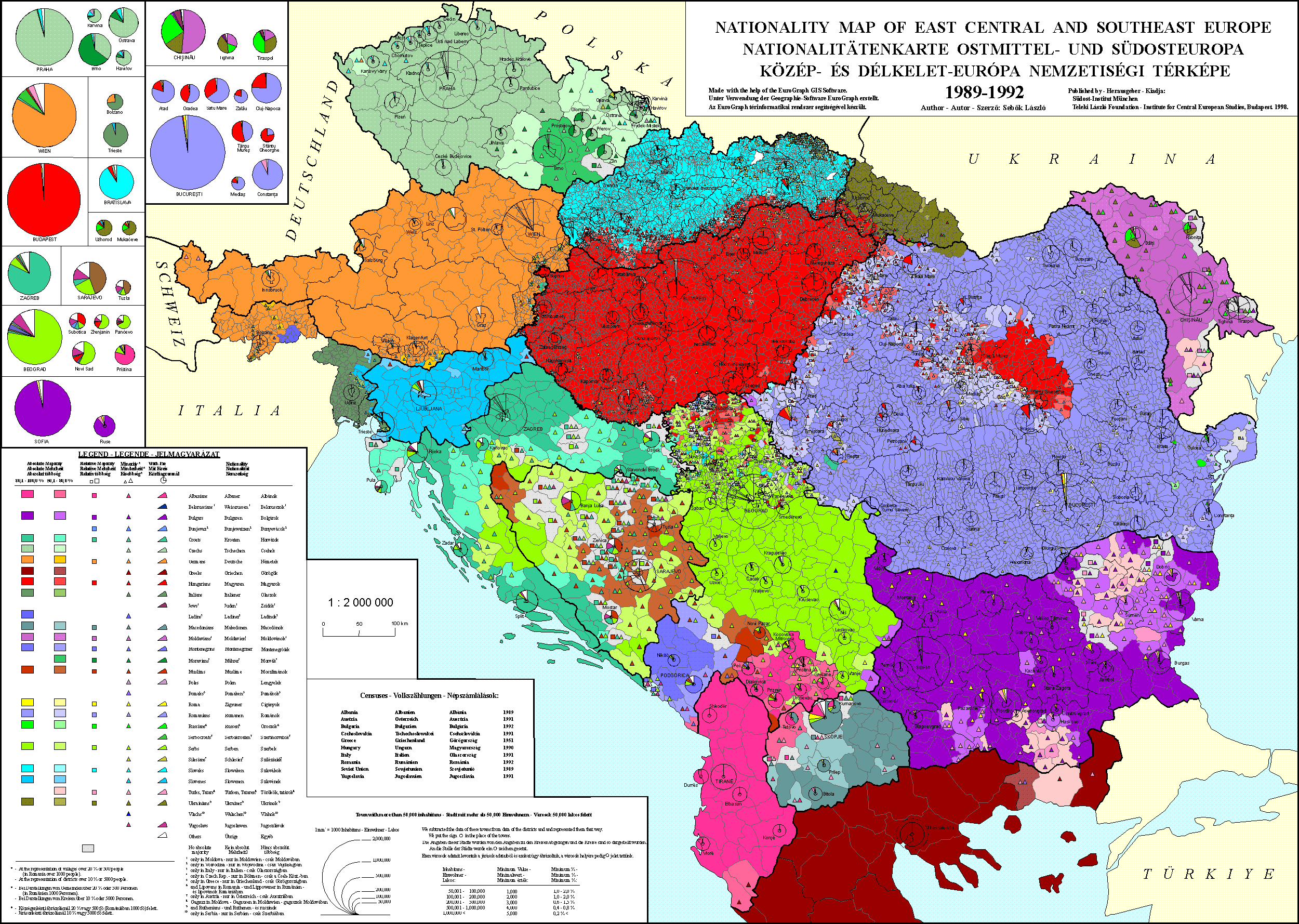
i) numbering 113,432 people. http://www.nepszamlalas.hu/hun/kotetek/06/03/data/tabhun/4/load01_1_0.html Note that administrative borders of the districts do not fully correspond with the geographical borders of Hungarian Bácska. Most of the inhabitants of Hungarian Bácska are ethnic Hungarians. http://lazarus.elte.hu/hun/maps/ke2500.gif
See also
- VojvodinaVojvodinaVojvodina, officially called Autonomous Province of Vojvodina is an autonomous province of Serbia. Its capital and largest city is Novi Sad...
- North Bačka DistrictNorth Backa DistrictNorth Bačka District is a northern district of Serbia. It lies in the Bačka region in the autonomous province of Vojvodina. It has a population of 200,140...
- West Bačka DistrictWest Backa DistrictWest Bačka District is a northern district of Serbia. It lies in the region of Bačka, in the autonomous province of Vojvodina. It has a population of 215,916...
- South Bačka DistrictSouth Backa DistrictSouth Bačka District is a northern district of Serbia. It lies in the southern part of Bačka and northern part of Syrmia, in the autonomous province of Vojvodina. It has a population of 607,835...
- Bács-BodrogBács-BodrogBács-Bodrog County was the administrative county of the Habsburg Kingdom of Hungary from 18th century to 1918. Its territory is currently in northern Serbia and southern Hungary. The capital of the county was Zombor .-Name:The county was named after two older counties: Bács and Bodrog...
- Bács-KiskunBács-KiskunBács-Kiskun is a county located in southern Hungary. It was created as a result of World War II, merging the pre war Bács-Bodrog and the southern parts of Pest-Pilis-Solt-Kiskun counties. With an area of 8,445 km2, Bács-Kiskun is the largest county in the country. The terrain is mostly flat...