
See Also

Dick Cheney

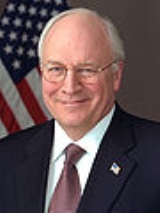
Richard Bruce "Dick" Cheney is the 46th and current Vice President of the United States Vice President of the United States

The Vice President of the United States is the second-highest executive official of the United States government [i] ... 

, serving under President President of the United States

The President of the United States of America is the head of state [i] of the United States [i]. ... 

 George W. Bush George W. Bush

This page is monitored by many people and bots, and joke edits are removed quickly. ... 

. Previously, he served as White House Chief of Staff White House Chief of Staff

The White House Chief of Staff is the highest-ranking member of the Executive Office of the President of the United States [i] ... 

, member of the U.S. House of Representatives United States House of Representatives

The United States House of Representatives is one of the two chambers [i] of the United States Congress [i] ... 

 from Wyoming Wyoming

Wyoming is a state [i] of the western [i] United States [i]. ... 

, and Secretary of Defense United States Secretary of Defense

The United States Secretary of Defense is the head of the United States Department of Defense [i], conce ... 

. In the private sector, he was the Chairman and Chief Executive Officer of Halliburton Energy Services Halliburton

Halliburton Energy Services is a multinational corporation [i] with operations in over 120 countries. ... 

; he is still a major stockholder. On June 29, 2002, he briefly assumed the duties and responsibilities as President of the United States President of the United States

The President of the United States of America is the head of state [i] of the United States [i]. ... 

 when President Bush underwent a medical exam involving anesthetics.

Discussions

  Discussion Features

   Ask a question about 'Dick Cheney'

   Start a new discussion about 'Dick Cheney'

   Answer questions about 'Dick Cheney'

   'Dick Cheney' discussion forum

Timeline

1941   Born


Encyclopedia

Richard Bruce "Dick" Cheney is the 46th and current Vice President of the United States Vice President of the United States

The Vice President of the United States is the second-highest executive official of the United States government [i] ... 

, serving under President President of the United States

The President of the United States of America is the head of state [i] of the United States [i]. ... 

 George W. Bush George W. Bush

This page is monitored by many people and bots, and joke edits are removed quickly.
... 

. Previously, he served as White House Chief of Staff White House Chief of Staff

The White House Chief of Staff is the highest-ranking member of the Executive Office of the President of the United States [i] ... 

, member of the U.S. House of Representatives United States House of Representatives

The United States House of Representatives is one of the two chambers [i] of the United States Congress [i] ... 

 from Wyoming Wyoming

Wyoming is a state [i] of the western [i] United States [i]. ... 

, and Secretary of Defense United States Secretary of Defense

The United States Secretary of Defense is the head of the United States Department of Defense [i], conce ... 

. In the private sector, he was the Chairman and Chief Executive Officer of Halliburton Energy Services Halliburton

Halliburton Energy Services is a multinational corporation [i] with operations in over 120 countries. ... 

; he is still a major stockholder. On June 29, 2002, he briefly assumed the duties and responsibilities as President of the United States President of the United States

The President of the United States of America is the head of state [i] of the United States [i]. ... 

 when President Bush underwent a medical exam involving anesthetics.

Early life and family

Richard Bruce Cheney was born in Lincoln Lincoln, Nebraska

Lincoln is the capital [i] of Nebraska [i] and is the county seat [i] of Lancaster County [i] ... 

, Nebraska Nebraska

Nebraska is a Great Plains [i] state [i] of the United States [i]. ... 

 to Richard Herbert Cheney and Marjorie Dickey, and grew up in Casper, Wyoming Casper, Wyoming

Casper is a city in Natrona County [i], Wyoming [i], United States [i]. ... 

. His father worked for the U.S. Department of Agriculture United States Department of Agriculture

The United States Department of Agriculture is a United States Federal Executive Department [i]. ... 

 as a soil conservation agent. He has a brother, Robert, and a sister, Susan.

In November 1962 at the age of twenty-one, Cheney was convicted for the first of two offenses of driving while intoxicated . According to the docket from the Municipal Court in Cheyenne, Wyoming Cheyenne, Wyoming

Cheyenne is the capital of Wyoming [i], a state [i] of the United States of America [i] ... 

, Cheney was arrested for drunkenness and, "operating motor vehicle while intoxicated." A Cheyenne Police Judge found Cheney guilty of the two charges. Cheney's driving license was suspended for 30 days and he had to forfeit a $150 bond posted at the time of his arrest.

Eight months later, in July 1963, Cheney was arrested in Rock Springs, Wyoming Rock Springs, Wyoming

Rock Springs is a city in Sweetwater County [i], Wyoming [i], United States [i] ... 

 and fined $100 for his second DWI conviction. At the time, it was not possible for the authorities in each area to link the two convictions, which would have resulted in the second offense being viewed much more seriously. Since this arrest, Cheney has had no further documented convictions.

Cheney discussed his record in a May 7, 2001 interview in The New Yorker The New Yorker

The New Yorker is an American [i] magazine [i] that publishes reportage, criticism, es ... 

. Cheney said that he found himself, "working, building power lines, having been in a couple of scrapes with the law." He said that the arrests made him, "think about where I was and where I was headed. I was headed down a bad road if I continued on that course."

Cheney attends the United Methodist Church United Methodist Church

The United Methodist Church is the largest Methodist [i], the largest mainline [i] Christian d ... 

.

Cheney and the draft


There continues to be controversy involving Dick Cheney and the draft, due in part to Cheney's five draft deferments. In January 1959, when Mr. Cheney reached age 18 and was classified as 1-A — available for service — he was doing poorly at Yale. At that time, however, the military was taking only older men, and like most others who were in college at the time, Cheney had little concern about being drafted. In June 1962, Cheney left Yale to return home to Casper, where he worked as a lineman for a power company. In 1962, only 82,060 men were inducted into the service, the fewest since 1949. While Cheney was eligible for the draft, as he said during his confirmation hearings in 1989, he was not called up because the Selective Service System was taking only older men.

By January 1963, with the US actively advising South Vietnamese forces, Cheney enrolled in Casper Community College and turned 22 that month. At that time, he sought his first student deferment which was granted on March 20, according to records from the Selective Service System. After transferring to the University of Wyoming at Laramie, Cheney sought his second student deferment on July 23, 1963. On August 7, 1964, Congress approved the Gulf of Tonkin Gulf of Tonkin

The Gulf of Tonkin, measuring approximately 480 km by 240 km, lies between China [i] and Vietnam [i]. ... 

 resolution, which allowed President Lyndon B. Johnson Lyndon B. Johnson

Lyndon Baines Johnson , often referred to as LBJ, was the 36th President of the United States [i] ... 

 to use military force in Vietnam. From that point on, American involvement in Vietnam began to escalate rapidly.

On August 29, 1964, 22 days after the resolution, Cheney married his high school sweetheart, Lynne. He sought and was granted his third student deferment on October 14, 1964. In May 1965, Cheney graduated from college and his draft status changed to 1-A. Since he was married, however, he had somewhat better protection from being drafted. In July, 1965, Johnson announced that he was doubling the number of men drafted. The number of inductions soared, to 382,010 in 1966 from 230,991 in 1965 and 112,386 in 1964. Cheney obtained his fourth deferment because he started graduate school at the University of Wyoming on November 1, 1965.

On October 6, 1965, the Selective Service lifted its ban against drafting married men who had no children. Nine months and two days later, Cheney's first daughter, Elizabeth, was born. On January 19, 1966, when his wife was about 10 weeks pregnant, Mr. Cheney applied for 3-A status, the "hardship" exemption, which excluded men with children or dependent parents. It was granted. In January 1967, Cheney turned 26 and was no longer eligible for the draft.

Early political career


Early White House appointments


Dick Cheney's political career began in 1969, during the Nixon Richard Nixon

Richard Milhous Nixon was the 37th President of the United States [i], serving from 1969 to 1974. ... 

 administration. He held a number of positions in the years that followed: special assistant to the Director of the OEO, White House staff assistant, assistant director of the Cost of Living Council, and Deputy Assistant to the President. Under President Gerald Ford Gerald Ford

Gerald Rudolph Ford, Jr., was the 38th President of the United States [i].... 

, Cheney became Assistant to the President and then the youngest White House Chief of Staff White House Chief of Staff

The White House Chief of Staff is the highest-ranking member of the Executive Office of the President of the United States [i] ... 

 in history. Many have pointed to this time as the point where both he and Donald Rumsfeld Donald Rumsfeld

Donald Henry Rumsfeld is the 21st United States Secretary of Defense [i]. ... 

 began consolidating political power. An article in Rolling Stone Rolling Stone

Rolling Stone is an American [i] magazine [i] devoted to music [i], politics [i] and popular culture [i] ... 

 said, "Having turned Ford into their instrument, Rumsfeld and Cheney staged a palace coup. They pushed Ford to fire Defense Secretary James Schlesinger James R. Schlesinger

James Rodney Schlesinger was United States Secretary of Defense [i] from 1973 [i] to 1975 [i] under pres... 

, tell Vice President Nelson Rockefeller Nelson Rockefeller

Nelson Aldrich Rockefeller was an American politician [i], philanthropist [i] and businessman [i] ... 

 to look for another job and remove Henry Kissinger Henry Kissinger

Henry Alfred Kissinger is a German [i]-born American [i] diplomat, Nobel laureate [i]... 

 from his post as national security adviser. Rumsfeld was named secretary of defense, and Cheney became chief of staff to the president."

He was campaign manager for Ford's 1976 presidential campaign United States presidential election, 1976

The U.S. presidential election of 1976 followed the resignation of President Richard M. Nixon [i] in the... 

, while James Baker James Baker

James Addison Baker III, American [i] politician and diplomat, was Chief of Staff [i] ... 

 served as campaign chairman.

Congress


In 1978, Cheney was elected to represent Wyoming Wyoming

Wyoming is a state [i] of the western [i] United States [i]. ... 

 in the U.S. House of Representatives United States House of Representatives

The United States House of Representatives is one of the two chambers [i] of the United States Congress [i] ... 

 to replace resigning Congressman Teno Roncalio Teno Roncalio

Teno Roncalio was a Democratic [i] politician from Wyoming [i] who served in the United States House of Representatives [i]... 

, defeating his Democrat opponent, Bill Bailey Bill Bailey

Mark "Bill" Bailey, is an English [i] comedian [i], actor [i], and musician [i] known for appear ... 

. Cheney was reelected five times, serving until 1989. He was Chairman of the Republican Policy Committee from 1981 to 1987 when he was elected Chairman of the House Republican Conference. The following year, he was elected House Minority Whip.

Among the many votes he cast during his tenure in the House, he voted in 1979 with the majority against making Dr. Martin Luther King, Jr. Martin Luther King, Jr.

Martin Luther King, Jr. was an American [i] political activist, the most famous leader of ... 

's birthday a national holiday National holiday

A national holiday is a statutory [i] holiday enacted by a country [i] to commemorate the countr ... 

, and again voted with the majority in 1983 when the measure passed.

He voted against the creation of the U.S. Department of Education United States Department of Education

The United States Department of Education is a Cabinet [i]-level department of the ... 

, citing his concern over budget deficits and expansion of the federal government. He also claimed the department was an encroachment on states' rights.

He also voted against funding Head Start. As a vice presidential candidate in 2000, he reversed his position.

In 1986, after President Reagan Ronald Reagan

Ronald Wilson Reagan was the 40th President [i] of the United States [i] ... 

 vetoed a bill to impose economic sanctions against South Africa South Africa

The Republic of South Africa is a country located at the southern tip of the Africa [i]n continent [i]. ... 

 for its official policy of apartheid History of South Africa in the apartheid era

Apartheid was a system of racial segregation [i] that was enforced in South Africa [i] from 1948 to 1994 ... 

, Cheney was one of 83 Representatives who voted against overriding the veto. In later years, Cheney articulated his opposition to "unilateral sanctions," against many different countries, stating "they almost never work." He also opposed unilateral sanctions against communist Cuba Cuba

Cuba, officially the Republic of Cuba, consists of the island of Cuba, the Isle of Youth [i] and a ... 

, and later in his career he would support multilateral sanctions against Iraq Iraq

The Republic of Iraq, is a Middle East [i]ern country [i] in southwestern Asia [i] encomp ... 

. However the comparison to Cuba is not exactly apt, as the European Community had voted to place limited sanctions upon South Africa in 1986.

In 1986, Cheney, along with 145 Republicans and 31 Democrats, voted against a nonbinding Congressional resolution calling on the South African government to release Nelson Mandela Nelson Mandela

Nelson Rolihlahla Mandela OM [i], CC [i], AC [i], QC [i] ... 

 from prison, after the majority Democrats defeated proposed amendments to the language that would have required Mandela to renounce violence sponsored by the ANC African National Congress

party_name = African National Congress |
... 

 and requiring the ANC to oust the Communist Communism

Communism is an ideology that seeks to establish a future classless [i], stateless [i] ... 

 faction from leadership. The resolution was defeated.
Appearing on CNN during the Presidential campaign in 2000 United States presidential election, 2000

The United States presidential election of 2000 was one of the closest Presidential elections in United ... 

, Cheney addressed criticism for this, saying he opposed the resolution because the ANC "at the time was viewed as a terrorist organization and had a number of interests that were fundamentally inimical to the United States."

As a Wyoming representative, he was also known for his vigorous advocacy of the state's petroleum Petroleum

Petroleum or crude oil is a black, dark brown or greenish liquid [i] found in porous rock formati ... 

 and coal Coal

Coal is a fossil fuel [i] extracted from the ground by underground mining or open-pit mining . ... 

 businesses. The federal building in Casper Casper, Wyoming

Casper is a city in Natrona County [i], Wyoming [i], United States [i]. ... 

, a regional center of the oil and coal business, was named the "Dick Cheney Federal Building."

Secretary of Defense


Cheney served as the Secretary of Defense United States Secretary of Defense

The United States Secretary of Defense is the head of the United States Department of Defense [i], conce ... 

 from March 1989 to January 1993 under President George H. W. Bush George H. W. Bush

George Herbert Walker Bush was the 41st President of the United States of America [i] .
... 

. He directed the United States invasion of Panama United States invasion of Panama

The United States invasion of Panama, codenamed Operation Just Cause, was the invasion [i] of Panama [i]... 

 and Operation Desert Storm Gulf War

The Gulf War was a conflict between Iraq [i] and a coalition [i] force of approximately 20 nations led b... 

 in the Middle East. In 1991 he was awarded the Presidential Medal of Freedom Presidential Medal of Freedom

The Presidential Medal of Freedom is one of the two highest civilian award [i] ... 

 for "preserving America's defenses at a time of great change around the world."

Early tenure

President George H. W. Bush George H. W. Bush

George Herbert Walker Bush was the 41st President of the United States of America [i] .
... 

 initially chose former Texas Sen. John G. Tower John Tower

John Goodwin Tower was the first Republican [i] United States senator from Texas [i] si... 

 to be his secretary of defense. When the Senate, in March, 1989, rejected his nomination, Bush selected Cheney, who was a Congressional Representative of Wyoming at the time.

Cheney generally focused on external matters and delegated most internal Pentagon management details to Deputy Secretary of Defense Donald J. Atwood, Jr. He worked closely with Pete Williams Pete Williams

Pete Williams is an NBC News correspondent based in Washington, D.C.... 

, assistant secretary of defense for public affairs, and Paul Wolfowitz Paul Wolfowitz

Paul Dundes Wolfowitz who is Jewish, is an American [i] academic and political figure [i] ... 

, under secretary of defense for policy. For chairman of the Joint Chiefs of Staff Joint Chiefs of Staff

The Joint Chiefs of Staff is a panel comprising the highest-ranking members of each major branch of the ... 

 he selected General Colin Powell Colin Powell

General Colin Luther Powell, United States Army was the 65th United States Secretary of State [i], se ... 

, who assumed the post on October 1, 1989. Many of Cheney's major decisions resulted from the almost daily meetings he had in the Pentagon with Powell and Atwood.

Cheney met regularly with Bush and other top-level members of the administration, including Secretary of State James Baker James Baker

James Addison Baker III, American [i] politician and diplomat, was Chief of Staff [i] ... 

, national security adviser Brent Scowcroft Brent Scowcroft

Brent Scowcroft Honorary KBE was the United States National Security Advisor [i] under Presidents Gerald Ford [i] ... 

, White House Chief of Staff John Sununu, and General Powell. Occasionally Bush consulted with Cheney on matters unrelated to defense, such as White House organization and management. When not at the White House, Cheney was often on Capitol Hill United States Capitol

The United States Capitol is the US capitol building [i], that serves as home for Congress [i] ... 

. He understood how Congress, and more particularly the legislative process, operated, and he used this knowledge and experience to avoid the kind of difficulties Caspar Weinberger Caspar Weinberger

Caspar "Cap" Willard Weinberger, GBE [i], was an American politician [i] ... 

 had encountered with Congress. In general Cheney got along well with Congress and with DoD's main oversight committees in the House and the Senate, though he suffered disappointments and frustrations.

Political climate and agenda

Although some of the usual turf battles between the State and Defense Departments continued during his term, Cheney and Secretary of State Baker were old friends and avoided the acrimony that sometimes occurred between the two departments during the Weinberger period. On the important problem of arms control, Cheney and General Powell tried to reach consensus on DoD's position in order to deal more effectively with the State Department. After the collapse of the Soviet Union History of the Soviet Union (1985-1991)

... 

 in 1991, Cheney worried about the dangers of nuclear proliferation Nuclear proliferation

Nuclear proliferation is the spread of nuclear weapons [i] production technology and knowledge to nation ... 

 and effective control of nuclear weapons from the Soviet nuclear arsenal that had come under the control of newly independent republics — Belarus Belarus

Belarus is a landlocked nation-state [i] in Eastern Europe [i], which borders Russia [i], Ukraine [i], ... 

, Ukraine Ukraine

Ukraine is a country [i] in Eastern Europe [i]. ... 

, and Kazakhstan Kazakhstan

Kazakhstan, also spelled Kazakstan, , officially the Republic of Kazakhstan, is a country th... 

 — as well as in Russia itself. Cheney warned about the possibility that other nations, such as Iraq Iraq

The Republic of Iraq, is a Middle East [i]ern country [i] in southwestern Asia [i] encomp ... 

, Iran Iran


Throughout history, Iran has been of great geostrategic [i] importance because of its centr ... 

, and North Korea North Korea

[i]n [[country]... 

, would acquire nuclear components after the Soviet collapse. He supported the initiatives that President Bush and Russian President Boris Yeltsin Boris Yeltsin

Boris Nikolayevich Yeltsin was the first President of Russia [i] from 1991 to 1999. ... 

 took in 1991 and 1992 to cut back the production and deployment of nuclear weapons and to move toward new arms control agreements.

The end of the Cold War Cold War

The Cold War was the protracted geopolitical [i], ideological [i], and economic [i]... 

, the fall of the Soviet Union, and the disintegration of the Warsaw Pact Warsaw Pact

he Warsaw Pact or Warsaw Treaty, officially named the Treaty of Friendship, Co-operation and Mu... 

 obliged the Bush administration to reevaluate NATO NATO

Aznar also proposed a strategic co-operation with India [i] and Colombia [i]. ... 

's purpose and makeup. How to restructure the alliance and modify its strategy to reflect changes in the military situation posed major questions for Cheney. He believed that NATO had to remain the foundation of European security relationships and that it would continue to be important to the United States in the long term. At the last NATO meeting he attended, in Brussels Brussels

Brussels is the capital [i] of Belgium [i], the French Community of Belgium [i], the Flemish Community [i]... 

 in December 1992, Cheney said that the alliance needed to lend more assistance to the new democracies in Eastern Europe Eastern Europe

Eastern Europe is the east [i]ern region [i] of Europe [i] variably defined. ... 

 and eventually offer them membership in NATO. Central and Eastern Europe, he told his NATO colleagues, presented the most threatening potential security problems in the years ahead. The current problem, rather than East versus West, was East and West versus instability.

Cheney's views on NATO reflected his skepticism about prospects for peaceful evolution in the former Soviet areas. He saw high potential for uncertainty and instability, and he felt that the Bush administration was too optimistic in supporting Mikhail Gorbachev and his successor, Boris Yeltsin. Cheney believed that as the United States downsized its military forces, reduced its troops in Europe, and moved forward with arms control, it needed to keep a watchful eye on Russia and other successor states of the Soviet Union.

Budgetary practices

The DoD budget faced Cheney with his most immediate and pressing problem when he came to the Pentagon. President Bush had already said publicly that the proposed FY 1990 Defense budget of more than $300 billion had to be cut immediately by $6.3 billion, and soon after Cheney began work the president increased the amount to $10 billion. Cheney recognized the necessity of cutting the budget and downsizing the military establishment, but he favored a cautious approach. In making decisions on the FY 1990 budget, the secretary had to confront the wish list of each of the services. The Air Force wanted to buy 312 B-2 stealth bombers B-2 Spirit

The B-2 Spirit, made by Northrop Grumman [i], is an American [i] multi-role stealth [i] ... 

 at over $500 million each; the Marine Corps wanted 12 V-22 Osprey V-22 Osprey

The V-22 Osprey is a joint service [i], multi-mission military aircraft [i] with vertical take-off and landing [i]... 

 tilt-rotor helicopters, $136 million each; the Army wanted some $240 million in FY 1990 to move toward production of the LHX, a new reconnaissance and attack helicopter, to cost $33 billion eventually; and the Navy wanted 5 Aegis guided-missile destroyers Aegis combat system

The Aegis combat system is an integrated missile guidance [i] system used by the United States Navy [i].... 

, at a cost of $3.6 billion. What direction to go with ballistic missiles also posed difficult choices. One option was to build 50 more MX missile LGM-118A Peacekeeper

The LGM-118A Peacekeeper was a land-based ICBM [i] deployed by the United States [i] starting in 1986. ... 

s to join the 50 already on hand, at a cost of about $10 billion. A decision had to be made on how to base the MX—whether on railroad cars or in some other mode. Another option was to build 500 single-warhead Midgetman missile MGM-134 Midgetman

The MGM-134 Midgetman, also known as the SICBM, was an intercontinental ballistic missile [i] developed ... 

s, still in the development stage, at an estimated cost of $24 billion.

In April, Cheney recommended to Bush that the United States move ahead to deploy the 50 MXs and discontinue the Midgetman project. While not unalterably opposed to the Midgetman, Cheney questioned how to pay for it in a time of shrinking defense budgets. Cheney's plan encountered opposition both inside the administration and in Congress. Bush decided not to take Cheney's advice; he said he would seek funding to put the MXs on railroad cars by the mid-1990s and to develop the Midgetman, with a goal of 250 to 500.


When Cheney's FY 1990 budget came before Congress in the summer of 1989, the Senate Armed Services Committee made only minor amendments, but the House Armed Services Committee cut the strategic accounts and favored the V-22, F-14D F-14 Tomcat

The Grumman [i] F-14 Tomcat is a supersonic [i], twin-engine,... 

, and other projects not high on Cheney's list. The House and Senate in November 1989 finally settled on a budget somewhere between the preferences of the administration and the House committee. Congress avoided a final decision on the MX/Midgetman issue by authorizing a $1 billion missile modernization account to be apportioned as the president saw fit. Funding for the F-14D was to continue for another year, providing 18 more aircraft in the program. Congress authorized only research funds for the V-22 and cut SDI funding more than $1 billion, much to the displeasure of President Bush.

In subsequent years under Cheney the budgets proposed and the final outcomes followed patterns similar to the FY 1990 budget experience. Early in 1991 the secretary unveiled a plan to reduce military strength by the mid-1990s to 1.6 million, compared to 2.2 million when he entered office. In his budget proposal for FY 1993, his last one, Cheney asked for termination of the B-2 program at 20 aircraft, cancellation of the Midgetman, and limitations on advanced cruise missile purchases to those already authorized. When introducing this budget, Cheney complained that Congress had directed Defense to buy weapons it did not want, including the V-22, M-1 tanks, and F-14 F-14 Tomcat

The Grumman [i] F-14 Tomcat is a supersonic [i], twin-engine,... 

 and F-16 F-16 Fighting Falcon

The F-16 Fighting Falcon is a multi-role jet [i] fighter aircraft [i] developed by General Dynamics [i] ... 

 aircraft, and required it to maintain some unneeded reserve forces. His plan outlined about $50 billion less in budget authority over the next 5 years than the Bush administration had proposed in 1991. Sen. Sam Nunn Sam Nunn

Samuel Augustus Nunn, Jr. is an American [i] businessman [i] and politician [i]. ... 

 of the Senate Armed Services Committee said that the 5-year cuts ought to be $85 billion, and Rep. Les Aspin Les Aspin

Leslie Aspin, Jr. was a United States Congressman [i] from 1971 to 1993, and the United States Secretary of Defense [i] ... 

 of the House Armed Services Committee put the figure at $91 billion.

Over Cheney's four years as secretary of defense, encompassing budgets for fiscal years 1990-93, DoD's total obligational authority in current dollars declined from $291.3 billion to $269.9 billion. Except for FY 1991, when the TOA budget increased by 1.7 percent, the Cheney budgets showed negative real growth: -2.9 percent in 1990, -9.8 percent in 1992, and -8.1 percent in 1993. During this same period total military personnel declined by 19.4 percent, from 2.202 million in FY 1989 to 1.776 million in FY 1993. The Army took the largest cut, from 770,000 to 572,000-25.8 percent of its strength. The Air Force declined by 22.3 percent, the Navy by 14 percent, and the Marines by 9.7 percent.

The V-22 question caused friction between Cheney and Congress throughout his tenure. DoD spent some of the money Congress appropriated to develop the aircraft, but congressional sources accused Cheney, who continued to oppose the Osprey, of violating the law by not moving ahead as Congress had directed. Cheney argued that building and testing the prototype Osprey would cost more than the amount appropriated. In the spring of 1992 several congressional supporters of the V-22 threatened to take Cheney to court over the issue. A little later, in the face of suggestions from congressional Republicans that Cheney's opposition to the Osprey was hurting President Bush's reelection campaign, especially in Texas and Pennsylvania where the aircraft would be built, Cheney relented and suggested spending $1.5 billion in fiscal years 1992 and 1993 to develop it. He made clear that he personally still opposed the Osprey and favored a less costly alternative.

International situations

Panama Panama

The Republic of Panama , commonly known as Panama, is the southernmost country of Central America [i]. ... 

, controlled by General Manuel Antonio Noriega Manuel Noriega

Manuel Antonio Noriega Moreno was a Panama [i]nian general and the de facto [i] military leader of Panam ... 

, the head of the country's military, against whom a U.S. grand jury had entered an indictment for drug trafficking in February 1988, held Cheney's attention almost from the time he took office. Using economic sanctions and political pressure, the United States mounted a campaign to drive Noriega from power. In May 1989 after Guillermo Endara had been duly elected president of Panama, Noriega nullified the election outcome, incurring intensified U.S. pressure on him. In October Noriega succeeded in quelling a military coup, but in December, after his defense forces shot a U.S. serviceman, 24,000 U.S. troops invaded Panama. Within a few days they achieved control and Endara assumed the presidency. U.S. forces arrested Noriega and flew him to Miami where he was held until his trial, which led to his conviction and imprisonment on racketeering and drug trafficking charges in April 1992.

Cheney took a strong stand against use of U.S. ground troops in the Bosnian War Bosnian War

The war in Bosnia and Herzegovina [i] was an armed conflict that took place between March 1992 and Novem ... 

 between Serbs, Croats, and Bosniaks that began in April 1992. After the collapse of a collective presidency in Yugoslavia Yugoslavia

Yugoslavia is a term used for the three separate political entities that existed during most of the 20th century [i] ... 

 in the early 1990s, the country split into several independent republics, including the Republic of Bosnia and Herzegovina Bosnia and Herzegovina

Bosnia and Herzegovina is a country on the Balkan [i] peninsula of southern Europe [i] with an a ... 

, which declared its independence in March 1992. Whether and how to intervene in Bosnia evoked an emotional debate in the United States, but Cheney left office before any firm decisions were made, and his successors inherited the knotty issue.

In Somalia Somalia

Somalia , formerly known as the Somali Democratic Republic, is a coastal nation at the Horn of Africa [i] ... 

 also, a civil war Somalian Civil War

Sorry, no overview for this topic 

 that began in 1991 claimed the world's attention. In August 1992 the United States began to provide humanitarian assistance, primarily food, through a military airlift. In December, only a month before he left office, at President Bush's direction Cheney dispatched the first of 26,000 U.S. troops to Somalia as part of the Unified Task Force , designed to provide security and food relief. Cheney's successors as secretary of defense, Les Aspin Les Aspin

Leslie Aspin, Jr. was a United States Congressman [i] from 1971 to 1993, and the United States Secretary of Defense [i] ... 

 and William J. Perry William Perry

William James Perry was the United States Secretary of Defense [i] from February 3 [i], 1994 [i] to January 23 [i]... 

, had to contend with both the Bosnian and Somalian issues.

Iraq invasion of Kuwait


Cheney's biggest challenge came in the Persian Gulf Persian Gulf

[i] region, is an extension of the [[Gulf of Oman]... 

. On August 1, 1990, Iraqi Iraq

The Republic of Iraq, is a Middle East [i]ern country [i] in southwestern Asia [i] encomp ... 

 President Saddam Hussein Saddam Hussein

Saddam Hussein Abd al-Majid al-Tikriti , was the President [i] of Iraq [i] from July 16 [i] ... 

 sent invading forces into neighboring Kuwait Gulf War

The Gulf War was a conflict between Iraq [i] and a coalition [i] force of approximately 20 nations led b... 

, a small oil-rich country long claimed by Iraq. An estimated 140,000 Iraqi troops quickly took control of Kuwait City Kuwait City

Kuwait City , population 32,403 , is the capital [i] of the emirate of Kuwait [i] and part of the Al-Asimah [i]... 

 and moved on to the Saudi Arabia Saudi Arabia

The Kingdom of Saudi Arabia is the largest country on the Arabian Peninsula [i]. ... 

/Kuwait border. Cheney regarded Iraq's intrusion into Kuwait as a grave threat to U.S. interests. The United States had already begun to develop contingency plans for defense of Saudi Arabia by the U.S. Central Command United States Central Command

The United States Central Command is a theater [i]-level Unified Combatant Command [i] unit of t ... 

, headed by General Norman Schwarzkopf Norman Schwarzkopf, Jr.

General [i] H. Norman "Stormin' Norman" Schwarzkopf, Jr. is a retired United States Army [i] general who ... 

.

Shortly after the Iraqi invasion, Cheney made the first of several visits to Saudi Arabia and secured King Fahd Fahd of Saudi Arabia

*Faisal [i]
  • Khalid [i]

... 

's permission to bring U.S. troops into his country. The United Nations United Nations

name = United Nations
Nations Unies
... 

 took action, passing a series of resolutions condemning Iraq's invasion of Kuwait, and eventually demanded that Iraq withdraw its forces by January 15, 1991. By then, the United States had a force of about 500,000 stationed in Saudi Arabia and the Persian Gulf. Other nations, including Great Britain Great Britain

Great Britain is an island lying off the northwestern coast of mainland Europe [i] and to the east of Ireland [i] ... 

, Canada Canada

Canada is the world's second-largest [i] country by total area, occupying most ... 

, France France

France, officially the French Republic, is a country [i] whose metropolitan territory [i] ... 

, Italy Italy

Italy, officially the Italian Republic , is a Southern European [i] country. ... 

, Syria Syria

Syria , officially the Syrian Arab Republic , is a country in the Middle East [i]. ... 

, and Egypt Egypt

[i] country in [[North Africa]... 

, contributed troops, and other allies, most notably Germany Germany

Germany , officially the Federal Republic of Germany , is a country [i] in central Europe [i]. ... 

 and Japan Japan

is an island country [i] in East Asia [i]. ... 

, agreed to provide financial support for the coalition effort, named Operation Desert Shield Gulf War

The Gulf War was a conflict between Iraq [i] and a coalition [i] force of approximately 20 nations led b... 

.

In the meantime a congressional and public debate developed in the United States about whether to rely on economic sanctions against Iraq or to use military force. Bush in October 1990 settled on military action if Iraq's troops had not left Kuwait by the January 15, 1991 deadline. In November 1990 UN Resolution 678 authorized "all necessary means" to expel Iraq from Kuwait. The debate ended on January 12, 1991, when both houses of Congress agreed to a joint resolution stating that the president was to satisfy Congress that he had exhausted all means to secure Iraq's compliance with UN resolutions on Kuwait before he initiated hostilities. Cheney signed an order, not publicly released at the time, stating that the president would make the determination required by the joint resolution and that offensive operations against Iraq would begin on January 17.

As the military buildup in Saudi Arabia proceeded in the fall of 1990 and as the UN coalition moved toward military action, Cheney worked closely with General Powell in directing the movement of U.S. personnel, equipment, and supplies to Saudi Arabia. He participated intently with Powell, Schwartzkopf, and others in overseeing planning for the operation. Cheney, according to Powell, "had become a glutton for information, with an appetite we could barely satisfy. He spent hours in the National Military Command Center peppering my staff with questions." When hostilities began in January 1991, Cheney turned most other DoD matters over to Deputy Secretary Atwood. Cheney spent many hours briefing Congress during the air and ground phases of the war.


In an incident in September 1990 involving General Michael Dugan Michael Dugan

General Michael J. Dugan was Chief of Staff of the United States Air Force [i]. ... 

, who had replaced General Welch as Air Force chief of staff, Cheney again demonstrated the primacy of civilian authority over the military. On a return flight from Saudi Arabia, in discussions with reporters about the Kuwait situation, Dugan was guilty of indiscretions that became public and could not help but invite Cheney's attention. Powell's later recollection of this episode summed up the problem: "Dugan had made the Iraqis look like a pushover; suggested that American commanders were taking their cue from Israel Israel

Israel , officially the State of Israel, is a country in Western Asia [i] on the so ... 

, a perception fatal to the Arab alliance we were trying to forge; suggested political assassination . . . ; claimed that air power was the only option; and said . . . that the American people would not support any other administration strategy." Cheney quickly decided to fire Dugan, who had been Air Force chief of staff for less than three months.

The first phase of Operation Desert Storm Gulf War

The Gulf War was a conflict between Iraq [i] and a coalition [i] force of approximately 20 nations led b... 

, begun on January 17, 1991, was an air offensive to secure air superiority and attack Iraq's forces in Kuwait and Iraq proper. Targets included key Iraqi command and control centers, including Baghdad and Basra. Iraq retaliated by firing Scud missile Scud

Scud is a series of tactical ballistic missiles [i] developed by the Soviet Union [i] during the Cold War [i] ... 

s against locations in Saudi Arabia and Israel. The United States used Patriot missile MIM-104 Patriot

The MIM-104 Patriot is the primary surface-to-air missile [i] system used by the United States Army [i] ... 

s to defend against the Scuds, which were old and unsophisticated, and diverted some aircraft to seek out and bomb the missile sites. The Israeli government wanted to use its own air power to hunt down and destroy Scud launch sites in western Iraq, but U.S. officials, concerned about the effect on the Arab members of the coalition, succeeded in persuading Israel not to intervene.

After an air offensive of more than five weeks, the UN coalition launched the ground war, with the first forces thrusting into Kuwait from Saudi Arabia early in the morning of February 24. Within four days Iraqi forces had been routed from Kuwait and pushed into the interior of Iraq after suffering heavy losses. Although easily defeated, Iraq's army did considerable damage while retreating, including setting fire to many oil wells. By February 27 General Schwartzkopf reported that the basic objective-expelling Iraqi forces from Kuwait-had been met. After consultation with Cheney, Powell, and other members of his national security team, Bush declared a suspension of hostilities effective at midnight on February 27, Washington time. A total of 147 U.S. military personnel died in combat, and another 236 died as a result of accidents or other causes. Iraq agreed to a formal truce on March 3, and a permanent cease-fire on April 6.

Subsequently there was debate about whether the UN coalition should have driven all the way to Baghdad Baghdad

Baghdad is the capital [i] of Iraq [i] and of Baghdad Governorate [i]. ... 

 to oust Saddam Hussein from power. Bush and his advisers agreed unanimously on the decision to end the ground war when they did. The UN resolutions on the war limited military action to expelling Iraq from Kuwait. Cheney thought that if the campaign continued, the invading force probably would get bogged down and suffer many casualties. The debate persisted for years after the war as Saddam Hussein remained in power, rebuilt his military forces, resisted full implementation of the cease-fire terms, and periodically threatened Kuwait.

Cheney regarded the Gulf War as the first example of the kind of regional problem the United States was likely to face in the aftermath of the Cold War. He thought the successful campaign validated the broad strategy developed under his direction. A draft Defense Planning Guidance issued early in 1992 envisioned several scenarios in which the United States might have to fight two large regional wars at one time-for example, against Iraq again, against North Korea North Korea

[i]n [[country]... 

, or in Europe against a resurgent, expansionist Russia. The Pentagon later modified this document, but it gave some indication of what the Defense Department saw as future threats to the United States.

Private sector career

With Democrats returning to the White House in January 1993, Cheney left the Department of Defense and joined the American Enterprise Institute. From 1995 until 2000, he served as Chairman of the Board and Chief Executive Officer of Halliburton Halliburton

Halliburton Energy Services is a multinational corporation [i] with operations in over 120 countries. ... 

, a Fortune 500 company and market leader in the energy sector. Under Cheney's tenure, the number of Halliburton subsidiaries in offshore tax havens increased from 9 to 44. As CEO of Halliburton, Cheney lobbied to lift U.S. sanctions against Iran and Libya, saying that unilateral moves to isolate countries damaged U.S. interests. He also sat on the Board of Directors of Procter & Gamble Procter & Gamble

Procter & Gamble Co. is an American [i] global corporation [i] based in Cincinnati, Ohio [i] ... 

, Union Pacific Union Pacific Railroad

The Union Pacific Railroad is one of the largest railroad [i] networks in the United States [i]. ... 

, and EDS. According to the CBC's the Fifth Estate ""During the election campaign Cheney tells ABC News. “I had a firm policy that we wouldn’t do anything in Iraq, even arrangements that were supposedly legal.”

However, during his time as CEO, Halliburton was selling millions of dollars to Iraq in supplies for its oil industry. The deals were done through old subsidiaries of Dresser Industries. It was done under the auspices of the corrupt UN Oil for Food Program." CBC The Fifth Estate. Link http://www.cbc.ca/fifth/dickcheney/vice.html

In 1997, he, along with Donald Rumsfeld Donald Rumsfeld

Donald Henry Rumsfeld is the 21st United States Secretary of Defense [i]. ... 

 and others, founded the "Project for the New American Century," a think tank whose self-stated goal is to "promote American global leadership". He was also part of the board of advisers of the Jewish Institute for National Security Affairs  before becoming Vice President.

He also makes a cameo in Die Hard 3 as a police official.

Health problems


Cheney's long histories of cardiovascular disease and periodic need for urgent health care have raised the question of whether he is medically fit to serve as Vice President. Formerly a heavy smoker, Cheney sustained the first of four heart attack Myocardial infarction

Acute myocardial infarction , commonly known as a heart attack, is a disease that occurs when the ... 

s in 1978, at age 37. Subsequent attacks in 1984, 1988, and 2000 have resulted in moderate contractile dysfunction of his left ventricle. He underwent four-vessel coronary artery bypass Coronary artery bypass surgery

Coronary artery bypass surgery, also coronary artery bypass graft surgery and heart [i] bypass' ... 

 grafting in 1988, coronary artery stenting Stent

In medicine [i], a stent is either an expandable wire form or perforated tube that is inserted into a na ... 

 in November 2000, and urgent coronary balloon angioplasty Angioplasty

Angioplasty is the mechanical alteration of a narrowed or totally obstructed vascular [i] lumen [i], gen... 

 in March 2001.

As Vice President, Cheney is cared for by the White House Medical Group. Staff from the WHMG accompany the President and the Vice President while either are traveling, and make advance contact with local emergency medical services to ensure that urgent care is available immediately should it be necessary.

In 2001 a Holter monitor Holter monitor

In medicine [i], a Holter monitor, named after its inventor, Dr. ... 

 disclosed brief episodes of ectopy. An electrophysiologic study was performed, at which Cheney was found to be inducible. An implantable cardioverter-defibrillator  was therefore implanted in his left upper anterior chest. As of 2004, it has never discharged.

On September 24, 2005, Cheney had an endo-vascular procedure to repair popliteal artery aneurysms bilaterally. The condition was discovered at a regular physical in July, and, while not life-threatening itself, is likely an indicator that Cheney's atherosclerotic disease Atherosclerosis

Atherosclerosis is a disease [i] affecting the arterial [i] blood vessel [i]. ... 

 is progressing despite aggressive treatment.

On January 9, 2006 Cheney was taken to the hospital for tests after experiencing shortness of breath. He was given heart tests and tests for retention of water before being discharged. He was placed on a diuretic to help get rid of the fluids.

Cheney occasionally requires the use of a cane for walking. This, according to Cheney, is due to a pre-existing foot condition and is unrelated to his cardiovascular disease.

Vice-Presidency


In the spring of 2000, while serving as Halliburton's CEO, he headed George W. Bush's Vice-Presidential search committee. After reviewing Cheney's findings, Bush surprised pundits by asking Cheney himself to join the Republican ticket.
In the 2000 presidential election, a question was raised by the Democrats as to Cheney's state of residency since he had been living in Texas. A lawsuit was brought in Jones v. Bush United States presidential election, 2000

The United States presidential election of 2000 was one of the closest Presidential elections in United ... 

attempting to invalidate electoral votes from Texas under the provisions of the Twelfth Amendment Twelfth Amendment to the United States Constitution

The Twelfth Amendment to the United States Constitution [i] altered Article II [i]... 

, but was rejected by a federal district court in Texas.

After taking office, Cheney quickly earned a reputation as a very "hands-on" Vice President, taking an active role in cabinet meetings and policy formation. He is often described as the most active and powerful Vice President in recent years. Some, like Kenneth Duberstein Kenneth Duberstein

Kenneth M. Duberstein served as U.S. [i] President [i] Ronald Reagan [i] ... 

 , have likened him to a prime minister because of his powerful position inside the Bush Administration. Bush himself has described the relationship between him and his vice president in the language of corporate governance: the president likened himself to a chief executive officer and Cheney to a chief operating officer.

As President of the Senate, he has cast seven tie-breaking votes, including deciding votes on concurring in the conference reports of the 2004 congressional budget and the Jobs and Growth Tax Relief Reconciliation Act of 2003.

Cheney directed the National Energy Policy Development Group commonly known as the Energy task force. Comprised by people in the energy industry, this group included several Enron executives. Because of the subsequent Enron scandal Enron

Enron Corporation was an American [i] energy [i] company based in Houston [i] ... 

, critics accused the Bush Administration of improper political and business ties. In July 2003, the Supreme Court ruled that the Department of Commerce must make the NEPDG's documents public. The documents included information on companies that had made agreements with Saddam Hussein Saddam Hussein

Saddam Hussein Abd al-Majid al-Tikriti , was the President [i] of Iraq [i] from July 16 [i] ... 

 to develop Iraq's oil. The documents also included maps of oil deposits in Saudi Arabia, Iraq, and the United Arab Emirates. The NEPDG's report contains several chapters, covering topics such as environmental protection, energy efficiency, renewable energy, and energy security. Critics focus on the eighth chapter, "Strengthening Global Alliances," claiming that this chapter urges military actions to remove strategic, political, and economic obstacles to increased U.S. consumption of oil, while others argue that the report contains no such recommendation.

Following the uncertainty immediately after the events of September 11, 2001, Cheney and President Bush were kept in physically distant locations for security reasons. For a period Cheney was not seen in public, remaining in an undisclosed location and communicating with the White House via secure video phones.

On the morning of June 29, 2002, Cheney became only the second man in history to serve as Acting President of the United States Acting President of the United States

Acting President of the United States is a temporary office in the government of the United States [i], ... 

 under the terms of the 25th Amendment Twenty-fifth Amendment to the United States Constitution

Amendment XXV of the United States Constitution [i] clarifies an ambiguous provision of the Constitution... 

 to the Constitution United States Constitution

The United States Constitution is the supreme law [i] of the United States of America [i]. ... 

, while President Bush was undergoing a colonoscopy Colonoscopy

Colonoscopy is the minimally invasive [i] endoscopic [i] examinat ... 

. Cheney acted as President from 11:09 UTC Coordinated Universal Time


Coordinated Universal Time is a high-precision atomic [i] time standard [i].... 

 that day until Bush resumed control at 13:24 UTC.

In March 2003 Executive Order 13292 gave the Vice President the power to classify documents. However, the Vice President's ability to de-classify documents exists in a legal grey area and, as of 2006, remains as a point of controversy.

Both supporters and opponents of Cheney point to his reputation as a very shrewd and knowledgeable politician who knows the functions and intricacies of the federal government. Opponents however accuse him of following policies that indirectly subsidize the oil industry and major campaign contributors and hold that Cheney strongly influenced the decision to use military force in Iraq. He is the leading proponent within the Bush administration of the right of the United States United States

The United States of America, also known as the United States, the U.S., the U.S.A., a... 

 to use torture Torture

Torture is any act by which severe pain, whether physical or psychological [i], is intentiona... 

 as part of the War on Terrorism War on Terrorism

The War on Terrorism or War on Terror is the name used by the United States [i], enlisting the sup ... 

 and has been lobbying Congress to exempt the CIA from Senator John McCain John McCain

John Sidney McCain III is the senior U.S. Senator [i] from Arizona [i], having ser ... 

's proposed anti-torture bill.

One sign of Cheney's active policy-making role is the fact that the Speaker of the House gave him an office near the House floor in addition to his office in the West Wing West Wing

The West Wing is the part of the White House [i] in which the Oval Office [i], the Cabinet [i] ... 

, his ceremonial office in the Old Executive Office Building Old Executive Office Building

The Old Executive Office Building, now officially known as the Eisenhower Executive Office Building... 

, and his Senate offices .
Cheney's former chief legal council, David Addington David Addington

David S. Addington, chief of staff [i] and former legal counsel [i] to Vice President [i]... 

, is currently his chief of staff.

Cheney is currently one of the most unpopular politicians in American history. His job approval rating, once in the 70s, has dipped into the low 30s and as low as 29% in the Time Magazine poll. In personal favorability ratings, he has even rated as low as 18%.

Secrecy


Cheney's critics have commented on what they perceive to be his penchant for excessive secrecy. They cite his unknown whereabouts in the aftermath of the 9/11 attacks, his legal battle to keep the notes of his Energy Task Force meetings private, his silence in the days following his hunting incident Dick Cheney hunting incident

On February 11, 2006, Vice President of the United States [i] Dick Cheney [i] accidentally shot Harry Whittington [i] ... 

, and even his disinclination to disclose who works in his office. "We just don't give out that kind of information," one of his aides told a reporter. "It's just not something we talk about."

Relationship to Halliburton as Vice President


Cheney has financial interests in Halliburton through 433,333 stock options worth about $8 million. They are part of a Gift Trust Agreement pursuant to which an Administrative Agent has the right to exercise those options and distribute the proceeds from the sale of the resulting stock to certain charitable organizations. Who that administrative agent is has not been disclosed. All proceeds of the options will be split between the George Washington University Medical Faculty Associates, Inc. for the benefit of the Cardiothoracic Institute, the University of Wyoming for the benefit of the University of Wyoming Foundation, and Capital Partners for Education for the benefit of low-income high school students in the Washington, D.C. area.

Cheney resigned as CEO of Halliburton Halliburton

Halliburton Energy Services is a multinational corporation [i] with operations in over 120 countries. ... 

 on July 25, 2000, and put all of his corporate shares into a blind trust. As part of his deferred compensation agreements with Halliburton contractually arranged prior to Cheney becoming Vice President, Cheney's public financial disclosure sheets filed with the U.S. Office of Government Ethics showed he received $162,392 in 2002 and $205,298 in 2001. Upon his nomination as a Vice Presidential candidate, Cheney purchased an annuity that would guarantee his deferred payments regardless of the company's performance. He argued that this step removed any conflict of interest. Cheney's net worth, estimated to be between $30 million and $100 million, is largely derived from his post at Halliburton.

In 2005, the Cheneys reported their gross income as nearly $8.82 million. This was largely the result of exercising Halliburton stock options that had been set aside in 2001 with the Gift Trust Agreement. The Cheneys donated just under $6.87 million to charity from the stock options and royalties from Mrs. Cheney's books.

On May 17 2006 Kiplinger's Personal Finance reported that, based on Cheney's financial disclosures, his "...financial advisers are apparently betting on a rise in inflation and interest rates and on a decline in the value of the dollar against foreign currencies."
Rebuilding of Iraq