


Chobham armour

Encyclopedia
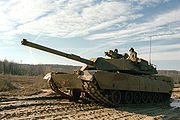
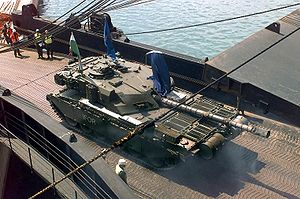
Composite armour
Composite armour is a type of vehicle armour consisting of layers of different material such as metals, plastics, ceramics or air. Most composite armour are lighter than their all-metal equivalent, but instead occupy a larger volume for the same resistance to penetration...
developed in the 1960s at the British tank
Tank
A tank is a tracked, armoured fighting vehicle designed for front-line combat which combines operational mobility, tactical offensive, and defensive capabilities...
research centre on Chobham Common
Chobham Common
Chobham Common is a area of lowland heath a globally rare and threatened habitat, in Surrey, England. It was formerly a freehold owned by the Earl of Onslow, and purchased for £1 an acre by Surrey County Council in 1966...
, Surrey
Surrey
Surrey is a county in the South East of England and is one of the Home Counties. The county borders Greater London, Kent, East Sussex, West Sussex, Hampshire and Berkshire. The historic county town is Guildford. Surrey County Council sits at Kingston upon Thames, although this has been part of...
, England. The name has since become the common generic term for ceramic vehicle armour
Vehicle armour
Military vehicles are commonly armoured to withstand the impact of shrapnel, bullets, missiles, or shells, protecting the personnel inside from enemy fire. Such vehicles include tanks, aircraft, and ships....
.
Although the construction details of the Chobham Common armour remain a secret, it has been described as being composed of ceramic
Ceramic
A ceramic is an inorganic, nonmetallic solid prepared by the action of heat and subsequent cooling. Ceramic materials may have a crystalline or partly crystalline structure, or may be amorphous...
tiles encased within a metal matrix and bonded to a backing plate and several elastic layers. Due to the extreme hardness of the ceramics used, they offer superior resistance against shaped charge
Shaped charge
A shaped charge is an explosive charge shaped to focus the effect of the explosive's energy. Various types are used to cut and form metal, to initiate nuclear weapons, to penetrate armor, and in the oil and gas industry...
s such as high explosive anti-tank
High explosive anti-tank
High explosive anti-tank warheads are made of an explosive shaped charge that uses the Munroe effect to create a very high-velocity partial stream of metal in a state of superplasticity that can punch through solid armor....
(HEAT) rounds and they shatter kinetic energy penetrator
Kinetic energy penetrator
A kinetic energy penetrator is a type of ammunition which, like a bullet, does not contain explosives and uses kinetic energy to penetrate the target....
s. Only the M1 Abrams
M1 Abrams
The M1 Abrams is a third-generation main battle tank produced in the United States. It is named after General Creighton Abrams, former Army Chief of Staff and Commander of US military forces in Vietnam from 1968 to 1972. The M1 is a well armed, heavily armored, and highly mobile tank designed for...
, Challenger 1
Challenger 1 tank
The British FV4030/4 Challenger 1, was the main battle tank of the British Army from 1983 to the mid 1990s, when it was superseded by the Challenger 2. It is also currently used by the Jordanian Armed Forces as their main battle tank after heavy modifications...
, and Challenger 2
Challenger 2 tank
FV4034 Challenger 2 is a British main battle tank currently in service with the armies of the United Kingdom and Oman. It was designed and built by the British company Vickers Defence Systems . The manufacturer advertises it as the world's most reliable main battle tank...
tanks have been disclosed as being thus armoured. Despite being a British invention, for financial reasons the armour type was first implemented on the American tank.
Protective qualities
Due to the extreme hardness of the ceramics used, they offer superior resistance against a shaped chargeShaped charge
A shaped charge is an explosive charge shaped to focus the effect of the explosive's energy. Various types are used to cut and form metal, to initiate nuclear weapons, to penetrate armor, and in the oil and gas industry...
jet and they shatter kinetic energy penetrator
Kinetic energy penetrator
A kinetic energy penetrator is a type of ammunition which, like a bullet, does not contain explosives and uses kinetic energy to penetrate the target....
s (KE-penetrators). The (pulverised) ceramic also strongly abrades
Abrasion (mechanical)
Abrasion is the process of scuffing, scratching, wearing down, marring, or rubbing away. It can be intentionally imposed in a controlled process using an abrasive...
any penetrator. Against lighter projectiles the hardness of the tiles causes a "shatter gap" effect: a higher velocity will, within a certain velocity range (the "gap"), not lead to a deeper penetration but destroy the projectile itself instead. Because the ceramic is so brittle
Brittle
A material is brittle if, when subjected to stress, it breaks without significant deformation . Brittle materials absorb relatively little energy prior to fracture, even those of high strength. Breaking is often accompanied by a snapping sound. Brittle materials include most ceramics and glasses ...
the entrance channel of a shaped charge jet is not smooth — as it would be when penetrating a metal — but ragged, causing extreme asymmetric pressures which disturb the geometry of the jet, on which its penetrative capabilities are critically dependent as its mass is relatively low. This initiates a vicious circle
Vicious Circle
Vicious Circle is an album released in 1994 by L.A. Guns. Most of the songs have Phil Lewis on lead vocals, but the track "Nothing Better to Do" features Kelly Nickels on lead vocals, and "Tarantula" is instrumental. MC Bones drums on several songs. Lewis and Bones also played together in the band...
as the disturbed jet causes still greater irregularities in the ceramic, until in the end it is defeated. The newer composites, though tougher, optimise this effect as tiles made with them have a layered internal structure conducive to it, causing "crack deflection". This mechanism using the jet's own energy against it, has caused some to compare the effects of Chobham to those of reactive armour
Reactive armour
Reactive armour is a type of vehicle armour that reacts in some way to the impact of a weapon to reduce the damage done to the vehicle being protected. It is most effective in protecting against shaped charges and specially hardened long rod penetrators...
. This should not be confused with the effect used in many laminate armours of any kind: that of sandwiching an inert but soft elastic material such as rubber, between two of the armour plates. The impact of either a shaped charge jet or long-rod penetrator after the first layer has been perforated and while the rubber
Rubber
Natural rubber, also called India rubber or caoutchouc, is an elastomer that was originally derived from latex, a milky colloid produced by some plants. The plants would be ‘tapped’, that is, an incision made into the bark of the tree and the sticky, milk colored latex sap collected and refined...
layer is being penetrated will cause the rubber to deform and expand, so deforming both the back and front plates. Both attack methods will suffer from obstruction to their expected paths, so experiencing a greater thickness of armour than there is nominally, thus lowering penetration. Also for rod penetrations, the transverse force experienced due to the deformation may cause the rod to shatter, bend, or just change its path, again lowering penetration.
The effectiveness of Chobham armour was demonstrated in the Gulf War of 1991
Gulf War
The Persian Gulf War , commonly referred to as simply the Gulf War, was a war waged by a U.N.-authorized coalition force from 34 nations led by the United States, against Iraq in response to Iraq's invasion and annexation of Kuwait.The war is also known under other names, such as the First Gulf...
where only 23 Coalition tanks were taken out of action and the 2003 Iraq War, where no Coalition tanks were destroyed by Iraqi armour or anti-tank guided missile
Anti-tank guided missile
An anti-tank missile , anti-tank guided missile , anti-tank guided weapon or anti-armor guided weapon is a guided missile primarily designed to hit and destroy heavily-armored military vehicles....
s. To date, few Chobham armour-protected tanks have been defeated by enemy fire in combat; the relevance of individual cases of lost tanks for determining the protective qualities of Chobham armour is difficult to ascertain as the extent to which such tanks are protected by ceramic modules is undisclosed.
Structure
Ceramic tiles have a "multiple hit capability" problem in that they cannot sustain successive impacts without quickly losing much of their protective value. To minimise the effects of this the tiles are made as small as possible, but the matrix elements have a minimal practical thickness of about one inch (25 mm), and the ratio of coverage provided by tiles would become unfavourable, placing a practical limit at a diameter of about four inches (ten centimetres). The small hexagonal or square ceramic tiles are encased within the matrix either by isostatically pressing them into the heated matrix, or by gluing them with an epoxyEpoxy
Epoxy, also known as polyepoxide, is a thermosetting polymer formed from reaction of an epoxide "resin" with polyamine "hardener". Epoxy has a wide range of applications, including fiber-reinforced plastic materials and general purpose adhesives....
resin. Since the early nineties it has been known that holding the tiles under constant compression by their matrix greatly improves their resistance to kinetic penetrators, which is difficult to achieve when using glues.
The matrix has to be backed by a plate, both to reinforce the ceramic tiles from behind and to prevent deformation of the metal matrix by a kinetic impact. Typically the backing plate has half of the mass of the composite matrix. The assemblage is again attached to elastic layers. These absorb impacts somewhat, but their main function is to prolong the service life of the composite matrix by protecting it against vibration
Vibration
Vibration refers to mechanical oscillations about an equilibrium point. The oscillations may be periodic such as the motion of a pendulum or random such as the movement of a tire on a gravel road.Vibration is occasionally "desirable"...
s. Several assemblages can be stacked, depending on the available space; this way the armour can be made of a modular nature, adaptable to the tactical situation. The thickness of a typical assemblage is today about five to six centimetres. Earlier assemblages, so-called DOP (Depth Of Penetration) -matrices, were thicker. The relative interface defeat
Interface defeat
Interface defeat is when a ceramic armour system, typically on an armoured fighting vehicle, defeats a kinetic energy penetrator at the ceramic's front surface. Above a certain impact velocity, known as the transition velocity, interface defeat can no longer occur and either penetration or...
component of the protective value of a ceramic is much larger than for steel armour. Using a number of thinner matrices again enlarges that component for the entire armour package, an effect analogous to the use of alternate layers of high hardness and softer steel, which is typical for the glacis
Glacis
A glacis in military engineering is an artificial slope of earth used in late European fortresses so constructed as to keep any potential assailant under the fire of the defenders until the last possible moment...
of modern Soviet tanks.
Ceramic tiles draw little or no advantage from sloped armour
Sloped armour
Sloped armour is armour that is neither in a vertical nor a horizontal position. Such "angled" armour is often mounted on tanks and other armoured fighting vehicles...
as they lack sufficient toughness to significantly deflect heavy penetrators. Indeed, because a single glancing shot could crack many tiles, the placement of the matrix is chosen so as to optimise the chance of a perpendicular hit, a reversal of the previous desired design feature for conventional armour. Ceramic armour normally even offers better protection for a given areal density when placed perpendicularly than when placed obliquely, because the cracking propagates along the surface normal
Surface normal
A surface normal, or simply normal, to a flat surface is a vector that is perpendicular to that surface. A normal to a non-flat surface at a point P on the surface is a vector perpendicular to the tangent plane to that surface at P. The word "normal" is also used as an adjective: a line normal to a...
of the plate. Instead of rounded forms, the turrets of tanks using Chobham armour typically have a slab-sided appearance.
The backing plate reflects the impact energy back to the ceramic tile in a wider cone. This dissipates the energy, limiting the cracking
Cracking
Cracking may refer to:* Cracking, the formation of a fracture or partial fracture in a solid material* Fluid catalytic cracking, a catalytic process widely used in oil refineries for cracking large hydrocarbon molecules into smaller molecules...
of the ceramic, but also means a more extended area is damaged. Spalling caused by the reflected energy can be partially prevented by a malleable thin graphite
Graphite
The mineral graphite is one of the allotropes of carbon. It was named by Abraham Gottlob Werner in 1789 from the Ancient Greek γράφω , "to draw/write", for its use in pencils, where it is commonly called lead . Unlike diamond , graphite is an electrical conductor, a semimetal...
layer on the face of the ceramic absorbing the energy without making it strongly rebound again as a metal face plate would.
Tiles under compression suffer far less from impacts; in their case it can be advantageous to have a metal face plate bringing the tile also under perpendicular compression. The confined ceramic tile then reinforces the metal face plate, a reversal of the normal situation.
A gradual technological development has taken place in ceramic armour: ceramic tiles, in themselves vulnerable to low energy impacts, were first reinforced by glueing them to a backplate; in the nineties their resistance was increased by bringing them under compression on two axes; in the final phase a third compression axis was added to optimise impact resistance. To confine the ceramic core several advanced techniques are used, supplementing the traditional machining and welding, including sintering
Sintering
Sintering is a method used to create objects from powders. It is based on atomic diffusion. Diffusion occurs in any material above absolute zero, but it occurs much faster at higher temperatures. In most sintering processes, the powdered material is held in a mold and then heated to a temperature...
the suspension material around the core; squeeze casting of molten metal around the core and spraying the molten metal onto the ceramic tile.
The whole is placed within the shell formed by the outer and inner wall of the tank turret or hull, the inner wall being the thicker.
Material
Over the years newer and tougher composites have been developed, giving about five times the protection value of the original pure ceramics, the best of which were again about five times as effective as a steel plate of equal weight. These are often a mixture of several ceramic materials, or metal matrix compositeMetal matrix composite
A metal matrix composite is composite material with at least two constituent parts, one being a metal. The other material may be a different metal or another material, such as a ceramic or organic compound. When at least three materials are present, it is called a hybrid composite...
s which combine ceramic compounds with metal. The latest developments involve the use of carbon nanotube
Carbon nanotube
Carbon nanotubes are allotropes of carbon with a cylindrical nanostructure. Nanotubes have been constructed with length-to-diameter ratio of up to 132,000,000:1, significantly larger than for any other material...
s to improve toughness even further. Commercially produced or researched ceramics for such type of armour include boron carbide
Boron carbide
Boron carbide is an extremely hard boron–carbon ceramic material used in tank armor, bulletproof vests, and numerous industrial applications...
, silicon carbide
Silicon carbide
Silicon carbide , also known as carborundum, is a compound of silicon and carbon with chemical formula SiC. It occurs in nature as the extremely rare mineral moissanite. Silicon carbide powder has been mass-produced since 1893 for use as an abrasive...
, aluminium oxide
Aluminium oxide
Aluminium oxide is an amphoteric oxide with the chemical formula 23. It is commonly referred to as alumina, or corundum in its crystalline form, as well as many other names, reflecting its widespread occurrence in nature and industry...
(sapphire
Sapphire
Sapphire is a gemstone variety of the mineral corundum, an aluminium oxide , when it is a color other than red or dark pink; in which case the gem would instead be called a ruby, considered to be a different gemstone. Trace amounts of other elements such as iron, titanium, or chromium can give...
or "alumina"), aluminium nitride
Aluminium nitride
Aluminium nitride is a nitride of aluminium. Its wurtzite phase is a wide band gap semiconductor material, giving it potential application for deep ultraviolet optoelectronics.-History:...
, titanium boride
Titanium boride
Titanium diboride is an extremely hard ceramic compound composed of titanium and boron which has excellent resistance to mechanical erosion...
and Syndie, a synthetic diamond
Synthetic diamond
Synthetic diamond is diamond produced in a technological process; as opposed to natural diamond, which is created in geological processes. Synthetic diamond is also widely known as HPHT diamond or CVD diamond, denoting the production method, High-Pressure High-Temperature synthesis and Chemical...
composite. Of these boron carbide is the hardest and lightest, but also the most expensive and brittle. Boron carbide composites are today favoured for ceramic plate
Ceramic plate
Ceramic plates are commonly used as inserts in soft ballistic vests. Most ceramic plates used in body armor provide National Institute of Justice Type III protection, allowing them to stop rifle bullets. Ceramic plates are a form of composite armor...
s protecting against smaller projectiles, such as used in body armour and armoured helicopter
Helicopter
A helicopter is a type of rotorcraft in which lift and thrust are supplied by one or more engine-driven rotors. This allows the helicopter to take off and land vertically, to hover, and to fly forwards, backwards, and laterally...
s; this was in fact in the early sixties the first general application of ceramic armour. Silicon carbide, better suited to protect against larger projectiles, was at that time only used in some prototype land vehicles, such as the MBT-70
MBT-70
The MBT-70 was a 1960s German-U.S. joint project to develop a new main battle tank, which was to be equipped with a number of advanced features. It utilized a newly developed hydropneumatic "kneeling" suspension and housed the entire crew in the large turret...
. The ceramics can be created by cold pressing or hot pressing. A high density is striven for in that air bubbles should be almost absent.
A matrix using a titanium
Titanium
Titanium is a chemical element with the symbol Ti and atomic number 22. It has a low density and is a strong, lustrous, corrosion-resistant transition metal with a silver color....
alloy is extremely expensive to manufacture but the metal is favoured for its lightness, strength and resistance to corrosion, which is a constant problem. The Rank company claims to have invented an alumina matrix for the insertion of boron carbide or silicon carbide tiles.
The backing plate can be made from steel
Steel
Steel is an alloy that consists mostly of iron and has a carbon content between 0.2% and 2.1% by weight, depending on the grade. Carbon is the most common alloying material for iron, but various other alloying elements are used, such as manganese, chromium, vanadium, and tungsten...
, but, as its main function is to improve the stability and stiffness of the assemblage, aluminium is more weight-efficient in light AFVs
Armoured fighting vehicle
An armoured fighting vehicle is a combat vehicle, protected by strong armour and armed with weapons. AFVs can be wheeled or tracked....
only to be protected against light anti-tank weapons. A deformable composite backing plate can combine the function of a metal backing plate and an elastic layer.
Heavy metal modules
The armour configuration of the first western tanks using Chobham armour was optimised to defeat shaped charges as guided missileGuided Missile
Guided Missile is a London based independent record label set up by Paul Kearney in 1994.Guided Missile has always focused on 'the underground', preferring to put out a steady flow of releases and developing the numerous GM events around London and beyond....
s were seen as the greatest threat. In the eighties however they began to face improved Soviet kinetic energy penetrator
Kinetic energy penetrator
A kinetic energy penetrator is a type of ammunition which, like a bullet, does not contain explosives and uses kinetic energy to penetrate the target....
rounds of various sorts, which the ceramic layer was not particularly effective against: the original ceramics had a resistance against penetrators of about a third compared to that against HEAT rounds, for the newest composites it is about one-tenth. For this reason many modern designs include additional layers of heavy metals
Heavy metals
A heavy metal is a member of a loosely-defined subset of elements that exhibit metallic properties. It mainly includes the transition metals, some metalloids, lanthanides, and actinides. Many different definitions have been proposed—some based on density, some on atomic number or atomic weight,...
to add more density to the overall armour package.
The introduction of more effective ceramic composite materials allows for a larger width of these metal layers within the armour shell: given a certain protection level provided by the composite matrix, it can be thinner. They typically form an inner layer placed below the much more expensive matrix, to prevent extensive damage to it should the metal layer strongly deform but not defeat a penetrator. They can also be used as the backing plate for the matrix itself, but this compromises the modularity and thus tactical adaptability of the armour system: ceramic and metal modules can then no longer be replaced independently. Furthermore, due to their extreme hardness, they deform insufficiently and would reflect too much of the impact energy, and in a too wide cone, to the ceramic tile, damaging it even further. Metals used include a tungsten
Tungsten
Tungsten , also known as wolfram , is a chemical element with the chemical symbol W and atomic number 74.A hard, rare metal under standard conditions when uncombined, tungsten is found naturally on Earth only in chemical compounds. It was identified as a new element in 1781, and first isolated as...
alloy for the Challenger 2 or, in the case of the M1A1HA
M1 Abrams
The M1 Abrams is a third-generation main battle tank produced in the United States. It is named after General Creighton Abrams, former Army Chief of Staff and Commander of US military forces in Vietnam from 1968 to 1972. The M1 is a well armed, heavily armored, and highly mobile tank designed for...
(Heavy Armor) and later American tank variants, a depleted uranium
Depleted uranium
Depleted uranium is uranium with a lower content of the fissile isotope U-235 than natural uranium . Uses of DU take advantage of its very high density of 19.1 g/cm3...
alloy. Some companies offer titanium carbide
Titanium carbide
Titanium carbide, TiC, is an extremely hard refractory ceramic material, similar to tungsten carbide.It is commercially used in tool bits. It has the appearance of black powder with NaCl-type face centered cubic crystal structure...
modules.
These metal modules (typically employing perpendicular rods) have many perforations or expansion spaces reducing the weight up to about a third while keeping the protective qualities fairly constant. The depleted uranium alloy of the M1 has been described as "arranged in a type of armour matrix" and a single module as a "stainless-steel shell surrounding a layer (probably an inch or two thick) of depleted uranium, woven into a wire-mesh blanket".
Such modules are also used by tanks not equipped with Chobham armour. The combination of a composite matrix and heavy metal modules is sometimes informally referred to as "second generation Chobham".
Development and application
The prehistory of ceramic armour goes back to 1918, when Major Neville Monroe Hopkins discovered that a plate of ballistic steel, covered with a thin (1–2 millimetres) layer of enamel was much more resistant to penetration.Since the early sixties there were, in the US, extensive research programmes ongoing aimed at investigating the prospects of employing composite ceramic materials as vehicle armour. This research mainly focused on the use of an aluminium metal matrix composite reinforced by silicon carbide whiskers, to be produced in the form of large sheets. The reinforced light metal sheets were to be sandwiched between steel layers. This arrangement had the advantage of having a good multiple-hit capability and of being able to be curved, allowing the main armour to benefit from a sloped armour effect. However, this composite with a high metal content was primarily intended to increase the protection against KE-penetrators for a given armour weight; its performance against shaped charge attack was mediocre and would have to be improved by means of a laminate spaced armour effect, as researched by the Germans within the joint MBT-70 project.
An alternative technology developed in the US was based on the use of glass modules to be inserted into the main armour; although this arrangement offered a better shaped charge protection, its multiple hit capability was poor. A similar system using glass inserts in the main steel armour was from the late fifties researched for the Soviet Obiekt 430 prototype of the T-64
T-64
The T-64 is a Soviet main battle tank, introduced in the early 1960s. It was used solely by the Soviet Army in its front-line divisions and was a more advanced counterpart to the T-62...
; this was later developed into the "Combination-K" type, having a ceramic compound mixed with the silicon oxide
Silicon oxide
Silicon oxide may refer to either of the following:*Silicon dioxide, SiO2, very well characterized*Silicon monoxide, SiO, not very well characterized...
inserts, which offered about 50% better protection against both shaped charge and KE-penetrator threats, compared with a steel armour of the same weight. It was, later in improved forms, part of all subsequent Soviet main battle tank designs. After an initial period of speculation in the West as to its true nature, the characteristics of this type were disclosed when the dissolution of the Soviet Union and the introduction of a market system forced the Russian industries to find new customers by highlighting its good qualities; it is today rarely referred to as Chobham armour.
Meanwhile in the United Kingdom another line of ceramic armour development had been started in the early sixties, meant to improve the existing cast turret configuration of the Chieftain
Chieftain tank
The FV 4201 Chieftain was the main battle tank of the United Kingdom during the 1960s and 1970s. It was one of the most advanced tanks of its era, and at the time of its introduction in 1966 had the most powerful main gun and heaviest armour of any tank in the world...
that already offered excellent heavy penetrator protection; the research by a team headed by Gilbert Harvey of the Fighting Vehicles Research and Development Establishment (FVRDE), was thus strongly oriented at optimising the ceramic composite system for defeating shaped charge attack. The British system consisted of a honeycomb matrix with ceramic tiles backed by ballistic nylon, placed on top of the cast main armour. In July 1973 an American delegation, in search of a new armour type for the XM815 tank prototype, now that the MBT-70 project had failed, visited Chobham Common to be informed about the British system, the development of which had then cost about ₤6,000,000; earlier information had already been divulged to the US in 1965 and 1968. It was very impressed by the excellent shaped charge protection combined with the penetrator impact damage limitation, inherent to the principle of using tiles. The Ballistic Research Laboratory at the Aberdeen Proving Ground
Aberdeen Proving Ground
Aberdeen Proving Ground is a United States Army facility located near Aberdeen, Maryland, . Part of the facility is a census-designated place , which had a population of 3,116 at the 2000 census.- History :...
that year initiated the development of a version, named Burlington, adapted to the specific American situation with a much higher projected tank production run and the use of a thinner rolled steel main armour. The increased threat posed by a new generation of Soviet guided missiles armed with a shaped charge warhead — as exemplified by the events of the Yom Kippur War
Yom Kippur War
The Yom Kippur War, Ramadan War or October War , also known as the 1973 Arab-Israeli War and the Fourth Arab-Israeli War, was fought from October 6 to 25, 1973, between Israel and a coalition of Arab states led by Egypt and Syria...
of October 1973, when even older generation missiles caused considerable tank losses on the Israeli side — made Burlington the preferred choice for the armour configuration of the XM1 (the renamed XM815) prototype.
However, on 11 December 1974 a Memorandum of Understanding was signed between the Federal Republic of Germany and the US about the common future production of a main battle tank; this made any application of Chobham armour dependent on the eventual choice for a tank type. Earlier in 1974 the Americans had asked the Germans to redesign the existing Leopard 2
Leopard 2
The Leopard 2 is a main battle tank developed by Krauss-Maffei in the early 1970s for the West German Army. The tank first entered service in 1979 and succeeded the earlier Leopard 1 as the main battle tank of the German Army. Various versions have served in the armed forces of Germany and twelve...
prototypes, considered by them too lightly armoured and had suggested to adopt Burlington for this purpose, of which type the Germans had already been informed in March 1970; the Germans however in response in 1974 initiated a new armour development programme of their own. Having already designed a system that in their opinion offered satisfactory protection against shaped charges, consisting of multiple laminate spaced armour with the spaces filled with ceramic polystyrene foam as fitted to the Leopard 1A3, they put a clear emphasis on improving KE-penetrator protection reworking the system into a perforated metal module armour. A version with added Burlington was considered, including ceramic inserts in the various spaces, but rejected as it would push vehicle weight well over sixty metric tonnes, a weight then seen as prohibitive by both armies. The US Army in the summer of 1974 faced the choice between the German system and their own Burlington, a decision made more difficult by the fact that Burlington offered, compared with steel armour, no weight advantage against KE-penetrators: the total armour system would have a RHA
Rolled homogeneous armour
Rolled homogeneous armour is a type of steel which is used to armour vehicles.-Composition:Armoured steel must be hard yet impervious to shock in order to resist high velocity metal projectiles. Steel with these characteristics is produced by processing cast steel billets of appropriate size and...
equivalence against them of about 350 mm (compared to about 700 mm against shaped charges). No consensus developing, General Creighton Abrams
Creighton Abrams
Creighton Williams Abrams Jr. was a general in the United States Army who commanded military operations in the Vietnam War from 1968–72 which saw U.S. troop strength in Vietnam fall from a peak of 543,000 to 49,000. He served as Chief of Staff of the United States Army from 1972 until shortly...
himself decided the issue in favour of Burlington. Eventually each army would procure its separate national tank design, the project of a common tank failing in 1976. In February 1978 the first tanks protected by Burlington left the factory when the first of eleven pilot M1 tanks were delivered to the US Army.
Beside these state projects, private enterprise in the US during the seventies also developed ceramic armour types, like the Noroc armour made by the Protective Products Division of the Norton
Norton
-England:*Norton, County Durham*Norton, Hertfordshire*Norton, Kent*Norton, Northamptonshire*Norton, Nottinghamshire*Norton, Runcorn, Cheshire*Norton, Suffolk*Norton, Dudley, West Midlands*Norton, Worcester, Worcestershire*Norton, Doncaster, South Yorkshire...
Company, consisting of boron carbide sheets backed by resin-bonded glass cloth.
Iran
Iran , officially the Islamic Republic of Iran , is a country in Southern and Western Asia. The name "Iran" has been in use natively since the Sassanian era and came into use internationally in 1935, before which the country was known to the Western world as Persia...
ian government ordered 1,225 vehicles of an upgraded Chieftain type, the Shir-2 (FV 4030/3), using the same technology of adding Chobham armour to the main cast armour, bringing total weight to 62 metric tonnes. When this order was cancelled in February 1979 because of the Iranian Revolution
Iranian Revolution
The Iranian Revolution refers to events involving the overthrow of Iran's monarchy under Shah Mohammad Reza Pahlavi and its replacement with an Islamic republic under Ayatollah Ruhollah Khomeini, the leader of the...
, the British government, under pressure to modernise its tank fleet to maintain a qualitative superiority relative to the Soviet tank forces, decided to use the sudden surplus production capacity to procure a number of vehicles very close in design to the Shir-2, called the Challenger 1. On 12 April 1983 the first British tank protected by Chobham armour was delivered to the Royal Hussars.
In France from 1966 GIAT
Nexter
Nexter is a French government-owned weapons manufacturer.-Products:...
Industries performed experiments aimed at developing a light vehicle ceramic armour, in 1970 resulting in the CERALU-system consisting of aluminium-backed alumina weldable to the vehicle, offering a 50% increase in weight-efficiency against ballistic threats compared to steel plate. An improved version was later applied in helicopter seats.
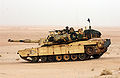
The latest version of Chobham armour is used on the Challenger 2 (called Dorchester armour), and (though the composition most probably differs) the M1 Abrams
M1 Abrams
The M1 Abrams is a third-generation main battle tank produced in the United States. It is named after General Creighton Abrams, former Army Chief of Staff and Commander of US military forces in Vietnam from 1968 to 1972. The M1 is a well armed, heavily armored, and highly mobile tank designed for...
series of tanks, which according to official sources is currently protected by silicon carbide
Silicon carbide
Silicon carbide , also known as carborundum, is a compound of silicon and carbon with chemical formula SiC. It occurs in nature as the extremely rare mineral moissanite. Silicon carbide powder has been mass-produced since 1893 for use as an abrasive...
tiles. Given the publicly stated protection level for the earliest M1: 350 mm steel equivalence against KE-penetrators (APFSDS
Kinetic energy penetrator
A kinetic energy penetrator is a type of ammunition which, like a bullet, does not contain explosives and uses kinetic energy to penetrate the target....
), it seems to have been equipped with alumina tiles.
Though it is often claimed to be otherwise, the original production model of the Leopard 2
Leopard 2
The Leopard 2 is a main battle tank developed by Krauss-Maffei in the early 1970s for the West German Army. The tank first entered service in 1979 and succeeded the earlier Leopard 1 as the main battle tank of the German Army. Various versions have served in the armed forces of Germany and twelve...
did not use Chobham armour, but rather pure perforated armour, avoiding the very large procurement, maintenance and replacement costs of those ceramic armour systems not based on the cheap but rather ineffective alumina. For many modern tanks, such as the Japanese Type 90 and the Italian Ariete
Ariete
The C1 Ariete is the main battle tank of the Italian Army, developed by a consortium formed by Iveco-Fiat and Oto Melara . The chassis and engine were produced by Iveco, while the turret and fire-control system were produced by Oto Melara...
, it is yet unknown which type is used. There is a general trend away from ceramic armour towards perforated armour, but even many tanks from the seventies like the Leopard 1A3 and A4, the French AMX 32 and AMX 40 prototypes used the latter system; the Leclerc
Leclerc
The AMX-56 Leclerc, commonly known as the Leclerc, is a main battle tank built by Nexter of France. It was named in honour of General Philippe Leclerc de Hauteclocque who led the French element of the drive towards Paris while in command of the Free French 2nd Armoured Division in World War...
has an improved version.
Aerospace applications
The first ceramic plates found application in the aerospace sector: in 1965, the helicopter UH-1 Huey was modified with HFC (Hard-Faced-Composite) around the seats of pilot and copilot, protecting them against small arms fire. The plates were in boron carbideBoron carbide
Boron carbide is an extremely hard boron–carbon ceramic material used in tank armor, bulletproof vests, and numerous industrial applications...
, which, though exceedingly costly, due to its superior lightness has remained the material of choice for aerospace applications. An example among many, the modern V-22 Osprey
V-22 Osprey
The Bell Boeing V-22 Osprey is an American multi-mission, military, tiltrotor aircraft with both a vertical takeoff and landing , and short takeoff and landing capability...
is protected similarly.