
All Topics  
Bomber

 
Bomber

   Email Print
   Bookmark   Link


Bomber


A bomber is a military aircraft
Military aircraft

A military aircraft is any Fixed-wing aircraft or military helicopters aircraft that is in the current employ of a military power. Fixed-wing military aircraft are also known as warplanes....
 designed to attack ground and sea targets, primarily by dropping bomb
Bomb

A bomb is any of a range of explosive devices that typically rely on the exothermic chemical reaction of an explosive material to produce an extremely sudden and violent release of energy....
s on them.

tegic bombers are primarily designed for long-range strike missions with bombs against strategic targets such as supply bases, bridges, factories, shipyards, and cities themselves, in order to damage an enemy's war effort.


Discussion
Ask a question about 'Bomber'
Start a new discussion about 'Bomber'
Answer questions from other users
Full Discussion Forum


Recent Posts


Encyclopedia


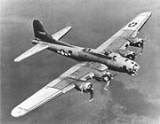
B 17 On Bomb Run
A bomber is a military aircraft
Military aircraft

A military aircraft is any Fixed-wing aircraft or military helicopters aircraft that is in the current employ of a military power. Fixed-wing military aircraft are also known as warplanes....
 designed to attack ground and sea targets, primarily by dropping bomb
Bomb

A bomb is any of a range of explosive devices that typically rely on the exothermic chemical reaction of an explosive material to produce an extremely sudden and violent release of energy....
s on them.

Classifications of bombers

Strategic bombers are primarily designed for long-range strike missions with bombs against strategic targets such as supply bases, bridges, factories, shipyards, and cities themselves, in order to damage an enemy's war effort. Examples include the: Avro Lancaster
Avro Lancaster

The Avro Lancaster was a United Kingdom four-engine World War II bomber aircraft made initially by Avro for the British Royal Air Force . It first saw active service in 1942, and together with the Handley-Page Halifax it was one of the main heavy bombers of the RAF, the Royal Canadian Air Force and squadrons from other Commonwealth of Nations...
, Heinkel He-111, Junkers Ju 88
Junkers Ju 88

The Junkers Ju 88 was a Second World War Luftwaffe twin-engine, multi-role aircraft.Designed by Hugo Junkers' Junkers company in the mid 1930s, it became one of the most versatile combat aircraft of the war....
, B-17 Flying Fortress
B-17 Flying Fortress

The Boeing B-17 Flying Fortress is a four-engine heavy bomber aircraft developed for the United States Army Air Corps . Competing against Douglas Aircraft Company and Glenn L....
, B-24 Liberator
B-24 Liberator

The Consolidated B-24 Liberator was an United States heavy bomber, built by Consolidated Aircraft. It was produced in greater numbers than any other American combat aircraft of World War II and still holds the record as the most produced U.S....
, B-29 Superfortress
B-29 Superfortress

The Boeing B-29 Superfortress was a four-engine Fixed-wing aircraft#Propeller aircraft heavy bomber that was flown by the United States Military in World War II and the Korean War, and by other nations afterwards....
, B-36, B-47, B-52 Stratofortress
B-52 Stratofortress

The Boeing B-52 Stratofortress is a long-range, subsonic, jet engine, strategic bomber operated by the United States Air Force since 1955.Beginning with the successful contract bid on 5 June 1946, the B-52 went through several design steps; from a straight wing aircraft powered by six turboprop engines to the final prototype YB-52, with ei...
, General Dynamics F-111
General Dynamics F-111

The General Dynamics F-111 is a medium-range interdictor and fighter bomber aircraft that also fills the roles of strategic bomber, reconnaissance and electronic warfare in its various versions....
, Tupolev Tu-16
Tupolev Tu-16

The Tupolev Tu-16 was a twin-engine jet bomber used by the Soviet Union. It has flown for more than 50 years and, as the Xian H-6, remains in service with the People's Liberation Army Air Force....
 'Badger', Tupolev Tu-160
Tupolev Tu-160

The Tupolev Tu-160 is a supersonic, swing-wing heavy bomber designed by the Soviet Union. It is similar in configuration to the B-1 Lancer but is significantly faster than the B-1B at altitude with a greater combat range and payload capacity....
 'Blackjack', Tupolev Tu-95
Tupolev Tu-95

The Tupolev Tu-95 is a large, four-engine turboprop powered strategic bomber and missile platform.First flown in 1952, the Tu-95 was put into service by the former Soviet Union in 1956 and is expected to serve the Russian Air Force until at least 2040.....
 'Bear', and Gotha G
Gotha G

The Gotha G.V was a heavy bomber used by the Luftstreitkr?fte during World War I....
.

Tactical bombers are smaller aircraft that operate at shorter range, typically along with troops on the ground. This role is filled by many designs, including those listed below. In modern terms, any combat aircraft that is not a purpose-designed strategic bomber falls into this category.

Ground attack aircraft or "close air support" aircraft are designed to loiter over a battlefield and attack tactical targets, such as tank
Tank

A tank is a Continuous track, armoured fighting vehicle designed for front-line combat which combines operational mobility and Military tactics Offensive and defence capabilities....
s, troop concentrations, etc. Examples: Junkers Ju 87
Junkers Ju 87

The Junkers Ju 87 or Stuka was a two-seat Nazi Germany ground-attack aircraft of World War II.Designed by Hermann Pohlmann, the Stuka first flew in 1935 and made its combat debut in 1936 as part of the Luftwaffe's Condor Legion during the Spanish Civil War....
 Stuka, Ilyushin Il-2
Ilyushin Il-2

The Ilyushin Il-2 Shturmovik was a ground attack aircraft in World War II, produced by the Soviet Union in large numbers. In combination with its successor, the Ilyushin Il-10, a total of 36,163 were built, making it the single most produced military aircraft design in all of aviation history as well as the third most produced aircraft i...
 Shturmovik, A-10 Thunderbolt II
A-10 Thunderbolt II

The A-10 Thunderbolt II is an United states single-seat, twin-engine, straight-wing jet aircraft developed by Fairchild for the United States Air Force to provide close air support of ground forces by attacking tanks, armored vehicles and other ground targets with a limited air interdiction capability....
, and Sukhoi Su-25 'Frogfoot'.

Fighter-bombers (also called tactical fighters, strike fighters, and attack fighters) are multi-role combat aircraft which can (at least theoretically) be equipped for either air-to-air combat or air-to-ground combat. Many fighter bombers were also designed to engage in aerial combat immediately after attacking ground targets. Modern multi-role combat aircraft are designed to fulfill multiple roles due to budget restrictions as often as they are for versatility. Examples: Chengdu J-10
Chengdu J-10

allery>Image:Example.jpg|Caption1The Chengdu J-10 , export designation FC-20, is a 4.5 generation multirole fighter aircraft designed and produced by the People's Republic of China's Chengdu Aircraft Industry Corporation with considerable foreign technological input for the People's Liberation Army Air Force ....
, Xian JH-7
Xian JH-7

The Xian JH-7 , also known as the FBC-1 Flying Leopard, is a two-seater , twin-engine fighter-bomber in service with the People's Liberation Army Naval Air Force , and the People's Liberation Army Air Force ....
, F-4 Phantom II
F-4 Phantom II

The McDonnell Douglas F-4 Phantom II is a two-seat, twin-engined, all-weather, long-range supersonic interceptor jet fighter/fighter-bomber originally developed for the United States Navy by McDonnell Aircraft....
, F-15E "Strike Eagle", F-16 Fighting Falcon
F-16 Fighting Falcon

The Lockheed Martin F-16 Fighting Falcon is a Multirole combat aircraft jet aircraft fighter aircraft originally developed by General Dynamics for the United States Air Force....
, F/A-18 Hornet
F/A-18 Hornet

The McDonnell Douglas F/A-18 Hornet is an all-weather carrier-capable Multirole combat aircraft jet, designed to attack both ground and aerial targets....
, Sukhoi Su-34 'Fullback', Dassault-Breguet Mirage 2000, and the Panavia Tornado
Panavia Tornado

The Panavia Tornado is a family of twin-engine combat aircraft, which was jointly developed by the United Kingdom, West Germany and Italy. There are three primary Panavia Tornado variants of the Tornado; the Tornado IDS Ground attack aircraft, the electronic warfare Tornado ECR and the Panavia Tornado ADV Interceptor aircraft....
.

History


Bombers evolved at the same time as the fighter aircraft at the start of World War I. The first use of an air-dropped bomb however, was carried out by the Italians in their 1911 war for Libya
Italo-Turkish War

The Italo-Turkish or Turco-Italian War was fought between the Ottoman Empire and the Kingdom of Italy from September 29, 1911 to October 18, 1912....
. In 1912 Bulgarian Air Force pilot Christo Toprakchiev suggested the use of airplanes to drop "bombs" (as grenades were called in the Bulgarian army at this time) on Turkish positions. Captain Simeon Petrov developed the idea and created several prototypes by adapting different types of grenades and increasing their payload. On October 16, 1912, observer Prodan Tarakchiev dropped two of those bombs on the Turkish railway station of Karaagac (near the besieged Edirne) from an Albatros F.II airplane piloted by Radul Milkov.

After a number of tests Petrov created the final design, with improved aerodynamics, an X-shaped tail and impact detonator. This version was widely used by the Bulgarian Air Force during the siege of Eirine. Later a copy of the plans was sold to Germany and the bomb, codenamed "Chathaldza" ("????????", after the strategic Turkish town of Çatalca
Çatalca

?atalca is a rural district of Istanbul Province, in Thrace, on the ridge between the Marmara and the Black Sea. Most people living in ?atalca are either farmers or those visiting vacation homes....
) remained in mass production until the end of World War I.

The weight of the bomb was 6 kilograms. On impact it created a crater 4-5 meters wide and about 1 meter deep.

The Germans used Zeppelin
Zeppelin

For the English rock group, please see Led Zeppelin. For other meanings please see Zeppelin .A Zeppelin is a type of rigid airship pioneered by the German Count Ferdinand von Zeppelin in the early 20th century, based on designs he had outlined in 1874, designs he had detailed in 1893, and that were reviewed by committee in 1894, which h...
s as bombers since they had the range and capacity to carry a useful bomb load from Germany to England. With advances in aircraft design and equipment, they were joined by larger multi-engined biplane aircraft on both sides for long range strategic bombing especially by night. The majority of bombing was still done by one-engined biplanes with one or two crew-members flying short distances to attack the enemy lines and immediate hinterland.

The world's first four-engined bomber was the Russian Il'ya Muromets created in 1914 and successfully used in World War I.

By the end of the First World War the UK had amassed a force of heavy bombers with the sole intent of attacking Germany's industrial heart but the armistice came before it was used.

World War II


In the past, bombers were a separate type of aircraft, and often looked dramatically different from other aircraft. This was due largely to the lack of power in aircraft engines, meaning that to carry any reasonable payload, the aircraft had to have multiple engines. The result was a much larger aircraft, one with a reasonable useful load fraction for the role.

With engine power as a major limitation combined with the desire for accuracy and other operational factors, bomber designs tended to be tailored to one particular role. By the start of World War II this included

  • dive bomber
    Dive bomber

    A dive bomber is a bomber aircraft that dives directly at its targets in order to provide greater accuracy and limit the exposure to and effectiveness of Anti-aircraft warfare fire....
  • light bomber
    Light bomber

    Light bomber is a relatively small and fast class of military bomber aircraft which was employed mainly before the 1950s. Such aircraft would probably not carry more than one ton of Bomb....
    , medium bomber
    Medium bomber

    A medium bomber is a bomber aircraft designed to operate with medium bombloads over medium distances; primarily to distinguish them from the much larger heavy bombers and smaller light bombers....
     and heavy bomber
    Heavy bomber

    A heavy bomber is a bomber aircraft of the largest size, and typically longest ranges. The term was used primarily prior to and during World War II, when engine power was so scarce that designs had to be carefully tailored to their missions....
  • torpedo bomber
    Torpedo bomber

    A torpedo bomber is a bomber aircraft designed primarily to attack ships with torpedoes, but they could also carry out conventional bombings. Torpedo bombers existed almost exclusively prior to and during World War II, when they were an important player in many famous battles, notably the United Kingdom attack at Battle of Taranto and the Jap...
  • specialized ground attack designs


Bombers have carried armament for defence against enemy aircraft only. They are not intended nor designed to actively engage in combat with other aircraft. The majority have been relatively large and unmaneuverable - although some smaller designs have been used as the basis for specialist fighters such as the night-fighter. Attack aircraft are smaller, faster, and more agile, but when armed for a ground attack mission, less so than a fighter
Fighter aircraft

A fighter aircraft is a military aircraft designed primarily for air-to-air combat with other aircraft, as opposed to a bomber, which is designed primarily to attack ground targets by dropping bombs....
. Attack aircraft may carry air-to-air armament, but typically only infrared-guided weapons (such as the AIM-9) for self-defence.

Cold War


At the start of the Cold War, bombers were the only means to take the nuclear weapons to the enemy and had the role of deterrence
Deterrence theory

Deterrence theory is a military strategy developed during the Cold War. It is especially relevant with regard to the use of nuclear weapons, and figures prominently in current United States foreign policy regarding the development of nuclear technology in North Korea and Iran....
. With the advent of the guided missile, bombers had to turn to different ways to avoid interception. High speed and high altitude flying became a means of evading detection and attack. Some designs such as the English Electric Canberra
English Electric Canberra

The English Electric Canberra is a first-generation jet-powered light bomber manufactured in large numbers through the 1950s. It proved to be highly adaptable, serving in such varied roles for tactical bomber, photographic, electronics, and meteorological reconnaissance....
 could fly faster or higher than contemporary fighters. Surface to air missiles threatened high flying aircraft, and bombers moved to high speed low flying to get under air defences. Since the bombs were now "stand off" designs (effectively large guided missiles themselves) they did not have to climb over the targets to drop them but would have fired and turned away to escape the blast. Nuclear
Nuclear warfare

Nuclear warfare, or atomic warfare refers to the strategy for fighting or deterring military conflicts and terrorism when nuclear weapons are present....
 strike aircraft were generally finished in bare metal or anti-flash white to avoid any residual effects.

At the same time the need to drop conventional bombs remained in conflicts with a non-nuclear power such as the Vietnam war or Malayan Emergency
Malayan Emergency

The Malayan Emergency refers to a guerrilla warfare for independence fought between Commonwealth armed forces and the Malayan Races Liberation Army, the military arm of the Malayan Communist Party, from 1948 to 1960; some have gone as far as to characterise it as a civil war....
.

The development of large strategic bombers stagnated in the later part of the Cold War because of spiraling costs and the advent of the intercontinental ballistic missile which was felt to have equal deterrent value while being much more difficult to intercept. The United States Air Force XB-70 Valkyrie
XB-70 Valkyrie

The North American Aviation XB-70 Valkyrie was a prototype version of the proposed B-70 Nuclear bomb-armed deep penetration bomber for the United States Air Force's Strategic Air Command....
 program was cancelled for that reason in the early 1960s, and the later B-1B Lancer
B-1 Lancer

The B-1 Lancer is a strategic bomber used by the United States Air Force. Its origins began in the 1960s as a supersonic bomber with sufficient range and payload to replace the B-52 Stratofortress, but developed primarily into a low-level, subsonic penetrator with long range....
 and B-2 Spirit
B-2 Spirit

The Northrop Grumman B-2 Spirit is a multirole heavy bomber with "low observable" stealth aircraft technology capable of penetration dense anti-aircraft warfare to deploy both conventional weapons and nuclear weapon weapons....
 aircraft entered service only after protracted political and development problems. Their high cost meant that few were built and the 1950s-designed B-52s continued in use into the 21st century. Similarly, the Soviet Union used the intermediate-range Tu-22M
Tupolev Tu-22M

The Tupolev Tu-22M is a supersonic, swing-wing, long-range strategic and maritime strike bomber developed by the Soviet Union. Significant numbers remain in service with the Russian Air Force....
 'Backfire'in the 1970s, but their Mach 3
Mach number

Mach number is the speed of an object moving through air, or any fluid substance, divided by the speed of sound as it is in that substance. It is commonly used to represent an object's speed, when it is travelling at the speed of sound....
 bomber project came to naught. The Mach 2 Tu-160 'Blackjack' was built only in tiny numbers, leaving the earlier Tupolev Tu-16 and Tu-95
Tupolev Tu-95

The Tupolev Tu-95 is a large, four-engine turboprop powered strategic bomber and missile platform.First flown in 1952, the Tu-95 was put into service by the former Soviet Union in 1956 and is expected to serve the Russian Air Force until at least 2040.....
 'Bear' heavy bombers of 1950s vintage to continue being used into the 21st century. Meanwhile, the British
United Kingdom

The United Kingdom of Great Britain and Northern Ireland, commonly known as the United Kingdom , the UK or Britain,is a sovereign state located off the northwestern coast of continental Europe....
 strategic bombing force largely came to an end with the phase-out of the V Bomber force (the last of which left service in 1983. The only other nation that fields a strategic bombing force at present is the People's Republic of China
People's Republic of China

The People's Republic of China , commonly known as China, is the largest country in East Asia and the List of countries by population in the world with over 1.3 billion people, approximately a fifth of the world's population....
, which has a number of Chinese-built Tu-16 'Badgers'.

Modern era


In modern air forces, the distinction between bombers, fighter-bombers, and attack aircraft has become blurred. Many attack aircraft, even ones that look like fighters, are optimized to drop bombs, with very little ability to engage in aerial combat. Indeed, the design qualities that make an effective low-level attack aircraft make for a distinctly inferior air superiority fighter, and vice versa. Conversely, many fighter aircraft, such as the F-16, are often used as 'bomb trucks,' despite being designed for aerial combat. Perhaps the one meaningful distinction at present is the question of range: a bomber is generally a long-range aircraft capable of striking targets deep within enemy territory, whereas fighter bombers and attack aircraft are limited to 'theater' missions in and around the immediate area of battlefield combat. Even that distinction is muddied by the availability of aerial refueling, which greatly increases the potential radius of combat operations.

Plans in the U.S. and Russia for successors to the current strategic bomber force remain only paper projects, and political and funding pressures suggest that they are likely to for the foreseeable future. In the U.S., current plans call for the existing USAF bomber fleet to remain in service until the mid-to-late 2020s, with the first possible replacements
2018 Bomber

The New Generation Bomber program is a medium bomber currently under development by the United States Air Force. It is projected to enter service in 2018 as a super stealthy, subsonic medium range, medium payload "B-3" type system to augment and possibly to a limited degree replace the U.S....
 becoming operational in 2018.

See also

  • Carpet bombing
    Carpet bombing

    Carpet bombing refers to the tactical bombing of a strategic area usually by the use of large numbers of unguided gravity bombs, often with a high proportion of incendiary devices....
  • Cruise missile
    Cruise missile

    A cruise missile is a guided missile missile that carries an explosive payload and uses a lifting wing and a propulsion system, usually a jet engine, to allow sustained flight; it is essentially a flying bomb....
  • Aerial bombing of cities
    Aerial bombing of cities

    The aerial bombing of cities began in 1911, developed through World War I, grew to a vast scale in World War II, and continues to the present day....
  • Aerial interdiction
  • Offensive counter air
    Offensive counter air

    Offensive Counter-Air is a military term for the suppression of an enemy's military aircraft by destroying or disabling the aircraft on the ground and/or destroying or crippling the runways and other infrastructure necessary to operate them....
  • Terror bombing
    Terror bombing

    Terror bombing is a strategy of deliberately bombing and/or strafing civilian targets in order to break the morale of the enemy, make its civilian population panic, bend the enemy's political leadership to the attacker's will, or to "punish" an enemy....
  • A bomb
  • Fighter
    Fighter

    Fighter may refer to:*Warrior, a person habitually engaged in combat*Fighter aircraft, a warplane designed to destroy other warplanes in combat...