

Airborne forces

Encyclopedia
Airborne forces are military
Military
A military is an organization authorized by its greater society to use lethal force, usually including use of weapons, in defending its country by combating actual or perceived threats. The military may have additional functions of use to its greater society, such as advancing a political agenda e.g...
units, usually light infantry
Light infantry
Traditionally light infantry were soldiers whose job was to provide a skirmishing screen ahead of the main body of infantry, harassing and delaying the enemy advance. Light infantry was distinct from medium, heavy or line infantry. Heavy infantry were dedicated primarily to fighting in tight...
, set up to be moved by aircraft
Aircraft
An aircraft is a vehicle that is able to fly by gaining support from the air, or, in general, the atmosphere of a planet. An aircraft counters the force of gravity by using either static lift or by using the dynamic lift of an airfoil, or in a few cases the downward thrust from jet engines.Although...
and 'dropped' into battle. Thus they can be placed behind enemy lines, and have an ability to deploy almost anywhere with little warning. The formations are limited only by the number and size of their aircraft, so given enough capacity a huge force can appear "out of nowhere" in minutes, an action referred to as vertical envelopment.
Conversely, airborne forces typically lack the supplies and equipment for prolonged combat operations, and are therefore more suited for airhead
Airhead
An airhead is a designated area in a hostile or threatened territory which, when seized and held, allows the air landing of further troops and material via an airbridge, and provides the maneuver and preparation space necessary for projected operations. Normally it is the area seized in the assault...
operations than long-term occupation; furthermore, parachute operations are particularly sensitive to adverse weather conditions. Advances in helicopter
Helicopter
A helicopter is a type of rotorcraft in which lift and thrust are supplied by one or more engine-driven rotors. This allows the helicopter to take off and land vertically, to hover, and to fly forwards, backwards, and laterally...
technology since World War II
World War II
World War II, or the Second World War , was a global conflict lasting from 1939 to 1945, involving most of the world's nations—including all of the great powers—eventually forming two opposing military alliances: the Allies and the Axis...
have brought increased flexibility to the scope of airborne operations, and air assault
Air assault
Air assault is the movement of ground-based military forces by vertical take-off and landing aircraft—such as the helicopter—to seize and hold key terrain which has not been fully secured, and to directly engage enemy forces...
s have largely replaced large-scale parachute
Parachute
A parachute is a device used to slow the motion of an object through an atmosphere by creating drag, or in the case of ram-air parachutes, aerodynamic lift. Parachutes are usually made out of light, strong cloth, originally silk, now most commonly nylon...
operations, and (almost) completely replaced combat glider operations. However, due to the limited range of helicopters and the limited number of troops that can be transported by them many countries retain Paratrooper
Paratrooper
Paratroopers are soldiers trained in parachuting and generally operate as part of an airborne force.Paratroopers are used for tactical advantage as they can be inserted into the battlefield from the air, thereby allowing them to be positioned in areas not accessible by land...
s as a valuable strategic asset.
General information
Airborne forces can be divided into three categories:- ParatrooperParatrooperParatroopers are soldiers trained in parachuting and generally operate as part of an airborne force.Paratroopers are used for tactical advantage as they can be inserted into the battlefield from the air, thereby allowing them to be positioned in areas not accessible by land...
Airborne Infantier— Infantry soldier landed by parachute from aircraft, - Military Parachutist Soldier [Non-Infantry i.e signaler, artilleryman, medic]landed by parachute from aircraft
- AirlandingGlider infantryGlider infantry was a type of airborne infantry in which soldiers and their equipment were inserted into enemy controlled territory via military glider rather than parachute...
troops—landed by aircraft (usually gliderMilitary gliderMilitary gliders have been used by the military of various countries for carrying troops and heavy equipment to a combat zone, mainly during the Second World War. These engineless aircraft were towed into the air and most of the way to their target by military transport planes, e.g...
), - Air assaultAir assaultAir assault is the movement of ground-based military forces by vertical take-off and landing aircraft—such as the helicopter—to seize and hold key terrain which has not been fully secured, and to directly engage enemy forces...
troops or airmobile infantry—transported to the battle by helicopter or by aircraft.
The basic premise of the Airborne is that they can arrive with such speed that a coherent defence cannot be mounted against them for some time. It is assumed that this tactical advantage cannot be sustained for very long, so effective Airborne missions require the rapid advance of ground based troops in support. Another problem regularly faced by Airborne troops, is that they are usually defenceless in transit and while they descend. However, it is rather difficult to hit a moving target, especially a paratrooper because their movements while descending will be erratic and not in a straight line.
Airborne forces are generally composed of infantry and light, non-armored vehicles and guns. In World War II light motorcycles were used by paratroopers; the American Cushman
Cushman
Cushman is a manufacturer of industrial vehicles, personal vehicles, and other custom vehicles, including parking patrol auto rickshaws.- Models :* Haulster, small industrial multi-purpose truck.* Truckster* Bellhop Series, golf carts....
Model 53 and the British Welbike
Welbike
The Welbike was a British single-seat motorcycle devised during World War Two at Station IX — the "Inter Services Research Bureau" — based at Welwyn, UK, for use by Special Operations Executive . It has the distinction of being the smallest motorcycle ever used by the British Armed Forces,...
. After the Korean war, vehicles light enough to be dropped by parachute were developed, such as the M551 Sheridan
M551 Sheridan
The M551 Sheridan was a light tank developed by the United States and named after Civil War General Philip Sheridan. It was designed to be landed by parachute and to swim across rivers. It was armed with the technically advanced but troublesome M81/M81E1 152mm gun/launcher which fired conventional...
. The Soviets developed the BMD-1
BMD-1
The BMD-1 is a Soviet airborne amphibious tracked infantry fighting vehicle, which was introduced in 1969 and first seen by the West in 1970. BMD stands for Boyevaya Mashina Desanta . It can be dropped by parachute and although it resembles the BMP-1 it is in fact much smaller...
and BMD-3 fighting vehicles. Besides also being parachuted, helicopters can also transport light armored vehicles such as the German Wiesel AWC, LAV-25 and British CVR(T)
Combat Vehicle Reconnaissance (Tracked)
The Combat Vehicle Reconnaissance —or CVR—is a family of armoured fighting vehicles s in service with the British Army and others throughout the world...
series. Large transports can carry only small numbers of main battle tanks or heavier infantry fighting vehicles.
Early history
The idea of "Sky Soldiers" is by no means a recent thought; Benjamin FranklinBenjamin Franklin
Dr. Benjamin Franklin was one of the Founding Fathers of the United States. A noted polymath, Franklin was a leading author, printer, political theorist, politician, postmaster, scientist, musician, inventor, satirist, civic activist, statesman, and diplomat...
envisioned a time when soldiers would be delivered from the sky, with a crude, rudimentary understanding of parachutes:
"Where is the prince who can afford so to cover his country with troops for its defense, so that ten thousand men descending from the clouds might not, in many places, do an infinite deal of mischief before a force could be brought together to repel them?" —Benjamin Franklin, 1784
Although Winston Churchill
Winston Churchill
Sir Winston Leonard Spencer-Churchill, was a predominantly Conservative British politician and statesman known for his leadership of the United Kingdom during the Second World War. He is widely regarded as one of the greatest wartime leaders of the century and served as Prime Minister twice...
, whilst serving in the British wartime government, had proposed the creation of an airborne force to assault the German flanks deep behind the trenches of the static Western front in 1917, the first modern operational consideration of the use of what we now call a paratroop force dates to late 1918. Towards the end of World War I
World War I
World War I , which was predominantly called the World War or the Great War from its occurrence until 1939, and the First World War or World War I thereafter, was a major war centred in Europe that began on 28 July 1914 and lasted until 11 November 1918...
, Major
Major
Major is a rank of commissioned officer, with corresponding ranks existing in almost every military in the world.When used unhyphenated, in conjunction with no other indicator of rank, the term refers to the rank just senior to that of an Army captain and just below the rank of lieutenant colonel. ...
Lewis H. Brereton
Lewis H. Brereton
Lewis Hyde Brereton was a military aviation pioneer and lieutenant general in the United States Air Force...
and his superior Brigadier General
Brigadier General
Brigadier general is a senior rank in the armed forces. It is the lowest ranking general officer in some countries, usually sitting between the ranks of colonel and major general. When appointed to a field command, a brigadier general is typically in command of a brigade consisting of around 4,000...
Billy Mitchell suggested dropping elements of the United States 1st Infantry Division
U.S. 1st Infantry Division
The 1st Infantry Division of the United States Army is the oldest division in the United States Army. It has seen continuous service since its organization in 1917...
behind German lines near Metz
Metz
Metz is a city in the northeast of France located at the confluence of the Moselle and the Seille rivers.Metz is the capital of the Lorraine region and prefecture of the Moselle department. Located near the tripoint along the junction of France, Germany, and Luxembourg, Metz forms a central place...
. The operation was planned for February 1919 but the war ended before such an attack could be seriously planned. Mitchell conceived that US troops could be rapidly trained to utilise parachutes and drop from converted bombers and land near Metz thus causing disruption behind the enemy's lines in sychronistaion with a planned infantry offensive.
The first true paratroop drop was carried out by Italy in November 1927. Within a few years several battalions had been raised and were eventually formed into the two elite Folgore
185 Airborne Division Folgore
185. Airborne Division Folgore or 185. Divisione Paracadutisti Folgore was an Parachute Division of the Italian Army during World War II.-History:It was formed in September 1941, as the 1 Division Paracadutisti...
and Nembo
184 Airborne Division Nembo
184 Airborne Division Nembo or 184 Divisione Paracadutisti Nembo was an Airborne Division of the Italian Army during World War II....
divisions. Although these would later fight with distinction in World War II
World War II
World War II, or the Second World War , was a global conflict lasting from 1939 to 1945, involving most of the world's nations—including all of the great powers—eventually forming two opposing military alliances: the Allies and the Axis...
, the divisions were never used in a parachute drop. Men drawn from the Italian parachute forces were dropped in a special forces operation in North Africa in 1943 in an attempt to destroy parked aircraft of the USAAF.
At about the same time, the Soviet Union was experimenting with the idea, planning to eventually drop entire units complete with vehicles including light tanks. To train enough experienced jumpers, parachute clubs were organized with the aim of transferring skilled members into the armed forces if needed. Planning progressed to the point that Corps-size drops were demonstrated to foreign observers, including the British Military Attache Archibald Wavell
Archibald Wavell, 1st Earl Wavell
Field Marshal Archibald Percival Wavell, 1st Earl Wavell GCB, GCSI, GCIE, CMG, MC, PC was a British field marshal and the commander of British Army forces in the Middle East during the Second World War. He led British forces to victory over the Italians, only to be defeated by the German army...
, in the Kiev military district maneuvers of 1935. By the late 1930s, the USSR possessed the largest Airborne forces in the world, but development stagnated prior to World War II as a result of the Great Purge
Great Purge
The Great Purge was a series of campaigns of political repression and persecution in the Soviet Union orchestrated by Joseph Stalin from 1936 to 1938...
.
One of the observing parties, Germany, was particularly interested. In 1936, Major F. W. Immans was ordered to set up a parachute school at Stendal
Stendal
Stendal is a town in Saxony-Anhalt, Germany. It is the capital of Stendal District and unofficial capital of the Altmark. Its population in 2001 was 38,900. It is located some west of Berlin and around east of Hanover...
(Borstel), and was allocated a number of Junkers Ju 52 aircraft
Junkers Ju 52
The Junkers Ju 52 was a German transport aircraft manufactured from 1932 to 1945. It saw both civilian and military service during the 1930s and 1940s. In a civilian role, it flew with over 12 air carriers including Swissair and Deutsche Luft Hansa as an airliner and freight hauler...
to train on. The military had already purchased large numbers of Junkers Ju 52 aircraft which were slightly modified for use as paratroop transports in addition to their other duties. The first training class was known as Ausbildungskommando Immans. They commenced the first course on May 3, 1936.
Other nations, including Japan, France and Poland also organized airborne units around this time. France became the first nation to organize women in an airborne unit. Recruiting 200 nurses who during peace time would parachute into natural disasters but also reservist would be a uniformed medical unit during war time.
German operations
Several groups within the German armed forces attempted to raise their own paratroop formations, resulting in confusion. As a result, LuftwaffeLuftwaffe
Luftwaffe is a generic German term for an air force. It is also the official name for two of the four historic German air forces, the Wehrmacht air arm founded in 1935 and disbanded in 1946; and the current Bundeswehr air arm founded in 1956....
General Kurt Student
Kurt Student
Kurt Student was a German Luftwaffe general who fought as a fighter pilot during the First World War and as the commander of German Fallschirmjäger during the Second World War.-Biography:...
was put in overall command of developing a paratrooper force to be known as the Fallschirmjäger.
During the invasion of Norway and Denmark in Operation Weserübung
Operation Weserübung
Operation Weserübung was the code name for Germany's assault on Denmark and Norway during the Second World War and the opening operation of the Norwegian Campaign...
the Luftwaffe dropped paratroopers on several locations. In Denmark a small unit was dropped on the Masnedøfort on the small island of Masnedø
Masnedø
Masnedø is a Danish island between Zealand and Falster. The island covers an area of 1.68 km² and has 156 inhabitants. Masnedø can be reached by the Masnedsund Bridge from Zealand or the Storstrøm Bridge from Falster...
to seize the Storstrøm Bridge
Storstrøm Bridge
Storstrøm Bridge is a road and railway arch bridge that crosses Storstrømmen between the islands of Falster and Masnedø in Denmark....
linking the islands of Falster
Falster
Falster is an island in south-eastern Denmark with an area of 514 km² and 43,398 inhabitants as of 1 January 2010. Located in the Baltic sea, it is part of Region Sjælland and is administered by Guldborgsund Municipality...
and Zealand. A paratroop detachment was also dropped at the airfield of Aalborg
Aalborg Air Base
Aalborg Air Base is a military base for the Danish Air Force . It is located near Aalborg, Denmark.Aalborg Air Base shares its runway system as well as some services with Aalborg Lufthavn.Residing Royal Danish Air Force units are:...
which was crucial for the Luftwaffe for operations over Norway. In Norway a company of paratroopers was dropped at Oslo's undefended airstrip. Over the course of the morning and early afternoon of April 9, 1940, the Germans flew in sufficient reinforcements to move into the capital in the afternoon, but by that time the Norwegian government had fled.
In the Battle of France
Battle of France
In the Second World War, the Battle of France was the German invasion of France and the Low Countries, beginning on 10 May 1940, which ended the Phoney War. The battle consisted of two main operations. In the first, Fall Gelb , German armoured units pushed through the Ardennes, to cut off and...
, members of the Brandenburg Regiment
Brandenburgers
The Brandenburgers were members of the Brandenburg German Special Forces unit during World War II.Units of Brandenburgers operated in almost all fronts - the invasion of Poland, Denmark and Norway, in the Battle of France, in Operation Barbarossa, in Finland, Greece and the invasion of Crete,...
were landed by Fieseler Fi 156
Fieseler Fi 156
The Fieseler Fi 156 Storch was a small German liaison aircraft built by Fieseler before and during World War II, and production continued in other countries into the 1950s for the private market...
Storch light reconnaissance planes on the bridges immediately to the south of the 10th Panzer Division
Panzer Division
A panzer division was an armored division in the army and air force branches of the Wehrmacht as well as the Waffen-SS of Nazi Germany during World War II....
's route of march through the southern Ardennes
Ardennes
The Ardennes is a region of extensive forests, rolling hills and ridges formed within the Givetian Ardennes mountain range, primarily in Belgium and Luxembourg, but stretching into France , and geologically into the Eifel...
. In Belgium, a small group of German glider-borne troops landed on top of the Belgian fortress of Eben Emael on the morning of May 10, 1940 and disabled the majority of its artillery. The fort held on for another day before surrendering. This opened up Belgium to attack by German Army Group B.
The Dutch were exposed to the first large scale airborne attack in history. During the invasion of the Netherlands
Battle of the Netherlands
The Battle of the Netherlands was part of Case Yellow , the German invasion of the Low Countries and France during World War II. The battle lasted from 10 May 1940 until 14 May 1940 when the main Dutch forces surrendered...
, the Germans threw into battle almost their entire Luftlandekorps, an airborne assault army corps that consisted of one airborne division, one parachute division and the necessary transport capacity. The existence of this formation had been carefully kept secret until then. Two simultaneous airborne operations were launched. German paratroopers landed
Battle for The Hague
The Battle for the Hague was the first paratroop assault in history. It took place on 10 May 1940 as part of the Battle of the Netherlands between the Royal Netherlands Army and Luftwaffe Fallschirmjäger . German paratroopers dropped in and around The Hague and were given orders to capture Dutch...
at three airfields near The Hague
The Hague
The Hague is the capital city of the province of South Holland in the Netherlands. With a population of 500,000 inhabitants , it is the third largest city of the Netherlands, after Amsterdam and Rotterdam...
, hoping to seize the Dutch government. From one of these airfields they were driven out after the first wave of reinforcements, brought in by Ju-52s, was annihilated by anti-aircraft fire and fierce resistance by some remaining Dutch defenders. As a result, numerous crashed and burning aircraft blocked the runway, preventing further reinforcements from landing. This was one of the few occasions where an airfield captured by paratroops has been recaptured. The other two airfields were recaptured as well. Simultaneously the Germans dropped small packets of paratroopers to seize the crucial bridges that led directly across the Netherlands and into the heart of the country. They opened the way for the 9th Panzer Division. Within a day the Dutch position was hopeless. Nevertheless, Dutch forces inflicted high losses on the German transportation aircraft. Moreover, 1200 German elite troops from the Luftlandekorps taken POW around The Hague, were shipped to England just before the capitulation of the Dutch armed forces.
The Fallschirmjäger's greatest victory and greatest losses occurred during the Battle of Crete
Battle of Crete
The Battle of Crete was a battle during World War II on the Greek island of Crete. It began on the morning of 20 May 1941, when Nazi Germany launched an airborne invasion of Crete under the code-name Unternehmen Merkur...
. Signals intelligence, in the form of Ultra
Ultra
Ultra was the designation adopted by British military intelligence in June 1941 for wartime signals intelligence obtained by "breaking" high-level encrypted enemy radio and teleprinter communications at the Government Code and Cypher School at Bletchley Park. "Ultra" eventually became the standard...
, enabled the British to wait on each German drop zone, yet despite compromised secrecy, surviving German paratroops and airlanded mountain troops pushed the Commonwealth forces off the island in part by unexpected fire support from their light 75 mm guns
7.5 cm Leichtgeschütz 40
The 7.5 cm Leichtgeschütz 40 was a recoilless gun used by the German Army during World War II.-Background:Development of recoilless weapons by Rheinmetall began in 1937 in an effort to provide airborne troops with heavy support weapons that could be dropped by parachute. Both Krupp and...
though seaborne reinforcements were destroyed by the Royal Navy. However, the losses were so great that Adolf Hitler
Adolf Hitler
Adolf Hitler was an Austrian-born German politician and the leader of the National Socialist German Workers Party , commonly referred to as the Nazi Party). He was Chancellor of Germany from 1933 to 1945, and head of state from 1934 to 1945...
forbade their use in such operations in the future. He felt that the main power of the paratroop was novelty, and now that the British
United Kingdom
The United Kingdom of Great Britain and Northern IrelandIn the United Kingdom and Dependencies, other languages have been officially recognised as legitimate autochthonous languages under the European Charter for Regional or Minority Languages...
had clearly figured out how to defend against them, there was no real point to using them any more.
There was one notable exception to this and that was the use of airborne forces in special operations. On September 12, 1943, Otto Skorzeny
Otto Skorzeny
Otto Skorzeny was an SS-Obersturmbannführer in the German Waffen-SS during World War II. After fighting on the Eastern Front, he was chosen as the field commander to carry out the rescue mission that freed the deposed Italian dictator Benito Mussolini from captivity...
led a daring glider-based assault on the Gran Sasso Hotel, high in the Apennines
Apennine mountains
The Apennines or Apennine Mountains or Greek oros but just as often used alone as a noun. The ancient Greeks and Romans typically but not always used "mountain" in the singular to mean one or a range; thus, "the Apennine mountain" refers to the entire chain and is translated "the Apennine...
mountains, and rescued Benito Mussolini
Benito Mussolini
Benito Amilcare Andrea Mussolini was an Italian politician who led the National Fascist Party and is credited with being one of the key figures in the creation of Fascism....
from house arrest with very few shots being fired. On May 25, 1944, paratroopers were dropped as part of a failed attempt to capture Josip Broz Tito
Josip Broz Tito
Marshal Josip Broz Tito – 4 May 1980) was a Yugoslav revolutionary and statesman. While his presidency has been criticized as authoritarian, Tito was a popular public figure both in Yugoslavia and abroad, viewed as a unifying symbol for the nations of the Yugoslav federation...
, the head of the Yugoslav Partisans and later postwar leader of Yugoslavia.
Japanese operations
The Japanese used troops with parachute training in several battles in the Dutch East Indies campaign of 1941–42. Before the Pacific WarPacific War
The Pacific War, also sometimes called the Asia-Pacific War refers broadly to the parts of World War II that took place in the Pacific Ocean, its islands, and in East Asia, then called the Far East...
began, the Imperial Japanese Army
Imperial Japanese Army
-Foundation:During the Meiji Restoration, the military forces loyal to the Emperor were samurai drawn primarily from the loyalist feudal domains of Satsuma and Chōshū...
formed Teishin Dan
Teishin Shudan
was a Japanese special forces/airborne unit during World War II. The unit was a division-level force, and was part of the Imperial Japanese Army Air Force...
("Raiding Brigades") and Imperial Japanese Navy
Imperial Japanese Navy
The Imperial Japanese Navy was the navy of the Empire of Japan from 1869 until 1947, when it was dissolved following Japan's constitutional renunciation of the use of force as a means of settling international disputes...
trained marine (Rikusentai) paratroopers
Japanese marine paratroopers of World War II
The Imperial Japanese Navy fielded naval paratroopers during World War II. The troops were officially part of the Special Naval Landing Forces . They came from the 1st, 2nd and 3rd Yokosuka SNLFs. The 2nd Yokosuka took no part in any airborne operations and became an island defensive base unit...
.
Rikusentai airborne troops were first dropped at the Battle of Manado
Battle of Manado
The Battle of Manado was a battle of the Pacific Theatre of World War II. It occurred at Manado on the Minahasa peninsula on the northern part of the island of Celebes , from 11–13 January 1942 as an attempt to open a passage to attack Australia through the eastern part of Dutch East...
, Celebes
Sulawesi
Sulawesi is one of the four larger Sunda Islands of Indonesia and is situated between Borneo and the Maluku Islands. In Indonesia, only Sumatra, Borneo, and Papua are larger in territory, and only Java and Sumatra have larger Indonesian populations.- Etymology :The Portuguese were the first to...
in January 1942, and then near Usua
USUA
The United States Ultralight Association is a non-profit organization that endeavors to support ultralight aviation and ultralight aircraft...
, during the Timor campaign, in February 1942. Teishin made a jump at the Battle of Palembang, on Sumatra
Sumatra
Sumatra is an island in western Indonesia, westernmost of the Sunda Islands. It is the largest island entirely in Indonesia , and the sixth largest island in the world at 473,481 km2 with a population of 50,365,538...
in February 1942. Japanese airborne units suffered heavy casualties during the Dutch East Indies campaign, and were rarely used as parachute troops afterward.
On 6 December 1944, a 750-strong detachment from Teishin Shudan ("Raiding Division") and the Takachiho special forces unit, attacked U.S. airbases in the Burauen area on Leyte
Leyte
Leyte is a province of the Philippines located in the Eastern Visayas region. Its capital is Tacloban City and occupies the northern three-quarters of the Leyte Island. Leyte is located west of Samar Island, north of Southern Leyte and south of Biliran...
, in The Philippines. The force destroyed some planes and inflicted casualties, but was wiped out.
Japan built a combat strike force of 825 gliders but never committed it to battle.
Soviet Operations
The Soviets mounted only one large-scale Airborne operation in World War Two, despite their early leadership in the field in the 1930s. The Axis air superiority early in the conflict limited the ability of the Soviets to mount such operations, whilst later in the conflict ongoing shortages of materiel, including silk for parachutes, reduced the ability of the Soviet airborne to operate. Nonetheless, the Soviets maintained their doctrinal belief in the effectiveness of airborne forces, as part of their concept of 'deep battle'Deep operations
Deep battle was a military theory developed by the Soviet Union for its armed forces during the 1920s and 1930s. It was developed by a number of influential military writers, such as Vladimir Triandafillov and Mikhail Tukhachevsky who endeavoured to create a military strategy with its own...
, throughout the war. The largest drop during the war was corp-sized, and was not successful (the Vyaz'ma Operation, the 4th Airborne Corps). Airborne formations were used as elite infantry units, however and played a critical role in several battles. For example, at the Battle of Kursk
Battle of Kursk
The Battle of Kursk took place when German and Soviet forces confronted each other on the Eastern Front during World War II in the vicinity of the city of Kursk, in the Soviet Union in July and August 1943. It remains both the largest series of armored clashes, including the Battle of Prokhorovka,...
, the defense of the eastern 'shoulder' of the southern penetration by Guards Airborne units was critical to holding back the German penetration. The Soviet military sent at least one team of observers to witness British and American airborne planning for D-Day, but took pains not to reciprocate the liaison.
Russia pioneered the development of combat gliders, but used them only for cargo during the war.
Peruvian Operations
During the Ecuadorian–Peruvian War, the Peruvian army had also established its own paratrooper unit and used it to great effect by seizing the Ecuadorian port city of Puerto BolívarPuerto Bolívar
Puerto Bolivar is part of the municipality of Machala, El Oro Province, Ecuador. Puerto Bolívar is one of the world's largest shipment points for bananas, most of them destined for Europe; about 80% of Ecuador's banana production is shipped through these port facilities.The port was named in honor...
, on July 27, 1941, marking the first time in the Americas that airborne
Airborne forces
Airborne forces are military units, usually light infantry, set up to be moved by aircraft and 'dropped' into battle. Thus they can be placed behind enemy lines, and have an ability to deploy almost anywhere with little warning...
troops were use in combat.
Allied operations
The actual heavy German casualties during the Battle of Crete were hidden from Allied planners. Ironically, the battle that ended Germany's paratrooper operations had the opposite effect on the Allies. Convinced of the effectiveness of airborne assaults, the Allies hurried to train and organize their own airborne units. No.1 Parachute Training School at RAF RingwayRAF Ringway
RAF Ringway, was a Royal Air Force station near Manchester, UK, in the parish of Ringway, then in Cheshire. It was operational from 1939 until 1957.-Prewar years:...
near Manchester
Manchester
Manchester is a city and metropolitan borough in Greater Manchester, England. According to the Office for National Statistics, the 2010 mid-year population estimate for Manchester was 498,800. Manchester lies within one of the UK's largest metropolitan areas, the metropolitan county of Greater...
trained all the 60,000 allied paras who were recruited in Europe during World War II.
A fundamental decision was whether to create small Airborne units to be used in coup-de-main
Coup de main
A coup de main is a swift attack that relies on speed and surprise to accomplish its objectives in a single blow. The United States Department of Defense defines it as:The literal translation from French means a stroke or blow of the hand...
type operations, or to organize entire Airborne Divisions for larger operations. Many of the early, successful Airborne operations were coups-de-main carried out by very small units. The Allies eventually formed two British and five US Airborne Divisions: the British 1st Airborne Division and 6th Airborne Division, and the US 11th Airborne Division, 13th Airborne Division, 17th Airborne Division, 82nd Airborne Division, and 101st Airborne Division
101st Airborne Division
The 101st Airborne Division—the "Screaming Eagles"—is a U.S. Army modular light infantry division trained for air assault operations. During World War II, it was renowned for its role in Operation Overlord, the D-Day landings on 6 June 1944, in Normandy, France, Operation Market Garden, the...
. By 1944 the British Divisions were grouped in the 1st Airborne Corps under General Frederick Browning
Frederick Browning
Lieutenant-General Sir Frederick Arthur Montague Browning GCVO, KBE, CB, DSO was a British Army officer who has been called the "father of the British airborne forces". He is best known as the commander of the I Airborne Corps and deputy commander of First Allied Airborne Army during Operation...
, while US Divisions in the ETO (the 17th, 82nd, and 101st) were organized into the XVIII Airborne Corps under US Major General Matthew Ridgway
Matthew Ridgway
Matthew Bunker Ridgway was a United States Army General. He held several major commands and was most famous for resurrecting the United Nations war effort during the Korean War. Several historians have credited Ridgway for turning around the war in favor of the UN side...
. Both Corps fell under the First Allied Airborne Army
First Allied Airborne Army
The First Allied Airborne Army was an Allied formation formed on 2 August 1944 by the order of General Dwight D. Eisenhower, the Supreme Allied Commander of the Allied Expeditionary Force. The formation was part of the Allied Expeditionary Force and controlled all Allied airborne forces in Western...
under US Lieutenant General Lewis Brereton
Lewis H. Brereton
Lewis Hyde Brereton was a military aviation pioneer and lieutenant general in the United States Air Force...
.
Operation Colossus: Raid on the Tragino Aqueduct
Britain’s first airborne assault took place on February 10, 1941, when 'X' Troop, No 11 Special Air Service Battalion (which was formed from No 2 Commando and subsequently became 1st Battalion, The Parachute Regiment) dropped into southern Italy from converted Whitley
Armstrong Whitworth Whitley
The Armstrong Whitworth A.W.38 Whitley was one of three British twin-engine, front line medium bomber types in service with the Royal Air Force at the outbreak of the Second World War...
bombers flying from Malta
Malta
Malta , officially known as the Republic of Malta , is a Southern European country consisting of an archipelago situated in the centre of the Mediterranean, south of Sicily, east of Tunisia and north of Libya, with Gibraltar to the west and Alexandria to the east.Malta covers just over in...
and demolished a span of the aqueduct near Tragino in a daring night raid named Operation Colossus
Operation Colossus
Operation Colossus was the codename given to the first airborne operation undertaken by the British military, which occurred on 10 February 1941 during World War II...
.
Operation Squatter: Raid on Axis airfields in Libya
54 effectives of 'L' Detachment, Special Air Service Brigade (Largely drawn from the disbanded Layforce
Layforce
Layforce was an ad hoc military formation of the British Army consisting of a number of commando units during the Second World War.Formed in February 1941 under the command of Colonel Robert Laycock, after whom the force was named, it consisted of approximately 2,000 men and served in the Middle...
) mounted a night parachute insertion onto two Drop Zones in Bir Temrad, North Africa on the night of November 16/17 1941 in preparation for a stealthy attack on the forward airfields of Gambut and Tmimi
Timimi
Timimi, At Timimi or Tmimi, is a small village in Libya about 75 km east of Derna and 100 km west of Tobruk. It is on the eastern shores of the Libyan coastline of the Mediterranean Sea.-Geography:...
in order to destroy the Axis fighter force on the ground before the start of Operation Crusader
Operation Crusader
Operation Crusader was a military operation by the British Eighth Army between 18 November–30 December 1941. The operation successfully relieved the 1941 Siege of Tobruk....
, a major offensive by the British Eighth Army.
Operation Biting: The Bruneval raid
A Würzburg radar
Würzburg radar
The Würzburg radar was the primary ground-based gun laying radar for both the Luftwaffe and the German Army during World War II. Initial development took place before the war, entering service in 1940. Eventually over 4,000 Würzburgs of various models were produced...
site on the coast of France was attacked by a company of British Paratroopers from 2 Battalion, The Parachute Regiment, commanded by Major John Frost, in Operation Biting
Operation Biting
Operation Biting, also known as the Bruneval Raid, was the codename given to a British Combined Operations raid on a German radar installation in Bruneval, France that occurred between 27–28 February 1942 during World War II...
on February 27, 1942. The key electronic components of the system were dismantled by an English radar mechanic and brought back to Britain for examination so that countermeasures could be devised.
Operation Mercury: Crete
This was the last large-scale airborne assault by Hitler and the Germans. The German paratroopers had such a high death rate in the jump into Crete that Hitler forbade any further large-scale airborne attacks. The Allies, on the other hand, were very impressed by the potential of paratroopers, and started to build their own airborne divisions.
Operation Torch: North Africa
The first United States airborne combat mission occurred during Operation Torch
Operation Torch
Operation Torch was the British-American invasion of French North Africa in World War II during the North African Campaign, started on 8 November 1942....
in North Africa on 8 November 1942. 531 men of the U.S. 2nd Battalion 509th Parachute Infantry Regiment flew over 1600 miles at night from Britain, over Spain, intending to drop near Oran
Oran
Oran is a major city on the northwestern Mediterranean coast of Algeria, and the second largest city of the country.It is the capital of the Oran Province . The city has a population of 759,645 , while the metropolitan area has a population of approximately 1,500,000, making it the second largest...
and capture two airfields. Navigation errors, communications problems, and bad weather scattered the forces. Seven of the 39 C-47s landed far from Oran from Gibraltar
Gibraltar
Gibraltar is a British overseas territory located on the southern end of the Iberian Peninsula at the entrance of the Mediterranean. A peninsula with an area of , it has a northern border with Andalusia, Spain. The Rock of Gibraltar is the major landmark of the region...
to Tunisia
Tunisia
Tunisia , officially the Tunisian RepublicThe long name of Tunisia in other languages used in the country is: , is the northernmost country in Africa. It is a Maghreb country and is bordered by Algeria to the west, Libya to the southeast, and the Mediterranean Sea to the north and east. Its area...
, and only ten actually delivered their troops by parachute drop. The remainder off-loaded after 28 C-47 troop carriers, short on fuel, landed on the Sebkra d'Oran dry lake, and marched overland to their objectives.
One week later, after repacking their own chutes, 304 men of the battalion conducted a second combat jump on 15 November 1942 to secure the airfield at Youk-les-Bains near the Tunisian border. From this base the battalion conducted combined operations with various French forces against the German Afrika Korps in Tunisia. A unit of French Algerian infantry, the 3rd Regiment of Zouaves, was present at Youk-les-Bains and awarded the American paratroopers their own Regimental Crest as a gesture of respect. This badge was awarded to the battalion commander on 15 November 1942 by the 3rd Zouaves' Regimental Commander, and is worn today by all members of the 509th Infantry.
Operation Husky: Sicily
As part of Operation Husky four airborne operations (two British and two American) were carried out, landing during the nights of July 9 and July 10. The American troops were from the U.S. 82nd Airborne Division
U.S. 82nd Airborne Division
The 82nd Airborne Division is an active airborne infantry division of the United States Army specializing in parachute landing operations. Based at Fort Bragg, North Carolina, the 82nd Airborne Division is the primary fighting arm of the XVIII Airborne Corps....
, making their first combat parachute jump. Strong winds encountered en route blew the dropping aircraft off course and scattered them widely. The result was that around half the US paratroops failed to make it to their rallying points. British glider-landed troops
Glider infantry
Glider infantry was a type of airborne infantry in which soldiers and their equipment were inserted into enemy controlled territory via military glider rather than parachute...
fared little better. Only 12 out of 137 gliders in Operation Ladbroke
Operation Ladbroke
Operation Ladbroke was a glider landing of British airborne forces near Syracuse, Sicily, that began on 9 July 1943 as part of the Allied invasion of Sicily. The first Allied mission using large numbers of the aircraft, the operation was carried out from Tunisia by the 1st Airlanding...
landed on target, with more than half landing in the sea. Nevertheless the scattered airborne troops maximised their opportunities, attacking patrols and creating confusion wherever possible. On the night of 11 July a reinforcement drop of the 82nd Airborne behind American lines at Farello airfield resulted in heavy friendly-fire
Friendly fire
Friendly fire is inadvertent firing towards one's own or otherwise friendly forces while attempting to engage enemy forces, particularly where this results in injury or death. A death resulting from a negligent discharge is not considered friendly fire...
casualties when, despite forewarnings, Allied antiaircraft fire both ashore and aboard U.S Navy ships shot down 23 of the transports as they flew over the beachhead.
Despite a catastrophic loss of gliders and troops loads at sea, the 1st Airlanding Brigade captured the Ponte Grande bridge south of Syracuse. Before the Germans' counterattack, the beach landings took place unopposed and the First Airlanding Brigade was relieved by the 8th Army
Eighth Army (United Kingdom)
The Eighth Army was one of the best-known formations of the British Army during World War II, fighting in the North African and Italian campaigns....
as it swept inland towards Catania
Catania
Catania is an Italian city on the east coast of Sicily facing the Ionian Sea, between Messina and Syracuse. It is the capital of the homonymous province, and with 298,957 inhabitants it is the second-largest city in Sicily and the tenth in Italy.Catania is known to have a seismic history and...
and Messina. For more details on this action see the article on the South Staffordshire Regiment
South Staffordshire Regiment
The South Staffordshire Regiment was an infantry regiment of the British Army formed in 1881 by the amalgamation of the 38th Regiment of Foot and the 80th Regiment of Foot. In 1959 the regiment was amlagamated with the North Staffordshire Regiment to form the Staffordshire Regiment...
.
On the evening of July 13, 1943, more than 112 aircraft carrying 1,856 men and 16 gliders with 77 artillerymen and ten 6 pounder guns, took off from North Africa
North Africa
North Africa or Northern Africa is the northernmost region of the African continent, linked by the Sahara to Sub-Saharan Africa. Geopolitically, the United Nations definition of Northern Africa includes eight countries or territories; Algeria, Egypt, Libya, Morocco, South Sudan, Sudan, Tunisia, and...
in Operation Fustian
Operation Fustian
Operation Fustian was a British airborne forces mission during the Allied invasion of Sicily in the Second World War. The operation was carried out by the 1st Parachute Brigade, part of the 1st Airborne Division. Their objective was the Primosole Bridge across the Simeto River. The intention was...
. The British First Parachute Brigade's initial target was to capture the Primosole bridge and the high ground around it, providing a pathway for the 8th Army, but heavy anti-aircraft fire shot down many of the Dakotas
C-47 Skytrain
The Douglas C-47 Skytrain or Dakota is a military transport aircraft that was developed from the Douglas DC-3 airliner. It was used extensively by the Allies during World War II and remained in front line operations through the 1950s with a few remaining in operation to this day.-Design and...
before they reached their target. Only 295 officers and men were dropped close enough to carry out the assault on the bridge. They captured the bridge but the German 4th Parachute Brigade recaptured it. They held the high ground until relieved by the 8th Army, which re-took the bridge at dawn of 16 July.
The Allied commanders were forced to reassess the use of airborne forces after the many misdrops and the deadly friendly fire incident. Nevertheless, improved training and some tactical changes kept airborne units in the war, eventually in much-increased numbers.
Italy
Italy agreed to an armistice with the Allies on September 3, 1943, with the stipulation that the Allies would provide military support to Italy in defending Rome from German occupation. Operation Giant II was a planned drop of one regiment of the 82nd Airborne Division northwest of Rome
Rome
Rome is the capital of Italy and the country's largest and most populated city and comune, with over 2.7 million residents in . The city is located in the central-western portion of the Italian Peninsula, on the Tiber River within the Lazio region of Italy.Rome's history spans two and a half...
, to assist four Italian divisions in seizing the Italian capital. An airborne assault plan to seize crossings of the Volturno River during the Allied invasion of Italy
Allied invasion of Italy
The Allied invasion of Italy was the Allied landing on mainland Italy on September 3, 1943, by General Harold Alexander's 15th Army Group during the Second World War. The operation followed the successful invasion of Sicily during the Italian Campaign...
, called Operation Giant, was abandoned in favor the Rome mission. However doubts about the willingness and capability of Italian forces to cooperate, and the distance of the mission far beyond support by the Allied military, resulted in the artillery commander of the 82nd, Brig. Gen. Maxwell Taylor (future commander of the 101st), being sent on a personal reconnaissance mission to Rome to assess the prospects of success. His report via radio on September 8 caused the operation to be postponed (and canceled the next day) as troop carriers loaded with two battalions of the 504th Parachute Infantry Regiment were warming up for takeoff.
With Giant II cancelled, Operation Giant I was laid on again for September 13 to drop two battalions of the 504th at Capua
Capua
Capua is a city and comune in the province of Caserta, Campania, southern Italy, situated 25 km north of Naples, on the northeastern edge of the Campanian plain. Ancient Capua was situated where Santa Maria Capua Vetere is now...
. However significant German counterattacks beginning September 12 resulted in a shrinking of the American perimeter and threatened destruction of the beachhead. As a result, Giant I was cancelled and the 504th instead dropped into the beachhead on the night of September 13 using transponding radar beacons
Transponder
In telecommunication, the term transponder has the following meanings:...
as a guide. The next night the 505th PIR was also dropped into the beachhead as reinforcement. In all, 3,500 paratroopers made the most concentrated mass night drop in history, providing the model for the American airborne landings in Normandy
American airborne landings in Normandy
The American airborne landings in Normandy were the first United States combat operations during Operation Overlord, the invasion of Normandy by the Western Allies on June 6, 1944. Around 13,100 paratroopers of the U.S. 82nd Airborne and 101st Airborne Divisions made night parachute drops early on...
in June 1944. An additional drop on the night of September 14–15 of the 2nd Battalion 509th PIR to destroy a key bridge at Avellino
Avellino
Avellino is a town and comune, capital of the province of Avellino in the Campania region of southern Italy. It is situated in a plain surrounded by mountains 42 km north-east of Naples and is an important hub on the road from Salerno to Benevento.-History:Before the Roman conquest, the...
, to disrupt German motorized movements, was badly dispersed and failed to destroy the bridge before the Germans withdrew to the north.
In April 1945 Operation Herring
Operation Herring
Operation Herring was the last World War II airborne combat drop in Europe.- Background :The Allied April 1945 offensive on the Italian front, which was to end the Italian campaign and the war in Italy, was to decisively break through the German Gothic Line, the defensive line along the Apennines...
, an Italian commando
Commando
In English, the term commando means a specific kind of individual soldier or military unit. In contemporary usage, commando usually means elite light infantry and/or special operations forces units, specializing in amphibious landings, parachuting, rappelling and similar techniques, to conduct and...
-style airborne drop aimed at disrupting German rear area communications and movement over key areas in Northern Italy
Northern Italy
Northern Italy is a wide cultural, historical and geographical definition, without any administrative usage, used to indicate the northern part of the Italian state, also referred as Settentrione or Alta Italia...
, took place. However the Italian troops were not dropped as a unit but as a series of small (8–10 man) groups. Another operation, Operation Potato, was mounted by men drawn from the Folgore and Nembo divisions, operating with British equipment and under British command as No 1 Italian Special Air Service Regiment. The men dropped in small groups from American C-47s and carried out a successful railway sabotage operation in Northern Italy.
Western Europe
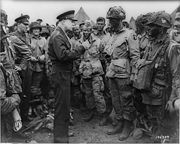
Western Front (World War II)
The Western Front of the European Theatre of World War II encompassed, Denmark, Norway, Luxembourg, Belgium, the Netherlands, France, and West Germany. The Western Front was marked by two phases of large-scale ground combat operations...
.
Operation Neptune :
D-Day Normandy :
One of the most famous of airborne operations was Operation Neptune, the assault of Normandy, part of Operation Overlord
Operation Overlord
Operation Overlord was the code name for the Battle of Normandy, the operation that launched the invasion of German-occupied western Europe during World War II by Allied forces. The operation commenced on 6 June 1944 with the Normandy landings...
of the Normandy landings on June 6, 1944. The task of the airborne forces was to secure the flanks and approaches of the landing beaches in Normandy. The British glider transported troops and paratroopers of the 6th Airborne Division secured the Eastern flank in Operation Tonga
Operation Tonga
Operation Tonga was the codename given to the airborne operation undertaken by the British 6th Airborne Division between 5 June and 7 June 1944 as a part of Operation Overlord and the Normandy Landings during the Second World War....
of which Operation Deadstick, capture of the Pegasus Bridge
Pegasus Bridge
Pegasus Bridge is a bascule bridge , built in 1934, that crossed the Caen Canal, between Caen and Ouistreham, in Normandy, France....
is the best remembered objective. Another objective was the Merville gun battery
Merville Gun Battery
The Merville Gun Battery was a coastal fortification in Normandy, France, in use as part of the Nazis' Atlantic Wall built to defend continental Europe from Allied invasion...
. The American glider and parachute infantry of the 82nd (Operation Detroit) and 101st Airborne Division
101st Airborne Division
The 101st Airborne Division—the "Screaming Eagles"—is a U.S. Army modular light infantry division trained for air assault operations. During World War II, it was renowned for its role in Operation Overlord, the D-Day landings on 6 June 1944, in Normandy, France, Operation Market Garden, the...
s (Operation Chicago), though widely scattered by poor weather and poorly marked landing zones in the American airborne landings in Normandy
American airborne landings in Normandy
The American airborne landings in Normandy were the first United States combat operations during Operation Overlord, the invasion of Normandy by the Western Allies on June 6, 1944. Around 13,100 paratroopers of the U.S. 82nd Airborne and 101st Airborne Divisions made night parachute drops early on...
, secured the western flank of VII Corps with heavy casualties. All together, Airborne casualties at D-Day Normandy totaled around 2,300.
D-Day Brittany :
Operation Dingson
Operation Dingson
Operation Dingson was an operation in the Second World War, conducted by about 178 Free French paratroops of the 4th Special Air Service , commanded by Colonel Pierre-Louis Bourgoin, who jumped into German occupied France near Vannes, Morbihan, Southern Brittany, in Plumelec, on the night of 5...
(5–18 June 1944) was an operation conducted by about 178 Free French paratroops of the 4th Special Air Service (SAS), commanded by Colonel Pierre-Louis Bourgoin, who jumped into German occupied France near Vannes, Morbihan
Morbihan
Morbihan is a department in Brittany, situated in the northwest of France. It is named after the Morbihan , the enclosed sea that is the principal feature of the coastline.-History:...
, Southern Brittany
Brittany
Brittany is a cultural and administrative region in the north-west of France. Previously a kingdom and then a duchy, Brittany was united to the Kingdom of France in 1532 as a province. Brittany has also been referred to as Less, Lesser or Little Britain...
, in Plumelec
Plumelec
Plumelec is a commune in the Morbihan department of Brittany in north-western France.-References:* * -External links:* * *...
, on the night of 5 June 1944 (11 h 30), (Captain Pierre Marienne with 17 men), and Saint-Marcel (8–18 June). At this time there was approximately 100 000 German troops, and artillery, preparing to move to the Normandy landing areas. Immediately upon landing in Brittany, on the night of 5 June 1944 (11 h 30), 18 Free French SAS who jumped in near Plumelec, went into action fighting against German troops (Vlassov's army). One hour later (0 h 40) the first victim of the liberation of his country, Corporal Emile Bouétard (born in Brittany, 1915) was killed near Plumelec. The Free French SAS established a base (Saint-Marcel) and began to arm and equip members of local resistance fighters, operating with up to 3,000 Maquis fighters. However, their base was heavily attacked by a German paratroop division on 18 June and were forced to disperse. Captain Pierre Marienne with 17 of his companions (6 paratroopers, 8 resistance fighters and 3 farmers) died a few weeks later in Kerihuel, Plumelec, (12 July at dawn). The Dingson team was joined by the men who had just completed operation Cooney
Operation Cooney
On 7 June 1944, 297 Squadron took part in Operation Cooney by providing 2 of the 9 aircraft of 38 Group that were used to deploy elements of the 4th Free French Parachute Battalion or 2eme RCP also known as 4th SAS....
. Dingson was conducted alongside operation Samwest
Operation Samwest
During World War II, Operation Samwest was a large raid conducted by 116 Free French paratroops of the 4th Special Air Service Regiment. Their objective was to hinder movement of German troops from west Brittany to the Normandy beaches via ambush and sabotage attempts.The first phase of the...
and operation Lost
Operation Lost
During World War II, Operation Lost was a reactive seven-man Special Air Service operation inserted into Brittany alongside Operation Dingson on 22-23 June 1944...
. Parts of Overlord. Operation Dingson 35A : on 5 August 1944, 10 Waco CG-4 gliders towed by aircraft of 298 Squadron and 644 Squadron transported the French SAS men and armed jeeps to Brittany near Vannes (Locoal-Mendon
Locoal-Mendon
Locoal-Mendon is a commune in the Morbihan department of Brittany in north-western France.-Breton language:In 2008, there was 17,81% of the children attended the bilingual schools in primary education.-External links:* * * * *...
), each glider carrying 3 Free French SAS troopers and a jeep. One glider was lost with the death of the British pilot. The SAS teams remained behind enemy lines in occupied territory until the Allies arrived.
Operation Dragoon: Southern France
On August 15, 1944, airborne units of the 7th Army's provisional airborne division, commanded by US Major General Robert T. Frederick
Robert T. Frederick
Robert Tryon Frederick was a highly decorated American combat commander during World War II, who commanded the 1st Special Service Force, the 1st Airborne Task Force and the 45th Infantry Division.-Career:...
, opened Operation Dragoon
Operation Dragoon
Operation Dragoon was the Allied invasion of southern France on August 15, 1944, during World War II. The invasion was initiated via a parachute drop by the 1st Airborne Task Force, followed by an amphibious assault by elements of the U.S. Seventh Army, followed a day later by a force made up...
, the invasion of Southern France, with a dawn assault. Called the "1st Airborne Task Force", the force was composed of the British 2nd Independent Parachute Brigade, the 517th Parachute Regimental Combat Team
517th Parachute Regimental Combat Team
The 517th Parachute Regimental Combat Team , one of the U.S. Army's first elite combat units, began its existence in March 1943, training at Camp Toccoa in the backwoods of Georgia...
, the 509th and 551st Parachute Infantry Battalion
551st Parachute Infantry Battalion
The 551st Parachute Infantry Battalion was for many years a little-recognized unit of the United States Army during World War II and the Battle of the Bulge. Originally commissioned to take the French Caribbean island of Martinique during World War II, they were shipped instead to Europe...
s, the glider-borne 550th Airborne Infantry Battalion
550th Airborne Infantry Battalion
The 550th Airborne Infantry Battalion was an independent formation of the United States Army formed on 1 July 1941 at Fort Kobbe Panama Canal Zone...
, and supporting units. Nearly 400 aircraft delivered 5,600 paratroopers and 150 guns to three drops zones surrounding Le Muy
Le Muy
Le Muy is a commune in the Var department in the Provence-Alpes-Côte d'Azur region in southeastern France. It was one of the first places to be liberated in the Allied invasion of Southern France in August 1944.It lies near Draguignan and Saint-Tropez....
, between Frejus
Fréjus
Fréjus is a commune in the Var department in the Provence-Alpes-Côte d'Azur region in southeastern France.It neighbours Saint-Raphaël, effectively forming one town...
and Cannes
Cannes
Cannes is one of the best-known cities of the French Riviera, a busy tourist destination and host of the annual Cannes Film Festival. It is a Commune of France in the Alpes-Maritimes department....
, in phase 1, Operation Albatross. Once they had captured their initial targets, they were reinforced by 2,600 soldiers and critical equipment carried in 408 gliders daylight missions code-named Operation Bluebird, phase 2, simultaneous with the beach landings, and Operation Dove
Operation Dove
In World War II, Mission Dove was the glider-borne assault conducted as part of the invasion of southern France on 15 August 1944. Over three hundred gliders carried three thousand soldiers and critical equipment to reinforce paratroopers who had already landed....
, phase 3. A second daylight parachute drop, Operation Canary, dropped 736 men of the 551st PIB with nearly 100% effectiveness late on the afternoon of August 15. The airborne objective was to capture the area, destroy all enemy positions and hold the ground until the US Seventh Army came ashore.
Operation Market Garden: "A Bridge Too Far"
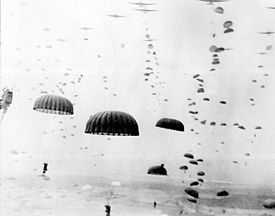
Operation Market Garden
Operation Market Garden was an unsuccessful Allied military operation, fought in the Netherlands and Germany in the Second World War. It was the largest airborne operation up to that time....
of September 1944, involved 35,000 troops dropped up to 100 miles (160.9 km) behind the German front lines in an attempt to capture a series of bridges over the Maas
Meuse River
The Maas or Meuse is a major European river, rising in France and flowing through Belgium and the Netherlands before draining into the North Sea...
, Waal and Rhine rivers, ultimately enabling the Allies to outflank German fortifications and penetrating into Germany. The operation was hastily planned and many key planning tasks were inadequately completed. Three complete airborne divisions executed Operation Market, the airborne phase. These were the British 1st Airborne Division
British 1st Airborne Division
The 1st Airborne Division was a division of the British airborne forces during the Second World War. The division was formed in 1941, after British Prime Minister Winston Churchill demanded an airborne force...
, the US 82nd Airborne Division and 101st Airborne Division
101st Airborne Division
The 101st Airborne Division—the "Screaming Eagles"—is a U.S. Army modular light infantry division trained for air assault operations. During World War II, it was renowned for its role in Operation Overlord, the D-Day landings on 6 June 1944, in Normandy, France, Operation Market Garden, the...
, as well as the Polish 1st Independent Parachute Brigade
Polish 1st Independent Parachute Brigade
The 1st Independent Parachute Brigade was a parachute brigade under command of Maj.Gen. Stanisław Sosabowski, created in Scotland in September 1941, with the exclusive mission to drop into occupied Poland in order to help liberate the country. The British government, however, pressured the Polish...
. All three Divisions, as well as the Independent Brigade, were landed or dropped at various points along Highway 69, or "Hell's Highway", in order to create a "carpet" over which the British XXX Corps could rapidly advance in Operation Garden, the armored phase. It was a daylight assault, with little initial opposition, and most units achieved high accuracy on drop and landing zones. In the end, after strong German counterattacks, the overall plan failed: the British 1st Airborne division was all but destroyed at Arnhem, and the final Rhine bridge remained in German hands.
Operation Repulse: re-supply of Bastogne
Operation Repulse, which took place in Bastogne on December 27, 1944, as part of the Battle of the Bulge, glider pilots, although flying directly through enemy fire, were able to land, delivering the badly needed ammunition, gasoline, and medical supplies that enabled defenders against the German offensive to persevere and secure the ultimate victory.
Operation Varsity: The Rhine Crossing
Operation Varsity
Operation Varsity
Operation Varsity was a successful joint American–British airborne operation that took place toward the end of World War II...
was a daylight assault conducted by two airborne Divisions, the British 6th Airborne Division and the American 17th Airborne Division, both of which formed a part of the US XVIII Airborne Corps. Conducted as a part of Operation Plunder
Operation Plunder
Commencing on the night of 23 March 1945 during World War II, Operation Plunder was the crossing of the River Rhine at Rees, Wesel, and south of the Lippe River by the British 2nd Army, under Lieutenant-General Sir Miles Dempsey , and the U.S. Ninth Army , under Lieutenant General William Simpson...
, the operation took place on the 24th of March, 1945 in aid of the attempt by the British 21st Army Group to cross the Rhine river. Having learnt from the heavy casualties inflicted upon the airborne formations which took part in Operation Market Garden, the two airborne divisions were dropped several thousand yards forward of friendly positions, and only some thirteen hours after Operation Plunder had begun and Allied ground forces had already crossed the Rhine. There was heavy resistance in some of the areas that the airborne troops landed in, with casualties actually statistically heavier than those incurred during Operation Market Garden. The British historian Max Hastings
Max Hastings
Sir Max Hugh Macdonald Hastings, FRSL is a British journalist, editor, historian and author. He is the son of Macdonald Hastings, the noted British journalist and war correspondent and Anne Scott-James, sometime editor of Harper's Bazaar.-Life and career:Hastings was educated at Charterhouse...
has labelled the operation both costly and unnecessary, writing that "Operation Varsity was a folly for which more than a thousand men paid for with their lives..."
South West Pacific
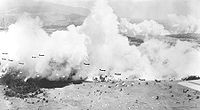
Territory of New Guinea
The Territory of New Guinea was the Australia-controlled, League of Nations-mandated territory in the north eastern part of the island of New Guinea, and surrounding islands, between 1920 and 1949...
, the U.S. 503rd Parachute Infantry Regiment made a highly successful, unopposed landing at Nadzab
Landing at Nadzab
The Landing at Nadzab was an airborne landing on 5 September 1943 during the New Guinea campaign of World War II that began with a parachute drop at Nadzab in conjunction with the Landing at Lae....
, during the Salamaua-Lae campaign
Salamaua-Lae campaign
The Salamaua–Lae campaign was a series of actions in the New Guinea campaign of World War II. Australian and United States forces sought to capture two major Japanese bases, one in the town of Lae, and another one at Salamaua. The campaign to take the Salamaua and Lae area began with the Australian...
. This was the first Allied airborne assault in the Pacific Theater
Pacific War
The Pacific War, also sometimes called the Asia-Pacific War refers broadly to the parts of World War II that took place in the Pacific Ocean, its islands, and in East Asia, then called the Far East...
.
In July 1944, the 503rd jumped again, Battle of Noemfoor
Battle of Noemfoor
The Battle of Noemfoor was a battle of World War II that took place on the island of Noemfoor, in Dutch New Guinea, between 2 July and 31 August 1944. United States and Australian forces attacked to capture Japanese bases on the island.-Background:...
onto Noemfoor Island, off Dutch New Guinea.
The 503rd's most famous operation was a landing on Corregidor ("The Rock") in February 1945, during the Philippines campaign of 1944–45.
The U.S. 11th Airborne Division saw a great deal of action in the Philippines as a ground unit. The 511th Parachute Regiment, made the division's first jump near Tagaytay Ridge
Tagaytay City
The City of Tagaytay is a second class city in the province of Cavite, Philippines. Only away from Manila via Aguinaldo Highway, it is one of the country's most popular tourist destinations. Tagaytay City provides a good view of the Taal Volcano...
, 3 February 1945, meeting no resistance at the drop zone. The division also jumped to liberate 2,000 Allied civilians interned at Los Baños
Los Baños, Laguna
The Nature and Science City of Los Baños is a 1st class urban city in the province of Laguna, Philippines. According to the latest census, it has a population of 98,631 inhabitants in 17,030 households...
, 23 February 1945. The final operation of the Division was conducted on 23 June 1945, in conjunction with an advance by U.S. ground forces in northern Luzon. A task force from the 11th was formed and jumped on Camalaniugan Airfield, south of Aparri
Aparri, Cagayan
Aparri is a 1st class municipality in the province of Cagayan, Luzon, Philippines. According to the latest census, Aparri has a population of 69,024 people.Aparri has an approximate income of Php 90,000,000.00...
.
Burma
A large British force, known as Chindits, operated behind Japanese lines during 1944. In Operation Thursday, most of the units were flown into landing grounds which had been seized by glider infantry
Glider infantry
Glider infantry was a type of airborne infantry in which soldiers and their equipment were inserted into enemy controlled territory via military glider rather than parachute...
transported by the American First Air Commando Group, commencing on March 5. Aircraft continued to land reinforcements at captured or hastily constructed landing strips until monsoon rains made them unusable. Small detachments were subsequently landed by parachute. The operation eventually wound down in July, with the exhausted Chindits making their way overland to link up with advancing American and Chinese forces.
For Operation Dracula, an ad hoc parachute battalion group made up of personnel from the 153 and 154 (Ghurka) Parachute Battalions of the Indian Army secured Japanese coastal defences, which enabled the seaborne assault by the 26th Indian Division to attain its objectives with the minimum of casualties and loss of time.
Korean War
The 187th Airborne Regimental Combat Team ("Rakkasans") made two combat jumps in Korea during the Korean WarKorean War
The Korean War was a conventional war between South Korea, supported by the United Nations, and North Korea, supported by the People's Republic of China , with military material aid from the Soviet Union...
. The first combat jump was made on October 20, 1950 at Sunchon
Sunchon, North Korea
Sunch'ŏn is a city in South Pyongan province, North Korea. It has an estimated population of 437,000, and is home to various manufacturing plants...
and Sukchon, North Korea. The missions of the 187th were to cut the road north going to China, preventing North Korean leaders from escaping from Pyongyang
Pyongyang
Pyongyang is the capital of the Democratic People's Republic of Korea, commonly known as North Korea, and the largest city in the country. Pyongyang is located on the Taedong River and, according to preliminary results from the 2008 population census, has a population of 3,255,388. The city was...
; and to rescue American prisoners of war.
The second combat jump was made on Wednesday, March 21, 1951, at Munsan-ni, South Korea codenamed Operation Tomahawk
Operation Tomahawk
Operation Tomahawk was an airborne military operation by the 187th Regimental Combat Team on 23 March 1951 at Munsan-ni as part of Operation Courageous in the Korean War. Operation Courageous was designed to trap large numbers of Chinese and North Korean troops between the Han and Imjin Rivers...
. The mission was to get behind Chinese forces and block their movement north. The 60th Indian Parachute Field Ambulance provided the medical cover for the operations, dropping an ADS and a surgical team totally 7 officers and 5 other ranks, treating over 400 battle casualties apart from the civilian casualties that formed the core of their objective as the unit was on a humanitarian mission.
The 187th served in six campaigns in Korea. Shortly after the war the 187th ARCT was considered for use in an Airborne drop to relieve the surrounded French garrison at Dien Bien Phu in Vietnam but the United States, at that time, decided not to send its troops into the combat zone.
The unit was assigned to the reactivated 101st Airborne Division and subsequently inactivated as a combat team in 1956 as part of the division's reorganization into the Pentomic structure, which featured battle groups in place of regiments and battalions. The 1st and 3rd Battalions, 187th Infantry, bearing the lineages of the former Co A and Co C, 187AIR, are now with the 101st Airborne Division
101st Airborne Division
The 101st Airborne Division—the "Screaming Eagles"—is a U.S. Army modular light infantry division trained for air assault operations. During World War II, it was renowned for its role in Operation Overlord, the D-Day landings on 6 June 1944, in Normandy, France, Operation Market Garden, the...
as air assault
Air assault
Air assault is the movement of ground-based military forces by vertical take-off and landing aircraft—such as the helicopter—to seize and hold key terrain which has not been fully secured, and to directly engage enemy forces...
units.
First Indochina War
The French used paratroops extensively during their 1946–54 war against the Viet Minh. Colonial, French Foreign LegionFrench Foreign Legion
The French Foreign Legion is a unique military service wing of the French Army established in 1831. The foreign legion was exclusively created for foreign nationals willing to serve in the French Armed Forces...
and local Vietnamese units took part in numerous operations which were to culminate in the disastrous siege of Dien Bien Phu
Dien Bien Phu
Điện Biên Phủ is a city in northwestern Vietnam. It is the capital of Dien Bien province, and is known for the events there during the First Indochina War, the Battle of Dien Bien Phu, during which the region was a breadbasket for the Việt Minh.-Population:...
.
Suez crisis: Operations Machbesh & Musketeer
Launching the 1956 Suez War, on October 29, 1956, Israeli paratroopers led by Ariel SharonAriel Sharon
Ariel Sharon is an Israeli statesman and retired general, who served as Israel’s 11th Prime Minister. He has been in a permanent vegetative state since suffering a stroke on 4 January 2006....
dropped onto the important Mitla Pass
Mitla Pass
The Mitla Pass is a 32 km-long snaky pass in the Sinai of Egypt, wedged between mountain ranges to the north and south, located about 50 km east of Suez...
to cut off and engage Egyptian forces. Operation Machbesh (Press) was the IDF
Israel Defense Forces
The Israel Defense Forces , commonly known in Israel by the Hebrew acronym Tzahal , are the military forces of the State of Israel. They consist of the ground forces, air force and navy. It is the sole military wing of the Israeli security forces, and has no civilian jurisdiction within Israel...
's first and only combat parachute drop.
A few days later, Operation Musketeer
Operation Musketeer (1956)
Operation Musketeer was the Anglo-French-Israeli plan for the invasion of Egypt to capture the Suez Canal during the Suez Crisis. Israel had the additional objective to open the Straits of Tiran.-The operation:...
needed the element of total surprise to succeed, and all 660 men had to be on the ground at El Gamil airfield and ready for action within four and a half minutes. At 04.15 hours on November 5, 1956, British 3rd Battalion, Parachute Regiment jumped in and although opposition was heavy, casualties were few. Meanwhile, French paratroopers of the 2nd Regiment of Colonial Paratroopers under the command of Colonel Chateau-Jobert jumped on the water treatment factory South of Port Said.
The landings from the sea the next day saw the first large-scale heliborne assault, as 45 Commando, Royal Marines
Royal Marines
The Corps of Her Majesty's Royal Marines, commonly just referred to as the Royal Marines , are the marine corps and amphibious infantry of the United Kingdom and, along with the Royal Navy and Royal Fleet Auxiliary, form the Naval Service...
were landed by helicopters in Port Said
Port Said
Port Said is a city that lies in north east Egypt extending about 30 km along the coast of the Mediterranean Sea, north of the Suez Canal, with an approximate population of 603,787...
from ships offshore.
Indo-Pakistani War of 1965
For the first time in a combat in South AsiaSouth Asia
South Asia, also known as Southern Asia, is the southern region of the Asian continent, which comprises the sub-Himalayan countries and, for some authorities , also includes the adjoining countries to the west and the east...
, paratroopers were used in the subcontinent
Indian subcontinent
The Indian subcontinent, also Indian Subcontinent, Indo-Pak Subcontinent or South Asian Subcontinent is a region of the Asian continent on the Indian tectonic plate from the Hindu Kush or Hindu Koh, Himalayas and including the Kuen Lun and Karakoram ranges, forming a land mass which extends...
during the Second Kashmir War of 1965. A covert operation was launched by Pakistan Army with the intention of infiltrating Indian airbases and sabotaging them. The SSG (Special Service Group) commandos numbering close to 200 were parachuted into Indian territory. Indian sources however claim as many as 800–900 attempted the landing. Given that most of the Indian targets (Halwara
Halwara
Halwara is a township in Punjab state in India. Located in the Ludhiana District close to Village Toosa , Halwara lies on the Mullanpur-Raikot road...
, Pathankot
Pathankot
Pathankot became 22nd district on 28th July 2011 and a municipal corporation in the Indian state of Punjab. It was a part of the Nurpur princely state ruled by the Rajputs prior to 1849 AD. It is a meeting point of the three northern states of Punjab, Himachal Pradesh and Jammu and Kashmir...
and Adampur
Adampur
Adampur is a city and a municipal council in Jalandhar district in the Indian state of Punjab.-Geography:Adampur Doaba is located at . It has an average elevation of 233 metres . The nearest hill station is Dharamshala which is the headquarters of the Dalai Lama...
) were deep into enemy territory only a dozen or so commandos made it back alive and the stealth operation proved ineffective. Of the remaining, 136 were taken prisoners, 22 were killed in encounters with the army, local police or the civilians. The daring attempt proved to be a disaster with the Commander of the operations, Major Khalid Butt too being arrested.
Indo-Pakistani War of 1971
In 1971, the Parachute RegimentParachute Regiment
Parachute Regiment may refer to:*Parachute Regiment *Parachute Regiment *Paratroopers Brigade , Israel*44 Parachute Regiment *1st Airborne Brigade...
of the Indian Army fought numerous actions both in the Eastern and Western Theatres. On 11 December, India airdropped 2 Para Bn Gp in what is now famous as the Tangail airdrop
Tangail Airdrop
The Tangail Airdrop was an airborne operation mounted on 11 December 1971 by the 2nd Parachute Battalion Group of the Indian Army during the Indo-Pakistani War of 1971. The main objective of the operation was the capture of Poongli Bridge on the Jamuna which would cut off the 93 Brigade of...
. The paratroop unit was instrumental in denying the retreat and regrouping of the Pakistani army, and contributed substantially to the early collapse of Dacca. The Para Commandos
Para Commandos
The Para Commandos are a special forces unit of the Indian Army. Formed in 1966, the Para Commandos are the largest and most important part of the Special Forces of India...
also proved their skills in lightning raids into Chachro (Sindh, Pakistan) and Mandhol (Jammu and Kashmir). The Regiment earned battle honours—Poongli Bridge, Chachro and Defence of Poonch
Poonch
Poonch is a town and a municipal committee in Poonch District in the Indian state of Jammu and Kashmir. Based on the Mahābhārata evidence, and the evidence from 7th Chinese traveler Xuanzang, the districts of Poonch along with Rajauri and Abhisara had been under the sway of the Republican Kambojas...
—during these operations.
Vietnam War
In 1963, in the Battle of Ap BacBattle of Ap Bac
The Battle of Ap Bac was a major battle fought on January 3, 1963, during the Vietnam War. It was fought in Dinh Tuong Province , South Vietnam. On December 28, 1962, U.S...
, ARVN forces delivered airborne troops by helicopter and air drop. The use of helicopter-borne airmobile troops by the United States in the Vietnam War
Vietnam War
The Vietnam War was a Cold War-era military conflict that occurred in Vietnam, Laos, and Cambodia from 1 November 1955 to the fall of Saigon on 30 April 1975. This war followed the First Indochina War and was fought between North Vietnam, supported by its communist allies, and the government of...
was widespread, and became an iconic image featuring in newsreels and movies about the conflict.
In February 1967 Operation Junction City
Operation Junction City
Operation Junction City was an 82-day military operation conducted by United States and Republic of Vietnam forces begun on 22 February 1967 during the Vietnam War. It was the largest U.S. airborne operation since Operation Market Garden during World War II, the only major airborne operation of...
was launched, it would be the largest operation the Coalition Force would assemble. During this operation, 845 members of the 2nd Battalion, 503rd Infantry (Airborne), the 319th Artillery (Airborne), and elements of H&H company of the 173rd Airborne Brigade made the only combat jump in Vietnam.
Rhodesian Bush War
FireforceFireforce
Fireforce is a variant of the tactic of vertical envelopment of a target by helicopter-borne and parachute infantry developed by the Rhodesian Security Forces during the Rhodesian Bush War...
is a variant of the tactic of vertical envelopment of a target by helicopter-borne and small groups of parachute infantry developed by the Rhodesian Security Force.
Fireforce counter-insurgency missions were designed to trap and eliminate terrorists (to use the contemporary term) before they could flee. The Rhodesian Security Force could react quickly to terrorist ambushes, farm attacks, Observation Post sightings, and could also be called in as reinforcements by trackers or patrols which made contact with the enemy. It was first deployed in January 1974 and saw its first action a month later on the 24 February 1974. By the end of Rhodesian operations with internal peace agreements, Fireforce was a well-developed counterinsurgency tactic.
Fireforce was an operational assault or response usually composed of a first wave of 32 soldiers carried to the scene by three Alouette III helicopters and one Dakota transport aircraft, with another Alouette III helicopter as a command/gunship aircraft and a light attack aircraft in support. One of the advantages of the Fireforce was its flexibility as all that was needed was a reasonable airstrip. It was such a successful tactic that some Rhodesian Light Infantry
Rhodesian Light Infantry
The 1st Battalion, The Rhodesian Light Infantry, commonly the Rhodesian Light Infantry , was a regiment formed in 1961 at Brady Barracks, Bulawayo, Southern Rhodesia as a light infantry unit within the army of the Federation of Rhodesia and Nyasaland...
(RLI) soldiers reputedly made as many as three parachute combat jumps in one day.
Soviet and Russian VDV

Soviet Union
The Soviet Union , officially the Union of Soviet Socialist Republics , was a constitutionally socialist state that existed in Eurasia between 1922 and 1991....
maintained the world's largest airborne force during the Cold War
Cold War
The Cold War was the continuing state from roughly 1946 to 1991 of political conflict, military tension, proxy wars, and economic competition between the Communist World—primarily the Soviet Union and its satellite states and allies—and the powers of the Western world, primarily the United States...
, consisting of seven airborne divisions and a training division. The VDV was subordinated directly to the Ministry of Armed Forces of USSR, and was a 'prestige service' in the armed forces of the USSR and Russia to reflect its strategic purpose. Recruits received much more rigorous training than ordinary Soviet units. Although a light infantry force, the paratroops were the recipients of several pieces of specifically designed equipment, such as the AKS-74 rifle, the ASU-85
ASU-85
The ASU-85 is a soviet-designed airborne self-propelled gun of the Cold War Era. From 1959 it replaced the open-topped ASU-57 in service but was in its turn replaced by the BMD-1 from 1969.-Development history:...
self-propelled gun
Self-propelled gun
A self-propelled gun is form of self-propelled artillery, and in modern use is usually used to refer to artillery pieces such as howitzers....
, and the BMD-1
BMD-1
The BMD-1 is a Soviet airborne amphibious tracked infantry fighting vehicle, which was introduced in 1969 and first seen by the West in 1970. BMD stands for Boyevaya Mashina Desanta . It can be dropped by parachute and although it resembles the BMP-1 it is in fact much smaller...
. The VDV have participated in virtually all Soviet and Russian conflicts since the Second World War, including the Soviet war in Afghanistan
Soviet war in Afghanistan
The Soviet war in Afghanistan was a nine-year conflict involving the Soviet Union, supporting the Marxist-Leninist government of the Democratic Republic of Afghanistan against the Afghan Mujahideen and foreign "Arab–Afghan" volunteers...
. As an elite force, the VDV developed two distinctive items of clothing: the telnyashka
Telnyashka
A telnyashka is a dark color and white striped, sleeveless or not, undershirt, which is an iconic uniform of the Russian Navy, the Russian Airborne Forces and the Russian Naval Infantry , initially by Soviet predecessors of these troops...
, or striped shirt, and the famous blue beret. Currently, after the beginning of Military Reform in Russian Armed Forces, VDV is the only military branch which retains divisonal
Division (military)
A division is a large military unit or formation usually consisting of between 10,000 and 20,000 soldiers. In most armies, a division is composed of several regiments or brigades, and in turn several divisions typically make up a corps...
-structure instead of brigade-structure in other military branches. It took a lot of efforts from VDV Supreme Commander General Shamanov
Vladimir Shamanov
Vladimir Anatolyevich Shamanov is a Lieutenant General in the Russian Army, the commander of the Russian Airborne Troops since May 2009 and a former Russian politician...
and his subordinates to defend the quantity of VDV from being reduced.
Airborne assault (десантно-штурмовые войска or DShV) units wore similar striped shirts (as did the naval infantry) but used helicopters, rather than the Military Transport Aviation's AN-12s, AN-22s, and IL-76s, which carried the Airborne Troops and their equipment. The airborne assault forces thus had tactical missions and subordinated to Military district
Military district (Soviet Union)
In the Soviet Union, a military district was a territorial association of military units, formations, military schools, and various local military administrative establishments...
s, which in case of a possible war would be transformed into a Army group
Army group
An army group is a military organization consisting of several field armies, which is self-sufficient for indefinite periods. It is usually responsible for a particular geographic area...
s. They had battalion-regimental-brigade structure. Today, all separate DShB-battalions are disbanded. Some brigades and regiments of aiborne assault troops were disbanded, other are now subordinated to VDV.
Operation Meghdoot
Operation Meghdoot was the name given to the preemptive strikePreemptive strike
A preemptive strike refers to a surprise attack launched with the stated intention of countering an anticipated enemy offensive. Preemptive strike may also refer to:...
launched by the Indian Military to capture most of the Siachen Glacier
Siachen Glacier
The Siachen Glacier is located in the eastern Karakoram range in the Himalaya Mountains at about , just east of the Line of Control between India-Pakistan. India controls all of the Siachen Glacier itself, including all tributary glaciers. At long, it is the longest glacier in the Karakoram and...
, in the disputed Kashmir
Kashmir
Kashmir is the northwestern region of the Indian subcontinent. Until the mid-19th century, the term Kashmir geographically denoted only the valley between the Great Himalayas and the Pir Panjal mountain range...
region. Launched on April 13, 1984, this military operation
Military operation
Military operation is the coordinated military actions of a state in response to a developing situation. These actions are designed as a military plan to resolve the situation in the state's favor. Operations may be of combat or non-combat types, and are referred to by a code name for the purpose...
was unique as it was the first assault launched in the world's highest battlefield. The military action was quite successful as Indian troops managed to gain two-thirds of the glacier
Glacier
A glacier is a large persistent body of ice that forms where the accumulation of snow exceeds its ablation over many years, often centuries. At least 0.1 km² in area and 50 m thick, but often much larger, a glacier slowly deforms and flows due to stresses induced by its weight...
with the rest remaining under Pakistani control.
Recent history
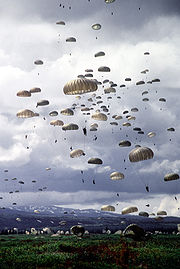
- During the 1983 Invasion of GrenadaInvasion of GrenadaThe Invasion of Grenada, codenamed Operation Urgent Fury, was a 1983 United States-led invasion of Grenada, a Caribbean island nation with a population of about 100,000 located north of Venezuela. Triggered by a military coup which had ousted a four-year revolutionary government, the invasion...
, the 75th Ranger Regiment made a combat jump on Point Salines International AirportPoint Salines International AirportMaurice Bishop International Airport , formerly known as Point Salines International Airport, is located in the parish of St. George's. The town of St. George's is about north of the airport and is the capital of the island nation of Grenada...
. - In 1989 during the U.S invasion of PanamaUnited States invasion of PanamaThe United States Invasion of Panama, code-named Operation Just Cause, was the invasion of Panama by the United States in December 1989. It occurred during the administration of U.S. President George H. W...
the U.S. 82nd Airborne Division made its first combat jump in over 40 years. The 2nd Battalion, 504th Parachute Infantry Regiment secured Omar Torrijos International AirportTocumen International AirportTocumen International Airport is an international airport located from Panama City, Panama. In 2006, it underwent a major expansion and renovation program in order to modernize and improve its facilities...
in Tocumen, PanamaTocumenTocumen is a town in the Panama province of Panama. It is known for the Tocumen International Airport.- References :* – World-Gazetteer.com...
. The jump was made hours after the 75th Ranger Regiment conducted its two separate combat jumps. M551 Sheridan tanks were also dropped by air, the only time this capability was used in combat. - On October 19, 2001 as part of Operation Enduring Freedom, the 3rd Ranger Battalion and a small Command and Control Element from the Regimental Headquarters of the 75th Ranger Regiment jumped into KandaharKandaharKandahar is the second largest city in Afghanistan, with a population of about 512,200 as of 2011. It is the capital of Kandahar Province, located in the south of the country at about 1,005 m above sea level...
to secure an airfield. - On March 23, 2003 A co 3/75 Ranger Regiment conducted a combat jump into Northern Iraq, to seize a desert airfield.
- On March 26, 2003 the U.S. 173rd Airborne Brigade conducted a combat jump into Northern Iraq, during the 2003 invasion of Iraq2003 invasion of IraqThe 2003 invasion of Iraq , was the start of the conflict known as the Iraq War, or Operation Iraqi Freedom, in which a combined force of troops from the United States, the United Kingdom, Australia and Poland invaded Iraq and toppled the regime of Saddam Hussein in 21 days of major combat operations...
, to seize an airfield and support special forces: Task Force VikingTask Force VikingJoint Special Operations Task Force – North , also known as Task Force Viking was the command responsible for the northern front during Operation Iraqi Freedom Rotation I...
. The paratroopers departed from Aviano Air BaseAviano Air BaseAviano Air Base is a NATO Air Base under U.S. Air Force administration in northeastern Italy, in Friuli-Venezia Giulia region. It is located in Aviano municipality, at the foot of the Carnic Pre-Alps, or Southern Carnic Alps, about 15 kilometers from Pordenone.-Units:Aviano is hosted by the...
, Italy on fifteen C-17s. - In 2009, Pakistan ArmyPakistan ArmyThe Pakistan Army is the branch of the Pakistani Armed Forces responsible for land-based military operations. The Pakistan Army came into existence after the Partition of India and the resulting independence of Pakistan in 1947. It is currently headed by General Ashfaq Parvez Kayani. The Pakistan...
's paratroopers conducted a combat jump operations during Operation Black ThunderstormOperation Black ThunderstormOperation Black Thunderstorm was an aggressive military operation that commenced on April 26, 2009 conducted by the Pakistan Army, with the aim of retaking Buner, Lower Dir, Swat and Shangla districts from the Taliban after the militants took control of them since the start of the year.- Background...
and Operation Rah-e-NijatOperation Rah-e-NijatThe Operation Rah-e-Nijat was a Pakistani military operation against the Taliban and other Islamist rebels in the South Waziristan area of the Federally Administered Tribal Areas that began on June 19, 2009; a major ground offensive was subsequently launched on October 17...
against the Taliban Forces in North-West Pakistan, to seize control of strategic mountains areas to support Special forces and infantry troops.
Other meanings of the word Airborne
- In the United States Air ForceUnited States Air ForceThe United States Air Force is the aerial warfare service branch of the United States Armed Forces and one of the American uniformed services. Initially part of the United States Army, the USAF was formed as a separate branch of the military on September 18, 1947 under the National Security Act of...
, the term refers to Airmen (other than pilots, navigators and weapon system officers) performing duties in aerial flight, such as the operations crew on the E-3 SentryE-3 SentryThe Boeing E-3 Sentry is an airborne warning and control system developed by Boeing as the prime contractor. Derived from the Boeing 707, it provides all-weather surveillance, command, control and communications, and is used by the United States Air Force , NATO, Royal Air Force , French Air Force...
. - In aviationAviationAviation is the design, development, production, operation, and use of aircraft, especially heavier-than-air aircraft. Aviation is derived from avis, the Latin word for bird.-History:...
an aircraftAircraftAn aircraft is a vehicle that is able to fly by gaining support from the air, or, in general, the atmosphere of a planet. An aircraft counters the force of gravity by using either static lift or by using the dynamic lift of an airfoil, or in a few cases the downward thrust from jet engines.Although...
becomes airborne when it takes offTakeoffTakeoff is the phase of flight in which an aerospace vehicle goes from the ground to flying in the air.For horizontal takeoff aircraft this usually involves starting with a transition from moving along the ground on a runway. For balloons, helicopters and some specialized fixed-wing aircraft , no...
.
See also
- ParatrooperParatrooperParatroopers are soldiers trained in parachuting and generally operate as part of an airborne force.Paratroopers are used for tactical advantage as they can be inserted into the battlefield from the air, thereby allowing them to be positioned in areas not accessible by land...
- Airborne gunAirborne gunAirborne guns are airborne artillery pieces, designed for use by paratroopers. They are similar to infantry support guns, and are generally capable of being broken down into smaller loads...
- AirheadAirheadAn airhead is a designated area in a hostile or threatened territory which, when seized and held, allows the air landing of further troops and material via an airbridge, and provides the maneuver and preparation space necessary for projected operations. Normally it is the area seized in the assault...
- HALO/HAHOHALO/HAHOMilitary free-fall form of insertion.PurposeDelivering personnel, equipment, or supplies.HALOHigh-Altitude/Low-OpeningHAHOHigh-Altitude/High-OpeningOrigins...
- Special forcesSpecial forcesSpecial forces, or special operations forces are terms used to describe elite military tactical teams trained to perform high-risk dangerous missions that conventional units cannot perform...
- PathfindersPathfinders (military)A pathfinder is a paratrooper who is inserted or dropped into place in order to set up and operate drop zones, pickup zones, and helicopter landing sites for airborne operations, air resupply operations, or other air operations in support of the ground unit commander...
Further reading
- Ambrose, Stephen E., Pegasus Bridge. Pocket Books, 2003
- Ambrose, Stephen E., Band of Brothers. Pocket Books, 2001
- Arthur, Max, Forgotten Voices Of The Second World War. Edbury Press, 2005
- Balkoski, Joseph, Utah Beach: The Amphibious Landing and Airborne Operations on D-Day, June 6, 1944. Stackpole Books US, 2006
- Bando, Mark A., 101st Airborne: The Screaming Eagles at Normandy. Motorbooks International, 2001
- Blair, Clay, Ridgway’s Paratroopers – The American Airborne In World War II. The Dial Press, 1985
- Buckingham, William F., Arnhem 1944. Tempus Publishing Limited, 2004
- Buckingham, William F., D-Day – The First 72 Hours. Tempus Publishing Limited, 2004
- Calvocoressi, Peter, The Penguin History of the Second World War, Penguin Books Ltd, 1999
- Department Of The Army, Pamphlet No. 20-232, Historical Study – Airborne Operations – A German Appraisal, 1951, Department Of The Army
- Devlin, Gerard M., Paratrooper – The Saga Of Parachute And Glider Combat Troops During World War II, Robson Books, 1979
- Dover, Victor, The Sky Generals, Cassell Ltd, 1981
- Flanagan, E.M. Jr., Airborne – A Combat History Of American Airborne Forces, The Random House Publishing Group, 2002
- Flint, Keith, Airborne Armour: Tetrarch, Locust, Hamilcar and the 6th Airborne Armoured Reconnaissance Regiment, 1938–50, Helion & Company, 2004
- French, David, Raising Churchill’s Army – The British Army And The War Against Germany 1919–1945, Oxford University Press, 2000
- Frost, John, A Drop Too Many, Leo Cooper Ltd, 1994
- Gregory, Barry, British Airborne Troops, Macdonald & Co (Publishers) Ltd, 1974
- Harclerode, Peter, Arnhem – A Tragedy Of Errors, Caxton Editions, 2000
- Harclerode, Peter, Para! – Fifty Years Of The Parachute Regiment, Orion Books Ltd, 1996
- Harclerode, Peter, Wings Of War – Airborne Warfare 1918–1945, Weidenfeld & Nicolson, 2005
- Hastings, Max, Overlord, Pan Books, 1999
- Hibbert, Christopher,‘Arnhem, B.T. Batsford Ltd, 1998
- Horrocks, Brian, A Full Life, Collins, 1960
- Huston, James A., Out Of The Blue – U.S Army Airborne Operations In World War II, Purdue University Press, 1998
- Jewell, Brian, ”Over The Rhine” – The Last Days Of War In Europe, Spellmount Ltd, 1985
- Keegan, John, The Second World War, Pimlico, 1997
- Kershaw, Robert J., It Never Snows In September – The German View Of MARKET-GARDEN And The Battle Of Arnhem, September 1944, Ian Allan Publishing Ltd, 2004
- Koskimaki, George E., D-Day With The Screaming Eagles, Presidio Press, 2002
- Koskimaki, George E., Hell’s Highway – A Chronicle Of The 101st Airborne In The Holland Campaign, September–November 1944, Presidio Press, 2007
- Jones, Robert, The History of the 101st Airborne Division, Turner Publishing Company, 2005
- Middlebrook, Martin, Arnhem 1944 – The Airborne Battle, Penguin Books, 1995
- Ministry Of Information, By Air To Battle – The Official Account Of The British Airborne Divisions, Her Majesty’s Stationary Office, 1945
- Nordyke, Phil, All American, All the Way: The Combat History Of The 82nd Airborne Division In World War II, Motorbooks International, 2005
- Nordyke, Phil, Four Stars of Valour: The Combat History of the 505th Parachute Infantry Regiment in World War II, Motorbooks, 2006
- Norton, G.G., The Red Devils – The Story Of The British Airborne Forces, Pan Books Ltd, 1973
- Otway, T.B.H, Airborne Forces, Adlib Books, 1990
- Rawson, Andrew, The Rhine Crossing – 9th US Army & 17th US Airborne, Pen & Sword Military, 2006
- Ryan, Cornelius, A Bridge Too Far, Coronet Books, 1984
- Saunders, Hilary St. George, The Red Beret – The Story Of The Parachute Regiment 1940–1945, Michael Joseph Ltd, 1954
- Saunders, Tim, Operation Plunder – The British & Canadian Rhine Crossing, Pen & Sword Military, 2006
- Tanase, Mircea, The airborne troops during the World War II, Military Publishing House Romania, 2006
- Tugwell, Maurice, Airborne To Battle – A History Of Airborne Warfare 1918–1971, William Kimber & Co Ltd, 1971
- Urquhart, R.E., Arnhem, Pan Books, 1960
- Weeks, John, Assault From The Sky – The History Of Airborne Warfare, David & Charles Publisher plc, 1988
- Whiting, Charles, American Eagles – The 101st Airborne’s Assault On Fortress Europe 1944/45, Eskdale Publishing, 2001
- Whiting, Charles, "Bounce The Rhine" – The Greatest Airborne Operation In History, Grafton Books, 1987
- Whiting, Charles Slaughter Over Sicily, Leo Cooper, 1992
External links
- The Paras
- ArmyParatrooper.org
- Pathfinder Parachute Group – WW2 parachute jump reenactments and military jumps with foreign nations
- Hagerman, Bart, Operation Varsity: Allied Airborne Assault Over the Rhine River World War II History Magazine, (1998), pp. 1–5
- Taylor, John M., 101st Airborne Division Participate in Operation Overlord Military History Quarterly, (2004), pp. 1–5
- Murray, Williamson, Airborne Operations During World War II World War II History Magazine (2004), pp. 1–4
- Airborne Engineers Association