
All Topics  
T-55

 
T 55

   Email Print
   Bookmark   Link


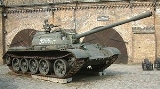
T-55


The T-54 and T-55 tanks were a series of main battle tanks designed in the Soviet Union
Soviet Union

The Union of Soviet Socialist Republics was a Constitution of the Soviet Union socialist state that existed in Eurasia from 1922 to 1991.The name is a translation of the , romanization of Russian Soyuz Sovetskikh Sotsialisticheskikh Respublik, abbreviated ????, SSSR....
. The first T-54 prototype appeared in March 1945, just before the end of the Second World War
World War II

World War II, or the Second World War , was a global military conflict which involved a Participants in World War II, including all of the great powers, organised into two opposing military alliances: the Allies of World War II and the Axis powers....
. The T-54 entered full production in 1947 and became the main tank of the Soviet Red Army
Red Army

The Red Army was the armed force first organized by the Bolsheviks during the Russian Civil War in 1918 and, in 1922, became the army of the Soviet Union....
's armored units, as well as of the armies of the Warsaw Pact
Warsaw Pact

The Warsaw Pact was an organization of communist states in Central Europe and Eastern Europe. The treaty was signed in Warsaw, Poland on May 14, 1955 and official copies were made in Russian language, Polish language, Czech language and German language....
 countries, and others. T-54s and T-55s have been involved in many of the world's armed conflicts during the late twentieth century.

The T-54/55 series eventually became the most-produced tank in history.


Discussion
Ask a question about 'T-55'
Start a new discussion about 'T-55'
Answer questions from other users
Full Discussion Forum


Recent Posts


Encyclopedia


The T-54 and T-55 tanks were a series of main battle tanks designed in the Soviet Union
Soviet Union

The Union of Soviet Socialist Republics was a Constitution of the Soviet Union socialist state that existed in Eurasia from 1922 to 1991.The name is a translation of the , romanization of Russian Soyuz Sovetskikh Sotsialisticheskikh Respublik, abbreviated ????, SSSR....
. The first T-54 prototype appeared in March 1945, just before the end of the Second World War
World War II

World War II, or the Second World War , was a global military conflict which involved a Participants in World War II, including all of the great powers, organised into two opposing military alliances: the Allies of World War II and the Axis powers....
. The T-54 entered full production in 1947 and became the main tank of the Soviet Red Army
Red Army

The Red Army was the armed force first organized by the Bolsheviks during the Russian Civil War in 1918 and, in 1922, became the army of the Soviet Union....
's armored units, as well as of the armies of the Warsaw Pact
Warsaw Pact

The Warsaw Pact was an organization of communist states in Central Europe and Eastern Europe. The treaty was signed in Warsaw, Poland on May 14, 1955 and official copies were made in Russian language, Polish language, Czech language and German language....
 countries, and others. T-54s and T-55s have been involved in many of the world's armed conflicts during the late twentieth century.

The T-54/55 series eventually became the most-produced tank in history. Estimated production numbers for the series range from 86,000 to 100,000.

The T-54/55 series was eventually replaced by the T-62
T-62

The T-62 is a Soviet Union main battle tank, a further development of the T-55. Its 115 mm gun was the first smoothbore tank gun in use.The T-62 was produced between 1961 and 1975....
, T-72
T-72

The T-72 is a Soviet Union-designed main battle tank that entered production in 1971. It is a further development of the T-62 with some features of the T-64#T-64A and has been further developed as the T-90....
, and T-90
T-90

The T-90 is a Russian main battle tank derived from the T-72, and is currently the most modern tank in service with the Russian Ground Forces and Naval Infantry ....
 in the Soviet and Russian Armies, but tanks of the series is still in use by up to 50 other armies worldwide, some having received sophisticated retrofitting.

T-54 and T-55 tanks never directly faced their NATO
NATO

The North Atlantic Treaty Organization , also called the Atlantic Alliance, is a military alliance established by the signing of the North Atlantic Treaty on 4 April 1949....
 Cold War
Cold War

The Cold War was the continuing state of conflict, tension and competition that existed between a number of world powers, including the United States, the Soviet Union, People's Republic of China, France, United Kingdom and those countries' respective allies from the mid-1940s to the early 1990s....
 adversaries in Europe, however, their first appearance in the west in 1960 spurred the United States to develop the M60
M60 Patton

The M60 Series was an all-purpose main battle tank designed to have the firepower and armor of a heavy tank and the mobility of a medium tank....
.

Development history


Predecessors: T-34 and T-44


The Soviet T-34
T-34

The T-34 was a Soviet Union Tank classification produced from 1940 to 1958. It is widely regarded as having been the world's best tank when the Soviet Union became involved in World War II, and although its armoured fighting vehicle and armament were surpassed by later tanks of the era, it has been often credited as the war's most effective,...
 medium tank of 1940 is considered by many to have the best balance of firepower, protection and mobility of its time of any tank in the world. Its development continued throughout the Second World War and it continued to perform well, however, the designers could not include the latest technologies or major developments as the series production of the tank could not be interrupted during wartime.

In 1943, the Morozov Design Bureau resurrected the pre-war T-34M development project and created the T-44 tank. Thanks to a space-efficient torsion-bar suspension, a novel transverse engine mount, and the removal of the hull machine-gunner's crew position, the T-44 performed at least as well as the T-34, but with substantially better armour
Vehicle armour

Armoured fighting vehicles are commonly armoured to withstand the impact of shrapnel, bullets, missiles, or shell s, protecting the personnel inside from enemy fire....
. The T-44's main drawback, however, was its small turret that was still incapable of mounting more powerful armament than its predecessor's 85 mm tank gun
Tank gun

A tank gun is the main armament of a tank. Modern tank guns are large-caliber high-velocity guns, capable of firing kinetic energy penetrators, high explosive anti-tank rounds, and in some cases guided missiles....
. A tank mounting a 100 mm gun was desired.

Prototypes


The development of the first T-54 prototype started in October 1944 at the OKB-520 design bureau, at the Stalin Ural Tank Factory No. 183 (Uralvagonzavod), located in Nizhny Tagil. The initial design was completed in December, with a prototype completed in February 1945.

Trials conducted between March and April 1945 resulted in the new tank being accepted for service with the Red Army as the T-54. The tank had almost the same hull and drive train as the T-44. The major differences included the thickened front armour (120 mm on the upper section and 90 mm on the lower section) and a newly-designed driver's hatch and vision slot. The turret ring increased in diameter to 1800 mm and had thicker armour (180 mm on the front, between 90 mm and 150 mm on the sides and 30 mm on the roof).

The main armament was the 100 mm D-10TK, with two 7.62 mm GWT machine guns. The tank was powered by a new V-54 12-cylinder 38.88 litre water-cooled diesel engine developing 520 hp (388 kW) at 2,000 rpm with two-stage reduction gearbox. The fuel capacity was also increased (530 litres in the internal fuel tank and 165 litres in the external fuel tank). Unlike in the T-34, the external fuel tanks were connected to the fuel system. The rubber rollers on road wheels were widened. The weight was 35.5 tonnes, making the T-54 slightly slower than the T-44 at 43.5 km/h. The road range increased to 360 km.

It was decided to modernize the tank before starting production. The new tank's turret was tried on two modified T-44 tanks.

Another T-54 prototype was built in July 1945 which received the alternative designation Ob'yekt 137. The tank was equipped with a new turret armed with 100 mm LB-1 tank gun and 7.62 mm SG medium coaxial machine gun. The turret armour was thickened (200 mm on the front, between 125 mm and 160 mm on the sides). The tank was also armed with two 7.62 mm SG-43 medium machine guns mounted inside fixed boxes on the fenders, each with 500 rounds of ammunition, operated by the driver. The turret was also fitted with the 12.7 mm DShK anti-aircraft heavy machine gun. The fuel capacity was increased (545 litres in internal fuel tanks and 180 litres in external fuel tanks) and because of it the road range remained 360 km despite the increased weight of 39.15 tonnes. This prototype went through trials between July and November 1945. Although there were many drawbacks which had to be corrected and many changes which had to be done to the vehicle's documentation, it was decided to begin serial production of the new vehicle and the vehicle officially entered service on 29 April 1946. It would go into production in Nizhni Tagil and Kharkiv in 1947.

T-54


Production of the initial series of T-54s began slowly as 1,490 modifications were made. The Red Army received a tank which was superior to WW2 designs and theoretically better than the newest tanks of potential opponents. Its 100 mm gun was not as powerful as the 88 mm gun on the Tiger II
Tiger II

Tiger II is the common name of a Nazi Germany heavy tank of the World War II. The official German designation was Panzerkampfwagen VI Ausf. B and the tank also had the ordnance inventory designation Sonderkraftfahrzeug 182....
 but was superior to the 88 mm on the Tiger I
Tiger I

The Tiger I was a Nazi Germany heavy tank used in World War II, from late 1942 until the German surrender in 1945. The tank design served as the basis for other armoured vehicles: the Sturmtiger heavy self-propelled gun and the Bergetiger armoured recovery vehicle....
, and was comparable to the 75 mm gun of the Panther medium tank.

Due to its revolutionary design, this gun was mounted in a tank weighing four-fifths that of the Panther, two-thirds that of the Tiger I, and only just more than half that of the Tiger II. The light weight, powerful engine, and robust suspension gave it excellent cross-country mobility. The exploitation trials went without any breakdowns.

The serial production version, designated T-54-1, differed from the second T-54 prototype. It had thicker hull armour (80 mm on the sides, 30 mm on the roof and 20 mm on the bottom) which surpassed that on the German Tiger tank
Tiger tank

The name Tiger was given to two German tanks of the Second World War:*Tiger I, Panzerkampfwagen VI Tiger I*Tiger II, Panzerkampfwagen VI Ausf....
. As production ramped up, quality problems emerged. Production was stopped and an improved T-54-2 (Ob'yekt 137R) version was designed. Several changes were made and a new turret was fitted. The new dome-shaped turret with flat sides was inspired by the turret from the IS-3 heavy tank; it is similar to the later T-54 turret but with a distinctive overhang at the rear. It also had a shorter bustle. The fender machine guns were removed in favour of a single bow-mounted machine gun. The transmission was modernized and the track was widened to 580 mm. The T-54-2 entered production in 1949 (at Stalin Ural Tank Factory No. 183 (Uralvagonzavod) the production started in 1950). In 1951, a second modernization was made, designated T-54-3 (Ob'yekt 137Sh), which had a new turret without side undercuts, as well as the new TSh-2-22 telescopic gunner's sight instead of the TSh-20. The tank also featured the TDA smoke generating system. A command version was also built, the T-54K (komandirskiy), with a second R-113 radio.

T-54A and T-54B

In the beginning of 1950s the personnel of the OKB-520 design bureau of the Stalin Ural Tank Factory No. 183 (Uralvagonzavod), located in Nizhny Tagil has been changed considerably. Morozov was replaced by Kolesnikow who in turn was replaced by Leonid N. Kartsev in March 1953. The first decision of the new designer was to fit the 100 mm D-10T tank gun with STP-1 "Gorizont" vertical stabilizer. The new tank gun received the designation D-10TG and was fitted into the T-54's turret. The new tank also received the night vision equipment for the driver and was designated T-54A (Ob'yekt 137G). Originally this had a small muzzle counter-weight, which was later replaced with a fume extractor. It is also equipped with OPVT wading snorkel, TSh-2A-22 telescopic sight, TVN-1 infrared driver's periscope and IR headlight, new R-113 radio, multi-stage engine air filter and radiator controls for improved engine performance, an electrical oil pump, bilge pump, automatic fire extinguisher and extra fuel tanks. The tank officially entered service in 1954 and production in 1955. It also served as a basis for T-54AK command tank, with additional R-112 radio set (front line tanks were equipped with R-113 radio set), TNA-2 navigational device, ammunition load for the main gun decreased by 5 rounds and the AB-1-P/30 charging unit, which was produced in small numbers. In October 1954 a T-54A tank, designated as T-54M (Ob'yekt 139) served as a testbed for new D-54T and D-54TS 100 mm smoothbore guns, "Raduga" and "Molniya" stabilization systems, which were later used in the T-62. These were not completely successful, so further T-55 development continued to use the D-10 series guns. It was also fitted with V-54-6 engine developing 581 hp (433 kW). It never went into production.

The new version based on T-54A, designated T-54B (Ob'yekt 137G2), and was designed in 1955. It is fitted with a new 100 mm D-10T2S tank gun with STP-2 "Tsyklon" 2-plane stabilizer. It entered production in 1957. During the last four months of production the new tanks were equipped with L-2 "Luna" infrared searchlight and TPN-1-22-11 IR gunner's sight, OU-3 IR commander's searchlight. In addition, modern APFSDS ammunition was developed, dramatically enhancing the penetrative performance of the gun to keep it competitive with NATO armor developments. T-54B also served as the basis for T-54BK command tank which had exactly the same additional equipment as the T-54AK command tank.

T-55


T 55 Icon
After the first trials with nuclear weapons it turned out that T-54 can survive 2-15 kt nuclear charge at a range of more than 300 m from the epicenter. The crew however has chances of surviving the same explosion at a range of more than 700 m from the epicenter. So it was decided to create an NBC protection system which would start working 0.3 seconds after detecting gamma radiation. The task of creating basic PAZ (PAZ stands for Protivoatomnaya Zashchita) NBC protection system offering protection against the deadly blast overpressure of a nuclear explosion and particulate filtration, but not against radiation or gas was given to the KB-60 design bureau in Kharkov and it was completed in 1956. The documentation was sent to Uralvagonzavod. It was decided to increase tank's battle capabilities by changing the tank's construction and introducing new production technologies. Many of those changes were earlier tested on T-54M (Ob'yekt 139). The tank was fitted with the new V-55 12-cylinder 4-stroke one-chamber 38.88 litre water-cooled diesel engine developing 581 hp (433 kW). Higher engine power was accomplished by increasing the pressure of fuel delivery and charging degree. It was planned to introduce a heating system for the engine compartment and MC-1 diesel fuel filter. The engine was supposed to be started pneumatically with the use of AK-150S charger and an electric starter. This eliminated the need for the tank to carry a tank filled with air. To allow easier access during maintenance and repairs it was decided to change hatches over the engine compartment. To increase the operational range fuel tanks with 300 litres were added to the front of the hull which increased the overall fuel capacity to 680 litres. The ammunition load for the main gun was increased from 34 to 45, 18 of which are stored in so called wet containers located in hull fuel tanks (the concept for which came from Kartsev's cancelled Ob'yekt 140 tank). The ammunition load included high explosive-fragmentation and anti-tank rounds and it was also planned to introduce the BK5M HEAT rounds which penetrated 390 mm thick armour. The TPKU commander's vision device was supposed to be replaced by either the TPKUB or TPKU-2B. The gunner was supposed to receive TNP-165 vision device. The loader's hatch-mounted 12.7 mm DShK anti-aircraft heavy machine gun was dropped, because it was deemed worthless against high-performance jets. The fact that it was removed meant that the loader's hatch had to be modified. The tank was supposed to be equipped with "Rosa" fire protection system. The tank also had a thicker turret casting and an improved two-plane gun stabilization system from T-54B as well as night vision fighting equipment. To balance the weight of the new equipment the armour on the back of the hull was thinned slightly. The T-55 was significantly superior to the IS-2 Heavy Tank in all respects, included the rate of fire of the gun (at least four compared to less than three rounds per minute). Despite somewhat thinner frontal turret armour (200 mm rather than 250 mm), it also compared favourably with the IS-3, thanks to its improved antitank gun and better mobility. Heavy tanks soon fell from favour, with only 350 IS-3s produced and future Soviet heavy tank designs remaining as prototypes. The old model of highly mobile medium tanks and heavily armoured heavy tanks was replaced with a new paradigm: the "main battle tank". Parallel developments in the West would produce similar results. However the T-55 was simply a modernized T-54 but it received a new designation because of political reasons. It entered production at Uralvagonzavod in 1958 and entered service with the Red Army on 8 May 1958.

Since 1959 the tank also served as a basis for T-55K command tank which was equipped with additional R-112 radio set, AB-1-P/30 fuel powered accumulator charging unit and TPN-1-22-11 night vision sight. All this additional equipment made it necessary to decrease the carried ammunition load for the main gun to 37 rounds and eliminate the bow machine gun. In the beginning of 1960s a T-55K was experimentally fitted with "Uran" TV relay apparatus used for battlefield observation. The tank was fitted with an external camera, the picture from which was relayed to a receiver in a BTR-50PU command vehicle. Additionally there was an observation camera mounted on a folding mast which was in turn mounted on UAZ 69 car. The range on which the picture could be relayed was between 10 km and 30 km. In 1961 a T-55 tank was used to test the "Almaz" TV complex which was supposed to replace the standard observation devices right after the nuclear explosion and while fording. There was a camera mounted on the hull for the driver and two cameras mounted on the turret, one for aiming and one for observation the picture from the cameras was relayed to two control screens. The tank had removed front hull fuel tanks and bow machine gun. Also the commander was seated on the driver's position while the driver sat next to him. The cameras allow battlefield observation and firing during daytime at ranges between 1.5 km and 2 km. However because of the low quality of the equipment the trials gave negative results. In the beginning of 1960s the OKB-29 design bureau in Omsk
Omsk

Omsk is a types of inhabited localities in Russia in southwest Siberia in Russia, the administrative center of Omsk Oblast. It is the second-largest city in Russia beyond the Urals....
 was working on adapting the tank to GTD-3T gas turbine engine developing 700 hp (522 kW). One T-55 tank fitted with the said gas turbine engine was passing trials which however weren't deemed unsatisfactory and the tank didn't go into production. Also in the same design bureau between 1962 and 1965 three experimental T-55 tanks (designated Ob'yekt 612) fitted with an automatic gearbox controlled by the electro-hydraulic device were tested. The trials showed that a gearbox of such kind will experience many break downs in a tank. At the same time the Ob'yekt 155ML (T-55 fitted with a launcher for three 9M14 "Malyutka" (NATO code: AT-3 Sagger) ATGMs mounted on the rear of the turret). Along with standard tanks a flamethrower armed version was designed (designated TO-55 (Ob'yekt 482)) which was produced until 1962. It was fitted with 460 litre tanks filled with flammable liquid instead of the hull front fuel tanks. the flamethrower replaced the coaxial machine gun. It was a much better way of mounting the flamethrower than in experimental Ob'yekt 483 based on T-54 tank where the flamethrower replaced the main gun. TO-55 flamethrower tanks were withdrawn from service in 1993.

During the 1950s, the T-55 remained a significantly smaller and lighter tank than its NATO contemporaries—the U.S. M48 Patton and the British Centurion
Centurion tank

The Centurion was the primary United Kingdom main battle tank of the postwar period, and has proven itself be a successful tank design for most of the postwar decades; the Centurion's success has been mainly due to its thick armour, adaptability of its chassis to other roles, and numerous upgrades....
—and with good firepower, protection, and reliability. Its 100-mm D-10T tank gun had a larger bore diameter than its Western counterparts. This advantage lasted until the tank began to be surpassed by newer Western developments like the M60
M60

M60 or M-60 may refer to:Firearms and military equipment* M60 machine gun, an American general purpose 7.62 mm machine gun* M60 Patton, an American main battle tank family...
 Main Battle Tank and upgraded Centurions - both using the 105 mm rifled Royal Ordnance L7
Royal Ordnance L7

The Royal Ordnance L7 is the basic model of United Kingdom most successful tank gun. The L7 was a 105 mm L/52 rifled design intended for use in armoured fighting vehicles....
 gun. Due to the 100 mm D-10T round's low velocity and the tank's simple fire-control system, however, the T-54/55 was forced to rely on HEAT shaped-charge ammunition to engage tanks well into the 1960s, despite the relative inaccuracy of this ammunition at long ranges. The Soviets considered this acceptable for a potential European conflict, until the development of Chobham armor began reducing the effectiveness of HEAT warheads.

T-55A

In 1961, development of improved NBC protection systems began. The goal was to protect the crew from fast neutrons; adequate protection against gamma radiation was provided by the thick armour and PAZ basic NBC protection system.

The POV plasticized lead antiradiation lining was developed to provide the needed protection. It was installed in the interior. Because of this, the driver's hatch had to be enlarged. The coamings over the turret hatches were also visibly enlarged. This liner had the added benefit of protecting the crew from fragments of penetrated armour.

The tank was also equipped with a full PAZ/FVU chemical filtration system. The coaxial 7.62 mm SGMT machine gun was replaced by 7.62 mm PKT machine gun
PK machine gun

The PK is a 7.62 mm general purpose machine gun designed in the Soviet Union and currently in production in Russia. Its NATO equivalents are the FN MAG, MG3, and M60 machine guns....
. The hull was lengthened from 6.04 m to 6.2 m. The hull machine gun was removed, making space for six more main gun rounds. These changes increased the weight of the vehicle to 38 tonnes.

The design work was done by OKB-520 design bureau of the Uralvagonzavod under the leadership of Leonid N. Kartsev. The T-55A also served as the basis for the T-55AK command tank.

T-54/T-55 upgrades


In its long service life the T-55 has been upgraded many times.

Early T-55s were fitted with a new TSh-2B-32P sight. In 1959, some tanks received mountings for the PT-55 mineclearing system or the BTU/BTU-55 plough. In 1967, the improved BM8 APFSDS round, which could penetrate 275 mm thick armour at a range of 2 km, was introduced. In 1970, new and old T-55 tanks had the loader's hatch modified to mount the 12.7 mm DShK machine gun, to deal with the threat of attack helicopters. Starting in 1974, T-55 tanks received the KTD-1 or KTD-2 laser rangefinder in an armoured box over the mantlet of the main gun, as well as the R-123 or R-123M radio set. Simultaneously efforts were made to modernize and increase the lifespan of the drive train.

During production the T-55A was frequently modernized. In 1965 a new track was introduced which could be used for between 2000 km and 3000 km which was two times more when compared to the old track. However it required new drive sprocket with 14 teeth instead of 13. Since 1974 T-55A tanks were equipped with KTD-1 "Newa" rangefinder and TSzS-32PM sight. All T-55A tanks were equipped with TPN-1-22-11 night sight. R-113 radio set was replaced by R-123 radio set. Late production models had rubber sideskirts and a driver's windshield for use during longer marches.

T-54 and T-55 tanks continued to be upgraded, refitted, and modernized into the 1990s. Advances in armour-piercing and HEAT
Heat

In physics and thermodynamics, heat is any transfer of energy from one body or thermodynamic system to another due to a difference in temperature....
 ammunition would improve the gun's antitank capabilities in the 1960s and 1980s.

A wide array of upgrades in different price ranges are provided by many manufacturers in different countries, intended to bring the T-54/55 up to the capabilities of newer MBTs, at a lower cost. Upgrades include new engines, explosive reactive armour, new main armament such as 120 mm or 125 mm guns, active protection systems, and fire control systems with range-finders or thermal sights. These improvements make it a potent main battle tank (MBT) for the low-end budget, even to this day.

One of these upgrade packages was produced by Cadillac Gage Textron
Textron

Founded in 1923 as the Special Yarns Company by Royal Little, Textron , today is a multi-industry company with a portfolio of familiar brands such as Bell Helicopter, E-Z-GO, Cessna Aircraft Company, and Greenlee, among others....
 and a prototype named the Jaguar was produced. The Jaguar looked quite different from its predecessors. A newly-designed turret was formed by flat armour plates installed at different angles. The hull top was also new. The engine compartment and fuel tanks on the shelves over the tracks were also armour-protected. The Soviet-made 100 mm gun was replaced with the American M68 105 mm rifled gun fitted with the thermal sleeve. A Marconi fire control system which was originally developed for the American light tank Stingray was also fitted. The vehicle incorporated a Cadillac-Gage weapon stabilizer and gunner's sight equipped with an integral laser rangefinder. The powerpack inherited by the Jaguar from the Stinger underwent only minor alterations and comprised the Detroit Diesel 8V-92TA engine and XTG-411 automatic transmission. In 1989, two Jaguar tanks were manufactured. The chassis were provided by PRC, while the hull tops, turrets and powerplants were manufactured by Cadillac Gage Textron.

Another prototype upgrade package was produced by Teledyne Continental Motors (now General Dynamics Land Systems) for the Egyptian Army and was known as the T-54E. After further modifications, and trials it was sent into mass-production and received a designation Ramses II
Ramses II tank

The Ramses II tank is a main battle tank designed for the armed forces of Egypt. A single T-55 was sent to the United states for upgrading. A primary prototype was sent to Egypt where extensive trials were completed in late 1987....
.

Description


Like many post-World War II tanks, the T-54 and T-55 have a conventional layout with fighting compartment in the front, engine compartment in the rear, and a dome-shaped turret
Gun turret

A gun turret is a device that protects the crew or mechanism of a artillery and at the same time lets the weapon be aimed and fired in many directions....
 in the centre of the hull. The driver's hatch is on the front-left of the hull roof. The commander is seated on the left, with the gunner to his front and the loader on the right. The tank's suspension has the drive sprocket
Sprocket

A sprocket is a profiled wheel with teeth that meshes with a roller chain, Caterpillar track or other perforated or indented material. It is distinguished from a gear in that sprockets are never meshed together directly, and from a pulley by not usually having a flange at each side....
 at the rear, and dead track
Caterpillar track

File:279-7.jpgContinuous tracks are large tracks used on the so-called caterpillar tanks, engineering vehicle and certain other off-road vehicles....
. Engine exhaust is on the left fender. There is a prominent gap between the first and second road wheel pairs, a distinguishing feature from the T-62, which has progressively larger spaces between road wheels towards the rear.

The T-54 and T-55 tanks are outwardly very similar and difficult to distinguish visually. Many T-54s were also updated to T-55 standards, so the distinction is often downplayed with the collective name T-54/55. Soviet tanks were factory-overhauled every 7,000 km
Kilometre

The kilometre , symbol km is a Units of measurement of length in the metric system, equal to one thousand metres.Slang terms for kilometre include click and kay ....
 and often given minor technology updates. Many states have added or modified the tank's equipment; India
India

India, officially the Republic of India , is a country in South Asia. It is the List of countries and outlying territories by total area country by geographical area, the List of countries by population country, and the most populous liberal democracy in the world....
, for example, affixed fake fume extractors to its T-54s and T-55s so that its gunners wouldn't confuse them with Pakistan
Pakistan

Pakistan , officially the Islamic Republic of Pakistan, is a country located in South Asia and borders Central Asia and the Middle East. It has a 1,046 kilometre coastline along the Arabian Sea and Gulf of Oman in the south, and is bordered by Afghanistan and Iran in the west, India in the east and People's Republic of China in th...
i Type 59s.

The older T-54 can be distinguished from the T-55 by a dome-shaped ventilator on the front-right of the turret and a driver-operated SGMT 7.62 mm
Millimetre

The millimetre is a Units of measurement of length in the metric system, equal to one thousandth of a metre, which is the current International System of Units SI base unit of length....
 machine gun mounted to fire through a tiny hole in the centre of the hull's front. Early T-54s lacked a gun fume extractor, had an undercut at the turret's rear, and a distinctive "pig-snout" gun mantlet.

Advantages and drawbacks


The T-54/55 tanks are mechanically simple and robust. They are very simple to operate compared to Western tanks, and don't require a high level of training or education in their crewmembers. The T-54/55 is a relatively small main battle tank, presenting a smaller target for its opponents to hit. The tanks also have good mobility thanks to their relatively light weight (which permits easy transport by rail or flatbed truck, and allows crossing of lighter bridges), wide tracks (which give lower ground pressure and hence good mobility on soft ground), a good cold-weather start-up system, and a snorkel which allows river crossings. The T-54/55 tanks have together been manufactured in the tens of thousands, and many still remain in reserve, or even in front-line use among lower-technology fighting forces. Abundance and age together make these tanks cheap and easy to purchase. And while the T-54/55 is clearly not a match for a modern main battle tank, armour and ammunition upgrades can dramatically improve the old vehicle's performance to the point that it cannot be dismissed on the battlefield. (Gelbart 1996:75-78) T-54/55 tanks also have many serious defects. Small size is achieved at the expense of interior space and crew comforts. This causes practical difficulties, as it constrains the physical movements of the crew and slows operation of controls and equipment. Israelis who crewed T-54/55's captured during the 1967 and 1973 wars constantly complained about this, and it remains a problem that cannot be remedied by any upgrades. The low turret profile of the tanks also prevents them from depressing their main guns by more than 5° (the average for Western tanks is 10°), which limits the ability to cover terrain by fire from a hull-down
Hull-down

The term hull-down describes the situation where the upper part of a vessel or vehicle is visible, but the main, lower body is not; the opposite term hull-up describes the situation where all of the body is visible....
 position on a reverse slope. While both tanks have stabilized guns, in practice they can only fire accurately when the vehicles are at rest (this problem may have been solved with more recent upgrades). The 100 mm gun is less effective than newer tank guns of 120 and 125 mm calibre, and only has a chance at being effective against heavily armoured tanks when firing special ammunition (such as missiles). The internal ammunition supply is not shielded, increasing the odds that any enemy penetration of the fighting compartment could cause a catastrophic secondary explosion. And while the T-54/55 tanks can be upgraded, the stunning losses suffered by upgraded Iraqi T-55's against American M1 Abrams
M1 Abrams

The M1 Abrams is a Tank classification#Main battle tank produced in the United States. The M1 is named after General Creighton Abrams, former Army Chief of Staff of the United States Army and Commander of US military forces in Vietnam from 1968 to 1972....
 tanks during Operation Desert Storm showed the inescapable limitations of the design. The T-54/55 tanks are simply outdated and cannot be expected to have much of a chance against modern opponents.

The T-54 is especially defective: It lacks NBC protection, a revolving turret floor (which complicated the crew's operations), and early models lacked gun stabilization. All of these problems were corrected in the T-55 tank, which is otherwise largely identical to the T-54.

Production history


USSR


The T-54-1 production was slow at first as only 3 vehicles were built in 1946 and 22 in 1947. 285 T-54-1 tanks were build in 1948 by Stalin Ural Tank Factory No. 183 (Uralvagonzavod), located in Nizhny Tagil. By that time it completely replaced T-44 in production at Uralvagonzavod (UVZ) in Nizhny Tagil, and Kharkov Diesel Factory No. 75 (KhPZ). However the production had stopped because of a low level of production quality and frequent breakdowns. T-54-2 entered production overall in 1949 (at Stalin Ural Tank Factory No. 183 (Uralvagonzavod) the production started in 1950 and until the end of the year it produced 423 tanks). It replaced the T-34 in production at the Omsk Factory No. 183 in 1950. In 1951 over 800 T-54-2 tanks were produced. T-54-2 remained in production until 1952. T-54A was produced between 1955 and 1957. T-54B was produced between 1957 and April 1959. T-55 was produced by Uralvagonzavod between 1958 and 1962. T-55K commands tank was produced since 1959. The TO-55 (Ob'yekt 482) flamethrower tank was produced until 1962.

Overall 35,000 T-54-1, T-54-2, T-54 (T-54-3), T-54A, T-54B, T-54AK1, T-54AK2, T-54BK1 and T-54BK2 were produced between 1946 and 1958 and 27,500 T-55, T-55A, T-55K1, T-55K2, T-55K3, T-55AK1, T-55AK2 and T-55AK3 were produced between 1955 and 1981.

Poland

T55 7 83
Poland produced 3,000 T-54, T-54A, T-54AD and T-54AM between 1956 and 1964 and 5,000 T-55 (between 1958 and 1964), T-55L, T-55AD-1 and T-55AD-2 (between 1964 and 1979).

Czechoslovakia


Czechoslovakia produced 2,700 T-54A, T-54AM, T-54AK, T-54AMK between 1957 and 1966 and 8,300 T-55 and T-55A between 1958 and 1983 (T-55A was probably produced since 1964) (most of them for export).

Service history


Soviet Union to Russian Federation

The T-54/55 and the T-62 were the two most common tanks in Soviet inventory—in the mid-1970s the two types together comprised approximately 85% of the Soviet Army's tanks.

T-54 tanks served in the 1956 invasion of Hungary, and a few were knocked out by Molotov cocktails and Hungarian antitank guns. The revolutionists delivered one captured T-54A to the British Embassy in Budapest
Budapest

Budapest is the Capitals of Hungary of Hungary. As the largest city of Hungary, it serves as the country's principal political, cultural, commerce, Industry, and transportation center and is considered an important hub in Central Europe....
; the analysis of which spurred the development of the Royal Ordnance L7
Royal Ordnance L7

The Royal Ordnance L7 is the basic model of United Kingdom most successful tank gun. The L7 was a 105 mm L/52 rifled design intended for use in armoured fighting vehicles....
 tank gun
Tank gun

A tank gun is the main armament of a tank. Modern tank guns are large-caliber high-velocity guns, capable of firing kinetic energy penetrators, high explosive anti-tank rounds, and in some cases guided missiles....
. The T-62 and T-55 are now mostly in reserve status; Russian active-duty units mainly use the T-80 and T-72, with a smaller number of T-90
T-90

The T-90 is a Russian main battle tank derived from the T-72, and is currently the most modern tank in service with the Russian Ground Forces and Naval Infantry ....
 tanks in service (the T-90 in a few units only).

Middle East

During the 1967 Six-Day War
Six-Day War

In the Six-Day War of June 5-10, 1967, Israel defeated the armies of the neighboring states of Egypt, Jordan, and Syria. In Arabic, the war is called ....
, U.S. M48 Patton tanks, Centurion tanks, and even upgraded World War II era Sherman tanks, were faced against T-55s. This mix of Israeli tanks, combined with superior planning of operations and superior airpower, proved to be more than capable of dealing with the T-54/T-55 series.

By the 1973 Yom Kippur War
Yom Kippur War

The Yom Kippur War, Ramadan War or October War , also known as the 1973 Arab-Israeli War and the Fourth Arab-Israeli War, was fought from October 6 to October 26, 1973 by a coalition of Arab states led by Egypt and Syria against Israel....
, the T-54A and T-55's gun was starting to lose its competitive effectiveness over to the 105 mm Royal Ordnance L7
Royal Ordnance L7

The Royal Ordnance L7 is the basic model of United Kingdom most successful tank gun. The L7 was a 105 mm L/52 rifled design intended for use in armoured fighting vehicles....
 gun mounted in Israel
Israel

Israel officially the State of Israel , is a country in the Middle East located on the eastern shore of the Mediterranean Sea. It borders Lebanon in the north, Syria in the northeast, Jordan in the east, and Egypt on the southwest, and contains geographically diverse features within its relatively small area....
i Centurion Mk V and M60A1 tanks. Israel
Israel

Israel officially the State of Israel , is a country in the Middle East located on the eastern shore of the Mediterranean Sea. It borders Lebanon in the north, Syria in the northeast, Jordan in the east, and Egypt on the southwest, and contains geographically diverse features within its relatively small area....
 captured many T-55s from Syria
Syria

Syria , officially the Syrian Arab Republic , is an Arab-majority country in Southwest Asia, bordering Lebanon and the Mediterranean Sea to the west, Israel to the southwest, Jordan to the south, Iraq to the east, and Turkey to the north....
 and mostly Egypt
Egypt

Egypt is a country mainly in North Africa, with the Sinai Peninsula forming a land bridge in Western Asia. Covering an area of about , Egypt borders the Mediterranean Sea to the north, the Gaza Strip and Israel to the northeast, the Red Sea to the east, Sudan to the south and Libya to the west....
 in 1967, and kept some of them in service. They were upgraded with a 105 mm NATO-standard L7 or M68 main gun replacing the old Soviet 100 mm D-10, and a General Motors diesel replacing the original Soviet diesel engine. The Israelis designated these Tiran-5 medium tanks, and they were used by reserve units until the early 1990s. Most of them were then sold to assorted Third World countries, some of them in Latin America, and the rest were heavily modified, converted into heavy armoured personnel carrier
Armoured personnel carrier

Armoured personnel carriers are armoured fighting vehicles developed to transport infantry on the battlefield. They usually have only a machine gun although variants carry recoilless rifles, anti-tank guided missiles , or mortar ....
s designated the IDF Achzarit
IDF Achzarit

The Achzarit is a heavily armored armored personnel carrier manufactured by the Israeli Defence Forces Corps of Ordnance....
.

Vietnam War

In the Vietnam War
Vietnam War

The Vietnam War, also known as the Second Indochina Wars, the Vietnam Conflict, or often in Vietnam the American War occurred in Vietnam, Laos and Cambodia from 1959 to April 30, 1975....
, armour of the North Vietnamese NVA
Vietnam People's Army

The Vietnam People's Army is the official name of the armed forces of the Socialist Republic of Vietnam. During the Vietnam War , the U.S. referred to it as the North Vietnamese Army , or People's Army of Vietnam and this term is commonly found throughout Vietnam War-related subjects....
 and South Vietnamese ARVN
Army of the Republic of Vietnam

The Army of the Republic of Vietnam was the military of the Republic of Vietnam . They are estimated to have received 1,170,000 casualties during the Vietnam War....
 engaged each other for the first time during Operation Lam Son 719
Operation Lam Son 719

Operation Lam Son 719 was a limited-objective offensive Military campaign conducted in southeastern portion of the Kingdom of Laos by the armed forces of the Republic of Vietnam between 8 February and 25 March 1971, during the Vietnam War....
, in February 1971. During that battle, 17 M41 light tanks
M41 Walker Bulldog

The M41 Walker Bulldog was an USA light tank developed to replace the M24 Chaffee. It was named for General Walton Walker who died in a jeep accident in Korea....
 of the ARVN 1st Armored Brigade destroyed 22 Communist tanks; 6 T-54 and 16 PT-76
PT-76

The PT-76 is a Soviet light tank amphibious vehicle tank which was introduced in the early 1950s and soon became the standard reconnaissance tank of the Soviet Army and the other Warsaw Pact armies....
, at no loss to themselves. On Easter Sunday, 2 April 1972, the newly-activated ARVN 20th Tank Regiment, consisting of approximately fifty-seven M48A3 Patton
M48 Patton

The M48 Patton was the third and final US medium tank the M48 Patton would also serve as an interim tank until replaced by the US Army's first Main Battle Tank , the M60 Patton....
 tanks (ARVN regiments were equivalent to US battalions, and ARVN squadrons were equivalent to US companies or troops) received reports of a large NVA tank column moving towards Dong Ha
Dong Ha

??ng H? is the capital town of Quang Tri Province, Vietnam. It is located at around . Dong Ha is situated at the crossroads of National Highway 1A and Road 9, part of the East-West Economic Corridor ....
 (the largest South Vietnamese city near the DMZ
Demilitarized zone

is an area, usually the frontier or boundary between two or more military powers , where military activity is not permitted, usually by peace treaty, armistice, or other bilateral or multilateral agreement....
 at the 17th parallel). At about noon, the crewmen of the ARVN 1st Squadron observed enemy armour moving south along highway 1 towards Dong Ha, and concealed their tanks with a good vantage from the high ground. Waiting for the NVA column to close to between 2,500 and 3,000 meters, the 90-mm guns of the Pattons opened fire, quickly destroying nine PT-76
PT-76

The PT-76 is a Soviet light tank amphibious vehicle tank which was introduced in the early 1950s and soon became the standard reconnaissance tank of the Soviet Army and the other Warsaw Pact armies....
 light tanks and two T-54 medium tanks. The remaining NVA armour, unable to see their enemy, turned about and withdrew.

On 9 April 1972, all three squadrons of the 20th Tank Regiment fought enemy armour, firing upon tanks accompanied by infantry, again while occupying the high ground. The Pattons opened fire at approximately 2,800 meters, a few answering shots from the T-54's fell short, and the NVA tanks began to scatter. By the end of the day, the 20th had destroyed sixteen T-54 and captured one Type 59, at no loss to themselves.

NVA armour equipped with the T-54 tank achieved one of its greatest victories in April 1972, when the NVA 203rd Armored Regiment attacked the ARVN 22nd Infantry Division at Tan Canh, which dominated a main route into the city of Kontum
Kontum

Kontum or Kon Tum is the capital town Kon Tum Province in Vietnam. It is located inland in the T?y Nguy?n region of Vietnam, near the borders with Laos and Cambodia....
. After a two-day artillery barrage, eighteen T-54 tanks from the 203rd regiment attacked the 22nd Division at dawn from two directions, breaking the ARVN unit, which quickly abandoned its positions.

On 30 April 1975, T-54 tank no. 843 of the NVA 203rd Armored Regiment went crashing through the gates of the South Vietnamese presidential palace, signalling the end of the war.

Other conflicts


T-54 tanks were also used during the Cambodian civil war
Cambodian Civil War

The Cambodian Civil War was a conflict that pitted the forces of the Communist Party of Kampuchea and their allies the Democratic Republic of Vietnam and the National Front for the Liberation of South Vietnam against the government forces of Cambodia , which were supported by the United States and the Republic of Vietnam ....


During the 1971 Indo-Pakistani War, India operated T-55s in Chaamb against Pakistan's M48 Patton
M48 Patton

The M48 Patton was the third and final US medium tank the M48 Patton would also serve as an interim tank until replaced by the US Army's first Main Battle Tank , the M60 Patton....
, M24 Chaffee
M24 Chaffee

The Light Tank M24 was an United States Tank classification#Light tank used during World War II and in postwar conflicts including the Korean War....
, and Chinese Type 59 tanks. The Indians benefited from infrared night vision and better AP rounds.

During the Ugandan-Tanzanian War of 1978-79, Libya
Libya

Libya , officially the Great Socialist People's Libyan Arab Jamahiriya , is a country located in North Africa. Bordering the Mediterranean Sea to the north, Libya lies between Egypt to the east, Sudan to the southeast, Chad and Niger to the south, and Algeria and Tunisia to the west....
 sent an expeditionary force to aid Uganda dictator Idi Amin
Idi Amin

Idi Amin Dada , commonly known as Idi Amin, was a Ugandan Military dictatorship and the President of Uganda of Uganda from 1971 to 1979. Amin joined the British colony regiment, the King's African Rifles, in 1946, and advanced to the rank of Major General and Commander of the Ugandan Army....
 which included a few dozen T-54/55 tanks. Some of these tanks saw action against Tanzanian forces.

Polish T-55L
T-54/T-55 Operators and variants

The T-54/T-55 tank series is the most widely used tank in the world and it has seen service in over 50 countries. It also served as the platform for a wide variety of specialty armored vehicles....
 tanks were also deployed during Martial law in Poland
Martial law in Poland

Martial law in Poland refers to the period of time from December 13, 1981 to July 22, 1983 when the government of the People's Republic of Poland drastically restricted normal life by introducing martial law in an attempt to crush the political opposition against the Communism rule in Poland....
 to intimidate the population and suppress overt displays against the Communist government.

The T-54/T-55 saw action against South African and UNITA forces during the war in Angola. This Soviet tank's reliability and ruggedness matched the demanding, rugged African operational environment. However, significant numbers of T-54/T-55 tanks were lost to S.African Olifant MBTs, artillery fire, and wire-guided missiles in several engagements.

The T-55 was the most numerous tank of the Yugoslavia
Yugoslavia

File:LocationYugoslavia2.pngYugoslavia is a term that describes three political entities that existed successively on the Balkan Peninsula in Europe, during most of the 20th century....
n Army (JNA). It was the mainstay of armoured combat units during the Yugoslav Wars
Yugoslav wars

The Yugoslav Wars were a series of violent conflicts in the territory of the former Socialist Federal Republic of Yugoslavia that took place between 1991 and 2001....
, where it proved vulnerable to infantry equipped with anti-tank rockets, and to misemployment in urban areas and unfriendly terrain. But there were too many of them in service for them to be replaced. During the battle of Vukovar
Battle of Vukovar

The Battle of Vukovar was an 87-day siege of the Croatian city of Vukovar by the Yugoslav People's Army , supported by various Serbian paramilitary forces, between August-November 1991 during the Croatian War of Independence....
, where the JNA grouped most of its tank force, many were destroyed, almost exclusively by infantry-carried anti-tank weapons. The T-55 tank remained the most common tank in the armies of the Yugoslavian successor states until recently, and it was most used tank by all armies during the wars. T-55s were also used by Yugoslavia and Macedonia in Kosovo
Kosovo War

Kosovo War occurred after the Rambouillet Agreement failed in February 1999. The term Kosovo War or Kosovo Conflict is used to describe two sequential and at times parallel armed conflicts in Kosovo:...
 and the 2001 Macedonia conflict.

China sold thousands of Type 69 tanks to both Iran
Iran

Iran , officially the Islamic Republic of Iran and formerly known internationally as Persian Empire until 1935, is a country in Central Eurasia, located on the northeastern shore of the Persian Gulf and the southern shore of the Caspian Sea....
 and Iraq
Iraq

Iraq , officially the Republic of Iraq , is a country in Western Asia spanning most of the northwestern end of the Zagros Mountains, the eastern part of the Syrian Desert and the northern part of the Arabian Desert....
 during the Iran–Iraq War of 1980-1988. Some saw action in the 1991 Gulf War and the US invasion of Iraq
2003 invasion of Iraq

The 2003 invasion of Iraq, from March 20 to May 1, 2003, was spearheaded by the United States, backed by United Kingdom forces and smaller contingents from Australia, Spain, Poland and Denmark....
 in 2003.

The T-55 has also been used by Ethiopia
Ethiopia

Ethiopia , officially the Federal Democratic Republic of Ethiopia, is a landlocked country situated in the Horn of Africa. Ethiopia is bordered by Eritrea to the north, Sudan to the west, Kenya to the south, Somalia to the east and Djibouti to the northeast....
 in the current conflict with the Islamic Courts in Somalia
Somalia

Somalia , officially the Republic of Somalia and formerly known as the Somali Democratic Republic, is a country located in the Horn of Africa....
.

Operators and variants


The T-55 has been used worldwide by as many as 50 countries and quasi-armies. They have been subject to numerous improvements throughout their production history and afterwards and many are still in service today.

Modifications to the T-54/55 series over the years have changed almost every aspect of the vehicle. Initially, Soviet modifications included better turret shape, improved NBC protection and improved powerplant. Later, improved fire-control equipment and night-vision equipment was added.

Foreign improvements, both in Warsaw Pact nations and elsewhere, have further improved protection, powerplant, and firepower. T-54/55s have been re-armed with improved tank guns, AA machine guns, advanced armour arrays, and technologies such as laser rangefinders and computerized fire control systems that did not exist when the tank was first being built in the early days of the Cold War.

See also

  • T-55 Variants
    T-54/T-55 Operators and variants

    The T-54/T-55 tank series is the most widely used tank in the world and it has seen service in over 50 countries. It also served as the platform for a wide variety of specialty armored vehicles....
     & Current Deployment
  • Ramses II
  • Type 59
    Type 59

    The China Type 59 Main Battle Tank is a China produced version of the ubiquitous Soviet Union T-55 tank. The first vehicles were produced in 1958 and it was accepted into service in 1959, with serial production beginning in 1963....
  • Al-Zarar
  • T-72Z Safir-74
    T-72Z Safir-74

    T-72Z, Type 72Z, or Safir-74 is a highly modernized a conversion of T-54 or Type 59 tanks by the Defense Industries Organization.This tank should not be confused with the Soviet T-72 MBT....


External links

  • , , , Additional photos