

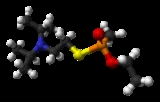
Nerve agent

Encyclopedia
Nerve agents are a class of phosphorus
-containing organic chemicals
(organophosphate
s) that disrupt the mechanism by which nerves transfer messages to organs. The disruption is caused by blocking acetylcholinesterase
, an enzyme
that normally relaxes the activity of acetylcholine
, a neurotransmitter
.
As chemical weapons, they are classified as weapons of mass destruction by the United Nations
according to UN Resolution 687 (passed in April 1991) and their production and stockpiling was outlawed by the Chemical Weapons Convention
of 1993; the Chemical Weapons Convention officially took effect on April 29, 1997.
Poisoning by a nerve agent leads to contraction of pupils, profuse salivation, convulsions, involuntary urination and defecation, and eventual death by asphyxiation as control is lost over respiratory muscles. Some nerve agents are readily vaporized or aerosolized and the primary portal of entry into the body is the respiratory system. Nerve agents can also be absorbed through the skin, requiring that those likely to be subjected to such agents wear a full body suit in addition to a respirator
.
of the human body. All such agents function the same way: by inhibiting the enzyme acetylcholinesterase
which is responsible for the breakdown of acetylcholine
(ACh) in the synapse. ACh gives the signal for muscles to contract, preventing them from relaxing.
Initial symptoms following exposure to nerve agents (like sarin
) are a runny nose, tightness in the chest, and constriction of the pupils. Soon after, the victim will then have difficulty breathing and will experience nausea and drooling. As the victim continues to lose control of his or her bodily functions, he or she will involuntarily salivate, lacrimate
, urinate, defecate, and experience gastrointestinal pain and vomiting
. Blisters and burning of the eyes and/or lungs may also occur. This phase is followed by initially myoclonic jerks followed by status epilepticus
. Death then comes via complete respiratory depression, most likely via the excessive peripheral activity at the neuromuscular junction of the diaphragm.
The effects of nerve agents are very long lasting and cumulative (increased by successive exposures) and survivors of nerve agent poisoning almost invariably suffer chronic neurological damage. This neurological damage can also lead to continuing psychiatric effects.
acetylcholine
, which transmits the impulse to a muscle or organ. Once the impulse is sent, the enzyme acetylcholinesterase
immediately breaks down the acetylcholine in order to allow the muscle or organ to relax.
Nerve agents disrupt the nervous system by inhibiting the function of acetylcholinesterase by forming a covalent bond
with the site of the enzyme where acetylcholine normally undergoes hydrolysis
(breaks down). The structures of the complexes of soman
(one of the most toxic nerve agents) with acetylcholinesterase
from Torpedo californica have been solved by X-ray crystallography (PDB codes: 2wfz, 2wg0, 2wg1, and 1som). The mechanism of action of soman could be seen on example of 2wfz. The result is that acetylcholine builds up and continues to act so that any nerve impulses are continually transmitted and muscle contractions do not stop.
This same action also occurs at the gland and organ levels, resulting in uncontrolled drooling, tearing of the eyes (lacrimation) and excess production of mucus
from the nose (rhinorrhea
).
and related anticholinergic
drugs act as antidotes to nerve agent poisoning because they block acetylcholine receptors, but they are poisonous in their own right. (Some synthetic anticholinergics, such as biperiden
may counteract the central symptoms of nerve agent poisoning better than atropine
, since they pass the blood-brain barrier better than atropine.) While these drugs will save the life of a person affected with nerve agents, that person may be incapacitated briefly or for an extended period, depending on the amount of exposure. The endpoint of atropine administration is the clearing of bronchial secretions. Atropine for field use by military personnel is often loaded in an autoinjector
, for ease of use in stressful conditions. The limitation of atropine is that it is only indicated for use against soman.
Pralidoxime chloride, also known as 2-PAM chloride, is also used as an antidote. Rather than counteracting the initial effects of the nerve agent on the nervous system like atropine
, pralidoxime chloride reactivates the poisoned enzyme (acetylcholinesterase) by scavenging the phosphoryl rest attached on the functional hydroxyl group of the enzyme. Though safer to use, it takes longer to act.
Revival of acetylcholinesterase with pralidoxime chloride works more effectively on nicotinic receptors while blocking acetylcholine with atropine is more effective on muscarinic receptors. Often, severe cases of the poisoning are treated with both drugs.
is a prophylactic countermeasure against organo-phosphorus nerve agents. It acts as a scavenger by binding nerve agent in the blood stream before it can exert effects in the nervous system. Because it is a biological scavenger (and universal target) it is currently the only therapeutic agent effective in providing complete stoichiometric protection against the entire spectrum of organo-phosphorus nerve agents.
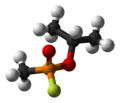 The G-series is thus named because German
scientists first synthesized them. G series agents are known as Non-persistent, whilst V series are persistent. All of the compounds in this class were discovered and synthesized during or soon after World War II, led by Dr. Gerhard Schrader
(later under the employment of IG Farben
).
This series is the first and oldest family of nerve agents. The first nerve agent ever synthesised was GA (tabun
) in 1936. GB (sarin
) was discovered next in 1939, followed by GD (soman
) in 1944 and finally the more obscure GF (cyclosarin
) in 1949. GB was the only G agent that was fielded by the USA as a munition, specifically in rockets, aerial bombs, howitzer rounds and gun rounds.
 Dr. Ranajit Ghosh, a chemist at the Plant Protection Laboratories of Imperial Chemical Industries
was investigating a class of organophosphate compounds (organophosphate esters of substituted aminoethanethiols). Like Dr. Schrader
, an earlier investigator of organophosphates, Dr. Ghosh found that they were quite effective pesticides. In 1954, ICI put one of them on the market under the trade name Amiton. It was subsequently withdrawn, as it was too toxic for safe use. The toxicity did not go unnoticed and some of the more toxic materials had in fact been sent to the British Armed Forces research facility at Porton Down for evaluation. After the evaluation was complete, several members of this class of compounds would become a new group of nerve agents, the V agents (depending on the source, the V stands for Victory, Venomous, or Viscous). The best known of these is probably VX
, with the Russian V-gas
coming a close second (Amiton is largely forgotten as VG). This class of compounds is also sometimes known as Tammelin's esters, after Lars-Erik Tammelin
of the Swedish Institute of Defense Research. Dr. Tammelin was also conducting research on this class of compounds in 1952, but for obvious reasons he did not publicize his work widely.
The V-series is the second family of nerve agents and contains five well known members: VE
, VG
, VM
, VR
and VX
, along with several more obscure analogues. The most studied agent in this family, VX
, was invented in the 1950s at Porton Down
in the United Kingdom
. The other agents in this series have not been studied extensively and information about them is limited. It is known, however, that the V-series agents are about 10 times more toxic than the G-agent sarin
(GB).
All of the V-agents are persistent agents, meaning that these agents do not degrade or wash away easily and can therefore remain on clothes and other surfaces for long periods. In use, this allows the V-agents to be used to blanket terrain to guide or curtail the movement of enemy ground forces. The consistency of these agents is similar to oil; as a result, the contact hazard for V-agents is primarily – but not exclusively – dermal. VX was the only V-series agent that was fielded by the USA as a munition, consisting of rockets, artillery shells, airplane spray tanks and landmines.
from the mid 1960s to the 1990s. The goal of this program was to develop and manufacture highly deadly chemical weapons that were unknown to the West. These new agents were designed to be undetectable by standard NATO chemical detection equipment and to defeat chemical protective gear.
In addition to the newly developed "third generation" weapons, binary versions of several Soviet agents were developed and are designated as "Novichok" agents.
s, the phenothiazine
s, organophosphates such as dichlorvos
, malathion
and parathion
, are nerve agents. The metabolism of insect
s is sufficiently different from mammal
s that these compounds have little effect on humans and other mammals at proper doses; but there is considerable concern about the effects of long-term exposure to these chemicals by farm workers and animals alike. At high enough doses, however, acute toxicity and death can occur through the same mechanism as other nerve agents. Organophosphate pesticide poisoning
is a major cause of disability in many developing countries and is often the preferred method of suicide.
The method chosen will depend upon the physical nature of the nerve agent(s) used, the nature of the target, and the achievable level of sophistication.
on December 23, 1936 by a research team headed by Dr. Gerhard Schrader
working for IG Farben. Since 1934, Schrader had been working in a laboratory in Leverkusen
to develop new types of insecticide
s for IG Farben
. While working toward his goal of improved insecticide, Schrader experimented with numerous compounds, eventually leading to the preparation of tabun
.
In experiments, tabun was extremely potent against insects: as little as 5 ppm of tabun killed all the leaf lice he used in his initial experiment. In January 1937, Schrader observed the effects of nerve agents on human beings first-hand when a drop of tabun spilled onto a lab bench. Within minutes he and his laboratory assistant began to experience miosis
(constriction of the pupils of the eyes), dizziness and severe shortness of breath. It took them three weeks to recover fully.
In 1935 the Nazi
government had passed a decree that required all inventions of possible military significance to be reported to the Ministry of War
, so in May 1937 Schrader sent a sample of tabun to the chemical warfare
(CW) section of the Army Weapons Office in Berlin-Spandau. Dr. Schrader was summoned to the Wehrmacht chemical lab in Berlin to give a demonstration, after which Schrader's patent application and all related research was classified. Colonel Rüdiger, head of the CW section, ordered the construction of new laboratories for the further investigation of tabun and other organophosphate compounds and Schrader soon moved to a new laboratory at Wuppertal-Elberfeld in the Ruhr valley to continue his research in secret throughout World War II
. The compound was initially codenamed Le-100 and later Trilon-83.
Sarin
was discovered by Schrader and his team in 1938 and named after their initials: Schrader, Ambrose, Rudriger and van der Linde. It was codenamed T-144 or Trilon-46. It was found to be more than ten times as potent as tabun. Soman
was discovered by Dr. Richard Kuhn
in 1944 as he worked with the existing compounds, the name is derived from either the Greek 'to sleep' or the Latin 'to bludgeon', it was codenamed T-300. Cyclosarin
was also discovered during WWII but the details were lost and it was 'discovered' again in 1949. The G-series naming system was created by the United States when it uncovered the German activities, labeling tabun as GA (German Agent A), sarin as GB and soman as GD. Ethyl sarin was tagged GE and cyclosarin as GF.
for tabun production was set up at Munster-Lager, on Lüneburg Heath near the German Army proving grounds at Raubkammer. In January 1940, construction began on a secret plant, code named "Hochwerk" (High factory), for the production of tabun at Dyherrnfurth an der Oder (now Brzeg Dolny
in Poland
), on the Oder River 40 km (24.9 mi) from Breslau (now Wrocław) in Silesia
.
The plant was large, covering an area of 2.4 by 0.8 km (1.5 by 0.5 miles) and was completely self-contained, synthesizing all intermediates as well as the final product, tabun. The factory even had an underground plant for filling munitions, which were then stored at Krappitz (now Krapkowice) in Upper Silesia. The plant was operated by Anorgana GmbH, a subsidiary of IG Farben
, as were all other chemical weapon agent production plants in Germany at the time.
Because of the plant's deep secrecy and the difficult nature of the production process, it took from January 1940 until June 1942 for the plant to become fully operational. Many of tabun's chemical precursors were so corrosive that reaction chambers not lined with quartz or silver soon became useless. Tabun itself was so hazardous that the final processes had to be performed while enclosed in double glass-lined chambers with a stream of pressurized air circulating between the walls.
3,000 German nationals were employed at Hochwerk, all equipped with respirators and clothing
constructed of a poly-layered rubber/cloth/rubber sandwich that was destroyed after the tenth wearing. Despite all precautions, there were over 300 accidents before production even began and at least ten workers died during the two and a half years of operation. Some incidents cited in A Higher Form of Killing: The Secret History of Chemical and Biological Warfare are as follows:
The plant produced between 10,000 and 30,000 tons of tabun before its capture by the Soviet Army.
In 1940 the German Army Weapons Office ordered the mass production of sarin for wartime use. A number of pilot plants were built and a high-production facility was under construction (but was not finished) by the end of World War II
. Estimates for total sarin production by Nazi Germany range from 500 kg to 10 tons.
During that time, German intelligence
believed that the Allies also knew of these compounds, assuming that because these compounds were not discussed in the Allies' scientific journals information about them was being suppressed. Though sarin, tabun and soman were incorporated into artillery
shells, the German government ultimately decided not to use nerve agents against Allied targets. The Allies did not learn of these agents until shells filled with them were captured towards the end of the war.
This is detailed in Joseph Borkin's book The Crime and Punishment of IG Farben:
.
The fourth G-series nerve agent, cyclosarin, although discovered by German scientists studying organophosphates during WWII was seemingly not found by the Allies, but independently rediscovered in 1949.
In 1952, researchers in Porton Down
, England
invented the VX
nerve agent, inspired by the commercial pesticide Amiton, later reclassified as VG
. The UK soon unilaterally abandoned the chemical weapons and chemical weapons research. In 1958 the British government traded their VX technology with the United States of America in exchange for information on thermonuclear weapons; by 1961 the US was producing large amounts of VX and performed its own nerve agent research. The four agents (VE, VG, VM, VX) are collectively known as the "V-Series" class of nerve agents.
 Since World War II, Iraq's use of mustard gas against Iranian troops and Kurds
(Iran-Iraq war
of 1981–1988) has been the only large-scale use of any chemical weapons. On the scale of the single Kurdish village of Halabja
within its own territory, Iraqi forces did expose the populace to some kind of chemical weapons, possibly mustard gas and most likely nerve agents.
In the Gulf War
, no nerve agents (nor other chemical weapons) were used, but a number of U.S. and UK personnel were exposed to them when the Khamisiyah
chemical depot was destroyed. This and the widespread use of anticholinergic drugs as a protective treatment against any possible nerve gas attack, have been proposed as a possible cause of Gulf War syndrome
.
One of the most widely publicised uses of nerve agents was the 1995 terrorist attack
in which operatives of the Aum Shinrikyo
religious group released sarin
into the Tokyo
subway
system.
. According to a 1998 report created by William Brankowitz, a deputy project manager in the U.S. Army Chemical Materials Agency, the Army created at least 26 chemical weapons dump sites in the ocean off at least 11 states on both the west and east coasts. Additionally, due to poor records, they currently only know the rough whereabouts of half of them.
It is unknown how these dumps of chemical weapons have affected the ocean ecology. The steel containers they are contained within face a variable rate of decay and no one is really certain where or how deep they were dumped. If a nerve agent leaks into the ocean, it is unlikely to negatively affect any living organisms before it breaks down into its nonlethal chemical components. This is because nerve agents are not very stable, so even remaining in their containers, they are likely not very active any more. Then, if they were to be exposed to salt water, the salt water would likely break them down very quickly before they did any significant damage to animal life .
Phosphorus
Phosphorus is the chemical element that has the symbol P and atomic number 15. A multivalent nonmetal of the nitrogen group, phosphorus as a mineral is almost always present in its maximally oxidized state, as inorganic phosphate rocks...
-containing organic chemicals
Organic chemistry
Organic chemistry is a subdiscipline within chemistry involving the scientific study of the structure, properties, composition, reactions, and preparation of carbon-based compounds, hydrocarbons, and their derivatives...
(organophosphate
Organophosphate
An organophosphate is the general name for esters of phosphoric acid. Phosphates are probably the most pervasive organophosphorus compounds. Many of the most important biochemicals are organophosphates, including DNA and RNA as well as many cofactors that are essential for life...
s) that disrupt the mechanism by which nerves transfer messages to organs. The disruption is caused by blocking acetylcholinesterase
Acetylcholinesterase
"Acetylcholinesterase, also known as AChE or acetylcholine acetylhydrolase, is an enzyme that degrades the neurotransmitter acetylcholine, producing choline and an acetate group. It is mainly found at neuromuscular junctions and cholinergic nervous system, where its activity serves to terminate...
, an enzyme
Enzyme
Enzymes are proteins that catalyze chemical reactions. In enzymatic reactions, the molecules at the beginning of the process, called substrates, are converted into different molecules, called products. Almost all chemical reactions in a biological cell need enzymes in order to occur at rates...
that normally relaxes the activity of acetylcholine
Acetylcholine
The chemical compound acetylcholine is a neurotransmitter in both the peripheral nervous system and central nervous system in many organisms including humans...
, a neurotransmitter
Neurotransmitter
Neurotransmitters are endogenous chemicals that transmit signals from a neuron to a target cell across a synapse. Neurotransmitters are packaged into synaptic vesicles clustered beneath the membrane on the presynaptic side of a synapse, and are released into the synaptic cleft, where they bind to...
.
As chemical weapons, they are classified as weapons of mass destruction by the United Nations
United Nations
The United Nations is an international organization whose stated aims are facilitating cooperation in international law, international security, economic development, social progress, human rights, and achievement of world peace...
according to UN Resolution 687 (passed in April 1991) and their production and stockpiling was outlawed by the Chemical Weapons Convention
Chemical Weapons Convention
The Chemical Weapons Convention is an arms control agreement which outlaws the production, stockpiling and use of chemical weapons. Its full name is the Convention on the Prohibition of the Development, Production, Stockpiling and Use of Chemical Weapons and on their Destruction...
of 1993; the Chemical Weapons Convention officially took effect on April 29, 1997.
Poisoning by a nerve agent leads to contraction of pupils, profuse salivation, convulsions, involuntary urination and defecation, and eventual death by asphyxiation as control is lost over respiratory muscles. Some nerve agents are readily vaporized or aerosolized and the primary portal of entry into the body is the respiratory system. Nerve agents can also be absorbed through the skin, requiring that those likely to be subjected to such agents wear a full body suit in addition to a respirator
Respirator
A respirator is a device designed to protect the wearer from inhaling harmful dusts, fumes, vapors, or gases. Respirators come in a wide range of types and sizes used by the military, private industry, and the public...
.
Biological effects
As their name suggests, nerve agents attack the nervous systemNervous system
The nervous system is an organ system containing a network of specialized cells called neurons that coordinate the actions of an animal and transmit signals between different parts of its body. In most animals the nervous system consists of two parts, central and peripheral. The central nervous...
of the human body. All such agents function the same way: by inhibiting the enzyme acetylcholinesterase
Acetylcholinesterase
"Acetylcholinesterase, also known as AChE or acetylcholine acetylhydrolase, is an enzyme that degrades the neurotransmitter acetylcholine, producing choline and an acetate group. It is mainly found at neuromuscular junctions and cholinergic nervous system, where its activity serves to terminate...
which is responsible for the breakdown of acetylcholine
Acetylcholine
The chemical compound acetylcholine is a neurotransmitter in both the peripheral nervous system and central nervous system in many organisms including humans...
(ACh) in the synapse. ACh gives the signal for muscles to contract, preventing them from relaxing.
Initial symptoms following exposure to nerve agents (like sarin
Sarin
Sarin, or GB, is an organophosphorus compound with the formula [2CHO]CH3PF. It is a colorless, odorless liquid, which is used as a chemical weapon. It has been classified as a weapon of mass destruction in UN Resolution 687...
) are a runny nose, tightness in the chest, and constriction of the pupils. Soon after, the victim will then have difficulty breathing and will experience nausea and drooling. As the victim continues to lose control of his or her bodily functions, he or she will involuntarily salivate, lacrimate
Tears
Tears are secretions that clean and lubricate the eyes. Lacrimation or lachrymation is the production or shedding of tears....
, urinate, defecate, and experience gastrointestinal pain and vomiting
Vomiting
Vomiting is the forceful expulsion of the contents of one's stomach through the mouth and sometimes the nose...
. Blisters and burning of the eyes and/or lungs may also occur. This phase is followed by initially myoclonic jerks followed by status epilepticus
Status epilepticus
Status epilepticus is a life-threatening condition in which the brain is in a state of persistent seizure. Definitions vary, but traditionally it is defined as one continuous unremitting seizure lasting longer than 5 minutes, or recurrent seizures without regaining consciousness between seizures...
. Death then comes via complete respiratory depression, most likely via the excessive peripheral activity at the neuromuscular junction of the diaphragm.
The effects of nerve agents are very long lasting and cumulative (increased by successive exposures) and survivors of nerve agent poisoning almost invariably suffer chronic neurological damage. This neurological damage can also lead to continuing psychiatric effects.
Mechanism of action
When a normally functioning motor nerve is stimulated it releases the neurotransmitterNeurotransmitter
Neurotransmitters are endogenous chemicals that transmit signals from a neuron to a target cell across a synapse. Neurotransmitters are packaged into synaptic vesicles clustered beneath the membrane on the presynaptic side of a synapse, and are released into the synaptic cleft, where they bind to...
acetylcholine
Acetylcholine
The chemical compound acetylcholine is a neurotransmitter in both the peripheral nervous system and central nervous system in many organisms including humans...
, which transmits the impulse to a muscle or organ. Once the impulse is sent, the enzyme acetylcholinesterase
Acetylcholinesterase
"Acetylcholinesterase, also known as AChE or acetylcholine acetylhydrolase, is an enzyme that degrades the neurotransmitter acetylcholine, producing choline and an acetate group. It is mainly found at neuromuscular junctions and cholinergic nervous system, where its activity serves to terminate...
immediately breaks down the acetylcholine in order to allow the muscle or organ to relax.
Nerve agents disrupt the nervous system by inhibiting the function of acetylcholinesterase by forming a covalent bond
Covalent bond
A covalent bond is a form of chemical bonding that is characterized by the sharing of pairs of electrons between atoms. The stable balance of attractive and repulsive forces between atoms when they share electrons is known as covalent bonding....
with the site of the enzyme where acetylcholine normally undergoes hydrolysis
Hydrolysis
Hydrolysis is a chemical reaction during which molecules of water are split into hydrogen cations and hydroxide anions in the process of a chemical mechanism. It is the type of reaction that is used to break down certain polymers, especially those made by condensation polymerization...
(breaks down). The structures of the complexes of soman
Soman
Soman, or GD , is an extremely toxic chemical substance. It is a nerve agent, interfering with normal functioning of the mammalian nervous system by inhibiting the cholinesterase enzyme. As a chemical weapon, it is classified as a weapon of mass destruction by the United Nations according to UN...
(one of the most toxic nerve agents) with acetylcholinesterase
Acetylcholinesterase
"Acetylcholinesterase, also known as AChE or acetylcholine acetylhydrolase, is an enzyme that degrades the neurotransmitter acetylcholine, producing choline and an acetate group. It is mainly found at neuromuscular junctions and cholinergic nervous system, where its activity serves to terminate...
from Torpedo californica have been solved by X-ray crystallography (PDB codes: 2wfz, 2wg0, 2wg1, and 1som). The mechanism of action of soman could be seen on example of 2wfz. The result is that acetylcholine builds up and continues to act so that any nerve impulses are continually transmitted and muscle contractions do not stop.
This same action also occurs at the gland and organ levels, resulting in uncontrolled drooling, tearing of the eyes (lacrimation) and excess production of mucus
Mucus
In vertebrates, mucus is a slippery secretion produced by, and covering, mucous membranes. Mucous fluid is typically produced from mucous cells found in mucous glands. Mucous cells secrete products that are rich in glycoproteins and water. Mucous fluid may also originate from mixed glands, which...
from the nose (rhinorrhea
Rhinorrhea
Rhinorrhea or rhinorrhoea is a condition where the nasal cavity is filled with a significant amount of mucous fluid. The condition, commonly known as "runny nose", occurs relatively frequently and is not usually considered dangerous. Rhinorrhea is a common symptom of allergies or certain diseases,...
).
Antidotes
AtropineAtropine
Atropine is a naturally occurring tropane alkaloid extracted from deadly nightshade , Jimson weed , mandrake and other plants of the family Solanaceae. It is a secondary metabolite of these plants and serves as a drug with a wide variety of effects...
and related anticholinergic
Anticholinergic
An anticholinergic agent is a substance that blocks the neurotransmitter acetylcholine in the central and the peripheral nervous system. An example of an anticholinergic is dicycloverine, and the classic example is atropine....
drugs act as antidotes to nerve agent poisoning because they block acetylcholine receptors, but they are poisonous in their own right. (Some synthetic anticholinergics, such as biperiden
Biperiden
Biperiden is an antiparkinsonian agent of the anticholinergic type. The original brand name, which still exists and is manufactured by BASF/Knoll Pharma, is Akineton. Generics are available worldwide.- Pharmacokinetics :...
may counteract the central symptoms of nerve agent poisoning better than atropine
Atropine
Atropine is a naturally occurring tropane alkaloid extracted from deadly nightshade , Jimson weed , mandrake and other plants of the family Solanaceae. It is a secondary metabolite of these plants and serves as a drug with a wide variety of effects...
, since they pass the blood-brain barrier better than atropine.) While these drugs will save the life of a person affected with nerve agents, that person may be incapacitated briefly or for an extended period, depending on the amount of exposure. The endpoint of atropine administration is the clearing of bronchial secretions. Atropine for field use by military personnel is often loaded in an autoinjector
Autoinjector
An autoinjector is a medical device designed to deliver a single dose of a particular drug....
, for ease of use in stressful conditions. The limitation of atropine is that it is only indicated for use against soman.
Pralidoxime chloride, also known as 2-PAM chloride, is also used as an antidote. Rather than counteracting the initial effects of the nerve agent on the nervous system like atropine
Atropine
Atropine is a naturally occurring tropane alkaloid extracted from deadly nightshade , Jimson weed , mandrake and other plants of the family Solanaceae. It is a secondary metabolite of these plants and serves as a drug with a wide variety of effects...
, pralidoxime chloride reactivates the poisoned enzyme (acetylcholinesterase) by scavenging the phosphoryl rest attached on the functional hydroxyl group of the enzyme. Though safer to use, it takes longer to act.
Revival of acetylcholinesterase with pralidoxime chloride works more effectively on nicotinic receptors while blocking acetylcholine with atropine is more effective on muscarinic receptors. Often, severe cases of the poisoning are treated with both drugs.
Countermeasures in Development
ButyrylcholinesteraseButyrylcholinesterase
Butyrylcholinesterase is a non-specific cholinesterase enzyme that hydrolyses many different choline esters...
is a prophylactic countermeasure against organo-phosphorus nerve agents. It acts as a scavenger by binding nerve agent in the blood stream before it can exert effects in the nervous system. Because it is a biological scavenger (and universal target) it is currently the only therapeutic agent effective in providing complete stoichiometric protection against the entire spectrum of organo-phosphorus nerve agents.
Classes
There are two main classes of nerve agents. The members of the two classes share similar properties and are given both a common name (such as sarin) and a two-character NATO identifier (such as GB).G-Series
Germany
Germany , officially the Federal Republic of Germany , is a federal parliamentary republic in Europe. The country consists of 16 states while the capital and largest city is Berlin. Germany covers an area of 357,021 km2 and has a largely temperate seasonal climate...
scientists first synthesized them. G series agents are known as Non-persistent, whilst V series are persistent. All of the compounds in this class were discovered and synthesized during or soon after World War II, led by Dr. Gerhard Schrader
Gerhard Schrader
Dr. Gerhard Schrader was a German chemist specializing in the discovery of new insecticides, hoping to make progress in the fight against hunger in the world. However, Dr...
(later under the employment of IG Farben
IG Farben
I.G. Farbenindustrie AG was a German chemical industry conglomerate. Its name is taken from Interessen-Gemeinschaft Farbenindustrie AG . The company was formed in 1925 from a number of major companies that had been working together closely since World War I...
).
This series is the first and oldest family of nerve agents. The first nerve agent ever synthesised was GA (tabun
Tabun (nerve agent)
Tabun or GA is an extremely toxic chemical substance. It is a clear, colorless, and tasteless liquid with a faint fruity odor. It is classified as a nerve agent because it fatally interferes with normal functioning of the mammalian nervous system...
) in 1936. GB (sarin
Sarin
Sarin, or GB, is an organophosphorus compound with the formula [2CHO]CH3PF. It is a colorless, odorless liquid, which is used as a chemical weapon. It has been classified as a weapon of mass destruction in UN Resolution 687...
) was discovered next in 1939, followed by GD (soman
Soman
Soman, or GD , is an extremely toxic chemical substance. It is a nerve agent, interfering with normal functioning of the mammalian nervous system by inhibiting the cholinesterase enzyme. As a chemical weapon, it is classified as a weapon of mass destruction by the United Nations according to UN...
) in 1944 and finally the more obscure GF (cyclosarin
Cyclosarin
Cyclosarin or GF is an extremely toxic substance used as a chemical weapon. It is a member of the G-series family of nerve agents, a group of chemical weapons discovered and synthesized by a German team led by Dr. Gerhard Schrader. The major nerve gases are the G agents, sarin , soman, tabun, and...
) in 1949. GB was the only G agent that was fielded by the USA as a munition, specifically in rockets, aerial bombs, howitzer rounds and gun rounds.
V-Series
Imperial Chemical Industries
Imperial Chemical Industries was a British chemical company, taken over by AkzoNobel, a Dutch conglomerate, one of the largest chemical producers in the world. In its heyday, ICI was the largest manufacturing company in the British Empire, and commonly regarded as a "bellwether of the British...
was investigating a class of organophosphate compounds (organophosphate esters of substituted aminoethanethiols). Like Dr. Schrader
Gerhard Schrader
Dr. Gerhard Schrader was a German chemist specializing in the discovery of new insecticides, hoping to make progress in the fight against hunger in the world. However, Dr...
, an earlier investigator of organophosphates, Dr. Ghosh found that they were quite effective pesticides. In 1954, ICI put one of them on the market under the trade name Amiton. It was subsequently withdrawn, as it was too toxic for safe use. The toxicity did not go unnoticed and some of the more toxic materials had in fact been sent to the British Armed Forces research facility at Porton Down for evaluation. After the evaluation was complete, several members of this class of compounds would become a new group of nerve agents, the V agents (depending on the source, the V stands for Victory, Venomous, or Viscous). The best known of these is probably VX
VX (nerve agent)
VX, IUPAC name O-ethyl S-[2-ethyl] methylphosphonothioate, is an extremely toxic substance whose only application is in chemical warfare as a nerve agent. As a chemical weapon, it is classified as a weapon of mass destruction by the United Nations in UN Resolution 687...
, with the Russian V-gas
VR (nerve agent)
VR is a "V-series" nerve agent closely related to the better-known VX nerve agent....
coming a close second (Amiton is largely forgotten as VG). This class of compounds is also sometimes known as Tammelin's esters, after Lars-Erik Tammelin
Lars-Erik Tammelin
Lars-Erik Tammelin, born 1923, died 1991, was a Swedish chemist, defence researcher and civil servant.Tammelin, who was an organic chemist, was recruited to the Swedish Defence Research Establishment in 1950 for research on nerve gas and nerve gas countermeasures...
of the Swedish Institute of Defense Research. Dr. Tammelin was also conducting research on this class of compounds in 1952, but for obvious reasons he did not publicize his work widely.
The V-series is the second family of nerve agents and contains five well known members: VE
VE (nerve agent)
VE is a "V-series" nerve agent closely related to the better-known VX nerve agent.Like most of the agents in the V-series , VE has not been extensively studied outside of military science...
, VG
VG (nerve agent)
VG is a "V-series" nerve agent chemically similar to the better-known VX nerve agent. Tetram is the common Russian name for the substance...
, VM
VM (nerve agent)
VM is a "V-series" nerve agent closely related to the better-known VX nerve agent.Like most of the agents in the V-series , VM has not been extensively studied outside of military science...
, VR
VR (nerve agent)
VR is a "V-series" nerve agent closely related to the better-known VX nerve agent....
and VX
VX (nerve agent)
VX, IUPAC name O-ethyl S-[2-ethyl] methylphosphonothioate, is an extremely toxic substance whose only application is in chemical warfare as a nerve agent. As a chemical weapon, it is classified as a weapon of mass destruction by the United Nations in UN Resolution 687...
, along with several more obscure analogues. The most studied agent in this family, VX
VX (nerve agent)
VX, IUPAC name O-ethyl S-[2-ethyl] methylphosphonothioate, is an extremely toxic substance whose only application is in chemical warfare as a nerve agent. As a chemical weapon, it is classified as a weapon of mass destruction by the United Nations in UN Resolution 687...
, was invented in the 1950s at Porton Down
Porton Down
Porton Down is a United Kingdom government and military science park. It is situated slightly northeast of Porton near Salisbury in Wiltshire, England. To the northwest lies the MoD Boscombe Down test range facility which is operated by QinetiQ...
in the United Kingdom
United Kingdom
The United Kingdom of Great Britain and Northern IrelandIn the United Kingdom and Dependencies, other languages have been officially recognised as legitimate autochthonous languages under the European Charter for Regional or Minority Languages...
. The other agents in this series have not been studied extensively and information about them is limited. It is known, however, that the V-series agents are about 10 times more toxic than the G-agent sarin
Sarin
Sarin, or GB, is an organophosphorus compound with the formula [2CHO]CH3PF. It is a colorless, odorless liquid, which is used as a chemical weapon. It has been classified as a weapon of mass destruction in UN Resolution 687...
(GB).
All of the V-agents are persistent agents, meaning that these agents do not degrade or wash away easily and can therefore remain on clothes and other surfaces for long periods. In use, this allows the V-agents to be used to blanket terrain to guide or curtail the movement of enemy ground forces. The consistency of these agents is similar to oil; as a result, the contact hazard for V-agents is primarily – but not exclusively – dermal. VX was the only V-series agent that was fielded by the USA as a munition, consisting of rockets, artillery shells, airplane spray tanks and landmines.
Novichok agents
The Novichok (Russian for "newcomer") agents are a series of organophosphate compounds that were developed in the Soviet UnionSoviet Union
The Soviet Union , officially the Union of Soviet Socialist Republics , was a constitutionally socialist state that existed in Eurasia between 1922 and 1991....
from the mid 1960s to the 1990s. The goal of this program was to develop and manufacture highly deadly chemical weapons that were unknown to the West. These new agents were designed to be undetectable by standard NATO chemical detection equipment and to defeat chemical protective gear.
In addition to the newly developed "third generation" weapons, binary versions of several Soviet agents were developed and are designated as "Novichok" agents.
Insecticides
A number of insecticideInsecticide
An insecticide is a pesticide used against insects. They include ovicides and larvicides used against the eggs and larvae of insects respectively. Insecticides are used in agriculture, medicine, industry and the household. The use of insecticides is believed to be one of the major factors behind...
s, the phenothiazine
Phenothiazine
Phenothiazine is an organic compound that occurs in various antipsychotic and antihistaminic drugs. It has the formula S2NH. This yellow tricyclic compound is soluble in acetic acid, benzene, and ether. The compound is related to the thiazine-class of heterocyclic compounds...
s, organophosphates such as dichlorvos
Dichlorvos
Dichlorvos or 2,2-dichlorovinyl dimethyl phosphate is a highly volatile organophosphate, widely used as a insecticide to control household pests, in public health, and protecting stored product from insects. It is effective against mushroom flies, aphids, spider mites, caterpillars, thrips, and...
, malathion
Malathion
Malathion is an organophosphate parasympathomimetic which binds irreversibly to cholinesterase. Malathion is an insecticide of relatively low human toxicity, however one recent study has shown that children with higher levels of organophosphate pesticide metabolites in their urine are more likely...
and parathion
Parathion
Parathion, also called parathion-ethyl or diethyl parathion, is an organophosphate compound. It is a potent insecticide and acaricide. It was originally developed by IG Farben in the 1940s. It is highly toxic to non-target organisms, including humans. Its use is banned or restricted in many...
, are nerve agents. The metabolism of insect
Insect
Insects are a class of living creatures within the arthropods that have a chitinous exoskeleton, a three-part body , three pairs of jointed legs, compound eyes, and two antennae...
s is sufficiently different from mammal
Mammal
Mammals are members of a class of air-breathing vertebrate animals characterised by the possession of endothermy, hair, three middle ear bones, and mammary glands functional in mothers with young...
s that these compounds have little effect on humans and other mammals at proper doses; but there is considerable concern about the effects of long-term exposure to these chemicals by farm workers and animals alike. At high enough doses, however, acute toxicity and death can occur through the same mechanism as other nerve agents. Organophosphate pesticide poisoning
Pesticide poisoning
A pesticide poisoning occurs when chemicals intended to control a pest affect non-target organisms such as humans, wildlife, or bees.-Cause:The most common exposure scenarios for pesticide-poisoning cases are accidental or suicidal poisonings, occupational exposure, by-stander exposure to...
is a major cause of disability in many developing countries and is often the preferred method of suicide.
Dissemination
Several methods exist for disseminating nerve agents on the battlefield. These include:- Uncontrolled Aerosol Munitions
- Smoke Generation
- Explosive Dissemination
- Atomizers, Humidifiers and Foggers
The method chosen will depend upon the physical nature of the nerve agent(s) used, the nature of the target, and the achievable level of sophistication.
The discovery of nerve agents
This first class of nerve agents, the G-Series, was accidentally discovered in GermanyGermany
Germany , officially the Federal Republic of Germany , is a federal parliamentary republic in Europe. The country consists of 16 states while the capital and largest city is Berlin. Germany covers an area of 357,021 km2 and has a largely temperate seasonal climate...
on December 23, 1936 by a research team headed by Dr. Gerhard Schrader
Gerhard Schrader
Dr. Gerhard Schrader was a German chemist specializing in the discovery of new insecticides, hoping to make progress in the fight against hunger in the world. However, Dr...
working for IG Farben. Since 1934, Schrader had been working in a laboratory in Leverkusen
Leverkusen
Leverkusen is a city in North Rhine-Westphalia, Germany on the eastern bank of the Rhine. To the South, Leverkusen borders the city of Cologne and to the North is the state capital Düsseldorf....
to develop new types of insecticide
Insecticide
An insecticide is a pesticide used against insects. They include ovicides and larvicides used against the eggs and larvae of insects respectively. Insecticides are used in agriculture, medicine, industry and the household. The use of insecticides is believed to be one of the major factors behind...
s for IG Farben
IG Farben
I.G. Farbenindustrie AG was a German chemical industry conglomerate. Its name is taken from Interessen-Gemeinschaft Farbenindustrie AG . The company was formed in 1925 from a number of major companies that had been working together closely since World War I...
. While working toward his goal of improved insecticide, Schrader experimented with numerous compounds, eventually leading to the preparation of tabun
Tabun (nerve agent)
Tabun or GA is an extremely toxic chemical substance. It is a clear, colorless, and tasteless liquid with a faint fruity odor. It is classified as a nerve agent because it fatally interferes with normal functioning of the mammalian nervous system...
.
In experiments, tabun was extremely potent against insects: as little as 5 ppm of tabun killed all the leaf lice he used in his initial experiment. In January 1937, Schrader observed the effects of nerve agents on human beings first-hand when a drop of tabun spilled onto a lab bench. Within minutes he and his laboratory assistant began to experience miosis
Miosis
Miosis is the constriction of the pupil of the eye to two millimeters or less...
(constriction of the pupils of the eyes), dizziness and severe shortness of breath. It took them three weeks to recover fully.
In 1935 the Nazi
Nazism
Nazism, the common short form name of National Socialism was the ideology and practice of the Nazi Party and of Nazi Germany...
government had passed a decree that required all inventions of possible military significance to be reported to the Ministry of War
Ministry of War
A Ministry of War or Ministry for War is an administrative, supply and services agency of an army, as opposed to the entire military establishment. Both Mexico and Brazil both still maintain a War Department for the support of their armies...
, so in May 1937 Schrader sent a sample of tabun to the chemical warfare
Chemical warfare
Chemical warfare involves using the toxic properties of chemical substances as weapons. This type of warfare is distinct from Nuclear warfare and Biological warfare, which together make up NBC, the military acronym for Nuclear, Biological, and Chemical...
(CW) section of the Army Weapons Office in Berlin-Spandau. Dr. Schrader was summoned to the Wehrmacht chemical lab in Berlin to give a demonstration, after which Schrader's patent application and all related research was classified. Colonel Rüdiger, head of the CW section, ordered the construction of new laboratories for the further investigation of tabun and other organophosphate compounds and Schrader soon moved to a new laboratory at Wuppertal-Elberfeld in the Ruhr valley to continue his research in secret throughout World War II
World War II
World War II, or the Second World War , was a global conflict lasting from 1939 to 1945, involving most of the world's nations—including all of the great powers—eventually forming two opposing military alliances: the Allies and the Axis...
. The compound was initially codenamed Le-100 and later Trilon-83.
Sarin
Sarin
Sarin, or GB, is an organophosphorus compound with the formula [2CHO]CH3PF. It is a colorless, odorless liquid, which is used as a chemical weapon. It has been classified as a weapon of mass destruction in UN Resolution 687...
was discovered by Schrader and his team in 1938 and named after their initials: Schrader, Ambrose, Rudriger and van der Linde. It was codenamed T-144 or Trilon-46. It was found to be more than ten times as potent as tabun. Soman
Soman
Soman, or GD , is an extremely toxic chemical substance. It is a nerve agent, interfering with normal functioning of the mammalian nervous system by inhibiting the cholinesterase enzyme. As a chemical weapon, it is classified as a weapon of mass destruction by the United Nations according to UN...
was discovered by Dr. Richard Kuhn
Richard Kuhn
Richard Kuhn was an Austrian-German biochemist, Nobel laureate, and Nazi collaborator.-Early life:Kuhn was born in Vienna, Austria where he attended grammar school and high school. His interest in chemistry surfaced early; however he had many interests and decided late to study chemistry...
in 1944 as he worked with the existing compounds, the name is derived from either the Greek 'to sleep' or the Latin 'to bludgeon', it was codenamed T-300. Cyclosarin
Cyclosarin
Cyclosarin or GF is an extremely toxic substance used as a chemical weapon. It is a member of the G-series family of nerve agents, a group of chemical weapons discovered and synthesized by a German team led by Dr. Gerhard Schrader. The major nerve gases are the G agents, sarin , soman, tabun, and...
was also discovered during WWII but the details were lost and it was 'discovered' again in 1949. The G-series naming system was created by the United States when it uncovered the German activities, labeling tabun as GA (German Agent A), sarin as GB and soman as GD. Ethyl sarin was tagged GE and cyclosarin as GF.
During World War II
In 1939, a pilot plantFactory
A factory or manufacturing plant is an industrial building where laborers manufacture goods or supervise machines processing one product into another. Most modern factories have large warehouses or warehouse-like facilities that contain heavy equipment used for assembly line production...
for tabun production was set up at Munster-Lager, on Lüneburg Heath near the German Army proving grounds at Raubkammer. In January 1940, construction began on a secret plant, code named "Hochwerk" (High factory), for the production of tabun at Dyherrnfurth an der Oder (now Brzeg Dolny
Brzeg Dolny
Brzeg Dolny is a town in Wołów County, Lower Silesian Voivodeship in south-western Poland. It is located north-west of Wrocław on the Oder River, and is the site of a large chemical complex, PCC Rokita SA...
in Poland
Poland
Poland , officially the Republic of Poland , is a country in Central Europe bordered by Germany to the west; the Czech Republic and Slovakia to the south; Ukraine, Belarus and Lithuania to the east; and the Baltic Sea and Kaliningrad Oblast, a Russian exclave, to the north...
), on the Oder River 40 km (24.9 mi) from Breslau (now Wrocław) in Silesia
Silesia
Silesia is a historical region of Central Europe located mostly in Poland, with smaller parts also in the Czech Republic, and Germany.Silesia is rich in mineral and natural resources, and includes several important industrial areas. Silesia's largest city and historical capital is Wrocław...
.
The plant was large, covering an area of 2.4 by 0.8 km (1.5 by 0.5 miles) and was completely self-contained, synthesizing all intermediates as well as the final product, tabun. The factory even had an underground plant for filling munitions, which were then stored at Krappitz (now Krapkowice) in Upper Silesia. The plant was operated by Anorgana GmbH, a subsidiary of IG Farben
IG Farben
I.G. Farbenindustrie AG was a German chemical industry conglomerate. Its name is taken from Interessen-Gemeinschaft Farbenindustrie AG . The company was formed in 1925 from a number of major companies that had been working together closely since World War I...
, as were all other chemical weapon agent production plants in Germany at the time.
Because of the plant's deep secrecy and the difficult nature of the production process, it took from January 1940 until June 1942 for the plant to become fully operational. Many of tabun's chemical precursors were so corrosive that reaction chambers not lined with quartz or silver soon became useless. Tabun itself was so hazardous that the final processes had to be performed while enclosed in double glass-lined chambers with a stream of pressurized air circulating between the walls.
3,000 German nationals were employed at Hochwerk, all equipped with respirators and clothing
Clothing
Clothing refers to any covering for the human body that is worn. The wearing of clothing is exclusively a human characteristic and is a feature of nearly all human societies...
constructed of a poly-layered rubber/cloth/rubber sandwich that was destroyed after the tenth wearing. Despite all precautions, there were over 300 accidents before production even began and at least ten workers died during the two and a half years of operation. Some incidents cited in A Higher Form of Killing: The Secret History of Chemical and Biological Warfare are as follows:
- Four pipe fitters had liquid tabun drain onto them and died before their rubber suits could be removed.
- A worker had two liters of tabun pour down the neck of his rubber suit. He died within two minutes.
- Seven workers were hit in the face with a stream of tabun of such force that the liquid was forced behind their respirators. Only two survived despite resuscitation measures.
The plant produced between 10,000 and 30,000 tons of tabun before its capture by the Soviet Army.
In 1940 the German Army Weapons Office ordered the mass production of sarin for wartime use. A number of pilot plants were built and a high-production facility was under construction (but was not finished) by the end of World War II
World War II
World War II, or the Second World War , was a global conflict lasting from 1939 to 1945, involving most of the world's nations—including all of the great powers—eventually forming two opposing military alliances: the Allies and the Axis...
. Estimates for total sarin production by Nazi Germany range from 500 kg to 10 tons.
During that time, German intelligence
Intelligence (information gathering)
Intelligence assessment is the development of forecasts of behaviour or recommended courses of action to the leadership of an organization, based on a wide range of available information sources both overt and covert. Assessments are developed in response to requirements declared by the leadership...
believed that the Allies also knew of these compounds, assuming that because these compounds were not discussed in the Allies' scientific journals information about them was being suppressed. Though sarin, tabun and soman were incorporated into artillery
Artillery
Originally applied to any group of infantry primarily armed with projectile weapons, artillery has over time become limited in meaning to refer only to those engines of war that operate by projection of munitions far beyond the range of effect of personal weapons...
shells, the German government ultimately decided not to use nerve agents against Allied targets. The Allies did not learn of these agents until shells filled with them were captured towards the end of the war.
This is detailed in Joseph Borkin's book The Crime and Punishment of IG Farben:
The secret gets out
Towards the end of World War II and during the occupation of Germany, the Allies recovered weapons containing the three German nerve agents of the day, prompting further research into nerve agents by the former Allies. The Red Army captured a factory producing tabun at Dyhernfurth in early 1945, they dismantled the entire site and took it back to Russia. Stocks of tabun, sarin and soman were discovered by all the Allies within Germany; the Anglo-American advance seizing around 250,000 tons of chemical weapons, the subset of nerve agents (totaling around 30,000 tons) was split with the British taking 14,000 tons of tabun-filled bombs and the Americans taking the balance of sarin-filled devices. The British-held bombs were eventually dumped at sea over 1955-56 as Operation SandcastleOperation Sandcastle
Operation Sandcastle was a British Ministry of Defence operation conducted in 1955-56 to dispose of chemical weapons at sea. It was the third of four 'phases' to dispose of unwanted chemical ordnance by the British government....
.
The fourth G-series nerve agent, cyclosarin, although discovered by German scientists studying organophosphates during WWII was seemingly not found by the Allies, but independently rediscovered in 1949.
In 1952, researchers in Porton Down
Porton Down
Porton Down is a United Kingdom government and military science park. It is situated slightly northeast of Porton near Salisbury in Wiltshire, England. To the northwest lies the MoD Boscombe Down test range facility which is operated by QinetiQ...
, England
England
England is a country that is part of the United Kingdom. It shares land borders with Scotland to the north and Wales to the west; the Irish Sea is to the north west, the Celtic Sea to the south west, with the North Sea to the east and the English Channel to the south separating it from continental...
invented the VX
VX (nerve agent)
VX, IUPAC name O-ethyl S-[2-ethyl] methylphosphonothioate, is an extremely toxic substance whose only application is in chemical warfare as a nerve agent. As a chemical weapon, it is classified as a weapon of mass destruction by the United Nations in UN Resolution 687...
nerve agent, inspired by the commercial pesticide Amiton, later reclassified as VG
VG (nerve agent)
VG is a "V-series" nerve agent chemically similar to the better-known VX nerve agent. Tetram is the common Russian name for the substance...
. The UK soon unilaterally abandoned the chemical weapons and chemical weapons research. In 1958 the British government traded their VX technology with the United States of America in exchange for information on thermonuclear weapons; by 1961 the US was producing large amounts of VX and performed its own nerve agent research. The four agents (VE, VG, VM, VX) are collectively known as the "V-Series" class of nerve agents.
Since World War II
Kurdish people
The Kurdish people, or Kurds , are an Iranian people native to the Middle East, mostly inhabiting a region known as Kurdistan, which includes adjacent parts of Iran, Iraq, Syria, and Turkey...
(Iran-Iraq war
Iran-Iraq War
The Iran–Iraq War was an armed conflict between the armed forces of Iraq and Iran, lasting from September 1980 to August 1988, making it the longest conventional war of the twentieth century...
of 1981–1988) has been the only large-scale use of any chemical weapons. On the scale of the single Kurdish village of Halabja
Halabja
Halabja , is a Kurdish town in Northern Iraq, located about north-east of Baghdad and 8–10 miles from the Iranian border....
within its own territory, Iraqi forces did expose the populace to some kind of chemical weapons, possibly mustard gas and most likely nerve agents.
In the Gulf War
Gulf War
The Persian Gulf War , commonly referred to as simply the Gulf War, was a war waged by a U.N.-authorized coalition force from 34 nations led by the United States, against Iraq in response to Iraq's invasion and annexation of Kuwait.The war is also known under other names, such as the First Gulf...
, no nerve agents (nor other chemical weapons) were used, but a number of U.S. and UK personnel were exposed to them when the Khamisiyah
Khamisiyah
Khamisiyah is an area in southern Iraq located approximately 350 km south east of Baghdad, 200 km north-west of Kuwait City and 270 km north of Al Qaysumah. Khamisiyah is under the administration of the province of Dhi Qar. The area contains a few small towns, including Khamisiyah...
chemical depot was destroyed. This and the widespread use of anticholinergic drugs as a protective treatment against any possible nerve gas attack, have been proposed as a possible cause of Gulf War syndrome
Gulf War syndrome
Gulf War syndrome or Gulf War illness describes a medical condition that affected veterans and civilians who were near conflicts during or downwind of chemical weapons depot demolition, after the 1991 Gulf War. A wide range of acute and chronic symptoms have included fatigue, musculoskeletal...
.
One of the most widely publicised uses of nerve agents was the 1995 terrorist attack
Sarin gas attack on the Tokyo subway
The Sarin attack on the Tokyo subway, usually referred to in the Japanese media as the , was an act of domestic terrorism perpetrated by members of Aum Shinrikyo on March 20, 1995....
in which operatives of the Aum Shinrikyo
Aum Shinrikyo
Aum Shinrikyo was a Japanese new religious movement. The group was founded by Shoko Asahara in 1984. The group gained international notoriety in 1995, when it carried out the Sarin gas attack on the Tokyo subway....
religious group released sarin
Sarin
Sarin, or GB, is an organophosphorus compound with the formula [2CHO]CH3PF. It is a colorless, odorless liquid, which is used as a chemical weapon. It has been classified as a weapon of mass destruction in UN Resolution 687...
into the Tokyo
Tokyo
, ; officially , is one of the 47 prefectures of Japan. Tokyo is the capital of Japan, the center of the Greater Tokyo Area, and the largest metropolitan area of Japan. It is the seat of the Japanese government and the Imperial Palace, and the home of the Japanese Imperial Family...
subway
Rapid transit
A rapid transit, underground, subway, elevated railway, metro or metropolitan railway system is an electric passenger railway in an urban area with a high capacity and frequency, and grade separation from other traffic. Rapid transit systems are typically located either in underground tunnels or on...
system.
Ocean disposal of chemical weapons
In 1972, The United States Congress banned the practice of disposing chemical weapons into the ocean. However 32,000 tons of nerve and mustard agents had already been dumped into the ocean waters off the United States by the U.S. Army, primarily as part of Operation CHASEOperation CHASE
Operation CHASE was a United States Department of Defense program that involved the disposal of unwanted munitions at sea from May 1964 into the early 1970s....
. According to a 1998 report created by William Brankowitz, a deputy project manager in the U.S. Army Chemical Materials Agency, the Army created at least 26 chemical weapons dump sites in the ocean off at least 11 states on both the west and east coasts. Additionally, due to poor records, they currently only know the rough whereabouts of half of them.
It is unknown how these dumps of chemical weapons have affected the ocean ecology. The steel containers they are contained within face a variable rate of decay and no one is really certain where or how deep they were dumped. If a nerve agent leaks into the ocean, it is unlikely to negatively affect any living organisms before it breaks down into its nonlethal chemical components. This is because nerve agents are not very stable, so even remaining in their containers, they are likely not very active any more. Then, if they were to be exposed to salt water, the salt water would likely break them down very quickly before they did any significant damage to animal life .
External links
- ATSDR Case Studies in Environmental Medicine: Cholinesterase Inhibitors, Including Pesticides and Chemical Warfare Nerve Agents U.S. Department of Health and Human Services
- Nervegas: America's Fifteen-year Struggle for Modern Chemical Weapons Army Chemical Review
- History Note: The CWS Effort to Obtain German Chemical Weapons for Retaliation Against Japan CBIAC Newsletter
- Goats' Milk Used in Production of Anti-nerve Gas Agents
- AChE inhibitors and substrates – 2wfz, 2wg0, 2wg1, 1som in ProteopediaProteopediaProteopedia is a wiki, 3D encyclopedia of proteins and other molecules..The site contains a page for every entry in the Protein Data Bank , as well as pages that are more descriptive of protein structures in general such as acetylcholinesterase, hemoglobin, and the photosystem II with a Jmol view...