

Iraqi no-fly zones

Encyclopedia
The Iraqi no-fly zones were a set of two separate no-fly zones (NFZs), and were proclaimed by the United States, United Kingdom and France after the Gulf War of 1991
to protect the Kurdish people
in northern Iraq
and Shiite Muslims in the south. Iraqi aircraft were forbidden from flying inside the zones. The policy was enforced by U.S., UK and French aircraft patrols until France withdrew in 1998. While the enforcing powers had cited United Nations Security Council Resolution 688
as authorizing the operations, the resolution contains no explicit authorization. The Secretary-General of the UN at the time the resolution was passed, Boutros Boutros-Ghali
called the no-fly zones "illegal" in a later interview with John Pilger
.
was established, but in 1996 it was expanded to the 33rd parallel
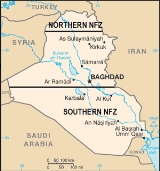
. From 1992 to the United States-led coalition invasion of Iraq in 2003, there were two NFZs in Iraq. The northern NFZ extended from the 36th parallel
northwards, while the southern extended from the 33rd parallel southwards. The northern NFZ was initially part of Operation Provide Comfort
relief operations to a persecuted Kurd
ish minority in Iraq, and was followed on by Operation Northern Watch
. The southern NFZ was maintained by Operation Southern Watch
.
When Operation Desert Storm ended in 1991, the safety of Kurds who were fleeing during the 1991 uprisings in Iraq
from Iraqi persecution became an issue, and Operation Provide Comfort
began. This operation essentially created a Northern NFZ to Iraqi military aircraft. The operation provided the Kurdish population with humanitarian aid and reassurance of safe skies.
However, this was marred by a friendly-fire incident on 14 April 1994 when two United States Air Force
F-15 Eagle
fighter planes mistakenly shot-down two United States Army
Blackhawk helicopters, killing 26 Allied military and civilian personnels.
Operation Provide Comfort officially ended on the 31st of December 1996. Following Operation Provide Comfort, the United States continued to watch over the northern skies with the launching of Operation Northern Watch
on 1 January 1997. Operation Northern Watch continued to provide air security to the Kurdish population in the north. By 1999, the Department of Defense had flown over 200,000 sorties over Iraq.
American and British aircraft continuously maintained the integrity of the NFZ, receiving anti-aircraft fire from Iraqi forces almost daily. The operation ran until its conclusion on 1 May 2003. In the south, Operation Southern Watch
was underway to watch over the persecuted Shi'ite populations. This operation was launched on 27 August 1992 with the mission of preventing further inhumane acts against civilian populations. Iraq challenged the no-fly zone beginning in December 1992 when a USAF F-16 fighter plane shot down an Iraqi MiG fighter which had locked on to it in the Southern no-fly zone. The next month Allied planes attacked Iraqi SAM sites in the South and bombed a nuclear facility. Baghdad eventually halted firing on patrolling Allied aircraft after August 1993.
In the aftermath of Operation Desert Fox
in December 1998, Iraq announced it would no longer respect the no-fly zones and resumed its efforts in shooting down Allied aircraft. Saddam Hussein
offered a $14,000 reward to anyone who could accomplish this task, but no manned aircraft were ever shot down by Iraq
. Air strikes by British and American aircraft against Iraqi claimed anti-aircraft and military targets continued weekly over the next few years. In the early 2000s, the U.S. developed a contingency plan, Operation Desert Badger
for dealing with pilots shot down over Iraqi no-fly zones.
The operation continued until it transitioned to Operation Southern Focus
in June 2002. They began to carry out offensive sorties, not only against targets that had fired on them, but upon installations that had demonstrated no hostile intent. The U.S. claimed that these increased attacks were the result of increasing Iraqi provocations, but later, in July 2005, the British Ministry of Defense released figures showing that the number of provocations had actually dropped dramatically prior to and just after the increase in allied attacks. Their records indicate that in the first seven months of 2001, there had been 370 provocations on the part of Iraq. In the seven months from Oct. 2001 into May 2002, only 32 such provocations were recorded. General Tommy Franks later acknowledged that the dramatic increase in offensive sorties was an attempt to destroy the Iraqi defenses in much the same way as the air strikes at the beginning of the Gulf War had. The U.S. and British operations had the (apparently intended) effect of reducing Iraqi ability to counter air strikes prior to the 2003 invasion of Iraq
.)
In purported retaliation for the Iraqi's now-daily air defense attacks on coalition aircraft (brought about by the increased coalition attacks), the September attacks included a 5 September 100-aircraft attack on the main air defense site in western Iraq. According to an editorial by Michael Smith for the New Statesman
, this was "Located at the furthest extreme of the southern no-fly zone, far away from the areas that needed to be patrolled to prevent attacks on the Shi'a; it was destroyed not because it was a threat to the patrols, but to allow allied special forces operating from Jordan to enter Iraq undetected."
The NFZs effectively ceased to exist with the beginning of the Iraq War in March 2003, since air superiority over the country was quickly attained by the coalition. The NFZs were officially deactivated right after Saddam Hussein's overthrow.
Gulf War
The Persian Gulf War , commonly referred to as simply the Gulf War, was a war waged by a U.N.-authorized coalition force from 34 nations led by the United States, against Iraq in response to Iraq's invasion and annexation of Kuwait.The war is also known under other names, such as the First Gulf...
to protect the Kurdish people
Kurdish people
The Kurdish people, or Kurds , are an Iranian people native to the Middle East, mostly inhabiting a region known as Kurdistan, which includes adjacent parts of Iran, Iraq, Syria, and Turkey...
in northern Iraq
Iraq
Iraq ; officially the Republic of Iraq is a country in Western Asia spanning most of the northwestern end of the Zagros mountain range, the eastern part of the Syrian Desert and the northern part of the Arabian Desert....
and Shiite Muslims in the south. Iraqi aircraft were forbidden from flying inside the zones. The policy was enforced by U.S., UK and French aircraft patrols until France withdrew in 1998. While the enforcing powers had cited United Nations Security Council Resolution 688
United Nations Security Council Resolution 688
United Nations Security Council Resolution 688, adopted on April 5, 1991, after receiving letters from the representatives of France, Iran and Turkey and expressing its concern over repression of the Iraqi people, including those in Iraqi Kurdistan, the Council condemned the repression and...
as authorizing the operations, the resolution contains no explicit authorization. The Secretary-General of the UN at the time the resolution was passed, Boutros Boutros-Ghali
Boutros Boutros-Ghali
Boutros Boutros-Ghali is an Egyptian politician and diplomat who was the sixth Secretary-General of the United Nations from January 1992 to December 1996...
called the no-fly zones "illegal" in a later interview with John Pilger
John Pilger
John Richard Pilger is an Australian journalist and documentary maker, based in London. He has twice won Britain's Journalist of the Year Award, and his documentaries have received academy awards in Britain and the US....
.
History
The NFZ in the north of Iraq was established shortly after the Gulf War. In August 1992 the NFZ in the south to the 32nd parallel32nd parallel north
The 32nd parallel north is a circle of latitude that is 32 degrees north of the Earth's equatorial plane. It crosses Africa, Asia, the Pacific Ocean, North America and the Atlantic Ocean....
was established, but in 1996 it was expanded to the 33rd parallel
33rd parallel north
The 33rd parallel north is a circle of latitude that is 33 degrees north of the Earth's equatorial plane. It crosses Africa, Asia, the Pacific Ocean, North America and the Atlantic Ocean....
. From 1992 to the United States-led coalition invasion of Iraq in 2003, there were two NFZs in Iraq. The northern NFZ extended from the 36th parallel
36th parallel north
The 36th parallel north is a circle of latitude that is 36 degrees north of the Earth's equatorial plane. It crosses Africa, the Mediterranean Sea, Asia, the Pacific Ocean, North America and the Atlantic Ocean....
northwards, while the southern extended from the 33rd parallel southwards. The northern NFZ was initially part of Operation Provide Comfort
Operation Provide Comfort
Operation Provide Comfort and Provide Comfort II were military operations by the United States and some of its Gulf War allies, starting in April 1991, to defend Kurds fleeing their homes in northern Iraq in the aftermath of the Persian Gulf War and deliver humanitarian aid to them.-Operation...
relief operations to a persecuted Kurd
Kürd
Kürd or Kyurd or Kyurt may refer to:*Kürd Eldarbəyli, Azerbaijan*Kürd Mahrızlı, Azerbaijan*Kürd, Goychay, Azerbaijan*Kürd, Jalilabad, Azerbaijan*Kürd, Qabala, Azerbaijan*Qurdbayram, Azerbaijan...
ish minority in Iraq, and was followed on by Operation Northern Watch
Operation Northern Watch
Operation Northern Watch, the successor to Operation Provide Comfort, was a US European Command Combined Task Force charged with enforcing its own no-fly zone above the 36th parallel in Iraq...
. The southern NFZ was maintained by Operation Southern Watch
Operation Southern Watch
Operation Southern Watch was an operation conducted by Joint Task Force Southwest Asia with the mission of monitoring and controlling airspace south of the 32nd Parallel in Iraq, following the 1991 Gulf War until the 2003 invasion of Iraq.-Summary:Operation Southern Watch began on 27 August 1992...
.
When Operation Desert Storm ended in 1991, the safety of Kurds who were fleeing during the 1991 uprisings in Iraq
1991 uprisings in Iraq
The 1991 uprisings in Iraq were a series of anti-governmental rebellions in southern and northern Iraq during the aftermath of the Gulf War. The revolt was fueled by the perception that the power of Iraqi President Saddam Hussein was vulnerable at the time; as well as by heavily fueled anger at...
from Iraqi persecution became an issue, and Operation Provide Comfort
Operation Provide Comfort
Operation Provide Comfort and Provide Comfort II were military operations by the United States and some of its Gulf War allies, starting in April 1991, to defend Kurds fleeing their homes in northern Iraq in the aftermath of the Persian Gulf War and deliver humanitarian aid to them.-Operation...
began. This operation essentially created a Northern NFZ to Iraqi military aircraft. The operation provided the Kurdish population with humanitarian aid and reassurance of safe skies.
However, this was marred by a friendly-fire incident on 14 April 1994 when two United States Air Force
United States Air Force
The United States Air Force is the aerial warfare service branch of the United States Armed Forces and one of the American uniformed services. Initially part of the United States Army, the USAF was formed as a separate branch of the military on September 18, 1947 under the National Security Act of...
F-15 Eagle
F-15 Eagle
The McDonnell Douglas F-15 Eagle is a twin-engine, all-weather tactical fighter designed by McDonnell Douglas to gain and maintain air superiority in aerial combat. It is considered among the most successful modern fighters with over 100 aerial combat victories with no losses in dogfights...
fighter planes mistakenly shot-down two United States Army
United States Army
The United States Army is the main branch of the United States Armed Forces responsible for land-based military operations. It is the largest and oldest established branch of the U.S. military, and is one of seven U.S. uniformed services...
Blackhawk helicopters, killing 26 Allied military and civilian personnels.
Operation Provide Comfort officially ended on the 31st of December 1996. Following Operation Provide Comfort, the United States continued to watch over the northern skies with the launching of Operation Northern Watch
Operation Northern Watch
Operation Northern Watch, the successor to Operation Provide Comfort, was a US European Command Combined Task Force charged with enforcing its own no-fly zone above the 36th parallel in Iraq...
on 1 January 1997. Operation Northern Watch continued to provide air security to the Kurdish population in the north. By 1999, the Department of Defense had flown over 200,000 sorties over Iraq.
American and British aircraft continuously maintained the integrity of the NFZ, receiving anti-aircraft fire from Iraqi forces almost daily. The operation ran until its conclusion on 1 May 2003. In the south, Operation Southern Watch
Operation Southern Watch
Operation Southern Watch was an operation conducted by Joint Task Force Southwest Asia with the mission of monitoring and controlling airspace south of the 32nd Parallel in Iraq, following the 1991 Gulf War until the 2003 invasion of Iraq.-Summary:Operation Southern Watch began on 27 August 1992...
was underway to watch over the persecuted Shi'ite populations. This operation was launched on 27 August 1992 with the mission of preventing further inhumane acts against civilian populations. Iraq challenged the no-fly zone beginning in December 1992 when a USAF F-16 fighter plane shot down an Iraqi MiG fighter which had locked on to it in the Southern no-fly zone. The next month Allied planes attacked Iraqi SAM sites in the South and bombed a nuclear facility. Baghdad eventually halted firing on patrolling Allied aircraft after August 1993.
In the aftermath of Operation Desert Fox
Operation Desert Fox
The December 1998 bombing of Iraq was a major four-day bombing campaign on Iraqi targets from December 16–19, 1998 by the United States and United Kingdom...
in December 1998, Iraq announced it would no longer respect the no-fly zones and resumed its efforts in shooting down Allied aircraft. Saddam Hussein
Saddam Hussein
Saddam Hussein Abd al-Majid al-Tikriti was the fifth President of Iraq, serving in this capacity from 16 July 1979 until 9 April 2003...
offered a $14,000 reward to anyone who could accomplish this task, but no manned aircraft were ever shot down by Iraq
Iraq
Iraq ; officially the Republic of Iraq is a country in Western Asia spanning most of the northwestern end of the Zagros mountain range, the eastern part of the Syrian Desert and the northern part of the Arabian Desert....
. Air strikes by British and American aircraft against Iraqi claimed anti-aircraft and military targets continued weekly over the next few years. In the early 2000s, the U.S. developed a contingency plan, Operation Desert Badger
Operation Desert Badger
Operation Desert Badger was a U.S. plan for response if a pilot was shot down while patrolling the Iraqi no-fly zones. It was designed to disrupt the Iraqis' ability to capture the pilot by attacking Saddam's command and control centres in downtown Baghdad. It included an escalating attack if a...
for dealing with pilots shot down over Iraqi no-fly zones.
The operation continued until it transitioned to Operation Southern Focus
Operation Southern Focus
Operation Southern Focus was a period in the months leading up to the 2003 invasion of Iraq in which the military responses to violations of the southern Iraqi no-fly zones were increased, with more intensive bombing of air defense artillery installations and other military complexes...
in June 2002. They began to carry out offensive sorties, not only against targets that had fired on them, but upon installations that had demonstrated no hostile intent. The U.S. claimed that these increased attacks were the result of increasing Iraqi provocations, but later, in July 2005, the British Ministry of Defense released figures showing that the number of provocations had actually dropped dramatically prior to and just after the increase in allied attacks. Their records indicate that in the first seven months of 2001, there had been 370 provocations on the part of Iraq. In the seven months from Oct. 2001 into May 2002, only 32 such provocations were recorded. General Tommy Franks later acknowledged that the dramatic increase in offensive sorties was an attempt to destroy the Iraqi defenses in much the same way as the air strikes at the beginning of the Gulf War had. The U.S. and British operations had the (apparently intended) effect of reducing Iraqi ability to counter air strikes prior to the 2003 invasion of Iraq
2003 invasion of Iraq
The 2003 invasion of Iraq , was the start of the conflict known as the Iraq War, or Operation Iraqi Freedom, in which a combined force of troops from the United States, the United Kingdom, Australia and Poland invaded Iraq and toppled the regime of Saddam Hussein in 21 days of major combat operations...
.)
In purported retaliation for the Iraqi's now-daily air defense attacks on coalition aircraft (brought about by the increased coalition attacks), the September attacks included a 5 September 100-aircraft attack on the main air defense site in western Iraq. According to an editorial by Michael Smith for the New Statesman
New Statesman
New Statesman is a British centre-left political and cultural magazine published weekly in London. Founded in 1913, and connected with leading members of the Fabian Society, the magazine reached a circulation peak in the late 1960s....
, this was "Located at the furthest extreme of the southern no-fly zone, far away from the areas that needed to be patrolled to prevent attacks on the Shi'a; it was destroyed not because it was a threat to the patrols, but to allow allied special forces operating from Jordan to enter Iraq undetected."
The NFZs effectively ceased to exist with the beginning of the Iraq War in March 2003, since air superiority over the country was quickly attained by the coalition. The NFZs were officially deactivated right after Saddam Hussein's overthrow.
Specific Operations
- Operation Provide ComfortOperation Provide ComfortOperation Provide Comfort and Provide Comfort II were military operations by the United States and some of its Gulf War allies, starting in April 1991, to defend Kurds fleeing their homes in northern Iraq in the aftermath of the Persian Gulf War and deliver humanitarian aid to them.-Operation...
- Operation Southern FocusOperation Southern FocusOperation Southern Focus was a period in the months leading up to the 2003 invasion of Iraq in which the military responses to violations of the southern Iraqi no-fly zones were increased, with more intensive bombing of air defense artillery installations and other military complexes...
- Operation Northern WatchOperation Northern WatchOperation Northern Watch, the successor to Operation Provide Comfort, was a US European Command Combined Task Force charged with enforcing its own no-fly zone above the 36th parallel in Iraq...
- Operation Southern WatchOperation Southern WatchOperation Southern Watch was an operation conducted by Joint Task Force Southwest Asia with the mission of monitoring and controlling airspace south of the 32nd Parallel in Iraq, following the 1991 Gulf War until the 2003 invasion of Iraq.-Summary:Operation Southern Watch began on 27 August 1992...
- Operation Airone